
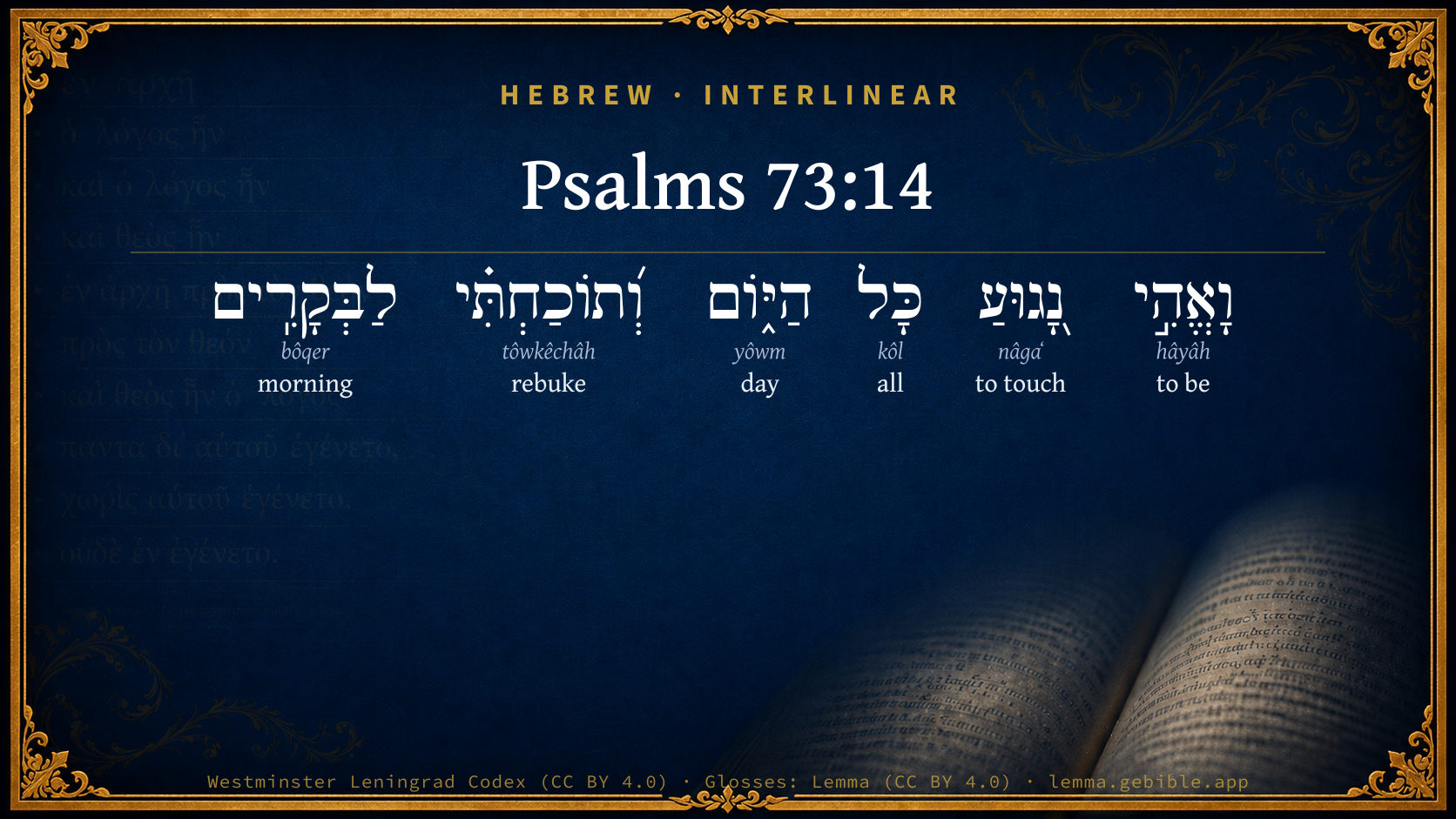
Psalms 73:14

Hebrew (Westminster Leningrad Codex) Psalms 73:14 appears in the Hebrew Old Testament. The text above is from the Westminster Leningrad Codex. Each word links to its Strong’s number, a concise gloss, and parsing drawn from the Open Scriptures Hebrew Bible morphology. Click any word for its full Brown-Driver-Briggs (BDB) entry.
Download image
Cite this verse

Psalms 73:14 (World English Bible). Public Domain. Lemma interlinear Bible study tool, https://lemma.gebible.app/v/psalms/73/14.

Show BibTeX & RIS
BibTeX
RIS
English Translation
For all day long have I been plagued, And punished every morning.
World English Bible · Public Domain
Download a study sheet

One document with this verse’s original text, its word-by-word gloss line, the meaning frame, cross-references with their text, attributed commentary, and full source and license credits — printable, and it pastes into notes with its structure intact.

This verse Autodidact and up

Study sheet (.html) Plain text (.txt)

A passage Seminary Student

Up to 50 verses in one chapter. A passage sheet keeps up to 6 commentary sources and 12 cross-references per verse, in the order this page ranks them, and says so on the sheet whenever that leaves anything out. Ask for a single verse and you get the Autodidact verse sheet above.

Everything on this page stays free to read, with no account — the sheet is a download of what is already on screen, not access to it.

Want to remove ads? Support Godless Engineer
Compare translations 3

The same verse in 3 English versions, stacked beneath the original-language interlinear above. Click any original word for its lexicon entry.

Each is an independent rendering of the whole verse — the interlinear is not word-aligned to these translations.

Highlighted words mark where these versions differ — a whole-verse word diff, not a word-by-word alignment.

  • World English Bible Public Domain
    For all day long have I been plagued, And punished every morning.
  • King James Version Public Domain
    For all the day long have I been plagued, and chastened every morning.
  • unfoldingWord Literal Text CC BY-SA 4.0
    For I have been stricken all of the day and punished every morning.

unfoldingWord Literal Text — © unfoldingWord, licensed CC BY-SA 4.0. Word-aligned USFM3 via Door43 (git.door43.org/unfoldingWord/en_ult).

Versions to compare (up to 4)

3 of 4 selected

Show all 18 translations

Every available English version of this verse, each an independent rendering of the whole verse.

  • World English Bible Public Domain
    For all day long have I been plagued, And punished every morning.
  • Berean Standard Bible Public Domain
    For I am afflicted all day long and punished every morning.
  • Majority Standard Bible Public Domain
    For I am afflicted all day long and punished every morning.
  • King James Version Public Domain
    For all the day long have I been plagued, and chastened every morning.
  • American Standard Version (1901) Public Domain
    For all the day long have I been plagued, And chastened every morning.
  • Revised Version (1885) Public Domain
    For all the day long have I been plagued, and chastened every morning.
  • Geneva Bible (1599) Public Domain
    For dayly haue I bene punished, and chastened euery morning.
  • Douay-Rheims (1899) Public Domain
    And I have been scourged all the day; and my chastisement hath been in the mornings.
  • Young's Literal Translation Public Domain
    And I am plagued all the day, And my reproof `is' every morning.
  • Literal Standard Version CC BY-SA 4.0
    And I am plagued all the day, || And my reproof—every morning.
  • Unlocked Literal Bible CC BY-SA 4.0
    For all the day long I have been afflicted and disciplined every morning.
  • unfoldingWord Literal Text CC BY-SA 4.0
    For I have been stricken all of the day and punished every morning.
  • Darby Bible Public Domain
    For all the day have I been plagued, and chastened every morning.
  • World Messianic Bible Public Domain
    For all day long I have been plagued, and punished every morning.
  • Webster's Bible Public Domain
    For all the day long have I been afflicted, and chastened every morning.
  • Free Bible Version CC BY-SA 4.0
    I'm cursed with suffering all day long; every morning I'm punished.
  • Bible in Basic English Public Domain
    For I have been troubled all the day; every morning have I undergone punishment.
  • JPS Tanakh (1917) Public Domain
    For all the day have I been plagued, and my chastisement came every morning.

Literal Standard Version (2020), Covenant Press — licensed CC BY-SA 4.0. Text via the HelloAO Bible API (eBible.org). Unlocked Literal Bible (unfoldingWord) — licensed CC BY-SA 4.0. Text via the HelloAO Bible API (eBible.org). unfoldingWord Literal Text — © unfoldingWord, licensed CC BY-SA 4.0. Word-aligned USFM3 via Door43 (git.door43.org/unfoldingWord/en_ult). Free Bible Version, Dr. Jonathan Gallagher — licensed CC BY-SA 4.0. Text via the HelloAO Bible API (eBible.org).

Word by word

More ways to search: Search by grammar → Find every occurrence → Compare this word →

Practice this passage: Drill this verse → Learn its vocabulary →

About this verse

These counts appear in no published source. They are computed here, from the morphology-tagged text and Lemma’s own curated glosses. What Lemma adds →

6
words
6
distinct lemmas
Wisdom
section

Shared distinctive vocabulary

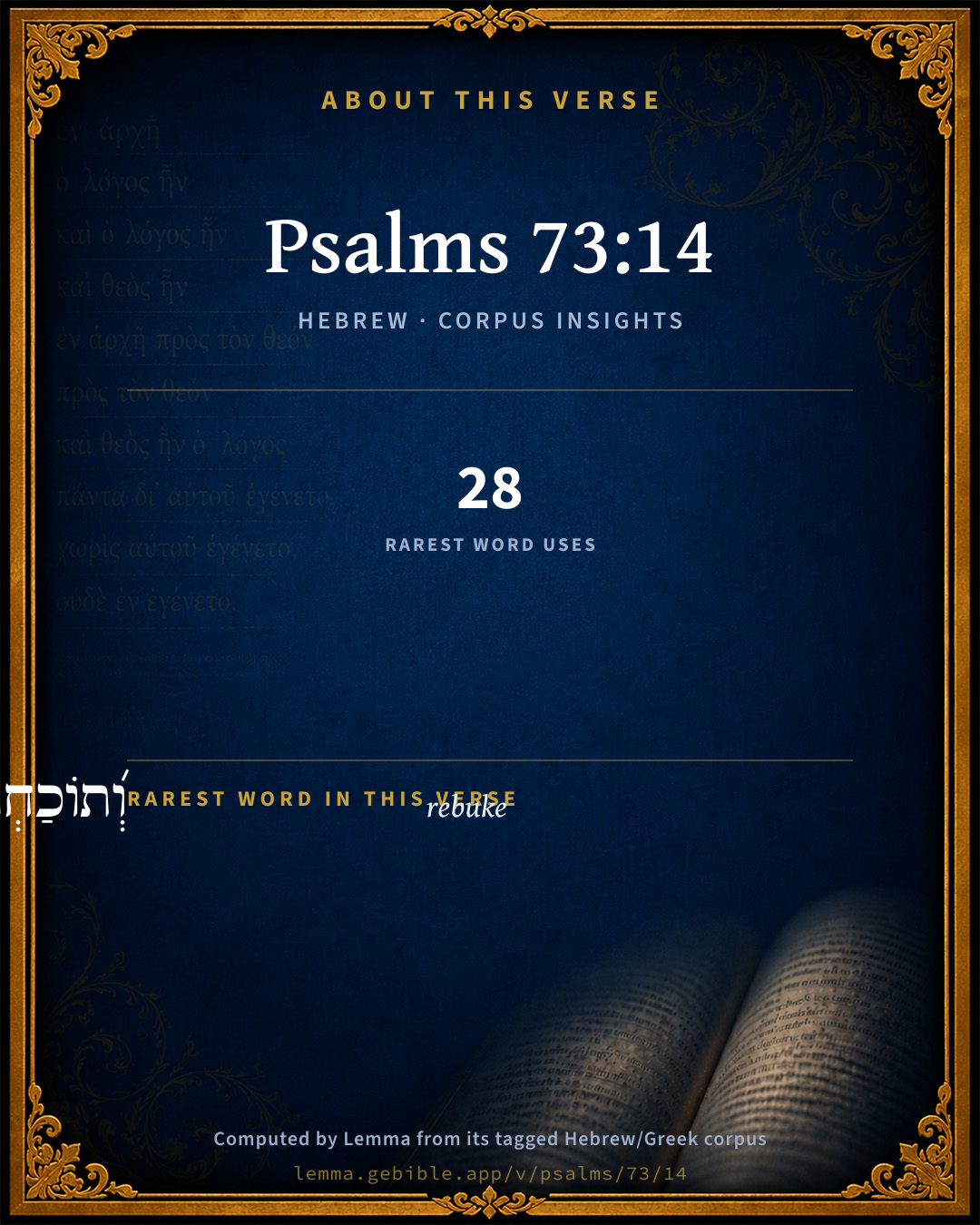
וְ֝תוֹכַחְתִּ֗י rebuke H8433 occurs in 28 verses of the Hebrew Bible. Also found in:

Grammatical profile

  • 2 verbs
  • 4 nouns

Verb forms

  • וָאֱהִ֣י Qal · Sequential Imperfect
  • נָ֭גוּעַ Qal · Participle Passive

Hebrew & Septuagint length

In English translation the verse runs 12 words from the Hebrew and 13 from the Septuagint (LXX English) — closely comparable.

A rough comparison of the two English renderings, which tokenize alike — not a word-level alignment.

Word counts can differ between the Hebrew and the Greek without any difference in meaning — e.g. the Hebrew direct-object marker אֵת has no separate Greek word, and Greek often adds the article ὁ.

Cross-references

10

Topical passages linked to Psalms 73:14 in the Treasury of Scripture Knowledge — connected by theme and wording, ordered by reader-vote popularity; previews shown in the World English Bible.

  • Psalms 94:12 Blessed is the man whom you discipline, Yah, And teach out of your law;
  • Hebrews 12:5 and you have forgotten the exhortation which reasons with you as with children, "My son, don't take lightly the chastening of the Lord, Nor faint when you are reproved by him;
  • Job 7:3–4 So am I made to possess months of misery, Wearisome nights are appointed to me.
  • Psalms 34:19 Many are the afflictions of the righteous, But Yahweh delivers him out of them all.
  • Jeremiah 15:18 Why is my pain perpetual, and my wound incurable, which refuses to be healed? will you indeed be to me as a deceitful [brook], as waters that fail?
  • Amos 3:2 "You only have I chosen of all the families of the earth. Therefore I will punish you for all of your sins."
  • 1 Peter 1:6 Wherein you greatly rejoice, though now for a little while, if need be, you have been put to grief in various trials,
  • Job 7:18 That you should visit him every morning, And test him every moment?
  • Job 10:3 Is it good to you that you should oppress, That you should despise the work of your hands, And smile on the counsel of the wicked?
  • Job 10:17 You renew your witnesses against me, And increase your indignation on me. Changes and warfare are with me.

Cross-references courtesy of OpenBible.info (CC BY 4.0).

Hebrew and Greek witnesses Masoretic Hebrew ↔ Greek Septuagint

The same verse in the two great witnesses to the Old Testament, shown verse-for-verse.

You’re reading Greek Psalm 72 (Hebrew Psalm 73). The Septuagint counts the superscription, so verse numbers can differ from the Hebrew — chapter-level alignment, not verse-by-verse. Numbering follows Rahlfs.

These are two independent witnesses, not word-aligned to each other, and the Septuagint is shown in lemma (dictionary) form.

Hebrew Psalms 73:14 Masoretic · Westminster Leningrad Codex

וָאֱהִ֣י נָ֭גוּעַ כָּל הַיּ֑וֹם וְ֝תוֹכַחְתִּ֗י לַבְּקָרִֽים

For all day long have I been plagued, And punished every morning.

World English Bible · Public Domain

Greek LXX Greek Psalm 72:14 Septuagint · lemma form

καί γίγνομαι μαστιγόω ὅλος ὁ ἡμέρα καί ὁ ἔλεγχος ἐγώ εἰς ὁ πρωία

For I was plagued all the day, and my reproof was every morning.

LXX2012 (modern English Septuagint) · Public Domain

Hebrew: Westminster Leningrad Codex (CC BY 4.0). Greek: Septuagint (public domain); English from LXX2012 (modern English Septuagint) (Public Domain). How the Septuagint differs from the Hebrew →

Commentary

Notes on Psalms 73:14 from classic Christian and Jewish commentators (each source and its license shown beneath its notes). The classic Christian expositions comment on the surrounding passage and are grouped to its opening verse, so a note may address several verses; the Jewish commentaries on the Tanakh (Rashi and others) are per-verse, so they appear only where the commentator wrote on this verse.

Lemma curates 59 commentaries, every one of them public domain or Creative Commons licensed, each selected and text-cleaned for this edition rather than reprinted as found. About our sources →

Trapp's Complete Commentary

John Trapp

Psa 73:14 For all the day long have I been plagued, and chastened every morning.

Ver. 14. For all the day long have I been plagued] God’s best-beloved are most afflicted, neither have any out of hell ever suffered more than the heirs of heaven. See my treatise called God’s Love tokens.

And chastened every morning] Singulis matufinis, I am no sooner awake than some new misery seizeth me, quasi egisset excubias, as if it had laid wait for me.

John Trapp, A Commentary or Exposition upon All the Books of the Old and New Testament (1647–1656) — public domain. Text from a community e-Sword module.

J. A. Alexander on Psalms

Joseph Addison Alexander

Psa 73:14. And I hare been smitten all the day, and my chastisement (has been inflicted) every morning, literally at (or in) the mornings. A similar form of expression occurs twice in Job 7:18. Smitten, literally touched, i.e. by the hand of God, a common expression for affliction, and especially for bodily disease considered as a divine judgment. The same idea was meant to be conveyed by the common version (plagued.) The psalmist here contrasts his own afflictions with the undisturbed enjoyments of his wicked neighbours. "While they, though wicked, still increase in wealth and seem secure for ever, I, who have faithfully endeavoured to avoid sin and to do the will of God, am subjected every day, and all day, to privation and distress."

Joseph Addison Alexander, The Psalms Translated and Explained (1850) — public domain. Text from a community e-Sword module.

Adam Clarke's Commentary

Verse 14. For all the day long have I been plagued] Far from enjoying worldly prosperity, we are not only poor, but we are afflicted also; and every succeeding day brings with it some new trouble.

Adam Clarke's Commentary on the Bible (1810–1826) — public domain. Text from a community e-Sword/MySword module.

The Cambridge Bible for Schools and Colleges

gen. ed. J. J. S. Perowne

14. For &c.] Apparently the recompence of his piety has been continual chastisement. The wicked are not plagued (Psa_73:5), but for him there has been constant renewal of divinely inflicted sufferings. Cp. Psa_39:10-11; Job_7:18.

The Cambridge Bible for Schools and Colleges (gen. ed. J. J. S. Perowne; Cambridge University Press, 1878–1918) — public domain. Text from a community e-Sword module.

John Gill's Exposition

For all the day long have I been plagued,.... "Smitten or scourged" (p), as in Psa 73:5, that is, afflicted of God; which is no ways inconsistent with his love, nor with his covenant, nor with an interest in him, as a covenant God and Father; see Psa 89:29,

and chastened every morning; not in wrath, but in love, and for good; not with the chastisement of a cruel one, but of a loving and tender father; and therefore not to be improved in such a manner, as if on this account there was nothing in religion; whereas the daily notices the Lord takes of his people this way show his regard unto them, and care of them.

(p) "flagellatus", V. L. Pagninus, Montanus; "percussus", Gejerus.

John Gill's Exposition of the Whole Bible (1746–1763) — public domain (CC PDM 1.0). Text via the HelloAO Bible API.

Albert Barnes' Notes on the Bible

For all the day long - Continually. All my life.

Have I been plagued - Smitten; afflicted; troubled. My life has been a life of trial. I have not known prosperity.

And chastened every morning - Margin, as in Hebrew, “My chastisement was.” That is, my sufferings - my trials - have been repeated with every returning morning. Each new day has brought some new form of affliction, designed to rebuke and punish me. I never have found exemption from trial even for a single day. So different is my lot from the lot of wicked people, who know nothing of this, and who are always prospered and happy. See the notes at Job 7:18.

Albert Barnes' Notes on the Bible (1834–1885) — public domain. Text from a community e-Sword/MySword module.

Matthew Poole's English Annotations

Whilst their ungodliness hath been attended with constant prosperity, my piety hath been exercised with continual afflictions.

Matthew Poole's English Annotations on the Holy Bible (1683–1685) — public domain. Text from a community e-Sword/MySword module.

The Treasury of David

Charles H. Spurgeon

Ver. 14. For all the day long have I been plagued. He was smitten from the moment he woke to the time he went to bed. His griefs were not only continued, but renewed with every opening day. And chastened every morning. This was a vivid contrast to the lot of the ungodly. There were crowns for the reprobates and crosses for the elect. Strange that the saints should sigh and the sinners sing. Rest was given to the disturbers, and yet peace was denied to the peace makers. The downcast seer was in a muse and a maze. The affairs of mankind appeared to him to be in a fearful tangle; how could it be permitted by a just ruler that things should be so turned upside down, and the whole course of justice dislocated.

Ver. 14. All the day long have I been plagued, etc. Sickly tempers must have a medicinal diet: to be purged both at spring and fall will scarce secure some from the malignity of their distempers. The Lord knows our frame, and sees what is usually needful for every temper; and when he afflicts most frequently, he does no more than he sees requisite. David Clarkson.

Ver. 14. If a man be watchful over his own ways, and the dealings of God with him, there is seldom a day but he may find some rod of affliction upon him; but, as through want of care and watchfulness, we lose the sight of many mercies, so we do of many afflictions. Though God doth not every day bring a man to his bed, and break his bones, yet we seldom, if at all, pass a day without some rebuke and chastening. I have been chastened every morning, saith the psalmist... As sure, or as soon, as I rise I have a whipping, and my breakfast is bread of sorrow and the water of adversity... Our lives are full of afflictions; and it is as great as part of a Christian's skill to know afflictions as to know mercies; to know when God smites, as to know when he girds us; and it is our sin to overlook afflictions as well as to overlook mercies. Joseph Caryl.

Ver. 14. The way to heaven is an afflicted way, a perplexed, persecuted way, crushed close together with crosses, as was the Israelites way in the wilderness, or that of Jonathan and his armour bearer, that had a sharp rock on the one side and a sharp rock on the other. And, whilst they crept upon all four, flinty stones were under them, briars and thorns on either hand of them; mountains, crags, and promontories over them; sic potitur caelum, so heaven is caught by pains, by patience, by violence, affliction being our inseparable companion. "The cross way is the highway to heaven, "said that martyr (Bradford); and another, "If there be any way to heaven on horseback, it is by the cross." Queen Elizabeth is said to have swum to the crown through a sea of sorrows. They that will to heaven, must sail by hell gates; they that will have knighthood, must kneel for it; and they that will get in at the strait gate, must crowd for it. "Strive to enter in at the strait gate, "saith our Saviour; strive and strain, even to an agony, as the word signifieth. Heaven is compared to a hill; hell to a hole. To hell a man may go without a staff, as we say; the way thereto is easy, steep, strawed with roses; it is but a yielding to Satan, a passing from sin to sin, from evil purposes to evil practices, from practice to custom, etc. Sed revocure gradum, but to turn short again, and make straight steps to our feet, that we may force through the strait gate, hic labor, hoc opus est, opus non pulvinaris sed pulveris; this is a work of great pains, a duty of no small difficulty. John Trapp.

Ver. 14. The frequent and even constant chastisement of the righteous; the necessity and design thereof; and the consolations connected therewith.

Psalms 73:15*

Charles H. Spurgeon's The Treasury of David (1869–1885) — public domain. Psalms only. Text from a community e-Sword/MySword module.

Whedon's Commentary on the Bible

Daniel D. Whedon

14. Have I been plagued—I who have endeavoured after innocency and righteousness, (Psa_73:13,) while the wicked “are not plagued like other men,” Psa_73:5, which see on the word “plagued.”

And chastened every morning— “Chastened” must be taken in the sense of rebuked, censured, for so it appeared to him, as Psa_39:11; Pro_3:11. “Every morning” is put for every day, daily. This apparent smiting and rebuking the righteous every day, while the wicked live in affluence and ease, is the complaint of the Church only in times of special and prolonged persecution and oppression, such as the nation was now suffering. See introduction.

Daniel D. Whedon (gen. ed.), Commentary on the Old and New Testaments (1874–1909) — public domain. Text from a community e-Sword module.

The Pulpit Commentary

For all the day long have been plagued. While the ungodly have prospered, and net been plagued at all (ver. 5), I, the representative of the righteous, have been "plagued," or afflicted, continually. What, then, does goodness advantage me? And chastened every morning; literally, and my chastisement has been every morning. (comp. Job_7:18)

The Pulpit Commentary (1880–1919), ed. H.D.M. Spence-Jones & Joseph S. Exell — public domain. Text from a community e-Sword module.

Rashi

Rabbi Shlomo Yitzchaki (Rashi)

and my chastisement appears all day; constantly, from morning to morning, new troubles are renewed.

Rashi on the Tanakh — English translations: “The Judaica Press complete Tanach with Rashi, translated by A. J. Rosenberg” (CC BY 4.0); “Pentateuch with Rashi's commentary by M. Rosenbaum and A.M. Silbermann, 1929-1934” (public domain); “The Metsudah Tanach series, Lakewood, N.J” (CC BY 4.0); and “The Book of Joshua, Metsudah Publications, 1997” (CC BY 4.0). Text via Sefaria.

Lesson kit

Teaching starters — assembled from the data on this page, not authored interpretation. Every prompt links to the verse data it draws on. Edit before teaching.

Psalms, in the Wisdom, opens this verse with 6 words (6 distinct Hebrew lemmas). Its most distinctive word is tôwkêchâh (“rebuke”). A historical commentator’s framing appears above. Read the whole chapter for the surrounding context.

Discussion questions

  1. What does “rebuke” (tôwkêchâh) contribute to the verse as a whole?
  2. How does 2 Kings 19:3, which shares the word «rebuke», read alongside this verse?
  3. These translations render this verse differently. What is at stake in choosing one wording over another?
  4. «וָאֱהִ֣י» is a Qal Sequential Imperfect verb. How does that grammatical form shape the action described?
  5. Compare how Trapp's Complete Commentary and J. A. Alexander on Psalms read this verse. Where do they agree or differ?

Things to notice

Reading settings

Reading text

Shown beneath each verse's original-language words.

Old Testament
Old Testament edition

Read the OT as the Masoretic Hebrew (MT) or the Greek Septuagint (LXX).

English shown for the Greek Septuagint (in the Hebrew ↔ Greek comparison).

Comparing translations? Open the Compare panel on any verse page to stack up to four side by side.