
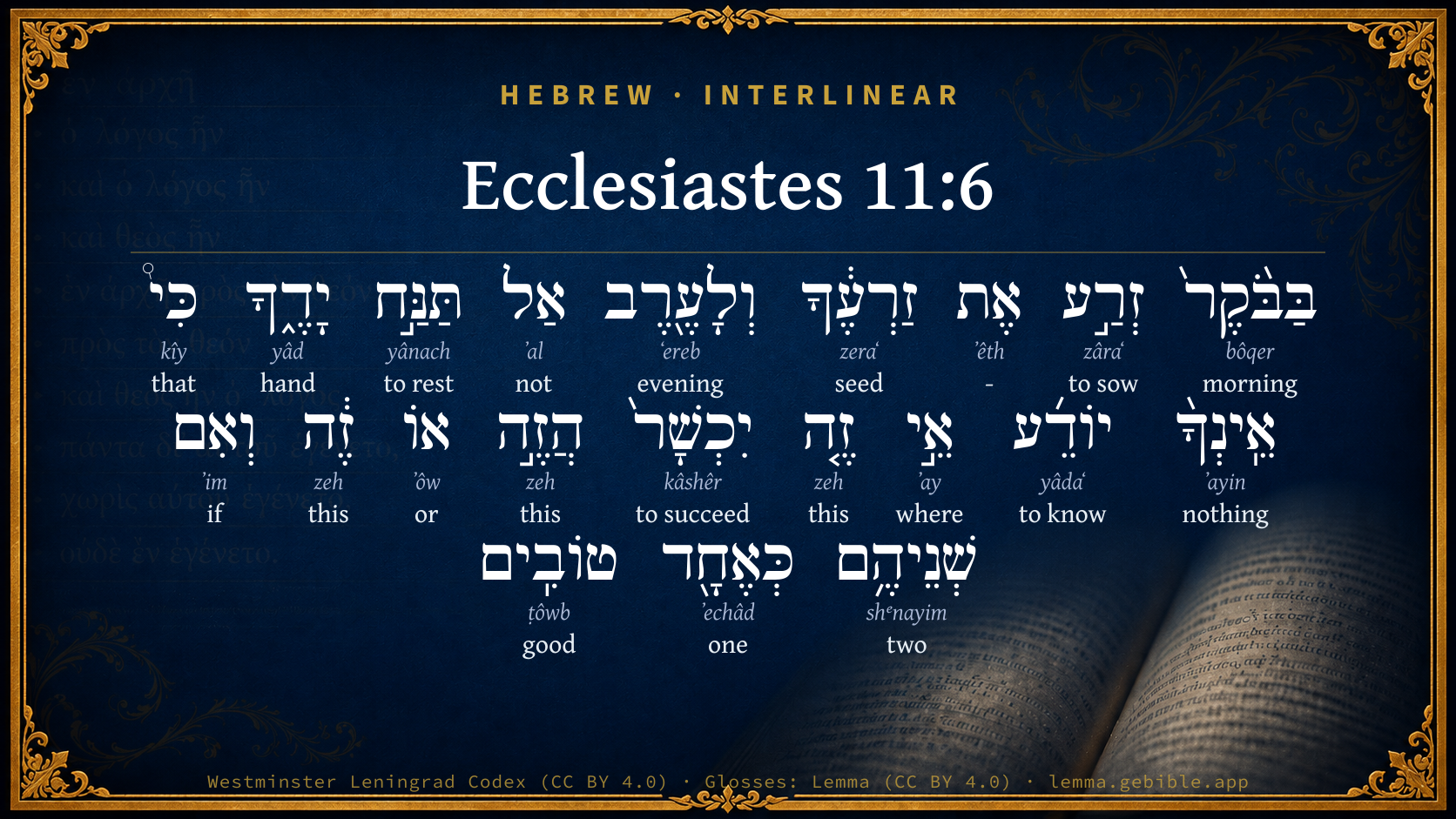
Ecclesiastes 11:6

Hebrew (Westminster Leningrad Codex) Ecclesiastes 11:6 appears in the Hebrew Old Testament. The text above is from the Westminster Leningrad Codex. Each word links to its Strong’s number, a concise gloss, and parsing drawn from the Open Scriptures Hebrew Bible morphology. Click any word for its full Brown-Driver-Briggs (BDB) entry.
Download image
Cite this verse

Ecclesiastes 11:6 (World English Bible). Public Domain. Lemma interlinear Bible study tool, https://lemma.gebible.app/v/ecclesiastes/11/6.

Show BibTeX & RIS
BibTeX
RIS
English Translation
In the morning sow your seed, And in the evening don't withhold your hand; For you don't know which will prosper, whether this or that, Or whether they both will be equally good.
World English Bible · Public Domain
Download a study sheet

One document with this verse’s original text, its word-by-word gloss line, the meaning frame, cross-references with their text, attributed commentary, and full source and license credits — printable, and it pastes into notes with its structure intact.

This verse Autodidact and up

Study sheet (.html) Plain text (.txt)

A passage Seminary Student

Up to 50 verses in one chapter. A passage sheet keeps up to 6 commentary sources and 12 cross-references per verse, in the order this page ranks them, and says so on the sheet whenever that leaves anything out. Ask for a single verse and you get the Autodidact verse sheet above.

Everything on this page stays free to read, with no account — the sheet is a download of what is already on screen, not access to it.

Want to remove ads? Support Godless Engineer
Compare translations 3

The same verse in 3 English versions, stacked beneath the original-language interlinear above. Click any original word for its lexicon entry.

Each is an independent rendering of the whole verse — the interlinear is not word-aligned to these translations.

Highlighted words mark where these versions differ — a whole-verse word diff, not a word-by-word alignment.

  • World English Bible Public Domain
    In the morning sow your seed, And in the evening don't withhold your hand; For you don't know which will prosper, whether this or that, Or whether they both will be equally good.
  • King James Version Public Domain
    In the morning sow thy seed, and in the evening withhold not thine hand: for thou knowest not whether shall prosper, either this or that, or whether they both shall be alike good.
  • unfoldingWord Literal Text CC BY-SA 4.0
    In the morning, sow your seed, and, in the evening, do not let your hand rest, for you are not knowing whether this one will prosper— this one or this one— or whether two of them as one good. q1

unfoldingWord Literal Text — © unfoldingWord, licensed CC BY-SA 4.0. Word-aligned USFM3 via Door43 (git.door43.org/unfoldingWord/en_ult).

Versions to compare (up to 4)

3 of 4 selected

Show all 18 translations

Every available English version of this verse, each an independent rendering of the whole verse.

  • World English Bible Public Domain
    In the morning sow your seed, And in the evening don't withhold your hand; For you don't know which will prosper, whether this or that, Or whether they both will be equally good.
  • Berean Standard Bible Public Domain
    Sow your seed in the morning, and do not rest your hands in the evening, for you do not know which will succeed, whether this or that, or if both will equally prosper.
  • Majority Standard Bible Public Domain
    Sow your seed in the morning, and do not rest your hands in the evening, for you do not know which will succeed, whether this or that, or if both will equally prosper.
  • King James Version Public Domain
    In the morning sow thy seed, and in the evening withhold not thine hand: for thou knowest not whether shall prosper, either this or that, or whether they both shall be alike good.
  • American Standard Version (1901) Public Domain
    In the morning sow thy seed, and in the evening withhold not thy hand; for thou knowest not which shall prosper, whether this or that, or whether they both shall be alike good.
  • Revised Version (1885) Public Domain
    In the morning sow thy seed, and in the evening withhold not thine hand: for thou knowest not which shall prosper, whether this or that, or whether they both shall be alike good.
  • Geneva Bible (1599) Public Domain
    In the morning sowe thy seede, and in the euening let not thine hand rest: for thou knowest not whither shall prosper, this or that, or whether both shalbe a like good.
  • Douay-Rheims (1899) Public Domain
    In the morning sow thy seed, and In the evening let not thy hand cease: for thou knowest not which may rather spring up, this or that: and if both together, it shall be the better.
  • Young's Literal Translation Public Domain
    In the morning sow thy seed, And at even withdraw not thy hand, For thou knowest not which is right, this or that, Or whether both of them alike `are' good.
  • Literal Standard Version CC BY-SA 4.0
    In the morning sow your seed, || And at evening do not withdraw your hand, || For you do not know which is right, this or that, || Or whether both of them alike [are] good.
  • Unlocked Literal Bible CC BY-SA 4.0
    In the morning plant your seed; until the evening, work with your hands as needed, for you know not which will prosper, whether morning or evening, or this or that, or whether they will both alike be good.
  • unfoldingWord Literal Text CC BY-SA 4.0
    In the morning, sow your seed, and, in the evening, do not let your hand rest, for you are not knowing whether this one will prosper— this one or this one— or whether two of them as one good. q1
  • Darby Bible Public Domain
    In the morning sow thy seed, and in the evening withhold not thy hand; for thou knowest not which shall prosper, whether this or that, or whether they both shall be alike good.
  • World Messianic Bible Public Domain
    In the morning sow your seed, and in the evening don’t withhold your hand; for you don’t know which will prosper, whether this or that, or whether they both will be equally good.
  • Webster's Bible Public Domain
    In the morning sow thy seed, and in the evening withhold not thy hand: for thou knowest not whether shall prosper, either this or that, or whether they both shall be alike good.
  • Free Bible Version CC BY-SA 4.0
    In the morning, sow your seed. In the evening, don't stop. For you have no way of knowing which crop will grow well—one may be profitable, or the other—or maybe both.
  • Bible in Basic English Public Domain
    In the morning put your seed into the earth, and till the evening let not your hand be at rest; because you are not certain which will do well, this or that--or if the two will be equally good.
  • JPS Tanakh (1917) Public Domain
    In the morning sow thy seed, and in the evening withhold not thy hand; for thou knowest not which shall prosper, whether this or that, or whether they both shall be alike good.

Literal Standard Version (2020), Covenant Press — licensed CC BY-SA 4.0. Text via the HelloAO Bible API (eBible.org). Unlocked Literal Bible (unfoldingWord) — licensed CC BY-SA 4.0. Text via the HelloAO Bible API (eBible.org). unfoldingWord Literal Text — © unfoldingWord, licensed CC BY-SA 4.0. Word-aligned USFM3 via Door43 (git.door43.org/unfoldingWord/en_ult). Free Bible Version, Dr. Jonathan Gallagher — licensed CC BY-SA 4.0. Text via the HelloAO Bible API (eBible.org).

Word by word

More ways to search: Search by grammar → Find every occurrence → Compare this word →

Practice this passage: Drill this verse → Learn its vocabulary →

יִכְשָׁר֙
kâshêr
H3787
“to succeed”
Verb, Qal, Imperfect, 3rd Person, Masculine, Singular
Part of Speech
Verb
Stem
Qal
Form
Imperfect
Person
3rd Person
Gender
Masculine
Number
Singular
Full BDB Definition

Origin: a primitive root

TWOT: 1052

to succeed, please, be suitable, be proper, be advantageous, be right and proper to - (Qal) to please, be proper - (Hiphil) to give success
  1. בַּבֹּ֨קֶר֙ bôqer H1242 “in/at the · morning” Preposition, Determined + Noun, Common, Masculine, Singular, Absolute
  2. זְרַ֣ע zâraʻ H2232 “sow” Verb, Qal, Imperative, 2nd Person, Masculine, Singular
  3. אֶת ʼêth H853 “-” Particle, Direct Object
  4. זַרְעֶ֔ךָ zeraʻ H2233 “seed · your” Noun, Common, Masculine, Singular, Construct + Suffix, Personal, 2nd Person, Masculine, Singular
  5. וְלָעֶ֖רֶב ʻereb H6153 “and · to/for the · evening” Conjunction + Preposition, Determined + Noun, Common, Masculine, Singular, Absolute
  6. אַל ʼal H408 “not” Particle, Negative
  7. תַּנַּ֣ח yânach H3240 “to rest” Verb, Hiphil, Jussive, 2nd Person, Masculine, Singular
  8. יָדֶ֑ךָ yâd H3027 “hand · your” Noun, Common, Both, Singular, Construct + Suffix, Personal, 2nd Person, Masculine, Singular
  9. כִּי֩ kîy H3588 “that” Conjunction
  10. אֵֽינְךָ֨ ʼayin H369 “nothing · you” Particle, Negative + Suffix, Personal, 2nd Person, Masculine, Singular
  11. יוֹדֵ֜ע yâdaʻ H3045 “knowing” Verb, Qal, Participle Active, Masculine, Singular, Absolute
  12. אֵ֣י ʼay H335 “where” Particle, Interrogative
  13. זֶ֤ה zeh H2088 “this” Pronoun, Demonstrative, Masculine, Singular
  14. הֲזֶ֣ה zeh H2088 “this” Particle, Interrogative + Pronoun, Demonstrative, Masculine, Singular
  15. אוֹ ʼôw H176 “or” Conjunction
  16. זֶ֔ה zeh H2088 “this” Pronoun, Demonstrative, Masculine, Singular
  17. וְאִם ʼim H518 “and · if” Conjunction + Conjunction
  18. שְׁנֵיהֶ֥ם shᵉnayim H8147 “two · their” Adjective, Cardinal number, Masculine, Dual, Construct + Suffix, Personal, 3rd Person, Masculine, Plural
  19. כְּאֶחָ֖ד ʼechâd H259 “like/as · one” Preposition + Adjective, Cardinal number, Masculine, Singular, Absolute
  20. טוֹבִֽים ṭôwb H2896 “good” Adjective, Adjective, Masculine, Plural, Absolute

About this verse

These counts appear in no published source. They are computed here, from the morphology-tagged text and Lemma’s own curated glosses. What Lemma adds →

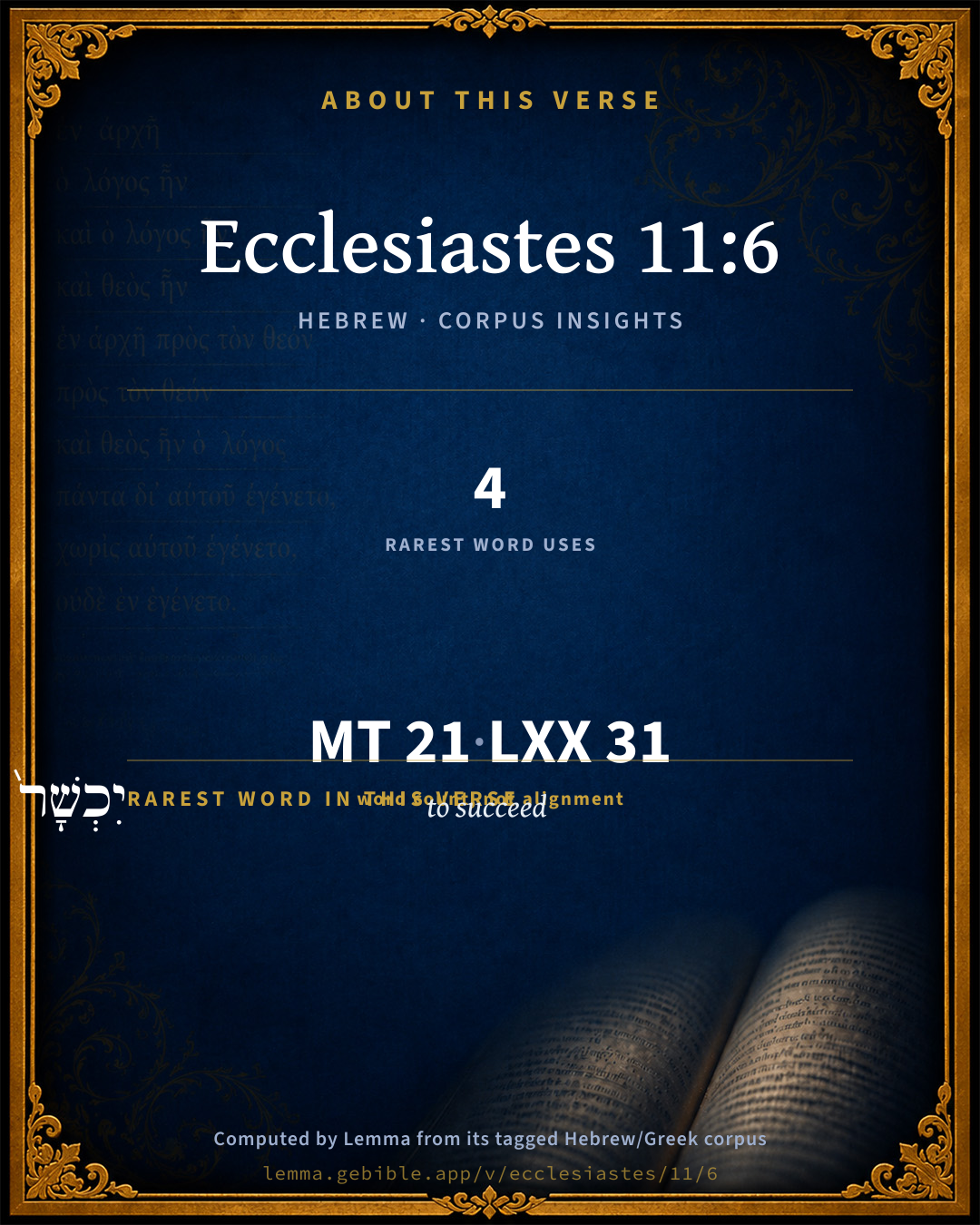
21
words
19
distinct lemmas
Wisdom
section

Notable vocabulary

The rarest word here is יִכְשָׁר֙ to succeed H3787 — appearing just 4 times in the whole Hebrew Bible.

Shared distinctive vocabulary

יִכְשָׁר֙ to succeed H3787 occurs in 3 verses of the Hebrew Bible. Also found in:

Grammatical profile

  • 4 verbs
  • 4 nouns
  • 3 adjectives
  • 3 pronouns
  • 3 conjunctions
  • 4 particles

Verb forms

  • זְרַ֣ע Qal · Imperative
  • תַּנַּ֣ח Hiphil · Jussive
  • יוֹדֵ֜ע Qal · Participle Active
  • יִכְשָׁר֙ Qal · Imperfect

Repetition

A word recurs within this verse — often emphatic in Hebrew:

  • זֶ֤ה this H2088 ×3

Hebrew & Septuagint length

In English translation the verse runs 33 words from the Hebrew and 35 from the Septuagint (LXX English) — closely comparable.

A rough comparison of the two English renderings, which tokenize alike — not a word-level alignment.

Word counts can differ between the Hebrew and the Greek without any difference in meaning — e.g. the Hebrew direct-object marker אֵת has no separate Greek word, and Greek often adds the article ὁ.

In the original languages it is 21 Hebrew tokens and 31 Greek tokens — but the two are counted differently (Hebrew bundles its prefixes and suffixes into one token; the Greek is in lemma form), so that isn’t a like-for-like length.

Cross-references

14

Topical passages linked to Ecclesiastes 11:6 in the Treasury of Scripture Knowledge — connected by theme and wording, ordered by reader-vote popularity; previews shown in the World English Bible.

  • 2 Corinthians 9:10–11 Now may he who supplies seed to the sower and bread for food, supply and multiply your seed for sowing, and increase the fruits of your righteousness;
  • Isaiah 55:10 For as the rain comes down and the snow from the sky, and doesn't return there, but waters the earth, and makes it bring forth and bud, and gives seed to the sower and bread to the eater;
  • Haggai 1:6–11 You have sown much, and bring in little. You eat, but you don't have enough. You drink, but you aren't filled with drink. You clothe yourselves, but no one is warm, and he who earns wages earns wages to put them into a bag with holes in it."
  • Hosea 10:12 Sow to yourselves in righteousness, Reap according to kindness. Break up your fallow ground; For it is time to seek Yahweh, Until he comes and rains righteousness on you.
  • 2 Corinthians 9:6 Remember this: he who sows sparingly will also reap sparingly. He who sows bountifully will also reap bountifully.
  • Zechariah 8:11–12 But now I will not be to the remnant of this people as in the former days," says Yahweh of Hosts.
  • John 4:36–38 He who reaps receives wages, and gathers fruit to eternal life; that both he who sows and he who reaps may rejoice together.
  • 1 Corinthians 3:5–7 Who then is Apollos, and who is Paul, but servants through whom you believed; and each as the Lord gave to him?
  • Haggai 2:17–19 I struck you with blight, mildew, and hail in all the work of your hands; yet you didn't turn to me,' says Yahweh.
  • 2 Timothy 4:2 preach the word; be urgent in season and out of season; reprove, rebuke, and exhort, with all patience and teaching.
  • Mark 4:26–29 He said, "The Kingdom of God is as if a man should cast seed on the earth,
  • Ecclesiastes 9:10 Whatever your hand finds to do, do it with your might; for there is no work, nor device, nor knowledge, nor wisdom, in Sheol, where you are going.
  • Ecclesiastes 9:1 For all this I laid to my heart, even to explore all this: that the righteous, and the wise, and their works, are in the hand of God; whether it is love or hatred, man doesn't know it; all is before them.
  • Acts 11:20–21 But there were some of them, men of Cyprus and Cyrene, who, when they had come to Antioch, spoke to the Greeks, preaching the Lord Jesus.

Cross-references courtesy of OpenBible.info (CC BY 4.0).

Hebrew and Greek witnesses Masoretic Hebrew ↔ Greek Septuagint

The same verse in the two great witnesses to the Old Testament, shown verse-for-verse.

These are two independent witnesses, not word-aligned to each other, and the Septuagint is shown in lemma (dictionary) form.

Hebrew Ecclesiastes 11:6 Masoretic · Westminster Leningrad Codex

בַּבֹּ֨קֶר֙ זְרַ֣ע אֶת זַרְעֶ֔ךָ וְלָעֶ֖רֶב אַל תַּנַּ֣ח יָדֶ֑ךָ כִּי֩ אֵֽינְךָ֨ יוֹדֵ֜ע אֵ֣י זֶ֤ה יִכְשָׁר֙ הֲזֶ֣ה אוֹ זֶ֔ה וְאִם שְׁנֵיהֶ֥ם כְּאֶחָ֖ד טוֹבִֽים

In the morning sow your seed, And in the evening don't withhold your hand; For you don't know which will prosper, whether this or that, Or whether they both will be equally good.

World English Bible · Public Domain

Greek LXX Ecclesiastes 11:6 Septuagint · lemma form

ἐν πρωΐα σπείρω ὁ σπέρμα σύ καί εἰς ἑσπέρα μή ἀποἵημι ὁ χείρ σύ ὅτι οὐ γιγνώσκω ποῖος στοιχέω ἤ οὗτος ἤ οὗτος καί ἐάν ὁ δύο ἐπί ὁ αὐτός ἀγαθός

In the morning sow your seed, and in the evening let not your hand be slack: for you know not what sort shall prosper, whether this or that, or whether both shall be good alike.

LXX2012 (modern English Septuagint) · Public Domain

On this verse, Keil & Delitzsch discusses the Septuagint’s reading. Read the note in Commentary ↓

Hebrew: Westminster Leningrad Codex (CC BY 4.0). Greek: Septuagint (public domain); English from LXX2012 (modern English Septuagint) (Public Domain). How the Septuagint differs from the Hebrew →

Commentary

Notes on Ecclesiastes 11:6 from classic Christian and Jewish commentators (each source and its license shown beneath its notes). The classic Christian expositions comment on the surrounding passage and are grouped to its opening verse, so a note may address several verses; the Jewish commentaries on the Tanakh (Rashi and others) are per-verse, so they appear only where the commentator wrote on this verse.

Lemma curates 59 commentaries, every one of them public domain or Creative Commons licensed, each selected and text-cleaned for this edition rather than reprinted as found. About our sources →

The Cambridge Bible for Schools and Colleges

gen. ed. J. J. S. Perowne

6. In the morning sow thy seed] Once again the enigmatic form, as in Ecc_11:2, is the touchstone of interpreters. It has been held to mean (1) that men are to seek sensual pleasures not in the morning of their youth only, but in the eventide of age, not to be afraid of begetting children, in or out of wedlock, in any period of their life; or (2) that man is to work, as we say, early and late, doing his appointed task, regardless of the chances of life; or (3) with a more specific application of the same general principle, that he is to sow the seed of good and kindly deeds, and wait for the harvest, the prospect of which is hidden from him. Of these (3) seems every way the truest and most satisfying interpretation. In “withdraw not thy hand,” and in the use of the two demonstrative pronouns (in the Hebrew, however, the same pronoun is repeated, this or this), we have a parallel to the thought and language of ch. Ecc_7:18. The whole precept is a call to activity in good, not unlike that of Him who said “I must work the works of Him that sent me, while it is called to day: the night cometh, when no man can work” (Joh_9:4); who taught men to labour in the vineyard, even though they were not called to begin their work till the eleventh hour when it was “toward evening, and the day far spent” (Mat_20:1-16).

thou knowest not whether shall prosper] The ignorance of men as to the results of their labour, still more the apparent or the actual failure of their earlier efforts, tempts them too often to despondency and indolence. The maxim, like that of Ecc_11:6, bids them take comfort from that very ignorance. The seed sown in the morning of life may bear its harvest at once, or not till the evening of age. The man may reap at one and the same time the fruits of his earlier and his later sowing, and may find that “both are alike good.”

The Cambridge Bible for Schools and Colleges (gen. ed. J. J. S. Perowne; Cambridge University Press, 1878–1918) — public domain. Text from a community e-Sword module.

Trapp's Complete Commentary

John Trapp

Ecc 11:6 In the morning sow thy seed, and in the evening withhold not thine hand: for thou knowest not whether shall prosper, either this or that, or whether they both [shall be] alike good.

Ver. 6. In the morning sow thy seed, &c.] At all times be ready to every good work, {Tit 3:1} as the bee is abroad as soon as ever the sun breaks forth. Sow mercy in the morning, sow it likewise in the evening, as those bountiful Macedonians did, to the shame of those richer but harder Corinthians, sending once and again to Paul’s necessities. {2Co 8:3 Php 4:16} Oh, sow much and oft of this unfailable seed into God’s blessed bosom, the fruit whereof you are sure to reap at your greatest need. Men may be thankful, or they may not, Perraro grati reperiuntur, saith Cicero: it is ten to one if any cured leper turn again to give thanks. But "God is not unrighteous to forget your labour of love in ministering to his saints." {Heb 6:10} Haply you may not sow and reap the same day, as the widow of Sarepta did: haply the seed may lie underground some while, and not be quickened except it die; but have patience, nothing so sure as a crop of comfort to those that are duly merciful. Up therefore and be doing, lose no time, slip no season; it is but a morning and an evening, one short day of life wherein we have to work, and to advance your blessedness. Sow therefore continually: blessed is he that "soweth beside all waters." Blessed Bradford held that hour lost wherein he had not done some good with his hand, tongue, or pen. {a} Titus remembering one day that he had done no good to any one, cried out, Amici, diem perdidi. Friends, I have wasted a day. And again, Hodie non regnavimus. Today we were not the master. We have lost a day, &c. This was that Titus that never sent any suitor away with a sad heart, and was therefore counted and called Humani generis deliciae, the darling of mankind, the people’s sweetheart. The senate loaded him with more praises when he was dead than ever they did living and present.

{a} Acts and Mon.

John Trapp, A Commentary or Exposition upon All the Books of the Old and New Testament (1647–1656) — public domain. Text from a community e-Sword module.

The Biblical Illustrator

Joseph S. Exell

Ecc_11:6

In the morning sow thy seed.

The seed-time of life

The morning, as we apply it to Christian youth, stands for brightness, freshness, promise, for regenerate hope, the salt of life, for opportunity, activity, and corresponding responsibility. The morning is pre-eminently the sowing time. Noon and eventide will take their complexion from the morning, and morning, whether we improve or waste it, never returns. How important, then, that we should sow well, that our aims should be right, that we should lay up the opportunity and live crowded hours. First, as a matter of fact, we are all sowing. God has so constituted our nature that we must sow. Every thought, emotion, motive, is a seed; all our words and deeds are seeds which must generate, spring up, and bear fruit in our hearts and lives, in the hearts and lives of others, in time and in eternity. Our present characters are the harvests of seeds sown in the past of our lives. The seed we are sowing is imperishable. Be the winds ever so high, be the frosts ever so severe, germinate and spring up the seed must. Outward circumstances may hasten or check the growth, but cannot kill the seed. Like the man who scatters it, it is immortal.

I. Sow in the morning for your intellectual advantage. My mind to me a kingdom is, sang Edward Dyer, the friend of Sir Philip Sidney. But what if that kingdom is enveloped in darkness, or peopled with undisciplined, not to speak of evil, thoughts, the home of the crude, the distorted, the perverted and perverting in knowledge? The kingdom of the mind, to bring joy to its king, need be luminous with knowledge, peopled with wise and pure thoughts, the home of virtue, beauty, and order--a kingdom in which are reaped and sown harvest after harvest of sound attainment and discreet dissemination as life advances. I need hardly say that one of the best instruments of manly culture is reading. Young people should make companions of wise and good books. Read books that have in them, if I may so speak, mountains of strength, and gardens of beauty, and wide cornfields of knowledge, and fruits of ripe wisdom; books through which blow winds of purity, and whose pages are bright with sunshine of unstained joys. Thus will you be sowing in the morning the seed of a harvest of true satisfaction. Some young people begrudge the time and pains which the pursuit of knowledge demands.

II. Sow in the morning the seed of noble manhood and womanhood. It has been asserted that the cardinal elements of national greatness are robust character, independent personality, and sincere religiousness. May not the same be said of individuals? Noble character is the supreme good. Without character even earthly knowledge is a vain possession in view of the highest ends of life, is only a phantasm of the brain, a fugitive mirage, whose illusive tropical gardens turn to dry sand. Without it, material prosperity is the souls deadly snare. Let me say, in what may seem a commonplace remark, that you must begin to sow it in repentance towards God and faith in our Lord Jesus Christ, which are the seeds of the new life in the soul. Prayer, humility, courage, self-control, and kindness are precious seeds. Scatter them with no miserly hand. Oh, sow for character. It is of all precious things the most precious--the diamond among jewels, the rose among flowers, the throne in the kingdom of mans possessions. For value, for beauty, for service, for command, it is the one thing needful. Keep the Lord Jesus Christ before you. He is your ideal as well as your Saviour. Self-surrender, faith, love, righteous living and good companionship will lead on to likeness to Him.

III. Sow in the morning the seed of usefulness. The morning is your opportunity, a magnificent opportunity, while it lasts. Soon manhood and womanhood, with the cares of life, and the claims of lawful duties, will overtake you. Then there will be little time to give to the specific task of scattering the seed of saving truth. Fill the morning hours with labour. Let pleasure wait, or be you content with such joys as God gives the husbandman; not the artificial joys of the crowded resorts of the worlds pleasures, but natural joys that are well symbolized by the babble of the brook and the skylarks song. You cannot fling abroad a handful of seed, you cannot speak a loving word for your Master, or do a serviceable deed without unsealing in your own heart a fountain of gladness. Oh, the world needs you. Give yourselves to it. Bestow on it your hopefulness and brightness, your purity and tenderness, your best thought and effort. II any here are using the morning to sow evil seed, pause. Remember, if you sow the wind, you will reap the whirlwind. (R. C. Cowell)

Thou knowest not whether shall prosper, either this or that.--

Magnificent failures

Every one must have been impressed with the curious fact that Columbus failed in most of the things that he tried for. He made a bad mistake at first in his reckonings. He never knew that he had not reached Asia. He looked for gold and wealth, but he died in poverty. Except that he proved that the earth was round, which had already been satisfactorily proved, everything turned out differently from what he thought. And yet we celebrate him as though he had completely succeeded. There is a certain kind of magnificent failure that takes hold of our imagination and sympathy even more effectively than unqualified success. The most thrilling episodes in history are stories like that of Columbus--of men who essayed vast endeavours, and, after all, proved to have done something vastly more important and other than they expected. The Protestant Reformation is such a story of magnificent failure. Nothing is more pathetic than the last weary year of Luthers life, Or the brave Zwingli dying in battle. The reformers had set out only to go a little way, to reform certain abuses and to correct a few errors. But they stirred up faction and war, they divided Germany, they let loose all manner of free thought. A hundred years after Luther the Reformation in Germany still looked like a failure. Now at last we enjoy what they only began to set in movement. The incoming religion is nobler, sunnier, more philosophical, more comprehensive than the reformers would have dared to accept. The story of the famous Savonarola is equally instructive. He did not save Florence. He could not work miracles, His visions did not come true. They put him to death like his Master. But the great world took up the holy impulse of his life; and his name, his passion for justice, his instinct for purity, passed over out of flames--a vitalizing spirit--into the infinite stream of our human destiny. One leaps at once, without citing other examples, to the great primitive Christ story. The story of Jesus is that of the most magnificent failure. As far as the records go, it seems clear that Jesus and His followers alike looked for what did not come. The glorious new kingdom of the sons of God was not ushered in before that generation passed away. The Son of Man did not appear in the skies. The good still suffered, the wicked and oppressors were not cast out. Nevertheless, we see that no one in Jesus place could have done more. No one ever had such magnificent success. We see the brotherly spirit which possessed Jesus going into all the world, even beyond where His name goes, slowly but surely banishing the ancient hate, banding men together, turning the evil into good. We believe that, if Jesus could see the travail of His soul, he would be satisfied. In the story of Columbus we distinguish two elements working out the evens of his life. He was right, on the whole, in the great main issue; namely, that, the earth being round, one voyaging west would find land, and, going far enough, the continent of Asia. All his greatness and success came of his following a great truth. But Columbus was mistaken by thousands of miles in all the details of his geography. His maps were drawn by guess-work, not from facts. This is typical of what has happened in all the pathetic tragedies. Thus Luther, brave as he was, only partly succeeded. His maps and charts, like Columbus, were not correct. The facts about this world by which to draw the maps in religion were not yet in. And the early Church, too, was right in its main direction. It started out toward the goal of a world religion. It was right to proclaim a good God and a righteous world, a gospel of faith and hope. But the noblest soul that ever sailed the sea of life had to work from the old charts. The unknown spaces of this world were a chaos of strange demonology. This had not yet been discovered to be a universe. Hence disasters and shipwrecks even to those who rightly sailed west. Here we stand to-day Confronting pressing questions of social and political administration. How can we most fairly organize society and humanize the relations of employers and the employed? Or take the gigantic question of the control of the drink traffic and the care of the intemperate. Good and earnest men are conscientiously divided over these questions. It is possible to-day that men are setting out from their Palos, and sailing west to find the distant lands of light. But others are also sailing, like Vasco da Gama, another and seemingly opposite course. It is possible that the men of neither expedition will find exactly what they look for. It is possible to-day that the bravest and noblest may be mistaken in their estimates of the contents of the seas into which humanity sails. Ah, we should be glad to know that the course was so short and the route so simple and straight as some of our friends believe! It may prove again that the world is larger and more capes must be rounded than are down on the present maps. I find everywhere that progress is a resultant of many forces and the impulse of many men. I find that all misunderstanding, narrowness, prejudice, and bitterness, lack of faith in God or man, on the part of any of us, is always so far a waste. But I find more notably yet that, though particular methods fail, no earnest work goes quite to waste, that all is taken up in the final readjustment. Every movement that has the true sailing direction--nay, even the mishaps and wrecks, so be they lie toward the land whither we sail--at last serve the worlds fleet of discovery. Vasco da Gama and Columbus each proved to help, and moved at last toward each other. It does not trouble me, therefore, that the good and wise differ, while yet we are only making maps. For this is to live in a world that moves and grows. It is to be learners and seekers of truth. It is to be children here that we may be sons of God by and by. (C. F. Dole.)

The Biblical Illustrator, edited by Joseph S. Exell (c. 1880s–1900s) — public domain. Text from a community e-Sword module.

Joseph Benson's Commentary

Ecc 11:6. In the morning — Early and late, in all seasons, and on all occasions; do it speedily and continually: be not weary of it. Sow thy seed — Do all good works, especially that of alms-giving, as sowing means, 2Co 9:6; Gal 6:7. In the evening withhold not thy hand — From working, or giving. For thou knowest not whether shall prosper — Which shall prosper most; which shall best answer thine end, or do most good to others; or which shall tend most to the comfort of thy great and final account. For thy morning alms may possibly be given to an unworthy person, or to one who did not need them, and will abuse them; and thy evening alms may fall upon a person of eminent worth, or upon one in extreme necessity, who might possibly have perished, both in soul and body, if thou hadst not relieved and comforted him. Besides, at one time thou mayest give with a more pure intention, and a more single eye to the glory of God, and with more tender compassion to thy distressed fellow-creature, than at another time, and so the one will be more right and acceptable to God than the other. Or whether they shall be both alike good — Equally successful to the receiver or to the giver.

Joseph Benson's Commentary on the Old and New Testaments (1811–1818) — public domain. Text from a community e-Sword module.

Keil & Delitzsch

C. F. Keil & F. Delitzsch

"In the morning sow thy seed, and towards evening withdraw not thine hand; for thou knowest not which shall prosper, whether this or that, or whether both together shall well succeed." The cultivation of the land is the prototype of all labour (Gen 2:15), and sowing is therefore an emblem of all activity in one's pursuit; this general meaning for ידך ... אל־ (like Ecc 7:18; synon. with ידך ... אל־, Jos 10:6, of the older language) is to be accepted. The parallel word to babokěr is not ba'ěTrěv; for the cessation from work (Jdg 19:16; Psa 104:23) must not be excluded, but incessant labour (cf. Luk 9:62) must be continued until the evening. And as Ecc 11:2 counsels that one should not make his success depend exclusively on one enterprise, but should divide that which he has to dispose of, and at the same time make manifold trials; so here also we have the reason for restless activity of manifold labour from morning till evening: success or failure (Ecc 5:5) is in the hand of God, - man knows not which (quid, here, according to the sense, utrum) will prosper, whether (ה) this or (או) that, and whether (אמו), etc.; vid., regarding the three-membered disjunctive question, Ewald, 361; and regarding keěhhad, it is in common use in the more modern language, as e.g., also in the last benediction of the Shemone-Esra: כאחד ... ברכנו, "bless us, our Father, us all together." שׁניהם goes back to the two זה, understood neut. (as at Ecc 7:18; cf. on the contrary, Ecc 6:5). The lxx rightly: καὶ ἐὰν (better: εἴτε) τὰ δύο επὶτὸ αυτὸ ἀγατηά. Luther, who translates: "and if both together it shall be better," has been misled by Jerome.

The proverb now following shows its connection with the preceding by the copula vav. "The tendency of the advice in Ecc 11:1, Ecc 11:2, Ecc 11:6, to secure guarantees for life, is justified in Ecc 11:7 : life is beautiful, and worthy of being cared for." Thus Hitzig; but the connection is simpler. It is in the spirit of the whole book that, along with the call to earnest activity, there should be the call to the pleasant enjoyment of life: he who faithfully labours has a right to enjoy his life; and this joy of life, based on fidelity to one's calling, and consecrated by the fear of God, is the most real and the highest enjoyment here below. In this sense the fruere vita here connects itself with the labora:

Keil & Delitzsch — Biblical Commentary on the Old Testament (1861–1891) — public domain (CC PDM 1.0). Text via the HelloAO Bible API. (Old Testament only.)

Geneva Bible (1599)

Geneva Bible translators

Be not weary of well doing.

That is, which of thy works are most agreeable to God.

Geneva Bible (1599) marginal notes — public domain. Text via Bolls.life.

Jamieson, Fausset & Brown

Robert Jamieson, A. R. Fausset & David Brown

morning . . . evening--early and late; when young and when old; in sunshine and under clouds.

seed--of godly works (Hos 10:12; Co2 9:10; Gal 6:7).

prosper-- (Isa 55:10-11).

both . . . alike--Both the unpromising and the promising sowing may bear good fruit in others; certainly they shall to the faithful sower.

Jamieson, Fausset & Brown — Commentary Critical and Explanatory on the Whole Bible (1871) — public domain (CC PDM 1.0). Text via the HelloAO Bible API.

Adam Clarke's Commentary

Verse 6. In the morning sow thy seed] Be ready at all times to show mercy; begin in the morning, continue till the evening. Thou knowest not the most worthy object; it is enough that God knoweth; and if thy motive be good, he will applaud and reward thee; not according to the worthiness or unworthiness of the object of thy charity, but according to the motive which induced thee to relieve him.

Adam Clarke's Commentary on the Bible (1810–1826) — public domain. Text from a community e-Sword/MySword module.

Ellicott's Commentary for English Readers

(6) Prosper.—The word is used again in Ecc_10:10 and Est_8:5, and belongs to modern Hebrew. (Comp. Gal_6:7-8.)

A Bible Commentary for English Readers, edited by Charles John Ellicott (1878–1897) — public domain. Text from a community e-Sword module.

John Gill's Exposition

In the morning sow thy seed,.... Do all good works early and diligently, which is expressed by sowing in righteousness, Hos 10:12; particularly alms deeds, often signified by sowing seed, Psa 112:9, Co2 9:6; this should be in the morning of youth, that persons may be inured to it betimes as Obadiah was; and in the morning of prosperity, as soon as ever Providence smiles on men, and puts it into the power of their hands, who should honour the Lord with the firstfruits of their increase;

and in the evening withhold not thine hand; from sowing seed, from doing good, particularly acts of charity, in the evening of old age, as Jarchi, like old Barzillai; an age in which men are apt to be more tenacious and covetous, and withhold more than is meet; yea, in the evening of adversity do not leave off doing good as much as can be; but do as the Macedonian churches, whose deep poverty abounded to the riches of their liberality in a great trial of affliction, Co2 8:2; in short, good is to be done at all times, as opportunity offers, throughout the whole of life, and in all conditions and circumstances;

for thou knowest not whether shall prosper, either this or that; the seed sown in the morning or in the evening, which good work shall best succeed; therefore do both, try all ways, make use of all opportunities;

or whether they both shall be alike good; acceptable to God, and useful to men; and if so, a man will have no occasion to repent of what he has done both in youth and old age.

John Gill's Exposition of the Whole Bible (1746–1763) — public domain (CC PDM 1.0). Text via the HelloAO Bible API.

Haydock's Catholic Bible Commentary

Better. Be kind to all during life, Galatians vi. 10. (Calmet) --- Do good, both in youth and in old age, (Worthington) lest, if thou shouldst grow remiss, all would be lost. (St. Jerome)

George Leo Haydock (1774–1849), Haydock's Catholic Family Bible and Commentary, 1859 edition — public domain. Excludes Psalms (Douay-Rheims chapter numbering differs from Protestant) and Deuterocanonical books (Catholic canon only).

Matthew Poole's English Annotations

In the morning, and in the evening; early and late, in all seasons and occasions; do it speedily and continually, be not weary of it. Sow thy seed; do all good works, and especially that of almsgiving, as sowing is understood, 2Co 9:6; Gal 6:7.

Withhold not thine hand from working or giving.

Whether shall prosper; which shall prosper most, as the next clause explains it; the positive degree being put for the comparative, or the superlative, which is not unusual in the Hebrew text. Which shall best answer thine end, or do most good to others, or which shall tend most to the comfort of thy great and last account; for thy morning alms may possibly be given to an unworthy person, or to one who did not need it, and will abuse it, and thy evening alms may fall upon a person of eminent worth, yea, upon an angel in human shape, which is remembered as a motive to hospitality, Heb 13:2, or upon one in extreme necessity, who might possibly have perished both in soul and body, if thou hadst not comforted and relieved him: or one time thou mayst give with more sincere intention, and with more tender compassion, than another time, and so one will be more right and more acceptable to God than the other.

Alike good; equally successful to the receiver, or to the giver.

Matthew Poole's English Annotations on the Holy Bible (1683–1685) — public domain. Text from a community e-Sword/MySword module.

Whedon's Commentary on the Bible

Daniel D. Whedon

6. Sow thy seed — This precept is an inference. Diligence in labours calculated for good, will be sure of some return, perhaps of very copious returns. This beautiful verse, with its lively rhetorical figure, is often and aptly applied to the labours of the Christian ministry, and fits well to all deeds and efforts of benevolence. The next verse gives one sure return.

Daniel D. Whedon (gen. ed.), Commentary on the Old and New Testaments (1874–1909) — public domain. Text from a community e-Sword module.

The Pulpit Commentary

In the morning sow thy seed. Do not let your ignorance of the future and the inscrutability of God"s dealings lead you to indolence and apathy; do your appointed work; be active and diligent in your calling. The labor of the farmer is taken as a type of business generally, and was especially appropriate to the class of persons whom Koheleth is instructing. The injunction occurs naturally after ver. 4. And in the evening withhold not thine hand. Labor on untiredly from morn till evening. It is not an advice to rest during midday, as that was too hot a time to work (Stuart), but a call to spend the entire day in active employment, the two extremities being mentioned in order to include the whole. Work undertaken in a right spirit is a blessing, not a curse, shuts out many temptations, encourages many virtues. Some see here a special reference to the maxim at the beginning of the chapter, as though the author meant, "Exercise thy charity at all times, early and late," the metaphor being similar to that in 2Co_9:6, "He which soweth sparingly," etc. Others find a figure of the ages of, man in the "morning and evening," thus, "From earliest youth practice piety and purity, and continue such conduct to its close." This leads naturally to the subject of the following section; but it may be doubted whether this thought was in the author"s mind. It seems best to take the paragraph merely as commending activity, whether in business or in benevolence, without anxious regard to results which are in higher hands. "Withhold not thy hand," i.e. from sowing; Mhtw hJ cei) sou (Septuagint). For thou knowest not whether shall prosper, which of the two sewings, either this or that, the morning or evening sowing. It is a chance, and a man must risk something; if one fails, the other may succeed. Or whether they both shall be alike good. The uncertainty rouses to exertion; labor may at any rate secure half the crop, or even give a double produce, if both sewings succeed. So in religion and morality, the good seed sown early and late may bear fruit early or late, or may have blessed results all along. The Vulgate is less correct, Et si utrumque simul, melius or, "And if both together, it will be better."

The Pulpit Commentary (1880–1919), ed. H.D.M. Spence-Jones & Joseph S. Exell — public domain. Text from a community e-Sword module.

John Wesley's Explanatory Notes

In the morning - Early and late, in all seasons and occasions; do it speedily and continually, be not weary of it. Sow - Do all good works. With-hold not - From working or giving.

John Wesley, Explanatory Notes Upon the Whole Bible (1754–1765) — public domain. Text via the GEBible commentary corpus.

unfoldingWord translationNotes

Door43 World Missions Community

work with your hands

Here "hands" represents the whole person. AT: "keep on working" (See: Synecdoche)

whether morning or evening, or this or that

These two phrases mean basically the same thing and emphasize that the person's work may prosper, no matter what time he has done it. AT: "whether the seed that you planted in the morning or the seed that you planted in the evening" (See: Doublet and Ellipsis)

light is sweet

Here the word "light" refers to being able to see the sun and therefore being alive. And, this speaks of the joy of being alive as if the light had a sweet taste. AT: "it is a joy to be able to see the sun" or "being alive is delightful" (See: Metonymy and Metaphor)

for the eyes to see the sun

The "eyes" represent the whole person. This phrase means basically the same thing as the previous phrase. AT: "for a person to see the sun" or "to be alive" (See: Synecdoche and Parallelism)

happy in all of them

Here the word "them" refers to the years that a person is alive.

the coming days of darkness

Future time is spoken of as if the "days are coming" And, here the word "darkness" refers to death. AT: "how many days that he will be dead" (See: Metaphor and Euphemism)

for they will be many

Here the word "they" refers to the "days of darkness" AT: "for he will be dead for many more days than he is alive" or "for he will be dead forever"

Everything to come is vanishing vapor

Here "vanishing vapor" is a metaphor. Possible meanings are 1) AT: "No one knows what will happen after he dies" or 2) AT: "Everything to come is meaningless" (See: Metaphor)

Everything to come

Possible meanings are 1) "Everything that happens after death" or 2) "Everything that happens in the future"

translationWords

seed

prosper

good

amen

light

darkness

unfoldingWord translationNotes — © Distant Shores Media and the Door43 World Missions Community, licensed CC BY-SA 4.0. Source: git.door43.org/Door43/en_tn.

Rashi

Rabbi Shlomo Yitzchaki (Rashi)

In the morning, sow your seed If your learned Torah in your youth, learn Torah in your old age. If you had disciples in your youth, you should have disciples in your old age. If you married a woman of childbearing age in your youth, you should marry a woman of childbearing age in your old age. If you performed acts of kindness in your youth, perform acts of kindness in your old age.

for you know not which will succeed whether the disciples and the children of your youth will survive you, or perhaps only those of your old age will survive. We find in the case of Rabbi Akiva that he had twenty-four thousand disciples from Gabbath to Antipatris, and they all died between Passover and Shavuoth, and he came to our Sages in the south and taught them. And concerning children, we find in the case of Ibzan, (Jud. 12:9): “and thirty daughters he sent abroad, and thirty daughters he brought in for his sons,” and they all died in his lifetime (Baba Bathra 91a), but in his old age, he begot Obed, who survived him.

Rashi on the Tanakh — English translations: “The Judaica Press complete Tanach with Rashi, translated by A. J. Rosenberg” (CC BY 4.0); “Pentateuch with Rashi's commentary by M. Rosenbaum and A.M. Silbermann, 1929-1934” (public domain); “The Metsudah Tanach series, Lakewood, N.J” (CC BY 4.0); and “The Book of Joshua, Metsudah Publications, 1997” (CC BY 4.0). Text via Sefaria.

Lesson kit

Teaching starters — assembled from the data on this page, not authored interpretation. Every prompt links to the verse data it draws on. Edit before teaching.

Ecclesiastes, in the Wisdom, opens this verse with 21 words (19 distinct Hebrew lemmas). Its most distinctive word is kâshêr (“to succeed”). A historical commentator’s framing appears above. Read the whole chapter for the surrounding context.

Discussion questions

  1. The word kâshêr carries the sense “to succeed.” How does it shape the verse?
  2. Esther 8:5 shares the word «to succeed» with this verse. How do the two illuminate each other?
  3. “this” occurs 3× in this one verse. What is the effect of the repetition?
  4. These translations render this verse differently. What is at stake in choosing one wording over another?
  5. The verb «זְרַ֣ע» is Qal Imperative. How does its form color the action?
  6. Reading how The Cambridge Bible for Schools and Colleges and Trapp's Complete Commentary read this verse, where do the two commentators agree and where do they part?

Things to notice

Reading settings

Reading text

Shown beneath each verse's original-language words.

Old Testament
Old Testament edition

Read the OT as the Masoretic Hebrew (MT) or the Greek Septuagint (LXX).

English shown for the Greek Septuagint (in the Hebrew ↔ Greek comparison).

Comparing translations? Open the Compare panel on any verse page to stack up to four side by side.