
1 Chronicles 23:30

Hebrew (Westminster Leningrad Codex) 1 Chronicles 23:30 appears in the Hebrew Old Testament. The text above is from the Westminster Leningrad Codex. Each word links to its Strong’s number, a concise gloss, and parsing drawn from the Open Scriptures Hebrew Bible morphology. Click any word for its full Brown-Driver-Briggs (BDB) entry.
Download image
Cite this verse

1 Chronicles 23:30 (World English Bible). Public Domain. Lemma interlinear Bible study tool, https://lemma.gebible.app/v/1-chronicles/23/30.

Show BibTeX & RIS
BibTeX
RIS
English Translation
and to stand every morning to thank and praise Yahweh, and likewise in the evening;
World English Bible · Public Domain
Download a study sheet

One document with this verse’s original text, its word-by-word gloss line, the meaning frame, cross-references with their text, attributed commentary, and full source and license credits — printable, and it pastes into notes with its structure intact.

This verse Autodidact and up

Study sheet (.html) Plain text (.txt)

A passage Seminary Student

Up to 50 verses in one chapter. A passage sheet keeps up to 6 commentary sources and 12 cross-references per verse, in the order this page ranks them, and says so on the sheet whenever that leaves anything out. Ask for a single verse and you get the Autodidact verse sheet above.

Everything on this page stays free to read, with no account — the sheet is a download of what is already on screen, not access to it.

Want to remove ads? Support Godless Engineer
Compare translations 3

The same verse in 3 English versions, stacked beneath the original-language interlinear above. Click any original word for its lexicon entry.

Each is an independent rendering of the whole verse — the interlinear is not word-aligned to these translations.

Highlighted words mark where these versions differ — a whole-verse word diff, not a word-by-word alignment.

  • World English Bible Public Domain
    and to stand every morning to thank and praise Yahweh, and likewise in the evening;
  • King James Version Public Domain
    And to stand every morning to thank and praise the LORD, and likewise at even:
  • unfoldingWord Literal Text CC BY-SA 4.0
    and to stand, by morning by morning, to thank and to praise Yahweh, and thus in the evening,

unfoldingWord Literal Text — © unfoldingWord, licensed CC BY-SA 4.0. Word-aligned USFM3 via Door43 (git.door43.org/unfoldingWord/en_ult).

Versions to compare (up to 4)

3 of 4 selected

Show all 18 translations

Every available English version of this verse, each an independent rendering of the whole verse.

  • World English Bible Public Domain
    and to stand every morning to thank and praise Yahweh, and likewise in the evening;
  • Berean Standard Bible Public Domain
    They were also to stand every morning to give thanks and praise to the LORD, and likewise in the evening.
  • Majority Standard Bible Public Domain
    They were also to stand every morning to give thanks and praise to the LORD, and likewise in the evening.
  • King James Version Public Domain
    And to stand every morning to thank and praise the LORD, and likewise at even:
  • American Standard Version (1901) Public Domain
    and to stand every morning to thank and praise Jehovah, and likewise at even;
  • Revised Version (1885) Public Domain
    and to stand every morning to thank and praise the LORD, and likewise at even;
  • Geneva Bible (1599) Public Domain
    And for to stand euery morning, to giue thanks and praise to the Lord, and likewise at euen,
  • Douay-Rheims (1899) Public Domain
    And the Levites are to stand in the morning to give thanks, and to sing praises to the Lord: and in like manner in the evening,
  • Young's Literal Translation Public Domain
    and to stand, morning by morning, to give thanks, and to give praise to Jehovah, and so at evening;
  • Literal Standard Version CC BY-SA 4.0
    and to stand, morning by morning, to give thanks, and to give praise to YHWH, and so at evening;
  • Unlocked Literal Bible CC BY-SA 4.0
    They also stood every morning to thank and praise Yahweh. They also did this in the evening
  • unfoldingWord Literal Text CC BY-SA 4.0
    and to stand, by morning by morning, to thank and to praise Yahweh, and thus in the evening,
  • Darby Bible Public Domain
    and to stand every morning to thank and praise Jehovah, and likewise at even;
  • World Messianic Bible Public Domain
    and to stand every morning to thank and praise the LORD, and likewise in the evening;
  • Webster's Bible Public Domain
    And to stand every morning to thank and praise the LORD, and likewise at evening;
  • Free Bible Version CC BY-SA 4.0
    They also had to stand every morning to give thanks and praise to the Lord, and do the same in the evening,
  • Bible in Basic English Public Domain
    They had to take their places every morning to give praise and make melody to the Lord, and in the same way at evening;
  • JPS Tanakh (1917) Public Domain
    and to stand every morning to thank and praise the LORD, and likewise at even;

Literal Standard Version (2020), Covenant Press — licensed CC BY-SA 4.0. Text via the HelloAO Bible API (eBible.org). Unlocked Literal Bible (unfoldingWord) — licensed CC BY-SA 4.0. Text via the HelloAO Bible API (eBible.org). unfoldingWord Literal Text — © unfoldingWord, licensed CC BY-SA 4.0. Word-aligned USFM3 via Door43 (git.door43.org/unfoldingWord/en_ult). Free Bible Version, Dr. Jonathan Gallagher — licensed CC BY-SA 4.0. Text via the HelloAO Bible API (eBible.org).

Word by word

More ways to search: Search by grammar → Find every occurrence → Compare this word →

Practice this passage: Drill this verse → Learn its vocabulary →

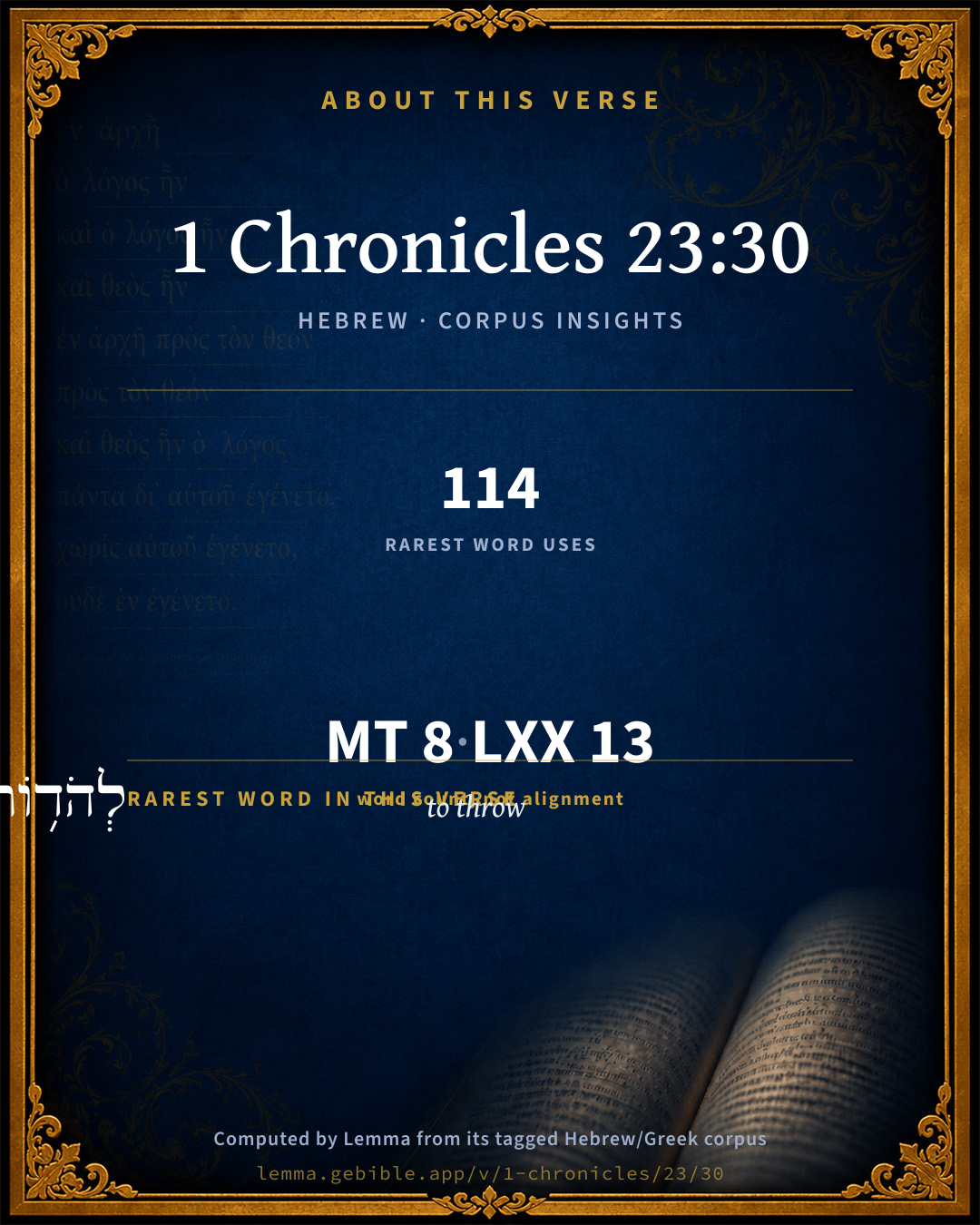
לְהֹד֥וֹת
yâdâh
H3034
“to throw”
Preposition + Verb, Hiphil, Infinitive Construct
Part of Speech
Preposition + Verb
Stem
Hiphil
Form
Infinitive Construct
Full BDB Definition

Origin: a primitive root; used only as denominative from H3027

TWOT: 847

to throw, shoot, cast - (Qal) to shoot (arrows) - (Piel) to cast, cast down, throw down - (Hiphil) - to give thanks, laud, praise - to confess, confess (the name of God) - (Hithpael) - to confess (sin) - to give thanks
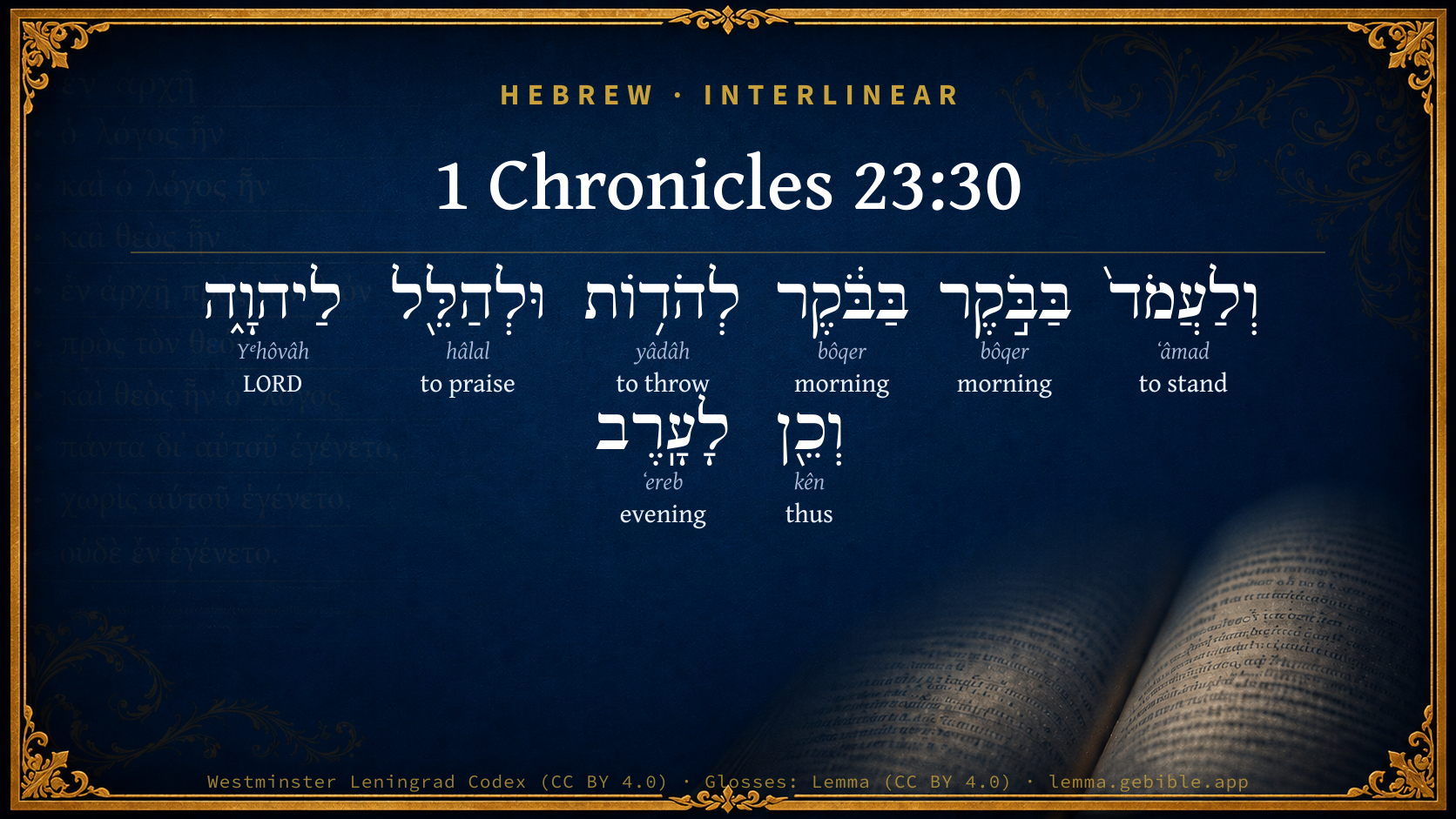
  1. וְלַעֲמֹד֙ ʻâmad H5975 “and · to stand” Conjunction + Preposition + Verb, Qal, Infinitive Construct
  2. בַּבֹּ֣קֶר bôqer H1242 “in/at the · morning” Preposition, Determined + Noun, Common, Masculine, Singular, Absolute
  3. בַּבֹּ֔קֶר bôqer H1242 “in/at the · morning” Preposition, Determined + Noun, Common, Masculine, Singular, Absolute
  4. וּלְהַלֵּ֖ל hâlal H1984 “and · to praise” Conjunction + Preposition + Verb, Piel, Infinitive Construct
  5. לַיהוָ֑ה Yᵉhôvâh H3068 “to/for · LORD” Preposition + Noun, Proper
  6. וְכֵ֖ן kên H3651 “and · thus” Conjunction + Particle, Demonstrative
  7. לָעָֽרֶב ʻereb H6153 “to/for the · evening” Preposition, Determined + Noun, Common, Masculine, Singular, Absolute

About this verse

These counts appear in no published source. They are computed here, from the morphology-tagged text and Lemma’s own curated glosses. What Lemma adds →

8
words
7
distinct lemmas
Historical
section

Grammatical profile

  • 3 verbs
  • 4 nouns
  • 1 particle

Verb forms

  • וְלַעֲמֹד֙ Qal · Infinitive Construct
  • לְהֹד֥וֹת Hiphil · Infinitive Construct
  • וּלְהַלֵּ֖ל Piel · Infinitive Construct

Repetition

A word recurs within this verse — often emphatic in Hebrew:

  • בַּבֹּ֣קֶר morning H1242 ×2

Hebrew & Septuagint length

In English translation the verse runs 15 words from the Hebrew and 19 from the Septuagint (LXX English) — closely comparable.

A rough comparison of the two English renderings, which tokenize alike — not a word-level alignment.

Word counts can differ between the Hebrew and the Greek without any difference in meaning — e.g. the Hebrew direct-object marker אֵת has no separate Greek word, and Greek often adds the article ὁ.

In the original languages it is 8 Hebrew tokens and 13 Greek tokens — but the two are counted differently (Hebrew bundles its prefixes and suffixes into one token; the Greek is in lemma form), so that isn’t a like-for-like length.

Cross-references

15

Topical passages linked to 1 Chronicles 23:30 in the Treasury of Scripture Knowledge — connected by theme and wording, ordered by reader-vote popularity; previews shown in the World English Bible.

  • Psalms 92:1–3 It is a good thing to give thanks to Yahweh, To sing praises to your name, Most High;
  • 1 Chronicles 9:33 These are the singers, heads of fathers' [houses] of the Levites, [who lived] in the chambers [and were] free [from other service]; for they were employed in their work day and night.
  • Ezra 3:10–11 When the builders laid the foundation of the temple of Yahweh, they set the priests in their clothing with trumpets, and the Levites the sons of Asaph with cymbals, to praise Yahweh, after the order of David king of Israel.
  • Exodus 29:39–42 The one lamb you shall offer in the morning; and the other lamb you shall offer at evening:
  • 1 Chronicles 6:31–33 These are they whom David set over the service of song in the house of Yahweh, after that the ark had rest.
  • 1 Chronicles 16:37–42 So he left there, before the ark of the covenant of Yahweh, Asaph and his brothers, to minister before the ark continually, as every day's work required;
  • 1 Chronicles 25:1–7 Moreover, David and the captains of the host set apart for the service certain of the sons of Asaph, and of Heman, and of Jeduthun, who should prophesy with harps, with psalteries, and with cymbals: and the number of those who did the work according to their service was:
  • 2 Chronicles 29:25–28 He set the Levites in the house of Yahweh with cymbals, with psalteries, and with harps, according to the commandment of David, and of Gad the king's seer, and Nathan the prophet; for the commandment was of Yahweh by his prophets.
  • 2 Chronicles 31:2 Hezekiah appointed the divisions of the priests and the Levites after their divisions, every man according to his service, both the priests and the Levites, for burnt offerings and for peace-offerings, to minister, and to give thanks, and to praise in the gates of the camp of Yahweh.
  • Psalms 134:1–2 Look! Praise Yahweh, all you servants of Yahweh, Who stand by night in Yahweh's house!
  • Psalms 135:1–3 Praise Yah! Praise the name of Yahweh! Praise him, you servants of Yahweh,
  • Psalms 135:19–20 House of Israel, praise Yahweh! House of Aaron, praise Yahweh!
  • Psalms 137:2–4 On the willows in the midst of it, We hung up our harps.
  • Revelation 5:8–14 Now when he had taken the book, the four living creatures and the twenty-four elders fell down before the Lamb, each one having a harp, and golden bowls full of incense, which are the prayers of the saints.
  • Revelation 14:3 They sing a new song before the throne, and before the four living creatures and the elders. No one could learn the song except the one hundred forty-four thousand, those who had been redeemed out of the earth.

Cross-references courtesy of OpenBible.info (CC BY 4.0).

Hebrew and Greek witnesses Masoretic Hebrew ↔ Greek Septuagint

The same verse in the two great witnesses to the Old Testament, shown verse-for-verse.

These are two independent witnesses, not word-aligned to each other, and the Septuagint is shown in lemma (dictionary) form.

Hebrew 1 Chronicles 23:30 Masoretic · Westminster Leningrad Codex

וְלַעֲמֹד֙ בַּבֹּ֣קֶר בַּבֹּ֔קֶר לְהֹד֥וֹת וּלְהַלֵּ֖ל לַיהוָ֑ה וְכֵ֖ן לָעָֽרֶב

and to stand every morning to thank and praise Yahweh, and likewise in the evening;

World English Bible · Public Domain

Greek LXX 1 Chronicles 23:30 Septuagint · lemma form

καί ὁ ἵστημι πρωΐ ὁ αἰνέω ἐκὁμολογέω ὁ κύριος καί οὕτως ὁ ἑσπέρα

and to stand in the morning to praise and give thanks to the Lord, and so in the evening;

LXX2012 (modern English Septuagint) · Public Domain

Hebrew: Westminster Leningrad Codex (CC BY 4.0). Greek: Septuagint (public domain); English from LXX2012 (modern English Septuagint) (Public Domain). How the Septuagint differs from the Hebrew →

Commentary

Notes on 1 Chronicles 23:30 from classic Christian and Jewish commentators (each source and its license shown beneath its notes). The classic Christian expositions comment on the surrounding passage and are grouped to its opening verse, so a note may address several verses; the Jewish commentaries on the Tanakh (Rashi and others) are per-verse, so they appear only where the commentator wrote on this verse.

Lemma curates 59 commentaries, every one of them public domain or Creative Commons licensed, each selected and text-cleaned for this edition rather than reprinted as found. About our sources →

Joseph Benson's Commentary

1Ch 23:30-32. To stand every morning, &c., and at evening — The two solemn times of offering sacrifices: which work was attended with public prayer and thanksgiving. According to the order commanded unto them continually — That is, unto those persons, the Levites, of whom he speaks. The charge of the sons of Aaron — That is, what the priests should commit to their charge, or command them to do.

Joseph Benson's Commentary on the Old and New Testaments (1811–1818) — public domain. Text from a community e-Sword module.

Adam Clarke's Commentary

Verse 30. To stand every morning] At the offering of the morning and evening sacrifice, they sounded their musical instruments, and sang praises to God.

Adam Clarke's Commentary on the Bible (1810–1826) — public domain. Text from a community e-Sword/MySword module.

Ellicott's Commentary for English Readers

(30) To thank and praise the Lord.—This refers to the special function of the 4,000 musicians (1Ch_23:5). (Comp. 1Ch_16:4.) Those who slew and flayed the victims could hardly have taken part in the service of song.

A Bible Commentary for English Readers, edited by Charles John Ellicott (1878–1897) — public domain. Text from a community e-Sword module.

The Cambridge Bible for Schools and Colleges

gen. ed. J. J. S. Perowne

30. every morning … and likewise at even] Corresponding with the daily morning and evening sacrifice; cp. Exo_29:38-39.

The Cambridge Bible for Schools and Colleges (gen. ed. J. J. S. Perowne; Cambridge University Press, 1878–1918) — public domain. Text from a community e-Sword module.

John Gill's Exposition

And that they should keep the charge of the tabernacle of the congregation,.... That no unclean persons entered into it, and that none of the vessels were carried out of it; this was the business of the porters:

and the charge of the holy place; of things that belonged unto it, the vessels in it, and what was requisite for it, and used there: and the charge of the sons of Aaron their brethren; the priests, whatever they should command them to do: in the service of the house of the Lord; in any part and branch of it before specified.

Next: 1 Chronicles Chapter 24

John Gill's Exposition of the Whole Bible (1746–1763) — public domain (CC PDM 1.0). Text via the HelloAO Bible API.

Haydock's Catholic Bible Commentary

And the Levites. This also is omitted in Hebrew, "and to stand," &c., as all the preceding offices pertained to the Levites, (Haydock) and priests were bound equally with them to praise the Lord.

George Leo Haydock (1774–1849), Haydock's Catholic Family Bible and Commentary, 1859 edition — public domain. Excludes Psalms (Douay-Rheims chapter numbering differs from Protestant) and Deuterocanonical books (Catholic canon only).

Matthew Poole's English Annotations

The two solemn times of offering sacrifices; which work was attended with public prayer and thanksgiving.

Matthew Poole's English Annotations on the Holy Bible (1683–1685) — public domain. Text from a community e-Sword/MySword module.

The Pulpit Commentary

To stand every morning to thank and praise the Lord. (so ver. 13 of this chapter and 1Ch_25:7) Though Bertheau sees no special sign in the connection for this description to be confined to the four thousand whose special work and privilege it was, yet it is in entire analogy with the whole context so to confine it.

Morning and evening praise.

The work of the Levites was "to wait on the sons of Aaron for the service of the house of the Lord." It was, therefore, to some extent servile and menial. Yet the work was dignified and hallowed by the fact that it was truly rendered to the God of Israel, the Lord of all. The function, however, described in the text is the most honourable that can be performed by man.

The glorified assembly above, the angelic hosts before the throne, are thus perpetually occupied.

I THE OFFICE ITSELF OF PRAISE. The Levites were doubtless organized by David, as never before. His poetical and musical gilts were consecrated to the praise of Jehovah. His psalms from that time forward became the vehicle of human thanksgiving and adoration. The instruments of music which he appointed became essential to the ecclesiastical orchestra of the temple. And whilst thanks and praise are due from all intelligent beings to the God of providence, the human race has a special song to present, a special service to offer thanks and praise to the God of all grace and salvation.

II THE PERIODICAL OFFERING OF PRAISE. It was appointed for the Levites to stand, in due order and according to their courses, in the presence of Jehovah. And every morning and every evening the sacrifice of praise was offered as regularly as the burnt offering itself. How suitable was this arrangement must be apparent to every reflecting mind. Each day brings with it new favours, which should be welcomed with a grateful song. Each evening summons us to record renewed instances of Divine mercy and forbearance, for which the Giver of all good should be warmly praised.

PRACTICAL LESSONS.

1. The duty and privilege of thanksgiving and adoration. "It is a good thingto give thanks unto the Lord, and to sing praises unto the Name of the Most High.

2. The desirableness of periodical and regular daily devotions: "To show forth his loving-kindness in the morning, and his faithfulness every night.

T.

The mission of those who praise.

Some were to "stand every morning to thank and praise the Lord, and likewise at even." This was the special work of certain of the younger Levites, whose voices retained their tone and power. They formed a choir to aid in the interest and beauty of Divine service. As this subject has been somewhat fully dealt with in previous outline homilies, we do but suggest a new framework, which the earlier materials will enable the reader to clothe. Deal with the mission of church choirs and singing bands, and show

I THEIR MISSION TO GIVE EXPRESSION TO OTHERS" FEELINGS, and to strengthen them by expression.

II THEIR MISSION TO INTEREST OTHERS IN DIVINE THINGS.

III THEIR MISSION IN AROUSING OTHERS TO RELIGIOUS ANXIETY, as with the singing of revival hymns.

Then press the importance of cultured spiritual fitness for the efficient fulfilment of this mission. They who sing for the religious helping and teaching of men must themselves be sincere, devout, earnest, and pious. It is as true of this as of any other form of Christian service, that "we can only kindle fire when we are ourselves on fire." "In order to the high result intended, the music of religion must be religious. There must be a distinction of sounds. As this language is given for the heart, it becomes a first principle that it must be of the heart, else it is an unknown tongue. And so true is this, that nothing can really fulfil the idea of religious music which is not the breathing of true love and worship. Even instruments without life will not speak the true notes of power unless the touch of faith is on them, and the breath of holy feeling is in them; how much less the voice itself, whose very qualities of sound are inevitably toned by the secret feeling of the spirit?" (Dr. Horace Bushnell). R.T.

The Pulpit Commentary (1880–1919), ed. H.D.M. Spence-Jones & Joseph S. Exell — public domain. Text from a community e-Sword module.

John Wesley's Explanatory Notes

Morning and even - The two solemn times of offering sacrifices: which work was attended with publick prayer and thanksgiving.

John Wesley, Explanatory Notes Upon the Whole Bible (1754–1765) — public domain. Text via the GEBible commentary corpus.

Keil & Delitzsch

C. F. Keil & F. Delitzsch

And that they should keep the charge of the tabernacle of the congregation,.... That no unclean persons entered into it, and that none of the vessels were carried out of it; this was the business of the porters:

and the charge of the holy place; of things that belonged unto it, the vessels in it, and what was requisite for it, and used there: and the charge of the sons of Aaron their brethren; the priests, whatever they should command them to do: in the service of the house of the Lord; in any part and branch of it before specified.

Next: 1 Chronicles Chapter 24

Keil & Delitzsch — Biblical Commentary on the Old Testament (1861–1891) — public domain (CC PDM 1.0). Text via the HelloAO Bible API. (Old Testament only.)

unfoldingWord translationNotes

Door43 World Missions Community

They also stood

"The Levites also stood at the temple"

whenever burnt offerings were offered to Yahweh

This can be stated in active form. AT: "whenever the priests offered burnt offerings to Yahweh" (See: Active or Passive)

new moon festivals

These holidays marked the beginning of each new month.

A fixed number, assigned by decree, always had to be present before Yahweh

"A specific number of the Levites were always assigned to be present at the temple to make offerings to Yahweh"

translationWords

praise

burnt offering

Sabbath

new moon

festival

feast

decree

unfoldingWord translationNotes — © Distant Shores Media and the Door43 World Missions Community, licensed CC BY-SA 4.0. Source: git.door43.org/Door43/en_tn.

Lesson kit

Teaching starters — assembled from the data on this page, not authored interpretation. Every prompt links to the verse data it draws on. Edit before teaching.

1 Chronicles, in the Historical, opens this verse with 8 words (7 distinct Hebrew lemmas). Its most distinctive word is yâdâh (“to throw”). A historical commentator’s framing appears above. Read the whole chapter for the surrounding context.

Discussion questions

  1. What does “to throw” (yâdâh) contribute to the verse as a whole?
  2. How does Psalms 92:1–3, which shares this passage’s theme, read alongside this verse?
  3. What does the repetition of “morning” (2× in this one verse) do in this verse?
  4. These translations render this verse differently; the difference is in the English rendering, not the original. What questions does that raise?
  5. «וְלַעֲמֹד֙» is a Qal Infinitive Construct verb. How does that grammatical form shape the action described?
  6. Compare how Joseph Benson's Commentary and Adam Clarke's Commentary read this verse. Where do they agree or differ?

Things to notice

Reading settings

Reading text

Shown beneath each verse's original-language words.

Old Testament
Old Testament edition

Read the OT as the Masoretic Hebrew (MT) or the Greek Septuagint (LXX).

English shown for the Greek Septuagint (in the Hebrew ↔ Greek comparison).

Comparing translations? Open the Compare panel on any verse page to stack up to four side by side.