
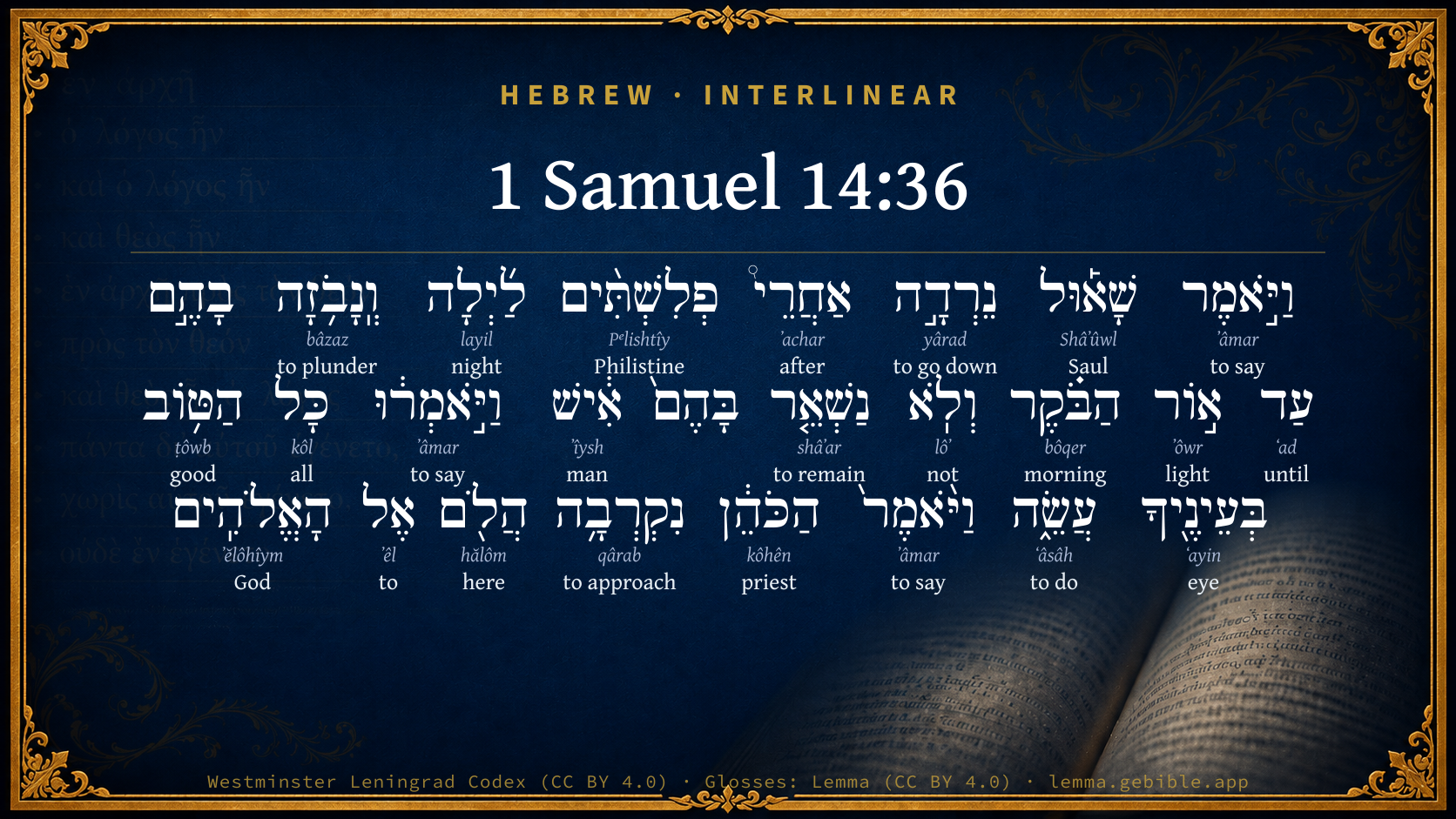
1 Samuel 14:36

Hebrew (Westminster Leningrad Codex) 1 Samuel 14:36 appears in the Hebrew Old Testament. The text above is from the Westminster Leningrad Codex. Each word links to its Strong’s number, a concise gloss, and parsing drawn from the Open Scriptures Hebrew Bible morphology. Click any word for its full Brown-Driver-Briggs (BDB) entry.
Download image
Cite this verse

1 Samuel 14:36 (World English Bible). Public Domain. Lemma interlinear Bible study tool, https://lemma.gebible.app/v/1-samuel/14/36.

Show BibTeX & RIS
BibTeX
RIS
English Translation
Saul said, Let us go down after the Philistines by night, and take spoil among them until the morning light, and let us not leave a man of them. They said, Do whatever seems good to you. Then said the priest, Let us draw near here to God.
World English Bible · Public Domain
Download a study sheet

One document with this verse’s original text, its word-by-word gloss line, the meaning frame, cross-references with their text, attributed commentary, and full source and license credits — printable, and it pastes into notes with its structure intact.

This verse Autodidact and up

Study sheet (.html) Plain text (.txt)

A passage Seminary Student

Up to 50 verses in one chapter. A passage sheet keeps up to 6 commentary sources and 12 cross-references per verse, in the order this page ranks them, and says so on the sheet whenever that leaves anything out. Ask for a single verse and you get the Autodidact verse sheet above.

Everything on this page stays free to read, with no account — the sheet is a download of what is already on screen, not access to it.

Want to remove ads? Support Godless Engineer
Compare translations 3

The same verse in 3 English versions, stacked beneath the original-language interlinear above. Click any original word for its lexicon entry.

Each is an independent rendering of the whole verse — the interlinear is not word-aligned to these translations.

Highlighted words mark where these versions differ — a whole-verse word diff, not a word-by-word alignment.

  • World English Bible Public Domain
    Saul said, Let us go down after the Philistines by night, and take spoil among them until the morning light, and let us not leave a man of them. They said, Do whatever seems good to you. Then said the priest, Let us draw near here to God.
  • King James Version Public Domain
    And Saul said, Let us go down after the Philistines by night, and spoil them until the morning light, and let us not leave a man of them. And they said, Do whatsoever seemeth good unto thee. Then said the priest, Let us draw near hither unto God.
  • unfoldingWord Literal Text CC BY-SA 4.0
    And Saul said, “Let us go down after the Philistines night, and let us plunder them until the light of morning. And let us not leave a man among them.” And they said, “Do all of the good in your eyes.” But the priest said, “Let us draw near to God here.”

unfoldingWord Literal Text — © unfoldingWord, licensed CC BY-SA 4.0. Word-aligned USFM3 via Door43 (git.door43.org/unfoldingWord/en_ult).

Versions to compare (up to 4)

3 of 4 selected

Show all 18 translations

Every available English version of this verse, each an independent rendering of the whole verse.

  • World English Bible Public Domain
    Saul said, Let us go down after the Philistines by night, and take spoil among them until the morning light, and let us not leave a man of them. They said, Do whatever seems good to you. Then said the priest, Let us draw near here to God.
  • Berean Standard Bible Public Domain
    And Saul said, “Let us go down after the Philistines by night and plunder them until dawn, leaving no man alive!” “Do what seems good to you,” the troops replied. But the priest said, “We must consult God here.”
  • Majority Standard Bible Public Domain
    And Saul said, “Let us go down after the Philistines by night and plunder them until dawn, leaving no man alive!” “Do what seems good to you,” the troops replied. But the priest said, “We must consult God here.”
  • King James Version Public Domain
    And Saul said, Let us go down after the Philistines by night, and spoil them until the morning light, and let us not leave a man of them. And they said, Do whatsoever seemeth good unto thee. Then said the priest, Let us draw near hither unto God.
  • American Standard Version (1901) Public Domain
    And Saul said, Let us go down after the Philistines by night, and take spoil among them until the morning light, and let us not leave a man of them. And they said, Do whatsoever seemeth good unto thee. Then said the priest, Let us draw near hither unto God.
  • Revised Version (1885) Public Domain
    And Saul said, Let us go down after the Philistines by night, and spoil them until the morning light, and let us not leave a man of them. And they said, Do whatsoever seemeth good unto thee. Then said the priest, Let us draw near hither unto God.
  • Geneva Bible (1599) Public Domain
    And Saul saide, Let vs goe downe after the Philistims by night, and spoyle them vntill the morning shine, and let vs not leaue a man of them. And they saide, Doe whatsoeuer thou thinkest best. Then saide the Priest, Let vs drawe neere hither vnto God.
  • Douay-Rheims (1899) Public Domain
    And Saul said: Let us fall upon the Philistines by night, and destroy them till the morning light, and let us not leave a man of them. And the people said: Do all that seemeth good in thy eyes. And the priest said: Let us draw near hither unto God.
  • Young's Literal Translation Public Domain
    And Saul saith, `Let us go down after the Philistines by night, and we prey upon them till the light of the morning, and leave not a man of them.' And they say, `All that is good in thine eyes do.' And the priest saith, `Let us draw near hither unto God.'
  • Literal Standard Version CC BY-SA 4.0
    And Saul says, “Let us go down after the Philistines by night, and we prey on them until the morning light, and do not leave a man of them.” And they say, “Do all that is good in your eyes.” And the priest says, “Let us draw near to God here.”
  • Unlocked Literal Bible CC BY-SA 4.0
    Then Saul said, “Let us pursue the Philistines by night and plunder them until morning; let us not leave one of them alive.” They replied, “Do whatever seems good to you.” But the priest said, “Let us approach God here.”
  • unfoldingWord Literal Text CC BY-SA 4.0
    And Saul said, “Let us go down after the Philistines night, and let us plunder them until the light of morning. And let us not leave a man among them.” And they said, “Do all of the good in your eyes.” But the priest said, “Let us draw near to God here.”
  • Darby Bible Public Domain
    And Saul said, Let us go down after the Philistines by night, and plunder them until the morning light, and let us not leave a man of them. And they said, Do whatsoever is good in thy sight. Then said the priest, Let us come near hither to God.
  • World Messianic Bible Public Domain
    Saul said, “Let’s go down after the Philistines by night, and take plunder among them until the morning light. Let’s not leave a man of them.” They said, “Do whatever seems good to you.” Then the priest said, “Let’s draw near here to God.”
  • Webster's Bible Public Domain
    And Saul said, Let us go down after the Philistines by night, and spoil them until the morning light, and let us not leave a man of them. And they said, Do whatever seemeth good to thee. Then said the priest, Let us draw near hither to God.
  • Free Bible Version CC BY-SA 4.0
    Saul said, “Let's go and chase down the Philistines during night and plunder them till dawn, leaving no survivors.” “Do what you think best,” they replied. But the priest said, “Let's ask God first.”
  • Bible in Basic English Public Domain
    And Saul said, Let us go down after the Philistines by night, attacking them till the morning, till there is not a man of them living. And they said, Do whatever seems right to you. Then the priest said, Let us come near to God.
  • JPS Tanakh (1917) Public Domain
    And Saul said: 'Let us go down after the Philistines by night, and spoil them until the morning light, and let us not leave a man of them.' And they said: 'Do whatsoever seemeth good unto thee.' Then said the priest: 'Let us draw near hither unto God.'

Literal Standard Version (2020), Covenant Press — licensed CC BY-SA 4.0. Text via the HelloAO Bible API (eBible.org). Unlocked Literal Bible (unfoldingWord) — licensed CC BY-SA 4.0. Text via the HelloAO Bible API (eBible.org). unfoldingWord Literal Text — © unfoldingWord, licensed CC BY-SA 4.0. Word-aligned USFM3 via Door43 (git.door43.org/unfoldingWord/en_ult). Free Bible Version, Dr. Jonathan Gallagher — licensed CC BY-SA 4.0. Text via the HelloAO Bible API (eBible.org).

Word by word

More ways to search: Search by grammar → Find every occurrence → Compare this word →

Practice this passage: Drill this verse → Learn its vocabulary →

הֲלֹ֖ם
hălôm
H1988
“here”
Adverb
Part of Speech
Adverb
Full BDB Definition

Origin: from the article [see H1973 ]

TWOT: 503

here, hither
  1. וַיֹּ֣אמֶר ʼâmar H559 “and · to say” Conjunction + Verb, Qal, Sequential Imperfect, 3rd Person, Masculine, Singular
  2. שָׁא֡וּל Shâʼûwl H7586 “Saul” Noun, Proper
  3. נֵרְדָ֣ה yârad H3381 “to go down” Verb, Qal, Cohortative, 1st Person, Common, Plural
  4. אַחֲרֵי֩ ʼachar H310 “after” Preposition
  5. פְלִשְׁתִּ֨ים Pᵉlishtîy H6430 “Philistines” Noun, Gentilic, Masculine, Plural, Absolute
  6. לַ֜יְלָה layil H3915 “night” Noun, Common, Masculine, Singular, Absolute
  7. וְֽנָבֹ֥זָה bâzaz H962 “and · to plunder” Conjunction + Verb, Qal, Cohortative, 1st Person, Common, Plural
  8. עַד ʻad H5704 “until” Preposition
  9. א֣וֹר ʼôwr H216 “light of” Noun, Common, Both, Singular, Construct
  10. הַבֹּ֗קֶר bôqer H1242 “the · morning” Particle, Definite Article + Noun, Common, Masculine, Singular, Absolute
  11. וְלֹֽא lôʼ H3808 “and · not” Conjunction + Particle, Negative
  12. נַשְׁאֵ֤ר shâʼar H7604 “to remain” Verb, Hiphil, Cohortative, 1st Person, Common, Plural
  13. אִ֔ישׁ ʼîysh H376 “man” Noun, Common, Masculine, Singular, Absolute
  14. וַיֹּ֣אמְר֔וּ ʼâmar H559 “and · to say” Conjunction + Verb, Qal, Sequential Imperfect, 3rd Person, Masculine, Plural
  15. כָּל kôl H3605 “all of” Noun, Common, Masculine, Singular, Construct
  16. הַטּ֥וֹב ṭôwb H2896 “the · good” Particle, Definite Article + Adjective, Adjective, Masculine, Singular, Absolute
  17. בְּעֵינֶ֖יךָ ʻayin H5869 “in/at · eyes · your” Preposition + Noun, Common, Both, Dual, Construct + Suffix, Personal, 2nd Person, Masculine, Singular
  18. עֲשֵׂ֑ה ʻâsâh H6213 “do” Verb, Qal, Imperative, 2nd Person, Masculine, Singular
  19. וַיֹּ֨אמֶר֙ ʼâmar H559 “and · to say” Conjunction + Verb, Qal, Sequential Imperfect, 3rd Person, Masculine, Singular
  20. הַכֹּהֵ֔ן kôhên H3548 “the · priest” Particle, Definite Article + Noun, Common, Masculine, Singular, Absolute
  21. נִקְרְבָ֥ה qârab H7126 “to approach” Verb, Qal, Cohortative, 1st Person, Common, Plural
  22. אֶל ʼêl H413 “to” Preposition
  23. הָאֱלֹהִֽים ʼĕlôhîym H430 “the · God(s)” Particle, Definite Article + Noun, Common, Masculine, Plural, Absolute

About this verse

These counts appear in no published source. They are computed here, from the morphology-tagged text and Lemma’s own curated glosses. What Lemma adds →

26
words
22
distinct lemmas
Historical
section

Notable vocabulary

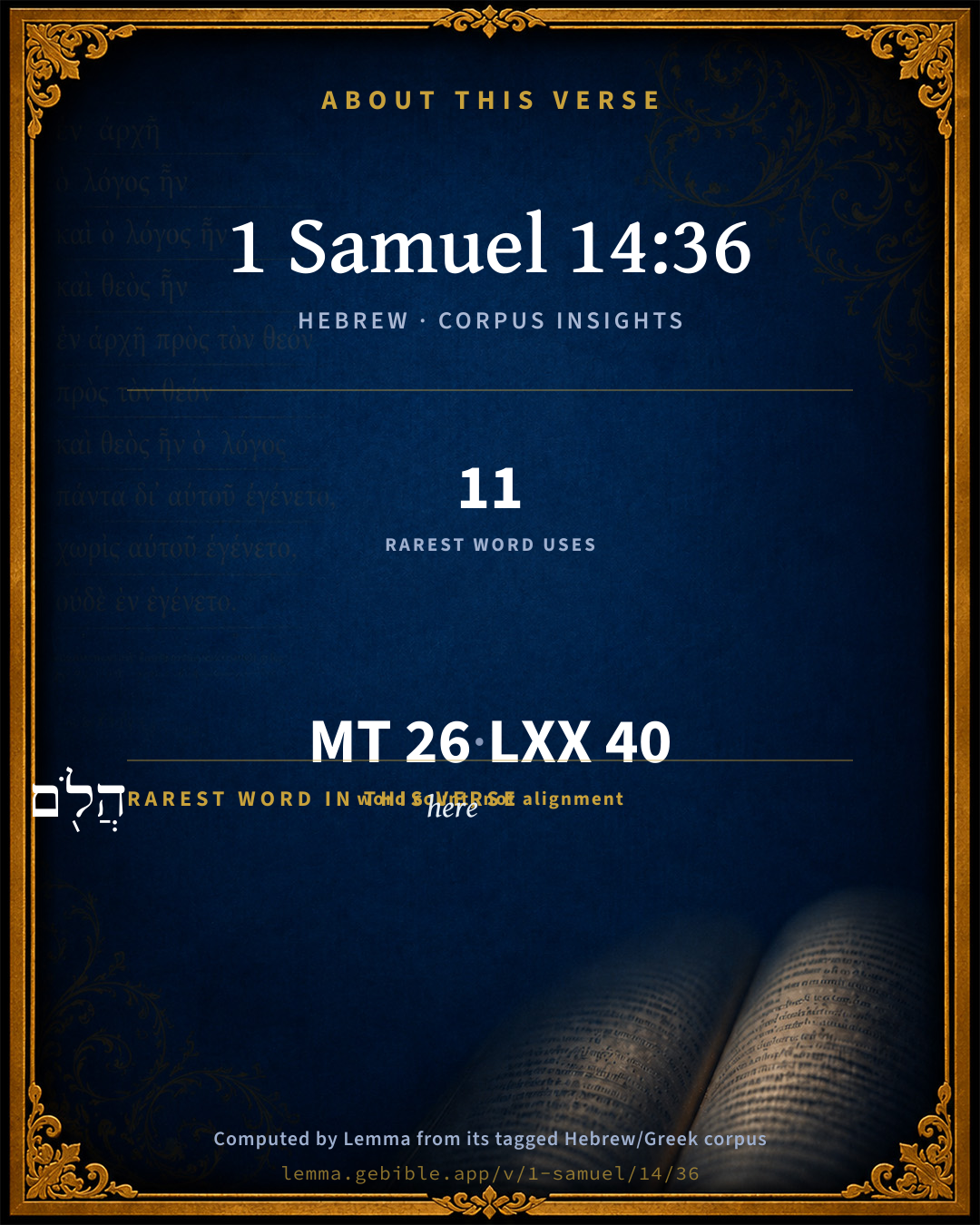
The rarest word here is הֲלֹ֖ם here H1988 — appearing just 11 times in the whole Hebrew Bible.

Shared distinctive vocabulary

הֲלֹ֖ם here H1988 occurs in 11 verses of the Hebrew Bible. Also found in:

Grammatical profile

  • 8 verbs
  • 10 nouns
  • 1 adjective
  • 5 prepositions
  • 1 adverb
  • 1 particle

Verb forms

  • וַיֹּ֣אמֶר Qal · Sequential Imperfect
  • נֵרְדָ֣ה Qal · Cohortative
  • וְֽנָבֹ֥זָה Qal · Cohortative
  • נַשְׁאֵ֤ר Hiphil · Cohortative
  • וַיֹּ֣אמְר֔וּ Qal · Sequential Imperfect
  • עֲשֵׂ֑ה Qal · Imperative
  • וַיֹּ֨אמֶר֙ Qal · Sequential Imperfect
  • נִקְרְבָ֥ה Qal · Cohortative

Repetition

A word recurs within this verse — often emphatic in Hebrew:

  • וַיֹּ֣אמֶר to say H559 ×3

Hebrew & Septuagint length

In English translation the verse runs 48 words from the Hebrew and 53 from the Septuagint (LXX English) — closely comparable.

A rough comparison of the two English renderings, which tokenize alike — not a word-level alignment.

Word counts can differ between the Hebrew and the Greek without any difference in meaning — e.g. the Hebrew direct-object marker אֵת has no separate Greek word, and Greek often adds the article ὁ.

In the original languages it is 26 Hebrew tokens and 40 Greek tokens — but the two are counted differently (Hebrew bundles its prefixes and suffixes into one token; the Greek is in lemma form), so that isn’t a like-for-like length.

Cross-references

13

Topical passages linked to 1 Samuel 14:36 in the Treasury of Scripture Knowledge — connected by theme and wording, ordered by reader-vote popularity; previews shown in the World English Bible.

  • Psalms 73:28 But it is good for me to come close to God. I have made the Lord Yahweh my refuge, That I may tell of all your works.
  • Isaiah 48:1–2 Hear you this, house of Jacob, who are called by the name of Israel, and are come forth out of the waters of Judah; who swear by the name of Yahweh, and make mention of the God of Israel, but not in truth, nor in righteousness
  • Numbers 27:21 He shall stand before Eleazar the priest, who shall inquire for him by the judgment of the Urim before Yahweh: at his word shall they go out, and at his word they shall come in, both he, and all the children of Israel with him, even all the congregation.
  • Joshua 10:9–14 Joshua therefore came on them suddenly; [for] he went up from Gilgal all the night.
  • Joshua 10:19 but don't stay; pursue after your enemies, and strike the hindmost of them; don't allow them to enter into their cities: for Yahweh your God has delivered them into your hand.
  • Joshua 11:14 All the spoil of these cities, and the cattle, the children of Israel took for a prey to themselves; but every man they struck with the edge of the sword, until they had destroyed them, neither left they any who breathed.
  • 1 Samuel 11:11 It was so on the next day, that Saul put the people in three companies; and they came into the midst of the camp in the morning watch, and struck the Ammonites until the heat of the day: and it happened, that those who remained were scattered, so that no two of them were left together.
  • 1 Samuel 14:3 and Ahijah, the son of Ahitub, Ichabod's brother, the son of Phinehas, the son of Eli, the priest of Yahweh in Shiloh, wearing an ephod. The people didn't know that Jonathan was gone.
  • 1 Samuel 14:18–19 Saul said to Ahijah, Bring here the ark of God. For the ark of God was [there] at that time with the children of Israel.
  • Isaiah 58:2 Yet they seek me daily, and delight to know my ways: as a nation that did righteousness, and didn't forsake the ordinance of their God, they ask of me righteous judgments; they delight to draw near to God.
  • Jeremiah 6:5 Arise, and let us go up by night, and let us destroy her palaces.
  • Malachi 2:7 For the priest's lips should keep knowledge, and they should seek the law at his mouth; for he is the messenger of Yahweh of Hosts.
  • James 4:8 Draw near to God, and he will draw near to you. Cleanse your hands, you sinners; and purify your hearts, you double-minded.

Cross-references courtesy of OpenBible.info (CC BY 4.0).

Hebrew and Greek witnesses Masoretic Hebrew ↔ Greek Septuagint

The same verse in the two great witnesses to the Old Testament, shown verse-for-verse.

These are two independent witnesses, not word-aligned to each other, and the Septuagint is shown in lemma (dictionary) form.

Hebrew 1 Samuel 14:36 Masoretic · Westminster Leningrad Codex

וַיֹּ֣אמֶר שָׁא֡וּל נֵרְדָ֣ה אַחֲרֵי֩ פְלִשְׁתִּ֨ים לַ֜יְלָה וְֽנָבֹ֥זָה בָהֶ֣ם עַד א֣וֹר הַבֹּ֗קֶר וְלֹֽא נַשְׁאֵ֤ר בָּהֶם֙ אִ֔ישׁ וַיֹּ֣אמְר֔וּ כָּל הַטּ֥וֹב בְּעֵינֶ֖יךָ עֲשֵׂ֑ה וַיֹּ֨אמֶר֙ הַכֹּהֵ֔ן נִקְרְבָ֥ה הֲלֹ֖ם אֶל הָאֱלֹהִֽים

Saul said, Let us go down after the Philistines by night, and take spoil among them until the morning light, and let us not leave a man of them. They said, Do whatever seems good to you. Then said the priest, Let us draw near here to God.

World English Bible · Public Domain

Greek LXX 1 Samuel 14:36 Septuagint · lemma form

καί εἶπον σαούλ καταβαίνω ὀπίσω ὁ ἀλλόφυλος ὁ νύξ καί διαἁρπάζω ἐν αὐτός ἕως διαφαύσκω ὁ ἡμέρα καί μή ὑπολείπω ἐν αὐτός ἀνήρ καί εἶπον πᾶς ὁ ἀγαθός ἐνώπιον σύ ποιέω καί εἶπον ὁ ἱερεύς προςἔρχομαι ἐνταῦθα πρός ὁ θεός

And Saul said, Let us go down after the Philistines this night, and let us plunder among them till the day break, and let us not leave a man among them. And they said, Do all that is good in your sight: and the priest said, let us draw near hither to God.

LXX2012 (modern English Septuagint) · Public Domain

Hebrew: Westminster Leningrad Codex (CC BY 4.0). Greek: Septuagint (public domain); English from LXX2012 (modern English Septuagint) (Public Domain). How the Septuagint differs from the Hebrew →

Targum (Aramaic paraphrase)

1

The Targum is the ancient Jewish Aramaic paraphrase of the Hebrew Scriptures — an interpretive translation, not the Hebrew text itself. Onkelos (literal) and Pseudo-Jonathan (expansive) render the Torah, and Jonathan the Prophets. Coverage is partial: where no permissively-licensed English translation exists for a verse, only the Aramaic is shown. This is verse-level text, not a word-by-word alignment to the Hebrew.

  1. Targum Jonathan Prophets (Joshua–Malachi)
    וַאֲמַר שָׁאוּל נֵחוֹת בָּתַר פְּלִשְׁתָּאֵי בְּלֵילְיָא וְנִקְטוֹל בְּהוֹן עַד מַנְהַר צַפְרָא וְלָא נִשְׁאַר בְּהוֹן אֱנַשׁ וַאֲמַרוּ כָּל דְתַקִין בְּעֵינָךְ עֲבִיד וַאֲמַר כַּהֲנָא נִתְקְרַב הַלְכָא וְנִשְׁאַל בְּמֵימְרָא דַיָי:

    (no public-domain English translation for this verse)

    Targum Jonathan — Aramaic: “Mikraot Gedolot” (public domain). English: “Sefaria Community Translation” (CC0 1.0 (public-domain dedication)); “London "Chaldee Paraphrase," 1871” (public domain). Text via Sefaria.

Commentary

Notes on 1 Samuel 14:36 from classic Christian and Jewish commentators (each source and its license shown beneath its notes). The classic Christian expositions comment on the surrounding passage and are grouped to its opening verse, so a note may address several verses; the Jewish commentaries on the Tanakh (Rashi and others) are per-verse, so they appear only where the commentator wrote on this verse.

Lemma curates 59 commentaries, every one of them public domain or Creative Commons licensed, each selected and text-cleaned for this edition rather than reprinted as found. About our sources →

Matthew Henry's Commentary

Here is, I. Saul's boasting against the Philistines. He proposed, as soon as his soldiers had got their suppers, to pursue them all night, and not leave a man of them, Sa1 14:36. Here he showed much zeal, but little discretion; for his army, thus fatigued, could as ill spare a night's sleep as a meal's meat. But it is common for rash and foolish men to consider nobody but themselves, and, so that they might but have their humour, not to care what hardships they put upon those that are under them. However, the people were so obsequious to their king that they would by no means oppose the motion, but resolved to make the best of it, and, if he will go on, they will follow him: Do whatsoever seemeth good to thee. Only the priest thought it convenient to go on with the devotions that were broken off abruptly (Sa1 14:19), and to consult the oracle: Let us draw near hither unto God. Princes and great men have need of such about them as will thus be their remembrancers, wherever they go, to take God along with them. And, when the priest proposed it, Saul could not for shame reject the proposal, but asked counsel of God (Sa1 14:37): "Shall I go down after the Philistines? And shall I speed?"

II. His falling foul on his son Jonathan: and the rest of this paragraph is wholly concerning him: for, while he is prosecuted, the Philistines make their escape. We know not what mischief may ensue upon on rash resolve.

1. God, by giving an intimation of his displeasure, put Saul upon searching for an accursed thing. When, by the priest, he consulted the oracle, God answered him not, Sa1 14:37. Note, When God denies our prayers it concerns us to enquire what the sin is that has provoked him to do so. Let us see where the sin is, Sa1 14:38. For God's ear is not heavy that it cannot hear, but it is sin that separates between us and him. If God turns away our prayer, we have reason to suspect it is for some iniquity regarding our hearts, which we are concerned to find out, that we may put it away, may mortify it, and put it to death. Saul swears by his Maker that whoever was the Achan that troubled the camp, by eating the forbidden fruit, should certainly die, though it were Jonathan himself, that is, though ever so dear to himself and the people, little thinking that Jonathan was the man (Sa1 14:39): He shall surely die, the curse shall be executed upon him. But none of the people answered him, that is, none of those who knew Jonathan had broken the order would inform against him.

2. Jonathan was discovered by lot to be the offender. Saul would have lots cast between himself and Jonathan on the one side, and the people on the other, perhaps because he was as confident of Jonathan's innocency in this matter as of his own, Sa1 14:40. The people, seeing him in a heat, durst not gainsay any thing he proposed, but acquiesced: Do as seemeth good unto thee. Before he cast lots, he prayed that God would give a perfect lot (Sa1 14:41), that is, make a full discovery of this matter, or, as it is in the margin, that he would show the innocent. This was with an air of impartial justice. Judges should desire that truth may come out, whoever may suffer by it. Lots should be cast with prayer, because they are a solemn appeal to Providence, and by them we beg of God to direct and determine us (Act 1:24), for which reason some have condemned games that depend purely upon lot or chance as making too bold with a sacred thing. Jonathan at length was taken (Sa1 14:42), Providence designing hereby to countenance and support a lawful authority, and to put an honour upon the administration of public justice in general, reserving another way to bring off one that had done nothing worthy of death.

3. Jonathan ingenuously confesses the fact, and Saul, with an angry curse, passes sentence upon him. Jonathan denies not the truth, nor goes about to conceal it, only he thinks it hard that he must die for it, Sa1 14:43. He might very fairly have pleaded his invincible ignorance of the law, or have insisted upon his merit, but he submitted to the necessity with a great and generous mind: "God's and my father's will be done:" thus he showed as much valour in receiving the messengers of death himself as in sending them among the Philistines. It is as brave to yield in some cases as it is in other cases to fight. Saul is not mollified by his filial submission nor the hardness of his case; but as one that affected to be thought firm to his word, and much more to his oath; even when it bound him hardest, with another imprecation he gives judgment upon Jonathan (Sa1 14:44): "God do so and more also to me if I do not execute the law upon thee, for thou shalt surely die, Jonathan." (1.) He passed this sentence too hastily, without consulting the oracle. Jonathan had a very good plea in arrest of the judgment. What he had done was not malum in se - bad in itself; and, as for the prohibition of it, he was ignorant of that, so that he could not be charged with rebellion or disobedience. (2.) He did it in fury. Had Jonathan been worthy to die, yet it would have become a judge, much more a father, to pass sentence with tenderness and compassion, and not with such an air of triumph, like a man perfectly divested of all humanity and natural affection. Justice is debased when it is administered with wrath and bitterness. (3.) He backed it with a curse upon himself if he did not see the sentence executed; and this curse did return upon his own head. Jonathan escaped, but God did so to Saul, and more also; for he was rejected of God and made anathema. Let none upon any occasion dare to use such imprecations as these, lest God say Amen to them, and make their own tongues to fall upon them, Psa 64:8. This stone will return upon him that rolleth it. Yet we have reason to think that Saul's bowels yearned toward Jonathan, so that he really punished himself, and very justly, when he seemed so severe upon Jonathan. God made him feel the smart of his own rash edict, which might make him fear being again guilty of the like. By all these vexatious accidents God did likewise correct him for his presumption in offering sacrifice without Samuel. An expedition so ill begun could not end without some rebukes.

4. The people rescued Jonathan out of his father's hands, v. 45. Hitherto they had expressed themselves very observant of Saul. What seemed good to him they acquiesced in, v. 36, 40. But, when Jonathan is in danger, Saul's word is no longer a law to them, but with the utmost zeal they oppose the execution of his sentence: "Shall Jonathan die - that blessing, that darling, of his country? Shall that life be sacrificed to a punctilio of law and honour which was so bravely exposed for the public service, and to which we owe our lives and triumphs? No, we will never stand by and see him thus treated whom God delights to honour." It is good to see Israelites zealous for the protection of those whom God has made instruments of public good. Saul had sworn that Jonathan should die, but they oppose their oath to his, and swear he shall not die: "As the Lord liveth there shall not only not his head, but not a hair of his head fall to the ground;" they did not rescue him by violence, but by reason and resolution; and Josephus says they made their prayer to God that he might be loosed from the curse. They pleaded for him that he has wrought with God this day; that is, "he has owned God's cause, and God has owned his endeavours, and therefore his life is too precious to be thrown away upon a nicety." We may suppose Saul had not so perfectly forgotten the relation of a father but that he was willing enough to have Jonathan rescued, and well pleased to have that done which yet he would not do himself: and he that knows the heart of a father knows not how to blame him.

5. The design against the Philistines is quashed by this incident (v. 46): Saul went up from following them, and so an opportunity was lost of completing the victory. When Israel's shields are clashing with one another the public safety and service suffer by it.

Matthew Henry's Commentary on the Whole Bible (1708–1710) — public domain (CC PDM 1.0). Text via the HelloAO Bible API.

Trapp's Complete Commentary

John Trapp

1Sa 14:36 And Saul said, Let us go down after the Philistines by night, and spoil them until the morning light, and let us not leave a man of them. And they said, Do whatsoever seemeth good unto thee. Then said the priest, Let us draw near hither unto God.

Ver. 36. Let us not leave a man of them.] Here he expresseth, say some, his excessive desire of revenge, his arrogancy, and his cruelty. He had an express command not to leave a man of the Amalekites, and yet he could spare many of them. {1Sa 15:7-8}

John Trapp, A Commentary or Exposition upon All the Books of the Old and New Testament (1647–1656) — public domain. Text from a community e-Sword module.

Joseph Benson's Commentary

1Sa 14:36-37. Let us go down after the Philistines by night — Having thus refreshed themselves in the evening, Saul proposes to them to renew the pursuit, hoping to cut off the whole army of the Philistines when they were asleep in the night. Then said the priest, Let us draw near hither unto God — To the ark, in order to inquire of God. It is probable he stood before the altar, and wished to remind them that it was dangerous to undertake any thing without God’s direction. He answered him not that day — Though the priest, it seems, often asked an answer, yet he received none.

Joseph Benson's Commentary on the Old and New Testaments (1811–1818) — public domain. Text from a community e-Sword module.

The Pulpit Commentary

CHAPTER 14:36-52

JONATHAN"S DANGER AND DELIVERANCE (vers. 36-46).

Let us go down after the Philistines by night. Saul, conscious that he had prevented the victory from being so decisive as it would otherwise have been, proposes to repair his fault, now that the people have taken food, by continuing the pursuit during the night. The people render the same unquestioning obedience as before, but Ahiah gives counsel that they should first ask the approval of God. Let us draw near hither. Ie. to the altar which Saul had just set up. Ahiah may have done this because he disapproved of Saul"s project, or because generally God ought to be consulted before undertaking anything of importance. Already the neglect of this had led to no good results (see ver. 19).

Vers. 36-46.

Seeking counsel of God and keeping one"s word.

The facts are

1. Saul, following his own impulse, desires to pursue the Philistines duringthe night, but is restrained by the priest advising to seek counsel of God.

2. No answer coming from God, Saul concludes that sin has beencommitted, and resolves that the sinner when discovered shall die.

3. A lot being taken, it falls on Jonathan, who admits having tasted honey,and submits to the sentence.

4. Saul, again solemnly consigning his son to death, is confronted by thepeople, who claim and rescue Jonathan"s life on the ground that he was doing God"s work that day. Rash impulse was the besetting sin of Saul. Being by Divine arrangement more than a military leader, it was his duty to seek guidance from God in times of uncertainty. Men of cooler judgment doubted whether it was wise to urge on all through the night men who had been worn down by fasting all day, and were scarcely free from their evening meal. The priest evidently saw that Saul"s haste and the unexpressed hesitation of the people could be best dealt with by consulting the Urim. The Divine silence at once indicated that something was wrong, and according to precedent it was necessary to ascertain where it lay. The ceremonial wrong was Jonathan"s, the moral Saul"s. The moral degeneracy of Saul was not only seen in his impulsive neglect of God"s counsel, but also in the self-complacent zeal with which he sought out the breach of his own rash command, and in the unnatural harshness of his sentence. People are sometimes better than their rulers, and hence the popular sense of justice demanded that in this instance royal authority and national custom should give way before the manifest will of God. Jonathan must not die, even though a king"s word be broken. The three prominent matters of the narrative are seeking counsel, keeping one"s word, and safety in God.

I SEEKING COUNSEL. It is the part of wisdom in life"s affairs to seek counsel of God; and although sometimes no counsel is given, its absence is very instructive, and the causes of it are ascertainable. In the case of Saul both duty and privilege demanded a frequent appeal to God. On the occasion before us the need was real, the method was at hand, and response was possible, and a lack of response was itself of value. Our common human relation to God is not unlike that of Israel"s king.

1. There is forevery one frequent need of Divine counsel. Life, even under the direction of the clearest reason and purest natural impulses, is not safe; for sin has disturbed the nature of the best of men. It is not always that that which at first seems good and safe turns out in the end to be so. What to do in private, domestic, and public affairs, and what proportion of time and strength to give to various claims, are questions pressing on every conscientious mind. In matters pertaining to religious belief, culture, and

2. enterprise, we each, if life be not stagnant, require more than earthly wisdom. The heart of man is sensible that it is not in him infallibly and safely to "direct his steps," and hence in all lands it instinctively though often in ignorance, cries out for the living God. (Pro_16:9; Jer_10:23)

3. There is a method at hand. The Urim was not far from Saul. By a study of God"s will as seen in his word, his providence, the yearnings of a sanctified heart, and the voice of his peoples we may gain guidance in addition to that private illumination which unquestionably comes in answer to true prayer. No rule can be laid down for individuals. Each day"s circumstances must suggest the means we use to ascertain the will of God.

1. There is reason for looking for a response to our seeking. It was a tacit understanding with Saul on the settlement of the kingdom (1Sa_9:25-27 1Sa_10:24, 1Sa_10:25) that he might count on the guidance of God. Samuel"s exhortations and instructions all through proceeded on this assumption. Nor was God"s silence on the present occasion contrary to this; for it was of itself a significant indication of the mind of God. Saul knew its meaning. The exhortations to us to "seek the Lord," the distinct promises that he will "hear," the many instances on record in which men sought and followed the Lord, raise an assurance that the seed of Jacob shall not seek his face in. (Isa_19:1) The answer may come in unlooked for forms, in the clearing of our moral perceptions, the secret bent given to the purified heart, the opening up of courses of action, or a concurrence of events and influences, but come it will some time if we are sincere and earnest.

2. The absence of response is often accountable. We know why Saul"s seeking for counsel was in vain. There are frequent instances in which the silence of God is conspicuous. He was silent when the Psalmist cried unto him to awake; (Psa_35:22-24) when defiled men cried unto him; (Isa_1:12-15) when amidst the storm men were in fear; (Mat_8:24-26) when in presence of a wounded heart be would not heed captious; (Joh_8:6, Joh_8:7) and when questioned by one who had no right to assume a tone of authority. (Joh_19:9) Even though our holiness of life, or at least consistency, be real, and our supposed need be urgent, it is possible that the discipline of faith and patience is the reason for no response.

II KEEPING ONE"S WORD. Saul felt bound in honour to keep his word, even at the cost of his son"s life. He found himself in an awkward position, for it would reveal an irresolution unfavourable to authority if he should overlook his son"s deed under a plea of ignorance which any one might make; and, on the other hand, as the people did believe Jonathan"s plea, and held him to be the real victor of the day, it would expose Saul"s folly and injustice if he should take away so valuable a life. Such was Saul"s sense of the importance of keeping his word, that all must be sacrificed to it.

1. There is a fictitious truthfulness. The bare doing as he had said, and merely because he had said it, was Saul"s ideal of truthfulness. Here, then, was a vague apprehension of a grand virtue, and a crude presentation of moral obliquity as being identical with it. Truth is a virtue entering into the depths of life; and had Saul been really a man of truth, he would have considered Jonathan"s case on its own merits, have honestly admitted the folly and sin of his own rash declaration, and have sacrificed his own repute to the general interests of righteousness. There is much fictitious truthfulness in the world. Some men, by sheer obstinacy of disposition, will do as they say simply because they said it, heedless of the injury it may do. To keep to what one has acknowledged to be binding is supposed to be truthfulness in act, and yet many will be rigorous in the observance of some moral obligations and careless of others. To avoid theft and murder is coincident with deeds of lying and selfishness. A similar fictitious truthfulness is seen in the careful outward observance of days without cherishing the spirit in accordance with them, and in the performance of acts of worship as a substitute for the homage of the soul.

2. Real truthfulness is a quality of extreme importance. Saul confessed this in his zeal for the fictitious; as do all men in their devices to secure an appearance of it, and their instinctive homage to the reality when presented in word or deed. Real truthfulness does not apply merely to correspondence of statement with occurrence. It is another name for reality in thought, feeling, life; and it applies to our relation both to man and God. The conformity of our nature with what is befitting a creature of the Holy One is the real truthfulness. Hence, nothing enters the New Jerusalem that "maketh a lie." Hence, regeneration is a renewal "in the image of him" who created us. Hence, also, in so far as we are like unto him who is "the Truths" all our relations to men are pure, lovely, honest the natural outcome of "truth in the inward parts." This quality is essential to the most perfect social confidence; for it renders fraud, deceit, selfishness, dissimulation, distrust impossible, and the reverse virtues real, whenever it is dominant in human nature. Attention to this in education is supremely important.

III SAFETY IN GOD. Jonathan"s life was safe in God"s care in spite of zeal for a fictitious regard for truth on the part of his father. The voice of the people demanding his release was the voice of God, and the honour put on Jonathan during the previous day was evidence to all but the obstinate king of a favour much to be desired. He who had gone forth in the service of the Lord with true, honest heart, and had been shielded in the dangerous enterprise, was not forsaken by his God when now the rashness of man encompassed his life with peril. Thus, the custom of Eastern rulers keeping their word when once uttered (Jud 11:30-39; Mat_14:9) personal consistency, and royal authority must give place where God makes manifest his approval. Does not the position of Jonathan lead our thoughts on to our own in a greater day of trial? We are not to be tried by the variable impulse of man or established custom, hut by impartial justice. What God declares shall be done when our day"s battle is over will be done in truth. If he acquits us then, who is he that condemneth? His favour will save from a worse calamity than any that threatened Jonathan; and the practical question is how to come into such relation to God that the universal demand of justice shall be for our not perishing. The answer is is no condemnation to them that are in Christ Jesus"; (Rom_8:1) "Who shall lay anything to the charge of God"s elect? It is God that justifieth". (Rom_8:33)

General lessons:

1. We are consistent with our privileges when not only our calamities andgreat affairs, but our ordinary actions, are made subject to Divine guidance. (Php_4:6)

2. It is especially desirable to seek counsel of God when we are consciousof restlessness and ill-regulated impulse.

3. Faithfulness requires that, a promise or engagement being made, wekeep our word even at much personal cost; but when such loss would occur, generosity requires of the gainer that it be not wholly insisted on Psa_15:4; Luk_6:31; Eph_4:32

4. Truthfulness in character is the opposite of sinfulness, for sin is apractical lie (Gen_3:1-5; 1Jn_2:4)

5. Our final safety rests not on the past untarnished purity of life (Rom_3:10; 1Jn_1:8) but on our being identified with Messiah"s life and purpose. (Joh_14:19; Rom_8:35-39)

HOMILIES BY B. DALE. Vers. 36, 37. (AJALON.)

Drawing near to God.

Of the fallen house of Eli, one at least, Ahiah, (Ahimelech 1Sa_21:1) the grandson of Phinehas, appears to have been a faithful servant of God. When the people, having ended their pursuit of the Philistines and satisfied their hunger, rested around their gleaming camp fires, and Saul proposed a nocturnal expedition against the enemy so as "not to leave a man of them, he devoutly and courageously interposed with the words, "Let us draw near hither unto God." He had already witnessed the effects of the king"s rashness, feared its further results, and felt that "it was dangerous to undertake anything without asking counsel of God" (see ver. 19). His language is suggestive of

I THE EXERCISE OF A RELIGIOUS PEOPLE in prayer. It is

1. A possibility. For God is "nigh at hand, and not afar off" (Deu_4:7; Psa_145:18; Jer_23:23) He hasprovided a way of access an altar, (Heb_13:10) a sacrifice, and a high priest (Heb_7:19 Heb_10:20-22; Eph_2:18) The throne of God is not only a throne of glory and of judgment, but also a throne of grace. "The Lamb is in the midst of the throne.

1. A privilege. What higher privilege or honour can be conferred than to hold intercourse with so glorious a Being? What greater benefit than his fellowship, counsel, and aid?. (Psa_73:28)

2. An obligation, arising out of his relationship to men, and indicated by his word, by conscience, and the deepest needs and impulses of the soul. "Draw nigh to God, and he will draw nigh to you" (Jam_4:8; Psa_43:4) "Ye people, pour out your heart before him". (Psa_62:8)

II THE VOCATION OF A FAITHFUL MINISTER with respect to this exercise. It is

1. To bear a fearless testimony concerning it before the people: setting forth the supreme claims of God upon their homage, reminding them of their want, reproving their forgetfulness, and teaching them the good and right way. (1Sa_12:23)

2. To exhibit a devotional spirit in his intercourse with them. He who exhorts others to pray should be himself a man of prayer, and speak to them by his example as well as by his words. Exhortation to them is often less beneficial than intercession for them. "We will give ourselves continually to prayer". (Act_6:4)

3. To invite them to sincere union with him in seeking the face of God. "Let us draw near." "Let us pray not merely with the lips or in outward form, not regarding iniquity in the heart; but humbly and sincerely, with one accord, with a true heart, and in full assurance of faith. (Psalm 1Ti_2:8)

III THE INFLUENCE OF TIMELY INTERVENTION On the part of a good man. Then (when both king and people were about to set forth without seeking Divine counsel) said the priest," etc.; and he did not speak in vain (ver. 37). Such advice and prayer are generally effectual

1. In restraining from the pursuit of a wrong course a doubtful or dangerous enterprise, devotion to worldly objects, following selfish and revengeful inclinations, etc. A single "word in season" sometimes prevents much mischief.

2. In constraining to the performance of neglected duty. The inquiry which Saul had broken off was now formally resumed, though not on his part in a right spirit.

3. In obtaining the possession of needful good. It is not always what is sought. There may be delay or refusal in granting a definite answer; but the experience thereby gained is itself beneficial, and the necessary condition of obtaining the highest good.

IV THE INSTRUCTIVENESS OF UNANSWERED PRAYER. "He answered him not that day". (1Sa_28:6, 1Sa_28:15) The silence of God is significant. It indicates

1. The presence of sin, which hinders the communications of Heaven, as a cloud intercepts the beams of the sun (Isa_59:2; Lamentations Hos_5:15; Jam_4:2, Jam_4:3)

1. The duty of its discovery, by means of diligent inquiry and self-examination (Jos_7:13; Psa_139:23, Psa_139:24; Lam_3:40)

2. The necessity of humiliation, removing "the accursed thing," and turning to God with full purpose of heart, so that he may cause his face to shine upon us. "Praying will either make a man leave off sinning or sinning will make him leave off praying." In the former case his path is upward into the light, in the latter it is downward into darkness and despair. D.

The Pulpit Commentary (1880–1919), ed. H.D.M. Spence-Jones & Joseph S. Exell — public domain. Text from a community e-Sword module.

Geneva Bible (1599)

Geneva Bible translators

To ask counsel of him.

Geneva Bible (1599) marginal notes — public domain. Text via Bolls.life.

Adam Clarke's Commentary

Verse 36. Then said the priest] It is evident that Ahiah doubted the propriety of pursuing the Philistines that night; and as a reverse of fortune might be ruinous after such a victory, he wished to have specific directions from the Lord.

Adam Clarke's Commentary on the Bible (1810–1826) — public domain. Text from a community e-Sword/MySword module.

Ellicott's Commentary for English Readers

(36) Let us go down after the Philistines by night.—In the depth of the night, when the rough feasting on the captured beasts was over, King Saul would have had the bloody work begun afresh, and would have hurried after the flying Philistines, and with a wild butchery have completed the great and signal victory. With the implicit obedience which his soldiers seem ever to have shown him—whether a vow of total abstinence, or a desperate charge, or a wild night attack, or a ruthless bloodshed, was enjoined on them by their stern and gloomy king—the army professed themselves at once ready again to fight. Only one man in that army flushed with victory dared, with the bravery which alone proceeds from righteousness, to withstand the imperious sovereign. The high priest, Ahiah, doubted whether such a wholesale bloodshed as would surely have resulted from the conquering troops of Saul pursuing a dispersed and vanquished enemy, was in accordance with the will of God. No command to exterminate these Philistines had ever been given, and that day, so glorious in the annals of Israel, was wholly due to the special interposition of the Eternal Friend of Israel. Ahiah said, “Let us first inquire of the oracles of God”—alluding, of course, to the jewels of Urim and Thummim on his high-priestly ephod.

A Bible Commentary for English Readers, edited by Charles John Ellicott (1878–1897) — public domain. Text from a community e-Sword module.

The Cambridge Bible for Schools and Colleges

gen. ed. J. J. S. Perowne

36–46. The consequence of Jonathan’s transgression

36. Let us draw near hither unto God] Ahijah checks Saul’s impulse, reminding him that it was necessary first to ascertain the will of God. Perhaps he felt that Saul’s neglect to wait for God’s answer in the morning (1Sa_14:19) had already borne evil fruit.

The Cambridge Bible for Schools and Colleges (gen. ed. J. J. S. Perowne; Cambridge University Press, 1878–1918) — public domain. Text from a community e-Sword module.

John Gill's Exposition

And Saul said,.... To his son Jonathan, or to some of the principal officers of his army:

let us go down after the Philistines by night; or tonight, that same night; which is another hardship he laid his troops under; as he had restrained them from eating all that day until evening, now he proposed they shall take no sleep that night, but proceed on in their pursuit of the Philistines, having eaten, and drank, and refreshed themselves. The Arabic version is, "let us go down to the Philistines"; and so Noldius (e) chooses to render the words; which I pretty much wonder at, and especially at what he observes in favour of it, and against the common rendering; that at this time the Philistines had not turned their backs, so that the Israelites could not be said to go after them, but were in a camp opposite to them; but that they had fled, and were pursued, is most certain from Sa1 14:22,

and spoil them until the morning light; or kill of them, as the Targum, and so the Arabic version; for spoiling must be meant of killing; for as for the spoil of their provisions, riches, &c. that had already fallen into their hands, Sa1 14:30, and this is confirmed by what follows:

and let us not leave a man of them; great numbers had been slain already, partly by their falling upon one another, and partly by the swords of Jonathan and his armourbearer at the first onset, and by Saul and his men in the pursuit of them; and so intent was Saul in the utter destruction of them, that he was for following and cutting them off, that none of their prodigious army might return home:

and they said, do whatsoever seemeth good unto thee; they had religiously observed his oath, in refraining from food all the day, and now they were as willing to be obedient to his command in denying themselves refreshing rest in sleep:

then said the priest, let us draw near hither unto God; Ahiah the priest, Josephus (f) calls him Ahitob, who was present with the ark, agreed to the proposal of Saul, only moved, that before they set forward they would seek the Lord; perhaps reflecting upon the abrupt manner in which Saul departed from Gibeah, just as he was consulting the Lord, and not staying for an answer from him; which the priest might fear would be resented by him, and therefore proposes first to draw nigh to God; not to the altar Saul had built, or had just begun to build, but to the ark, with which the high priest was, and was a symbol of the divine Presence: the Targum is,"let us draw near hither, and inquire by the word of the Lord.''

(e) Ebr. Concord. Part. p. 15. No. 92. (f) Antiqu. l. 6. c. 6. sect. 4.

John Gill's Exposition of the Whole Bible (1746–1763) — public domain (CC PDM 1.0). Text via the HelloAO Bible API.

Albert Barnes' Notes on the Bible

Then said the priest ... - Ahijah, with equal courage and faithfulness, worthy of his office as “the priest,” when every one else yielded to Saul’s humor, proposed that they should draw near to God to inquire of Him. (Compare 1Ki 22:7.)

Albert Barnes' Notes on the Bible (1834–1885) — public domain. Text from a community e-Sword/MySword module.

Haydock's Catholic Bible Commentary

God, to consult him, whether the enterprise met with his approbation. Saul is too eager to follow his own prudence. (Haydock) --- He would not before wait for God’s answer; (ver. 19) now he can get none. (Worthington)

George Leo Haydock (1774–1849), Haydock's Catholic Family Bible and Commentary, 1859 edition — public domain. Excludes Psalms (Douay-Rheims chapter numbering differs from Protestant) and Deuterocanonical books (Catholic canon only).

Matthew Poole's English Annotations

Remembering Saul’s contempt of God’s ordinance the last time, and the in consequence of it; and perceiving Saul ready to run into the same error again, even though he had not now the same pretence of the necessity of haste as before, and that the people were forward to comply with the motion; he gives them this pious and prudent advice.

Hither unto God, to wit, to the ark, as above, 1Sa 14:18.

Matthew Poole's English Annotations on the Holy Bible (1683–1685) — public domain. Text from a community e-Sword/MySword module.

Whedon's Commentary on the Bible

Daniel D. Whedon

36. Let us draw near hither unto God — Ahiah, the priest, doubted the propriety of the thing proposed by Saul, and would therefore seek counsel of God. Hither unto God does not imply that the ark was there among them, but has reference to the altar on which the sacrifices had been offered, and also to the urim and thummin on the breastplate of the priest.

Daniel D. Whedon (gen. ed.), Commentary on the Old and New Testaments (1874–1909) — public domain. Text from a community e-Sword module.

John Wesley's Explanatory Notes

Draw near - To the ark, in order to inquire of God.

John Wesley, Explanatory Notes Upon the Whole Bible (1754–1765) — public domain. Text via the GEBible commentary corpus.

unfoldingWord translationNotes

Door43 World Missions Community

General Information:

Saul seeks to continue the fight against the Philistines.

let us not leave one of them alive

This is stated in a negative way to emphasize the slaughter. It can be stated in positive form. AT: "let us kill every one of them" (See: Litotes)

Do whatever seems good to you

Saul had the support of his army to continue the fight.

Let us approach God here

Here "approaching God" is associated with asking him counsel. AT: "Let us ask God what we should do" (See: Metonymy)

give them into the hand of Israel

Here "hand" refers to the power to defeat them. AT: "enable us to defeat them" (See: Metonymy)

But God did not answer him that day

This implies that God was not willing to help Saul.

translationWords

Philistines

life

priest

hand

Israel

unfoldingWord translationNotes — © Distant Shores Media and the Door43 World Missions Community, licensed CC BY-SA 4.0. Source: git.door43.org/Door43/en_tn.

Lesson kit

Teaching starters — assembled from the data on this page, not authored interpretation. Every prompt links to the verse data it draws on. Edit before teaching.

1 Samuel, in the Historical, opens this verse with 26 words (22 distinct Hebrew lemmas). Its most distinctive word is hălôm (“here”). A historical commentator’s framing appears above. Read the whole chapter for the surrounding context.

Discussion questions

  1. The word hălôm carries the sense “here.” How does it shape the verse?
  2. Genesis 16:13 shares the word «here» with this verse. How do the two illuminate each other?
  3. “to say” occurs 3× in this one verse. What is the effect of the repetition?
  4. These translations render this verse differently. What is at stake in choosing one wording over another?
  5. The verb «וַיֹּ֣אמֶר» is Qal Sequential Imperfect. How does its form color the action?
  6. Reading how Matthew Henry's Commentary and Trapp's Complete Commentary read this verse, where do the two commentators agree and where do they part?

Things to notice

Reading settings

Reading text

Shown beneath each verse's original-language words.

Old Testament
Old Testament edition

Read the OT as the Masoretic Hebrew (MT) or the Greek Septuagint (LXX).

English shown for the Greek Septuagint (in the Hebrew ↔ Greek comparison).

Comparing translations? Open the Compare panel on any verse page to stack up to four side by side.