
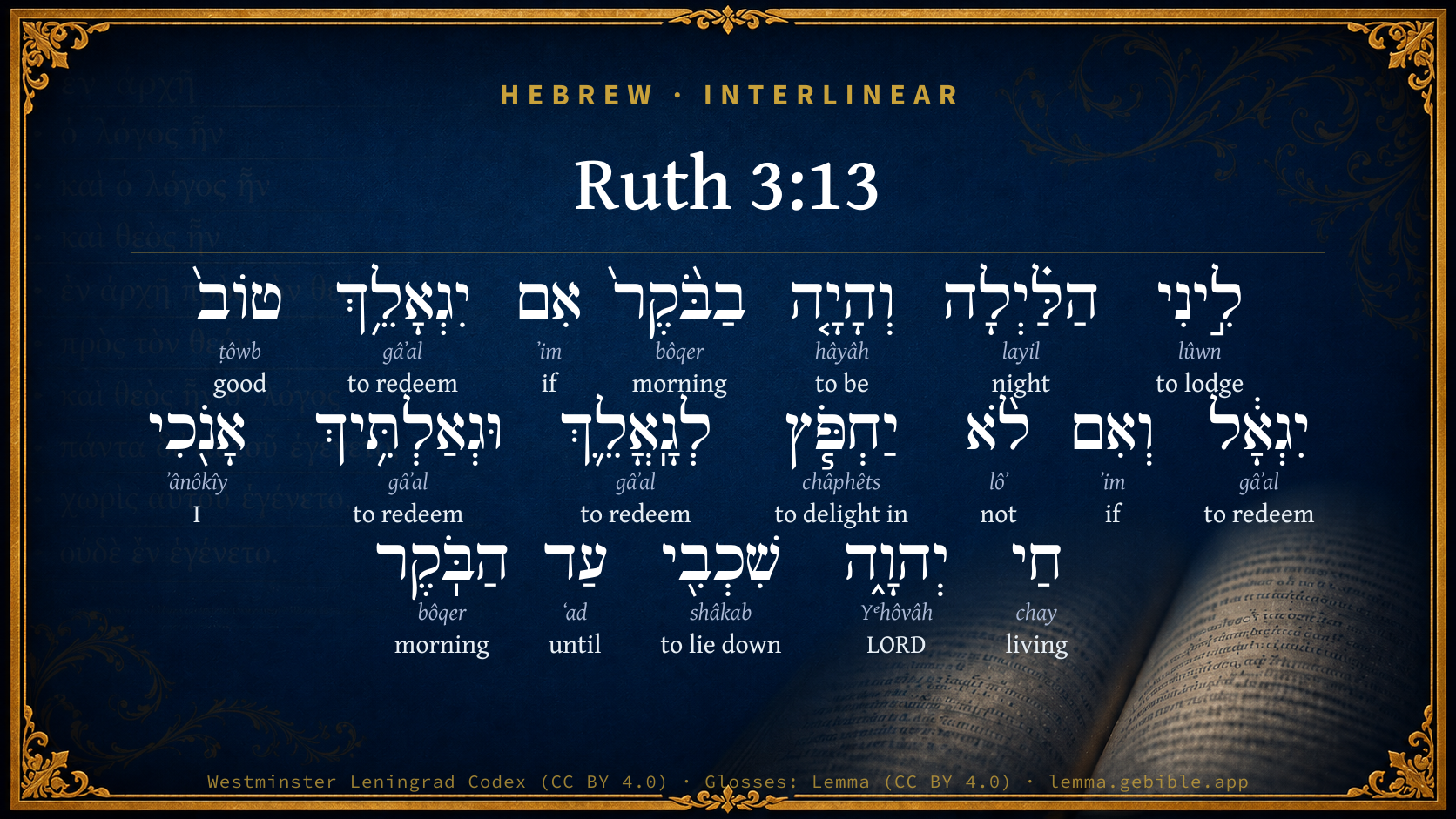
Ruth 3:13

Hebrew (Westminster Leningrad Codex) Ruth 3:13 appears in the Hebrew Old Testament. The text above is from the Westminster Leningrad Codex. Each word links to its Strong’s number, a concise gloss, and parsing drawn from the Open Scriptures Hebrew Bible morphology. Click any word for its full Brown-Driver-Briggs (BDB) entry.
Download image
Cite this verse

Ruth 3:13 (World English Bible). Public Domain. Lemma interlinear Bible study tool, https://lemma.gebible.app/v/ruth/3/13.

Show BibTeX & RIS
BibTeX
RIS
English Translation
Stay this night, and it shall be in the morning, that if he will perform to you the part of a kinsman, well; let him do the kinsman's part: but if he will not do the part of a kinsman to you, then will I do the part of a kinsman to you, as Yahweh lives: lie down until the morning.
World English Bible · Public Domain
Download a study sheet

One document with this verse’s original text, its word-by-word gloss line, the meaning frame, cross-references with their text, attributed commentary, and full source and license credits — printable, and it pastes into notes with its structure intact.

This verse Autodidact and up

Study sheet (.html) Plain text (.txt)

A passage Seminary Student

Up to 50 verses in one chapter. A passage sheet keeps up to 6 commentary sources and 12 cross-references per verse, in the order this page ranks them, and says so on the sheet whenever that leaves anything out. Ask for a single verse and you get the Autodidact verse sheet above.

Everything on this page stays free to read, with no account — the sheet is a download of what is already on screen, not access to it.

Want to remove ads? Support Godless Engineer
Compare translations 3

The same verse in 3 English versions, stacked beneath the original-language interlinear above. Click any original word for its lexicon entry.

Each is an independent rendering of the whole verse — the interlinear is not word-aligned to these translations.

Highlighted words mark where these versions differ — a whole-verse word diff, not a word-by-word alignment.

  • World English Bible Public Domain
    Stay this night, and it shall be in the morning, that if he will perform to you the part of a kinsman, well; let him do the kinsman's part: but if he will not do the part of a kinsman to you, then will I do the part of a kinsman to you, as Yahweh lives: lie down until the morning.
  • King James Version Public Domain
    Tarry this night, and it shall be in the morning, that if he will perform unto thee the part of a kinsman, well; let him do the kinsman's part: but if he will not do the part of a kinsman to thee, then will I do the part of a kinsman to thee, as the LORD liveth: lie down until the morning.
  • unfoldingWord Literal Text CC BY-SA 4.0
    Stay here tonight. And when it is morning, if he will redeem you, good, let him redeem. But if he does not want to redeem you, then I will redeem you myself, as Yahweh lives. Lie down until morning.”

unfoldingWord Literal Text — © unfoldingWord, licensed CC BY-SA 4.0. Word-aligned USFM3 via Door43 (git.door43.org/unfoldingWord/en_ult).

Versions to compare (up to 4)

3 of 4 selected

Show all 18 translations

Every available English version of this verse, each an independent rendering of the whole verse.

  • World English Bible Public Domain
    Stay this night, and it shall be in the morning, that if he will perform to you the part of a kinsman, well; let him do the kinsman's part: but if he will not do the part of a kinsman to you, then will I do the part of a kinsman to you, as Yahweh lives: lie down until the morning.
  • Berean Standard Bible Public Domain
    Stay here tonight, and in the morning, if he wants to redeem you, good. Let him redeem you. But if he does not want to redeem you, as surely as the LORD lives, I will. Now lie here until morning.”
  • Majority Standard Bible Public Domain
    Stay here tonight, and in the morning, if he wants to redeem you, good. Let him redeem you. But if he does not want to redeem you, as surely as the LORD lives, I will. Now lie here until morning.”
  • King James Version Public Domain
    Tarry this night, and it shall be in the morning, that if he will perform unto thee the part of a kinsman, well; let him do the kinsman's part: but if he will not do the part of a kinsman to thee, then will I do the part of a kinsman to thee, as the LORD liveth: lie down until the morning.
  • American Standard Version (1901) Public Domain
    Tarry this night, and it shall be in the morning, that if he will perform unto thee the part of a kinsman, well; let him do the kinsman's part: but if he will not do the part of a kinsman to thee, then will I do the part of a kinsman to thee, as Jehovah liveth: lie down until the morning.
  • Revised Version (1885) Public Domain
    Tarry this night, and it shall be in the morning, that if he will perform unto thee the part of a kinsman, well; let him do the kinsman’s part: but if he will not do the part of a kinsman to thee, then will I do the part of a kinsman to thee, as the LORD liveth: lie down until the morning.
  • Geneva Bible (1599) Public Domain
    Tarie to night, and when morning is come, if he will doe the duetie of a kinsman vnto thee, well, let him doe the kinsmans duetie: but if he will not doe the kinsmans part, then wil I doe the duetie of a kinsman, as the Lord liueth: sleepe vntill the morning.
  • Douay-Rheims (1899) Public Domain
    Rest thou this night: and when morning is come, if he will take thee by the right of kindred, all is well: but if he will not, I will undoubtedly take thee, as the Lord liveth: sleep till the morning.
  • Young's Literal Translation Public Domain
    Lodge to night, and it hath been in the morning, if he doth redeem thee, well: he redeemeth; and if he delight not to redeem thee, then I have redeemed thee -- I; Jehovah liveth! lie down till the morning.'
  • Literal Standard Version CC BY-SA 4.0
    Lodge tonight, and it has been in the morning, if he redeems you, well: he redeems; and if he does not delight to redeem you, then I have redeemed you—I; YHWH lives! Lie down until the morning.”
  • Unlocked Literal Bible CC BY-SA 4.0
    Stay here tonight, and in the morning, if he will perform for you the duty of a kinsman, good, let him do the kinsman's duty. But if he will not do the duty of a kinsman for you, then I will do it, by the life of Yahweh. Lie down until the morning.”
  • unfoldingWord Literal Text CC BY-SA 4.0
    Stay here tonight. And when it is morning, if he will redeem you, good, let him redeem. But if he does not want to redeem you, then I will redeem you myself, as Yahweh lives. Lie down until morning.”
  • Darby Bible Public Domain
    Stay over to-night, and it shall be in the morning, if he will redeem thee, well -- let him redeem; but if he like not to redeem thee, then will I redeem thee, [as] Jehovah liveth. Lie down until the morning.
  • World Messianic Bible Public Domain
    Stay this night, and in the morning, if he will perform for you the part of a kinsman, good. Let him do the kinsman’s duty. But if he will not do the duty of a kinsman for you, then I will do the duty of a kinsman for you, as the LORD lives. Lie down until the morning.”
  • Webster's Bible Public Domain
    Tarry this night, and it shall be in the morning, that if he will perform to thee the part of a kinsman, well; let him do the kinsman's part: but if he will not do the part of a kinsman to thee, then will I do the part of a kinsman to thee, as the LORD liveth: lie down until the morning.
  • Free Bible Version CC BY-SA 4.0
    Stay here tonight, and in the morning if he wants to redeem you, then fine, let him do it. But if he doesn't, then I promise you in the name of the living Lord, I will redeem you. Lie down here until morning.”
  • Bible in Basic English Public Domain
    Take your rest here tonight; and in the morning, if he will do for you what it is right for a relation to do, very well, let him do so: but if he will not, then by the living Lord I myself will do so.
  • JPS Tanakh (1917) Public Domain
    Tarry this night, and it shall be in the morning, that if he will perform unto thee the part of a kinsman, well; let him do the kinsman's part; but if he be not willing to do the part of a kinsman to thee, then will I do the part of a kinsman to thee, as the LORD liveth; lie down until the morning.'

Literal Standard Version (2020), Covenant Press — licensed CC BY-SA 4.0. Text via the HelloAO Bible API (eBible.org). Unlocked Literal Bible (unfoldingWord) — licensed CC BY-SA 4.0. Text via the HelloAO Bible API (eBible.org). unfoldingWord Literal Text — © unfoldingWord, licensed CC BY-SA 4.0. Word-aligned USFM3 via Door43 (git.door43.org/unfoldingWord/en_ult). Free Bible Version, Dr. Jonathan Gallagher — licensed CC BY-SA 4.0. Text via the HelloAO Bible API (eBible.org).

Word by word

More ways to search: Search by grammar → Find every occurrence → Compare this word →

Practice this passage: Drill this verse → Learn its vocabulary →

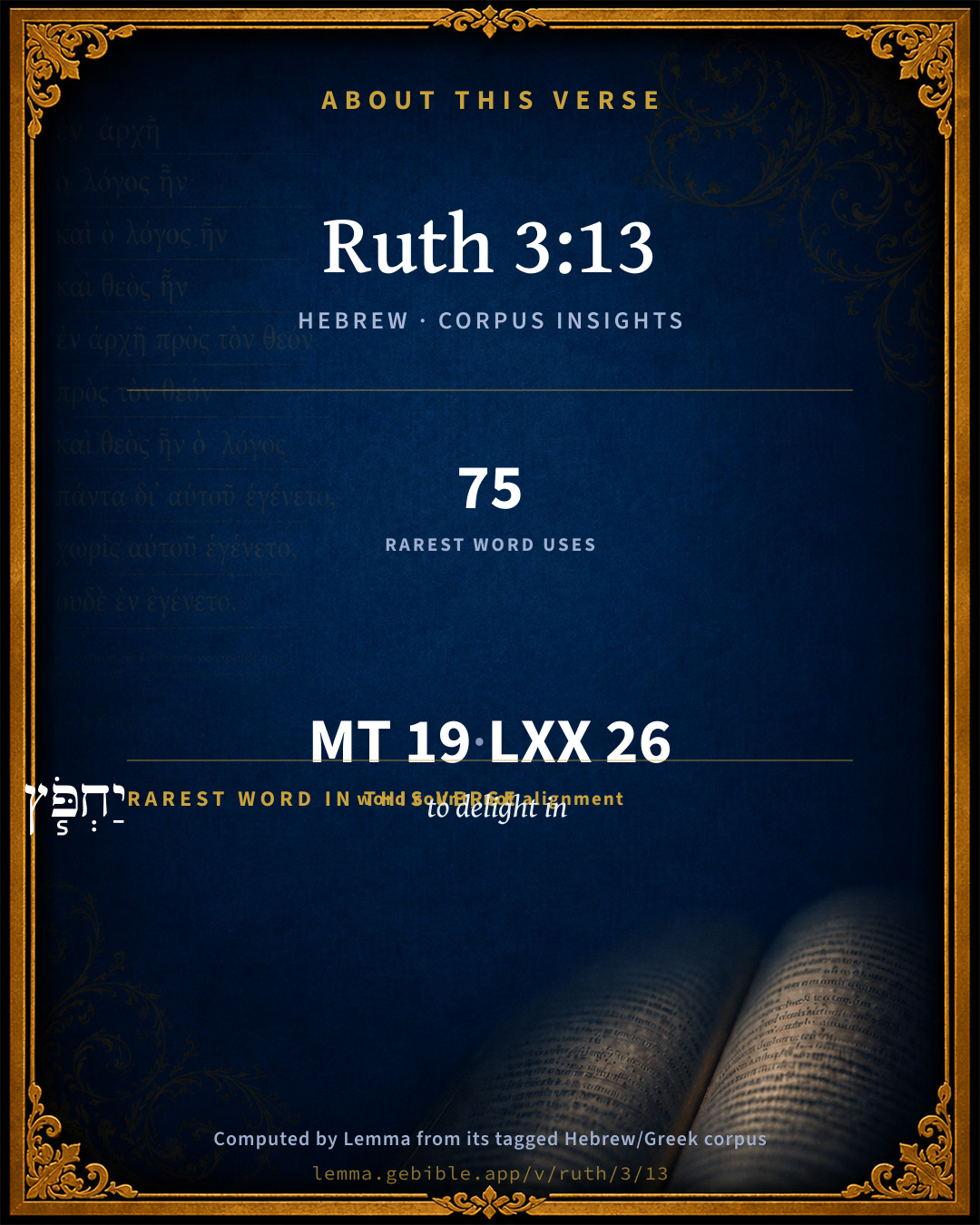
יַחְפֹּ֧ץ
châphêts
H2654
“to delight in”
Verb, Qal, Imperfect, 3rd Person, Masculine, Singular
Part of Speech
Verb
Stem
Qal
Form
Imperfect
Person
3rd Person
Gender
Masculine
Number
Singular
Full BDB Definition

Origin: a primitive root

TWOT: 712 , 713

to delight in, take pleasure in, desire, be pleased with - (Qal) - of men - to take pleasure in, delight in - to delight, desire, be pleased to do - of God - to delight in, have pleasure in - to be pleased to do - to move, bend down - (Qal) to bend down
  1. לִ֣ינִי lûwn H3885 “lodge” Verb, Qal, Imperative, 2nd Person, Feminine, Singular
  2. הַלַּ֗יְלָה layil H3915 “the · night” Particle, Definite Article + Noun, Common, Masculine, Singular, Absolute
  3. וְהָיָ֤ה hâyâh H1961 “and · to be” Conjunction + Verb, Qal, Sequential Perfect, 3rd Person, Masculine, Singular
  4. בַבֹּ֨קֶר֙ bôqer H1242 “in/at the · morning” Preposition, Determined + Noun, Common, Masculine, Singular, Absolute
  5. אִם ʼim H518 “if” Conjunction
  6. יִגְאָלֵ֥ךְ gâʼal H1350 “to redeem · you” Verb, Qal, Imperfect, 3rd Person, Masculine, Singular + Suffix, Personal, 2nd Person, Feminine, Singular
  7. טוֹב֙ ṭôwb H2896 “good” Adjective, Adjective, Masculine, Singular, Absolute
  8. יִגְאָ֔ל gâʼal H1350 “to redeem” Verb, Qal, Imperfect, 3rd Person, Masculine, Singular
  9. וְאִם ʼim H518 “and · if” Conjunction + Conjunction
  10. לֹ֨א lôʼ H3808 “not” Particle, Negative
  11. לְגָֽאֳלֵ֛ךְ gâʼal H1350 “to redeem · you” Preposition + Verb, Qal, Infinitive Construct + Suffix, Personal, 2nd Person, Feminine, Singular
  12. וּגְאַלְתִּ֥יךְ gâʼal H1350 “and · to redeem · you” Conjunction + Verb, Qal, Sequential Perfect, 1st Person, Common, Singular + Suffix, Personal, 2nd Person, Feminine, Singular
  13. אָנֹ֖כִי ʼânôkîy H595 “I” Pronoun, Personal, 1st Person, Common, Singular
  14. חַי chay H2416 “living” Noun, Common, Both, Singular, Absolute
  15. יְהוָ֑ה Yᵉhôvâh H3068 “LORD” Noun, Proper
  16. שִׁכְבִ֖י shâkab H7901 “lie down” Verb, Qal, Imperative, 2nd Person, Feminine, Singular
  17. עַד ʻad H5704 “until” Preposition
  18. הַבֹּֽקֶר bôqer H1242 “the · morning” Particle, Definite Article + Noun, Common, Masculine, Singular, Absolute

About this verse

These counts appear in no published source. They are computed here, from the morphology-tagged text and Lemma’s own curated glosses. What Lemma adds →

19
words
14
distinct lemmas
Historical
section

Grammatical profile

  • 8 verbs
  • 5 nouns
  • 1 adjective
  • 1 pronoun
  • 1 preposition
  • 2 conjunctions
  • 1 particle

Verb forms

  • לִ֣ינִי Qal · Imperative
  • וְהָיָ֤ה Qal · Sequential Perfect
  • יִגְאָלֵ֥ךְ Qal · Imperfect
  • יִגְאָ֔ל Qal · Imperfect
  • יַחְפֹּ֧ץ Qal · Imperfect
  • לְגָֽאֳלֵ֛ךְ Qal · Infinitive Construct
  • וּגְאַלְתִּ֥יךְ Qal · Sequential Perfect
  • שִׁכְבִ֖י Qal · Imperative

Repetition

Words recur within this verse — often emphatic in Hebrew:

  • יִגְאָלֵ֥ךְ to redeem H1350 ×4
  • בַבֹּ֨קֶר֙ morning H1242 ×2
  • אִם if H518 ×2

Hebrew & Septuagint length

In English translation the verse runs 61 words from the Hebrew and 57 from the Septuagint (LXX English) — closely comparable.

A rough comparison of the two English renderings, which tokenize alike — not a word-level alignment.

Word counts can differ between the Hebrew and the Greek without any difference in meaning — e.g. the Hebrew direct-object marker אֵת has no separate Greek word, and Greek often adds the article ὁ.

In the original languages it is 19 Hebrew tokens and 26 Greek tokens — but the two are counted differently (Hebrew bundles its prefixes and suffixes into one token; the Greek is in lemma form), so that isn’t a like-for-like length.

Cross-references

8

Topical passages linked to Ruth 3:13 in the Treasury of Scripture Knowledge — connected by theme and wording, ordered by reader-vote popularity; previews shown in the World English Bible.

  • Ruth 4:5 Then said Boaz, What day you buy the field of the hand of Naomi, you must buy it also of Ruth the Moabitess, the wife of the dead, to raise up the name of the dead on his inheritance.
  • Jeremiah 4:2 and you shall swear, As Yahweh lives, in truth, in justice, and in righteousness; and the nations shall bless themselves in him, and in him shall they glory.
  • Ruth 2:20 Naomi said to her daughter-in-law, Blessed be he of Yahweh, who has not left off his kindness to the living and to the dead. Naomi said to her, The man is a close relative to us, one of our near kinsmen.
  • Deuteronomy 25:5–9 If brothers dwell together, and one of them die, and have no son, the wife of the dead shall not be married outside to a stranger: her husband's brother shall go in to her, and take her to him as wife, and perform the duty of a husband's brother to her.
  • Judges 8:19 He said, They were my brothers, the sons of my mother: as Yahweh lives, if you had saved them alive, I would not kill you.
  • Matthew 22:24–27 saying, "Teacher, Moses said, 'If a man dies, having no children, his brother shall marry his wife, and raise up seed for his brother.'
  • Hebrews 6:16 For men indeed swear by a greater one, and in every dispute of theirs the oath is final for confirmation.
  • 2 Corinthians 1:23 But I call God for a witness to my soul, that I didn't come to Corinth to spare you.

Cross-references courtesy of OpenBible.info (CC BY 4.0).

Hebrew and Greek witnesses Masoretic Hebrew ↔ Greek Septuagint

The same verse in the two great witnesses to the Old Testament, shown verse-for-verse.

These are two independent witnesses, not word-aligned to each other, and the Septuagint is shown in lemma (dictionary) form.

Hebrew Ruth 3:13 Masoretic · Westminster Leningrad Codex

לִ֣ינִי הַלַּ֗יְלָה וְהָיָ֤ה בַבֹּ֨קֶר֙ אִם יִגְאָלֵ֥ךְ טוֹב֙ יִגְאָ֔ל וְאִם לֹ֨א יַחְפֹּ֧ץ לְגָֽאֳלֵ֛ךְ וּגְאַלְתִּ֥יךְ אָנֹ֖כִי חַי יְהוָ֑ה שִׁכְבִ֖י עַד הַבֹּֽקֶר

Stay this night, and it shall be in the morning, that if he will perform to you the part of a kinsman, well; let him do the kinsman's part: but if he will not do the part of a kinsman to you, then will I do the part of a kinsman to you, as Yahweh lives: lie down until the morning.

World English Bible · Public Domain

Greek LXX Ruth 3:13 Septuagint · lemma form

αὐλίζω ὁ νύξ καί εἰμί ὁ πρωί ἐάν ἀγχιστεύω σύ ἀγαθός ἀγχιστεύω ἐάν δέ μή βούλομαι ἀγχιστεύω σύ ἀγχιστεύω σύ ἐγώ ζάω κύριος κοιμάω ἕως πρωί

Lodge here for the night, and it shall be in the morning, if he will do the part of a kinsman to you, well—let him do it: but if he will not do the part of a kinsman to you, I will do the kinsman's part to you, as the Lord lives; lie down till the morning.

LXX2012 (modern English Septuagint) · Public Domain

On this verse, Haydock's Catholic Bible Commentary discusses the Septuagint’s reading. Read the note in Commentary ↓

Hebrew: Westminster Leningrad Codex (CC BY 4.0). Greek: Septuagint (public domain); English from LXX2012 (modern English Septuagint) (Public Domain). How the Septuagint differs from the Hebrew →

Commentary

Notes on Ruth 3:13 from classic Christian and Jewish commentators (each source and its license shown beneath its notes). The classic Christian expositions comment on the surrounding passage and are grouped to its opening verse, so a note may address several verses; the Jewish commentaries on the Tanakh (Rashi and others) are per-verse, so they appear only where the commentator wrote on this verse.

Lemma curates 59 commentaries, every one of them public domain or Creative Commons licensed, each selected and text-cleaned for this edition rather than reprinted as found. About our sources →

Trapp's Complete Commentary

John Trapp

Rth 3:13 Tarry this night, and it shall be in the morning, [that] if he will perform unto thee the part of a kinsman, well; let him do the kinsman’s part: but if he will not do the part of a kinsman to thee, then will I do the part of a kinsman to thee, [as] the LORD liveth: lie down until the morning.

Ver. 13. Tarry this night.] He saith not, Come up hither, for I mind to marry thee: but tarry till morning, lest thou suffer as a night walker, &c. Let none presume to leap into the married estate, or to abuse themselves unchastely before marriage; but deliberate, and be sure to come clear to it, if thou expect comfort.

If he will perform unto thee the part of a kinsman.] Let "no man go beyond, or defraud his brother in any matter, because that the Lord is the avenger of all such," {1Th 4:6} and no man would himself be deceived or wronged.

As the Lord liveth.] This was an oath. {Jer 4:2} A private oath may be taken, but sparingly and warily, not but upon a necessity, for the satisfaction of the other party, {Mat 5:37} and in matters of great importance. Thus Jacob sware to Laban, the spies to Rahab, Jonathan to David, &c. But let such oaths be rare, reverent, well advised, &c.

Lie down until the morning.] She was risen up, it seemeth, to be gone; but he thought it not fit: and found in himself strength, by God’s grace, to resist a temptation; though it be true that

“ Nox et amor vinumque nihil moderabile suadent:

Illa pudore vacat, liber amorque metu. ” - Ovid.

John Trapp, A Commentary or Exposition upon All the Books of the Old and New Testament (1647–1656) — public domain. Text from a community e-Sword module.

Geneva Bible (1599)

Geneva Bible translators

If he will take thee to be his wife by the title of affinity, according to God’s law, Deut. 25:5.

Geneva Bible (1599) marginal notes — public domain. Text via Bolls.life.

Adam Clarke's Commentary

Verse 13. As the Lord liveth] Thus he bound himself by an oath to take her to wife if the other should refuse.

Adam Clarke's Commentary on the Bible (1810–1826) — public domain. Text from a community e-Sword/MySword module.

Ellicott's Commentary for English Readers

(13) Until the morning.—You have made clear the object of your plea, and I fully assent to it; but do not run the risk of going now, in the dead of night, back to your home.

A Bible Commentary for English Readers, edited by Charles John Ellicott (1878–1897) — public domain. Text from a community e-Sword module.

The Cambridge Bible for Schools and Colleges

gen. ed. J. J. S. Perowne

13. Tarry this night] as a precaution against chance perils; see Son_5:7.

The Cambridge Bible for Schools and Colleges (gen. ed. J. J. S. Perowne; Cambridge University Press, 1878–1918) — public domain. Text from a community e-Sword module.

John Gill's Exposition

Tarry this day,.... Or lodge here tonight, where she was; this he said not from any design upon her, but for her own safety and honour, that she might not be exposed to danger or disgrace, by returning home at such an unseasonable time of night. The first letter in the word for "tarry" is larger than usual in the Hebrew text; which may be done to raise the attention of the reader, to observe it as a thing very singular, that a widow should lodge with a man without any diminution of her chastity; so Buxtorf (x) says, that hereby attention is noted, even the honesty of Boaz ordering Ruth to lodge without a man, and wait until a nearer kinsman, according to the law, should come, and promising that on failure thereof he would be the lawful redeemer; but Dr. Lightfoot (y) observes, that as there is a special mark over a word in the story of Lot's eldest daughter lying with her father, Gen 19:34 and a special mark on this word here, in the story of Ruth going to Boaz his bed, seems to relate one to the other, and both together to point at the great providence of God in bringing light out of darkness, Ruth, a mother of Christ, out of the incest of Lot:

and it shall be, in the morning, that if he will perform unto thee the part of a kinsman, well, let him do the kinsman's part; by marrying Ruth, and redeeming her husband's estate, which if he did, it would be all very well, and right according to law; and it would be very well for Ruth, as Aben Ezra and Abendana interpret it; seeing, as they observe, that kinsman was a very respectable man, a man of great esteem and worth, a man of wealth and authority, and she would be well matched to him. Some think, as the same writers observe, that the word "Tob", translated "well", is the name of the kinsman, the same with Tobias; so R. Joshuah says (z), that Salmon (who was the father of Boaz), and Elimelech (the father of Ruth's husband), and Tob (this near kinsman), were brethren:

but if he will not do the part of a kinsman to thee, then will I do the part of a kinsman to thee, as the Lord liveth: that is, he swore he would marry her, and redeem the inheritance, if the other would not; for the phrase, "as the Lord liveth", is the form of an oath, it is swearing by the living God; so the Targum,"I say with an oath before the Lord, that as I have spoken unto thee, so will I do:"

lie down until the morning; and take some sleep and rest, and be at ease in mind, depending upon the performance of what I have promised.

(x) Tiberias, c. 14. p. 38. (y) Works, vol. 1. p. 48. (z) In Midrash Ruth, ut supra. (fol. 31. 4. & 34. 2.)

John Gill's Exposition of the Whole Bible (1746–1763) — public domain (CC PDM 1.0). Text via the HelloAO Bible API.

Haydock's Catholic Bible Commentary

Well. Hebrew tob. (Haydock) --- Hence the Jews would translate, "If Tob will redeem thee, let him." They say that Tob was the paternal uncle of Mahalon: but it is not probable that his proper name should be only here mentioned, and not [in] chap. iv. The Septuagint and Chaldean are conformable to the Vulgate and the opinion of the Jews is abandoned by most interpreters; (Calmet) and by the Protestant, "well, let him do the kinsman’s part." (Haydock) --- Liveth. Chaldean, "Bound by an oath, before the Lord, I say that I will fulfil my promise unto thee."

George Leo Haydock (1774–1849), Haydock's Catholic Family Bible and Commentary, 1859 edition — public domain. Excludes Psalms (Douay-Rheims chapter numbering differs from Protestant) and Deuterocanonical books (Catholic canon only).

Matthew Poole's English Annotations

If he will perform unto thee the part of a kinsman, i.e. take thee to wife, to raise up seed to his brother, as he ought to do.

Matthew Poole's English Annotations on the Holy Bible (1683–1685) — public domain. Text from a community e-Sword/MySword module.

Whedon's Commentary on the Bible

Daniel D. Whedon

13. Tarry this night — For it would have been dangerous for her to return alone to the city in the darkness of midnight; but in the early morning, before one can readily recognise another, women may be seen in the East going forth on some errand or work.

Daniel D. Whedon (gen. ed.), Commentary on the Old and New Testaments (1874–1909) — public domain. Text from a community e-Sword module.

The Pulpit Commentary

Abide here tonight; and it shall come to pass in the morning, if he will act to thee the part of a kinsman, well; he shall act the kinsman"s part: and if it please him not to act to thee the kinsman"s part, then sure as Yahveh is alive, I will act to thee the kinsman"s part. Lie still till the morning. Love is quick-witted. Boaz"s plan of operations would formulate itself on the spur of the moment; but the remainder of the night would doubtless be spent in maturing the details of procedure. The aim would be to secure, as far as honor would permit, the much-wished-for prize. There would be, moreover, we need not doubt, much conversation between them, and mutual consultation, and arrangement. A large letter, a majuscula, occurs in the first word of the verse yniyli which the smaller Masora ascribes to the Oriental or

Babylonian textualists. It had, no doubt, been at first either a merely accidental, or a finically capricious, enlargement; but, being found, mysteries had to be ex-cogitated to account for it; all mere rubbish. "Tonight" is a perfect translation of hlyLh, for the to is simply the common definite article in one of its peculiar forms, perhaps peculiarly crushed and defaced. (see note on Rth_3:2)

Boaz"s mind still runs on the lines of a kinsman"s duty. There was hence something that might be thrust in between the desires of his heart and the object toward whom they trembled.

The Pulpit Commentary (1880–1919), ed. H.D.M. Spence-Jones & Joseph S. Exell — public domain. Text from a community e-Sword module.

John Wesley's Explanatory Notes

Perform, &c. - Take thee to wife, to raise up seed to his brother. Bishop Hall sums up the matter thus. "Boaz, instead of touching her as a wanton, blesseth her as a father, encourages her as a friend, promises her as a kinsman, rewards her as a patron, and sends her away laden with hopes and gifts, no less chast, but more happy than she came. O admirable temperance, worthy the progenitor of him, in whose lips and heart there was no guile!"

John Wesley, Explanatory Notes Upon the Whole Bible (1754–1765) — public domain. Text via the GEBible commentary corpus.

Rashi

Rabbi Shlomo Yitzchaki (Rashi)

Stay over tonight stay over without a husband.

as the Lord lives She said to him, “You are dismissing me with words.” He jumped up and swore to her that he would not dismiss her with words. Some of our Rabbis said: He swore to his evil inclination, for his evil inclination was contending with him, “You are single, and she is single; be intimate with her”; so he swore that he would be intimate with her only in marriage.

Rashi on the Tanakh — English translations: “The Judaica Press complete Tanach with Rashi, translated by A. J. Rosenberg” (CC BY 4.0); “Pentateuch with Rashi's commentary by M. Rosenbaum and A.M. Silbermann, 1929-1934” (public domain); “The Metsudah Tanach series, Lakewood, N.J” (CC BY 4.0); and “The Book of Joshua, Metsudah Publications, 1997” (CC BY 4.0). Text via Sefaria.

Ibn Ezra

Rabbi Abraham ibn Ezra

"אם יגאלך טוב (if he will perform to thee the part of a kinsman, well):" Some say that "טוב" (Tov) was the name of the kinsman. However, if this were so, why does the text in the scroll later say, "Turn aside, sit down here, Ploni Almoni" (a certain someone)? Rather, its meaning is, if the kinsman will redeem you, it is good for you that he should redeem, because he is an important person.

Ibn Ezra on the Tanakh — English translations: “Sefaria Community Translation” (CC0 1.0 (public-domain dedication)); “Yalkut, Sifsei Chachomim Chumash, Metsudah Publications, 2009” (CC BY 4.0); and “Commentary of Ibn Ezra on Isaiah - trans. by M. Friedlander, 1873” (public domain). Text via Sefaria.

Lesson kit

Teaching starters — assembled from the data on this page, not authored interpretation. Every prompt links to the verse data it draws on. Edit before teaching.

Ruth, in the Historical, opens this verse with 19 words (14 distinct Hebrew lemmas). Its most distinctive word is châphêts (“to delight in”). A historical commentator’s framing appears above. Read the whole chapter for the surrounding context.

Discussion questions

  1. How does “to delight in” (châphêts) shape what this verse is saying?
  2. Ruth 4:5 shares this passage’s theme. How do the two illuminate each other?
  3. “to redeem” occurs 4× in this one verse. What is the effect of the repetition?
  4. These translations render this verse differently. What is at stake in choosing one wording over another?
  5. The verb «לִ֣ינִי» is Qal Imperative. How does its form color the action?
  6. Reading how Trapp's Complete Commentary and Geneva Bible (1599) read this verse, where do the two commentators agree and where do they part?

Things to notice

Reading settings

Reading text

Shown beneath each verse's original-language words.

Old Testament
Old Testament edition

Read the OT as the Masoretic Hebrew (MT) or the Greek Septuagint (LXX).

English shown for the Greek Septuagint (in the Hebrew ↔ Greek comparison).

Comparing translations? Open the Compare panel on any verse page to stack up to four side by side.