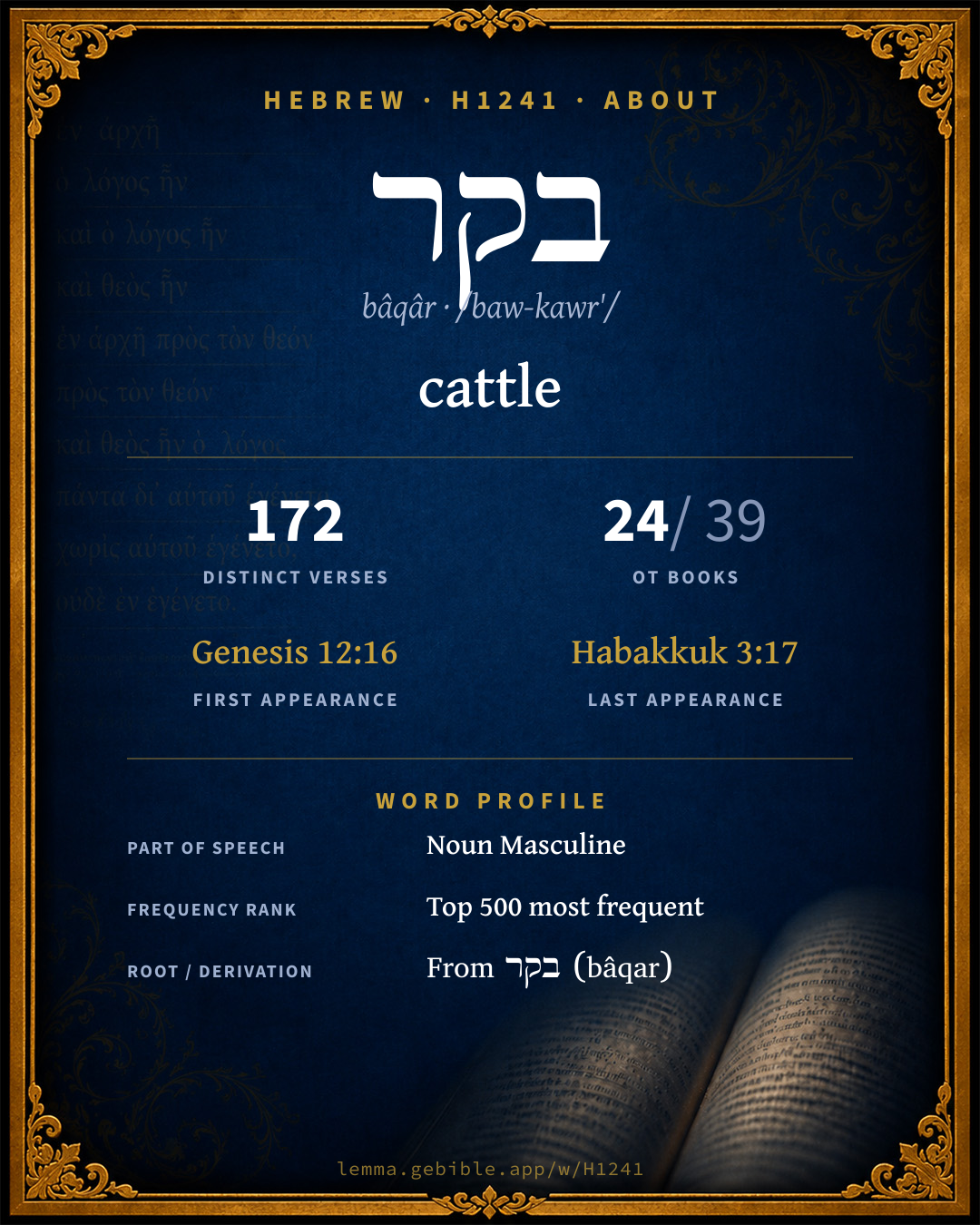
בָּקָר
cattle
also: herd, oxen, ox fuller range ↓
Full lexicon entry — Brown-Driver-Briggs (BDB)
From Brown-Driver-Briggs (BDB)
Where this word appears
See every Absolute-state word in the Hebrew Bible →
Grammar key — what these labels mean
Part of speech
- Noun
- A naming word — a person, place, thing, or idea.
Noun type
- Common
- A common noun — a general class of person, place, or thing (“king,” “city,” “water”), not a specific name.
State
- Absolute
- The independent form of a noun, not bound to a following word.
- Construct
- A noun bound to a following noun in a possessive / “of” relationship (the construct chain).
Gender
- Both
- Attested as both masculine and feminine.
Number
- Singular
- One.
- Plural
- More than one (in Hebrew, generally three or more).
Grammatical forms
- Noun, Common, Both, Singular, Absolute 159 times (87%)
- Noun, Common, Both, Singular, Construct 21 times (11%)
- Noun, Common, Both, Plural, Absolute 2 times (1%)
- Noun, Common, Both, Plural, Construct 1 time (1%)
Parsed forms decoded from the imported morphology (morphhb / Westminster Leningrad Codex — WLC text public domain, morphhb tagging CC BY 4.0), counted across 183 parsed occurrences — not distinct verses.
Every verse where H1241 appears — 172 distinct verses across 24 books. Click any verse to open its interlinear word-by-word view. Verse text shown in the World English Bible for context — . Each verse’s Hebrew form is shown with its reference; the English is not keyword-highlighted, since the data carries no word-level English alignment. Use “Compare translations” on any verse to read it across multiple English versions. This concordance covers the Hebrew Bible; Septuagint (Greek Old Testament) occurrences are not indexed here.
Genesis 16 verses
- Genesis 12:16 וּ/בָקָר֙ conj + n c bs He dealt well with Abram for her sake. He had sheep, and oxen, and male donkeys, and men-servants, and maid-servants, and female donkeys, and camels.
- Genesis 13:5 וּ/בָקָ֖ר conj + n c bs Lot also, who went with Abram, had flocks, and herds, and tents.
- Genesis 18:7 הַ/בָּקָ֖ר בָּקָ֜ר ptcl def.art + n c bs n c bs Abraham ran to the herd, and fetched a tender and good calf, and gave it to the servant. He hurried to dress it.
- Genesis 18:8 הַ/בָּקָר֙ ptcl def.art + n c bs He took butter, milk, and the calf which he had dressed, and set it before them. He stood by them under the tree, and they ate.
- Genesis 20:14 וּ/בָקָ֗ר conj + n c bs Abimelech took sheep and oxen, men-servants and women-servants, and gave them to Abraham, and restored Sarah, his wife to him.
- Genesis 21:27 וּ/בָקָ֔ר conj + n c bs Abraham took sheep and oxen, and gave them to Abimelech. Those two made a covenant.
- Genesis 24:35 וּ/בָקָר֙ conj + n c bs Yahweh has blessed my master greatly. He has become great. He has given him flocks and herds, silver and gold, men-servants and maid-servants, and camels and donkeys.
- Genesis 26:14 בָקָ֔ר n c bs He had possessions of flocks, possessions of herds, and a great household. The Philistines envied him.
- Genesis 32:7 הַ/בָּקָ֛ר ptcl def.art + n c bs Then Jacob was greatly afraid and was distressed: and he divided the people who were with him, and the flocks, and the herds, and the camels, into two companies;
- Genesis 33:13 וְ/הַ/בָּקָ֖ר conj + ptcl def.art + n c bs Jacob said to him, "My lord knows that the children are tender, and that the flocks and herds with me have their young, and if they overdrive them one day, all the flocks will die.
- Genesis 34:28 בְּקָרָ֖/ם n c bs cs + sfx pers 3mp They took their flocks, their herds, their donkeys, that which was in the city, that which was in the field;
- Genesis 45:10 וּ/בְקָרְ/ךָ֖ conj + n c bs cs + sfx pers 2ms You shall dwell in the land of Goshen, and you will be near to me, you, your children, your children's children, your flocks, your herds, and all that you have.
- Genesis 46:32 וּ/בְקָרָ֛/ם conj + n c bs cs + sfx pers 3mp These men are shepherds, for they have been keepers of cattle, and they have brought their flocks, and their herds, and all that they have.'
- Genesis 47:1 וּ/בְקָרָ/ם֙ conj + n c bs cs + sfx pers 3mp Then Joseph went in and told Pharaoh, and said, "My father and my brothers, with their flocks, their herds, and all that they own, have come out of the land of Canaan; and, behold, they are in the land of Goshen."
- Genesis 47:17 הַ/בָּקָ֖ר ptcl def.art + n c bs They brought their cattle to Joseph, and Joseph gave them bread in exchange for the horses, and for the flocks, and for the herds, and for the donkeys: and he fed them with bread in exchange for all their cattle for that year.
- Genesis 50:8 וּ/בְקָרָ֔/ם conj + n c bs cs + sfx pers 3mp all the house of Joseph, his brothers, and his father's house. Only their little ones, their flocks, and their herds, they left in the land of Goshen.
Exodus 9 verses
- Exodus 9:3 בַּ/בָּקָ֖ר prep det + n c bs behold, the hand of Yahweh is on your cattle which are in the field, on the horses, on the donkeys, on the camels, on the herds, and on the flocks with a very grievous pestilence.
- Exodus 10:9 וּ/בִ/בְקָרֵ֨/נוּ֙ conj + prep + n c bs cs + sfx pers 1cp Moses said, "We will go with our young and with our old; with our sons and with our daughters, with our flocks and with our herds will we go; for we must hold a feast to Yahweh."
- Exodus 10:24 וּ/בְקַרְ/כֶ֖ם conj + n c bs cs + sfx pers 2mp Pharaoh called to Moses, and said, "Go, serve Yahweh. Only let your flocks and your herds stay behind. Let your little ones also go with you."
- Exodus 12:32 בְּקַרְ/כֶ֥ם n c bs cs + sfx pers 2mp Take both your flocks and your herds, as you have said, and be gone; and bless me also!"
- Exodus 12:38 וּ/בָקָ֔ר conj + n c bs A mixed multitude went up also with them, with flocks, herds, and even very much cattle.
- Exodus 20:24 בְּקָרֶ֑/ךָ n c bs cs + sfx pers 2ms You shall make an altar of earth for me, and shall sacrifice on it your burnt offerings and your peace-offerings, your sheep and your oxen. In every place where I record my name I will come to you and I will bless you.
- Exodus 22:1 בָקָ֗ר n c bs "If a man steals an ox or a sheep, and kills it, or sells it; he shall pay five oxen for an ox, and four sheep for a sheep.
- Exodus 29:1 בָּקָ֛ר n c bs "This is the thing that you shall do to them to make them holy, to minister to me in the priest's office: take one young bull and two rams without blemish,
- Exodus 34:3 וְ/הַ/בָּקָר֙ conj + ptcl def.art + n c bs No one shall come up with you; neither let anyone be seen throughout all the mountain; neither let the flocks nor herds feed before that mountain."
Leviticus 12 verses
- Leviticus 1:2 הַ/בָּקָר֙ ptcl def.art + n c bs "Speak to the children of Israel, and tell them, 'When anyone of you offers an offering to Yahweh, you shall offer your offering of the cattle, from the herd and from the flock.
- Leviticus 1:3 הַ/בָּקָ֔ר ptcl def.art + n c bs "'If his offering is a burnt offering from the herd, he shall offer a male without blemish. He shall offer it at the door of the Tent of Meeting, that he may be accepted before Yahweh.
- Leviticus 1:5 הַ/בָּקָ֖ר ptcl def.art + n c bs He shall kill the bull before Yahweh. Aaron's sons, the priests, shall present the blood and sprinkle the blood around on the altar that is at the door of the Tent of Meeting.
- Leviticus 3:1 הַ/בָּקָר֙ ptcl def.art + n c bs "'If his offering is a sacrifice of peace offerings; if he offers it from the herd, whether male or female, he shall offer it without blemish before Yahweh.
- Leviticus 4:3 בָּקָ֥ר n c bs if the anointed priest sins so as to bring guilt on the people, then let him offer for his sin, which he has sinned, a young bull without blemish to Yahweh for a sin offering.
- Leviticus 4:14 בָּקָר֙ n c bs when the sin in which they have sinned is known, then the assembly shall offer a young bull for a sin offering, and bring it before the Tent of Meeting.
- Leviticus 9:2 בָּקָ֧ר n c bs and he said to Aaron, "Take a calf from the herd for a sin offering, and a ram for a burnt offering, without blemish, and offer them before Yahweh.
- Leviticus 16:3 בָּקָ֛ר n c bs "Herewith shall Aaron come into the sanctuary: with a young bull for a sin offering, and a ram for a burnt offering.
- Leviticus 22:19 בַּ/בָּקָ֕ר prep det + n c bs that you may be accepted, you shall offer a male without blemish, of the bulls, of the sheep, or of the goats.
- Leviticus 22:21 בַּ/בָּקָ֖ר prep det + n c bs Whoever offers a sacrifice of peace offerings to Yahweh to accomplish a vow, or for a freewill offering, of the herd or of the flock, it shall be perfect to be accepted; there shall be no blemish therein.
- Leviticus 23:18 בָּקָ֛ר n c bs You shall present with the bread seven lambs without blemish a year old, one young bull, and two rams. Yhey shall be a burnt offering to Yahweh, with their meal offering, and their drink offerings, even an offering made by fire, of a sweet aroma to Yahweh.
- Leviticus 27:32 בָּקָר֙ n c bs All the tithe of the herds or the flocks, whatever passes under the rod, the tenth shall be holy to Yahweh.
Numbers 49 verses
- Numbers 7:3 בָּקָ֔ר n c bs and they brought their offering before Yahweh, six covered wagons, and twelve oxen; a wagon for every two of the princes, and for each one an ox: and they presented them before the tabernacle.
- Numbers 7:6 הַ/בָּקָ֑ר ptcl def.art + n c bs Moses took the wagons and the oxen, and gave them to the Levites.
- Numbers 7:7 הַ/בָּקָ֔ר ptcl def.art + n c bs He gave two wagons and four oxen to the sons of Gershon, according to their service:
- Numbers 7:8 הַ/בָּקָ֔ר ptcl def.art + n c bs and he gave four wagons and eight oxen to the sons of Merari, according to their service, under the direction of Ithamar the son of Aaron the priest.
- Numbers 7:15 בָּקָ֗ר n c bs one young bull, one ram, one male lamb a year old, for a burnt offering;
- Numbers 7:17 בָּקָ֣ר n c bs and for the sacrifice of peace offerings, two oxen, five rams, five male goats, and five male lambs a year old. This was the offering of Nahshon the son of Amminadab.
- Numbers 7:21 בָּקָ֗ר n c bs one young bull, one ram, one male lamb a year old, for a burnt offering;
- Numbers 7:23 בָּקָ֣ר n c bs and for the sacrifice of peace offerings, two oxen, five rams, five male goats, five male lambs a year old. This was the offering of Nethanel the son of Zuar.
- Numbers 7:27 בָּקָ֗ר n c bs one young bull, one ram, one male lamb a year old, for a burnt offering;
- Numbers 7:29 בָּקָ֣ר n c bs and for the sacrifice of peace offerings, two oxen, five rams, five male goats, and five male lambs a year old. This was the offering of Eliab the son of Helon.
- Numbers 7:33 בָּקָ֗ר n c bs one young bull, one ram, one male lamb a year old, for a burnt offering;
- Numbers 7:35 בָּקָ֣ר n c bs and for the sacrifice of peace offerings, two oxen, five rams, five male goats, and five male lambs a year old. This was the offering of Elizur the son of Shedeur.
- Numbers 7:39 בָּקָ֗ר n c bs one young bull, one ram, one male lamb a year old, for a burnt offering;
- Numbers 7:41 בָּקָ֣ר n c bs and for the sacrifice of peace offerings, two oxen, five rams, five male goats, and five male lambs a year old: this was the offering of Shelumiel the son of Zurishaddai.
- Numbers 7:45 בָּקָ֗ר n c bs one young bull, one ram, one male lamb a year old, for a burnt offering;
- Numbers 7:47 בָּקָ֣ר n c bs and for the sacrifice of peace offerings, two oxen, five rams, five male goats, and five male lambs a year old. This was the offering of Eliasaph the son of Deuel.
- Numbers 7:51 בָּקָ֗ר n c bs one young bull, one ram, one male lamb a year old, for a burnt offering;
- Numbers 7:53 בָּקָ֣ר n c bs and for the sacrifice of peace offerings, two oxen, five rams, five male goats, and five male lambs a year old. This was the offering of Elishama the son of Ammihud.
- Numbers 7:57 בָּקָ֗ר n c bs one young bull, one ram, one male lamb a year old, for a burnt offering;
- Numbers 7:59 בָּקָ֣ר n c bs and for the sacrifice of peace offerings, two oxen, five rams, five male goats, and five male lambs a year old. This was the offering of Gamaliel the son of Pedahzur.
- Numbers 7:63 בָּקָ֗ר n c bs one young bull, one ram, one male lamb a year old, for a burnt offering;
- Numbers 7:65 בָּקָ֣ר n c bs and for the sacrifice of peace offerings, two oxen, five rams, five male goats, and five male lambs a year old. This was the offering of Abidan the son of Gideoni.
- Numbers 7:69 בָּקָ֗ר n c bs one young bull, one ram, one male lamb a year old, for a burnt offering;
- Numbers 7:71 בָּקָ֣ר n c bs and for the sacrifice of peace offerings, two oxen, five rams, five male goats, and five male lambs a year old. This was the offering of Ahiezer the son of Ammishaddai.
- Numbers 7:75 בָּקָ֗ר n c bs one young bull, one ram, one male lamb a year old, for a burnt offering;
- Numbers 7:77 בָּקָ֣ר n c bs and for the sacrifice of peace offerings, two oxen, five rams, five male goats, and five male lambs a year old. This was the offering of Pagiel the son of Ochran.
- Numbers 7:81 בָּקָ֗ר n c bs one young bull, one ram, one male lamb a year old, for a burnt offering;
- Numbers 7:83 בָּקָ֣ר n c bs and for the sacrifice of peace offerings, two oxen, five rams, five male goats, and five male lambs a year old. This was the offering of Ahira the son of Enan.
- Numbers 7:87 הַ/בָּקָ֨ר ptcl def.art + n c bs all the oxen for the burnt offering twelve bulls, the rams twelve, the male lambs a year old twelve, and their meal offering; and the male goats for a sin offering twelve;
- Numbers 7:88 בְּקַ֣ר n c bs cs and all the oxen for the sacrifice of peace offerings twenty-four bulls, the rams sixty, the male goats sixty, the male lambs a year old sixty. This was the dedication of the altar, after it was anointed.
- Numbers 8:8 בָּקָ֔ר בָּקָ֖ר n c bs n c bs Then let them take a young bull, and its meal offering, fine flour mixed with oil; and another young bull you shall take for a sin offering.
- Numbers 11:22 וּ/בָקָ֛ר conj + n c bs Shall flocks and herds be slain for them, to suffice them? or shall all the fish of the sea be gathered together for them, to suffice them?
- Numbers 15:3 הַ/בָּקָ֖ר ptcl def.art + n c bs and will make an offering by fire to Yahweh, a burnt offering, or a sacrifice, to accomplish a vow, or as a freewill-offering, or in your set feasts, to make a sweet savor to Yahweh, of the herd, or of the flock;
- Numbers 15:8 בָּקָ֖ר n c bs When you prepare a bull for a burnt offering, or for a sacrifice, to accomplish a vow, or for peace-offerings to Yahweh;
- Numbers 15:9 הַ/בָּקָר֙ ptcl def.art + n c bs then shall he offer with the bull a meal-offering of three tenth parts [of an ephah] of fine flour mixed with half a hin of oil:
- Numbers 15:24 בָּקָר֩ n c bs then it shall be, if it be done unwittingly, without the knowledge of the congregation, that all the congregation shall offer one young bull for a burnt offering, for a sweet savor to Yahweh, with the meal-offering of it, and the drink-offering of it, according to the ordinance, and one male goat for a sin-offering.
- Numbers 22:40 בָּקָ֣ר n c bs Balak sacrificed oxen and sheep, and sent to Balaam, and to the princes who were with him.
- Numbers 28:11 בָקָ֤ר n c bs In the beginnings of your months you shall offer a burnt offering to Yahweh: two young bulls, and one ram, seven he-lambs a year old without blemish;
- Numbers 28:19 בָקָ֛ר n c bs but you shall offer an offering made by fire, a burnt offering to Yahweh: two young bulls, and one ram, and seven he-lambs a year old; they shall be to you without blemish;
- Numbers 28:27 בָקָ֛ר n c bs but you shall offer a burnt offering for a sweet savor to Yahweh: two young bulls, one ram, seven he-lambs a year old;
- Numbers 29:2 בָּקָ֛ר n c bs You shall offer a burnt offering for a sweet savor to Yahweh: one young bull, one ram, seven he-lambs a year old without blemish;
- Numbers 29:8 בָּקָ֛ר n c bs but you shall offer a burnt offering to Yahweh for a sweet savor: one young bull, one ram, seven he-lambs a year old; they shall be to you without blemish;
- Numbers 29:13 בָקָ֛ר n c bs and you shall offer a burnt offering, an offering made by fire, of a sweet savor to Yahweh; thirteen young bulls, two rams, fourteen he-lambs a year old; they shall be without blemish;
- Numbers 29:17 בָקָ֛ר n c bs On the second day [you shall offer] twelve young bulls, two rams, fourteen he-lambs a year old without blemish;
- Numbers 31:28 הַ/בָּקָ֔ר ptcl def.art + n c bs Levy a tribute to Yahweh of the men of war who went out to battle: one soul of five hundred, [both] of the persons, and of the oxen, and of the donkeys, and of the flocks:
- Numbers 31:30 הַ/בָּקָ֛ר ptcl def.art + n c bs Of the children of Israel's half, you shall take one drawn out of every fifty, of the persons, of the oxen, of the donkeys, and of the flocks, [even] of all the cattle, and give them to the Levites, who keep the charge of the tent of Yahweh.
- Numbers 31:33 וּ/בָקָ֕ר conj + n c bs and seventy-two thousand oxen,
- Numbers 31:38 וְ/הַ֨/בָּקָ֔ר conj + ptcl def.art + n c bs The oxen were thirty-six thousand; of which Yahweh's tribute was seventy-two.
- Numbers 31:44 וּ/בָקָ֕ר conj + n c bs and thirty-six thousand oxen,
Deuteronomy 10 verses
- Deuteronomy 8:13 וּ/בְקָֽרְ/ךָ֤ conj + n c bs cs + sfx pers 2ms and when your herds and your flocks multiply, and your silver and your gold is multiplied, and all that you have is multiplied;
- Deuteronomy 12:6 בְּקַרְ/כֶ֖ם n c bs cs + sfx pers 2mp and there you shall bring your burnt offerings, and your sacrifices, and your tithes, and the heave-offering of your hand, and your vows, and your freewill-offerings, and the firstborn of your herd and of your flock:
- Deuteronomy 12:17 בְּקָרְ/ךָ֖ n c bs cs + sfx pers 2ms You may not eat within your gates the tithe of your grain, or of your new wine, or of your oil, or the firstborn of your herd or of your flock, nor any of your vows which you vow, nor your freewill-offerings, nor the heave-offering of your hand;
- Deuteronomy 12:21 מִ/בְּקָרְ/ךָ֣ prep + n c bs cs + sfx pers 2ms If the place which Yahweh your God shall choose, to put his name there, be too far from you, then you shall kill of your herd and of your flock, which Yahweh has given you, as I have commanded you; and you may eat within your gates, after all the desire of your soul.
- Deuteronomy 14:23 בְּקָרְ/ךָ֖ n c bs cs + sfx pers 2ms You shall eat before Yahweh your God, in the place which he shall choose, to cause his name to dwell there, the tithe of your grain, of your new wine, and of your oil, and the firstborn of your herd and of your flock; that you may learn to fear Yahweh your God always.
- Deuteronomy 14:26 בַּ/בָּקָ֣ר prep det + n c bs and you shall bestow the money for whatever your soul desires, for oxen, or for sheep, or for wine, or for strong drink, or for whatever your soul asks of you; and you shall eat there before Yahweh your God, and you shall rejoice, you and your household.
- Deuteronomy 15:19 בִּ/בְקָרְ/ךָ֤ prep + n c bs cs + sfx pers 2ms All the firstborn males that are born of your herd and of your flock you shall sanctify to Yahweh your God: you shall do no work with the firstborn of your herd, nor shear the firstborn of your flock.
- Deuteronomy 16:2 וּ/בָקָ֑ר conj + n c bs You shall sacrifice the Passover to Yahweh your God, of the flock and the herd, in the place which Yahweh shall choose, to cause his name to dwell there.
- Deuteronomy 21:3 בָּקָ֗ר n c bs and it shall be, that the city which is nearest to the slain man, even the elders of that city shall take a heifer of the herd, which hasn't been worked with, and which has not drawn in the yoke;
- Deuteronomy 32:14 בָּקָ֜ר n c bs Butter of the herd, and milk of the flock, With fat of lambs, Rams of the breed of Bashan, and goats, With the finest of the wheat; Of the blood of the grape you drank wine.
Judges 1 verse
1 Samuel 10 verses
- 1 Samuel 11:5 הַ/בָּקָר֙ ptcl def.art + n c bs Behold, Saul came following the oxen out of the field; and Saul said, What ails the people that they weep? They told him the words of the men of Jabesh.
- 1 Samuel 11:7 בָּקָ֜ר לִ/בְקָר֑/וֹ n c bs prep + n c bs cs + sfx pers 3ms He took a yoke of oxen, and cut them in pieces, and sent them throughout all the borders of Israel by the hand of messengers, saying, Whoever doesn't come forth after Saul and after Samuel, so shall it be done to his oxen. The dread of Yahweh fell on the people, and they came out as one man.
- 1 Samuel 14:32 וּ/בָקָ֛ר בָקָ֖ר conj + n c bs n c bs and the people flew on the spoil, and took sheep, and oxen, and calves, and killed them on the ground; and the people ate them with the blood.
- 1 Samuel 15:9 וְ/הַ/בָּקָ֨ר conj + ptcl def.art + n c bs But Saul and the people spared Agag, and the best of the sheep, and of the oxen, and of the fatlings, and the lambs, and all that was good, and wouldn't utterly destroy them: but everything that was vile and refuse, that they destroyed utterly.
- 1 Samuel 15:14 הַ/בָּקָ֔ר ptcl def.art + n c bs Samuel said, What means then this bleating of the sheep in my ears, and the lowing of the oxen which I hear?
- 1 Samuel 15:15 וְ/הַ/בָּקָ֔ר conj + ptcl def.art + n c bs Saul said, They have brought them from the Amalekites: for the people spared the best of the sheep and of the oxen, to sacrifice to Yahweh your God; and the rest we have utterly destroyed.
- 1 Samuel 15:21 וּ/בָקָ֖ר conj + n c bs But the people took of the spoil, sheep and oxen, the chief of the devoted things, to sacrifice to Yahweh your God in Gilgal.
- 1 Samuel 16:2 בָּקָר֙ n c bs Samuel said, How can I go? if Saul hear it, he will kill me. Yahweh said, Take a heifer with you, and say, I am come to sacrifice to Yahweh.
- 1 Samuel 27:9 וּ/בָקָ֜ר conj + n c bs David struck the land, and saved neither man nor woman alive, and took away the sheep, and the oxen, and the donkeys, and the camels, and the clothing; and he returned, and came to Achish.
- 1 Samuel 30:20 וְ/הַ/בָּקָ֑ר conj + ptcl def.art + n c bs David took all the flocks and the herds, [which] they drove before those [other] cattle, and said, This is David's spoil.
2 Samuel 6 verses
- 2 Samuel 6:6 הַ/בָּקָֽר ptcl def.art + n c bs When they came to the threshing floor of Nacon, Uzzah put forth [his hand] to the ark of God, and took hold of it; for the oxen stumbled.
- 2 Samuel 12:2 וּ/בָקָ֖ר conj + n c bs The rich man had very many flocks and herds,
- 2 Samuel 12:4 וּ/מִ/בְּקָר֔/וֹ conj + prep + n c bs cs + sfx pers 3ms A traveler came to the rich man, and he spared to take of his own flock and of his own herd, to dress for the wayfaring man who had come to him, but took the poor man's lamb, and dressed it for the man who had come to him."
- 2 Samuel 17:29 בָּקָ֔ר n c bs and honey, and butter, and sheep, and cheese of the herd, for David, and for the people who were with him, to eat: for they said, The people are hungry, and weary, and thirsty, in the wilderness.
- 2 Samuel 24:22 הַ/בָּקָ֣ר הַ/בָּקָ֖ר ptcl def.art + n c bs ptcl def.art + n c bs Araunah said to David, Let my lord the king take and offer up what seems good to him: behold, the oxen for the burnt offering, and the threshing instruments and the yokes of the oxen for the wood:
- 2 Samuel 24:24 הַ/בָּקָ֔ר ptcl def.art + n c bs The king said to Araunah, No; but I will most assuredly buy it of you at a price. Neither will I offer burnt-offerings to Yahweh my God which cost me nothing. So David bought the threshing floor and the oxen for fifty shekels of silver.
1 Kings 9 verses
- 1 Kings 1:9 וּ/בָקָר֙ conj + n c bs Adonijah killed sheep and oxen and fatlings by the stone of Zoheleth, which is beside En Rogel; and he called all his brothers, the king's sons, and all the men of Judah, the king's servants:
- 1 Kings 4:23 בָקָ֜ר בָּקָ֛ר n c bs n c bs ten fat oxen, and twenty oxen out of the pastures, and one hundred sheep, besides harts, and gazelles, and roebucks, and fattened fowl.
- 1 Kings 7:25 בָּקָ֗ר n c bs It stood on twelve oxen, three looking toward the north, and three looking toward the west, and three looking toward the south, and three looking toward the east; and the sea was set on them above, and all their hinder parts were inward.
- 1 Kings 7:29 בָּקָר֙ וְ/לַ/בָּקָ֔ר n c bs conj + prep det + n c bs and on the panels that were between the ledges were lions, oxen, and cherubim; and on the ledges there was a pedestal above; and beneath the lions and oxen were wreaths of hanging work.
- 1 Kings 7:44 הַ/בָּקָ֥ר ptcl def.art + n c bs and the one sea, and the twelve oxen under the sea;
- 1 Kings 8:5 וּ/בָקָ֔ר conj + n c bs King Solomon and all the congregation of Israel, who were assembled to him, were with him before the ark, sacrificing sheep and oxen, that could not be counted nor numbered for multitude.
- 1 Kings 8:63 בָּקָ֗ר n c bs Solomon offered for the sacrifice of peace-offerings, which he offered to Yahweh, two and twenty thousand oxen, and one hundred twenty thousand sheep. So the king and all the children of Israel dedicated the house of Yahweh.
- 1 Kings 19:20 הַ/בָּקָ֗ר ptcl def.art + n c bs He left the oxen, and ran after Elijah, and said, Let me, I pray you, kiss my father and my mother, and then I will follow you. He said to him, Go back again; for what have I done to you?
- 1 Kings 19:21 הַ/בָּקָ֣ר הַ/בָּקָר֙ ptcl def.art + n c bs ptcl def.art + n c bs He returned from following him, and took the yoke of oxen, and killed them, and boiled their flesh with the instruments of the oxen, and gave to the people, and they ate. Then he arose, and went after Elijah, and ministered to him.
2 Kings 2 verses
- 2 Kings 5:26 וּ/בָקָ֔ר conj + n c bs He said to him, Didn't my heart go with you, when the man turned from his chariot to meet you? Is it a time to receive money, and to receive garments, and olive groves and vineyards, and sheep and oxen, and men-servants and maid-servants?
- 2 Kings 16:17 הַ/בָּקָ֥ר ptcl def.art + n c bs King Ahaz cut off the panels of the bases, and removed the basin from off them, and took down the sea from off the brazen oxen that were under it, and put it on a pavement of stone.
1 Chronicles 4 verses
- 1 Chronicles 12:40 וּֽ/בַ/בָּקָ֡ר וּ/בָקָ֥ר conj + prep det + n c bs conj + n c bs Moreover those who were near to them, [even] as far as Issachar and Zebulun and Naphtali, brought bread on donkeys, and on camels, and on mules, and on oxen, food of meal, cakes of figs, and clusters of raisins, and wine, and oil, and oxen, and sheep in abundance: for there was joy in Israel.
- 1 Chronicles 13:9 הַ/בָּקָֽר ptcl def.art + n c bs When they came to the threshing floor of Chidon, Uzza put forth his hand to hold the ark; for the oxen stumbled.
- 1 Chronicles 21:23 הַ/בָּקָ֜ר ptcl def.art + n c bs Ornan said to David, Take it to you, and let my lord the king do that which is good in his eyes: behold, I give [you] the oxen for burnt offerings, and the threshing instruments for wood, and the wheat for the meal-offering; I give it all.
- 1 Chronicles 27:29 הַ/בָּקָר֙ הַ/בָּקָר֙ ptcl def.art + n c bs ptcl def.art + n c bs and over the herds that fed in Sharon was Shitrai the Sharonite: and over the herds that were in the valleys was Shaphat the son of Adlai:
2 Chronicles 17 verses
- 2 Chronicles 4:3 בְּקָרִים֩ הַ/בָּקָ֔ר n c bp ptcl def.art + n c bs Under it was the likeness of oxen, which did compass it round about, for ten cubits, compassing the sea round about. The oxen were in two rows, cast when it was cast.
- 2 Chronicles 4:4 בָּקָ֗ר n c bs It stood on twelve oxen, three looking toward the north, and three looking toward the west, and three looking toward the south, and three looking toward the east: and the sea was set on them above, and all their hinder parts were inward.
- 2 Chronicles 4:15 הַ/בָּקָ֥ר ptcl def.art + n c bs one sea, and the twelve oxen under it.
- 2 Chronicles 5:6 וּ/בָקָ֔ר conj + n c bs King Solomon and all the congregation of Israel, that were assembled to him, were before the ark, sacrificing sheep and oxen, that could not be counted nor numbered for multitude.
- 2 Chronicles 7:5 הַ/בָּקָ֗ר ptcl def.art + n c bs King Solomon offered a sacrifice of twenty-two thousand oxen, and a hundred and twenty thousand sheep. So the king and all the people dedicated the house of God.
- 2 Chronicles 13:9 בָּקָר֙ n c bs Haven't you driven out the priests of Yahweh, the sons of Aaron, and the Levites, and made you priests after the manner of the peoples of [other] lands? so that whoever comes to consecrate himself with a young bull and seven rams, the same may be a priest of [those who are] no gods.
- 2 Chronicles 15:11 בָּקָר֙ n c bs They sacrificed to Yahweh in that day, of the spoil which they had brought, seven hundred oxen and seven thousand sheep.
- 2 Chronicles 18:2 וּ/בָקָר֙ conj + n c bs After certain years he went down to Ahab to Samaria. Ahab killed sheep and oxen for him in abundance, and for the people who were with him, and moved him to go up [with him] to Ramoth-gilead.
- 2 Chronicles 29:22 הַ/בָּקָ֔ר ptcl def.art + n c bs So they killed the bulls, and the priests received the blood, and sprinkled it on the altar: and they killed the rams, and sprinkled the blood on the altar: they killed also the lambs, and sprinkled the blood on the altar.
- 2 Chronicles 29:32 בָּקָ֣ר n c bs The number of the burnt offerings which the assembly brought was seventy bulls, one hundred rams, and two hundred lambs: all these were for a burnt offering to Yahweh.
- 2 Chronicles 29:33 בָּקָר֙ n c bs The consecrated things were six hundred oxen and three thousand sheep.
- 2 Chronicles 31:6 בָּקָר֙ n c bs The children of Israel and Judah, who lived in the cities of Judah, they also brought in the tithe of oxen and sheep, and the tithe of dedicated things which were consecrated to Yahweh their God, and laid them by heaps.
- 2 Chronicles 32:29 וּ/בָקָ֖ר conj + n c bs Moreover he provided him cities, and possessions of flocks and herds in abundance; for God had given him very much substance.
- 2 Chronicles 35:7 וּ/בָקָ֖ר conj + n c bs Josiah gave to the children of the people, of the flock, lambs and kids, all of them for the Passover offerings, to all who were present, to the number of thirty thousand, and three thousand bulls: these were of the king's substance.
- 2 Chronicles 35:8 וּ/בָקָ֖ר conj + n c bs His princes gave for a freewill-offering to the people, to the priests, and to the Levites. Hilkiah and Zechariah and Jehiel, the rulers of the house of God, gave to the priests for the Passover offerings two thousand and six hundred [small cattle], and three hundred oxen.
- 2 Chronicles 35:9 וּ/בָקָ֖ר conj + n c bs Conaniah also, and Shemaiah and Nethanel, his brothers, and Hashabiah and Jeiel and Jozabad, the chiefs of the Levites, gave to the Levites for the Passover offerings five thousand [small cattle], and five hundred oxen.
- 2 Chronicles 35:12 לַ/בָּקָֽר prep det + n c bs They removed the burnt offerings, that they might give them according to the divisions of the fathers' houses of the children of the people, to offer to Yahweh, as it is written in the book of Moses. So did they with the oxen.
Nehemiah 1 verse
Job 4 verses
- Job 1:3 בָּקָר֙ n c bs His possessions also were seven thousand sheep, three thousand camels, five hundred yoke of oxen, five hundred she-donkeys, and a very great household; so that this man was the greatest of all the children of the east.
- Job 1:14 הַ/בָּקָר֙ ptcl def.art + n c bs that there came a messenger to Job, and said, "The oxen were plowing, and the donkeys feeding beside them,
- Job 40:15 כַּ/בָּקָ֥ר prep det + n c bs "See now, behemoth, which I made as well as you. He eats grass as an ox.
- Job 42:12 בָּקָ֖ר n c bs So Yahweh blessed the latter end of Job more than his beginning. He had fourteen thousand sheep, six thousand camels, one thousand yoke of oxen, and a thousand female donkeys.
Psalms 1 verse
Ecclesiastes 1 verse
Isaiah 5 verses
- Isaiah 7:21 בָּקָ֖ר n c bs It shall happen in that day that a man shall keep alive a young cow, and two sheep;
- Isaiah 11:7 כַּ/בָּקָ֥ר prep det + n c bs The cow and the bear shall feed; their young ones shall lie down together; and the lion shall eat straw like the ox.
- Isaiah 22:13 בָּקָר֙ n c bs and behold, joy and gladness, killing oxen and killing sheep, eating flesh and drinking wine: let us eat and drink, for tomorrow we shall die.
- Isaiah 65:10 בָּקָ֑ר n c bs Sharon shall be a fold of flocks, and the valley of Achor a place for herds to lie down in, for my people who have sought me.
- Isaiah 65:25 כַּ/בָּקָ֣ר prep det + n c bs The wolf and the lamb shall feed together, and the lion shall eat straw like the ox; and dust shall be the serpent's food. They shall not hurt nor destroy in all my holy mountain, says Yahweh.
Jeremiah 4 verses
- Jeremiah 3:24 בְּקָרָ֔/ם n c bs cs + sfx pers 3mp But the shameful thing has devoured the labor of our fathers from our youth, their flocks and their herds, their sons and their daughters.
- Jeremiah 5:17 וּ/בְקָרֶ֔/ךָ conj + n c bs cs + sfx pers 2ms They shall eat up your harvest, and your bread, [which] your sons and your daughters should eat; they shall eat up your flocks and your herds; they shall eat up your vines and your fig trees; they shall beat down your fortified cities, in which you trust, with the sword.
- Jeremiah 31:12 וּ/בָקָ֑ר conj + n c bs They shall come and sing in the height of Zion, and shall flow to the goodness of Yahweh, to the grain, and to the new wine, and to the oil, and to the young of the flock and of the herd: and their soul shall be as a watered garden; and they shall not sorrow any more at all.
- Jeremiah 52:20 וְ/הַ/בָּקָ֞ר conj + ptcl def.art + n c bs The two pillars, the one sea, and the twelve brazen bulls that were under the bases, which king Solomon had made for the house of Yahweh. The brass of all these vessels was without weight.
Ezekiel 6 verses
- Ezekiel 4:15 הַ/בָּקָ֔ר ptcl def.art + n c bs Then he said to me, Behold, I have given you cow's dung for man's dung, and you shall prepare your bread thereon.
- Ezekiel 43:19 בָּקָ֖ר n c bs You shall give to the priests the Levites who are of the seed of Zadok, who are near to me, to minister to me, says the Lord Yahweh, a young bull for a sin-offering.
- Ezekiel 43:23 בָּקָ֣ר n c bs When you have made an end of cleansing it, you shall offer a young bull without blemish, and a ram out of the flock without blemish.
- Ezekiel 43:25 בָּקָ֛ר n c bs Seven days shall you prepare every day a goat for a sin-offering: they shall also prepare a young bull, and a ram out of the flock, without blemish.
- Ezekiel 45:18 בָּקָ֖ר n c bs Thus says the Lord Yahweh: In the first [month], in the first [day] of the month, you shall take a young bull without blemish; and you shall cleanse the sanctuary.
- Ezekiel 46:6 בָּקָ֖ר n c bs On the day of the new moon it shall be a young bull without blemish, and six lambs, and a ram; they shall be without blemish:
Hosea 1 verse
Joel 1 verse
Amos 1 verse
Jonah 1 verse
Habakkuk 1 verse
About this entry
At a glance — auto-summarized from this page’s data, not written by a person. Every figure links to its source below. This summary describes the numbers; it doesn’t interpret them.
At its core, בקר (bâqâr) means “cattle.” Translators differ — “oxen” in the King James Version, then “cattle” (unfoldingWord Literal Text), as the renderings breakdown shows. It turns up in 172 verses across 24 books, a common footprint. The word gravitates to Numbers (28%), then 2 Chronicles and Genesis. Beyond its headline sense, its full sense range takes in “herd”, “oxen”, and “ox”. Dig into 172-verse concordance and the renderings breakdown below.
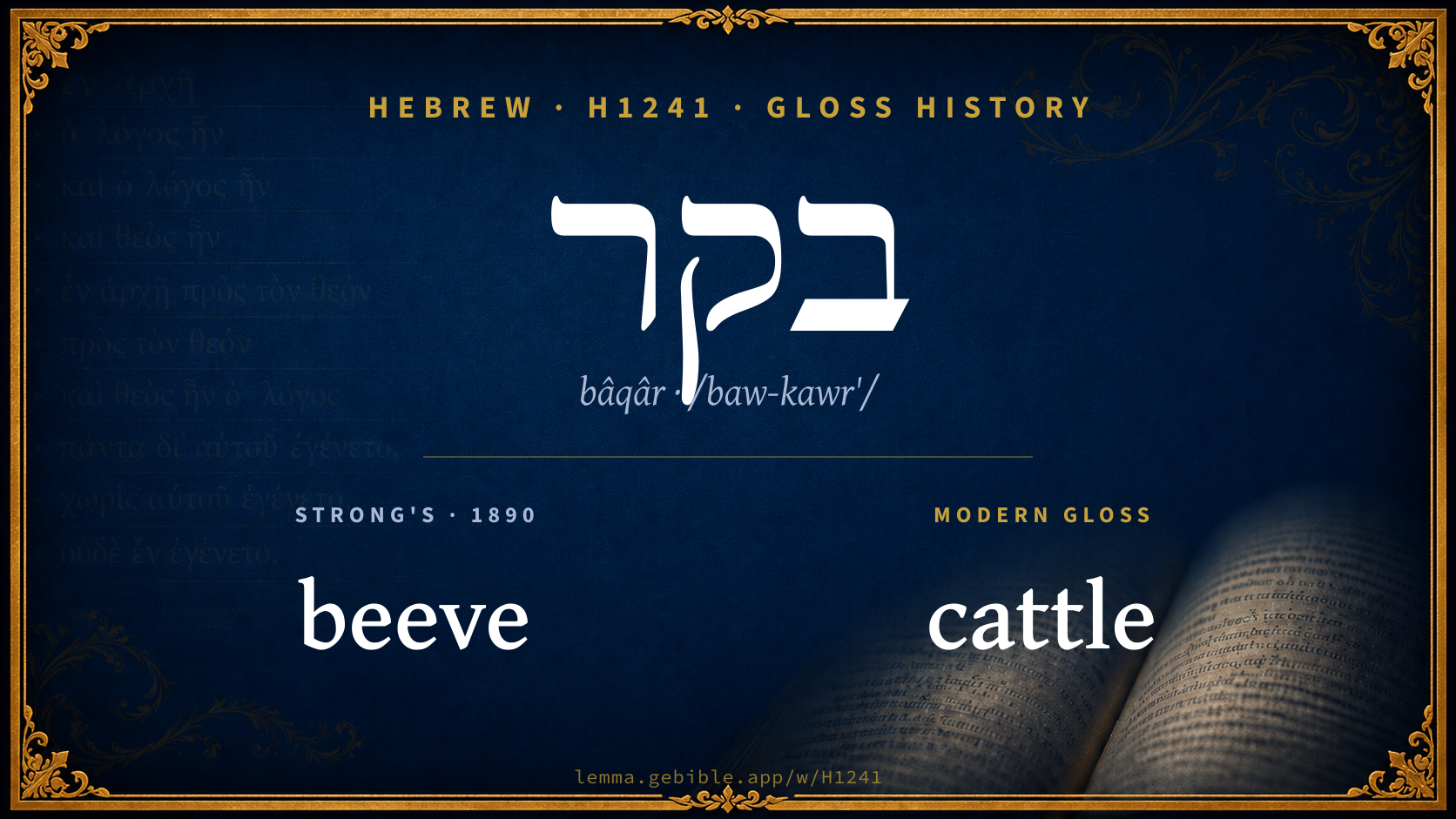
Gloss history
Strong's 1890 vs modern scholarship
About this word
Strong's H1241 catalogs a Hebrew word from the Hebrew Old Testament.
These counts are not copied from any lexicon or concordance. They are computed here, from the morphology-tagged Hebrew Old Testament. What Lemma adds →
- 172
- distinct verses
- The word appears in 172 distinct verses.
- 24 / 39
- OT books
- The word appears in 24 of 39 Old Testament books.
- #255
- by frequency
- Top 500 most frequent Hebrew words (rank 255 of 8,640 Hebrew words by occurrence).
View all 172 occurrences in the concordance →
Most concentrated in
- Numbers 49 verses 28%
- 2 Chronicles 17 verses 10%
- Genesis 16 verses 9%
By section of the Old Testament
By traditional corpus
Conventional, traditional groupings — biblical authorship is debated, so this is a traditional corpus grouping, not an authorship claim. Each share is this word’s portion of its verses in that division of the Hebrew canon. Each figure is a share of the word’s 172 distinct verses.
- Torah (Pentateuch) 96 verses · 56%
- Prophets (Nevi'im) 48 verses · 28%
- Writings (Ketuvim) 28 verses · 16%
How translations render this word
Counts come from each version’s own published word-to-Strong’s tagging or interlinear alignment — an approximate guide to how each version renders this word, not a word-level alignment the data otherwise carries. Because each total is that version’s own tagged count, the per-version totals vary from one another and need not match the appearance or distinct-verse counts above. These counts may also differ from a printed concordance because Lemma counts each distinctly tagged rendering and does not collapse phrase taggings into a single head-word total. This is a fixed set of word-tagged versions (KJV, ASV, BSB, ULT) and does not change with the reading translation you choose elsewhere. Each version’s license is shown beside its name below (and on Sources).
- King James Version: Oxen 70×, Herds 27×, Young 22×
- American Standard Version: Oxen 72×, Herds 24×, Young 21×
- Berean Standard Bible: Oxen 48×, Herds 31×, Cattle 24×
- unfoldingWord Literal Text: Cattle 93×, Oxen 30×, Herd 18×
King James Version Public Domain
Renders H1241 across 166 tagged occurrences — most commonly:
Plus 14 renderings that appear only once — usually multi-word phrases or single function words the recovered tagging swept in, not distinct renderings. Not rendered by a distinct English word in 16 further occurrences.
American Standard Version Public Domain
Renders H1241 across 166 tagged occurrences — most commonly:
Plus 20 renderings that appear only once — usually multi-word phrases or single function words the recovered tagging swept in, not distinct renderings.
Berean Standard Bible Public Domain
Renders H1241 across 142 tagged occurrences — most commonly:
Plus 11 renderings that appear only once — usually multi-word phrases or single function words the recovered tagging swept in, not distinct renderings. Not rendered by a distinct English word in 41 further occurrences.
unfoldingWord Literal Text CC BY-SA 4.0
Renders H1241 across 186 tagged occurrences — most commonly:
Plus 10 renderings that appear only once — usually multi-word phrases or single function words the recovered tagging swept in, not distinct renderings.
Senses in the full BDB
What do BDB’s symbols mean?
BDB uses these scholarly abbreviations:
| Symbol | Meaning |
|---|---|
| 𝔊 | the Septuagint (the ancient Greek translation, LXX) |
| 𝔙 | the Vulgate (the Latin translation) |
| 𝔖 | the Syriac version (the Peshitta) |
| 𝔗 | the Targum (the Aramaic translation) |
| ψ | the Psalms |
| √ | root (the underlying root or stem) |
| ‖ | parallel passage (a synonymous or contrasted parallel) |
| † | the dagger: every passage where the word occurs is cited |
The 4 senses and sub-senses the full Brown-Driver-Briggs lexicon distinguishes for this word, in lexicon order (not ranked by frequency), with BDB’s own verbatim wording and sub-sense lettering. Shown in Hebrew script with BDB’s own scholarly abbreviations. The condensed entry is in the Lexicon Entry tab. See also the Forms in the corpus table below.
- 1. mostly coll.
- a. cattle, generic (never pl. in form) Gn 12:16; 13:5; 20:14; 21:27; 24:35 Lv 1:2 Dt 8:13 1 S 11:5 Ho 5:6 Jo 1:18 1 Ch 27:29(×2) + often (frequently ‖ צֹאן); as grazing, 1 Ch 27:29 +; in sim. כַּבּ׳ Jb 40:15 Is 11:7; 65:25; as lowing (קוֹל הַבּ׳) 1 S 15:14; מִקְנֵה בָקָר possession of (i.e. property in) cattle Gn 6:14; 47:17 (both J); עֶדְרֵי ב׳ Jo 1:18 herds of cattle; especially בֶּן־בָּקָר son of cattle (i.e. belonging to the בקר), to denote a single ox, calf, etc.; as used for food Gn 18:7 cf. v 8 (J)—in these prob. = calf (v also 1 S 14:32 בָּקָר וּבְנֵי בָקָר); usually for sacrifice (Hex only P) Nu 15:8, 9; בֶּן־הַבּ׳ Lv 1:5; appos. עֵגֶל †Lv 9:2;—cf. עֶגְלַת בָּקָר †Dt 21:3 1 S 16:2 Is 7:21;—mostly appos. פַּר Ex 29:1 + 27 times; also pl. †פָּרִים בני בקר Nu 28:11, 19, 27; 29:13, 17 (on all these cf. בֵּן); also indef. cattle, oxen, of a number not specified Nu 7:87, 88 (in both enumerated as פָּרִים); 22:40 1 S 14:32; 15:21 1 K 1:9; 7:29(×2) (here of graven work) 8:5 1 Ch 12:40 2 Ch 5:6; 18:2 Is 22:13 ψ 66:15; also as beasts of burden †1 Ch 12:40 e.g. Genesis 12:16
- b. a particular herd of cattle Gn 18:7 (J); cf. pl. בְּקָרֵינוּ, our herds, only Ne 10:37. e.g. Genesis 18:7
- 2. more individually, head of cattle,—yet always of more than one (Hex mostly P; pl. only Am 6:12 + 2 Ch 4:3 v. supr.); of two Nu 7:17 + 11 times Nu 7; †cf. also צֶמֶד ב׳ yoke (pair) of oxen 1 S 11:7 cf. v 7, 1 K 19:21 cf. v 21 (ploughing, cf. v 19); also 2 S 6:6 = 1 Ch 13:9 (drawing a cart, cf. Nu 7:3 f. 1 S 6:7 f.), 2 S 24:22 = 1 Ch 21:23, 2 S 24:22, 24 1 K 19:20 Am 6:12 (pl.); 500 yoke of oxen Jb 1:3 cf. v 14; 1000 yoke 42:12; further, of four Nu 7:7; five Ex 21:37 (תַּחַת הַשּׁוֹר); seven 2 Ch 29:22 (‖ פָּרִים v 21); eight Nu 7:8; ten 1 K 5:3; twelve Nu 7:3 (singly called שׁוֹר) cf. v 6; of the twelve brazen bulls beneath the sea in Sol.’s temple 1 K 7:25, 44 = 2 Ch 4:4, 15 cf. 2 K 16:17 2 Ch 4:3 (דְּמוּת בְּקָרִים) v 3 (but read in both פְּקָעִים, as ‖ 1 K 7:24 cf. Be Öt) v 4 Je 52:20; of twenty 1 K 5:3; seventy 2 Ch 29:32; hundreds or thousands 1 K 8:63 = 2 Ch 7:5, 2 Ch 15:11; 29:33; 35:7, 8, 9 (cf. v 12), & Nu 31:33, 38, 44†. Note חֶמְאַת בָּקָר Dt 32:14 (poem), שְׁפוֹת ב׳ 2 S 17:29, כְּלִי הַבּ׳ 2 S 24:22 1 K 19:21, מַלְמַד הַבּ׳ Ju 3:31, צְפִו֯עֵי הַבּ׳ Ez. 4:15 (opp. גֶּלֲלֵי הָאָדָם). e.g. Amos 6:12
Senses from the full Brown-Driver-Briggs lexicon (Brown, Driver, Briggs; Oxford 1906 — public domain), digitized via Sefaria, supplemented by the OpenScriptures HebrewLexicon (CC BY 4.0). Full attribution on Sources.
Word origin
n.m. 1 K 5:3 + (f. Gn 33:13; Jb 1:14 cf. Dt 32:14 2 S 17:29) cattle, herd, ox (Arabic بَقَرٌ, Aramaic בַּקְרָא, בַּקְרְתָא, ܒܰܩܪܳܐ (cf. also HomNS 222 ff.); name from ploughing, so Thes LagBN 51 al.)—abs. בּ׳ Gn 12:16 +; cstr. בְּקַר Nu 7:88; sf. בְּקָֽרְךָ Gn 45:10 +; בְּקָרֶ֑ךָ Ex 20:24 Je 5:17; בְּקָרוֹ 1 S 11:7 2 S 12:4; בְּקַרְכֶם Dt 12:6; בְּקָרָם Je 3:24 +; pl. בְּקָרִים Am 6:12 (al. read בקר ים) 2 Ch 4:3 (but read פְּקָעִים v. ‖ 1 K 7:24 infr.); sf. בְּקָרֵינוּ Ne 10:37; read בקריכם for בחוריכם 1 S 8:16 𝔊 We Dr;—
— Brown-Driver-Briggs (Oxford 1906, public domain), digitized via Sefaria, supplemented by the OpenScriptures HebrewLexicon (CC BY 4.0). See Sources.
Derived from בקר (bâqar) (H1239) — to seek.
Jastrow Dictionary
A second Hebrew/Aramaic lexicon for comparison, covering Aramaic and post-biblical (Talmudic, Targumic, Midrashic) usage that the biblical-Hebrew BDB does not. Matched by lemma rather than by Strong’s number, so a lemma may carry more than one Jastrow headword (shown separately below), and the entries cover usage well beyond the Bible.
בָּקַר
- , v. בקע) to enter into, to clear, split; whence
- 1. (= בער) to eat up. Denom. בָּקָר (= בְּעִיר).
- 2. (= בער) to break forth, shine. Denom. בֹּקֶר.
- (b. h.)
- 1. to enter into, examine, search, distinguish (cmp. בִּין). Keth. 106ᵃ מְבַקְּרֵי מומין those entrusted with the examination of sacrificial animals. Y. Bets. II, 61ᶜ top ובִיקְּרָן ממומן and had them examined (and declared free) from bodily defects. Ḥag. 9ᵇ אין אומרים בַּקְּרוּ וכ׳ we do not say, Examine ye a camel, a swine &c. (i.e. only the deeds of distinguished persons are scrutinized); a. fr.—Part. pass. מְבוּקָּר examined and found fit. Y. Ber. IV, 7ᵇ top טליים מְבוּקָּרִים lambs which passed examination.
- 2. to inquire after one’s health, to visit the sick. Ned. IV, 4 (38ᵇ). ונכנס לְבַקְּרוֹ and comes to see him. Snh. 68ᵃ; a. v. fr. [Ruth. R. to II, 15, v. infra.]
- , Nithpa. נִתְבַּקֵּר
- 1. to be examined. Gen. R. s. 81 פנקסו נִתְבַּקְּרָה his account is examined (his sins visited); Tanḥ. Vayishlaḥ 8 מִתְבַּקֶּרֶת. Gen. R. s. 84, read with Yalk. Gen. 141 נתב׳ פנקסי my account &c.
- 2. to be visited, attended to. Num. R. s. 18 as all sick persons מִתְבַּקְּרִין are tended (by physicians).
- (Y. Dial. for הִפְקִיר, v. פָּקַר; v. next w.) to give free, to resign ownership, to declare a property ownerless. Y. Ned. IV, 38ᵈ; Y. Peah V, beg. 19ᵇ [read:] כיון שאדם מַבְקִיר דבר יצא מרשותו as soon as one declares a thing to be free, it has gone out of his control; Y. Dem. III, 23ᵇ bot. כיון שאדם מ׳ … ויצא … הבקירו הבקר as soon as one gives a thing free and it has left his possession, his act is valid; a. fr. [Ruth. R. to II, 15 מבקר, מבדר, prob. מבקיר; v. בָּדַר.]
- to be declared free, to be free. Y. Peah VI, 19ᶜ top.—Part. מוּבְקָר Ib. 19ᵇ bot. שדי מוּבְקֶרֶת וכ׳ (Tosef. Maasr. III, 11. הרי … מופ׳) my field shall be free for one day &c.; a. e.
בְּקַר
- —Pa. בַּקַּר
- 1. to search, examine. Targ. O. Lev. XIII, 36; a. fr.
- 2. to clear, glean. Targ. Y. I Deut. XXIV, 20 (II תתב׳, read תבקרון, h. text תפאר).
- 3. to let the herd graze (cmp. בער), to drive unmuzzled animals. Targ. Y. Gen. XIII, 7.
- 4. to visit the sick. Targ. Y. Ex. XVIII, 20; a. e.—Y. Sabb. VI, 8ᶜ bot.; a. fr.
- 5. (= preced. Hif.) to abandon, leave unclaimed, declare free. Targ. Y. Ex. XXIII, 11 Ar. (some ed. ותפקד, read ותפקר). Y. Shebi. IX, 39ᵃ top וַאֲבַקְּרָה קומיהון and I will declare it free goods in their presense. Ib. ומְבַקְּרִין ליה and declare ye it free property.
בֹּקֶר
- v. בָּקַר) morning, early day; metaph. light, salvation. Y. Taan. I, 64ᵃ top ב׳ לצדיקים וכ׳ a morning for the righteous, a night for the wicked. Ruth. R. to III, 13 בַּבּ׳ בעולם וכ׳ ‘in the morning’—that means in the world which is all-good. Esth. R., introd. (ref. to Deut. XXVIII, 67) בבָקְרָהּ של בבל וכ׳ in the morning (ascendancy) of Babel thou shalt say, Oh that her evening (downfall) would come! Gen. R. s. 21 (ref. to Dan. VIII, 14) לִכְשֶׁיֵּעָשֶׂה בָּקְרָן וכ׳ when the morning of the (persecuting) nations shall become evening, and the evening of Israel morning; Tanḥ. ed. Bub. B’resh. 23. Mekh. Bo, s. 6 in order to define it: לבָקְרוֹ של ב׳ at the very break of morning; Y. Ber. I, 2ᶜ top.—Pl. בְּקָרִים. Yoma 33ᵇ חלקהו לשני ב׳ divide the acts prescribed into two mornings, i.e. let another act be inserted between. Ber. 27ᵃ חלקהו לשני ב׳ take only one half of the morning hours. Y. Pes. V, 31ᵈ top אית לך מימר תמן בין הַבְּקָרַיִם then it ought to have read there ben hab-b’karaim (as you read בין הערבים, Du.). e.g. Deuteronomy 28:67
בָּקָר
- v. בָּקַר) a beef; (collect.) oxen, cattle. Sifra Vayikra ch. II, Par. 2 אין לך בבהמה אלא ב׳ וכ׳ under b’hemah for offerings (Lev. I, 2) are meant only beeves and sheep; a. fr. בן ב׳ young cattle, calf. Ib.; a. fr.—רועי ב׳ herders (suspected of feeding upon other people’s fields). Snh. III, 2 נאמנין עלי שלשה ר׳ ב׳ (if one says) I have faith in (the arbitration of) three herders. e.g. Leviticus 1:2
בַּקָּר
- (preced.) neat-herd, cow-herd; cattle-driver. Y. Bets. V, 63ᵇ, v. רֶגֶל.
קַר
- to be cold, v. קָרַר II, קְרַר II.—[Erub. X, 14, a. e. באר (בור) הקר, v. הָקֵר.]
A Dictionary of the Targumim, the Talmud Babli and Yerushalmi, and the Midrashic Literature (Marcus Jastrow; London, Luzac, 1903) — Public Domain. Digitized via Sefaria. Digitized via Sefaria. Full attribution on Sources.
Forms in the corpus
The 76 distinct written forms H1241 takes in the Hebrew Bible, most frequent first — each parse links to that state’s occurrences in the concordance. Hebrew forms include their vowel points and cantillation, so a single lemma takes many written forms.
The 60 most common forms are shown; 16 rarer forms follow in the full concordance.
Same root — word family
Other BDB entries built from the same root as H1241, grouped by Strong’s listed origin. These share a root / origin per the lexicon — not necessarily a shared meaning. Each links to that word’s own entry.
Derives from
Shares the same root
- בוקר bôwqêr H951 herdsman
- בקר bᵉqar H1240 to seek
- בקר bôqer H1242 morning
- בקרה baqqârâh H1243 seeking
- בקרת biqqôreth H1244 punishment
Proper names from this root
People and places named from this root — a name, not an additional meaning of the word.
Compare all same-root words → Showing 4 of 8 — not the complete family. 1 of the same-root words is a proper name (a person or place). They share a root, not necessarily a meaning.
Septuagint verse parallels
This word appears in 169 verses that also exist in the Greek Old Testament (Septuagint), out of the 172 Hebrew verses it occurs in. You can read those verses in Greek by switching the Old Testament edition to the Septuagint.
Read these verses in the Septuagint
- Genesis 12:16
- Exodus 9:3
- Leviticus 1:2
- Numbers 7:3
- Deuteronomy 8:13
- Judges 3:31
- 1 Samuel 11:5
- 2 Samuel 6:6
- 1 Kings 1:9
- 2 Kings 5:26
- 1 Chronicles 12:40
- 2 Chronicles 4:3
This is a verse-level parallel only — the same verses exist in both the Hebrew and Greek Old Testaments. No word-level Hebrew↔Greek correspondence is claimed: the data carries no such alignment, so no Greek word is shown as this Hebrew word’s translation. Coverage is not total — the Septuagint omits the deuterocanon and renumbers the Psalms, so some Hebrew verses have no direct Greek parallel.