

Psalms 88:13

Hebrew (Westminster Leningrad Codex) Psalms 88:13 appears in the Hebrew Old Testament. The text above is from the Westminster Leningrad Codex. Each word links to its Strong’s number, a concise gloss, and parsing drawn from the Open Scriptures Hebrew Bible morphology. Click any word for its full Brown-Driver-Briggs (BDB) entry.
Download image
Cite this verse

Psalms 88:13 (World English Bible). Public Domain. Lemma interlinear Bible study tool, https://lemma.gebible.app/v/psalms/88/13.

Show BibTeX & RIS
BibTeX
RIS
English Translation
But to you, Yahweh, I have cried. In the morning, my prayer comes before you.
World English Bible · Public Domain
Download a study sheet

One document with this verse’s original text, its word-by-word gloss line, the meaning frame, cross-references with their text, attributed commentary, and full source and license credits — printable, and it pastes into notes with its structure intact.

This verse Autodidact and up

Study sheet (.html) Plain text (.txt)

A passage Seminary Student

Up to 50 verses in one chapter. A passage sheet keeps up to 6 commentary sources and 12 cross-references per verse, in the order this page ranks them, and says so on the sheet whenever that leaves anything out. Ask for a single verse and you get the Autodidact verse sheet above.

Everything on this page stays free to read, with no account — the sheet is a download of what is already on screen, not access to it.

Want to remove ads? Support Godless Engineer
Compare translations 3

The same verse in 3 English versions, stacked beneath the original-language interlinear above. Click any original word for its lexicon entry.

Each is an independent rendering of the whole verse — the interlinear is not word-aligned to these translations.

Highlighted words mark where these versions differ — a whole-verse word diff, not a word-by-word alignment.

  • World English Bible Public Domain
    But to you, Yahweh, I have cried. In the morning, my prayer comes before you.
  • King James Version Public Domain
    But unto thee have I cried, O LORD; and in the morning shall my prayer prevent thee.
  • unfoldingWord Literal Text CC BY-SA 4.0
    But I, I cry out to you, Yahweh, and in the morning my prayer precedes you.

unfoldingWord Literal Text — © unfoldingWord, licensed CC BY-SA 4.0. Word-aligned USFM3 via Door43 (git.door43.org/unfoldingWord/en_ult).

Versions to compare (up to 4)

3 of 4 selected

Show all 18 translations

Every available English version of this verse, each an independent rendering of the whole verse.

  • World English Bible Public Domain
    But to you, Yahweh, I have cried. In the morning, my prayer comes before you.
  • Berean Standard Bible Public Domain
    But to You, O LORD, I cry for help; in the morning my prayer comes before You.
  • Majority Standard Bible Public Domain
    But to You, O LORD, I cry for help; in the morning my prayer comes before You.
  • King James Version Public Domain
    But unto thee have I cried, O LORD; and in the morning shall my prayer prevent thee.
  • American Standard Version (1901) Public Domain
    But unto thee, O Jehovah, have I cried; And in the morning shall my prayer come before thee.
  • Revised Version (1885) Public Domain
    But unto thee, O LORD, have I cried, and in the morning shall my prayer come before thee.
  • Geneva Bible (1599) Public Domain
    But vnto thee haue I cryed, O Lord, and early shall my prayer come before thee.
  • Douay-Rheims (1899) Public Domain
    Shall thy wonders be known in the dark; and thy justice in the land of forgetfulness?
  • Young's Literal Translation Public Domain
    And I, unto Thee, O Jehovah, I have cried, And in the morning doth my prayer come before Thee.
  • Literal Standard Version CC BY-SA 4.0
    And I, to You, O YHWH, I have cried, || And in the morning my prayer comes before You.
  • Unlocked Literal Bible CC BY-SA 4.0
    But I cry to you, Yahweh; in the morning my prayer comes before you.
  • unfoldingWord Literal Text CC BY-SA 4.0
    But I, I cry out to you, Yahweh, and in the morning my prayer precedes you.
  • Darby Bible Public Domain
    But as for me, Jehovah, I cry unto thee, and in the morning my prayer cometh before thee.
  • World Messianic Bible Public Domain
    But to you, LORD, I have cried. In the morning, my prayer comes before you.
  • Webster's Bible Public Domain
    \\88:12\\Shall thy wonders be known in the dark? and thy righteousness in the land of forgetfulness?
  • Free Bible Version CC BY-SA 4.0
    But I cry out to you for help; every morning I pray to you.
  • Bible in Basic English Public Domain
    But to you did I send up my cry, O Lord; in the morning my prayer came before you.
  • JPS Tanakh (1917) Public Domain
    (88-14) But as for me, unto Thee, O LORD, do I cry, and in the morning doth my prayer come to meet Thee.

Literal Standard Version (2020), Covenant Press — licensed CC BY-SA 4.0. Text via the HelloAO Bible API (eBible.org). Unlocked Literal Bible (unfoldingWord) — licensed CC BY-SA 4.0. Text via the HelloAO Bible API (eBible.org). unfoldingWord Literal Text — © unfoldingWord, licensed CC BY-SA 4.0. Word-aligned USFM3 via Door43 (git.door43.org/unfoldingWord/en_ult). Free Bible Version, Dr. Jonathan Gallagher — licensed CC BY-SA 4.0. Text via the HelloAO Bible API (eBible.org).

Word by word

More ways to search: Search by grammar → Find every occurrence → Compare this word →

Practice this passage: Drill this verse → Learn its vocabulary →

About this verse

These counts appear in no published source. They are computed here, from the morphology-tagged text and Lemma’s own curated glosses. What Lemma adds →

7
words
7
distinct lemmas
Wisdom
section

Notable vocabulary

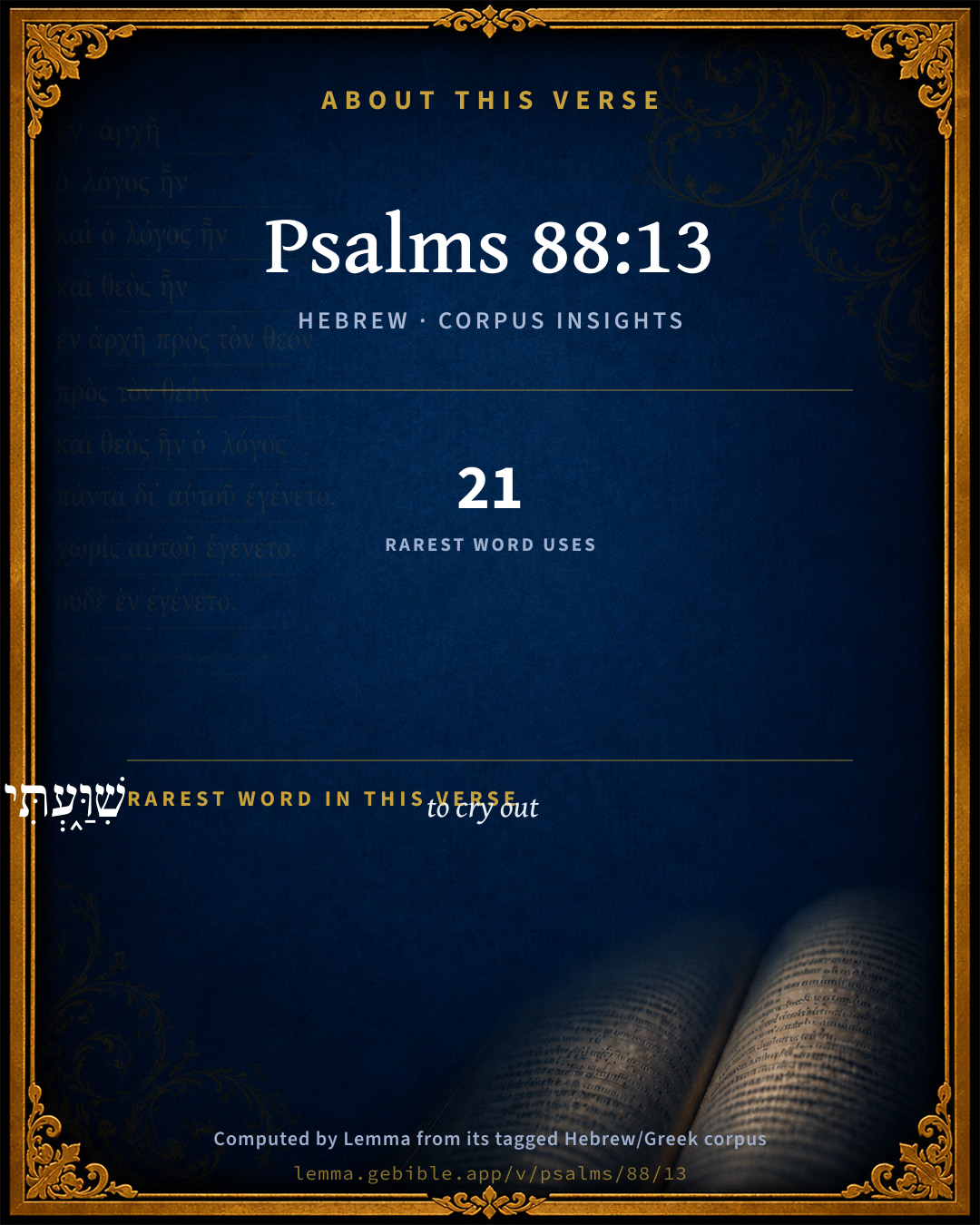
The rarest word here is שִׁוַּ֑עְתִּי to cry out H7768 — appearing just 21 times in the whole Hebrew Bible.

Shared distinctive vocabulary

שִׁוַּ֑עְתִּי to cry out H7768 occurs in 21 verses of the Hebrew Bible. Also found in:

Grammatical profile

  • 2 verbs
  • 3 nouns
  • 1 pronoun
  • 1 preposition

Verb forms

  • שִׁוַּ֑עְתִּי Piel · Perfect
  • תְקַדְּמֶֽךָּ Piel · Imperfect

Hebrew & Septuagint length

In English translation the verse runs 15 words from the Hebrew and 16 from the Septuagint (LXX English) — closely comparable.

A rough comparison of the two English renderings, which tokenize alike — not a word-level alignment.

Word counts can differ between the Hebrew and the Greek without any difference in meaning — e.g. the Hebrew direct-object marker אֵת has no separate Greek word, and Greek often adds the article ὁ.

Cross-references

4

Topical passages linked to Psalms 88:13 in the Treasury of Scripture Knowledge — connected by theme and wording, ordered by reader-vote popularity; previews shown in the World English Bible.

  • Psalms 5:3 Yahweh, in the morning you shall hear my voice. In the morning I will lay my requests before you, and will watch expectantly.
  • Mark 1:35 Early in the night, he rose up and went out, and departed into a deserted place, and prayed there.
  • Psalms 30:2 Yahweh my God, I cried to you, And you have healed me.
  • Psalms 119:147–148 I rise before dawn and cry for help. I put my hope in your words.

Cross-references courtesy of OpenBible.info (CC BY 4.0).

Hebrew and Greek witnesses Masoretic Hebrew ↔ Greek Septuagint

The same verse in the two great witnesses to the Old Testament, shown verse-for-verse.

You’re reading Greek Psalm 87 (Hebrew Psalm 88). The Septuagint counts the superscription, so verse numbers can differ from the Hebrew — chapter-level alignment, not verse-by-verse. Numbering follows Rahlfs.

These are two independent witnesses, not word-aligned to each other, and the Septuagint is shown in lemma (dictionary) form.

Hebrew Psalms 88:13 Masoretic · Westminster Leningrad Codex

וַאֲנִ֤י אֵלֶ֣יךָ יְהוָ֣ה שִׁוַּ֑עְתִּי וּ֝בַבֹּ֗קֶר תְּֽפִלָּתִ֥י תְקַדְּמֶֽךָּ

But to you, Yahweh, I have cried. In the morning, my prayer comes before you.

World English Bible · Public Domain

Greek LXX Greek Psalm 87:13 Septuagint · lemma form

μή γιγνώσκω ἐν ὁ σκότος ὁ θαυμάσιος σύ καί ὁ δικαιοσύνη σύ ἐν γῆ ἐπιλανθάνω

But I cried to you, O Lord; and in the morning shall my prayer prevent you.

LXX2012 (modern English Septuagint) · Public Domain

On this verse, Keil & Delitzsch discusses the Septuagint’s reading. Read the note in Commentary ↓

Hebrew: Westminster Leningrad Codex (CC BY 4.0). Greek: Septuagint (public domain); English from LXX2012 (modern English Septuagint) (Public Domain). How the Septuagint differs from the Hebrew →

Commentary

Notes on Psalms 88:13 from classic Christian and Jewish commentators (each source and its license shown beneath its notes). The classic Christian expositions comment on the surrounding passage and are grouped to its opening verse, so a note may address several verses; the Jewish commentaries on the Tanakh (Rashi and others) are per-verse, so they appear only where the commentator wrote on this verse.

Lemma curates 59 commentaries, every one of them public domain or Creative Commons licensed, each selected and text-cleaned for this edition rather than reprinted as found. About our sources →

Trapp's Complete Commentary

John Trapp

Psa 88:13 But unto thee have I cried, O LORD; and in the morning shall my prayer prevent thee.

Ver. 13. But unto thee have I cried] Oh, condescend to thy poor crying creature in extremity.

In the morning] {See Trapp on "Psa 5:3"}

John Trapp, A Commentary or Exposition upon All the Books of the Old and New Testament (1647–1656) — public domain. Text from a community e-Sword module.

The Biblical Illustrator

Joseph S. Exell

Psa_88:13

In the morning shall my prayer prevent Thee.

Morning devotion

As the Oriental traveller sets out for the sultry journey over burning sands by loading up his camel under the palm-trees shade, and fills his water flagons from the crystal fountain which sparkles at its roots, so does Christs pilgrim draw his morning supplies from the exhaustless spring. Morning is the golden hour for prayer and praise. The mind is fresh; the mercies of the night and the new resurrection of the dawn both prompt a devout soul to thankfulness. The buoyant heart takes its earliest flight, like the lark, towards the gates of heaven. One of the finest touches in Bunyans immortal allegory is his description of Christian in the chamber of Peace, who awoke and sang while his window looked out to the sun rising. In the morning will I direct my prayer unto Thee. (T. L. Cuyler, D. D.)

The Biblical Illustrator, edited by Joseph S. Exell (c. 1880s–1900s) — public domain. Text from a community e-Sword module.

Joseph Benson's Commentary

Psa 88:13-18. In the morning shall my prayer prevent thee — That is, shall be offered to thee early, before the ordinary time of morning prayer, or before the dawning of the day, or the rising of the sun. The sense is, Though I have hitherto got no answer to my prayers, yet I will not give over praying and hoping for an answer. Why hidest thou thy face from me? — This proceeding seems not to agree with the benignity of thy nature, nor with the manner of thy dealing with thy people. I am ready to die from my youth up — My whole life hath been filled with a succession of deadly calamities. O Lord, take some pity upon me, and let me have a little breathing space before I die. While I suffer thy terrors — Upon my mind and conscience, which accompany and aggravate my outward miseries, I am distracted — I am so astonished, that I know not what to do with myself. They came about me like water — As the waters of the sea encompass him who is in the midst, and at the bottom of it.

Joseph Benson's Commentary on the Old and New Testaments (1811–1818) — public domain. Text from a community e-Sword module.

J. A. Alexander on Psalms

Joseph Addison Alexander

14. (Psa 88:13) And I unto thee, 0 Jehovah, have cried, and in the morning shall my prayer come before thee. What he has done he is still resolved to do, as the only means of safety. Hence the alternation of the preterite and future. The first verb means to cry for help. See above, on Psa 18:41. With the last clause compare Psa 5:3; Psa 57:8; Psa 59:16. The verb has its proper sense of coming before one or into his presence. See above, on Psa 17:13; Psa 18:5; Psa 21:3.

Joseph Addison Alexander, The Psalms Translated and Explained (1850) — public domain. Text from a community e-Sword module.

Tyndale Open Study Notes

Tyndale Open Resources

88:13-17 In his third charge, the psalmist accuses the Lord of rejecting him. The force and apparent cruelty of the psalmist’s suffering overwhelm him.

Tyndale Open Study Notes — © Tyndale Open Resources, licensed CC BY-SA 4.0. Text via the HelloAO Bible API.

Adam Clarke's Commentary

Verse 13. Shall my prayer prevent thee.] It shall get before thee; I will not wait till the accustomed time to offer my morning sacrifice, I shall call on thee long before others come to offer their devotions.

Adam Clarke's Commentary on the Bible (1810–1826) — public domain. Text from a community e-Sword/MySword module.

Ellicott's Commentary for English Readers

(13) But unto Thee . . .—Better, But as for me, I, &c. The pronoun is emphatic. The speaker has not gone down to the land where all is silent and forgotten, and can therefore still cry to God, and send his prayer to meet (prevent, i.e. go to meet; see Psa_17:13) the Divine Being who still has an interest in him. And this makes the expostulation of the next verses still stronger. Why, since the sufferer is still alive, is he forsaken, or seemingly forsaken, by the God of that covenant in which he still abides?

A Bible Commentary for English Readers, edited by Charles John Ellicott (1878–1897) — public domain. Text from a community e-Sword module.

The Cambridge Bible for Schools and Colleges

gen. ed. J. J. S. Perowne

13. But as for me, unto thee, Jehovah, have I cried for help,

And in the morning shall my prayer come before thee.

He contrasts himself with the dead, whose covenant relation with God is at an end. He at least can still pray, and in spite of all discouragement will not cease to pray.

Prevent = ‘go to meet,’ as in Psa_59:10; Psa_79:8. The first thought of each day shall be prayer. Cp. Psa_5:3; Psa_55:17.

13–18. Death brings no hope. Will not God then listen to his prayer and grant him some relief in his extremity of suffering and solitude?

The Cambridge Bible for Schools and Colleges (gen. ed. J. J. S. Perowne; Cambridge University Press, 1878–1918) — public domain. Text from a community e-Sword module.

John Gill's Exposition

But unto thee have I cried, O Lord,.... Formerly, and had been heard, answered, and relieved, and which was an encouragement to cry again to him in his distress; Christ was always heard, Joh 11:42, or, now, in his present case, yet was not heard, at least not immediately answered; which was the case of the Messiah, when forsaken by his God and Father, Psa 22:1, yet still determines to continue praying, as follows:

and in the morning shall my prayer prevent thee; not before the Lord is awake, and can hear; for he neither slumbers nor sleeps, and he always hears: but the meaning is, that he would pray before he entered upon another business; this should be the first thing in the morning he would do, and this he would do before others did, or he himself used to do; before the usual time of morning prayer; signifying, he would pray to him very early, which is expressive of his vehemency, fervency, and importunity and earnestness, and what a sense he had of his case, and of his need of divine help: so Christ rose early in the morning, a great while before day, to pray, Mar 1:35. See Gill on Psa 5:4.

John Gill's Exposition of the Whole Bible (1746–1763) — public domain (CC PDM 1.0). Text via the HelloAO Bible API.

Albert Barnes' Notes on the Bible

But unto thee have I cried, O Lord - I have earnestly prayed; I have sought thy gracious interposition.

And in the morning - That is, each morning; every day. My first business in the morning shall be prayer.

Shall my prayer prevent thee - Anticipate thee; go before thee: that is, it shall be early; so to speak even before thou dost awake to the employments of the day. The language is that which would be applicable to a case where one made an appeal to another for aid before he had arisen from his bed, or who came to him even while he was asleep - and who thus, with an earnest petition, anticipated his rising. Compare the notes at Job 3:12; compare Psa 21:3; Psa 59:10; Psa 79:8; Psa 119:148; Mat 17:25; 1Th 4:15.

Albert Barnes' Notes on the Bible (1834–1885) — public domain. Text from a community e-Sword/MySword module.

Matthew Poole's English Annotations

i.e. Early, come to thee, before the ordinary time of morning prayer, or before the dawning of the day, or the rising of the sun. The sense is, Though I have hitherto got no answer to my prayers, yet I will not give over praying nor hoping for an answer.

Matthew Poole's English Annotations on the Holy Bible (1683–1685) — public domain. Text from a community e-Sword/MySword module.

The Treasury of David

Charles H. Spurgeon

Ver. 13. But unto thee have I cried, O LORD; I have continued to pray for help to thee, O Jehovah, the living God, even though thou hast so long delayed to answer. A true born child of God may be known by his continuing to cry; a hypocrite is great at a spurt, but the genuine believer holds on till he wins his suit.

And in the morning shall my prayer prevent thee. He meant to plead on yet, and to increase his earnestness. He intended to be up betimes, to anticipate the day light, and begin to pray before the sun was up. If the Lord is pleased to delay, he has a right to do as he wills, but we must not therefore become tardy in supplication. If we count the Lord slack concerning his promise we must only be the more eager to outrun him, lest sinful sloth on our part should hinder the blessing.

"Let prayer and holy hymn

Perfume the morning air;

Before the world with smoke is dim

Bestir thy soul to prayer."

"While flowers are wet with dew

Lament thy sins with tears,

And ere the sun shines forth anew

Tell to thy Lord thy fears."

Ver. 13. But, etc. That "but" seems to come in as an expression of his resolution hitherto, that though these were his apprehensions of his condition, yet he had sought the Lord, and would go on to do the same. Suppose thou findest no relish in the ordinances, yet use them; thou art desperately sick, yet eat still take all that is brought thee, some strength will come of it. Say, Be I damned or saved, hypocrite or no hypocrite, I resolve to go on. Thomas Goodwin.

Ver. 13. In the morning shall my prayer prevent thee. The morning prayer is the best...In the morning God gave various gifts. First, the manna, Ex 16:13, And in the morning the dew lay round about the host: He who is in the camp of God, and bravely fights, receives from God dew and consolation, if in the morning, that is, in the beginning of temptation, he prays. In the evening flesh was given, whence death overtook them, but in another case in the morning the manna was given, whereby life was sustained, until they came into the land of promise. Secondly, the law was given in the morning, Ex 19:16, And it came to pass on the third day in the morning, that there were thunders and lightnings, and a thick cloud upon the mount, and the voice of the trumpet exceeding loud. In morning devotion the thunders of God, that is, his judgments, are more distinctly heard; his lightnings, that is, his divine enlightenments, are best seen; the thick cloud upon the mount, that is, the divine overshadowing of the soul, is perceived; and the voice of the trumpet is best heard, that is, inspiration then with greater force moves the mind. Thirdly, in the morning, very early, the children of Israel went forth from Egypt; for in the middle of the night God smote all the first born in the land of Egypt, Ex 12:29...In the morning pray, and you shall conquer your daily and nightly foes; and the Red Sea itself, that is the place of temptation, shall be to thee a field of glory, of victory and exultation and all things shall go well with thee. Le Blanc.

Ver. 13. Unto thee have I cried, O Lord. There is something comitant with the Christian's present darkness of spirit that distinguishes it from the hypocrite's horror; and that is the lively working of grace, which then commonly is very visible, when his peace and former comfort are most questioned by him; the less joy he hath from any present sense of the love of God, the more abounding you shall find him in sorrow for his sin that clouded his joy; the further Christ is gone out of his sight, the more he clings in his love to Christ, and vehemently cries after him in prayer, as we see in Heman here. O the fervent prayers that then are shot from his troubled spirit to heaven, the pangs of affection which are springing after God, and his face and favour! Never did a banished child more desire admittance into his angry father's presence, than he to have the light of God's countenance shine on him, which is now veiled from him. William Gurnall.

Ver. 13.

1. Blessings delayed to prayer, "Unto thee", etc.

2. Blessings anticipated by prayer, "in the morning", etc. Daily mercies anticipated by morning prayers. G.R.

Ver. 13. (last clause). The advantages of early morning prayer meetings.

Psalms 88:14*

Charles H. Spurgeon's The Treasury of David (1869–1885) — public domain. Psalms only. Text from a community e-Sword/MySword module.

Whedon's Commentary on the Bible

Daniel D. Whedon

13. Unto thee have I cried—Here faith rallies and reasserts herself, as in Psa_88:1. No relief has yet come, but the psalmist gives himself to prayer, which itself implies hope.

Daniel D. Whedon (gen. ed.), Commentary on the Old and New Testaments (1874–1909) — public domain. Text from a community e-Sword module.

The Pulpit Commentary

But unto thee have I cried, O Lord; literally, but as for me, to thee have I cried. The psalmist returns from the somewhat vague speculations of vers. 10-12 to fact and to himself. He is not yet a mere shade, an inhabitant of Sheol; he is in the flesh, upon the earth; he can still cry, and does still cry, to Jehovah. There is thus still a faint gleam of hope for him. And in the morning shall my prayer prevent thee. The psalmist will draw out God"s mercy, as it were, before its time, by importuning him with early and continual prayer (comp. vers. 1, 9).

Prayer getting in front of God.

"In the morning shall my prayer prevent thee." The idea is a singular one, based upon the older meaning of the word "prevent." Thinking of God under the figure of an earthly King, he conceives of himself as a petitioner who is so intense in his desire that he reaches the palace gate before the King is up. His prayer is there before the King is. To "prevent" now means to "hinder." In older days it simply meant to "go before," to "anticipate." The word is never used in the sense of "hinder," either in the Bible, as we have it, or in the books of the age in which it was translated. But it should further be observed that getting up very early in the morning to do a thing is a frequent Bible figure for doing a thing earnestly, doing it with all your heart. It is still true of us that if we are thoroughly in earnest about a matter, we can easily get up early in the morning to attend to it. So this figure of the psalmist does but express his intense earnestness in prayer, the fervency of his desire, his almost passionate waiting on God, that makes him feel as if he could get before God, as if he could be there to plead before God was there to hear. It can be but a figure of man"s feeling. He never can be ready before God is; he cannot get before God. Man is always second in prayer; God is always first in waiting to receive prayer.

I MAN THINKING HE CAN BE FIRST WITH GOD. He can get before his fellow man, and ask what his fellow has not thought about, and is not quite prepared to give. And so, in his intensity, man thinks he can even be first with God; he thinks he can ask what God has not thought about. He can tell God something. God does indeed gently and graciously deal with impetuous and impulsive souls, and let them freely speak out all their hearts, and even think they have informed him a great deal. He loves our confidences, even if they are intense; but he must often smile as the mother smiles on her impetuous boy, who tells her, as if it was something quite new, what she has suspected or known for a long time. But the earnestness that tries to be first with God cannot fail to be acceptable to him.

II MAN FINDING OUT THAT GOD IS ALWAYS FIRST WITH HIM. It comes to us occasionally as a great surprise, that what we have asked God about so intensely, he has been a long while attending to. He knew our need before we felt it, and let it take shape as prayer. And that is one of the most important blessings that follow prayer. Asking God"s help in some things, we find out that God"s help has all the while been in everything. R.T.

The Pulpit Commentary (1880–1919), ed. H.D.M. Spence-Jones & Joseph S. Exell — public domain. Text from a community e-Sword module.

John Wesley's Explanatory Notes

Prevent - Come to thee before the dawning of the day, or the rising of the sun.

John Wesley, Explanatory Notes Upon the Whole Bible (1754–1765) — public domain. Text via the GEBible commentary corpus.

Keil & Delitzsch

C. F. Keil & F. Delitzsch

He who complains thus without knowing any comfort, and yet without despairing, gathers himself up afresh for prayer. With ואני he contrasts himself with the dead who are separated from God's manifestation of love. Being still in life, although under wrath that apparently has no end, he strains every nerve to struggle through in prayer until he shall reach God's love. His complaints are petitions, for they are complaints that are poured forth before God. The destiny under which for a long time he has been more like one dying than living, reaches back even into his youth. מנּער (since נער is everywhere undeclined) is equivalent to מנּערי. The ἐξηπορήθην of the lxx is the right indicator for the understanding of the ἅπαξ λ.ε.γ. אפוּנה. Aben-Ezra and Kimchi derive it from פּן, like עלה from על,

(Note: The derivation is not contrary to the genius of the language; the supplementing productive force of the language displayed in the liturgical poetry of the synagogue, also changes particles into verbs: vid., Zunz, Die synagogaie Poesie des Mittelalters, S. 421.)

and assign to it the signification of dubitare. But it may be more safely explained after the Arabic words Arab. afana, afina, ma'fûn (root 'f, to urge forwards, push), in which the fundamental notion of driving back, narrowing and exhausting, is transferred to a weakening or weakness of the intellect. We might also compare פּנה, Arab. faniya, "to disappear, vanish, pass away;" but the ἐξηπορήθην of the lxx favours the kinship with that Arab. afina, infirma mente et consilii inops fuit,

(Note: Abulwald also explains אפוּנה after the Arabic, but in a way that cannot be accepted, viz., "for a long time onwards," from the Arabic iffân (ibbân, iff, afaf, ifâf, taiffah), time, period - time conceived of in the onward rush, the constant succession of its moments.)

which has been already compared by Castell. The aorist of the lxx, however, is just as erroneous in this instance as in Psa 42:5; Psa 55:3; Psa 57:5. In all these instances the cohortative denotes the inward result following from an outward compulsion, as they say in Hebrew: I lay hold of trembling (Isa 13:8; Job 18:20; Job 21:6) or joy (Isa 35:10; Isa 51:11), when the force of circumstances drive one into such states of mind. Labouring under the burden of divine dispensations of a terrifying character, he finds himself in a state of mental weakness and exhaustion, or of insensible (senseless) fright; over him as their destined goal before many others go God's burnings of wrath (plur. only in this instance), His terrible decrees (vid., concerning בעת on Psa 18:5) have almost annihilated him. צמּתתוּני is not an impossible form (Olshausen, 251, a), but an intensive form of צמּתוּ, the last part of the already inflected verb being repeated, as in עהבוּ הבוּ, Hos 4:18 (cf. in the department of the noun, פּיפיּות, edge-edges = many edges, Psa 149:6), perhaps under the influence of the derivative.

(Note: Heidenheim interprets: Thy terrors are become to me as צמתת (Lev 25:23), i.e., inalienably my own.)

The corrections צמתּתני (from צמתת) or צמּתתני (from צמּת) are simple enough; but it is more prudent to let tradition judge of that which is possible in the usage of the language. In Psa 88:18 the burnings become floods; the wrath of God can be compared to every destroying and overthrowing element. The billows threaten to swallow him up, without any helping hand being stretched out to him on the part of any of his lovers and friends. In v. 19a to be now explained according to Job 16:14, viz., My familiar friends are gloomy darkness; i.e., instead of those who were hitherto my familiars (Job 19:14), darkness is become my familiar friend? One would have thought that it ought then to have been מידּעי (Schnurrer), or, according to Pro 7:4, מודעי, and that, in connection with this sense of the noun, מחשׁך ought as subject to have the precedence, that consequently מידּעי is subject and מחשׁך predicate: my familiar friends have lost themselves in darkness, are become absolutely invisible (Hitzig at last). But the regular position of the words is kept to if it is interpreted: my familiar friends are reduced to gloomy darkness as my familiar friend, and the plural is justified by Job 19:14 : Mother and sister (do I call) the worm. With this complaint the harp falls from the poet's hands. He is silent, and waits on God, that He may solve this riddle of affliction. From the Book of Job we might infer that He also actually appeared to him. He is more faithful than men. No soul that in the midst of wrath lays hold upon His love, whether with a firm or with a trembling hand, is suffered to be lost.

Keil & Delitzsch — Biblical Commentary on the Old Testament (1861–1891) — public domain (CC PDM 1.0). Text via the HelloAO Bible API. (Old Testament only.)

unfoldingWord translationNotes

Door43 World Missions Community

my prayer comes before you

The writer praying to Yahweh is spoken of as if the prayer itself goes to speak with Yahweh. (See: Metaphor)

Why do you hide your face from me?

This speaks of the writer feeling like God has rejected or abandoned him as if God were hiding his face or physically turning away from the writer. (See: Metaphor)

translationWords

Yahweh

pray

reject

face

unfoldingWord translationNotes — © Distant Shores Media and the Door43 World Missions Community, licensed CC BY-SA 4.0. Source: git.door43.org/Door43/en_tn.

Lesson kit

Teaching starters — assembled from the data on this page, not authored interpretation. Every prompt links to the verse data it draws on. Edit before teaching.

Psalms, in the Wisdom, opens this verse with 7 words (7 distinct Hebrew lemmas). Its most distinctive word is shâvaʻ (“to cry out”). A historical commentator’s framing appears above. Read the whole chapter for the surrounding context.

Discussion questions

  1. How does “to cry out” (shâvaʻ) shape what this verse is saying?
  2. Job 19:7 shares the word «to cry out» with this verse. How do the two illuminate each other?
  3. These translations render this verse differently; the difference is in the English rendering, not the original. What questions does that raise?
  4. The verb «שִׁוַּ֑עְתִּי» is Piel Perfect. How does its form color the action?
  5. Reading how Trapp's Complete Commentary and The Biblical Illustrator read this verse, where do the two commentators agree and where do they part?

Things to notice

Reading settings

Reading text

Shown beneath each verse's original-language words.

Old Testament
Old Testament edition

Read the OT as the Masoretic Hebrew (MT) or the Greek Septuagint (LXX).

English shown for the Greek Septuagint (in the Hebrew ↔ Greek comparison).

Comparing translations? Open the Compare panel on any verse page to stack up to four side by side.