Exodus 30:7

Hebrew (Westminster Leningrad Codex) Exodus 30:7 appears in the Hebrew Old Testament. The text above is from the Westminster Leningrad Codex. Each word links to its Strong’s number, a concise gloss, and parsing drawn from the Open Scriptures Hebrew Bible morphology. Click any word for its full Brown-Driver-Briggs (BDB) entry.
Download image
Cite this verse

Exodus 30:7 (World English Bible). Public Domain. Lemma interlinear Bible study tool, https://lemma.gebible.app/v/exodus/30/7.

Show BibTeX & RIS
BibTeX
RIS
English Translation
Aaron shall burn incense of sweet spices on it every morning. When he tends the lamps, he shall burn it.
World English Bible · Public Domain
Download a study sheet

One document with this verse’s original text, its word-by-word gloss line, the meaning frame, cross-references with their text, attributed commentary, and full source and license credits — printable, and it pastes into notes with its structure intact.

This verse Autodidact and up

Study sheet (.html) Plain text (.txt)

A passage Seminary Student

Up to 50 verses in one chapter. A passage sheet keeps up to 6 commentary sources and 12 cross-references per verse, in the order this page ranks them, and says so on the sheet whenever that leaves anything out. Ask for a single verse and you get the Autodidact verse sheet above.

Everything on this page stays free to read, with no account — the sheet is a download of what is already on screen, not access to it.

Want to remove ads? Support Godless Engineer
Compare translations 3

The same verse in 3 English versions, stacked beneath the original-language interlinear above. Click any original word for its lexicon entry.

Each is an independent rendering of the whole verse — the interlinear is not word-aligned to these translations.

Highlighted words mark where these versions differ — a whole-verse word diff, not a word-by-word alignment.

  • World English Bible Public Domain
    Aaron shall burn incense of sweet spices on it every morning. When he tends the lamps, he shall burn it.
  • King James Version Public Domain
    And Aaron shall burn thereon sweet incense every morning: when he dresseth the lamps, he shall burn incense upon it.
  • unfoldingWord Literal Text CC BY-SA 4.0
    And Aaron shall cause smoke on it, incense of fragrance. Morning by morning, when he makes the lamps good, he shall cause it to smoke,

unfoldingWord Literal Text — © unfoldingWord, licensed CC BY-SA 4.0. Word-aligned USFM3 via Door43 (git.door43.org/unfoldingWord/en_ult).

Versions to compare (up to 4)

3 of 4 selected

Show all 18 translations

Every available English version of this verse, each an independent rendering of the whole verse.

  • World English Bible Public Domain
    Aaron shall burn incense of sweet spices on it every morning. When he tends the lamps, he shall burn it.
  • Berean Standard Bible Public Domain
    And Aaron is to burn fragrant incense on it every morning when he tends the lamps.
  • Majority Standard Bible Public Domain
    And Aaron is to burn fragrant incense on it every morning when he tends the lamps.
  • King James Version Public Domain
    And Aaron shall burn thereon sweet incense every morning: when he dresseth the lamps, he shall burn incense upon it.
  • American Standard Version (1901) Public Domain
    And Aaron shall burn thereon incense of sweet spices: every morning, when he dresseth the lamps, he shall burn it.
  • Revised Version (1885) Public Domain
    And Aaron shall burn thereon incense of sweet spices: every morning, when he dresseth the lamps, he shall burn it.
  • Geneva Bible (1599) Public Domain
    And Aaron shall burne thereon sweete incense euery morning: when hee dresseth the lampes thereof, shall he burne it.
  • Douay-Rheims (1899) Public Domain
    And Aaron shall burn sweet smelling incense upon it in the morning. When he shall dress the lamps, he shall burn it:
  • Young's Literal Translation Public Domain
    `And Aaron hath made perfume on it, perfume of spices, morning by morning; in his making the lamps right he doth perfume it,
  • Literal Standard Version CC BY-SA 4.0
    And Aaron has made incense on it, incense of spices, morning by morning; in his making the lamps right, he makes incense [on] it,
  • Unlocked Literal Bible CC BY-SA 4.0
    Aaron must burn fragrant incense every morning. He must burn it when he tends the lamps,
  • unfoldingWord Literal Text CC BY-SA 4.0
    And Aaron shall cause smoke on it, incense of fragrance. Morning by morning, when he makes the lamps good, he shall cause it to smoke,
  • Darby Bible Public Domain
    And Aaron shall burn thereon fragrant incense: every morning, when he dresseth the lamps, he shall burn the incense.
  • World Messianic Bible Public Domain
    Aaron shall burn incense of sweet spices on it every morning. When he tends the lamps, he shall burn it.
  • Webster's Bible Public Domain
    And Aaron shall burn upon it sweet incense every morning: when he dresseth the lamps, he shall burn incense upon it.
  • Free Bible Version CC BY-SA 4.0
    Aaron is to burn fragrant incense on the altar every morning when he takes care of the lamps.
  • Bible in Basic English Public Domain
    And on this altar sweet spices are to be burned by Aaron every morning when he sees to the lights.
  • JPS Tanakh (1917) Public Domain
    And Aaron shall burn thereon incense of sweet spices; every morning, when he dresseth the lamps, he shall burn it.

Literal Standard Version (2020), Covenant Press — licensed CC BY-SA 4.0. Text via the HelloAO Bible API (eBible.org). Unlocked Literal Bible (unfoldingWord) — licensed CC BY-SA 4.0. Text via the HelloAO Bible API (eBible.org). unfoldingWord Literal Text — © unfoldingWord, licensed CC BY-SA 4.0. Word-aligned USFM3 via Door43 (git.door43.org/unfoldingWord/en_ult). Free Bible Version, Dr. Jonathan Gallagher — licensed CC BY-SA 4.0. Text via the HelloAO Bible API (eBible.org).

Word by word

More ways to search: Search by grammar → Find every occurrence → Compare this word →

Practice this passage: Drill this verse → Learn its vocabulary →

סַמִּ֑ים
çam
H5561
“spices”
Noun, Common, Masculine, Plural, Absolute
Part of Speech
Noun
Type
Common
Gender
Masculine
Number
Plural
State
Absolute
Full BDB Definition

Origin: from an unused root meaning to smell sweet

TWOT: 1516a

spice - a spice used in incense
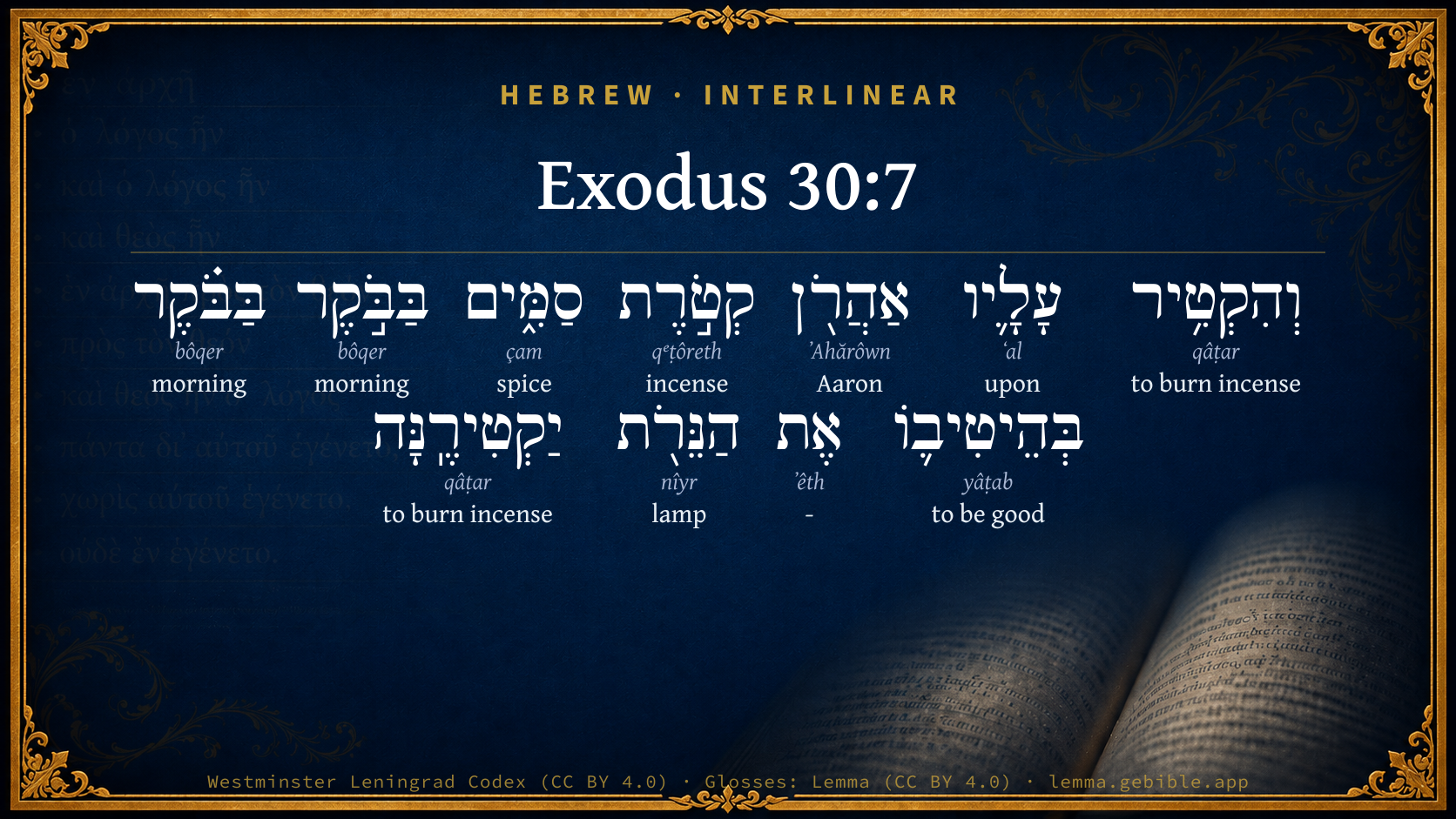
  1. וְהִקְטִ֥יר qâṭar H6999 “and · to burn incense” Conjunction + Verb, Hiphil, Sequential Perfect, 3rd Person, Masculine, Singular
  2. עָלָ֛יו ʻal H5921 “upon · him” Preposition + Suffix, Personal, 3rd Person, Masculine, Singular
  3. אַהֲרֹ֖ן ʼAhărôwn H175 “Aaron” Noun, Proper
  4. קְטֹ֣רֶת qᵉṭôreth H7004 “incense of” Noun, Common, Feminine, Singular, Construct
  5. בַּבֹּ֣קֶר bôqer H1242 “in/at the · morning” Preposition, Determined + Noun, Common, Masculine, Singular, Absolute
  6. בַּבֹּ֗קֶר bôqer H1242 “in/at the · morning” Preposition, Determined + Noun, Common, Masculine, Singular, Absolute
  7. בְּהֵיטִיב֛וֹ yâṭab H3190 “in/at · to be good · him” Preposition + Verb, Hiphil, Infinitive Construct + Suffix, Personal, 3rd Person, Masculine, Singular
  8. אֶת ʼêth H853 “-” Particle, Direct Object
  9. הַנֵּרֹ֖ת nîyr H5216 “the · lamps” Particle, Definite Article + Noun, Common, Masculine, Plural, Absolute
  10. יַקְטִירֶֽנָּה qâṭar H6999 “to burn incense · her” Verb, Hiphil, Imperfect, 3rd Person, Masculine, Singular + Suffix, Personal, 3rd Person, Feminine, Singular

About this verse

These counts appear in no published source. They are computed here, from the morphology-tagged text and Lemma’s own curated glosses. What Lemma adds →

11
words
9
distinct lemmas
Pentateuch
section

Notable vocabulary

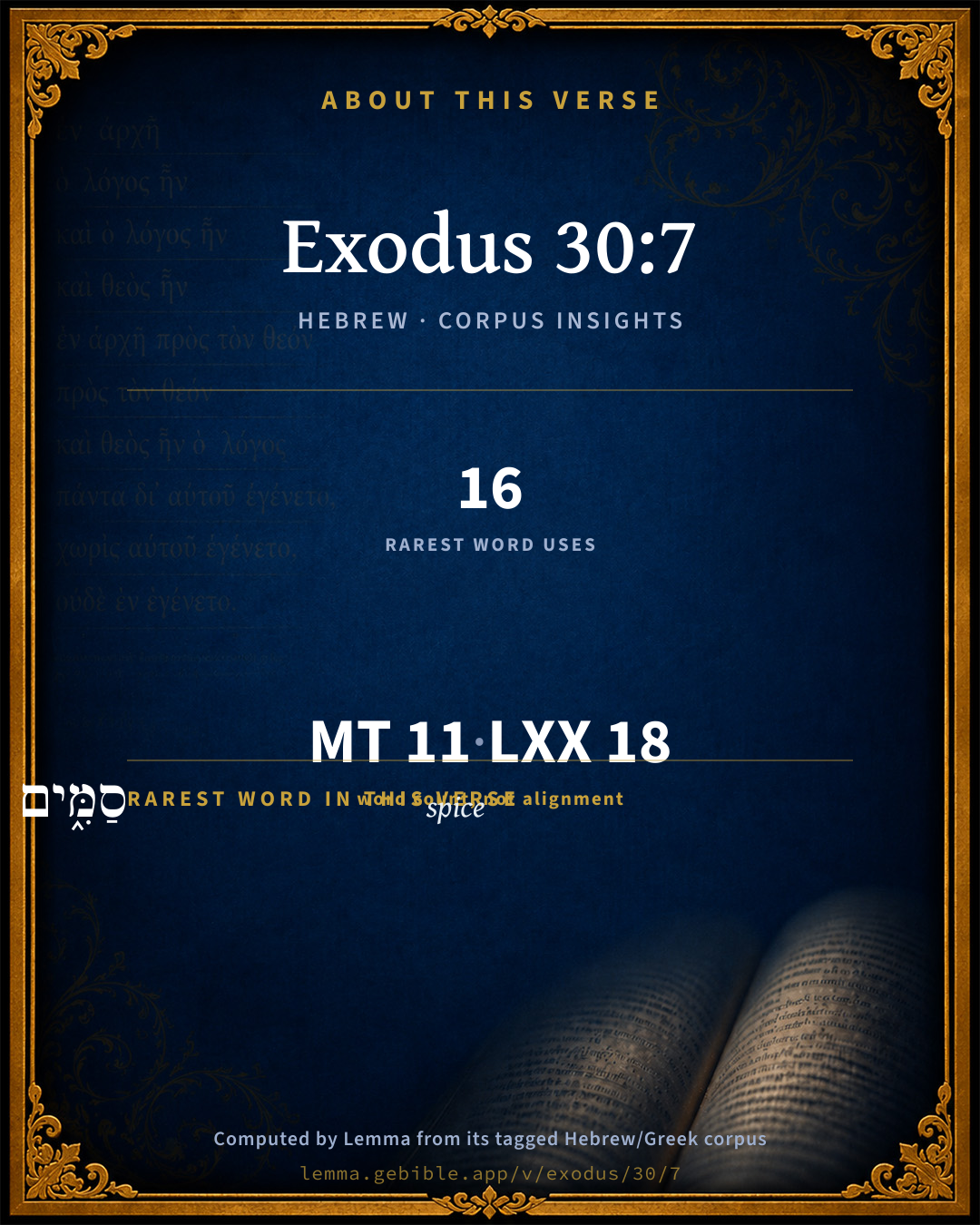
The rarest word here is סַמִּ֑ים spice H5561 — appearing just 16 times in the whole Hebrew Bible.

Shared distinctive vocabulary

סַמִּ֑ים spice H5561 occurs in 15 verses of the Hebrew Bible. Also found in:

Grammatical profile

  • 3 verbs
  • 6 nouns
  • 1 preposition
  • 1 particle

Verb forms

  • וְהִקְטִ֥יר Hiphil · Sequential Perfect
  • בְּהֵיטִיב֛וֹ Hiphil · Infinitive Construct
  • יַקְטִירֶֽנָּה Hiphil · Imperfect

Repetition

Words recur within this verse — often emphatic in Hebrew:

  • וְהִקְטִ֥יר to burn incense H6999 ×2
  • בַּבֹּ֣קֶר morning H1242 ×2

Hebrew & Septuagint length

In English translation the verse runs 20 words from the Hebrew and 22 from the Septuagint (LXX English) — closely comparable.

A rough comparison of the two English renderings, which tokenize alike — not a word-level alignment.

Word counts can differ between the Hebrew and the Greek without any difference in meaning — e.g. the Hebrew direct-object marker אֵת has no separate Greek word, and Greek often adds the article ὁ.

In the original languages it is 11 Hebrew tokens and 18 Greek tokens — but the two are counted differently (Hebrew bundles its prefixes and suffixes into one token; the Greek is in lemma form), so that isn’t a like-for-like length.

Cross-references

7

Topical passages linked to Exodus 30:7 in the Treasury of Scripture Knowledge — connected by theme and wording, ordered by reader-vote popularity; previews shown in the World English Bible.

  • 1 Samuel 2:28 and did I choose him out of all the tribes of Israel to be my priest, to go up to my altar, to burn incense, to wear an ephod before me? and did I give to the house of your father all the offerings of the children of Israel made by fire?
  • Exodus 27:20–21 "You shall command the children of Israel, that they bring to you pure olive oil beaten for the light, to cause a lamp to burn continually.
  • 1 Chronicles 23:13 The sons of Amram: Aaron and Moses; and Aaron was separated, that he should sanctify the most holy things, he and his sons, forever, to burn incense before Yahweh, to minister to him, and to bless in his name, forever.
  • Luke 1:9 according to the custom of the priest's office, his lot was to enter into the temple of the Lord and burn incense.
  • Exodus 30:34 Yahweh said to Moses, "Take to yourself sweet spices, gum resin, and onycha, and galbanum; sweet spices with pure frankincense: of each shall there be an equal weight;
  • 1 Samuel 3:3 and the lamp of God hadn't yet gone out, and Samuel had laid down [to sleep], in the temple of Yahweh, where the ark of God was;
  • Acts 6:4 But we will continue steadfastly in prayer and in the ministry of the word."

Cross-references courtesy of OpenBible.info (CC BY 4.0).

Hebrew and Greek witnesses Masoretic Hebrew ↔ Greek Septuagint

The same verse in the two great witnesses to the Old Testament, shown verse-for-verse.

These are two independent witnesses, not word-aligned to each other, and the Septuagint is shown in lemma (dictionary) form.

Hebrew Exodus 30:7 Masoretic · Westminster Leningrad Codex

וְהִקְטִ֥יר עָלָ֛יו אַהֲרֹ֖ן קְטֹ֣רֶת סַמִּ֑ים בַּבֹּ֣קֶר בַּבֹּ֗קֶר בְּהֵיטִיב֛וֹ אֶת הַנֵּרֹ֖ת יַקְטִירֶֽנָּה

Aaron shall burn incense of sweet spices on it every morning. When he tends the lamps, he shall burn it.

World English Bible · Public Domain

Greek LXX Exodus 30:7 Septuagint · lemma form

καί θυμιάω ἐπί αὐτός ααρων θυμίαμα σύνθετος λεπτός ὁ πρωΐ πρωΐ ὅταν ἐπισκευάζω ὁ λύχνος θυμιάω ἐπί αὐτός

And Aaron shall burn upon it fine compound incense every morning; whenever he trims the lamps he shall burn incense upon it.

LXX2012 (modern English Septuagint) · Public Domain

Hebrew: Westminster Leningrad Codex (CC BY 4.0). Greek: Septuagint (public domain); English from LXX2012 (modern English Septuagint) (Public Domain). How the Septuagint differs from the Hebrew →

Targum (Aramaic paraphrase)

2

The Targum is the ancient Jewish Aramaic paraphrase of the Hebrew Scriptures — an interpretive translation, not the Hebrew text itself. Onkelos (literal) and Pseudo-Jonathan (expansive) render the Torah, and Jonathan the Prophets. Coverage is partial: where no permissively-licensed English translation exists for a verse, only the Aramaic is shown. This is verse-level text, not a word-by-word alignment to the Hebrew.

  1. Targum Onkelos Torah (Genesis–Deuteronomy)
    וְיַקְטַר עֲלוֹהִי אַהֲרֹן קְטוֹרֶת בּוּסְמִין בִּצְפַר בִּצְפַר בְּאַתְקָנוּתֵהּ יָת בּוֹצִינַיָא יַסֵקִנַהּ:

    (no public-domain English translation for this verse)

    Targum Onkelos — Aramaic: “Onkelos Genesis” (public domain); “Onkelos Exodus” (public domain); “Onkelos Leviticus” (public domain); “Onkelos Numbers” (public domain); “Onkelos Deuteronomy” (public domain). English: “Sefaria Community Translation” (CC0 1.0 (public-domain dedication)); “J.W. Etheridge. The Targums of Onkelos and Jonathan Ben Uzziel on the Pentateuch. London: Longmans, Green, 1862” (public domain). Text via Sefaria.

  2. Targum Pseudo-Jonathan Torah (Genesis–Deuteronomy)
    וְיַקְטֵר עֲלוֹי אַהֲרן קְטוֹרֶת בּוּסְמִין בִּצְפַר בִּצְפַר בְּאַתְקָנוּתֵיהּ יַת בּוֹצִינַיָא יַקְטְרִינָהּ

    And Aharon shall burn sweet incense upon it from morning to morning: when he ordereth the lamps, be shall burn it.

    Targum Pseudo-Jonathan — Aramaic: “Targum Jonathan on Genesis” (public domain); “Targum Jonathan on Exodus” (public domain); “Targum Jonathan on Leviticus” (public domain); “Targum Jonathan on Numbers” (public domain); “Targum Jonathan on Deuteronomy” (public domain). English: “The Targum of Jonathan ben Uzziel, trans. J. W. Etheridge, London, 1862” (public domain). Text via Sefaria.

Commentary

Notes on Exodus 30:7 from classic Christian and Jewish commentators (each source and its license shown beneath its notes). The classic Christian expositions comment on the surrounding passage and are grouped to its opening verse, so a note may address several verses; the Jewish commentaries on the Tanakh (Rashi and others) are per-verse, so they appear only where the commentator wrote on this verse.

Lemma curates 59 commentaries, every one of them public domain or Creative Commons licensed, each selected and text-cleaned for this edition rather than reprinted as found. About our sources →

Trapp's Complete Commentary

John Trapp

Exo 30:7 And Aaron shall burn thereon sweet incense every morning: when he dresseth the lamps, he shall burn incense upon it.

Ver. 7. Shall burn thereon sweet incense.] Faciunt et vespae favos. The heathens had the like custom -

“Verbenasque adole pingues, et mascula thura.”

- Virgil.

John Trapp, A Commentary or Exposition upon All the Books of the Old and New Testament (1647–1656) — public domain. Text from a community e-Sword module.

Joseph Benson's Commentary

Exo 30:7-8. Aaron was to burn sweet incense upon this altar every morning and every evening, which was intended not only to take away the ill smell of the flesh that was burned daily on the brazen altar, but for the honour of God, and to show the acceptableness of his people’s services to him. As by the offerings on the brazen altar satisfaction was made for what had been done displeasing to God, so by the offering on this, what they did well was, as it were, recommended to the divine acceptance.

Joseph Benson's Commentary on the Old and New Testaments (1811–1818) — public domain. Text from a community e-Sword module.

Geneva Bible (1599)

Geneva Bible translators

Meaning, when he trimmeth them, and refresheth the oil.

Geneva Bible (1599) marginal notes — public domain. Text via Bolls.life.

Jamieson, Fausset & Brown

Robert Jamieson, A. R. Fausset & David Brown

Aaron shall burn thereon sweet incense--literally, "incense of spices"--Strong aromatic substances were burnt upon this altar to counteract by their odoriferous fragrance the offensive fumes of the sacrifices; or the incense was employed in an offering of tributary homage which the Orientals used to make as a mark of honor to kings; and as God was Theocratic Ruler of Israel, His palace was not to be wanting in a usage of such significancy. Both these ends were served by this altar--that of fumigating the apartments of the sacred edifice, while the pure lambent flame, according to Oriental notions, was an honorary tribute to the majesty of Israel's King. But there was a far higher meaning in it still; for as the tabernacle was not only a palace for Israel's King, but a place of worship for Israel's God, this altar was immediately connected with a religious purpose. In the style of the sacred writers, incense was a symbol or emblem of prayer (Psa 141:2; Rev 5:8; Rev 8:3). From the uniform combination of the two services, it is evident that the incense was an emblem of the prayers of sincere worshippers ascending to heaven in the cloud of perfume; and, accordingly, the priest who officiated at this altar typified the intercessory office of Christ (Luk 1:10; Heb 7:25).

every morning . . . at even--In every period of the national history this daily worship was scrupulously observed.

Jamieson, Fausset & Brown — Commentary Critical and Explanatory on the Whole Bible (1871) — public domain (CC PDM 1.0). Text via the HelloAO Bible API.

Adam Clarke's Commentary

Verse 7. When he dresseth the lamps] Prepares the wicks, and puts in fresh oil for the evening.

Shall burn incense upon it.] Where so many sacrifices were offered it was essentially necessary to have some pleasing perfume to counteract the disagreeable smells that must have arisen from the slaughter of so many animals, the sprinkling of so much blood, and the burning of so much flesh, &c. The perfume that was to be burnt on this altar is described Ex 30:34. No blood was ever sprinkled on this altar, except on the day of general expiation, which happened only once in the year, Ex 30:10. But the perfume was necessary in every part of the tabernacle and its environs.

Adam Clarke's Commentary on the Bible (1810–1826) — public domain. Text from a community e-Sword/MySword module.

Ellicott's Commentary for English Readers

(7) Aaron shall burn thereon sweet incense (Heb., incense of spices) every morning.—On the composition of the incense, see Exo_30:34-35. That the offering of incense regularly accompanied both the morning and evening sacrifice appears from Psa_141:2; Luk_1:10. That it was symbolical of prayer may be gathered both from those passages and also from Rev_5:8; Rev_8:3-4.

When he dresseth the lamps.—Comp. Exo_27:21.

A Bible Commentary for English Readers, edited by Charles John Ellicott (1878–1897) — public domain. Text from a community e-Sword module.

The Cambridge Bible for Schools and Colleges

gen. ed. J. J. S. Perowne

7. burn] properly, make to exhale (or make into) sweet smoke, as Exo_29:13 (see the note).

sweet spices] see on v. 34.

when he dresseth the lamps] cf. on Exo_27:21.

7–10. Incense is to be burnt upon the altar twice a day by the high priest, in the morning when the lamps are removed from the candlestick for trimming, and in the evening when they are replaced and lighted. Atonement is to be made for it once a year by the blood of the sin-offering (Lev_16:15-19) being applied to its horns.

The Cambridge Bible for Schools and Colleges (gen. ed. J. J. S. Perowne; Cambridge University Press, 1878–1918) — public domain. Text from a community e-Sword module.

John Gill's Exposition

And Aaron shall burn thereon sweet incense every morning,.... This in later times was done by a common priest, who obtained this service by lots as we find in the times of Zacharias, Luk 1:9 the incense was fetched out of the house of Abtines, where it was made, and burning coals were taken off of the altar of burnt offering in a vessel, and the incense was spread upon them and burnt: the Jewish canons about this matter run thus (r); he that was worthy of, or allotted to, the incense, took a vessel that held three kabs, and a bowl in the midst of it, full and heaped up with incense, and took a silver censer, and went up to the top of the altar, and moved the coals to and fro, and took them and went down and poured them into a golden censer: and again (s), he that was worthy of, or allotted to, a censer, gathered the coals upon the top of the altar, and spread them with the edges of the censer, and bowing himself went out; and he that was worthy of, or allotted to, the incense, took the bowl out of the midst of the vessel, and gave it to his friend or neighbour: and he that burns the incense may not burn until the president says to him, burn; and if he was an high priest, the president says, lord high priest, burn; the people depart, and he burns the incense, and bows and goes away: the burning of the sweet incense was typical of the mediation and intercession of Christ; the burning coals typified his sufferings, which were painful to his body, and in which he endured the wrath of God in his soul, and both must be very distressing to him: the incense put upon these shows that Christ's mediation and intercession proceeds upon his sufferings and death, his bloodshed, satisfaction, and sacrifice; which mediation of his, like the sweet incense, is frequent, is pure and holy, though made for transgressors, and there is none like unto it; there is but one Mediator between God and man: likewise this was typical of the prayers of the saints; and at the same time that the incense was burnt the people were at prayer, which was set before the Lord as incense, see Psa 141:3, these go upwards to God, and come up with acceptance to him, from off the golden altar, being offered up to him by Christ, with his much incense, through his blood and righteousness, and are pure, holy, fervent, and fragrant, and called odours, Rev 5:8.

when he dresseth the lamps, he shall burn incense upon it; which he did every morning he went into the holy place, where the candlestick with its lamps was; these he trimmed and dressed, snuffed those that were ready to go out, lighted those that were gone out, supplied them with oil and wicks, and cleared the snuff dishes, and the like: now near to the candlestick stood the altar of incense, so that when the priest looked after the one, he did the service of the other; and hence we learn, that our intercessor and lamplighter is one and the same; he that was seen amidst the golden candlesticks dressing the lamps of them, appears at the golden altar with a golden censer, to offer up the prayers of his saints, Rev 1:13 and we learn also, that the light of the word and prayer should go together, as they do in faithful ministers and conscientious Christians, who give themselves up unto and employ themselves therein; the one to and in the ministry of the word and prayer, and the other to and in the reading and hearing of the word and prayer.

(r) Misn. Tamid, c. 5. sect. 4, 5. (s) Ibid. c. 6. sect. 2, 3.

John Gill's Exposition of the Whole Bible (1746–1763) — public domain (CC PDM 1.0). Text via the HelloAO Bible API.

Haydock's Catholic Bible Commentary

Aaron, or some other priest. They did it by turns, and were bound to observe continence during the time of their ministry. (Leviticus xv. 16; Luke i. 9.) (Calmet)

George Leo Haydock (1774–1849), Haydock's Catholic Family Bible and Commentary, 1859 edition — public domain. Excludes Psalms (Douay-Rheims chapter numbering differs from Protestant) and Deuterocanonical books (Catholic canon only).

Matthew Poole's English Annotations

Aaron was to do this for the first time, but afterwards any priest might do it, as appears from Luk 1:9; this not being done in the holy of holies, which was the high priest’s peculiar.

When he dresseth the lamps, i.e. cleansed them, and prepared them for the receiving of the new light.

Matthew Poole's English Annotations on the Holy Bible (1683–1685) — public domain. Text from a community e-Sword/MySword module.

Whedon's Commentary on the Bible

Daniel D. Whedon

7, 8. Perpetual incense — Like the continual burnt offering, this burning of incense of spices was to be repeated every morning, and also at even, or between the two evenings. See on Exo_29:39. It was to correspond with the dressing and lighting of the lamps. The composition of the incense is described in Exo_30:34-38.

Daniel D. Whedon (gen. ed.), Commentary on the Old and New Testaments (1874–1909) — public domain. Text from a community e-Sword module.

The Pulpit Commentary

Sweet incense. Literally, "incense of perfumes." For the composition of the incense, see vers. 34-38. When he dresseth the lamps. The lamps of the golden candlestick were to be trimmed and cleaned, their wicks looked to, and fresh oil added, if necessary, every morning, immediately after daybreak. See the comment on Exo_27:21. The duty devolved on the priests.

The Pulpit Commentary (1880–1919), ed. H.D.M. Spence-Jones & Joseph S. Exell — public domain. Text from a community e-Sword module.

John Wesley's Explanatory Notes

Aaron was to burn sweet incense upon this altar every morning and every evening, which was intended not only to take away the ill smell of the flesh that was burnt daily on the brazen altar, but for the honour of God, and to shew the, acceptableness of his people's services to him. As by the offerings on the brazen altar satisfaction was made for what had been done displeasing to God, so by the offering on this what they did well was, as it were, recommended to the divine acceptance.

John Wesley, Explanatory Notes Upon the Whole Bible (1754–1765) — public domain. Text via the GEBible commentary corpus.

unfoldingWord translationNotes

Door43 World Missions Community

General Information:

Yahweh continues telling Moses what the people must do.

throughout your generations

"through all the generations of your descendants." See how you translated this in Exodus 12:14.

But you must offer

Though the word "you" is addressed to Moses, the instruction is given specifically to Aaron and his descendants as to when and what they are to offer on the altar of incense.

translationWords

Aaron

incense

lampstand

altar of incense

Yahweh

people group

generation

burnt offering

grain offering

sacrifice

drink offering

unfoldingWord translationNotes — © Distant Shores Media and the Door43 World Missions Community, licensed CC BY-SA 4.0. Source: git.door43.org/Door43/en_tn.

Rashi

Rabbi Shlomo Yitzchaki (Rashi)

בהטיבו WHEN HE TRIMMETH — This word is an expression for cleansing the bowls of the candelabrum from the ashes of the wicks which had burnt out during the night; and he used to clean them (the lamps) out every morning.

הנרת THE LAMPS — luces in old French And this is the meaning of נרות whenever it is mentioned in connection with the candelabrum, except in any passage where the term העלאה “causing to ascend” (any verbal form which is the Hiphil of עלה), which denotes lighting is used, and there it signifies “lights”, (The translation here is therefore: “when he cleans out the lamps”, not “when he trims the lights”).

Rashi on the Tanakh — English translations: “The Judaica Press complete Tanach with Rashi, translated by A. J. Rosenberg” (CC BY 4.0); “Pentateuch with Rashi's commentary by M. Rosenbaum and A.M. Silbermann, 1929-1934” (public domain); “The Metsudah Tanach series, Lakewood, N.J” (CC BY 4.0); and “The Book of Joshua, Metsudah Publications, 1997” (CC BY 4.0). Text via Sefaria.

Ramban (Nachmanides)

Rabbi Moshe ben Nachman (Ramban / Nachmanides)

AND AARON SHALL BURN THEREON INCENSE. This commandment [of burning the incense] did not devolve upon the High Priest alone, but was also incumbent upon the common priests, as is the law of the lighting of the lamps mentioned right beside it, [every morning, when he dresseth the lamps], although of that too it says, And when Aaron lighteth the lamps, and yet it does not apply to the High Priest alone, as He said above, Aaron and his sons shall set in order. Therefore I do not know why He mentioned Aaron in both of them, and did not say “the priest” [which would signify any — even a common-priest]. Perhaps it is because of Scripture’s statement further, And Aaron shall make atonement upon the horns of it once in the year, which was done by Aaron only, [because the reference there is to the Service on the Day of Atonement which could be performed only by the High Priest — therefore He also mentioned the name of Aaron in the verse before us and in the following verse]. Or it may be that He hinted that it was to be Aaron who [at the first time] was to begin the burning of the incense and the lighting of the lamps. Similarly at the end of Seder Emor el hakohanim He said, Aaron shall set in order, and He did not mention his sons, because it was Aaron who performed it first. The phrase a statute forever mentioned there, refers to the commandment [of kindling the lamps, and does not mean that it is a statute forever that only the High Priest do it].

Ramban (Nachmanides) on the Tanakh — English translation: “Commentary on the Torah by Ramban (Nachmanides). Translated and annotated by Charles B. Chavel. New York, Shilo Pub. House, 1971-1976” (CC BY 4.0). Text via Sefaria.

Lesson kit

Teaching starters — assembled from the data on this page, not authored interpretation. Every prompt links to the verse data it draws on. Edit before teaching.

Exodus, in the Pentateuch, opens this verse with 11 words (9 distinct Hebrew lemmas). Its most distinctive word is çam (“spice”). A historical commentator’s framing appears above. Read the whole chapter for the surrounding context.

Discussion questions

  1. What does “spice” (çam) contribute to the verse as a whole?
  2. Exodus 25:6 shares the word «spice» with this verse. How do the two illuminate each other?
  3. “to burn incense” occurs 2× in this one verse. What is the effect of the repetition?
  4. The translations on this page render this verse differently — a whole-verse word diff, not a word-by-word alignment. What might account for the different wordings?
  5. The verb «וְהִקְטִ֥יר» is Hiphil Sequential Perfect. How does its form color the action?
  6. Reading how Trapp's Complete Commentary and Joseph Benson's Commentary read this verse, where do the two commentators agree and where do they part?

Things to notice

Reading settings

Reading text

Shown beneath each verse's original-language words.

Old Testament
Old Testament edition

Read the OT as the Masoretic Hebrew (MT) or the Greek Septuagint (LXX).

English shown for the Greek Septuagint (in the Hebrew ↔ Greek comparison).

Comparing translations? Open the Compare panel on any verse page to stack up to four side by side.