
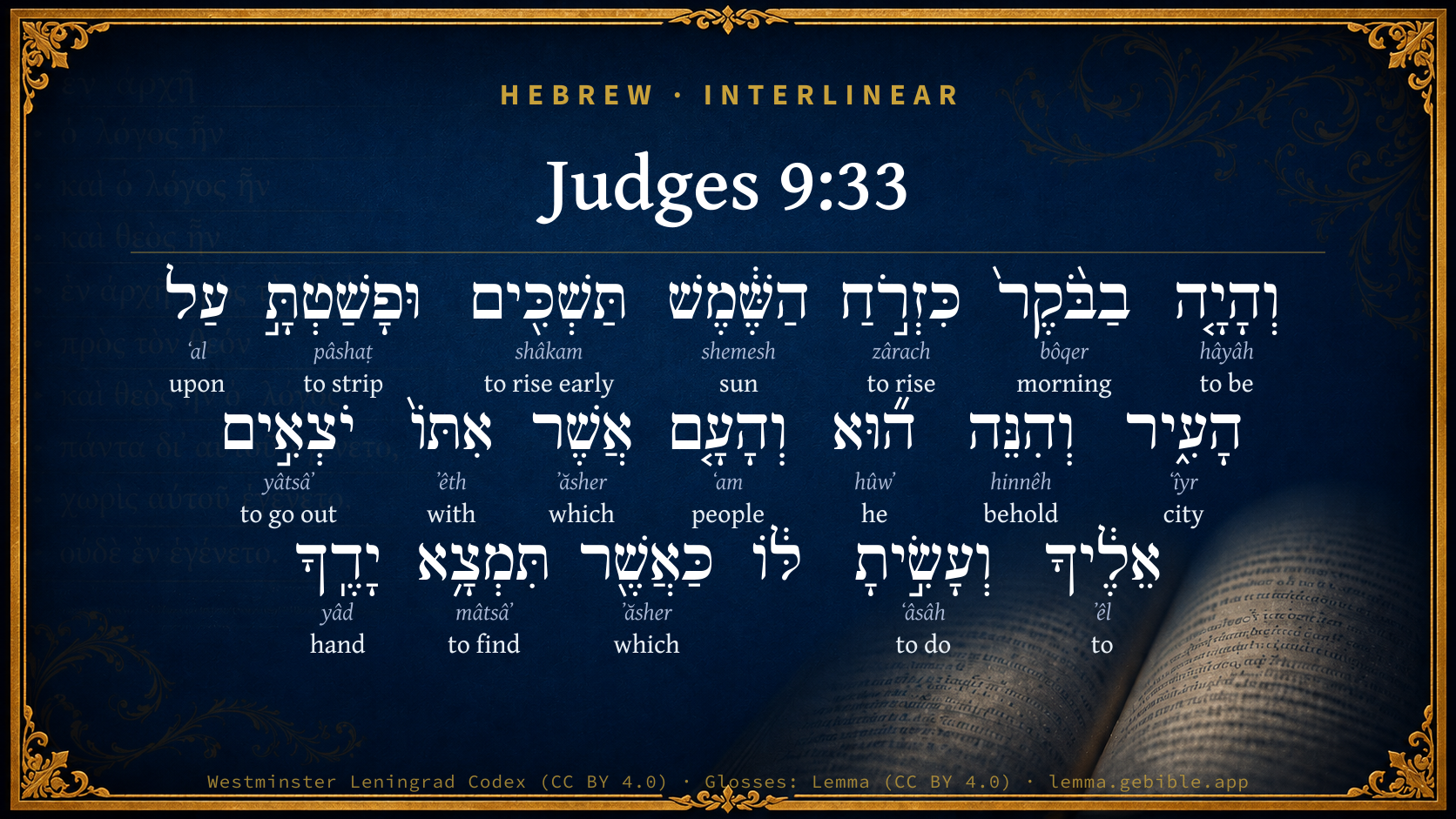
Judges 9:33

Hebrew (Westminster Leningrad Codex) Judges 9:33 appears in the Hebrew Old Testament. The text above is from the Westminster Leningrad Codex. Each word links to its Strong’s number, a concise gloss, and parsing drawn from the Open Scriptures Hebrew Bible morphology. Click any word for its full Brown-Driver-Briggs (BDB) entry.
Download image
Cite this verse

Judges 9:33 (World English Bible). Public Domain. Lemma interlinear Bible study tool, https://lemma.gebible.app/v/judges/9/33.

Show BibTeX & RIS
BibTeX
RIS
English Translation
and it shall be, that in the morning, as soon as the sun is up, you shall rise early, and rush on the city; and, behold, when he and the people who are with him come out against you, then may you do to them as you shall find occasion.
World English Bible · Public Domain
Download a study sheet

One document with this verse’s original text, its word-by-word gloss line, the meaning frame, cross-references with their text, attributed commentary, and full source and license credits — printable, and it pastes into notes with its structure intact.

This verse Autodidact and up

Study sheet (.html) Plain text (.txt)

A passage Seminary Student

Up to 50 verses in one chapter. A passage sheet keeps up to 6 commentary sources and 12 cross-references per verse, in the order this page ranks them, and says so on the sheet whenever that leaves anything out. Ask for a single verse and you get the Autodidact verse sheet above.

Everything on this page stays free to read, with no account — the sheet is a download of what is already on screen, not access to it.

Want to remove ads? Support Godless Engineer
Compare translations 3

The same verse in 3 English versions, stacked beneath the original-language interlinear above. Click any original word for its lexicon entry.

Each is an independent rendering of the whole verse — the interlinear is not word-aligned to these translations.

Highlighted words mark where these versions differ — a whole-verse word diff, not a word-by-word alignment.

  • World English Bible Public Domain
    and it shall be, that in the morning, as soon as the sun is up, you shall rise early, and rush on the city; and, behold, when he and the people who are with him come out against you, then may you do to them as you shall find occasion.
  • King James Version Public Domain
    And it shall be, that in the morning, as soon as the sun is up, thou shalt rise early, and set upon the city: and, behold, when he and the people that is with him come out against thee, then mayest thou do to them as thou shalt find occasion.
  • unfoldingWord Literal Text CC BY-SA 4.0
    And it shall happen in the morning, as the sun rises, you shall start early and you shall rush against the city. And behold, he and the people who with him coming out against you, and you shall do to him according to what your hand finds.”

unfoldingWord Literal Text — © unfoldingWord, licensed CC BY-SA 4.0. Word-aligned USFM3 via Door43 (git.door43.org/unfoldingWord/en_ult).

Versions to compare (up to 4)

3 of 4 selected

Show all 18 translations

Every available English version of this verse, each an independent rendering of the whole verse.

  • World English Bible Public Domain
    and it shall be, that in the morning, as soon as the sun is up, you shall rise early, and rush on the city; and, behold, when he and the people who are with him come out against you, then may you do to them as you shall find occasion.
  • Berean Standard Bible Public Domain
    And in the morning at sunrise, get up and advance against the city. When Gaal and his men come out against you, do to them whatever you are able.”
  • Majority Standard Bible Public Domain
    And in the morning at sunrise, get up and advance against the city. When Gaal and his men come out against you, do to them whatever you are able.”
  • King James Version Public Domain
    And it shall be, that in the morning, as soon as the sun is up, thou shalt rise early, and set upon the city: and, behold, when he and the people that is with him come out against thee, then mayest thou do to them as thou shalt find occasion.
  • American Standard Version (1901) Public Domain
    and it shall be, that in the morning, as soon as the sun is up, thou shalt rise early, and rush upon the city; and, behold, when he and the people that are with him come out against thee, then mayest thou do to them as thou shalt find occasion.
  • Revised Version (1885) Public Domain
    and it shall be, that in the morning, as soon as the sun is up, thou shalt rise early, and set upon the city: and, behold, when he and the people that is with him come out against thee, then mayest thou do to them as thou shalt find occasion.
  • Geneva Bible (1599) Public Domain
    And rise early in the morning as soone as the sunne is vp, and assault the citie: and when he and the people that is with him, shall come out against thee, doe to him what thou canst.
  • Douay-Rheims (1899) Public Domain
    And betimes in the morning at sun rising set upon the city. And when he shall come out against thee with his people, do to him what thou shalt be able.
  • Young's Literal Translation Public Domain
    and it hath been, in the morning, about the rising of the sun, thou dost rise early, and hast pushed against the city; and lo, he and the people who `are' with him are going out unto thee -- and thou hast done to him as thy hand doth find.'
  • Literal Standard Version CC BY-SA 4.0
    and it has been, in the morning, about the rising of the sun, you rise early, and have pushed against the city; and behold, he and the people who [are] with him are going out to you—and you have done to him as your hand finds.”
  • Unlocked Literal Bible CC BY-SA 4.0
    Then in the morning, as soon as the sun is up, rise early and make a raid on the city. When he and the people with him come out against you, do whatever you can to them.”
  • unfoldingWord Literal Text CC BY-SA 4.0
    And it shall happen in the morning, as the sun rises, you shall start early and you shall rush against the city. And behold, he and the people who with him coming out against you, and you shall do to him according to what your hand finds.”
  • Darby Bible Public Domain
    Then in the morning, as soon as the sun is up, rise early and rush upon the city; and when he and the men that are with him come out against you, you may do to them as occasion offers."
  • World Messianic Bible Public Domain
    It shall be that in the morning, as soon as the sun is up, you shall rise early and rush on the city. Behold, when he and the people who are with him come out against you, then may you do to them as you shall find occasion.”
  • Webster's Bible Public Domain
    And it shall be, that in the morning, as soon as the sun hath risen, thou shalt rise early, and attack the city: and behold, when he and the people that are with him come out against thee, then mayest thou do to them as thou shalt find occasion.
  • Free Bible Version CC BY-SA 4.0
    In the morning as soon as the sun comes up, go and attack the town. When Gaal and his men come out to fight you, you can do whatever you want to them.”
  • Bible in Basic English Public Domain
    And in the morning, when the sun is up, get up early and make a rush on the town; and when he and his people come out against you, do to them whatever you have a chance to do.
  • JPS Tanakh (1917) Public Domain
    And it shall be, that in the morning, as soon as the sun is up, thou shalt rise early, and set upon the city; and, behold, when he and the people that are with him come out against thee, then mayest thou do to them as thou shalt be able.'

Literal Standard Version (2020), Covenant Press — licensed CC BY-SA 4.0. Text via the HelloAO Bible API (eBible.org). Unlocked Literal Bible (unfoldingWord) — licensed CC BY-SA 4.0. Text via the HelloAO Bible API (eBible.org). unfoldingWord Literal Text — © unfoldingWord, licensed CC BY-SA 4.0. Word-aligned USFM3 via Door43 (git.door43.org/unfoldingWord/en_ult). Free Bible Version, Dr. Jonathan Gallagher — licensed CC BY-SA 4.0. Text via the HelloAO Bible API (eBible.org).

Word by word

More ways to search: Search by grammar → Find every occurrence → Compare this word →

Practice this passage: Drill this verse → Learn its vocabulary →

כִּזְרֹ֣חַ
zârach
H2224
“like/as · to rise”
Preposition + Verb, Qal, Infinitive Construct
Part of Speech
Preposition + Verb
Stem
Qal
Form
Infinitive Construct
Full BDB Definition

Origin: a primitive root

TWOT: 580

to rise, come forth, break out, arise, rise up, shine - (Qal) - to rise - to come out, appear
  1. וְהָיָ֤ה hâyâh H1961 “and · to be” Conjunction + Verb, Qal, Perfect, 3rd Person, Masculine, Singular
  2. בַבֹּ֨קֶר֙ bôqer H1242 “in/at the · morning” Preposition, Determined + Noun, Common, Masculine, Singular, Absolute
  3. הַשֶּׁ֔מֶשׁ shemesh H8121 “the · sun” Particle, Definite Article + Noun, Common, Both, Singular, Absolute
  4. תַּשְׁכִּ֖ים shâkam H7925 “to rise early” Verb, Hiphil, Imperfect, 2nd Person, Masculine, Singular
  5. וּפָשַׁטְתָּ֣ pâshaṭ H6584 “and · to strip” Conjunction + Verb, Qal, Perfect, 2nd Person, Masculine, Singular
  6. עַל ʻal H5921 “upon” Preposition
  7. הָעִ֑יר ʻîyr H5892 “the · city” Particle, Definite Article + Noun, Common, Feminine, Singular, Absolute
  8. וְהִנֵּה hinnêh H2009 “and · behold” Conjunction + Particle, Demonstrative
  9. ה֞וּא hûwʼ H1931 “he” Pronoun, Personal, 3rd Person, Masculine, Singular
  10. וְהָעָ֤ם ʻam H5971 “and · the · people” Conjunction + Particle, Definite Article + Noun, Common, Masculine, Singular, Absolute
  11. אֲשֶׁר ʼăsher H834 “which” Particle, Relative
  12. אִתּוֹ֙ ʼêth H854 “with · him” Preposition + Suffix, Personal, 3rd Person, Masculine, Singular
  13. יֹצְאִ֣ים yâtsâʼ H3318 “going out” Verb, Qal, Participle Active, Masculine, Plural, Absolute
  14. אֵלֶ֔יךָ ʼêl H413 “to · you” Preposition + Suffix, Personal, 2nd Person, Masculine, Singular
  15. וְעָשִׂ֣יתָ ʻâsâh H6213 “and · to do” Conjunction + Verb, Qal, Sequential Perfect, 2nd Person, Masculine, Singular
  16. כַּאֲשֶׁ֖ר ʼăsher H834 “like/as · which” Preposition + Particle, Relative
  17. תִּמְצָ֥א mâtsâʼ H4672 “to find” Verb, Qal, Imperfect, 3rd Person, Feminine, Singular
  18. יָדֶֽךָ yâd H3027 “hand · your” Noun, Common, Both, Singular, Construct + Suffix, Personal, 2nd Person, Masculine, Singular

About this verse

These counts appear in no published source. They are computed here, from the morphology-tagged text and Lemma’s own curated glosses. What Lemma adds →

20
words
18
distinct lemmas
Historical
section

Notable vocabulary

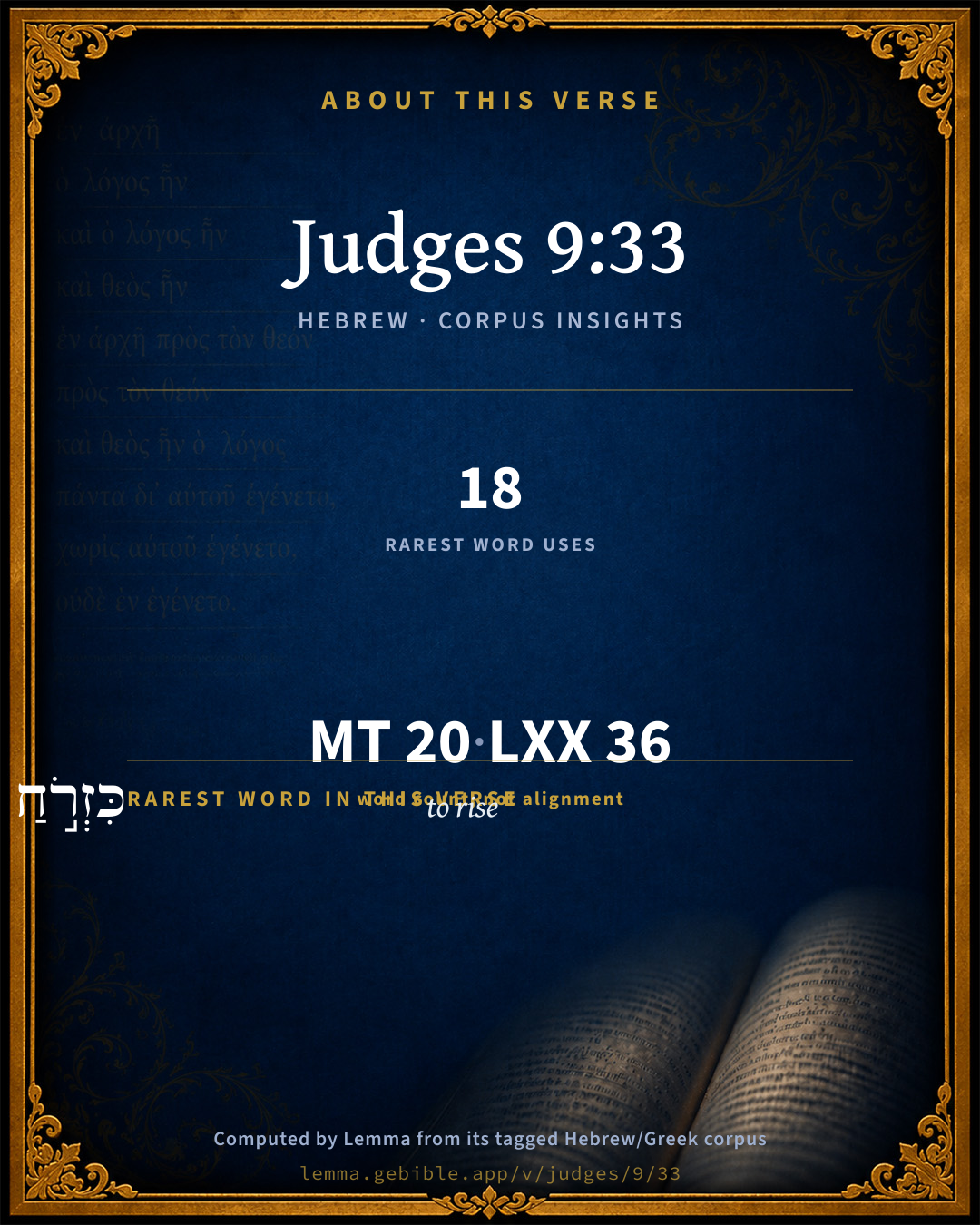
The rarest word here is כִּזְרֹ֣חַ to rise H2224 — appearing just 18 times in the whole Hebrew Bible.

Shared distinctive vocabulary

כִּזְרֹ֣חַ to rise H2224 occurs in 17 verses of the Hebrew Bible. Also found in:

Grammatical profile

  • 7 verbs
  • 5 nouns
  • 1 pronoun
  • 4 prepositions
  • 3 particles

Verb forms

  • וְהָיָ֤ה Qal · Perfect
  • כִּזְרֹ֣חַ Qal · Infinitive Construct
  • תַּשְׁכִּ֖ים Hiphil · Imperfect
  • וּפָשַׁטְתָּ֣ Qal · Perfect
  • יֹצְאִ֣ים Qal · Participle Active
  • וְעָשִׂ֣יתָ Qal · Sequential Perfect
  • תִּמְצָ֥א Qal · Imperfect

Repetition

A word recurs within this verse — often emphatic in Hebrew:

  • אֲשֶׁר which H834 ×2

Hebrew & Septuagint length

In English translation the verse runs 50 words from the Hebrew and 44 from the Septuagint (LXX English) — closely comparable.

A rough comparison of the two English renderings, which tokenize alike — not a word-level alignment.

Word counts can differ between the Hebrew and the Greek without any difference in meaning — e.g. the Hebrew direct-object marker אֵת has no separate Greek word, and Greek often adds the article ὁ.

In the original languages it is 20 Hebrew tokens and 36 Greek tokens — but the two are counted differently (Hebrew bundles its prefixes and suffixes into one token; the Greek is in lemma form), so that isn’t a like-for-like length.

Cross-references

4

Topical passages linked to Judges 9:33 in the Treasury of Scripture Knowledge — connected by theme and wording, ordered by reader-vote popularity; previews shown in the World English Bible.

  • 1 Samuel 10:7 Let it be, when these signs are come to you, that you do as occasion shall serve you; for God is with you.
  • Ecclesiastes 9:10 Whatever your hand finds to do, do it with your might; for there is no work, nor device, nor knowledge, nor wisdom, in Sheol, where you are going.
  • Leviticus 25:26 If a man has no one to redeem it, and he becomes prosperous and finds sufficient means to redeem it;
  • 1 Samuel 25:8 Ask your young men, and they will tell you: therefore let the young men find favor in your eyes; for we come in a good day. Please give whatever comes to your hand, to your servants, and to your son David.

Cross-references courtesy of OpenBible.info (CC BY 4.0).

Hebrew and Greek witnesses Masoretic Hebrew ↔ Greek Septuagint

The same verse in the two great witnesses to the Old Testament, shown verse-for-verse.

These are two independent witnesses, not word-aligned to each other, and the Septuagint is shown in lemma (dictionary) form.

Hebrew Judges 9:33 Masoretic · Westminster Leningrad Codex

וְהָיָ֤ה בַבֹּ֨קֶר֙ כִּזְרֹ֣חַ הַשֶּׁ֔מֶשׁ תַּשְׁכִּ֖ים וּפָשַׁטְתָּ֣ עַל הָעִ֑יר וְהִנֵּה ה֞וּא וְהָעָ֤ם אֲשֶׁר אִתּוֹ֙ יֹצְאִ֣ים אֵלֶ֔יךָ וְעָשִׂ֣יתָ לּ֔וֹ כַּאֲשֶׁ֖ר תִּמְצָ֥א יָדֶֽךָ

and it shall be, that in the morning, as soon as the sun is up, you shall rise early, and rush on the city; and, behold, when he and the people who are with him come out against you, then may you do to them as you shall find occasion.

World English Bible · Public Domain

Greek LXX Judges 9:33 Septuagint · lemma form

καί εἰμί ὁ πρωΐ ἅμα ὁ ἀνατέλλω ὁ ἥλιος ὀρθρίζω καί ἐκτείνω ἐπί ὁ πόλις καί ἰδού αὐτός καί ὁ λαός ὁ μετά αὐτός ἐκπορεύομαι πρός σύ καί ποιέω αὐτός ὅσος ἄν εὑρίσκω ὁ χείρ σύ

And it shall come to pass in the morning at sunrising, you shall rise up early and draw toward the city; and behold, he and the people with him will come forth against you, and you shall do to him according to your power.

LXX2012 (modern English Septuagint) · Public Domain

Hebrew: Westminster Leningrad Codex (CC BY 4.0). Greek: Septuagint (public domain); English from LXX2012 (modern English Septuagint) (Public Domain). How the Septuagint differs from the Hebrew →

Targum (Aramaic paraphrase)

1

The Targum is the ancient Jewish Aramaic paraphrase of the Hebrew Scriptures — an interpretive translation, not the Hebrew text itself. Onkelos (literal) and Pseudo-Jonathan (expansive) render the Torah, and Jonathan the Prophets. Coverage is partial: where no permissively-licensed English translation exists for a verse, only the Aramaic is shown. This is verse-level text, not a word-by-word alignment to the Hebrew.

  1. Targum Jonathan Prophets (Joshua–Malachi)
    וִיהֵי בְצַפְרָא כְּמַדְנַח שִׁמְשָׁא תַּקְדֵים וְתִתְנְגֵיד עַל קַרְתָּא וְהָא הוּא וְעַמָא דִי עִמֵיהּ נַפְקִין לָקֳדָמוּתָךְ וְתַעְבֵּיד לֵיהּ כְּמָא דְתַשְׁכַּח יְדָךְ:

    (no public-domain English translation for this verse)

    Targum Jonathan — Aramaic: “Mikraot Gedolot” (public domain). English: “Sefaria Community Translation” (CC0 1.0 (public-domain dedication)); “London "Chaldee Paraphrase," 1871” (public domain). Text via Sefaria.

Commentary

Notes on Judges 9:33 from classic Christian and Jewish commentators (each source and its license shown beneath its notes). The classic Christian expositions comment on the surrounding passage and are grouped to its opening verse, so a note may address several verses; the Jewish commentaries on the Tanakh (Rashi and others) are per-verse, so they appear only where the commentator wrote on this verse.

Lemma curates 59 commentaries, every one of them public domain or Creative Commons licensed, each selected and text-cleaned for this edition rather than reprinted as found. About our sources →

Trapp's Complete Commentary

John Trapp

Jdg 9:33 And it shall be, [that] in the morning, as soon as the sun is up, thou shalt rise early, and set upon the city: and, behold, [when] he and the people that [is] with him come out against thee, then mayest thou do to them as thou shalt find occasion.

Ver. 33. As thou shalt find occasion.] This was welcome advice to Abimelech, who might probably hereupon set as high a price upon Zebul, as afterwards Darius did upon Zopyrus. {a}

{a} Justin., lib. i.

John Trapp, A Commentary or Exposition upon All the Books of the Old and New Testament (1647–1656) — public domain. Text from a community e-Sword module.

Geneva Bible (1599)

Geneva Bible translators

Hebrew, what thine hand can find.

Geneva Bible (1599) marginal notes — public domain. Text via Bolls.life.

Ellicott's Commentary for English Readers

(33) As thou shalt find occasion.—Literally, as in the margin, as thine hand shall find, as in 1Sa_10:7; 1Sa_25:8.

A Bible Commentary for English Readers, edited by Charles John Ellicott (1878–1897) — public domain. Text from a community e-Sword module.

The Cambridge Bible for Schools and Colleges

gen. ed. J. J. S. Perowne

33. set upon] make a dash upon, rush forward against, from a place of hiding, cf. Jdg_9:44, Jdg_20:37.

as thou shalt find occasion] For the idiom (see marg.) cf. 1Sa_10:7; 1Sa_25:8, Ecc_9:10.

The Cambridge Bible for Schools and Colleges (gen. ed. J. J. S. Perowne; Cambridge University Press, 1878–1918) — public domain. Text from a community e-Sword module.

John Gill's Exposition

And Abimelech rose up, and all the people that were with him, by night,.... According to the advice of Zebul:

and they laid wait against Shechem in four companies; he divided his army into four parts, which he placed on the four sides of the city, at some distance from it, to act as they should have opportunity, to find ways and means of getting into it on either quarter.

John Gill's Exposition of the Whole Bible (1746–1763) — public domain (CC PDM 1.0). Text via the HelloAO Bible API.

Matthew Poole's English Annotations

Behold, when he, i.e. Gaal, mentioned Jdg 9:31.

Matthew Poole's English Annotations on the Holy Bible (1683–1685) — public domain. Text from a community e-Sword/MySword module.

Lesson kit

Teaching starters — assembled from the data on this page, not authored interpretation. Every prompt links to the verse data it draws on. Edit before teaching.

Judges, in the Historical, opens this verse with 20 words (18 distinct Hebrew lemmas). Its most distinctive word is zârach (“to rise”). A historical commentator’s framing appears above. Read the whole chapter for the surrounding context.

Discussion questions

  1. How does “to rise” (zârach) shape what this verse is saying?
  2. How does Genesis 32:31, which shares the word «to rise», read alongside this verse?
  3. What does the repetition of “which” (2× in this one verse) do in this verse?
  4. The translations on this page render this verse differently — a whole-verse word diff, not a word-by-word alignment. What might account for the different wordings?
  5. «וְהָיָ֤ה» is a Qal Perfect verb. How does that grammatical form shape the action described?
  6. Compare how Trapp's Complete Commentary and Geneva Bible (1599) read this verse. Where do they agree or differ?

Things to notice

Reading settings

Reading text

Shown beneath each verse's original-language words.

Old Testament
Old Testament edition

Read the OT as the Masoretic Hebrew (MT) or the Greek Septuagint (LXX).

English shown for the Greek Septuagint (in the Hebrew ↔ Greek comparison).

Comparing translations? Open the Compare panel on any verse page to stack up to four side by side.