
Esther 2:14

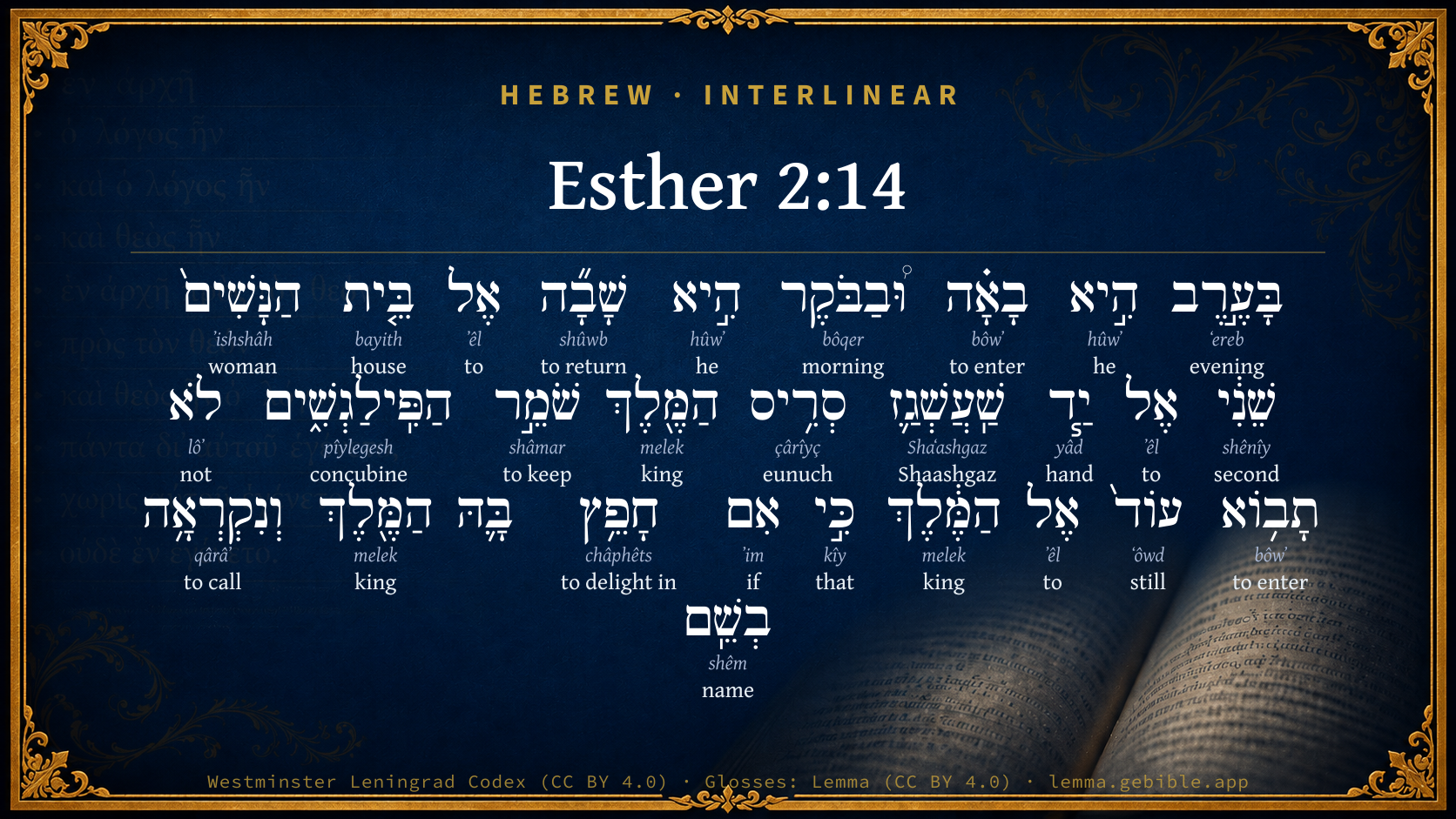
Hebrew (Westminster Leningrad Codex) Esther 2:14 appears in the Hebrew Old Testament. The text above is from the Westminster Leningrad Codex. Each word links to its Strong’s number, a concise gloss, and parsing drawn from the Open Scriptures Hebrew Bible morphology. Click any word for its full Brown-Driver-Briggs (BDB) entry.
Download image
Cite this verse

Esther 2:14 (World English Bible). Public Domain. Lemma interlinear Bible study tool, https://lemma.gebible.app/v/esther/2/14.

Show BibTeX & RIS
BibTeX
RIS
English Translation
In the evening she went, and on the next day she returned into the second house of the women, to the custody of Shaashgaz, the king's chamberlain, who kept the concubines: she came in to the king no more, except the king delighted in her, and she were called by name.
World English Bible · Public Domain
Highlights
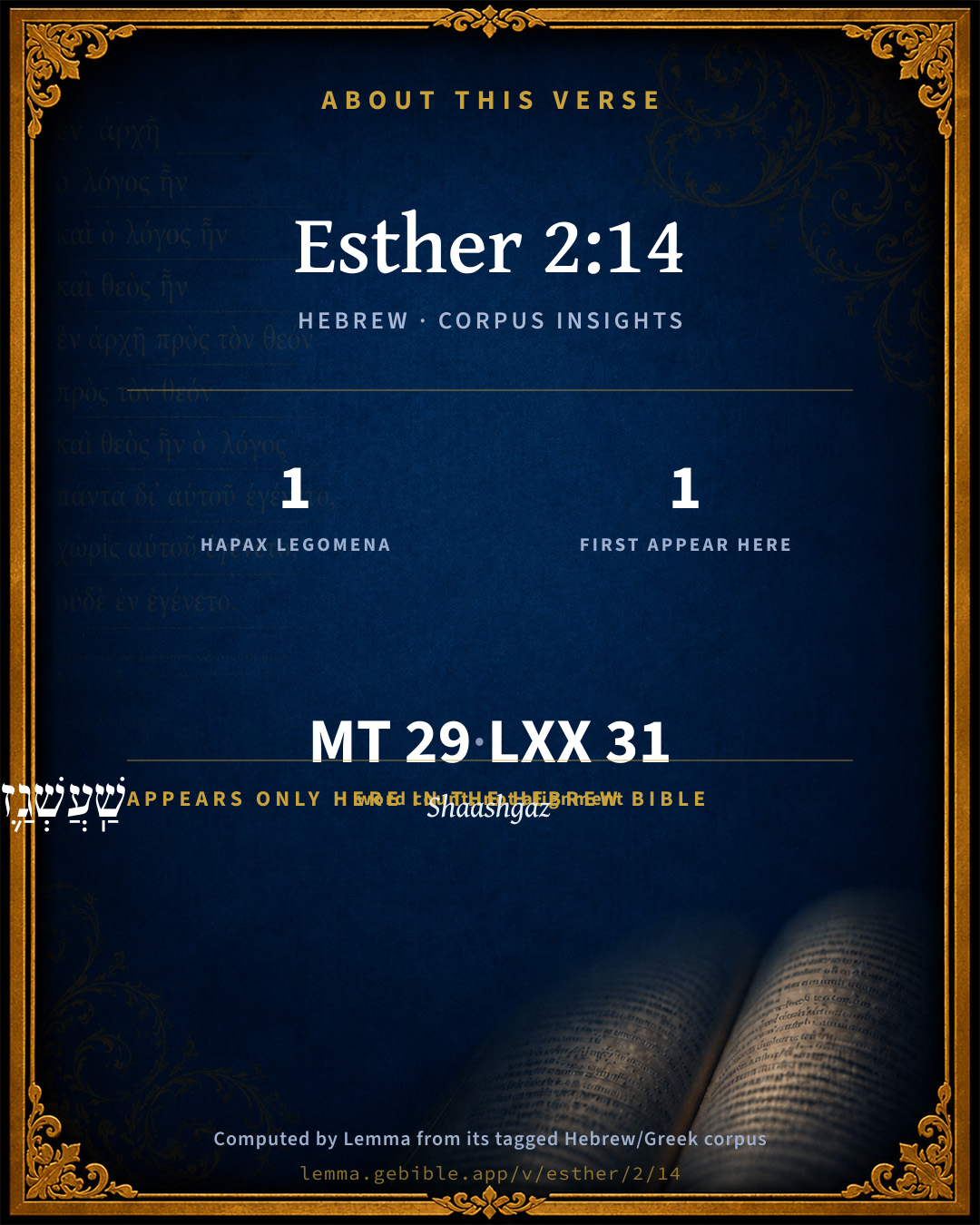
  • 1 hapax legomenon — only here in the Hebrew Bible
  • 1 first appearance in the Hebrew Bible
Full analysis ↓
Download a study sheet

One document with this verse’s original text, its word-by-word gloss line, the meaning frame, cross-references with their text, attributed commentary, and full source and license credits — printable, and it pastes into notes with its structure intact.

This verse Autodidact and up

Study sheet (.html) Plain text (.txt)

A passage Seminary Student

Up to 50 verses in one chapter. A passage sheet keeps up to 6 commentary sources and 12 cross-references per verse, in the order this page ranks them, and says so on the sheet whenever that leaves anything out. Ask for a single verse and you get the Autodidact verse sheet above.

Everything on this page stays free to read, with no account — the sheet is a download of what is already on screen, not access to it.

Want to remove ads? Support Godless Engineer
Compare translations 3

The same verse in 3 English versions, stacked beneath the original-language interlinear above. Click any original word for its lexicon entry.

Each is an independent rendering of the whole verse — the interlinear is not word-aligned to these translations.

Highlighted words mark where these versions differ — a whole-verse word diff, not a word-by-word alignment.

  • World English Bible Public Domain
    In the evening she went, and on the next day she returned into the second house of the women, to the custody of Shaashgaz, the king's chamberlain, who kept the concubines: she came in to the king no more, except the king delighted in her, and she were called by name.
  • King James Version Public Domain
    In the evening she went, and on the morrow she returned into the second house of the women, to the custody of Shaashgaz, the king's chamberlain, which kept the concubines: she came in unto the king no more, except the king delighted in her, and that she were called by name.
  • unfoldingWord Literal Text CC BY-SA 4.0
    In the evening she would go, and in the morning she would return to the second house of women, into the hand of Shaashgaz (the eunuch of the king who was overseer of the concubines). She would not go to the king again unless the king had delighted in her and she was called by name.

unfoldingWord Literal Text — © unfoldingWord, licensed CC BY-SA 4.0. Word-aligned USFM3 via Door43 (git.door43.org/unfoldingWord/en_ult).

Versions to compare (up to 4)

3 of 4 selected

Show all 18 translations

Every available English version of this verse, each an independent rendering of the whole verse.

  • World English Bible Public Domain
    In the evening she went, and on the next day she returned into the second house of the women, to the custody of Shaashgaz, the king's chamberlain, who kept the concubines: she came in to the king no more, except the king delighted in her, and she were called by name.
  • Berean Standard Bible Public Domain
    She would go there in the evening, and in the morning she would return to a second harem under the care of Shaashgaz, the king’s eunuch in charge of the concubines. She would not return to the king unless he delighted in her and summoned her by name.
  • Majority Standard Bible Public Domain
    She would go there in the evening, and in the morning she would return to a second harem under the care of Shaashgaz, the king’s eunuch in charge of the concubines. She would not return to the king unless he delighted in her and summoned her by name.
  • King James Version Public Domain
    In the evening she went, and on the morrow she returned into the second house of the women, to the custody of Shaashgaz, the king's chamberlain, which kept the concubines: she came in unto the king no more, except the king delighted in her, and that she were called by name.
  • American Standard Version (1901) Public Domain
    In the evening she went, and on the morrow she returned into the second house of the women, to the custody of Shaashgaz, the king's chamberlain, who kept the concubines: she came in unto the king no more, except the king delighted in her, and she were called by name.
  • Revised Version (1885) Public Domain
    In the evening she went, and on the morrow she returned into the second house of the women, to the custody of Shaashgaz, the king’s chamberlain, which kept the concubines: she came in unto the king no more, except the king delighted in her, and that she were called by name.
  • Geneva Bible (1599) Public Domain
    In the euening she went, and on the morow she returned into the second house of the women vnder the hand of Shaashgaz the Kings eunuche, which kept the concubines: shee came in to the King no more, except shee pleased the King, and that she were called by name.
  • Douay-Rheims (1899) Public Domain
    And she that went in at evening, came out in the morning, and from thence she was conducted to the second house, that was under the hand of Susagaz the eunuch, who had the charge over the king's concubines: neither could she re- turn any more to the king, unless the king desired it, and had ordered her by name to come.
  • Young's Literal Translation Public Domain
    in the evening she hath gone in, and in the morning she hath turned back unto the second house of the women, unto the hand of Shaashgaz eunuch of the king, keeper of the concubines; she cometh not in any more unto the king except the king hath delighted in her, and she hath been called by name.
  • Literal Standard Version CC BY-SA 4.0
    in the evening she has gone in, and in the morning she has turned back to the second house of the women, to the hand of Shaashgaz eunuch of the king, keeper of the concubines; she does not come in anymore to the king except the king has delighted in her, and she has been called by name.
  • Unlocked Literal Bible CC BY-SA 4.0
    In the evening she would go in, and in the morning she would return to the second house of the women, and to the custody of Shaashgaz, the king's official, who was in charge of the concubines. She would not return to the king again unless he had taken great pleasure in her and called for her again.
  • unfoldingWord Literal Text CC BY-SA 4.0
    In the evening she would go, and in the morning she would return to the second house of women, into the hand of Shaashgaz (the eunuch of the king who was overseer of the concubines). She would not go to the king again unless the king had delighted in her and she was called by name.
  • Darby Bible Public Domain
    In the evening she went, and on the morrow she returned into the second house of the women, unto the custody of Shaashgaz, the king's chamberlain, keeper of the concubines. She came in to the king no more, unless the king delighted in her, and she were called by name.
  • World Messianic Bible Public Domain
    In the evening she went, and on the next day she returned into the second women’s house, to the custody of Shaashgaz, the king’s eunuch, who kept the concubines. She came in to the king no more, unless the king delighted in her, and she was called by name.
  • Webster's Bible Public Domain
    In the evening she went, and on the morrow she returned into the second house of the women, to the custody of Shaashgaz, the king's chamberlain, who kept the concubines: she came in to the king no more, except that the king delighted in her, and she was called by name.
  • Free Bible Version CC BY-SA 4.0
    In the evening she would go, and in the morning she would return to a different harem under the supervision of Shaashgaz, who was the king's eunuch in charge of the concubines. She would not go back to be with the king again unless he was particularly attracted to her and called for her by name.
  • Bible in Basic English Public Domain
    In the evening she went, and on the day after she came back to the second house of the women, into the keeping of Shaashgaz, one of the king's unsexed servants who had the care of the king's wives: only if the king had delight in her and sent for her by name did she go in to him again.
  • JPS Tanakh (1917) Public Domain
    In the evening she went, and on the morrow she returned into the second house of the women, to the custody of Shaashgaz, the king's chamberlain, who kept the concubines; she came in unto the king no more, except the king delighted in her, and she were called by name.

Literal Standard Version (2020), Covenant Press — licensed CC BY-SA 4.0. Text via the HelloAO Bible API (eBible.org). Unlocked Literal Bible (unfoldingWord) — licensed CC BY-SA 4.0. Text via the HelloAO Bible API (eBible.org). unfoldingWord Literal Text — © unfoldingWord, licensed CC BY-SA 4.0. Word-aligned USFM3 via Door43 (git.door43.org/unfoldingWord/en_ult). Free Bible Version, Dr. Jonathan Gallagher — licensed CC BY-SA 4.0. Text via the HelloAO Bible API (eBible.org).

Word by word

More ways to search: Search by grammar → Find every occurrence → Compare this word →

Practice this passage: Drill this verse → Learn its vocabulary →

שַֽׁעֲשְׁגַ֛ז
Shaʻashgaz
H8190
“Shaashgaz”
Noun, Proper
Part of Speech
Noun
Type
Proper
Full BDB Definition

Origin: of Persian derivation

TWOT: None

Shaashgaz = "servant of the beautiful" - the eunuch in the palace of Xerxes who was in charge of the women in the 2nd house
  1. בָּעֶ֣רֶב ʻereb H6153 “in/at the · evening” Preposition, Determined + Noun, Common, Masculine, Singular, Absolute
  2. הִ֣יא hûwʼ H1931 “he” Pronoun, Personal, 3rd Person, Feminine, Singular
  3. בָאָ֗ה bôwʼ H935 “entering” Verb, Qal, Participle Active, Feminine, Singular, Absolute
  4. וּ֠בַבֹּקֶר bôqer H1242 “and · in/at the · morning” Conjunction + Preposition, Determined + Noun, Common, Masculine, Singular, Absolute
  5. הִ֣יא hûwʼ H1931 “he” Pronoun, Personal, 3rd Person, Feminine, Singular
  6. שָׁבָ֞ה shûwb H7725 “returning” Verb, Qal, Participle Active, Feminine, Singular, Absolute
  7. אֶל ʼêl H413 “to” Preposition
  8. בֵּ֤ית bayith H1004 “house of” Noun, Common, Masculine, Singular, Construct
  9. הַנָּשִׁים֙ ʼishshâh H802 “the · women” Particle, Definite Article + Noun, Common, Feminine, Plural, Absolute
  10. שֵׁנִ֔י shênîy H8145 “second” Adjective, Ordinal number, Masculine, Singular, Absolute
  11. אֶל ʼêl H413 “to” Preposition
  12. יַ֧ד yâd H3027 “hand of” Noun, Common, Both, Singular, Construct
  13. סְרִ֥יס çârîyç H5631 “eunuch of” Noun, Common, Masculine, Singular, Construct
  14. הַמֶּ֖לֶךְ melek H4428 “the · king” Particle, Definite Article + Noun, Common, Masculine, Singular, Absolute
  15. שֹׁמֵ֣ר shâmar H8104 “keeping” Verb, Qal, Participle Active, Masculine, Singular, Construct
  16. הַפִּֽילַגְשִׁ֑ים pîylegesh H6370 “the · concubines” Particle, Definite Article + Noun, Common, Feminine, Plural, Absolute
  17. לֹא lôʼ H3808 “not” Particle, Negative
  18. תָב֥וֹא bôwʼ H935 “to enter” Verb, Qal, Imperfect, 3rd Person, Feminine, Singular
  19. עוֹד֙ ʻôwd H5750 “still” Adverb
  20. אֶל ʼêl H413 “to” Preposition
  21. הַמֶּ֔לֶךְ melek H4428 “the · king” Particle, Definite Article + Noun, Common, Masculine, Singular, Absolute
  22. כִּ֣י kîy H3588 “that” Conjunction
  23. אִם ʼim H518 “if” Conjunction
  24. חָפֵ֥ץ châphêts H2654 “to delight in” Verb, Qal, Perfect, 3rd Person, Masculine, Singular
  25. הַמֶּ֖לֶךְ melek H4428 “the · king” Particle, Definite Article + Noun, Common, Masculine, Singular, Absolute
  26. וְנִקְרְאָ֥ה qârâʼ H7121 “and · to call” Conjunction + Verb, Niphal, Perfect, 3rd Person, Feminine, Singular
  27. בְשֵֽׁם shêm H8034 “in/at · name” Preposition + Noun, Common, Masculine, Singular, Absolute

About this verse

These counts appear in no published source. They are computed here, from the morphology-tagged text and Lemma’s own curated glosses. What Lemma adds →

29
words
22
distinct lemmas
Historical
section

Notable vocabulary

1 hapax legomenon — a word that appears only here in the entire Hebrew Bible:

  • שַֽׁעֲשְׁגַ֛ז Shaashgaz H8190

First appearance in Scripture

This word makes its first canonical appearance in the Hebrew Bible here:

  • שַֽׁעֲשְׁגַ֛ז Shaashgaz H8190

Shared distinctive vocabulary

הַפִּֽילַגְשִׁ֑ים concubine H6370 occurs in 35 verses of the Hebrew Bible. Also found in:

Grammatical profile

  • 6 verbs
  • 12 nouns
  • 1 adjective
  • 2 pronouns
  • 4 prepositions
  • 2 conjunctions
  • 1 adverb
  • 1 particle

Verb forms

  • בָאָ֗ה Qal · Participle Active
  • שָׁבָ֞ה Qal · Participle Active
  • שֹׁמֵ֣ר Qal · Participle Active
  • תָב֥וֹא Qal · Imperfect
  • חָפֵ֥ץ Qal · Perfect
  • וְנִקְרְאָ֥ה Niphal · Perfect

Repetition

Words recur within this verse — often emphatic in Hebrew:

  • הַמֶּ֖לֶךְ king H4428 ×3
  • בָאָ֗ה to enter H935 ×2
  • אֶל to H413 ×3
  • הִ֣יא he H1931 ×2

Hebrew & Septuagint length

In English translation the verse runs 51 words from the Hebrew and 42 from the Septuagint (LXX English) — closely comparable.

A rough comparison of the two English renderings, which tokenize alike — not a word-level alignment.

Word counts can differ between the Hebrew and the Greek without any difference in meaning — e.g. the Hebrew direct-object marker אֵת has no separate Greek word, and Greek often adds the article ὁ.

In the original languages it is 29 Hebrew tokens and 31 Greek tokens — but the two are counted differently (Hebrew bundles its prefixes and suffixes into one token; the Greek is in lemma form), so that isn’t a like-for-like length.

Cross-references

6

Topical passages linked to Esther 2:14 in the Treasury of Scripture Knowledge — connected by theme and wording, ordered by reader-vote popularity; previews shown in the World English Bible.

  • Esther 4:11 All the king's servants, and the people of the king's provinces, do know, that whoever, whether man or woman, shall come to the king into the inner court, who is not called, there is one law for him, that he be put to death, except those to whom the king shall hold out the golden scepter, that he may live: but I have not been called to come in to the king these thirty days.
  • Genesis 34:19 The young man didn't wait to do this thing, because he had delight in Jacob's daughter, and he was honored above all the house of his father.
  • Deuteronomy 21:14 It shall be, if you have no delight in her, then you shall let her go where she will; but you shall not sell her at all for money, you shall not deal with her as a slave, because you have humbled her.
  • Isaiah 43:1 But now thus says Yahweh who created you, Jacob, and he who formed you, Israel: Don't be afraid, for I have redeemed you; I have called you by your name, you are mine.
  • Isaiah 45:4 For Jacob my servant's sake, and Israel my chosen, I have called you by your name: I have surnamed you, though you have not known me.
  • Isaiah 62:4–5 You shall no more be termed Forsaken; neither shall your land any more be termed Desolate: but you shall be called Hephzibah, and your land Beulah; for Yahweh delights in you, and your land shall be married.

Cross-references courtesy of OpenBible.info (CC BY 4.0).

Hebrew and Greek witnesses Masoretic Hebrew ↔ Greek Septuagint

The same verse in the two great witnesses to the Old Testament, shown verse-for-verse.

These are two independent witnesses, not word-aligned to each other, and the Septuagint is shown in lemma (dictionary) form.

Hebrew Esther 2:14 Masoretic · Westminster Leningrad Codex

בָּעֶ֣רֶב הִ֣יא בָאָ֗ה וּ֠בַבֹּקֶר הִ֣יא שָׁבָ֞ה אֶל בֵּ֤ית הַנָּשִׁים֙ שֵׁנִ֔י אֶל יַ֧ד שַֽׁעֲשְׁגַ֛ז סְרִ֥יס הַמֶּ֖לֶךְ שֹׁמֵ֣ר הַפִּֽילַגְשִׁ֑ים לֹא תָב֥וֹא עוֹד֙ אֶל הַמֶּ֔לֶךְ כִּ֣י אִם חָפֵ֥ץ בָּ֛הּ הַמֶּ֖לֶךְ וְנִקְרְאָ֥ה בְשֵֽׁם

In the evening she went, and on the next day she returned into the second house of the women, to the custody of Shaashgaz, the king's chamberlain, who kept the concubines: she came in to the king no more, except the king delighted in her, and she were called by name.

World English Bible · Public Domain

Greek LXX Esther 2:14 Septuagint · lemma form

δείλη εἰςπορεύομαι καί πρός ἡμέρα ἀποτρέχω εἰς ὁ γυναικών ὁ δεύτερος οὗ γαι ὁ εὐνοῦχος ὁ βασιλεύς ὁ φύλαξ ὁ γυνή καί οὐκέτι εἰςπορεύομαι πρός ὁ βασιλεύς ἐάν μή καλέω ὄνομα

She enters in the evening, and in the morning she departs to the second women's apartment, where Gai the king's chamberlain is keeper of the women: and she goes not in to the king again, unless she should be called by name.

LXX2012 (modern English Septuagint) · Public Domain

Hebrew: Westminster Leningrad Codex (CC BY 4.0). Greek: Septuagint (public domain); English from LXX2012 (modern English Septuagint) (Public Domain). How the Septuagint differs from the Hebrew →

Commentary

Notes on Esther 2:14 from classic Christian and Jewish commentators (each source and its license shown beneath its notes). The classic Christian expositions comment on the surrounding passage and are grouped to its opening verse, so a note may address several verses; the Jewish commentaries on the Tanakh (Rashi and others) are per-verse, so they appear only where the commentator wrote on this verse.

Lemma curates 59 commentaries, every one of them public domain or Creative Commons licensed, each selected and text-cleaned for this edition rather than reprinted as found. About our sources →

Trapp's Complete Commentary

John Trapp

Est 2:14 In the evening she went, and on the morrow she returned into the second house of the women, to the custody of Shaashgaz, the king’s chamberlain, which kept the concubines: she came in unto the king no more, except the king delighted in her, and that she were called by name.

Ver. 14. In the evening she went] As the fittest time for a work of darkness.

And on the morrow she returned] So short is the pleasure of sin. Laura venire Venus, tristis abire solet.

Into the second house of the women] That having made sale of her honesty, she might converse with such as had likewise left their honesties behind them; companions in evil, and miserable comforters, with whom they might make up their measure, and God’s power on his.

She came in unto the king no more] But must burn in lust, without means of allayment; being scalded, as it were, in her own grease, frying within and freezing without. Sed βορβορουμεθα ταντα λεγοντες, as Cyril saith in a like case, We do but rake a dunghill in a discourse of this nature. Let us therefore stay here no longer (as Merlin hath it) in setting forth the filthiness of this heathen prince, who yet hath too many among us that imitate his uncleanness and intemperance.

John Trapp, A Commentary or Exposition upon All the Books of the Old and New Testament (1647–1656) — public domain. Text from a community e-Sword module.

Tyndale Open Study Notes

Tyndale Open Resources

2:14 the second harem: Each woman would spend one night with the king in his bedroom and then live essentially as a widow the rest of her life unless the king remembered her name and called for her. The women in the second harem lived an easy life in a luxurious setting under the care of Shaashgaz, the king’s eunuch.

Tyndale Open Study Notes — © Tyndale Open Resources, licensed CC BY-SA 4.0. Text via the HelloAO Bible API.

Adam Clarke's Commentary

Verse 14. She returned into the second house] This was the place where the king's concubines were kept. They went out no more, and were never given in marriage to any man, and saw the king's face no more unless specially called.

Custody of Shaashgaz] This is probably another Persian name; [Persian] sheshkhunj, beardless, a proper epithet of a eunuch; or [Persian] sestgunj, weak loins, for the same reason. Names of this kind at once show the reason of their imposition, by describing the state of the person.

Adam Clarke's Commentary on the Bible (1810–1826) — public domain. Text from a community e-Sword/MySword module.

John Gill's Exposition

In the evening she went, and on the morrow she returned into the second house of the women,.... Or the other apartment of the house of the women, where were kept those the king had made his concubines or secondary wives. Aben Ezra interprets it the second time, and so the Targum by "again":

to the custody of Shaashgaz the king's chamberlain, which kept the concubines; of which the kings of Persia had a great number; Darius, whom Alexander conquered, had three hundred and sixty (q):

she came in unto the king no more, except the king delighted in her, and that she was called by name; but remained shut up in the house, and might not lie with, nor be married to, another man.

(q) Curt. Hist. l. 3. c. 3.

John Gill's Exposition of the Whole Bible (1746–1763) — public domain (CC PDM 1.0). Text via the HelloAO Bible API.

Albert Barnes' Notes on the Bible

The second house of the women - i. e. Esther returned to the “house of the women,” but not to the same part of it. She became an inmate of the “second house,” or “house of the concubines,” under the superintendence of a distinct officer, Shaashgaz.

Albert Barnes' Notes on the Bible (1834–1885) — public domain. Text from a community e-Sword/MySword module.

Matthew Poole's English Annotations

Darius Nothus is reckoned to have had three hundred and sixty concubines.

Matthew Poole's English Annotations on the Holy Bible (1683–1685) — public domain. Text from a community e-Sword/MySword module.

Whedon's Commentary on the Bible

Daniel D. Whedon

14. The second house of the women — An apartment or division of the harem of secondary importance or rank — the place of the concubines. But the word second may be taken in the sense of again, and the passage rendered, she returned to the house of the women again, or, a second time. So Bertheau and Keil. When, however, these women returned again to the harem, they were assigned to a different department from that of the virgins. This is evident from their being placed in custody of Shaashgaz, the keeper of the concubines, not of Hegai, who had charge of the virgins.

Daniel D. Whedon (gen. ed.), Commentary on the Old and New Testaments (1874–1909) — public domain. Text from a community e-Sword module.

The Pulpit Commentary

On the morrow. Literally, "in the morning." The second house of the women. The gynaeceum comprised at least three distinct houses:

1. A residence for the queen, corresponding to that which Solomon builtfor the daughter of Pharaoh; (1Ki_7:8)

2. A house for the secondary wives, or concubines; and,

3. A house for the virgins. On returning from her first visit to the king"schamber, a woman ordinarily became an inmate of the "second house." This "second house" was under the care of a eunuch called Sha"ashgaz.

The Pulpit Commentary (1880–1919), ed. H.D.M. Spence-Jones & Joseph S. Exell — public domain. Text from a community e-Sword module.

unfoldingWord translationNotes

Door43 World Missions Community

Connecting Statement:

This continues the background information that began in Esther 2:12 about the customs for the women who became the king's wives. (See: Background Information)

in the morning

It is implied that this is the following morning. This information can be made clear. AT: "the next morning" (See: Assumed Knowledge and Implicit Information)

second house

"a different house" (See: Numbers)

to the custody of Shaashgaz, ... concubines

"to where Shaashgaz, ... concubines would take care of her"

custody

"supervision" or "protection"

Shaashgaz

This is a man's name. (See: How to Translate Names)

translationWords

king

concubine

unfoldingWord translationNotes — © Distant Shores Media and the Door43 World Missions Community, licensed CC BY-SA 4.0. Source: git.door43.org/Door43/en_tn.

Rashi

Rabbi Shlomo Yitzchaki (Rashi)

to the second house of the women Heb. שֵּׁנִי [Like the usual form] הַשֵּׁנִי.

Rashi on the Tanakh — English translations: “The Judaica Press complete Tanach with Rashi, translated by A. J. Rosenberg” (CC BY 4.0); “Pentateuch with Rashi's commentary by M. Rosenbaum and A.M. Silbermann, 1929-1934” (public domain); “The Metsudah Tanach series, Lakewood, N.J” (CC BY 4.0); and “The Book of Joshua, Metsudah Publications, 1997” (CC BY 4.0). Text via Sefaria.

Lesson kit

Teaching starters — assembled from the data on this page, not authored interpretation. Every prompt links to the verse data it draws on. Edit before teaching.

Esther, in the Historical, opens this verse with 29 words (22 distinct Hebrew lemmas). Its most distinctive word is Shaʻashgaz (“Shaashgaz”). A historical commentator’s framing appears above. Read the whole chapter for the surrounding context.

Discussion questions

  1. What does “Shaashgaz” (Shaʻashgaz) contribute to the verse as a whole?
  2. This verse holds 1 word here found nowhere else in the Hebrew Bible. What might the rare word draw attention to?
  3. The word “Shaashgaz” first appears here in Scripture. What is being introduced at this debut?
  4. Genesis 22:24 shares the word «concubine» with this verse. How do the two illuminate each other?
  5. “king” occurs 3× in this one verse. What is the effect of the repetition?
  6. These translations render this verse differently; the difference is in the English rendering, not the original. What questions does that raise?
  7. The verb «בָאָ֗ה» is Qal Participle Active. How does its form color the action?
  8. Reading how Trapp's Complete Commentary and Tyndale Open Study Notes read this verse, where do the two commentators agree and where do they part?

Things to notice

  • 1 word in this verse appears nowhere else in the Hebrew Bible.
  • 1 word makes its first canonical appearance in Scripture here.
  • This verse counts 29 Hebrew ↔ 31 Greek words.
  • These translations choose different wording for 24 words in this verse.
  • “king” occurs 3× in this single verse.

Reading settings

Reading text

Shown beneath each verse's original-language words.

Old Testament
Old Testament edition

Read the OT as the Masoretic Hebrew (MT) or the Greek Septuagint (LXX).

English shown for the Greek Septuagint (in the Hebrew ↔ Greek comparison).

Comparing translations? Open the Compare panel on any verse page to stack up to four side by side.