
Ezekiel 46:14

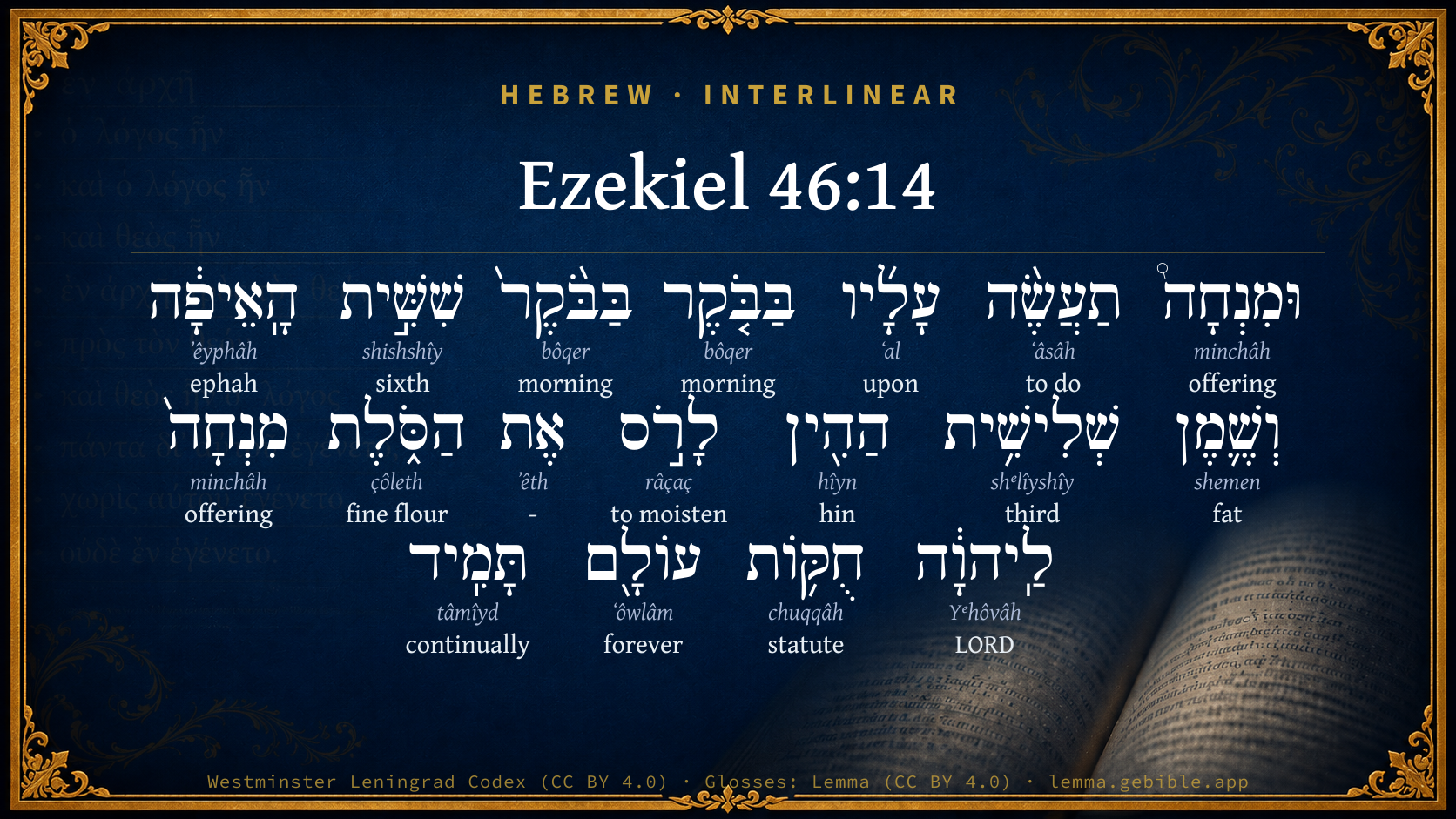
Hebrew (Westminster Leningrad Codex) Ezekiel 46:14 appears in the Hebrew Old Testament. The text above is from the Westminster Leningrad Codex. Each word links to its Strong’s number, a concise gloss, and parsing drawn from the Open Scriptures Hebrew Bible morphology. Click any word for its full Brown-Driver-Briggs (BDB) entry.
Download image
Cite this verse

Ezekiel 46:14 (World English Bible). Public Domain. Lemma interlinear Bible study tool, https://lemma.gebible.app/v/ezekiel/46/14.

Show BibTeX & RIS
BibTeX
RIS
English Translation
You shall prepare a meal-offering with it morning by morning, the sixth part of an ephah, and the third part of a hin of oil, to moisten the fine flour; a meal-offering to Yahweh continually by a perpetual ordinance.
World English Bible · Public Domain
Highlights
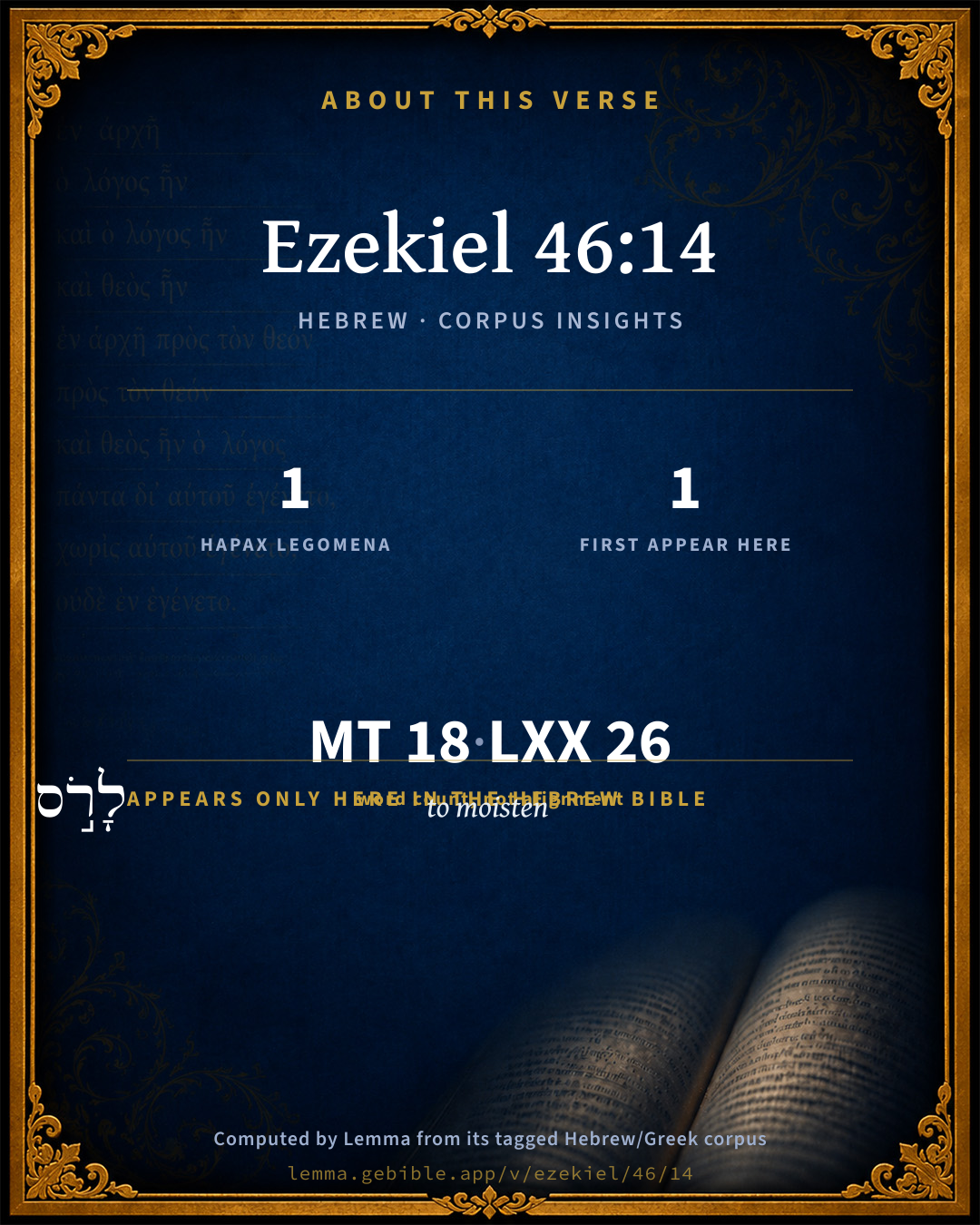
  • 1 hapax legomenon — only here in the Hebrew Bible
  • 1 first appearance in the Hebrew Bible
Full analysis ↓
Download a study sheet

One document with this verse’s original text, its word-by-word gloss line, the meaning frame, cross-references with their text, attributed commentary, and full source and license credits — printable, and it pastes into notes with its structure intact.

This verse Autodidact and up

Study sheet (.html) Plain text (.txt)

A passage Seminary Student

Up to 50 verses in one chapter. A passage sheet keeps up to 6 commentary sources and 12 cross-references per verse, in the order this page ranks them, and says so on the sheet whenever that leaves anything out. Ask for a single verse and you get the Autodidact verse sheet above.

Everything on this page stays free to read, with no account — the sheet is a download of what is already on screen, not access to it.

Want to remove ads? Support Godless Engineer
Compare translations 3

The same verse in 3 English versions, stacked beneath the original-language interlinear above. Click any original word for its lexicon entry.

Each is an independent rendering of the whole verse — the interlinear is not word-aligned to these translations.

Highlighted words mark where these versions differ — a whole-verse word diff, not a word-by-word alignment.

  • World English Bible Public Domain
    You shall prepare a meal-offering with it morning by morning, the sixth part of an ephah, and the third part of a hin of oil, to moisten the fine flour; a meal-offering to Yahweh continually by a perpetual ordinance.
  • King James Version Public Domain
    And thou shalt prepare a meat offering for it every morning, the sixth part of an ephah, and the third part of an hin of oil, to temper with the fine flour; a meat offering continually by a perpetual ordinance unto the LORD.
  • unfoldingWord Literal Text CC BY-SA 4.0
    You will give a grain offering with it morning after morning, a sixth of an ephah and a third of a hin of oil to moisten the flour of the grain offering for Yahweh, according to a permanent statute.

unfoldingWord Literal Text — © unfoldingWord, licensed CC BY-SA 4.0. Word-aligned USFM3 via Door43 (git.door43.org/unfoldingWord/en_ult).

Versions to compare (up to 4)

3 of 4 selected

Show all 18 translations

Every available English version of this verse, each an independent rendering of the whole verse.

  • World English Bible Public Domain
    You shall prepare a meal-offering with it morning by morning, the sixth part of an ephah, and the third part of a hin of oil, to moisten the fine flour; a meal-offering to Yahweh continually by a perpetual ordinance.
  • Berean Standard Bible Public Domain
    You are also to provide with it every morning a grain offering of a sixth of an ephah with a third of a hin of oil to moisten the fine flour—a grain offering to the LORD. This is a permanent statute.
  • Majority Standard Bible Public Domain
    You are also to provide with it every morning a grain offering of a sixth of an ephah with a third of a hin of oil to moisten the fine flour—a grain offering to the LORD. This is a permanent statute.
  • King James Version Public Domain
    And thou shalt prepare a meat offering for it every morning, the sixth part of an ephah, and the third part of an hin of oil, to temper with the fine flour; a meat offering continually by a perpetual ordinance unto the LORD.
  • American Standard Version (1901) Public Domain
    And thou shalt prepare a meal-offering with it morning by morning, the sixth part of an ephah, and the third part of a hin of oil, to moisten the fine flour; a meal-offering unto Jehovah continually by a perpetual ordinance.
  • Revised Version (1885) Public Domain
    And thou shalt prepare a meal offering with it morning by morning, the sixth part of an ephah, and the third part of an hin of oil, to moisten the fine flour; a meal offering unto the LORD continually by a perpetual ordinance;
  • Geneva Bible (1599) Public Domain
    And thou shalt prepare a meate offring for it euery morning, the sixt part of an Ephah, and the thirde part of an Hin of oyle, to mingle with the fine flowre: this meate offring shalbe continually by a perpetuall ordinance vnto the Lord.
  • Douay-Rheims (1899) Public Domain
    And he shall offer the sacrifice for it morning by morning, the sixth part of ephi: and the third part of a bin of oil be mingled with the fine hour: a to the Lord by ordinance continual and everlasting.
  • Young's Literal Translation Public Domain
    And a present thou dost make for it morning by morning, a sixth part of the ephah, and of oil a third part of the hin, to temper with the fine flour, a present to Jehovah, by a statute age-during -- continually;
  • Literal Standard Version CC BY-SA 4.0
    And you make a present with it morning by morning, a sixth part of the ephah, and a third part of the hin of oil, to temper with the fine flour, a present to YHWH, by a continuous statute—continually;
  • Unlocked Literal Bible CC BY-SA 4.0
    You will give a grain offering with it morning after morning, a sixth of an ephah and a third of a hin of oil to moisten the flour of the grain offering for Yahweh, according to a permanent statute.
  • unfoldingWord Literal Text CC BY-SA 4.0
    You will give a grain offering with it morning after morning, a sixth of an ephah and a third of a hin of oil to moisten the flour of the grain offering for Yahweh, according to a permanent statute.
  • Darby Bible Public Domain
    And thou shalt prepare an oblation with it every morning, the sixth part of an ephah, and of oil the third part of a hin, to moisten the fine flour: an oblation unto Jehovah continually by a perpetual ordinance.
  • World Messianic Bible Public Domain
    You shall prepare a meal offering with it morning by morning, the sixth part of an efah, and the third part of a hin of oil to moisten the fine flour; a meal offering to the LORD continually by a perpetual ordinance.
  • Webster's Bible Public Domain
    And thou shalt prepare a meat-offering for it every morning, the sixth part of an ephah, and the third part of a hin of oil, to temper with the fine flour; a meat-offering continually by a perpetual ordinance to the LORD.
  • Free Bible Version CC BY-SA 4.0
    Every morning a grain offering of a sixth of an ephah with a third of a hin of olive oil to moisten the best flour is to be provided as a grain offering to the Lord. This regulation is to be followed forever.
  • Bible in Basic English Public Domain
    And you are to give, morning by morning, a meal offering with it, a sixth of an ephah and a third of a hin of oil dropped on the best meal; a meal offering offered to the Lord at all times by an eternal order.
  • JPS Tanakh (1917) Public Domain
    And thou shalt prepare a meal-offering with it morning by morning, the sixth part of an ephah, and the third part of a hin of oil, to moisten the fine flour: a meal-offering unto the LORD continually by a perpetual ordinance.

Literal Standard Version (2020), Covenant Press — licensed CC BY-SA 4.0. Text via the HelloAO Bible API (eBible.org). Unlocked Literal Bible (unfoldingWord) — licensed CC BY-SA 4.0. Text via the HelloAO Bible API (eBible.org). unfoldingWord Literal Text — © unfoldingWord, licensed CC BY-SA 4.0. Word-aligned USFM3 via Door43 (git.door43.org/unfoldingWord/en_ult). Free Bible Version, Dr. Jonathan Gallagher — licensed CC BY-SA 4.0. Text via the HelloAO Bible API (eBible.org).

Word by word

More ways to search: Search by grammar → Find every occurrence → Compare this word →

Practice this passage: Drill this verse → Learn its vocabulary →

לָרֹ֣ס
râçaç
H7450
“to moisten”
Preposition + Verb, Qal, Infinitive Construct
Part of Speech
Preposition + Verb
Stem
Qal
Form
Infinitive Construct
Full BDB Definition

Origin: a primitive root

TWOT: 2181

(Qal) to moisten
  1. וּמִנְחָה֩ minchâh H4503 “and · offering” Conjunction + Noun, Common, Feminine, Singular, Absolute
  2. תַעֲשֶׂ֨ה ʻâsâh H6213 “to do” Verb, Qal, Imperfect, 2nd Person, Masculine, Singular
  3. עָלָ֜יו ʻal H5921 “upon · him” Preposition + Suffix, Personal, 3rd Person, Masculine, Singular
  4. בַּבֹּ֤קֶר bôqer H1242 “in/at the · morning” Preposition, Determined + Noun, Common, Masculine, Singular, Absolute
  5. בַּבֹּ֨קֶר֙ bôqer H1242 “in/at the · morning” Preposition, Determined + Noun, Common, Masculine, Singular, Absolute
  6. שִׁשִּׁ֣ית shishshîy H8345 “sixth” Adjective, Ordinal number, Feminine, Singular, Construct
  7. הָֽאֵיפָ֔ה ʼêyphâh H374 “the · ephah” Particle, Definite Article + Noun, Common, Feminine, Singular, Absolute
  8. וְשֶׁ֛מֶן shemen H8081 “and · fat” Conjunction + Noun, Common, Masculine, Singular, Absolute
  9. שְׁלִישִׁ֥ית shᵉlîyshîy H7992 “third of” Noun, Common, Feminine, Singular, Construct
  10. הַהִ֖ין hîyn H1969 “the · hin” Particle, Definite Article + Noun, Common, Masculine, Singular, Absolute
  11. אֶת ʼêth H853 “-” Particle, Direct Object
  12. הַסֹּ֑לֶת çôleth H5560 “the · fine flour” Particle, Definite Article + Noun, Common, Feminine, Singular, Absolute
  13. מִנְחָה֙ minchâh H4503 “offering” Noun, Common, Feminine, Singular, Absolute
  14. לַֽיהוָ֔ה Yᵉhôvâh H3068 “to/for · LORD” Preposition + Noun, Proper
  15. חֻקּ֥וֹת chuqqâh H2708 “statutes of” Noun, Common, Both, Plural, Construct
  16. עוֹלָ֖ם ʻôwlâm H5769 “forever” Noun, Common, Masculine, Singular, Absolute
  17. תָּמִֽיד tâmîyd H8548 “continually” Noun, Common, Masculine, Singular, Absolute

About this verse

These counts appear in no published source. They are computed here, from the morphology-tagged text and Lemma’s own curated glosses. What Lemma adds →

18
words
16
distinct lemmas
Prophets
section

Notable vocabulary

1 hapax legomenon — a word that appears only here in the entire Hebrew Bible:

  • לָרֹ֣ס to moisten H7450

First appearance in Scripture

This word makes its first canonical appearance in the Hebrew Bible here:

  • לָרֹ֣ס to moisten H7450

Shared distinctive vocabulary

הַהִ֖ין hin H1969 occurs in 19 verses of the Hebrew Bible. Also found in:

Grammatical profile

  • 2 verbs
  • 13 nouns
  • 1 adjective
  • 1 preposition
  • 1 particle

Verb forms

  • תַעֲשֶׂ֨ה Qal · Imperfect
  • לָרֹ֣ס Qal · Infinitive Construct

Repetition

Words recur within this verse — often emphatic in Hebrew:

  • וּמִנְחָה֩ offering H4503 ×2
  • בַּבֹּ֤קֶר morning H1242 ×2

Hebrew & Septuagint length

In English translation the verse runs 39 words from the Hebrew and 47 from the Septuagint (LXX English) — closely comparable.

A rough comparison of the two English renderings, which tokenize alike — not a word-level alignment.

Word counts can differ between the Hebrew and the Greek without any difference in meaning — e.g. the Hebrew direct-object marker אֵת has no separate Greek word, and Greek often adds the article ὁ.

In the original languages it is 18 Hebrew tokens and 26 Greek tokens — but the two are counted differently (Hebrew bundles its prefixes and suffixes into one token; the Greek is in lemma form), so that isn’t a like-for-like length.

Cross-references

1

Topical passages linked to Ezekiel 46:14 in the Treasury of Scripture Knowledge — connected by theme and wording, ordered by reader-vote popularity; previews shown in the World English Bible.

  • Numbers 28:5 and the tenth part of an ephah of fine flour for a meal-offering, mixed with the fourth part of a hin of beaten oil.

Cross-references courtesy of OpenBible.info (CC BY 4.0).

Hebrew and Greek witnesses Masoretic Hebrew ↔ Greek Septuagint

The same verse in the two great witnesses to the Old Testament, shown verse-for-verse.

These are two independent witnesses, not word-aligned to each other, and the Septuagint is shown in lemma (dictionary) form.

Hebrew Ezekiel 46:14 Masoretic · Westminster Leningrad Codex

וּמִנְחָה֩ תַעֲשֶׂ֨ה עָלָ֜יו בַּבֹּ֤קֶר בַּבֹּ֨קֶר֙ שִׁשִּׁ֣ית הָֽאֵיפָ֔ה וְשֶׁ֛מֶן שְׁלִישִׁ֥ית הַהִ֖ין לָרֹ֣ס אֶת הַסֹּ֑לֶת מִנְחָה֙ לַֽיהוָ֔ה חֻקּ֥וֹת עוֹלָ֖ם תָּמִֽיד

You shall prepare a meal-offering with it morning by morning, the sixth part of an ephah, and the third part of a hin of oil, to moisten the fine flour; a meal-offering to Yahweh continually by a perpetual ordinance.

World English Bible · Public Domain

Greek LXX Ezekiel 46:14 Septuagint · lemma form

καί μαναα ποιέω ἐπί αὐτός ὁ πρωΐ ἕκτος ὁ μέτρον καί ἔλαιον ὁ τρίτος ὁ ιν ὁ ἀναμίγνυμι ὁ σεμίδαλις μαναα ὁ κύριος πρόσταγμα διά πᾶς

And he shall prepare a free will offering for it in the morning, the sixth part of a measure of flour, and a third part of a hin of oil to mix therewith the fine flour, as a free will offering to the Lord, a perpetual ordinance.

LXX2012 (modern English Septuagint) · Public Domain

Hebrew: Westminster Leningrad Codex (CC BY 4.0). Greek: Septuagint (public domain); English from LXX2012 (modern English Septuagint) (Public Domain). How the Septuagint differs from the Hebrew →

Targum (Aramaic paraphrase)

1

The Targum is the ancient Jewish Aramaic paraphrase of the Hebrew Scriptures — an interpretive translation, not the Hebrew text itself. Onkelos (literal) and Pseudo-Jonathan (expansive) render the Torah, and Jonathan the Prophets. Coverage is partial: where no permissively-licensed English translation exists for a verse, only the Aramaic is shown. This is verse-level text, not a word-by-word alignment to the Hebrew.

  1. Targum Jonathan Prophets (Joshua–Malachi)
    וּמִנְחָתָא תַעְבֵּיד עֲלוֹהִי בִּצְפַר בִּצְפַר חַד מִן שִׁתָּא בִּמְכִלְתָּא וּמִשְׁחָא תִּילְתוּת הִינָא לְעָרָבָא יַת סוּלְתָּא מִנְחָתָא קֳדָם יְיָ קְיַם עֲלַם תְּדִירָא:

    (no public-domain English translation for this verse)

    Targum Jonathan — Aramaic: “Mikraot Gedolot” (public domain). English: “Sefaria Community Translation” (CC0 1.0 (public-domain dedication)); “London "Chaldee Paraphrase," 1871” (public domain). Text via Sefaria.

Commentary

Notes on Ezekiel 46:14 from classic Christian and Jewish commentators (each source and its license shown beneath its notes). The classic Christian expositions comment on the surrounding passage and are grouped to its opening verse, so a note may address several verses; the Jewish commentaries on the Tanakh (Rashi and others) are per-verse, so they appear only where the commentator wrote on this verse.

Lemma curates 59 commentaries, every one of them public domain or Creative Commons licensed, each selected and text-cleaned for this edition rather than reprinted as found. About our sources →

Trapp's Complete Commentary

John Trapp

Eze 46:14 And thou shalt prepare a meat offering for it every morning, the sixth part of an ephah, and the third part of an hin of oil, to temper with the fine flour; a meat offering continually by a perpetual ordinance unto the LORD.

Ver. 14. The sixth part of an ephah.] This is also different from the Levitical ordinance, {Num 15:3-12; Num 28:3-5 Exo 29:40} though R. Solomon here extremely troubleth himself, but to no purpose, to reconcile them.

John Trapp, A Commentary or Exposition upon All the Books of the Old and New Testament (1647–1656) — public domain. Text from a community e-Sword module.

The Cambridge Bible for Schools and Colleges

gen. ed. J. J. S. Perowne

14. to temper] Probably as R.V. to moisten, or, besprinkle the fine flour. Son_5:2, drops of the night.

The Cambridge Bible for Schools and Colleges (gen. ed. J. J. S. Perowne; Cambridge University Press, 1878–1918) — public domain. Text from a community e-Sword module.

John Gill's Exposition

Thus shall they prepare,.... This shows that not a single person is meant in the preceding verses, but all the Lord's people; who are all priests unto God, and who are to offer up daily spiritual sacrifices unto him:

the lamb, and the meat offering, and the oil every morning, for a continual burnt offering; which is repeated for the confirmation of it, and to excite a careful and constant attention to it.

John Gill's Exposition of the Whole Bible (1746–1763) — public domain (CC PDM 1.0). Text via the HelloAO Bible API.

Haydock's Catholic Bible Commentary

By. Cata seems to be taken (Calmet) from the Greek: kata, "according to," or by, ver. 15. (Haydock)

George Leo Haydock (1774–1849), Haydock's Catholic Family Bible and Commentary, 1859 edition — public domain. Excludes Psalms (Douay-Rheims chapter numbering differs from Protestant) and Deuterocanonical books (Catholic canon only).

Matthew Poole's English Annotations

A meat-offering: see Eze 46:7.

The sixth part of an ephah; half a bushel of fine meal.

The third part of an hin; an hin held nine pints.

Continually; morning by morning.

A perpetual ordinance, to continue till the Messiah comes, who will set up a more spiritual worship.

Matthew Poole's English Annotations on the Holy Bible (1683–1685) — public domain. Text from a community e-Sword/MySword module.

Rashi

Rabbi Shlomo Yitzchaki (Rashi)

a sixth of an ephah of the [post-Exodus] Jerusalemite measure, which is a fifth of the [Mosaic] “measure of the desert,” equaling two tenth parts, one for the daily meal-offering and one for the pancakes. And although the pancakes were offered up by halves, he brings a complete tenth part in the morning and divides it in half, as we learned in Menahoth (4:5)

to stir [with] the fine flour [Heb. לָרֹם,] asperger in French, to moisten, besprinkle. Manuscripts read: ameller in Old French, to mix. לָרֹם אֶתהַסֹלֶת, to crush and mix with it the fine flour, a form of word for crushing (רִסוּם), as in (Amos 6: 11): “and he shall smite the great house into splinters (רְסִיסִים),” and in the language of the Mishnah (Shab. 8:6): If it was thick or cracked (מְרֻסָם).

Rashi on the Tanakh — English translations: “The Judaica Press complete Tanach with Rashi, translated by A. J. Rosenberg” (CC BY 4.0); “Pentateuch with Rashi's commentary by M. Rosenbaum and A.M. Silbermann, 1929-1934” (public domain); “The Metsudah Tanach series, Lakewood, N.J” (CC BY 4.0); and “The Book of Joshua, Metsudah Publications, 1997” (CC BY 4.0). Text via Sefaria.

Lesson kit

Teaching starters — assembled from the data on this page, not authored interpretation. Every prompt links to the verse data it draws on. Edit before teaching.

Ezekiel, in the Prophets, opens this verse with 18 words (16 distinct Hebrew lemmas). Its most distinctive word is râçaç (“to moisten”). A historical commentator’s framing appears above. Read the whole chapter for the surrounding context.

Discussion questions

  1. How does “to moisten” (râçaç) shape what this verse is saying?
  2. This verse holds 1 word here found nowhere else in the Hebrew Bible. What might the rare word draw attention to?
  3. The word “to moisten” first appears here in Scripture. What is being introduced at this debut?
  4. Exodus 29:40 shares the word «hin» with this verse. How do the two illuminate each other?
  5. “offering” occurs 2× in this one verse. What is the effect of the repetition?
  6. These translations render this verse differently. What is at stake in choosing one wording over another?
  7. The verb «תַעֲשֶׂ֨ה» is Qal Imperfect. How does its form color the action?
  8. Reading how Trapp's Complete Commentary and The Cambridge Bible for Schools and Colleges read this verse, where do the two commentators agree and where do they part?

Things to notice

  • 1 word in this verse appears nowhere else in the Hebrew Bible.
  • 1 word makes its first canonical appearance in Scripture here.
  • This verse counts 18 Hebrew ↔ 26 Greek words.
  • These translations choose different wording for 23 words in this verse.
  • “offering” occurs 2× in this single verse.

Reading settings

Reading text

Shown beneath each verse's original-language words.

Old Testament
Old Testament edition

Read the OT as the Masoretic Hebrew (MT) or the Greek Septuagint (LXX).

English shown for the Greek Septuagint (in the Hebrew ↔ Greek comparison).

Comparing translations? Open the Compare panel on any verse page to stack up to four side by side.