
Hosea 13:3

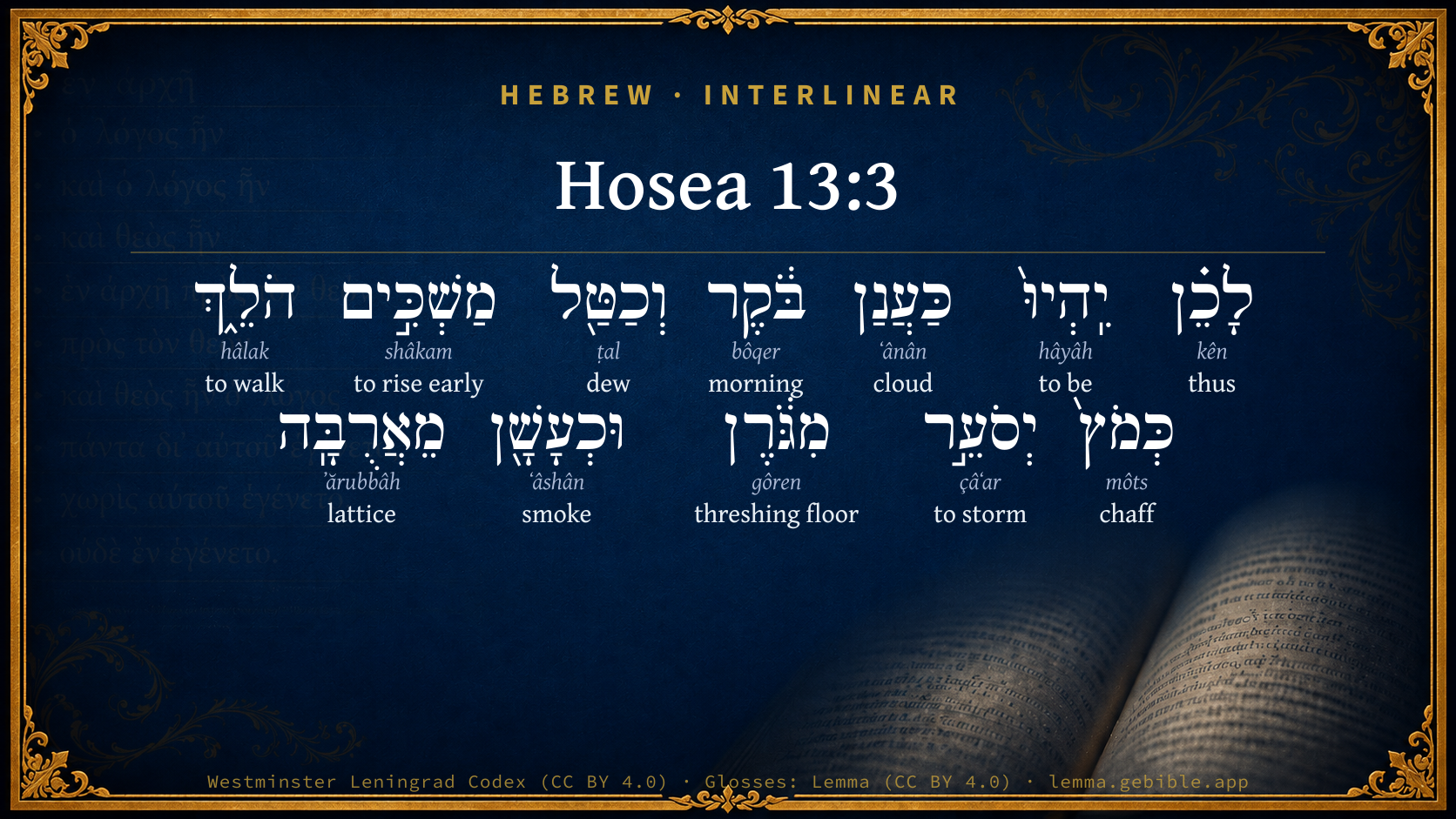
Hebrew (Westminster Leningrad Codex) Hosea 13:3 appears in the Hebrew Old Testament. The text above is from the Westminster Leningrad Codex. Each word links to its Strong’s number, a concise gloss, and parsing drawn from the Open Scriptures Hebrew Bible morphology. Click any word for its full Brown-Driver-Briggs (BDB) entry.
Download image
Cite this verse

Hosea 13:3 (World English Bible). Public Domain. Lemma interlinear Bible study tool, https://lemma.gebible.app/v/hosea/13/3.

Show BibTeX & RIS
BibTeX
RIS
English Translation
Therefore they will be like the morning cloud, And like the dew that passes away early, Like the chaff that is driven with the whirlwind out of the threshing floor, And like the smoke out of the chimney.
World English Bible · Public Domain
Download a study sheet

One document with this verse’s original text, its word-by-word gloss line, the meaning frame, cross-references with their text, attributed commentary, and full source and license credits — printable, and it pastes into notes with its structure intact.

This verse Autodidact and up

Study sheet (.html) Plain text (.txt)

A passage Seminary Student

Up to 50 verses in one chapter. A passage sheet keeps up to 6 commentary sources and 12 cross-references per verse, in the order this page ranks them, and says so on the sheet whenever that leaves anything out. Ask for a single verse and you get the Autodidact verse sheet above.

Everything on this page stays free to read, with no account — the sheet is a download of what is already on screen, not access to it.

Want to remove ads? Support Godless Engineer
Compare translations 3

The same verse in 3 English versions, stacked beneath the original-language interlinear above. Click any original word for its lexicon entry.

Each is an independent rendering of the whole verse — the interlinear is not word-aligned to these translations.

Highlighted words mark where these versions differ — a whole-verse word diff, not a word-by-word alignment.

  • World English Bible Public Domain
    Therefore they will be like the morning cloud, And like the dew that passes away early, Like the chaff that is driven with the whirlwind out of the threshing floor, And like the smoke out of the chimney.
  • King James Version Public Domain
    Therefore they shall be as the morning cloud and as the early dew that passeth away, as the chaff that is driven with the whirlwind out of the floor, and as the smoke out of the chimney.
  • unfoldingWord Literal Text CC BY-SA 4.0
    Therefore they will be like a cloud of the morning and like the dew rising early, going; like chaff—it is blown away from the threshing floor— and like smoke from a window.

unfoldingWord Literal Text — © unfoldingWord, licensed CC BY-SA 4.0. Word-aligned USFM3 via Door43 (git.door43.org/unfoldingWord/en_ult).

Versions to compare (up to 4)

3 of 4 selected

Show all 18 translations

Every available English version of this verse, each an independent rendering of the whole verse.

  • World English Bible Public Domain
    Therefore they will be like the morning cloud, And like the dew that passes away early, Like the chaff that is driven with the whirlwind out of the threshing floor, And like the smoke out of the chimney.
  • Berean Standard Bible Public Domain
    Therefore they will be like the morning mist, like the early dew that vanishes, like chaff blown from a threshing floor, like smoke through an open window.
  • Majority Standard Bible Public Domain
    Therefore they will be like the morning mist, like the early dew that vanishes, like chaff blown from a threshing floor, like smoke through an open window.
  • King James Version Public Domain
    Therefore they shall be as the morning cloud and as the early dew that passeth away, as the chaff that is driven with the whirlwind out of the floor, and as the smoke out of the chimney.
  • American Standard Version (1901) Public Domain
    Therefore they shall be as the morning cloud, and as the dew that passeth early away, as the chaff that is driven with the whirlwind out of the threshing-floor, and as the smoke out of the chimney.
  • Revised Version (1885) Public Domain
    Therefore they shall be as the morning cloud, and as the dew that passeth early away, as the chaff that is driven with the whirlwind out of the threshing-floor, and as the smoke out of the chimney.
  • Geneva Bible (1599) Public Domain
    Therefore they shall bee as the morning cloude, and as the morning dewe that passeth away, as the chaffe that is driuen with a whirlewind out of the floore, and as the smoke that goeth out of the chimney.
  • Douay-Rheims (1899) Public Domain
    Therefore they shall be as a morning aloud, and as the early dew that passeth away, as the dust that is driven with a whirlwind out of the floor, and as the smoke out of the chimney.
  • Young's Literal Translation Public Domain
    Therefore they are as a cloud of the morning, And as dew, rising early, going away, As chaff tossed about out of a floor, And as smoke out of a window.
  • Literal Standard Version CC BY-SA 4.0
    Therefore they are as a cloud of the morning, || And as dew, rising early, going away, || As chaff tossed about out of a floor, || And as smoke out of a window.
  • Unlocked Literal Bible CC BY-SA 4.0
    So they will be like the morning clouds, like the dew that goes away early, like the chaff that is driven by the wind away from a threshing floor, and like smoke out of a chimney.
  • unfoldingWord Literal Text CC BY-SA 4.0
    Therefore they will be like a cloud of the morning and like the dew rising early, going; like chaff—it is blown away from the threshing floor— and like smoke from a window.
  • Darby Bible Public Domain
    Therefore they shall be as the morning cloud, and as the early dew that passeth away, as the chaff driven with the whirlwind out of the threshing-floor, and as the smoke out of the lattice.
  • World Messianic Bible Public Domain
    Therefore they will be like the morning mist, like the dew that passes away early, like the chaff that is driven with the whirlwind out of the threshing floor, and like the smoke out of the chimney.
  • Webster's Bible Public Domain
    Therefore they shall be as the morning cloud, and as the early dew that passeth away, as the chaff that is driven with the whirlwind from the floor, and as the smoke from the chimney.
  • Free Bible Version CC BY-SA 4.0
    Consequently they will be like the morning mist, like early morning dew, like chaff blowing away from the threshing floor, like smoke from a chimney.
  • Bible in Basic English Public Domain
    So they will be like the morning cloud, like the dew which goes early away, like the dust of the grain which the wind is driving out of the crushing-floor, like smoke going up from the fireplace.
  • JPS Tanakh (1917) Public Domain
    Therefore they shall be as the morning cloud, and as the dew that early passeth away, as the chaff that is driven with the wind out of the threshing-floor, and as the smoke out of the window.

Literal Standard Version (2020), Covenant Press — licensed CC BY-SA 4.0. Text via the HelloAO Bible API (eBible.org). Unlocked Literal Bible (unfoldingWord) — licensed CC BY-SA 4.0. Text via the HelloAO Bible API (eBible.org). unfoldingWord Literal Text — © unfoldingWord, licensed CC BY-SA 4.0. Word-aligned USFM3 via Door43 (git.door43.org/unfoldingWord/en_ult). Free Bible Version, Dr. Jonathan Gallagher — licensed CC BY-SA 4.0. Text via the HelloAO Bible API (eBible.org).

Word by word

More ways to search: Search by grammar → Find every occurrence → Compare this word →

Practice this passage: Drill this verse → Learn its vocabulary →

יְסֹעֵ֣ר
çâʻar
H5590
“to storm”
Verb, Poel, Imperfect, 3rd Person, Masculine, Singular
Part of Speech
Verb
Stem
Poel
Form
Imperfect
Person
3rd Person
Gender
Masculine
Number
Singular
Full BDB Definition

Origin: a primitive root

TWOT: 1528b

to storm, rage - (Qal) - to storm - stormy, growing storm (participle) - (Niphal) to be enraged - (Piel) to storm away - (Pual) to be driven by storm
  1. לָכֵ֗ן kên H3651 “to/for · thus” Preposition + Adverb
  2. יִֽהְיוּ֙ hâyâh H1961 “to be” Verb, Qal, Imperfect, 3rd Person, Masculine, Plural
  3. כַּעֲנַן ʻânân H6051 “like/as · cloud of” Preposition + Noun, Common, Masculine, Singular, Construct
  4. בֹּ֔קֶר bôqer H1242 “morning” Noun, Common, Masculine, Singular, Absolute
  5. וְכַטַּ֖ל ṭal H2919 “and · like/as the · dew” Conjunction + Preposition, Determined + Noun, Common, Masculine, Singular, Absolute
  6. מַשְׁכִּ֣ים shâkam H7925 “rising early” Verb, Hiphil, Participle Active, Masculine, Singular, Absolute
  7. הֹלֵ֑ךְ hâlak H1980 “walking” Verb, Qal, Participle Active, Masculine, Singular, Absolute
  8. כְּמֹץ֙ môts H4671 “like/as · chaff” Preposition + Noun, Common, Masculine, Singular, Absolute
  9. מִגֹּ֔רֶן gôren H1637 “from · threshing floor” Preposition + Noun, Common, Both, Singular, Absolute
  10. וּכְעָשָׁ֖ן ʻâshân H6227 “and · like/as · smoke” Conjunction + Preposition + Noun, Common, Masculine, Singular, Absolute
  11. מֵאֲרֻבָּֽה ʼărubbâh H699 “from · lattice” Preposition + Noun, Common, Feminine, Singular, Absolute

About this verse

These counts appear in no published source. They are computed here, from the morphology-tagged text and Lemma’s own curated glosses. What Lemma adds →

12
words
12
distinct lemmas
Prophets
section

Notable vocabulary

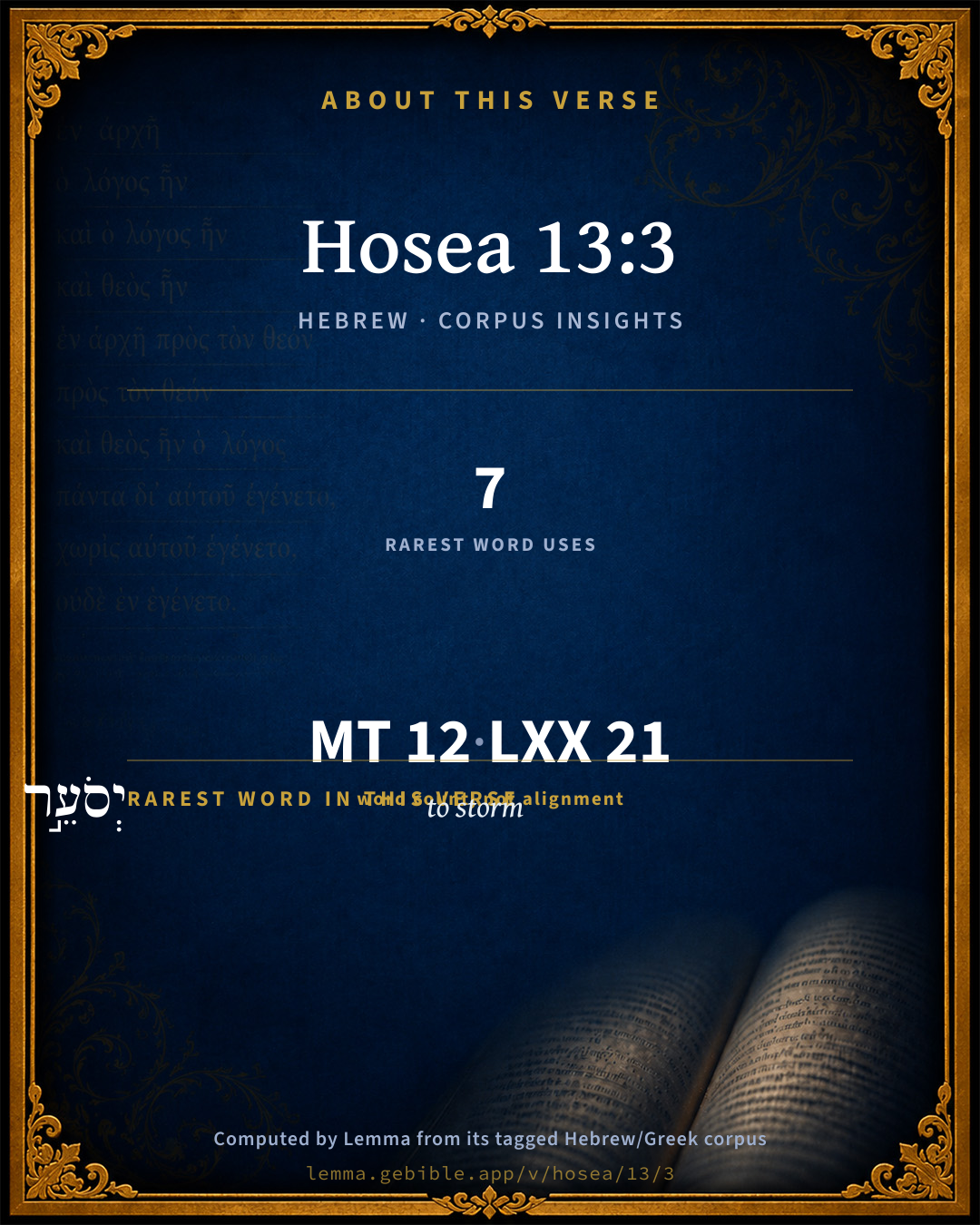
The rarest word here is יְסֹעֵ֣ר to storm H5590 — appearing just 7 times in the whole Hebrew Bible.

Shared distinctive vocabulary

יְסֹעֵ֣ר to storm H5590 occurs in 7 verses of the Hebrew Bible. Also found in:

Grammatical profile

  • 4 verbs
  • 7 nouns
  • 1 adverb

Verb forms

  • יִֽהְיוּ֙ Qal · Imperfect
  • מַשְׁכִּ֣ים Hiphil · Participle Active
  • הֹלֵ֑ךְ Qal · Participle Active
  • יְסֹעֵ֣ר Poel · Imperfect

Hebrew & Septuagint length

In English translation the verse runs 38 words from the Hebrew and 30 from the Septuagint (LXX English) — closely comparable.

A rough comparison of the two English renderings, which tokenize alike — not a word-level alignment.

Word counts can differ between the Hebrew and the Greek without any difference in meaning — e.g. the Hebrew direct-object marker אֵת has no separate Greek word, and Greek often adds the article ὁ.

In the original languages it is 12 Hebrew tokens and 21 Greek tokens — but the two are counted differently (Hebrew bundles its prefixes and suffixes into one token; the Greek is in lemma form), so that isn’t a like-for-like length.

Cross-references

7

Topical passages linked to Hosea 13:3 in the Treasury of Scripture Knowledge — connected by theme and wording, ordered by reader-vote popularity; previews shown in the World English Bible.

  • Psalms 1:4 The wicked are not so, But are like the chaff which the wind drives away.
  • Psalms 68:2 As smoke is driven away, So drive them away. As wax melts before the fire, So let the wicked perish at the presence of God.
  • Hosea 6:4 "Ephraim, what shall I do to you? Judah, what shall I do to you? For your love is like a morning cloud, And like the dew that disappears early.
  • Isaiah 17:13 The nations shall rush like the rushing of many waters: but he shall rebuke them, and they shall flee far off, and shall be chased as the chaff of the mountains before the wind, and like the whirling dust before the storm.
  • Daniel 2:35 Then was the iron, the clay, the brass, the silver, and the gold, broken in pieces together, and became like the chaff of the summer threshing floors; and the wind carried them away, so that no place was found for them: and the stone that struck the image became a great mountain, and filled the whole earth.
  • Isaiah 41:15–16 Behold, I have made you [to be] a new sharp threshing instrument having teeth; you shall thresh the mountains, and beat them small, and shall make the hills as chaff.
  • Psalms 83:12–17 Who said, "Let us take possession Of God's pasturelands."

Cross-references courtesy of OpenBible.info (CC BY 4.0).

Hebrew and Greek witnesses Masoretic Hebrew ↔ Greek Septuagint

The same verse in the two great witnesses to the Old Testament, shown verse-for-verse.

These are two independent witnesses, not word-aligned to each other, and the Septuagint is shown in lemma (dictionary) form.

Hebrew Hosea 13:3 Masoretic · Westminster Leningrad Codex

לָכֵ֗ן יִֽהְיוּ֙ כַּעֲנַן בֹּ֔קֶר וְכַטַּ֖ל מַשְׁכִּ֣ים הֹלֵ֑ךְ כְּמֹץ֙ יְסֹעֵ֣ר מִגֹּ֔רֶן וּכְעָשָׁ֖ן מֵאֲרֻבָּֽה

Therefore they will be like the morning cloud, And like the dew that passes away early, Like the chaff that is driven with the whirlwind out of the threshing floor, And like the smoke out of the chimney.

World English Bible · Public Domain

Greek LXX Hosea 13:3 Septuagint · lemma form

διά οὗτος εἰμί ὡς νεφέλη πρωινός καί ὡς δρόσος ὀρθρινός πορεύομαι ὥσπερ χνοῦς ἀποφυσάω ἀπό ἅλων καί ὡς ἀτμίς ἀπό ἀκρίς

Therefore shall they be as a morning cloud, and as the early dew that passes away, as chaff blown away from the threshing floor, and as a vapor from tears.

LXX2012 (modern English Septuagint) · Public Domain

On this verse, Haydock's Catholic Bible Commentary discusses the Septuagint’s reading. Read the note in Commentary ↓

Hebrew: Westminster Leningrad Codex (CC BY 4.0). Greek: Septuagint (public domain); English from LXX2012 (modern English Septuagint) (Public Domain). How the Septuagint differs from the Hebrew →

Targum (Aramaic paraphrase)

1

The Targum is the ancient Jewish Aramaic paraphrase of the Hebrew Scriptures — an interpretive translation, not the Hebrew text itself. Onkelos (literal) and Pseudo-Jonathan (expansive) render the Torah, and Jonathan the Prophets. Coverage is partial: where no permissively-licensed English translation exists for a verse, only the Aramaic is shown. This is verse-level text, not a word-by-word alignment to the Hebrew.

  1. Targum Jonathan Prophets (Joshua–Malachi)
    בְּכֵן יְהוֹן כַּעֲנַן צַפְרָא וּכְטַלָא דְמוֹהִי פְסִיק כְּמוֹצָא דְנָשְׁבָה רוּחַ מֵאִדְרָא וְכִתְנָנָא מִכֵּוַת נוּרָא:

    (no public-domain English translation for this verse)

    Targum Jonathan — Aramaic: “Mikraot Gedolot” (public domain). English: “Sefaria Community Translation” (CC0 1.0 (public-domain dedication)); “London "Chaldee Paraphrase," 1871” (public domain). Text via Sefaria.

Commentary

Notes on Hosea 13:3 from classic Christian and Jewish commentators (each source and its license shown beneath its notes). The classic Christian expositions comment on the surrounding passage and are grouped to its opening verse, so a note may address several verses; the Jewish commentaries on the Tanakh (Rashi and others) are per-verse, so they appear only where the commentator wrote on this verse.

Lemma curates 59 commentaries, every one of them public domain or Creative Commons licensed, each selected and text-cleaned for this edition rather than reprinted as found. About our sources →

Trapp's Complete Commentary

John Trapp

Hos 13:3 Therefore they shall be as the morning cloud, and as the early dew that passeth away, as the chaff [that] is driven with the whirlwind out of the floor, and as the smoke out of the chimney.

Ver. 3. Therefore they shall be as the morning cloud] They shall vanish and come to nothing: the morning cloud, irradiated by the sun, seems very gay at first, but is soon dispelled by it; the dew lies very lovely upon the grass, and seems to impearl it, but is soon dried up; see Hos 6:4. The chaff lies hollow and high, but is soon dispersed before a whirlwind; see Psa 35:5 Dan 2:35 Psa 1:5. The smoke rolls out of the chimney as if it were some solid substance, and would muffle the whole heavens, but is presently scattered evaporat et evanescit, the higher it ascendeth the sooner it vanisheth. See here how that is verified, Hos 12:10, "I have used similitudes by the ministry of my prophets" (four in a breath we have here), and be hereby advertised. 1. Of man’s weakness; 2. Of God’s power; 3. Of the swiftness of Ephraim’s ensuing misery; 4. The severity of God’s dealing with idolaters; he will leave no sign nor remain of them; he will utterly remove them, as a man takes away dung, till it be gone, 1Ki 14:19. Sic transit gloria mundi. So passes worldly honour. Life itself is but a shadow, a dream, yea, a dream of a shadow (οκιας οναρ ανθρωπος), Psa 144:4; profit, an uncertainty, 1Ti 6:17; pleasure, a spirt; honour, a blast, pomp, a fancy, Act 25:23; the whole world a scheme or notion, that hath nothing in it of any firmness, or solid consistency, 1Co 7:31. Why then should wicked wordlings brag, and look so big? Why should the saints be affected either with its allurements or affrightments, and not cry out with that heroical Luther, Contemptus est a me Romanus et favor et furor, I care neither for Rome’s favour nor fury, I am neither fond of the one nor afraid of the other, for all is but fumus aut funus, vanity and vexation?

John Trapp, A Commentary or Exposition upon All the Books of the Old and New Testament (1647–1656) — public domain. Text from a community e-Sword module.

The Biblical Illustrator

Joseph S. Exell

Hos_13:3

As the morning cloud . . . early dew . . . as the chaff . . . as the smoke out of the chimney.

The life of the wicked

I. It is deceptive. Like the morning cloud. In Palestine and countries of the same latitude, dense clouds often appear in the morning, cover the heavens, and promise fertilising showers that never come. A life without moral goodness is necessarily deceptive. It deceives itself and deceives others. How many lives seem full of promise! But they result in nothing but disappointment.

II. It is evanescent. The early dew that passeth away. In such latitudes too, the copious dews that sparkle on the hedges and the fields soon evaporate and disappear. The millions that make up this generation are only as dewdrops, sparkling for an hour and then lost and gone.

III. It is worthless. Like chaff stowed away from the threshing-floor. Chaff, empty, dead, destined to rot. How empty the life of an ungodly man!

IV. It is offensive. As the smoke out of the chimney. The ancient houses of Palestine were without chimneys: the smoke filled the houses, and smoke is a nuisance. A corrupt life is evermore offensive to the moral sense of mankind. To what conscience is falsehood, selfishness, carnality, meanness and such elements that make up the character of the wicked at all pleasing? To none. (Homilist.)

The Biblical Illustrator, edited by Joseph S. Exell (c. 1880s–1900s) — public domain. Text from a community e-Sword module.

Joseph Benson's Commentary

Hos 13:3-5. Therefore they shall be as the morning cloud, &c. — All the comparisons in this verse are intended to express a quick destruction, or that they should soon come to nothing. Yet I am the Lord thy God, &c. — Notwithstanding thy recourse to idols, I am the Lord thy God, who delivered thee out of the bondage of Egypt. And thou shalt know — That is, thou oughtest to acknowledge; no god but me — For thou hast never yet proved, and thou never wilt prove by experience, the power and protection of any other. Those whom thou callest thy gods will be able to do nothing for thee; for there is no saviour besides me — No one who can deliver, or preserve thee from evil as I have done. I did know thee in the wilderness, &c. — That is, I acknowledged thee as my peculiar people, by my watchful care of thee. I was attentive to thee, protecting thee in all dangers, and supplying all thy wants.

Joseph Benson's Commentary on the Old and New Testaments (1811–1818) — public domain. Text from a community e-Sword module.

Keil & Delitzsch

C. F. Keil & F. Delitzsch

They prepare for themselves swift destruction in consequence. Hos 13:3. "Therefore will they be like the morning cloud, and like the dew that passes early away, as chaff blows away from the threshing-floor, and as smoke out of the window." Lâkhēn, therefore, viz., because they would not let their irrational idolatry go, they would quickly perish. On the figures of the morning cloud and dew, see at Hos 6:4. The figure of the chaff occurs more frequently (vid., Isa 17:13; Isa 41:15-16; Psa 1:4; Psa 35:5, etc.). יס'ער is used relatively: which is stormed away, i.e., blown away from the threshing-floor by a violent wind. The threshing-floors were situated upon eminences (compare my Bibl. Archol. ii. p. 114). "Smoke out of the window," i.e., smoke from the fire under a saucepan in the room, which passed out of the window-lattice, as the houses were without chimneys (see Psa 68:3).

Keil & Delitzsch — Biblical Commentary on the Old Testament (1861–1891) — public domain (CC PDM 1.0). Text via the HelloAO Bible API. (Old Testament only.)

Tyndale Open Study Notes

Tyndale Open Resources

13:3 God’s judgment on idolatrous Ephraim was that they would disappear (cp. 6:4). • Mist . . . dew . . . chaff and smoke signify impermanence.

Tyndale Open Study Notes — © Tyndale Open Resources, licensed CC BY-SA 4.0. Text via the HelloAO Bible API.

Jamieson, Fausset & Brown

Robert Jamieson, A. R. Fausset & David Brown

they shall be as the morning cloud . . . dew-- (Hos 6:4). As their "goodness" soon vanished like the morning cloud and dew, so they shall perish like them.

the floor--the threshing-floor, generally an open area, on a height, exposed to the winds.

chimney--generally in the East an orifice in the wall, at once admitting the light, and giving egress to the smoke.

Jamieson, Fausset & Brown — Commentary Critical and Explanatory on the Whole Bible (1871) — public domain (CC PDM 1.0). Text via the HelloAO Bible API.

Adam Clarke's Commentary

Verse 3. Therefore they shall be as the morning CLOUD - as the early DEW - as the CHAFF - as the SMOKE] Four things, most easy to be driven about and dissipated, are employed here to show how they should be scattered among the nations, and dissipated by captivity.

Adam Clarke's Commentary on the Bible (1810–1826) — public domain. Text from a community e-Sword/MySword module.

John Calvin's Commentaries

The Prophet employs here four similitudes to show the condition of Israel. How much soever they flourished for a time, and might be deemed happy, their state would yet be fading and evanescent. They shall be, he says, as the morning cloud: though they be loftily proud, the Lord will yet shake off from them whatever power they may have. Secondly, they shall be as the dew that rises up in the morning — having nothing substantial in them. Thirdly they shall be as the chaff which from the floor is driven by a whirlwind And, lastly they shall be, he says, as the smoke; for as the smoke produces thick darkness, and, after having gone out of the chimney, disperses and disappears, so these proud people, how much soever they may have praised themselves, would not continue in a permanent condition.

We hence conclude, that the Israelites were not so much like the dead, but that yet they had some power remaining in them: for God would have otherwise threatened to no purpose, that they should be made like a cloud, and the dew, and the chaff, and the smoke: but they had been already in a great measure consumed. And God denounces on them here utter destruction, that they might not think that they had already suffered the last punishment, and that they might not suppose that they could gather new strength: for proud men entertain vain confidence, through which they remove to a distance the judgement of God. Lest, then, they should delude themselves with such allurements, the Prophet here declares that their condition would be fading, such as would soon come to ruin. It follows —

John Calvin's Commentaries (1540-1563) — public domain. Text from the Calvin Translation Society English edition (1840s-50s) via the Christian Classics Ethereal Library (ccel.org). Calvin's coverage is partial (roughly two-thirds of the Bible); uncommented books and verses are honest gaps, never fabricated. The 19th-century editor's footnotes and remarks are omitted so the notes are faithfully Calvin's own voice.

Ellicott's Commentary for English Readers

(3) Early dew . . .—Better, dew that early passeth away, like chaff that flies in a whirlwind from the threshing-floor, and like smoke from the window (i.e., the lattice beneath the roof through which it vanished).

A Bible Commentary for English Readers, edited by Charles John Ellicott (1878–1897) — public domain. Text from a community e-Sword module.

The Cambridge Bible for Schools and Colleges

gen. ed. J. J. S. Perowne

3. the early dew, &c.] Rather, the night-mist that early passeth away. See on Hos_6:4.

as the chaff … the floor] A familiar figure, but here expressed with more fulness than usual. The point of it is partly in the elevated situation of ‘the floor’ (comp. 1Sa_19:22 Sept.; 2Sa_24:18; 2Ch_3:1), partly in the suddenness of the whirlwinds in Palestine, which start up ‘as if by magic or spirit-influence’ (Thomson, The Land and the Book, p. 154).

chimney] Rather, lattice.

The Cambridge Bible for Schools and Colleges (gen. ed. J. J. S. Perowne; Cambridge University Press, 1878–1918) — public domain. Text from a community e-Sword module.

John Gill's Exposition

Therefore they shall be as the morning cloud,.... Which, however promising it is, soon disappears when the sun is risen; signifying that the idolatrous Israelites, king, priests, and people, should be no more; their kingdom would cease, all their riches and wealth would depart from them, and they and their children be carried captive into a strange land:

and as the early dew it passeth away; as soon as the heat of the sun is felt, when the earth is left dry; so these people, though they seemed to be in great prosperity, and to be very fruitful in children, and in substance, and promised themselves much more; yet in a little time their land would become desolate, and they stripped of all that was dear and valuable to them these metaphors are used in Hos 6:4;

as the chaff that is driven with a whirlwind out of the floor; signifying that these idolatrous people were like chaff, fight and empty, useless and unprofitable, fit for nothing but burning; and that they would be driven out of their own land through the Assyrian, that should come like a whirlwind with great three and power, as easily and as quickly as chaff is drove out of a threshing floor of corn with a strong blast of wind; see Psa 1:5;

and as the smoke out of the chimney; which rises up in a pillar, and is so on dissipated by the wind, or dissolved into air; and is no sooner seen but it disappears; see Psa 68:2. All these similes show how easily, suddenly, and quickly, the destruction of this idolatrous nation would be brought about.

John Gill's Exposition of the Whole Bible (1746–1763) — public domain (CC PDM 1.0). Text via the HelloAO Bible API.

Albert Barnes' Notes on the Bible

Therefore they shall be as the morning cloud - There is often a fair show of prosperity, out of God; but it is short-lived. “The third generation,” says the pagan proverb, “never enjoys the ill-gotten gain.” The highest prosperity of an ungodly state is often the next to its fall. Israel never so flourished, as under Jeroboam II. Bright and glistening with light is “the early dew;” in an hour it is gone, as if it had never been. Glowing and gilded by the sun is “the morning cloud;” while you admire its beauty, its hues have vanished. “The chaff” lay in one heap “on the floor” with the wheat. Its owner casts the mingled chaff and wheat against the strong wind; in a moment, it is “driven by the wind out of the floor.” While every gram falls to the ground, the chaff, light, dry, worthless, unsubstantial, is hurried along, unresisting, the sport of the viewless wind, and itself is soon seen no more. The “smoke,” one, seemingly solid, full, lofty, column, ascendeth, swelleth, welleth, vanisheth . In form, it is as solid, when about to be dispersed and seen no more, as when it first issued “out of the chimney.” : “It is raised aloft, and by that very uplifting swells into a vast globe; but the larger that globe is, the emptier, for from that unsolid, unbased, inflated greatness it vanisheth in air, so that its very greatness injures it. For the more it is uplifted, extended, diffused on all sides into a larger compass, so much the poorer it becometh, and faileth, and disappeareth.” Such was the prosperity of Ephraim, a mere show, to vanish forever. In the image of “the chaff,” the prophet substitutes the “whirlwind” for the wind by which the Easterns used to winnow, in order to picture the violence with which they should be whirled away from their own land.

While these four emblems, in common, picture what is fleeting, two, the “early dew” and the “morning cloud,” are emblems of what is in itself good, but passing ; the two others, the chaff and the smoke, are emblems of what is worthless. The dew and the cloud were temporary mercies on the part of God which should cease from them, “good in themselves, but to their evil, soon to pass away.” If the dew have not, in its brief space, refreshed the vegetation, no trace of it is left. It gives way to the burning sun. If grace have not done its work in the soul, its day is gone. Such dew were the many prophets vouchsafed to Israel; such was Hosea himself, most brilliant, but soon to pass away. The chaff was the people itself, to be carried out of the Lord’s land; the smoke, “its pride and its errors, whose disappearance was to leave the air pure for the household of God.” : “So it is written; ‘As the smoke is driven away, so shalt thou drive’ them ‘away; as wax melteth before the fire, so shall the ungodly perish before the presence of God’ Psa 68:2; and in Proverbs; ‘As the whirlwind passeth’ Pro 10:25, so is ‘the wicked no’ more; ‘but the righteous is an everlasting foundation.’ Who although they live and flourish, as to the life of the body; yet spiritually they die, yea, and are brought to nothing, for by sin man became a nothing. Virtue makes man upright and stable; vice, empty and unstable. Whence Isaiah says, ‘the wicked are like the troubled sea, which cannot rest’ Isa 57:20; and Job; ‘If iniquity be in thy hand, put it far away; then shalt thou be steadfast.’ Job 11:14-15.”

Albert Barnes' Notes on the Bible (1834–1885) — public domain. Text from a community e-Sword/MySword module.

Haydock's Catholic Bible Commentary

Away. Chap. vi. 4. --- Chimney, or hole, at the side or top of the room. (Calmet) --- Hebrew arubba, (Haydock) means also "a locust," as the Septuagint render it, though here it affords no sense.

George Leo Haydock (1774–1849), Haydock's Catholic Family Bible and Commentary, 1859 edition — public domain. Excludes Psalms (Douay-Rheims chapter numbering differs from Protestant) and Deuterocanonical books (Catholic canon only).

Matthew Poole's English Annotations

Therefore; for these sins in multiplied idolatries and trusting to idols.

They, Ephraim, his king, his captains, his fortresses, and aids, shall be, in the day of the Assyrian invasion, suddenly, easily, totally, and finally dispersed, expressed here by four similes, every one very apt and full, clear and easy to be understood.

Matthew Poole's English Annotations on the Holy Bible (1683–1685) — public domain. Text from a community e-Sword/MySword module.

The Pulpit Commentary

Therefore they shall be as the morning cloud, and as the early dew that passeth away, as the chaff that is driven with the whirlwind cut of the floor, and as the smoke out of the chimney. The illative particle with which the verse begins has reference to the sins of Israel, so great and multiplied that punishment could not be long delayed. Their irrational and God-dishonoring conduct was bringing on them sure and swift destruction. The prophet employs four figures to exhibit their political extinction. Two of these, the morning cloud and early dew, or rather the dew early passing away, have already been employed by him to characterize the transient nature of Israel"s goodness; here they denote the evanescent nature of their national existence. The other two are the chaff and the smoke; the former whirled away by the storm-wind from the threshing-floor, the latter dissipated and speedily vanishing as soon as it escapes from the chimney or lattice. Such shall be the utter extermination of Israel. The senselessness of their idolatry had been treated with derision in the preceding verse; the punishment of their sin is sternly denounced in this. Kimchi comments concisely and correctly thus: "Therefore they shall go to destruction, and shall be as the morning cloud, or as the dew speedily disappearing in the morning, width vanishes when the heat of the sun has touched it; so they shall go away speedily. So also shall they be as chaff it is the fine particles of straw, which the wind whirls away from the threshing-floor; thus shall they be whirled away from their land. Or as a pillar of smoke which goes forth out of the lattice, which shall speedily disperse and cease." Instead of hBrua lattice, from bra, to knit or twist, the Septuagint, according to Jerome, read hBra locusts, as may be inferred from their rendering atmi akridwn in the Complete-Man edition of the LXX, erroneously written in some copies dakruwn , that is, vapor from locusts or from tears.

Driven chaff and vanished smoke.

The imagery here employed is of obvious interpretation. When the blast of the whirlwind or of the winnowing fan passes ever the threshing-floor, the chaff is driven away and dispersed. When the fire is kindled upon the earth, the smoke makes its escape through the lattice-work below the roof into the open air. Even so, those who wickedly depart from Jehovah and addict themselves to the worship of idols shall, says the prophet, learn by bitter experience the folly of their course and the vanity of their trust. No safety, no stability, but certain ruin and destruction shall be their lot.

I DEFECTION FROM TRUE RELIGION EXCITES THE DISPLEASURE AND INDIGNATION OF THE ONLY TRUE GOD. There are many who refuse to admit that the supreme Ruler concerns himself with the conduct of men. And others consider that benevolence is so all-absorbing an attribute of Deity that they will not hear of punishment either in this world or in a world to come. The declarations of the prophet are utterly inconsistent with such views as these.

II RETRIBUTIVE JUSTICE WILL CERTAINLY ASSERT ITSELF IN THE CONDEMNATION AND PUNISHMENT OF THE IRRELIGIOUS.

1. There is national retribution, as the history of Israel and of every nation abundantly proves.

2. There is individual chastisement, as every human life in a measure may convince us.

3. The punishment inflicted upon the ungodly and impenitent is not limited to this earthly life, to this transitory scene of probation. T.

HOMILIES BY D. THOMAS Ver. 3. The life of the wicked.

"Therefore they shall be as the morning cloud, and as the early dew that passeth away, as the chaff that is driven with the whirlwind out of the floor, and as the smoke out of the chimney." This verse may be taken as a picture of a human life unregenerate, out of vital sympathy with God and goodness.

I IT IS DECEPTIVE. "Like the morning cloud." In Palestine and countries of the same latitude, dense clouds often appear in the morning, cover the heavens, and promise fertilizing showers that never come. The farmer whose land is parched by drought looks up with anxious hope as he sees them gather and float over his head. But they often pass away without a fertilizing drop, and leave him with a disappointed and anxious heart. A life without moral goodness is necessarily deceptive. It walks in a vain show, it deceives itself and deceives others; it is an acted lie from beginning to end. How many lives seem full of promise! They awaken as much interest and as much hope as clouds that float over parched lands; but they result in nothing but disappointment. Oh, what lives there are which are like clouds without water!

II IT IS EVANESCENT. "The early dew that passeth away." In such latitudes, too, the copious dews that sparkle on the hedges and the fields soon evaporate and disappear. How transient is life! not the life of the wicked only, but the life of the righteous as well; just like the dew, appearing for a short time, then gone for ever. The Bible abounds with figures to represent the transientness of human life the grass, the flower, the vapor, the dew, the shadow. The millions that make up this generation are only as dewdrops, sparkling for an hour and then lost and gone!

III IT IS WORTHLESS. "As chaff that is driven with the whirlwind out of the floor." Like chaff stowed away from the threshing-floor. Chaff, empty, dead, destined to rot. How empty the life of an ungodly man! The life of the righteous is grain it will grow and flourish; but that of the wicked is only chaff. It is destitute of moral vitality. "Driven away." "The wicked is driven away in his wickedness, whilst the righteous hath hope in his death." The wicked die reluctantly, they hold on to the last; it is only the strong storm of death that bears them off.

IV IT IS OFFENSIVE. "As the smoke out of the chimney." The ancient houses of Palestine were without chimneys; the smoke filled the houses, and smoke is a nuisance. A corrupt life is evermore offensive to the moral sense of mankind. To what conscience is falsehood, selfishness, carnality, meanness, and such elements that make up the character of the wicked, at all pleasing? To none. The aroma of a corrupt life is as offensive to the moral soul as "smoke out of the chimney." Like to the falling of a star, Or as the flight of eagles are, Or like the fresh spring"s gaudy hue, Or silver drops of morning dew, Or like a wind that chafes the flood, Or bubbles which on water stood, E"en such is man, whose borrowed light Is straight called in, and paid to-night. The wind blows out, the bubble dies, The spring entombed in autumn lies, The dew dries up, the star is shot, The flight is past and man forgot. (Henry King.) D.T.

The Pulpit Commentary (1880–1919), ed. H.D.M. Spence-Jones & Joseph S. Exell — public domain. Text from a community e-Sword module.

unfoldingWord translationNotes

Door43 World Missions Community

So they will be like the morning clouds ... like the dew ... like the chaff ... like smoke out of a chimney

These expressions state that Israel is temporary and will soon disappear if they continue to worship idols instead of following Yahweh. (See: Simile)

that is driven by the wind away

This can be stated in active form. AT: "that the wind blows away" (See: Active or Passive)

translationWords

chaff

thresh

unfoldingWord translationNotes — © Distant Shores Media and the Door43 World Missions Community, licensed CC BY-SA 4.0. Source: git.door43.org/Door43/en_tn.

Rashi

Rabbi Shlomo Yitzchaki (Rashi)

and like dew that passes away early Jonathan renders: And like dew, the water of which evaporates.

like chaff that is driven with the wind out of the threshingfloor Jonathan renders: Like chaff which the wind blows from the threshingfloor.

{e wind lifts up.}

Rashi on the Tanakh — English translations: “The Judaica Press complete Tanach with Rashi, translated by A. J. Rosenberg” (CC BY 4.0); “Pentateuch with Rashi's commentary by M. Rosenbaum and A.M. Silbermann, 1929-1934” (public domain); “The Metsudah Tanach series, Lakewood, N.J” (CC BY 4.0); and “The Book of Joshua, Metsudah Publications, 1997” (CC BY 4.0). Text via Sefaria.

Lesson kit

Teaching starters — assembled from the data on this page, not authored interpretation. Every prompt links to the verse data it draws on. Edit before teaching.

Hosea, in the Prophets, opens this verse with 12 words (12 distinct Hebrew lemmas). Its most distinctive word is çâʻar (“to storm”). A historical commentator’s framing appears above. Read the whole chapter for the surrounding context.

Discussion questions

  1. The word çâʻar carries the sense “to storm.” How does it shape the verse?
  2. How does 2 Kings 6:11, which shares the word «to storm», read alongside this verse?
  3. The translations on this page render this verse differently — a whole-verse word diff, not a word-by-word alignment. What might account for the different wordings?
  4. «יִֽהְיוּ֙» is a Qal Imperfect verb. How does that grammatical form shape the action described?
  5. Compare how Trapp's Complete Commentary and The Biblical Illustrator read this verse. Where do they agree or differ?

Things to notice

Reading settings

Reading text

Shown beneath each verse's original-language words.

Old Testament
Old Testament edition

Read the OT as the Masoretic Hebrew (MT) or the Greek Septuagint (LXX).

English shown for the Greek Septuagint (in the Hebrew ↔ Greek comparison).

Comparing translations? Open the Compare panel on any verse page to stack up to four side by side.