
Zephaniah 3:5

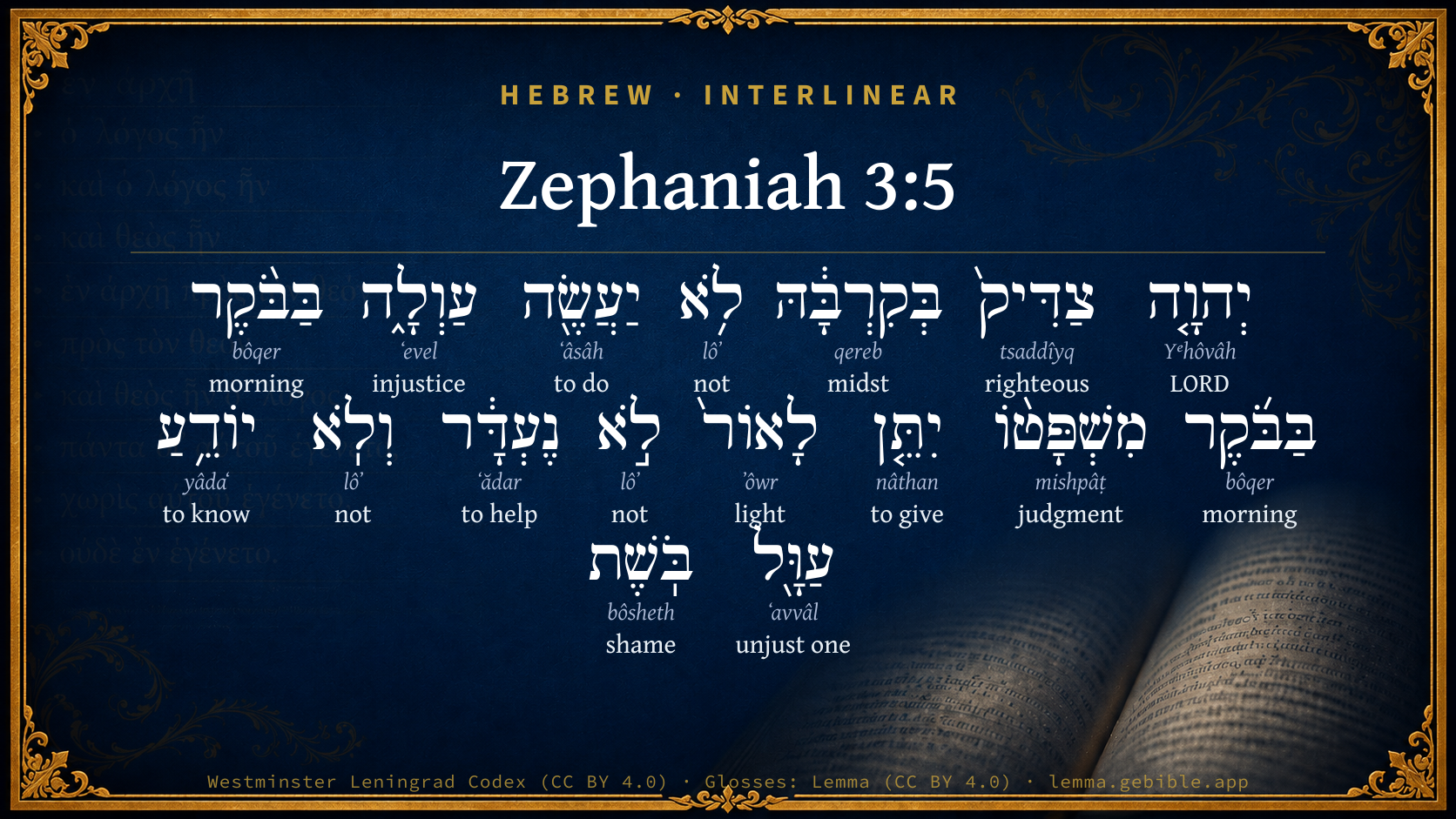
Hebrew (Westminster Leningrad Codex) Zephaniah 3:5 appears in the Hebrew Old Testament. The text above is from the Westminster Leningrad Codex. Each word links to its Strong’s number, a concise gloss, and parsing drawn from the Open Scriptures Hebrew Bible morphology. Click any word for its full Brown-Driver-Briggs (BDB) entry.
Download image
Cite this verse

Zephaniah 3:5 (World English Bible). Public Domain. Lemma interlinear Bible study tool, https://lemma.gebible.app/v/zephaniah/3/5.

Show BibTeX & RIS
BibTeX
RIS
English Translation
Yahweh, in the midst of her, is righteous. He will do no wrong. Every morning he brings his justice to light. He doesn't fail, but the unjust know no shame.
World English Bible · Public Domain
Download a study sheet

One document with this verse’s original text, its word-by-word gloss line, the meaning frame, cross-references with their text, attributed commentary, and full source and license credits — printable, and it pastes into notes with its structure intact.

This verse Autodidact and up

Study sheet (.html) Plain text (.txt)

A passage Seminary Student

Up to 50 verses in one chapter. A passage sheet keeps up to 6 commentary sources and 12 cross-references per verse, in the order this page ranks them, and says so on the sheet whenever that leaves anything out. Ask for a single verse and you get the Autodidact verse sheet above.

Everything on this page stays free to read, with no account — the sheet is a download of what is already on screen, not access to it.

Want to remove ads? Support Godless Engineer
Compare translations 3

The same verse in 3 English versions, stacked beneath the original-language interlinear above. Click any original word for its lexicon entry.

Each is an independent rendering of the whole verse — the interlinear is not word-aligned to these translations.

Highlighted words mark where these versions differ — a whole-verse word diff, not a word-by-word alignment.

  • World English Bible Public Domain
    Yahweh, in the midst of her, is righteous. He will do no wrong. Every morning he brings his justice to light. He doesn't fail, but the unjust know no shame.
  • King James Version Public Domain
    The just LORD is in the midst thereof; he will not do iniquity: every morning doth he bring his judgment to light, he faileth not; but the unjust knoweth no shame.
  • unfoldingWord Literal Text CC BY-SA 4.0
    Yahweh righteous in her midst. He does not commit unrighteousness. In the morning, in the morning he gives his justice; at light he is not left out. Yet the unrighteous does not know shame.

unfoldingWord Literal Text — © unfoldingWord, licensed CC BY-SA 4.0. Word-aligned USFM3 via Door43 (git.door43.org/unfoldingWord/en_ult).

Versions to compare (up to 4)

3 of 4 selected

Show all 18 translations

Every available English version of this verse, each an independent rendering of the whole verse.

  • World English Bible Public Domain
    Yahweh, in the midst of her, is righteous. He will do no wrong. Every morning he brings his justice to light. He doesn't fail, but the unjust know no shame.
  • Berean Standard Bible Public Domain
    The LORD within her is righteous; He does no wrong. He applies His justice morning by morning; He does not fail at dawn, yet the unjust know no shame.
  • Majority Standard Bible Public Domain
    The LORD within her is righteous; He does no wrong. He applies His justice morning by morning; He does not fail at dawn, yet the unjust know no shame.
  • King James Version Public Domain
    The just LORD is in the midst thereof; he will not do iniquity: every morning doth he bring his judgment to light, he faileth not; but the unjust knoweth no shame.
  • American Standard Version (1901) Public Domain
    Jehovah in the midst of her is righteous; he will not do iniquity; every morning doth he bring his justice to light, he faileth not; but the unjust knoweth no shame.
  • Revised Version (1885) Public Domain
    The LORD in the midst of her is righteous; he will not do iniquity; every morning doth he bring his judgment to light, he faileth not; but the unjust knoweth no shame.
  • Geneva Bible (1599) Public Domain
    The iust Lord is in the middes thereof: he will doe none iniquitie: euery morning doeth hee bring his iudgement to light, he faileth not: but the wicked will not learne to be ashamed.
  • Douay-Rheims (1899) Public Domain
    The just Lord is in the midst thereof, he will not do iniquity: in the morning, in the morning he will bring his judgment to light, and it shall not be hid: but the wicked man hath not known shame.
  • Young's Literal Translation Public Domain
    Jehovah `is' righteous in her midst, He doth not do perverseness, Morning by morning His judgment he giveth to the light, It hath not been lacking, And the perverse doth not know shame.
  • Literal Standard Version CC BY-SA 4.0
    YHWH [is] righteous in her midst, || He does not do perverseness, || Morning by morning His judgment He gives to the light, || It has not been lacking, || And the perverse do not know shame.
  • Unlocked Literal Bible CC BY-SA 4.0
    Yahweh is righteous in her midst. He can do no wrong. Morning by morning he will dispense his justice! It will not be hidden in the light, yet unrighteous people know no shame.
  • unfoldingWord Literal Text CC BY-SA 4.0
    Yahweh righteous in her midst. He does not commit unrighteousness. In the morning, in the morning he gives his justice; at light he is not left out. Yet the unrighteous does not know shame.
  • Darby Bible Public Domain
    The righteous Jehovah is in the midst of her: he doeth no wrong. Every morning doth he bring his judgment to light; it faileth not: but the unrighteous knoweth no shame.
  • World Messianic Bible Public Domain
    The LORD, within her, is righteous. He will do no wrong. Every morning he brings his justice to light. He doesn’t fail, but the unjust know no shame.
  • Webster's Bible Public Domain
    The just LORD is in the midst of her; he will not do iniquity: every morning doth he bring his judgment to light, he faileth not; but the unjust knoweth no shame.
  • Free Bible Version CC BY-SA 4.0
    But the Lord who does right is still among you, he does no wrong. Every morning he gives his judgment, every day without fail. But those who act unjustly have no shame.
  • Bible in Basic English Public Domain
    The Lord in her is upright; he will not do evil; every morning he lets his righteousness be seen, he is unchanging; but the evil-doer has no sense of shame.
  • JPS Tanakh (1917) Public Domain
    The LORD who is righteous is in the midst of her, He will not do unrighteousness; every morning doth He bring His right to light, it faileth not; but the unrighteous knoweth no shame.

Literal Standard Version (2020), Covenant Press — licensed CC BY-SA 4.0. Text via the HelloAO Bible API (eBible.org). Unlocked Literal Bible (unfoldingWord) — licensed CC BY-SA 4.0. Text via the HelloAO Bible API (eBible.org). unfoldingWord Literal Text — © unfoldingWord, licensed CC BY-SA 4.0. Word-aligned USFM3 via Door43 (git.door43.org/unfoldingWord/en_ult). Free Bible Version, Dr. Jonathan Gallagher — licensed CC BY-SA 4.0. Text via the HelloAO Bible API (eBible.org).

Word by word

More ways to search: Search by grammar → Find every occurrence → Compare this word →

Practice this passage: Drill this verse → Learn its vocabulary →

עַוָּ֖ל
ʻavvâl
H5767
“unjust one”
Noun, Common, Masculine, Singular, Absolute
Part of Speech
Noun
Type
Common
Gender
Masculine
Number
Singular
State
Absolute
Full BDB Definition

Origin: intensive from H5765

TWOT: 1580c

unjust one, perverse one, unrighteous one
  1. יְהוָ֤ה Yᵉhôvâh H3068 “LORD” Noun, Proper
  2. צַדִּיק֙ tsaddîyq H6662 “righteous” Adjective, Adjective, Masculine, Singular, Absolute
  3. בְּקִרְבָּ֔הּ qereb H7130 “in/at · midst · her” Preposition + Noun, Common, Masculine, Singular, Construct + Suffix, Personal, 3rd Person, Feminine, Singular
  4. לֹ֥א lôʼ H3808 “not” Particle, Negative
  5. יַעֲשֶׂ֖ה ʻâsâh H6213 “to do” Verb, Qal, Imperfect, 3rd Person, Masculine, Singular
  6. עַוְלָ֑ה ʻevel H5766 “injustice” Noun, Common, Both, Singular, Absolute
  7. בַּבֹּ֨קֶר bôqer H1242 “in/at the · morning” Preposition, Determined + Noun, Common, Masculine, Singular, Absolute
  8. בַּבֹּ֜קֶר bôqer H1242 “in/at the · morning” Preposition, Determined + Noun, Common, Masculine, Singular, Absolute
  9. מִשְׁפָּט֨וֹ mishpâṭ H4941 “judgment · his” Noun, Common, Masculine, Singular, Construct + Suffix, Personal, 3rd Person, Masculine, Singular
  10. יִתֵּ֤ן nâthan H5414 “to give” Verb, Qal, Imperfect, 3rd Person, Masculine, Singular
  11. לָאוֹר֙ ʼôwr H216 “to/for the · light” Preposition, Determined + Noun, Common, Both, Singular, Absolute
  12. לֹ֣א lôʼ H3808 “not” Particle, Negative
  13. נֶעְדָּ֔ר ʻădar H5737 “to help” Verb, Niphal, Perfect, 3rd Person, Masculine, Singular
  14. וְלֹֽא lôʼ H3808 “and · not” Conjunction + Particle, Negative
  15. יוֹדֵ֥עַ yâdaʻ H3045 “knowing” Verb, Qal, Participle Active, Masculine, Singular, Absolute
  16. בֹּֽשֶׁת bôsheth H1322 “shame” Noun, Common, Feminine, Singular, Absolute

About this verse

These counts appear in no published source. They are computed here, from the morphology-tagged text and Lemma’s own curated glosses. What Lemma adds →

17
words
14
distinct lemmas
Prophets
section

Notable vocabulary

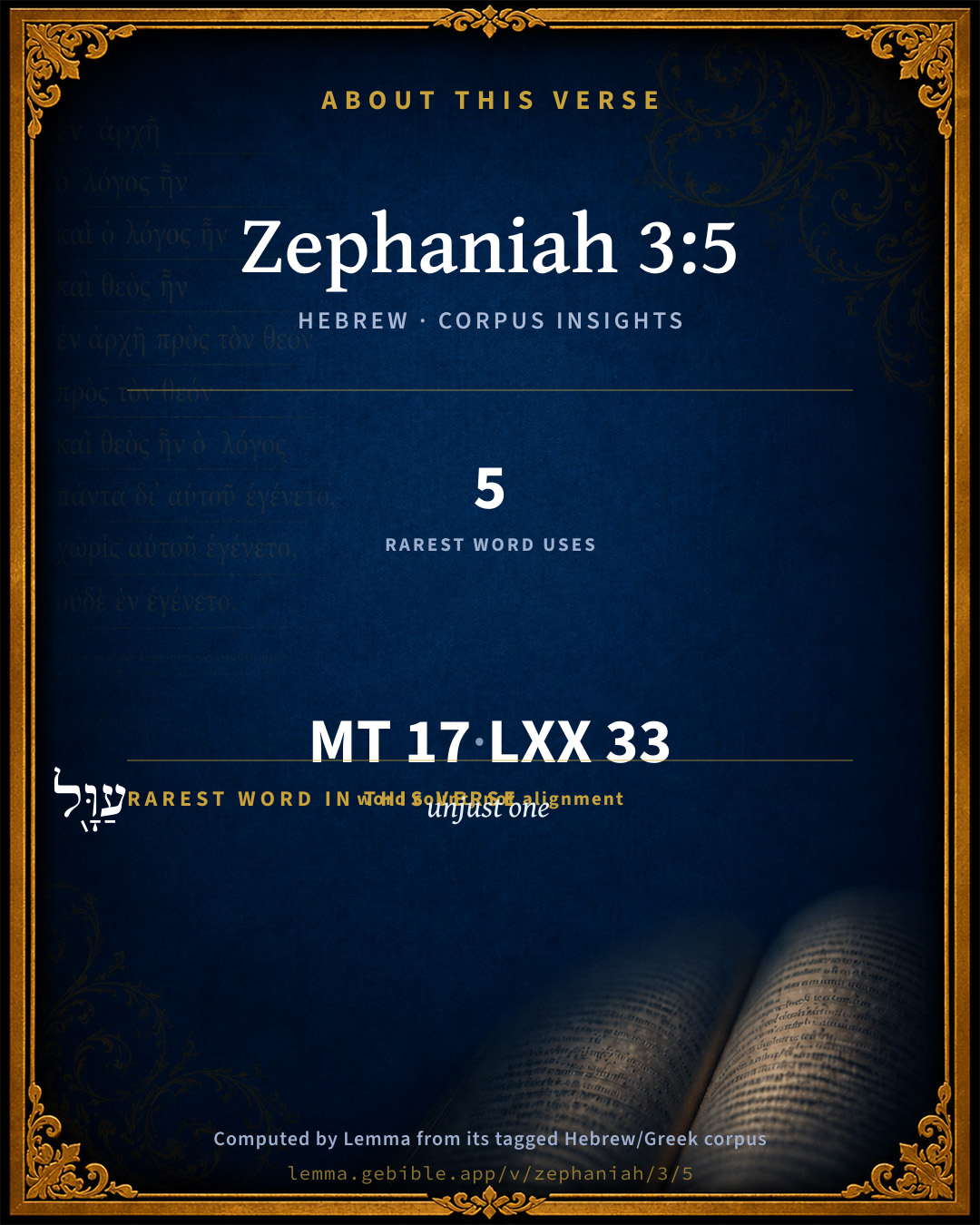
The rarest word here is עַוָּ֖ל unjust one H5767 — appearing just 5 times in the whole Hebrew Bible.

Shared distinctive vocabulary

עַוָּ֖ל unjust one H5767 occurs in 5 verses of the Hebrew Bible. Also found in:

Grammatical profile

  • 4 verbs
  • 9 nouns
  • 1 adjective
  • 3 particles

Verb forms

  • יַעֲשֶׂ֖ה Qal · Imperfect
  • יִתֵּ֤ן Qal · Imperfect
  • נֶעְדָּ֔ר Niphal · Perfect
  • יוֹדֵ֥עַ Qal · Participle Active

Repetition

Words recur within this verse — often emphatic in Hebrew:

  • בַּבֹּ֨קֶר morning H1242 ×2
  • לֹ֥א not H3808 ×3

Hebrew & Septuagint length

In English translation the verse runs 30 words from the Hebrew and 46 from the Septuagint (LXX English) — the Septuagint runs noticeably longer here. See the side-by-side →

A rough comparison of the two English renderings, which tokenize alike — not a word-level alignment.

Word counts can differ between the Hebrew and the Greek without any difference in meaning — e.g. the Hebrew direct-object marker אֵת has no separate Greek word, and Greek often adds the article ὁ.

In the original languages it is 17 Hebrew tokens and 33 Greek tokens — but the two are counted differently (Hebrew bundles its prefixes and suffixes into one token; the Greek is in lemma form), so that isn’t a like-for-like length.

Cross-references

35

Topical passages linked to Zephaniah 3:5 in the Treasury of Scripture Knowledge — connected by theme and wording, ordered by reader-vote popularity; previews shown in the World English Bible.

  • Deuteronomy 32:4 The Rock, his work is perfect; For all his ways are justice: A God of faithfulness and without iniquity, Just and right is he.
  • Psalms 145:17 Yahweh is righteous in all his ways, And gracious in all his works.
  • Lamentations 3:23 They are new every morning; great is your faithfulness.
  • Zephaniah 3:15 Yahweh has taken away your judgments. He has thrown out your enemy. The King of Israel, Yahweh, is in the midst of you. You will not be afraid of evil any more.
  • Deuteronomy 23:14 for Yahweh your God walks in the midst of your camp, to deliver you, and to give up your enemies before you; therefore shall your camp be holy, that he may not see an unclean thing in you, and turn away from you.
  • Isaiah 12:6 Cry aloud and shout, you inhabitant of Zion; for great in the midst of you is the Holy One of Israel!"
  • Isaiah 28:19 As often as it passes though, it shall take you; for morning by morning shall it pass through, by day and by night: and it shall be nothing but terror to understand the message.
  • Zephaniah 3:17 Yahweh, your God, is in the midst of you, a mighty one who will save. He will rejoice over you with joy. He will rest in his love. He will rejoice over you with singing.
  • Psalms 99:3–4 Let them praise your great and awesome name. He is Holy!
  • 1 Peter 1:17 If you call on him as Father, who without respect of persons judges according to each man's work, pass the time of your living as strangers here in reverent fear:
  • Job 34:10 "Therefore listen to me, you men of understanding: Far be it from God, that he should do wickedness, From the Almighty, that he should commit iniquity.
  • Psalms 37:6 He will make your righteousness go forth as the light, And your justice as the noon day sun.
  • Ecclesiastes 3:16–17 Moreover I saw under the sun, in the place of justice, that wickedness was there; and in the place of righteousness, that wickedness was there.
  • Jeremiah 6:15 Were they ashamed when they had committed abomination? nay, they were not at all ashamed, neither could they blush: therefore they shall fall among those who fall; at the time that I visit them they shall be cast down, says Yahweh.
  • Jeremiah 8:12 Were they ashamed when they had committed abomination? nay, they were not at all ashamed, neither could they blush: therefore shall they fall among those who fall; in the time of their visitation they shall be cast down, says Yahweh.
  • Micah 7:9 I will bear the indignation of Yahweh, Because I have sinned against him, Until he pleads my case, and executes judgment for me. He will bring me forth to the light. I will see his righteousness.
  • Zechariah 2:5 For I,' says Yahweh, 'will be to her a wall of fire around it, and I will be the glory in the midst of her.
  • Romans 3:26 to demonstrate his righteousness at this present time; that he might himself be just, and the justifier of him who has faith in Jesus.
  • Genesis 18:25 Be it far from you to do things like that, to kill the righteous with the wicked, that so the righteous should be as the wicked. May that be far from you. Shouldn't the Judge of all the earth do right?"
  • Job 8:3 Does God pervert justice? Or does the Almighty pervert righteousness?
  • Job 34:17–19 Shall even one who hates justice govern? Will you condemn him who is righteous and mighty?--
  • Isaiah 33:2 Yahweh, be gracious to us; we have waited for you: be our arm every morning, our salvation also in the time of trouble.
  • Isaiah 42:3–4 A bruised reed will he not break, and a dimly burning wick will he not quench: he will bring forth justice in truth.
  • Isaiah 45:21 Declare you, and bring [it] forth; yes, let them take counsel together: who has shown this from ancient time? who has declared it of old? Haven't I, Yahweh? and there is no God else besides me, a just God and a Savior; there is no one besides me.
  • Isaiah 50:4 The Lord Yahweh has given me the tongue of those who are taught, that I may know how to sustain with words him who is weary: he wakens morning by morning, he wakens my ear to hear as those who are taught.
  • Jeremiah 3:3 Therefore the showers have been withheld, and there has been no latter rain; yet you have a prostitute's forehead, you refused to be ashamed.
  • Jeremiah 21:12 House of David, thus says Yahweh, Execute justice in the morning, and deliver him who is robbed out of the hand of the oppressor, lest my wrath go forth like fire, and burn so that none can quench it, because of the evil of your doings.
  • Ezekiel 48:35 It shall be eighteen thousand [reeds] round about: and the name of the city from that day shall be, Yahweh is there.
  • Micah 3:11 Her leaders judge for bribes, And her priests teach for a price, And her prophets of it tell forturnes for money: Yet they lean on Yahweh, and say, Isn't Yahweh in the midst of us? No disaster will come on us.
  • Habakkuk 1:3 Why do you show me iniquity, and look at perversity? For destruction and violence are before me. There is strife, and contention rises up.
  • Zephaniah 2:1 Gather yourselves together, yes, gather together, you nation that has no shame,
  • Luke 12:2 But there is nothing covered up, that will not be revealed, nor hidden, that will not be known.
  • Romans 2:5 But according to your hardness and unrepentant heart you are treasuring up for yourself wrath in the day of wrath, revelation, and of the righteous judgment of God;
  • 1 Corinthians 4:5 Therefore judge nothing before the time, until the Lord comes, who will both bring to light the hidden things of darkness, and reveal the counsels of the hearts. Then each man will get his praise from God.
  • Zechariah 9:9 Rejoice greatly, daughter of Zion! Shout, daughter of Jerusalem! Behold, your king comes to you! He is righteous, and having salvation; Lowly, and riding on a donkey, Even on a colt, the foal of a donkey.

Cross-references courtesy of OpenBible.info (CC BY 4.0).

Hebrew and Greek witnesses Masoretic Hebrew ↔ Greek Septuagint

The same verse in the two great witnesses to the Old Testament, shown verse-for-verse.

Here the Septuagint runs noticeably longer than the Hebrew — LXX2012 (modern English Septuagint) 46 words vs World English Bible 30. A rough length comparison of the two English translations, not a word-level alignment — read both below.

These are two independent witnesses, not word-aligned to each other, and the Septuagint is shown in lemma (dictionary) form.

Hebrew Zephaniah 3:5 Masoretic · Westminster Leningrad Codex

יְהוָ֤ה צַדִּיק֙ בְּקִרְבָּ֔הּ לֹ֥א יַעֲשֶׂ֖ה עַוְלָ֑ה בַּבֹּ֨קֶר בַּבֹּ֜קֶר מִשְׁפָּט֨וֹ יִתֵּ֤ן לָאוֹר֙ לֹ֣א נֶעְדָּ֔ר וְלֹֽא יוֹדֵ֥עַ עַוָּ֖ל בֹּֽשֶׁת

Yahweh, in the midst of her, is righteous. He will do no wrong. Every morning he brings his justice to light. He doesn't fail, but the unjust know no shame.

World English Bible · Public Domain

Greek LXX Zephaniah 3:5 Septuagint · lemma form

ὁ δέ κύριος δίκαιος ἐν μέσος αὐτός καί οὐ μή ποιέω ἄδικος πρωΐ πρωΐ δίδωμι κρίμα αὐτός εἰς φῶς καί οὐ ἀποκρύπτω καί οὐ γιγνώσκω ἀδικία ἐν ἀπαίτησις καί οὐ εἰς νεῖκος ἀδικία

But the just Lord is in the midst of her, and he will never do an unjust thing: morning by morning he will bring out his judgment to the light, and it is not hidden, and he knows not injustice by extortion, nor injustice in strife.

LXX2012 (modern English Septuagint) · Public Domain

On this verse, Haydock's Catholic Bible Commentary discusses the Septuagint’s reading. Read the note in Commentary ↓

Hebrew: Westminster Leningrad Codex (CC BY 4.0). Greek: Septuagint (public domain); English from LXX2012 (modern English Septuagint) (Public Domain). How the Septuagint differs from the Hebrew →

Targum (Aramaic paraphrase)

1

The Targum is the ancient Jewish Aramaic paraphrase of the Hebrew Scriptures — an interpretive translation, not the Hebrew text itself. Onkelos (literal) and Pseudo-Jonathan (expansive) render the Torah, and Jonathan the Prophets. Coverage is partial: where no permissively-licensed English translation exists for a verse, only the Aramaic is shown. This is verse-level text, not a word-by-word alignment to the Hebrew.

  1. Targum Jonathan Prophets (Joshua–Malachi)
    יְיָ זַכָּאָה אֲמַר לְאַשְׁרָאָה שְׁכִנְתֵּיהּ בְּגַוָהּ לֵית קֳדָמוֹהִי לְמֶעְבַּד שְׁקַר הָא כִנְהוֹר צַפְרָא דְאָזֵיל וְתַקִין כֵּן דִינֵיהּ נָפֵיק לְאַפְּרַשׁ לָא מִתְעַכֵּב וְלָא יָדְעִין עַיְלַיָא בַהֲתָא:

    (no public-domain English translation for this verse)

    Targum Jonathan — Aramaic: “Mikraot Gedolot” (public domain). English: “Sefaria Community Translation” (CC0 1.0 (public-domain dedication)); “London "Chaldee Paraphrase," 1871” (public domain). Text via Sefaria.

Commentary

Notes on Zephaniah 3:5 from classic Christian and Jewish commentators (each source and its license shown beneath its notes). The classic Christian expositions comment on the surrounding passage and are grouped to its opening verse, so a note may address several verses; the Jewish commentaries on the Tanakh (Rashi and others) are per-verse, so they appear only where the commentator wrote on this verse.

Lemma curates 59 commentaries, every one of them public domain or Creative Commons licensed, each selected and text-cleaned for this edition rather than reprinted as found. About our sources →

Ellicott's Commentary for English Readers

(5-7) In contradistinction to this universal corruption, Jehovah daily exemplifies the law of righteousness, yet sinners are not moved to repentance (Zep_3:5). He sets forth the great judgments He has executed on other sinful nations, but the warning is not heeded (Zep_3:6-7).

A Bible Commentary for English Readers, edited by Charles John Ellicott (1878–1897) — public domain. Text from a community e-Sword module.

Trapp's Complete Commentary

John Trapp

Zep 3:5 The just LORD [is] in the midst thereof; he will not do iniquity: every morning doth he bring his judgment to light, he faileth not; but the unjust knoweth no shame.

Ver. 5. The just Lord is in the midst thereof] The unjust princes were said to be in the midst of Jerusalem as roaring lions, Zep 3:3. Here the just Lord is also said to be in the midst of her, as a sin revenging judge. He sitteth as God in the midst of those uncircumcised vicegods (as I may in the worst sense best term them), he sets a jealous eye upon all their unrighteous proceedings, and is with them in the judgment. Neither eyeth he them only, but all others in like sort; as the king in the Gospel came in to see his guests. His eye, like a well drawn picture, taketh view of all that come into the room. Oh that we could be in his fear all the day! Oh that we would ever walk in the sense of his presence, and light of his countenance! Noli peccare, nam Deus videt, angeli astant, diabolus accusabit, conscientia testabitur, Infernus cruciabit. Sin not; for God sees you, the good angels stand about you, Satan will accuse you, conscience will give in evidence against you, hell will torment you. A reverend and religious man had this written before his eyes in his study.

He will not do iniquity] i.e. He will not let enormities go unpunished, nor pass by the infirmities of his people without a sensible check, Psa 99:8. See Hab 1:13.

Every morning doth he bring his judgment to light] Daily and diligently doth he both threaten by his prophets and execute with his hand the menaces of his mouth upon those that will not be warned, that refuse to be reformed. He hath in a readiness to revenge all disobedience, 2Co 10:6. Maturely he will do it, and accurately; it is his morning’s work, Psa 101:8, like as it is theirs to rise early, and corrupt all their doings, Zep 3:7. He will be up and at it as soon as they.

He faileth not] As he may seem to do when he forbeareth. Non deest, he will not be wanting to his office to proceed against the uncounsellable.

But the unjust knoweth no shame] He can blush no more than a sackbut, as the proverb is. Such an impudence hath sin woaded {a} in his face, that he basheth nothing. Et pudet non esse impudentem, he is past all grace, as we say, and as good at resisting the Holy Ghost as ever those Jews were that had a whore’s forehead, Jer 3:3, sinews of iron and brows of brass, Isa 48:4. When neither fear of God nor shame of the world will rein men in, what hope is there of such? Illum ego periisse dico cui periit pudor, saith Curtius, a heathen. He is an undone man that knoweth no shame. Prevent it in time; for the modest beginnings of sin at first will make way for immodest proceedings. The thickest ice that will bear a cart beginneth with a thin trembling cover, that will not bear a pebble.

{a} A bluish dye the ancient British warriors covered themselves with when going to battle to make their appearance more terrible to the enemy.

John Trapp, A Commentary or Exposition upon All the Books of the Old and New Testament (1647–1656) — public domain. Text from a community e-Sword module.

Joseph Benson's Commentary

Zep 3:5. The just Lord is in the midst thereof — Namely, of Jerusalem, and sees all these things. He will not do iniquity — He is just and holy, and will do nothing but what is right; nor will he suffer wickedness to pass unpunished. Every morning doth he bring his judgment to light — “The sense is, not a day passes but we see instances of his goodness to righteous men, and of his vengeance on the wicked.” — Newcome. The expression, every morning, alludes to the custom of the Jews and neighbouring nations, who passed judgment only in the morning. He faileth not — He never omits thus to act. But the unjust knew not shame — The wicked continue to be hardened in their sins, and will not be induced to forsake them by any consideration, either of the baseness and evil of their conduct, or of the judgments of God continually inflicted on transgressors.

Joseph Benson's Commentary on the Old and New Testaments (1811–1818) — public domain. Text from a community e-Sword module.

The Preacher's Complete Homiletical Commentary

Joseph S. Exell (gen. ed.)

CRITICAL NOTES.]

Zep_3:5.] The cause not with God. He is very near, declares his displeasure with sin, and daily brings all things to light. Morning] Lit. in the morning, in the morning. Shame] of penitence and conversion.

Zep_3:6. Cut off] Judgments appealed to as warnings (ch. 2); to consider severity and goodness.

Zep_3:7.] Threatened danger would be averted if the people would turn from evil. But] Instead of repenting, they rose early, became more zealous in wickedness, prepared themselves for it, like parties starting early for a journey. Hence punishment.

HOMILETICS

GOD’S JUSTICE PROVED TO A GUILTY PEOPLE.—Zep_3:5-6

No argument against the righteousness of God can be presented by those who have been warned, spared, and at last condemned. If iniquity be determined, and the sinner becomes incorrigible, the course of justice is clear. God could not rightly be taxed with injustice in punishing Jerusalem with greater suffering than the offence deserved. This is proved—

I. By God’s holy character. “The just Lord is in the midst thereof.” He is essentially holy, eternally just; the primal law of right to all. He is—

1. Just in himself; and

2. Just to others. “He will not do iniquity.” He is in the midst of men who are polluted and oppressive; reproving wrong, and giving an example of right. Hence, if sinners heed not, God cannot connive at their wickedness, and become as one of themselves (Psa_50:21). “The Lord is upright, and there is no unrighteousness in him.”

II. By God’s righteous administration. God not only dwelt in the temple; but gave clear intimations of duty, bright manifestations of equity, which they heeded not. God’s condemnations of evil practices were—

1. Open. In the day, not in secret.

2. Clear. He brought “his judgment to light.” All secret things, all works of darkness, were exposed and reproved (2Sa_12:12).

3. Continual. “Every morning;” morning by morning, day by day, his voice was heard and his judgments conspicuous. “He faileth not” in judgment and mercy; but they knew no shame, were conscious of no sin. “They were not at all ashamed, neither could they blush.”

III. By God’s terrible judgments upon others. “I have cut off the nations,” &c. (Zep_3:6). Judgments upon others had always been set before them as a warning. When about to enter the inheritance (Lev_18:24-26; Lev_20:23), they were cautioned. When they got possession the ruins of cities were silent preachers of the results of sin (Isa_17:9). They had been the instruments of inflicting judgments, and lived in the memories of God’s visitations upon others. Fortified cities had been destroyed, mighty towers levelled to the dust, and nations completely ruined, to admonish them, but all in vains How earnest is God in seeking the sinner, but how terrible the punishment at last! “I said, Surely thou wilt fear me, thou wilt receive instruction; so their dwelling should not be cut off, howsoever I punished them.”

AGGRAVATIONS OF HUMAN GUILT.—Zep_3:5-7

What aggravated their guilt till it became intolerable, and put them beyond all mercy save the “mercy of judgment,” was—

1. That God had given them a pure law of life, and himself administered it among them. In other cities, such as Gaza or Nineveh, the presence and the law of God were but obscurely revealed. Men were left to grope after the Unknown, if haply they might find him; to infer a spiritual presence from the operation of physical laws; to deduce a Divine rule from the imperfect and confused utterances of reason and conscience. In Jerusalem, God and his will were “set in the light;” the history of the chosen race, the services of the temple, the voices and scriptures of the prophets, the national habits of thought, and manner of life, loudly proclaimed God to be their God. Who should know him if they did not? and who do his will if they disobeyed it? But with so pure light of goodness in their midst, they wrapped themselves in darkness, and hated the light which reproved their deeds. “But the unjust know no shame.”

2. That in the destruction inflicted upon neighbouring kingdoms, he had constantly warned them of the inevitable results of violating that law (Zep_3:6). They had seen race after race cut off, their battlements laid waste, their cities battered down, and their streets reduced to such ruinous desolation that no man dwelt in them, nor so much as passed through them. What were these judgments but the law of God “writ large,” and illustrated so impressively as to arrest the attention of the most heedless, and to rouse a saving fear in the stubborn and impenitent? But even these glaring and portentous illustrations of God’s wrath against sin and all who cleave to it, had been wasted. They were unmoved, or moved only for a moment, under shocks and alarms. Only a judgment more severe than any they had seen or known could constrain them to penitence, through penitence to righteousness, and through righteousness to peace. “The nation that did not turn pale” (ch. Zep_2:1).

3. That much as they suffered, they had not accepted correction, nor learned that the beginning of wisdom is the fear of the Lord (Zep_3:7). Not only had they seen “a day of the Lord” darken other lands, and judgments desolate heathen cities. They themselves had been visited with judgment, smitten again and again till the whole head was sick, and the whole heart faint. The whole body politic was bruised, and wounded, and sore. Their whole past history was full of Divine chastenings. What was their meaning? what were they sent to say? “Only fear God, accept correction,” let it produce its natural effect upon you, and all will be right. Corrections were sent to them that their land and city might be spared. But if they be rejected, they harden and deprave. Jerusalem had been content to give the day to disobedience and mutiny. Now as if it were not long enough for the sins they were eager to commit, “they rose up early” in the morning “to corrupt all their doings,” so shameless were they, so incorrigible [Preacher’s Lantern. Vol. II. Adapted].

HOMILETIC HINTS AND SUGGESTIONS

Zep_3:5. In the midst. God’s presence with an apostate people will not save from wrath, but will bring it nearer to them. “Is not the Lord among us?” was their boast (Mic_3:11). True, he is, but it is for another end from what ye think [Calvin].

He faileth not.

1. In presence;

2. In promise;

3. In help. He continually sets before us examples of judgment and mercy. “He wakeneth morning by morning” (Isa_5:4; Isa_1:4). He does not fail to visit at the time looked for, though he may seem to forbear or linger behind (Hab_2:3).

Shame.

1. Many in the Church and in the nation acknowledge God, yet sin against the clear light of the Word.

2. When such are mad in their sin and rush to ruin, it is a presage of their destruction when the Word has no influence upon them; a token that judgment must come, notwithstanding warnings, when “the unjust knoweth no shame” [Hutcheson].

Zep_3:6-7.

1. The chastisement of others is designed to improve us. The design is benevolent; “so their dwelling should not be cut off.” The method is suitable; “howsoever I punished them.” The results are reasonable; “surely thou wilt fear.”

2. If the warning is unheeded we shall ourselves be punished. “No words could be more simple and direct than these; none could state more plainly the merciful and Divine purpose of judgment; the true function of the miseries men are called to endure. These judgments and miseries come to teach us the fear of the Lord; that is, to save us from all fear. So soon as we accept them as corrections of our sins, their end is answered; henceforth there is no anger in them, no injurious pain, but only a Divine love and goodwill. And if no statement of the meaning and function of suffering can be more plain than this, surely none can be more consolatory. For, according to Zephaniah, it comes only for our good, for our highest good; to teach us the true wisdom, and to make us perfect. When once we ‘accept’ it, its end being reached, there is no reason why it should not either pass away or be changed into the stay and stimulus of our life.”

Long unaffected, undismayed,

In pleasure’s path secure I stray’d

Thou mad’st me feel thy chast’ning rod,

And straight I turn’d unto my God.

Instruction.—Other men’s woes should be our warnings; others’ sufferings our sermons; others’ lashes our lessons; God’s house of correction, a school of instruction where we should hear and fear, and do no more so (Deu_17:13). He that trembleth not in hearing, shall be crushed to pieces in feeling, said that martyr [Trapp].

ILLUSTRATIONS TO CHAPTER 3

Zep_3:5. Just. If there be one truth that speaks throughout the Bible like the voice of God, and resounds with all the grandeur of the Divine intonation, it is the truth that God does not look with an equal eye upon the evil and the good, that He is a discriminator of character, a lover of that which is right, and a hater of that which is wrong [H. W. Beecher].

Zep_3:6-7. The desolation is complete, within as well as without; ruin itself is hardly so desolate as the empty habitations and forsaken streets, once full of life, where

“The echoes and the empty tread

Would sound like voices from the dead.” [Pusey.]

The Preacher's Complete Homiletical Commentary (gen. ed. Joseph S. Exell; Funk & Wagnalls, c. 1892) — public domain (pre-1929). A full-Bible homiletical/sermon-outline anthology covering 65 of 66 books (2 John is absent from the source module). Text from a community e-Sword module.

Keil & Delitzsch

C. F. Keil & F. Delitzsch

Jerusalem sins in this manner, without observing that Jehovah is constantly making known to it His own righteousness. Zep 3:5. "Jehovah is just in the midst of her; does no wrong: morning by morning He sets His justice in the light, not failing; but the unjust knoweth no shame. Zep 3:6. I have cut off nations: their battlements are laid waste; I have devastated their streets, so that no one else passeth over: their cities are laid waste, that there is no man there, not an inhabitant more." Zep 3:5 is attached adversatively to what precedes without a particle, in this sense: And yet Jehovah is just beqirbâh, i.e., in the midst of the city filled with sinners. The words recal to mind the description of the divine administration in Deu 32:4, where Jehovah is described as אין עול and ישׁר. It follows from this that tsaddı̄q is not to be referred to the fact that God does not leave the sins of the nation unpunished (Ros.), but to the fact that He commits no wrong: so that לא יעשׂה עולה is only a negative paraphrase of tsaddı̄q. His justice, i.e., the righteousness of His conduct, He puts in the light every morning (babbōqer babbōqer, used distributively, as in Exo 16:21; Lev 6:5, etc.), not by rewarding virtue and punishing wickedness (Hitzig, Strauss, after the Chaldee, Jerome, Theodoret, and Cyril), according to which mishpât would signify judgment; but by causing His law and justice to be proclaimed to the nation daily "by prophets, whose labour He employs to teach the nation His laws, and who exert themselves diligently by exhorting and admonishing every day, to call it to bring forth better fruit, but all in vain (Ros., Ewald, etc.; cf. Hos 6:5). It is at variance with the context to take these words as referring to the judgments of God. These are first spoken of in Zep 3:6, and the correspondence between these two verses and Zep 3:7 and Zep 3:8 shows that we must not mix up together Zep 3:5 and Zep 3:6, or interpret Zep 3:5 from Zep 3:6. Just as the judgment is threatened there (Zep 3:8) because the people have accepted no correction, and have not allowed themselves to be moved to the fear of Jehovah, so also in Zep 3:5 and Zep 3:6 the prophet demonstrates the righteousness of God from His double administration: viz., first, from the fact that He causes His justice to be proclaimed to the people, that they may accept correction; and secondly, by pointing to the judgments upon the nations. לא נעדּר paraphrases the idea of "infallibly;" the literal meaning is, that there is no morning in which the justice is wanting. Hitzig, Strauss, and others have rendered it quite unsuitably, "God does not suffer Himself to be wanting," i.e., does not remain absent. But the perverse one, viz., the nation sunk in unrighteousness, knows no disgrace, to make it ashamed of its misdeeds. In Zep 3:6 Jehovah is introduced as speaking, to set before the nations in the most impressive manner the judgments in which He has manifested His righteousness. The two hemistichs are formed uniformly, each consisting of two clauses, in which the direct address alternates with an indefinite, passive construction: I have cut off nations, their battlements have been laid waste, etc. Gōyı̄m are neither those nations who are threatened with ruin in Zep 2:4-15, nor the Canaanites, who have been exterminated by Israel, but nations generally, which have succumbed to the judgments of God, without any more precise definition. Pinnōth, the battlements of the fortress-walls and towers (Zep 1:16), stand per synecdochen for castles or fortifications. Chūtsōth are not streets of the city, but roads, and stand synecdochically for the flat country. This is required by the correspondence of the clauses. For just as the cities answer to the castles, so do chūtsōth to the nations. Nitsdū, from tsâdâh, not in the sense of waylaying (Exo 21:13; Sa1 24:12), but in accordance with Aramaean usage, to lay waste, answering to nâshammū, for which Jeremiah uses nittetsū in Jer 4:26.

Keil & Delitzsch — Biblical Commentary on the Old Testament (1861–1891) — public domain (CC PDM 1.0). Text via the HelloAO Bible API. (Old Testament only.)

Tyndale Open Study Notes

Tyndale Open Resources

3:5 He does no wrong, unlike those mentioned in 3:3-4.

Tyndale Open Study Notes — © Tyndale Open Resources, licensed CC BY-SA 4.0. Text via the HelloAO Bible API.

Geneva Bible (1599)

Geneva Bible translators

The wicked thus boasted that God was ever among them, but the Prophet answereth that that cannot excuse their wickedness: for God will not bear with their sins: yet that he did patiently abide and sent his Prophets continually to call them to repentance, but he profited nothing.

Geneva Bible (1599) marginal notes — public domain. Text via Bolls.life.

Jamieson, Fausset & Brown

Robert Jamieson, A. R. Fausset & David Brown

The Jews regard not God's justice manifested in the midst of them, nor His judgments on the guilty nations around.

The just Lord--Why then are ye so unjust?

is in the midst thereof--He retorts on them their own boast, "Is not the Lord among us" (Mic 3:11)? True He is, but it is for another end from what ye think [CALVIN]; namely, to lead you by the example of His righteousness to be righteous. Lev 19:2, "Ye shall be holy: for I the Lord your God am holy" [MAURER]. But CALVIN, "That ye may feel His hand to be the nearer for taking vengeance for your crimes: 'He will not do iniquity' by suffering your sins to go unpunished" (Deu 32:4).

every morning--literally, "morning by morning." The time in the sultry East for dispensing justice.

bring . . . to light--publicly and manifestly by the teaching of His prophets, which aggravates their guilt; also by samples of His judgments on the guilty.

he faileth not--He is continually setting before you samples of His justice, sparing no pains. Compare Isa 5:4; Isa 50:4, "he wakeneth morning by morning."

knoweth no shame--The unjust Jews are not shamed by His justice into repentance.

Jamieson, Fausset & Brown — Commentary Critical and Explanatory on the Whole Bible (1871) — public domain (CC PDM 1.0). Text via the HelloAO Bible API.

Adam Clarke's Commentary

Verse 5. The just Lord is in the midst thereof] He sees, marks down, and will punish all these wickednesses.

Every morning doth he bring his judgment to light] The sense is, says Bp. Newcome, "Not a day passes but we see instances of his goodness to righteous men, and of his vengeance on the wicked."

Adam Clarke's Commentary on the Bible (1810–1826) — public domain. Text from a community e-Sword/MySword module.

John Calvin's Commentaries

Here the Prophet throws back against hypocrites what they were wont to pretend, when they sought wickedly to reject every instruction and all warnings; for they said, that God dwelt in the midst of them, like the Papists at the present day, who raise up this as their shield against us,—that the Church is the pillar of the truth. Hence they think that all their wicked deeds are defended by this covering. So the Jews at that time had this boast ever on their lips,—We are notwithstanding the holy people of God, and he dwells in the midst of us, for he is worshipped in the Temple, which has been built, not according to men’s will, but by his command; for that voice proceeded not from earth, but came from heaven, ‘This is my rest for ever, here will I dwell.’ Psalm 132:14. Since then the Jews were inflated with this presumption, the Prophet concedes what they claimed, that God dwelt among them; but it was for a far different purpose, which was, that they might understand, that his hand was nigh to punish their sins. This is one thing.

Jehovah is in the midst of them; Granted, he says; I allow that he dwells in this city; for he has commanded a temple to be built for him on Mount Sion, he has ordered a holy altar for himself; but why does God dwell among you, and has preferred this habitation to all others? Surely, he says, he will not do iniquity. Consider now what the nature of God is; for when he purposed to dwell among you, he certainly did not deny himself, nor did he cease to be what he is. There is therefore no reason for you to imagine, as though God intended, for the sake of those to whom he bound himself, to throw aside his own justice, or intended to pollute himself by the defilements of men. He warns the Jews, that they absurdly blended these things together. God then who dwells in the midst of you, will not do iniquity; that is, He will not approve of your evil deeds; and though he may for a time connive at them, he will not yet bear with them continually. Do not therefore foolishly flatter yourselves, as though God were the approver of your wickedness.

Some apply this to the people,—that they ought not to have done iniquity; but this is a strained exposition, and altogether foreign to the context. Most other interpreters give this meaning, that God is just and will do no iniquity, for he had sufficient reasons for executing his vengeance on a people so wicked. They hence think, that the Prophet anticipates the Jews, lest they murmured, as though the Lord was cruel or too rigid. He will not do iniquity, that is, Though the Lord may inflict on you a most grievous punishment, yet he cannot be arraigned by you as unjust; and ye in vain contend with him, for he will ever be found to be a righteous judge. But this also is a very frigid explanation. Let us bear in mind what I have already said,—that the Prophet here, by way of irony, concedes to the Jews, that God dwelt among them, but afterwards brings against them what they thought was a protection to them,— God dwells in the midst of you; I allow it, he says; but is not he a just God? Do not then dream that he is one like yourselves, that he approves of your evil deeds. God will not do iniquity; ye cannot prevail with him to renounce himself, or to change his own nature. Why then does God dwell in the midst of you? In the morning, in the morning, he says, his judgment will he bring forth to light; the Lord will daily bring forth his judgment. How this is to be understood, we shall explain tomorrow.

John Calvin's Commentaries (1540-1563) — public domain. Text from the Calvin Translation Society English edition (1840s-50s) via the Christian Classics Ethereal Library (ccel.org). Calvin's coverage is partial (roughly two-thirds of the Bible); uncommented books and verses are honest gaps, never fabricated. The 19th-century editor's footnotes and remarks are omitted so the notes are faithfully Calvin's own voice.

The Cambridge Bible for Schools and Colleges

gen. ed. J. J. S. Perowne

5. All these wrongs they practise undeterred and uninstructed by the presence and operations of the righteous Lord in the midst of them.

The just Lord is] Rather: The LORD is righteous in the midst of her. Jehovah dwells in the midst of Jerusalem and is seen to be righteous both by His word and works, but the people are insensible and receive no impression from His presence and nature. Jer_11:20.

will not do iniquity] Or, doeth no unrighteousness; Deu_32:4.

Every morning … his judgment to light] Morning by morning, i.e. every morning, constantly, He brings His just judgment or justice to light; His moral rule is as constant and as visible as the material law that brings in the dawn. Cf. Hos_6:5 (read: my judgment goeth forth like the light).

the unjust knoweth no shame] The unrighteous, untouched by the righteousness of God and receiving no impression from His rule, though exercised before his eyes, pursues his own unrighteous way with no feeling of shame. Jer_3:3; Jer_6:15; Jer_8:12.

The Cambridge Bible for Schools and Colleges (gen. ed. J. J. S. Perowne; Cambridge University Press, 1878–1918) — public domain. Text from a community e-Sword module.

John Gill's Exposition

The just Lord [is] in the midst thereof In the midst of the city of Jerusalem, where those princes, judges, prophets and priests, were, that behaved so ill, and saw and observed all their evil actions; and yet they were not deterred from them by his presence, even though he is the "just" and Holy One, who loves righteousness, and hates iniquity, and will punish for it; nor were they directed and allured to do what is righteous and good by his example. This character of the just Lord well agrees with Christ, who is perfectly righteous in both his natures, and in the execution of his offices; and is the author of righteousness to his people; and this is to be understood of his incarnation and personal presence in human nature in Jerusalem, and in the temple, where he taught his doctrine, and wrought his miracles: he will not do iniquity; Christ was holy in his nature, harmless in his life; he knew no sin; he did not commit any; no violence was done by him, or guile found in him; he was not guilty of sin against God, nor of doing any injury to men; and should have been imitated by the men of the age in which he lived, as well as by others; and should have been valued and esteemed, and not traduced and vilified as he was, as if he had been the worst of men: every morning doth he bring his judgment to light; the doctrine of the Gospel, which he set in the clearest light, and preached with the greatest constancy, day after day, morning by morning, and very early in the morning, when the people came to hear him in the temple; and he continued in it all the day; he waking morning by morning to this service, as was predicted of him, ( Isaiah 1:4 ) see ( Luke 21:37 Luke 21:38 ) : he faileth not; in this work of preaching the word, with the greatest evidence and assiduity: but the unjust knoweth no shame: those unjust persons, who aspersed the character of Christ, and traduced his doctrine and miracles; though there was nothing in his life, nor in his ministry, that could be justly blamed, yet they blushed not at their sin and wickedness; and though they were sharply reproved by him, and their errors in principle, and sins in practice, were exposed by him, yet they were not ashamed; such were the hardness and obduracy of their hearts.

John Gill's Exposition of the Whole Bible (1746–1763) — public domain (CC PDM 1.0). Text via the HelloAO Bible API.

Albert Barnes' Notes on the Bible

But, beside these “evening wolves in the midst of her,” there standeth Another “in the midst of her,” whom they knew not, and so, very near to them although they would not draw near to Him. But He was near, to behold all the iniquities which they did in the very city and place called by His Name and in His very presence; He was in her to protect, foster her with a father’s love, but she, presuming on His mercy, had cast it off. And so He was near to punish, not to deliver; as a Judge, not as a Saviour. Dionysius: “God is everywhere, Who says by Jeremiah, ‘I fill heaven and earth’ Jer 23:24. But since, as Solomon attesteth, ‘The Lord is far from the wicked’ Pro 15:29, how is He said here to be in the midst of these most wicked men? Because the Lord is far from the wicked, as regards the presence of love and grace; still in His Essence He is everywhere, and in this way He is equally present to all.”

The Lord is in the midst thereof; He will not do iniquity - Dionysius: “Since He is the primal rule and measure of all righteousness; therefore from the very fact that He doeth anything, it is just, for He cannot do amiss, being essentially holy. Therefore He will give to every man what he deserves. Therefore we chant, ‘The Lord is upright, and there is no unrighteousness in Him’ Psa 92:15.” justice and injustice, purity and impurity, cannot be together. God’s presence then must destroy the sinners, if not the sin. He was “in the midst of them,” to sanctify them, giving them His judgments as a pattern of theirs; “He will not do iniquity:” but if they heeded it not, the judgment would fall upon themselves. It were for God to become “such an one as themselves” Psa 50:21, and to connive at wickedness, were He to spare at last the impenitent.

Every morning - (Literally, in the morning, in the morning) one after the other, quickly, openly, daily, continually, bringing all secret things, all works of darkness, to light, as He said to David, “Thou didst it secretly, but I will do this thing before all Israel, and before the sun” 2Sa 12:12. Doth He bring His judgments to light,” so that no sin should be hidden in the brightness of His Light, as He said by Hosea, “Thy judgments are a light which goeth forth.” Cyril: “Morning by morning, He shall execute His judgments, that is, in bright day and visibly, not restraining His anger, but bringing it forth in the midst, and making it conspicuous, and, as it were, setting in open vision what He had foreannounced.” Day by day God gives some warning of His judgments. By chastisements which are felt to be His on this side or on that or all around, He gives ensamples which speak to the sinner’s heart. “He faileth not.” As God said by Habakkuk, that His promises, although they seem to “linger,” were not “behind” Hab 2:3 the real time, which lay in the Divine Mind, so, contrariwise, neither are His judgments. His hand is never missing at the appointed time. “But the unjust,” he, whose very being and character, “iniquity,” is the exact contrary to what he had said of the perfection of God, “Who doth not iniquity,” or, as Moses had taught them in his song, “all His ways are judgment, a God of truth and without iniquity, just and right is He” Deu 32:4. “Knoweth no shame,” as God saith by Jeremiah, “Thou refusedst to be ashamed” Jer 3:3. They were not at all ashamed, neither could they blush” Jer 6:15; Jer 8:12. Even thus they would not be ashamed of their sins, “that they might be converted and God might heal them” Isa 6:10.

Albert Barnes' Notes on the Bible (1834–1885) — public domain. Text from a community e-Sword/MySword module.

Haydock's Catholic Bible Commentary

Morning. Speedily he will punish the guilty before all. --- Shame. He is hardened. (Calmet) --- Septuagint, "and not injustice for victory." Grabe substitutes contention. God is just, (Haydock) even when he takes vengeance. (Calmet)

George Leo Haydock (1774–1849), Haydock's Catholic Family Bible and Commentary, 1859 edition — public domain. Excludes Psalms (Douay-Rheims chapter numbering differs from Protestant) and Deuterocanonical books (Catholic canon only).

Matthew Poole's English Annotations

The just Lord is in the midst thereof: though unjust princes, judges, prophets, and priests do not think so, yet the Lord who is most just is in the midst of them; possibly the sanhedrim; he observeth all, condemneth their violence and injustice, he is sovereign as Lord, and just as Judge. lie will not do iniquity; to him it appertaineth to judge all, therefore the unjust shall be punished as well as the just approved.

Every morning doth he bring his judgment to light; daily he discovereth his displeasure against the wicked, and punisheth them.

He faileth not; lets not one fit season slip to convince and awaken secure sinners, by public and visible punishments, or judgments.

But the unjust knoweth no shame; but the wicked Jews proceed impudently, without shame, and without fear or amendment: there is no hope of better where is no shame for worst of doings, Jer 3:3.

Matthew Poole's English Annotations on the Holy Bible (1683–1685) — public domain. Text from a community e-Sword/MySword module.

The Pulpit Commentary

In the midst of this congregation of sinners God is continually manifesting his righteousness; he leaves not himself without witness; and therefore their iniquities are without excuse. The just Lord is in the midst thereof; or, the Lord in the midst of her is righteous. (Deu_32:4) His presence was associated with the temple; his moral government was always being manifested. He would not be "just" if he left sinners unpunished. Every morning; Hebrew," in the morning, in the morning." The phrase is rightly explained in our version. (comp. Exo_16:21 Psa_87:5) Doth he bring his judgment to light. His prophets proclaim his perfect justice; his judgments on the heathen manifest it. (ver. Hos_6:5) It is not from ignorance of the Law that the people sin. He faileth not; or, it faileth not; Vulgate, non abscoudetur. God never ceases thus to act; or, his justice is clear as (lay. But the unjust knoweth no shame. In spite of this hourly manifestation of God"s justice, and the enactments of the Law so well known, the perverse nation will not amend its ways, feels no shame at its backslidings. (Jer_3:3 Jer_6:15) The Septuagint Version, according to the Vatican manuscript, is curious here, and in the latter part somewhat like St. Matthew"s rendering of Isa_42:3, Kai ouk egnw adikian en apaithsei, kai ouk eiv neikov adikian , (comp. Mat_12:20) which Jerome translates, "Nescit iniquitatem in exactione, nec insempiternum injustitiam," and explains, "When God exacts from every man the sum he has committed to him, he will not be unjust, nor allow injustice to prevail.

The shamelessness of sin.

I A DEMONSTRABLE FACT.

1. Asserted by Scripture. In addition to the statement of the text, that "the unjust knoweth no shame," may be cited other declarations to the same effect from both the Old (Jer_3:3 Jer_6:15 Jer_8:12) and the NewTestament (Eph_4:19 Php_3:19) Testaments.

2. Proved by experience. Besides the individuals to whom the above passages allude, persons are often met with in actual life who not only seem, but so far as can be discovered from their behaviour actually are, insensible to shame.

II A PSYCHOLOGICAL ENIGMA.

1. Shame the fruit of sin. Exemplified in the case of Adam and Eve. (Gen_2:25 Gen_3:7) Shame is the outward sign of the soul"s inward consciousness of guilt.

2. Sin the death of shame. If shame does not lead to repentance, and so to the destruction of sin, sin will soon assert its supremacy over shame and lead to its extinction.

III A SIGNIFICANT PHENOMENON. Teaching:

1. The possibility of complete spiritual deteriotation. When a soul can no longer feel ashamed on account of sin, when its moral perceptions have become darkened, and its conscience is deadened, the process of spiritual or religious degeneration has reached its lowest point. The soul is practically dead in trespasses and in sins. It has become essentially and permanently unjust.

2. The impossibility of ultimate red, raptly. The soul that cannot blush is at least perilously near the condition of those of whom it is written, "It is impossible to renew them again unto repentance". T.W. (Heb_6:6)

The Pulpit Commentary (1880–1919), ed. H.D.M. Spence-Jones & Joseph S. Exell — public domain. Text from a community e-Sword module.

John Wesley's Explanatory Notes

In the midst - Observing all. Not do iniquity - He will judge them righteously. Every morning - Daily he discovers his displeasure against the wicked. Faileth not - Lets no season slip to convince them, by public and visible punishments. The unjust - But the wicked Jews proceed without shame, and without fear.

John Wesley, Explanatory Notes Upon the Whole Bible (1754–1765) — public domain. Text via the GEBible commentary corpus.

unfoldingWord translationNotes

Door43 World Missions Community

General Information:

In verses Zep 3:1-5, Zephaniah speaks Yahweh's message of judgment to the sinful people of Jerusalem.

Yahweh is righteous ... He can do no wrong

These two phrases mean the same thing, and emphasize Yahweh's righteousness even among the wicked people in Jerusalem. (See: Parallelism)

in her midst

"among them"

Morning by morning

This idiom means "Every day" or "Day after day." (See: Idiom)

he will dispense his justice

Yahweh's just treatment of every person is spoken of as if he was handing out a commodity. AT: "he will treat people justly" (See: Metaphor)

It will not be hidden in the light

This uses a negative statement to emphasize the positive truth that Yahweh's justice is always visible. AT: "His justice is clearly shown to all" (See: Litotes)

know no shame

"are not ashamed"

translationWords

righteous

wrong

just

light

crime

shame

unfoldingWord translationNotes — © Distant Shores Media and the Door43 World Missions Community, licensed CC BY-SA 4.0. Source: git.door43.org/Door43/en_tn.

Rashi

Rabbi Shlomo Yitzchaki (Rashi)

The Lord is just He caused His Shechinah to rest in their midst; therefore, He cannot look upon their evil deeds. He is just, and there is no injustice before Him.

He brings His judgment to light He judges a true judgment to its absolute truth.

But the one who commits injustice knows no shame But the unjust judges do not take it to heart, to be ashamed because of the Righteous One Who dwells among them.

Rashi on the Tanakh — English translations: “The Judaica Press complete Tanach with Rashi, translated by A. J. Rosenberg” (CC BY 4.0); “Pentateuch with Rashi's commentary by M. Rosenbaum and A.M. Silbermann, 1929-1934” (public domain); “The Metsudah Tanach series, Lakewood, N.J” (CC BY 4.0); and “The Book of Joshua, Metsudah Publications, 1997” (CC BY 4.0). Text via Sefaria.

Lesson kit

Teaching starters — assembled from the data on this page, not authored interpretation. Every prompt links to the verse data it draws on. Edit before teaching.

Zephaniah, in the Prophets, opens this verse with 17 words (14 distinct Hebrew lemmas). Its most distinctive word is ʻavvâl (“unjust one”). The Greek Septuagint runs longer here. A historical commentator’s framing appears above. Read the whole chapter for the surrounding context.

Discussion questions

  1. What does “unjust one” (ʻavvâl) contribute to the verse as a whole?
  2. Job 18:21 shares the word «unjust one» with this verse. How do the two illuminate each other?
  3. “morning” occurs 2× in this one verse. What is the effect of the repetition?
  4. Compared with the Hebrew, the Septuagint runs longer here. What questions does that raise?
  5. These translations render this verse differently. What is at stake in choosing one wording over another?
  6. The verb «יַעֲשֶׂ֖ה» is Qal Imperfect. How does its form color the action?
  7. Reading how Ellicott's Commentary for English Readers and Trapp's Complete Commentary read this verse, where do the two commentators agree and where do they part?

Things to notice

Reading settings

Reading text

Shown beneath each verse's original-language words.

Old Testament
Old Testament edition

Read the OT as the Masoretic Hebrew (MT) or the Greek Septuagint (LXX).

English shown for the Greek Septuagint (in the Hebrew ↔ Greek comparison).

Comparing translations? Open the Compare panel on any verse page to stack up to four side by side.