

Lamentations 3:23

Hebrew (Westminster Leningrad Codex) Lamentations 3:23 appears in the Hebrew Old Testament. The text above is from the Westminster Leningrad Codex. Each word links to its Strong’s number, a concise gloss, and parsing drawn from the Open Scriptures Hebrew Bible morphology. Click any word for its full Brown-Driver-Briggs (BDB) entry.
Download image
Cite this verse

Lamentations 3:23 (World English Bible). Public Domain. Lemma interlinear Bible study tool, https://lemma.gebible.app/v/lamentations/3/23.

Show BibTeX & RIS
BibTeX
RIS
English Translation
They are new every morning; great is your faithfulness.
World English Bible · Public Domain
Download a study sheet

One document with this verse’s original text, its word-by-word gloss line, the meaning frame, cross-references with their text, attributed commentary, and full source and license credits — printable, and it pastes into notes with its structure intact.

This verse Autodidact and up

Study sheet (.html) Plain text (.txt)

A passage Seminary Student

Up to 50 verses in one chapter. A passage sheet keeps up to 6 commentary sources and 12 cross-references per verse, in the order this page ranks them, and says so on the sheet whenever that leaves anything out. Ask for a single verse and you get the Autodidact verse sheet above.

Everything on this page stays free to read, with no account — the sheet is a download of what is already on screen, not access to it.

Want to remove ads? Support Godless Engineer
Compare translations 3

The same verse in 3 English versions, stacked beneath the original-language interlinear above. Click any original word for its lexicon entry.

Each is an independent rendering of the whole verse — the interlinear is not word-aligned to these translations.

Highlighted words mark where these versions differ — a whole-verse word diff, not a word-by-word alignment.

  • World English Bible Public Domain
    They are new every morning; great is your faithfulness.
  • King James Version Public Domain
    They are new every morning: great is thy faithfulness.
  • unfoldingWord Literal Text CC BY-SA 4.0
    are new in the mornings; great your faithfulness.

unfoldingWord Literal Text — © unfoldingWord, licensed CC BY-SA 4.0. Word-aligned USFM3 via Door43 (git.door43.org/unfoldingWord/en_ult).

Versions to compare (up to 4)

3 of 4 selected

Show all 18 translations

Every available English version of this verse, each an independent rendering of the whole verse.

  • World English Bible Public Domain
    They are new every morning; great is your faithfulness.
  • Berean Standard Bible Public Domain
    They are new every morning; great is Your faithfulness!
  • Majority Standard Bible Public Domain
    They are new every morning; great is Your faithfulness!
  • King James Version Public Domain
    They are new every morning: great is thy faithfulness.
  • American Standard Version (1901) Public Domain
    They are new every morning; great is thy faithfulness.
  • Revised Version (1885) Public Domain
    They are new every morning; great is thy faithfulness.
  • Geneva Bible (1599) Public Domain
    They are renued euery morning: great is thy faithfulnesse.
  • Douay-Rheims (1899) Public Domain
    Heth. They are new every morning, great is thy faithfulness.
  • Young's Literal Translation Public Domain
    New every morning, abundant `is' thy faithfulness.
  • Literal Standard Version CC BY-SA 4.0
    New every morning, abundant [is] Your faithfulness.
  • Unlocked Literal Bible CC BY-SA 4.0
    they are new every morning; your faithfulness is great.
  • unfoldingWord Literal Text CC BY-SA 4.0
    are new in the mornings; great your faithfulness.
  • Darby Bible Public Domain
    they are new every morning: great is thy faithfulness.
  • World Messianic Bible Public Domain
    They are new every morning. Great is your faithfulness.
  • Webster's Bible Public Domain
    They are new every morning: great is thy faithfulness.
  • Free Bible Version CC BY-SA 4.0
    They're new every morning. Lord, you're completely faithful!”
  • Bible in Basic English Public Domain
    They are new every morning; great is your good faith.
  • JPS Tanakh (1917) Public Domain
    They are new every morning; great is Thy faithfulness.

Literal Standard Version (2020), Covenant Press — licensed CC BY-SA 4.0. Text via the HelloAO Bible API (eBible.org). Unlocked Literal Bible (unfoldingWord) — licensed CC BY-SA 4.0. Text via the HelloAO Bible API (eBible.org). unfoldingWord Literal Text — © unfoldingWord, licensed CC BY-SA 4.0. Word-aligned USFM3 via Door43 (git.door43.org/unfoldingWord/en_ult). Free Bible Version, Dr. Jonathan Gallagher — licensed CC BY-SA 4.0. Text via the HelloAO Bible API (eBible.org).

Word by word

More ways to search: Search by grammar → Find every occurrence → Compare this word →

Practice this passage: Drill this verse → Learn its vocabulary →

About this verse

These counts appear in no published source. They are computed here, from the morphology-tagged text and Lemma’s own curated glosses. What Lemma adds →

4
words
4
distinct lemmas
Prophets
section

Shared distinctive vocabulary

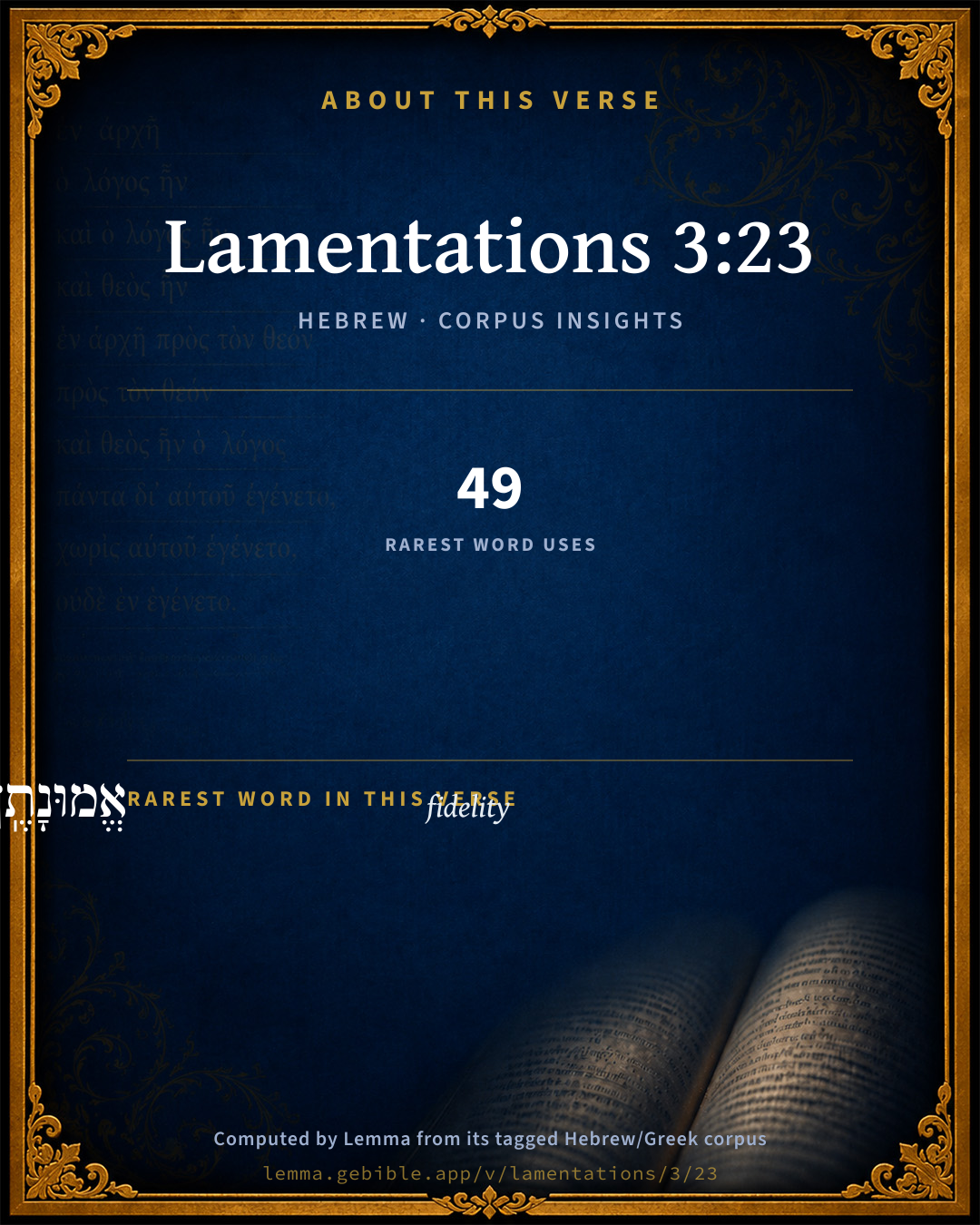
אֱמוּנָתֶֽךָ fidelity H530 occurs in 49 verses of the Hebrew Bible. Also found in:

Grammatical profile

  • 2 nouns
  • 2 adjectives

Hebrew & Septuagint length

In English translation the verse runs 9 words from the Hebrew and 9 from the Septuagint (LXX English) — the same length.

A rough comparison of the two English renderings, which tokenize alike — not a word-level alignment.

Word counts can differ between the Hebrew and the Greek without any difference in meaning — e.g. the Hebrew direct-object marker אֵת has no separate Greek word, and Greek often adds the article ὁ.

Cross-references

11

Topical passages linked to Lamentations 3:23 in the Treasury of Scripture Knowledge — connected by theme and wording, ordered by reader-vote popularity; previews shown in the World English Bible.

  • Hebrews 10:23 let us hold fast the confession of our hope unyieldingly. For he who promised is faithful.
  • Psalms 30:5 For his anger is but for a moment; His favor is for a lifetime. Weeping may stay for the night, But joy comes in the morning.
  • Isaiah 33:2 Yahweh, be gracious to us; we have waited for you: be our arm every morning, our salvation also in the time of trouble.
  • Psalms 36:5 Your loving kindness, Yahweh, is in the heavens. Your faithfulness reaches to the skies.
  • Psalms 89:33 But I will not completely take my loving kindness from him, Nor allow my faithfulness to fail.
  • Zephaniah 3:5 Yahweh, in the midst of her, is righteous. He will do no wrong. Every morning he brings his justice to light. He doesn't fail, but the unjust know no shame.
  • Exodus 34:6 Yahweh passed by before him, and proclaimed, "Yahweh! Yahweh, a merciful and gracious God, slow to anger, and abundant in loving kindness and truth,
  • Psalms 146:6 Who made heaven and earth, The sea, and all that is in them; Who keeps truth forever;
  • Hebrews 6:18 that by two immutable things, in which it is impossible for God to lie, we may have a strong encouragement, who have fled for refuge to take hold of the hope set before us.
  • Titus 1:2 in hope of eternal life, which God, who can't lie, promised before eternal times;
  • Psalms 89:1–2 I will sing of the loving kindness of Yahweh forever. With my mouth, I will make known your faithfulness to all generations.

Cross-references courtesy of OpenBible.info (CC BY 4.0).

Hebrew and Greek witnesses Masoretic Hebrew ↔ Greek Septuagint

The same verse in the two great witnesses to the Old Testament, shown verse-for-verse.

These are two independent witnesses, not word-aligned to each other, and the Septuagint is shown in lemma (dictionary) form.

Hebrew Lamentations 3:23 Masoretic · Westminster Leningrad Codex

חֲדָשִׁים֙ לַבְּקָרִ֔ים רַבָּ֖ה אֱמוּנָתֶֽךָ

They are new every morning; great is your faithfulness.

World English Bible · Public Domain

Greek LXX Lamentations 3:23 Septuagint · lemma form
They are new every morning: great is your faithfulness.

LXX2012 (modern English Septuagint) · Public Domain

Hebrew: Westminster Leningrad Codex (CC BY 4.0). Greek: Septuagint (public domain); English from LXX2012 (modern English Septuagint) (Public Domain). How the Septuagint differs from the Hebrew →

Commentary

Notes on Lamentations 3:23 from classic Christian and Jewish commentators (each source and its license shown beneath its notes). The classic Christian expositions comment on the surrounding passage and are grouped to its opening verse, so a note may address several verses; the Jewish commentaries on the Tanakh (Rashi and others) are per-verse, so they appear only where the commentator wrote on this verse.

Lemma curates 59 commentaries, every one of them public domain or Creative Commons licensed, each selected and text-cleaned for this edition rather than reprinted as found. About our sources →

Trapp's Complete Commentary

John Trapp

Lam 3:23 [They are] new every morning: great [is] thy faithfulness.

Ver. 23. They are new every morning.] Yea, every moment. We have continual experiments.

Great is thy faithfulness.] God’s mercy moved him to promise; his truth to perform. See 2Sa 7:18; 2Sa 7:21. {See Trapp on "2Sa 7:18"} {See Trapp on "2Sa 7:21"}

John Trapp, A Commentary or Exposition upon All the Books of the Old and New Testament (1647–1656) — public domain. Text from a community e-Sword module.

Tyndale Open Study Notes

Tyndale Open Resources

3:23 God’s faithfulness speaks of his absolute reliability, which is evident in his daily mercies. He continually provides a habitable world in which we can live.

Tyndale Open Study Notes — © Tyndale Open Resources, licensed CC BY-SA 4.0. Text via the HelloAO Bible API.

Geneva Bible (1599)

Geneva Bible translators

We feel thy benefits daily.

Geneva Bible (1599) marginal notes — public domain. Text via Bolls.life.

Jamieson, Fausset & Brown

Robert Jamieson, A. R. Fausset & David Brown

(Isa 33:2).

Jamieson, Fausset & Brown — Commentary Critical and Explanatory on the Whole Bible (1871) — public domain (CC PDM 1.0). Text via the HelloAO Bible API.

Adam Clarke's Commentary

Verse 23. They are new every morning] Day and night proclaim the mercy and compassion of God. Who could exist throughout the day, if there were not a continual superintending Providence? Who could be preserved in the night, if the Watchman of Israel ever slumbered or slept?

Adam Clarke's Commentary on the Bible (1810–1826) — public domain. Text from a community e-Sword/MySword module.

John Calvin's Commentaries

This verse confirms what I have said, that the same truth is here repeated by the Prophet, that God’s mercies were not consumed, nor had his compassion’s failed. How so? Because they were new, or renewed, every day; but he puts morning, and that in the plural number. I am surprised at the hour striking so soon; I hardly think that I have lectured a whole hour.

John Calvin's Commentaries (1540-1563) — public domain. Text from the Calvin Translation Society English edition (1840s-50s) via the Christian Classics Ethereal Library (ccel.org). Calvin's coverage is partial (roughly two-thirds of the Bible); uncommented books and verses are honest gaps, never fabricated. The 19th-century editor's footnotes and remarks are omitted so the notes are faithfully Calvin's own voice.

Ellicott's Commentary for English Readers

(23) They are new.—The subject of the sentence is found in the “compassions” of the preceding verse. With the dawn of every day there dawn also the mercies of Jehovah.

A Bible Commentary for English Readers, edited by Charles John Ellicott (1878–1897) — public domain. Text from a community e-Sword module.

John Gill's Exposition

They are new every morning,.... That is, the tender mercies or compassions of God are, which prove that they fail not; there are instances of them every day, not only in a temporal, but in a spiritual sense; they are ever new, always fresh and vigorous, constant and perpetual; such are the love, grace, and mercy of God, though of old, yet daily renewed in the manifestations thereof; and which make a morning of spiritual light, joy, and comfort; and whenever it is morning with the saints, they have new discoveries of the love of God to them; and these indeed are a bright morning to them, a morning without clouds;

great is thy faithfulness; some render it "thy faith concerning thee" (y); this is a great grace, it is the gift of God, the operation of his Spirit, and to exercise it is a great thing; to this purpose is Jarchi's note,

"great is thy promise, and a great thing it is to believe in thee, that it shall be performed, and that thou wilt observe or keep what thou hast promised to us;''

but the attribute of God's faithfulness is rather meant; which is another reason why the people of God are not consumed, since that never fails; God is faithful to himself, and cannot deny himself; he is faithful to his counsels and purposes, which shall be truly accomplished; and to his covenant and promises, which shall be fulfilled; and to his Son, the surety and Saviour of his people.

(y) "fides tua", V. L. Montanus, Junius & Tremellius, Piscator; "fides quae est de te", Pagninus.

John Gill's Exposition of the Whole Bible (1746–1763) — public domain (CC PDM 1.0). Text via the HelloAO Bible API.

Haydock's Catholic Bible Commentary

New. Novi should be novæ, to agree with miserationes. (Calmet) --- Chaldean, "new miracles" occur daily. (Haydock) --- God’s mercies are ever fresh. (Worthington)

George Leo Haydock (1774–1849), Haydock's Catholic Family Bible and Commentary, 1859 edition — public domain. Excludes Psalms (Douay-Rheims chapter numbering differs from Protestant) and Deuterocanonical books (Catholic canon only).

Matthew Poole's English Annotations

These compassions of God are renewed day by day, to declare the great faithfulness of God in fulfilling his many promises made for mercy to his people.

Matthew Poole's English Annotations on the Holy Bible (1683–1685) — public domain. Text from a community e-Sword/MySword module.

Whedon's Commentary on the Bible

Daniel D. Whedon

23. New every morning — That is, Jehovah’s mercies are “new,” or repeated.

Daniel D. Whedon (gen. ed.), Commentary on the Old and New Testaments (1874–1909) — public domain. Text from a community e-Sword module.

The Pulpit Commentary

"New every morning.

Human life abounds in novelties. It is made up of experiences which combine novelty and repetition. But the mercies of the Eternal are ever new; no day breaks which does not open up some new prospect of Divine faithfulness and loving kindness towards the children of men.

I THE SAME MERCIES ARE REPEATED AFRESH. Because a gift of God resembles a previous gift, it does not, therefore, fail in being a new proof of Divine beneficence and favour. The most necessary blessings are those which are most frequently bestowed, and are those which we are most likely to receive without attention and to undervalue.

II NEW MERCIES ARE CONSTANTLY BESTOWED. The successive stages of our earthly pilgrimage reveal fresh wants, call for fresh supplies from the bounty and benevolence of our God anal Father. With new needs come new favours. Varying duties, fresh relationships, and changing circumstances are the occasion of ever renewed manifestations Of Divine goodness. And our repeated errors and infirmities are the occasion of new manifestations of Divine forbearance and forgiveness.

III NEW CLAIMS ARE THUS ESTABLISHED UPON HUMAN CONSECRATION AND OBEDIENCE. If a human benefactor who has upon some one important occasion come to our assistance deserves lifelong gratitude, how can the claims of God be justly conceived and practically acknowledged, seeing that the hours of every day are laden with his favours? If a motive is needed to a new life, a life of devotion and holy service, where can a more powerful motive be found than here? Often as we have partaken of Divine goodness, often as we have enjoyed the assurance of Divine forgiveness, we are called upon by the favours which are new every morning to renewed devotion of ourselves to the God of all grace and forgiveness.

IV NEW OCCASIONS ARE THUS AFFORDED FOR RENEWED PRAISES AND THANKSGIVINGS. With every new morning nature offers a new tribute of praise to Heaven. Shall man alone be silent and ungrateful? Shall the Christian, who is the chosen recipient of Divine favours, be slow to acknowledge their heavenly source, to praise the heavenly Giver? "New mercies each returning day" etc. T.

The Pulpit Commentary (1880–1919), ed. H.D.M. Spence-Jones & Joseph S. Exell — public domain. Text from a community e-Sword module.

John Wesley's Explanatory Notes

Faithfulness - In fulfilling thy promises to thy people.

John Wesley, Explanatory Notes Upon the Whole Bible (1754–1765) — public domain. Text via the GEBible commentary corpus.

Rashi

Rabbi Shlomo Yitzchaki (Rashi)

They are new every morning Your kindnesses are renewed from day to day.

great is Your faithfulness Your promise is great, and it is a great thing to believe in You that You will fulfill and keep what You promised us.

Rashi on the Tanakh — English translations: “The Judaica Press complete Tanach with Rashi, translated by A. J. Rosenberg” (CC BY 4.0); “Pentateuch with Rashi's commentary by M. Rosenbaum and A.M. Silbermann, 1929-1934” (public domain); “The Metsudah Tanach series, Lakewood, N.J” (CC BY 4.0); and “The Book of Joshua, Metsudah Publications, 1997” (CC BY 4.0). Text via Sefaria.

Lesson kit

Teaching starters — assembled from the data on this page, not authored interpretation. Every prompt links to the verse data it draws on. Edit before teaching.

Lamentations, in the Prophets, opens this verse with 4 words (4 distinct Hebrew lemmas). Its most distinctive word is ʼĕmûwnâh (“fidelity”). A historical commentator’s framing appears above. Read the whole chapter for the surrounding context.

Discussion questions

  1. How does “fidelity” (ʼĕmûwnâh) shape what this verse is saying?
  2. How does Exodus 17:12, which shares the word «fidelity», read alongside this verse?
  3. These translations render this verse differently; the difference is in the English rendering, not the original. What questions does that raise?
  4. Compare how Trapp's Complete Commentary and Tyndale Open Study Notes read this verse. Where do they agree or differ?

Things to notice

Reading settings

Reading text

Shown beneath each verse's original-language words.

Old Testament
Old Testament edition

Read the OT as the Masoretic Hebrew (MT) or the Greek Septuagint (LXX).

English shown for the Greek Septuagint (in the Hebrew ↔ Greek comparison).

Comparing translations? Open the Compare panel on any verse page to stack up to four side by side.