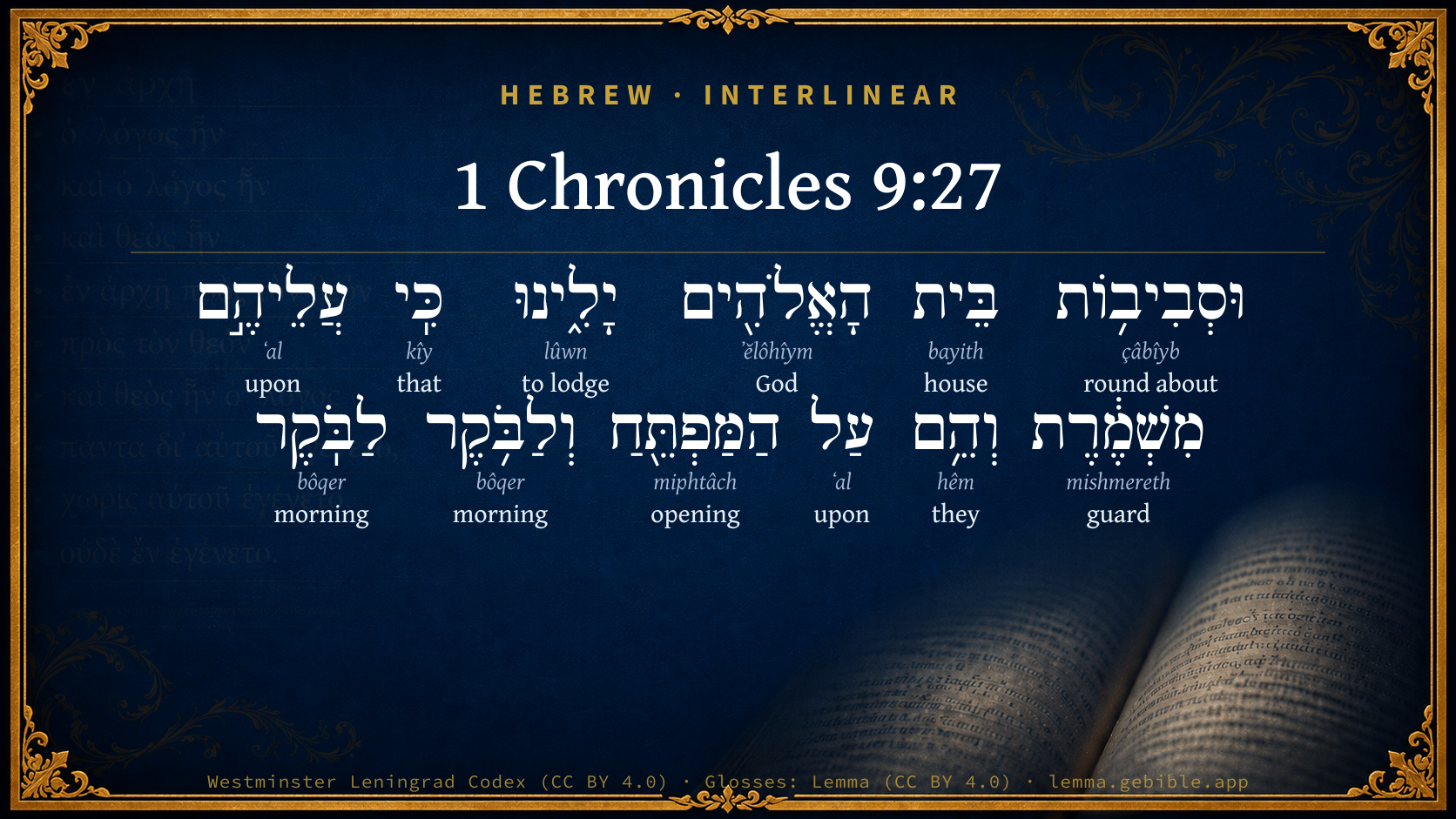
1 Chronicles 9:27

Hebrew (Westminster Leningrad Codex) 1 Chronicles 9:27 appears in the Hebrew Old Testament. The text above is from the Westminster Leningrad Codex. Each word links to its Strong’s number, a concise gloss, and parsing drawn from the Open Scriptures Hebrew Bible morphology. Click any word for its full Brown-Driver-Briggs (BDB) entry.
Download image
Cite this verse

1 Chronicles 9:27 (World English Bible). Public Domain. Lemma interlinear Bible study tool, https://lemma.gebible.app/v/1-chronicles/9/27.

Show BibTeX & RIS
BibTeX
RIS
English Translation
They lodged round about the house of God, because the charge [of it] was on them; and to them pertained the opening of it morning by morning.
World English Bible · Public Domain
Highlights
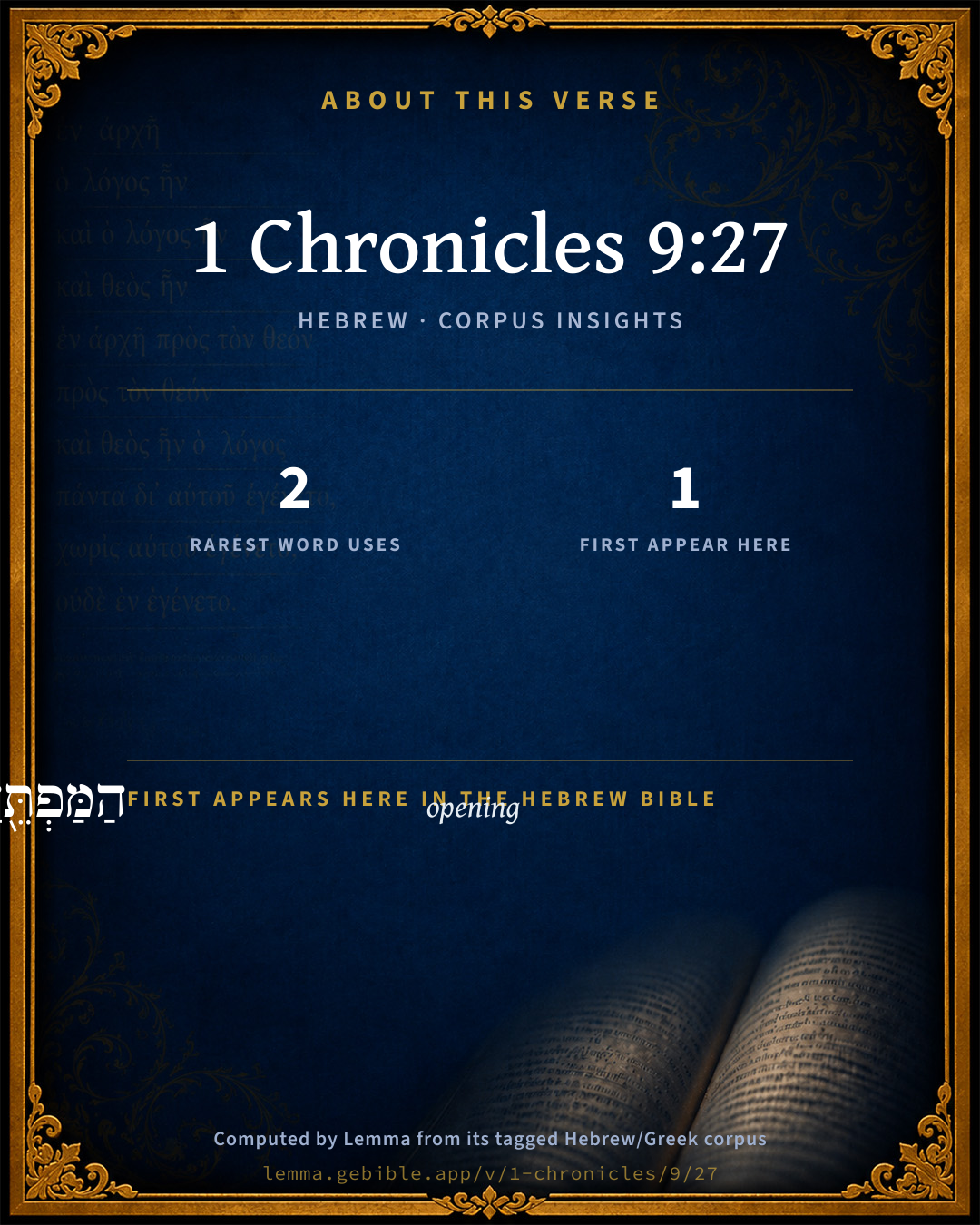
  • 1 first appearance in the Hebrew Bible
Full analysis ↓
Download a study sheet

One document with this verse’s original text, its word-by-word gloss line, the meaning frame, cross-references with their text, attributed commentary, and full source and license credits — printable, and it pastes into notes with its structure intact.

This verse Autodidact and up

Study sheet (.html) Plain text (.txt)

A passage Seminary Student

Up to 50 verses in one chapter. A passage sheet keeps up to 6 commentary sources and 12 cross-references per verse, in the order this page ranks them, and says so on the sheet whenever that leaves anything out. Ask for a single verse and you get the Autodidact verse sheet above.

Everything on this page stays free to read, with no account — the sheet is a download of what is already on screen, not access to it.

Want to remove ads? Support Godless Engineer
Compare translations 3

The same verse in 3 English versions, stacked beneath the original-language interlinear above. Click any original word for its lexicon entry.

Each is an independent rendering of the whole verse — the interlinear is not word-aligned to these translations.

Highlighted words mark where these versions differ — a whole-verse word diff, not a word-by-word alignment.

  • World English Bible Public Domain
    They lodged round about the house of God, because the charge [of it] was on them; and to them pertained the opening of it morning by morning.
  • King James Version Public Domain
    And they lodged round about the house of God, because the charge was upon them, and the opening thereof every morning pertained to them.
  • unfoldingWord Literal Text CC BY-SA 4.0
    And they lodged around the house of God, for the watch upon them. And they over the opening, and to morning, to morning.

unfoldingWord Literal Text — © unfoldingWord, licensed CC BY-SA 4.0. Word-aligned USFM3 via Door43 (git.door43.org/unfoldingWord/en_ult).

Versions to compare (up to 4)

3 of 4 selected

Show all 18 translations

Every available English version of this verse, each an independent rendering of the whole verse.

  • World English Bible Public Domain
    They lodged round about the house of God, because the charge [of it] was on them; and to them pertained the opening of it morning by morning.
  • Berean Standard Bible Public Domain
    They would spend the night stationed around the house of God, because they were responsible for guarding it and opening it every morning.
  • Majority Standard Bible Public Domain
    They would spend the night stationed around the house of God, because they were responsible for guarding it and opening it every morning.
  • King James Version Public Domain
    And they lodged round about the house of God, because the charge was upon them, and the opening thereof every morning pertained to them.
  • American Standard Version (1901) Public Domain
    And they lodged round about the house of God, because the charge `thereof' was upon them; and to them pertained the opening thereof morning by morning.
  • Revised Version (1885) Public Domain
    And they lodged round about the house of God, because the charge thereof was upon them, and to them pertained the opening thereof morning by morning.
  • Geneva Bible (1599) Public Domain
    And they lay rounde about the house of God, because the charge was theirs, and they caused it to be opened euery morning.
  • Douay-Rheims (1899) Public Domain
    And they abode in their watches round about the temple of the Lord: that when it was time, they might open the gates in the morning.
  • Young's Literal Translation Public Domain
    and round about the house of God they lodge, for on them `is' the watch, and they `are' over the opening, even morning by morning.
  • Literal Standard Version CC BY-SA 4.0
    and they lodge around the house of God, for the watch [is] on them, and they [are] over the opening, even morning by morning.
  • Unlocked Literal Bible CC BY-SA 4.0
    They would spend the night in their posts all around the house of God, for they were responsible for guarding it. They would open it each morning.
  • unfoldingWord Literal Text CC BY-SA 4.0
    And they lodged around the house of God, for the watch upon them. And they over the opening, and to morning, to morning.
  • Darby Bible Public Domain
    for they stayed round about the house of God during the night, because the charge was upon them, and the opening thereof every morning [pertained] to them.
  • World Messianic Bible Public Domain
    They stayed around God’s house, because that was their duty; and it was their duty to open it morning by morning.
  • Webster's Bible Public Domain
    And they lodged about the house of God, because the charge was upon them, and the opening of it every morning pertained to them.
  • Free Bible Version CC BY-SA 4.0
    They spent the night around the house of God because they had to guard it and they had the key to unlock it in the morning.
  • Bible in Basic English Public Domain
    Their sleeping-rooms were round the house of God, for they had the care of it, and were responsible for opening it morning by morning.
  • JPS Tanakh (1917) Public Domain
    And they lodged round about the house of God, because the charge thereof was upon them, and to them pertained the opening thereof morning by morning.

Literal Standard Version (2020), Covenant Press — licensed CC BY-SA 4.0. Text via the HelloAO Bible API (eBible.org). Unlocked Literal Bible (unfoldingWord) — licensed CC BY-SA 4.0. Text via the HelloAO Bible API (eBible.org). unfoldingWord Literal Text — © unfoldingWord, licensed CC BY-SA 4.0. Word-aligned USFM3 via Door43 (git.door43.org/unfoldingWord/en_ult). Free Bible Version, Dr. Jonathan Gallagher — licensed CC BY-SA 4.0. Text via the HelloAO Bible API (eBible.org).

Word by word

More ways to search: Search by grammar → Find every occurrence → Compare this word →

Practice this passage: Drill this verse → Learn its vocabulary →

הַמַּפְתֵּ֖חַ
miphtâch
H4669
“the · opening”
Particle, Definite Article + Noun, Common, Masculine, Singular, Absolute
Part of Speech
Particle + Noun
Type
Common
Gender
Masculine
Number
Singular
State
Absolute
Full BDB Definition

Origin: from H6605

TWOT: 1854e

opening, utterance
  1. וּסְבִיב֥וֹת çâbîyb H5439 “and · surroundings of” Conjunction + Noun, Common, Both, Plural, Construct
  2. בֵּית bayith H1004 “house of” Noun, Common, Masculine, Singular, Construct
  3. הָאֱלֹהִ֖ים ʼĕlôhîym H430 “the · God(s)” Particle, Definite Article + Noun, Common, Masculine, Plural, Absolute
  4. יָלִ֑ינוּ lûwn H3885 “to lodge” Verb, Qal, Imperfect, 3rd Person, Masculine, Plural
  5. כִּֽי kîy H3588 “that” Conjunction
  6. עֲלֵיהֶ֣ם ʻal H5921 “upon · them” Preposition + Suffix, Personal, 3rd Person, Masculine, Plural
  7. מִשְׁמֶ֔רֶת mishmereth H4931 “guard” Noun, Common, Feminine, Singular, Absolute
  8. וְהֵ֥ם hêm H1992 “and · they” Conjunction + Pronoun, Personal, 3rd Person, Masculine, Plural
  9. עַל ʻal H5921 “upon” Preposition
  10. וְלַבֹּ֥קֶר bôqer H1242 “and · to/for the · morning” Conjunction + Preposition, Determined + Noun, Common, Masculine, Singular, Absolute
  11. לַבֹּֽקֶר bôqer H1242 “to/for the · morning” Preposition, Determined + Noun, Common, Masculine, Singular, Absolute

About this verse

These counts appear in no published source. They are computed here, from the morphology-tagged text and Lemma’s own curated glosses. What Lemma adds →

12
words
10
distinct lemmas
Historical
section

Notable vocabulary

The rarest word here is הַמַּפְתֵּ֖חַ opening H4669 — appearing just 2 times in the whole Hebrew Bible.

First appearance in Scripture

This word makes its first canonical appearance in the Hebrew Bible here:

  • הַמַּפְתֵּ֖חַ opening H4669

Shared distinctive vocabulary

הַמַּפְתֵּ֖חַ opening H4669 occurs in 2 verses of the Hebrew Bible. Also found in:

Grammatical profile

  • 1 verb
  • 7 nouns
  • 1 pronoun
  • 2 prepositions
  • 1 conjunction

Verb forms

  • יָלִ֑ינוּ Qal · Imperfect

Repetition

Words recur within this verse — often emphatic in Hebrew:

  • עֲלֵיהֶ֣ם upon H5921 ×2
  • וְלַבֹּ֥קֶר morning H1242 ×2

Hebrew & Septuagint length

In English translation the verse runs 27 words from the Hebrew and 22 from the Septuagint (LXX English) — closely comparable.

A rough comparison of the two English renderings, which tokenize alike — not a word-level alignment.

Word counts can differ between the Hebrew and the Greek without any difference in meaning — e.g. the Hebrew direct-object marker אֵת has no separate Greek word, and Greek often adds the article ὁ.

Cross-references

4

Topical passages linked to 1 Chronicles 9:27 in the Treasury of Scripture Knowledge — connected by theme and wording, ordered by reader-vote popularity; previews shown in the World English Bible.

  • 1 Chronicles 23:30–32 and to stand every morning to thank and praise Yahweh, and likewise in the evening;
  • 1 Samuel 3:15 Samuel lay until the morning, and opened the doors of the house of Yahweh. Samuel feared to show Eli the vision.
  • Malachi 1:10 "Oh that there were one among you who would shut the doors, that you might not kindle fire on my altar in vain! I have no pleasure in you," says Yahweh of hosts, "neither will I accept an offering at your hand.
  • Romans 12:7 or service, let us give ourselves to service; or he who teaches, to his teaching;

Cross-references courtesy of OpenBible.info (CC BY 4.0).

Hebrew and Greek witnesses Masoretic Hebrew ↔ Greek Septuagint

The same verse in the two great witnesses to the Old Testament, shown verse-for-verse.

These are two independent witnesses, not word-aligned to each other, and the Septuagint is shown in lemma (dictionary) form.

Hebrew 1 Chronicles 9:27 Masoretic · Westminster Leningrad Codex

וּסְבִיב֥וֹת בֵּית הָאֱלֹהִ֖ים יָלִ֑ינוּ כִּֽי עֲלֵיהֶ֣ם מִשְׁמֶ֔רֶת וְהֵ֥ם עַל הַמַּפְתֵּ֖חַ וְלַבֹּ֥קֶר לַבֹּֽקֶר

They lodged round about the house of God, because the charge [of it] was on them; and to them pertained the opening of it morning by morning.

World English Bible · Public Domain

Greek LXX 1 Chronicles 9:27 Septuagint · lemma form

καί περικύκλῳ οἶκος ὁ θεός παρα ἐνβάλλω ὅτι ἐπί αὐτός φυλακή καί οὗτος ἐπί ὁ κλείς ὁ πρωΐ πρωΐ ἀναοἴγω ὁ θύρα ὁ ἱερός

For the charge was upon them, and these were charged with the keys to open the doors of the temple every morning.

LXX2012 (modern English Septuagint) · Public Domain

On this verse, John Gill's Exposition discusses the Septuagint’s reading. Read the note in Commentary ↓

Hebrew: Westminster Leningrad Codex (CC BY 4.0). Greek: Septuagint (public domain); English from LXX2012 (modern English Septuagint) (Public Domain). How the Septuagint differs from the Hebrew →

Commentary

Notes on 1 Chronicles 9:27 from classic Christian and Jewish commentators (each source and its license shown beneath its notes). The classic Christian expositions comment on the surrounding passage and are grouped to its opening verse, so a note may address several verses; the Jewish commentaries on the Tanakh (Rashi and others) are per-verse, so they appear only where the commentator wrote on this verse.

Lemma curates 59 commentaries, every one of them public domain or Creative Commons licensed, each selected and text-cleaned for this edition rather than reprinted as found. About our sources →

The Biblical Illustrator

Joseph S. Exell

1Ch_9:27

And they lodged round about the house of God, because the charge was upon them, and the opening thereof every morning pertained to them

The dominence of duty

I.

As to recognising the imperativeness of duty. The charge was upon them. Duty was the absolute and dominant thing to these gate-keepers. So should it be with us. Duty grows out of the relations in which we are placed.

1. Some of these relations are toward God. God puts us where we are.

2. Some of these relations, as with the Levite gate-keepers, are towards Gods house. The charge is upon us as Church-members to attend upon, give to, and work for the advancement of the Church to which we belong.

3. Some of these relations are toward our fellow-men. Israel depended on these Levites for certain service. Our family, Church, city, State, nation--all have claims upon us for duty.

II. Concerning the importance of adjusting ones life so as to be able to do duty. These Levites lodged round about the house of God. That is, they so adjusted their arrangements of living that they could do the duty that devolved upon them. They planned for it, provided for its certain accomplishment.

III. As to some of the ways in which duty is presented to us.

1. In ways of permanent obligation. In the case of these Levites we are told that the work pertained to them. It was a permanent thing, of unchanging obligation. One of the best ways for us to recognise the dominance of duty is by faithfulness in connection with those possibly prosaic, but unchanging and permanent, duties that pertain to us.

2. Others come in the way of regular recurrence. The opening thereof every morning pertained to them. Most of our duties are of this everyday, regular, recurring kind.

3. Duty is presented to us oftentimes in things apparently trivial Theirs was the opening and shutting of the gates: Not apparently a great thing; but it had as close and vital a relation to character as if it had seen great, As they did their work, lowly though it seemed, well or ill, they were morally well or ill. To most of us the work God gives does not seem great. But little things can be greatly done. By doing little things faithfully many a life has been made great. (G. B. F. Halleck, D. D.)

The Biblical Illustrator, edited by Joseph S. Exell (c. 1880s–1900s) — public domain. Text from a community e-Sword module.

The Cambridge Bible for Schools and Colleges

gen. ed. J. J. S. Perowne

27. because … to them] R.V. because the charge thereof was upon them, and to them pertained the opening thereof morning by morning. The reference is to the four “chief porters” (1Ch_9:26).

The Cambridge Bible for Schools and Colleges (gen. ed. J. J. S. Perowne; Cambridge University Press, 1878–1918) — public domain. Text from a community e-Sword module.

John Gill's Exposition

And some of the sons of the priests made the ointment of the spices. For though the Levites had the care of the spices, they might not make the ointment with them, only the priests, see Exo 30:23.

.

1 Chronicles 9:31

ch1 9:31

ch1 9:31

ch1 9:31And Mattithiah, one of the Levites, who was the firstborn of Shallum the Korahite,.... Of whom see Ch1 9:19,

had the set office over the things that were made in the pans; the meat offerings that were made in pans; and so had the care of the fine flour, oil, and frankincense used in them, which he delivered to the priests when necessary, see Lev 2:5, the Septuagint version is,"over the works of the sacrifice of the pan of the high priest;''as if it respected peculiarly his meat offering, Lev 6:20, we read in the Misnah (y) of the offerings of the high priest, as expressed by this word, which it signifies, and not pans, but what was fried in them (z); and Ben Melech on the place says, this man was an high priest who offered every day the tenth part of an ephah in a pan, half of it in the morning, and half of it in the evening, according to Lev 6:20, but that cannot be, for certain it is he was a Levite, as the text expresses it.

(y) Menachot, c. 11. sect. 3. & Tamid, c. 1. sect. 3. (z) Vid. Sheringham. in Misn. Yoma, c. 2. sect. 3. p. 16.

John Gill's Exposition of the Whole Bible (1746–1763) — public domain (CC PDM 1.0). Text via the HelloAO Bible API.

Matthew Poole's English Annotations

They lodged round about the house of God; therefore they were obliged to constant residence in the place; and were not permitted to dwell in the villages, as their brethren were.

Matthew Poole's English Annotations on the Holy Bible (1683–1685) — public domain. Text from a community e-Sword/MySword module.

Keil & Delitzsch

C. F. Keil & F. Delitzsch

And some of the sons of the priests made the ointment of the spices. For though the Levites had the care of the spices, they might not make the ointment with them, only the priests, see Exo 30:23.

.

1 Chronicles 9:31

ch1 9:31

ch1 9:31

ch1 9:31And Mattithiah, one of the Levites, who was the firstborn of Shallum the Korahite,.... Of whom see Ch1 9:19,

had the set office over the things that were made in the pans; the meat offerings that were made in pans; and so had the care of the fine flour, oil, and frankincense used in them, which he delivered to the priests when necessary, see Lev 2:5, the Septuagint version is,"over the works of the sacrifice of the pan of the high priest;''as if it respected peculiarly his meat offering, Lev 6:20, we read in the Misnah (y) of the offerings of the high priest, as expressed by this word, which it signifies, and not pans, but what was fried in them (z); and Ben Melech on the place says, this man was an high priest who offered every day the tenth part of an ephah in a pan, half of it in the morning, and half of it in the evening, according to Lev 6:20, but that cannot be, for certain it is he was a Levite, as the text expresses it.

(y) Menachot, c. 11. sect. 3. & Tamid, c. 1. sect. 3. (z) Vid. Sheringham. in Misn. Yoma, c. 2. sect. 3. p. 16.

Keil & Delitzsch — Biblical Commentary on the Old Testament (1861–1891) — public domain (CC PDM 1.0). Text via the HelloAO Bible API. (Old Testament only.)

Kretzmann's Popular Commentary

Paul E. Kretzmann

The Charge of the Levites

v. 27. And they, the Levites in general, lodged round about the house of God, because the charge was upon them, and the opening thereof every morning pertained to them, the large gates had to be opened every morning at a specified time.

v. 28. And certain of them had the charge of the ministering vessels, they were responsible for the precious vessels used for the sacrifices, that they should bring them in and out by tale, for of everything in the Temple treasuries a careful count was kept.

v. 29. Some of them also were appointed to oversee the vessels, and all the instruments of the Sanctuary, all those used in the ordinary daily offerings, and the fine flour, and the wine, and the oil, and the frankincense, and the spices, all the materials used for incense, for meat and drink-offerings.

v. 30. And some of the sons of the priests made the ointment of the spices, a precious and singular oil, used exclusively for sacred purposes.

v. 31. And Mattithiah, one of the Levites, who was the first-born of Shallum the Korahite, had the set office over the things that were made in the pans, literally, "was in trust over the baking in pans," Lev 2:5; Lev 6:14.

v. 32. And other of their brethren, of the sons of the Kohathites, were over the showbread, to prepare it every Sabbath, Lev 24:6-8. So the entire worship was once more organized in line with the institution of the Lord.

v. 33. And these are the singers, chief of the fathers of the Levites, who, remaining in the chambers, were free, they were exclusively engaged in the liturgical part of the services and were therefore excused from other work; for they were employed in that work day and night; when not actually engaged in public worship, they were busy practising the difficult liturgical melodies.

v. 34. These chief fathers of the Levites, heads of the father-houses among the Levites, were chief throughout their generations; these dwelt at Jerusalem. The genealogy of Saul is here repeated, as an introduction to the historical section of the book, which opens with an account of the fall of Saul’s house.

v. 35. And in Gibeon dwelt the father of Gibeon, Jehiel, whose wife’s name was Maachah;

v. 36. and his firstborn son Abdon, then Zur, and Kish, and Baal, and Ner, and Nadab,

v. 37. and Gedor, and Ahio, and Zechariah, and Mikloth.

v. 38. And Mikloth begat Shimeam. And they also dwelt with their brethren at Jerusalem, over against their brethren.

v. 39. And Ner begat Kish; and Kish begat Saul; and Saul begat Jonathan, and Malchi-shua, and Abinadab, and Esh-baal.

v. 40. And the son of Jonathan was Meribbaal; and Merib-baal begat Micah.

v. 41. And the sons of Micah were Pithon, and Melech, and Tahrea, and Ahaz.

v. 42. And Ahaz begat Jarah; and Jarah begat Alemeth, and Azmaveth, and Zimri; and Zimri begat Moza;

v. 43. and Moza begat Binea; and Rephaiah, his son, Eleasah, his son, Azel, his son.

v. 44. And Azel had six sons, whose names are these: Azrikam, Bocheru, and Ishmael, and Sheariah, and Obadiah, and Hanan; these were the sons of Azel. Cf 1Ch 8:28-38.

Paul E. Kretzmann, Popular Commentary of the Bible (1921–1924) — public domain. Text from a community e-Sword module.

Rashi

Rabbi Shlomo Yitzchaki (Rashi)

and they were [appointed] over the key[s] over the key[s] of the forecourt.

and every morning to open.

Rashi on the Tanakh — English translations: “The Judaica Press complete Tanach with Rashi, translated by A. J. Rosenberg” (CC BY 4.0); “Pentateuch with Rashi's commentary by M. Rosenbaum and A.M. Silbermann, 1929-1934” (public domain); “The Metsudah Tanach series, Lakewood, N.J” (CC BY 4.0); and “The Book of Joshua, Metsudah Publications, 1997” (CC BY 4.0). Text via Sefaria.

Lesson kit

Teaching starters — assembled from the data on this page, not authored interpretation. Every prompt links to the verse data it draws on. Edit before teaching.

1 Chronicles, in the Historical, opens this verse with 12 words (10 distinct Hebrew lemmas). Its most distinctive word is miphtâch (“opening”). A historical commentator’s framing appears above. Read the whole chapter for the surrounding context.

Discussion questions

  1. How does “opening” (miphtâch) shape what this verse is saying?
  2. This is the first place “opening” appears in Scripture (first appears here). What does its debut here establish?
  3. How does Proverbs 8:6, which shares the word «opening», read alongside this verse?
  4. What does the repetition of “upon” (2× in this one verse) do in this verse?
  5. The translations on this page render this verse differently — a whole-verse word diff, not a word-by-word alignment. What might account for the different wordings?
  6. «יָלִ֑ינוּ» is a Qal Imperfect verb. How does that grammatical form shape the action described?
  7. Compare how The Biblical Illustrator and The Cambridge Bible for Schools and Colleges read this verse. Where do they agree or differ?

Things to notice

  • 1 word makes its first canonical appearance in Scripture here.
  • These translations choose different wording for 11 words in this verse.
  • “upon” occurs 2× in this single verse.
  • 10 distinct Hebrew lemmas span 12 words in this verse.

Reading settings

Reading text

Shown beneath each verse's original-language words.

Old Testament
Old Testament edition

Read the OT as the Masoretic Hebrew (MT) or the Greek Septuagint (LXX).

English shown for the Greek Septuagint (in the Hebrew ↔ Greek comparison).

Comparing translations? Open the Compare panel on any verse page to stack up to four side by side.