
Exodus 7:15

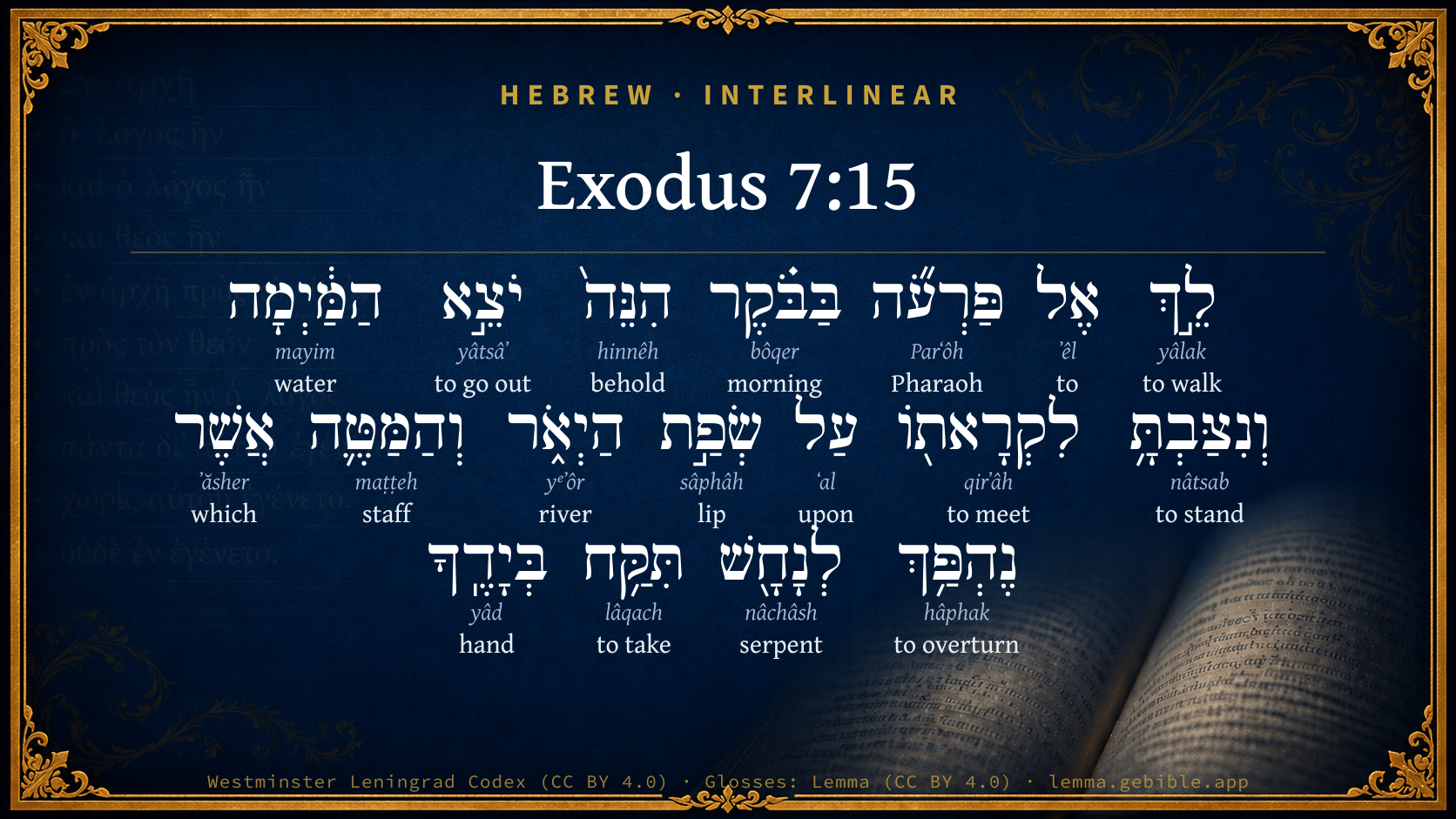
Hebrew (Westminster Leningrad Codex) Exodus 7:15 appears in the Hebrew Old Testament. The text above is from the Westminster Leningrad Codex. Each word links to its Strong’s number, a concise gloss, and parsing drawn from the Open Scriptures Hebrew Bible morphology. Click any word for its full Brown-Driver-Briggs (BDB) entry.
Download image
Cite this verse

Exodus 7:15 (World English Bible). Public Domain. Lemma interlinear Bible study tool, https://lemma.gebible.app/v/exodus/7/15.

Show BibTeX & RIS
BibTeX
RIS
English Translation
Go to Pharaoh in the morning. Behold, he goes out to the water; and you shall stand by the river's bank to meet him; and the rod which was turned to a serpent you shall take in your hand.
World English Bible · Public Domain
Download a study sheet

One document with this verse’s original text, its word-by-word gloss line, the meaning frame, cross-references with their text, attributed commentary, and full source and license credits — printable, and it pastes into notes with its structure intact.

This verse Autodidact and up

Study sheet (.html) Plain text (.txt)

A passage Seminary Student

Up to 50 verses in one chapter. A passage sheet keeps up to 6 commentary sources and 12 cross-references per verse, in the order this page ranks them, and says so on the sheet whenever that leaves anything out. Ask for a single verse and you get the Autodidact verse sheet above.

Everything on this page stays free to read, with no account — the sheet is a download of what is already on screen, not access to it.

Want to remove ads? Support Godless Engineer
Compare translations 3

The same verse in 3 English versions, stacked beneath the original-language interlinear above. Click any original word for its lexicon entry.

Each is an independent rendering of the whole verse — the interlinear is not word-aligned to these translations.

Highlighted words mark where these versions differ — a whole-verse word diff, not a word-by-word alignment.

  • World English Bible Public Domain
    Go to Pharaoh in the morning. Behold, he goes out to the water; and you shall stand by the river's bank to meet him; and the rod which was turned to a serpent you shall take in your hand.
  • King James Version Public Domain
    Get thee unto Pharaoh in the morning; lo, he goeth out unto the water; and thou shalt stand by the river's brink against he come; and the rod which was turned to a serpent shalt thou take in thine hand.
  • unfoldingWord Literal Text CC BY-SA 4.0
    Go to Pharaoh. Behold, in the morning he goes out to the water, so station yourself to meet him on the edge of the river. And take in your hand the staff that turned into a snake.

unfoldingWord Literal Text — © unfoldingWord, licensed CC BY-SA 4.0. Word-aligned USFM3 via Door43 (git.door43.org/unfoldingWord/en_ult).

Versions to compare (up to 4)

3 of 4 selected

Show all 18 translations

Every available English version of this verse, each an independent rendering of the whole verse.

  • World English Bible Public Domain
    Go to Pharaoh in the morning. Behold, he goes out to the water; and you shall stand by the river's bank to meet him; and the rod which was turned to a serpent you shall take in your hand.
  • Berean Standard Bible Public Domain
    Go to Pharaoh in the morning as you see him walking out to the water. Wait on the bank of the Nile to meet him, and take in your hand the staff that was changed into a snake.
  • Majority Standard Bible Public Domain
    Go to Pharaoh in the morning as you see him walking out to the water. Wait on the bank of the Nile to meet him, and take in your hand the staff that was changed into a snake.
  • King James Version Public Domain
    Get thee unto Pharaoh in the morning; lo, he goeth out unto the water; and thou shalt stand by the river's brink against he come; and the rod which was turned to a serpent shalt thou take in thine hand.
  • American Standard Version (1901) Public Domain
    Get thee unto Pharaoh in the morning; lo, he goeth out unto the water; and thou shalt stand by the river's brink to meet him; and the rod which was turned to a serpent shalt thou take in thy hand.
  • Revised Version (1885) Public Domain
    Get thee unto Pharaoh in the morning; lo, he goeth out unto the water; and thou shalt stand by the river’s brink to meet him; and the rod which was turned to a serpent shalt thou take in thine hand.
  • Geneva Bible (1599) Public Domain
    Goe vnto Pharaoh in the morning, (loe, he will come forth vnto the water) and thou shalt stand and meete him by the riuers brinke, and the rod, which was turned into a serpent, shalt thou take in thine hand.
  • Douay-Rheims (1899) Public Domain
    Go to him in the morning, behold he will go out to the waters: and thou shalt stand to meet him on the bank of the river: and thou shalt take in thy hand the rod that was turned into a serpent.
  • Young's Literal Translation Public Domain
    go unto Pharaoh in the morning, lo, he is going out to the water, and thou hast stood to meet him by the edge of the River, and the rod which was turned to a serpent thou dost take in thy hand,
  • Literal Standard Version CC BY-SA 4.0
    go to Pharaoh in the morning, behold, he is going out to the water, and you have stood to meet him by the edge of the River, and the rod which was turned to a serpent you take in your hand,
  • Unlocked Literal Bible CC BY-SA 4.0
    Go to Pharaoh in the morning when he goes out to the water. Stand on the riverbank to meet him, and take in your hand the staff that had turned into a snake.
  • unfoldingWord Literal Text CC BY-SA 4.0
    Go to Pharaoh. Behold, in the morning he goes out to the water, so station yourself to meet him on the edge of the river. And take in your hand the staff that turned into a snake.
  • Darby Bible Public Domain
    Go unto Pharaoh in the morning -- behold, he will go out unto the water -- and take thy stand by the bank of the river in front of him; and take in thy hand the staff that was turned into a serpent.
  • World Messianic Bible Public Domain
    Go to Pharaoh in the morning. Behold, he is going out to the water. You shall stand by the river’s bank to meet him. You shall take the rod which was turned to a serpent in your hand.
  • Webster's Bible Public Domain
    Go to Pharaoh in the morning; lo, he goeth out to the water, and thou shalt stand by the river's brink against he cometh; and the rod which was turned to a serpent shalt thou take in thy hand.
  • Free Bible Version CC BY-SA 4.0
    So tomorrow morning go to Pharaoh as he walks down to the river. Wait to meet him on the bank of the Nile. Take with you the walking stick that turned into a snake.
  • Bible in Basic English Public Domain
    Go to Pharaoh in the morning; when he goes out to the water, you will be waiting for him by the edge of the Nile, with the rod which was turned into a snake in your hand;
  • JPS Tanakh (1917) Public Domain
    Get thee unto Pharaoh in the morning; lo, he goeth out unto the water; and thou shalt stand by the river's brink to meet him; and the rod which was turned to a serpent shalt thou take in thy hand.

Literal Standard Version (2020), Covenant Press — licensed CC BY-SA 4.0. Text via the HelloAO Bible API (eBible.org). Unlocked Literal Bible (unfoldingWord) — licensed CC BY-SA 4.0. Text via the HelloAO Bible API (eBible.org). unfoldingWord Literal Text — © unfoldingWord, licensed CC BY-SA 4.0. Word-aligned USFM3 via Door43 (git.door43.org/unfoldingWord/en_ult). Free Bible Version, Dr. Jonathan Gallagher — licensed CC BY-SA 4.0. Text via the HelloAO Bible API (eBible.org).

Word by word

More ways to search: Search by grammar → Find every occurrence → Compare this word →

Practice this passage: Drill this verse → Learn its vocabulary →

לְנָחָ֖שׁ
nâchâsh
H5175
“to/for · serpent”
Preposition + Noun, Common, Masculine, Singular, Absolute
Part of Speech
Preposition + Noun
Type
Common
Gender
Masculine
Number
Singular
State
Absolute
Full BDB Definition

Origin: from H5172

TWOT: 1347a

serpent, snake - serpent - image (of serpent) - fleeing serpent (mythological)
  1. לֵ֣ךְ yâlak H3212 “walk” Verb, Qal, Imperative, 2nd Person, Masculine, Singular
  2. אֶל ʼêl H413 “to” Preposition
  3. פַּרְעֹ֞ה Parʻôh H6547 “Pharaoh” Noun, Proper
  4. בַּבֹּ֗קֶר bôqer H1242 “in/at the · morning” Preposition, Determined + Noun, Common, Masculine, Singular, Absolute
  5. הִנֵּה֙ hinnêh H2009 “behold” Particle, Demonstrative
  6. יֹצֵ֣א yâtsâʼ H3318 “going out” Verb, Qal, Participle Active, Masculine, Singular, Absolute
  7. הַמַּ֔יְמָה mayim H4325 “the · water(s) · toward” Particle, Definite Article + Noun, Common, Masculine, Plural, Absolute + Suffix, Demonstrative
  8. וְנִצַּבְתָּ֥ nâtsab H5324 “and · to stand” Conjunction + Verb, Niphal, Sequential Perfect, 2nd Person, Masculine, Singular
  9. לִקְרָאת֖וֹ qirʼâh H7125 “to meet · him” Preposition + Verb, Qal, Infinitive Construct + Suffix, Personal, 3rd Person, Masculine, Singular
  10. עַל ʻal H5921 “upon” Preposition
  11. שְׂפַ֣ת sâphâh H8193 “lip of” Noun, Common, Feminine, Singular, Construct
  12. הַיְאֹ֑ר yᵉʼôr H2975 “the · river” Particle, Definite Article + Noun, Proper
  13. וְהַמַּטֶּ֛ה maṭṭeh H4294 “and · the · staff” Conjunction + Particle, Definite Article + Noun, Common, Masculine, Singular, Absolute
  14. אֲשֶׁר ʼăsher H834 “which” Particle, Relative
  15. נֶהְפַּ֥ךְ hâphak H2015 “to overturn” Verb, Niphal, Perfect, 3rd Person, Masculine, Singular
  16. תִּקַּ֥ח lâqach H3947 “to take” Verb, Qal, Imperfect, 2nd Person, Masculine, Singular
  17. בְּיָדֶֽךָ yâd H3027 “in/at · hand · your” Preposition + Noun, Common, Both, Singular, Construct + Suffix, Personal, 2nd Person, Masculine, Singular

About this verse

These counts appear in no published source. They are computed here, from the morphology-tagged text and Lemma’s own curated glosses. What Lemma adds →

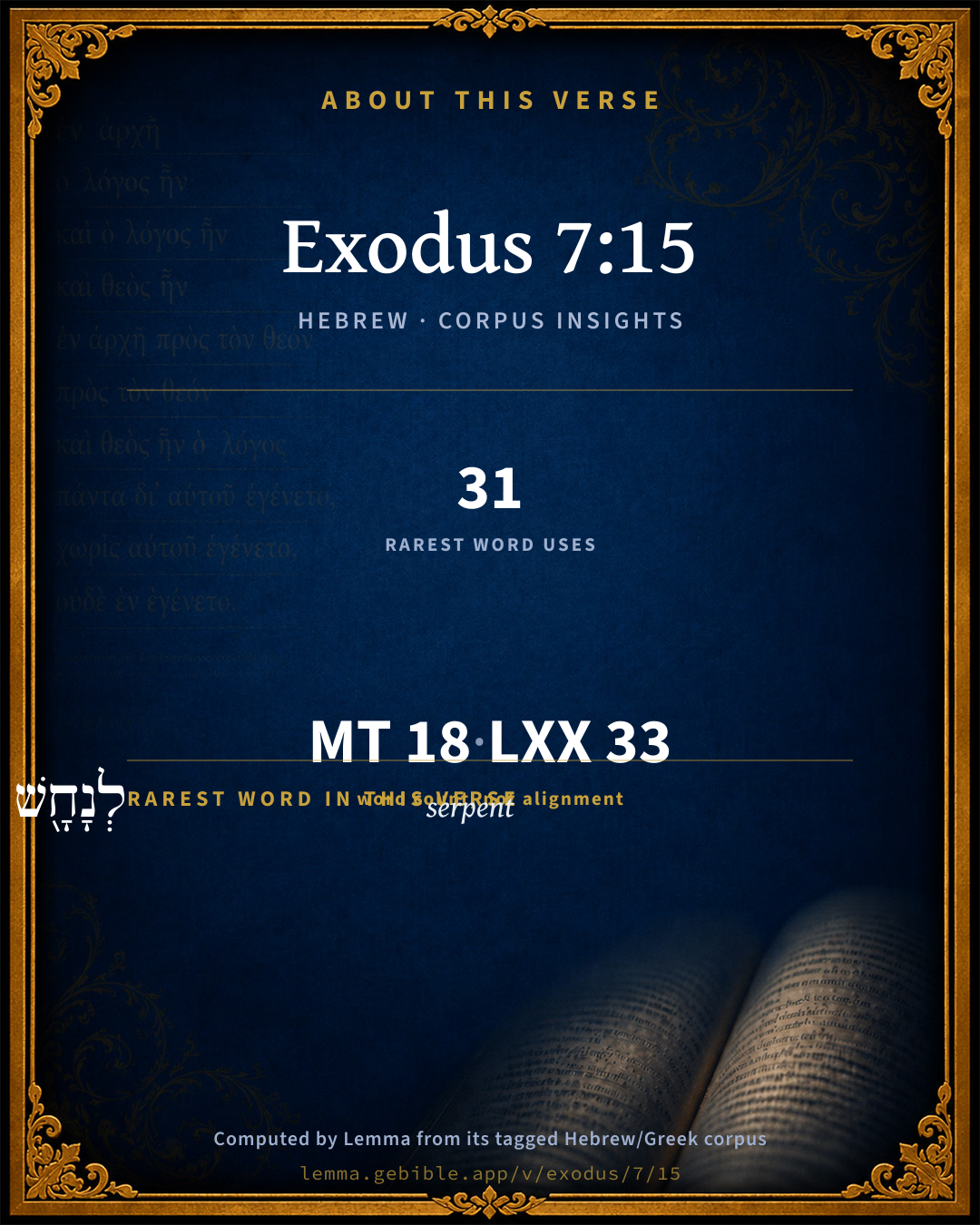
18
words
18
distinct lemmas
Pentateuch
section

Shared distinctive vocabulary

לְנָחָ֖שׁ serpent H5175 occurs in 28 verses of the Hebrew Bible. Also found in:

Grammatical profile

  • 6 verbs
  • 8 nouns
  • 2 prepositions
  • 2 particles

Verb forms

  • לֵ֣ךְ Qal · Imperative
  • יֹצֵ֣א Qal · Participle Active
  • וְנִצַּבְתָּ֥ Niphal · Sequential Perfect
  • לִקְרָאת֖וֹ Qal · Infinitive Construct
  • נֶהְפַּ֥ךְ Niphal · Perfect
  • תִּקַּ֥ח Qal · Imperfect

Hebrew & Septuagint length

In English translation the verse runs 39 words from the Hebrew and 40 from the Septuagint (LXX English) — closely comparable.

A rough comparison of the two English renderings, which tokenize alike — not a word-level alignment.

Word counts can differ between the Hebrew and the Greek without any difference in meaning — e.g. the Hebrew direct-object marker אֵת has no separate Greek word, and Greek often adds the article ὁ.

In the original languages it is 18 Hebrew tokens and 33 Greek tokens — but the two are counted differently (Hebrew bundles its prefixes and suffixes into one token; the Greek is in lemma form), so that isn’t a like-for-like length.

Cross-references

5

Topical passages linked to Exodus 7:15 in the Treasury of Scripture Knowledge — connected by theme and wording, ordered by reader-vote popularity; previews shown in the World English Bible.

  • Exodus 8:20 Yahweh said to Moses, "Rise up early in the morning, and stand before Pharaoh; behold, he comes forth to the water; and tell him, 'This is what Yahweh says, "Let my people go, that they may serve me.
  • Exodus 2:5 Pharaoh's daughter came down to bathe at the river. Her maidens walked along by the riverside. She saw the basket among the reeds, and sent her handmaid to get it.
  • Exodus 7:10 Moses and Aaron went in to Pharaoh, and they did so, as Yahweh had commanded: and Aaron cast down his rod before Pharaoh and before his servants, and it became a serpent.
  • Exodus 4:2–4 Yahweh said to him, "What is that in your hand?" He said, "A rod."
  • Ezekiel 29:3 speak, and say, Thus says the Lord Yahweh: Behold, I am against you, Pharaoh king of Egypt, the great monster that lies in the midst of his rivers, that has said, My river is my own, and I have made it for myself.

Cross-references courtesy of OpenBible.info (CC BY 4.0).

Hebrew and Greek witnesses Masoretic Hebrew ↔ Greek Septuagint

The same verse in the two great witnesses to the Old Testament, shown verse-for-verse.

These are two independent witnesses, not word-aligned to each other, and the Septuagint is shown in lemma (dictionary) form.

Hebrew Exodus 7:15 Masoretic · Westminster Leningrad Codex

לֵ֣ךְ אֶל פַּרְעֹ֞ה בַּבֹּ֗קֶר הִנֵּה֙ יֹצֵ֣א הַמַּ֔יְמָה וְנִצַּבְתָּ֥ לִקְרָאת֖וֹ עַל שְׂפַ֣ת הַיְאֹ֑ר וְהַמַּטֶּ֛ה אֲשֶׁר נֶהְפַּ֥ךְ לְנָחָ֖שׁ תִּקַּ֥ח בְּיָדֶֽךָ

Go to Pharaoh in the morning. Behold, he goes out to the water; and you shall stand by the river's bank to meet him; and the rod which was turned to a serpent you shall take in your hand.

World English Bible · Public Domain

Greek LXX Exodus 7:15 Septuagint · lemma form

βαδίζω πρός φαραώ ὁ πρωΐ ἰδού αὐτός ἐκπορεύομαι ἐπί ὁ ὕδωρ καί ἵστημι συν ἀντιεἰμί αὐτός ἐπί ὁ χεῖλος ὁ ποταμός καί ὁ ῥάβδος ὁ στρέφω εἰς ὄφις λαμβάνω ἐν ὁ χείρ σύ

Go to Pharao early in the morning: behold, he goes forth to the water; and you shall meet him on the bank of the river, and you shall take in your hand the rod that was turned into a serpent.

LXX2012 (modern English Septuagint) · Public Domain

Hebrew: Westminster Leningrad Codex (CC BY 4.0). Greek: Septuagint (public domain); English from LXX2012 (modern English Septuagint) (Public Domain). How the Septuagint differs from the Hebrew →

Targum (Aramaic paraphrase)

2

The Targum is the ancient Jewish Aramaic paraphrase of the Hebrew Scriptures — an interpretive translation, not the Hebrew text itself. Onkelos (literal) and Pseudo-Jonathan (expansive) render the Torah, and Jonathan the Prophets. Coverage is partial: where no permissively-licensed English translation exists for a verse, only the Aramaic is shown. This is verse-level text, not a word-by-word alignment to the Hebrew.

  1. Targum Onkelos Torah (Genesis–Deuteronomy)
    אִזֵיל לְוָת פַּרְעֹה בְּצַפְרָא הָא נָפֵיק לְמַיָא וְתִתְעַתַּד לְקַדָמוּתֵהּ עַל כֵּיף נַהֲרָא וְחֻטְרָא דְאִתְהֲפִיךְ לְחִוְיָא תִּסַב בִּידָךְ:

    (no public-domain English translation for this verse)

    Targum Onkelos — Aramaic: “Onkelos Genesis” (public domain); “Onkelos Exodus” (public domain); “Onkelos Leviticus” (public domain); “Onkelos Numbers” (public domain); “Onkelos Deuteronomy” (public domain). English: “Sefaria Community Translation” (CC0 1.0 (public-domain dedication)); “J.W. Etheridge. The Targums of Onkelos and Jonathan Ben Uzziel on the Pentateuch. London: Longmans, Green, 1862” (public domain). Text via Sefaria.

  2. Targum Pseudo-Jonathan Torah (Genesis–Deuteronomy)
    אִיזֵיל לְוַת פַּרְעה בְּצַפְרָא הָא נָפֵיק לְמִנְטוֹר קוּסְמִין עִילַוֵי מַיָא הֵי כְּאַמְגוֹשָׁא וְתִתְעַתַּד לְקָדָמוּתֵיהּ עַל גֵיף נַהֲרָא וּבְרַם חוּטְרָא דְאַהֲרן דְאִתְהֲפִיךְ לְחִיוֵי תִּיסֵב בִּידָךְ

    Go unto Pharoh in the morning: behold, he cometh forth to observe divinations at the water as a magician; so shalt thou prepare thee to meet him on the bank of the river, and Aharon's rod that was changed to be a serpent thou shalt take in thy hand.

    Targum Pseudo-Jonathan — Aramaic: “Targum Jonathan on Genesis” (public domain); “Targum Jonathan on Exodus” (public domain); “Targum Jonathan on Leviticus” (public domain); “Targum Jonathan on Numbers” (public domain); “Targum Jonathan on Deuteronomy” (public domain). English: “The Targum of Jonathan ben Uzziel, trans. J. W. Etheridge, London, 1862” (public domain). Text via Sefaria.

Commentary

Notes on Exodus 7:15 from classic Christian and Jewish commentators (each source and its license shown beneath its notes). The classic Christian expositions comment on the surrounding passage and are grouped to its opening verse, so a note may address several verses; the Jewish commentaries on the Tanakh (Rashi and others) are per-verse, so they appear only where the commentator wrote on this verse.

Lemma curates 59 commentaries, every one of them public domain or Creative Commons licensed, each selected and text-cleaned for this edition rather than reprinted as found. About our sources →

Trapp's Complete Commentary

John Trapp

Exo 7:15 Get thee unto Pharaoh in the morning; lo, he goeth out unto the water; and thou shalt stand by the river’s brink against he come; and the rod which was turned to a serpent shalt thou take in thine hand.

Ver. 15. In the morning.] It was in the night then that God appeared to Moses. But afterwards "mouth to mouth," "apparently," by special privilege, {Num 12:6; Num 12:8 Exo 33:11} "as a man speaketh with his friend."

John Trapp, A Commentary or Exposition upon All the Books of the Old and New Testament (1647–1656) — public domain. Text from a community e-Sword module.

Joseph Benson's Commentary

Exo 7:15. Lo, he goeth out unto the water — Of the river Nile: whither he went at that time, either for his recreation, or to pay his morning worship to that river, which, as Plutarch testifies, the Egyptians had in great veneration.

Joseph Benson's Commentary on the Old and New Testaments (1811–1818) — public domain. Text from a community e-Sword module.

Geneva Bible (1599)

Geneva Bible translators

To wit, the river Nile.

Geneva Bible (1599) marginal notes — public domain. Text via Bolls.life.

Jamieson, Fausset & Brown

Robert Jamieson, A. R. Fausset & David Brown

Get thee unto Pharaoh--Now began those appalling miracles of judgment by which the God of Israel, through His ambassadors, proved His sole and unchallengeable supremacy over all the gods of Egypt, and which were the natural phenomena of Egypt, at an unusual season, and in a miraculous degree of intensity. The court of Egypt, whether held at Rameses, or Memphis, or Tanis in the field of Zoan (Psa 78:12), was the scene of those extraordinary transactions, and Moses must have resided during that terrible period in the immediate neighborhood.

in the morning; lo, he goeth out unto the water--for the purpose of ablutions or devotions perhaps; for the Nile was an object of superstitious reverence, the patron deity of the country. It might be that Moses had been denied admission into the palace; but be that as it may, the river was to be the subject of the first plague, and therefore, he was ordered to repair to its banks with the miracle-working rod, now to be raised, not in demonstration, but in judgment, if the refractory spirit of the king should still refuse consent to Israel's departure for their sacred rites.

Jamieson, Fausset & Brown — Commentary Critical and Explanatory on the Whole Bible (1871) — public domain (CC PDM 1.0). Text via the HelloAO Bible API.

Adam Clarke's Commentary

Verse 15. Lo, he goeth out unto the water] Probably for the purpose of bathing, or of performing some religious ablution. Some suppose he went out to pay adoration to the river Nile, which was an object of religious worship among the ancient Egyptians. "For," says Plutarch, De Iside., ουδεν οὑτω τιμη Αιγυπτιοις ὡς ὁ Νειλος. "nothing is in greater honour among the Egyptians than the river Nile." Some of the ancient Jews supposed that Pharaoh himself was a magician, and that he walked by the river early each morning for the purpose of preparing magical rites, &c.

Adam Clarke's Commentary on the Bible (1810–1826) — public domain. Text from a community e-Sword/MySword module.

Ellicott's Commentary for English Readers

(15) He goeth out unto the water.—Perhaps to bathe, like the princess who saved Moses (Exo_2:5), perhaps to inaugurate some festival in the river’s honour. Of these the Egyptian calendar contained several.

The river’s brink.—Heb., the lip of the river. (Comp. Exo_2:3.)

A Bible Commentary for English Readers, edited by Charles John Ellicott (1878–1897) — public domain. Text from a community e-Sword module.

The Cambridge Bible for Schools and Colleges

gen. ed. J. J. S. Perowne

15. goeth out unto the water] for what reason is not stated. Apparently a standing custom is alluded to (cf. Exo_8:20; also Exo_2:5): to bathe1[117] (cf. Exo_2:5), to pay his devotions to the Nile2[118], to ascertain, if it were the time (June) at which the annual inundation was beginning, how much the river had risen, have all been suggested.

[117] But Diod. Sic. i. 70 is not proof that the Egyptian king bathed every morning in the Nile.

[118] The Nile, the source of Egypt’s fertility, was personified as a deity: in honour of the Nile-god, religious festivals were held, at which the Pharaoh himself sometimes officiated, especially at the time when the annual inundation was expected, and hymns addressed to him are extant (see Maspero, Dawn of Civil., pp. 36–42; cf. Nile in EB., with an illustration of the Nile-god).

the river’s brink] the brink of the Nile. See on Exo_1:22.

the rod] The rod given to Moses by Jehovah in Exo_4:17; Exo_4:20 b. The words, which was turned to a serpent, are regarded, even by Di., as a harmonizing addition of the compiler of JE; for the wonder referred to (Exo_4:3 J) is not described by E.

The Cambridge Bible for Schools and Colleges (gen. ed. J. J. S. Perowne; Cambridge University Press, 1878–1918) — public domain. Text from a community e-Sword module.

John Gill's Exposition

Get thee unto Pharaoh in the morning,.... The next morning, a time in which the mind is most composed and sedate, and fit to attend to what may be suggested:

lo, he goeth out unto the water; the river Nile, either to take his morning's walk, and to refresh himself at the waterside, as the Jerusalem Targum; or to observe divinations upon the water, as a magician, as the Targum of Jonathan. So in the Talmud (d) it is said, that the Pharaoh in the days of Moses was a magician. Or rather, as Aben Ezra thinks, which he says is a custom of the kings of Egypt to this day, to go out in the months of Tammuz and Ab, i.e. June, and July, when the river increases, to observe how many degrees it has ascended, by which the fruitfulness of the ensuing season was judged of. See Gill on Or else he went to worship the rising sun, or the Nile, to pay his morning devotions to it: for not only Jarchi, and other Jewish writers, say it was their chief god, but Plutarch (e) also affirms, that nothing was so much honoured with the Egyptians as the Nile; and both Theodoret on this place, and Athanasius (f) elsewhere says, that they reckoned it a god, and worshipped it as such; and it has been usual with other nations to worship rivers, as Aelianus (g) reports:

and thou shall stand by the river's brink against he come; over against the brink of the river Nile, in order to meet him:

and the rod which was turned to a serpent shalt thou take in thine hand; as a terror to Pharaoh, on sight of which he might be put in mind of what had been done, and by means of which he might fear other wonders would be wrought; by this it appears, that after the rod had been turned into a serpent, it became a rod again, as it did at Horeb, Exo 4:4. Moses having previous notice of all this, shows the prescience of God, and his certain knowledge of future contingent events.

(d) T. Bab. Moed. Katon, fol. 18. 1. (e) De lside & Osir. Vide Philo de Vita Mosis, l. 1. p. 617. (f) Contr. Gentil p. 20. & de Incarnatione, p. 73. (g) Var. Hist. l. 2. c. 33.

John Gill's Exposition of the Whole Bible (1746–1763) — public domain (CC PDM 1.0). Text via the HelloAO Bible API.

Albert Barnes' Notes on the Bible

He goeth out unto the water - The Nile was worshipped under various names and symbols; at Memphis especially, as Hapi, i. e. Apis, the sacred bull, or living representation of Osiris, of whom the river was regarded as the embodiment or manifestation. If, as is probable, the king went to offer his devotions, the miracle would have special force and suitableness. It was also the season of the yearly overflowing, about the middle of June; and the daily rise of the water was accurately recorded, under the personal superintendence of the king. In early inscriptions the Nilometer is the symbol of stability and providential care.

Albert Barnes' Notes on the Bible (1834–1885) — public domain. Text from a community e-Sword/MySword module.

Matthew Poole's English Annotations

He goeth out unto the water, i. e. the Nile, whither he went at that time, either for his recreation, or to pay his morning worship to that river, which the Egyptians had in great veneration, as Plutarch testifies.

Matthew Poole's English Annotations on the Holy Bible (1683–1685) — public domain. Text from a community e-Sword/MySword module.

The Pulpit Commentary

In the morning. The expression used both here and again in Ex 20 seems rather to imply a daily custom of the Pharaoh. It is conjectured; not without reason, that among the recognised duties of the monarch at this time was the offering of a morning sacrifice to the Nile on the banks of the river (Keil and Delitzsch, Kalisch, etc.). Possibly, however, this may not have been the case, and God may have chosen for certain miracles particular days, on which the king was about to proceed to the river in view of some special ceremony connected with the annual inundation. Against he come. Literally, "to meet him." In their hand. When the time came for smiting the waters, the rod was transferred to Aaron"s hand (ver. 19).

The Pulpit Commentary (1880–1919), ed. H.D.M. Spence-Jones & Joseph S. Exell — public domain. Text from a community e-Sword module.

Rashi

Rabbi Shlomo Yitzchaki (Rashi)

הנה יצא המימה LO, HE GOETH OUT UNTO THE WATER to ease himself. For he claimed to be a god and asserted that because of his divine power he did not need to ease himself; and therefore he used to rise early and go to the Nile and there eased himself in secret (Midrash Tanchuma, Vaera 14; Exodus Rabbah 9:8).

Rashi on the Tanakh — English translations: “The Judaica Press complete Tanach with Rashi, translated by A. J. Rosenberg” (CC BY 4.0); “Pentateuch with Rashi's commentary by M. Rosenbaum and A.M. Silbermann, 1929-1934” (public domain); “The Metsudah Tanach series, Lakewood, N.J” (CC BY 4.0); and “The Book of Joshua, Metsudah Publications, 1997” (CC BY 4.0). Text via Sefaria.

Lesson kit

Teaching starters — assembled from the data on this page, not authored interpretation. Every prompt links to the verse data it draws on. Edit before teaching.

Exodus, in the Pentateuch, opens this verse with 18 words (18 distinct Hebrew lemmas). Its most distinctive word is nâchâsh (“serpent”). A historical commentator’s framing appears above. Read the whole chapter for the surrounding context.

Discussion questions

  1. How does “serpent” (nâchâsh) shape what this verse is saying?
  2. How does Genesis 3:1, which shares the word «serpent», read alongside this verse?
  3. These translations render this verse differently; the difference is in the English rendering, not the original. What questions does that raise?
  4. «לֵ֣ךְ» is a Qal Imperative verb. How does that grammatical form shape the action described?
  5. Compare how Trapp's Complete Commentary and Joseph Benson's Commentary read this verse. Where do they agree or differ?

Things to notice

Reading settings

Reading text

Shown beneath each verse's original-language words.

Old Testament
Old Testament edition

Read the OT as the Masoretic Hebrew (MT) or the Greek Septuagint (LXX).

English shown for the Greek Septuagint (in the Hebrew ↔ Greek comparison).

Comparing translations? Open the Compare panel on any verse page to stack up to four side by side.