
1 Samuel 29:10

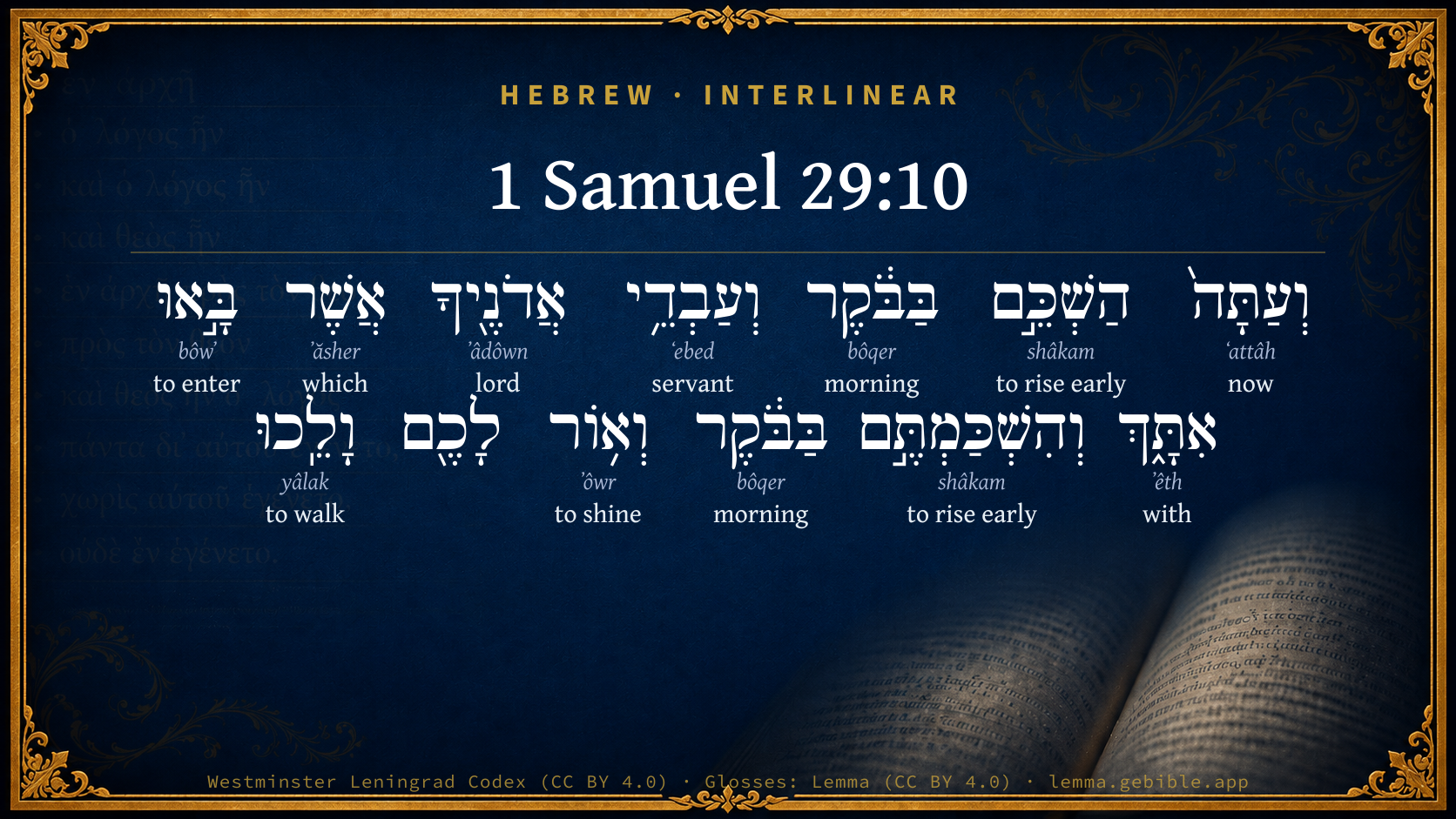
Hebrew (Westminster Leningrad Codex) 1 Samuel 29:10 appears in the Hebrew Old Testament. The text above is from the Westminster Leningrad Codex. Each word links to its Strong’s number, a concise gloss, and parsing drawn from the Open Scriptures Hebrew Bible morphology. Click any word for its full Brown-Driver-Briggs (BDB) entry.
Download image
Cite this verse

1 Samuel 29:10 (World English Bible). Public Domain. Lemma interlinear Bible study tool, https://lemma.gebible.app/v/1-samuel/29/10.

Show BibTeX & RIS
BibTeX
RIS
English Translation
Therefore now rise up early in the morning with the servants of your lord who have come with you; and as soon as you are up early in the morning, and have light, depart.
World English Bible · Public Domain
Download a study sheet

One document with this verse’s original text, its word-by-word gloss line, the meaning frame, cross-references with their text, attributed commentary, and full source and license credits — printable, and it pastes into notes with its structure intact.

This verse Autodidact and up

Study sheet (.html) Plain text (.txt)

A passage Seminary Student

Up to 50 verses in one chapter. A passage sheet keeps up to 6 commentary sources and 12 cross-references per verse, in the order this page ranks them, and says so on the sheet whenever that leaves anything out. Ask for a single verse and you get the Autodidact verse sheet above.

Everything on this page stays free to read, with no account — the sheet is a download of what is already on screen, not access to it.

Want to remove ads? Support Godless Engineer
Compare translations 3

The same verse in 3 English versions, stacked beneath the original-language interlinear above. Click any original word for its lexicon entry.

Each is an independent rendering of the whole verse — the interlinear is not word-aligned to these translations.

Highlighted words mark where these versions differ — a whole-verse word diff, not a word-by-word alignment.

  • World English Bible Public Domain
    Therefore now rise up early in the morning with the servants of your lord who have come with you; and as soon as you are up early in the morning, and have light, depart.
  • King James Version Public Domain
    Wherefore now rise up early in the morning with thy master's servants that are come with thee: and as soon as ye be up early in the morning, and have light, depart.
  • unfoldingWord Literal Text CC BY-SA 4.0
    And now, arise early in the morning with the servants of your master who came with you. And you shall arise early in the morning, when light to you, and go.”

unfoldingWord Literal Text — © unfoldingWord, licensed CC BY-SA 4.0. Word-aligned USFM3 via Door43 (git.door43.org/unfoldingWord/en_ult).

Versions to compare (up to 4)

3 of 4 selected

Show all 18 translations

Every available English version of this verse, each an independent rendering of the whole verse.

  • World English Bible Public Domain
    Therefore now rise up early in the morning with the servants of your lord who have come with you; and as soon as you are up early in the morning, and have light, depart.
  • Berean Standard Bible Public Domain
    Now then, get up early in the morning, along with your master’s servants who came with you, and go as soon as it is light.”
  • Majority Standard Bible Public Domain
    Now then, get up early in the morning, along with your master’s servants who came with you, and go as soon as it is light.”
  • King James Version Public Domain
    Wherefore now rise up early in the morning with thy master's servants that are come with thee: and as soon as ye be up early in the morning, and have light, depart.
  • American Standard Version (1901) Public Domain
    Wherefore now rise up early in the morning with the servants of thy lord that are come with thee; and as soon as ye are up early in the morning, and have light, depart.
  • Revised Version (1885) Public Domain
    Wherefore now rise up early in the morning with the servants of thy lord that are come with thee: and as soon as ye be up early in the morning, and have light, depart.
  • Geneva Bible (1599) Public Domain
    Wherefore now rise vp earely in the morning with thy masters seruants that are come with thee: and when ye be vp earely, assoone as ye haue light, depart.
  • Douay-Rheims (1899) Public Domain
    Therefore arise in the morning, thou, and the servants of thy lord, who came with thee: and when you are up before day, and it shall begin to be light, go on your way.
  • Young's Literal Translation Public Domain
    and now, rise thou early in the morning, and the servants of thy lord who have come with thee, when ye have risen early in the morning, and have light, then go ye.'
  • Literal Standard Version CC BY-SA 4.0
    and now, rise early in the morning—and the servants of your lord who have come with you. When you have risen early in the morning, and have light, then go.”
  • Unlocked Literal Bible CC BY-SA 4.0
    So now rise up early in the morning with the servants of your master who have come with you; as soon as you are up early in the morning and have light, go away.”
  • unfoldingWord Literal Text CC BY-SA 4.0
    And now, arise early in the morning with the servants of your master who came with you. And you shall arise early in the morning, when light to you, and go.”
  • Darby Bible Public Domain
    And now rise up early in the morning with thy master's servants that are come with thee; and rise ye early in the morning, and when ye have daylight, depart.
  • World Messianic Bible Public Domain
    Therefore now rise up early in the morning with the servants of your lord who have come with you; and as soon as you are up early in the morning and have light, depart.”
  • Webster's Bible Public Domain
    Wherefore now rise early in the morning with thy master's servants that are come with thee: and as soon as ye shall have risen early in the morning, and have light, depart.
  • Free Bible Version CC BY-SA 4.0
    So get up early tomorrow morning and leave with your men as soon as it's light.”
  • Bible in Basic English Public Domain
    So get up early in the morning, with the servants of your lord who are with you, and go to the place I have given you, and have no evil design in your heart, for you are good in my eyes; but when there is light enough in the morning, go away.
  • JPS Tanakh (1917) Public Domain
    Wherefore now rise up early in the morning with the servants of thy lord that are come with thee; and as soon as ye are up early in the morning, and have light, depart.'

Literal Standard Version (2020), Covenant Press — licensed CC BY-SA 4.0. Text via the HelloAO Bible API (eBible.org). Unlocked Literal Bible (unfoldingWord) — licensed CC BY-SA 4.0. Text via the HelloAO Bible API (eBible.org). unfoldingWord Literal Text — © unfoldingWord, licensed CC BY-SA 4.0. Word-aligned USFM3 via Door43 (git.door43.org/unfoldingWord/en_ult). Free Bible Version, Dr. Jonathan Gallagher — licensed CC BY-SA 4.0. Text via the HelloAO Bible API (eBible.org).

Word by word

More ways to search: Search by grammar → Find every occurrence → Compare this word →

Practice this passage: Drill this verse → Learn its vocabulary →

וְא֥וֹר
ʼôwr
H215
“and · to shine”
Conjunction + Verb, Qal, Sequential Perfect, 3rd Person, Masculine, Singular
Part of Speech
Conjunction + Verb
Stem
Qal
Form
Sequential Perfect
Person
3rd Person
Gender
Masculine
Number
Singular
Full BDB Definition

Origin: a primitive root

TWOT: 52

to be or become light, shine - (Qal) - to become light (day) - to shine (of the sun) - to become bright - (Niphal) - to be illuminated - to become lighted up - (Hiphil) - to give light, shine (of sun, moon, and stars) - to illumine, light up, cause to shine, shine - to kindle, light (candle, wood) - lighten (of the eyes, his law, etc) - to make shine (of the face)
  1. וְעַתָּה֙ ʻattâh H6258 “and · now” Conjunction + Adverb
  2. הַשְׁכֵּ֣ם shâkam H7925 “rise early” Verb, Hiphil, Imperative, 2nd Person, Masculine, Singular
  3. בַּבֹּ֔קֶר bôqer H1242 “in/at the · morning” Preposition, Determined + Noun, Common, Masculine, Singular, Absolute
  4. וְעַבְדֵ֥י ʻebed H5650 “and · servants of” Conjunction + Noun, Common, Masculine, Plural, Construct
  5. אֲדֹנֶ֖יךָ ʼâdôwn H113 “lords · your” Noun, Common, Masculine, Plural, Construct + Suffix, Personal, 2nd Person, Masculine, Singular
  6. אֲשֶׁר ʼăsher H834 “which” Particle, Relative
  7. בָּ֣אוּ bôwʼ H935 “to enter” Verb, Qal, Perfect, 3rd Person, Common, Plural
  8. אִתָּ֑ךְ ʼêth H854 “with · you” Preposition + Suffix, Personal, 2nd Person, Feminine, Singular
  9. וְהִשְׁכַּמְתֶּ֣ם shâkam H7925 “and · to rise early” Conjunction + Verb, Hiphil, Sequential Perfect, 2nd Person, Masculine, Plural
  10. בַּבֹּ֔קֶר bôqer H1242 “in/at the · morning” Preposition, Determined + Noun, Common, Masculine, Singular, Absolute
  11. וָלֵֽכוּ yâlak H3212 “and · walk” Conjunction + Verb, Qal, Imperative, 2nd Person, Masculine, Plural

About this verse

These counts appear in no published source. They are computed here, from the morphology-tagged text and Lemma’s own curated glosses. What Lemma adds →

13
words
10
distinct lemmas
Historical
section

Shared distinctive vocabulary

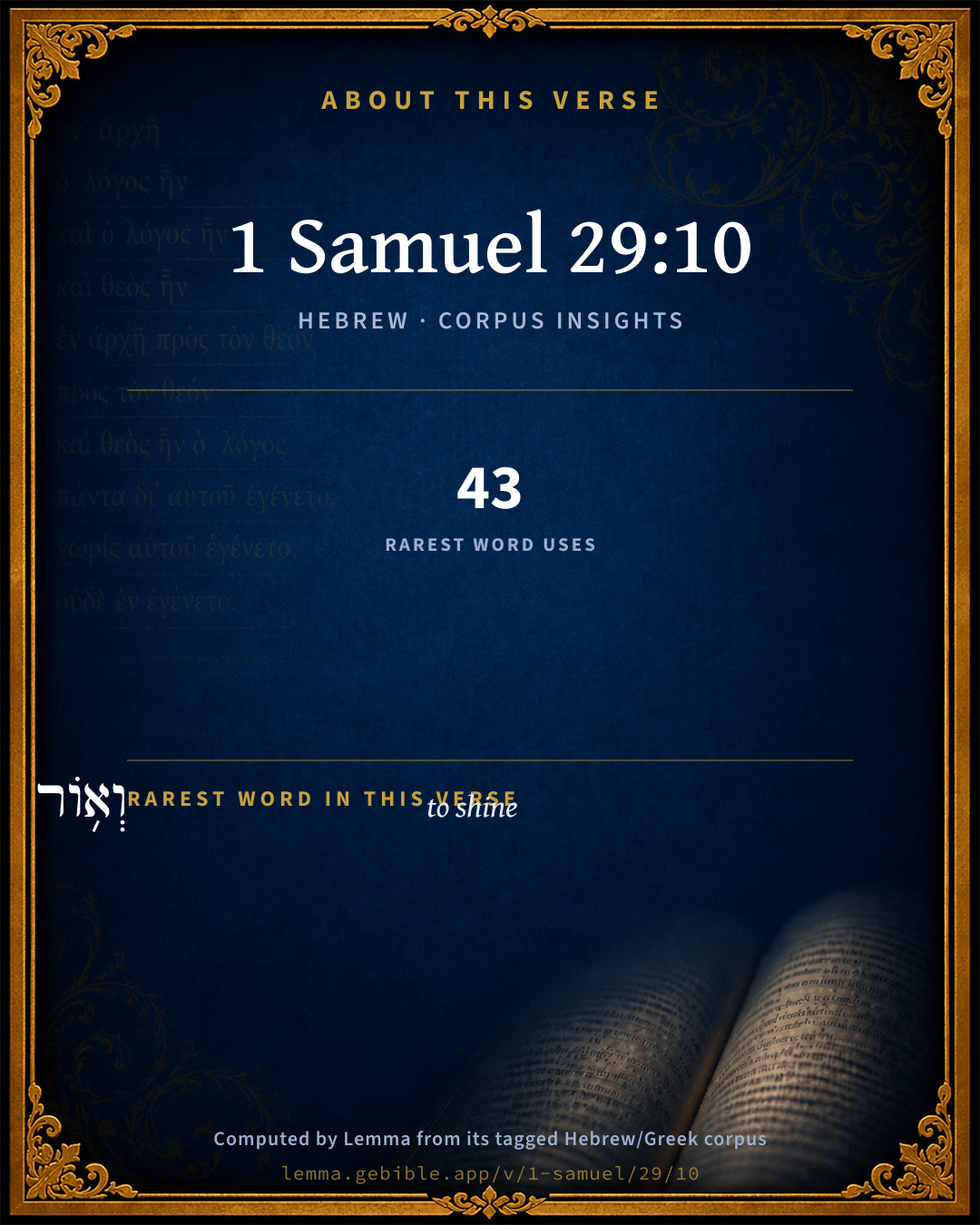
וְא֥וֹר to shine H215 occurs in 43 verses of the Hebrew Bible. Also found in:

Grammatical profile

  • 5 verbs
  • 4 nouns
  • 2 prepositions
  • 1 adverb
  • 1 particle

Verb forms

  • הַשְׁכֵּ֣ם Hiphil · Imperative
  • בָּ֣אוּ Qal · Perfect
  • וְהִשְׁכַּמְתֶּ֣ם Hiphil · Sequential Perfect
  • וְא֥וֹר Qal · Sequential Perfect
  • וָלֵֽכוּ Qal · Imperative

Repetition

Words recur within this verse — often emphatic in Hebrew:

  • הַשְׁכֵּ֣ם to rise early H7925 ×2
  • בַּבֹּ֔קֶר morning H1242 ×2

Hebrew & Septuagint length

In English translation the verse runs 34 words from the Hebrew and 56 from the Septuagint (LXX English) — the Septuagint runs noticeably longer here. See the side-by-side →

A rough comparison of the two English renderings, which tokenize alike — not a word-level alignment.

Word counts can differ between the Hebrew and the Greek without any difference in meaning — e.g. the Hebrew direct-object marker אֵת has no separate Greek word, and Greek often adds the article ὁ.

Cross-references

7

Topical passages linked to 1 Samuel 29:10 in the Treasury of Scripture Knowledge — connected by theme and wording, ordered by reader-vote popularity; previews shown in the World English Bible.

  • 1 Chronicles 12:19 Of Manasseh also there fell away some to David, when he came with the Philistines against Saul to battle: but they didn't help them; for the lords of the Philistines sent him away after consultation, saying, He will fall away to his master Saul to the jeopardy of our heads.
  • Genesis 22:14 Abraham called the name of that place Yahweh-Jireh. As it is said to this day, "In Yahweh's mountain it will be provided.
  • 1 Samuel 30:1–2 It happened, when David and his men were come to Ziklag on the third day, that the Amalekites had made a raid on the South, and on Ziklag, and had struck Ziklag, and burned it with fire,
  • 1 Chronicles 12:22 For from day to day men came to David to help him, until there was a great host, like the host of God.
  • Psalms 37:23–24 A man's goings are established by Yahweh. He delights in his way.
  • 1 Corinthians 10:13 No temptation has taken you except what is common to man. God is faithful, who will not allow you to be tempted above what you are able, but will with the temptation also make the way of escape, that you may be able to endure it.
  • 2 Peter 2:9 the Lord knows how to deliver the godly out of temptation and to keep the unrighteous under punishment for the day of judgment;

Cross-references courtesy of OpenBible.info (CC BY 4.0).

Hebrew and Greek witnesses Masoretic Hebrew ↔ Greek Septuagint

The same verse in the two great witnesses to the Old Testament, shown verse-for-verse.

Here the Septuagint runs noticeably longer than the Hebrew — LXX2012 (modern English Septuagint) 56 words vs World English Bible 34. A rough length comparison of the two English translations, not a word-level alignment — read both below.

These are two independent witnesses, not word-aligned to each other, and the Septuagint is shown in lemma (dictionary) form.

Hebrew 1 Samuel 29:10 Masoretic · Westminster Leningrad Codex

וְעַתָּה֙ הַשְׁכֵּ֣ם בַּבֹּ֔קֶר וְעַבְדֵ֥י אֲדֹנֶ֖יךָ אֲשֶׁר בָּ֣אוּ אִתָּ֑ךְ וְהִשְׁכַּמְתֶּ֣ם בַּבֹּ֔קֶר וְא֥וֹר לָכֶ֖ם וָלֵֽכוּ

Therefore now rise up early in the morning with the servants of your lord who have come with you; and as soon as you are up early in the morning, and have light, depart.

World English Bible · Public Domain

Greek LXX 1 Samuel 29:10 Septuagint · lemma form

καί νῦν ὀρθρίζω ὁ πρωΐ σύ καί ὁ παῖς ὁ κύριος σύ ὁ ἥκω μετά σύ καί πορεύομαι εἰς ὁ τόπος οὗ καταἵστημι σύ ἐκεῖ καί λόγος λοιμός μή τίθημι ἐν καρδία σύ ὅτι ἀγαθός σύ ἐνώπιον ἐγώ καί ὀρθρίζω ἐν ὁ ὁδός καί φωτίζω σύ καί πορεύομαι

Now then rise up early in the morning, you and the servants of your lord that are come with you, and go to the place where I appointed you, and entertain no evil thought in your heart, for you are good in my sight: and rise early for your journey when it is light, and depart.

LXX2012 (modern English Septuagint) · Public Domain

Hebrew: Westminster Leningrad Codex (CC BY 4.0). Greek: Septuagint (public domain); English from LXX2012 (modern English Septuagint) (Public Domain). How the Septuagint differs from the Hebrew →

Targum (Aramaic paraphrase)

1

The Targum is the ancient Jewish Aramaic paraphrase of the Hebrew Scriptures — an interpretive translation, not the Hebrew text itself. Onkelos (literal) and Pseudo-Jonathan (expansive) render the Torah, and Jonathan the Prophets. Coverage is partial: where no permissively-licensed English translation exists for a verse, only the Aramaic is shown. This is verse-level text, not a word-by-word alignment to the Hebrew.

  1. Targum Jonathan Prophets (Joshua–Malachi)
    וּכְעַן אַקְדֵים בְּצַפְרָא וְעַבְדֵי רִבּוֹנָךְ דַאֲתוֹ עִמָךְ וּתְקַדְמוּן בְּצַפְרָא וְיִנְהַר לְכוֹן וְתֵיזְלוּן:

    (no public-domain English translation for this verse)

    Targum Jonathan — Aramaic: “Mikraot Gedolot” (public domain). English: “Sefaria Community Translation” (CC0 1.0 (public-domain dedication)); “London "Chaldee Paraphrase," 1871” (public domain). Text via Sefaria.

Commentary

Notes on 1 Samuel 29:10 from classic Christian and Jewish commentators (each source and its license shown beneath its notes). The classic Christian expositions comment on the surrounding passage and are grouped to its opening verse, so a note may address several verses; the Jewish commentaries on the Tanakh (Rashi and others) are per-verse, so they appear only where the commentator wrote on this verse.

Lemma curates 59 commentaries, every one of them public domain or Creative Commons licensed, each selected and text-cleaned for this edition rather than reprinted as found. About our sources →

Trapp's Complete Commentary

John Trapp

1Sa 29:10 Wherefore now rise up early in the morning with thy master’s servants that are come with thee: and as soon as ye be up early in the morning, and have light, depart.

Ver. 10. Wherefore now rise up early in the morning.] Matutinum te age in mane, get up by peep of day, before the fight begin. Oh, happy word! the fruit of prayer doubtless, and therefore the sweeter to David; who could the better digest the contumely of being cashiered the army.

With thy master’s servants,] i.e., Cum meis servis qui sum dominus tuus, with my servants who are your lord, saith Piscator. But others understand it, and better, of Saul’s servants, and this bred the jealousy.

John Trapp, A Commentary or Exposition upon All the Books of the Old and New Testament (1647–1656) — public domain. Text from a community e-Sword module.

Joseph Benson's Commentary

1Sa 29:10-11. With thy master’s servants — This intimates that the lords of the Philistines would not trust them, because they looked on them still as Saul’s subjects. David and his men rose up early — David did not then know how necessary this was for the relief of his own city. But God knew it well, and sent him thither accordingly. On how many occasions may we say, What I do thou knowest not now, but thou shalt know hereafter!

Joseph Benson's Commentary on the Old and New Testaments (1811–1818) — public domain. Text from a community e-Sword module.

Geneva Bible (1599)

Geneva Bible translators

With them that fled unto thee from Saul.

Geneva Bible (1599) marginal notes — public domain. Text via Bolls.life.

Adam Clarke's Commentary

Verse 10. With thy master's servants] Who were these? has been very properly asked; and to this question there can be but two answers:-

1. The six hundred Israelites which were with him; and who might still be considered the subjects of SAUL, though now residing in a foreign land.

2. The servants of ACHISH; i.e., David's men thus considered; because on his coming to Gath, he had in effect given up himself and his men to Achish. But Saul may be the master to whom Achish refers, and the words convey a delicate information to David that he is no vassal, but still at liberty.

Adam Clarke's Commentary on the Bible (1810–1826) — public domain. Text from a community e-Sword/MySword module.

Ellicott's Commentary for English Readers

(10) With thy master’s servants.—The words have perplexed expositors. It is hardly the expression we should expect Achish to use of David’s followers. All Israelites were, of course, “subjects of Saul,” but the term would hardly be used except by one hostile to David, as Nabal was; he once (1Sa_25:10) made use of an insulting term of a like nature to David. Achish, we know, seemed ever kindly disposed to the outlawed son of Jesse. A probable suggestion has, however, been lately made, that the reference here is to those tribes of Manasseh (comp. 1Ch_12:19-21) who had only lately come over to David. Was it not also possible that these very Manassites, who had only very recently deserted the king’s cause for David’s, were known to some of the Philistines as Saul’s soldiers, and that their suspicions had been awakened in the first place by finding them marching under David’s standard in the division of Gath?

A Bible Commentary for English Readers, edited by Charles John Ellicott (1878–1897) — public domain. Text from a community e-Sword module.

The Cambridge Bible for Schools and Colleges

gen. ed. J. J. S. Perowne

10. with thy master’s servants] Achish speaks of David’s men as Saul’s subjects, in view of the objection which has been made to their presence in the army.

with thee] After these words the Sept. (A B) adds: “And go ye unto the place which I have appointed you; and lay not up any evil thought in thine heart, for thou art good in my sight.”

The Cambridge Bible for Schools and Colleges (gen. ed. J. J. S. Perowne; Cambridge University Press, 1878–1918) — public domain. Text from a community e-Sword module.

John Gill's Exposition

Wherefore now rise up early with thy master's servants that are come with thee,.... Meaning his six hundred men, who were considered as the servants and subjects of Saul, though with David: and which tacitly carried in it the objection of the Philistine lords unto them, that since they were the servants and subjects of Saul, they were not to be trusted in a battle with him; lest finding an opportunity, they should seize it, and thereby ingratiate themselves into his favour again:

and as soon as ye be up early in the morning, and have light, depart; he advises them to get away as soon as they could, lest the Philistines should fall upon them, and force them, and he could not say what mischief might befall them; wherefore for their safety it was best to depart as soon as they could see their way.

John Gill's Exposition of the Whole Bible (1746–1763) — public domain (CC PDM 1.0). Text via the HelloAO Bible API.

Albert Barnes' Notes on the Bible

With thy master’s servants - The clue to this may be found in 1Ch 12:19-21, where it appears that a considerable number of Manassites “fell” to David just at this time, and went back with him to Ziklag. It is therefore to these new comers that Achish applies the expression. It is impossible not to recognize here a merciful interposition of Providence, by which David was not only saved from fighting against his king and country, but sent home just in time to recover his wives and property from the Amalekites 1 Sam. 30. That David maintained his position by subtlety and falsehood, which were the invariable characteristics of his age and nation, is not in the least to be wondered at. No sanction is given by this narrative to the use of falsehood.

Albert Barnes' Notes on the Bible (1834–1885) — public domain. Text from a community e-Sword/MySword module.

Haydock's Catholic Bible Commentary

Thy Lord. He may allude to Saul, (ver. 3,) or to himself, (chap. v. 8,) or to God, as David was under obligations to all three. (Haydock) --- Light, that none might know or be dejected, in the rest of the army. (Menochius)

George Leo Haydock (1774–1849), Haydock's Catholic Family Bible and Commentary, 1859 edition — public domain. Excludes Psalms (Douay-Rheims chapter numbering differs from Protestant) and Deuterocanonical books (Catholic canon only).

Matthew Poole's English Annotations

With thy master’s servants; he intimates the ground of the Philistines’ jealousy concerning David and his men, that they were all servants of Saul, and therefore had an obligation, and were suspected to have an affection, to their old lord and master, against whom even David himself could not make them fight, especially with and for the Philistines.

As soon as ye have light, depart; before the battle begin, lest, if you delay, the lords of the Philistines fall upon you, and destroy you.

Matthew Poole's English Annotations on the Holy Bible (1683–1685) — public domain. Text from a community e-Sword/MySword module.

The Pulpit Commentary

Vers. 10, 11. With thy master"s servants. It has been well remarked that while this would be a strange description of David"s own men, it would exactly describe that band of deserters belonging to the tribe of Manasseh who, instead of obeying Saul"s summons to the war with the Philistines, joined David about this time. (see 1Ch_12:19-21) As soon as ye be up early in the morning, etc. If it was on the second day s march that the Philistine lords objected to David"s continuance with them, he would be back at Gath in two days, and on the third day reach Ziklag, as is said in 1Sa_30:1. However difficult David"s position may have been, still every one must condemn his conduct towards Achish as dishonourable; but God, who often deals with men more mercifully than they deserve, nevertheless rescued him from his state of perplexity, and saved him from the necessity of either fighting against his own countrymen or of still more dishonourably breaking his word to Achish by deserting in the battle. He also sent him home just in time to rescue from a miserable fate those whom he loved.

The Pulpit Commentary (1880–1919), ed. H.D.M. Spence-Jones & Joseph S. Exell — public domain. Text from a community e-Sword module.

unfoldingWord translationNotes

Door43 World Missions Community

your master

The reader should understand that Achish is speaking of Saul.

have light

"can see with the morning sun"

translationWords

raise

servant

lord

light

Philistines

Jezreel

unfoldingWord translationNotes — © Distant Shores Media and the Door43 World Missions Community, licensed CC BY-SA 4.0. Source: git.door43.org/Door43/en_tn.

Lesson kit

Teaching starters — assembled from the data on this page, not authored interpretation. Every prompt links to the verse data it draws on. Edit before teaching.

1 Samuel, in the Historical, opens this verse with 13 words (10 distinct Hebrew lemmas). Its most distinctive word is ʼôwr (“to shine”). The Greek Septuagint runs longer here. A historical commentator’s framing appears above. Read the whole chapter for the surrounding context.

Discussion questions

  1. The word ʼôwr carries the sense “to shine.” How does it shape the verse?
  2. Genesis 1:15 shares the word «to shine» with this verse. How do the two illuminate each other?
  3. “to rise early” occurs 2× in this one verse. What is the effect of the repetition?
  4. Compared with the Hebrew, the Septuagint runs longer here. What questions does that raise?
  5. The translations on this page render this verse differently — a whole-verse word diff, not a word-by-word alignment. What might account for the different wordings?
  6. The verb «הַשְׁכֵּ֣ם» is Hiphil Imperative. How does its form color the action?
  7. Reading how Trapp's Complete Commentary and Joseph Benson's Commentary read this verse, where do the two commentators agree and where do they part?

Things to notice

  • These translations choose different wording for 18 words in this verse.
  • “to rise early” occurs 2× in this single verse.
  • 10 distinct Hebrew lemmas span 13 words in this verse.

Reading settings

Reading text

Shown beneath each verse's original-language words.

Old Testament
Old Testament edition

Read the OT as the Masoretic Hebrew (MT) or the Greek Septuagint (LXX).

English shown for the Greek Septuagint (in the Hebrew ↔ Greek comparison).

Comparing translations? Open the Compare panel on any verse page to stack up to four side by side.