
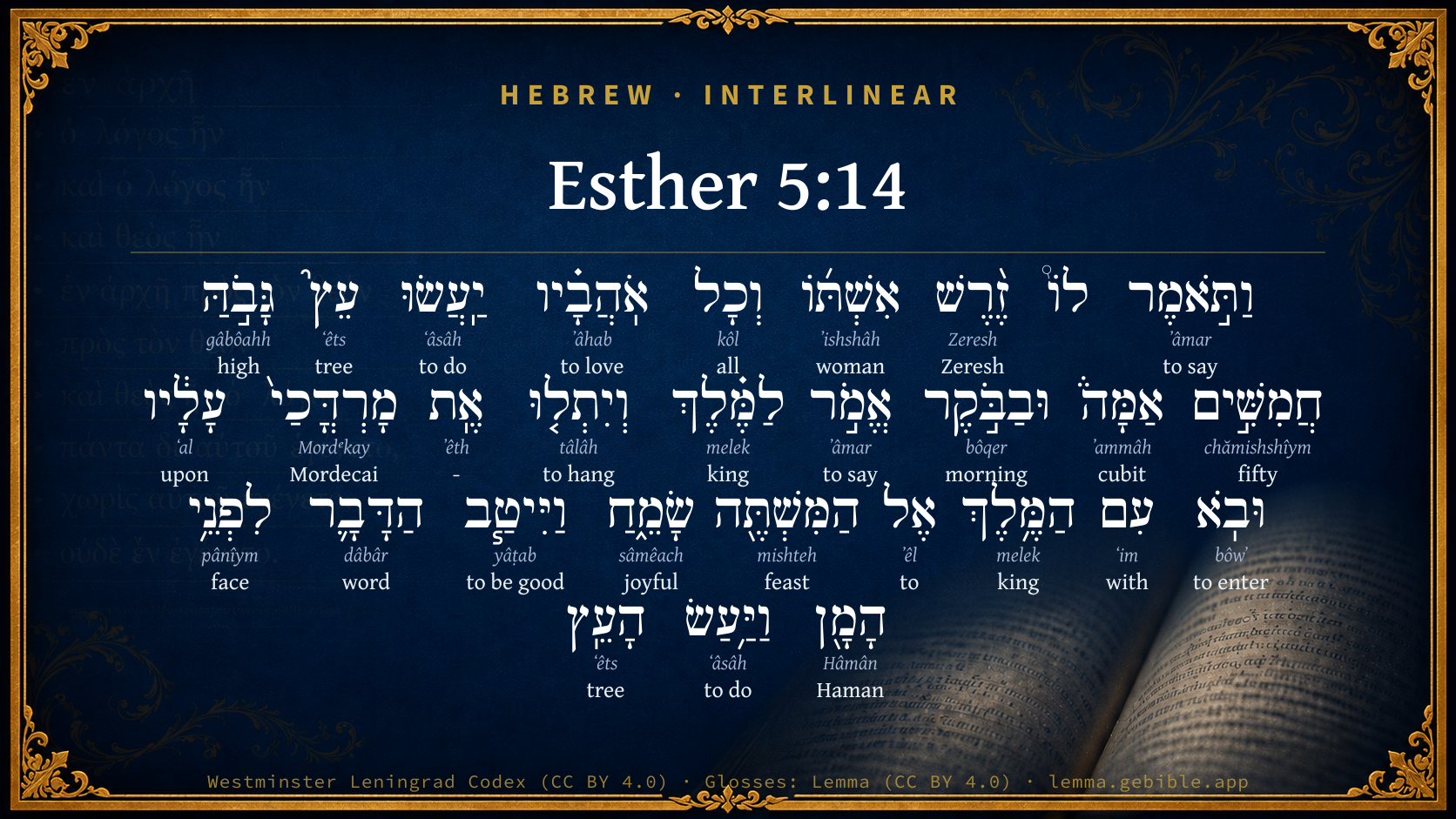
Esther 5:14

Hebrew (Westminster Leningrad Codex) Esther 5:14 appears in the Hebrew Old Testament. The text above is from the Westminster Leningrad Codex. Each word links to its Strong’s number, a concise gloss, and parsing drawn from the Open Scriptures Hebrew Bible morphology. Click any word for its full Brown-Driver-Briggs (BDB) entry.
Download image
Cite this verse

Esther 5:14 (World English Bible). Public Domain. Lemma interlinear Bible study tool, https://lemma.gebible.app/v/esther/5/14.

Show BibTeX & RIS
BibTeX
RIS
English Translation
Then said Zeresh his wife and all his friends to him, Let a gallows be made fifty cubits high, and in the morning speak you to the king that Mordecai may be hanged thereon: then go you in merrily with the king to the banquet. The thing pleased Haman; and he caused the gallows to be made.
World English Bible · Public Domain
Download a study sheet

One document with this verse’s original text, its word-by-word gloss line, the meaning frame, cross-references with their text, attributed commentary, and full source and license credits — printable, and it pastes into notes with its structure intact.

This verse Autodidact and up

Study sheet (.html) Plain text (.txt)

A passage Seminary Student

Up to 50 verses in one chapter. A passage sheet keeps up to 6 commentary sources and 12 cross-references per verse, in the order this page ranks them, and says so on the sheet whenever that leaves anything out. Ask for a single verse and you get the Autodidact verse sheet above.

Everything on this page stays free to read, with no account — the sheet is a download of what is already on screen, not access to it.

Want to remove ads? Support Godless Engineer
Compare translations 3

The same verse in 3 English versions, stacked beneath the original-language interlinear above. Click any original word for its lexicon entry.

Each is an independent rendering of the whole verse — the interlinear is not word-aligned to these translations.

Highlighted words mark where these versions differ — a whole-verse word diff, not a word-by-word alignment.

  • World English Bible Public Domain
    Then said Zeresh his wife and all his friends to him, Let a gallows be made fifty cubits high, and in the morning speak you to the king that Mordecai may be hanged thereon: then go you in merrily with the king to the banquet. The thing pleased Haman; and he caused the gallows to be made.
  • King James Version Public Domain
    Then said Zeresh his wife and all his friends unto him, Let a gallows be made of fifty cubits high, and to morrow speak thou unto the king that Mordecai may be hanged thereon: then go thou in merrily with the king unto the banquet. And the thing pleased Haman; and he caused the gallows to be made.
  • unfoldingWord Literal Text CC BY-SA 4.0
    And Zeresh his wife, with all of his friends, said to him, “Let them make a pole 50 cubits high. And in the morning speak to the king, and let them hang Mordecai on it. Then go with the king to the banquet joyful.” And the word was good before the face of Haman, and he made the pole.

unfoldingWord Literal Text — © unfoldingWord, licensed CC BY-SA 4.0. Word-aligned USFM3 via Door43 (git.door43.org/unfoldingWord/en_ult).

Versions to compare (up to 4)

3 of 4 selected

Show all 18 translations

Every available English version of this verse, each an independent rendering of the whole verse.

  • World English Bible Public Domain
    Then said Zeresh his wife and all his friends to him, Let a gallows be made fifty cubits high, and in the morning speak you to the king that Mordecai may be hanged thereon: then go you in merrily with the king to the banquet. The thing pleased Haman; and he caused the gallows to be made.
  • Berean Standard Bible Public Domain
    His wife Zeresh and all his friends told him, “Have them build a gallows fifty cubits high, and ask the king in the morning to have Mordecai hanged on it. Then go to the banquet with the king and enjoy yourself.” The advice pleased Haman, and he had the gallows constructed.
  • Majority Standard Bible Public Domain
    His wife Zeresh and all his friends told him, “Have them build a gallows fifty cubits high, and ask the king in the morning to have Mordecai hanged on it. Then go to the banquet with the king and enjoy yourself.” The advice pleased Haman, and he had the gallows constructed.
  • King James Version Public Domain
    Then said Zeresh his wife and all his friends unto him, Let a gallows be made of fifty cubits high, and to morrow speak thou unto the king that Mordecai may be hanged thereon: then go thou in merrily with the king unto the banquet. And the thing pleased Haman; and he caused the gallows to be made.
  • American Standard Version (1901) Public Domain
    Then said Zeresh his wife and all his friends unto him, Let a gallows be made fifty cubits high, and in the morning speak thou unto the king that Mordecai may be hanged thereon: then go thou in merrily with the king unto the banquet. And the thing pleased Haman; and he caused the gallows to be made.
  • Revised Version (1885) Public Domain
    Then said Zeresh his wife and all his friends unto him, Let a gallows be made of fifty cubits high, and in the morning speak thou unto the king that Mordecai may be hanged thereon: then go thou in merrily with the king unto the banquet. And the thing pleased Haman; and he caused the gallows to be made.
  • Geneva Bible (1599) Public Domain
    Then sayde Zeresh his wife and all his friends vnto him, Let them make a tree of fiftie cubites hie, and to morowe speake thou vnto the King, that Mordecai may be hanged thereon: then shalt thou goe ioyfully with the King vnto the banket. And the thing pleased Haman, and he caused to make the tree.
  • Douay-Rheims (1899) Public Domain
    Then Zares his wife, and the rest of his friends answered him: Order a great beam to be prepared, fifty cubits high, and in the morning speak to the king, that Mardochai may be hanged upon it, and so thou shalt go full of joy with the king to the banquet. The counsel pleased him, and he commanded a high gibbet to be prepared.
  • Young's Literal Translation Public Domain
    And Zeresh his wife saith to him, and all his friends, `Let them prepare a tree, in height fifty cubits, and in the morning speak to the king, and they hang Mordecai on it, and go thou in with the king unto the banquet rejoicing;' and the thing is good before Haman, and he prepareth the tree.
  • Literal Standard Version CC BY-SA 4.0
    And his wife Zeresh says to him, and all his friends, “Let them prepare a tree, in height fifty cubits, and in the morning speak to the king, and they hang Mordecai on it, and go in with the king to the banquet rejoicing”; and the thing is good before Haman, and he prepares the tree.
  • Unlocked Literal Bible CC BY-SA 4.0
    Then Zeresh his wife said to Haman and all his friends, “Let them make a gallows fifty cubits high. In the morning speak to the king for them to hang Mordecai on it. Then go joyfully with the king to the feast.” This pleased Haman and he had the gallows constructed.
  • unfoldingWord Literal Text CC BY-SA 4.0
    And Zeresh his wife, with all of his friends, said to him, “Let them make a pole 50 cubits high. And in the morning speak to the king, and let them hang Mordecai on it. Then go with the king to the banquet joyful.” And the word was good before the face of Haman, and he made the pole.
  • Darby Bible Public Domain
    Then said Zeresh his wife and all his friends to him, Let a gallows be made of fifty cubits high, and in the morning speak to the king that Mordecai may be hanged on it: then go in merrily with the king to the banquet. And the thing pleased Haman; and he caused the gallows to be made.
  • World Messianic Bible Public Domain
    Then Zeresh his wife and all his friends said to him, “Let a gallows be made fifty cubits high, and in the morning speak to the king about hanging Mordecai on it. Then go in merrily with the king to the banquet.” This pleased Haman, so he had the gallows made.
  • Webster's Bible Public Domain
    Then said Zeresh his wife and all his friends to him, Let a gallows be made fifty cubits high, and to-morrow speak thou to the king that Mordecai may be hanged upon it: then go thou in merrily with the king to the banquet. And the thing pleased Haman; and he caused the gallows to be made.
  • Free Bible Version CC BY-SA 4.0
    His wife Zeresh and his friends told him, “Arrange for a pole to be set up, fifty cubits high. Then, in the morning, go and ask the king to have Mordecai impaled on it. Afterwards, you'll be happy as you go with the king to the dinner.” Haman thought this was good advice, so he had the pole set up.
  • Bible in Basic English Public Domain
    Then his wife Zeresh and all his friends said to him, Let a pillar, fifty cubits high, be made ready for hanging him, and in the morning get the king to give orders for the hanging of Mordecai: then you will be able to go to the feast with the king with a glad heart. And Haman was pleased with the suggestion, and he had the pillar made.
  • JPS Tanakh (1917) Public Domain
    Then said Zeresh his wife and all his friends unto him: 'Let a gallows be made of fifty cubits high, and in the morning speak thou unto the king that Mordecai may be hanged thereon; then go thou in merrily with the king unto the banquet.' And the thing pleased Haman; and he caused the gallows to be made.

Literal Standard Version (2020), Covenant Press — licensed CC BY-SA 4.0. Text via the HelloAO Bible API (eBible.org). Unlocked Literal Bible (unfoldingWord) — licensed CC BY-SA 4.0. Text via the HelloAO Bible API (eBible.org). unfoldingWord Literal Text — © unfoldingWord, licensed CC BY-SA 4.0. Word-aligned USFM3 via Door43 (git.door43.org/unfoldingWord/en_ult). Free Bible Version, Dr. Jonathan Gallagher — licensed CC BY-SA 4.0. Text via the HelloAO Bible API (eBible.org).

Word by word

More ways to search: Search by grammar → Find every occurrence → Compare this word →

Practice this passage: Drill this verse → Learn its vocabulary →

זֶ֨רֶשׁ
Zeresh
H2238
“Zeresh”
Noun, Proper
Part of Speech
Noun
Type
Proper
Full BDB Definition

Origin: of Persian origin

TWOT: None

Zeresh = "gold" - the wife of Haman, the Agagite
  1. וַתֹּ֣אמֶר ʼâmar H559 “and · to say” Conjunction + Verb, Qal, Sequential Imperfect, 3rd Person, Feminine, Singular
  2. אִשְׁתּ֜וֹ ʼishshâh H802 “woman · his” Noun, Common, Feminine, Singular, Construct + Suffix, Personal, 3rd Person, Masculine, Singular
  3. וְכָל kôl H3605 “and · all of” Conjunction + Noun, Common, Masculine, Singular, Construct
  4. אֹֽהֲבָ֗יו ʼâhab H157 “loving · him” Verb, Qal, Participle Active, Masculine, Plural, Construct + Suffix, Personal, 3rd Person, Masculine, Singular
  5. יַֽעֲשׂוּ ʻâsâh H6213 “to do” Verb, Qal, Jussive, 3rd Person, Masculine, Plural
  6. עֵץ֮ ʻêts H6086 “tree” Noun, Common, Masculine, Singular, Absolute
  7. גָּבֹ֣הַּ gâbôahh H1364 “high” Adjective, Adjective, Masculine, Singular, Absolute
  8. חֲמִשִּׁ֣ים chămishshîym H2572 “fifty” Adjective, Cardinal number, Both, Plural, Absolute
  9. אַמָּה֒ ʼammâh H520 “cubit” Noun, Common, Feminine, Singular, Absolute
  10. וּבַבֹּ֣קֶר bôqer H1242 “and · in/at the · morning” Conjunction + Preposition, Determined + Noun, Common, Masculine, Singular, Absolute
  11. אֱמֹ֣ר ʼâmar H559 “say” Verb, Qal, Imperative, 2nd Person, Masculine, Singular
  12. לַמֶּ֗לֶךְ melek H4428 “to/for the · king” Preposition, Determined + Noun, Common, Masculine, Singular, Absolute
  13. וְיִתְל֤וּ tâlâh H8518 “and · to hang” Conjunction + Verb, Qal, Jussive, 3rd Person, Masculine, Plural
  14. אֶֽת ʼêth H853 “-” Particle, Direct Object
  15. מָרְדֳּכַי֙ Mordᵉkay H4782 “Mordecai” Noun, Proper
  16. עָלָ֔יו ʻal H5921 “upon · him” Preposition + Suffix, Personal, 3rd Person, Masculine, Singular
  17. וּבֹֽא bôwʼ H935 “and · enter” Conjunction + Verb, Qal, Imperative, 2nd Person, Masculine, Singular
  18. עִם ʻim H5973 “with” Preposition
  19. הַמֶּ֥לֶךְ melek H4428 “the · king” Particle, Definite Article + Noun, Common, Masculine, Singular, Absolute
  20. אֶל ʼêl H413 “to” Preposition
  21. הַמִּשְׁתֶּ֖ה mishteh H4960 “the · feast” Particle, Definite Article + Noun, Common, Masculine, Singular, Absolute
  22. שָׂמֵ֑חַ sâmêach H8056 “joyful” Adjective, Adjective, Masculine, Singular, Absolute
  23. וַיִּיטַ֧ב yâṭab H3190 “and · to be good” Conjunction + Verb, Qal, Sequential Imperfect, 3rd Person, Masculine, Singular
  24. הַדָּבָ֛ר dâbâr H1697 “the · word” Particle, Definite Article + Noun, Common, Masculine, Singular, Absolute
  25. לִפְנֵ֥י pânîym H6440 “to/for · face(s) of” Preposition + Noun, Common, Both, Plural, Construct
  26. הָמָ֖ן Hâmân H2001 “Haman” Noun, Proper
  27. וַיַּ֥עַשׂ ʻâsâh H6213 “and · to do” Conjunction + Verb, Qal, Sequential Imperfect, 3rd Person, Masculine, Singular
  28. הָעֵֽץ ʻêts H6086 “the · tree” Particle, Definite Article + Noun, Common, Masculine, Singular, Absolute

About this verse

These counts appear in no published source. They are computed here, from the morphology-tagged text and Lemma’s own curated glosses. What Lemma adds →

30
words
25
distinct lemmas
Historical
section

Notable vocabulary

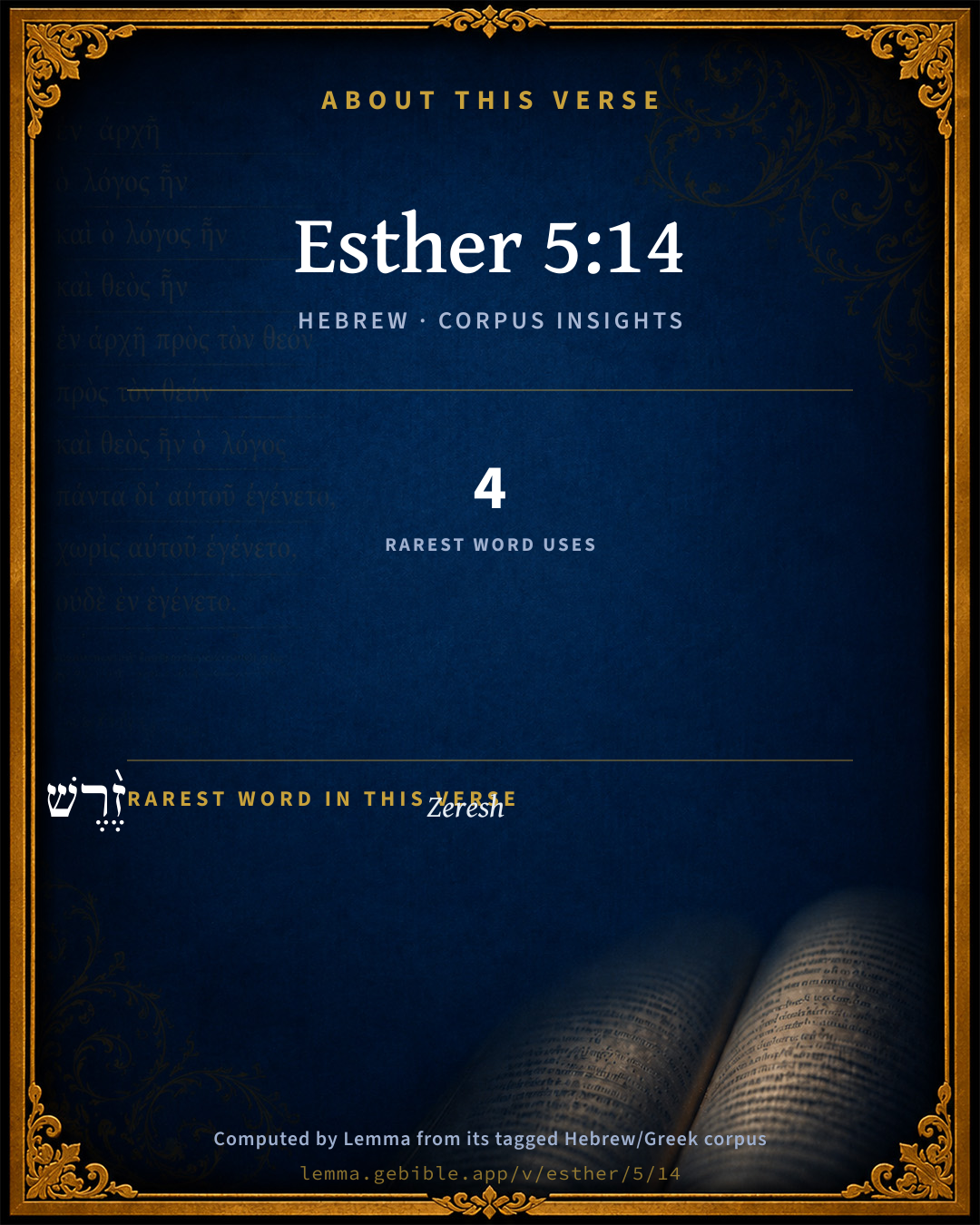
The rarest word here is זֶ֨רֶשׁ Zeresh H2238 — appearing just 4 times in the whole Hebrew Bible.

Shared distinctive vocabulary

זֶ֨רֶשׁ Zeresh H2238 occurs in 3 verses of the Hebrew Bible. Also found in:

Grammatical profile

  • 8 verbs
  • 14 nouns
  • 3 adjectives
  • 4 prepositions
  • 1 particle

Verb forms

  • וַתֹּ֣אמֶר Qal · Sequential Imperfect
  • אֹֽהֲבָ֗יו Qal · Participle Active
  • יַֽעֲשׂוּ Qal · Jussive
  • אֱמֹ֣ר Qal · Imperative
  • וְיִתְל֤וּ Qal · Jussive
  • וּבֹֽא Qal · Imperative
  • וַיִּיטַ֧ב Qal · Sequential Imperfect
  • וַיַּ֥עַשׂ Qal · Sequential Imperfect

Repetition

Words recur within this verse — often emphatic in Hebrew:

  • וַתֹּ֣אמֶר to say H559 ×2
  • יַֽעֲשׂוּ to do H6213 ×2
  • עֵץ֮ tree H6086 ×2
  • לַמֶּ֗לֶךְ king H4428 ×2

Hebrew & Septuagint length

In English translation the verse runs 57 words from the Hebrew and 63 from the Septuagint (LXX English) — closely comparable.

A rough comparison of the two English renderings, which tokenize alike — not a word-level alignment.

Word counts can differ between the Hebrew and the Greek without any difference in meaning — e.g. the Hebrew direct-object marker אֵת has no separate Greek word, and Greek often adds the article ὁ.

Cross-references

21

Topical passages linked to Esther 5:14 in the Treasury of Scripture Knowledge — connected by theme and wording, ordered by reader-vote popularity; previews shown in the World English Bible.

  • Esther 6:4 The king said, "Who is in the court?" Now Haman was come into the outward court of the king's house, to speak to the king to hang Mordecai on the gallows that he had prepared for him.
  • 1 Kings 21:7 Jezebel his wife said to him, Do you now govern the kingdom of Israel? arise, and eat bread, and let your heart be merry: I will give you the vineyard of Naboth the Jezreelite.
  • Esther 7:9–10 Then said Harbonah, one of the chamberlains who were before the king, Behold also, the gallows fifty cubits high, which Haman has made for Mordecai, who spoke good for the king, stands in the house of Haman. The king said, Hang him thereon.
  • Psalms 37:14 The wicked have drawn out the sword, and have bent their bow, To cast down the poor and needy, To kill those who are upright in the way.
  • Psalms 37:32 The wicked watches the righteous, And seeks to kill him.
  • Psalms 7:13–16 He has also prepared for himself the instruments of death. He makes ready his flaming arrows.
  • Acts 23:14–15 They came to the chief priests and the elders, and said, "We have bound ourselves under a great curse, to taste nothing until we have killed Paul.
  • 2 Samuel 13:3–5 But Amnon had a friend, whose name was Jonadab, the son of Shimeah, David's brother; and Jonadab was a very subtle man.
  • 2 Samuel 16:21–17:4 Ahithophel said to Absalom, Go in to your father's concubines, that he has left to keep the house; and all Israel will hear that you are abhorred of your father: then will the hands of all who are with you be strong.
  • 1 Kings 21:25 (But there was none like Ahab, who did sell himself to do that which was evil in the sight of Yahweh, whom Jezebel his wife stirred up.
  • 2 Chronicles 22:3–4 He also walked in the ways of the house of Ahab; for his mother was his counselor to do wickedly.
  • Esther 3:8–15 Haman said to king Ahasuerus, There is a certain people scattered abroad and dispersed among the peoples in all the provinces of your kingdom; and their laws are diverse from [those of] every people; neither keep they the king's laws: therefore it is not for the king's profit to allow them.
  • Psalms 9:15 The nations have sunk down in the pit that they made; In the net which they hid, their own foot is taken.
  • Proverbs 1:18 But these lay wait for their own blood. They lurk secretly for their own lives.
  • Proverbs 4:16 For they don't sleep, unless they do evil. Their sleep is taken away, unless they make someone fall.
  • Amos 6:4–6 Who lie on beds of ivory, And stretch themselves on their couches, And eat the lambs out of the flock, And the calves out of the midst of the stall;
  • Mark 6:19–24 Herodias set herself against him, and desired to kill him, but she couldn't,
  • Mark 14:10–11 Judas Iscariot, who was one of the twelve, went away to the chief priests, that he might deliver him to them.
  • Romans 1:32 who, knowing the ordinance of God, that those who practice such things are worthy of death, not only do the same, but also approve of those who practice them.
  • Romans 3:15 "Their feet are swift to shed blood.
  • Revelation 11:10 Those who dwell on the earth rejoice over them, and they will be glad. They will give gifts to one another, because these two prophets tormented those who dwell on the earth.

Cross-references courtesy of OpenBible.info (CC BY 4.0).

Hebrew and Greek witnesses Masoretic Hebrew ↔ Greek Septuagint

The same verse in the two great witnesses to the Old Testament, shown verse-for-verse.

These are two independent witnesses, not word-aligned to each other, and the Septuagint is shown in lemma (dictionary) form.

Hebrew Esther 5:14 Masoretic · Westminster Leningrad Codex

וַתֹּ֣אמֶר לוֹ֩ זֶ֨רֶשׁ אִשְׁתּ֜וֹ וְכָל אֹֽהֲבָ֗יו יַֽעֲשׂוּ עֵץ֮ גָּבֹ֣הַּ חֲמִשִּׁ֣ים אַמָּה֒ וּבַבֹּ֣קֶר אֱמֹ֣ר לַמֶּ֗לֶךְ וְיִתְל֤וּ אֶֽת מָרְדֳּכַי֙ עָלָ֔יו וּבֹֽא עִם הַמֶּ֥לֶךְ אֶל הַמִּשְׁתֶּ֖ה שָׂמֵ֑חַ וַיִּיטַ֧ב הַדָּבָ֛ר לִפְנֵ֥י הָמָ֖ן וַיַּ֥עַשׂ הָעֵֽץ

Then said Zeresh his wife and all his friends to him, Let a gallows be made fifty cubits high, and in the morning speak you to the king that Mordecai may be hanged thereon: then go you in merrily with the king to the banquet. The thing pleased Haman; and he caused the gallows to be made.

World English Bible · Public Domain

Greek LXX Esther 5:14 Septuagint · lemma form
And Zosara his wife and his friends said to him, Let there be a gallows made for you of fifty cubits, and in the morning do you speak to the king, and let Mardochaeus be hanged on the gallows: but do you go in to the feast with the king, and be merry. And the saying pleased Aman, and the gallows was prepared.

LXX2012 (modern English Septuagint) · Public Domain

On this verse, Ellicott's Commentary for English Readers discusses the Septuagint’s reading. Read the note in Commentary ↓

Hebrew: Westminster Leningrad Codex (CC BY 4.0). Greek: Septuagint (public domain); English from LXX2012 (modern English Septuagint) (Public Domain). How the Septuagint differs from the Hebrew →

Commentary

Notes on Esther 5:14 from classic Christian and Jewish commentators (each source and its license shown beneath its notes). The classic Christian expositions comment on the surrounding passage and are grouped to its opening verse, so a note may address several verses; the Jewish commentaries on the Tanakh (Rashi and others) are per-verse, so they appear only where the commentator wrote on this verse.

Lemma curates 59 commentaries, every one of them public domain or Creative Commons licensed, each selected and text-cleaned for this edition rather than reprinted as found. About our sources →

Trapp's Complete Commentary

John Trapp

Est 5:14 Then said Zeresh his wife and all his friends unto him, Let a gallows be made of fifty cubits high, and to morrow speak thou unto the king that Mordecai may be hanged thereon: then go thou in merrily with the king unto the banquet. And the thing pleased Haman; and he caused the gallows to be made.

Ver. 14. Then said Zeresh his wife] Thrasos shall never want for Gnathos. Such as have first flattered themselves shall have others enough to soothe them, and to say with them. Zeresh sets the motion of revenge on foot, she was a fit helve for such a hatchet, wittily wicked. The wit of women hath wont to be noted for more sudden and more shrewd.

And all his friends unto him] Indeed, no friends, because flatterers and furtherers in evil Sed divitibus ideo amicus deest, quia nihil deest. The rich hath many friends, saith Solomon, seeming friends, but true enemies, parasites, brokers coal carters, good to scour a hot oven with. Such a one was that Adullamite to Judah, Gen 38:20; Jonadab to Amnon, 2Sa 13:3; 2Sa 13:8; those green headed counsellors to Rehoboam, &c. Haman should have made a better choice, and have come more calm to counsel. It is not good sowing in a tempest, nor taking medicine in a fit. These friends of Haman deserved to speed as ill as those of Sejanus did, who were executed with him, because they served his lust, and added fuel to his flame.

Let a gallows be made of fifty cubits high] A cubit was half a yard at least. In those parts they had trees very tall, or they might piece one to another. But why so high a gallows, but for the greater disgrace to Mordecai, and terror to all that should slight the king’s favourite? So Canute, the first Danish king of England, caused the false Edric’s head to be set upon the highest part of the Tower of London. And our gunpowder traitors were served in like manner.

And tomorrow] But why so soon, since in case of life, Nulla cunctatio satis diuturna esse possit? were it not fit that he were tried first? Haman’s malice will bear no delays, he is in pain till the business be despatched; he cannot sleep till he have caused this innocent man to fall, Pro 4:16, though he fall with him, as the dragon doth with the elephant, whose blood he sucketh out, and perisheth by his falling weight (Plin. 1. viii. c. 12).

Speak thou unto the king] It will be but dictum, factum, said and done, he will lightly say as Zedekiah did to his princes, requiring Jeremiah to the stocks. The king is not he that can deny you anything. How much better that Roman emperor, who being to subscribe a warrant for execution of a certain malefactor, cried out, Non nisi coactus, full sore against my will! and another, Utinam literas nescirem, I would I could not write my name. So when one Joan Butcher was to be burned for her deserts, all the Council could not prevail with our Edward VI for a long time to set to his hand. But these wicked friends of Haman question not the king’s readiness to gratify him, though they could not but know that Mordecai had once at least saved the king’s life, Est 2:21-23, and what could they tell, but the king might now remember it? Sed Deus quem destruit dementat, when God has a mind to undo a man, he first infatuateth him.

That Mordecai may be hanged thereon] And that before Haman’s door, that he may feed his eyes on that sweet spectacle, and say as that bloody Prince Charles IX of France did, when he saw the noble admiral’s carcass hanging and stinking upon the gallows, Quam suaviter olet cadaver inimici! How sweetly smelleth the dead body of an enemy!

Then go thou in merrily with the king, &c.] They knew that he could not be heartily merry till then, and forced smiles are but as counterfeit complexion, the hypocrisy of mirth. So Richard III would not sit down to dinner till the Lord Hastings were beheaded; nor Stephen Gardiner, till he had the news brought him that the bishops were burnt at Oxford. Oh that we could be as restless till the hindrances of our true spiritual joy were removed, I mean those stubborn corruptions that will not stoop to the power of grace.

And the thing pleased Haman] As being agreeable to his malicious humour, and that which he doubted not to be able to effect. Man purposeth, but God disposeth.

And he caused the gallows to be made] Little thought he for whom. Aequum est ut faber quas fecit compedes ipse gestet. So let thine enemies perish, O Lord.

John Trapp, A Commentary or Exposition upon All the Books of the Old and New Testament (1647–1656) — public domain. Text from a community e-Sword module.

The Biblical Illustrator

Joseph S. Exell

Est_5:14

Then said Zeresh his wife and all his friends.

Bad advice

If a proud man make his complaint to you of his unhappiness, you but make him more unhappy if you advise him to gratify his pride by unreasonable and sinful means. You might as well advise a man dying of a dropsy to pour into his throat large quantities of water. Advise him to mortify his pride, and to learn of Him who was meek, and lowly of heart; to deny himself, to prepare himself for bearing the cross, to take upon himself the yoke of Christ, which is easy. The humble man is always happy. The proud man can never be happy till he is effectually humbled. It is not consistent with the nature of things, nor with the will of the High and Lofty One, who abhors the proud, that the gratifications which pride requires should ever give pure or lasting pleasure to the soul. (G. Lawson.)

Women best and worst

The truth is women are the best and the worst. Because they can be the best, they can be the worst. Because they can rise to the highest in moral grandeur, in self-sacrificing love, in the things which bring human nature nearest to the angelic mood, therefore they can sink to the lowest, and when past feeling can be most like the angels fallen. Thank God that your best friends would renounce your society rather than stand by you in anything revengeful or mean. (A. Raleigh, D. D.)

.

The Biblical Illustrator, edited by Joseph S. Exell (c. 1880s–1900s) — public domain. Text from a community e-Sword module.

Joseph Benson's Commentary

Est 5:14. Then said Zeresh his wife and all his friends — They saw how gladly he would dispense with his own resolution, of deferring the slaughter till the time determined by the lot, and therefore advise him to take an earnest of the satisfaction he then expected, in the speedy execution of Mordecai: Let a gallows be made — They advise him to have one made ready, that, as soon as he could get the warrant signed, there might be no delay of the execution, and to cause it to be made fifty cubits high, that it might be more conspicuous to all, and thereby be more disgraceful to Mordecai, and might strike all Haman’s enemies with the greater dread of despising or opposing him. And to-morrow speak thou unto the king — They advise him to go early in the morning to get an order from the king for hanging Mordecai, which they doubted not would be readily granted to one that was so much the king’s favourite, and who had so easily obtained an edict for the destruction of the whole nation of the Jews. Then go thou in merrily with the king unto the banquet — Having thus triumphed over thy implacable enemy, and got rid of all that vexes thee and imbitters thy prosperity and glory. And the thing pleased Haman — He approved of their advice, and caused the gallows to be erected accordingly. “And now,” says Henry, “we leave Haman to go to bed, pleased with the thoughts of seeing Mordecai hanged the next day, and then going merrily to the banquet, and not dreaming of handselling his own gallows.”

Joseph Benson's Commentary on the Old and New Testaments (1811–1818) — public domain. Text from a community e-Sword module.

The Preacher's Complete Homiletical Commentary

Joseph S. Exell (gen. ed.)

CRITICAL NOTES.]

Est_5:14. Then said Zeresh his wife and all his friends unto him, &c.] The name Zeresh is probably connected with Zered Zara, “gold.” Compare the Greek chrysis.—Rawlinson. Zeresh led the counsel. Kings as well as their chief officers doubtless often allowed themselves to be directed by their wives. Let a gallows] Heb. a tree, or wood: that is, a lofty beam or post for impalement; not a gallows, or gibbet, in the ordinary sense. Hanging with a rope by the neck seems not to have been a Persian mode of punishment, but impalement was common. Haman’s wife and friends proposed to make the post of wood for Mordecai’s execution fifty cubits high—seventy-five feet—so as to make his impalement as conspicuous and as ignominious as possible. Feuardent well says: “But why make it so high? (i.e. the tree, gallows). In order that his disgrace might be plainly observable to the eyes of all, and the more striking. Wherefore should he be in such haste about it? Lest there should be danger in delay or procrastination. For what reason have it erected before his own house? So that he and all his family, going in and out, seeing Mordecai hanging, might mock and feast their cruel eyes and minds with so miserable and foul a spectacle.”

MAIN HOMILETICS OF THE PARAGRAPH. Est_5:14

THE SPEECH OF A FOOLISH WIFE

Job said unto his wife, “Thou speakest as one of the foolish women speaketh;” and if Haman had been as good and as wise as Job he might have said the same unto his wife, Zeresh. But Haman was not like Job; and it may be that his wife and his friends spoke according to that which they knew would harmonize with his depraved and wicked nature. Sometimes the wife is the salvation of her husband, but too often by the natural delicacy of her nature she follows his leadings. We know little about Zeresh, but her speech in this verse at least does not tend to give us an exalted view of her character. Here we find that the wicked Haman is joined to, and backed up by, a wicked wife. We now refer to the wife, and leave the friends alone, for she is evidently the mouth-piece of the company. She leads the counsel; she lays down the diabolical plan by which Haman may seek to satisfy his revenge. A good wife, who shall tell her value? A bad wife, who shall declare her power of mischief? Haman was now far gone in wickedness; but a good wife might still have done much for his restraint.

I. The speech of this foolish wife is vindictive. Here are none of those sweet words which we naturally expect from a gentle woman. There is not the slightest trace of that tenderness which should be the characteristic and the glory of the female nature. There is rather the hard cruelty of Lady Macbeth inciting her shrinking husband to the performance of the murderous deed. “Let a gallows be made of fifty cubits high.” Let the lofty gallows speak of the all-mastering force of the revenge. Let the ignominious nature of the punishment set forth thy determination to glut thy wicked feelings. Revenge is loathsome in any. Never does revenge seem more loathsome than in a woman. The wife, the mother, appears to view with a nature so hard that we can scarcely imagine her capable of motherly feeling. Is it possible that the woman who speaks in this verse ever gloated with motherly love and fondness over the infant beauty of her first-born? But what strange mixtures we are. Zeresh might have run to her child in distress, and have gently nurtured the sick ones; and yet can say, “Let a gallows be made of fifty cubits high.” Strange inconsistency! Our human love is too often of a mere selfish character. Divine love is not self-considering. It flows out to the evil and the good. Human love must be formed after the pattern of Divine love if it is to work beneficially, and to be ennobling.

II. The speech of this foolish wife is flattering. “To-morrow speak thou unto the king.” Thou art all-powerful at Court; use thy power for the removal of thy hated enemy sitting at the king’s gate, and causing thee constant annoyance. The pleasant words of a dear wife are encouraging. The busy world does not sufficiently consider how much it owes to the stimulating words of good wives living in retirement, living for those whom they fondly love, living to strengthen their husbands for the stern battle. The faith of a fond wife in her husband’s power has but the husband’s salvation. Happy is it for the nervous and sensitive husband that the wife considers him a here, and loves to extol his virtues. A true wife has large conceptions of her husband’s abilities. Zeresh may still have believed in her wicked husband. But her flattery is ruinous. Let discretion rule in our loving words. Let us beware lest we be led astray to our own destruction by flattering words.

III. The speech of this foolish wife is cruel. Bitterly cruel as coming from a woman. Cruel if we consider the doom proposed for poor Mordecai; and cruel if we consider the repellent selfishness to be encouraged by the exhortation. “Then go thou in merrily with the king to the banquet.” What is Mordecai’s crime that he should be impaled on the lofty tree? What has so hardened the delicate nature of a woman that she can speak callously of that most awful form of human punishment? How very hard a woman can be when she sets herself to be hard. The hellish cruelty of a cruel woman is the most awful fact on God’s sin blighted earth. Happy the man so far who has never had to experience the effects of such cruelty! Oh, Zeresh, this is not the high road to merriment! The gallows on which the Mordecais hang are not the means by which it is to be secured. Well, yes, perhaps merriment, but not lasting happiness. The laughter of fools, but not the deep joy of the righteous. Merriment and hanging! The banquet and the gallows! Extremes meet in this world of contradictions. Joy and sorrow tread upon each other’s heels. Tears and smiles are close together in this strangely disordered universe. The gallows is raised by selfishness. Merriment is the outcome of selfishness. Celestial joy is the outcome of benevolence.

IV. The speech of this foolish wife was pleasing. “The thing pleased Haman.” It was intended to please, and the object was accomplished. Depraved nature is pleased by that which ministers to its depravity. Had Zeresh set herself to reform Haman, the work would have been more difficult, less pleasing, but perhaps more satisfactory in the long run. The work of the reformer is always difficult, and not always satisfactory in this world. Some tell us that speaking the truth always pays. That men at first may not like the truth, but that afterwards they come to respect the speaker, and even give a testimonial. The only testimonial that Stephen received was stones, not curiously carved, not having inscribed upon them his virtues, and not presented by a kid-gloved deputation. Stephen was not likely to receive much benefit in this world from the report of his testimonial as sent to the Christian newspapers of his time. Zeresh had evidently no high-souled views; she spoke of the present, like too many. She pleased Haman, and thought of no dreadful future.

V. The speech of this foolish wife was ruinously successful. Haman caused the gallows to be made in accordance with the suggestion of Zeresh and the friends. There is a success which is ruinous, and this was one of the kind. Ruinous not to Mordecai, but to Haman and to Zeresh. Our own words are sometimes our own bitter and relentless destroyers. “By thy words thou shalt be justified, and by thy words shalt thou be condemned.” In lonely hours of bitter grief did the words of Zeresh haunt her memory, and fill her soul with anguish. As she saw her poor Haman impaled on the lofty gallows, how she would have liked to have recalled the foolish words. But they cannot be recalled. Foolish words once spoken are spoken beyond control. Be slow to speak. Be swift to hear. In consigning other people to sorrow we must inflict sorrow on ourselves. Those who erect the gallows for others should walk very carefully themselves.

SUGGESTIVE COMMENTS ON Est_5:14

An envious man cannot peacefully enjoy the benefits which God gives him. “Go not after thy lusts, but refrain thyself from thine appetites.” It is very grievous of wives to urge their husbands to do wickedly. He who digs a pit for others will fall in himself. We must not of ourselves revenge ourselves on our enemy, but first bring him before the proper tribunal. When the wicked are busy to remove from their path what will mar their earthly joy, then, on the other hand, the godly should be diligent to remove that which will embitter their spiritual and heavenly joy.—Starke.

Observe how false and vain is the confidence of impious and cruel men, who seek and hope to oppress, and utterly destroy, the servants of God. It is themselves that perish by the just judgment of God, and they are often caught by the very snares they lay for others; while God rescues his servants, and magnificently vindicates them. Goliath and Holofernes are slain with their own swords, and the saints triumph with their heads. The Babylonian satraps seemed to themselves secure, when the flames and the lions were about to devour Daniel and his companions; but the latter were gloriously preserved, and the former ignominously perished by their own artifices and instruments. Pharaoh boasted, “I will overtake (the Hebrews); I will divide the spoil;” but he immediately became food for the fishes, and a prey for the servants of the Lord. “The Lord knoweth the thoughts of man, that they are foolishness.” “He that sitteth in the heavens shall laugh at them.” These are the effects of the judgment of which the Holy Spirit speaks by the prophets: “Evil-doers shall be cut off; but those that wait upon the Lord, they shall inherit the earth.” Let us therefore cast away impious security, contempt of God, and inhumanity towards others; but let us walk in the love and fear of the Lord, that at length we may come to His heavenly kingdom.—Feuardent.

The wit of women hath wont to be noted for more sudden, and more sharp. Zeresh, the wife of Haman, sets on foot the motion of speedy revenge, which is applauded by the rest. I do not hear them say: Be patient awhile; thou hast already set Mordecai his last day; the month Adar will not be long in coming; the determination of his death hath made him desperate; let him in the mean time eat his own heart in envy at thy greatness. But they rather advise of a quick despatch. Malice is a thing full of impatience, and hates delay of execution next unto mercy. While any grudge lies at the heart, it cannot be freely cheerful. Forced smiles are but the hypocrisy of mirth. How happy were it for us, if we would be zealously careful to remove the hindrances of our true spiritual joy, those stubborn corruptions that will not stoop to the power of grace.—Bishop Hall.

“Thou canst never prevail against Mordecai by means which have already been brought to bear against his people,” said Zeresh to Haman. “Thou canst not kill him with a knife or sword, for Isaac was delivered from the same; neither canst thou drown him, for Moses and the people of Israel walked safely through the sea. Fire will not burn him, for with Chananyah and his comrades it failed; wild beasts will not tear him, for Daniel was rescued from the lion’s fangs; neither will a dungeon contain him, for Joseph walked to honour through a prison’s gates. Even if we deprive him of sight, we cannot prevail against him, for Samson was made blind, and yet destroyed thousands of the Philistines. There is but one way left us; we must hang him.” It was in accordance with this advice that Haman built the gallows fifty cubits high. After he had erected this dread instrument of death, he sought the presence of Mordecai, to gloat over his coming triumph. He found the Jew in the College, with his pupils gathered around him. Their loins were girded in sackcloth, and they wept at the words which their teacher was addressing to them. “To-morrow,” said Haman, “I will first destroy these children, and I will then hang Mordecai on the gallows I have prepared.” He remained in the school and saw the mothers of the pupils bring them their meals; but they all refused to eat, saying: “By the life of our teacher, Mordecai, we will neither eat nor drink; fasting will we die.”

But Haman was to receive his punishment. There is a saying of the Rabbis: “If a stone falls upon a pitcher, the pitcher breaks; if the pitcher falls upon the stone, the pitcher also breaks.” Be it as it may, it is bad for the pitcher, and bad similarly for the enemies of Israel; for even when Israel strays from righteousness, the instruments of their chastisement are also punished, as in the instances of Nebuchadnezzar, Titus, Haman, &c.—Talmud.

Haman was pleased with the advice of his friends, and began to put it in execution. But he found too soon, that “he who flattereth a man spreadeth a net for his feet.” Haman prepared for Mordecai in intention, but for himself in reality, a gallows of fifty cubits high. Remember and believe the instruction of the wise man, “He that diggeth a pit shall fall into it; and whoso breaketh an hedge a serpent shall bite him.”—Lawson.

As Mordecai’s offence had been presumptuous above measure in the view of Haman and his friends, so the punishment of it was to be conspicuous. The gallows on which he was to be hanged was to be upwards of forty feet (seventy-five feet) in height, so that the victim might be exposed to the view of the whole city—so that all might learn that it was no slight matter to provoke the vengeance of the favourite of the king. And mark how the thirst for vengeance converts men into fiends. Far more gratifying than any of the luxuries which he could taste at the table of the queen would be the sight to Haman of Mordecai hanging on the gibbet. “Have everything ready to feed your revenge,” his friends said to him, “and then go in merrily with the king unto the banquet.” Generally a deed of cruelty and bloodshed for a time destroys, even in wicked men, their relish for their usual pleasure. But there are monsters in human form, as the recent massacres in India show us; indeed as all history shows us; and as we see here in the case of Haman. There are human fiends who, when their passions are inflamed, riot in cruelty, and feel as if the exercise of it gave a zest to all their other enjoyments. Some philosophers talk of the innate dignity and excellence of human nature, but it may be safely said that there is no enormity which men will not perpetrate when they are left to themselves, and destitute of the softening and elevating influence of true religion.

But passing from this topic, we may suppose now, when Haman was comforted by the suggestion of his friends, that the two things which chiefly occupied his mind and pleased him, were the preparation of the gallows for Mordecai, and the thought of the interview with the king on the morrow, when he felt sure he would obtain the request he was to make. “Behold the wicked,” says the Psalmist, “he travaileth with iniquity, and hath conceived mischief: he made a pit and digged it, and is fallen into the ditch which he made: his mischief shall return upon his own head, and his violent dealing shall come down upon himself.” That night was spent in Haman’s house—by his slaves in making all ready for the murderous deed of the morrow, and by himself, in joyous anticipation of having his victim fully within his power.

“Macbeth.

Lady M.

If we should fail,—

We fail.

But screw your courage to the sticking place,

And we’ll not fail. When Duncan is asleep,

(Whereto the rather shall his day’s hard journey

Soundly invite him,) his two chamberlains

Will I with wine and wassel so convince,

That memory, the warder of the brain,

Shall be a fume, and the receipt of reason

A limbeck only: When in swinish sleep

Their drenched natures lie, as in a death,

What cannot you and I perform upon

The unguarded Duncan? what not put upon

His spongy officers: who shall bear the guilt

Of our great quell?”

Shakespeare.

A good wife, says an old writer, is heaven’s last, best gift to man: his angel of mercy; minister of graces innumerable; his gem of many virtues; his casket of jewels. Her voice, his sweetest music; her smiles, his brightest day; her kiss, the guardian of innocence; her arms, the pall of his safety, the balm of his health, the balsam of his life; her industry, his sweetest wealth; her economy, his safest steward; her lips, his faithful counsellors; her bosom, the softest pillow of his cares; and her prayers, the ablest advocates of heaven’s blessing on his head. A married man falling into misfortune is more apt to retrieve his situation in the world than a single one, chiefly because his spirits are soothed and retrieved by domestic endearments, and his self-respect kept alive by finding that although all abroad be darkness and humiliation, yet there is a little world of love at home over which he is monarch.

The Preacher's Complete Homiletical Commentary (gen. ed. Joseph S. Exell; Funk & Wagnalls, c. 1892) — public domain (pre-1929). A full-Bible homiletical/sermon-outline anthology covering 65 of 66 books (2 John is absent from the source module). Text from a community e-Sword module.

Tyndale Open Study Notes

Tyndale Open Resources

5:14 A sharpened pole was a common device of execution (see also 2:23; Gen 40:19, 22; Josh 8:29). • Seventy-five feet is unusually high, but Haman wanted to make an example out of Mordecai, with everyone viewing his dead body. The number might be a hyperbole for effect—fifty cubits is an obviously round number—or it might reflect a stake placed high atop the city wall for public viewing.

Tyndale Open Study Notes — © Tyndale Open Resources, licensed CC BY-SA 4.0. Text via the HelloAO Bible API.

Geneva Bible (1599)

Geneva Bible translators

Meaning, the highest that could be found.

Geneva Bible (1599) marginal notes — public domain. Text via Bolls.life.

Adam Clarke's Commentary

Verse 14. Let a gallows be made of fifty cubits high] The word עץ ets, which we translate gallows, signifies simply wood, a tree, or pole; and this was to be seventy-five feet high, that he might suffer the greater ignominy, and be a more public spectacle. I believe impaling is here also meant. See Clarke on Es 2:23.

IN former times the Jews were accustomed to burn Haman in effigy; and with him a wooden cross, which they pretended to be in memory of that which he had erected for the suspension of Mordecai; but which was, in fact, to deride the Christian religion. The emperors, Justinian and Theodosius, abolished it by their edicts; and the practice has ceased from that time, though the principle from which it sprang still exists, with the same virulence against Christianity and its glorious Author.

Adam Clarke's Commentary on the Bible (1810–1826) — public domain. Text from a community e-Sword/MySword module.

Ellicott's Commentary for English Readers

(14) Gallows.—Literally, tree; the Hebrew word, as well as the corresponding Greek word used by the LXX., standing both for the living tree and the artificial structure. Doubtless the punishment intended for Mordecai was crucifixion, for hanging, in the common sense of the term, does not seem to have been in use among the Persians. The same Hebrew word occurring above (Est_2:23) is rendered tree. The Greek word employed is the same as that used in the New Testament for our Saviour’s cross (Act_5:30; Act_10:39, &c). The Latin Vulgate here actually renders the word on its last occurrence by crucem.

Fifty cubits high.—That is, about seventy-five feet; the great height being to call as much attention as possible to the execution, that thereby Haman’s glory might be proportionately increased.

A Bible Commentary for English Readers, edited by Charles John Ellicott (1878–1897) — public domain. Text from a community e-Sword module.

The Cambridge Bible for Schools and Colleges

gen. ed. J. J. S. Perowne

14. Let a gallows be made] Heb. tree. See Est_2:23. ‘Fifty cubits’ is a hyperbolical expression meaning exceedingly high. The cubit at this time was probably equal to six handbreadths, and thus approximately 1½ feet in English measure. Zeresh and the rest considered it a safe assumption that one who had such influence with the king as to be permitted to condemn a whole nation to be exterminated within a few months, might reckon absolutely on obtaining authority to put an individual of that nation to death at once. Hence the order for the erection of the ‘gallows’ might be made beforehand, although according to Persian law the power of life and death resided in the king alone.

The Cambridge Bible for Schools and Colleges (gen. ed. J. J. S. Perowne; Cambridge University Press, 1878–1918) — public domain. Text from a community e-Sword module.

Albert Barnes' Notes on the Bible

A gallows, in the ordinary sense, is scarcely intended, since hanging was not a Persian punishment. The intention, no doubt, was to crucify (see the Est 2:23 note) or impale Mordecai; and the pale or cross was to be 75 feet high, to make the punishment more conspicuous.

Speak thou unto the king ... - Requests for leave to put persons to death were often made to Persian kings by their near relatives, but only rarely by others.

Albert Barnes' Notes on the Bible (1834–1885) — public domain. Text from a community e-Sword/MySword module.

Haydock's Catholic Bible Commentary

High. This was to increase the shame. Hence Galba condemned a Roman citizen to be hung on a high white cross. (Suetonius ix.) --- The Jews formerly burned a man in effigy with a cross, pretending to do it in detestation of Aman, but in reality to deride our Saviour, till the emperors forbade the custom, chap. ix. 21. (Calmet) (Just. and Theodos.) (Calmet)

George Leo Haydock (1774–1849), Haydock's Catholic Family Bible and Commentary, 1859 edition — public domain. Excludes Psalms (Douay-Rheims chapter numbering differs from Protestant) and Deuterocanonical books (Catholic canon only).

Matthew Poole's English Annotations

Fifty cubits high; that it might be more conspicuous to all, and thereby be more disgraceful to Mordecai, and strike all Haman’s enemies with the great dread of despising or opposing him.

Matthew Poole's English Annotations on the Holy Bible (1683–1685) — public domain. Text from a community e-Sword/MySword module.

Whedon's Commentary on the Bible

Daniel D. Whedon

14. Let a gallows — Hebrew, a tree, or wood: that is, a lofty beam or post for impalement; not a gallows, or gibbet, in the ordinary sense. Compare Gen_40:19; Deu_21:22-23. Hanging with a rope by the neck seems not to have been a Persian mode of punishment, but impalement was common. See note on Est_2:23. Haman’s wife and friends proposed to make the post of wood for Mordecai’s execution fifty cubits high — seventy-five feet — so as to make his impalement as conspicuous and as ignominious as possible.

Daniel D. Whedon (gen. ed.), Commentary on the Old and New Testaments (1874–1909) — public domain. Text from a community e-Sword module.

The Pulpit Commentary

Let a gallows be made. Rather, "a pale" or "cross." The Persians did not hang men, as we do, but ordinarily executed them by impalement. (see the comment on Est_2:23) Fifty cubits high. This is a very improbable height, and we may suspect a corruption of the number. It occurs, however, again in Est_7:9. Speak thou unto the king. Haman"s wife and friends assume that so trifling a matter as the immediate execution of one Jew will be of course allowed at the request of the chief minister, who has already obtained an edict for the early destruction of the entire people. It certainly would seem to be highly probable that Xerxes would have granted Haman"s petition but for the accident of his sleeplessness, as narrated in the next chapter.

Malevolent purpose and pleasure.

This one verse contains the record of "a world of iniquity," and shows us to what lengths sinners may proceed in their evil plans. Happily the sequel shows us that there is One who says to the raging sea of human malevolence and impiety, "Hitherto shalt thou go, and no further; and here shall thy proud waves be stayed!" Follow the clauses of the verse, and behold the progress of atrocious crime.

I WICKED COUNSELLORS. Wife and friends, instead of expostulating with Haman because of his folly, "fooled him to the top of his bent." They counselled him as they knew he would fain be counselled. It is too generally so with the families and companions of the great. Haman"s responsibility was not diminished because his friends were partakers of his sin.

II UNJUST PROPOSALS. What had Mordecai done that deserved hanging? His offence was trifling, and should have been altogether disregarded. It is a serious thing to take away the life even of a murderer; how much more of an innocent, unoffending man.

III INFLUENCE ABUSED. The minister could not put the poor Jew to death by his own authority. The plan was to speak to the king, and to get his sanction for the detestable deed. It is well when a sovereign is reluctant to use his prerogative and order the execution of a capital sentence; as the Roman emperor, who in such an ease exclaimed, I would I could not write my name; or as Edward VI, who could hardly be persuaded to sign the order for burning one condemned. There was no apprehension of any difficulty with Artaxerxes; let him but be urged by his favourite, and the deed was done. An awful responsibility, to give such advice.

IV THE HEART RELIEVED AND REJOICED BY AN UNJUST ACT. As Stephen Gardiner would not dine until the tidings reached him that the Protestant bishops were burnt at Oxford, so Haman could not enjoy the banquet until the order for Mordecai"s impalement or crucifixion had been given by the king. They sleep not, except they do evil.

V PLEASURE IN THE PROSPECT OF SIN. "The thing pleased Haman!" What a "thing!" and what a man to be pleased therewith!

VI MISCHIEF ANTICIPATED. Already, before the project was sanctioned by the king, the order was given to rear the gallows, that the evil work might be accomplished. Little thought they whose body should be hanged thereon, ere many hours were passed.

Practical lesson: The heinousness of sin; the need of a Divine remedy; the wisdom and grace of God in the gospel of Christ.

The Pulpit Commentary (1880–1919), ed. H.D.M. Spence-Jones & Joseph S. Exell — public domain. Text from a community e-Sword module.

John Wesley's Explanatory Notes

Fifty cubits - That it may be more conspicuous to all, and thereby be more disgraceful to Mordecai, and strike all Haman's enemies with a greater dread of despising or opposing him.

John Wesley, Explanatory Notes Upon the Whole Bible (1754–1765) — public domain. Text via the GEBible commentary corpus.

unfoldingWord translationNotes

Door43 World Missions Community

a gallows

a structure used for killing a person by tying one end of a a rope around the top of the structure and the other end of the rope around the person's neck and hanging him from it. See how you translated this in Esther 2:23. (See: Translate Unknowns)

fifty cubits high

"50 cubits high." You may convert this to a modern measure. AT: "twenty-three meters high" (See: Numbers and Biblical Distance)

he had the gallows constructed

"he told people to construct the gallows"

This pleased Haman

"Haman liked this idea"

unfoldingWord translationNotes — © Distant Shores Media and the Door43 World Missions Community, licensed CC BY-SA 4.0. Source: git.door43.org/Door43/en_tn.

Lesson kit

Teaching starters — assembled from the data on this page, not authored interpretation. Every prompt links to the verse data it draws on. Edit before teaching.

Esther, in the Historical, opens this verse with 30 words (25 distinct Hebrew lemmas). Its most distinctive word is Zeresh (“Zeresh”). A historical commentator’s framing appears above. Read the whole chapter for the surrounding context.

Discussion questions

  1. How does “Zeresh” (Zeresh) shape what this verse is saying?
  2. How does Esther 5:10, which shares the word «Zeresh», read alongside this verse?
  3. What does the repetition of “to say” (2× in this one verse) do in this verse?
  4. These translations render this verse differently. What is at stake in choosing one wording over another?
  5. «וַתֹּ֣אמֶר» is a Qal Sequential Imperfect verb. How does that grammatical form shape the action described?
  6. Compare how Trapp's Complete Commentary and The Biblical Illustrator read this verse. Where do they agree or differ?

Things to notice

Reading settings

Reading text

Shown beneath each verse's original-language words.

Old Testament
Old Testament edition

Read the OT as the Masoretic Hebrew (MT) or the Greek Septuagint (LXX).

English shown for the Greek Septuagint (in the Hebrew ↔ Greek comparison).

Comparing translations? Open the Compare panel on any verse page to stack up to four side by side.