
2 Samuel 24:11

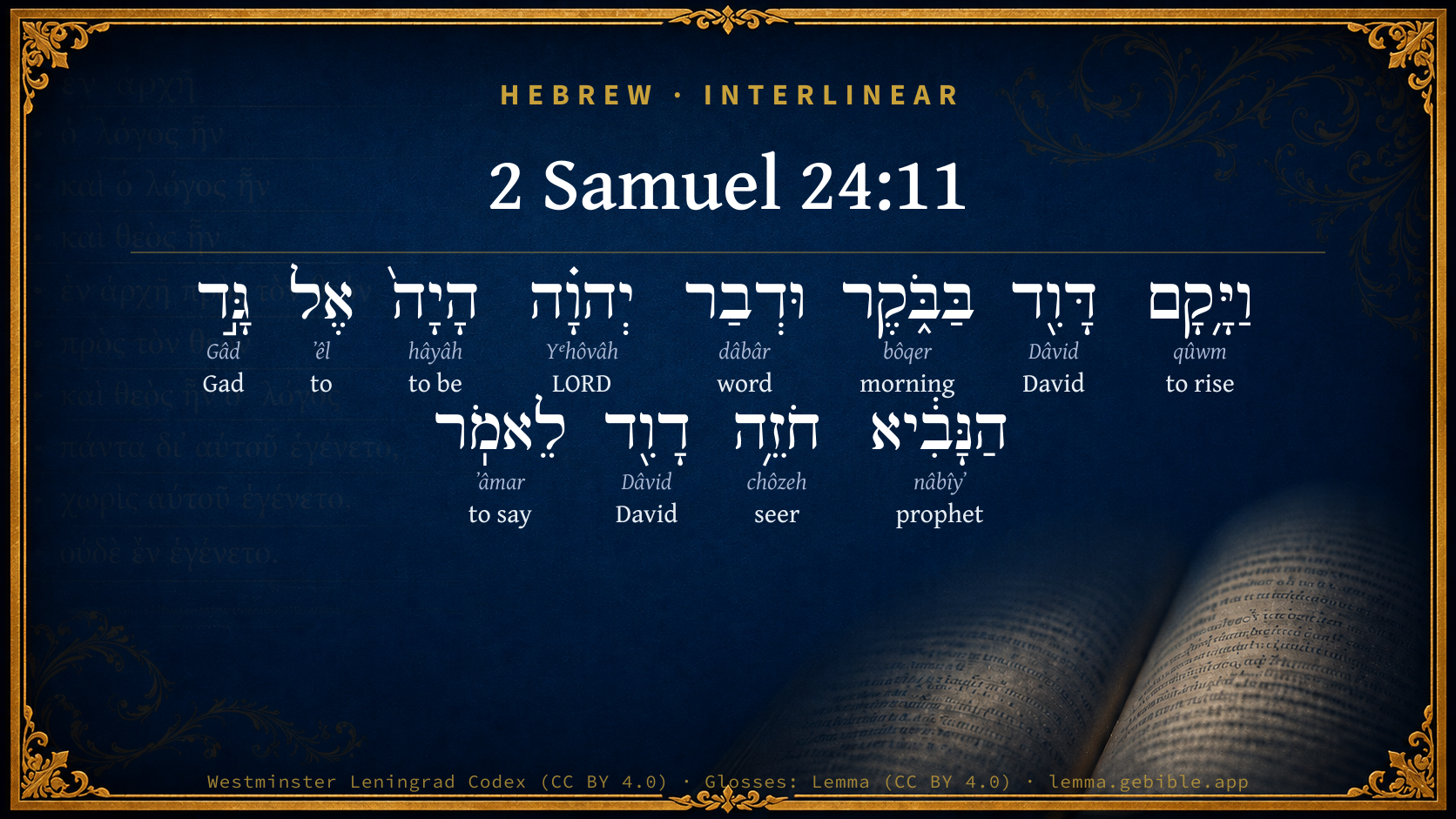
Hebrew (Westminster Leningrad Codex) 2 Samuel 24:11 appears in the Hebrew Old Testament. The text above is from the Westminster Leningrad Codex. Each word links to its Strong’s number, a concise gloss, and parsing drawn from the Open Scriptures Hebrew Bible morphology. Click any word for its full Brown-Driver-Briggs (BDB) entry.
Download image
Cite this verse

2 Samuel 24:11 (World English Bible). Public Domain. Lemma interlinear Bible study tool, https://lemma.gebible.app/v/2-samuel/24/11.

Show BibTeX & RIS
BibTeX
RIS
English Translation
When David rose up in the morning, the word of Yahweh came to the prophet Gad, David's seer, saying,
World English Bible · Public Domain
Highlights Full analysis ↓
Download a study sheet

One document with this verse’s original text, its word-by-word gloss line, the meaning frame, cross-references with their text, attributed commentary, and full source and license credits — printable, and it pastes into notes with its structure intact.

This verse Autodidact and up

Study sheet (.html) Plain text (.txt)

A passage Seminary Student

Up to 50 verses in one chapter. A passage sheet keeps up to 6 commentary sources and 12 cross-references per verse, in the order this page ranks them, and says so on the sheet whenever that leaves anything out. Ask for a single verse and you get the Autodidact verse sheet above.

Everything on this page stays free to read, with no account — the sheet is a download of what is already on screen, not access to it.

Want to remove ads? Support Godless Engineer
Compare translations 3

The same verse in 3 English versions, stacked beneath the original-language interlinear above. Click any original word for its lexicon entry.

Each is an independent rendering of the whole verse — the interlinear is not word-aligned to these translations.

Highlighted words mark where these versions differ — a whole-verse word diff, not a word-by-word alignment.

  • World English Bible Public Domain
    When David rose up in the morning, the word of Yahweh came to the prophet Gad, David's seer, saying,
  • King James Version Public Domain
    For when David was up in the morning, the word of the LORD came unto the prophet Gad, David's seer, saying,
  • unfoldingWord Literal Text CC BY-SA 4.0
    And David arose in the morning, and the word of Yahweh was to Gad, the prophet, a seer of David, saying,

unfoldingWord Literal Text — © unfoldingWord, licensed CC BY-SA 4.0. Word-aligned USFM3 via Door43 (git.door43.org/unfoldingWord/en_ult).

Versions to compare (up to 4)

3 of 4 selected

Show all 18 translations

Every available English version of this verse, each an independent rendering of the whole verse.

  • World English Bible Public Domain
    When David rose up in the morning, the word of Yahweh came to the prophet Gad, David's seer, saying,
  • Berean Standard Bible Public Domain
    When David got up in the morning, a revelation from the LORD had come to Gad the prophet, David’s seer:
  • Majority Standard Bible Public Domain
    When David got up in the morning, the word of the LORD had come to Gad the prophet, David’s seer:
  • King James Version Public Domain
    For when David was up in the morning, the word of the LORD came unto the prophet Gad, David's seer, saying,
  • American Standard Version (1901) Public Domain
    And when David rose up in the morning, the word of Jehovah came unto the prophet Gad, David's seer, saying,
  • Revised Version (1885) Public Domain
    And when David rose up in the morning, the word of the LORD came unto the prophet Gad, David’s seer, saying,
  • Geneva Bible (1599) Public Domain
    And when Dauid was vp in the morning, the worde of the Lord came vnto the Prophet Gad Dauids Seer, saying,
  • Douay-Rheims (1899) Public Domain
    And David arose in the morning, and the word of the Lord came to Gad the prophet and the seer of David, saying:
  • Young's Literal Translation Public Domain
    And David riseth in the morning, and the word of Jehovah hath been unto Gad the prophet, seer of David, saying,
  • Literal Standard Version CC BY-SA 4.0
    And David rises in the morning, and the word of YHWH has been to Gad the prophet, seer of David, saying,
  • Unlocked Literal Bible CC BY-SA 4.0
    When David rose up in the morning, the word of Yahweh came to the prophet Gad, David's seer, saying,
  • unfoldingWord Literal Text CC BY-SA 4.0
    And David arose in the morning, and the word of Yahweh was to Gad, the prophet, a seer of David, saying,
  • Darby Bible Public Domain
    And when David arose in the morning, the word of Jehovah came to the prophet Gad, David's seer, saying,
  • World Messianic Bible Public Domain
    When David rose up in the morning, the LORD’s word came to the prophet Gad, David’s seer, saying,
  • Webster's Bible Public Domain
    For when David had risen in the morning, the word of the LORD came to the prophet Gad, David's seer, saying,
  • Free Bible Version CC BY-SA 4.0
    When David got up in the morning, the Lord had sent a message to the prophet Gad, David's seer, saying,
  • Bible in Basic English Public Domain
    And David got up in the morning; now the word of the Lord had come to the prophet Gad, David's seer, saying,
  • JPS Tanakh (1917) Public Domain
    And when David rose up in the morning, the word of the LORD came unto the prophet Gad, David's seer, saying:

Literal Standard Version (2020), Covenant Press — licensed CC BY-SA 4.0. Text via the HelloAO Bible API (eBible.org). Unlocked Literal Bible (unfoldingWord) — licensed CC BY-SA 4.0. Text via the HelloAO Bible API (eBible.org). unfoldingWord Literal Text — © unfoldingWord, licensed CC BY-SA 4.0. Word-aligned USFM3 via Door43 (git.door43.org/unfoldingWord/en_ult). Free Bible Version, Dr. Jonathan Gallagher — licensed CC BY-SA 4.0. Text via the HelloAO Bible API (eBible.org).

Word by word

More ways to search: Search by grammar → Find every occurrence → Compare this word →

Practice this passage: Drill this verse → Learn its vocabulary →

About this verse

These counts appear in no published source. They are computed here, from the morphology-tagged text and Lemma’s own curated glosses. What Lemma adds →

12
words
11
distinct lemmas
Historical
section

Notable vocabulary

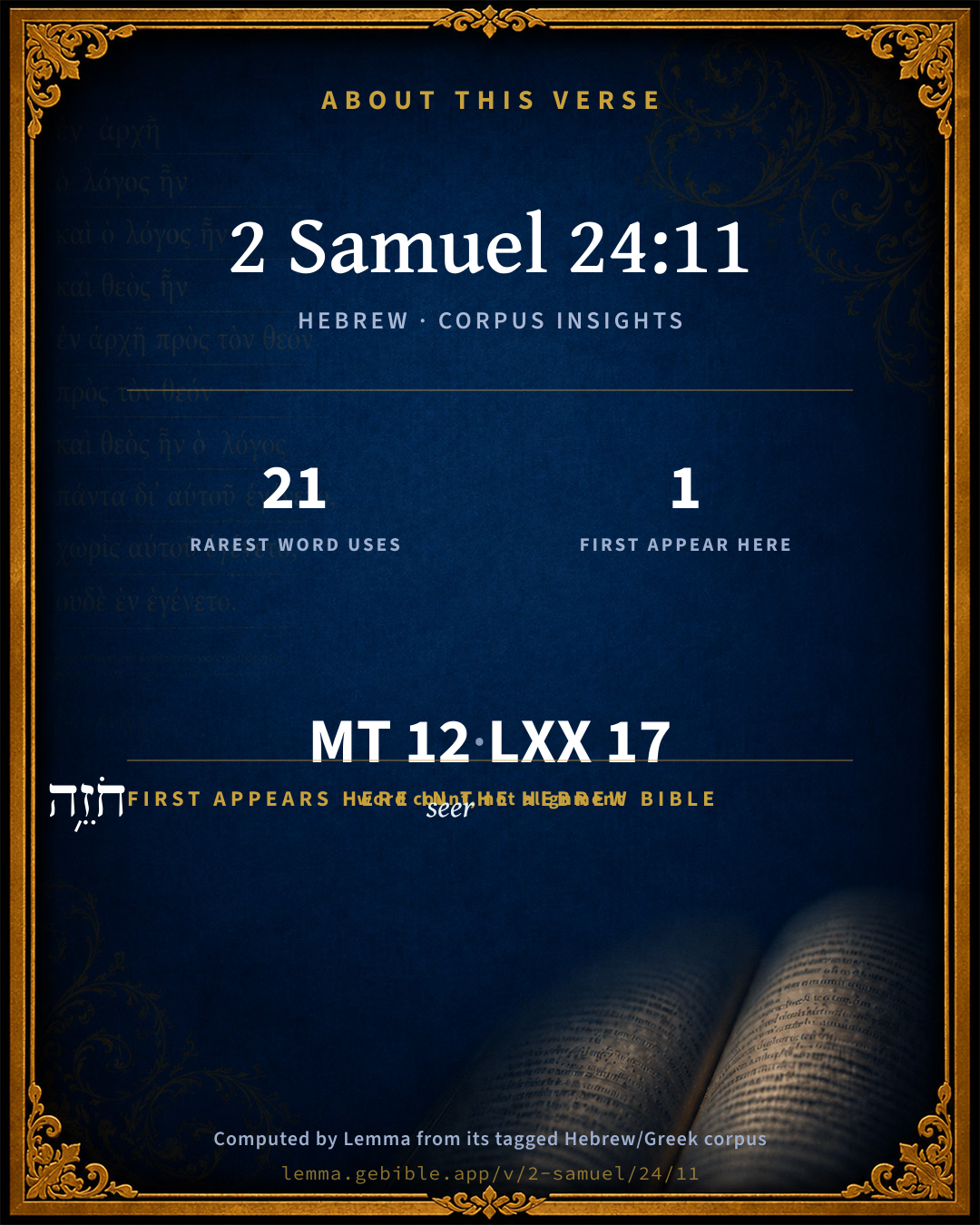
The rarest word here is חֹזֵ֥ה seer H2374 — appearing just 21 times in the whole Hebrew Bible.

First appearance in Scripture

This word makes its first canonical appearance in the Hebrew Bible here:

  • חֹזֵ֥ה seer H2374

Shared distinctive vocabulary

חֹזֵ֥ה seer H2374 occurs in 21 verses of the Hebrew Bible. Also found in:

Grammatical profile

  • 3 verbs
  • 8 nouns
  • 1 preposition

Verb forms

  • וַיָּ֥קָם Qal · Sequential Imperfect
  • הָיָה֙ Qal · Perfect
  • לֵאמֹֽר Qal · Infinitive Construct

Repetition

A word recurs within this verse — often emphatic in Hebrew:

  • דָּוִ֖ד David H1732 ×2

Hebrew & Septuagint length

In English translation the verse runs 19 words from the Hebrew and 27 from the Septuagint (LXX English) — the Septuagint runs noticeably longer here. See the side-by-side →

A rough comparison of the two English renderings, which tokenize alike — not a word-level alignment.

Word counts can differ between the Hebrew and the Greek without any difference in meaning — e.g. the Hebrew direct-object marker אֵת has no separate Greek word, and Greek often adds the article ὁ.

In the original languages it is 12 Hebrew tokens and 17 Greek tokens — but the two are counted differently (Hebrew bundles its prefixes and suffixes into one token; the Greek is in lemma form), so that isn’t a like-for-like length.

Cross-references

4

Topical passages linked to 2 Samuel 24:11 in the Treasury of Scripture Knowledge — connected by theme and wording, ordered by reader-vote popularity; previews shown in the World English Bible.

  • 1 Samuel 9:9 (In earlier times in Israel, when a man went to inquire of God, thus he said, Come, and let us go to the seer; for he who is now called a Prophet was before called a Seer.)
  • 1 Samuel 22:5 The prophet Gad said to David, Don't stay in the stronghold; depart, and get you into the land of Judah. Then David departed, and came into the forest of Hereth.
  • 1 Chronicles 29:29 Now the acts of David the king, first and last, behold, they are written in the history of Samuel the seer, and in the history of Nathan the prophet, and in the history of Gad the seer,
  • 1 Chronicles 2:19 Azubah died, and Caleb took to him Ephrath, who bore him Hur.

Cross-references courtesy of OpenBible.info (CC BY 4.0).

Hebrew and Greek witnesses Masoretic Hebrew ↔ Greek Septuagint

The same verse in the two great witnesses to the Old Testament, shown verse-for-verse.

Here the Septuagint runs noticeably longer than the Hebrew — LXX2012 (modern English Septuagint) 27 words vs World English Bible 19. A rough length comparison of the two English translations, not a word-level alignment — read both below.

These are two independent witnesses, not word-aligned to each other, and the Septuagint is shown in lemma (dictionary) form.

Hebrew 2 Samuel 24:11 Masoretic · Westminster Leningrad Codex

וַיָּ֥קָם דָּוִ֖ד בַּבֹּ֑קֶר וּדְבַר יְהוָ֗ה הָיָה֙ אֶל גָּ֣ד הַנָּבִ֔יא חֹזֵ֥ה דָוִ֖ד לֵאמֹֽר

When David rose up in the morning, the word of Yahweh came to the prophet Gad, David's seer, saying,

World English Bible · Public Domain

Greek LXX 2 Samuel 24:11 Septuagint · lemma form

καί ἀναἵστημι δαυίδ ὁ πρωί καί λόγος κύριος γίγνομαι πρός γαδ ὁ προφήτης ὁ ὁράω δαυίδ λέγω

And David rose early in the morning, and the word of the Lord came to the prophet Gad, the seer, saying, Go, and speak to David, saying,

LXX2012 (modern English Septuagint) · Public Domain

On this verse, Joseph Benson's Commentary discusses the Septuagint’s reading. Read the note in Commentary ↓

Hebrew: Westminster Leningrad Codex (CC BY 4.0). Greek: Septuagint (public domain); English from LXX2012 (modern English Septuagint) (Public Domain). How the Septuagint differs from the Hebrew →

Targum (Aramaic paraphrase)

1

The Targum is the ancient Jewish Aramaic paraphrase of the Hebrew Scriptures — an interpretive translation, not the Hebrew text itself. Onkelos (literal) and Pseudo-Jonathan (expansive) render the Torah, and Jonathan the Prophets. Coverage is partial: where no permissively-licensed English translation exists for a verse, only the Aramaic is shown. This is verse-level text, not a word-by-word alignment to the Hebrew.

  1. Targum Jonathan Prophets (Joshua–Malachi)
    וְקָם דָוִד בְּצַפְרָא וּפִתְגַם נְבוּאָה מִן קֳדָם יְיָ הֲוָה עִם גָד נְבִיָא חֶזְוַיָא דְדָוִד לְמֵימָר:

    (no public-domain English translation for this verse)

    Targum Jonathan — Aramaic: “Mikraot Gedolot” (public domain). English: “Sefaria Community Translation” (CC0 1.0 (public-domain dedication)); “London "Chaldee Paraphrase," 1871” (public domain). Text via Sefaria.

Commentary

Notes on 2 Samuel 24:11 from classic Christian and Jewish commentators (each source and its license shown beneath its notes). The classic Christian expositions comment on the surrounding passage and are grouped to its opening verse, so a note may address several verses; the Jewish commentaries on the Tanakh (Rashi and others) are per-verse, so they appear only where the commentator wrote on this verse.

Lemma curates 59 commentaries, every one of them public domain or Creative Commons licensed, each selected and text-cleaned for this edition rather than reprinted as found. About our sources →

Trapp's Complete Commentary

John Trapp

2Sa 24:11 For when David was up in the morning, the word of the LORD came unto the prophet Gad, David’s seer, saying,

Ver. 11. And when David was up in the morning.] Having prayed the night afore in faith, that God would take away his iniquity, and own him for his servant, for he knew that he had deserved to be discountenanced and rejected for ever. His sin was doubtless pardoned; but in his people - his pride - he must be punished. Gad therefore cometh to him, and saith in effect, as that other prophet did to the wife of Jeroboam, {1Ki 14:6} "I am sent to thee with heavy tidings."

John Trapp, A Commentary or Exposition upon All the Books of the Old and New Testament (1647–1656) — public domain. Text from a community e-Sword module.

Joseph Benson's Commentary

2Sa 24:11-13. For when David was up in the morning — The words thus translated give the reader to apprehend that David’s penitence was caused by Gad’s threat, which certainly was not the case. He was made sensible of his sin and made sorry for it before Gad came to him. They should here be rendered, And when David was up, &c., David’s seer — Gad is so called because he was David’s domestic prophet, by whom he consulted God in difficult cases, and received his directions and commands. I offer thee three things — To show him and the world that the vengeance he now came to denounce was no casual calamity, nor the effects of any natural cause, he gave him his choice of the three evils, one of which must be immediately inflicted upon him. Shall seven years of famine come unto thee — In 1Ch 21:12, it is only three years of famine which is the reading of the LXX.; a reading, says Houbigant, which I prefer in this place, because the three years of famine answer to the three months’ flight before his enemies, and the three days’ pestilence. It is easy to suppose here, as in 2Sa 24:9, that a slight mistake has been made by the writer in transcribing the text. If this be not satisfactory to the reader, he may suppose, with Poole and others, that in Chronicles the sacred writer speaks exactly of those years of famine only which came for David’s sin: but that here he speaks comprehensively, including those three years of famine sent for Saul’s sin, chap. 21. And this sin of David’s being committed in the year next after them, was in a manner a year of famine; either because it was a sabbatical year, wherein they might not sow nor reap; or rather because, not being able to sow in the third year, on account of the excessive drought, they were not capable of reaping this fourth year. And three years more being added to these four, make up the seven here mentioned. So the meaning of the words is this: As thou hast already had four years of famine, shall three years more come? Now advise — That is, consider. The divine wisdom appears in the nature of the offer here made to David; he had sinned by placing his heart on human means of safety and security, instead of placing it on the divine protection. A trial was therefore made of him by this offer, how his heart now stood, and whether it would not fly to human means for safety. He had numbered his people, that he might rest in confidence by knowing the strength of his kingdom. Had not, therefore, his heart smote him, as mentioned 2Sa 24:10, and had he not seen the sin and folly of seeking safety in human strength, independent of the Almighty, he would, in all likelihood, have chosen to have tried his fortune with his enemies in war, as depending on the known strength, courage, and number of his people. Or he would have chosen famine, as depending on his great riches for obtaining a sufficient supply of food from other countries, though the famine should come into his land. But by humbly and confidently leaving it to God, to inflict either of those punishments which come more immediately from his own hand, and one of which, namely, the pestilence, he knew no human power or means could any ways guard against, and from which all his mighty men of war, or his own valour and wisdom, could not defend him, but he would lie equally exposed as the meanest subject; by such a submission or choice as this, David gave a public testimony, that he was again convinced that all human means or strength avails nothing, unless we have the help and protection of the Almighty; that all our confidence is vain, unless that which is placed in the Lord.

Joseph Benson's Commentary on the Old and New Testaments (1811–1818) — public domain. Text from a community e-Sword module.

Tyndale Open Study Notes

Tyndale Open Resources

24:11 Gad . . . David’s seer appears only here and in 1 Sam 22:5. Seer is an early name for a prophet (1 Sam 9:9, 19). Unlike pagan magicians or sorcerers, biblical seers had divinely inspired visions (see also 2 Kgs 17:13; Isa 29:10; 30:9-10; Amos 7:12; Mic 3:7) and functioned as God’s messengers.

Tyndale Open Study Notes — © Tyndale Open Resources, licensed CC BY-SA 4.0. Text via the HelloAO Bible API.

Geneva Bible (1599)

Geneva Bible translators

Whom God had appointed for David and his time.

Geneva Bible (1599) marginal notes — public domain. Text via Bolls.life.

Adam Clarke's Commentary

Verse 11. For when David was up] It is supposed that David's contrition arose from the reproof given by Gad, and that in the order of time the reproof came before the confession stated in the 10th verse. 2Sa 24:10

David's seer] A holy man of God, under the Divine influence, whom David had as a domestic chaplain.

Adam Clarke's Commentary on the Bible (1810–1826) — public domain. Text from a community e-Sword/MySword module.

Ellicott's Commentary for English Readers

(1l) For when David.—Read, and when. There is no suggestion in the original, as seems to be implied in the English, that David’s repentance was in consequence of the visit of Gad; on the contrary, it was in consequence of his repentance and confession that the prophet was sent to him.

The prophet Gad.—This prophet has not been mentioned since his warning to David to return from the land of Moab (1Sa_22:5); but he had probably been all along one of David’s counsellors. From 1Ch_29:29 it is not unlikely that this account was written by Gad.

A Bible Commentary for English Readers, edited by Charles John Ellicott (1878–1897) — public domain. Text from a community e-Sword module.

The Cambridge Bible for Schools and Colleges

gen. ed. J. J. S. Perowne

11. For when David was up in the morning] And David arose in the morning, and, &c.: after the recognition and confession of his sin. The E. V. gives the false impression that the conviction of his sin was the result of Gad’s visit, which is not the meaning of the passage. Gad was not sent until after his confession and prayer for pardon.

the prophet Gad, David’s seer] Gad has not been mentioned since he was with David in his wanderings (1Sa_22:5), but no doubt had been acting as his confidential counsellor throughout. The word for “seer” is chôzeh, literally “gazer,” a term first used here in place of the older word “seer,” rôeh. See note on 1Sa_9:9. The narrative before us was not improbably written by Gad himself (1Ch_29:29).

The Cambridge Bible for Schools and Colleges (gen. ed. J. J. S. Perowne; Cambridge University Press, 1878–1918) — public domain. Text from a community e-Sword module.

John Gill's Exposition

For when David was up in the morning,.... Which it is probable was very early, he not being able to sleep through the distress of mind he was in; for the words should be rendered, "and David arose in the morning" (c), for, as we render them, they seem to imply as if he had no sense of his sin before the prophet came to him next mentioned; whereas it was in the night he had been under the conviction of it, and had acknowledged it, and prayed for the pardon of it; upon which the prophet was sent to acquaint him what was the will of God concerning him:

the word of the Lord came unto the prophet Gad, David's seer; with whom he had used to advise about the will of God on various occasions, though in this he had neglected to consult him; the Targum calls it the word of prophecy from the Lord:

saying; as follows.

(c) "et surrexit", Pagninus, Montanus, &c.

John Gill's Exposition of the Whole Bible (1746–1763) — public domain (CC PDM 1.0). Text via the HelloAO Bible API.

Albert Barnes' Notes on the Bible

David’s seer - Margin, references. From the latter passage it is probable that we have here Gad’s narrative.

Albert Barnes' Notes on the Bible (1834–1885) — public domain. Text from a community e-Sword/MySword module.

Haydock's Catholic Bible Commentary

And seer. This was a peculiar distinction of the prophet, (Haydock) who was appointed to direct David, (Menochius) to whom he had been long attached, 1 Kings xxii. 5. (Calmet0

George Leo Haydock (1774–1849), Haydock's Catholic Family Bible and Commentary, 1859 edition — public domain. Excludes Psalms (Douay-Rheims chapter numbering differs from Protestant) and Deuterocanonical books (Catholic canon only).

Matthew Poole's English Annotations

David’s seer; so called, because he was a prophet, (for such were called seers, 1Sa 9:9) now and at other times employed by God to reveal his mind and will to David. See 1Sa 22:5; 1Ch 29:29.

Matthew Poole's English Annotations on the Holy Bible (1683–1685) — public domain. Text from a community e-Sword/MySword module.

Whedon's Commentary on the Bible

Daniel D. Whedon

11. When David was up — From his bed, where probably all night he had watered his couch with his tears. See Psa_6:6, which was, perhaps, composed on this sad occasion.

Gad — Who had been with him in his early wanderings. 1Sa_22:5.

Seer — See note on 1Sa_9:9.

Daniel D. Whedon (gen. ed.), Commentary on the Old and New Testaments (1874–1909) — public domain. Text from a community e-Sword module.

The Pulpit Commentary

For when, etc.; Hebrew, and David arose in the morning, and a word of Jehovah came unto Gad, a seer of David, saying. The visit of the seer was the result of David"s repentance, and not its cause. And he was sent in mercy, that, after such punishment as would cure both king and people of their folly, there might be for both forgiveness. The name for seer is not roeh, the old word used in 1Sa_9:9, and which simply means "one who sees;" but chozeh, a gazer, one who looks with fixed eyes, that penetrate into the hidden world.

The Pulpit Commentary (1880–1919), ed. H.D.M. Spence-Jones & Joseph S. Exell — public domain. Text from a community e-Sword module.

unfoldingWord translationNotes

Door43 World Missions Community

the word of Yahweh came to the prophet Gad, David's seer, saying, "Go

The idiom "the word of Yahweh came to" is used to introduce a special message from God. See how you translated this idiom in 2 Samuel 7:4. AT: "Yahweh gave a message to the prophet Gad, David's seer. He said, 'Go" or "Yahweh spoke this message to the prophet Gad, David's seer: 'Go" (See: Idiom)

David's seer

This means Gad was the official prophet in the royal palace.

translationWords

raise

word of God

prophet

Gad

unfoldingWord translationNotes — © Distant Shores Media and the Door43 World Missions Community, licensed CC BY-SA 4.0. Source: git.door43.org/Door43/en_tn.

Lesson kit

Teaching starters — assembled from the data on this page, not authored interpretation. Every prompt links to the verse data it draws on. Edit before teaching.

2 Samuel, in the Historical, opens this verse with 12 words (11 distinct Hebrew lemmas). Its most distinctive word is chôzeh (“seer”). The Greek Septuagint runs longer here. A historical commentator’s framing appears above. Read the whole chapter for the surrounding context.

Discussion questions

  1. How does “seer” (chôzeh) shape what this verse is saying?
  2. This is the first place “seer” appears in Scripture (first appears here). What does its debut here establish?
  3. How does 2 Kings 17:13, which shares the word «seer», read alongside this verse?
  4. What does the repetition of “David” (2× in this one verse) do in this verse?
  5. The Septuagint runs longer here than the Hebrew. What might account for the difference?
  6. These translations render this verse differently. What is at stake in choosing one wording over another?
  7. «וַיָּ֥קָם» is a Qal Sequential Imperfect verb. How does that grammatical form shape the action described?
  8. Compare how Trapp's Complete Commentary and Joseph Benson's Commentary read this verse. Where do they agree or differ?

Things to notice

Reading settings

Reading text

Shown beneath each verse's original-language words.

Old Testament
Old Testament edition

Read the OT as the Masoretic Hebrew (MT) or the Greek Septuagint (LXX).

English shown for the Greek Septuagint (in the Hebrew ↔ Greek comparison).

Comparing translations? Open the Compare panel on any verse page to stack up to four side by side.