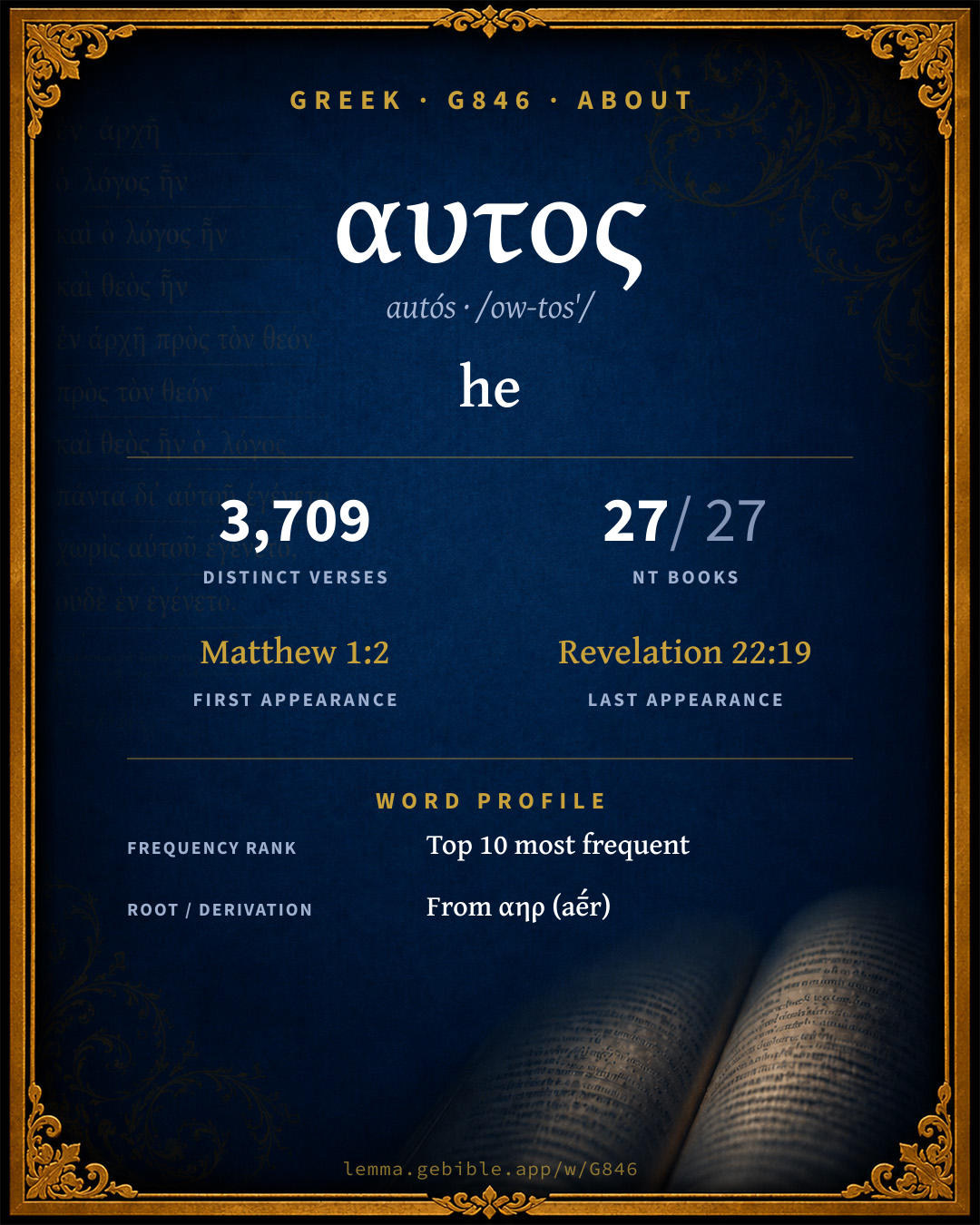
αὐτός
he
‘he’ is one of 3 main senses fuller range ↓
Full lexicon entry — Thayer's Greek Lexicon
From Thayer's Greek Lexicon
Where this word appears
See every Genitive-case word in the Greek New Testament →
Grammar key — what these labels mean
Part of speech
- Personal pronoun
- Stands in for a person already named (“I,” “you,” “he”).
Case
- Genitive
- The case of source, possession, or “of” — answers “whose / from what.”
- Accusative
- The case of the direct object and of extent.
- Dative
- The case of the indirect object, means, or location — “to / for / with / in.”
- Nominative
- The case of the subject (and the predicate nominative).
Gender
- Masculine
- Grammatically masculine.
- Feminine
- Grammatically feminine.
- Neuter
- Grammatically neuter.
Number
- Singular
- One.
- Plural
- More than one.
Page 1 of 2 — showing verses 1–200 of 300 distinct verses where G846 appears in the Accusative case in the Book of Luke. Filtered view — show all forms. Click any verse to open its interlinear word-by-word view. Verse text shown in the World English Bible for context — . Each verse’s Greek form is shown with its reference; the English is not keyword-highlighted, since the data carries no word-level English alignment. Use “Compare translations” on any verse to read it across multiple English versions. This concordance covers the Greek New Testament; Septuagint (Greek Old Testament) occurrences of this word are not indexed here.
Luke
- Luke 1:8 αὐτὸν αὐτοῦ pron acc sg masc pron gen sg masc Now it happened, while he executed the priest's office before God in the order of his division,
- Luke 1:12 αὐτόν pron acc sg masc Zacharias was troubled when he saw him, and fear fell upon him.
- Luke 1:13 αὐτὸν αὐτοῦ pron acc sg masc pron gen sg masc But the angel said to him, "Don't be afraid, Zacharias, because your request has been heard, and your wife, Elizabeth, will bear you a son, and you shall call his name John.
- Luke 1:21 αὐτὸν pron acc sg masc The people were waiting for Zacharias, and they marveled that he delayed in the temple.
- Luke 1:28 αὐτὴν pron acc sg fem Having come in, the angel said to her, "Rejoice, you highly favored one! The Lord is with you. Blessed are you among women!"
- Luke 1:50 αὐτοῦ αὐτόν pron gen sg masc pron acc sg masc His mercy is for generations of generations on those who fear him.
- Luke 1:57 αὐτήν pron acc sg fem Now the time that Elizabeth should give birth was fulfilled, and she brought forth a son.
- Luke 1:59 αὐτὸ αὐτοῦ pron acc sg neut pron gen sg masc It happened on the eighth day, that they came to circumcise the child; and they would have called him Zacharias, after the name of the father.
- Luke 1:61 αὐτὴν pron acc sg fem They said to her, "There is no one among your relatives who is called by this name."
- Luke 1:62 αὐτοῦ αὐτό pron gen sg masc pron acc sg neut They made signs to his father, what he would have him called.
- Luke 1:65 αὐτούς pron acc pl masc Fear came on all who lived around them, and all these sayings were talked about throughout all the hill country of Judea.
- Luke 2:4 αὐτὸν pron acc sg masc Joseph also went up from Galilee, out of the city of Nazareth, into Judea, to the city of David, which is called Bethlehem, because he was of the house and family of David;
- Luke 2:6 αὐτοὺς αὐτήν pron acc pl masc pron acc sg fem It happened, while they were there, that the day had come that she should give birth.
- Luke 2:7 αὐτῆς αὐτὸν αὐτὸν αὐτοῖς pron gen sg fem pron acc sg masc pron acc sg masc pron dat pl masc She brought forth her firstborn son, and she wrapped him in bands of cloth, and laid him in a feeding trough, because there was no room for them in the inn.
- Luke 2:9 αὐτοῖς αὐτούς pron dat pl masc pron acc pl masc Behold, an angel of the Lord stood by them, and the glory of the Lord shone around them, and they were terrified.
- Luke 2:18 αὐτούς pron acc pl masc All who heard it wondered at the things which were spoken to them by the shepherds.
- Luke 2:20 αὐτούς pron acc pl masc The shepherds returned, glorifying and praising God for all the things that they had heard and seen, just as it was told them.
- Luke 2:21 αὐτόν αὐτοῦ αὐτὸν pron acc sg masc pron gen sg masc pron acc sg masc When eight days were fulfilled for the circumcision of the child, his name was called Jesus, which was given by the angel before he was conceived in the womb.
- Luke 2:22 αὐτῶν αὐτὸν pron gen pl masc pron acc sg masc When the days of their purification according to the law of Moses were fulfilled, they brought him up to Jerusalem, to present him to the Lord
- Luke 2:25 αὐτόν pron acc sg masc Behold, there was a man in Jerusalem whose name was Simeon. This man was righteous and devout, looking for the consolation of Israel, and the Holy Spirit was on him.
- Luke 2:27 αὐτοὺς αὐτοῦ pron acc pl masc pron gen sg masc He came in the Spirit into the temple. When the parents brought in the child, Jesus, that they might do concerning him according to the custom of the law,
- Luke 2:28 αὐτὸς αὐτὸ pron nom sg masc pron acc sg neut then he received him into his arms, and blessed God, and said,
- Luke 2:34 αὐτοὺς αὐτοῦ pron acc pl masc pron gen sg masc and Simeon blessed them, and said to Mary, his mother, "Behold, this child is set for the falling and the rising of many in Israel, and for a sign which is spoken against.
- Luke 2:40 αὐτό pron acc sg neut The child was growing, and was becoming strong in spirit, being filled with wisdom, and the grace of God was upon him.
- Luke 2:43 αὐτοὺς αὐτοῦ pron acc pl masc pron gen sg masc and when they had fulfilled the days, as they were returning, the boy Jesus stayed behind in Jerusalem. Joseph and his mother didn't know it,
- Luke 2:44 αὐτὸν αὐτὸν pron acc sg masc pron acc sg masc but supposing him to be in the company, they went a day's journey, and they looked for him among their relatives and acquaintances.
- Luke 2:45 αὐτόν pron acc sg masc When they didn't find him, they returned to Jerusalem, looking for him.
- Luke 2:46 αὐτὸν αὐτῶν αὐτούς pron acc sg masc pron gen pl masc pron acc pl masc It happened after three days they found him in the temple, sitting in the midst of the teachers, both listening to them, and asking them questions.
- Luke 2:48 αὐτὸν αὐτὸν αὐτοῦ pron acc sg masc pron acc sg masc pron gen sg masc When they saw him, they were astonished, and his mother said to him, "Son, why have you treated us this way? Behold, your father and I were anxiously looking for you."
- Luke 2:49 αὐτούς pron acc pl masc He said to them, "Why were you looking for me? Didn't you know that I must be in my Father's house?"
- Luke 3:10 αὐτὸν pron acc sg masc The multitudes asked him, "What then must we do?"
- Luke 3:12 αὐτόν pron acc sg masc Tax collectors also came to be baptized, and they said to him, "Teacher, what must we do?"
- Luke 3:13 αὐτούς pron acc pl masc He said to them, "Collect no more than that which is appointed to you."
- Luke 3:14 αὐτὸν αὐτούς pron acc sg masc pron acc pl masc Soldiers also asked him, saying, "What about us? What must we do?" He said to them, "Extort from no one by violence, neither accuse anyone wrongfully. Be content with your wages."
- Luke 3:22 αὐτόν pron acc sg masc and the Holy Spirit descended in a bodily form as a dove on him; and a voice came out of the sky, saying "You are my beloved Son. In you I am well pleased."
- Luke 4:4 αὐτὸν pron acc sg masc Jesus answered him, saying, "It is written, 'Man shall not live by bread alone, but by every word of God.'"
- Luke 4:5 αὐτὸν αὐτῷ pron acc sg masc pron dat sg masc The devil, leading him up on a high mountain, showed him all the kingdoms of the world in a moment of time.
- Luke 4:6 αὐτῷ αὐτῶν αὐτήν pron dat sg masc pron gen pl fem pron acc sg fem The devil said to him, "I will give you all this authority, and their glory, for it has been delivered to me; and I give it to whomever I want.
- Luke 4:9 αὐτὸν αὐτῷ pron acc sg masc pron dat sg masc He led him to Jerusalem, and set him on the pinnacle of the temple, and said to him, "If you are the Son of God, cast yourself down from here,
- Luke 4:21 αὐτοὺς pron acc pl masc He began to tell them, "Today, this Scripture has been fulfilled in your hearing."
- Luke 4:23 αὐτούς pron acc pl masc He said to them, "Doubtless you will tell me this parable, 'Physician, heal yourself! Whatever we have heard done at Capernaum, do also here in your hometown.'"
- Luke 4:29 αὐτὸν αὐτὸν αὐτῶν αὐτόν pron acc sg masc pron acc sg masc pron gen pl masc pron acc sg masc They rose up, threw him out of the city, and led him to the brow of the hill that their city was built on, that they might throw him off the cliff.
- Luke 4:31 αὐτοὺς pron acc pl masc He came down to Capernaum, a city of Galilee. He was teaching them on the Sabbath day,
- Luke 4:35 αὐτῷ αὐτοῦ αὐτὸν αὐτοῦ αὐτόν pron dat sg neut pron gen sg masc pron acc sg masc pron gen sg masc pron acc sg masc Jesus rebuked him, saying, "Be silent, and come out of him!" When the demon had thrown him down in their midst, he came out of him, having done him no harm.
- Luke 4:38 αὐτὸν αὐτῆς pron acc sg masc pron gen sg fem He rose up from the synagogue, and entered into Simon's house. Simon's mother-in-law was afflicted with a great fever, and they begged him for her.
- Luke 4:39 αὐτῆς αὐτήν αὐτοῖς pron gen sg fem pron acc sg fem pron dat pl masc He stood over her, and rebuked the fever; and it left her. Immediately she rose up and served them.
- Luke 4:40 αὐτοὺς αὐτόν αὐτῶν αὐτούς pron acc pl masc pron acc sg masc pron gen pl masc pron acc pl masc When the sun was setting, all those who had any sick with various diseases brought them to him; and he laid his hands on every one of them, and healed them.
- Luke 4:41 αὐτὰ αὐτὸν pron acc pl neut pron acc sg masc Demons also came out from many, crying out, and saying, "You are the Christ, the Son of God!" Rebuking them, he didn't allow them to speak, because they knew that he was the Christ.
- Luke 4:42 αὐτόν αὐτοῦ αὐτὸν αὐτῶν pron acc sg masc pron gen sg masc pron acc sg masc pron gen pl masc When it was day, he departed and went into an uninhabited place, and the multitudes looked for him, and came to him, and held on to him, so that he wouldn't go away from them.
- Luke 4:43 αὐτοὺς pron acc pl masc But he said to them, "I must preach the good news of the Kingdom of God to the other cities also. For this reason I have been sent."
- Luke 5:3 αὐτὸν pron acc sg masc He entered into one of the boats, which was Simon's, and asked him to put out a little from the land. He sat down and taught the multitudes from the boat.
- Luke 5:7 αὐτοῖς αὐτά pron dat pl masc pron acc pl neut They beckoned to their partners in the other boat, that they should come and help them. They came, and filled both boats, so that they began to sink.
- Luke 5:9 αὐτὸν αὐτῷ pron acc sg masc pron dat sg masc For he was amazed, and all who were with him, at the catch of fish which they had caught;
- Luke 5:12 αὐτὸν αὐτοῦ pron acc sg masc pron gen sg masc It happened, while he was in one of the cities, behold, there was a man full of leprosy. When he saw Jesus, he fell on his face, and begged him, saying, "Lord, if you want to, you can make me clean."
- Luke 5:17 αὐτὸς αὐτόν pron nom sg masc pron acc sg masc It happened on one of those days, that he was teaching; and there were Pharisees and teachers of the law sitting by, who had come out of every village of Galilee, Judea, and Jerusalem. The power of the Lord was with him to heal them.
- Luke 5:18 αὐτὸν αὐτοῦ pron acc sg masc pron gen sg masc Behold, men brought a paralyzed man on a cot, and they sought to bring him in to lay before Jesus.
- Luke 5:19 αὐτὸν αὐτὸν pron acc sg masc pron acc sg masc Not finding a way to bring him in because of the multitude, they went up to the housetop, and let him down through the tiles with his cot into the midst before Jesus.
- Luke 5:22 αὐτῶν αὐτούς pron gen pl masc pron acc pl masc But Jesus, perceiving their thoughts, answered them, "Why are you reasoning so in your hearts?
- Luke 5:31 αὐτούς pron acc pl masc Jesus answered them, "Those who are healthy have no need for a physician, but those who are sick do.
- Luke 5:33 αὐτόν pron acc sg masc They said to him, "Why do John's disciples often fast and pray, likewise also the disciples of the Pharisees, but yours eat and drink?"
- Luke 5:34 αὐτούς αὐτῶν pron acc pl masc pron gen pl masc He said to them, "Can you make the friends of the bridegroom fast, while the bridegroom is with them?
- Luke 5:36 αὐτοὺς pron acc pl masc He also told a parable to them. "No one puts a piece from a new garment on an old garment, or else he will tear the new, and also the piece from the new will not match the old.
- Luke 6:1 αὐτὸν αὐτοῦ pron acc sg masc pron gen sg masc Now it happened on the second Sabbath after the first, that he was going through the grain fields. His disciples plucked the heads of grain, and ate, rubbing them in their hands.
- Luke 6:3 αὐτοὺς αὐτὸς αὐτοῦ pron acc pl masc pron nom sg masc pron gen sg masc Jesus, answering them, said, "Haven't you read what David did when he was hungry, he, and those who were with him;
- Luke 6:6 αὐτὸν αὐτοῦ pron acc sg masc pron gen sg masc It also happened on another Sabbath that he entered into the synagogue and taught. There was a man there, and his right hand was withered.
- Luke 6:9 αὐτούς pron acc pl masc Then Jesus said to them, "I will ask you something: Is it lawful on the Sabbath to do good, or to do harm? To save a life, or to kill?"
- Luke 6:10 αὐτοὺς αὐτῷ αὐτοῦ pron acc pl masc pron dat sg masc pron gen sg masc He looked around at them all, and said to the man, "Stretch out your hand." He did, and his hand was restored as sound as the other.
- Luke 6:12 αὐτὸν pron acc sg masc It happened in these days, that he went out to the mountain to pray, and he continued all night in prayer to God.
- Luke 6:23 αὐτὰ αὐτῶν pron acc pl neut pron gen pl masc Rejoice in that day, and leap for joy, for behold, your reward is great in heaven, for their fathers did the same thing to the prophets.
- Luke 6:26 αὐτὰ αὐτῶν pron acc pl neut pron gen pl masc Woe, when men speak well of you! For their fathers did the same thing to the false prophets.
- Luke 6:32 αὐτοὺς pron acc pl masc If you love those who love you, what credit is that to you? For even sinners love those who love them.
- Luke 6:33 αὐτὸ pron acc sg neut If you do good to those who do good to you, what credit is that to you? For even sinners do the same.
- Luke 6:47 αὐτούς pron acc pl masc Everyone who comes to me, and hears my words, and does them, I will show you who he is like.
- Luke 6:48 αὐτὴν αὐτήν pron acc sg fem pron acc sg fem He is like a man building a house, who dug and went deep, and laid a foundation on the rock. When a flood arose, the stream broke against that house, and could not shake it, because it was founded on the rock.
- Luke 7:3 αὐτὸν αὐτὸν αὐτοῦ pron acc sg masc pron acc sg masc pron gen sg masc When he heard about Jesus, he sent to him elders of the Jews, asking him to come and save his servant.
- Luke 7:4 αὐτὸν pron acc sg masc When they came to Jesus, they begged him earnestly, saying, "He is worthy for you to do this for him,
- Luke 7:9 αὐτόν αὐτῷ pron acc sg masc pron dat sg masc When Jesus heard these things, he marveled at him, and turned and said to the multitude who followed him, "I tell you, I have not found such great faith, no, not in Israel."
- Luke 7:13 αὐτὴν αὐτὴν αὐτῇ pron acc sg fem pron acc sg fem pron dat sg fem When the Lord saw her, he had compassion on her, and said to her, "Don't cry."
- Luke 7:15 αὐτὸν αὐτοῦ pron acc sg masc pron gen sg masc He who was dead sat up, and began to speak. And he gave him to his mother.
- Luke 7:20 αὐτὸν pron acc sg masc When the men had come to him, they said, "John the Baptizer has sent us to you, saying, 'Are you he who comes, or should we look for another?'"
- Luke 7:36 αὐτὸν αὐτοῦ pron acc sg masc pron gen sg masc One of the Pharisees invited him to eat with him. He entered into the Pharisee's house, and sat at the table.
- Luke 7:39 αὐτὸν αὐτοῦ pron acc sg masc pron gen sg masc Now when the Pharisee who had invited him saw it, he said to himself, "This man, if he were a prophet, would have perceived who and what kind of woman this is who touches him, that she is a sinner."
- Luke 7:40 αὐτόν pron acc sg masc Jesus answered him, "Simon, I have something to tell you." He said, "Teacher, say on."
- Luke 7:42 αὐτῶν αὐτῶν αὐτόν pron gen pl masc pron gen pl masc pron acc sg masc When they couldn't pay, he forgave them both. Which of them therefore will love him most?"
- Luke 8:4 αὐτὸν pron acc sg masc When a great multitude came together, and people from every city were coming to him, he spoke by a parable.
- Luke 8:5 αὐτοῦ αὐτὸν αὐτό pron gen sg masc pron acc sg masc pron acc sg neut "The farmer went out to sow his seed. As he sowed, some fell along the road, and it was trampled under foot, and the birds of the sky devoured it.
- Luke 8:7 αὐτό pron acc sg neut Other fell amid the thorns, and the thorns grew with it, and choked it.
- Luke 8:9 αὐτὸν αὐτοῦ pron acc sg masc pron gen sg masc Then his disciples asked him, "What does this parable mean?"
- Luke 8:16 αὐτὸν pron acc sg masc "No one, when he has lit a lamp, covers it with a container, or puts it under a bed; but puts it on a stand, that those who enter in may see the light.
- Luke 8:19 αὐτὸν αὐτοῦ αὐτοῦ αὐτῷ pron acc sg masc pron gen sg masc pron gen sg masc pron dat sg masc His mother and brothers came to him, and they could not come near him for the crowd.
- Luke 8:21 αὐτούς pron acc pl masc But he answered them, "My mother and my brothers are these who hear the word of God, and do it."
- Luke 8:22 αὐτὸς αὐτοῦ αὐτούς pron nom sg masc pron gen sg masc pron acc pl masc Now it happened on one of those days, that he entered into a boat, himself and his disciples, and he said to them, "Let's go over to the other side of the lake." So they launched out.
- Luke 8:24 αὐτὸν pron acc sg masc They came to him, and awoke him, saying, "Master, master, we are dying!" He awoke, and rebuked the wind and the raging of the water, and they ceased, and it was calm.
- Luke 8:29 αὐτόν pron acc sg masc For Jesus was commanding the unclean spirit to come out of the man. For the unclean spirit had often seized the man. He was kept under guard, and bound with chains and fetters. Breaking the bands apart, he was driven by the demon into the desert.
- Luke 8:30 αὐτὸν αὐτόν pron acc sg masc pron acc sg masc Jesus asked him, "What is your name?" He said, "Legion," for many demons had entered into him.
- Luke 8:31 αὐτὸν αὐτοῖς pron acc sg masc pron dat pl neut They begged him that he would not command them to go into the abyss.
- Luke 8:32 αὐτὸν αὐτοῖς αὐτοῖς pron acc sg masc pron dat pl neut pron dat pl neut Now there was there a herd of many pigs feeding on the mountain, and they begged him that he would allow them to enter into those. He allowed them.
- Luke 8:37 αὐτὸν αὐτῶν αὐτὸς pron acc sg masc pron gen pl neut pron nom sg masc All the people of the surrounding country of the Gadarenes asked him to depart from them, for they were very much afraid. He entered into the boat, and returned.
- Luke 8:38 αὐτοῦ αὐτῷ αὐτὸν pron gen sg masc pron dat sg masc pron acc sg masc But the man from whom the demons had gone out begged him that he might go with him, but Jesus sent him away, saying,
- Luke 8:40 αὐτὸν αὐτόν pron acc sg masc pron acc sg masc It happened, when Jesus returned, that the multitude welcomed him, for they were all waiting for him.
- Luke 8:41 αὐτὸς αὐτὸν αὐτοῦ pron nom sg masc pron acc sg masc pron gen sg masc Behold, there came a man named Jairus, and he was a ruler of the synagogue. He fell down at Jesus' feet, and begged him to come into his house,
- Luke 8:42 αὐτῷ αὐτὴ αὐτὸν αὐτόν pron dat sg masc pron nom sg fem pron acc sg masc pron acc sg masc for he had an only daughter, about twelve years of age, and she was dying. But as he went, the multitudes pressed against him.
- Luke 8:52 αὐτήν pron acc sg fem All were weeping and mourning her, but he said, "Don't weep. She isn't dead, but sleeping."
- Luke 9:2 αὐτοὺς pron acc pl masc He sent them forth to preach the Kingdom of God, and to heal the sick.
- Luke 9:3 αὐτούς pron acc pl masc He said to them, "Take nothing for your journey--neither staffs, nor wallet, nor bread, nor money; neither have two coats apiece.
- Luke 9:5 αὐτούς pron acc pl masc As many as don't receive you, when you depart from that city, shake off even the dust from your feet for a testimony against them."
- Luke 9:9 αὐτόν pron acc sg masc Herod said, "John I beheaded, but who is this, about whom I hear such things?" He sought to see him.
- Luke 9:10 αὐτῷ αὐτοὺς pron dat sg masc pron acc pl masc The apostles, when they had returned, told him what things they had done. He took them, and withdrew apart to a deserted place of a city called Bethsaida.
- Luke 9:11 αὐτῷ αὐτοὺς αὐτοῖς pron dat sg masc pron acc pl masc pron dat pl masc But the multitudes, perceiving it, followed him. He welcomed them, and spoke to them of the Kingdom of God, and he cured those who needed healing.
- Luke 9:13 αὐτούς αὐτοῖς pron acc pl masc pron dat pl masc But he said to them, "You give them something to eat." They said, "We have no more than five loaves and two fish, unless we should go and buy food for all these people."
- Luke 9:14 αὐτοῦ αὐτοὺς pron gen sg masc pron acc pl masc For they were about five thousand men. He said to his disciples, "Make them sit down in groups of about fifty each."
- Luke 9:16 αὐτοὺς pron acc pl masc He took the five loaves and the two fish, and looking up to the sky, he blessed them, and broke them, and gave them to the disciples to set before the multitude.
- Luke 9:18 αὐτὸν αὐτῷ αὐτοὺς pron acc sg masc pron dat sg masc pron acc pl masc It happened, as he was praying alone, that the disciples were with him, and he asked them, "Who do the multitudes say that I am?"
- Luke 9:24 αὐτοῦ αὐτήν αὐτοῦ αὐτήν pron gen sg masc pron acc sg fem pron gen sg masc pron acc sg fem For whoever desires to save his life will lose it, but whoever will lose his life for my sake, the same will save it.
- Luke 9:29 αὐτὸν αὐτοῦ αὐτοῦ pron acc sg masc pron gen sg masc pron gen sg masc As he was praying, the appearance of his face was altered, and his clothing became white and dazzling.
- Luke 9:33 αὐτοὺς αὐτοῦ pron acc pl masc pron gen sg masc It happened, as they were parting from him, that Peter said to Jesus, "Master, it is good for us to be here. Let's make three tents: one for you, and one for Moses, and one for Elijah," not knowing what he said.
- Luke 9:34 αὐτοῦ αὐτούς αὐτοὺς pron gen sg masc pron acc pl masc pron acc pl masc While he said these things, a cloud came and overshadowed them, and they were afraid as they entered into the cloud.
- Luke 9:39 αὐτόν αὐτὸν αὐτοῦ αὐτόν pron acc sg masc pron acc sg masc pron gen sg masc pron acc sg masc Behold, a spirit takes him, he suddenly cries out, and it convulses him so that he foams, and it hardly departs from him, bruising him severely.
- Luke 9:40 αὐτό pron acc sg neut I begged your disciples to cast it out, and they couldn't."
- Luke 9:42 αὐτοῦ αὐτὸν αὐτὸν αὐτοῦ pron gen sg masc pron acc sg masc pron acc sg masc pron gen sg masc While he was still coming, the demon threw him down and convulsed him violently. But Jesus rebuked the unclean spirit, and healed the boy, and gave him back to his father.
- Luke 9:45 αὐτῶν αὐτό αὐτὸν pron gen pl masc pron acc sg neut pron acc sg masc But they didn't understand this saying. It was concealed from them, that they should not perceive it, and they were afraid to ask him about this saying.
- Luke 9:47 αὐτῶν αὐτὸ pron gen pl masc pron acc sg neut Jesus, perceiving the reasoning of their hearts, took a little child, and set him by his side,
- Luke 9:49 αὐτόν pron acc sg masc John answered, "Master, we saw someone casting out demons in your name, and we forbade him, because he doesn't follow with us."
- Luke 9:50 αὐτὸν pron acc sg masc Jesus said to him, "Don't forbid him, for he who is not against us is for us."
- Luke 9:53 αὐτόν αὐτοῦ pron acc sg masc pron gen sg masc They didn't receive him, because he was traveling with his face set towards Jerusalem.
- Luke 9:54 αὐτούς pron acc pl masc When his disciples, James and John, saw this, they said, "Lord, do you want us to command fire to come down from the sky, and destroy them, just as Elijah did?"
- Luke 9:57 αὐτῶν αὐτόν pron gen pl masc pron acc sg masc As they went on the way, a certain man said to him, "I want to follow you wherever you go, Lord."
- Luke 9:62 αὐτὸν αὐτοῦ pron acc sg masc pron gen sg masc But Jesus said to him, "No one, having put his hand to the plow, and looking back, is fit for the Kingdom of God."
- Luke 10:1 αὐτοὺς αὐτοῦ αὐτὸς pron acc pl masc pron gen sg masc pron nom sg masc Now after these things, the Lord also appointed seventy others, and sent them two by two ahead of him into every city and place, where he was about to come.
- Luke 10:2 αὐτούς αὐτοῦ pron acc pl masc pron gen sg masc Then he said to them, "The harvest is indeed plentiful, but the laborers are few. Pray therefore to the Lord of the harvest, that he may send out laborers into his harvest.
- Luke 10:6 αὐτὸν pron acc sg masc If a son of peace is there, your peace will rest on him; but if not, it will return to you.
- Luke 10:21 αὐτῇ αὐτὰ pron dat sg fem pron acc pl neut In that same hour Jesus rejoiced in the Holy Spirit, and said, "I thank you, O Father, Lord of heaven and earth, that you have hidden these things from the wise and understanding, and revealed them to little children. Yes, Father, for so it was well-pleasing in your sight."
- Luke 10:25 αὐτόν pron acc sg masc Behold, a certain lawyer stood up and tested him, saying, "Teacher, what shall I do to inherit eternal life?"
- Luke 10:26 αὐτόν pron acc sg masc He said to him, "What is written in the law? How do you read it?"
- Luke 10:30 αὐτὸν pron acc sg masc Jesus answered, "A certain man was going down from Jerusalem to Jericho, and he fell among robbers, who both stripped him and beat him, and departed, leaving him half dead.
- Luke 10:31 αὐτὸν pron acc sg masc By chance a certain priest was going down that way. When he saw him, he passed by on the other side.
- Luke 10:33 αὐτὸν pron acc sg masc But a certain Samaritan, as he traveled, came where he was. When he saw him, he was moved with compassion,
- Luke 10:34 αὐτοῦ αὐτὸν αὐτὸν αὐτοῦ pron gen sg masc pron acc sg masc pron acc sg masc pron gen sg masc came to him, and bound up his wounds, pouring on oil and wine. He set him on his own animal, and brought him to an inn, and took care of him.
- Luke 10:38 αὐτοὺς αὐτὸς αὐτόν pron acc pl masc pron nom sg masc pron acc sg masc It happened as they went on their way, he entered into a certain village, and a certain woman named Martha received him into her house.
- Luke 11:1 αὐτὸν αὐτοῦ αὐτόν αὐτοῦ pron acc sg masc pron gen sg masc pron acc sg masc pron gen sg masc It happened, that when he finished praying in a certain place, one of his disciples said to him, "Lord, teach us to pray, just as John also taught his disciples."
- Luke 11:5 αὐτούς αὐτὸν αὐτῷ pron acc pl masc pron acc sg masc pron dat sg masc He said to them, "Which of you, if you go to a friend at midnight, and tell him, 'Friend, lend me three loaves of bread,
- Luke 11:13 αὐτόν pron acc sg masc If you then, being evil, know how to give good gifts to your children, how much more will your heavenly Father give the Holy Spirit to those who ask him?"
- Luke 11:22 αὐτοῦ αὐτόν αὐτοῦ αὐτοῦ pron gen sg masc pron acc sg masc pron gen sg masc pron gen sg masc But when someone stronger attacks him and overcomes him, he takes from him his whole armor in which he trusted, and divides his spoils.
- Luke 11:27 αὐτὸν αὐτῷ pron acc sg masc pron dat sg masc It came to pass, as he said these things, a certain woman out of the multitude lifted up her voice, and said to him, "Blessed is the womb that bore you, and the breasts which nursed you!"
- Luke 11:31 αὐτούς pron acc pl masc The Queen of the South will rise up in the judgment with the men of this generation, and will condemn them: for she came from the ends of the earth to hear the wisdom of Solomon; and behold, one greater than Solomon is here.
- Luke 11:32 αὐτήν pron acc sg fem The men of Nineveh will stand up in the judgment with this generation, and will condemn it: for they repented at the preaching of Jonah, and behold, one greater than Jonah is here.
- Luke 11:37 αὐτὸν αὐτῷ pron acc sg masc pron dat sg masc Now as he spoke, a certain Pharisee asked him to dine with him. He went in, and sat at the table.
- Luke 11:39 αὐτόν pron acc sg masc The Lord said to him, "Now you Pharisees cleanse the outside of the cup and of the platter, but your inward part is full of extortion and wickedness.
- Luke 11:47 αὐτούς pron acc pl masc Woe to you! For you build the tombs of the prophets, and your fathers killed them.
- Luke 11:48 αὐτοὶ αὐτοὺς pron nom pl masc pron acc pl masc So you testify and consent to the works of your fathers. For they killed them, and you build their tombs.
- Luke 11:49 αὐτοὺς αὐτῶν pron acc pl masc pron gen pl masc Therefore also the wisdom of God said, 'I will send to them prophets and apostles; and some of them they will kill and persecute,
- Luke 11:53 αὐτοῦ αὐτὸν pron gen sg masc pron acc sg masc As he said these things to them, the scribes and the Pharisees began to be terribly angry, and to draw many things out of him;
- Luke 12:15 αὐτούς αὐτοῦ αὐτῷ pron acc pl masc pron gen sg masc pron dat sg masc He said to them, "Beware! Keep yourselves from covetousness, for a man's life doesn't consist of the abundance of the things which he possesses."
- Luke 12:16 αὐτοὺς pron acc pl masc He spoke a parable to them, saying, "The ground of a certain rich man brought forth abundantly.
- Luke 12:24 αὐτούς pron acc pl masc Consider the ravens: they don't sow, they don't reap, they have no warehouse or barn, and God feeds them. How much more valuable are you than birds!
- Luke 12:37 αὐτοὺς αὐτοῖς pron acc pl masc pron dat pl masc Blessed are those servants, whom the lord will find watching when he comes. Most assuredly I tell you, that he will dress himself, and make them recline, and will come and serve them.
- Luke 12:44 αὐτοῦ αὐτόν pron gen sg masc pron acc sg masc Truly I tell you, that he will set him over all that he has.
- Luke 12:46 αὐτόν αὐτοῦ pron acc sg masc pron gen sg masc then the lord of that servant will come in a day when he isn't expecting him, and in an hour that he doesn't know, and will cut him in two, and place his portion with the unfaithful.
- Luke 12:48 αὐτοῦ αὐτόν pron gen sg masc pron acc sg masc but he who didn't know, and did things worthy of stripes, will be beaten with few stripes. To whoever much is given, of him will much be required; and to whom much was entrusted, of him more will be asked.
- Luke 13:4 αὐτούς αὐτοὶ pron acc pl masc pron nom pl masc Or those eighteen, on whom the tower in Siloam fell, and killed them; do you think that they were worse offenders than all the men who dwell in Jerusalem?
- Luke 13:7 αὐτήν pron acc sg fem He said to the vine dresser, 'Behold, these three years I have come looking for fruit on this fig tree, and found none. Cut it down. Why does it waste the soil?'
- Luke 13:8 αὐτῷ αὐτὴν αὐτὴν pron dat sg masc pron acc sg fem pron acc sg fem He answered, 'Lord, leave it alone this year also, until I dig around it, and fertilize it.
- Luke 13:9 αὐτήν pron acc sg fem If it bears fruit, fine; but if not, after that, you can cut it down.'"
- Luke 13:12 αὐτὴν αὐτῇ pron acc sg fem pron dat sg fem When Jesus saw her, he called her, and said to her, "Woman, you are freed from your infirmity."
- Luke 13:18 αὐτήν pron acc sg fem He said, "What is the Kingdom of God like? To what shall I compare it?
- Luke 13:23 αὐτῷ αὐτούς pron dat sg masc pron acc pl masc One said to him, "Lord, are they few who are saved?" He said to them,
- Luke 13:34 αὐτήν pron acc sg fem "Jerusalem, Jerusalem, that kills the prophets, and stones those who are sent to her! How often I wanted to gather your children together, like a hen gathers her own brood under her wings, and you refused!
- Luke 14:1 αὐτὸν αὐτοὶ αὐτόν pron acc sg masc pron nom pl masc pron acc sg masc It happened, when he went into the house of one of the rulers of the Pharisees on a Sabbath to eat bread, that they were watching him.
- Luke 14:4 αὐτὸν pron acc sg masc But they were silent. He took him, and healed him, and let him go.
- Luke 14:5 αὐτοὺς αὐτὸν pron acc pl masc pron acc sg masc He answered them, "Which of you, if your son or an ox fell into a well, wouldn't immediately pull him out on a Sabbath day?"
- Luke 14:7 αὐτούς pron acc pl masc He spoke a parable to those who were invited, when he noticed how they chose the best seats, and said to them,
- Luke 14:9 αὐτὸν pron acc sg masc and he who invited both of you would come and tell you, 'Make room for this person.' Then you would begin, with shame, to take the lowest place.
- Luke 14:12 αὐτόν αὐτοὶ pron acc sg masc pron nom pl masc He also said to the one who had invited him, "When you make a dinner or a supper, don't call your friends, nor your brothers, nor your kinsmen, nor rich neighbors, or perhaps they might also return the favor, and pay you back.
- Luke 14:18 αὐτῷ αὐτόν pron dat sg masc pron acc sg masc They all as one began to make excuses. "The first said to him, 'I have bought a field, and I must go and see it. Please have me excused.'
- Luke 14:19 αὐτά pron acc pl neut "Another said, 'I have bought five yoke of oxen, and I must go try them out. Please have me excused.'
- Luke 14:25 αὐτῷ αὐτούς pron dat sg masc pron acc pl masc Now great multitudes were going with him. He turned and said to them,
- Luke 14:31 αὐτόν pron acc sg masc Or what king, as he goes to encounter another king in war, will not sit down first and consider whether he is able with ten thousand to meet him who comes against him with twenty thousand?
- Luke 14:35 αὐτό pron acc sg neut It is fit neither for the soil nor for the manure pile. It is thrown out. He who has ears to hear, let him hear."
- Luke 15:3 αὐτοὺς pron acc pl masc He told them this parable.
- Luke 15:4 αὐτῶν αὐτό pron gen pl neut pron acc sg neut "Which of you men, if you had one hundred sheep, and lost one of them, wouldn't leave the ninety-nine in the wilderness, and go after the one that was lost, until he found it?
- Luke 15:15 αὐτὸν αὐτοῦ pron acc sg masc pron gen sg masc He went and joined himself to one of the citizens of that country, and he sent him into his fields to feed pigs.
- Luke 15:20 αὐτοῦ αὐτοῦ αὐτὸν αὐτοῦ αὐτοῦ αὐτόν pron gen sg masc pron gen sg masc pron acc sg masc pron gen sg masc pron gen sg masc pron acc sg masc "He arose, and came to his father. But while he was still far off, his father saw him, and was moved with compassion, and ran, and fell on his neck, and kissed him.
- Luke 15:22 αὐτοῦ αὐτόν αὐτοῦ pron gen sg masc pron acc sg masc pron gen sg masc "But the father said to his servants, 'Bring out the best robe, and put it on him. Put a ring on his hand, and shoes on his feet.
- Luke 15:27 αὐτῷ αὐτὸν pron dat sg masc pron acc sg masc He said to him, 'Your brother has come, and your father has killed the fattened calf, because he has received him back safe and healthy.'
- Luke 15:28 αὐτοῦ αὐτόν pron gen sg masc pron acc sg masc But he was angry, and would not go in. Therefore his father came out, and begged him.
- Luke 16:2 αὐτὸν αὐτῷ pron acc sg masc pron dat sg masc He called him, and said to him, 'What is this that I hear about you? Give an accounting of your management, for you can no longer be manager.'
- Luke 16:14 αὐτόν pron acc sg masc The Pharisees, who were lovers of money, also heard all these things, and they scoffed at him.
- Luke 16:16 αὐτὴν pron acc sg fem The law and the prophets were until John. From that time the Gospel of the Kingdom of God is preached, and everyone is forcing his way into it.
- Luke 16:22 αὐτὸν pron acc sg masc It happened that the beggar died, and that he was carried away by the angels to Abraham's bosom. The rich man also died, and was buried.
- Luke 16:27 αὐτὸν pron acc sg masc "He said, 'I ask you therefore, father, that you would send him to my father's house;
- Luke 16:30 αὐτούς pron acc pl masc "He said, 'No, father Abraham, but if one goes to them from the dead, they will repent.'
- Luke 17:14 αὐτοῖς αὐτοὺς pron dat pl masc pron acc pl masc When he saw them, he said to them, "Go and show yourselves to the priests." It happened that as they went, they were cleansed.
- Luke 17:25 αὐτὸν pron acc sg masc But first, he must suffer many things and be rejected by this generation.
- Luke 17:30 αὐτὰ pron acc pl neut It will be the same way in the day that the Son of Man is revealed.
- Luke 17:31 αὐτοῦ αὐτά pron gen sg masc pron acc pl neut In that day, he who will be on the housetop, and his goods in the house, let him not go down to take them away. Let him who is in the field likewise not turn back.
- Luke 17:33 αὐτοῦ αὐτήν αὐτήν pron gen sg masc pron acc sg fem pron acc sg fem Whoever seeks to save his life loses it, but whoever loses his life preserves it.
- Luke 17:35 αὐτό pron acc sg neut There will be two grinding grain together. One will be taken, and the other will be left."
- Luke 18:1 αὐτοῖς αὐτοὺς pron dat pl masc pron acc pl masc He also spoke a parable to them that they must always pray, and not give up,
- Luke 18:3 αὐτὸν pron acc sg masc A widow was in that city, and she often came to him, saying, 'Defend me from my adversary!'
- Luke 18:5 αὐτήν pron acc sg fem yet because this widow bothers me, I will defend her, or else she will wear me out by her continual coming.'"
About this entry
At a glance — auto-summarized from this page’s data, not written by a person. Every figure links to its source below. This summary describes the numbers; it doesn’t interpret them.
αυτος (autós) is a Greek word most often rendered “he.” Scripture first uses it in Matthew 1:2. It turns up in 3,709 verses across 27 books, one of the most common footprint. Ranging over 3 senses, it is not a single-sense word. It clusters with αηρ, αετος and ανεμος under a shared root. For the data behind this summary, explore the sense tree and the renderings breakdown below.
Gloss history
Strong's 1890 vs modern scholarship

About this word
Strong's G846 catalogs a Greek word from the Greek New Testament.
These counts are not copied from any lexicon or concordance. They are computed here, from the morphology-tagged Greek New Testament. What Lemma adds →
- 3,709
- distinct verses
- The word appears in 3,709 distinct verses.
- 27 / 27
- NT books
- The word appears in 27 of 27 New Testament books.
- #3
- by frequency
- Top 10 most frequent Greek words (rank 3 of 5,347 Greek words by occurrence).
View all 3,709 occurrences in the concordance →
By section of the New Testament
By traditional corpus
Conventional, traditional groupings — biblical authorship is debated, so this is a traditional corpus grouping, not an authorship claim. Some books belong to more than one corpus (Luke is in both the Gospels and the Lukan corpus, and so on), so these shares overlap and need not total 100%. Each figure is a share of the word’s 3,709 distinct verses.
- Gospels 2,275 verses · 61%
- Lukan (Luke–Acts) 1,196 verses · 32%
- Johannine 831 verses · 22%
- Pauline corpus 429 verses · 12%
- Revelation 243 verses · 7%
- General (Catholic) Epistles 160 verses · 4%
- Hebrews 98 verses · 3%
How translations render this word
Counts come from each version’s own published word-to-Strong’s tagging or interlinear alignment — an approximate guide to how each version renders this word, not a word-level alignment the data otherwise carries. Because each total is that version’s own tagged count, the per-version totals vary from one another and need not match the appearance or distinct-verse counts above. These counts may also differ from a printed concordance because Lemma counts each distinctly tagged rendering and does not collapse phrase taggings into a single head-word total. This is a fixed set of word-tagged versions (KJV, ASV, BSB, ULT) and does not change with the reading translation you choose elsewhere. Each version’s license is shown beside its name below (and on Sources).
- King James Version: Him 1,940×, Them 1,129×, His 1,081×
- American Standard Version: Him 1,799×, Them 1,045×, His 997×
- Berean Standard Bible: Him 1,170×, His 883×, Them 707×
- unfoldingWord Literal Text: Him 1,901×, Them 1,133×, His 1,045×
King James Version Public Domain
Renders G846 across 5,665 tagged occurrences — most commonly:
Plus other, less common renderings. Plus 67 renderings that appear only once — usually multi-word phrases or single function words the recovered tagging swept in, not distinct renderings. Not rendered by a distinct English word in 122 further occurrences.
American Standard Version Public Domain
Renders G846 across 5,555 tagged occurrences — most commonly:
Plus other, less common renderings. Plus 208 renderings that appear only once — usually multi-word phrases or single function words the recovered tagging swept in, not distinct renderings. Not rendered by a distinct English word in 22 further occurrences.
Berean Standard Bible Public Domain
Renders G846 across 4,053 tagged occurrences — most commonly:
Plus other, less common renderings. Plus 61 renderings that appear only once — usually multi-word phrases or single function words the recovered tagging swept in, not distinct renderings. Not rendered by a distinct English word in 1,464 further occurrences.
unfoldingWord Literal Text CC BY-SA 4.0
Renders G846 across 5,591 tagged occurrences — most commonly:
Plus other, less common renderings. Plus 26 renderings that appear only once — usually multi-word phrases or single function words the recovered tagging swept in, not distinct renderings.
Senses in Thayer's
The 3 senses Thayer's distinguishes for this word, in lexicon order (not ranked by frequency or importance). The full entry — with sub-senses — is in the Lexicon Entry tab.
- himself, herself, themselves, itself
- he, she, it
- the same
Word origin
Derived from αηρ (aḗr) (G109) — air.
From the particle αὖ au (perhaps akin to the base of G109 through the idea of a baffling wind; backward ); the reflexive pronoun self used (alone or in the compound of G1438 ) of the third person and (with the proper personal pronoun) of the other persons : - her it (-self) one the other (mine) own said ([self-] the) same ([him- my- thy-]) self [your-] selves she that their (-s) them ([-selves]) there [-at -by -in -into -of -on -with] they (these) things this (man) those together very which. Compare G848 .
— Strong’s Exhaustive Concordance (1890), public domain.
Forms in the corpus
The 29 distinct written forms G846 takes in the Greek New Testament, most frequent first — each parse links to that case’s occurrences in the concordance.
Same root — word family
Other Thayer's entries built from the same root as G846, grouped by Strong’s listed origin. These share a root / origin per the lexicon — not necessarily a shared meaning. Each links to that word’s own entry.
Derives from
Shares the same root
- αετος aetós G105 eagle
- ανεμος ánemos G417 wind
- ατμις atmís G822 vapour
- αυλη aulḗ G833 courtyard
- αυλος aulós G836 pipe
- αυριον aúrion G839 tomorrow
- αυστηρος austērós G840 harsh
- αυχμηρος auchmērós G850 squalid
Derived from this word
- αυθαδης authádēs G829 self-willed
- αυθαιρετος authaíretos G830 voluntary
- αυθεντεω authentéō G831 autocrat
- αυταρκης autárkēs G842 self-sufficient
- αυτοκατακριτος autokatákritos G843 self-condemned
- αυτοματος autómatos G844 of itself
- αυτοπτης autóptēs G845 eyewitness
- αυτου autoû G847 there
- αυτοχειρ autócheir G849 with own hands
- εαυτου heautoû G1438 himself
Compare all same-root words → Showing 4 of 20 — not the complete family. They share a root, not necessarily a meaning.
Septuagint usage
The same Greek word αυτος appears 22,367 times in the Greek Old Testament (Septuagint), across 11,866 verses in 38 books.
- 22,367
- LXX occurrences
- Tagged occurrences of this Greek word in the Septuagint.
- 11,866
- verses
- Distinct Septuagint verses containing this word.
- 38 / 39
- OT books
- The word appears in 38 of the 39 Old Testament books.
Sample Septuagint occurrences
- Genesis 1:9 αὐτός
- Exodus 1:1 αὐτός
- Leviticus 1:1 αὐτός
- Numbers 1:1 αὐτός
- Deuteronomy 1:3 αὐτός
- Joshua 1:2 αὐτός
- Judges 1:1 αὐτός
- Ruth 1:1 αὐτός
- 1 Samuel 1:1 αὐτός
- 2 Samuel 1:2 αὐτός
- 1 Kings 1:1 αὐτός
- 2 Kings 1:2 αὐτός
Septuagint occurrences (same lexeme)
Every verse where the same Strong’s number (G846) appears in the Greek Septuagint — showing the first 50 of 11,866. Verse text shown in the World English Bible for context; the Greek form is the matched word — the English is not keyword-highlighted.
- Genesis 1:9 αὐτός God said, "Let the waters under the sky be gathered together to one place, and let the dry land appear," and it was so.
- Genesis 1:11 αὐτός God said, "Let the earth put forth grass, herbs yielding seed, and fruit trees bearing fruit after their kind, with its seed in it, on the earth," and it was so.
- Genesis 1:12 αὐτός The earth brought forth grass, herbs yielding seed after their kind, and trees bearing fruit, with its seed in it, after their kind: and God saw that it was good.
- Genesis 1:17 αὐτός God set them in the expanse of sky to give light to the earth,
- Genesis 1:21 αὐτός God created the large sea creatures, and every living creature that moves, with which the waters swarmed, after their kind, and every winged bird after its kind. God saw that it was good.
- Genesis 1:22 αὐτός God blessed them, saying, "Be fruitful, and multiply, and fill the waters in the seas, and let birds multiply on the earth."
- Genesis 1:25 αὐτός God made the animals of the earth after their kind, and the cattle after their kind, and everything that creeps on the ground after its kind. God saw that it was good.
- Genesis 1:27 αὐτός God created man in his own image. In God's image he created him; male and female he created them.
- Genesis 1:28 αὐτός God blessed them. God said to them, "Be fruitful, multiply, fill the earth, and subdue it. Have dominion over the fish of the sea, over the birds of the sky, and over every living thing that moves on the earth."
- Genesis 2:1 αὐτός The heavens and the earth were finished, and all the host of them.
- Genesis 2:2 αὐτός On the seventh day God finished his work which he had made; and he rested on the seventh day from all his work which he had made.
- Genesis 2:3 αὐτός God blessed the seventh day, and made it holy, because he rested in it from all his work which he had created and made.
- Genesis 2:7 αὐτός Yahweh God formed man from the dust of the ground, and breathed into his nostrils the breath of life; and man became a living soul.
- Genesis 2:15 αὐτός Yahweh God took the man, and put him into the garden of Eden to dress it and to keep it.
- Genesis 2:17 αὐτός but of the tree of the knowledge of good and evil, you shall not eat of it: for in the day that you eat of it you will surely die."
- Genesis 2:18 αὐτός Yahweh God said, "It is not good that the man should be alone; I will make him a helper suitable for him."
- Genesis 2:19 αὐτός Out of the ground Yahweh God formed every animal of the field, and every bird of the sky, and brought them to the man to see what he would call them. Whatever the man called every living creature, that was its name.
- Genesis 2:20 αὐτός The man gave names to all cattle, and to the birds of the sky, and to every animal of the field; but for man there was not found a helper suitable for him.
- Genesis 2:21 αὐτός Yahweh God caused a deep sleep to fall on the man, and he slept; and he took one of his ribs, and closed up the flesh in its place.
- Genesis 2:22 αὐτός He made the rib, which Yahweh God had taken from the man, into a woman, and brought her to the man.
- Genesis 2:23 αὐτός The man said, "This is now bone of my bones, and flesh of my flesh. She will be called Woman, because she was taken out of Man."
- Genesis 2:24 αὐτός Therefore a man will leave his father and his mother, and will join with his wife, and they will be one flesh.
- Genesis 2:25 αὐτός They were both naked, the man and his wife, and were not ashamed.
- Genesis 3:3 αὐτός but of the fruit of the tree which is in the midst of the garden, God has said, 'You shall not eat of it, neither shall you touch it, lest you die.'"
- Genesis 3:5 αὐτός for God knows that in the day you eat it, your eyes will be opened, and you will be like God, knowing good and evil."
- Genesis 3:6 αὐτός When the woman saw that the tree was good for food, and that it was a delight to the eyes, and that the tree was to be desired to make one wise, she took of the fruit of it, and ate; and she gave some to her husband with her, and he ate.
- Genesis 3:8 αὐτός They heard the voice of Yahweh God walking in the garden in the cool of the day, and the man and his wife hid themselves from the presence of Yahweh God among the trees of the garden.
- Genesis 3:9 αὐτός Yahweh God called to the man, and said to him, "Where are you?"
- Genesis 3:10 αὐτός The man said, "I heard your voice in the garden, and I was afraid, because I was naked; and I hid myself."
- Genesis 3:11 αὐτός God said, "Who told you that you were naked? Have you eaten from the tree that I commanded you not to eat from?"
- Genesis 3:15 αὐτός I will put enmity between you and the woman, and between your offspring and her offspring. He will bruise your head, and you will bruise his heel."
- Genesis 3:16 αὐτός To the woman he said, "I will greatly multiply your pain in childbirth. In pain you will bring forth children. Your desire will be for your husband, and he will rule over you."
- Genesis 3:17 αὐτός To Adam he said, "Because you have listened to your wife's voice, and have eaten of the tree, of which I commanded you, saying, 'You shall not eat of it,' cursed is the ground for your sake. In toil you will eat of it all the days of your life.
- Genesis 3:20 αὐτός The man called his wife Eve, because she was the mother of all living.
- Genesis 3:21 αὐτός Yahweh God made coats of skins for Adam and for his wife, and clothed them.
- Genesis 3:23 αὐτός Therefore Yahweh God sent him forth from the garden of Eden, to till the ground from whence he was taken.
- Genesis 3:24 αὐτός So he drove out the man; and he placed Cherubs at the east of the garden of Eden, and the flame of a sword which turned every way, to guard the way to the tree of life.
- Genesis 4:1 αὐτός The man knew Eve his wife. She conceived, and gave birth to Cain, and said, "I have gotten a man with Yahweh's help."
- Genesis 4:2 αὐτός Again she gave birth, to Cain's brother Abel. Abel was a keeper of sheep, but Cain was a tiller of the ground.
- Genesis 4:4 αὐτός Abel also brought some of the firstborn of his flock and of the fat of it. Yahweh respected Abel and his offering,
- Genesis 4:5 αὐτός but he didn't respect Cain and his offering. Cain was very angry, and the expression on his face fell.
- Genesis 4:7 αὐτός If you do well, will it not be lifted up? If you don't do well, sin crouches at the door. Its desire is for you, but you are to rule over it."
- Genesis 4:8 αὐτός Cain said to Abel, his brother, "Let's go into the field." It happened, when they were in the field, that Cain rose up against Abel, his brother, and killed him.
- Genesis 4:11 αὐτός Now you are cursed because of the ground, which has opened its mouth to receive your brother's blood from your hand.
- Genesis 4:12 αὐτός From now on, when you till the ground, it won't yield its strength to you. You shall be a fugitive and a wanderer in the earth."
- Genesis 4:15 αὐτός Yahweh said to him, "Therefore whoever slays Cain, vengeance will be taken on him sevenfold." Yahweh appointed a sign for Cain, lest any finding him should strike him.
- Genesis 4:17 αὐτός Cain knew his wife. She conceived, and gave birth to Enoch. He built a city, and called the name of the city, after the name of his son, Enoch.
- Genesis 4:21 αὐτός His brother's name was Jubal, who was the father of all who handle the harp and pipe.
- Genesis 4:22 αὐτός Zillah also gave birth to Tubal Cain, the forger of every cutting instrument of brass and iron. Tubal Cain's sister was Naamah.
- Genesis 4:25 αὐτός Adam knew his wife again. She gave birth to a son, and named him Seth. For, she said, "God has appointed me another child instead of Abel, for Cain killed him."
These are occurrences of the same Greek lexeme (G846) in the Septuagint — not a translation of any one Hebrew word. The store carries no word-level Hebrew↔Greek alignment, so no Hebrew original is asserted here. Counts come from the recovered LXX Strong's tagging — high-frequency vocabulary is well covered, while rare or late forms may be untagged — so they reflect tagged occurrences and may slightly undercount.