Luke 3:13

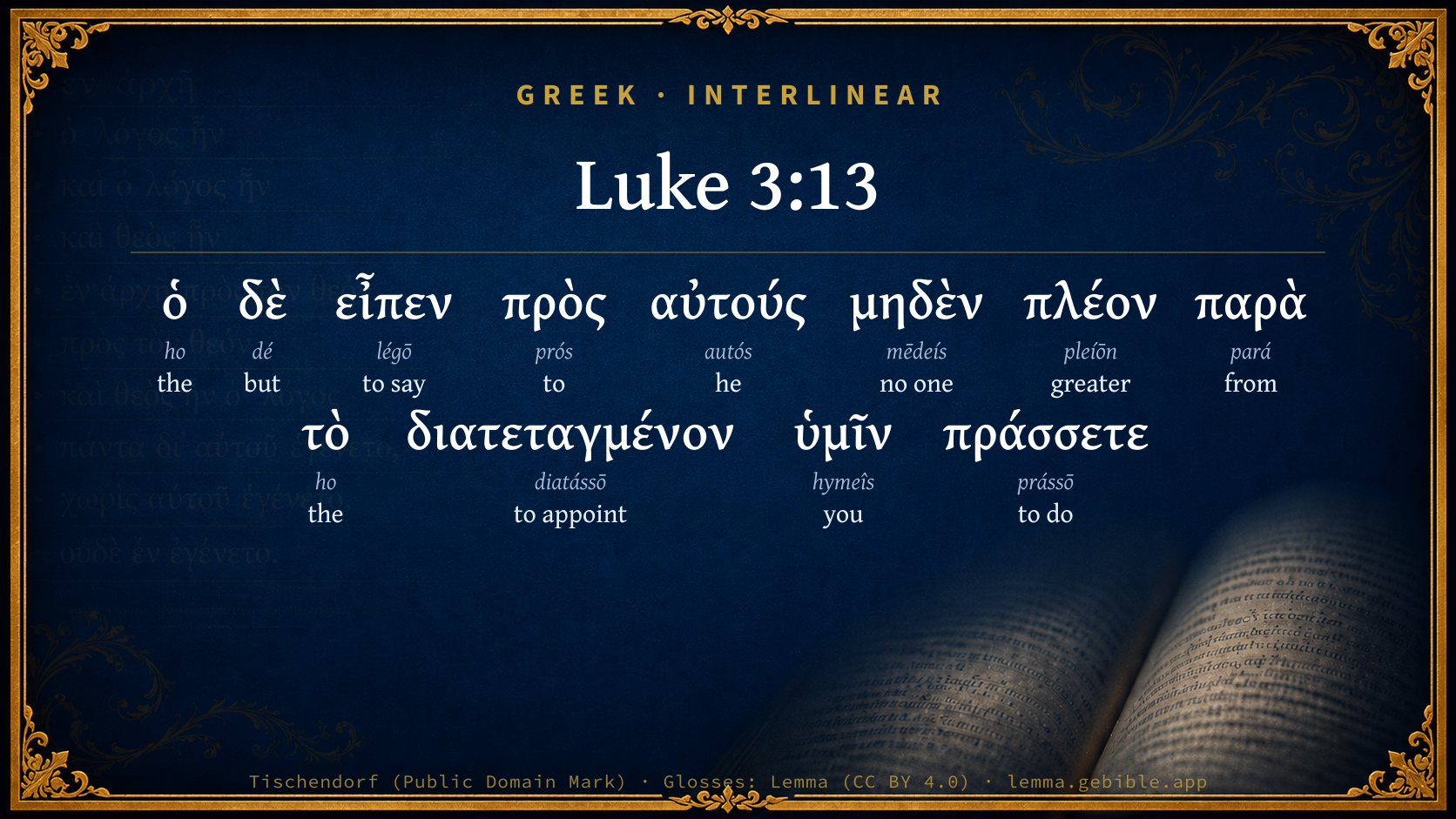
Greek (Tischendorf 8th ed.) Luke 3:13 appears in the Greek New Testament. The text above is from the Tischendorf 8th edition. Each word links to its Strong’s number and a concise gloss. Click any word for its full Thayer’s Greek Lexicon entry.
Download image
Cite this verse

Luke 3:13 (World English Bible). Public Domain. Lemma interlinear Bible study tool, https://lemma.gebible.app/v/luke/3/13.

Show BibTeX & RIS
BibTeX
RIS
English Translation
He said to them, "Collect no more than that which is appointed to you."
World English Bible · Public Domain
Highlights
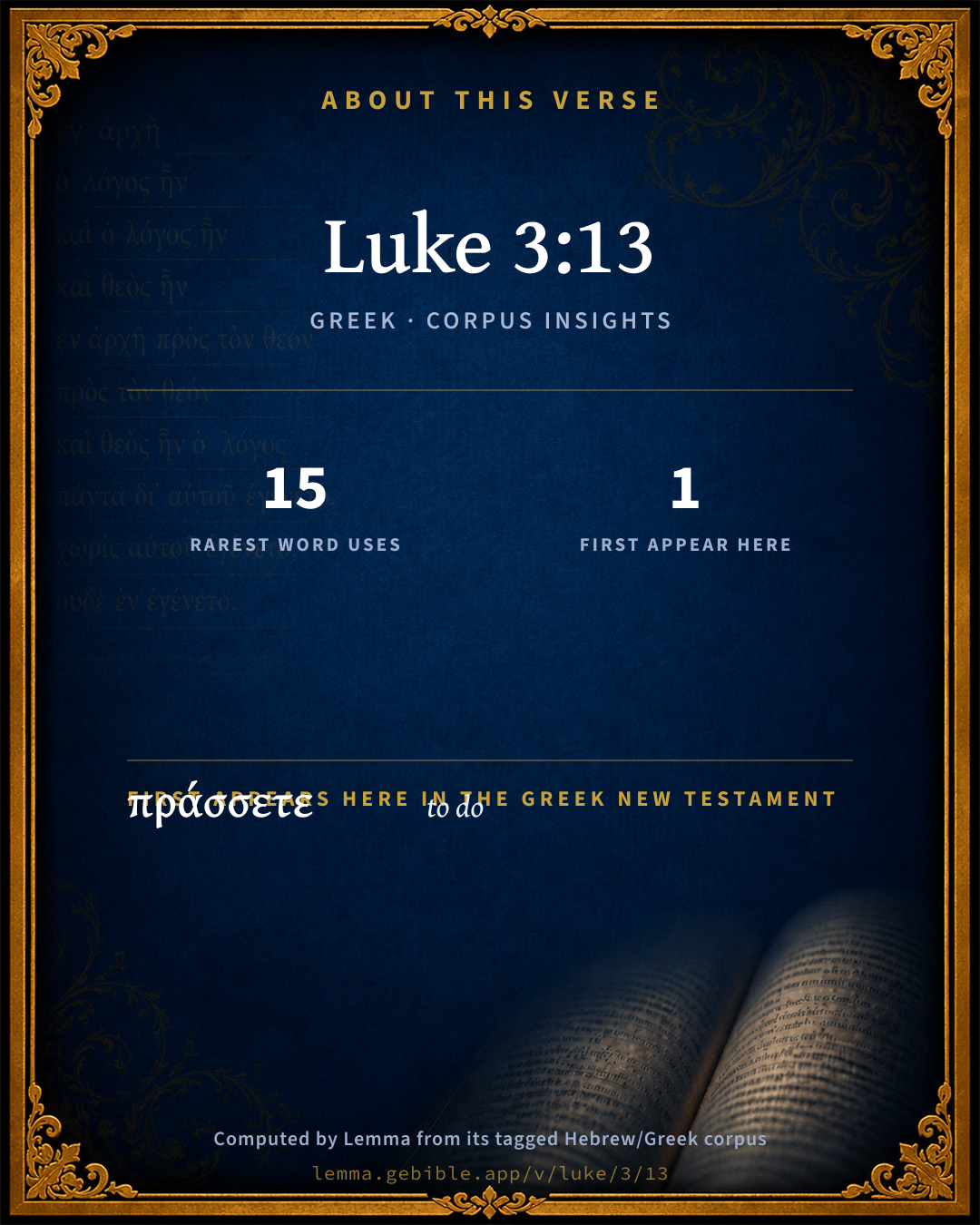
  • 1 first appearance in the Greek New Testament
Full analysis ↓
Download a study sheet

One document with this verse’s original text, its word-by-word gloss line, the meaning frame, cross-references with their text, attributed commentary, and full source and license credits — printable, and it pastes into notes with its structure intact.

This verse Autodidact and up

Study sheet (.html) Plain text (.txt)

A passage Seminary Student

Up to 50 verses in one chapter. A passage sheet keeps up to 6 commentary sources and 12 cross-references per verse, in the order this page ranks them, and says so on the sheet whenever that leaves anything out. Ask for a single verse and you get the Autodidact verse sheet above.

Everything on this page stays free to read, with no account — the sheet is a download of what is already on screen, not access to it.

Want to remove ads? Support Godless Engineer
Compare translations 3

The same verse in 3 English versions, stacked beneath the original-language interlinear above. Click any original word for its lexicon entry.

Each is an independent rendering of the whole verse — the interlinear is not word-aligned to these translations.

Highlighted words mark where these versions differ — a whole-verse word diff, not a word-by-word alignment.

  • World English Bible Public Domain
    He said to them, "Collect no more than that which is appointed to you."
  • King James Version Public Domain
    And he said unto them, Exact no more than that which is appointed you.
  • unfoldingWord Literal Text CC BY-SA 4.0
    So he said to them, “Collect nothing more than you have been ordered.”

unfoldingWord Literal Text — © unfoldingWord, licensed CC BY-SA 4.0. Word-aligned USFM3 via Door43 (git.door43.org/unfoldingWord/en_ult).

Versions to compare (up to 4)

3 of 4 selected

Show all 19 translations

Every available English version of this verse, each an independent rendering of the whole verse.

  • World English Bible Public Domain
    He said to them, "Collect no more than that which is appointed to you."
  • Berean Standard Bible Public Domain
    “Collect no more than you are authorized,” he answered.
  • Majority Standard Bible Public Domain
    “Collect no more than you are authorized,” he answered.
  • King James Version Public Domain
    And he said unto them, Exact no more than that which is appointed you.
  • American Standard Version (1901) Public Domain
    And he said unto them, Extort no more than that which is appointed you.
  • Revised Version (1885) Public Domain
    And he said unto them, Extort no more than that which is appointed you.
  • Geneva Bible (1599) Public Domain
    And hee saide vnto them, Require no more then that which is appointed vnto you.
  • Douay-Rheims (1899) Public Domain
    But he said to them: Do nothing more than that which is appointed you.
  • Young's Literal Translation Public Domain
    and he said unto them, `Exact no more than that directed you.'
  • Literal Standard Version CC BY-SA 4.0
    And he said to them, “Exact no more than that directed you.”
  • Unlocked Literal Bible CC BY-SA 4.0
    He said to them, “Do not collect more money than you have been ordered to collect.”
  • unfoldingWord Literal Text CC BY-SA 4.0
    So he said to them, “Collect nothing more than you have been ordered.”
  • Darby Bible Public Domain
    And he said to them, Take no more [money] than what is appointed to you.
  • World Messianic Bible Public Domain
    He said to them, “Collect no more than that which is appointed to you.”
  • Webster's Bible Public Domain
    And he said to them, Exact no more than that which is appointed you.
  • Free Bible Version CC BY-SA 4.0
    “Don't collect any more tax than you're meant to,” he replied.
  • Bible in Basic English Public Domain
    And he said to them, Do not make an attempt to get more money than the right amount.
  • Text-Critical English NT CC BY 4.0
    He said to them, “Collect no more than what you have been authorized to collect.”
  • Tyndale New Testament (1534) Public Domain
    And he sayde vnto the: requyre no more then that which ys appoynted vnto you.

Literal Standard Version (2020), Covenant Press — licensed CC BY-SA 4.0. Text via the HelloAO Bible API (eBible.org). Unlocked Literal Bible (unfoldingWord) — licensed CC BY-SA 4.0. Text via the HelloAO Bible API (eBible.org). unfoldingWord Literal Text — © unfoldingWord, licensed CC BY-SA 4.0. Word-aligned USFM3 via Door43 (git.door43.org/unfoldingWord/en_ult). Free Bible Version, Dr. Jonathan Gallagher — licensed CC BY-SA 4.0. Text via the HelloAO Bible API (eBible.org).

Word by word

More ways to search: Search by grammar → Find every occurrence → Compare this word →

Practice this passage: Drill this verse → Learn its vocabulary →

διατεταγμένον
diatássō
G1299
“to appoint”
Verb, Perfect, Passive, Participle, Accusative, Singular, Neuter
Part of Speech
Verb
Tense
Perfect
Voice
Passive
Mood
Participle
Case
Accusative
Number
Singular
Gender
Neuter
Full Thayer's Definition

Origin: from G1223 and G5021

TDNT: 08:34,1

1. to arrange, appoint, ordain, prescribe, give order
  1. ὁ ho G3588 “the” Article, Nominative, Singular, Masculine
  2. δὲ dé G1161 “but” Conjunction
  3. εἶπεν légō G3004 “to say” Verb, Aorist, Active, Indicative, 3rd person, Singular
  4. πρὸς prós G4314 “to” Preposition
  5. αὐτούς autós G846 “he” Personal pronoun, Accusative, Plural, Masculine
  6. μηδὲν mēdeís G3367 “no one” Adjective, Accusative, Singular, Neuter, Negative
  7. πλέον pleíōn G4119 “greater” Adjective, Accusative, Singular, Neuter, Comparative
  8. παρὰ pará G3844 “from” Preposition
  9. τὸ ho G3588 “the” Article, Accusative, Singular, Neuter
  10. ὑμῖν hymeîs G5210 “you” Personal pronoun, 2nd person, Dative, Plural
  11. πράσσετε prássō G4238 “to do” Verb, Present, Active, Imperative, 2nd person, Plural

About this verse

These counts appear in no published source. They are computed here, from the morphology-tagged text and Lemma’s own curated glosses. What Lemma adds →

12
words
11
distinct lemmas
Gospels
section

Notable vocabulary

The rarest word here is διατεταγμένον to appoint G1299 — appearing just 15 times in the whole Greek New Testament.

First appearance in Scripture

This word makes its first canonical appearance in the Greek New Testament here:

  • πράσσετε to do G4238

Shared distinctive vocabulary

διατεταγμένον to appoint G1299 occurs in 15 verses of the Greek New Testament. Also found in:

Repetition

A word recurs within this verse:

Cross-references

10

Topical passages linked to Luke 3:13 in the Treasury of Scripture Knowledge — connected by theme and wording, ordered by reader-vote popularity; previews shown in the World English Bible.

  • Luke 19:8 Zacchaeus stood and said to the Lord, "Behold, Lord, half of my goods I give to the poor. If I have wrongfully exacted anything of anyone, I restore four times as much."
  • Ephesians 4:28 Let him who stole steal no more; but rather let him labor, working with his hands the thing that is good, that he may have something to give to him who has need.
  • Isaiah 1:16–17 Wash yourselves, make yourself clean. Put away the evil of your doings from before my eyes; Cease to do evil.
  • Micah 6:8 He has shown you, O man, what is good. What does Yahweh require of you, but to act justly, To love mercy, and to walk humbly with your God?
  • 1 Corinthians 6:10 nor thieves, nor covetous, nor drunkards, nor slanderers, nor extortioners, will inherit the Kingdom of God.
  • Matthew 7:12 Therefore whatever you desire for men to do to you, you shall also do to them; for this is the law and the prophets.
  • Titus 2:11–12 For the grace of God has appeared, bringing salvation to all men,
  • Psalms 18:23 I was also blameless with him. I kept myself from my iniquity.
  • Proverbs 28:13 He who conceals his sins doesn't prosper, But whoever confesses and renounces them finds mercy.
  • Isaiah 55:6–7 Seek you Yahweh while he may be found; call you on him while he is near:

Cross-references courtesy of OpenBible.info (CC BY 4.0).

Commentary

Notes on Luke 3:13 from classic Christian and Jewish commentators (each source and its license shown beneath its notes). The classic Christian expositions comment on the surrounding passage and are grouped to its opening verse, so a note may address several verses; the Jewish commentaries on the Tanakh (Rashi and others) are per-verse, so they appear only where the commentator wrote on this verse.

Lemma curates 59 commentaries, every one of them public domain or Creative Commons licensed, each selected and text-cleaned for this edition rather than reprinted as found. About our sources →

The Biblical Illustrator

Joseph S. Exell

Luk_3:13

Exact no more than that which is appointed you--

Oppressions and extortions of tax-gatherers

Present-day conditions of Eastern lands painfully illustrate the continuance of some of the most demoralizing customs of the past.

When the crop is reared, and while the winnowing is actually going on upon the threshing-floor, the tax-gatherer stands by and appropriates one-tenth as soon as the work is completed. The Mahommedan government adopts the oppressive system of the Romans, sells the tithes to the highest bidder, for a sum of money which he is ready enough to pay in advance. This purchaser, or farmer of the taxes, has then to make his profits on the transaction by forcing the most extravagant payments from the people, and in so doing he is armed with irresponsible authority. The tithe-gatherers go through the land, employing every device for the purpose of overreaching the cultivators of the soil, and obtaining from them more than their dues. The farmers are strictly ordered not to thresh their grain before the tax-gatherers are ready, which is the means of additional extortions. Crops, therefore, sometimes remain heaped upon the threshing-floors for many weeks, the distressed owners not daring to thresh and harvest them, and being compelled both to watch them by day and night, and to devise means to protect them from being wet with showers. (Biblical Things not generally known.)

Exacting more than was just

In the Edinburgh Weekly Review we find some anecdotes relating to the Rev. William Anderson, D.D., more than fifty years pastor of the John Street United Presbyterian Church, of Glasgow, who died some time ago. He was one of the most eminent and beloved ministers of that city. He was once expounding the 15th Psalm, and had come to the word usury--He putteth not out his money to usury. Does that mean, he asked, taking ten per cent or more? Not entirely. It means also the spirit in which the ten per cent is taken. There was once in this Church a poor widow, and she wanted twenty pounds to begin a small shop. Having no friends, she came to me, her minister. And I happened to know a man--not of this Church--who could advance the money to the poor widow. So we went to this man--the widow and I--and the man said he would be happy to help the widow. And he drew out a bill for £20, and the widow signed it, and I signed it too. Then he put the signed paper in his desk and took out the money and gave it to the widow. But the widow, counting it, said: Sir, there is only £15 here. It is all right, said the man; that is the interest I charge. And, as we had no redress, we came away. But the widow prospered. And she brought the £20 to me, and I took it myself to the office of the man who lent it, and I said to him: Sir, there is the £20 from the widow. And he said: Here is the paper you signed, and if you know any other poor widow I will be happy to help her in the same way. I said to him: You help the widow! Sir, you have robbed this widow, and you will be damned! And, my friends, I kept my eye on that man. And before six months were over, God smote him, and he died. We can still recall, after many years, the creep of soul with which we listened to the closing sentences, and the vivid glimpse we got of a Divine retribution falling suddenly on a bad man.

The law of exaction

It gives us a fresh sense of the greatness of that reformer who makes this answer to see in it how free he was from the infirmities of his class. It is comparatively easy to see that things are wrong, and that they ought to be changed and righted. It is less easy, but still not uncommon, to have the courage that denounces wrong and that rebukes its perpetrators. It is quite another thing to have the practical insight and the patient determination that can discover a remedy for abuses and point the way to its successful application. There are wrongs that have been denounced and then forgotten, as though their denunciation and their repression were identical. And by such a course the moral sense of a community, of a man, becomes dulled, and at length slumbers and is inert. People see that behind the passionate voice there is wanting the guiding hand; that the scream of indignation somehow exhausts the impulse of reform, and that men who are eager in general terms to tell other men what they ought to do are quite powerless often to tell them how to do it. It explains the confidence with which men followed John the Baptist that he not only rebuked their vices, but that he showed them how to forsake them. What shall we do? Do I Bald John, do something for your brother-man, Instead of hoarding, spend. Instead of accumulating, give. It is not much to do, but it is a beginning. Get your shrunken heart enlarged a little by making it sensible of the needs of others. Exact no more than that which is appointed. It is a law for all men, and of manifold application. Let us see this morning, as the preacher in the wilderness turns on it the strong, full light of this personal application, what that is which it has to say to us. At the base of every mans consciousness is the sense of his relationship to God. While we are arguing about the existence of such a Being; the deepest convictions of men are more or less candidly owning it as beyond argument. Next to a mans relations to his Maker are his relations to his fellows, and here the personal consciousness is far less certain or clear. What each one of us owes to our neighbour--in what spirit we shall maintain our business or social relations with our fellow-men--what is human brother hood, and how men shall practically illustrate it--these are questions concerning which many people are in frequent and serious perplexity. If you are a capitalist, and I am a tradesman, or a farmer, or a labourer, the time will almost inevitably come when in one way or another you will have me in your power. You are stronger than I am, like the Hebrew or Roman publicans. You may do with impunity things that I cannot. Above all, owing to my necessities, it may easily be that you have obtained a knowledge of my affairs, which gives you, in our business dealings, an overwhelming advantage. You can freeze me out after one fashion or another. You can foreclose on me, if I am a little behind in my interest. We read of men in civic place who, entrusted with the care of the stranger and the immigrant, make them welcome to these shores by robbing, and even ruining them. And our cheeks flush at an infamy so shameless and so inhuman. But here is some imposing personage to whom men bow obsequiously on Change, and who finds a hospitable welcome at the tables of eminent Christian citizens, who only differs from the immigrant runner or a boarding-house striker in the bulk and the boldness of his transactions! In essence these are of precisely the same nature, for they are both trading upon the ignorance of the unsuspecting and wringing their profits out of the poverty of the poor and the weakness of the weak. To all such, and to you and me, just in so far as we are tempted by their success to descend to their methods, the gospel speaks in plain and stern rebuke, Exact no more than that which is appointed you. And no less does it say to that other life which most of us live in homes. Here, as between man and woman, parent and child, master and servant, there is a large field for undue and unwarrantable exactions. How many sweet and gracious relationships, begun in love, and cemented, it may be, by mutual sympathies, have been spoiled at length by a temper which was all the time throwing itself back upon its wifely or husbandly rights, and exacting not only these but more than these with a petulant impatience and peevish and fault-finding querulousness, a harsh imperiousness, which thought only of itself! In every such relation there is one who is stronger and one who is weaker. I wish, said a father to his sons teacher, that I could at least persuade my son to treat me like a gentleman. Suppose, replied the other, that you try the effect of treating him like a gentleman! Does it ever occur to some of us that because God has constituted the family as a Divine institution in which the parent is king, it does not follow that our sovereignty is to be an absolute despotism. Few of us are in danger of working seven days in the week. Some of us would be happier if we did a little more work on the remaining six. But this at least we can do--we can protect on Sundays the rights of those who work for us. (Bishop H. C. Potter.)

The Biblical Illustrator, edited by Joseph S. Exell (c. 1880s–1900s) — public domain. Text from a community e-Sword module.

Expositor's Greek Testament

ed. W. Robertson Nicoll

Luk 3:13 . μηδὲν πλέον παρὰ : this mode of expressing comparison (usual in mod. Grk.) is common to Lk. and the Ep. to Heb. (Luk 1:4 , etc.), and has been used in support of the view that Lk. wrote Heb. “Non improbabilis videtur mihi eorum opinio qui Lucae eam Ep. adjudicant,” Pricaeus. πράσσετε , make, in a sinister sense, exact, exigite , Beza. Kypke quotes Julius Pollux on the vices of the publicans, one being παρεισπράττων , nimium exigens , and remarks that this word could not be better explained than by the phrase in Lk., πράττων π . π . τὸ διατ .

The Expositor's Greek Testament, edited by W. Robertson Nicoll (1897–1910) — public domain. Text from a community e-Sword module.

Geneva Bible (1599)

Geneva Bible translators

Require no more than that sum that is appointed for the tribute money.

Geneva Bible (1599) marginal notes — public domain. Text via Bolls.life.

Jamieson, Fausset & Brown

Robert Jamieson, A. R. Fausset & David Brown

Exact no more, &c.--directed against that extortion which made the publicans a byword. (See on Luk 19:2; Luk 19:8). (Also see on Mat 3:10.)

Jamieson, Fausset & Brown — Commentary Critical and Explanatory on the Whole Bible (1871) — public domain (CC PDM 1.0). Text via the HelloAO Bible API.

Ellicott's Commentary for English Readers

(13) Exact no more.—Under the “farming” system of taxation adopted by the Roman empire, this was the besetting temptation of all collectors employed in it, and it led naturally to the evil repute which attached, not in Judæa only, to the name of publican. (See Note on Luk_19:2.)

A Bible Commentary for English Readers, edited by Charles John Ellicott (1878–1897) — public domain. Text from a community e-Sword module.

The Cambridge Bible for Schools and Colleges

gen. ed. J. J. S. Perowne

13. Exact no more] This was their habitual sin, and later historians often allude to the immodestia (i. e. the extravagant greed) of the publicans and their cruel exactions (Caes. Bell. Civ. iii. 32). The cheating and meddling for which Zacchaeus promised fourfold restoration (Luk_19:8) were universal among them.

The Cambridge Bible for Schools and Colleges (gen. ed. J. J. S. Perowne; Cambridge University Press, 1878–1918) — public domain. Text from a community e-Sword module.

John Gill's Exposition

And he said unto them,.... Not by advising them to quit their employments, as if it was a thing unlawful to impose pay, and collect taxes, but by directing them to perform their office aright:

exact no more than that which is appointed you; by the government: there were two sorts of publicans; there were some that exacted more than what they were ordered, and settled the tax at their own pleasure, and collected what they would themselves; and these were very odious to the people, and were reckoned with the worst of sinners, as thieves and robbers; but there were others, who behaved according to the orders of the government, and these were submitted to, as appears from the Jewish canons:

"says (s) Samuel, the judgment a kingdom, is judgment (i.e. the orders of a government ought to be regarded); R. Chanina bar Cahana says, that Samuel says it of a publican, "who has nothing appointed for him": the house of R. Jannai say, of a publican that stands of himself.''

The gloss is,

""the judgment of a kingdom is judgment"; this is he that receives from a king, a tax (to gather) in a thing, "that is fixed", so and so for the year, and he is no robber: "who has nothing appointed for him", but takes according to his whole will and pleasure.''

Maimonides expresses this in plainer language (t).

"in what things is it said that a publican is as thieves? when a Gentile publican, or a Gentile that stands of himself, or a publican that stands for the king, and hath nothing fixed for him, but he takes what he pleases, and leaves what he pleases: but a publican with whom the king agrees, and orders that he should take a third or a fourth, or, "any thing that is appointed"; and he constitutes an Israelitish publican to collect that part for the king, and it is known that the man is faithful, and does not add any thing to what the king has decreed; he is not in the class of robbers, for the judgment of a king is judgment.--And so a king that lays a tax upon citizens, or upon every man and man, "a thing fixed"; or decrees, that whoever transgresses this thing, they shall take all his goods into the king's house; or that whatever shall be found in the field in the time of the barn (i.e. when it should be there) should pay tribute for it, whether he is the owner of the field or not: and so with respect to any thing else of this kind, it is not a robbery; and an Israelite that collects them for the king, is not in the number of robbers; for lo! he is right, and he does not add nor alter, nor take any thing to himself.''

Now such publicans as these, were received and submitted to, but others were rejected; so Moses Kotsensis says (u), that

"publicans that take, "more than what is appointed for them", are rejected.''

From all which we may learn what publicans these were that came to John's baptism, and put the above question to him; that they were Jewish publicans, and not Gentiles; and therefore John says nothing to them, but what concerned their employment, which he doubtless would have done, if they had been ignorant Gentiles: and also we see the reason of his expressing himself in this manner, since publicans were very apt to go beyond their orders, and require more than was fixed for them to collect; and likewise that John, in this advice, spoke the sense of the Jews themselves; who did not refuse to pay tribute, excepting some few, provided no more was exacted, than the government appointed; and as temptations to such evils were very great, and it lay in the power of these men to impose on the people, and extort from them, to abstain from such practices was an argument of the fear of God, of the truth of grace, and of the sincerity of repentance.

(s) T. Bab. Bava Kama, fol. 113. 1. (t) Hilch. Gezala, c. 5. sect. 11, 12. (u) Mitzvot Tora, pr. neg. 214. Vid. T. Bab. Sanhedrin, fol. 25. 2. Gloss in ib.

John Gill's Exposition of the Whole Bible (1746–1763) — public domain (CC PDM 1.0). Text via the HelloAO Bible API.

Trapp's Complete Commentary

John Trapp

13 And he said unto them, Exact no more than that which is appointed you.

Ver. 13. Exact no more] πρασσετε, make no more of your places, than ye may with a good conscience. Shun that mystery of iniquity that is crept into most callings. A great part of the Turk’s civil justice to this day is grounded upon Christ’s words, "Thou shalt not do what thou wouldest not have done to thee."

John Trapp, A Commentary or Exposition upon All the Books of the Old and New Testament (1647–1656) — public domain. Text from a community e-Sword module.

Albert Barnes' Notes on the Bible

Exact - Demand, or take, no more.

Than that which is appointed - That is, by the government. John does not condemn the office, or say that the employment should be forsaken. Though it was hated by the people - though often abused and therefore unpopular - yet “the office itself” was not dishonorable. If there is a government, it must be supported; and of course there must be people whose duty it is to collect taxes, as the means of the proper support of the government; and as such a support of the government is necessary, so the people should pay cheerfully the just apportionment of their rulers, and regard favorably those who are authorized to collect it. See Rom 13:1-6.

Albert Barnes' Notes on the Bible (1834–1885) — public domain. Text from a community e-Sword/MySword module.

Haydock's Catholic Bible Commentary

Do nothing more. You who are military men, exact no more of the people than what is allowed and appointed you. (Witham)

George Leo Haydock (1774–1849), Haydock's Catholic Family Bible and Commentary, 1859 edition — public domain. Excludes Psalms (Douay-Rheims chapter numbering differs from Protestant) and Deuterocanonical books (Catholic canon only).

Whedon's Commentary on the Bible

Daniel D. Whedon

13. Exact no more—The publicans, in regard to whom see our life of St. Matthew, (prefixed to his Gospel,) were not only unpopular from being the officers of a foreign dominion, but as being plunderers of the public. By extorting more than the appointed government rates of taxes and pocketing the surplus, they made dishonest gains. That the proper dues of government should be collected was right; but there was needed an immense reformation on the part of this class of persons to bring the public morality to its proper tone, and repair the general apostacy of the times.

Daniel D. Whedon (gen. ed.), Commentary on the Old and New Testaments (1874–1909) — public domain. Text from a community e-Sword module.

Cambridge Greek Testament for Schools and Colleges

13. μηδὲν πλέον … πράσσετε. The verb πράσσω (like πρᾶξις, see Luk 23:51; Col 3:9, &c.) is often used in a bad sense (Luk 23:41; Joh 3:2, &c.). The immodestia (i.e. the extravagant greed) of the publicans was their habitual sin, and later historians often allude to their cruel exactions (Caes. Bell. Civ. III. 32). The cheating and meddling for which Zacchaeus promised fourfold restoration (Luk 19:8) were universal among them.

Cambridge Greek Testament for Schools and Colleges (Cambridge University Press, 1896; 21 vols, various authors incl. Carr, Maclear, Plummer, Farrar, Lumby, Moule, M. R. James, Simcox) — public domain. Text from a community e-Sword module.

Alford’s Greek Testament

Henry Alford

13.] πράσσετε, exact: see examples in .

Henry Alford, The Greek Testament (1849–1861) — public domain. Text from a community e-Sword module.

International Critical Commentary

13. Διδάσκαλε. Publicani majore ceteris reverentia utuntur (Beng.). Syr-Sin. omits the word.

πλέον παρά. For παρά after comparatives comp. Heb 1:4, Heb 1:3:3, Heb 1:9:23, Heb 1:11:4, Heb 1:12:24; Hdt. 7:103. 6; Thuc. i . 23, 4, iv. 6, 1. The effect is to intensify the notion of excess: so also ὑπέρ, 16:8; Heb 4:12.

τὸ διατεταγμένον. “That which stands prescribed” (perf.), a favourite word with Lk.: 8:55; 17:9, 10; Act 7:44, Act 18:2, Act 20:13, Act 23:31, Act 24:23. Comp. disponere, verordnen. It is from the general meaning of “transacting business” that πράσσειν acquires the special sense of “exacting tribute, extorting money”: comp. 19:23. This use is found from Herodotus onwards: Hdt. iii. 58. 4; Æsch. Cho. 311; Pers. 476; Eum. 624; Xen. Anab. vii. 6. 17: comp. πράκτωρ, εἰσπράσσειν, ἐκπράσσειν, and many illustrations in Wetst. Agere is similarly used: publicum quadragesimæ in Asia egit (Suet. Vesp. i.); but what follows is of interest as showing how rare an honourable publicanus was: manebantque imagines in civitatibus ei positæ sub hoc titulo ΚΑΛΩΣ ΤΕΛΩΝΗΣΑΝΤΙ. This is said of Sabinus, father of Vespasian. After farming the quadragesima tax in Asia he was a money-lender among the Helvetii. It is to be noticed that the Baptist does not condemn the calling of a tax-collector as unlawful for a Jew. He assumes that these τελῶναι will continue to act as such.

International Critical Commentary — older volumes (1896–1929), various authors — public domain. Text from a community e-Sword module.

Vincent's Word Studies in the New Testament

Marvin R. Vincent

Exact [πρασσετε] . The change of the Rev., to exhort is unfortunate. The word is used of the exaction of legal tribute, and excessive exaction is expressed by the following words : John would hardly have commanded them to extort in any case.

Marvin R. Vincent, Word Studies in the New Testament (1887–1900) — public domain. Text from a community e-Sword/MySword module.

Lesson kit

Teaching starters — assembled from the data on this page, not authored interpretation. Every prompt links to the verse data it draws on. Edit before teaching.

Luke, in the Gospels, opens this verse with 12 words (11 distinct Greek lemmas). Its most distinctive word is diatássō (“to appoint”). A historical commentator’s framing appears above. Read the whole chapter for the surrounding context.

Discussion questions

  1. What does “to appoint” (diatássō) contribute to the verse as a whole?
  2. The word “to do” first appears here in Scripture. What is being introduced at this debut?
  3. Matthew 11:1 shares the word «to appoint» with this verse. How do the two illuminate each other?
  4. “the” occurs 2× in this one verse. What is the effect of the repetition?
  5. The translations on this page render this verse differently — a whole-verse word diff, not a word-by-word alignment. What might account for the different wordings?
  6. Reading how The Biblical Illustrator and Expositor's Greek Testament read this verse, where do the two commentators agree and where do they part?

Things to notice

  • 1 word makes its first canonical appearance in Scripture here.
  • These translations choose different wording for 8 words in this verse.
  • “the” occurs 2× in this single verse.
  • 11 distinct Greek lemmas span 12 words in this verse.

Reading settings

Reading text

Shown beneath each verse's original-language words.

Old Testament
Old Testament edition

Read the OT as the Masoretic Hebrew (MT) or the Greek Septuagint (LXX).

English shown for the Greek Septuagint (in the Hebrew ↔ Greek comparison).

Comparing translations? Open the Compare panel on any verse page to stack up to four side by side.