
Luke 8:7

Greek (Tischendorf 8th ed.) Luke 8:7 appears in the Greek New Testament. The text above is from the Tischendorf 8th edition. Each word links to its Strong’s number and a concise gloss. Click any word for its full Thayer’s Greek Lexicon entry.
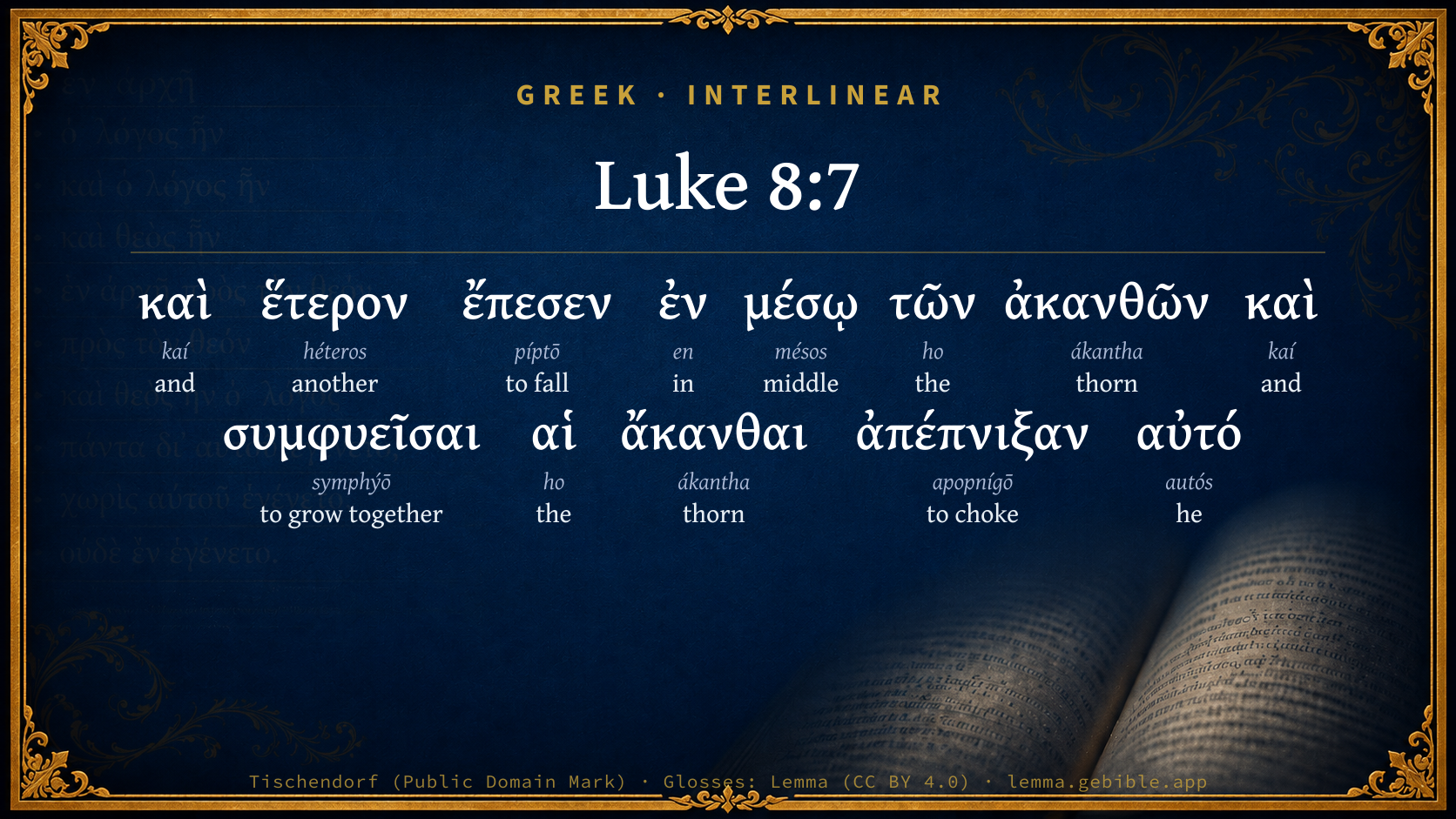
Download image
Cite this verse

Luke 8:7 (World English Bible). Public Domain. Lemma interlinear Bible study tool, https://lemma.gebible.app/v/luke/8/7.

Show BibTeX & RIS
BibTeX
RIS
English Translation
Other fell amid the thorns, and the thorns grew with it, and choked it.
World English Bible · Public Domain
Highlights
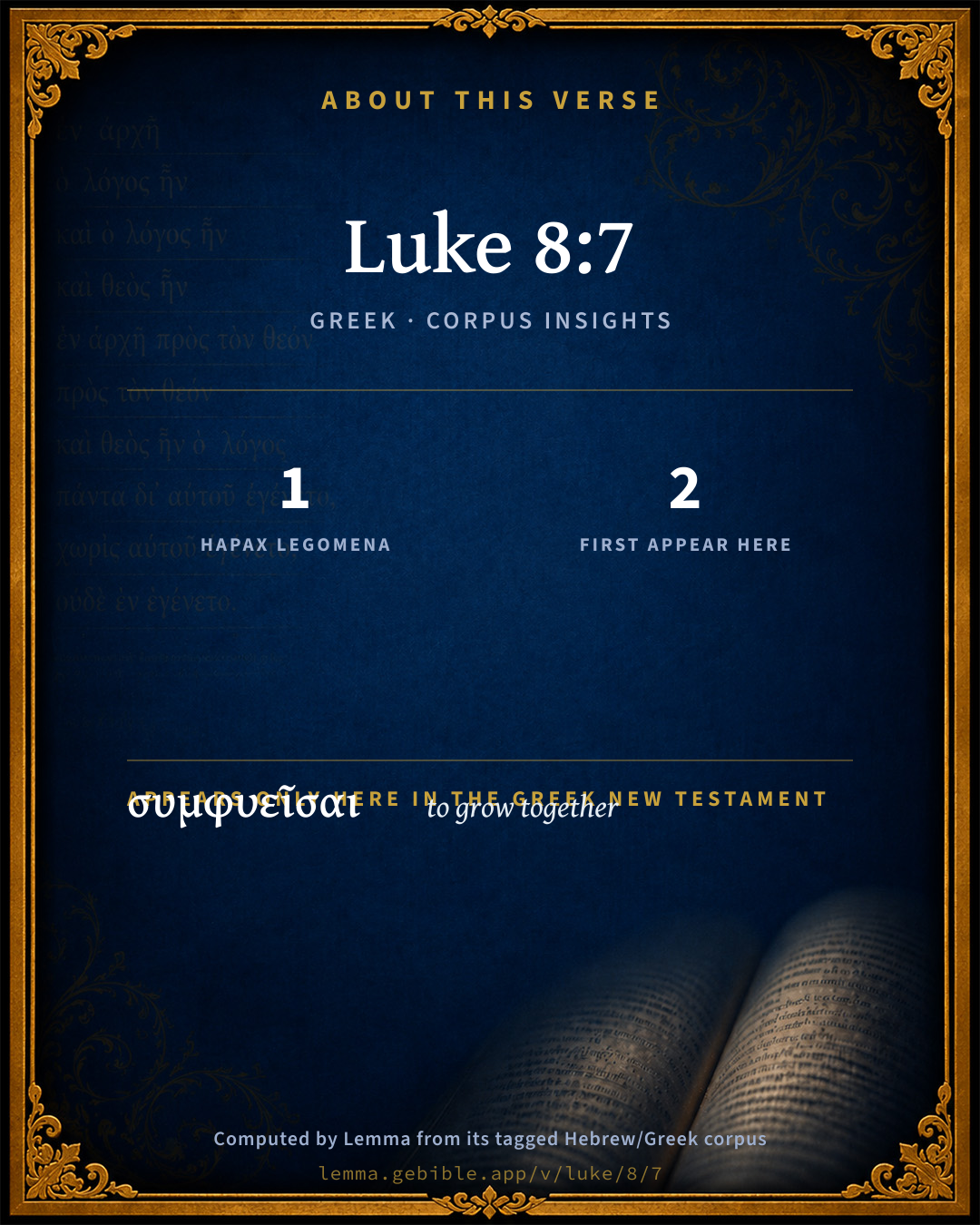
  • 1 hapax legomenon — only here in the Greek New Testament
  • 2 first appearances in the Greek New Testament
Full analysis ↓
Download a study sheet

One document with this verse’s original text, its word-by-word gloss line, the meaning frame, cross-references with their text, attributed commentary, and full source and license credits — printable, and it pastes into notes with its structure intact.

This verse Autodidact and up

Study sheet (.html) Plain text (.txt)

A passage Seminary Student

Up to 50 verses in one chapter. A passage sheet keeps up to 6 commentary sources and 12 cross-references per verse, in the order this page ranks them, and says so on the sheet whenever that leaves anything out. Ask for a single verse and you get the Autodidact verse sheet above.

Everything on this page stays free to read, with no account — the sheet is a download of what is already on screen, not access to it.

Want to remove ads? Support Godless Engineer
Compare translations 3

The same verse in 3 English versions, stacked beneath the original-language interlinear above. Click any original word for its lexicon entry.

Each is an independent rendering of the whole verse — the interlinear is not word-aligned to these translations.

Highlighted words mark where these versions differ — a whole-verse word diff, not a word-by-word alignment.

  • World English Bible Public Domain
    Other fell amid the thorns, and the thorns grew with it, and choked it.
  • King James Version Public Domain
    And some fell among thorns; and the thorns sprang up with it, and choked it.
  • unfoldingWord Literal Text CC BY-SA 4.0
    And other seed fell in the midst of the thorns, and having grown up with, the thorns choked it.

unfoldingWord Literal Text — © unfoldingWord, licensed CC BY-SA 4.0. Word-aligned USFM3 via Door43 (git.door43.org/unfoldingWord/en_ult).

Versions to compare (up to 4)

3 of 4 selected

Show all 19 translations

Every available English version of this verse, each an independent rendering of the whole verse.

  • World English Bible Public Domain
    Other fell amid the thorns, and the thorns grew with it, and choked it.
  • Berean Standard Bible Public Domain
    Other seed fell among thorns, which grew up with it and choked the seedlings.
  • Majority Standard Bible Public Domain
    Other seed fell among thorns, which grew up with it and choked the seedlings.
  • King James Version Public Domain
    And some fell among thorns; and the thorns sprang up with it, and choked it.
  • American Standard Version (1901) Public Domain
    And other fell amidst the thorns; and the thorns grew with it, and choked it.
  • Revised Version (1885) Public Domain
    And other fell amidst the thorns; and the thorns grew with it, and choked it.
  • Geneva Bible (1599) Public Domain
    And some fell among thornes, and the thornes sprang vp with it, and choked it.
  • Douay-Rheims (1899) Public Domain
    And other some fell among thorns, and the thorns growing up with it, choked it.
  • Young's Literal Translation Public Domain
    `And other fell amidst the thorns, and the thorns having sprung up with it, did choke it.
  • Literal Standard Version CC BY-SA 4.0
    And other fell amidst the thorns, and the thorns having sprung up with it, choked it.
  • Unlocked Literal Bible CC BY-SA 4.0
    Some fell among thorns, and the thorns grew up together with the seed and choked it.
  • unfoldingWord Literal Text CC BY-SA 4.0
    And other seed fell in the midst of the thorns, and having grown up with, the thorns choked it.
  • Darby Bible Public Domain
    and other fell in the midst of the thorns, and the thorns having sprung up with [it] choked it;
  • World Messianic Bible Public Domain
    Other fell amid the thorns, and the thorns grew with it and choked it.
  • Webster's Bible Public Domain
    And some fell among thorns; and the thorns sprang up with it, and choked it.
  • Free Bible Version CC BY-SA 4.0
    Some seeds fell among thorns and as they both grew the thorns choked the plants.
  • Bible in Basic English Public Domain
    And some went among thorns, and the thorns came up with it and it had no room for growth.
  • Text-Critical English NT CC BY 4.0
    Other seed fell among the thorns, and the thorns grew up with it and choked it.
  • Tyndale New Testament (1534) Public Domain
    And some fell amonge thornes and the thornes spronge vp with it and choked it.

Literal Standard Version (2020), Covenant Press — licensed CC BY-SA 4.0. Text via the HelloAO Bible API (eBible.org). Unlocked Literal Bible (unfoldingWord) — licensed CC BY-SA 4.0. Text via the HelloAO Bible API (eBible.org). unfoldingWord Literal Text — © unfoldingWord, licensed CC BY-SA 4.0. Word-aligned USFM3 via Door43 (git.door43.org/unfoldingWord/en_ult). Free Bible Version, Dr. Jonathan Gallagher — licensed CC BY-SA 4.0. Text via the HelloAO Bible API (eBible.org).

Word by word

More ways to search: Search by grammar → Find every occurrence → Compare this word →

Practice this passage: Drill this verse → Learn its vocabulary →

συμφυεῖσαι
symphýō
G4855
“to grow together”
Verb, Aorist, Passive, Participle, Nominative, Plural, Feminine
Part of Speech
Verb
Tense
Aorist
Voice
Passive
Mood
Participle
Case
Nominative
Number
Plural
Gender
Feminine
Full Thayer's Definition

Origin: from G4862 and G5453

TDNT: None

1. to cause to grow together 2. to grow together, grow with
  1. καὶ kaí G2532 “and” Conjunction
  2. ἕτερον héteros G2087 “another” Adjective, Nominative, Singular, Neuter
  3. ἔπεσεν píptō G4098 “to fall” Verb, Aorist, Active, Indicative, 3rd person, Singular
  4. ἐν en G1722 “in” Preposition
  5. μέσῳ mésos G3319 “middle” Adjective, Dative, Singular, Neuter
  6. τῶν ho G3588 “the” Article, Genitive, Plural, Feminine
  7. ἀκανθῶν ákantha G173 “thorn” Noun, Genitive, Plural, Feminine
  8. καὶ kaí G2532 “and” Conjunction
  9. αἱ ho G3588 “the” Article, Nominative, Plural, Feminine
  10. ἄκανθαι ákantha G173 “thorn” Noun, Nominative, Plural, Feminine
  11. ἀπέπνιξαν apopnígō G638 “to choke” Verb, Aorist, Active, Indicative, 3rd person, Plural
  12. αὐτό autós G846 “he” Personal pronoun, Accusative, Singular, Neuter

About this verse

These counts appear in no published source. They are computed here, from the morphology-tagged text and Lemma’s own curated glosses. What Lemma adds →

13
words
10
distinct lemmas
Gospels
section

Notable vocabulary

1 hapax legomenon — a word that appears only here in the entire Greek New Testament:

  • συμφυεῖσαι to grow together G4855

First appearance in Scripture

These words make their first canonical appearance in the Greek New Testament here:

  • συμφυεῖσαι to grow together G4855
  • ἀπέπνιξαν to choke G638

Shared distinctive vocabulary

ἀπέπνιξαν to choke G638 occurs in 2 verses of the Greek New Testament. Also found in:
Repetition

Words recur within this verse:

  • ἀκανθῶν thorn G173 ×2
  • καὶ and G2532 ×2
  • τῶν the G3588 ×2

Cross-references

9

Topical passages linked to Luke 8:7 in the Treasury of Scripture Knowledge — connected by theme and wording, ordered by reader-vote popularity; previews shown in the World English Bible.

  • Jeremiah 4:3 For thus says Yahweh to the men of Judah and to Jerusalem, Break up your fallow ground, and don't sow among thorns.
  • Luke 8:14 That which fell among the thorns, these are those who have heard, and as they go on their way they are choked with cares, riches, and pleasures of life, and bring no fruit to maturity.
  • Genesis 3:18 Thorns also and thistles will it bring forth to you; and you will eat the herb of the field.
  • Matthew 13:7 Others fell among thorns. The thorns grew up and choked them:
  • Matthew 13:22 What was sown among the thorns, this is he who hears the word, but the cares of this age and the deceitfulness of riches choke the word, and he becomes unfruitful.
  • Mark 4:7 Others fell among the thorns, and the thorns grew up, and choked it, and it yielded no fruit.
  • Mark 4:18–19 Others are those who are sown among the thorns. These are those who have heard the word,
  • Luke 21:34 "So be careful, or your hearts will be loaded down with carousing, drunkenness, and cares of this life, and that day will come on you suddenly.
  • Hebrews 6:7–8 For the land which has drunk the rain that comes often on it, and brings forth a crop suitable for them for whose sake it is also tilled, receives blessing from God;

Cross-references courtesy of OpenBible.info (CC BY 4.0).

Commentary

Notes on Luke 8:7 from classic Christian and Jewish commentators (each source and its license shown beneath its notes). The classic Christian expositions comment on the surrounding passage and are grouped to its opening verse, so a note may address several verses; the Jewish commentaries on the Tanakh (Rashi and others) are per-verse, so they appear only where the commentator wrote on this verse.

Lemma curates 59 commentaries, every one of them public domain or Creative Commons licensed, each selected and text-cleaned for this edition rather than reprinted as found. About our sources →

The Biblical Illustrator

Joseph S. Exell

Luk_8:7

And some fell among thorns

The thorn roots

These are not thoroughly worldly persons, who pay no heed at all to the Word of God; nor yet are they persons who trust to their own feelings and impulses, and what are called religious impressions, for strength to stand in the evil day, and to endure tribulation for the sake of Christ; but they are those who set themselves to accomplish the task which our Lord says is impossible, of serving God and Mammon, of making, as it has been said, the best of both worlds.

They cannot seek God with their whole heart, because their heart is always occupied, in part at least, with some other object. God and the things of God are acknowledged by them as having a claim on their time and thoughts, but it is only the spare time, only the thoughts of (so to say) idle moments, that they can afford to give up in response to this claim. Whatever home the Word of God can find for itself in vacant spaces of mind and heart it is welcome to occupy; whatever influence it can exercise within the narrow limits which other things do not fill, they do not grudge it; but it can by no means be permitted to interfere with more pressing interests, or to assert anything like a free right of entry into all the concerns of life. It is not at all, I think, that, like those represented by the shallow soil, they grasp eagerly at the sweet and comforting portions of the Words teaching, set aside all that is more stern and terrible, and so live really under the influence of that part of the Word which they have gladly received until they wake to the conviction that what they have received is only a part, and that the time has come when the choice lies between giving up the part received and receiving in addition the part set aside, and then have not sufficient earnestness to take the harder and better course, and so fall away altogether. Rather it would seem they do from the first recognize both sides of the teaching--the sweetness of the promises, and the awfulness of the threatenings; but at the same time there is something which prevents them from fully appreciating either the one or the other; something which hinders them from really using all their energies that they may avoid the threatened woe and attain the promised blessedness. And this something is the hold upon their hearts which is already established by cares, riches, pleasures, delights of the world. Thus they feel some desire to escape the future punishment of sin, but the desire of being free from present cares lies deeper, and if it comes to a question between voluntary endurance of cares here for the sake of happiness hereafter, and self indulgence now with the risk of misery in the future, they choose the latter, because they see the things temporal more clearly than the things eternal,, and what they see most clearly they rank most highly. Thus also they wish to enjoy the glories of heaven, but they wish also to have all they can of the enjoyments of earth, and if they -must forego one for the sake of ensuring the other, they will most readily forego that which they wish for most feebly, because its excellence and desirableness is least real to them, and this again will be the distant glory which is discerned by faith only, not the present enjoyment which forces itself upon the notice of their senses. (C. S. Turner, M. A.)

Among thorns

Here a new and startling thought is brought out, which leads our minds into a different and most suggestive channel. The Masters mind recurs to the great germ-principle, and teaches us that Gods Word is not the only seed that is sown broadcast over the world; that the controlling application of Gods fundamental laws covers evil as well as good, and that all through this vast globe of nature there are seeds which never fell from the hand of the Divine Husbandman, quick with the same mysterious germ of life, subject to the same law of germination and development under like conditions, and bound by the same inexorable necessity to reproduce themselves after their kind, but noxious in character, waging ceaseless and destructive warfare against the good, and promising an inevitable harvest of sorrow and death. Remembering, now, that all life is governed by this same law of the germ, we may go for our first illustration to what we call animate nature, where the seed is found under the form of the egg. Walking by the waterside we find two eggs on the shore, so nearly similar in size, and shape, and colour, that an unpractised eye would scarcely distinguish one from the other. The same white, brittle shell, every section of which is some modification of the arch, equally the strongest form to resist external violence and the weakest against pressure from within. Break this shell and we find in each a similar living membrane, an air-chamber for the support of the young animal, a yolk for its nourishment suspended by twisted ligaments and protected by an envelope of glairy albumen, with the germ-vesicle containing potentially the future young as yet indistinguishable by any human power. We submit these almost exactly similar eggs to the requisite conditions of time and heat until the breaking shell reveals the developed young, and lo! the marvellous difference! From the one, a bird of pure and beautiful plumage, serviceable to man in its every part, an ornament to nature and fitted to walk the land, to float on the crested wave, or to cleave the light air with its sweeping pinions as it soars toward heaven. From the other a scaly monster of loathsome form and frightful aspect, fitted to live only in slime and mire, and destined only to destroy its fellow-creatures. These results, we know, will be invariable, nor can any power reverse or modify them. Thus we learn how exact are the analogies between moral and physical nature. Experience teaches us, further, how full is all soil of the seeds of noxious weeds, and the parable shows us how equally full is our moral nature of the germs of deadly sins and cares which choke out every growth of good. So true is this in the physical world, and so absolutely impossible is it to detect the germs of life prevailing everywhere, that science has even dreamed of spontaneous life as the only solution of the mystery. Prepare your ground, however carefully, for the seeding, it will be green with unwelcome growths long before your grain has sprouted. Let a drop of purest water remain exposed for a few hours, it will swarm with animalculae and microscopic vegetables. Make anywhere an artificial pond, and in process of time it will contain fish and water-plants, but rarely of useful kinds. The air we breathe is full of the infinitesimal spores of deadly maladies, ready to germinate and produce their lethal fruit; but who ever heard of an atmosphere quick with the seeds of health? Under the same great law, then, the soul of man, his moral nature, the moral atmosphere in which he lives, must be full of those evil germs which bring forth the thorns of the parable. So evident has been this truth to all human experience, that men have believed in a dual source of life--the Ormuzd and Ahriman of the Persian mythology, the God and Demiurge of the Gnostic philosophy, the one the creator of evil, the other of the good. But whence come these seeds of evil? How is it that these germs of destruction so pervade all nature? Science has but recently demonstrated that they are not, in the physical world, of spontaneous origin. The water which so rapidly devolopes life becomes utterly lifeless when heated to boiling and absolutely excluded from the air. There is one series of processes familiar to us which gives the clue to all the rest, because it shows how God works in creation by the instrumentality of the law of germination. In the barren depths of ocean one of the lowest forms of animal life, the coral polyp, multiplies itself into unnumbered millions, exuding from its body the stony substance which slowly reaches to the surface and forms a reef. This catches the floating seaweed and the drifting pieces of wreck, which decay in the sunshine and form a soil. Some nut or fruit, protected by its hard covering, is borne by the waves from a far-off shore and cast upon the new-formed island, and sprouting there, in process of time produces a tree, which in turn produces others like itself. The falling leaves and rotting stems increase the depth of the soil. The wearied sea-birds seek shelter from the storm, and soon form a colony. Then other birds are driven there, and drop the seeds of their food, and man comes in his vessels and leaves behind him other germs of animal and vegetable life. Thus, in the course of centuries, a great and populous island comes into being. Were our opportunities and our faculties sufficient to the task, we could doubtless in the same way trace out the most mysterious of these phenomena, and learn how in thousands of simple, but unsuspected ways the seeds are carried and planted. The squirrel buries his winter store of nuts and acorns, only a small part of which are consumed; and in a few seasons the growth is entirely changed, and the grassy plain becomes a forest; the swift-winged pigeon is slain by the hawk miles away from his feeding ground, and the undigested seeds in his crop are scattered, and shoot into plants hitherto unknown there. But in the moral world there is another and a darker agency at work to disseminate the germs of evil, as it snatches away the seed which falls by the wayside; for we learn from the parable of the tares among the wheat that an enemy hath done this. There is an evil being of great power and malignant purpose who fills mans heart with the deadly seeds of worldly cares and sorrows, and who well knows that the richest and mellowest soil is the best for his objects. (Robert Wilson, M. D.)

Among thorns

I. WHY LUSTS ARE COMPARED TO THORNS. Carnal lusts are fitly compared to thorns in five respects.

1. There are some flowers, and some show on thorns, small fruits, and many pricks; so whatever appearance these lusts make, no good fruit riseth of them, but many pricks and sorrows by them in the end. Thorns pierce the body, lusts the mind.

2. Thorns are everywhere armed, and ready to wound and tear him that, meddling with them, doth not carefully fence himself; so they that nourish the cares of the world, or addict themselves to pleasure or profits, pierce themselves through with many sorrows.

3. As a thorn held softly pricks not nor hurteth, but when it is held hard and crushed, it easily draweth blood; so a man may use this world, as not using it, without danger, and hold softly the profits and pleasures of this life; but grip them, and fasten on them, there is certain hurt.

4. Thorns and briars are the dens and receptacles of serpents and poisonful worms and creatures; so are these unmortified desires the harbours of infinite noisome sins, which shall creep as thick into the soul as the frogs into Pharaohs lodgings. As Israel, not content with Gods daily allowance, but out of a covetous and distrustful desire, against Gods commandments, saved some of the manna till morning, but it was all full of worms, and stunk; so do fleshly minds, by nourishing unlawful lusts, turn manna into worms.

5. As thorns and briars are at last good for nothing but fuel for fire; so these thickets of lusts, and pursuit after the profits and pleasures of this life, are the proper fuel of the fire of the great day, and prepare the ground itself (which all worldlings are), without timely repentance, as fuel for the fire of hell, which is unquenchable.

II. THESE BAD HEARERS ARE APTLY COMPARED TO THORNY GROUND. For as a thorny and weedy soil chokes and kills at length such seeds as come up hopefully; so a heart, stuffed with unmortified affections, at length resists and chokes the seed of Gods Word, that it shall not prosper to the salvation of that hearer in the harvest; for--

1. These thorns supplant the Word, and unroof it again, as thorns, to root themselves, undermine the seed below.

2. These thorny corruptions hinder the comfortable heat and shine of the sun from the heart, namely, the sweet beams and influence of the spirit of grace, which cannot come so sweetly and freely to the heart to cherish the growth and work begun, as thorns hinder the sun from plants.

3. Thorns draw away the moisture which should preserve the plants in their growth and greenness; even so these inward lusts draw the heart from means of moisture and grace; they sometimes give a man leave to hear, but as they prevail and take up the heart, there shall be little time allowed to remember, meditate, or apply that which is heard, and as small leave to bring things into practice.

III. THORNS AND LUSTS OF ANY SORT, SUFFERED TO GROW IN THE HEART, DO SOON OVERGROW THE WORD OF GOD, AND SUFFER IT NOT TO PROSPER. For as the husbandman, who suffers thorns and weeds to choke his seed coming up, loseth his harvest; even so that man loseth his part in the gospel that cherisheth lusts and disordered desires in his heart, together with the gospel. Hence the Apostle James (Jam_1:21) telleth us that if we would hear the Word so as it may be ingrafted in us, we must first east away, or put off as an old rag, the superfluity of maliciousness and filthiness, that is, the abundance of carnal affections, looseness of life, pride, disdain, wrath, contention, earthly pleasures, vanity, evil speaking of Divine doctrine, &c.; and in the next verse shows that with these lusts men may be hearers of the Word, but never doers till they be weeded out; they will at length overgrow it. Reasons:

1. Ill weeds, we say, spring apace; good seeds or herbs not half so fast. We shall see a bramble grow more in seven months than an oak in seven years. So our text--the thorns grow up with the seed, but choke it by overgrowing.

2. Our grounds are fit and prepared to produce thorns rather than bring up the good seed. Our hearts are the natural mother to lusts, but a step mother to seeds of grace. For there lies in our nature a sea of evil lusts lurking; our own original lust is a fountain, and an inordinate disposition to all evil. From which fountain issue innumerable streams of actual lusts, which are the innumerable motions of the soul, contrary to every commandment of God; all which, in their several armies and bands, issue out against God and His Word, as the Philistines still warred against Israel. Now, our ground being so apt to weeds, they will soon overgrow the Word, if but a little neglected.

3. A part of the curse on mans sin is that the earth should bring forth thorns and thistles. The earth should have brought them forth, if man had not sinned; but they should not have been so noisome and hurtful to man and the fruits of the earth. Even so it is a part of the curse of our sin that there should grow up such noisome lusts (as thorns) in the ground of our hearts, as do far more hinder the growth of grace in our hearts, and choke the seed of the Word sown ill our souls, than all the weeds and thorns in the world can choke the seeds and fruits of the earth. Lusts are still remaining in the best, but not now as a curse, but only, as the Canaanites, to keep them humble.

4. The reign of lust cannot but thrust down the reign of the Word; for, first, that the Word may reign, it must be understood, but thorns hinder the light of the sun from the seed. One thorn is enough to darken the eye of the understanding. Secondly, that the Word may reign, it must first renew. But there can be no new creature, till the old man be put off, with his lusts Eph_4:22-23). Thirdly, that the Word may reign, it must be obeyed when it commands, and be expressed in the fruits of holiness. But lusts unsubdued oppose themselves, and hinder the motions when they should come into practice, and the Lords plant becomes fruitful only on that condition, that the Father purge it (Joh_15:1-27.).. Again, how can a man walk on cheerfully in his way that hath a thorn sticking m his foot? No less do these thorns cast men back in their way of obedience. These superfluities of lusts and inordinate desires are as dead branches, that must be lopped off before fruit can be expected. (Thomas Taylor, D. D.)

The seed among thorns; or, the fatal compromise

We are now introduced to another character, which we may denominate--the compromising. They strike hands with the gospel, but with the world at the same time. Some are willing to suffer for their souls good, who are still unwilling to relinquish each rival to Christ. The case has these prominent features--there is, under the hearing of the gospel, a partial suppression of worldliness. But the worldly desires gain an ultimate victory over the gospel.

I. THE PARTIAL SUPPRESSION OF WORLDLINESS IN HEARING THE WORD.

1. The attention of the mind is, for the time, diverted from the world. Human consciousness follows the will and sensibilities. It takes no cognisance of deep, underlying principles in the heart. They may be master-principles, giving to the character its every distinctive feature, and shaping the whole current of action; and yet, under particular circumstances, they shall be to the souls consciousness, annihilated. This law of the mind is of the first magnitude; and yet human history is filled with the delusions which men practise on themselves by overlooking it. Now, men may have no consciousness that they are governed by a love of the world, and may readily embrace the hopes of the gospel, under an impression of their entire sincerity and earnestness in doing it, while at the same time their hearts cling to the created sources of enjoyment, with a tenacity strong as the desire of happiness and dread of misery can make it. The first reason of this temporary ascendancy of the gospel, and of their delusion in regard to its completeness, is the strong impression which is, for the time, made on the sensibilities. It may come in various forms. One is--a temporary disgust with the world. This has deceived thousands; for this very disgust derives its acuteness from the strength of that affection which is disappointed. The man who has calmly looked behind every mask the world wears, long recognized the hollowness of its pretensions, and the falseness of its promises, is the very farthest from any paroxysm of disgust. He has been accustomed to consider a thorn a thorn, and if by any inattention he leaned his hand upon it, and it pierced him, he only reproaches himself for his heedlessness, and walks thereafter more guardedly. But here are your romancers, whose gravest occupation in youth was the day-dream. They studied the world through their fancies and their favourite writers. And on some dark day a storm arises, and lightnings strike the cherished tree on which grew their hearts fondest hopes. In an instant its blossoms wither; its leaves are scattered; its shattered trunk alone remains. And to the hearts moanings there is no response but sullen thunder, howling wind, and roaring floods. Such has the world become in one day to some that most fondly cherished, most devoutly worshipped it. Now the love of the world, as a principle, may remain entirely unshaken by all this violence.

2. The gospel is taken up without reference to its opposition to the world. Men do regard themselves as religious who never formed one definite idea as to the peculiar spirit of the gospel and its unworldly features. There are thorns in the ground which will yet effectually choke every religious sentiment and purpose.

II. THE ULTIMATE TRIUMPH OF THE WORLD OVER THE GOSPEL. He also that received seed among the thorns is he that heareth the word; and the care of the world and the deceitfulness of riches choke the word; and he becometh unfruitful.

1. The feebleness of the religious principle. It sprung from transient causes. If these causes had been made merely occasions it would have been well. But it remained a thing of impulse, and did not become a matter of principle. He should have struck the blow that would have emancipated him from the world.

2. The strength of the worldly principle. There is a care which becomes us, as endowed with forethought. The poor feel it, the rich feel from it. Itself a sin, it begets sin. It fills the mind with so many vain desires, perplexing thoughts, and wicked purposes, that Gods Holy Word can find no permanent entertainment there. Then an innumerable host of interests, objects, and passions are included under the phrase--the lust of other things. But we have gone far enough to see this principle established--that the mastery of one worldly desire over the human heart will effectually neutralize all the power of the gospel. The evidence of it is in the fact that the prevalence of that desire proves the complete delusion of the soul on a vital point. And every indulgence of the desire strengthens the souls aversion to God. (E. N. Kirk, D. D.)

Thorns like flowers

Our thorns sometimes appear like flowers. Our worldly cares seem quite legitimate, our sins appear pleasant, our earthly graspings necessary; but there is not a single thing that hinders the reception and supremacy of the truth within us that will not become a thorn to pierce us. The rose of our sinful delights will wither, and we shall find that our hearts have nourished thorns. All these evil growths must be destroyed, brethren; the high towering thorns of pride that cast their shadow upon all tender springings of violet-like virtues; the creeping, entangling thorns of lusts; the glossy-leaved thorns of deceit, so smooth to the eye and yet so stinging to the touch; the long, bare spiney thorns of malice; the short stubbed thorns of worldly worry, and the sharp-hooking thorns of covetousness--all must be rooted out of us if the truth is to spring up into the pleasant foliage of moral beauty and the sweet fruit of gracious deeds. (W. O. Lilley.)

The Biblical Illustrator, edited by Joseph S. Exell (c. 1880s–1900s) — public domain. Text from a community e-Sword module.

Tyndale Open Study Notes

Tyndale Open Resources

8:7 fell among thorns: One type of weed looked very much like wheat as it grew, but it had larger roots and took away the moisture and nutrients that the wheat needed.

Tyndale Open Study Notes — © Tyndale Open Resources, licensed CC BY-SA 4.0. Text via the HelloAO Bible API.

Expositor's Greek Testament

ed. W. Robertson Nicoll

Luk 8:7 . ἐν μέσῳ τ . ἀ .: Mt. has ἐπὶ , Mk. εἰς . Lk.’s expression suggests that the thorns are already above ground.

The Expositor's Greek Testament, edited by W. Robertson Nicoll (1897–1910) — public domain. Text from a community e-Sword module.

Ellicott's Commentary for English Readers

(7) The thorns sprang up with it.—Here again there is a distinctive feature. What made the thorns so fatal to the good seed was that they “grew with its growth, and strengthened with its strength,” and finally overpowered it.

A Bible Commentary for English Readers, edited by Charles John Ellicott (1878–1897) — public domain. Text from a community e-Sword module.

The Cambridge Bible for Schools and Colleges

gen. ed. J. J. S. Perowne

7. thorns] In rich soils and hot valleys like Gennesareth the growth of weeds and thorns is as rapid and luxuriant as that of good seed. In summer and autumn there are parts of the plain which are quite impervious from the forest of gigantic thistles which covers them—“so tall and so dense that no horse can break through” (Porter, Palestine, II. 403). It was natural that this circumstance should suggest several of Christ’s illustrations.

The Cambridge Bible for Schools and Colleges (gen. ed. J. J. S. Perowne; Cambridge University Press, 1878–1918) — public domain. Text from a community e-Sword module.

John Gill's Exposition

And some fell among thorns,.... On ground which had within it the roots of thorns and briars; and design such hearers who have their hearts filled with worldly cares, and sensual lusts and pleasures:

and the thorns sprang up with it; and grew faster than that:

and choked it; as the above things do the word, and make it useless and unprofitable; so that though it took place for a while, and was professed, yet process of time was neglected and dropped; and, as Mark says, "it yielded no fruit"; at least that came to perfection.

John Gill's Exposition of the Whole Bible (1746–1763) — public domain (CC PDM 1.0). Text via the HelloAO Bible API.

The Pulpit Commentary

And some fell among thorns. "Every one who has been in Palestine must have been struck with the number of thorny shrubs and plants that abound there. The traveller finds them in his path, go where he may. Many of them are small, but some grow as high as a man"s head. The rabbinical writers say that there are no less than twenty-two words in the Hebrew Bible denoting thorny and prickly plants" (Professor Hacker).

The Pulpit Commentary (1880–1919), ed. H.D.M. Spence-Jones & Joseph S. Exell — public domain. Text from a community e-Sword module.

unfoldingWord translationNotes

Door43 World Missions Community

Connecting Statement:

Jesus finishes telling the parable to the crowd.

choked it

The thorn plants took all the nutrients, water, and sunlight, so the farmer's plants could not grow well.

produced a crop

"grew a harvest" or "grew more seeds"

a hundred times greater

This means a hundred times more than the seeds that were sown. (See: Ellipsis)

Whoever has ears to hear, let him hear

It may be more natural in some languages to use the second person: "You who have ears to hear, hear" (See: First, Second, or Third Person)

Whoever has ears to hear

Possible meanings are 1) "Everyone" since everyone has ears or 2) "Whoever has the ability to understand" which refers to those who are willing to listen to God. (See: Idiom)

let him hear

"he should listen well" or "he should pay attention to what I say"

translationWords

thorn

Jesus

unfoldingWord translationNotes — © Distant Shores Media and the Door43 World Missions Community, licensed CC BY-SA 4.0. Source: git.door43.org/Door43/en_tn.

Cambridge Greek Testament for Schools and Colleges

7. τῶν ἀκανθῶν. In rich soils and hot valleys like Gennesareth the growth of weeds and thorns is as rapid and luxuriant as that of good seed. In summer and autumn there are parts of the plain which are quite impervious from the forest of gigantic thistles which covers them—“so tall and so dense that no horse can break through” (Porter, Palestine, II. 403). It was natural that this circumstances should suggest several of Christ’s illustrations.

Cambridge Greek Testament for Schools and Colleges (Cambridge University Press, 1896; 21 vols, various authors incl. Carr, Maclear, Plummer, Farrar, Lumby, Moule, M. R. James, Simcox) — public domain. Text from a community e-Sword module.

International Critical Commentary

7. ἐν μέσῳ τῶν ἀκανθῶν. The result of the falling was that it was in the midst of the thorns: prep. of rest after a verb of motion: comp, 7:17. Lk is fond of ἐν μέσῳ (2:46, 10:3, 21, 22:27, 55, 24:36; Act 1:15, etc.). Elsewhere it is rare, except in Rev. Neither Mt. nor Mk. have it here.

συνθυεῖσαι. Here only in N.T. In LXX only Wisd. 13:13. In Plato and Aristotle it is transitive: “cause to grow together.” We are to understand that the good seed fell into ground where young thorns were growing; otherwise the growing together would hardly be possible. Indeed the ἀνέβησαν αἱ ἄκανθαι of Mt. and Mk. almost implies that the thorns were not yet visible, when the good seed was sown in the midst of them. The ἀπέπνιξαν means “choked it off, ” so as to exterminate it: comp. the ἀπό in ἀποκτείνω. Wic. has “strangliden it” but that, though sufficient for suffocaverunt (Vulg.), does not express the ἀπό. The verb occurs only here and ver. 33 in N.T., and in LXX only in Nah 2:12 and Tobit 3:8. Mat 13:7 is doubtful.

International Critical Commentary — older volumes (1896–1929), various authors — public domain. Text from a community e-Sword module.

Vincent's Word Studies in the New Testament

Marvin R. Vincent

Among [εν μεσω] . In the midst. Stronger than the simple ejn, in, as giving more prominence to the danger.

Sprung up with it [συμφυεισαι] . Only here in New Testament. See on ver. 6, and Mt 13:7. The technical word among physicians for closing of wounds or ulcers, and uniting of nerves or bones. Dioscorides uses it, as here, of plants growing in the same place : "The hellebore grows together with the vines."

Choked [απεπνιξαν] . Lit., choked off. Matthew has the simple epnixan, choked; and Mark sunepnixan; the sun, together, emphasizing the idea of compression. Luke is very fond of compounds and sonorous words. See on ch. Luk 23:51.

Marvin R. Vincent, Word Studies in the New Testament (1887–1900) — public domain. Text from a community e-Sword/MySword module.

Lesson kit

Teaching starters — assembled from the data on this page, not authored interpretation. Every prompt links to the verse data it draws on. Edit before teaching.

Luke, in the Gospels, opens this verse with 13 words (10 distinct Greek lemmas). Its most distinctive word is symphýō (“to grow together”). A historical commentator’s framing appears above. Read the whole chapter for the surrounding context.

Discussion questions

  1. The word symphýō carries the sense “to grow together.” How does it shape the verse?
  2. This verse holds 1 word here found nowhere else in the Greek New Testament. What might the rare word draw attention to?
  3. 2 words here appear for the first time in Scripture. What is being introduced at this debut?
  4. Luke 8:33 shares the word «to choke» with this verse. How do the two illuminate each other?
  5. “thorn” occurs 2× in this one verse. What is the effect of the repetition?
  6. These translations render this verse differently. What is at stake in choosing one wording over another?
  7. Reading how The Biblical Illustrator and Tyndale Open Study Notes read this verse, where do the two commentators agree and where do they part?

Things to notice

  • 1 word in this verse appears nowhere else in the Greek New Testament.
  • 2 words make their first canonical appearance in Scripture here.
  • These translations choose different wording for 11 words in this verse.
  • “thorn” occurs 2× in this single verse.
  • 10 distinct Greek lemmas span 13 words in this verse.

Reading settings

Reading text

Shown beneath each verse's original-language words.

Old Testament
Old Testament edition

Read the OT as the Masoretic Hebrew (MT) or the Greek Septuagint (LXX).

English shown for the Greek Septuagint (in the Hebrew ↔ Greek comparison).

Comparing translations? Open the Compare panel on any verse page to stack up to four side by side.