Luke 9:3

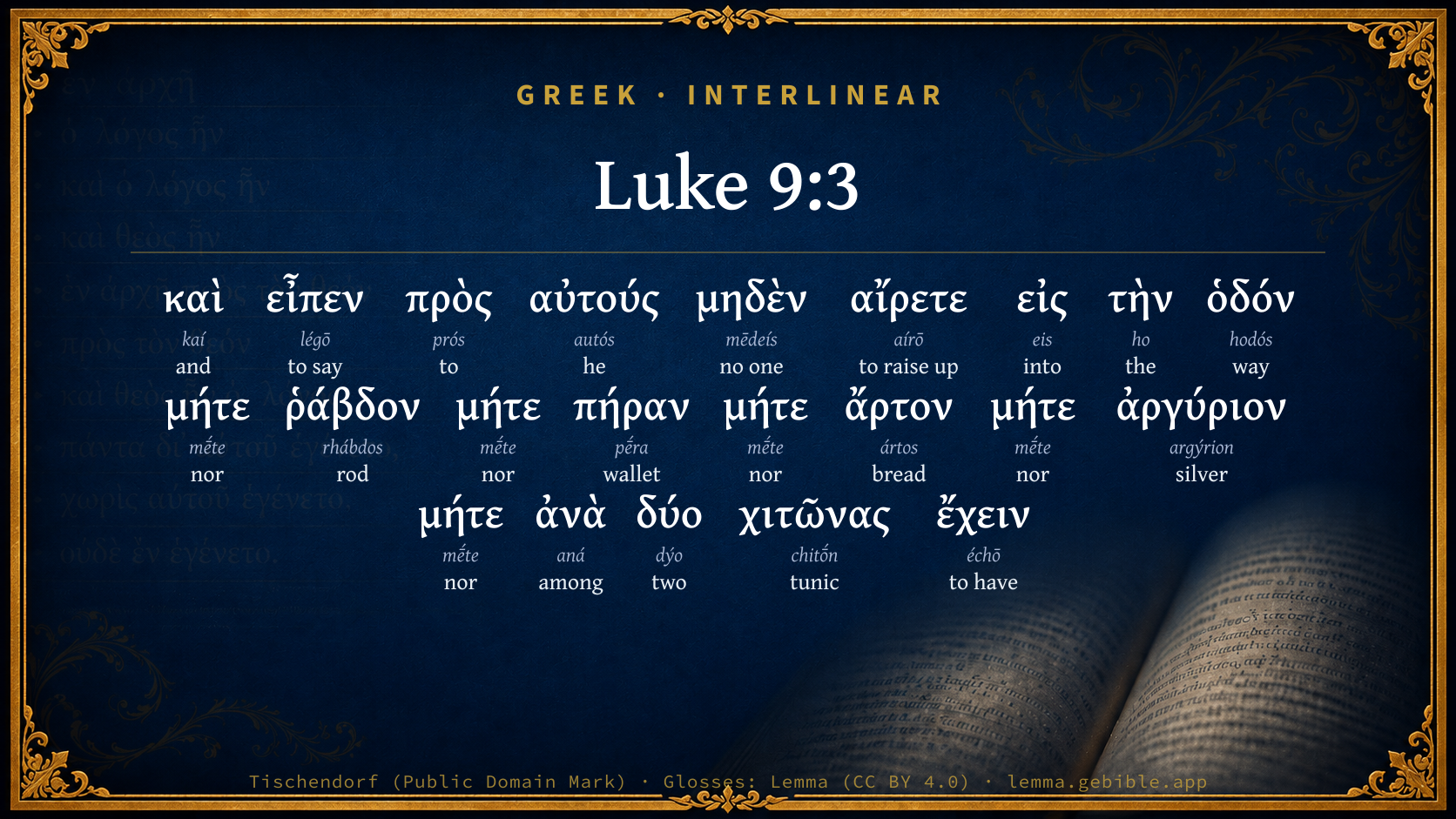
Greek (Tischendorf 8th ed.) Luke 9:3 appears in the Greek New Testament. The text above is from the Tischendorf 8th edition. Each word links to its Strong’s number and a concise gloss. Click any word for its full Thayer’s Greek Lexicon entry.
Download image
Cite this verse

Luke 9:3 (World English Bible). Public Domain. Lemma interlinear Bible study tool, https://lemma.gebible.app/v/luke/9/3.

Show BibTeX & RIS
BibTeX
RIS
English Translation
He said to them, "Take nothing for your journey--neither staffs, nor wallet, nor bread, nor money; neither have two coats apiece.
World English Bible · Public Domain
Download a study sheet

One document with this verse’s original text, its word-by-word gloss line, the meaning frame, cross-references with their text, attributed commentary, and full source and license credits — printable, and it pastes into notes with its structure intact.

This verse Autodidact and up

Study sheet (.html) Plain text (.txt)

A passage Seminary Student

Up to 50 verses in one chapter. A passage sheet keeps up to 6 commentary sources and 12 cross-references per verse, in the order this page ranks them, and says so on the sheet whenever that leaves anything out. Ask for a single verse and you get the Autodidact verse sheet above.

Everything on this page stays free to read, with no account — the sheet is a download of what is already on screen, not access to it.

Want to remove ads? Support Godless Engineer
Compare translations 3

The same verse in 3 English versions, stacked beneath the original-language interlinear above. Click any original word for its lexicon entry.

Each is an independent rendering of the whole verse — the interlinear is not word-aligned to these translations.

Highlighted words mark where these versions differ — a whole-verse word diff, not a word-by-word alignment.

  • World English Bible Public Domain
    He said to them, "Take nothing for your journey--neither staffs, nor wallet, nor bread, nor money; neither have two coats apiece.
  • King James Version Public Domain
    And he said unto them, Take nothing for your journey, neither staves, nor scrip, neither bread, neither money; neither have two coats apiece.
  • unfoldingWord Literal Text CC BY-SA 4.0
    And he said to them, “Take nothing for the road—neither staff, nor bag, nor bread, nor silver—nor have two tunics.

unfoldingWord Literal Text — © unfoldingWord, licensed CC BY-SA 4.0. Word-aligned USFM3 via Door43 (git.door43.org/unfoldingWord/en_ult).

Versions to compare (up to 4)

3 of 4 selected

Show all 19 translations

Every available English version of this verse, each an independent rendering of the whole verse.

  • World English Bible Public Domain
    He said to them, "Take nothing for your journey--neither staffs, nor wallet, nor bread, nor money; neither have two coats apiece.
  • Berean Standard Bible Public Domain
    “Take nothing for the journey,” He told them, “no staff, no bag, no bread, no money, no second tunic.
  • Majority Standard Bible Public Domain
    “Take nothing for the journey,” He told them, “no staffs, no bag, no bread, no money, no second tunic.
  • King James Version Public Domain
    And he said unto them, Take nothing for your journey, neither staves, nor scrip, neither bread, neither money; neither have two coats apiece.
  • American Standard Version (1901) Public Domain
    And he said unto them, Take nothing for your journey, neither staff, nor wallet, nor bread, nor money; neither have two coats.
  • Revised Version (1885) Public Domain
    And he said unto them, Take nothing for your journey, neither staff, nor wallet, nor bread, nor money; neither have two coats.
  • Geneva Bible (1599) Public Domain
    And he sayd to them, Take nothing to your iourney, neither staues, nor scrip, neither bread, nor siluer, neither haue two coates apiece.
  • Douay-Rheims (1899) Public Domain
    And he said to them: Take nothing for your journey; neither staff, nor scrip, nor bread, nor money; neither have two coats.
  • Young's Literal Translation Public Domain
    And he said unto them, `Take nothing for the way, neither staff, nor scrip, nor bread, nor money; neither have two coats each;
  • Literal Standard Version CC BY-SA 4.0
    And He said to them, “Take nothing for the way, neither staff, nor leather pouch, nor bread, nor money; neither have two coats each;
  • Unlocked Literal Bible CC BY-SA 4.0
    He said to them, “Take nothing for your journey—no staff, no wallet, no bread, no money, and no extra tunic.
  • unfoldingWord Literal Text CC BY-SA 4.0
    And he said to them, “Take nothing for the road—neither staff, nor bag, nor bread, nor silver—nor have two tunics.
  • Darby Bible Public Domain
    And he said to them, Take nothing for the way, neither staff, nor scrip, nor bread, nor money; nor to have two body-coats apiece.
  • World Messianic Bible Public Domain
    He said to them, “Take nothing for your journey—no staffs, nor wallet, nor bread, nor money. Don’t have two tunics each.
  • Webster's Bible Public Domain
    And he said to them, Take nothing for your journey, neither staffs, nor bag, neither bread, neither money; neither have two coats apiece.
  • Free Bible Version CC BY-SA 4.0
    “Take nothing with you for the journey,” he told them. “No walking stick, no bag, no bread, no money, not even any extra clothes.
  • Bible in Basic English Public Domain
    And he said to them, Take nothing for your journey, no stick or bag or bread or money, and do not take two coats.
  • Text-Critical English NT CC BY 4.0
    He said to them, “Take nothing for your journey—no staffs, no knapsack, no bread, no money—and bring only one tunic each.
  • Tyndale New Testament (1534) Public Domain
    And he sayd to them: Take nothinge to sucker you by the waye: nether staffe nor scripe nether breed nether money nether have twoo cootes.

Literal Standard Version (2020), Covenant Press — licensed CC BY-SA 4.0. Text via the HelloAO Bible API (eBible.org). Unlocked Literal Bible (unfoldingWord) — licensed CC BY-SA 4.0. Text via the HelloAO Bible API (eBible.org). unfoldingWord Literal Text — © unfoldingWord, licensed CC BY-SA 4.0. Word-aligned USFM3 via Door43 (git.door43.org/unfoldingWord/en_ult). Free Bible Version, Dr. Jonathan Gallagher — licensed CC BY-SA 4.0. Text via the HelloAO Bible API (eBible.org).

Word by word

More ways to search: Search by grammar → Find every occurrence → Compare this word →

Practice this passage: Drill this verse → Learn its vocabulary →

πήραν
pḗra
G4082
“wallet”
Noun, Accusative, Singular, Feminine
Part of Speech
Noun
Case
Accusative
Number
Singular
Gender
Feminine
Full Thayer's Definition

Origin: of uncertain affinity

TDNT: 07:59,8

1. a wallet 2. a leathern sack, in which travellers and shepherds carried their provisions
  1. καὶ kaí G2532 “and” Conjunction
  2. εἶπεν légō G3004 “to say” Verb, Aorist, Active, Indicative, 3rd person, Singular
  3. πρὸς prós G4314 “to” Preposition
  4. αὐτούς autós G846 “he” Personal pronoun, Accusative, Plural, Masculine
  5. μηδὲν mēdeís G3367 “no one” Adjective, Accusative, Singular, Neuter, Negative
  6. αἴρετε aírō G142 “to raise up” Verb, Present, Active, Imperative, 2nd person, Plural
  7. εἰς eis G1519 “into” Preposition
  8. τὴν ho G3588 “the” Article, Accusative, Singular, Feminine
  9. ὁδόν hodós G3598 “way” Noun, Accusative, Singular, Feminine
  10. μήτε mḗte G3383 “nor” Conjunction, Negative
  11. ῥάβδον rhábdos G4464 “rod” Noun, Accusative, Singular, Feminine
  12. μήτε mḗte G3383 “nor” Conjunction, Negative
  13. μήτε mḗte G3383 “nor” Conjunction, Negative
  14. ἄρτον ártos G740 “bread” Noun, Accusative, Singular, Masculine
  15. μήτε mḗte G3383 “nor” Conjunction, Negative
  16. ἀργύριον argýrion G694 “silver” Noun, Accusative, Singular, Neuter
  17. μήτε mḗte G3383 “nor” Conjunction, Negative
  18. ἀνὰ aná G303 “among” Preposition
  19. δύο dýo G1417 “two” Adjective, Numeral (indeclinable)
  20. χιτῶνας chitṓn G5509 “tunic” Noun, Accusative, Plural, Masculine
  21. ἔχειν échō G2192 “to have” Verb, Present, Active, Infinitive

About this verse

These counts appear in no published source. They are computed here, from the morphology-tagged text and Lemma’s own curated glosses. What Lemma adds →

22
words
18
distinct lemmas
Gospels
section

Notable vocabulary

The rarest word here is πήραν wallet G4082 — appearing just 6 times in the whole Greek New Testament.

Shared distinctive vocabulary

πήραν wallet G4082 occurs in 6 verses of the Greek New Testament. Also found in:

Repetition

A word recurs within this verse:

Cross-references

10

Topical passages linked to Luke 9:3 in the Treasury of Scripture Knowledge — connected by theme and wording, ordered by reader-vote popularity; previews shown in the World English Bible.

  • Luke 22:35 He said to them, "When I sent you out without purse, and wallet, and shoes, did you lack anything?" They said, "Nothing."
  • Psalms 37:3 Trust in Yahweh, and do good. Dwell in the land, and enjoy safe pasture.
  • Luke 10:4–12 Carry no purse, nor wallet, nor sandals. Greet no one on the way.
  • Matthew 10:9–14 Don't take any gold, nor silver, nor brass in your money belts.
  • 2 Timothy 2:4 No soldier on service entangles himself in the affairs of life, that he may please him who enrolled him as a soldier.
  • Mark 6:8–11 He charged them that they should take nothing for their journey, except a staff only: no bread, no wallet, no money in their purse,
  • Luke 3:11 He answered them, "He who has two coats, let him give to him who has none. He who has food, let him do likewise."
  • Luke 12:22 He said to his disciples, "Therefore I tell you, don't be anxious for your life, what you will eat, nor yet for your body, what you will wear.
  • Luke 5:29 Levi made a great feast for him in his house. There was a great crowd of tax collectors and others who were reclining with them.
  • Luke 12:28 But if this is how God clothes the grass in the field, which today exists, and tomorrow is cast into the oven, how much more will he clothe you, O you of little faith?

Cross-references courtesy of OpenBible.info (CC BY 4.0).

Where the printed editions differ

1 variant

Places in this verse where the major printed Greek editions disagree on the wording in a way that affects the translation — a comparison of editions, not a manuscript-by-manuscript collation. The editions are the modern critical texts (Nestlé-Aland 28/27, SBL, Westcott-Hort, Tregelles, Tyndale House) and the traditional texts behind the KJV (the Textus Receptus and the Byzantine/Majority text). It is not a claim about which reading is original.

  1. Different wording
    ῥάβδον

    “staff”

    In NA28NA27TynSBLWHTreg Not in TRByz

    ῥάβδους (rhabdous) 'staffs' occurs in traditional manuscripts (TR+Byz) instead of ῥάβδον (rhabdon) 'staff' in older manuscripts (NA28+NA27+Tyn+SBL+WH+Treg)

Textual data: Translators Amalgamated Greek New Testament (STEPBible TAGNT) · CC BY 4.0.

Commentary

Notes on Luke 9:3 from classic Christian and Jewish commentators (each source and its license shown beneath its notes). The classic Christian expositions comment on the surrounding passage and are grouped to its opening verse, so a note may address several verses; the Jewish commentaries on the Tanakh (Rashi and others) are per-verse, so they appear only where the commentator wrote on this verse.

Lemma curates 59 commentaries, every one of them public domain or Creative Commons licensed, each selected and text-cleaned for this edition rather than reprinted as found. About our sources →

The Biblical Illustrator

Joseph S. Exell

Luk_9:3

Take nothing for your Journey

Travelling without any burden

It is easy travelling if you have no burden.

They were on His business, sent by Him, and He assumed their care, and forbade them to trust themselves, or any other but Him. What a load of care goes off with this, what a burden of responsibility is removed; but what faith and humility is needed! Some of them had been called away from full nets (Luk_5:11), and it takes faith to follow under such circumstances. Many would start if they were permitted to carry the fish, but they are afraid. Afraid--of what, or whom? How strange to their eyes would some of us appear, as we go forth to our work, clothed in rags of self-righteousness and wrappers of pride, loaded with burdens of care and sin? Too much like the Israelites, leaving Egypt with flocks and herds, clothes and kettles, bread and kneading troughs; delivered from bondage, but knowing nothing of the manna, or the water from the rock. Others are afraid to go, fearing to swing off from their earthly base of supplies, and trust the promises of God. But it is all explained in the word, Lo, I am with you alway. And what for?

1. Surely to provide. Is He not the Creator? And what would come of all their care if He did not provide? How long would it take them to create a barley-corn, or make a fish?

2. Surely to direct. What would their ignorance have accomplished without Him? And, with such a captain, what need of vexatious study over plans and methods?

3. Surely to lead. In the march through an unknown wilderness, or through a trackless desert, or over an unknown sea, to an unknown port, what progress without a guide and a pilot?

4. Surely to carry all their burdens (Psa_55:22; 1Pe_5:7). And, if he wishes to carry them all, why need we refuse or complain? Is it not because He knows our weakness, and because of His strength? And is this all? Oh no! Surely it is because He will be our companion. What are the power and wisdom and riches without the love? If Thy presence go not with me, carry us not up hence (Exo_33:15). (Sunday School Times.)

Apostolic simplicity

The Rev. H. Davies, sometimes called the Welsh Apostle, was walking early one Sabbath morning to a place where he was to preach. He was overtaken by a clergyman on horseback, who complained that he could not get above half a guinea for a discourse. Oh sir, said Mr. Davies, I preach for a crown; Do you? replied the stranger; then you are a disgrace to the cloth. To this rude observation he returned this meek answer, Perhaps I shall be held in still greater disgrace, in your estimation, when I inform you that I am now going nine miles to preach, and have but sevenpence in my pocket to bear my expenses out and in; but I look forward to that crown of glory which my Lord and Saviour will freely bestow upon me when He makes His appearance before an assembled world.

The Biblical Illustrator, edited by Joseph S. Exell (c. 1880s–1900s) — public domain. Text from a community e-Sword module.

Tyndale Open Study Notes

Tyndale Open Resources

9:3 Take nothing for your journey: They were to live in dependence on God and on the charity of those to whom they ministered.

Tyndale Open Study Notes — © Tyndale Open Resources, licensed CC BY-SA 4.0. Text via the HelloAO Bible API.

Bengel's Gnomon

Johann Albrecht Bengel

Luk 9:3. Ἔχειν, to have) The Infinitive may be resolved either into an Imperative or into a Gerund.

Bengel's Gnomon of the New Testament — English translation (T&T Clark, Edinburgh, 1860) — public domain. Text from a community e-Sword module.

Expositor's Greek Testament

ed. W. Robertson Nicoll

Luk 9:3 . The instructions in this and the next two verses follow pretty closely the version in Mk. μηδὲν αἴρετε εἰς τὴν ὁδόν : as in Mk., but in direct speech, while Mk.’s is indirect ( ἵνα μ . αἴρωσιν .) μήτε ῥάβδον : Lk. interprets tie prohibition more severely than Mk. Not a staff (Mk. except a staff only). ἀργύριον , silver, for Mk.’s χαλκόν : silver the common metal for coinage among the Greeks, copper among the Romans. δύο χιτῶνας , two tunics each, one on and one for change. ἔχειν : infinitive, after αἴρετε , imperative. It may be a case of the infinitive used as an imperative, of which one certain instance is to be found in Phi 3:16 ( στοιχεῖν = walk), or it may be viewed as a transition from direct to indirect speech (so most commentators). Bengel favours the first view.

The Expositor's Greek Testament, edited by W. Robertson Nicoll (1897–1910) — public domain. Text from a community e-Sword module.

Godet's Commentaries

Frédéric Louis Godet

2 d. Luk 9:3-5. Their Instructions.—“And He said unto them, Take nothing for your journey, neither staves, nor scrip, neither bread, neither money; neither have two coats apiece. 4. And whatsoever house ye enter into, there abide and thence depart. 5. And whosoever will not receive you, when ye go out of that city, shake off the very dust from your feet for a testimony against them.”

Ver. 3 contains instructions for their setting out; Luk 9:4, instructions respecting their arrival and stay; Luk 9:5, instructions for leaving each place.

Ver. 3. The feeling of confidence is the key to the injunctions of this verse: “Make no preparations, such as are ordinarily made on the eve of a journey; set out just as you are. God will provide for all your wants.” The reply of the apostles, Luk 22:35, proves that this promise was not unfulfilled.—Μηδέν, nothing, is a general negative, to which the subsequent μήτε, neither...nor...are subordinate. Mark, who commences with a simple μή, naturally continues with the negative μηδέ, nor further. Each writer, though expressing the same idea as the other, has his own particular way of doing it. Luke says, neither staff, or, according to another reading, neither staves; Matthew is like Luke; Mark, on the contrary, save one staff only. The contradiction in terms could not be greater, yet the agreement in idea is perfect. For as far as the sentiment is concerned which Jesus wishes to express, it is all one to say, “nothing, not even a staff” (Matthew and Luke), or, “nothing, except it be simply (or at most) a staff” (Mark). Ebrard makes the acute observation, that in Aramaean Jesus probably said, כִּי אִםמַטֶּה, for if...a staff, an elliptical form also much used in Hebrew, and which may be filled up in two ways: For if you take a staff, this of itself is quite sufficient (Mark); or, this of itself is too much (Matthew and Luke). This saying of Jesus might therefore be reproduced in Greek either in one way or the other. But in no case could these two opposite forms be explained on the hypothesis of a common written Greek source. Bleek, who prefers the expression given in Matthew and Luke, does not even attempt to explain how that in Mark could have originated.

If we read staves, according to a various reading found in Luke and Matthew, the plural must naturally be applied to the two apostles travelling together.

Luke says, Do not have each (ἀνά, distributive) two coats, that is to say, each a change of coat, beyond what you wear. As they were not to have a travelling cloak (πήρα), they must have worn the second coat on their person; and it is this idea, implied by Luke, that is exactly expressed by Mark, “neither put on two coats.” The infinitive μὴ ἔχειν depends on εἶπε: “He said to them...not to have...”

As an unanswerable proof of an opposite tendency in Matthew and Luke, it is usual to cite the omission in this passage of the prohibition with which in Matthew this discourse commences (Luk 10:5): “Go not into the way of the Gentiles, and into any city of the Samaritans enter ye not: but go rather to the lost sheep of the house of Israel.” But even in Matthew this prohibition is not absolute (rather) nor permanent (Mat 28:19, “Go and teach all nations”). It was therefore a restriction temporarily imposed upon the disciples, in consideration of the privilege accorded to the Jewish nation of being the cradle of the work of the Messiah. With some exceptions, for which there were urgent reasons, Jesus Himself was generally governed by this rule. He says, indeed, in reference to His earthly ministry: “I am not sent save to the lost sheep of the house of Israel” (Mat 15:24); nevertheless, He is not ignorant that it is His mission to seek and to save all that which is lost, and consequently the heathen. He affirms it in the Gospels of Matthew and Mark, no less than in that of Luke. Paul himself does homage to this divine fidelity, when he recalls the fact that Jesus, during His earthly life, consented to become a minister of the circumcision (Rom 15:8). But, 1. What reason could Luke have, in the circle for which he was writing, to refer to this restriction temporarily imposed upon the Twelve for the purpose of this particular mission? 2. Mark, no less than Luke, omits these words in the account he gives of this discourse, but the harmony of his leaning with that of the first evangelist is not suspected. 3. This last circumstance makes it all but certain that this detail had already been omitted in the sources whence these two evangelists drew their narratives, and must completely exculpate Luke from all anti-Jewish prejudice in his reproduction of this discourse.

Frédéric Louis Godet — Commentaries on Luke, John, Romans, and 1 Corinthians — English translation (T&T Clark, Edinburgh, 1870s–1890s) — public domain. Text from a community e-Sword module.

Adam Clarke's Commentary

Verse 3. Take nothing] See note on Mr 6:7; Mr 6:8.

Neither money] See Clarke on Mt 10:9.

Neither have two coats] Show that in all things ye are ambassadors for God; and go on his charges.

Adam Clarke's Commentary on the Bible (1810–1826) — public domain. Text from a community e-Sword/MySword module.

Ellicott's Commentary for English Readers

(3) Neither staves.—The better MSS. give, “neither a staff.” The plural was probably adopted in order to bring the verse into harmony with Mat_10:10, and Mar_6:8.

A Bible Commentary for English Readers, edited by Charles John Ellicott (1878–1897) — public domain. Text from a community e-Sword module.

The Cambridge Bible for Schools and Colleges

gen. ed. J. J. S. Perowne

3. And he said unto them] For a much fuller account of the instructions given to the Twelve see Mat_10:5-15. Some of these are recorded by St Luke as given also to the Seventy, Luk_10:1-16.

neither staves] Or a staff (as N, A, B, and many uncials). The plural may have been frivolously introduced by some copyist who wished to avoid an apparent discrepancy with Mar_6:8, “save a staff only.” St Matthew also says, ‘not even a staff.’ Minute and wholly unimportant as the variation would have been, it may turn on the fact that our Lord told them not specially to procure (μὴ κτήσησθε, Matt.) these things for the journey; or on the fact that speaking in Aramaic He used the phrase כי אם (kee im), which might be explained ‘even if you have a staff it is unnecessary.’

nor scrip] i.e. wallet, a bag carried over the shoulder to contain a few dates or other common necessaries. 1Sa_17:40.

neither dread] which they usually took with them, Luk_9:13; Mat_16:7.

neither money] Literally, “silver.” St Luke uses the word because it was the common metal for coinage among the Greeks. St Mark uses “copper,” the common Roman coinage.

neither have two coats apiece] i.e. do not carry with you a second tunic (ketoneth)—which indeed is a rare luxury among poor Orientals. (See on Luk_3:11.) If they carried a second tunic at all they could only do so conveniently by putting it on (Mar_6:9). St Mark adds that they were to wear sandals, and St Matthew that they were not to have travelling shoes (hupodimata). The general spirit of the instructions merely is, Go forth in the simplest, humblest manner, with no hindrances to your movements and in perfect faith; and this, as history shews, has always been the method of the most successful missions. At the same time we must remember that the wants of the Twelve were very small (see on Luk_8:3) and were secured by the open hospitality of the East (Thomson, Land and Book, p. 346).

The Cambridge Bible for Schools and Colleges (gen. ed. J. J. S. Perowne; Cambridge University Press, 1878–1918) — public domain. Text from a community e-Sword module.

John Gill's Exposition

And he said unto them, take nothing for your journey,.... Throughout the towns and cities of Judea, where they were sent to preach the Gospel:

neither staves, The Vulgate Latin, and all the Oriental versions, read in the singular number, "neither staff, rod, or club"; and so it was in one of Beza's ancient copies, but in all the rest in the plural, as in Matthew; which last must be the true reading, since one staff was allowed, according as in Mar 6:8 though more than one were forbidden:

nor scrip; or bag to put provision in; See Gill on Mat 10:10.

Neither bread, neither money; gold, silver, or brass, to buy bread with; because they were to have it, wherever they came, given them, as their due, and the reward of their labour;

neither have two coats apiece; the word "apiece" is left out in one copy, nor is it expressed in the Vulgate Latin and the eastern versions, which read as in Mat 10:10 though the word does aptly and clearly express the sense of the prohibition, which was not that they should not have two coats among them, but not two apiece; or each man should not have two, or have change of raiment; See Gill on Mat 10:10

John Gill's Exposition of the Whole Bible (1746–1763) — public domain (CC PDM 1.0). Text via the HelloAO Bible API.

Trapp's Complete Commentary

John Trapp

3 And he said unto them, Take nothing for your journey, neither staves, nor scrip, neither bread, neither money; neither have two coats apiece.

Ver. 3. Take nothing for your journey] But preach the gospel, and depend upon divine providence. Look you to your work, and God will take care for your wages. This the disciples might do, but this was no warrant to those maleferiati among us, who (if fame belie them not) pretending to an immediate call from God to go and preach the gospel in Galilee, sold their estates, set forward for that place, taking neither scrip nor scrap with them; resolving to trust God for their necessary sustentation. Is not this the efficacy of error? Are not these a diabolo dementatis, besotted by the devil?

John Trapp, A Commentary or Exposition upon All the Books of the Old and New Testament (1647–1656) — public domain. Text from a community e-Sword module.

The Pulpit Commentary

Take nothing for your journey. Dr. Farrar well sums up the various directions of the Master to these his first missionaries: "The general spirit of the instructions merely is, "Go forth in the simplest, humblest manner, with no hindrances to your movements, and in perfect faith;" and this, as history shows, has always been the method of the most successful missions. At the same time, we must remember that the wants of the twelve were very small, and were secured by the free open hospitality of the East."

The Pulpit Commentary (1880–1919), ed. H.D.M. Spence-Jones & Joseph S. Exell — public domain. Text from a community e-Sword module.

Scofield Reference Notes

C. I. Scofield

Take nothing

Cf. (See Scofield "Mat 10:9"). Also, Luk 10:4; Luk 22:35; 3Jn 1:5-8; 1Co 9:7; 1Co 9:14.

The Scofield Reference Bible (1917 edition), notes by C. I. Scofield — public domain. Text from a community e-Sword module.

unfoldingWord translationNotes

Door43 World Missions Community

He said to them

"Jesus said to the twelve." It may be helpful to state that this happened before they went out. AT: "Before they left, Jesus said to them"

Take nothing

"Do not take anything with you" or "Do not bring anything with you"

for your journey

"for your trip" or "when you travel." They are to take nothing for their entire trip, as they move from village to village, and until they come back to Jesus.

staff

large stick that people use for balance when climbing or walking on uneven ground, as well as for defense against attackers

wallet

a bag a traveler uses for carrying what he needs on a journey

bread

This is here used as a general reference to "food."

Whatever house you enter

"Any house you enter"

stay there

"remain there" or "temporarily live in that house as a guest"

until you leave

"until you leave that town" or "until you leave that place"

translationWords

staff

bread

tunic

unfoldingWord translationNotes — © Distant Shores Media and the Door43 World Missions Community, licensed CC BY-SA 4.0. Source: git.door43.org/Door43/en_tn.

Cambridge Greek Testament for Schools and Colleges

3. εἶπεν πρὸς αὐτούς. For a much fuller account of the instructions given to the Twelve, see Mat 10:5-15. Some of these are recorded by St Luke as given also to the Seventy, Luk 10:1-16.

μήτε ῥάβδον. So אAB &c. The plural may have been frivolously introduced by some copyist who wished to avoid an apparent discrepancy with Mar 6:8, “save a staff only.” St Matthew also says, ‘not even a staff.’ Minute and wholly unimportant as the variation would have been, it may turn on the fact that our Lord told them not specially to procure (μὴ κτήσησθε, Matt.) these things for the journey; or on the fact that speaking in Aramaic He used the phrase כי אם (kee im), which might be explained ‘even if you have a staff it is unnecessary.’ Meanwhile the variations furnish an interesting proof of the independence of the three Synoptists.

πήραν. A ‘wallet,’ a bag of kid’s skin carried over the shoulder to contain a few dates or other common necessaries. 1Sa 17:40. (Thomson, Land and Book, p. 355.)

μήτε ἄρτον. Which they usually took with them, Luk 9:13; Mat 16:7.

μήτε ἀργύριον. Literally, ‘silver.’ St Luke uses the word because it was the common metal for coinage among the Greeks. St Mark uses ‘copper,’ the common Roman coinage.

μήτε ἀνὰ δύο χιτῶνας. ‘Do not carry with you a second tunic or under-garment (ketoneth)’—which indeed is a rare luxury among poor Orientals. (See on Luk 3:11.) If they carried a second tunic at all they could only do so conveniently by putting it on (Mar 6:9). St Mark adds that they were to wear sandals, and St Matthew that they were not to have travelling shoes (ὑποδήματα). The general spirit of the instructions merely is, ‘Go forth in the simplest, humblest manner, with no hindrances to your movements and in perfect faith’; and this, as history shews, has always been the method of the most successful missions. At the same time we must remember that the wants of the Twelve were very small (see on Luk 8:3) and were secured by the open hospitality of the East (Thomson, Land and Book, p. 346). For the distributive use of ἀνὰ see Joh 2:6, ἀνὰ μετρητὰς δύο; Mar 6:40, ἀνὰ πεντήκοντα. The ἔχειν is a mixture of the indirect with the direct construction, as though the clause had begun with μηδὲν αἴρειν. It would be less natural to explain the infinitive as being here used for an imperative, or as an epexegetic infinitive—‘two coats apiece, to wear.’ See Winer, p. 397.

Cambridge Greek Testament for Schools and Colleges (Cambridge University Press, 1896; 21 vols, various authors incl. Carr, Maclear, Plummer, Farrar, Lumby, Moule, M. R. James, Simcox) — public domain. Text from a community e-Sword module.

Alford’s Greek Testament

Henry Alford

3.] μήτε [ἀνὰ] δύο χ. ἔχειν—a mixed construction;—the former clause having been in the second person, this is added as if it had been in the infin., αἴρειν. The infinitive for the imperative would not be in place here,—see Winer, Gram. § 43, 5. d, edn. 6.

It is remarkable that in Mark, there is also a mixed construction, ἵνα μηδὲν αἴρωσιν … ἀλλʼ ὑποδεδεμένους … καὶ μὴ ἐνδύσησθε … (On ἀνά, see reff.)

Henry Alford, The Greek Testament (1849–1861) — public domain. Text from a community e-Sword module.

International Critical Commentary

3. μήτε ῥάβδον. Mk. has εἰ μὴ ῥάβδον μόνον (6:8); and the attempts to explain away this discrepancy in a small matter of detail are not very happy. As between Mt. and Mk. it is possible to explain that both mean “Do not procure (κτήσεσθε) a staff for the journey, but take (αἴρωσιν) the one which you have.” But both Mk. and Lk. use αἴρειν, and the one has “Take nothing except a staff,” while the other has “Take nothing, neither a staff,” etc. Yet in all three the meaning is substantially the same: “Make no special preparations; go as you are.” From 22:35 we learn that the directions were obeyed, and with good results. Lk. says nothing about sandals, respecting which there is another discrepancy between Mt. and Mk., unless we are to suppose that ὑποδήματα are different from σανδάλια. D. C. G. art. “Staff.”

μήτε ἀργύριον. Mk. has χαλκόν and Mt. has both, μηδὲ ἄργυρον μηδὲ χαλκόν. Thus Lk. is Greek, and Mk. is Roman, in choice of words. In LXX ἀργύριον is very common, ἄργυρος comparatively rare, while χαλκός is common as a metal, but not in the sense of money.

μήτε δύο χιτῶνας ἔχειν. As no πήρα was allowed, the second tunic, if taken, would have to be worn. Hence the form in Mk., “Put not on two tunics.” Comp. Jos. Ant. xvii. 5. 7.

In ἔχειν we have an anacoluthon; change from direct to oblique oration. For it is scarcely admissible to take ἔχειν as infin. for imperat. The actmal imperat. both precedes (αἴρετε) and follows (μένετε). Win. 43:5. d, p. 397. Mk. here is strangely abrupt in his mixture of constructions.

International Critical Commentary — older volumes (1896–1929), various authors — public domain. Text from a community e-Sword module.

Vincent's Word Studies in the New Testament

Marvin R. Vincent

Take [αιρετε] . Lit., lift, with a view of carrying away.

Staves. Following the reading rJabdouv, for which read rJabdon, staff. Two coats [ανα δυο χιτωνας] . Lit., two apiece : the force of ajna, as in Joh 2:6.

Marvin R. Vincent, Word Studies in the New Testament (1887–1900) — public domain. Text from a community e-Sword/MySword module.

Lesson kit

Teaching starters — assembled from the data on this page, not authored interpretation. Every prompt links to the verse data it draws on. Edit before teaching.

Luke, in the Gospels, opens this verse with 22 words (18 distinct Greek lemmas). Its most distinctive word is pḗra (“wallet”). A historical commentator’s framing appears above. Read the whole chapter for the surrounding context.

Discussion questions

  1. The word pḗra carries the sense “wallet.” How does it shape the verse?
  2. How does Matthew 10:10, which shares the word «wallet», read alongside this verse?
  3. What does the repetition of “nor” (5× in this one verse) do in this verse?
  4. The translations on this page render this verse differently — a whole-verse word diff, not a word-by-word alignment. What might account for the different wordings?
  5. Compare how The Biblical Illustrator and Tyndale Open Study Notes read this verse. Where do they agree or differ?

Things to notice

Reading settings

Reading text

Shown beneath each verse's original-language words.

Old Testament
Old Testament edition

Read the OT as the Masoretic Hebrew (MT) or the Greek Septuagint (LXX).

English shown for the Greek Septuagint (in the Hebrew ↔ Greek comparison).

Comparing translations? Open the Compare panel on any verse page to stack up to four side by side.