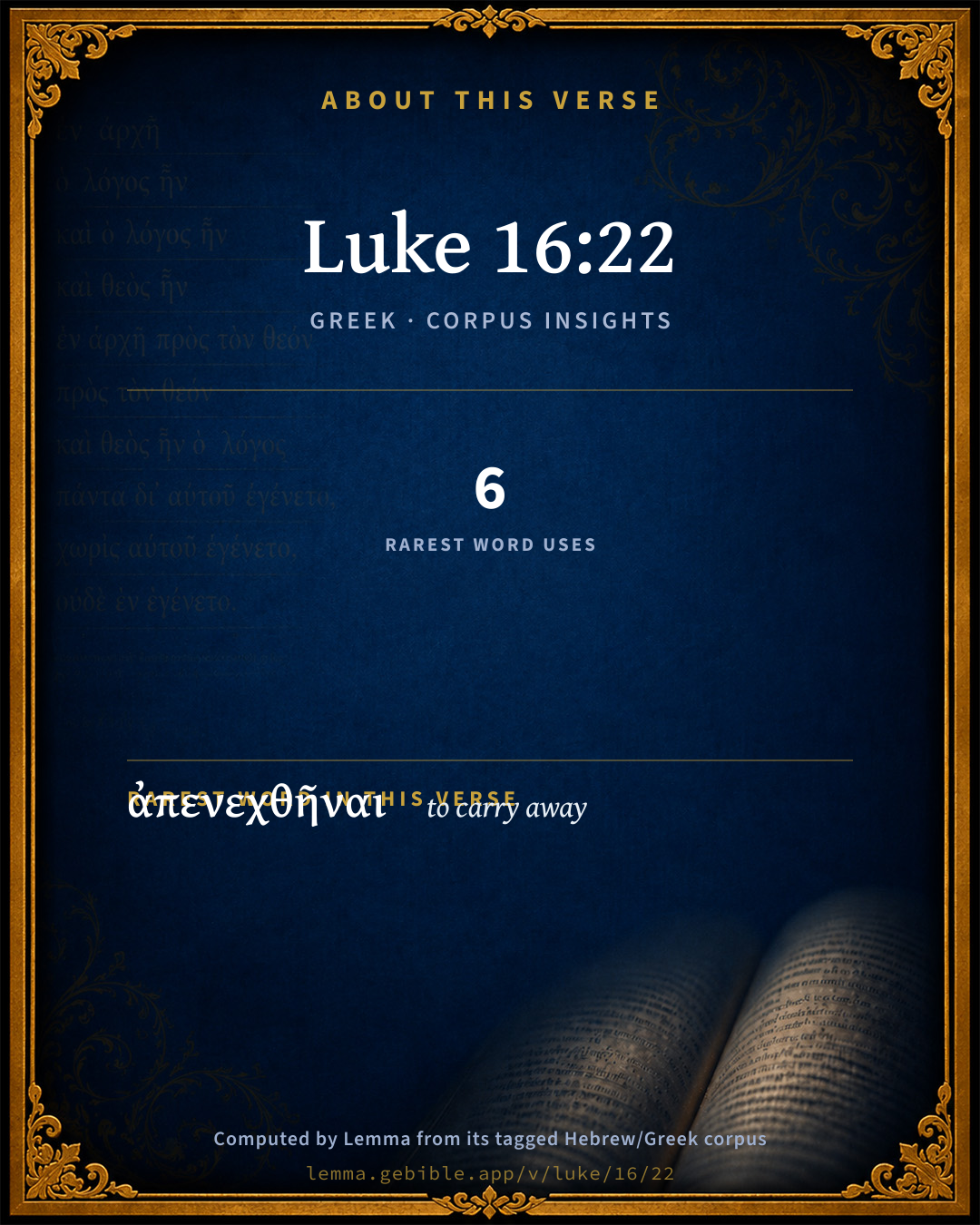
Luke 16:22

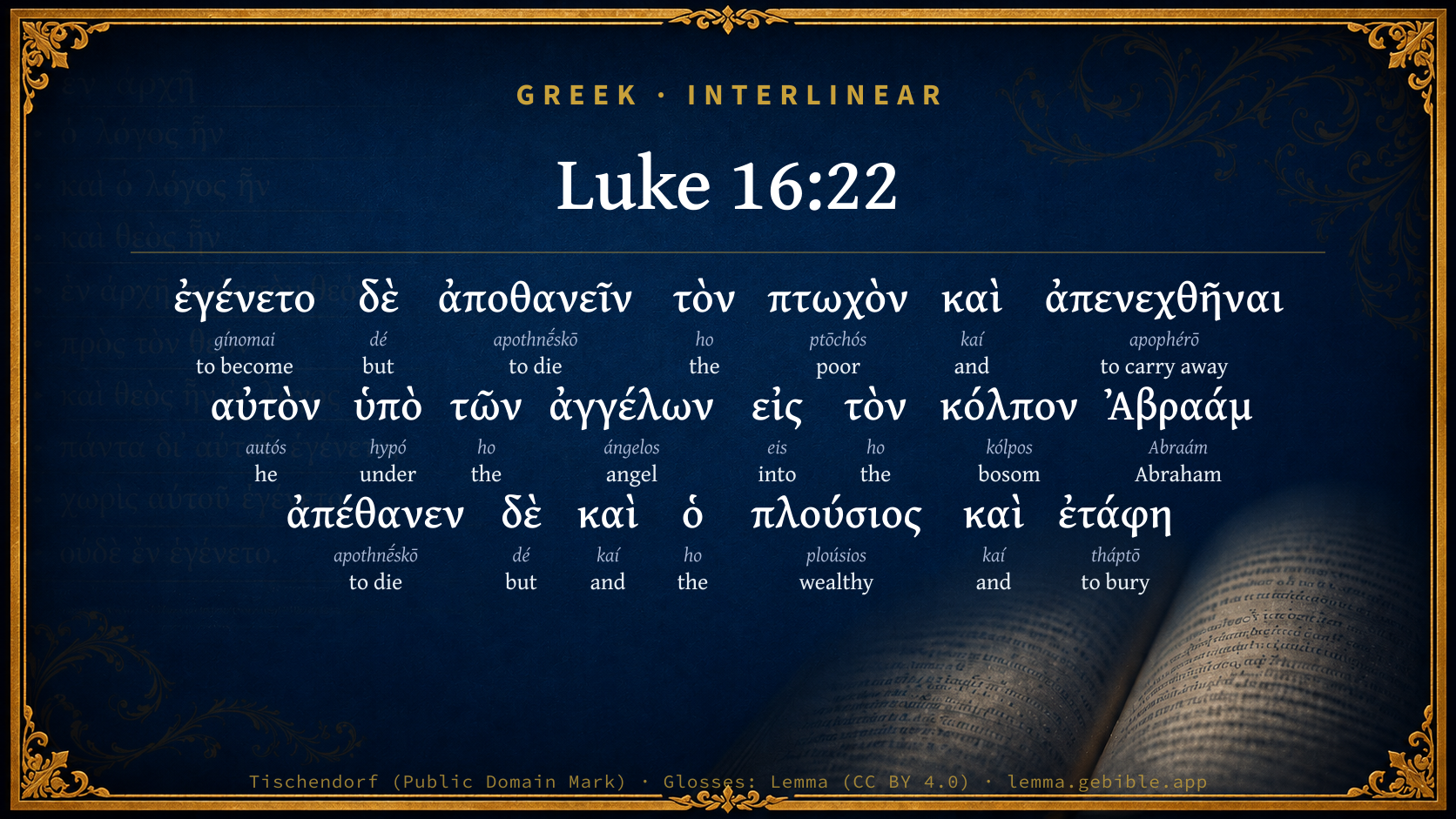
Greek (Tischendorf 8th ed.) Luke 16:22 appears in the Greek New Testament. The text above is from the Tischendorf 8th edition. Each word links to its Strong’s number and a concise gloss. Click any word for its full Thayer’s Greek Lexicon entry.
Download image
Cite this verse

Luke 16:22 (World English Bible). Public Domain. Lemma interlinear Bible study tool, https://lemma.gebible.app/v/luke/16/22.

Show BibTeX & RIS
BibTeX
RIS
English Translation
It happened that the beggar died, and that he was carried away by the angels to Abraham's bosom. The rich man also died, and was buried.
World English Bible · Public Domain
Download a study sheet

One document with this verse’s original text, its word-by-word gloss line, the meaning frame, cross-references with their text, attributed commentary, and full source and license credits — printable, and it pastes into notes with its structure intact.

This verse Autodidact and up

Study sheet (.html) Plain text (.txt)

A passage Seminary Student

Up to 50 verses in one chapter. A passage sheet keeps up to 6 commentary sources and 12 cross-references per verse, in the order this page ranks them, and says so on the sheet whenever that leaves anything out. Ask for a single verse and you get the Autodidact verse sheet above.

Everything on this page stays free to read, with no account — the sheet is a download of what is already on screen, not access to it.

Want to remove ads? Support Godless Engineer
Compare translations 3

The same verse in 3 English versions, stacked beneath the original-language interlinear above. Click any original word for its lexicon entry.

Each is an independent rendering of the whole verse — the interlinear is not word-aligned to these translations.

Highlighted words mark where these versions differ — a whole-verse word diff, not a word-by-word alignment.

  • World English Bible Public Domain
    It happened that the beggar died, and that he was carried away by the angels to Abraham's bosom. The rich man also died, and was buried.
  • King James Version Public Domain
    And it came to pass, that the beggar died, and was carried by the angels into Abraham's bosom: the rich man also died, and was buried;
  • unfoldingWord Literal Text CC BY-SA 4.0
    Then it happened that the poor man died, and he was carried away by the angels to the bosom of Abraham. Then the rich man also died and was buried,

unfoldingWord Literal Text — © unfoldingWord, licensed CC BY-SA 4.0. Word-aligned USFM3 via Door43 (git.door43.org/unfoldingWord/en_ult).

Versions to compare (up to 4)

3 of 4 selected

Show all 19 translations

Every available English version of this verse, each an independent rendering of the whole verse.

  • World English Bible Public Domain
    It happened that the beggar died, and that he was carried away by the angels to Abraham's bosom. The rich man also died, and was buried.
  • Berean Standard Bible Public Domain
    One day the beggar died and was carried by the angels to Abraham’s side. And the rich man also died and was buried.
  • Majority Standard Bible Public Domain
    One day the beggar died and was carried by the angels to Abraham’s side. And the rich man also died and was buried.
  • King James Version Public Domain
    And it came to pass, that the beggar died, and was carried by the angels into Abraham's bosom: the rich man also died, and was buried;
  • American Standard Version (1901) Public Domain
    And it came to pass, that the beggar died, and that he was carried away by the angels into Abraham's bosom: and the rich man also died, and was buried.
  • Revised Version (1885) Public Domain
    And it came to pass, that the beggar died, and that he was carried away by the angels into Abraham’s bosom: and the rich man also died, and was buried.
  • Geneva Bible (1599) Public Domain
    And it was so that the begger died, and was caried by the Angels into Abrahams bosome. The rich man also died, and was buried.
  • Douay-Rheims (1899) Public Domain
    And it came to pass, that the beggar died, and was carried by the angels into Abraham's bosom. And the rich man also died: and he was buried in hell.
  • Young's Literal Translation Public Domain
    `And it came to pass, that the poor man died, and that he was carried away by the messengers to the bosom of Abraham -- and the rich man also died, and was buried;
  • Literal Standard Version CC BY-SA 4.0
    And it came to pass, that the poor man died, and that he was carried away by the messengers into the bosom of Abraham—and the rich man also died, and was buried;
  • Unlocked Literal Bible CC BY-SA 4.0
    It came about that the beggar died and was carried away by the angels to Abraham's side. The rich man also died and was buried,
  • unfoldingWord Literal Text CC BY-SA 4.0
    Then it happened that the poor man died, and he was carried away by the angels to the bosom of Abraham. Then the rich man also died and was buried,
  • Darby Bible Public Domain
    And it came to pass that the poor man died, and that he was carried away by the angels into the bosom of Abraham. And the rich man also died and was buried.
  • World Messianic Bible Public Domain
    The beggar died, and he was carried away by the angels to Abraham’s bosom. The rich man also died and was buried.
  • Webster's Bible Public Domain
    And it came to pass, that the beggar died, and was carried by angels into Abraham's bosom. The rich man also died, and was buried:
  • Free Bible Version CC BY-SA 4.0
    Then the beggar died, and angels carried him away to be with Abraham. The rich man also died and was buried.
  • Bible in Basic English Public Domain
    And in time the poor man came to his end, and angels took him to Abraham's breast. And the man of wealth came to his end, and was put in the earth.
  • Text-Critical English NT CC BY 4.0
    Now the poor man died and was carried away by the angels to Abraham's side, and the rich man also died and was buried.
  • Tyndale New Testament (1534) Public Domain
    And that fortuned that the begger dyed and was caried by the angelles into Abrahams bosome. The riche man also died and was buried.

Literal Standard Version (2020), Covenant Press — licensed CC BY-SA 4.0. Text via the HelloAO Bible API (eBible.org). Unlocked Literal Bible (unfoldingWord) — licensed CC BY-SA 4.0. Text via the HelloAO Bible API (eBible.org). unfoldingWord Literal Text — © unfoldingWord, licensed CC BY-SA 4.0. Word-aligned USFM3 via Door43 (git.door43.org/unfoldingWord/en_ult). Free Bible Version, Dr. Jonathan Gallagher — licensed CC BY-SA 4.0. Text via the HelloAO Bible API (eBible.org).

Word by word

More ways to search: Search by grammar → Find every occurrence → Compare this word →

Practice this passage: Drill this verse → Learn its vocabulary →

ἀπενεχθῆναι
apophérō
G667
“to carry away”
Verb, Aorist, Passive, Infinitive
Part of Speech
Verb
Tense
Aorist
Voice
Passive
Mood
Infinitive
Full Thayer's Definition

Origin: from G575 and G5342

TDNT: None

1. to carry off or bring away
  1. ἐγένετο gínomai G1096 “to become” Verb, Aorist, Middle deponent, Indicative, 3rd person, Singular
  2. δὲ dé G1161 “but” Conjunction
  3. ἀποθανεῖν apothnḗskō G599 “to die” Verb, Aorist, Active, Infinitive
  4. τὸν ho G3588 “the” Article, Accusative, Singular, Masculine
  5. πτωχὸν ptōchós G4434 “poor” Adjective, Accusative, Singular, Masculine
  6. καὶ kaí G2532 “and” Conjunction
  7. αὐτὸν autós G846 “he” Personal pronoun, Accusative, Singular, Masculine
  8. ὑπὸ hypó G5259 “under” Preposition
  9. τῶν ho G3588 “the” Article, Genitive, Plural, Masculine
  10. ἀγγέλων ángelos G32 “angel” Noun, Genitive, Plural, Masculine
  11. εἰς eis G1519 “into” Preposition
  12. τὸν ho G3588 “the” Article, Accusative, Singular, Masculine
  13. κόλπον kólpos G2859 “bosom” Noun, Accusative, Singular, Masculine
  14. Ἀβραάμ Abraám G11 “Abraham” Noun, Proper, indeclinable
  15. ἀπέθανεν apothnḗskō G599 “to die” Verb, Aorist, Active, Indicative, 3rd person, Singular
  16. δὲ dé G1161 “but” Conjunction
  17. καὶ kaí G2532 “and” Conjunction
  18. ὁ ho G3588 “the” Article, Nominative, Singular, Masculine
  19. πλούσιος ploúsios G4145 “wealthy” Adjective, Nominative, Singular, Masculine
  20. καὶ kaí G2532 “and” Conjunction
  21. ἐτάφη tháptō G2290 “to bury” Verb, Aorist, Passive, Indicative, 3rd person, Singular

About this verse

These counts appear in no published source. They are computed here, from the morphology-tagged text and Lemma’s own curated glosses. What Lemma adds →

22
words
15
distinct lemmas
Gospels
section

Notable vocabulary

The rarest word here is ἀπενεχθῆναι to carry away G667 — appearing just 6 times in the whole Greek New Testament.

Shared distinctive vocabulary

ἀπενεχθῆναι to carry away G667 occurs in 6 verses of the Greek New Testament. Also found in:

Repetition

Words recur within this verse:

  • ἀποθανεῖν to die G599 ×2
  • τὸν the G3588 ×4
  • καὶ and G2532 ×3
  • δὲ but G1161 ×2

Cross-references

26

Topical passages linked to Luke 16:22 in the Treasury of Scripture Knowledge — connected by theme and wording, ordered by reader-vote popularity; previews shown in the World English Bible.

  • 1 Peter 2:24 who his own self bore our sins in his body on the tree, that we, having died to sins, might live to righteousness; by whose stripes you were healed.
  • Psalms 49:16–19 Don't be afraid when a man is made rich, When the glory of his house is increased.
  • James 1:11 For the sun arises with the scorching wind, and withers the grass, and the flower in it falls, and the beauty of its appearance perishes. So also will the rich man fade away in his pursuits.
  • Revelation 14:13 I heard the voice from heaven saying, "Write, 'Blessed are the dead who die in the Lord from now on.'" "Yes," says the Spirit, "that they may rest from their labors; for their works follow with them."
  • Psalms 49:6–12 Those who trust in their wealth, And boast in the multitude of their riches--
  • Proverbs 14:32 The wicked is brought down in his calamity, But in death, the righteous has a refuge.
  • Ecclesiastes 8:10 So I saw the wicked buried. Indeed they came also from holiness. They went and were forgotten in the city where they did this. This also is vanity.
  • Matthew 18:10 See that you don't despise one of these little ones, for I tell you that in heaven their angels always see the face of my Father who is in heaven.
  • Job 21:13 They spend their days in prosperity. In an instant they go down to Sheol.
  • Isaiah 57:1–2 The righteous perishes, and no man lays it to heart; and merciful men are taken away, none considering that the righteous is taken away from the evil [to come].
  • Mark 8:36 For what does it profit a man, to gain the whole world, and forfeit his life?
  • Hebrews 1:14 Aren't they all ministering spirits, sent out to do service for the sake of those who will inherit salvation?
  • Psalms 91:11–12 For he will give his angels charge over you, To guard you in all your ways.
  • Matthew 24:31 He will send out his angels with a great sound of a trumpet, and they will gather together his chosen ones from the four winds, from one end of the sky to the other.
  • Luke 12:20 "But God said to him, 'You foolish one, tonight your soul is required of you. The things which you have prepared--whose will they be?'
  • 2 Kings 9:34–35 When he was come in, he ate and drink; and he said, See now to this cursed woman, and bury her; for she is a king's daughter.
  • Job 3:13–19 For now should I have lain down and been quiet. I should have slept, then I would have been at rest,
  • Job 21:30–32 That the evil man is reserved to the day of calamity? That they are led forth to the day of wrath?
  • Psalms 73:18–20 Surely you set them in slippery places. You throw them down to destruction.
  • John 13:23 One of his disciples, whom Jesus loved, was at the table, leaning against Jesus' breast.
  • Isaiah 14:18 All the kings of the nations, all of them, sleep in glory, everyone in his own house.
  • Isaiah 22:16 "What are you doing here? and who has you here, that you have hewed out a tomb here? Cutting him out a tomb on high, chiseling a habitation for himself in the rock!"
  • Matthew 8:11 I tell you that many will come from the east and the west, and will sit down with Abraham, Isaac, and Jacob in the Kingdom of Heaven,
  • Matthew 13:38–43 the field is the world; and the good seed, these are the children of the Kingdom; and the darnel are the children of the evil one.
  • John 21:20 Then Peter, turning around, saw a disciple following. This was the disciple whom Jesus sincerely loved, the one who had also leaned on Jesus' breast at the supper and asked, "Lord, who is going to betray You?"
  • Hebrews 2:14 Since then the children have shared in flesh and blood, he also himself in like manner partook of the same, that through death he might bring to nothing him who had the power of death, that is, the devil,

Cross-references courtesy of OpenBible.info (CC BY 4.0).

Commentary

Notes on Luke 16:22 from classic Christian and Jewish commentators (each source and its license shown beneath its notes). The classic Christian expositions comment on the surrounding passage and are grouped to its opening verse, so a note may address several verses; the Jewish commentaries on the Tanakh (Rashi and others) are per-verse, so they appear only where the commentator wrote on this verse.

Lemma curates 59 commentaries, every one of them public domain or Creative Commons licensed, each selected and text-cleaned for this edition rather than reprinted as found. About our sources →

Joseph Benson's Commentary

Luk 16:22. And it came to pass — In a little time; that the beggar died — Worn out with hunger, and pain, and want of all things; and was carried by angels (amazing change of the scene!) into Abraham’s bosom — So the Jews styled paradise; the place or state where the souls of good men remain from death to the resurrection. The expression alludes to the way of representing the felicities of heaven, by sharing a magnificent banquet with Abraham and the other patriarchs; (see Mat 8:11; Luk 22:30;) and nothing could better describe the honour and happiness of Lazarus, who had lain in so wretched a condition before the rich man’s gate, than telling us that he was placed next to Abraham, and so, as the Jews expressed themselves, lay in his bosom, Joh 13:23. The rich man also died — For death knocks with equal boldness at the sumptuous mansion of the rich, or even at the palace of the prince, and at the cottage of the peasant. This rich man’s purple and fine linen, and his faring sumptuously every day, could not keep death from him: nay, probably these things served to hasten its approach: for various diseases, and even those of a very dreadful and tormenting kind, are frequently the certain consequences of luxury and high living. And was buried — Doubtless with pomp enough, though we do not read of his lying in state: that stupid, senseless pageantry, that shocking insult on a poor putrifying carcass, was reserved for our enlightened age! We read nothing of poor Lazarus’s funeral: and indeed, this is one advantage which the rich have over the poor, their wealth will provide for them a costly funeral! Their clay-cold corpse shall be enclosed in a coffin covered with velvet, many mourners shall be hired to put on a melancholy aspect, a cloak for a glad heart, and horses decked with nodding plumes, shall bear their wretched remains to the cold, senseless tomb! But alas! what is all this pomp to the soul, which, the moment it leaves the body, enters on an eternal scene of bliss or wo! Nay, and even before it leaves it, has views and feelings very different, according to the difference of the state it finds itself to be in, and the apprehensions of coming misery, or expectations of approaching happiness which it entertains. How great was the difference in these respects between the feelings of the rich man and those of Lazarus, when on the verge of eternity! the approach of death being very terrible to the former, while the latter descried the goal with inexpressible joy. And from the moment of their departure, how utterly were all things respecting them reversed! the beggar, being a pious man, finds himself, after being wafted by guardian angels through the unknown regions, laid in Abraham’s bosom; whereas the man that was in high life, having probably always pleased himself with the thought that there would be no future state, is amazed beyond what can be expressed, when he finds himself plunged in the torments of hell.

Joseph Benson's Commentary on the Old and New Testaments (1811–1818) — public domain. Text from a community e-Sword module.

Tyndale Open Study Notes

Tyndale Open Resources

16:22 carried by the angels to sit beside Abraham (literally into Abraham’s bosom): The Greek suggests a banquet at which guests reclined around a low table (see John 13:23). Lazarus was taken to the messianic banquet in the Kingdom of God (see Luke 14:1-24).

Tyndale Open Study Notes — © Tyndale Open Resources, licensed CC BY-SA 4.0. Text via the HelloAO Bible API.

Bengel's Gnomon

Johann Albrecht Bengel

Luk 16:22. Ἀπενεχθῆναι) He was carried away, from the place that was strange to him (in which he was an alien) to his true country.—αὐτὸν, that he) i.e. his soul: inasmuch as Abraham also is designated in reference to the soul [not the body], although his bosom, and the finger of Lazarus, as also the tongue of the rich man, are mentioned.—εἰς τὸν κόλπον, into the bosom) as his own genuine son, the coheir and sharer of the same table with Abraham, who “sits down” to the banquet in the kingdom of the heavens [Mat 8:11]. An abbreviated mode of expression: For the bosom presupposes the banquet; the banquet presupposes the kingdom of the heavens. Lazarus attained to the kingdom of the heavens; nay more, to the banquet: nay even to the bosom of Abraham. Lazarus afterwards having become more intimately united to Abraham, is said to be ἐν τοῖς κόλποις αὐτοῦ, Luk 16:23, in the plural.[176] The Jews used to call the good state of the dead the bosom of Abraham, and the garden of Eden, with which comp. Luk 32:43. See Lightfoot on this passage.—καὶ, also) Often two men die at the one time, who during life were next neighbours.—ἐτάφη, was buried) with great pomp. This formed the conclusion of those “good things,” which the rich man received: see Luk 16:25.

[176] An allusion to the folds of the garment on the bosom, or in the lap.—E. and T.

Bengel's Gnomon of the New Testament — English translation (T&T Clark, Edinburgh, 1860) — public domain. Text from a community e-Sword module.

Meyer's Critical & Exegetical Commentary

Heinrich August Wilhelm Meyer

Luk_16:22-23. Ἀπενεχθῆναι αὐτόν] not his soul merely (non possunt ingredi Paradisum nisi justi, quorum animae eo feruntur per angelos, Targum on Cantic. Luk_4:12), but the dead person who is not buried (as the rich man was, Luk_16:23), but instead thereof is carried away by the angels (antequam egrederentur socii ex hac area, mortui sunt R. Jose et R. Chiskia et R. Jesa; et viderunt, quod angeli sancti eos deportarent in illud velum expansum, Idra Rabba, 1137 f.), and that too into Abrahams bosom, where he lives once more and is blessed (Luk_16:24 f.). Ewald also, and Schegg, hold the correct view. The usual device, that the burial of the poor man was left without mention, as being worthy of no consideration, is an evasion, the more arbitrary in proportion as the narrative is a fictitious one, the doctrine of which indeed concerns only the condition of the souls in Hades, while its concrete poetic representation concerns the whole man; hence Hofmann, Schriftbew. I. p. 359, mistaking very inconsiderately the poetic character of the description, calls our explanation folly.

εἰς τὸν κόλπ. Ἀβρ.] בחיקו של אברהם, among the Rabbins also a frequent sensuous representation of special blessedness in Paradise,[209] where the departed referred to are in intimate fellowship with the patriarch who loves them (resting on his breast). Comp. Wetstein. See also 4Ma_13:16, where Abraham, Isaac, and Jacob receive the dead into their bosom. The κόλπ. Ἀβρ. is therefore not of the same import as Paradise, Luk_23:43, but Abraham is in Paradise (comp. on Joh_8:56), and has there received Lazarus to his bosom. The representation of a repast (Grotius, Bengel, Michaelis, Kuinoel, and others) does not belong to this place, but refers to the Messianic kingdom (Mat_8:11).

καὶ ἐτάφη] so that therefore it was not with him as it was with Lazarus, who was carried by the angels, etc. It is usually supposed by way of addition to this: splendidly, in accordance with his position, and the like. This is purely arbitrary.

Luk_16:23. Hades corresponds to the Hebrew Sheol, which in the LXX. is translated by ᾅδης, and hence denotes the whole subterranean place of abode of departed souls until the resurrection, divided into Paradise (Luk_23:43) for the pious, and Gehenna for the godless. Ruth R. Luk_1:1 : Illi descendunt in Paradisum, hi vero descendunt in Gehennam. That ᾅδης in itself does not mean the place of punishment alonehell, although the context may bring with it the reference thereto, is very clearly evident in the New Testament from Act_2:27; Act_2:31.[210] This is in opposition to West in the Stud. u. Krit. 1858, p. 265. From the Old Testament, compare especially Gen_37:35. The reward and punishment in Hades is a preliminary one until the full retribution after resurrection and judgment. The upper Paradise, which is in heaven, is not to be confounded with that lower one. See on 2Co_12:3 f.

ἐν τῷ ἅδῃ] which region of Hades is meant, is shown by the context. Moreover, let it be observed that the poetry of the narrative transfers even the rich man as to his whole person to Hades, see Luk_16:24, whither he, however, comes down from the grave.[211]

ἐπάρας τ. ὀφθ. ὁρᾷ Ἀβρ.] for Paradisus et Gehenna ita posita sunt, ut ex uno in alterum prospiciant, Midr. on Ecc_7:14. Paradise is not conceived of as higher in situation (see, on the other hand, Luk_16:26), but the rich man in his torment has not yet until now lifted up his eyes in order to look around him, beyond his nearest neighbourhood.

ἐν τοῖς κόλποις] the plural, as is often the case also in the classical writers since Homer.

[209] Not of the heavenly blessedness, in respect of which the κόλπος Ἀβρ. has been made into sinus gratiae divinae, in quem Abraham pater credentium receptus est (Calovius). In this way dogmatic theology is at no loss to come to terms with exegesis, maintaining that the sinus Abrahae is not to be understood subjectively, quasi ab Abrahamo et in ipsius sinu receptus Lazarus sit (and this is nevertheless the only correct view), but objectively, as that bosom which Abrahamum ceu objectum fovet in complexu suo. Even Lechler in the Stud. u. Krit. 1854, p. 820 f., doubts that an abode of Abraham in Hades may be meant; but without sufficient reason. His reason, at least,that the angels elsewhere bring about the intercourse between earth and heaven, not between earth and Sheol,is not to the purpose. For the angels have also, in the passage before us, the service of mediation between heaven and earth; they are sent from heaven to the earth to bear Lazarus into Abrahams bosom in the paradise of Sheol. The reveries of the later Jews about the angels in the lower paradise, see in Eisenmenger, II. p. 309 ff.

[210] Comp. Güder in Herzogs Encyklop. V. p. 442, and see Grotius on the passage.

[211] In view of the poetic character of these representations, it is very precarious (see Delitzsch, Bibl. Psychol. p. 429 ff.) to seek to gather from them anything on the constitution of a psychical body in the intermediate state (to give instruction on which subject is not at all the purpose of the narrative). Scripture (even 2Co_5:1 ff.) leaves us without any disclosure on this point; hence all the less are we to give heed to declarations of clairvoyants, and to theosophic and other kind of speculations.

Meyer — Critical and Exegetical Commentary on the New Testament — English translation by Peter Christie, edited by Frederick Crombie (T&T Clark, 1880) — public domain. Text from a community e-Sword module.

Expositor's Greek Testament

ed. W. Robertson Nicoll

Luk 16:22 . The end comes to the two men. ἀπενεχθῆναι : the poor man dies, and is carried by angels into the bosom of Abraham; the man , body and soul (so Meyer), but of course this is poetry . What really happened to the carcase is passed over in delicate reserve. ἐτάφη : of course Dives was buried with all due pomp, his funeral worth mentioning. (“It is not said that the poor man was buried because of the meanness of poor men’s burial, but it is said expressly of the rich man, διὰ τὸ πολυτελὲς τῆς τῶν πλουσίων ταφῆς .” Euthy. Zig.)

The Expositor's Greek Testament, edited by W. Robertson Nicoll (1897–1910) — public domain. Text from a community e-Sword module.

Jamieson, Fausset & Brown

Robert Jamieson, A. R. Fausset & David Brown

died--His burial was too unimportant to mention; while "the rich man died and was buried"--his carcass carried in pomp to its earthly resting-place.

in to Abraham's bosom--as if seen reclining next to Him at the heavenly feast (Mat 8:11).

Jamieson, Fausset & Brown — Commentary Critical and Explanatory on the Whole Bible (1871) — public domain (CC PDM 1.0). Text via the HelloAO Bible API.

Adam Clarke's Commentary

Verse 22. The rich man also died, and was buried] There is no mention of this latter circumstance in the case of Lazarus; he was buried, no doubt-necessity required this; but he had the burial of a pauper, while the pomp and pride of the other followed him to the tomb. But what a difference in these burials, if we take in the reading of my old MS. BIBLE, which is supported by several versions: forsothe the riche man is deed: and is buried in helle. And this is also the reading of the Anglo-saxon,: [A.S.], and was in hell buried. In some MSS. the point has been wanting after εταφη, he was buried; and the following και, and, removed and set before επαρας he lifted up: so that the passage reads thus: The rich man died also, and was buried in hell; and lifting up his eyes, being in torment, he saw, c. But let us view the circumstances of this man's punishment.

Scarcely had he entered the place of his punishment, when he lifted up his eyes on high and what must his surprise be, to see himself separated from God, and to feel himself tormented in that flame! Neither himself, nor friends, ever suspected that the way in which he walked could have led to such a perdition.

1. And seeth Abraham afar off, and Lazarus in his bosom, Lu 16:23. He sees Lazarus clothed with glory and immortality - this is the first circumstance in his punishment. What a contrast! What a desire does he feel to resemble him, and what rage and despair because he is not like him? We may safely conclude that the view which damned souls have, in the gulf of perdition, of the happiness of the blessed, and the conviction that they themselves might have eternally enjoyed this felicity, from which, through their own fault, they are eternally excluded, will form no mean part of the punishment of the lost.

2. The presence of a good to which they never had any right, and of which they are now deprived, affects the miserable less than the presence of that to which they had a right, and of which they are now deprived. Even in hell, a damned spirit must abhor the evil by which he is tormented, and desire that good that would free him from his torment. If a lost soul could be reconciled to its torment, and to its situation, then, of course, its punishment must cease to be such. An eternal desire to escape from evil, and an eternal desire to be united with the supreme good, the gratification of which is for ever impossible, must make a second circumstance in the misery of the lost.

3. Son, remember that thou in thy lifetime receivedst thy good things, Lu 16:25. The remembrance of the good things possessed in life, and now to be enjoyed no more for ever, together with the remembrance of grace offered or abused, will form a third circumstance in the perdition of the ungodly. Son, remember that thou in thy lifetime, c.

4. The torments which a soul endures in the hell of fire will form, through all eternity, a continual present source of indescribable wo. Actual torment in the flames of the bottomless pit forms a fourth circumstance in the punishment of the lost. I am tormented in this flame, Lu 16:24.

5. The known impossibility of ever escaping from this place of torment, or to have any alleviation of one's misery in it, forms a fifth circumstance in the punishment of ungodly men. Besides all this, between us and you there is a great gulf, Lu 16:26. The eternal purpose of God, formed on the principles of eternal reason, separates the persons, and the places of abode, of the righteous and the wicked, so that there can be no intercourse: They who wish to pass over hence to you, cannot neither can they pass over, who would come from you hither. A happy spirit cannot go from heaven to alleviate their miseries; nor can any of them escape from the place of their confinement, to enter among the blessed. There may be a discovery from hell of the paradise of the blessed; but there can be no intercourse nor connection.

6. The iniquitous conduct of relatives and friends, who have been perverted by the bad example of those who are lost, is a source of present punishment to them; and if they come also to the same place of torment, must be, to those who mere the instruments of bringing them thither, an eternal source of anguish. Send Lazarus to my father's family, for I have five brothers, that he may earnestly testify (διαμαρτυρηται) to them, that they come not to this place of torment. These brothers had probably been influenced by his example to content themselves with an earthly portion, and to neglect their immortal souls. Those who have been instruments of bringing others into hell shall suffer the deeper perdition on that account.

Adam Clarke's Commentary on the Bible (1810–1826) — public domain. Text from a community e-Sword/MySword module.

Ellicott's Commentary for English Readers

(22) Was carried by the angels into Abraham’s bosom.—Of the three terms in common use among the Jews to express the future state of blessedness—(1) the Garden of Eden, or Paradise; (2) the Throne of Glory; (3) the bosom of Abraham—this was the most widely popular. It rested on the idea of a great feast, in which Abraham was the host. To lie in his bosom, as St. John in that of our Lord’s (Joh_13:23), was to be there as the most favoured guest. And this was the position which was assigned to the beggar, obviously not merely as a compensation for the “evil things” he had endured on earth, but as the crown of the faith and patience with which he had borne them. The being “carried by angels” was literally in accord with the popular Jewish belief. Either good angels in general, or the special guardian angels of the righteous, took on them this office.

The rich man also died, and was buried.—As no mention is made of the burial of the beggar, it is obvious that there is something specially distinctive in the word. It had been, we may imagine, a stately burial, with hired mourners and all the pageantry of woe. such as within a few weeks, or even days, was to be the portion of the historic Lazarus of Bethany.

A Bible Commentary for English Readers, edited by Charles John Ellicott (1878–1897) — public domain. Text from a community e-Sword module.

The Cambridge Bible for Schools and Colleges

gen. ed. J. J. S. Perowne

22. into Abraham’s bosom] Comp. Luk_13:28. This expression is used as a picture for the banquet of Paradise (comp. Num_11:12; Joh_1:18; Joh_13:23, and Josephus, De Maccab. 13).

the rich man also died] “They spend their days in wealth, and in a moment go down to the grave,” Job_21:13.

and was buried] Nothing is said of the pauper-funeral of Lazarus. In one touch our Lord shews how little splendid obsequies can avail to alter the judgment of heaven.

“One second, and the angels alter that.”

The Cambridge Bible for Schools and Colleges (gen. ed. J. J. S. Perowne; Cambridge University Press, 1878–1918) — public domain. Text from a community e-Sword module.

John Gill's Exposition

And in hell he lift up his eyes, being in torments,.... Which may design the place of torment, and the miserable state the Scribes and Pharisees, as all wicked men, enter immediately into upon death, Psa 9:17 who in their lifetime were blind, and are called blind guides, blind watchmen, blind leaders of the blind, and who were given up to judicial blindness and hardness of heart; but in hell their eyes are opened, and they see their mistakes about the Messiah, and find themselves in torments, under dreadful gnawings, and remorse of conscience; and having a terrible sensation of divine wrath, their worm dies not, and their fire is not quenched: or this may regard the vengeance of God on the Jews, at the destruction of Jerusalem; when a fire was kindled against their land, and burned to the lowest hell; and consumed the earth with her increase, and set on fire the foundations of the mountains; and the whole land became brimstone, salt, and burning; and they were rooted out of it in anger, wrath, and great indignation; see Deu 29:23 or rather, the dreadful calamities which came upon them in the times of Adrian at Bither; when their false Messiah Bar Cochab was taken and slain, and such multitudes of them were destroyed in the most miserable manner (z), when that people, who before had their eyes darkened, and a spirit of slumber and stupidity fallen upon them, in those calamities began to be under some convictions:

and seeth Abraham afar off: the covenant of circumcision given to him, and to them his natural seed, now of no use to them; their descent from him, of which they boasted, and in which they trusted, now of no avail; and him in the kingdom of heaven, and themselves thrust out; see Luk 13:28.

And Lazarus in his bosom; they now found the Messiah was come, and was gone to heaven, whither they could not come, Joh 7:33. The Jews are convinced that the Messiah is born, though not revealed; and they sometimes confess, that he was born the same day Jerusalem was destroyed; and sometimes they say, he sits at the gates of Rome among the lepers, and at other times, that he is in the walks of paradise (a). This is said in agreement with the notions of the Jews, that wicked men will see the righteous in happiness, and themselves in torment; by which the latter will be aggravated, to which the allusion is; for they say (b),

"the gates of paradise are fixed over against the gates of hell, so that they can see the righteous in rest, and themselves in distress.''

(z) Vid. Buxtorf. Lex. Talmud. col. 372. (a) Synagog. Jud. c. 50. T. Bab. Sanhedrin, fol. 98. 1. Aben Ezra in Cant. vii. 5. T. Hieros Beracot, fol. 5. 1. (b) Tzeror Hammor, fol. 125. 3.

John Gill's Exposition of the Whole Bible (1746–1763) — public domain (CC PDM 1.0). Text via the HelloAO Bible API.

Trapp's Complete Commentary

John Trapp

22 And it came to pass, that the beggar died, and was carried by the angels into Abraham’s bosom: the rich man also died, and was buried;

Ver. 22. Into Abraham’s bosom] A metaphor from feasts, say some; from fathers, say others, who imbosom and hug their children when wearied with long running about, or have met with a knock, and come crying unto them.

And was carried by the angels] Through the air, the devil’s region, do the angels conduct the saints at death; who may therefore call death, as Jacob did the place where he met the angels, Mahanaim, Gen 32:2. For like as the palsyman was let down with his bed through the tiling before Jesus, Luk 5:18, so is every good soul taken up in a heavenly couch through the roof of his house, and carried into Christ’s presence by these heavenly courtiers; who as in life they are our supporters, Psa 91:10-11, so after death our porters, as here, by the angels; as if they had striven which should have a part.

And was buried] Possibly with as much noisome stench and hurry in the air, as at Cardinal Wolsey’s burial. A terrible example there is in the Book of Martyrs of one Christopher Landsdale, an unmerciful courtier, who suffering a poor lazar {a} to die in a ditch by him, did afterwards perish himseff in a ditch.

The rich man also died] Perhaps he was choked, as Hardicanutus (noted for epicurism, A.D. 1041) was at a marriage at Lambeth, most men rejoicing to be rid of him; in memory whereof Hocktide (a feast of scorning) was a long time after continued in this kingdom, saith our chronicler.

{a} A poor and diseased person, usually one afflicted with a loathsome disease; esp. a leper. ŒD

John Trapp, A Commentary or Exposition upon All the Books of the Old and New Testament (1647–1656) — public domain. Text from a community e-Sword module.

Albert Barnes' Notes on the Bible

Was carried by the angels - The Jews held the opinion that the spirits of the righteous were conveyed by angels to heaven at their death. Our Saviour speaks in accordance with this opinion; and as he expressly affirms the fact, it seems as proper that it should be taken literally, as when it is said the rich man died and was buried. Angels are ministering spirits sent forth to minister to those who are heirs of salvation Heb 1:14, and there is no more improbability in the supposition that they attend departing spirits to heaven, than that they attend them while on earth.

Abraham’s bosom - This is a phrase taken from the practice of reclining at meals, where the head of one lay on the bosom of another, and the phrase, therefore, denotes intimacy and friendship. See the notes at Mat 23:6. Also Joh 13:23; Joh 21:20. The Jews had no doubt that Abraham was in paradise. To say that Lazarus was in his bosom was, therefore, the same as to say that he was admitted to heaven and made happy there. The Jews, moreover, boasted very much of being the friends of Abraham and of being his descendants, Mat 3:9. To be his friend was, in their view, the highest honor and happiness. Our Saviour, therefore, showed them that this poor and afflicted man might be raised to the highest happiness, while the rich, who prided themselves on their being descended from Abraham, might be cast away and lost forever.

Was buried - This is not said of the poor man. Burial was thought to be an honor, and funerals were, as they are now, often expensive, splendid, and ostentatious. This is said of the rich man to show that he had “every” earthly honor, and all that the world calls happy and desirable.

Albert Barnes' Notes on the Bible (1834–1885) — public domain. Text from a community e-Sword/MySword module.

Haydock's Catholic Bible Commentary

Abraham’s bosom.[3] The place of rest, where the souls of the saints resided, till Christ had opened heaven by his death. (Challoner) --- It was an ancient tradition of the Jews, that the souls of the just were conducted by angels into paradise. The bosom of Abraham (the common Father of all the faithful) was the place where the souls of the saints, and departed patriarchs, waited the arrival of their Deliverer. It was thither the Jesus went after his death; as it is said in the Creed, "he descended into hell," to deliver those who were detained there, and who might at Christ’s ascension enter into heaven. (Calmet) See 1 Peter iii. 19. --- "Many shall come from the east and the west, and shall sit down with Abraham." (Matthew viii. 11.)

===============================

[BIBLIOGRAPHY]

In sinum Abrahæ, Greek: eis ton kolpon tou Abraam. --- Ver. 22. In inferno, Greek: en to ade. See Pearson on the Creed, (p. 236) and our Catholic controvertists.

====================

George Leo Haydock (1774–1849), Haydock's Catholic Family Bible and Commentary, 1859 edition — public domain. Excludes Psalms (Douay-Rheims chapter numbering differs from Protestant) and Deuterocanonical books (Catholic canon only).

Whedon's Commentary on the Bible

Daniel D. Whedon

22. The beggar died—It is not said that the beggar was, like the rich man, buried. His carcass may have been thrown into the valley of Hinnom; so that while his soul may have been in Paradise, his body may have been in the earthly symbol of hell.

He was carried—That is, his true self, his soul. Phaedon asked the dying Socrates: “How shall we bury you, Socrates?” “Just as you please,” said Socrates, “if you can catch me.” And smiling, he continued: “I cannot convince Phaedon that the mind conversing with him is myself; but he thinks me to be the corpse he will soon see laid out, and asks how he shall bury ME.”

Lazarus’s dogs gave place to the angels. Thus heavenly beings minister to them which shall be heirs of salvation. Abraham’s bosom—The abode of the blessed spirits was symbolized by the Jewish Church as a great banquet at whose head was the great father of the faithful, Abraham. Happy he who, as John reclined on the Saviour’s breast at the last supper, reclines at the paradisaic table in Abraham’s bosom. But this, the chief point of happiness, was then not only conceived as belonging to all, but the very term Abraham’s bosom became the name for the blessed abode. So it is said by the Jewish doctors, “We, dying, shall be received by Abraham, Isaac, and Jacob into their bosoms.”

Daniel D. Whedon (gen. ed.), Commentary on the Old and New Testaments (1874–1909) — public domain. Text from a community e-Sword module.

The Pulpit Commentary

And it came to pass, that the beggar died, and was carried by the angels into Abraham"s bosom. At last kind death came, and relieved Lazarus of his sufferings. His dismissal, as might have been expected, preceded that of the rich man; for he was enfeebled by a deadly disease. We must not, of course, press too much the details we find in parables; still, from our Lord"s way of speaking of the great change in the cases of both Lazarus and Dives, it would seem as though there was absolutely no pause between the two lives of this world and the world to come. The rich man evidently is pictured as closing his eyes upon his gorgeous surroundings here, and opening them directly again upon his cheerless surroundings there. Lazarus is described as being borne at once into Abraham"s bosom. Indeed, some interpret the words as signifying that the body as well as the soul was carried by angels into Paradise. It is, however, better, with Calvin, to understand the expression as alluding only to Lazarus"s soul; of the body of the pauper nothing was said, as men probably contemptuously, if not carelessly, buried it with the burial rites which such homeless, friendless ones too often receive. The place whither the blest Lazarus went is termed "Abraham"s bosom." This term was used by the Jews indifferently, with "the garden of Eden," or "under the throne of glory," for the home of happy but waiting souls. The rich man also died, and was buried. There is a terrible irony here in this mention of burial. This human pageantry of woe was for the rich man what the carrying by the angels into Abraham"s bosom was for Lazarus it was his equivalent; but while these empty honours were being paid to his senseless, deserted body, the rich man was already gazing on the surroundings of his new and cheerless home. After the moment"s sleep of death, what an awakening!

The Pulpit Commentary (1880–1919), ed. H.D.M. Spence-Jones & Joseph S. Exell — public domain. Text from a community e-Sword module.

John Wesley's Explanatory Notes

And the beggar - Worn out with hunger, and pain, and want of all things, died: and was carried by angels (amazing change of the scene!) into Abraham's bosom - So the Jews styled paradise; the place where the souls of good men remain from death to the resurrection. The rich man also died, and was buried - Doubtless with pomp enough, though we do not read of his lying in state; that stupid, senseless pageantry, that shocking insult on a poor, putrefying carcass, was reserved for our enlightened age!

John Wesley, Explanatory Notes Upon the Whole Bible (1754–1765) — public domain. Text via the GEBible commentary corpus.

Scofield Reference Notes

C. I. Scofield

angels

(See Scofield "Heb 1:4")

The Scofield Reference Bible (1917 edition), notes by C. I. Scofield — public domain. Text from a community e-Sword module.

Kretzmann's Popular Commentary

Paul E. Kretzmann

Another contrast:

v. 22. And it came to pass that the beggar died, and was carried, by the angels into Abraham’s bosom; the rich man also died, and was buried;

v. 23. and in hell he lift up his eyes, being in torments, and seeth Abraham afar off, and Lazarus in his bosom.

v. 24. And he cried and said, Father Abraham, have mercy on me, and send Lazarus that he may dip the tip of his finger in water and cool my tongue; for I am tormented in this flame.

v. 25. But Abraham said, Son, remember that thou in thy lifetime receivedst thy good things, and likewise Lazarus evil things; but now he is comforted, and thou art tormented.

v. 26. And beside all this, between us and you there is a great gulf fixed, so that they which would pass from hence to you cannot; neither can they pass to us that would come from thence.

Here the fortunes are reversed with a vengeance: the servant of God in bliss, the servant of mammon in misery. The beggar died, he finally succumbed to the combination of sickness and starvation. But his death provoked an embassy from heaven: he was carried up by the angels into the bosom of Abraham. Note: So inexpressibly wonderful is the bliss of heaven that human language cannot, even remotely, describe its glories; and therefore this circumscription is used, the bosom of Abraham, as the father of all the faithful. He that had not had a friend in the wide world, whom people refused so much as to touch, now was joyfully received into the eternal home and found a place of honor by the side of Abraham, leaning against his bosom, as the beloved disciple leaned against the bosom of Jesus. But the account of the death and funeral of the rich man is extremely bare and meager: he died and was buried. Such is the valuation which God places upon the life of him that wasted his substance in service of self; that was God’s obituary. But the sequel? In hell, where his soul found itself, the former rich man found himself in tortures, in inexpressible agony, as great, by contrast, as was the bliss of Lazarus whom he could see. In his pain and misery he called out for relief, asking Abraham to have pity upon him and dispatch Lazarus with only so much as a single drop of water on the tip of his finger, to quench the burning, feverish thirst which was consuming the pampered soul. Just a little cooling he longed, he pleaded for, on account of the flame which was affecting him with the severest pains. Note: Now the rich man could and did notice Lazarus, now he could plead for a favor from the hands of him whom his dainty fingers refused to touch in life. But the pathetic request is refused. Son, indeed, Abraham calls him, for such he is after the flesh, and upon that carnal relationship he had depended; but there is no relationship of spirit between them. He should remember that he had received that which he had wanted, the good things of life, while he was still alive and in the world. He had served mammon, and mammon had rewarded him after his own manner. Now the position of Lazarus and the rich man were reversed: the former received comfort, the latter torture. There was absolute justice in the situation. And even if Abraham had been willing to listen to the pleading of the poor wretch in hell, there was no possibility of fulfilling his request, since there was a deep chasm, an unbridgeable abyss, between the place of the blessed and that of the damned, firmly fixed, excluding all possibility of intercourse. So, though he that never showed pity now asks pity; though he that never practiced humility now humbly pleads, there is no chance, his last hope is gone.

Paul E. Kretzmann, Popular Commentary of the Bible (1921–1924) — public domain. Text from a community e-Sword module.

Burkitt's Expository Notes on the New Testament

William Burkitt

Observe here, 1. That our Saviour represents all men, both good and bad, passing immediately out of this life into a state of happiness or misery; Lazarus died, and was carried by angels into Abraham’s bosom.

Thence note,

1. That the souls of men survive in sensibility and activity, after the dissolution of their bodies, and do not sleep with the body until the day of the resurrection.

2. That all holy souls, and amongst the rest the godly poor, are instantly, after death, conveyed by angels to their place of rest and blessedness. The rich man also died: this is added to let us know that riches, for all men’s confidence in them, will not deliver from death; the rich man might be surfeited by faring deliciously every day, while Lazarus was famished.

And was buried: here is no mention of Lazarus’s burial, probably he had none, but was flung out of the way into some hole or pit; or if he had a burial, a very mean one, which is past over in silence: all the advantage which a rich man has by a great estate after he is dead, is only to have a pompous funeral, which yet signifies nothing to him, because he is not sensible of it. And in hell he lifted up his eyes, etc. He feels at once both his own misery, and sensibly perceives Lazarus’s happiness.

Thence note, that the souls of wicked men, while their bodies lie in the grave, are in the state of the greatest misery, which is aggravated by the sense they have at the same time of the saints’ happiness. For probably the blessed shall see the torments of the damned, and the damned probably shall see the glory of the blessed.

William Burkitt's Expository Notes on the New Testament (1700–1703) — public domain. Text from a community e-Sword module.

The People's New Testament

B. W. Johnson

22. The beggar died. What became of his body is not stated. It may have been cast into the potter's field. Was carried by the angels. Here is one who in his life had not a single friend, and now, suddenly, not one, but many angels wait upon him.—Luther. His body may have had no pall-bearers, but angels carried his soul. Into Abraham's bosom. The place of rest where Abraham welcomed his children; heavenly bliss. The Jews spoke of those who went to Abraham's heavenly abode as in Abraham's bosom. The rich man also died, and was buried. We are to infer that he had a splendid burial; his body was placed in a costly tomb, but where was he?

B. W. Johnson's The People's New Testament with Notes (1889–1891) — public domain. Electronic text from the Christian Classics Ethereal Library (CCEL) ThML edition.

unfoldingWord translationNotes

Door43 World Missions Community

It came about that

This phrase is used here to mark an event in the story. If your language has a way for doing this, you could consider using it here. (See: Introduction of a New Event)

was carried away by the angels

This can be stated in active form. AT: "the angels carried him away" (See: Active or Passive)

to Abraham's side ... at his side

This implies that Abraham and Lazarus were reclining next to each other at a feast, in the Greek style of feasting. The joy in heaven is often represented in the scriptures by the idea of a feast. (See: Assumed Knowledge and Implicit Information)

was buried

This can be stated in active form. AT: "people buried him" (See: Active or Passive)

in Hades, being in torment

"he went to Hades, where, suffering in terrible pain"

he lifted up his eyes

This idiom means "he looked up" (See: Idiom)

translationWords

angel

Abraham

bury

Hades

torment

unfoldingWord translationNotes — © Distant Shores Media and the Door43 World Missions Community, licensed CC BY-SA 4.0. Source: git.door43.org/Door43/en_tn.

Cambridge Greek Testament for Schools and Colleges

22. εἰς τὸν κόλπον Ἀβραάμ. Comp. Luk 13:28. This expression is used as a picture for the banquet of Paradise (comp. Num 11:12; Joh 1:18; Joh 13:23, and Ps. Josephus, De Maccab. 13).

ἀπέθανεν δέ. “They spend their days in wealth, and in a moment go down to the grave,” Job 21:13.

καὶ ἐτάφη. Nothing is said of the pauper-funeral of Lazarus. In one touch our Lord shews how little splendid obsequies can avail to alter the judgment of heaven.

“One second, and the angels alter that.”

Cambridge Greek Testament for Schools and Colleges (Cambridge University Press, 1896; 21 vols, various authors incl. Carr, Maclear, Plummer, Farrar, Lumby, Moule, M. R. James, Simcox) — public domain. Text from a community e-Sword module.

Alford’s Greek Testament

Henry Alford

22.] The burial of Lazarus is not mentioned, διὰ τὸ ἀτημέλητον τῆς τῶν πτωχῶν ταφῆς, This is the only admissible reason. Meyer rejects it as arbitrary, and not consistent with the received notions about Hades, in which not the soul only, but the whole man was after death—believing it to be meant that the angels carried Lazarus bodily into Paradise. But then his interpretation halts, when he comes to the burial of the rich man, whom he makes go down out of his grave into hell. The fact is, that in both cases the material corpse remains on this earth, buried or unburied; while that personality, to which universal consent rightly attributes sensibility to bliss and woe, and the feelings and parts of the body, the man’s real self, is translated into the other world. (If, when parts of the body are removed, we still believe that we possess those limbs, and feel pain in them, why may not the disembodied spirit still subjectively exist in, and feel the sensations of, that corporeal system from which it is temporarily separated?)

ἀπενεχθ. αὐτ.…] In the whole of this description, the following canon of interpretation may be safely laid down:—Though it is unnatural to suppose that our Lord would in such a parable formally reveal any new truth respecting the state of the dead,—yet, in conforming himself to the ordinary language current on these subjects, it is impossible to suppose that He, whose essence is Truth, could have assumed as existing any thing which does not exist. It would destroy the truth of our Lord’s sayings, if we could conceive Him to have used popular language which did not point at truth. And accordingly, where such language was current, we find Him not adopting, but protesting against it: see Mat 15:5.

The bearing of the spirits of the just into bliss by the holy angels is only analogous to their other employments: see Mat 13:41: Heb 1:14.

τ. κόλπ. Ἀβραάμ] The above remark does not apply here—for this, as a form of speech among the Jews, was not even by themselves understood in its strict literal sense; and though the purposes of the parable require this, ver. 23, no one would think of pressing it into a truth, but all would see in it the graphic filling up of a state which in itself is strictly actual. The expression בחיקו של אברהם signified the happy side of Hades, where all the Fathers were conceived as resting in bliss. In Joseph. de Macc. § 13 we have οὕτω γὰρ θανόντας ἡμᾶς Ἀβραὰμ κ. Ἰσ. κ. Ἰακ. ὑποδέξονται εἰς τοὺς κόλπους αὐτῶν.

No pre-eminence is signified, as in Joh 13:23;—all the blessed are spoken of as in Abraham’s bosom. See also Joh 1:18.

The death of the rich man last should be remarked; Lazarus was taken soon from his sufferings; Dives was left longer, that he might have space to repent.

κ. ἐτάφη] There can be no doubt that the funeral is mentioned as being congruous to his station in life,—and, as Trench observes, ‘in a sublime irony,’—implying that he had all things properly cared for; the purple and fine linen which he wore in life, not spared at his obsequies. See Meyer’s interpretation above.

Henry Alford, The Greek Testament (1849–1861) — public domain. Text from a community e-Sword module.

International Critical Commentary

22. This verse serves to connect the two scenes of the parable. The reversal of the positions of the two men is perhaps intimated in the fact that Lazarus dies first. The opportunity of doing good to him was lost before the rich man died, but the loss was not noticed.

ἀπενεχθῆναι αὐτόν. . “His soul was carried,” a loco alieno in patriam. Clearly we are not to understand that what never happened to anyone before happened to him, and that body and soul were both translated to Hades. In saying that he died (ἀποθανεῖν) the severance of soul and body is implied. And the fact that his burial is not mentioned is no proof that it is not to be understood Jesus would scarcely have shocked Jewish feeling by the revolting idea that close to human habitations a corpse was left unburied, In each case the feature which specially characterized the death is mentioned. See Aug. De Civ. Dei, xxi. 10, 2.

ὑπὸ τῶν ἀγγέλων . The transition was painless and happy. A Targum on Cantic. iv. 12 says that the souls of the righteous are carried to paradise by Angels. Comp. the λειτουργικὰ πνεύματα of Heb 1:14 and the ἄγγελοι λειτουργοί of Philo. But it is no purpose of the parable to give information about the unseen world. The general principle is maintained that bliss and misery after death are determined by conduct previous to death; but the details of the picture are taken from Jewish beliefs as to the condition of souls in Sheol, and must not be understood as confirming those beliefs. The properties of bodies are attributed to souls in order to enable us to realize the picture.

εἰς τὸν κόλπον Ἀβραάμ. This is not the objective genitive, “the bosom which contained Abraham,” but the subjective, “that in which Abraham received Lazarus.” Comp. Mat 8:11. Lazarus in Sheol reposes with his head on Abraham’s breast, as a child in his father’s lap, and shares his happiness. Comp. Joh 1:18. The expression is not common in Jewish writings; but Abraham is sometimes represented as welcoming the penitent into paradise. Edersh. L. & T. 2. p. 280. Comp. οὕτω γὰρ παθόντας (v.l. θανόντας) ἡμᾶς Ἀβραὰμ καὶ Ἰσαὰκ ἀκὼβ ὑποδέξονται (4 Mac 13:17). Such expressions as “go to one’s fathers” (Gen 15:15), “lie with one’s fathers” (Gen 47:30), “be gathered to one’s fathers” (Jdg 2:10), and “sleep with one’s fathers” (1Ki 1:21), apply to death only, and contain no clue as to the bliss or misery of the departed. “Abraham’s bosom” does contain this. It is not a synonym for paradise; but to repose on Abraham’s bosom is to be in paradise, for Abraham is there (Joh 8:56: Diptychs of the Dead in the Liturgy of S. James).

καὶ ἐτάφη. It is not the contrast between the magnificence of his funeral (of which nothing is stated) and the lack of funeral for Lazarus (of which nothing is stated) that is to be marked, but the contrast between mere burial in the one case and the ministration of Angels in the other.

Some authorities seem to have omitted the καί before ἐν τῷ ᾄδῃ and to have joined these words with ἐτάφη. Vulg. has et sepultus est in inferno: elevans autem oculos suos. Aug. has both arrangements. Comp. Joh 13:30, Joh 13:31 for a similar improbable shifting of a full stop in some texts. Other examples Greg. Proleg. p. 181.

International Critical Commentary — older volumes (1896–1929), various authors — public domain. Text from a community e-Sword module.

Vincent's Word Studies in the New Testament

Marvin R. Vincent

Abraham 's bosom. A Rabbinical phrase, equivalent to being with Abraham in Paradise. "To the Israelite Abraham seems the personal center and meeting - point of Paradise" (Goebel).

Marvin R. Vincent, Word Studies in the New Testament (1887–1900) — public domain. Text from a community e-Sword/MySword module.

Lesson kit

Teaching starters — assembled from the data on this page, not authored interpretation. Every prompt links to the verse data it draws on. Edit before teaching.

Luke, in the Gospels, opens this verse with 22 words (15 distinct Greek lemmas). Its most distinctive word is apophérō (“to carry away”). A historical commentator’s framing appears above. Read the whole chapter for the surrounding context.

Discussion questions

  1. The word apophérō carries the sense “to carry away.” How does it shape the verse?
  2. Mark 15:1 shares the word «to carry away» with this verse. How do the two illuminate each other?
  3. “to die” occurs 2× in this one verse. What is the effect of the repetition?
  4. The translations on this page render this verse differently — a whole-verse word diff, not a word-by-word alignment. What might account for the different wordings?
  5. Reading how Joseph Benson's Commentary and Tyndale Open Study Notes read this verse, where do the two commentators agree and where do they part?

Things to notice

  • These translations choose different wording for 9 words in this verse.
  • “to die” occurs 2× in this single verse.
  • 15 distinct Greek lemmas span 22 words in this verse.

Reading settings

Reading text

Shown beneath each verse's original-language words.

Old Testament
Old Testament edition

Read the OT as the Masoretic Hebrew (MT) or the Greek Septuagint (LXX).

English shown for the Greek Septuagint (in the Hebrew ↔ Greek comparison).

Comparing translations? Open the Compare panel on any verse page to stack up to four side by side.