Revelation 17:14

Greek (Tischendorf 8th ed.) Revelation 17:14 appears in the Greek New Testament. The text above is from the Tischendorf 8th edition. Each word links to its Strong’s number and a concise gloss. Click any word for its full Thayer’s Greek Lexicon entry.
Download image
Cite this verse

Revelation 17:14 (World English Bible). Public Domain. Lemma interlinear Bible study tool, https://lemma.gebible.app/v/revelation/17/14.

Show BibTeX & RIS
BibTeX
RIS
English Translation
These will war against the Lamb, and the Lamb will overcome them, for he is Lord of lords, and King of kings. They also will overcome who are with him, called and chosen and faithful."
World English Bible · Public Domain
Download a study sheet

One document with this verse’s original text, its word-by-word gloss line, the meaning frame, cross-references with their text, attributed commentary, and full source and license credits — printable, and it pastes into notes with its structure intact.

This verse Autodidact and up

Study sheet (.html) Plain text (.txt)

A passage Seminary Student

Up to 50 verses in one chapter. A passage sheet keeps up to 6 commentary sources and 12 cross-references per verse, in the order this page ranks them, and says so on the sheet whenever that leaves anything out. Ask for a single verse and you get the Autodidact verse sheet above.

Everything on this page stays free to read, with no account — the sheet is a download of what is already on screen, not access to it.

Want to remove ads? Support Godless Engineer
Compare translations 3

The same verse in 3 English versions, stacked beneath the original-language interlinear above. Click any original word for its lexicon entry.

Each is an independent rendering of the whole verse — the interlinear is not word-aligned to these translations.

Highlighted words mark where these versions differ — a whole-verse word diff, not a word-by-word alignment.

  • World English Bible Public Domain
    These will war against the Lamb, and the Lamb will overcome them, for he is Lord of lords, and King of kings. They also will overcome who are with him, called and chosen and faithful."
  • King James Version Public Domain
    These shall make war with the Lamb, and the Lamb shall overcome them: for he is Lord of lords, and King of kings: and they that are with him are called, and chosen, and faithful.
  • unfoldingWord Literal Text CC BY-SA 4.0
    They will make war against the Lamb, but the Lamb will conquer them because he is Lord of lords and King of kings and the ones with him called and chosen and faithful.”

unfoldingWord Literal Text — © unfoldingWord, licensed CC BY-SA 4.0. Word-aligned USFM3 via Door43 (git.door43.org/unfoldingWord/en_ult).

Versions to compare (up to 4)

3 of 4 selected

Show all 19 translations

Every available English version of this verse, each an independent rendering of the whole verse.

  • World English Bible Public Domain
    These will war against the Lamb, and the Lamb will overcome them, for he is Lord of lords, and King of kings. They also will overcome who are with him, called and chosen and faithful."
  • Berean Standard Bible Public Domain
    They will make war against the Lamb, and the Lamb will triumph over them, because He is Lord of lords and King of kings; and He will be accompanied by His called and chosen and faithful ones.”
  • Majority Standard Bible Public Domain
    They will make war against the Lamb, and the Lamb will triumph over them, because He is Lord of lords and King of kings; and He will be accompanied by His called and chosen and faithful ones.”
  • King James Version Public Domain
    These shall make war with the Lamb, and the Lamb shall overcome them: for he is Lord of lords, and King of kings: and they that are with him are called, and chosen, and faithful.
  • American Standard Version (1901) Public Domain
    These shall war against the Lamb, and the Lamb shall overcome them, for he is Lord of lords, and King of kings; and they `also shall overcome' that are with him, called and chosen and faithful.
  • Revised Version (1885) Public Domain
    These shall war against the Lamb, and the Lamb shall overcome them, for he is Lord of lords, and King of kings; and they also shall overcome that are with him, called and chosen and faithful.
  • Geneva Bible (1599) Public Domain
    These shall fight with the Lambe, and the Lambe shall ouercome them: for he is Lord of Lordes, and King of Kings: and they that are on his side, called, and chosen, and faithfull.
  • Douay-Rheims (1899) Public Domain
    These shall fight with the Lamb, and the Lamb shall overcome them, because he is Lord of lords, and King of kings, and they that are with him are called, and elect, and faithful.
  • Young's Literal Translation Public Domain
    these with the Lamb shall make war, and the Lamb shall overcome them, because Lord of lords he is, and King of kings, and those with him are called, and choice, and stedfast.'
  • Literal Standard Version CC BY-SA 4.0
    these will make war with the Lamb, and the Lamb will overcome them, because He is Lord of lords, and King of kings, and those with Him are called, and chosen, and steadfast.”
  • Unlocked Literal Bible CC BY-SA 4.0
    They will wage war against the Lamb. But the Lamb will conquer them because he is Lord of lords and King of kings—and with him are the called ones, the chosen ones, and the faithful ones.”
  • unfoldingWord Literal Text CC BY-SA 4.0
    They will make war against the Lamb, but the Lamb will conquer them because he is Lord of lords and King of kings and the ones with him called and chosen and faithful.”
  • Darby Bible Public Domain
    These shall make war with the Lamb, and the Lamb shall overcome them; for he is Lord of lords and King of kings: and they [that are] with him called, and chosen, and faithful.
  • World Messianic Bible Public Domain
    These will war against the Lamb, and the Lamb will overcome them, for he is Lord of lords and King of kings; and those who are with him are called, chosen, and faithful.”
  • Webster's Bible Public Domain
    These will make war with the Lamb, and the Lamb will overcome them: for he is Lord of lords, and King of kings; and they that are with him are called, and chosen, and faithful.
  • Free Bible Version CC BY-SA 4.0
    They will make war on the Lamb, and the Lamb will defeat them for he is Lord of lords and King of kings. His followers are called and chosen, and they trust in him.”
  • Bible in Basic English Public Domain
    These will make war against the Lamb, and the Lamb will overcome them, because he is the Lord of lords and King of kings; and those who are with him are named, marked out, and true.
  • Text-Critical English NT CC BY 4.0
    They will make war with the Lamb, but the Lamb will conquer them because he is the Lord of lords and King of kings, and those with him are called, chosen, and faithful.”
  • Tyndale New Testament (1534) Public Domain
    These shall fyght with the lambe and the lambe shall overcome them: For he is lorde of lordes and kynge of kynges: and they that are on hys syde are called and chosen and faythfull.

Literal Standard Version (2020), Covenant Press — licensed CC BY-SA 4.0. Text via the HelloAO Bible API (eBible.org). Unlocked Literal Bible (unfoldingWord) — licensed CC BY-SA 4.0. Text via the HelloAO Bible API (eBible.org). unfoldingWord Literal Text — © unfoldingWord, licensed CC BY-SA 4.0. Word-aligned USFM3 via Door43 (git.door43.org/unfoldingWord/en_ult). Free Bible Version, Dr. Jonathan Gallagher — licensed CC BY-SA 4.0. Text via the HelloAO Bible API (eBible.org).

Word by word

More ways to search: Search by grammar → Find every occurrence → Compare this word →

Practice this passage: Drill this verse → Learn its vocabulary →

πολεμήσουσιν
poleméō
G4170
“to war”
Verb, Future, Active, Indicative, 3rd person, Plural
Part of Speech
Verb
Tense
Future
Voice
Active
Mood
Indicative
Person
3rd person
Number
Plural
Full Thayer's Definition

Origin: from G4171

TDNT: 14:22,9

1. to war, carry on war 2. to fight
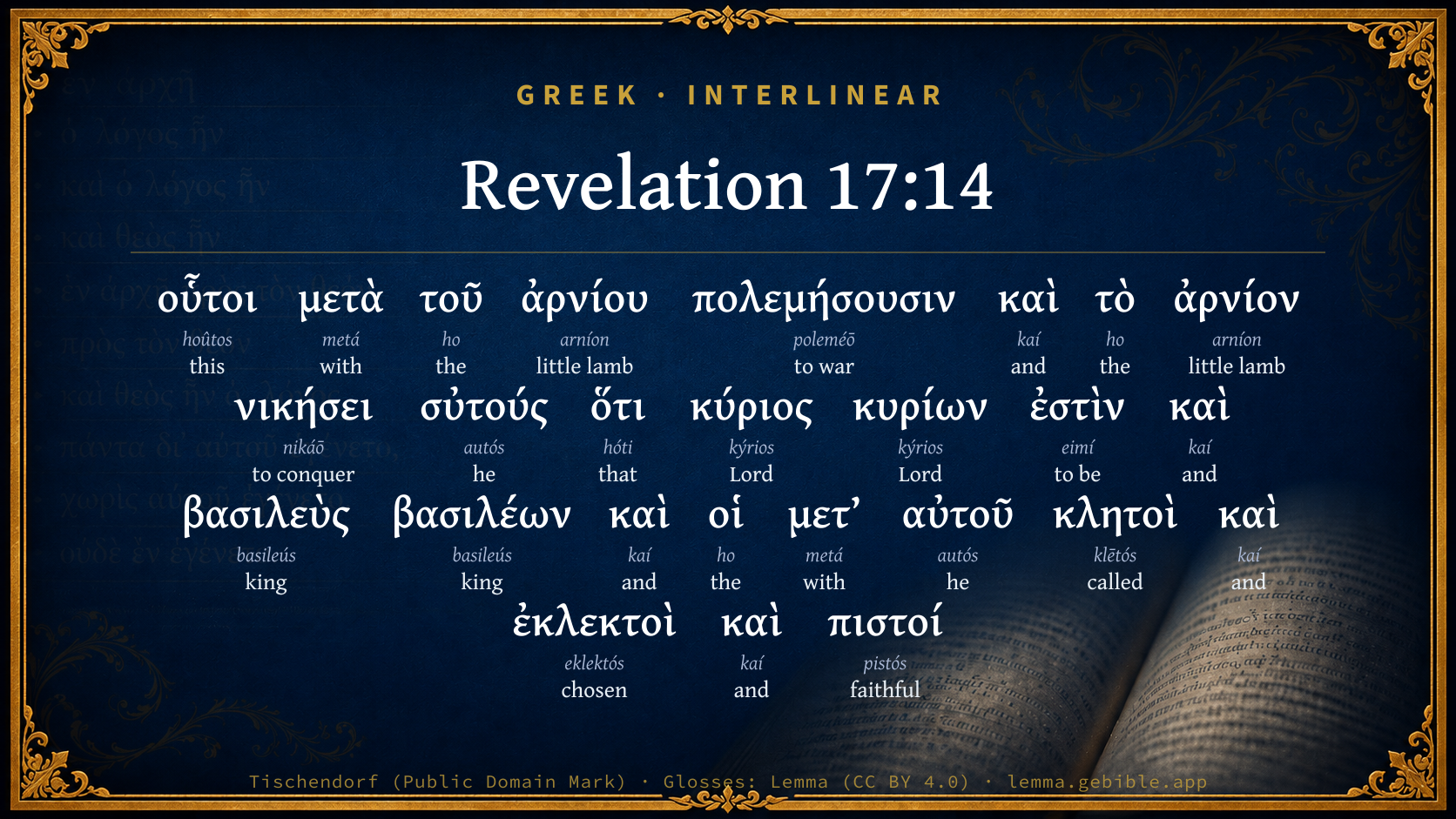
  1. οὗτοι hoûtos G3778 “this” Demonstrative pronoun, Nominative, Plural, Masculine
  2. μετὰ metá G3326 “with” Preposition
  3. τοῦ ho G3588 “the” Article, Genitive, Singular, Neuter
  4. ἀρνίου arníon G721 “little lamb” Noun, Genitive, Singular, Neuter
  5. καὶ kaí G2532 “and” Conjunction
  6. τὸ ho G3588 “the” Article, Nominative, Singular, Neuter
  7. ἀρνίον arníon G721 “little lamb” Noun, Nominative, Singular, Neuter
  8. νικήσει nikáō G3528 “to conquer” Verb, Future, Active, Indicative, 3rd person, Singular
  9. σὐτούς autós G846 “he” Personal pronoun, Accusative, Plural, Masculine
  10. ὅτι hóti G3754 “that” Conjunction
  11. κύριος kýrios G2962 “Lord” Noun, Nominative, Singular, Masculine
  12. κυρίων kýrios G2962 “Lord” Noun, Genitive, Plural, Masculine
  13. ἐστὶν eimí G1510 “to be” Verb, Present, Active, Indicative, 3rd person, Singular
  14. καὶ kaí G2532 “and” Conjunction
  15. βασιλεὺς basileús G935 “king” Noun, Nominative, Singular, Masculine
  16. βασιλέων basileús G935 “king” Noun, Genitive, Plural, Masculine
  17. καὶ kaí G2532 “and” Conjunction
  18. οἱ ho G3588 “the” Article, Nominative, Plural, Masculine
  19. μετ’ metá G3326 “with” Preposition
  20. αὐτοῦ autós G846 “he” Personal pronoun, Genitive, Singular, Masculine
  21. κλητοὶ klētós G2822 “called” Adjective, Nominative, Plural, Masculine
  22. καὶ kaí G2532 “and” Conjunction
  23. ἐκλεκτοὶ eklektós G1588 “chosen” Adjective, Nominative, Plural, Masculine
  24. καὶ kaí G2532 “and” Conjunction
  25. πιστοί pistós G4103 “faithful” Adjective, Nominative, Plural, Masculine

About this verse

These counts appear in no published source. They are computed here, from the morphology-tagged text and Lemma’s own curated glosses. What Lemma adds →

26
words
15
distinct lemmas
Revelation
section

Notable vocabulary

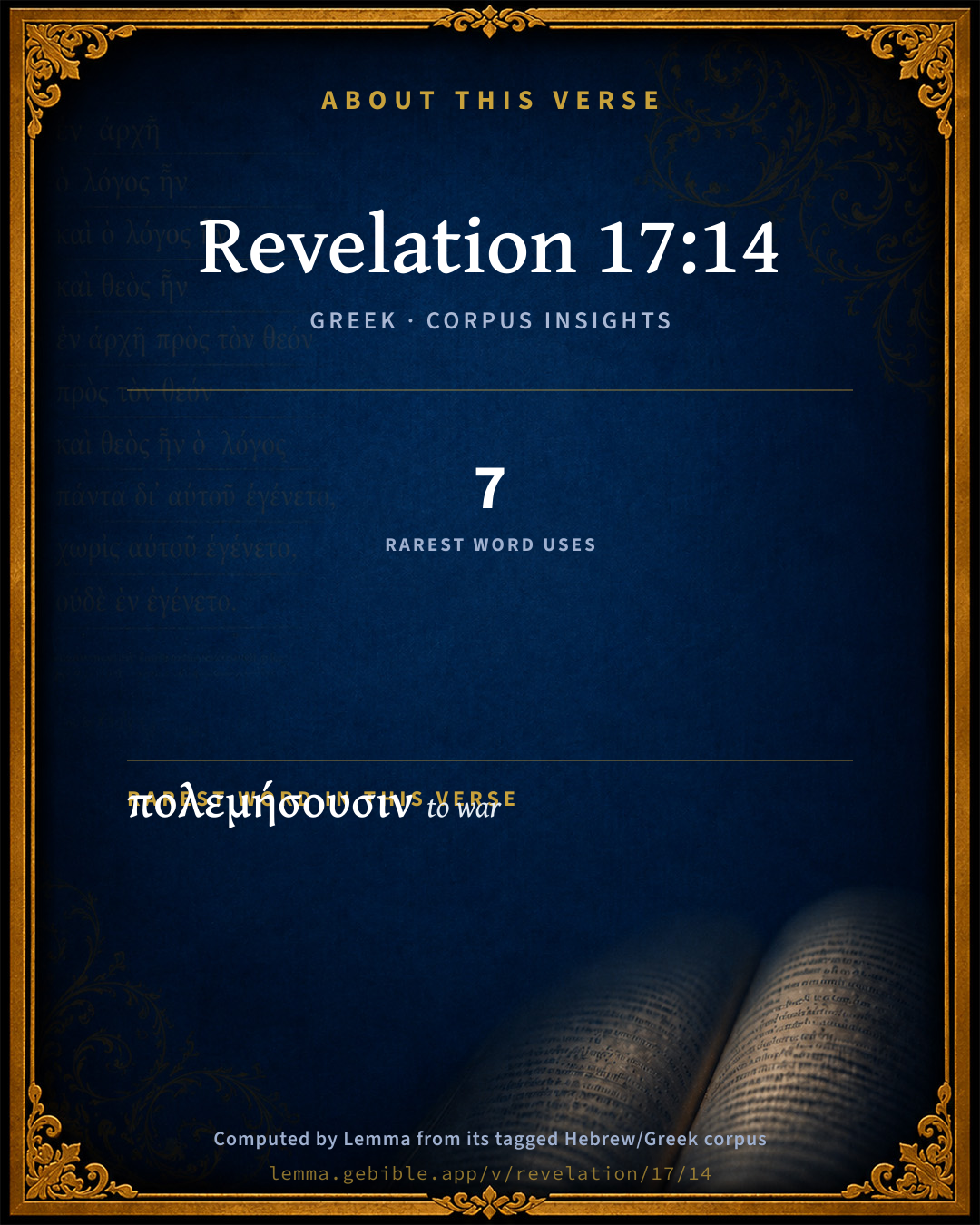
The rarest word here is πολεμήσουσιν to war G4170 — appearing just 7 times in the whole Greek New Testament.

Shared distinctive vocabulary

πολεμήσουσιν to war G4170 occurs in 6 verses of the Greek New Testament. Also found in:

Repetition

Words recur within this verse:

  • ἀρνίου little lamb G721 ×2
  • κύριος Lord G2962 ×2
  • βασιλεὺς king G935 ×2
  • καὶ and G2532 ×5
  • τοῦ the G3588 ×3
  • μετὰ with G3326 ×2
  • σὐτούς he G846 ×2

Cross-references

39

Topical passages linked to Revelation 17:14 in the Treasury of Scripture Knowledge — connected by theme and wording, ordered by reader-vote popularity; previews shown in the World English Bible.

  • Romans 8:30 Whom he predestined, those he also called. Whom he called, those he also justified. Whom he justified, those he also glorified.
  • 1 Timothy 6:15 which in its own times he will show, who is the blessed and only Ruler, the King of kings, and Lord of lords;
  • Matthew 22:14 For many are called, but few chosen."
  • Revelation 3:21 He who overcomes, I will give to him to sit down with me on my throne, as I also overcame, and sat down with my Father on his throne.
  • Deuteronomy 10:17 For Yahweh your God, he is God of gods, and Lord of lords, the great God, the mighty, and the awesome, who doesn't regard persons, nor takes reward.
  • Daniel 2:47 The king answered to Daniel, and said, Of a truth your God is the God of gods, and the Lord of kings, and a revealer of secrets, seeing you have been able to reveal this secret.
  • Revelation 1:5 and from Jesus Christ, the faithful witness, the firstborn of the dead, and the ruler of the kings of the earth. To him who loves us, and washed us from our sins by his blood;
  • Revelation 2:10 Don't be afraid of the things which you are about to suffer. Behold, the devil is about to throw some of you into prison, that you may be tested; and you will have oppression for ten days. Be faithful to death, and I will give you the crown of life.
  • Revelation 19:14–21 The armies which are in heaven followed him on white horses, clothed in white, pure, fine linen.
  • Revelation 16:14 for they are spirits of demons, performing signs; which go forth to the kings of the whole inhabited earth, to gather them together for the war of that great day of God, the Almighty.
  • Revelation 14:1–4 I saw, and behold, the Lamb standing on Mount Zion, and with him a number, one hundred forty-four thousand, having his name, and the name of his Father, written on their foreheads.
  • Jeremiah 1:19 They shall fight against you; but they shall not prevail against you: for I am with you, says Yahweh, to deliver you.
  • Matthew 28:18 Jesus came to them and spoke to them, saying, "All authority has been given to me in heaven and on earth.
  • Romans 8:37 No, in all these things, we are more than conquerors through him who loved us.
  • 1 Corinthians 15:24 Then the end comes, when he will deliver up the Kingdom to God, even the Father; when he will have abolished all rule and all authority and power.
  • Hebrews 3:1–2 Therefore, holy brothers, partakers of a heavenly calling, consider the Apostle and High Priest of our confession, Jesus;
  • Psalms 2:8–9 Ask of me, and I will give the nations for your inheritance, The uttermost parts of the earth for your possession.
  • 2 Timothy 2:4 No soldier on service entangles himself in the affairs of life, that he may please him who enrolled him as a soldier.
  • 1 Peter 2:9 But you are a chosen race, a royal priesthood, a holy nation, a people for God's own possession, that you may show forth the excellencies of him who called you out of darkness into his marvelous light:
  • Psalms 110:5 The Lord is at your right hand. He will crush kings in the day of his wrath.
  • Psalms 136:2–3 Give thanks to the God of gods; For his loving kindness endures forever.
  • Psalms 149:5–9 Let the saints rejoice in honor. Let them sing for joy on their beds.
  • Daniel 2:44 In the days of those kings shall the God of heaven set up a kingdom which shall never be destroyed, nor shall the sovereignty of it be left to another people; but it shall break in pieces and consume all these kingdoms, and it shall stand forever.
  • Daniel 7:25–27 He shall speak words against the Most High, and shall wear out the saints of the Most High; and he shall think to change the times and the law; and they shall be given into his hand until a time and times and half a time.
  • Revelation 6:12–17 I saw when he opened the sixth seal, and there was a great earthquake. The sun became black as sackcloth made of hair, and the whole moon became as blood.
  • Revelation 11:7 When they have finished their testimony, the beast that comes up out of the abyss will make war with them, and overcome them, and kill them.
  • Jeremiah 50:44 Behold, [the enemy] shall come up like a lion from the pride of the Jordan against the strong habitation: for I will suddenly make them run away from it; and whoever is chosen, him will I appoint over it: for who is like me? and who will appoint me a time? and who is the shepherd who can stand before me?
  • Micah 5:7–9 The remnant of Jacob will be in the midst of many peoples, Like dew from Yahweh, Like showers on the grass, That don't wait for man, Nor wait for the sons of men.
  • Zechariah 2:8 For thus says Yahweh of hosts: 'For honor he has sent me to the nations which plundered you; for he who touches you touches the apple of his eye.
  • Matthew 25:40 "The King will answer them, 'Most assuredly I tell you, inasmuch as you did it to one of the least of these my brothers, you did it to me.'
  • John 15:16 You didn't choose me, but I chose you, and appointed you, that you should go and bear fruit, and that your fruit should remain; that whatever you will ask of the Father in my name, he may give it to you.
  • Psalms 21:8–12 Your hand will find out all of your enemies. Your right hand will find out those who hate you.
  • Proverbs 8:15–16 By me kings reign, And princes decree justice.
  • Jeremiah 1:15 For, behold, I will call all the families of the kingdoms of the north, says Yahweh; and they shall come, and they shall set everyone his throne at the entrance of the gates of Jerusalem, and against all the walls of it round about, and against all the cities of Judah.
  • Daniel 7:21 I saw, and the same horn made war with the saints, and prevailed against them;
  • Daniel 11:24–25 In time of security shall he come even on the fattest places of the province; and he shall do that which his fathers have not done, nor his fathers' fathers; he shall scatter among them prey, and spoil, and substance: yes, he shall devise his devices against the strongholds, even for a time.
  • Acts 9:4–5 He fell on the earth, and heard a voice saying to him, "Saul, Saul, why do you persecute me?"
  • Revelation 8:6–7 The seven angels who had the seven trumpets prepared themselves to sound.
  • Daniel 11:9–12 He shall come into the realm of the king of the south, but he shall return into his own land.

Cross-references courtesy of OpenBible.info (CC BY 4.0).

Commentary

Notes on Revelation 17:14 from classic Christian and Jewish commentators (each source and its license shown beneath its notes). The classic Christian expositions comment on the surrounding passage and are grouped to its opening verse, so a note may address several verses; the Jewish commentaries on the Tanakh (Rashi and others) are per-verse, so they appear only where the commentator wrote on this verse.

Lemma curates 59 commentaries, every one of them public domain or Creative Commons licensed, each selected and text-cleaned for this edition rather than reprinted as found. About our sources →

Tyndale Open Study Notes

Tyndale Open Resources

17:14 Whatever power they amass, the beast and ten kings (17:11-12) have no hope of winning because Jesus is Lord of all lords (see 19:11-16). Those God has called and chosen and who remain faithful to him will stand with him as victors.

Tyndale Open Study Notes — © Tyndale Open Resources, licensed CC BY-SA 4.0. Text via the HelloAO Bible API.

Bengel's Gnomon

Johann Albrecht Bengel

Rev 17:14. Κλητοὶ καὶ ἐκλεκτοὶ καὶ πιστοὶ, called and chosen and faithful) The companions of the Conqueror are described. They are here called κλητοὶ: at ch. Rev 19:9, κεκλημένοι. Each word is used once only in this book, as also ἐκλεκτοί. Comp. 1Ki 1:41, καὶ πάντες οἱ κλητοὶ οἱ μετʼ αὐτοῦ.

Bengel's Gnomon of the New Testament — English translation (T&T Clark, Edinburgh, 1860) — public domain. Text from a community e-Sword module.

Expositor's Greek Testament

ed. W. Robertson Nicoll

Rev 17:14 . An abrupt and proleptic allusion to Rev 19:11-21 ; the Christian messiah is the true King of kings (a side reference to the well-known Parthian title). This is the first time that John brings the Lamb on the scene of earthly action. He now appears at the side, or rather at the head, of his followers in the final crisis, not in a struggle preceding the sack of Rome. He and Satan (as represented by the empire) are the real protagonists. Note the share assigned to the faithful in this victory (after Rev 2:26-27 ). The war fought on their behalf by the Lamb is their fight also ( cf. on Rev 19:14 ); its success rests on the divine election and their corresponding loyalty ( cf. Rev 12:11 , Rev 13:8 ; a Zoroastrian parallel in Yasht xiii. 48; the favourite description of the saints in Enoch as “chosen [and] righteous”; and Passio Perpetuae , xxi., “o fortissimi martyres o uere uocati et electi in gloriam Domini nostri Jesu Christi”). The redeeming power of Christ, together with the adoration which he alone can rightfully claim, make his cause more than equal to the empires of the world ( cf. the thought of Isa 53:12 ).

The Expositor's Greek Testament, edited by W. Robertson Nicoll (1897–1910) — public domain. Text from a community e-Sword module.

Geneva Bible (1599)

Geneva Bible translators

With Christ and his Church, as the reason following doth declare, and here are mentioned the facts and the events which followed for Christ’s sake, and for the grace of God the Father towards those that are called, elected, and are his faithful ones in Christ.

Geneva Bible (1599) marginal notes — public domain. Text via Bolls.life.

Matthew Henry's Commentary

Here we have some account of the downfall of Babylon, to be more fully described in the following chapter.

I. Here is a war begun between the beast and his followers, and the Lamb and his followers. The beast and his army, to an eye of sense, appear much stronger than the Lamb and his army: one would think an army with a lamb at the head of them could not stand before the great red dragon. But,

II. Here is a victory gained by the Lamb: The Lamb shall overcome. Christ must reign till all enemies be put under his feet; he will be sure to meet with many enemies, and much opposition, but he will also be sure to gain the victory.

III. Here is the ground or reason of the victory assigned; and this is taken, 1. From the character of the Lamb: He is King of kings and Lord of lords. He has, both by nature and by office, supreme dominion and power over all things; all the powers of earth and hell are subject to his check and control. 2. From the character of his followers: They are called, and chosen, and faithful. They are called out by commission to this warfare; they are chosen and fitted for it, and they will be faithful in it. Such an army, under such a commander, will at length carry all the world before them.

IV. The victory is justly aggrandized. 1. By the vast multitude who paid obedience and subjection to the beast and to the whore. She sat upon (that is, presided over) many waters; and these waters were so many multitudes of people, and nations, of all languages; yea, she reigned not only over kingdoms, but over the kings, and they were her tributaries and vassals, Rev 17:15, Rev 17:18. 2. By the powerful influence which God hereby showed he had over the minds of great men. Their hearts were in his hand, and he turned them as he pleased; for, (1.) It was of God, and to fulfil his will, that these kings agreed to give their kingdom unto the beast; they were judicially blinded and hardened to do so. And, (2.) It was of God that afterwards their hearts were turned against the whore, to hate her, and to make her desolate and naked, and to eat her flesh, and burn her with fire; they shall at length see their folly, and how they have been bewitched and enslaved by the papacy, and, out of a just resentment, shall not only fall off from Rome, but shall be made the instruments of God's providence in her destruction.

Matthew Henry's Commentary on the Whole Bible (1708–1710) — public domain (CC PDM 1.0). Text via the HelloAO Bible API.

Jamieson, Fausset & Brown

Robert Jamieson, A. R. Fausset & David Brown

These shall . . . war with the Lamb--in league with the beast. This is a summary anticipation of Rev 19:19. This shall not be till after they have first executed judgment on the harlot (Rev 17:15-16).

Lord of lords, &c.--anticipating Rev 19:16.

are--not in the Greek. Therefore translate, "And they that are with Him, called chosen, and faithful (shall overcome them, namely, the beast and his allied kings)." These have been with Christ in heaven unseen, but now appear with Him.

Jamieson, Fausset & Brown — Commentary Critical and Explanatory on the Whole Bible (1871) — public domain (CC PDM 1.0). Text via the HelloAO Bible API.

Adam Clarke's Commentary

Verse 14. These shall make war with the Lamb, and the Lamb shall overcome them; for he is Lord of lords, and King of kings: and they that are with him are called, and chosen, and, faithful.] The ten powers of the beast must compose the secular kingdom of antichrist, for they make war with the Lamb, who is Christ Jesus. This is perfectly true of all popish states, for they have constantly opposed, as long as they have had any secular power, the progress of pure Christianity. They make war with the Lamb by persecuting his followers; but the Lamb shall overcome them, for he is the Lord of lords, and King of kings-all lords have their authority from him, and no king can reign without him; therefore the ten Latin kings are God's ministers to execute his vengeance upon the idolatrous nations. But when these antichristian monarchies have executed the Divine purpose, those that are with the Lamb-the called, the chosen, and the faithful, those who have kept THE TRUTH in the love of it, shall prevail against all their adversaries, because their battles are fought by the Lamb, who is their God and Deliverer. See Rev 19:19; Rev 19:20.

Adam Clarke's Commentary on the Bible (1810–1826) — public domain. Text from a community e-Sword/MySword module.

The Cambridge Bible for Schools and Colleges

gen. ed. J. J. S. Perowne

14. These shall make war with the Lamb] See the same passages.

Lord of lords, and King of kings] Rev_19:16; Dan_2:47.

they that are with him] Rev_19:14.

called, and chosen, and faithful] All common titles of Christians applied even to the imperfect Churches on earth.

The Cambridge Bible for Schools and Colleges (gen. ed. J. J. S. Perowne; Cambridge University Press, 1878–1918) — public domain. Text from a community e-Sword module.

John Gill's Exposition

These shall make war with the Lamb,.... The Lord Jesus Christ, so often spoken of in this book under this character, Rev 5:6. And this war is not to be understood of a war with him personally, or of that last and decisive, battle at Armageddon, in which will be the kings of the earth; but of a war with his members, of their persecuting of the saints, and faithful witnesses of Christ in all ages, within their jurisdictions, being instigated to it by the beast, under whose influence they are:

and the Lamb shall overcome them: partly through the constancy of his people, who will not love their lives to the death, but freely lay them down for him; nor can anything separate them from the love of Christ, or prevail upon them to desert him, his truths and ordinances, cause and interest, but are more than conquerors through him, and so he overcomes in them; and partly through a reformation which he effects, as in some of those kingdoms already, as Sweden, Denmark, England, Scotland, and Ireland, and others, and will do in others hereafter; see Rev 17:16

for he is Lord of lords, and King of kings; he is so by nature, as God and Creator, to whom the kingdom of nature and providence belongs; and by office, as Mediator, being made higher than the kings of the earth; hence he is more than a match for them, they cannot stand before him; this is a reason why he overcomes them, and it cannot be thought it should be otherwise: this Lamb is the lion of the tribe of Judah, and when he rouses himself, and stirs up his wrath, and exerts his power, kings and great men flee from him; see Rev 6:15. This is a proof of Christ's proper deity, the same titles being given to him, the Word and Son of God, as to God himself, Rev 19:16.

And they that are with him: his servants and his soldiers, that fight under him, and abide by him,

are called, and chosen, and faithful; they are chosen in Christ from all eternity, to grace here, and glory hereafter, and so stand opposed to the admirers of the beast, whose names are not written in the book of life, Rev 17:8 for this is to be understood of their eternal election, and not of their separation by the effectual calling in time, for that is expressed by their being "called"; and though their calling is here set before election, as in Pe2 1:10 yet it does not precede it; the Arabic version reads, "chosen, called, faithful"; first "chosen" by God the Father, then "called", not with the bare external call by the ministry of the word, for, so, many are called, and not chosen; but by special grace to special benefits, and with an holy and heavenly calling, and which is irresistible, and without repentance; and being called they remain "faithful": the meaning is, either that they have faith, or are believers in Christ; which faith they have bestowed on them in the effectual calling, as a fruit of electing grace; and by this they overcome the world: or else, that they are persons of integrity and uprightness, that are on the side of Christ; they are the faithful in the Lord, and are made so by him; and they are faithful to him, and abide by his Gospel and ordinances, and in his cause and interest, even unto death; and so this character is expressive of the perseverance of those who are chosen and called, even unto the end.

John Gill's Exposition of the Whole Bible (1746–1763) — public domain (CC PDM 1.0). Text via the HelloAO Bible API.

Trapp's Complete Commentary

John Trapp

14 These shall make war with the Lamb, and the Lamb shall overcome them: for he is Lord of lords, and King of kings: and they that are with him are called, and chosen, and faithful.

Ver. 14. The Lamb shall overcome them] 1. With a spiritual victory, by a sweet: subjection, at least by a conviction of their consciences. 2. With an external victory, as the Imperialists in Germany, the Papists here.

John Trapp, A Commentary or Exposition upon All the Books of the Old and New Testament (1647–1656) — public domain. Text from a community e-Sword module.

Albert Barnes' Notes on the Bible

These shall make war with the Lamb - The Lamb of God - the Lord Jesus (See the notes at Rev 5:6); that is, they would combine with the papacy in opposing evangelical religion. It is not meant that they would openly and avowedly proclaim war against the Son of God, but that they would practically do this in sustaining a persecuting power. It is unnecessary to show how true this has been in history; how entirely they sustained the papacy in all its measures of persecution.

And the Lamb shall overcome them - Shall ultimately gain the victory over them. The meaning is, that they would not be able to extinguish the true religion. In spite of all opposition and persecution, that would still live in the world, until it would be said that a complete triumph was gained.

For he is Lord of lords, and King of kings - He has supreme power over all the earth, and all kings and princes are subject to his control. Compare Rev 19:16.

And they that are with him - The reference is to the persecuted saints who have adhered to him as his faithful followers in all these protracted conflicts.

Are called - That is, called by him to be his followers; as if he had selected them out of the world to maintain his cause. See the notes on Rom 1:7.

And chosen - See the Joh 15:16 note, and 1Pe 1:2 note. In their steadfast adherence to the truth, they had shown that they were truly chosen by the Saviour, and could be relied on in the warfare against the powers of evil.

And faithful - They had shown themselves faithful to him in times of persecution, and in the hour of darkness.

Albert Barnes' Notes on the Bible (1834–1885) — public domain. Text from a community e-Sword/MySword module.

Haydock's Catholic Bible Commentary

These shall fight with the Lamb. There actions and affections being always led away with the love of this world, which is an enemy to Christ and his doctrine: but the Lamb, Christ, shall overcome them, and punish them, when he pleases: for he, Christ, God and man, is Lord of lords, and King of kings; and as St. John says again, (chap. xix. 16,) has written on his thigh, the King of kings, and Lord of lords, to signify to us his divinity, or divine nature. (Witham) --- All these different people were either heathens or heretics, and of course were bitter enemies to the Catholic religion; but the Lamb overcame them, by turning their hearts, and converting them to Christianity.

George Leo Haydock (1774–1849), Haydock's Catholic Family Bible and Commentary, 1859 edition — public domain. Excludes Psalms (Douay-Rheims chapter numbering differs from Protestant) and Deuterocanonical books (Catholic canon only).

Matthew Poole's English Annotations

These shall make war with the Lamb; these ten kings shall a while oppose themselves to the gospel, taking part with antichrist.

And the Lamb shall overcome them; Christ shall overcome them by the power of is gospel, or some of them that way; others, that will not be converted, shall be confounded, some way or other brought to ruin.

For he is Lord of lords and King of kings: and they that are with him are called, and chosen, and faithful; for he hath a power above others, and knows how to fit instruments for his purpose; so as those whom he shall make use of in this work, shall be chosen persons, and faithful in discharge of the trust committed to them.

Matthew Poole's English Annotations on the Holy Bible (1683–1685) — public domain. Text from a community e-Sword/MySword module.

Whedon's Commentary on the Bible

Daniel D. Whedon

14. Make war… the Lamb shall overcome—They shall persecute the evangelical Church, slaughter pure Christians, and raise great religious wars, but the cause of freedom and true religion will finally prevail. This is the grand note of apocalyptic triumph.

King of kings—See Rev_19:16. The battle of Rev_19:21 is not the battle of one day, but of centuries. Its initiation is here shadowed.

Daniel D. Whedon (gen. ed.), Commentary on the Old and New Testaments (1874–1909) — public domain. Text from a community e-Sword module.

The Pulpit Commentary

These shall make war with the Lamb, and the Lamb shall overcome them; shall war against. This connects the description with Rev_16:3-4 and with Rev_19:11-21. This war between the Lamb and the powers of evil is that which extends throughout the history of the world (vide infra); it occupies the "one hour" of ver. 12, which is equivalent to the period of the world"s existence. But the seer in this verse looks forward also to the termination of the conflict, the result of which, here briefly indicated, is soon to be narrated more fully. For he is Lord of lords, and King of kings. This is the reason given to the Israelites (Deu_10:17) for obedience to God. (cf. also Dan_2:47 1Ti_6:15; and Rev_19:16) Though the beast may exercise m this world dominion and power as "prince of this world," yet the Lamb is King still greater, to whom the beast must finally succumb. He is thus King above the kings of Rev_17:2, Rev_17:10. And they that are with him are called, and chosen, and faithful. The Revised Version is more correct, And they that are with him, called and chosen and faithful shall also overcome. Another evidence of the lifelong nature of this war. Not only Christ wars and overcomes, but those associated with him are permitted to share in the battle and the victory. Christ"s saints are called here to battle; in Rev_19:9 they are called to the marriage supper of the Lamb. (cf. also the exhortation to faithfulness in Rev_2:10) The three epithets describe the progressive life of those who share Christ"s victory They are called as all men are to serve him; having heard the call, they dedicate their lives to his service, and become his chosen servants; finally, having remained faithful to him, they share in his victory.

HOMILIES BY S. CONWAY. Ver. 14. The war with the Lamb.

This chapter and the next are mainly occupied with the description of the combatants the city, the court, and the provinces of Rome who waged war against the Church of Christ, and therefore are said to "make war with the Lamb;" and with (Revelation 18) the fall of the city, which was the centre and head of the whole war against Christ. We hold to the belief that St. John was telling, not of something in the far future, which could be but of little avail to the persecuted Church of his day, but of events which were near at hand, imminent, and should "shortly come to pass." Therefore, concerning the interpretation which makes Daniel explain St. John, and understands the seven kings as the seven world empires from Egypt to Rome, and the ten horns as the future dismemberment of the Roman empire how, we ask, could the knowledge of this then far future event help the suffering saints, to cheer and strengthen whom was the one chief purpose of this book? To say nothing of the incongruity of speaking of Rome in St. John"s day as a power that "was, and is not" (ver. 11); or that in his day it had received a "deadly wound"; (Rev_13:3) or that the dismembered Roman empire, of which we and most of modern Europe have for nigh a thousand years formed parts, should continue only "a short space." We should feel pressed with the difficulties of this interpretation were there none other which avoided them. But as there is such other, we feel compelled to adopt it. We do not say that this one has no difficulties, but they are small in comparison with those belonging to the one we have refused. And now let us consider

I "THESE" WHO MAKE WAR WITH THE LAMB. Who are they? We believe St. John to refer:

1. To the court of Rome, especially to the monster Nero, the emperor.

(1) He is described:

(a) As "the beast." Sometimes this name stands for the God and Christ opposing world power in general, the secular antichrist of the several ages; and sometimes for the embodiment of that power in one person, as in Nero. How he deserved the name by reason of his ferocity, cruelty, and bestiality, let Tacitus tell, and many others who knew (cf. Renan"s "L"Antichrist").

(b) As soon to be no more. So soon, so certain, was his removal, that he is spoken of in ver. 8 as "the beast that was, and is not, and yet is;" and again (ver. 10, as "was, and is not;" though, from ver. 10 and many other sources, we know that when St. John wrote Nero was yet living, and furiously persecuting the Church of God. This is an inspired prediction of what was soon to come, and is clothed, after the frequent manner of prophecy, in the language of an event already past, though indeed it was future.

(c) As one day to reappear (ver. 8, "He shall ascend out," etc.). The belief that Nero should return was notorious (cf. Stuart and Farrar, in loc. ).

(2) He is identified:

(a) By the city over which he rules (ver. 9). Seven-hilled Rome, "the city of the seven hills," was as frequent and well understood a name for Rome as would be "the city on the banks of the Thames" for London.

(b) By his place in the succession of kings. He stands sixth in the list of the Roman emperors. "Five" had passed away of the twelve Caesars. He was the sixth the "one is" (ver. 10).

(c) His successor"s short reign. Galba reigned but three months: "He must continue a short space.

(d) By the universal belief that he would return (cf. supra).

(3) He is doomed to go "into perdition" (ver. 11). Such was the man or monster beast, rather who led the war against the Church of Christ in his day.

2. To the city of Rome. She is branded with the name of "Babylon... mother of harlots" (ver. 5), and is described as an utterly abandoned woman, revelling in wealth and splendour, exercising her deadly seductive influences over all the empire, flaunting forth her shame with unblushing effrontery, and cruel with a ferocity that the beast she sat upon, and who sustained her, could hardly rival or satisfy. "Drunk with the blood of the saints." Such was the seven-hilled Rome when St. John knew it. Even a monster like Nero would hardly have dared to rage as he did had he not been encouraged by the brutal populace that swarmed in Rome.

3. To the consuls and proconsuls. The ten provincial governors who aided and abetted "the beast" in his war against Christ. There were ten of these: Italy, Achaia, Asia, Syria, Egypt, Africa, Spain, Gaul, Britain, Germany (Farrar). And in all these the will of Nero was law. His persecution was by no means confined to Rome this entire book shows that, though it began there. It was, as ver. 13 says, they gave "their power... unto the beast.

II THE METHODS OF THEIR WARFARE.

1. Then, when St. John wrote, it was by cruel, horrible, widespread, and bloody persecution. So that Rome is represented as "drunk with blood," and the description is confirmed by historic fact. But:

2. Now, in our day, the secular, antichristian spirit manifests itself in quite another form. The beast spirit "yet is," though clothed in other garb. The world is the world yet, and still makes "war with the Lamb." It aims now not so much to hurt the body as the soul. The former it may not touch, but the latter it can and does. It kills holy habits, wounds conscience, defiles the thoughts, stuns religious sensibilities, mocks at religious earnestness, exiles her language, her literature, and her laws. All this the world spirit does by its customs, maxims, and its administration of its rewards and punishments. It has corrupted public opinion, poisoned the atmosphere which daily the believer has to breathe; its influence is often, generally, unseen, intangible, indescribable, but nevertheless as real and deadly to the souls of men as were the bloody laws of Rome to the bodies of the believers in the Church of the first century. But consider

III THE LAMB AGAINST WHOM "THESE" WAR. A Lamb, and yet "Lord of lords, and King of kings." The ideas seem incongruous. How, then, is "the Lamb" this?

1. By rightful authority. Though Son of man, he is also Son of God. (cf. Ps 2)

2. By virtue of his sacrifice. It is this great fact that he keeps prominently through his chosen name Lamb." In heaven he is thus seen as "a Lamb who had been slain": (Re 4; cf. Php 3, "Therefore hath God also highly exalted him, and," etc.)

3. By the might of meekness. See how at his nativity the shepherds were told they should see the "Saviour, Christ the Lord." And what was it that they did see? A babe, "wrapped in swaddling clothes, and lying in a manger." But in that utter humiliation and self abnegation of the Son of God lay the might that should make him, as it has made him, "King of kings, and Lord of lords." Meekness is might, sacrifice is sovereignty, losing life is gaining it; the cross creates the crown. It is no arbitrary arrangement; it lies in the constitution of our nature, to which his meekness and love appeal with such resistless force. "O Galilaean, thou has; conquered!" said the Emperor Julian. And Constantine confessed the same, and Rome bowed to Christ.

4. By the consent of conscience. Blessed be God, there is a better self in the worst of men, and the appeal to that better self in men, though drowned by many a vile clamour for a long time, will yet be heard and obeyed. And Christ by his gospel made such appeal.

5. By the grace he imparted to his people. "Their patient continuance in well doing put to silence" all their foes. Rome looked on at these Christians and wondered, and, after a while, gave way and worshipped with them. For not alone in and by himself does the Lamb overcome, but:

6. In his people. "They that are with him." The Revised Version rightly renders St. John"s words, "They also shall overcome that are with him, called, chosen, faithful." St. John does not teach that the Lamb was indebted to them for this victory, as a general is indebted to his army. That, though the Authorized Version seems to lend countenance to such idea, is very far from the truth. But what is meant is that, like their Lord, "they that are with him" overcome. "The noble army of martyrs praise thee." In them he repeats and reproduces his victory. It is, therefore, of great interest and importance to know who they are that are "with him." For the conditions of victory are the same today as they were of old. The enemy has not changed in reality, though he has in form. And would we overcome, we must be as they of old who overcame. Well, then, see how they are described. They are:

(1) Called. We answer to that description. So far so good. We, the avowed Christian people of our day, have been called by God"s providence, by his Spirit, through his Word, his ministers, and by his manifold means of grace, and we are in his Church because of it.

(2) Chosen. Are we this? It does not at all follow that we are so because we are called. All the chosen are called, but not all the called are chosen. "Many are called, and few," etc. How, then, may we know if we are elect, chosen? Not by frames and feelings, fitful emotions of the mind, which come and go like the clouds. Not by position and efface. We may be recognized communicants and pastors, teachers, or aught else of the kind. God forbid that we should say all this counts for nothing as evidence of our Christian standing! It does count for something, but in itself is by no means sufficient evidence as to whether we be God"s chosen or not. And not by Church or creed. We may prefer our own and feel persuaded that we are in the right. But Churches and. creeds other than our own have furnished many of Christ"s elect, and not all ours are certainly chosen. But thus we may know if we be chosen:

(3) If we be of those who are faithful. Called we are; chosen we may be. If faithful, then we are of the chosen too; and this, and this only, is the proof. They of old through the Lamb overcame. It is they who today through him alone overcome. May we not, then, hear the apostolic word addressed to us, "My brethren, give all diligence to make your calling and election sure"? S.C.

Vers. 14-18. The great moral campaign.

"These shall make war with the Lamb, and the Lamb shall overcome them: for he is Lord of lords, and King of kings: and they that are with him are called, and chosen, and faithful," etc. To our mind these verses seem to adumbrate the greatest of all the campaigns this world has ever witnessed or ever will. In every department of sentient being there seems to be an arena of conflict, and physical wars in human life have been rife in every part of the world, from the first periods to the present hour. But the great moral campaign is the most universal, unremitting, and momentous. The words serve to bring to our notice two subjects in relation to this campaign

I THE CONTENDING FORCES. "These shall make war," etc. (ver. 14). What are these? Truth and falsehood, selfishness and benevolence, right and wrong, these are the battling powers. "We wrestle not against flesh and blood, but against principalities, against powers, against the rulers of the darkness of this world, against spiritual wickedness in high places." Each of these contending forces has its own leader or general.

1. The one is represented as a "beast. The beast is the emblem of the mighty aggregate of wrong in all its elements and operations; wrong in theories and in institutions; wrong in sentiments, ideas, and habits; wrong as imposing as seven mountains, as majestic as kings and empires; wrong sitting as empress over all "nations, and peoples, and tongues." Wrong is the greatest thing in this world at present; it is the mighty Colossus with the "head of gold, breast and arms of silver, his thighs of brass, his legs of iron, his feet part of iron and part of clay.

2. The other is represented as a "Lamb. "These shall make war with shall war against the Lamb" (ver. 14). The Lamb is the emblem of innocence, mildness, and purity. In Daniel"s vision wrong was a colossal figure, and right a little stone. Here wrong is a terrible "beast," and right a tender "Lamb." Here are the two great generals in this mighty campaign.

II THE MARVELLOUS CONQUEST. Observe:

1. The Conqueror. "The Lamb shall overcome them" (ver. 14). The Lamb, not the beast, is the Conqueror. Power is not to be estimated by size or form. The little stone shivered the image; the Lamb strikes the beast into the dust. The Lamb, though not a bellicose existence, is:

(1) Invested with the highest authority. "He is Lord of lords, and King of kings" (ver. 14). The greatest sovereignty that man wields over his fellows is lamb like rather than leonine. It is not that of physical force and gorgeous form, but of lowliness and silence.

(2) Followed by a noble army. "They that are with him are called, and chosen, and faithful" (ver. 14). Who are his followers? Whom does he lead into the battle? "The called, and chosen, and faithful." Soldiers in the physical battles of nations are men who have embarked in the campaign, not from disinterested love of their country or admiration for their generals, but from motives sordid and sinister; they have sold themselves to the execrable work. Not so with the armies under the command of the Lamb, who is "Lord of lords, and King of kings." They are "called, and chosen, and faithful." Love to him and his grand cause fills and fires their souls.

2. The conquered. "These shall hate the whore," etc. (vers. 16-18).

(1) The conquered turn with indignation on themselves. The "beast" with the "ten horns," all his mighty armies, "hate the whore," the harlot whom they fondled and adored, strip her of her grandeur, devour her, and "burn her with fire" (ver. 16). Thus it has ever been. Those whom Christ conquers in his love and truth turn in devouring indignation against their old comrades. Thus Paul turned against the Hebrews, in whom at one time he gloried as a Hebrew of the Hebrews.

(2) This wonderful change in them is the result of the spiritual influences of God. "He hath did put in their hearts to fulfil his will to do his mind, and to agree to come to one mind" (ver. 17). The moral conquest of wrong is ever ascribable to him who is the Fountain of truth and right. "Now thanks be unto God, which always causeth us to triumph," etc D.T.

The Pulpit Commentary (1880–1919), ed. H.D.M. Spence-Jones & Joseph S. Exell — public domain. Text from a community e-Sword module.

John Wesley's Explanatory Notes

These - Kings with the beast. He is Lord of lords - Rightful sovereign of all, and ruling all things well. And King of kings - As a king he fights with and conquers all his enemies. And they that are with him - Beholding his victory, are such as were, while in the body, called, by his word and Spirit. And chosen - Taken out of the world, when they were enabled to believe in him. And faithful - Unto death.

John Wesley, Explanatory Notes Upon the Whole Bible (1754–1765) — public domain. Text via the GEBible commentary corpus.

The People's New Testament

B. W. Johnson

14. These shall war against the Lamb. They aid the false church in its war on the saints. The Lamb shall overcome them. They shall finally turn away from the false church.

B. W. Johnson's The People's New Testament with Notes (1889–1891) — public domain. Electronic text from the Christian Classics Ethereal Library (CCEL) ThML edition.

Cambridge Greek Testament for Schools and Colleges

14. κλητοὶ καὶ ἐκλεκτοὶ καὶ πιστοί. Primas[609] electi et fideles et vocati. Tyc[610] vocati et electi. 1 κλητοὶ ὄτι ἐκλεκτοὶ καὶ πιστοί. An[611]

[612] κλητοὶ ὅτι πιστοὶ καὶ ἐκλεκτοί.

[609] Primasius, edited by Haussleiter.

[610] Tyconius.

[611] Andreas’ Augsburg MS. 12th century.

[612] Andreas’ Augsburg MS. 12th century.

14. See the same passages.

κύριος κυρίων … καὶ βασιλεὺς βασιλέων. Rev 19:16; Dan 2:47.

οἱ μετʼ αὐτοῦ. Rev 19:14.

κλητοὶ καὶ ἐκλεκτοὶ καὶ πιστοί. All common titles of Christians applied even to the imperfect Churches on earth.

Cambridge Greek Testament for Schools and Colleges (Cambridge University Press, 1896; 21 vols, various authors incl. Carr, Maclear, Plummer, Farrar, Lumby, Moule, M. R. James, Simcox) — public domain. Text from a community e-Sword module.

Lesson kit

Teaching starters — assembled from the data on this page, not authored interpretation. Every prompt links to the verse data it draws on. Edit before teaching.

Revelation, in the Revelation, opens this verse with 26 words (15 distinct Greek lemmas). Its most distinctive word is poleméō (“to war”). A historical commentator’s framing appears above. Read the whole chapter for the surrounding context.

Discussion questions

  1. The word poleméō carries the sense “to war.” How does it shape the verse?
  2. James 4:2 shares the word «to war» with this verse. How do the two illuminate each other?
  3. “little lamb” occurs 2× in this one verse. What is the effect of the repetition?
  4. These translations render this verse differently; the difference is in the English rendering, not the original. What questions does that raise?
  5. Reading how Tyndale Open Study Notes and Bengel's Gnomon read this verse, where do the two commentators agree and where do they part?

Things to notice

  • These translations choose different wording for 10 words in this verse.
  • “little lamb” occurs 2× in this single verse.
  • 15 distinct Greek lemmas span 26 words in this verse.

Reading settings

Reading text

Shown beneath each verse's original-language words.

Old Testament
Old Testament edition

Read the OT as the Masoretic Hebrew (MT) or the Greek Septuagint (LXX).

English shown for the Greek Septuagint (in the Hebrew ↔ Greek comparison).

Comparing translations? Open the Compare panel on any verse page to stack up to four side by side.