
Luke 13:23

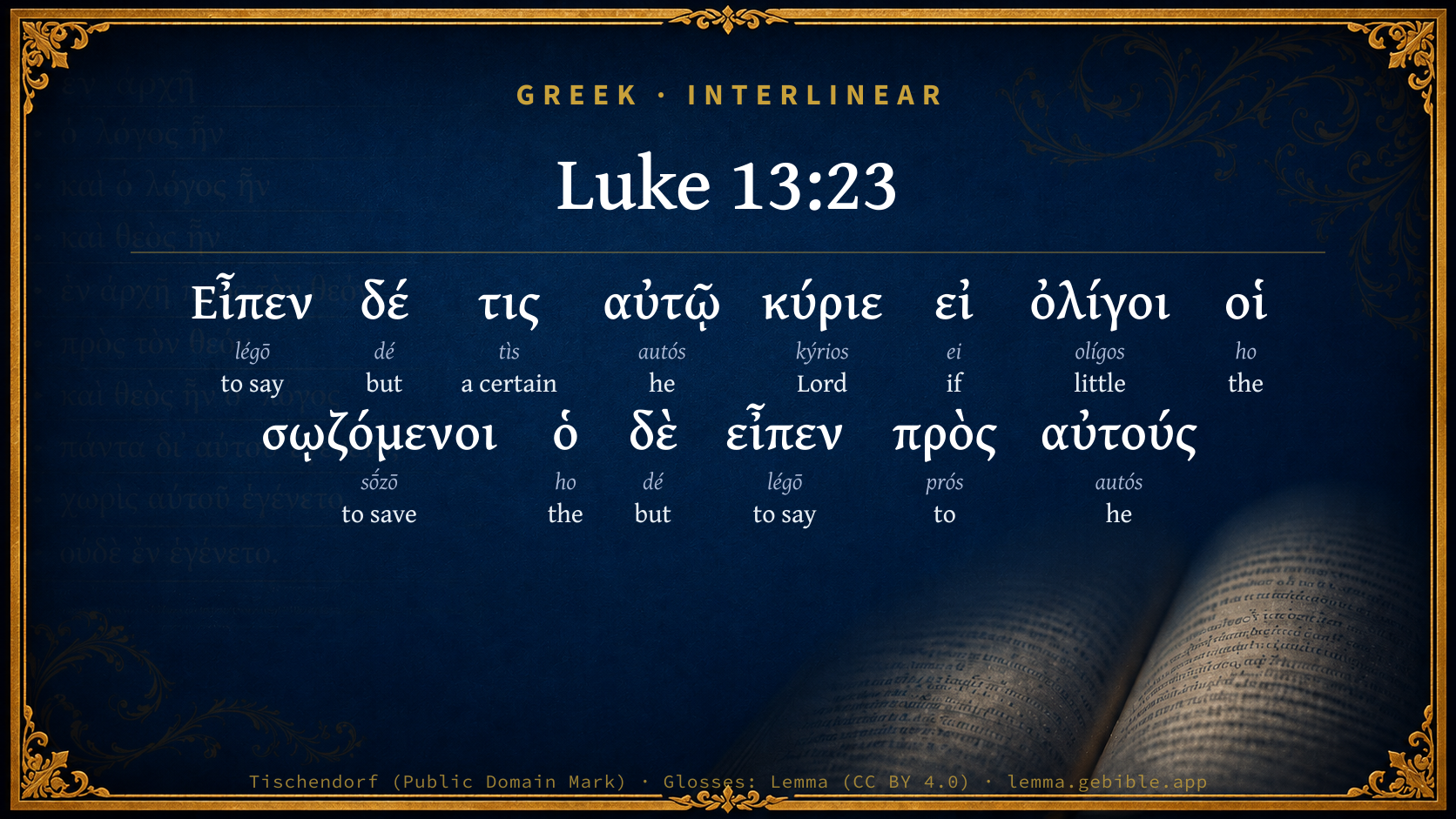
Greek (Tischendorf 8th ed.) Luke 13:23 appears in the Greek New Testament. The text above is from the Tischendorf 8th edition. Each word links to its Strong’s number and a concise gloss. Click any word for its full Thayer’s Greek Lexicon entry.
Download image
Cite this verse

Luke 13:23 (World English Bible). Public Domain. Lemma interlinear Bible study tool, https://lemma.gebible.app/v/luke/13/23.

Show BibTeX & RIS
BibTeX
RIS
English Translation
One said to him, "Lord, are they few who are saved?" He said to them,
World English Bible · Public Domain
Download a study sheet

One document with this verse’s original text, its word-by-word gloss line, the meaning frame, cross-references with their text, attributed commentary, and full source and license credits — printable, and it pastes into notes with its structure intact.

This verse Autodidact and up

Study sheet (.html) Plain text (.txt)

A passage Seminary Student

Up to 50 verses in one chapter. A passage sheet keeps up to 6 commentary sources and 12 cross-references per verse, in the order this page ranks them, and says so on the sheet whenever that leaves anything out. Ask for a single verse and you get the Autodidact verse sheet above.

Everything on this page stays free to read, with no account — the sheet is a download of what is already on screen, not access to it.

Want to remove ads? Support Godless Engineer
Compare translations 3

The same verse in 3 English versions, stacked beneath the original-language interlinear above. Click any original word for its lexicon entry.

Each is an independent rendering of the whole verse — the interlinear is not word-aligned to these translations.

Highlighted words mark where these versions differ — a whole-verse word diff, not a word-by-word alignment.

  • World English Bible Public Domain
    One said to him, "Lord, are they few who are saved?" He said to them,
  • King James Version Public Domain
    Then said one unto him, Lord, are there few that be saved? And he said unto them,
  • unfoldingWord Literal Text CC BY-SA 4.0
    And someone said to him, “Lord, if the ones being saved few?” And he said to them,

unfoldingWord Literal Text — © unfoldingWord, licensed CC BY-SA 4.0. Word-aligned USFM3 via Door43 (git.door43.org/unfoldingWord/en_ult).

Versions to compare (up to 4)

3 of 4 selected

Show all 19 translations

Every available English version of this verse, each an independent rendering of the whole verse.

  • World English Bible Public Domain
    One said to him, "Lord, are they few who are saved?" He said to them,
  • Berean Standard Bible Public Domain
    “Lord,” someone asked Him, “will only a few people be saved?” Jesus answered,
  • Majority Standard Bible Public Domain
    “Lord,” someone asked Him, “will only a few people be saved?” Jesus answered,
  • King James Version Public Domain
    Then said one unto him, Lord, are there few that be saved? And he said unto them,
  • American Standard Version (1901) Public Domain
    And one said unto him, Lord, are they few that are saved? And he said unto them,
  • Revised Version (1885) Public Domain
    And one said unto him, Lord, are they few that be saved? And he said unto them,
  • Geneva Bible (1599) Public Domain
    Then saide one vnto him, Lord, are there fewe that shalbe saued? And he said vnto them,
  • Douay-Rheims (1899) Public Domain
    And a certain man said to him: Lord, are they few that are saved? But he said to them:
  • Young's Literal Translation Public Domain
    and a certain one said to him, `Sir, are those saved few?' and he said unto them,
  • Literal Standard Version CC BY-SA 4.0
    and a certain one said to Him, “Lord, are those saved few?” And He said to them,
  • Unlocked Literal Bible CC BY-SA 4.0
    Someone said to him, “Lord, are only a few people to be saved?” So he said to them,
  • unfoldingWord Literal Text CC BY-SA 4.0
    And someone said to him, “Lord, if the ones being saved few?” And he said to them,
  • Darby Bible Public Domain
    And one said to him, Sir, [are] such as are to be saved few in number? But he said unto them,
  • World Messianic Bible Public Domain
    One said to him, “Lord, are they few who are saved?” He said to them,
  • Webster's Bible Public Domain
    Then said one to him, Lord, are there few that are saved? And he said to them,
  • Free Bible Version CC BY-SA 4.0
    Someone asked him, “Lord, will only a few be saved?” Jesus replied,
  • Bible in Basic English Public Domain
    And someone said to him, Lord, will only a small number have salvation? And he said to them,
  • Text-Critical English NT CC BY 4.0
    Someone said to him, “Lord, will only a few be saved?” Jesus said to them,
  • Tyndale New Testament (1534) Public Domain
    Then sayde one vnto him: Lorde are ther feawe that shalbe saved? And he sayde vnto them:

Literal Standard Version (2020), Covenant Press — licensed CC BY-SA 4.0. Text via the HelloAO Bible API (eBible.org). Unlocked Literal Bible (unfoldingWord) — licensed CC BY-SA 4.0. Text via the HelloAO Bible API (eBible.org). unfoldingWord Literal Text — © unfoldingWord, licensed CC BY-SA 4.0. Word-aligned USFM3 via Door43 (git.door43.org/unfoldingWord/en_ult). Free Bible Version, Dr. Jonathan Gallagher — licensed CC BY-SA 4.0. Text via the HelloAO Bible API (eBible.org).

Word by word

More ways to search: Search by grammar → Find every occurrence → Compare this word →

Practice this passage: Drill this verse → Learn its vocabulary →

ὀλίγοι
olígos
G3641
“little”
Adjective, Nominative, Plural, Masculine
Part of Speech
Adjective
Case
Nominative
Number
Plural
Gender
Masculine
Full Thayer's Definition

Origin: of uncertain affinity

TDNT: 07:51,7

1. little, small, few a. of number: multitude, quantity, or size b. of time: short c. of degree or intensity: light, slight
  1. Εἶπεν légō G3004 “to say” Verb, Aorist, Active, Indicative, 3rd person, Singular
  2. δέ dé G1161 “but” Conjunction
  3. τις tìs G5100 “a certain” Indefinite pronoun, Nominative, Singular, Masculine
  4. αὐτῷ autós G846 “he” Personal pronoun, Dative, Singular, Masculine
  5. κύριε kýrios G2962 “Lord” Noun, Vocative, Singular, Masculine
  6. εἰ ei G1487 “if” Conditional
  7. οἱ ho G3588 “the” Article, Nominative, Plural, Masculine
  8. σῳζόμενοι sṓzō G4982 “to save” Verb, Present, Passive, Participle, Nominative, Plural, Masculine
  9. ὁ ho G3588 “the” Article, Nominative, Singular, Masculine
  10. δὲ dé G1161 “but” Conjunction
  11. εἶπεν légō G3004 “to say” Verb, Aorist, Active, Indicative, 3rd person, Singular
  12. πρὸς prós G4314 “to” Preposition
  13. αὐτούς autós G846 “he” Personal pronoun, Accusative, Plural, Masculine

About this verse

These counts appear in no published source. They are computed here, from the morphology-tagged text and Lemma’s own curated glosses. What Lemma adds →

14
words
10
distinct lemmas
Gospels
section

Shared distinctive vocabulary

ὀλίγοι little G3641 occurs in 40 verses of the Greek New Testament. Also found in:
Repetition

Words recur within this verse:

Cross-references

10

Topical passages linked to Luke 13:23 in the Treasury of Scripture Knowledge — connected by theme and wording, ordered by reader-vote popularity; previews shown in the World English Bible.

  • Matthew 7:14 How narrow is the gate, and restricted is the way that leads to life! Few are those who find it.
  • Matthew 22:14 For many are called, but few chosen."
  • Matthew 20:16 So the last will be first, and the first last. For many are called, but few are chosen."
  • Luke 12:13–15 One of the multitude said to him, "Teacher, tell my brother to divide the inheritance with me."
  • John 21:21–22 Peter seeing him, said to Jesus, "Lord, what about this man?"
  • Matthew 24:3–5 As he sat on the Mount of Olives, the disciples came to him privately, saying, "Tell us, when will these things be? What is the sign of your coming, and of the end of the age?"
  • Matthew 19:25 When the disciples heard it, they were exceedingly astonished, saying, "Who then can be saved?"
  • Mark 13:4–5 "Tell us, when will these things be? What is the sign that these things are all about to be fulfilled?"
  • Luke 21:7–8 They asked him, "Teacher, so when will these things be? What is the sign that these things are about to happen?"
  • Acts 1:7–8 He said to them, "It isn't for you to know times or seasons which the Father has set within His own authority.

Cross-references courtesy of OpenBible.info (CC BY 4.0).

Commentary

Notes on Luke 13:23 from classic Christian and Jewish commentators (each source and its license shown beneath its notes). The classic Christian expositions comment on the surrounding passage and are grouped to its opening verse, so a note may address several verses; the Jewish commentaries on the Tanakh (Rashi and others) are per-verse, so they appear only where the commentator wrote on this verse.

Lemma curates 59 commentaries, every one of them public domain or Creative Commons licensed, each selected and text-cleaned for this edition rather than reprinted as found. About our sources →

Matthew Henry's Commentary

We have here,

I. A question put to our Lord Jesus. Who it was that put it we are not told, whether a friend or a foe; for he both gave a great liberty of questioning him and returned answers to the thoughts and intents of the heart. The question was, Are there few that are saved? Luk 13:23 : ei oligoi hoi sōzomenoi - "If the saved be few? Master, I have heard thou shouldest say so; is it true?" 1. Perhaps it was a captious question. He put it to him, tempting him, with a design to ensnare him and lessen his reputation. If he should say that many would be saved, they would reproach him as too loose, and making salvation cheap; if few, they would reproach him as precise and strait-laced. The Jewish doctors said that all Israel should have a place in the world to come; and would he dare to contradict that? Those that have sucked in a corrupt nation are ready to make it the standard by which to measure all men's judgments; and in nothing do men more betray their ignorance, presumption, and partiality, than in judging of the salvation of others. 2. Perhaps it was a curious question, a nice speculation, which he had lately been disputing upon with his companions, and they all agreed to refer it to Christ. Note, Many are more inquisitive respecting who shall be saved, and who not, than respecting what they shall do to be saved. It is commonly asked, "May such and such be saved?" But it is well that we may be saved without knowing this. 3. Perhaps it was an admiring question. He had taken notice how strict the law of Christ was, and how bad the world was, and, comparing these together, cries out, "How few are there that will be saved!" Note, We have reason to wonder that of the many to whom the word of salvation is sent there are so few to whom it is indeed a saving word. 4. Perhaps it was an enquiring question: "If there be few that be saved, what then? What influence should this have upon me?" Note, It concerns us all seriously to improve the great truth of the fewness of those that are saved.

II. Christ's answer to this question, which directs us what use to make of this truth. Our Saviour did not give a direct answer to this enquiry, for he came to guide men's consciences, not to gratify their curiosity. Ask not, "How many shall be saved?" But, be they more or fewer, "Shall I be one of them?" Not, "What shall become of such and such, and what shall this man do?" But, "What shall I do, and what will become of me?" Now in Christ's answer observe,

1. A quickening exhortation and direction: Strive to enter in at the strait gate. This is directed not to him only that asked the question, but to all, to us, it is in the plural number: Strive ye. Note, (1.) All that will be saved must enter in at the strait gate, must undergo a change of the whole man, such as amounts to no less than being born again, and must submit to a strict discipline. (2.) Those that would enter in at the strait gate must strive to enter. It is a hard matter to get to heaven, and a point that will not be gained without a great deal of care and pains, of difficulty and diligence. We must strive with God in prayer, wrestle as Jacob, strive against sin and Satan. We must strive in every duty of religion; strive with our own hearts, agōnizesthe - "Be in an agony; strive as those that run for a prize; excite and exert ourselves to the utmost."

2. Divers awakening considerations, to enforce this exhortation. O that we may be all awakened and quickened by them! They are such considerations as will serve to answer the question, Are there few that shall be saved?

(1.) Think how many take some pains for salvation and yet perish because they do not take enough, and you will say that there are few that will be saved and that it highly concerns us to strive: Many will seek to enter in, and shall not be able; they seek, but they do not strive. Note, The reason why many come short of grace and glory is because they rest in a lazy seeking of that which will not be attained without a laborious striving. They have a good mind to happiness, and a good opinion of holiness, and take some good steps towards both. But their convictions are weak; they do not consider what they know and believe, and, consequently, their desires are cold, and their endeavours feeble, and there is no strength or steadiness in their resolutions; and thus they come short, and lose the prize, because they do not press forward. Christ avers this upon his own word: I say unto you; and we may take it upon his word, for he knows both the counsels of God and the hearts of the children of men.

(2.) Think of the distinguishing day that is coming and the decisions of that day, and you will say there are a few that shall be saved and that we are concerned to strive: The Master of the house will rise up, and shut to the door, Luk 13:25. Christ is the Master of the house, that will take cognizance of all that frequent his house and are retainers to it, will examine comers and goers and those that pass and repass. Now he seems as if he left things at large; but the day is coming when he will rise up, and shut to the door. What door? [1.] A door of distinction. Now, within the temple of the church there are carnal professors who worship in the outer-court, and spiritual professors who worship within the veil; between these the door is now open, and they meet promiscuously in the same external performances. But, when the Master of the house is risen up, the door will be shut between them, that those who are in the outer-court may be kept out, and left to be trodden underfoot by the Gentiles, Rev 11:2. As to those that are filthy, shut the door upon them, and let them be filthy still; that those who are within may be kept within, that those who are holy may be holy still. The door is shut to separate between the precious and the vile, that sinners may no longer stand in the congregation of the righteous. Then you shall return, and discern betwixt them. [2.] A door of denial and exclusion. The door of mercy and grace has long stood open to them, but they would not come in by it, would not be beholden to the favour of that door; they hoped to climb up some other way, and to get to heaven by their own merits, and therefore when the Master of the house is risen up he will justly shut that door; let them not expect to enter by it, but let them take their own measures. Thus, when Noah was safe in the ark, God shut the door, to exclude all those that depended upon shelters of their own in the approaching flood.

(3.) Think how many who were very confident that they should be saved will be rejected in the day of trial, and their confidences will deceive them, and you will say that there are few that shall be saved and that we are all concerned to strive. Consider,

[1.] What an assurance they had of admission, and how far their hope carried them, even to heaven's gate. There they stand and knock, knock as if they had authority, knock as those that belong to the house, saying, "Lord, Lord, open to us, for we think we have a right to enter; take us in among the saved ones, for we joined ourselves to them." Note, Many are ruined by an ill-grounded hope of heaven, which they never distrusted or called in question, and therefore conclude their state is good because they never doubted it. They call Christ, Lord, as if they were his servants; nay, in token of their importunity, they double it, Lord, Lord; they are desirous now to enter in by that door which they had formerly made light of, and would now gladly come in among those serious Christians whom they had secretly despised.

[2.] What grounds they had for this confidence. Let us see what their plea is, Luk 13:26. First, They had been Christ's guests, had had an intimate converse with him, and had shared in his favours: We have eaten and drunk in thy presence, at thy table. Judas ate bread with Christ, dipped with him in the dish. Hypocrites, under the disguise of their external profession, receive the Lord's supper, and in it partake of the children's bread, as if they were children. Secondly, They had been Christ's hearers, had received instruction from him, and were well acquainted with his doctrine and law: "Thou hast taught in our streets - a distinguishing favour, which few had, and surely it might be taken as a pledge of distinguishing favour now; for wouldest thou teach us, and not save us?"

[3.] How their confidence will fail them, and all their pleas be rejected as frivolous. Christ will say to them, I know you not whence you are, Luk 13:25. And again (Luk 13:27), I tell you, I know you not, depart from me. He does not deny that what they pleaded was true; they had eaten and drunk in his presence, by the same token that they had no sooner eaten of his bread than they lifted up the heel against him. He had taught in their streets, by the same token that they had despised his instruction and would not submit to it. And therefore, First, He disowns them: "I know you not; you do not belong to my family." The Lord knows them that are his, but them that are not he does not know, he has nothing to do with them: "I know you not whence you are. You are not of me, you are not from above, you are not branches of my house, of my vine." Secondly, He discards them: Depart from me. It is the hell of hell to depart from Christ, the principal part of the misery of the damned. "Depart from my door, here is nothing for you, no, not a drop of water." Thirdly, He gives them such a character as is the reason of this doom: You are workers of iniquity. This is their ruin, that, under a pretence of piety, they kept up secret haunts of sin, and did the devil's drudgery in Christ's livery.

[4.] How terrible their punishment will be (Luk 13:28): There shall be weeping and gnashing of teeth, the utmost degree of grief and indignation; and that which is the cause of it, and contributes to it, is a sight of the happiness of those that are saved: You shall see the patriarchs and prophets in the kingdom of God, and yourselves thrust out. Observe here, First, That the Old Testament saints are in the kingdom of God; those had benefit by the Messiah who died before his coming, for they saw his day at a distance and it reflected comfort upon them. Secondly, That New Testament sinners will be thrust out of the kingdom of God. It intimates that they will be thrusting in, and will presume upon admission, but in vain; they shall be thrust out with shame, as having no part or lot in the matter. Thirdly, That the sight of the saint's glory will be a great aggravation of sinner's misery; they shall thus far see the kingdom of God that they shall see the prophets in it, whom they hated and despised, and themselves, though they thought themselves sure of it, thrust out. This is that at which they will gnash their teeth, Psa 112:10.

(4.) Think who are they that shall be saved, notwithstanding: They shall come from the east and the west; and the last shall be first, Luk 13:29, Luk 13:30. [1.] By what Christ said, it appears that but few shall be saved of those whom we think most likely, and who bid fairest for it. Yet do not say then that the gospel is preached in vain; for, though Israel be not gathered, Christ will be glorious. There shall come many from all parts of the Gentile world that shall be admitted into the kingdom of grace in this world, and of glory in the other. Plainly thus, when we come to heaven, we shall meet a great many there whom we little thought to have met there, and miss a great many thence whom we verily expected to have found there. [2.] Those who sit down in the kingdom of God are such as had taken pains to get thither, for they came from far - from the east and from the west, from the north and from the south; they had passed through different climates, had broken through many difficulties and discouragements. This shows that they who would enter into that kingdom must strive, as the queen of Sheba, who came from the utmost parts of the earth to hear the wisdom of Solomon. They who travel now in the service of God and religion shall shortly sit down to rest in the kingdom of God. [3.] Many who stood fair for heaven came short, and others who seemed cast behind, and thrown quite out of the way, will win and wear this prize, and therefore it concerns us to strive to enter. Let us be provoked, as Paul desires the Jews might be, to a holy emulation, by the zest an forwardness of the Gentiles, Rom 11:14. Shall I be outstripped by my juniors? Shall I, who started first, and stood nearest, miss of heaven, when others, less likely, enter into it? If it be got by striving, why should not I strive?

Matthew Henry's Commentary on the Whole Bible (1708–1710) — public domain (CC PDM 1.0). Text via the HelloAO Bible API.

The Biblical Illustrator

Joseph S. Exell

Luk_13:23-24

Lord, are there few that be saved?

--

Unpractical questions about religion

The man that asked this question has long been dead, but the character lives, and it is not among the rarest exhibitions that we see. We carry to the Bible, if not the very same question he put to the Saviour, yet questions as unpractical and irrelevant, or if not in every sense irrelevant, yet premature and of minor importance; and so it is when you have the opportunity of conversing with clergymen and others, for whose theological knowledge and science in the Scriptures you have some respect. Your questions are such as these, What is likely to be the future condition of such as die in infancy? Cannot you trust them in the hands of God? Are you afraid that He will do them injustice? What is the probability of the salvation of the heathen? And why do you wish to estimate that! Is not this one thing clear, that their condition for the present life, and their prospects for the life to come, would both he far better, provided they had the gospel? And is it not manifestly your duty to do all that is in your power to send them the gospel? What, then, do you want more? Why expend all your charity in wondering, and wishing, and hoping, and pitying? Let it rather flow forth in its appropriate channel, in action. Do something. Promote foreign missions. That is the way to care for the heathens. Another is curious to know if we shall recognize each other in heaven. That is taking it for granted that we shall get there. Let us make sure of heaven, before we agitate the question of recognition. And then let us be satisfied with this, if our heavenly Father sees that it will be conducive to the happiness of the children whom He has adopted from earth that they should recognize each other and recollect the relations and renew the intimacies of life, it will be so, and if not, it will be otherwise. There are those who investigate the Scriptures primarily for some historical purpose, or to resolve some prophetical question. Others consult these oracles but as critics; and still others, only as cavillers, anxious to see how much they can discover to find fault with. They wonder what this passage means, or how it is possible to reconcile this part of the Bible with that, or what could have induced our Saviour to express Himself as He is reported to have done on certain occasions which they will specify; and the conclusion to which they come, perhaps, after all, is that this is a very strange and unintelligible volume; they can make nothing out of it. Ah! and is it so that they can make nothing out of it? Can they not make out of it what their duty is? Do they not but too plainly perceive that it is something, which they have no disposition to do, and is not this the secret of their fault-finding? (W. Nevins, D. D.)

Silence of Scripture on irrelevant questions

Thus, a Government sends forth a colonist; hut gives him just information enough to enable him to perform his particular work. A general charges an inferior officer with a special duty; but here, too, there is silence as to whatever does not belong to this duty. To enlarge the official directions given in either case, so as to include all the knowledge the superior may possess, would perplex the agent and withdraw his attention from that which concerned his work to that which did not concern it. And if we are to expect such silence in a parents dealings with a child, and in a Governments dealing with a subaltern, how much more reason have we to expect it in the dealings of God with man! God knows all things, and endures from eternity to eternity! Man comes into the world knowing nothing, lives at the best a life which endures for a few years, and in this short life is charged with the momentous work of preparing for the eternity to come. Silence, then, on all irrelevant questions is what we would expect in the revelation of an all-wise God, and of the irrelevancy He is the sole Judge.

Prying into the secret things of God reproved

I. THE QUESTION PROPOSED.

II. THE ANSWER GIVEN TO IT.

I. The question is put in very general, and seemingly inoffensive, terms; yet probably a great deal of Jewish pride and uncharitableness couched under it. This busy mans inquiry proceeded from an ill-natured hope of being confirmed in the national persuasion, that God was not the God of the Gentiles; but had reserved future happiness for the Israelites alone. But supposing there was no ground for imputation either of ill-will or vanity; still all such questions--for this is a leading one to many others--are useless and irreverent. Since, then, God is just, He will make none miserable farther than they deserve; since He is good, He will both pardon and reward in such degree as is fit; and since He is wise, what appears disorder and confusion to our short sight will appear in the end perfect regularity and proportion. But why was our nature formed so liable to fall short of it, in the sad degree that we often do?

II. Part of the text, to which I now proceed, REFUSE TO GRATIFY THE QUERISTS CURIOSITY, AND RETURN AN ANSWER ENTIRELY PRACTICAL that it was not the business of mankind to pry into what God had hid, but mind what He had revealed, and to master another kind of difficulty, that of fulfilling His commands; that multitudes indeed, who professed religion, would finally appear to have professed it in vain; but this was a matter not to raise idle speculations upon. One fatal mistake of believers in religion hath always been an absurd notion that their steady faith in it, their zeal to support and spread that faith, their punctilious observance of certain forms, their constant practice of some precepts, and their periodical pretences of sorrow for having wilfully lived in the neglect of the rest; that one or other of these things would be accepted, instead of true piety and virtue. Immediately after the text He declares, that neither acknowledgment of His authority, nor attendance on His teaching, nor anything else, shall avail the workers of iniquity. They who have not been thus forewarned go on indeed with great ease; but it is not in religion that they go on. Doubtless common decency and outward regularity are very valuable things--would God more attention were paid to them! But still with these there may be little true sense of duty to God, or even man; little care that the heart and affections be such as they ought; nay, much indulgence of very criminal actions, either concealed from the world or approved by it. In short, almost everything may be right in the opinion of those around us, perhaps in our own: and almost everything wrong in the eyes of our Maker. That most men act wickedly is no more an objection against religion, than that most men act unwisely is against common prudence. That so many fail by taking a wrong course is only a warning to make sure of taking the right. And if in that several duties are painful, it is not Christianity that hath made them so. All its peculiar precepts are easy in themselves, and assistances to the practice of the rest. (T. Secker.)

The number of the saved

A natural question to any one who thinks seriously of the destiny of human life.

1. Probably prompted in this instance merely by curiosity. This Jew, educated from childhood under a creed in which the most rigid aspects of the doctrine of election were taught, came to Christ in the hope that he might get some authoritative statement of the mystery of predestination from this One whom he regarded as a prophet of God. Christ replies, Strive, &c. Whether there be few or many saved is no business of yours; what you have to do is to make your own calling and election sure; that cannot be accomplished by indulging in idle speculations about other people, but by struggling yourself with your whole energy, to enter into and be within the narrow door that leads to salvation. Not easy work, but difficult; not a question about your opinions, but a question of action. Agonize as wrestler, and be content with nothing but admittance.

2. Another sense in which we may put the question. Are there few or many who show in their lives that they are being delivered, because of their faith and love towards Christ, from their sins, and that the gospel they profess is producing in them the Christian spirit--the spirit of love, purity, truth, gentleness, considerateness, kindness, righteousness? This seems to have been the very light in which Jesus Christ Himself viewed the matter of salvation, for He goes on, after this man puts his question, to cast discredit upon the religion of opinions and observances, and to insist upon doing the will of God as being the only security. It is when we put the question in this sense, that we may discover ground for some serious reflections. Are there many whose lives are savingly affected by the religion they profess? Is the Christian spirit being realized in Christian society? Are there few or many of whom you can confidently assert that there is a deliverance from sin actually going on, and of goodness being attained, which is the fruit of their faith and love towards Christ? For my own part, the sad conviction is frequently borne in upon me that, when thus tested, the question admits almost of only one reply. How seldom is it that when we go to Church we expect to be made spiritually better, to be saved from our everyday sins, and to get such convictions and strength as may make us liker and liker the Master in life and character? (N. Macleod.)

The Biblical Illustrator, edited by Joseph S. Exell (c. 1880s–1900s) — public domain. Text from a community e-Sword module.

Tyndale Open Study Notes

Tyndale Open Resources

13:23 will only a few be saved? Some believed that only a small number would be saved. Others thought that all Jews would be saved because they were descendants of Abraham (see study note on 3:8).

Tyndale Open Study Notes — © Tyndale Open Resources, licensed CC BY-SA 4.0. Text via the HelloAO Bible API.

Bengel's Gnomon

Johann Albrecht Bengel

Luk 13:23. Εἰ ὀλίγοι, whether few) The man seems to have thought that out of the pale of Judaism there would be no salvation.

Bengel's Gnomon of the New Testament — English translation (T&T Clark, Edinburgh, 1860) — public domain. Text from a community e-Sword module.

Meyer's Critical & Exegetical Commentary

Heinrich August Wilhelm Meyer

Luk_13:23. This questioner was certainly a confessor of Jesus, Luk_13:24 ff. There is nothing besides this that we can define more precisely, except that the question itself might be called forth by the stringency of the claims of Jesus.

As to εἰ,[162] see on Mat_12:10.

[162] That in direct questions εἰ should be used as the recitative ὅτι, which would have to be explained by a transition of the oratio obliqua into the oratio directa, even after the learned investigation of Lipsius, Paulin. Rechtfertigungslehre, 1853, p. 30 ff., I must doubt, since we should find this use of εἰ much more frequently elsewhere, and since in the isolated places where it occurs it is just the meaning of the doubtful question (whether indeed?) which is very appropriate (Mat_12:10; Mat_19:3; Luk_13:23; Luk_22:49; Act_1:6; Act_7:1; Act_19:2; Act_21:37; Act_22:25). On the classical beginnings of this usage, nothing likewise is to be decided other than on the New Testament usage, to wit, with Ast, Lex. Plat. I. p. 601: Dubitanter interrogat, ita ut interrogatio videatur directa esse.

Meyer — Critical and Exegetical Commentary on the New Testament — English translation by Peter Christie, edited by Frederick Crombie (T&T Clark, 1880) — public domain. Text from a community e-Sword module.

Expositor's Greek Testament

ed. W. Robertson Nicoll

Luk 13:23-24 . εἰ ὀλ . οἱ σωζ .: εἰ introduces a direct question as in Mat 12:10 and Luk 22:49 : are those who are being saved few? πρὸς αὐτούς , to them , not to the questioner merely but to all present, as the reply was of general concern.

The Expositor's Greek Testament, edited by W. Robertson Nicoll (1897–1910) — public domain. Text from a community e-Sword module.

Godet's Commentaries

Frédéric Louis Godet

Vers. 23-27. “Then one said unto Him, Lord, are there few that be saved? And He said unto them, 24. Strive to enter in at the strait gate: for many, I say unto you, will seek to enter in, and shall not be able. 25. When once the Master of the house is risen up, and shut to the door, and ye begin to stand without, and to knock at the door, saying, Lord, Lord, open unto us, and He shall answer and say unto you, I know you not whence ye are: 26. Then shall ye begin to say, We have eaten and drunk in Thy presence, and Thou hast taught in our streets. 27. But He shall say, I tell you, I know you not whence ye are; depart from me, all ye workers of iniquity.”

The question of Luk 13:23 was to a certain extent a matter of curiosity. In such cases Jesus immediately gives a practical turn to His answer. Comp. Luk 12:41, Joh 3:3; and hence Luke says (Luk 13:23): “He said to them.” Jesus gives no direct answer to the man; He addresses a warning to the people on the occasion of his question.

The Messianic kingdom is represented under the figure of a palace, into which men do not enter, as might appear natural, by a magnificent portal, but by a narrow gate, low, and scarcely visible, a mere postern. Those invited refuse to pass in thereby; then it is closed, and they in vain supplicate the master of the house to re-open it; it remains closed, and they are, and continue, excluded. The application is blended, to a certain extent, as in Luk 12:58-59, with the figure. ᾿Αγωνίζεσθαι, to strive, refers in the parable to the difficulty of passing through the narrow opening; in the application, to the humiliations of penitence, the struggles of conversion. The strait gate represents attachment to the lowly Messiah; the magnificent gateway by which the Jews would have wished to enter, would represent, if it were mentioned, the appearance of the glorious Messiah whom they expected. I declare unto you, says Jesus: They will think it incredible that so great a number of Jews, with the ardent desire to have part in that kingdom, should not succeed in entering it. The word πολλοί, many, proves the connection between this discourse and the question of Luk 13:23. Only Jesus does not say whether there will be few or many saved; He confines Himself to saying that there will be many lost. This is the one important matter for practical and individual application. It is perfectly consistent with this truth that there should be many saved. The meaning of the expression, will seek to enter in, Luk 13:24, is explained at Luk 13:25 by the cries which are uttered, and the knockings at the gate; and the meaning of the words, but shall not be able, Luk 13:24, is explained by Luk 13:26-27, which describe the futility of those efforts.

It is not possible to connect the ἀφ᾿ οὗ, when once, with the preceding phrase; the period would drag intolerably. The principal proposition on which this conjunction depends must therefore be sought in what follows. This might be καὶ ἄρξεσθε (not ἄρξησθε), Luk 13:25 b: “When once the Master has risen...ye shall begin, on your side (καί),...;” or καὶ ἀποκριθεὶς ἐρεῖ at the end of the same Luk 13:25: “He, on His side (καί), shall answer and say...;” or, finally, and most naturally of all, the apodosis may be placed, as we have put it in our translation, at Luk 13:26, in the words: τότε ἄρξεσθε: then ye shall begin. The word then favours this construction. The decisive act of the Master in rising from His seat to shut the door symbolizes the fact that conversion and pardon are no longer possible (ἀφ᾿ οὗ, when once). What moment is this? Is it that of the rejection and dispersion of Israel? No; for the Jews did not then begin to cry and to knock according to the description of Luk 13:25. Is it the time of the Parousia, when the great Messianic festival shall open? No; for the Jews then living shall be converted and received into the palace. The words, when ye shall see (Luk 13:28), strikingly recall a similar feature in the parable of the wicked rich man,—that in which this unhappy one is represented in Hades contemplating from afar the happiness of Lazarus in Abraham’s bosom. We are thereby led to apply what follows (“when ye shall see Abraham...,” Luk 13:23) to the judgment which Jesus pronounces at present on the unbelieving Jews, excluding them in the life to come from all participation in the blessings of salvation. Gess: “The house where Jesus waits can be no other than heaven; it is the souls of the dead who remind Him, Luk 13:26, of the relations which He had with them on the earth.”

This Luk 13:26 indicates the tendency to rest salvation on certain external religious advantages: “Thou wast one of ourselves; we cannot perish.” Is there in the words, I know not whence ye are (Luk 13:27), an allusion to the false confidence which the Jews put in their natural descent from Abraham?

Frédéric Louis Godet — Commentaries on Luke, John, Romans, and 1 Corinthians — English translation (T&T Clark, Edinburgh, 1870s–1890s) — public domain. Text from a community e-Sword module.

Jamieson, Fausset & Brown

Robert Jamieson, A. R. Fausset & David Brown

Lord, &c.--one of those curious questions by talking of which some flatter themselves they are religious.

said unto them--the multitude; taking no notice of the man or his question, save as furnishing the occasion of a solemn warning not to trifle with so momentous a matter as "salvation."

Jamieson, Fausset & Brown — Commentary Critical and Explanatory on the Whole Bible (1871) — public domain (CC PDM 1.0). Text via the HelloAO Bible API.

Adam Clarke's Commentary

Verse 23. Are there few that be saved?] A question either of impertinence or curiosity, the answer to which can profit no man. The grand question is, Can I be saved? Yes. How? Strive earnestly to enter in through the strait gate - αγωνιζεσθε, agonize - exert every power of body and soul-let your salvation be the grand business of your whole life.

Adam Clarke's Commentary on the Bible (1810–1826) — public domain. Text from a community e-Sword/MySword module.

Ellicott's Commentary for English Readers

(23) Are there few that be saved?—More accurately, that are being saved, or, that are in the way of salvation. The Greek participle is present, not perfect, and this sense should be borne in mind both here and in 2Co_2:15—still more so, perhaps, in Act_2:47, where the English version gives, with a singular infelicity, “such as should be saved.”

We are left to conjecture to what class the questioner belonged, and what feelings prompted the question. Was he thinking of salvation in the higher Christian sense of the term, or of safety from that destruction of which Christ had spoken as coming on the impenitent people? In the mind of the questioner the two things may have been blended together, but the answer clearly points to the former, and we have sufficient evidence that such questions were agitating men’s minds in the apocryphal Revelation known as the Second Book of Esdras. This book is probably (in part, at least, certainly, see 2Es_8:28-29), post-Christian, and has been assigned to the time of Nero, or Domitian, or Trajan; but it reflects with a wonderful fulness the fevered, anxious thoughts that were working among both Jews and Gentiles, and among those none is so prominent as that “many are created, but few shall be saved” (2Es_8:1; 2Es_8:3; 2Es_8:55). Among the strange cabbalistic fancies of the Rabbis, one was an attempt to fix the number of the saved by the numerical value of the letters of this or that text that prophesied of the Kingdom of Heaven. Assuming the question to be of this nature, its form indicates that it was a speculative inquiry. A man anxious and in earnest would have asked, “What must I do to be saved?” And, being a speculative question, our Lord put it aside, gave no direct answer, and sought to force the man back on the thought of what was needed that he himself might take his place in that company.

A Bible Commentary for English Readers, edited by Charles John Ellicott (1878–1897) — public domain. Text from a community e-Sword module.

The Cambridge Bible for Schools and Colleges

gen. ed. J. J. S. Perowne

23. are there few that be saved?] The question may naturally have arisen from the last teachings respecting the small beginnings of the Kingdom of God. There is nothing to shew whether it was suggested by speculative curiosity, or by despondent pity. But without directly rebuking such questions, our Lord, as in other instances, strove to place the questioners in a wiser frame of mind (Deu_29:29). The answer is a direct discouragement to all pitiless, and especially to all self-righteous, eschatologies. It is a solemn assertion of the necessity for earnest, personal endeavour. Thus to all idle attempts to define the certainties of the future, our Lord says, Consider the question with reference to yourself, not with reference to others. Look at it in the spirit of the publican, not in the spirit of the Pharisee. The wisdom and necessity of the answer may be seen from 2 Esdras 8., where the question is discussed, and where it is assumed that few only will be saved, “The most High hath made this world for many, but the world to come for few” (2Es_8:1). “There are many more of them which perish than of them which shall be saved; like as a wave is greater than a drop” (2Es_9:15-16). “Let the multitude perish then” (2Es_9:22). Part, at least, of the Book of Esdras is probably post-Christian.

that be saved] Literally, “who are being saved,” i.e. who are in the way of salvation. The same word occurs in Act_2:47, and is the opposite to apollumenoi, ‘those that are perishing,’ 1Co_1:18; 2Co_2:15.

The Cambridge Bible for Schools and Colleges (gen. ed. J. J. S. Perowne; Cambridge University Press, 1878–1918) — public domain. Text from a community e-Sword module.

John Gill's Exposition

Strive to enter in at the strait gate,.... What is meant by the strait gate, and by entering in at it; see Gill on Mat 7:13. To "strive", is to be diligent in the use of means; to search the Scriptures with care; to attend on the preaching of the word with constancy, neglecting no opportunity; to pray earnestly for spiritual light, knowledge, and grace; to contend with every enemy that opposes the salvation of the soul, as sin, Satan, and the world; to bear all reproaches and persecutions, and press through all difficulties, for the prize of the incorruptible crown: the metaphor seems to be taken from the striving, wrestling, and combat in the Olympic games, for a corruptible crown:

for many I say unto you, will seek to enter in, and shall not be able: either when it is too late, when the door is shut; or else before, very faintly, in a superficial manner, from a mere natural affection, from a principle of self-love, which leads every one to desire happiness; and by very indirect and improper methods, by their own civility, morality, and righteousness; by works of the law, moral, or ceremonial; or by a profession of religion, and an outward compliance with the ordinances of the Gospel, and not by Christ, and faith in him.

John Gill's Exposition of the Whole Bible (1746–1763) — public domain (CC PDM 1.0). Text via the HelloAO Bible API.

Trapp's Complete Commentary

John Trapp

23 Then said one unto him, Lord, are there few that be saved? And he said unto them,

Ver. 23. Are there few, &c.] Few received Christ in the flesh, Joh 1:12: he wondered at one good Nathanael. They are Methe mispar that look towards heaven. Apparent rari nantes in gurgite vasto. The most rest on that old popish rule, To follow the crowd.

Are there few?] A curious question, and therefore not vouchsafed an answer: whereas otherwhere, in things needful to be known, the Scripture often answers the questions and objections of men’s hearts only. "Jesus knowing their thoughts," &c.

John Trapp, A Commentary or Exposition upon All the Books of the Old and New Testament (1647–1656) — public domain. Text from a community e-Sword module.

Albert Barnes' Notes on the Bible

Then said one - Who this was does not appear. It is probable that he was not one of the disciples, but one of the Jews, who came either to perplex him, or to involve him in a controversy with the Pharisees.

Are there few that be saved? - It was the prevalent opinion among the Jews that few would enter heaven. As but two of all the hosts that came out of Egypt entered into the land of Canaan, so some of them maintained that a proportionally small number would enter into heaven (Lightfoot). On this subject the man wished the opinion of Jesus. It was a question of idle curiosity. The answer to it would have done little good. It was far more important for the man to secure his own salvation, than to indulge in such idle inquiries and vain speculations. Our Lord therefore advised “him,” as he does “all, to strive” to enter into heaven.

Albert Barnes' Notes on the Bible (1834–1885) — public domain. Text from a community e-Sword/MySword module.

Matthew Poole's English Annotations

Our Saviour hath told us, Mat 7:14, that strait is the gate, and narrow is the way, that leadeth to eternal life, and few there be that find it. Upon this this exhortation is founded. Ἀγωνιζεσθε, Contend, or strive, to enter in at this strait gate, a word which signifies a labouring against opposition, and the utmost endeavour of the mind and body: not that our own labouring will bring us thither, the eternal life is the gift of God, and without the influence of his grace we can do nothing effectually; but to let us know, that the Lord will give heaven to none but such as labour and strive for it, yea, and also strive lawfully: he tells us that many

will seek to enter, and shall not be able; either seeking in a wrong way, or in an undue time. By this speech of our Saviour’s he diverts them from that curious question, about the number of those that shall be saved. That was not so much their concern to know, as that they should be some of that number.

Matthew Poole's English Annotations on the Holy Bible (1683–1685) — public domain. Text from a community e-Sword/MySword module.

Whedon's Commentary on the Bible

Daniel D. Whedon

§ 89.—ARE THERE FEW SAVED?—HEROD’S MESSAGE TO JESUS, Luk_13:22-35.

23. Lord—The respectful address, and the confidence of the inquirer in our Lord’s ability to furnish an authoritative answer, show that he is a believer. The question was much debated by the Jewish doctors, some maintaining that all Israelites are saved by birthright, others asserting that the saved will be few; just as but two of the original Israelites arrived in Canaan. We may remark that there can be no reasonable doubt that the word saved in such discourses refers, contrary to most Universalist interpretations, to salvation from hell in a future world. Such was its meaning among the debaters of our Lord’s day.

Daniel D. Whedon (gen. ed.), Commentary on the Old and New Testaments (1874–1909) — public domain. Text from a community e-Sword module.

The Pulpit Commentary

Vers. 23-30. Jesus replies to the question of Are there few that be saved?

Then said one unto him, Lord, are there few that be saved? The immediate circumstance which called out this question is not recorded, but the general tone of the Master"s later teaching, especially on the subject of his kingdom of the future, had disturbed the vision of many in Israel, who loved to dwell on the exclusion of all save the chosen race from the glories of the world to come. The words of the Second Book of Esdras, written perhaps forty or fifty years after this time, well reflect this selfish spirit of harsh exclusiveness, peculiarly a characteristic of the Jew in the days of our Lord. "The Most High hath made this world for many, but the world to come for few". (RAPC 2Est_8:1) "There be many more of them which perish, than of them which shall be saved: like as a wave is greater than a drop". (RAPC 2Est_9:15, 16) Other passages breathing a similar spirit might be quoted. What relics we possess of Jewish literature of this period all reflect the same stern, jealous, exclusive spirit. The questioner here either hoped to get from the popular Master some statement which might be construed into an approval of this national spirit of hatred of everything that was not Jewish, or, if Jesus chose to combat these selfish hopes, the Master"s words might then be quoted to the people as unpatriotic.

Vers. 23, 24. Vain inquiry and spiritual strenuousness.

There is all the difference m the world between the question that is general and speculative and that which is personal and practical; between asking," "Are there few that be saved?" and asking, "What must I do to be saved?" A great many unspiritual people show no small concern respecting matters that pertain to religion. It may be that they are curious, or that they are imaginative, or that they are visionary, and that religion provides a wide field for investigation, or for romance, or for mysticism. This speculative and unpractical piety may be:

1. A vain and unrewarded curiosity. It was so in this instance; the applicant was moved by nothing more than a mere passing whim and he received no gratification from Christ (see Luk_23:8, 9 Joh_21:21, Joh_21:22) It will be found that, on the one hand, Jesus always answered the questions of those who were in earnest, however humble might be the applicant; and, on the other hand, that he never answered the questions of the irreverent, however distinguished the inquirer might be. And it is found now by us that if we go to his Word or to his sanctuary to inquire his will, we shall not go away unblessed; but that if we go to either for mere gratification, we shall be unrewarded.

2. The retreat of irreligion and unworthiness. (see Joh_4:18-20) It is convenient to pass from personal and practical considerations to those of theological controversy.

3. The act of mistaken religiousness. (see Joh_14:8) We act thus when we want to see the Divine side of God"s dealings with us, or are anxious to know "the times and seasons which the Father hath put in his own power." Our Lord"s reply suggests

I THE SUPREME IMPORTANCE OF PERSONAL RELIGION. "Are there few that be saved?... Strive to enter in," etc.; i.e. the question for you to be concerned to answer is, whether you yourself are in the kingdom of God; that is preliminary to all others; that is the thing of primary importance; that is worth your caring for, your seeking after, your diligent searching, your strenuous pursuit. Surely the most inconsistent, self-condemning, contradictory thing of all is for men to be thinking, planning, discussing, expending, in order to put other people into the right way when they themselves are taking the downward road. Shall we not say to such, "Go and learn what this meaneth, "Let every man prove his own work, then shall he have rejoicing in himself alone, and not in another; for every man shall bear his own burden" of responsibility to God"? The first duty a man owes to God and to his neighbour is the duty he owes to himself to become right with the living God by faith in Jesus Christ his Saviour.

II The fact that ENTRANCE INTO THE KINGDOM OF GOD DEMANDS GREAT STRENUOUSNESS OF SOUL.

1. It is the great crisis of a man"s career, and may well be attended with much spiritual disturbance. When a human soul first hears and heeds his Father"s call and rises to return to his true spiritual home, he may well be affected with profound spiritual solicitude, and may well count that the goal he is seeking is worth all the labour and all the patience he expends to reach it.

2. There are occasions when special strenuousness of soul is demanded. Such are these:

(1) When a man by long neglect has lost nearly all his sensibility.

(2) When the earnest seeker cannot find the consciousness of acceptance which he yearns to attain.

(3) When a man finds himself opposed by adverse forces; when "a man"s foes are they of his own household;" when he has to act as if he positively" hated" father and mother, in order to be loyal to his Lord; when downright earnestness and unflinching fidelity bring him into serious conflict with the prejudices and the practices of the home, or the mart, or the social circle; and when to follow the lead of his convictions means to suffer, to lose, to endure much at the hands of man. Then comes the message of the Master Strive, wrestle, agonize to enter in; put forth the effort, however arduous; make the sacrifice, however great; go through the struggle, however severe it may prove to be. Strive to enter in; it will not be long before you will have your reward in a pure and priceless peace, in a profound and abiding joy, in a heritage which no man and no time can take from you. C.

The Pulpit Commentary (1880–1919), ed. H.D.M. Spence-Jones & Joseph S. Exell — public domain. Text from a community e-Sword module.

Scofield Reference Notes

C. I. Scofield

saved

(See Scofield "Rom 1:16").

The Scofield Reference Bible (1917 edition), notes by C. I. Scofield — public domain. Text from a community e-Sword module.

The People's New Testament

B. W. Johnson

23. Are there few that be saved? The same question is often asked now. Christ never answers it, but bids the questioner to look out for his own salvation.

B. W. Johnson's The People's New Testament with Notes (1889–1891) — public domain. Electronic text from the Christian Classics Ethereal Library (CCEL) ThML edition.

Cambridge Greek Testament for Schools and Colleges

23. εἰ ὀλίγοι οἱ σωζόμενοι; For εἰ introducing a dubious question see Mat 12:10. The question may naturally have arisen from the last teachings respecting the small beginnings of the Kingdom of God. There is nothing to shew whether it was suggested by speculative curiosity, or by despondent pity. But without directly rebuking such questions, our Lord, as in other instances, strove to place the questioners in a wiser frame of mind (Deu 29:29). The answer is a direct discouragement to all pitiless, and especially to all self-righteous, eschatologies. It is a solemn assertion of the necessity for earnest, personal endeavour. Thus to all idle attempts to define the certainties of the future, our Lord says, Consider the question with reference to yourself, not with reference to others. Look at it in the spirit of the publican, not in the spirit of the Pharisee. The wisdom and necessity of the answer may be seen from 2 Esdras 8, where the question is discussed, and where it is assumed that few only will be saved, “The most High hath made this world for many, but the world to come for few” (Luk 8:1). “There are many more of them which perish than of them which shall be saved; like as a wave is greater than a drop” (Luk 9:15-16). “Let the multitude perish then” (id. 22). Part, at least, of the Book of Esdras is probably post-Christian.

οἱ σωζόμενοι. Literally, ‘who are being saved,’ i.e. who are in the way of salvation. The same word occurs in Act 2:47, and is the opposite to ἀπολλύμενοι, ‘those that are perishing,’ 1Co 1:18; 2Co 2:15.

Cambridge Greek Testament for Schools and Colleges (Cambridge University Press, 1896; 21 vols, various authors incl. Carr, Maclear, Plummer, Farrar, Lumby, Moule, M. R. James, Simcox) — public domain. Text from a community e-Sword module.

Alford’s Greek Testament

Henry Alford

23.] On οἱ σωζόμενοι, see note, Act 2:47. Here, the implication of final salvation is obvious.

αὐτούς, the multitude. Similar sayings have occurred in the Sermon on the Mount, but the connexion here is intimate and strict.

Henry Alford, The Greek Testament (1849–1861) — public domain. Text from a community e-Sword module.

International Critical Commentary

23. Εἶπεν δέ τις αὐτῷ. We have no means of knowing whether he was a disciple or not, or what his motive was. The question has always been an attractive one to certain minds (2 Esdras 8.).

εἰ ὀλίγοι οἱ σωζόμενοι. The questioner perhaps supposes that, at any rate, none but Jews will be saved. Comp. Act 2:47; 1Co 1:18; 2Co 2:15. In all these passages the pres. part. should be marked; “these who are being saved, who are in the way of salvation.”

For εἰ introducing a direct interrogative comp. 22:49, Act 1:6, Act 1:19:2; Mat 12:10, etc. The constr. is not classical, and may be explained as arising from the omission of θαυμάζω, γινώσκειν θέλω, or the like. In German we might have, Ob. Wenige selig werden?

εἶπεν πρὸς αὐτούς. Note the plur. As in 12:15, 42, Jesus gives no answer to the question asked, but replies in a way that may benefit others as well as the interrogator far more than a direct answer would have done.

International Critical Commentary — older volumes (1896–1929), various authors — public domain. Text from a community e-Sword module.

Lesson kit

Teaching starters — assembled from the data on this page, not authored interpretation. Every prompt links to the verse data it draws on. Edit before teaching.

Luke, in the Gospels, opens this verse with 14 words (10 distinct Greek lemmas). Its most distinctive word is olígos (“little”). A historical commentator’s framing appears above. Read the whole chapter for the surrounding context.

Discussion questions

  1. The word olígos carries the sense “little.” How does it shape the verse?
  2. Matthew 7:14 shares the word «little» with this verse. How do the two illuminate each other?
  3. “to say” occurs 2× in this one verse. What is the effect of the repetition?
  4. These translations render this verse differently; the difference is in the English rendering, not the original. What questions does that raise?
  5. Reading how Matthew Henry's Commentary and The Biblical Illustrator read this verse, where do the two commentators agree and where do they part?

Things to notice

  • These translations choose different wording for 6 words in this verse.
  • “to say” occurs 2× in this single verse.
  • 10 distinct Greek lemmas span 14 words in this verse.

Reading settings

Reading text

Shown beneath each verse's original-language words.

Old Testament
Old Testament edition

Read the OT as the Masoretic Hebrew (MT) or the Greek Septuagint (LXX).

English shown for the Greek Septuagint (in the Hebrew ↔ Greek comparison).

Comparing translations? Open the Compare panel on any verse page to stack up to four side by side.