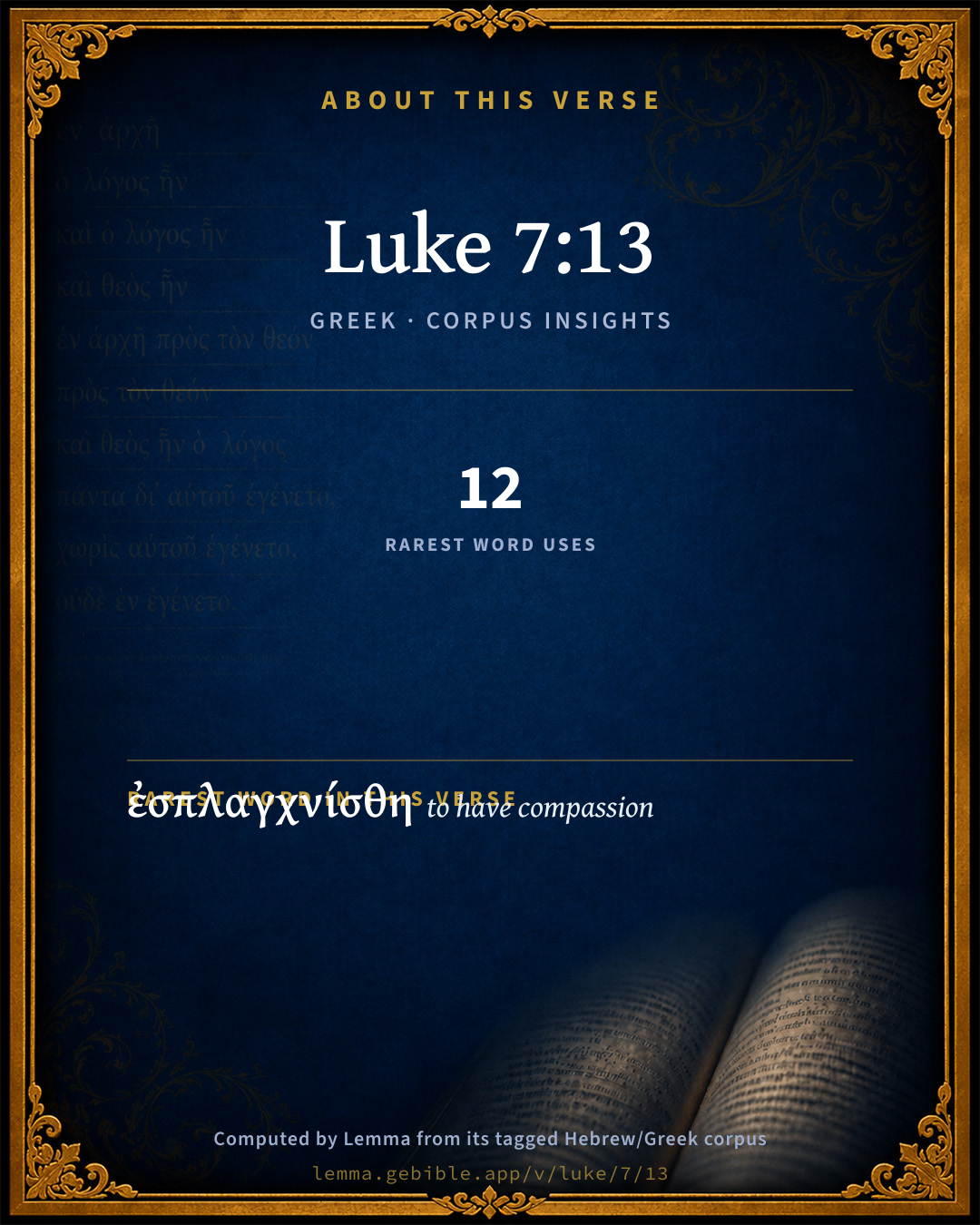
Luke 7:13

Greek (Tischendorf 8th ed.) Luke 7:13 appears in the Greek New Testament. The text above is from the Tischendorf 8th edition. Each word links to its Strong’s number and a concise gloss. Click any word for its full Thayer’s Greek Lexicon entry.
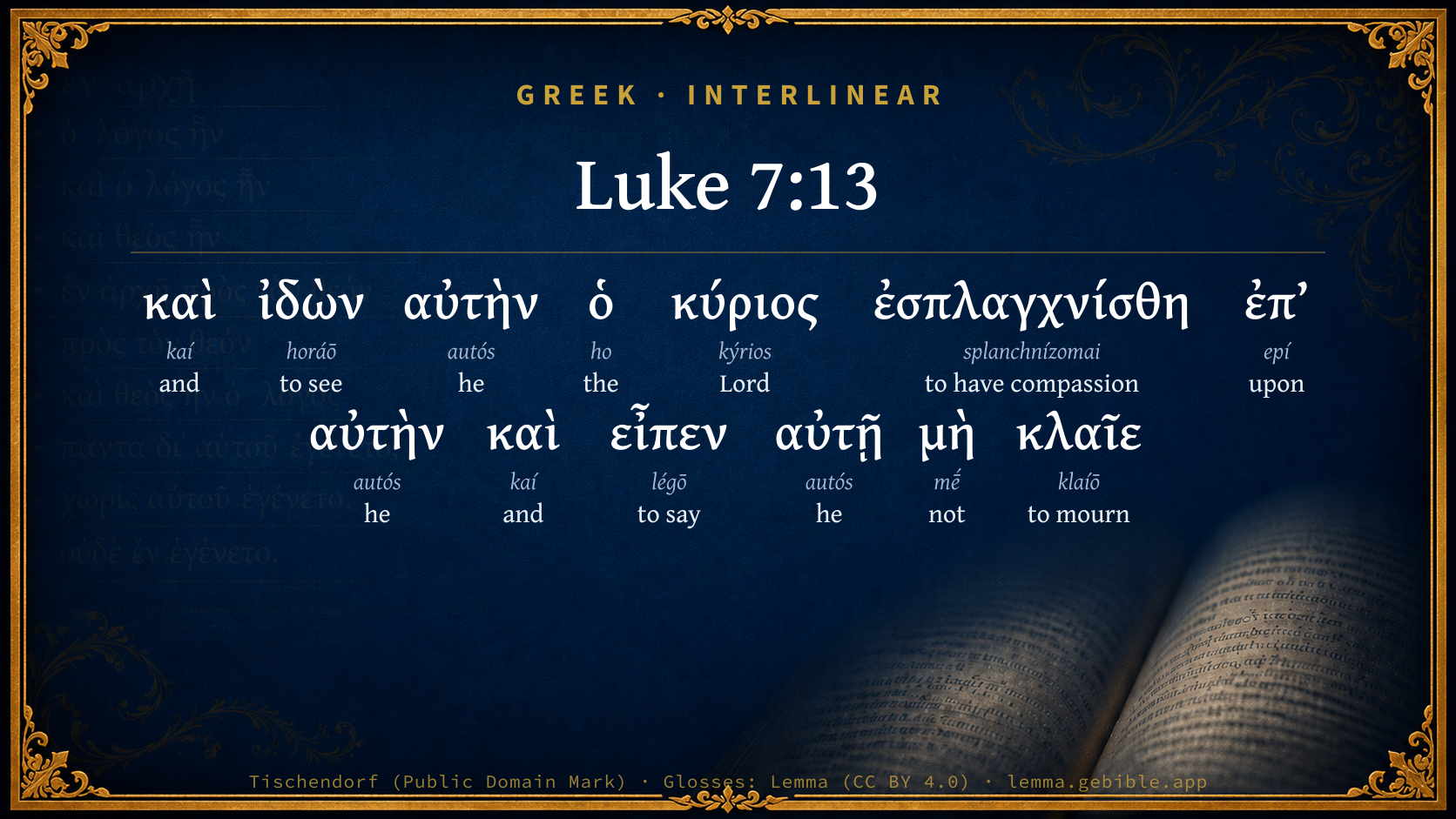
Download image
Cite this verse

Luke 7:13 (World English Bible). Public Domain. Lemma interlinear Bible study tool, https://lemma.gebible.app/v/luke/7/13.

Show BibTeX & RIS
BibTeX
RIS
English Translation
When the Lord saw her, he had compassion on her, and said to her, "Don't cry."
World English Bible · Public Domain
Download a study sheet

One document with this verse’s original text, its word-by-word gloss line, the meaning frame, cross-references with their text, attributed commentary, and full source and license credits — printable, and it pastes into notes with its structure intact.

This verse Autodidact and up

Study sheet (.html) Plain text (.txt)

A passage Seminary Student

Up to 50 verses in one chapter. A passage sheet keeps up to 6 commentary sources and 12 cross-references per verse, in the order this page ranks them, and says so on the sheet whenever that leaves anything out. Ask for a single verse and you get the Autodidact verse sheet above.

Everything on this page stays free to read, with no account — the sheet is a download of what is already on screen, not access to it.

Want to remove ads? Support Godless Engineer
Compare translations 3

The same verse in 3 English versions, stacked beneath the original-language interlinear above. Click any original word for its lexicon entry.

Each is an independent rendering of the whole verse — the interlinear is not word-aligned to these translations.

Highlighted words mark where these versions differ — a whole-verse word diff, not a word-by-word alignment.

  • World English Bible Public Domain
    When the Lord saw her, he had compassion on her, and said to her, "Don't cry."
  • King James Version Public Domain
    And when the Lord saw her, he had compassion on her, and said unto her, Weep not.
  • unfoldingWord Literal Text CC BY-SA 4.0
    And having seen her, the Lord felt compassion for her, and said to her, “Do not weep.”

unfoldingWord Literal Text — © unfoldingWord, licensed CC BY-SA 4.0. Word-aligned USFM3 via Door43 (git.door43.org/unfoldingWord/en_ult).

Versions to compare (up to 4)

3 of 4 selected

Show all 19 translations

Every available English version of this verse, each an independent rendering of the whole verse.

  • World English Bible Public Domain
    When the Lord saw her, he had compassion on her, and said to her, "Don't cry."
  • Berean Standard Bible Public Domain
    When the Lord saw her, He had compassion on her and said, “Do not weep.”
  • Majority Standard Bible Public Domain
    When the Lord saw her, He had compassion on her and said, “Do not weep.”
  • King James Version Public Domain
    And when the Lord saw her, he had compassion on her, and said unto her, Weep not.
  • American Standard Version (1901) Public Domain
    And when the Lord saw her, he had compassion on her, and said unto her, Weep not.
  • Revised Version (1885) Public Domain
    And when the Lord saw her, he had compassion on her, and said unto her, Weep not.
  • Geneva Bible (1599) Public Domain
    And when the Lord sawe her, he had compassion on her, and said vnto her, Weepe not.
  • Douay-Rheims (1899) Public Domain
    Whom when the Lord had seen, being moved with mercy towards her, he said to her: Weep not.
  • Young's Literal Translation Public Domain
    And the Lord having seen her, was moved with compassion towards her, and said to her, `Be not weeping;'
  • Literal Standard Version CC BY-SA 4.0
    And the LORD having seen her, was moved with compassion toward her and said to her, “Do not be weeping”;
  • Unlocked Literal Bible CC BY-SA 4.0
    When the Lord saw her, he was deeply moved with compassion for her and said to her, “Do not cry.”
  • unfoldingWord Literal Text CC BY-SA 4.0
    And having seen her, the Lord felt compassion for her, and said to her, “Do not weep.”
  • Darby Bible Public Domain
    And the Lord, seeing her, was moved with compassion for her, and said to her, Weep not;
  • World Messianic Bible Public Domain
    When the Lord saw her, he had compassion on her and said to her, “Don’t cry.”
  • Webster's Bible Public Domain
    And when the Lord saw her, he had compassion on her, and said to her, Weep not.
  • Free Bible Version CC BY-SA 4.0
    When the Lord saw her he was filled with compassion for her. “Don't cry,” he told her.
  • Bible in Basic English Public Domain
    And when the Lord saw her, he had pity on her and said to her, Be not sad.
  • Text-Critical English NT CC BY 4.0
    When the Lord saw her, he was moved with compassion for her and said to her, “Do not weep.”
  • Tyndale New Testament (1534) Public Domain
    And when the lorde sawe her he had compassion on her and sayde vnto her: wepe not.

Literal Standard Version (2020), Covenant Press — licensed CC BY-SA 4.0. Text via the HelloAO Bible API (eBible.org). Unlocked Literal Bible (unfoldingWord) — licensed CC BY-SA 4.0. Text via the HelloAO Bible API (eBible.org). unfoldingWord Literal Text — © unfoldingWord, licensed CC BY-SA 4.0. Word-aligned USFM3 via Door43 (git.door43.org/unfoldingWord/en_ult). Free Bible Version, Dr. Jonathan Gallagher — licensed CC BY-SA 4.0. Text via the HelloAO Bible API (eBible.org).

Word by word

More ways to search: Search by grammar → Find every occurrence → Compare this word →

Practice this passage: Drill this verse → Learn its vocabulary →

ἐσπλαγχνίσθη
splanchnízomai
G4697
“to have compassion”
Verb, Aorist, Passive deponent, Indicative, 3rd person, Singular
Part of Speech
Verb
Tense
Aorist
Voice
Passive deponent
Mood
Indicative
Person
3rd person
Number
Singular
Full Thayer's Definition

Origin: middle voice from G4698

TDNT: 16:08,1

1. to be moved as to one's bowels, hence to be moved with compassion, have compassion (for the bowels were thought to be the seat of love and pity)
  1. καὶ kaí G2532 “and” Conjunction
  2. ἰδὼν horáō G3708 “to see” Verb, Aorist, Active, Participle, Nominative, Singular, Masculine
  3. αὐτὴν autós G846 “he” Personal pronoun, Accusative, Singular, Feminine
  4. ὁ ho G3588 “the” Article, Nominative, Singular, Masculine
  5. κύριος kýrios G2962 “Lord” Noun, Nominative, Singular, Masculine
  6. ἐπ’ epí G1909 “upon” Preposition
  7. αὐτὴν autós G846 “he” Personal pronoun, Accusative, Singular, Feminine
  8. καὶ kaí G2532 “and” Conjunction
  9. εἶπεν légō G3004 “to say” Verb, Aorist, Active, Indicative, 3rd person, Singular
  10. αὐτῇ autós G846 “he” Personal pronoun, Dative, Singular, Feminine
  11. μὴ mḗ G3361 “not” Particle, Negative
  12. κλαῖε klaíō G2799 “to mourn” Verb, Present, Active, Imperative, 2nd person, Singular

About this verse

These counts appear in no published source. They are computed here, from the morphology-tagged text and Lemma’s own curated glosses. What Lemma adds →

13
words
10
distinct lemmas
Gospels
section

Notable vocabulary

The rarest word here is ἐσπλαγχνίσθη to have compassion G4697 — appearing just 12 times in the whole Greek New Testament.

Shared distinctive vocabulary

ἐσπλαγχνίσθη to have compassion G4697 occurs in 12 verses of the Greek New Testament. Also found in:

Repetition

Words recur within this verse:

  • αὐτὴν he G846 ×3
  • καὶ and G2532 ×2

Cross-references

24

Topical passages linked to Luke 7:13 in the Treasury of Scripture Knowledge — connected by theme and wording, ordered by reader-vote popularity; previews shown in the World English Bible.

  • Psalms 103:13 Like a father has compassion on his children, So Yahweh has compassion on those who fear him.
  • Isaiah 63:9 In all their affliction he was afflicted, and the angel of his presence saved them: in his love and in his pity he redeemed them; and he bore them, and carried them all the days of old.
  • Lamentations 3:32–33 For though he cause grief, yet will he have compassion according to the multitude of his loving kindnesses.
  • Hebrews 4:15 For we don't have a high priest who can't be touched with the feeling of our infirmities, but one who has been in all points tempted like we are, yet without sin.
  • Psalms 86:15 But you, Lord, are a merciful and gracious God, Slow to anger, and abundant in loving kindness and truth.
  • Jeremiah 31:20 Is Ephraim my dear son? is he a darling child? for as often as I speak against him, I do earnestly remember him still: therefore my heart yearns for him; I will surely have mercy on him, says Yahweh.
  • Luke 8:52 All were weeping and mourning her, but he said, "Don't weep. She isn't dead, but sleeping."
  • Psalms 86:5 For you, Lord, are good, and ready to forgive; Abundant in loving kindness to all those who call on you.
  • John 11:33–35 When Jesus therefore saw her weeping, and the Jews weeping who came with her, he groaned in the spirit, and was troubled,
  • Hebrews 2:17 Therefore he was obligated in all things to be made like his brothers, that he might become a merciful and faithful high priest in things pertaining to God, to make atonement for the sins of the people.
  • Judges 10:16 They put away the foreign gods from among them, and served Yahweh; and his soul was grieved for the misery of Israel.
  • Jeremiah 31:15–16 Thus says Yahweh: A voice is heard in Ramah, lamentation, and bitter weeping, Rachel weeping for her children; she refuses to be comforted for her children, because they are no more.
  • John 20:15 Jesus said to her, "Woman, why are you weeping? Who are you looking for?" She, supposing him to be the gardener, said to him, "Sir, if you have carried him away, tell me where you have laid him, and I will take him away."
  • Mark 8:2 "I have compassion on the multitude, because they have stayed with me now three days, and have nothing to eat.
  • Luke 17:5 The apostles said to the Lord, "Increase our faith."
  • Luke 24:34 saying, "The Lord is risen indeed, and has appeared to Simon!"
  • John 11:2 It was that Mary who had anointed the Lord with ointment, and wiped his feet with her hair, whose brother, Lazarus, was sick.
  • Luke 7:19 John, calling to himself two of his disciples, sent them to Jesus, saying, "Are you the one who is coming, or should we look for another?"
  • Luke 10:1 Now after these things, the Lord also appointed seventy others, and sent them two by two ahead of him into every city and place, where he was about to come.
  • Luke 13:15 Therefore the Lord answered him, "You hypocrites! Doesn't each one of you free his ox or his donkey from the stall on the Sabbath, and lead him away to water?
  • John 20:13 They told her, "Woman, why are you weeping?" She said to them, "Because they have taken away my Lord, and I don't know where they have laid him."
  • 1 Corinthians 7:30 and those who weep, as though they didn't weep; and those who rejoice, as though they didn't rejoice; and those who buy, as though they didn't possess;
  • Luke 22:61 The Lord turned, and looked at Peter. Then Peter remembered the Lord's word, how he said to him, "Before the rooster crows you will deny me three times."
  • 1 Thessalonians 4:13 But we don't want you to be ignorant, brothers, concerning those who have fallen asleep, so that you don't grieve like the rest, who have no hope.

Cross-references courtesy of OpenBible.info (CC BY 4.0).

Commentary

Notes on Luke 7:13 from classic Christian and Jewish commentators (each source and its license shown beneath its notes). The classic Christian expositions comment on the surrounding passage and are grouped to its opening verse, so a note may address several verses; the Jewish commentaries on the Tanakh (Rashi and others) are per-verse, so they appear only where the commentator wrote on this verse.

Lemma curates 59 commentaries, every one of them public domain or Creative Commons licensed, each selected and text-cleaned for this edition rather than reprinted as found. About our sources →

Joseph Benson's Commentary

Luk 7:13-15. When the Lord saw her, he had compassion on her, &c. — Jesus, whose tenderness made him susceptible of the strongest impressions from occurrences of this kind, knowing that the mother’s affliction was bitter, and the occasion of it real, was greatly moved with compassion at the sorrowful scene. Here was no application made to him for her, not so much as that he would speak some words of comfort to her; but, ex mero motu, purely from the goodness of his nature he was troubled for her, and said unto her, Weep not. Observe, reader, Christ has a concern for mourners, for the miserable, and often prevents them with the blessings of his goodness. He undertook the work of our redemption and salvation in his love and in his pity, Isa 63:9. What a pleasing idea doth this give us of the compassion of the Lord Jesus, and the multitude of his tender mercies, which may be very encouraging to us, when at any time we are in sorrow! Let poor widows comfort themselves in their sorrows with this, that Christ pities them, and knows their souls in adversity; and, if others despise their grief, he does not. Christ said, Weep not; and he could give her a reason for it, which no one else could; weep not for a dead son, for he shall presently become a living one. This was a reason peculiar to her case; yet there is a reason, common to all that sleep in Jesus, (which is of equal force against inordinate and excessive grief for their death,) that they shall rise again, shall rise in glory, and therefore we must not sorrow as those that have no hope, 1Th 4:13. Let Rachel, that weeps for her children, refrain her eyes from tears; for there is hope in thine end, saith the Lord, that thy children shall come again to their own border, Jer 31:17. And let our passion at such a time be checked and calmed by the consideration of Christ’s compassion. And he came and touched the bier — Which he could do without contracting pollution. The people of the East bury their dead without coffins, but they carry them to the grave on a bier that is shaped like one. By touching this, Jesus intimated to the bearers that they should not proceed. And he said, Young man, I say unto thee, Arise — And no sooner had he uttered this command than he that was dead sat up — Without any human help, having received life from Jesus, which was thus evinced, as it was also by his beginning to speak. Thus, when Christ communicates spiritual life to a person who had been dead in trespasses and sins, he instantly arises out of the state of insensibility, darkness, and death, in which he had lain, and his lips are opened in prayer and praise. And he delivered him to his mother — Christ did not oblige this young man, to whom he had given a new life, to go along and continue with him, as his disciple to minister to him, though he owed him much, even his own self; much less as a trophy of his dominion over death, to get honour by him; but presented him to his mother, to attend her, as became a dutiful son, showing hereby, that it was in compassion of her affliction he had wrought the life-giving miracle. Indeed, all Christ’s miracles were miracles of mercy; and a great act of mercy this was to this widow. Now she was comforted according to the time in which she had been afflicted, and much more; for she could now look upon this son as a particular favourite of Heaven, with more pleasure than if he had not died. And as this miracle was an illustrious display of our Lord’s compassion for a person in distress, so it was a striking confirmation of his divine mission; this youth being raised from the dead near the gate of the city, a place of public resort, and in the presence of many witnesses, particularly the multitude which came with Jesus, the people who accompanied the corpse, and all who happened in that instant to be in or passing through the gate upon business.

Joseph Benson's Commentary on the Old and New Testaments (1811–1818) — public domain. Text from a community e-Sword module.

MacLaren's Expositions of Holy Scripture

Alexander MacLaren

Luke

JESUS AT THE BIER

Luk 7:13 - Luk 7:15.

We owe our knowledge of this incident to Luke only. He is the Evangelist who specially delights in recording the gracious relations of our Lord with women, and he is also the Evangelist who delights in telling us of unasked miracles which Christ performed. Both of these characteristics unite in this story, and it may have been these, rather than the fact of its being a narrative of a resurrection, that found for it a place in this Gospel.

Be that as it may, it is obvious to remark that this miracle was not wrought with any intention of establishing Christ’s claims thereby. Its motive was simply pity; its purpose was merely to comfort a desolate woman whose hope and love and defence were lying stretched on her boy’s bier. Was that a sufficient reason for a miracle? People tell us that a test of a spurious miracle is that it is done without any adequate purpose to be served. Jesus Christ thought that to comfort one poor, sorrowful heart was reason enough for putting His hand out, and dragging the prey from the very jaws of death, so loftily did He think of human sorrow and of the comforting thereof.

Now I think we unduly limit the meaning of our Lord’s miracles when we regard them as specially intended to authenticate His claims. They are not merely the evidences of revelation; they are themselves a large part of revelation. My purpose in this sermon is to look at this incident from that one point of view, and to try to set clearly before our minds what it shows us of the character and work of Jesus Christ. And there are three things on which I desire to touch briefly. We have Him here revealed to us as the compassionate Drier of all tears; the life-giving Antagonist of death; and as the Re-uniter of parted hearts.

Note, then, these three things.

I. First of all, look at that wonderful revelation that lies here of Jesus Christ as the compassionate Drier of all tears.

The poor woman, buried in her grief, with her eyes fixed on the bier, has no thought for the little crowd that came up the rocky road, as she and her friends are hurrying down it to the place of graves. She was a stranger to Christ, and Christ a stranger to her. The last thing that she would have thought of would have been eliciting any compassion from those who thus fortuitously met her on her sad errand. But Christ looks, and His eye sees far more deeply and far more tenderly into the sorrow of the desolate, childless widow than any human eyes looked. And as swift as was His perception of the sorrow, so swiftly does He throw Himself into sympathy with it. The true human emotion of unmingled pity wells up in His heart and moves Him to action.

And just because the manhood was perfect and sinless, therefore the sympathy of Christ was deeper than any human sympathy, howsoever tender it may be; for what unfits us to feel compassion is our absorption with ourselves. That makes our hearts hard and insensitive, and is the true, ‘witches’ mark’-to recur to the old fable-the spot where no external pressure can produce sensation. The ossified heart of the selfish man is closed against divine compassion. Since Jesus Christ forgot Himself in pitying men, and Himself ‘took our infirmities and bare our sicknesses,’ He must have been what none of us are-free from all taint of selfishness, and from all insensibility born of sin.

But there is another step to be taken. That pitying Christ, on the rocky road outside the little Galilean village, feeling all the pain and sorrow of the lonely mother-that is God! ‘Lo! this is our God; and we have waited for Him.’ Ay! waited through all the uncompassionating centuries, waited in the presence of the false gods, waited whilst men have been talking about an impassive Deity careless in the heavens, over whose serene blessedness no shadow can ever pass. This is our God. No impassive monster that no man can love or care for, but a God with a heart, a God that can pity, a God who, wonderful as it is, can and does enter, in the humanity of Jesus Christ, into a fellow-feeling of our infirmities.

If Jesus Christ in His pity was only a perfect and lovely example of unselfish sympathy such as man can exercise, what in the name of common-sense does it matter to me how much, or how tenderly, He pitied those past generations? The showers and the sunshine of this summer will do as much good to the springing corn in the fields to-day as the pity of a dead, human Christ will do for you and me. In our weaknesses, in our sorrows great and small, in our troubles and annoyances, you and I need, dear brethren, a living Jesus to pity us, there in the heavens, just as He pitied that poor woman outside the gate of Nain. Blessed be God!, we have Him. The human Christ is the manifestation of the Divine, and as we listen to the Evangelist that says, ‘When He saw her He had compassion upon her,’ we bow our heads and feel that the old psalmist spoke a truth when He said, ‘His compassions fail not,’ and that the old prophet spoke a truth, the depth of which his experience did not enable him to fathom, when he said that ‘in all their afflictions He was afflicted.’

Then, note that the pitying Christ dries the tears before He raises the dead. That is beautiful, I think. ‘Weep not,’ He says to the woman-a kind of a prophecy that He is going to take away the occasion for weeping; and so He calls lovingly upon her for some movement of hope and confidence towards Himself. With what an ineffable sweetness of cadence in His sympathetic voice these words would be spoken! How often, kindly and vainly, men say to one another, ‘Weep not,’ when they are utterly powerless to take away or in the smallest degree to diminish the occasion for weeping! And how often, unkindly, in mistaken endeavour to bring about resignation and submission, do well-meaning and erring good people say to mourners in the passion of their sorrow, ‘Weep not!’ Jesus Christ never dammed back tears when tears were wholesome, and would bring blessing. And Jesus Christ never said, ‘Dry your tears,’ without stretching out His own hand to do it.

How does He do it? First of all by the assurance of His sympathy. Ah! in that word there came a message to the lonely heart, as there comes a message, dear brethren, to any man or woman among us now who may be fighting with griefs and cares or sorrows, great or small-the assurance that Jesus Christ knows all about your pain and will help you to bear it if you will let Him. The sweet consciousness of Christ’s sympathy is the true antidote to excessive grief.

And He dries the tears, not only by the assurance of His sympathy, but by encouraging expectation and hope. When He said, ‘Weep not,’ He was pledging Himself to do what was needed in order to stay the flow of weeping. And He would encourage us, in the midst of our cares and sorrows and loneliness, not indeed to suppress the natural emotion of sorrow, nor to try after a fantastic and unreal suppression of its wholesome signs, but to weep as though we wept not, because beyond the darkness and the dreariness we see the glimmering of the eternal day. He encourages expectation as the antagonist of sorrow, for the curse of sorrow is that it is ever looking backwards, and the true attitude for all men who have an immortal Christ to trust, and an immortality for themselves to claim, is that not ‘backward’ should their ‘glances be, but forward to their Father’s home.’ These are the thoughts that dry our tears, the assurance of the sympathy of Christ, and the joyous expectation of a great good to be ours, where beyond those voices there is peace.

Brother! it may be with all of us-for all of us carry some burden of sorrow or care-as it is with the hedgerows and wet ploughed fields to-day; on every spray hangs a raindrop, and in every raindrop gleams a reflected sun. And so all our tears and sorrows may flash into beauty, and sparkle into rainbowed light if the smile of His face falls upon us.

And then, still further, this pitying Christ is moved by His pity to bring unasked gifts. No petition, no expectation, not the least trace of faith or hope drew from Him this mighty miracle. It came welling up from His own heart. And therein it is of a piece with all His work. For the divine love of which Christ is the Bearer, the Agent, and the Channel for us men, ‘tarries not for men, nor waiteth for the sons of men,’ but before we ask, delights to bestow itself, and gives that which no man ever sought, even the miracles of the Incarnation and Crucifixion of Jesus Christ our Lord. If heaven had waited until men’s prayers had forced its gates ere it sent forth its greatest gift, it had waited for ever, and all mankind had perished. God’s love flows out of its own expansive and diffusive nature. Its necessity is to impart itself, and its nature and property is to give. A measureless desire to bestow itself, and in itself all good, is the definition of the love of God. And Christ comes ‘to the unthankful and to the evil,’ bringing a gift which none of us have asked, and giving as much of Himself as He can give, undesired, to every heart, that thereby we may be led to desire these better gifts which cannot be bestowed unless we seek them.

So here we have the compassion of the human Christ, which is the divine compassion, drying all tears and giving unasked blessings.

II. Note, secondly, the further revelation of our Lord here as being the life-giving Antagonist of Death.

There is something exceedingly picturesque, and if I might use the word, dramatic, in the meeting of these two processions outside the city gate, the little crowd of mourners hurrying, according to the Eastern fashion, down the hill to the place of tombs, and the other little group toiling up the hill to the city. There Life and Death stand face to face. Jesus Christ puts out His hand, and lays it upon the bier, not to communicate anything, but simply to arrest its progress. Is it not a parable of His work in the world? His great work is to stop the triumphant march of Death-that grim power which broods like a thundercloud over humanity, and sucks up all brightness into its ghastly folds, and silences all song. He comes and says ‘Stop’; and it stands fixed upon the spot. He arrests the march of Death. Not indeed that He touches the mere physical fact. The physical fact is not what men mean by death. It is not what they cower before. What the world shrinks from is the physical fact plus its associations, its dim forebodings, its recoilings from the unknown regions into which the soul goes from out of ‘the warm precincts of the cheerful day,’ and plus the possibilities of retribution, the certainty of judgment. All these Christ sweeps away, so that we may say, ‘He hath abolished Death,’ even though we all have to pass through the mere externals of dying, for the dread of Death is gone for ever, if we trust Him.

And then note, still further, we have Christ here as the Life-giver. ‘Young man, I say unto thee, Arise!’ Christ took various methods of imparting His miraculous power. These methods varied, as it would appear, according to the religious necessities of the subjects or beholders of the miracle. Sometimes He touched, sometimes He employed still more material vehicles, such as the clay with which He moistened the eyes of the blind man, and the spittle with which He touched the ears of the deaf. But all these various methods were but helps to feeble faith, and in the case of all the raisings from the dead it is the voice alone that is employed.

So, then, what is the meaning of that majestic ‘I say unto thee, Arise’? He claims to work by His own power. Unless Jesus Christ wielded divine authority in a fashion in which no mere human representative and messenger of God ever has wielded it, for Him to stand by that bier and utter, ‘I say unto thee, Arise!’ was neither more nor less than blasphemy. And yet the word had force. He assumed to act by His own power, and the event showed that He assumed not too much. ‘The Son quickeneth whom He will.’

Further, He acts by His bare word. So He did on many other occasions-rebuking the fever and it departs, speaking to the wind and it ceases, calling to the dead and they come forth. And who is He, the bare utterance of whose will is supreme, and has power over material things? Let that centurion whose creed is given to us in the earlier portion of this chapter answer the question. ‘I say to my servant, Go! and he goeth; Come! and he cometh; Do this! and he doeth it. Speak Thou, and all the embattled forces of the universe will obey Thine autocratic and sovereign behest,’ they ‘hearken to His commandments, and do the voice of His word.’

Then note, still further, that this voice of Christ’s has power in the regions of the dead. Wherever that young man was, he heard; in whatsoever state or condition he was, his personality felt and obeyed the magnetic force of Christ’s will. The fact that the Lord spake and the boy heard, disposes, if it be true, of much error, and clears away much darkness. Then the separation of body and soul is a separation and not a destruction. Then consciousness is not a function of the brain, as they tell us. Then man lives wholly after he is dead. Then it is possible for the spirit to come out of some dim region, where we know not, in what condition we know not. Only this we know-that, wherever it is, Christ’s will has authority there; and there, too, is obedience to His commandment.

And so let me remind you that this Voice is not only revealing as to Christ’s authority and power, and illuminative as to the condition of the disembodied dead, but it is also prophetic as to the future. It tells us that there is nothing impossible or unnatural in that great assurance. ‘The hour is coming when they that are in the graves shall hear His voice, and shall come forth.’ There shall be for the dead a reunion with a body, which will bring men again into connection with an external universe, and be the precursor of a fuller judgment and an intenser retribution.

Brethren, that Voice that raised one poor bewildered boy to sit up on his bier, and begin to speak-broken exclamations possibly, and stammering words of astonishment-shall be flung, like a trumpet that scatters marvellous sounds, through the sepulchres of the nations and compel all to stand before the throne. You and I will hear it; let us be ready for it.

III. So, lastly, we have here the revelation of our Lord as the Reuniter of parted hearts.

That is a wonderfully beautiful touch, evidently coming from an eye-witness-’He delivered him to his mother.’ That was what it had all been done for. The mighty miracle was wrought that that poor weeping woman might be comforted.

May we not go a step further? May we not say, If Jesus Christ was so mindful of the needs of a sorrowful solitary soul here upon earth, will He be less mindful of the enduring needs of loving hearts yonder in the heavens? If He raised this boy from the dead that his mother’s arms might twine round him again, and his mother’s heart be comforted, will He not in that great Resurrection give back dear ones to empty, outstretched arms, and thereby quiet hungry hearts? It is impossible to suppose that, continuing ourselves, we should be deprived of our loves. These are too deeply engrained and enwrought into the very texture of our being for that to be possible. And it is as impossible that, in the great day and blessed world where all lost treasures are found, hearts that have been sad and solitary here for many a day shall not clasp again the souls of their souls-’and with God be the rest.’

So, though we know very little, surely we may take the comfort of such a thought as this, which should be very blessed and sweet to some of us, and with some assurance of hope may feel that the risen boy at the gate of Nain was not the last lost one whom Christ, with a smile, will deliver to the hearts that mourn for them, and there we ‘shall clasp inseparable hands with joy and bliss in over-measure for ever.’ ‘And so shall we’-they and I, for that is what we means-’ so shall we ever be with the Lord. Wherefore comfort one another with these words.’

Alexander MacLaren, Expositions of Holy Scripture (1904–1910) — public domain. Text from a community e-Sword module.

Tyndale Open Study Notes

Tyndale Open Resources

7:13-14 The word translated coffin may refer to a casket or a funeral bier. A Jew was rendered unclean by touching a dead body or the coffin or bier (Lev 21:1, 11-12). As when he touched the man with leprosy (Luke 5:13), however, Jesus was not defiled. He replaced disease and death with cleansing and life.

Tyndale Open Study Notes — © Tyndale Open Resources, licensed CC BY-SA 4.0. Text via the HelloAO Bible API.

Bengel's Gnomon

Johann Albrecht Bengel

Luk 7:13. Ὁ Κύριος, the Lord) This sublime appellation was better known and more used when Luke and John wrote, than when Matthew wrote. Mark holds a midway place. This head of the faith needed to be taught and established in the beginning: then afterwards it might be taken for granted.—ἐσπλαγχνίσθη, the bowels of His compassion were moved) And so for the consolation of the mother, the young man must return to this life.—μὴ κλαῖε, weep not) His thus administering consolation before the performance of the miracle, shows His power of surely performing it. It is His frequent preface elsewhere, Fear not. Among men [on the part of men] there is always something which the approach of God has to remove out of the way at the beginning.

Bengel's Gnomon of the New Testament — English translation (T&T Clark, Edinburgh, 1860) — public domain. Text from a community e-Sword module.

Meyer's Critical & Exegetical Commentary

Heinrich August Wilhelm Meyer

Luk_7:13-15. The sympathy with the mother was in itself sufficiently well founded, even without the need of any special (perhaps direct) acquaintance with her circumstances.

μὴ κλαῖε] Consolatio ante opus ostendit operis certo futuri potestatem, Bengel.

The coffin (ἡ σορός) was an uncovered chest. See Wetstein in loc.; Harmar, Beob. II. p. 141.

The mere touch without a word caused the bearers to stand still. A trait of the marvellous.

νεανίσκε, σοὶ λ.] The preceding touch had influenced the bearers.

ἀνεκάθισεν] He sat upright. Comp. Act_9:40; Xen. Cyr. v. 19; Plat. Phaed. p. 60 B: ἀνακαθιζόμενος ἐπὶ τὴν κλίνην, and thereon Stallbaum.

ἔδωκεν] Comp. Luk_9:42. His work had now been done on him.

Meyer — Critical and Exegetical Commentary on the New Testament — English translation by Peter Christie, edited by Frederick Crombie (T&T Clark, 1880) — public domain. Text from a community e-Sword module.

Expositor's Greek Testament

ed. W. Robertson Nicoll

Luk 7:13 . ὁ Κύριος , the Lord, first time this title has been used for Jesus in the narrative. Lk. frequently introduces it where the other synoptists have “Jesus”. The heavenly Christ, Lord of the Church, is in his mind, and perhaps he employs the title here because it is a case of raising from the dead. The “Lord” is Himself the risen One. ἐσπλαγχνίσθη : express mention of sympathy, pity, as the motive of the miracle. Cf. Mar 1:41 . μὴ κλαῖε , cease weeping, a hint of what was coming, but of course not understood by the widow.

The Expositor's Greek Testament, edited by W. Robertson Nicoll (1897–1910) — public domain. Text from a community e-Sword module.

Godet's Commentaries

Frédéric Louis Godet

Vers. 13-15. The Miracle.

The expression: the Lord, is seldom met with in our Gospels except in Luke, and principally in the passages which are peculiar to him: Luk 10:1, Luk 11:39, Luk 12:42, Luk 13:15, Luk 17:5-6, Luk 18:6, Luk 22:31; Luk 22:61 (Bleek).

The whole circumstances enumerated Luk 7:12: an only son, a widowed mother, and the public sympathy, enable us to understand what it was that acted with such power upon the heart of Jesus. It seems that He could not resist the silent appeal presented by this combination of circumstances. His heart is completely subdued by the sobs of the mother. Hence the word, at once tender and authoritative: Weep not. Prudence perhaps would have dictated that He should not work such a striking miracle at this time. But when pity speaks so loud (ἐσπλαγχνίσθη), there is no longer any room for prudence. Besides, He feels Himself authorized to comfort. For in this very meeting He recognises the will of His Father.

Among the Jews the bier was not covered; it was a simple plank, with a somewhat raised edge. The body, wrapped in its shroud, was therefore visible to all. Jesus lays His hand on the bier, as if to arrest this fugitive from life. The bearers, struck by the majesty of this gesture, which was at once natural and symbolical, stopped. There is a matchless grandeur in this σοὶ λέγω: “I say to thee,...to thee who seemest no longer able to hear the voice of the living...” There is absolutely nothing in the text to justify the sarcasm of Keim: “Faith in a force which penetrates to the dead, even through the wood of the bier, evidently belongs to the evangelist, but it is not ours.” The resurrection is in no way attributed to the touching of the bier, but to the command of Jesus.

The interruption of the connection between the soul and the body in death, as in sleep, is only relative; and as man’s voice suffices to re-establish this connection in any one who is wrapt in slumber, so the word of the Lord has power to restore this interrupted connection even in the dead. The advocates of the natural interpretation have maintained that the young man was only in a lethargic sleep. But if this were so, the miracle of power would only disappear to be replaced by a miracle of knowledge quite as incomprehensible. How could Jesus know that this apparently dead man was still living, and that the moment of his awaking was imminent?

As soon as the soul returned to animate the body, motion and speech indicated its presence. Jesus certainly has acquired a right over the resuscitated man; He asserts this right, but simply to enjoy the happiness of restoring to the afflicted mother the treasure which He has rescued from death. The expression: He gave him to his mother, corresponds to this: He was moved with compassion, Luk 7:13.

Frédéric Louis Godet — Commentaries on Luke, John, Romans, and 1 Corinthians — English translation (T&T Clark, Edinburgh, 1870s–1890s) — public domain. Text from a community e-Sword module.

Jamieson, Fausset & Brown

Robert Jamieson, A. R. Fausset & David Brown

the Lord--"This sublime appellation is more usual with Luke and John than Matthew; Mark holds the mean" [BENGEL].

saw her, he had compassion, &c.--What consolation to thousands of the bereaved has this single verse carried from age to age!

Jamieson, Fausset & Brown — Commentary Critical and Explanatory on the Whole Bible (1871) — public domain (CC PDM 1.0). Text via the HelloAO Bible API.

Ellicott's Commentary for English Readers

(13) And when the Lord saw her.—The words are noticeable as being one of the comparatively few instances in which the term “the Lord” is used absolutely instead of Jesus. As far as it goes it confirms the view suggested in the previous Note, that the narrative came from those who had a profound reverence for the Master they had followed, and at a time when they had learnt thus to speak of Him. (Comp. the language of Mary Magdalene in Joh_20:2; Joh_20:13.) It may be noted further that this use of “the Lord” occurs more frequently in St. Luke and St. John than in the other Gospels. Comp. Luk_7:31; Luk_10:1; Luk_11:39; Luk_12:42; Luk_17:5-6; Luk_19:8; Luk_22:61; Joh_4:1; Joh_6:23; Joh_20:18; Joh_20:20; Joh_20:25; Joh_21:7; Joh_21:12. The last three or four references show that the disciples habitually used the same mode of speech, but it would not follow that in their lips it necessarily meant more at first than our “Sir,” or “Master.” After the Resurrection, doubtless, it rose to its higher meaning, as in the exclamations of St. Thomas (Joh_20:28; comp. Joh_20:25), and of St. John (Joh_21:7).

He had compassion.—Note, in this instance, as in so many others (e.g., Mat_20:34; Mar_1:41), how our Lord’s works of wonder spring not from a distinct purpose to offer credentials of His mission, but from the outflow of His infinite sympathy with human suffering.

A Bible Commentary for English Readers, edited by Charles John Ellicott (1878–1897) — public domain. Text from a community e-Sword module.

The Cambridge Bible for Schools and Colleges

gen. ed. J. J. S. Perowne

13. when the Lord saw her] “The Lord” is far more frequent as a title of Jesus in St Luke (Luk_7:31, Luk_10:1, Luk_11:1, Luk_12:42, Luk_17:5-6, Luk_19:8, Luk_22:61) than in the other Evangelists except St John. The fact is a sign of the spread of Christian faith. Even though St Luke’s Gospel may not have been published more than a year or two after St Matthew’s, yet St Luke belongs so to speak to a later generation of disciples.

he had compassion on her] Jesus, who was always touched by the sight of human agony (Mar_7:34; Mar_8:12), seems to have felt a peculiar compassion for the anguish of bereavement (Joh_11:33-37). The fact that this youth was “the only son of his mother and she a widow” would convey to Jewish notions a deeper sorrow than it even does to ours, for they regarded childlessness as a special calamity, and the loss of offspring as a direct punishment for sin (Jer_6:26; Zec_12:10; Amo_8:10).

weep not] Rather, Be not weeping, i.e. ‘dry thy tears.’

The Cambridge Bible for Schools and Colleges (gen. ed. J. J. S. Perowne; Cambridge University Press, 1878–1918) — public domain. Text from a community e-Sword module.

John Gill's Exposition

And when the Lord saw her, he had compassion on her,.... Knowing her case, that she was a widow, and had lost her only son:

and said unto her, weep not; signifying, that he would help her, which he did without being asked to do it, as usual in other cases.

John Gill's Exposition of the Whole Bible (1746–1763) — public domain (CC PDM 1.0). Text via the HelloAO Bible API.

Trapp's Complete Commentary

John Trapp

13 And when the Lord saw her, he had compassion on her, and said unto her, Weep not.

Ver. 13. He had compassion on her] Of his own free accord, and unrequested, he raised him. Christ had a most tender heart. How shall he not pity and provide for his praying people?

John Trapp, A Commentary or Exposition upon All the Books of the Old and New Testament (1647–1656) — public domain. Text from a community e-Sword module.

Whedon's Commentary on the Bible

Daniel D. Whedon

13. Compassion on her—”Here was no solicitor,” says Bishop Hall, “but his own compassion. The centurion came to him for a servant, the ruler for a son, Jairus for a daughter, the neighbours for a paralytic; here he seeks up the patient, and offers the cure unrequested. While we have to do with the Father of mercies, our afflictions are the most powerful suitors.” Compassion for her is the suggesting motive, but doubtless other reasons favoured the result. There was a temper of faith and tenderness in both his followers and the funeral assembly, that stood in perfect contrast to the faithlessness of the Nazarenes, from whose hands he had so lately walked forth, rejected and rejecting.

Weep not—The large attendance came to weep with her; this stranger met them to arrest her tears. They came to deposit her son in the tomb; he came to give him back to life. Like John, in Rev_5:5, she was bidden to weep not, because the Lion of the tribe of Judah had prevailed to unseal the enclosures of death.

Daniel D. Whedon (gen. ed.), Commentary on the Old and New Testaments (1874–1909) — public domain. Text from a community e-Sword module.

The Pulpit Commentary

And when the Lord saw her. It is rare in the Gospels to find the expression, "the Lord," used by itself, "Jesus" being the usual term. It agrees with the unanimous tradition in the Church respecting the authorship of this Gospel neither Luke nor Paul had been with Jesus. These had always looked on Jesus, thought of him, as the Lord risen from the dead, enthroned in heaven. At the period when St. Luke wrote, not earlier than A.D. 60, this title had probably become the usual term by which the Redeemer was known among his own. He had compassion on her. In this instance, as in so many others, our Lord"s miracles were worked, not from a distinct purpose to offer credentials of his mission, but proceeded rather from his intense compassion with and his Divine pity for human sufferings.

Vers. 13-16. Christ visiting and abiding.

We cannot wonder that the people exclaimed as they did, "God hath visited his people," when they witnessed such a miracle as this. It was clear enough that One from the heavenly world was with them, manifesting Divine power and pity. We have here

I A TOUCHING PICTURE OF THE EXTREMES OF HUMAN JOY AND SORROW. The great darkness of death had overshadowed a human home; death had come to a young man, one who had passed through the perils of early life, and had qualified himself for the larger duties and weightier obligations of manhood; one, therefore, to whom life was peculiarly dear and precious. This young man was an only son, in whom all his mother"s love had centred, on whom she leaned as her one support; and she was a widow, most needing the solace of affection, least able to dispense with the prop that was left her. A supreme sorrow was hers. Then came a sudden revulsion of feeling. Just at the very hour when grief was at its very depth, as the young man was being carried to his grave, he is restored to her. The inanimate form is quickened to a new life; there is "a light upon the brows" which is not "the daylight only," but the light of consciousness; the stilled tongue speaks again; the pallor of death gives place to the hue of health. Her son is hers again; her home is home again; she takes back her life with his. A more complete rebound from uttermost sorrow to intensest peace and joy can never have been known.

II CHRIST"S CROWNING ACT OF AUTHENTICATION. When our Lord sent back his reply to John we are not surprised that he mentions, as the crowning instance of his power, that "the dead are raised" (ver. 22). Much as it was to give sight to the blind and hearing to the deaf and activity to the lame, much as it was to cleanse the lepers of their foul and terrible disease, it was very much more to restore the dead to life. That was the supreme and sovereign act, proving that Jesus did come forth from God, and was what he claimed to be. That was a power beyond all the skill of human science, beyond all the arts of necromancy; it bespoke the near presence of the Divine. Surely God was visiting his people.

III A PROPHECY OF THE PRESENT AND THE LASTING MISSION OF THE DIVINE RESTORER. What Jesus Christ visited this world to do for the bodies of men he now lives and reigns to do for their souls to restore them to newness of life. He is with us always, here on earth, "not to sojourn, but to abide" with us, exercising a far more glorious power than that he put forth at the gates of the city of Nain. That young man had another lease of life; to the days that he had spent on earth there were added a certain number more. Then he sickened again, and died; and death and the grave claimed their own. But when Jesus Christ, our Divine Saviour, now confers spiritual life, he awakens us to an existence

(1) which is far higher than the mortal life we are living here, and

(2) which is not limited by a few years. The great work of restoration which the risen Saviour is now accomplishing is that of which his work below was but the preparation and the promise.

1. The death to which this man succumbed was the type of the spiritual death which is the sad consequence of sin.

2. To those thus lost to God and man he speaks with sovereign voice, "Arise!" he bids them realize their guilt and danger; he summons them to repentance; he invites them to a whole-hearted trust in himself, the Almighty Saviour; he bids them walk thenceforth in the way of his commandments.

3. He restores them to their friends as those who, under his gracious hand, will be henceforth what they have never been before.

4. He calls forth deepest gratitude and reverence from all that witness the exercise of his power and grace. C.

The Pulpit Commentary (1880–1919), ed. H.D.M. Spence-Jones & Joseph S. Exell — public domain. Text from a community e-Sword module.

The People's New Testament

B. W. Johnson

13. Had compassion. Sorrow or need always touched his loving heart. Weep not. How often he has dried up the fountains of sorrow!

B. W. Johnson's The People's New Testament with Notes (1889–1891) — public domain. Electronic text from the Christian Classics Ethereal Library (CCEL) ThML edition.

Cambridge Greek Testament for Schools and Colleges

13. ὁ κύριος. “The Lord” is far more frequent as a title of Jesus in St Luke (Luk 10:1, Luk 11:39, Luk 12:42, Luk 17:5-6, Luk 19:8, Luk 22:61) than in the other Evangelists except St John. The fact is a sign of the spread of Christian faith. Even though St Luke’s Gospel may not have been published more than a year or two after St Matthew’s, yet St Luke belongs, so to speak, to a later generation of disciples.

ἐσπλαγχνίσθη. Jesus, who was always touched by the sight of human agony (Mar 7:34; Mar 8:12), seems to have felt a peculiar compassion for the anguish of bereavement (Joh 11:33-37). The fact that this youth was “the only son of his mother, and she a widow” would convey to Jewish notions a deeper sorrow than it even does to ours, for they regarded childlessness as a special calamity, and the loss of offspring as a direct punishment for sin (Jer 6:26; Zec 12:10; Amo 8:10).

μὴ κλαῖε. ‘Be not weeping,’ i.e. ‘dry thy tears.’ The consolation, as Bengel says, involved the promise of the miracle. The hypothesis that this was a case of suspended animation might have served to explain a single instance. It becomes utterly absurd when applied to five or six similar miracles in the New Testament. The only choice lies between belief in a fact and repudiation of a deliberately invented falsehood. Comp. Luk 7:22; Mat 11:5.

Cambridge Greek Testament for Schools and Colleges (Cambridge University Press, 1896; 21 vols, various authors incl. Carr, Maclear, Plummer, Farrar, Lumby, Moule, M. R. James, Simcox) — public domain. Text from a community e-Sword module.

International Critical Commentary

13. καὶ ἰδὼν αὐτὴν ὁ κύριος ἐσπλαγχνίσθη ἐπʼ αὐτῇ. The introduction of ὁ Κύριος has special point here: it is the Lord of Life meeting sorrow and death. The expression is characteristic of Lk. Comp. 24:34, and see on 5:17. Compassion is elsewhere mentioned as a moving cause in Christ’s miracles (Mat 14:14, Mat 14:15:32, Mat 14:20:34; Mar 1:41, Mar 8:2). The verb is peculiar to the Synoptists; and, excepting in parables (Luk 10:33, Luk 10:15:20; Mat 18:27), is used of no one but Christ. It is followed, as here, by ἐπί c. dat. Mat 14:14; and by περί c. gen. Mat 9:36; but generally by ἐπί c. acc. (Mat 15:32; Mar 6:34, Mar 8:2, Mar 9:22).

Μὴ κλαῖε. “Do not go on weeping, cease to weep”: comp. ver. 6. He is absolutely sure of the result; otherwise the command would have been unnatural. Quis matrem, nisi mentis inops, in funere nati Flere vetat?

International Critical Commentary — older volumes (1896–1929), various authors — public domain. Text from a community e-Sword module.

Vincent's Word Studies in the New Testament

Marvin R. Vincent

The Lord. See on Mt 21:3.

Saw her. Edersheim says, "Had it been in Judaea, the hired mourners and musicians would have preceded the bier; in Galilee they followed. First came the women; for, as an ancient Jewish commentary explains, woman, who brought death into our world, ought to lead the way in the funeral procession" (" Jewish Social Life ").

Had compassion [εσπλαγχνισθη] . From splagcna, the nobler entrails, regarded as the seat of the affections. See on pitiful, 1Pe 3:8.

Marvin R. Vincent, Word Studies in the New Testament (1887–1900) — public domain. Text from a community e-Sword/MySword module.

Lesson kit

Teaching starters — assembled from the data on this page, not authored interpretation. Every prompt links to the verse data it draws on. Edit before teaching.

Luke, in the Gospels, opens this verse with 13 words (10 distinct Greek lemmas). Its most distinctive word is splanchnízomai (“to have compassion”). A historical commentator’s framing appears above. Read the whole chapter for the surrounding context.

Discussion questions

  1. What does “to have compassion” (splanchnízomai) contribute to the verse as a whole?
  2. Matthew 9:36 shares the word «to have compassion» with this verse. How do the two illuminate each other?
  3. “he” occurs 3× in this one verse. What is the effect of the repetition?
  4. These translations render this verse differently; the difference is in the English rendering, not the original. What questions does that raise?
  5. Reading how Joseph Benson's Commentary and MacLaren's Expositions of Holy Scripture read this verse, where do the two commentators agree and where do they part?

Things to notice

Reading settings

Reading text

Shown beneath each verse's original-language words.

Old Testament
Old Testament edition

Read the OT as the Masoretic Hebrew (MT) or the Greek Septuagint (LXX).

English shown for the Greek Septuagint (in the Hebrew ↔ Greek comparison).

Comparing translations? Open the Compare panel on any verse page to stack up to four side by side.