
Matthew 5:15

Greek (Tischendorf 8th ed.) Matthew 5:15 appears in the Greek New Testament. The text above is from the Tischendorf 8th edition. Each word links to its Strong’s number and a concise gloss. Click any word for its full Thayer’s Greek Lexicon entry.
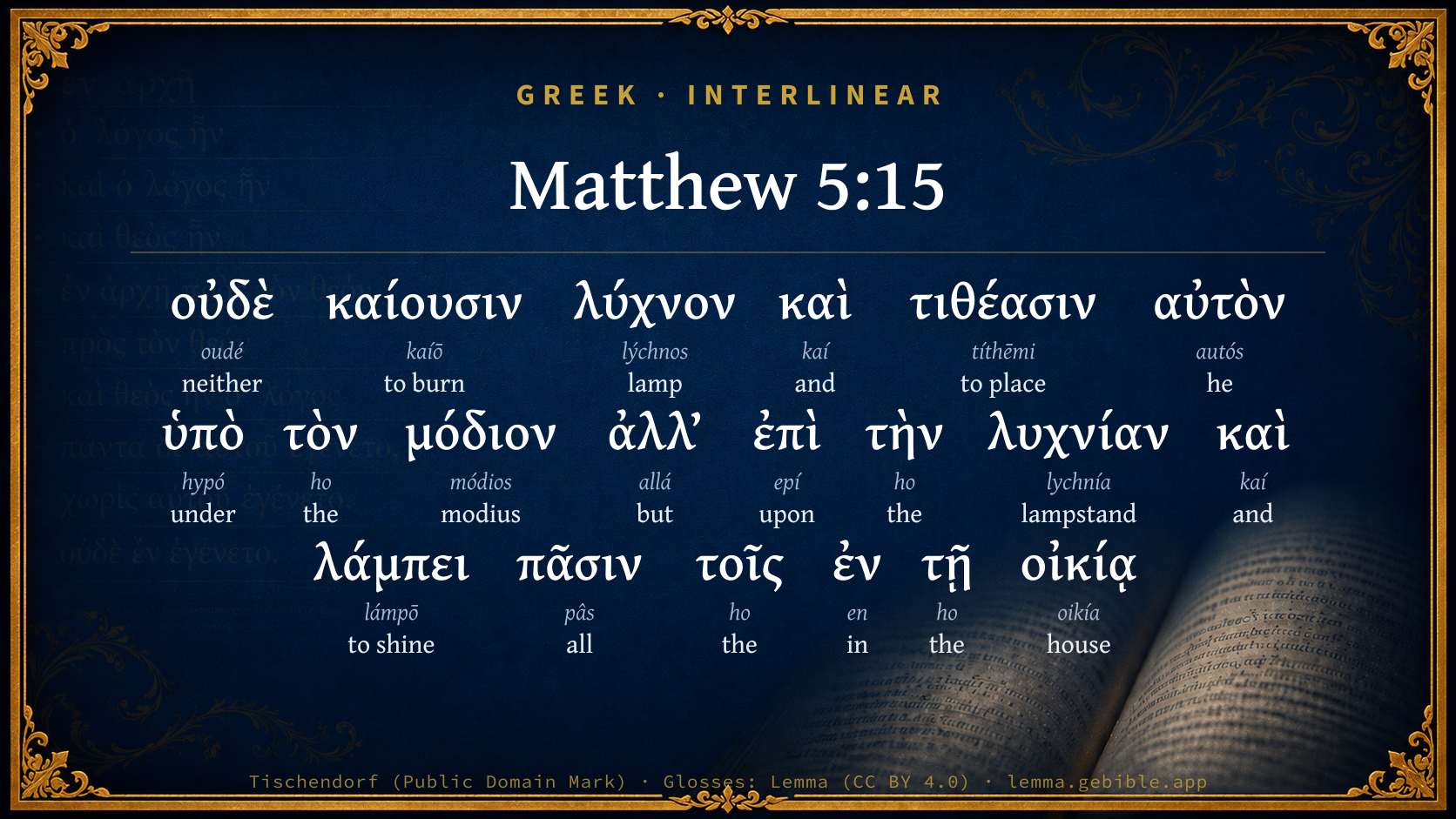
Download image
Cite this verse

Matthew 5:15 (World English Bible). Public Domain. Lemma interlinear Bible study tool, https://lemma.gebible.app/v/matthew/5/15.

Show BibTeX & RIS
BibTeX
RIS
English Translation
Neither do you light a lamp, and put it under a measuring basket, but on a stand; and it shines to all who are in the house.
World English Bible · Public Domain
Highlights
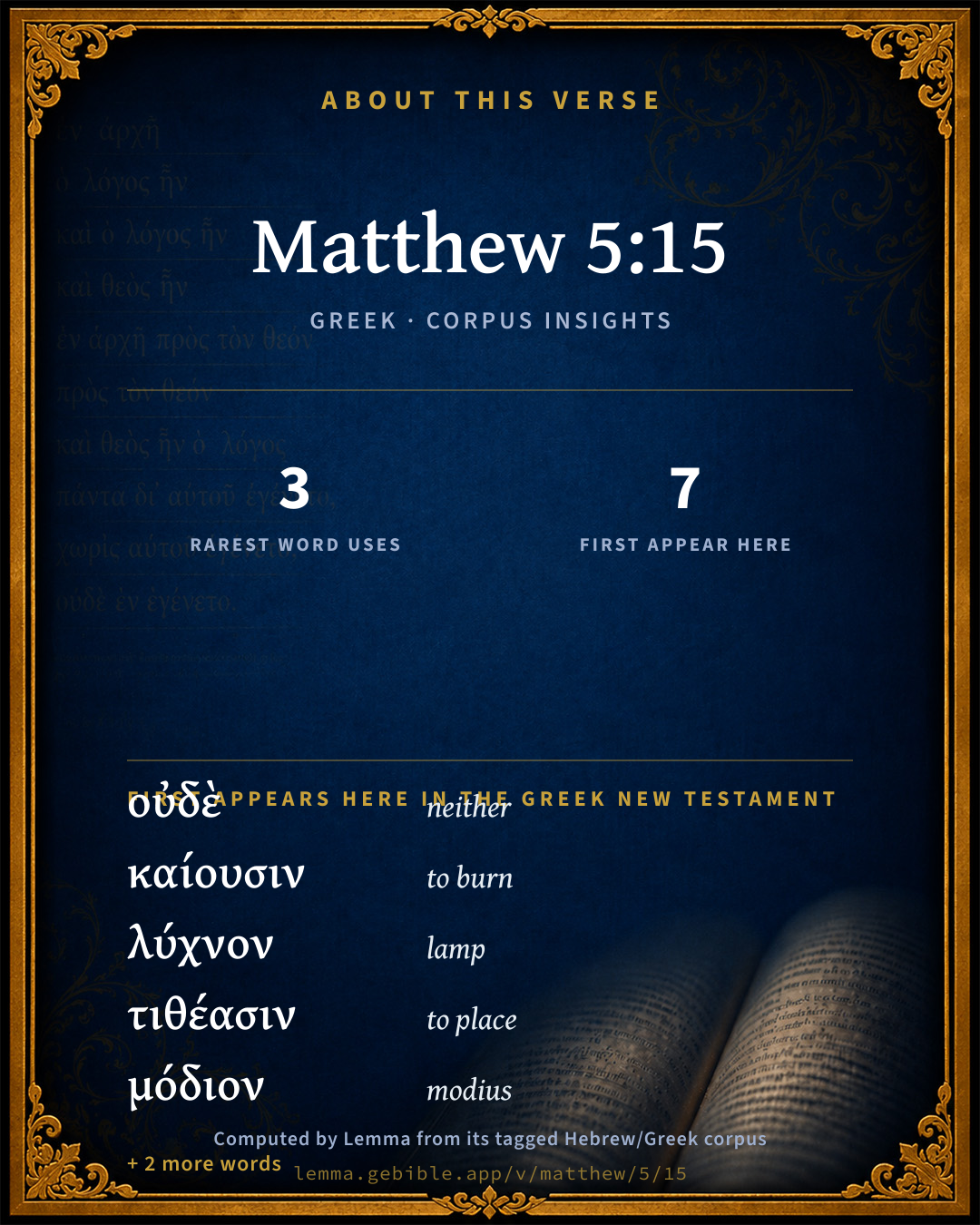
  • 7 first appearances in the Greek New Testament
Full analysis ↓
Download a study sheet

One document with this verse’s original text, its word-by-word gloss line, the meaning frame, cross-references with their text, attributed commentary, and full source and license credits — printable, and it pastes into notes with its structure intact.

This verse Autodidact and up

Study sheet (.html) Plain text (.txt)

A passage Seminary Student

Up to 50 verses in one chapter. A passage sheet keeps up to 6 commentary sources and 12 cross-references per verse, in the order this page ranks them, and says so on the sheet whenever that leaves anything out. Ask for a single verse and you get the Autodidact verse sheet above.

Everything on this page stays free to read, with no account — the sheet is a download of what is already on screen, not access to it.

Want to remove ads? Support Godless Engineer
Compare translations 3

The same verse in 3 English versions, stacked beneath the original-language interlinear above. Click any original word for its lexicon entry.

Each is an independent rendering of the whole verse — the interlinear is not word-aligned to these translations.

Highlighted words mark where these versions differ — a whole-verse word diff, not a word-by-word alignment.

  • World English Bible Public Domain
    Neither do you light a lamp, and put it under a measuring basket, but on a stand; and it shines to all who are in the house.
  • King James Version Public Domain
    Neither do men light a candle, and put it under a bushel, but on a candlestick; and it giveth light unto all that are in the house.
  • unfoldingWord Literal Text CC BY-SA 4.0
    Neither do they light a lamp and put it under a basket, but rather on the lampstand, and it shines for all the ones in the house.

unfoldingWord Literal Text — © unfoldingWord, licensed CC BY-SA 4.0. Word-aligned USFM3 via Door43 (git.door43.org/unfoldingWord/en_ult).

Versions to compare (up to 4)

3 of 4 selected

Show all 19 translations

Every available English version of this verse, each an independent rendering of the whole verse.

  • World English Bible Public Domain
    Neither do you light a lamp, and put it under a measuring basket, but on a stand; and it shines to all who are in the house.
  • Berean Standard Bible Public Domain
    Neither do people light a lamp and put it under a basket. Instead, they set it on a stand, and it gives light to everyone in the house.
  • Majority Standard Bible Public Domain
    Neither do people light a lamp and put it under a basket. Instead, they set it on a stand, and it gives light to everyone in the house.
  • King James Version Public Domain
    Neither do men light a candle, and put it under a bushel, but on a candlestick; and it giveth light unto all that are in the house.
  • American Standard Version (1901) Public Domain
    Neither do `men' light a lamp, and put it under the bushel, but on the stand; and it shineth unto all that are in the house.
  • Revised Version (1885) Public Domain
    Neither do men light a lamp, and put it under the bushel, but on the stand; and it shineth unto all that are in the house.
  • Geneva Bible (1599) Public Domain
    Neither doe men light a candel, and put it vnder a bushel, but on a candlesticke, and it giueth light vnto all that are in the house.
  • Douay-Rheims (1899) Public Domain
    Neither do men light a candle and put it under a bushel, but upon a candlestick, that it may shine to all that are in the house.
  • Young's Literal Translation Public Domain
    nor do they light a lamp, and put it under the measure, but on the lamp-stand, and it shineth to all those in the house;
  • Literal Standard Version CC BY-SA 4.0
    nor do they light a lamp and put it under the measure, but on the lampstand, and it shines to all those in the house;
  • Unlocked Literal Bible CC BY-SA 4.0
    Neither do people light a lamp and put it under a basket, but rather on the lampstand, and it shines for everyone in the house.
  • unfoldingWord Literal Text CC BY-SA 4.0
    Neither do they light a lamp and put it under a basket, but rather on the lampstand, and it shines for all the ones in the house.
  • Darby Bible Public Domain
    Nor do [men] light a lamp and put it under the bushel, but upon the lamp-stand, and it shines for all who are in the house.
  • World Messianic Bible Public Domain
    Neither do you light a lamp and put it under a measuring basket, but on a stand; and it shines to all who are in the house.
  • Webster's Bible Public Domain
    Neither do men light a candle, and put it under a close vessel, but on a candlestick: and it giveth light to all that are in the house.
  • Free Bible Version CC BY-SA 4.0
    No one lights a lamp and then puts it under a bucket. No, it's placed on a lamp-stand and it provides light to everyone in the house.
  • Bible in Basic English Public Domain
    And a burning light is not put under a vessel, but on its table; so that its rays may be shining on all who are in the house.
  • Text-Critical English NT CC BY 4.0
    nor do people light a lamp and put it under a basket, but on a lampstand, and it shines for all who are in the house.
  • Tyndale New Testament (1534) Public Domain
    nether do men lyght a cadell and put it vnder a busshell but on a candelstick and it lighteth all that are in the house.

Literal Standard Version (2020), Covenant Press — licensed CC BY-SA 4.0. Text via the HelloAO Bible API (eBible.org). Unlocked Literal Bible (unfoldingWord) — licensed CC BY-SA 4.0. Text via the HelloAO Bible API (eBible.org). unfoldingWord Literal Text — © unfoldingWord, licensed CC BY-SA 4.0. Word-aligned USFM3 via Door43 (git.door43.org/unfoldingWord/en_ult). Free Bible Version, Dr. Jonathan Gallagher — licensed CC BY-SA 4.0. Text via the HelloAO Bible API (eBible.org).

Word by word

More ways to search: Search by grammar → Find every occurrence → Compare this word →

Practice this passage: Drill this verse → Learn its vocabulary →

μόδιον
módios
G3426
“modius”
Noun, Accusative, Singular, Masculine
Part of Speech
Noun
Case
Accusative
Number
Singular
Gender
Masculine
Full Thayer's Definition

Origin: of Latin origin

TDNT: None

1. a dry measure holding 16 sextarii (or 1/6 of the Attic medimnus), about a peck (9 litres)
  1. οὐδὲ oudé G3761 “neither” Conjunction, Negative
  2. καίουσιν kaíō G2545 “to burn” Verb, Present, Active, Indicative, 3rd person, Plural
  3. λύχνον lýchnos G3088 “lamp” Noun, Accusative, Singular, Masculine
  4. καὶ kaí G2532 “and” Conjunction
  5. τιθέασιν títhēmi G5087 “to place” Verb, Present, Active, Indicative, 3rd person, Plural
  6. αὐτὸν autós G846 “he” Personal pronoun, Accusative, Singular, Masculine
  7. ὑπὸ hypó G5259 “under” Preposition
  8. τὸν ho G3588 “the” Article, Accusative, Singular, Masculine
  9. ἀλλ’ allá G235 “but” Conjunction
  10. ἐπὶ epí G1909 “upon” Preposition
  11. τὴν ho G3588 “the” Article, Accusative, Singular, Feminine
  12. λυχνίαν lychnía G3087 “lampstand” Noun, Accusative, Singular, Feminine
  13. καὶ kaí G2532 “and” Conjunction
  14. λάμπει lámpō G2989 “to shine” Verb, Present, Active, Indicative, 3rd person, Singular
  15. πᾶσιν pâs G3956 “all” Adjective, Dative, Plural, Masculine
  16. τοῖς ho G3588 “the” Article, Dative, Plural, Masculine
  17. ἐν en G1722 “in” Preposition
  18. τῇ ho G3588 “the” Article, Dative, Singular, Feminine
  19. οἰκίᾳ oikía G3614 “house” Noun, Dative, Singular, Feminine

About this verse

These counts appear in no published source. They are computed here, from the morphology-tagged text and Lemma’s own curated glosses. What Lemma adds →

20
words
16
distinct lemmas
Gospels
section

Notable vocabulary

The rarest word here is μόδιον modius G3426 — appearing just 3 times in the whole Greek New Testament.

First appearance in Scripture

These words make their first canonical appearance in the Greek New Testament here:

  • οὐδὲ neither G3761
  • καίουσιν to burn G2545
  • λύχνον lamp G3088
  • τιθέασιν to place G5087
  • μόδιον modius G3426
  • λυχνίαν lampstand G3087
  • λάμπει to shine G2989

Shared distinctive vocabulary

μόδιον modius G3426 occurs in 3 verses of the Greek New Testament. Also found in:
Repetition

Words recur within this verse:

Cross-references

5

Topical passages linked to Matthew 5:15 in the Treasury of Scripture Knowledge — connected by theme and wording, ordered by reader-vote popularity; previews shown in the World English Bible.

  • Luke 11:33 "No man, when he has lit a lamp, puts it in a cellar, nor under a basket, but on a stand, that those who enter in may see the light.
  • Mark 4:21 He said to them, "Is the lamp brought to be put under a basket or under a bed? Isn't it put on a lampstand?
  • Luke 8:16 "No one, when he has lit a lamp, covers it with a container, or puts it under a bed; but puts it on a stand, that those who enter in may see the light.
  • Numbers 8:2 "Speak to Aaron, and tell him, 'When you light the lamps, the seven lamps shall give light in front of the lampstand.'"
  • Exodus 25:37 You shall make its lamps seven, and they shall light its lamps to give light to the space in front of it.

Cross-references courtesy of OpenBible.info (CC BY 4.0).

Commentary

Notes on Matthew 5:15 from classic Christian and Jewish commentators (each source and its license shown beneath its notes). The classic Christian expositions comment on the surrounding passage and are grouped to its opening verse, so a note may address several verses; the Jewish commentaries on the Tanakh (Rashi and others) are per-verse, so they appear only where the commentator wrote on this verse.

Lemma curates 59 commentaries, every one of them public domain or Creative Commons licensed, each selected and text-cleaned for this edition rather than reprinted as found. About our sources →

Bengel's Gnomon

Johann Albrecht Bengel

Mat 5:15. Καίουσι, do they light) Impersonal. οἱ καίοντες, those who light must be understood, cf. Mat 7:16.—ὑπὸ, under) i.e. behind. In Luk 8:16, we find ὑποκάτω, underneath.

Bengel's Gnomon of the New Testament — English translation (T&T Clark, Edinburgh, 1860) — public domain. Text from a community e-Sword module.

Meyer's Critical & Exegetical Commentary

Heinrich August Wilhelm Meyer

Mat_5:15. Ὑπὸ τὸν μόδιον] Fulgentius, Mat_3:6 : lucernamque modio contegit. The article denotes the grain measure that is at hand in the house. On μόδιος, comp. Plut. Demetr. 33. It was one-sixth of the μέδιμνος, the μέδιμνος, according to Boeckh, 2602 Paris cubic inches [nearly 12 gallons English]. What Hebrew measure did Jesus mention? most probably מְאָה, as in Mar_13:33.

The καί is the consecutivum: and, and thus, that is, placed upon the candlestick; comp. Mat_4:19; Maetzner, ad Lycurgum, p. 253. On the lamps which were in domestic use, and the candlesticks upon which they were placed, see as regards the Greeks, Hermann, Privatalterth. Mat_20:23; Becker, Charikl. II. p. 214 ff.; as to the Greek expression λυχνία, Lobeck, ad Phryn. p. 313.

Meyer — Critical and Exegetical Commentary on the New Testament — English translation by Peter Christie, edited by Frederick Crombie (T&T Clark, 1880) — public domain. Text from a community e-Sword module.

Expositor's Greek Testament

ed. W. Robertson Nicoll

Mat 5:15 . A parabolic word pointing out that such a policy in the natural sphere is unheard of and absurd. καίουσι , to kindle, accendere , ordinarily neuter = urere ; not as Beza thought, a Hebraism; examples occur in late Greek authors ( vide Kypke, Obser. Sac. ). The figure is taken from lowly cottage life. There was a projecting stone in the wall on which the lamp was set. The house consisted of a single room, so that the tiny light sufficed for all. It might now and then be placed under the modius , an earthenware grain measure, or under the bed (Mar 4:21 ), high to keep clear of serpents, therefore without danger of setting it on fire (Koetsveld, De Gelijkenissen , p. 305). But that would be the exception, not the rule done occasionally for special reasons, perhaps during the hours of sleep. Schanz says the lamp burned all night, and that when they wanted darkness they put it on the floor and covered it with the “bushel”. Tholuck also thinks people might cover the light when they wished to keep it burning, when they had occasion to leave the room for a time. Weiss, on the other hand, thinks it would be put under a cover only when they wished to put it out (Matt.-Evan., p. 144). But was it ever put out? Not so, according to Benzinger (Heb. Arch., p. 124).

The Expositor's Greek Testament, edited by W. Robertson Nicoll (1897–1910) — public domain. Text from a community e-Sword module.

Jamieson, Fausset & Brown

Robert Jamieson, A. R. Fausset & David Brown

Neither do men light a candle--or, lamp.

and put it under a bushel--a dry measure.

but on a candlestick--rather, "under the bushel, but on the lampstand." The article is inserted in both cases to express the familiarity of everyone with those household utensils.

and it giveth light--shineth "unto all that are in the house."

Jamieson, Fausset & Brown — Commentary Critical and Explanatory on the Whole Bible (1871) — public domain (CC PDM 1.0). Text via the HelloAO Bible API.

Adam Clarke's Commentary

Verse 15. Neither do men light a candle and put it under a bushel] A bushel μοδιος: - a measure both among the Greeks and Romans, containing a little more than a peck English. From some ancient writers we learn, that only those who had bad designs hid a candle under a bushel; that, in the dead of the night, when all were asleep, they might rise up, and have light at hand to help them to effect their horrid purposes of murder, &c. See Wetstein, Kypke, Wolf, &c.

Adam Clarke's Commentary on the Bible (1810–1826) — public domain. Text from a community e-Sword/MySword module.

Ellicott's Commentary for English Readers

(15) Light a candle.—The word so rendered was probably a portable lamp rather than a candle in the common meaning of the word. The candles of the seven-branched candlestick of the Temple were undoubtedly lamps supplied with oil, and so probably were the “candles” of household use. The word is not the same, however, as that used for the “lamps” of the Wise and Foolish Virgins (Mat_25:1), and was applied apparently to the cheaper vessels of the poor rather than to those of the wealthy. Wiclif translates it “lantern.”

The image was drawn from objects familiar to all the hearers, and the presence of the article in the Greek, “under the bushel,” “on the candlestick or lamp-stand,” implies the familiarity. Each cottage had one such article of furniture. The “bushel” was a Latin measure, nearly the same as the English peck. It adds to the interest of the illustration to remember that as they were commonly of wood, such articles as these must often have been turned out from the carpenter’s shop at Nazareth for the use of its neighbours. It should also be remembered that the self-same word had been applied a short time before by our Lord to the Baptist (Joh_5:35). His disciples were in this way to continue the Baptist’s work.

A Bible Commentary for English Readers, edited by Charles John Ellicott (1878–1897) — public domain. Text from a community e-Sword module.

The Cambridge Bible for Schools and Colleges

gen. ed. J. J. S. Perowne

15. a bushel] Rather, the bushel, i. e. the common measure found in every Jewish house. Strictly speaking, the modius, translated “bushel,” denoted a smaller measure equal to about two gallons.

candle … candlestick …] Or rather, lamp … lampstand. The lamp in a Jewish house was not set on a table, but on a tall pedestal or stand, sometimes made with a sliding shaft.

all that are in the house] i. e. the Jews. St Luke, true to the character of his gospel, says “that they which enter in,” i. e. the Gentiles, “may see the light.”

The Cambridge Bible for Schools and Colleges (gen. ed. J. J. S. Perowne; Cambridge University Press, 1878–1918) — public domain. Text from a community e-Sword module.

John Gill's Exposition

Neither do men light a candle,.... Which may be read impersonally, "a candle is not lighted": and by it may be meant the Gospel, and gifts qualifying men to preach it; which, like a candle, was lighted in the evening of the Jewish dispensation, though not confined to the land of Judea; but has shone throughout the world, being as a candle to be removed, and has been removed from place to place: wherever it is set, it gives light, more or less, and dispels darkness; it is useful both to work by and walk with; it does not always burn alike clearly, it needs looking after; it has its thieves, as candles sometimes have; and will give the greatest light towards the close of the world, as they usually do, when ready to go out. Now when a candle is lighted by men, they do not

put it under a bushel, or anything which may hide and cover it, and so hinder its light and usefulness. The Greek word rendered a "bushel", answers to the Hebrew "seah", which is the very word used in Munster's Hebrew Gospel; and this was a dry measure that held about a gallon and a half; and accordingly is rendered here by the Syriac The design of the expression is, that Christ has lighted the candle of the everlasting Gospel, and given gifts to men for the ministration of it, not to be concealed and neglected, or to be used as the servant did his lord's money, wrap it up in a napkin, and hide it in the earth. Ministers are not, through slothfulness, to neglect the gift that is in them; nor, through fear, to hide their talents, or keep back any part of the Gospel, or cover anything out of sight, which may be profitable to souls: "but" men, when they light a candle, put it

on a candlestick, and it giveth light to all that are in the house; as on the candlestick in the temple, a type of the church; where Christ has set the light of the Gospel, where it is held forth particularly by the ministers of the word, to illuminate the whole house and family of God; by the light of which poor sinners, the lost pieces of silver, are looked up; straggling souls are brought home; hypocrites and formalists are detected; and saints are enlightened, directed, and comforted. Much such a proverbial saying is used by the Jews (r):

"do not leave a vessel of balsam in a dunghill, but move it from its place, that its smell may spread, and men may receive profit from it.''

(r) Vid. Joh. Isaac. Praefat. ad Eliae Levit. Methurgeman.

John Gill's Exposition of the Whole Bible (1746–1763) — public domain (CC PDM 1.0). Text via the HelloAO Bible API.

Trapp's Complete Commentary

John Trapp

15 Neither do men light a candle, and put it under a bushel, but on a candlestick; and it giveth light unto all that are in the house.

Ver. 15. Neither do men light a candle to put it under a bushel, &c.] Nor doth God set up a minister, and so light a link or torch, as the word λυχνος here signifieth, among a people, but for the disusing of the light of the knowledge of the glory of God in the face of Jesus Christ, 2Co 4:6. The heavenly bodies enlighten not their own orbs only, but send forth their beams far and near. The grace of God (that is, the doctrine of grace) that bringeth salvation hath appeared, or shone forth, as a candle on a candlestick; or as a beacon on a hill, teaching us to deny ungodliness, &c. (επεφανη), Tit 2:11-12. Dicuntur εποφαινεσθαι quae repente conspectaculos omnium in se convertunt. (Chrysost. in 2 Tim.) The priest’s lips must not only preserve knowledge, but also present it to the people, who shall seek it at his mouth. And John Baptist (that burning and shining light) was to give the knowledge of salvation, not by way of infusion, for so God only, but by way of instruction, Luk 1:77. The same word, in the holy tongue, that signifieth to understand, signifieth also to instruct and to prosper, they that teach others what they know themselves (as Abraham did those of his familiarity and family) shall know more of God’s mind, yea, they shall be, as Abraham was, both of his court and council, Gen 18:19. But the Lord likes not such empty vines as (with Ephraim) bear fruit to themselves, Hos 10:1; such idle servants as thrust their hands into their bosoms, dig their talents into the earth, hide their candles under a bed or bushel; living and lording it as if their lips were their own; barrelling and hoarding up their gifts, as rich cormorants do their grain; refusing to give down their milk, as curst kine; or resolving to speak no more than what may breed applause and admiration of their worth and wisdom, as proud self-seekers. The manifestation of the spirit was given to profit also; and the Philippians were all partakers, or compartners of St Paul’s grace; which he elsewhere calleth the gift bestowed on us, for many, that we may serve one another in love; yea, make ourselves servants to all, that we may edify some, 1Co 12:7; (συγκοινωνοι), Php 1:7, 2Co 1:11; Gal 5:13; 1Co 9:19. Certainly the gifts of such shall not perish in the use, or be the worse for wearing, but the better and brighter; as the torch by tapping; they shall grow in their hands, as the loaves in our Saviour’s, as the widow’s oil, as that great mountain of salt in Spain, de quo quantum demas, tantum accrescit, which the more you take from it, the more it increaseth; or, lastly, as the fountains or wells, which, by much drawing, are made better and sweeter, as St Basil observeth, and common experience confirmeth. και γαρ τα φρεατα φασιν, αντλουμενα, βελτιω γινεσθαι. Epist. 81.

And it giveth light to all that are in the house] He that alloweth his servants a great candle, or two or three lesser lights, looks for more work. God sets up his ministers, as candles on the candlestick of his Church, to waste themselves, wax and wick, for the lighting of men into life eternal. Let them therefore see to it, that they work hard while the light lasteth, lest their candlestick be removed, lest the night surprise them on the sudden, when none can work, Rev 2:5; Joh 9:4-5; lest they pay dear for those precious graces of his Spirit, in his faithful ministers, spent, or rather spilt upon them; lest God cause the sun to go down at noon, and darken the earth in the clear day, Amo 8:9.

John Trapp, A Commentary or Exposition upon All the Books of the Old and New Testament (1647–1656) — public domain. Text from a community e-Sword module.

Albert Barnes' Notes on the Bible

Neither do men light a candle ... - The word rendered “candle” means any portable light, as a lamp, candle, lantern. Compare Mar 4:21; Luk 8:16; Luk 12:35. Jesus proceeded here to show them that the very reason why they were enlightened was that others might also see the light, and be benefited by it. When people light a candle, they do not conceal the light, but place it where it may be of use. So it is with religion. It is given that we may benefit others. It is not to be concealed, but suffered to show itself, and to shed light on a surrounding wicked world.

A bushel - Greek, a measure containing nearly a peck. It denotes anything, here, that might conceal the light.

Albert Barnes' Notes on the Bible (1834–1885) — public domain. Text from a community e-Sword/MySword module.

Haydock's Catholic Bible Commentary

This light of the world, city on a mountain, and candle upon a candlestick, signify the Catholic Church, so built upon Christ, the mountain, that it must be visible, and cannot be hidden or unknown. (St. Augustine, cont. Fulg.) Therefore the Church being a candle not under a bushel, but shining to all in the house, i.e. in the world, what shall I say more, saith St. Augustine than that all are blind, who shut their eyes against the candle which is set on the candlestick? (Tract ii. in ep. Jo.)

George Leo Haydock (1774–1849), Haydock's Catholic Family Bible and Commentary, 1859 edition — public domain. Excludes Psalms (Douay-Rheims chapter numbering differs from Protestant) and Deuterocanonical books (Catholic canon only).

Matthew Poole's English Annotations

You ought also to consider the end why I have communicated of my light unto you; it is in part the same with that of men: when they light up a candle in a room, which is to show light to all those that are in the room, they do not use to light it up to hide it under a vessel, or a bushel; so I have not communicated my truths or my grace unto you merely for your own use, but for others use. It is said of John, (by our Saviour), he was a burning and shining light: so is every true minister of the gospel, yea, and every true Christian; not only a burning light, burning with love to God, and zeal for God, and love to and zeal for the souls of others; but also a shining light, communicating his light to others, both by instruction and a holy conversation. Others’ pretended candles were never of God’s lighting.

Matthew Poole's English Annotations on the Holy Bible (1683–1685) — public domain. Text from a community e-Sword/MySword module.

Whedon's Commentary on the Bible

Daniel D. Whedon

15. Light a candle — Or lamp. Candlestick — Or lampstand. House — The world, or circle of your acquaintance. The Christian should, like a lamp, shed divine light upon all in reach.

Neither do men light a candle — Men light candles; God has lighted you for his candles to the world. Men are not so foolish as to light a candle to be covered up, so God is not so unwise as to light you for concealment. You are lighted that you may illuminate. A bushel — In Greek the bushel, with the definite article, to indicate that he refers to a measure ordinarily in use. It was the modius, a measure really containing about a peck.

Daniel D. Whedon (gen. ed.), Commentary on the Old and New Testaments (1874–1909) — public domain. Text from a community e-Sword module.

The Pulpit Commentary

Neither do men light a candle, etc. The same illustration comes in Luk_8:16, (Mar_4:21) immediately after the parable of the sower, and again in Luk_11:33, immediately after the reference to the repentance of the men of Nineveh at the preaching of Jonah. All four passages have too much verbal similarity to admit of any of them being absolutely independent. Mar_4:21 has the greatest number of peculiarities. The two passages in Luke agree very closely with each other, but of the two, Luk_11:33 most resembles Matthew. The close agreement here with the context seems to point to this being an original position of the utterance. Of the other two contexts Luk_11:33, if we must choose, seems the more natural. Godet, however, says, "This passage has been placed in the sermon on the mount, like so many others, rather because of the association of ideas than from historical reminiscence" (similarly Weiss). Neither. The inherent position, so to speak, of Christ"s disciples, as of a city set on a mountain, is not accidental. It answers to the purpose of their being disciples, as is explained further by the illustration of a lamp. A candle; Revised Version, a lamp (lucnon); i.e. the flat, saucer-like Eastern lamp, in which sometimes the wick merely floats on the oil A bushel... a candlestick; Revised Version, the bushel... the stand (todion ... than). Probably rightly, for if the article had been generic (cf. Mishna, "Sabb.," 4:2, "One may fill a pitcher literally, "the pitcher," wtyqh ta. and put it under, a literally, "the pillow, or under a literally, the bolster on the sabbath in order to take the chill off it," W.H. Lowe, "Fragment of Pesachim," 1879, p. 95; cf. also Driver on 1Sa_19:13) it would have been found also before lucnon . "The description applies to the common houses of the people. In each there was one principal room, in which they ate and slept; the lampstand, with its single light, the flour-bin, and the bed, with a few seats, were all its furniture" (Cook, in "Speaker"s Commentary," on Mar_4:21). A bushel (todion). This is probably equivalent to the seah (so Peshito), which was "the ordinary measure for domestic purposes," and, as slated in the margins of the Authorized and the Revised Versions on Mat_13:33, held "nearly a peck and a half" dry measure. The Latin modius, here used to render scab, itself held nearly a peck. In Luk_8:16 the vaguer term dkeuov is used. "Bushel" is retained in the Revised Version probably because it can be used of the vessel apart from all thought of measure; cf. "The Sense represents the Sun no bigger than a Bushel" (Hale 1677, in Murray"s "Oxford Dictionary"). But on a candlestick; Revised Version, but on the stand (epi than); Vulgate, from Old Latin, Neque accendunt lucernam et possunt cam sub modio sed super candelabrum.

Candelabrum (cf. "chandelier") meant a stand for either candles or lamps; hence Wickliffe, translating from the Vulgate, could say, "Ne men teendith not a lanterne a puttith it vndir a buyschel: but on a candilstik." We still use "candlestick" in the rarer sense when we speak of the seven-branched "candlestick" of the tabernacle, which was lighted by lamps, not candies (cf. Humphry, on Revised Version, in Loc. ). it giveth Light; Revised Version, it shineth (lampei). The Rheims alone of the older English versions renders" shine," thus showing that the same Greek word is used as in the next verse. The Vulgate (followed by Wickliffe and Rheims) renders it in the subjunctive, ut lucent, possibly originally a copyist"s error from the luceat of ver. 16. If so, it was apparently made before the time of Tertullian ("De Prescript.," The thought is stir primarily of the light itself being necessarily seen rather than of its benefiting others. (fwtizw , Luk_11:36; cf. Joh_1:9) To all. For in a room none can help noticing it, even though the lamp and the light itself be but small. The negative of this verse is given in Pseudo-Cyprian, "De Aleat.," 3., "Monet dominus et dicit: nolite contris tare Spiritum Sanctum, qui in vobis est, et nolite exstinguere lumen, quod in vobis efful sit" (vide Resch, "Agrapha," pp. 111, 215).

The Pulpit Commentary (1880–1919), ed. H.D.M. Spence-Jones & Joseph S. Exell — public domain. Text from a community e-Sword module.

John Wesley's Explanatory Notes

Nay, the very design of God in giving you this light was, that it might shine. Mark iv, 21; Luke viii, 16; xi, 33.

John Wesley, Explanatory Notes Upon the Whole Bible (1754–1765) — public domain. Text via the GEBible commentary corpus.

The People's New Testament

B. W. Johnson

15. Light a candle and put it under a bushel. A lamp, in the Revision, which is correct. Candles and candlesticks were not used in Scripture times. It would be foolishness to light a lamp and put it under a bushel measure.

B. W. Johnson's The People's New Testament with Notes (1889–1891) — public domain. Electronic text from the Christian Classics Ethereal Library (CCEL) ThML edition.

unfoldingWord translationNotes

Door43 World Missions Community

Neither do people light a lamp

"People do not light a lamp"

put it under a basket

"place the lamp under a basket." This is saying it is foolish to create light only to hide it so people do not see the light of the lamp.

Let your light shine before people

This means a disciple of Jesus should live in such a way that others can learn about God's truth. AT: "Let your lives be like a light that shines before people" (See: Metaphor)

your Father who is in heaven

It is best to translate "Father" with the same word your language would naturally use to refer to a human father.

translationWords

light

lamp

lampstand

works

praise

God the Father

heaven

unfoldingWord translationNotes — © Distant Shores Media and the Door43 World Missions Community, licensed CC BY-SA 4.0. Source: git.door43.org/Door43/en_tn.

Cambridge Greek Testament for Schools and Colleges

15. τὸν μόδιον. ‘The bushel,’ i.e. the common measure found in every Jewish house. The article generalises. Strictly speaking, the modius denoted a smaller measure equal to about two gallons.

λύχνος … λυχνία. ‘Lamp,’ ‘lampstand.’ The lamp in a Jewish house was not set on a table, but on a tall pedestal or stand, sometimes made with a sliding shaft.

πᾶσιν τοῖς ἐν τῇ οἰκίᾳ, i.e. the Jews. St Luke, true to the character of his gospel, says ‘that they which enter in’, i.e. the Gentiles, ‘may see the light’.

Cambridge Greek Testament for Schools and Colleges (Cambridge University Press, 1896; 21 vols, various authors incl. Carr, Maclear, Plummer, Farrar, Lumby, Moule, M. R. James, Simcox) — public domain. Text from a community e-Sword module.

Alford’s Greek Testament

Henry Alford

15. μόδιον] A Latin word (the art. is by many supposed to express that the μόδιος is a vessel usually found in the house: but it is rather to be regarded as the sign of the generic singular, as in κοινοῖ τὸν ἄνθρωπον, ch. 15:20)—called by the more general name σκεῦος, Luk 8:16.

καίουσιν, i.e. men in general: shewing, in the spiritual reference of the parable, that these lights of the world are ‘lighted’ by Him for whose use they are. See above.

Henry Alford, The Greek Testament (1849–1861) — public domain. Text from a community e-Sword module.

International Critical Commentary

(L) 15. Neither do they light a lamp, and place it under the bushel, but on the lampstand; and it lightens all who are in the house.] Cf. Luk 8:16, Luk 11:33, Mar 4:21.

International Critical Commentary — older volumes (1896–1929), various authors — public domain. Text from a community e-Sword module.

Vincent's Word Studies in the New Testament

Marvin R. Vincent

A bushel [τον μοδιον] . Rev., rightly, "the bushel;" since the definite article is designed to indicate a familiar object - the grain - measure which is found in every house.

A candlestick [την λυχνιαν] . Rev., the stand. Also a part of the furniture of every house, and commonly but one in the house : hence the article. The word, which occurs four times in the Gospels and eight times elsewhere, means, in every case, not a candlestick, but a lamp - stand. In Heb 9:2, the golden "candlestick" of the tabernacle is called lucnia; but in the description of this article (Exo 25:31, 39), we read, "Thou shalt make the seven lamps thereof;" and in Zec 4:2, where the imagery is drawn from the sanctuary, we have a "candlestick" with a bowl on the top of it, "and his seven lamps thereon, and seven pipes (for the oil) to the lamps which are upon the top thereof."

Marvin R. Vincent, Word Studies in the New Testament (1887–1900) — public domain. Text from a community e-Sword/MySword module.

Lesson kit

Teaching starters — assembled from the data on this page, not authored interpretation. Every prompt links to the verse data it draws on. Edit before teaching.

Matthew, in the Gospels, opens this verse with 20 words (16 distinct Greek lemmas). Its most distinctive word is módios (“modius”). A historical commentator’s framing appears above. Read the whole chapter for the surrounding context.

Discussion questions

  1. What does “modius” (módios) contribute to the verse as a whole?
  2. 7 words make their first appearance in Scripture here. What does this debut establish?
  3. How does Mark 4:21, which shares the word «modius», read alongside this verse?
  4. What does the repetition of “the” (4× in this one verse) do in this verse?
  5. These translations render this verse differently. What is at stake in choosing one wording over another?
  6. Compare how Bengel's Gnomon and Meyer's Critical & Exegetical Commentary read this verse. Where do they agree or differ?

Things to notice

  • 7 words make their first canonical appearance in Scripture here.
  • These translations choose different wording for 15 words in this verse.
  • “the” occurs 4× in this single verse.
  • 16 distinct Greek lemmas span 20 words in this verse.

Reading settings

Reading text

Shown beneath each verse's original-language words.

Old Testament
Old Testament edition

Read the OT as the Masoretic Hebrew (MT) or the Greek Septuagint (LXX).

English shown for the Greek Septuagint (in the Hebrew ↔ Greek comparison).

Comparing translations? Open the Compare panel on any verse page to stack up to four side by side.