
Matthew 4:13

Greek (Tischendorf 8th ed.) Matthew 4:13 appears in the Greek New Testament. The text above is from the Tischendorf 8th edition. Each word links to its Strong’s number and a concise gloss. Click any word for its full Thayer’s Greek Lexicon entry.
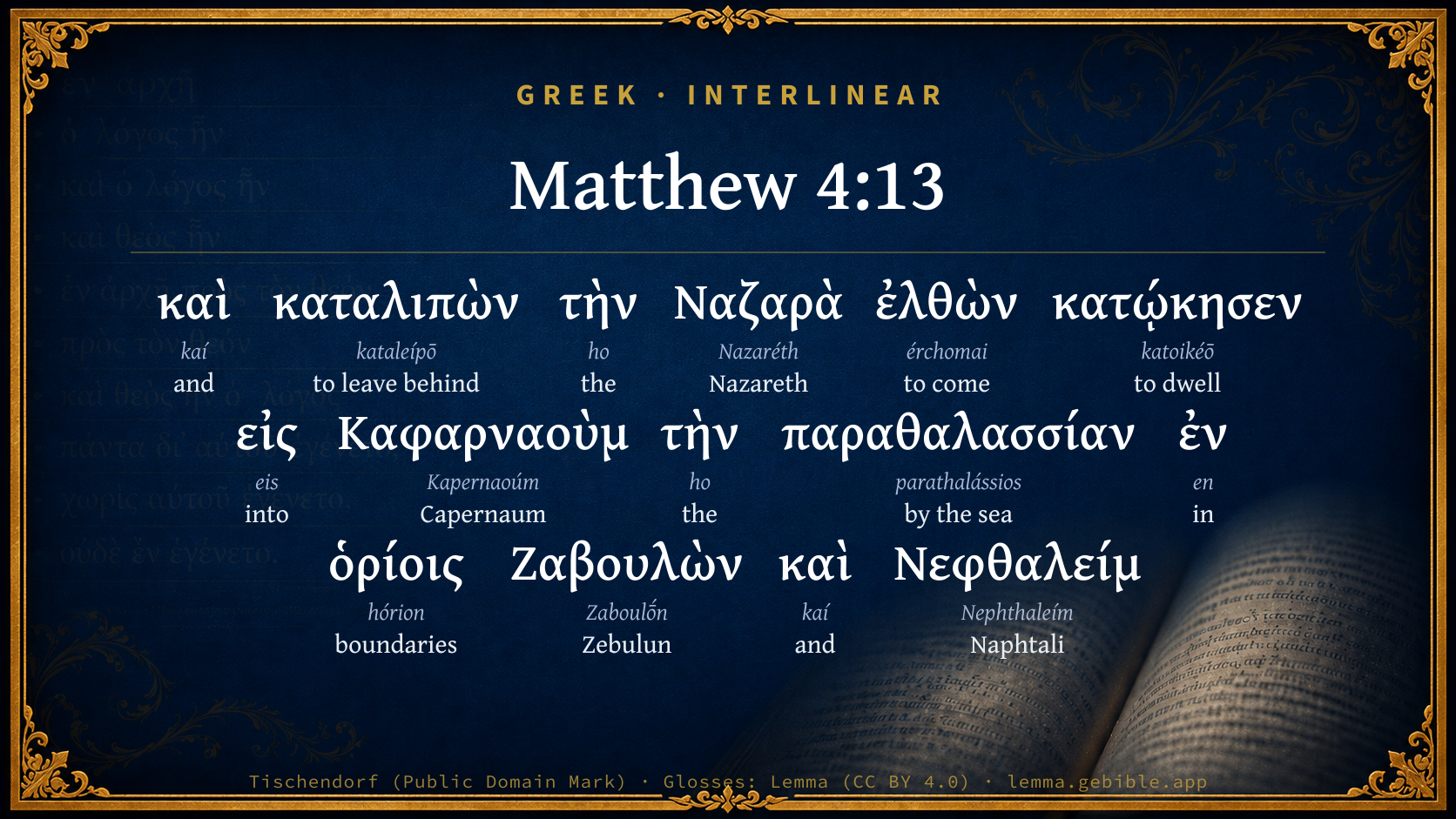
Download image
Cite this verse

Matthew 4:13 (World English Bible). Public Domain. Lemma interlinear Bible study tool, https://lemma.gebible.app/v/matthew/4/13.

Show BibTeX & RIS
BibTeX
RIS
English Translation
Leaving Nazareth, he came and lived in Capernaum, which is by the sea, in the region of Zebulun and Naphtali,
World English Bible · Public Domain
Highlights
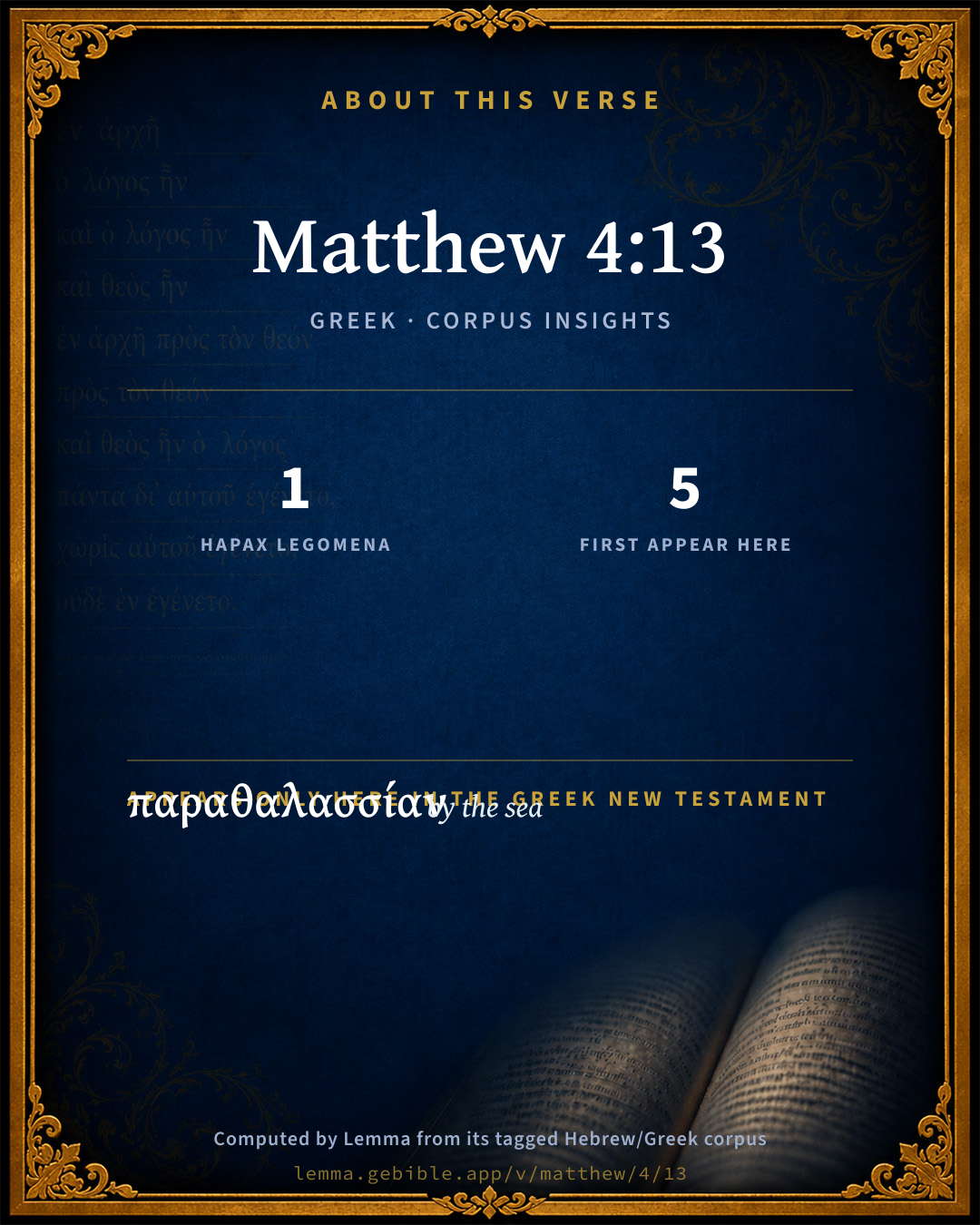
  • 1 hapax legomenon — only here in the Greek New Testament
  • 5 first appearances in the Greek New Testament
Full analysis ↓
Download a study sheet

One document with this verse’s original text, its word-by-word gloss line, the meaning frame, cross-references with their text, attributed commentary, and full source and license credits — printable, and it pastes into notes with its structure intact.

This verse Autodidact and up

Study sheet (.html) Plain text (.txt)

A passage Seminary Student

Up to 50 verses in one chapter. A passage sheet keeps up to 6 commentary sources and 12 cross-references per verse, in the order this page ranks them, and says so on the sheet whenever that leaves anything out. Ask for a single verse and you get the Autodidact verse sheet above.

Everything on this page stays free to read, with no account — the sheet is a download of what is already on screen, not access to it.

Want to remove ads? Support Godless Engineer
Compare translations 3

The same verse in 3 English versions, stacked beneath the original-language interlinear above. Click any original word for its lexicon entry.

Each is an independent rendering of the whole verse — the interlinear is not word-aligned to these translations.

Highlighted words mark where these versions differ — a whole-verse word diff, not a word-by-word alignment.

  • World English Bible Public Domain
    Leaving Nazareth, he came and lived in Capernaum, which is by the sea, in the region of Zebulun and Naphtali,
  • King James Version Public Domain
    And leaving Nazareth, he came and dwelt in Capernaum, which is upon the sea coast, in the borders of Zabulon and Nephthalim:
  • unfoldingWord Literal Text CC BY-SA 4.0
    And having left Nazareth, having come, he lived in Capernaum by the sea, in the territories of Zebulun and Naphtali,

unfoldingWord Literal Text — © unfoldingWord, licensed CC BY-SA 4.0. Word-aligned USFM3 via Door43 (git.door43.org/unfoldingWord/en_ult).

Versions to compare (up to 4)

3 of 4 selected

Show all 19 translations

Every available English version of this verse, each an independent rendering of the whole verse.

  • World English Bible Public Domain
    Leaving Nazareth, he came and lived in Capernaum, which is by the sea, in the region of Zebulun and Naphtali,
  • Berean Standard Bible Public Domain
    Leaving Nazareth, He went and lived in Capernaum, which is by the sea in the region of Zebulun and Naphtali,
  • Majority Standard Bible Public Domain
    Leaving Nazareth, He went and lived in Capernaum, which is by the sea in the region of Zebulun and Naphtali,
  • King James Version Public Domain
    And leaving Nazareth, he came and dwelt in Capernaum, which is upon the sea coast, in the borders of Zabulon and Nephthalim:
  • American Standard Version (1901) Public Domain
    and leaving Nazareth, he came and dwelt in Capernaum, which is by the sea, in the borders of Zebulun and Naphtali:
  • Revised Version (1885) Public Domain
    and leaving Nazareth, he came and dwelt in Capernaum, which is by the sea, in the borders of Zebulun and Naphtali:
  • Geneva Bible (1599) Public Domain
    And leauing Nazareth, went and dwelt in Capernaum, which is neere the sea in the borders of Zabulon and Nephthalim,
  • Douay-Rheims (1899) Public Domain
    And leaving the city Nazareth, he came and dwelt in Capharnaum on the sea coast, in the borders of Zabulon and Nephthalim;
  • Young's Literal Translation Public Domain
    and having left Nazareth, having come, he dwelt at Capernaum that is by the sea, in the borders of Zebulun and Naphtalim,
  • Literal Standard Version CC BY-SA 4.0
    and having left Nazareth, having come, He dwelt at Capernaum that is by the sea, in the borders of Zebulun and Naphtali,
  • Unlocked Literal Bible CC BY-SA 4.0
    He left Nazareth and went and lived in Capernaum, which is by the Sea of Galilee, in the territories of Zebulun and Naphtali.
  • unfoldingWord Literal Text CC BY-SA 4.0
    And having left Nazareth, having come, he lived in Capernaum by the sea, in the territories of Zebulun and Naphtali,
  • Darby Bible Public Domain
    and having left Nazareth, he went and dwelt at Capernaum, which is on the sea-side in the borders of Zabulon and Nepthalim,
  • World Messianic Bible Public Domain
    Leaving Nazareth, he came and lived in Capernaum, which is by the sea, in the region of Zebulun and Naphtali,
  • Webster's Bible Public Domain
    And leaving Nazareth, he came and dwelt in Capernaum, which is upon the sea coast, in the borders of Zabulon and Nephthalim;
  • Free Bible Version CC BY-SA 4.0
    Leaving Nazareth, he came to stay in Capernaum, on the shores of the sea in the regions of Zebulun and Naphthali.
  • Bible in Basic English Public Domain
    And going away from Nazareth, he came and made his living-place in Capernaum, which is by the sea, in the country of Zebulun and Naphtali:
  • Text-Critical English NT CC BY 4.0
    And leaving Nazareth, he went and dwelt at Capernaum by the sea, in the region of Zebulun and Naphtali,
  • Tyndale New Testament (1534) Public Domain
    and left Nazareth and went and dwelte in Capernaum which is a cite apon the see in the coostes of zabulon and Neptalim

Literal Standard Version (2020), Covenant Press — licensed CC BY-SA 4.0. Text via the HelloAO Bible API (eBible.org). Unlocked Literal Bible (unfoldingWord) — licensed CC BY-SA 4.0. Text via the HelloAO Bible API (eBible.org). unfoldingWord Literal Text — © unfoldingWord, licensed CC BY-SA 4.0. Word-aligned USFM3 via Door43 (git.door43.org/unfoldingWord/en_ult). Free Bible Version, Dr. Jonathan Gallagher — licensed CC BY-SA 4.0. Text via the HelloAO Bible API (eBible.org).

Word by word

More ways to search: Search by grammar → Find every occurrence → Compare this word →

Practice this passage: Drill this verse → Learn its vocabulary →

παραθαλασσίαν
parathalássios
G3864
“by the sea”
Adjective, Accusative, Singular, Feminine
Part of Speech
Adjective
Case
Accusative
Number
Singular
Gender
Feminine
Full Thayer's Definition

Origin: from G3844 and G2281

TDNT: None

1. besides the sea, by the sea
  1. καὶ kaí G2532 “and” Conjunction
  2. καταλιπὼν kataleípō G2641 “to leave behind” Verb, Aorist, Active, Participle, Nominative, Singular, Masculine
  3. τὴν ho G3588 “the” Article, Accusative, Singular, Feminine
  4. Ναζαρὰ Nazaréth G3478 “Nazareth” Noun, Proper, indeclinable
  5. ἐλθὼν érchomai G2064 “to come” Verb, Aorist, Active, Participle, Nominative, Singular, Masculine
  6. κατῴκησεν katoikéō G2730 “to dwell” Verb, Aorist, Active, Indicative, 3rd person, Singular
  7. εἰς eis G1519 “into” Preposition
  8. Καφαρναοὺμ Kapernaoúm G2584 “Capernaum” Noun, Proper, indeclinable
  9. τὴν ho G3588 “the” Article, Accusative, Singular, Feminine
  10. ἐν en G1722 “in” Preposition
  11. ὁρίοις hórion G3725 “boundaries” Noun, Dative, Plural, Neuter
  12. Ζαβουλὼν Zaboulṓn G2194 “Zebulun” Noun, Proper, indeclinable
  13. καὶ kaí G2532 “and” Conjunction
  14. Νεφθαλείμ Nephthaleím G3508 “Naphtali” Noun, Proper, indeclinable

About this verse

These counts appear in no published source. They are computed here, from the morphology-tagged text and Lemma’s own curated glosses. What Lemma adds →

15
words
13
distinct lemmas
Gospels
section

Notable vocabulary

1 hapax legomenon — a word that appears only here in the entire Greek New Testament:

  • παραθαλασσίαν by the sea G3864

First appearance in Scripture

These words make their first canonical appearance in the Greek New Testament here:

  • καταλιπὼν to leave behind G2641
  • Καφαρναοὺμ Capernaum G2584
  • παραθαλασσίαν by the sea G3864
  • Ζαβουλὼν Zebulun G2194
  • Νεφθαλείμ Naphtali G3508

Shared distinctive vocabulary

Ζαβουλὼν Zebulun G2194 occurs in 3 verses of the Greek New Testament. Also found in:
Repetition

Words recur within this verse:

Cross-references

12

Topical passages linked to Matthew 4:13 in the Treasury of Scripture Knowledge — connected by theme and wording, ordered by reader-vote popularity; previews shown in the World English Bible.

  • Mark 1:21 They went into Capernaum, and immediately on the Sabbath day he entered into the synagogue and taught.
  • John 4:46 Jesus came therefore again to Cana of Galilee, where he made the water into wine. There was a certain nobleman whose son was sick at Capernaum.
  • Matthew 11:23 You, Capernaum, who are exalted to Heaven, you will go down to Hades. For if the mighty works had been done in Sodom which were done in you, it would have remained until this day.
  • John 6:24 When the multitude therefore saw that Jesus wasn't there, nor his disciples, they themselves got into the boats, and came to Capernaum, seeking Jesus.
  • John 6:59 These things he said in the synagogue, as he taught in Capernaum.
  • Joshua 19:10–16 The third lot came up for the children of Zebulun according to their families; and the border of their inheritance was to Sarid;
  • Joshua 19:32–39 The sixth lot came out for the children of Naphtali, even for the children of Naphtali according to their families.
  • Matthew 17:24 When they had come to Capernaum, those who collected the didrachma coins came to Peter, and said, "Doesn't your teacher pay the didrachma?"
  • Luke 4:30–31 But he, passing through the midst of them, went his way.
  • John 2:12 After this, he went down to Capernaum, he, and his mother, his brothers, and his disciples; and they stayed there a few days.
  • John 6:17 and they entered into the boat, and were going over the sea to Capernaum. It was now dark, and Jesus had not come to them.
  • Luke 4:23 He said to them, "Doubtless you will tell me this parable, 'Physician, heal yourself! Whatever we have heard done at Capernaum, do also here in your hometown.'"

Cross-references courtesy of OpenBible.info (CC BY 4.0).

Commentary

Notes on Matthew 4:13 from classic Christian and Jewish commentators (each source and its license shown beneath its notes). The classic Christian expositions comment on the surrounding passage and are grouped to its opening verse, so a note may address several verses; the Jewish commentaries on the Tanakh (Rashi and others) are per-verse, so they appear only where the commentator wrote on this verse.

Lemma curates 59 commentaries, every one of them public domain or Creative Commons licensed, each selected and text-cleaned for this edition rather than reprinted as found. About our sources →

Joseph Benson's Commentary

Mat 4:13. Leaving Nazareth — Namely, when they had rejected his word, and even attempted to kill him, as is described Luk 4:29 : he came and dwelt in Capernaum, upon the sea-coast — “Capernaum is nowhere mentioned in the Old Testament, either by its own name or by any other. Probably it was one of those towns which the Jews built after their return from Babylon. Its exact situation has not, as yet, been determined with certainty by geographers: only, from its being on the confines of the two tribes, Reland and others conjecture that it stood somewhere on the north- west shore of the lake of Gennesareth. According to Josephus, Bell., 3:18, the length of this lake was one hundred furlongs, or twelve miles and a half, and its breadth forty furlongs, or five miles. Pliny says it was sixteen miles long, and six broad. Anciently, the lake of Gennesareth was called the sea of Chinneroth, Num 34:11; but in later times, it was named the sea of Galilee, because that country formed part of its shore, and the sea of Tiberias: from the city Tiberias, lying on the south-west coast thereof. Its bottom is gravel, which gives its waters both a good colour and taste. The river Jordan runs through the middle of it, and stocks it with a variety of excellent fish. In the countries round this lake, our Lord spent a great part of the two former years of his public life; and though he afterward enlarged the compass of his journeys, yet they always enjoyed a considerable share of his blessed company and divine instructions.” — Macknight.

Joseph Benson's Commentary on the Old and New Testaments (1811–1818) — public domain. Text from a community e-Sword module.

Godbey's Commentary on the New Testament

William B. Godbey

JESUS REJECTED AT NAZARETH, MIGRATES TO CAPERNAUM

Luk 4:16-31; Mat 4:13-16. “He came into Nazareth, where he was brought up, and according to the custom to Him on the Sabbath-day, He came into the synagogue, and stood up to read. And the Book of Isaiah the prophet was given unto Him, and opening the book, He found the place where it was written [Isa 61:1], The Spirit of the Lord is upon Me, because He hath anointed Me to preach the gospel unto the poor; sent Me to heal the broken-hearted; to preach deliverance to the captives, and sight to the blind; to send away with liberty those who are bruised; to preach the acceptable year of the Lord. And closing the book, giving it to the officer, He sat down; and the eyes of all in the synagogue were concentrated on Him. And He began to speak to them, This day is this Scripture fulfilled in your ears.” Isaiah has been denominated the Messianic prophet, because his writings so copiously, brilliantly, and triumphantly set forth the Christ, the Shiloh of prophecy, the Redeemer of Israel, and the Savior of the world. Jesus now preaches to them these Scriptures, assuring them that they are fulfilled. This is to them, not only astounding, but paradoxical. He had spent His life there. They looked upon Him as one of them, and the idea that these grand prophecies are fulfilled in Him is more than they can receive.

“And all continued to witness to Him and to be astonished at the words of grace which proceeded out of His mouth, and said, Is not this the son of Joseph?” When I was in Nazareth, I visited Joseph’s workshop, and saw, in beautiful and impressive statuary, Joseph and Jesus working at the carpenter’s trade, and Mary sitting by looking at them. The scene was wonderfully sweet and charming, especially the statue of the loving boy Jesus, working with His hands. They had known Him thirty years as the son of the carpenter Joseph. There were no common schools in that country; no educational opportunities except the rabbinical colleges at Jerusalem, the prophetical schools of Elijah and Elisha being institutions of the past. They knew He had never gone away to college. Hence they are astonished, and all eyes centered on Him, and all minds wrapped in bewilderment. The birth of Jesus in Bethlehem symbolizes the regeneration of the human heart by the Holy Spirit, while His induement with the Holy Ghost, immediately after His consecration to the official Messiahship by the baptism of John, responds to our sanctification; as you must bear in mind that the negative work of sin’s removal had no place in His experience as in ours. Hence, He only had the positive side born in Bethlehem, and filled with the Holy Ghost at the Jordan. During the thirty years of His minority at Nazareth, His life was perfectly irreproachable, and He was a paragon saint in His disposition, attending the synagogue worship regularly as a faithful Church member. But now they see a wonderful change in Him. Such is His magnetism that all eyes are centered on Him. While they all know Him, having been acquainted with Him all His life, they can scarcely believe their own eyes and ears when they see such a change in the flash of His eye, the tone of His voice, the character and manner of His speech. What is the solution? Why, He has been filled with the Holy Ghost since they saw Him, so that now His words are like flaming fire, burning their way into the deep interior of all hearts, arousing the carnal mind with rattlesnake venom and retaliation.

Doubtless, during the years of His young manhood, He had taken an active part in the synagogue worship; but never before had they realized those fiery thunderbolts, going down into the deep interior of their spirits, producing heart-ache intolerable, and arousing Adam the First to fight for his life.

“And He said to them, Truly do you speak to Me this parable, Physician, heal thyself; so many things as we have heard having been done in Capernaum, do even so here in Thy own country.” As they had heard of His working mighty miracles in Capernaum (of which we have no record except this terse allusion), now they demand of Him to do the same in Nazareth; and as He is a citizen of Nazareth, the old medical problem, “Physician, heal thyself,” is here applied. “As You are a Nazarene, and in healing the Nazarenes, You would heal Yourself.” “And He said, Truly, I say unto you, A prophet is not acceptable in his own country.” He also said He could not do many mighty works there on account of their unbelief. This illustrates the importance of leaving home, pursuant to the Commission, “Go and preach.” We must not forget, that “Go” is a part of the Commission as well as preach. Even our Savior found it necessary to go away from Nazareth to do His mighty works, as their unbelief laid an incorrigible paralysis even on the ministry of Jesus. Multitudes of good preachers blight their own usefulness by staying where they were brought up, and so frequently by remaining too long at any one place.

“But in truth I say unto you, There were many widows in the days of Elijah in Israel, when heaven was shut up, as there was a great drought on all the land; and Elijah was sent to no one of them except to a widow woman in Sareptah of Sidon. And there were many lepers in Israel in the days of Elisha the prophet; and no one of them was healed except Naaman the Syrian.” Our Lord here sets forth the sovereign, discriminating mercy of God, as illustrated in the case of Elijah and Elisha, the greatest prophets — the one only sent to relieve one widow, and she not an Israelite, but a Gentile; and the other only healing one leper, and he was not an Israelite, but a Syrian. So we really deserve none of God’s mercies. Whatever He does is a sheer gratuity; and if He does not relieve us, we have no right to complain if He simply lets us alone in the sin and misery which we have brought on ourselves.

“And they were all in the synagogue, hearing these things, filled with rage.” They regard His talk as an impudent insinuation against them, as if they were not as good as the people in other cities where He had done these mighty works of philanthropy and benefaction. He had attended service in that synagogue thirty years; they felt that He was one of them; and they had a right to the wonderful benefit of His prophetical services. Now they conclude that He has gotten above them, treated them with contempt, as if they were not as good as other people. Therefore, instead of receiving the truth and getting convicted, they become violently angry.

“And rising up, they were preparing to cast Him out of their city, and were leading Him to the brow of the mountain, on which their city was built, in order to precipitate Him down; and He, going through the midst of them, departed. And He came down to Capernaum, a city of Galilee.” When I was in Nazareth, I visited this synagogue, as they claim, yet standing, a venerable stone edifice, where Jesus worshipped during the thirty years of His minority, and where they finally rejected the burning truth which He preached with the Holy Ghost sent down from heaven, and, rising up, led Him away, to cast Him down from a precipice, and kill Him. The young men went from this synagogue directly to the Mount of Precipitation. They point out two precipices, both claiming to be the height from which they aimed to cast Him. The one more distant from the city is quite a conspicuous mountain, which we had in full view two days in our peregrinations. We see that Jesus changed his residence to Capernaum, where many of the people believed on Him, and He received much appreciation. The people of Nazareth had gotten along with Him, so far as we know, without any trouble all His life till He got sanctified; i.e., filled with the Holy Ghost. Then His words were like forked lightnings, burning them through and through, and utterly intolerable to the carnal mind. Though you have always gotten along pleasantly in your Church till you go away to a holiness camp and get sanctified, — but do not be surprised or discouraged, when you go home, if they reject your testimony, and even get so mad at you that they “cast you out” — i.e., turn you out of the Church — and feel like killing you. This was precisely the history of Jesus. His example is before you. When they rejected His testimony at Nazareth, He went away from His native home, and never lived there any more. At Capernaum, whither He went and fixed His abode, He received much encouragement. Peter, Andrew, James, John, and Philip, noble apostles, and many disciples, He received at Capernaum.

Matthew: “Leaving Nazareth, having come, He dwelt in Capernaum, by the seaside, in the coast of Zebulun and Naphtali; in order that the word spoken by Isaiah the prophet may be fulfilled, Thou land of Zebulun and land of Naphtali, the way of the sea, beyond the Jordan, Galilee of the Gentiles, the people sitting in darkness saw a great light; and to those sitting in the valley and shadow of death, light sprang up.” Capernaum is on the northern coast of the Sea of Galilee, in the tribe of Zebulun, but near the border of Naphtali, and a short distance west of the Jordan, which was the boundary of the Jews and Gentiles at that place, the country lying east of the Jordan and the Sea of Galilee being occupied by the Gadarenes and the Decapolis. Hence the fulfillment of this prophecy, as our Savior made Capernaum his headquarters. The wonderful influence of His ministry brought a sunburst on all that country, bringing untold blessings to both Jews and Gentiles.

William B. Godbey, Commentary on the New Testament (1896–1900) — public domain. Text from a community e-Sword module.

Tyndale Open Study Notes

Tyndale Open Resources

4:13 Capernaum was in Galilee, a district viewed negatively by the religious establishment in Judea and Jerusalem (see John 1:46; 7:41-42, 52). Many Judeans considered Galileans to be uncultured, with a lazy command of the language (cp. Matt 26:73), a factor sometimes thought to affect the accuracy of their teachings. Galilee also had a proportionately larger Gentile population than Judea did.

Tyndale Open Study Notes — © Tyndale Open Resources, licensed CC BY-SA 4.0. Text via the HelloAO Bible API.

Bengel's Gnomon

Johann Albrecht Bengel

Mat 4:13. Ναζαρέτ, Nazareth) where He had hitherto resided.—παραθαλασσίαν, which is upon the sea-coast) See Mat 4:15; Mat 4:18. A place much frequented.

Bengel's Gnomon of the New Testament — English translation (T&T Clark, Edinburgh, 1860) — public domain. Text from a community e-Sword module.

Meyer's Critical & Exegetical Commentary

Heinrich August Wilhelm Meyer

Mat_4:13-14. Καφαρναούμ] so, with Lachmann, Tischendorf, we must write כְּפַר נַחוּם, vicus Nachumi, not χωρίον παρακλήσεως (Origen), or villa pulcherrima (Jerome). It was a prosperous manufacturing town on the north-west shore of the Lake of Tiberias. Not mentioned in the Old Test.; in Josephus, Vit. lxxii., κώμη Κεφαρνώμη. It has now disappeared, and not even can its site be determined with certainty (Tell Hûm? so also Wilsons Lands of the Bible, II. p. 137 ff., and Furer in Schenkels Bibellex. III. p. 494 f., likewise Ritter, Ewald, and several others; Robinson,[393] III. p. 543 ff., and Later Researches, p. 457 ff.; Saulcy, II. p. 491 ff.; Ritter, Erdk. XV. 1, p. 338 ff.). The designation of the situation by τ. παραθαλ. and ἘΝ ὉΡΊΟΙς etc. (where the boundaries of both tribes touch each other), is given with reference to the following prophecy, for which even the position of these boundaries was not a matter of indifference (in answer to Hengstenberg, Christol. II. p. 93), as, in consequence of it, the settlement in Capernaum had reference to the districts of both the tribes.

καταλιπ. τ. Ναζαρ] why, Matthew does not say, but see Luk_4:16 ff. Misconceived in Nazareth, Jesus preferred as a place of settlement the more populous, and, through intercourse with strangers, the more liberally-minded Capernaum, Considering His migratory life and work, neither Mat_8:5 f. nor Mat_8:20 can be regarded as not agreeing with the statement in our passage (in answer to Hilgenfeld).

[393] According to Robinson, it is the present Khân Minieh, farther south than Tell Hûm; so also Sepp, Keim.

Meyer — Critical and Exegetical Commentary on the New Testament — English translation by Peter Christie, edited by Frederick Crombie (T&T Clark, 1880) — public domain. Text from a community e-Sword module.

Expositor's Greek Testament

ed. W. Robertson Nicoll

Mat 4:13 . Ναζαρέτ . Jesus naturally went to Nazareth first, but He did not tarry there. κατῴκησεν εἰς Καπερναοὺμ , He went to settle (as in Mat 2:23 ) in Capernaum. This migration to Capernaum is not formally noted in the other Gospels, but Capernaum appears in all the synoptists as the main centre of Christ’s Galilean ministry. τὴν παραθαλασσίαν , etc.: sufficiently defined by these words, “on the sea (of Galilee), on the confines of Zebulun and Naphthali”. Well known then, now of doubtful situation, being no longer in existence. Tel Hûm and Khan Minyeh compete for the honour of the site. The evangelist describes the position not to satisfy the curiosity of geographers, but to pave the way for another prophetic reference.

The Expositor's Greek Testament, edited by W. Robertson Nicoll (1897–1910) — public domain. Text from a community e-Sword module.

Geneva Bible (1599)

Geneva Bible translators

Which was a town a great deal more famous than Nazareth was.

Geneva Bible (1599) marginal notes — public domain. Text via Bolls.life.

Jamieson, Fausset & Brown

Robert Jamieson, A. R. Fausset & David Brown

And leaving Nazareth--The prevalent opinion is that this refers to a first visit to Nazareth after His baptism, whose details are given by Luke (Luk 4:16, &c.); a second visit being that detailed by our Evangelist (Mat 13:54-58), and by Mark (Mar 6:1-6). But to us there seem all but insuperable difficulties in the supposition of two visits to Nazareth after His baptism; and on the grounds stated in Luk 4:16, &c., we think that the one only visit to Nazareth is that recorded by Matthew (Mat 13:53-58), Mark (Mar 6:1-6), and Luke (Luke 4:14-30). But how, in that case, are we to take the word "leaving Nazareth" here? We answer, just as the same word is used in Act 21:3, "Now when we had sighted Cyprus, and left it on the left, we sailed into Syria,"--that is, without entering Cyprus at all, but merely "sighting" it, as the nautical phrase is, they steered southeast of it, leaving it on the northwest. So here, what we understand the Evangelist to say is, that Jesus, on His return to Galilee, did not, as might have been expected, make Nazareth the place of His stated residence, but, "leaving for passing by Nazareth,"

he came and dwelt in Capernaum, which is upon the seacoast--maritime Capernaum, on the northwest shore of the Sea of Galilee; but the precise spot is unknown. (See on Mat 11:23). Our Lord seems to have chosen it for several reasons. Four or five of the Twelve lived there; it had a considerable and mixed population, securing some freedom from that intense bigotry which even to this day characterizes all places where Jews in large numbers dwell nearly alone; it was centrical, so that not only on the approach of the annual festivals did large numbers pass through it or near it, but on any occasion multitudes could easily be collected about it; and for crossing and recrossing the lake, which our Lord had so often occasion to do, no place could be more convenient. But one other high reason for the choice of Capernaum remains to be mentioned, the only one specified by our Evangelist.

in the borders of Zabulon and Nephthalim--the one lying to the west of the Sea of Galilee, the other to the north of it; but the precise boundaries cannot now be traced out.

Jamieson, Fausset & Brown — Commentary Critical and Explanatory on the Whole Bible (1871) — public domain (CC PDM 1.0). Text via the HelloAO Bible API.

Adam Clarke's Commentary

Verse 13. And leaving Nazareth] Or, entirely leaving Nazareth, και καταλιπων την ναζαρετ, from κατα, intensive, and δειπω, I leave. It seems that, from this time, our blessed Lord made Capernaum his ordinary place of residence; and utterly forsook Nazareth, because they had wholly rejected his word, and even attempted to take away his life. See Lu 4:29.

Galilee was bounded by mount Lebanon on the north, by the river Jordan and the sea of Galilee on the east, by Chison on the south, and by the Mediterranean on the west.

Nazareth, a little city in the tribe of Zebulon, in lower Galilee, with Tabor on the east, and Ptolemais on the west. It is supposed that this city was the usual residence of our Lord for the first thirty years of his life. It was here he became incarnate, lived in subjection to Joseph and Mary, and from which he took the name of a Nazorean.

Capernaum, a city famous in the New Testament, but never mentioned in the Old. Probably it was one of those cities which the Jews built after their return from Babylon. It stood on the sea-coast of Galilee, on the borders of Zabulon and Nephthalim, as mentioned in the text. This was called his own city, Mt 9:1, &c., and here, as a citizen, he paid the half shekel, Mt 17:24. Among the Jews, if a man became a resident in any city for twelve months, he thereby became a citizen, and paid his proportion of dues and taxes. See Lightfoot. Capernaum is well known to have been the principal scene of our Lord's miracles during the three years of his public ministry.

Zabulon, the country of this tribe, in which Nazareth and Capernaum were situated, bordered on the lake of Gennesareth, stretching to the frontiers of Sidon, Ge 49:13. Nephthalim was contiguous to it, and both were on the east side of Jordan, Jos 19:34.

Adam Clarke's Commentary on the Bible (1810–1826) — public domain. Text from a community e-Sword/MySword module.

Ellicott's Commentary for English Readers

(13) Leaving Nazareth.—The form of the name in the older MSS. is Nazara. St. Matthew records the bare fact. St. Luke (Luk_4:16-30) connects it with His rejection by the men of this very place, where He had been brought up, and their attempt upon His life. St. John (Joh_2:12) states a fact which implies (1) that Capernaum had not been before the home of the mother of our Lord and of His brethren, and (2) that there were ties of some kind drawing them thither for a temporary visit. The reasons for the choice of that city lie, some of them, on the surface.

(1.) The exact site of Capernaum has long been one of the vexed questions of the topography of Palestine, but the researches of the Palestine Exploration Society have identified it with the modern village of Tell-Hûm, where their excavations have disinterred the remains of an ancient building of the Roman period, which is supposed to have been the synagogue of the city; possibly, therefore, the very synagogue, built by the believing centurion (Luk_7:5), in which our Lord worshipped and taught (Joh_6:59). Its position on the shore of the lake, as a town with a garrison and a custom-house, made it the natural centre of the fishing-trade of the Lake of Galilee. As such, it fell in with the habits of the four first-called disciples, who, though two of them were of Bethsaida, were already partly domiciled there. (2.) It was within an easy day’s journey of Nazareth, and so admitted either of another visit thither, as if to see whether those who dwelt there were more capable of faith than they had shown themselves at first (Mat_13:54), or, as in Mat_12:46-50, of visits from His mother, and His brethren, when they were anxious to restrain Him from teaching that seemed to them perilous. (3.) Even the presence of the “publicans and sinners”—the latter term including Gentiles, the class of those who had flocked to the preaching of John, and were to be found in the half-Romanised city, and were not to be found in the more secluded villages—may have been one of the elements which led to the decisive choice. (4.) Lastly, St. John’s narrative supplies another link. The healing of the son of one of the Tetrarch’s officers at Capernaum (Joh_4:46-54) had secured there a certain degree of protection and of influence.

The chronology of Joh_5:1 is uncertain (see Notes there), but at some time before, or shortly after, this migration to Capernaum, we must place the visit to Jerusalem, and the miracle at Bethesda, which St. John there records.

A Bible Commentary for English Readers, edited by Charles John Ellicott (1878–1897) — public domain. Text from a community e-Sword module.

The Cambridge Bible for Schools and Colleges

gen. ed. J. J. S. Perowne

13. leaving Nazareth] partly because of the unbelief of the Nazarenes, partly (we may infer) in order to be in a frontier town from which He might easily pass from the jurisdiction of Antipas.

Capernaum] or Capharnaum, a town on the N. W. shore of the Sea of Galilee. The exact site is keenly disputed. It was, perhaps, at Khan Minyeh (see map), not quite on the Sea, but on the plain of Gennesaret, at a short distance from the sea. It was the scene of a considerable traffic, and had a large Gentile element in its population.

Others identify Capernaum with the modern Tell Hûm, at the N. end of the Lake in the plain of the Jordan. The name Tell Hûm nearly

THE SEA OF GALILEE,

called the Lake of Gennesareth (Luk_5:1), the Sea of Tiberias (Joh_6:1; Joh_21:1).

Bethsaida Julias, rebuilt by Herod Philip, the tetrareh, and called Julias after Julia, daughter of Augustus. See note, ch. Mat_4:19.

Kerazeh, identified by Capt. Wilson with Chorazin. Ch. Mat_11:21.

Highland or The Mountain, the probable scene of the Sermon on the Mount and of the appearance of Jesus Christ, ch. Mat_28:16.

Tell Hûm, the site of Capernaum, according to Thomson (Land and Book), Capt. Wilson, Dean Stanley latterly, and others.

Et Tabigah, by some thought to be the Bethsaida (“House of Fish”), mentioned as being the home of Peter, Andrew and Philip (Joh_1:44); see chs. Mat_8:14 and Mat_11:21. Near Et Tabigah is a large fountain, probably “the fountain of Capharnaum” “mentioned by Josephus, B. J. iii. 10. 8, from which water was conveyed by an aqueduct to the plain of Gennesareth. Traces of this aqueduct and of an octagonal reservoir are distinctly visible. See Recovery of Jerusalem, p. 349.

Khan Minyeh, the site of Capernaum according to Dean Stanley in S. and P. (in Preface to Rec. of Jerusalem the Dean inclines to the Tell Hûm site), Dr Robinson, Mr Macgregor (Rob Roy), and others.

El Ghuweir or The Land of Gennesareth, a fertile plain 2½ miles in length, about 1 mile in breadth; ch. Mat_14:34.

Mejdel, the Magdala of ch. Mat_15:39.

Tiberias. Not mentioned in this Gospel. But possibly Herod Antipas was holding his Court here when John Baptist was put to death at Machærus; ch. Mat_14:6 foll. It was built by Herod Antipas and named Tiberias in honour of the Emperor. See note, ch. Mat_14:13-21, and cp. Joh_6:1; Joh_6:23.

K’hersa, identified with Gergesa. Gerasa (not the well-known Gerasa N. of the Jabbok; see Smith, Bib. Dic. sub voc.) is probably another form of the same name. See ch. Mat_8:23.

Gadara, the capital of “the country of the Gadarenes,” to which district Gergesa belonged.

A and B, disputed sites for the miracle of feeding 5000; ch. Mat_14:13-21.

corresponds with Kefr na Hum, thought by some to have been the ancient form of Capernaum. The most interesting point in the identification is that among the ruins at Tell Hûm are remains of a Synagogue, in which some of the Saviour’s “mighty works” may have been wrought. See map.

Whatever the truth may be in this question it is certain that in passing from Nazareth to Capernaum Jesus left a retired mountain home for a busy and populous neighbourhood, “the manufacturing district of Palestine.”

The Cambridge Bible for Schools and Colleges (gen. ed. J. J. S. Perowne; Cambridge University Press, 1878–1918) — public domain. Text from a community e-Sword module.

John Gill's Exposition

That it might be fulfilled which was spoken,.... Christ's dwelling in Capernaum accomplished a prophecy of the prophet Isa 9:1 and he went and dwelt there, that it might be fulfilled which he had spoken: the meaning of which prophecy is (x), that as those parts of the land of Israel, there mentioned, had suffered much by Tiglathpileser, who had carried them captive, Kg2 15:29 and is "the vexation" referred to; so they should be honoured, and made very glorious, by the presence and conversation of the Messiah among them, and which now had its literal fulfilment: for Christ now came and dwelt in Capernaum, which lay between the lands and upon the borders both of Zabulon and Nephthalim; was situated by the sea of Tiberias, beyond Jordan, and in, "Galilee of the nations"; the upper Galilee, which had in it people of other nations besides Jews. The ancient Jews expected the Messiah to make his first appearance in Galilee; which expectation must be grounded on this prophecy; for so they say (y) expressly,

"the king Messiah shall be revealed , "in the land of Galilee."''

And in another place (z) explaining Isa 2:19 they paraphrase it thus,

""for fear of the Lord"; this is the indignation of the whole world: and for the "glory of his majesty"; this is the Messiah; when he ariseth to shake terribly the earth, when he shall arise and be revealed , "in the land of Galilee": because that this is the first place to be destroyed in the holy land; therefore he shall be revealed there the first of all places.''

Here Jesus, the true Messiah, made his first appearance publicly; here he called his disciples, and began his ministry.

(x) See my treatise upon the "Prophecies of the Messiah", &c. p. 147, &c. (y) Zohar in Gen. fol. 74. 3. (z) Ib. in Exod. fol. 3. 3. & 88. 3.

John Gill's Exposition of the Whole Bible (1746–1763) — public domain (CC PDM 1.0). Text via the HelloAO Bible API.

Trapp's Complete Commentary

John Trapp

13 And leaving Nazareth, he came and dwelt in Capernaum, which is upon the sea coast, in the borders of Zabulon and Nephthalim:

Ver. 13. And leaving Nazareth] Where he had his conception and education; and did therefore in a special manner affect them, and seek their good, but they would not. For when he would have healed Israel, then the iniquity of Ephraim broke out, as the leprosy in their foreheads, Hos 7:1; they refused to be reformed, they hated to be healed. Some few sick folk he healed there, and that was all he could do for them, more than marvel at their unbelief. He "could do there no mighty work," saith St Mark, {Mar 6:5-6} and therefore left them, saith St Matthew: than the which he could hardly have done them a greater displeasure, for "woe be unto you, if I depart from you," Hos 9:12. In Eze 9:3; Eze 10:4; Eze 10:18-19; Eze 11:22-23, God makes various removes; and still as he goes out, some judgment comes in, till at length he was quite gone out of the city, Mat 11:23. And then followed the fatal calamity in the ruin thereof. Oh, pray that the sun of that dismal day may never arise, wherein it shall be said, that our candlestick is removed, Rev 2:5, that our sun is eclipsed, that the glory is departed from our English Israel, that Christ hath turned his back upon this our Nazareth; Mittamus preces et laerymas, cordis legatos, saith Cyprian. Currat poenitentia ne praecurrat sententia, saith Chrysologus. Wish we for our Church, as Forus did for the Romish synagogue, that we had some Moses to take away the evils and abuses therein. Nam non unum tantum vitulum, sed multos habemus. And then sing as another did,

" Ah, ne diem illum posteri

Vivant met, quo pristinum

Vertantur in lutum aurea

Quae nos bearunt soecula!"

He came and dwelt in Capernaum] Happy town in so sweet and precious an inhabitant! and is therefore said to be lifted up to heaven, Mat 11:23; as, Rev 7:4-8, among those that were sealed of the various tribes, Judah is first reckoned of all Leah’s children, because our Lord sprang out of Judah: and Nephthalim (of all those of Rachel’s side) because at Capernaum, in that tribe, he dwelt, Ut utrobique superemineat Christi praerogativa, saith an interpreter, that Christ may be all and in all. (Mede in Apocalyps.; Aquinas; Jerome in Mat 8:1-34) Here he dwelt in a house, either let or lent him; for of his own he had not where to rest his head, Mat 8:20. Here he paid tribute as an inhabitant; and hither he resorted and retired himself, when he was tired at any time with preaching and journeying, and was willing to take rest; which yet hardly he could do through the continual concourse, but was glad to get into a ship or desert to pray, eat, or sleep.

Which is upon the sea coast] That is, hard by the lake of Gennesareth in Galilee of the Gentiles. Josephus calls it a town, κωμην, because it was without walls (belike). For Strabo writeth that Pompey had commanded the walls of all fenced cities in those parts to be pulled down. St Jerome also saith it was a town, and that it so continued till his times. But St Matthew and St Luke name it a city, wherein there was a synagogue of the Jews, and a garrison of Herod’s soldiers, because it bordered upon Arabia. It had fifteen thousand inhabitants at least, there being no town in Galilee that had fewer, saith Josephus (B. J. iii. 2). The inhabitants might be of the same mind with those of the Hague in Holland, who will not wall their town, though it hath two thousand households in it, as desiring to have it counted rather the principal village of Europe than a lesser city.

In the borders of Zabulon and Nephthalim] In the former whereof is Galilee, in the latter this Galilee of the Gentiles, where stands the town of Capernaum, and near unto it is a well of the same name, and of apt signification; for Capernaum, saith St Jerome, is by interpretation "the town of consolation." It was situated on this side Jordan, over against Bethsaida, otherwise called Julius, not far from Tiberius, and Tarichaea, famous places lying likewise upon the lake.

John Trapp, A Commentary or Exposition upon All the Books of the Old and New Testament (1647–1656) — public domain. Text from a community e-Sword module.

Albert Barnes' Notes on the Bible

Leaving Nazareth - Because his townsmen cast him out, and rejected him. See Luke 4:14-30.

Came and dwelt in Capernaum - This was a city on the northwest corner of the Sea of Tiberias. It is not mentioned in the Old Testament, but is repeatedly referred to in the Gospels. Though it was once a city of renown, and the metropolis of all Galilee, the site it occupied is now uncertain. When Mr. Fisk, an American missionary, traveled in Syria in 1823, he found 20 or 30 uninhabited Arab huts occupying what are supposed to be the ruins of the once-celebrated city of Capernaum.

The exact site of this ancient city has been a question of much interest, and is not supposed to be as yet fully settled; perhaps it is not possible that it should be. Dr. Robinson (Biblical Researches, iii. pp. 283, 284, 288-295) supposes that the site of the ancient city is a place now called Khan Minyeh. Dr. Thomson (The Land and the Book, vol. ii. pp. 542-547) supposes that it was at a place now called Tell Hum. This place is a short distance north of Khan Minyeh, or the site supposed by Dr. Robinson to be Capernaum. It is at the northwest corner of the Sea of Tiberias.

In this place and its neighborhood Jesus spent no small part of the three years of his public ministry. It is hence called his own city, Mat 9:1. Here he healed the nobleman’s son Joh 4:47; Peter’s wife’s mother Mat 8:14; the centurion’s servant Mat 8:5-13; and the ruler’s daughter Mat 9:23-25.

Upon the sea coast - The Sea of Tiberias.

In the borders of Zabulon and Nephthalim - These were two tribes of the children of Israel which were located in this part of the land of Canaan, and constituted in the time of Christ a part of Galilee. Compare Gen 49:13; Jos 19:10, Jos 19:32. The word “borders” here means boundaries. Jesus came and lived in the boundaries or regions of Zabulon and Naphthali.

Albert Barnes' Notes on the Bible (1834–1885) — public domain. Text from a community e-Sword/MySword module.

Haydock's Catholic Bible Commentary

Nazareth was situated in Lower Galilee; and Capharnaum, a maritime town, in Higher Galilee. According to the historian, Josephus, it did not belong to Herod, the tetrarch, who sent the baptist to confinement, but to Philip, the tetrarch, his brother. (Calmet) --- He leaves Nazareth for good and all, and retires to Capharnaum, a very flourishing and much frequented emporium, both for the Jews and Gentiles. Here he makes his chief residence, a place well calculated for his preaching, being on the limits of both Galilee, although he made frequent excursions through Galilee to disseminate his doctrines. (Syn. crit.)

George Leo Haydock (1774–1849), Haydock's Catholic Family Bible and Commentary, 1859 edition — public domain. Excludes Psalms (Douay-Rheims chapter numbering differs from Protestant) and Deuterocanonical books (Catholic canon only).

Matthew Poole's English Annotations

By this (as was said before) it should seem that our Lord first went into the Nether Galilee, where Nazareth was, which after a time he left, and went to Capernaum; which Capernaum was a city near the sea, in the borders of Zebulun and Naphtali, whose lots in the land of Canaan were contiguous, and by the seaside, as appeareth by Jos 19:1-51.

Matthew Poole's English Annotations on the Holy Bible (1683–1685) — public domain. Text from a community e-Sword/MySword module.

Whedon's Commentary on the Bible

Daniel D. Whedon

13. Leaving Nazareth — After being rejected there the first time. (See Hist. Synop.) As Nazareth was in Galilee, this implies that our Lord’s course from Judea was first to Nazareth. Thence, for reasons we proceed to explain, he went and took his residence at Capernaum. Came and dwelt at Capernaum — As Bethlehem was the place of Jesus’s birth, and Nazareth of his childhood, so Capernaum was the home of his ministry, and Jerusalem the place of his death.

Capernaum was a town situated upon the western shore of the Lake of Gennesaret. Its name is compounded of the words Kefr, village, and Nahum, refreshment. It was called the place of refreshment, from the springs near which it stood. There is much difference of opinion as to its true position. We adopt, however, the opinion of Dr. Thomson, that it was situated at the point which is now called Tell-Hum. The word Hum is doubtless the closing syllable of thee word Capernaum. As the word Kefr signifies a village, and the word Tell signifies a mound, or ancient, site, so the ancient Kefr-Nahum would be the modern Tell-Hum. The town of Khorazy, about two miles north of Tell-Hum, seems to represent the ancient Chorazin. This place was eminently suited to be the location of our Lord’s ministry. The lake by which it stood, though now deserted and lonely, was then the scene of busy life. “Situated,” says Stanley, “in the midst of the Jordan valley, on the great thoroughfare from Babylon and Damascus, in Palestine, its waters seemed to answer a purpose like that served by the Lake of Lucerne, between Italy and Germany. Its fisheries furnished a source of sustenance to the surrounding inhabitants, and an industry for its labourers. Its surface was alive with the ships, or rather lake-boats, of fisher-men and navigators. Under the Roman government custom-houses were established, at which tribute was taken by the publicans, of which Matthew was one. The adjoining countries of Naphtali and Zebulun, diversified with mountain and vale, were covered with verdure, and cultivated by a swarming population. Its surface was dotted by countless villages, visited by our Lord at various times, mentioned or unmentioned by the evangelists. Thus the double advantages of intercourse by sea and land were secured by our Lord’s position at Capernaum.”

Which is upon the sea coast — The coast or shore of the Lake of Gennesaret. This lake and its surrounding localities must ever remain one of the most interesting spots on the map of the globe.

The Lake of Gennesaret is seldom mentioned in the Old Testament, or in secular history. In the dim antiquity of the most ancient records, its name appears to have been Cinneroth, of which Gennesaret is the modernized Greek form, and which appears to have been derived from a town of Cinneroth, on its western shore. It was afterward called the Sea of Galilee, and finally, in honour of the Emperor Tiberius, it was called the Lake of Tiberias, and a town was called Tiberias on its western coast.

The Sea of Tiberias is about thirteen miles in length, and, in its broadest part, six miles in breadth. In the clearness of the eastern atmosphere it looks much smaller than its real size. What gives it a remarkable aspect, is the deep depression of its surface not only far below the lofty summits of its banks, but far below the level of the Mediterranean Sea. As the traveller descends from the rocky walls by which it is encompassed, the temperature of its deep basin grows warm. In the summer or late spring it is filled with an atmosphere of oppressive heat, in great contrast with the bracing breezes of the neighbouring hills of Galilee. “All along the edge of this secluded basin,” says Stanley, “runs the whole way round from north to south a level beach, at the southern end roughly strewn with the black and white stones peculiar to this district, and also connected with its volcanic structure; but the central or northern part formed of smooth sand, or of a texture of shells and pebbles so minute as to resemble sand, like the substance of the beach on the Gulf of ‘Akabah. Shrubs, too, of the tropical thorn, fringe the greater part of the line of shore, mingled here and there with the bright pink colours of the oleander,

‘All thro’ the summer night

Those blossoms, red and bright,

Spread their soft breasts’

long before they are in flower in the valleys of the higher country. On this beach, which can be discerned running like a white line all round the lake, the hills plant their dark base, descending nowhere precipitously, but almost everywhere presenting an alternation of soft grassy slopes and rocky cliffs, occasionally broken away so as to exhibit the red and gray colours so familiar in the limestone of Greece.”

Through the centre of this lake, from north to south, runs the rapid current of the River Jordan, which, coming down from its sources in the Lebanon, passes onward to the Dead Sea. On both sides of the inlet of the River Jordan, at the northern extremity of the lake, stood the double town of Bethsaida. Thence on the curve of the northeastern shore was the grassy plain of Butaiha, where the five thousand were miraculously fed. Moving down the eastern shore, we come to Kersa or Gergesa, the place of the two demoniacs and the possessed swine. On the western banks were the towns of Tiberias, of Magdala, (the residence of the Magdalen,) Capernaum, and Chorazin. These localities are unparalleled in interest to the heart of the Christian traveller, and no waters in the world are surveyed with such emotions as the Lake of Gennesaret, and the stream of the Jordan.

Borders of Zebulun and Nephalim — By the ancient division of the tribes, Zebulun bordered on this Sea of Gennesaret. Long before the settlement of the tribes in the land of Canaan, the dying Jacob prophesied of Zebulun, (Gen_49:13 :) “Zebulun shall dwell at the haven of the sea; and he shall be an haven of the ships; and his borders shall be unto Zidon.”

Daniel D. Whedon (gen. ed.), Commentary on the Old and New Testaments (1874–1909) — public domain. Text from a community e-Sword module.

The Pulpit Commentary

And leaving Nazareth. Finally as a place of residence. The form Nazara occurs only here and Luk_4:16, which in itself well suits the opinion that Luk_4:16-30 is only a fuller account of this sojourn at Nazareth (cf. Weiss, "Matthaus-Evang."). He came and dwelt; i.e. made his home in. (cf. Mat_2:23) Not as having a house of his own there, so that he could take shelter in it as of right; (cf. Mat_8:20, "The foxes have holes," etc.) but probably settling his mother there, and being himself generally admitted to some one"s house (perhaps Peter"s, cf. Mat_8:14, Mat_8:16) when he came to the town. In Capernaum . Most probably the modern Tell-hum, upon the north-western shore, two miles from where the Jordan enters the lake. On the interesting relic of the synagogue, presumably that built by the centurion, (Luk_7:5) vide especially Bishop Westcott on Joh_6:59. The identification with Tell-Hum can, however, hardly be considered as absolutely settled. "Some of the narratives of pilgrims of the sixth and seventh centuries appear to place Capernaum here. Jewish authors mention a place called Karat Tankhum, or Nakhum; and as the Arabic Tell ("hill") might easily be substituted for the word Kaphar ("village"), and Nakhum corrupted to Hum, Capernaum and Tell-Hum may be identical. On the other hand, Sepp supposes that the name of the Minim (Jewish Christians), who are known to have been numerous at Capernaum down to the time of Constantine, has been preserved in the Khan Minyeh (Socin"s "Baedeker," p. 373). Which is upon the sea coast, in the borders of Zabulon and Nephthalim. The details are mentioned to show the accordance with the following prophecy. Neubauer ("Geogr. du Talm.," p. 222, edit. 1868) points out that, according to Jos_19:33, Jos_19:34, and the notices in the Talmud, the whole western side of the lake was in Naphtali, and that hence Capernaum could not, strictly speaking, be "in the borders of Zabulon and Nephthalim." He himself explains the discrepancy by saying that St. Matthew imitates the Haggadistic methods in accommodating the geography to the text he quotes. But it is clear that the expression is satisfied by the fact that Zebulun was really near Capernaum, and that numbers of those who frequented the town must have come from Zebulun. The position of Capernaum thus formed quite a sufficient reason for quoting the prophecy in Isaiah. Our evangelist, who (ch. 2.) had noticed the coining of distant heathen to worship Messiah, though he was persecuted by the then ruler of the nation, found it very significant that his public activity should begin at a distance from the home of the hierarchy, and in a district which had been the first to suffer from heathen attacks in the past, and had at the present moment a population in which there was a great mixture of the heathen element (cf. Weiss, "Matthiaus-Evang.").

The Pulpit Commentary (1880–1919), ed. H.D.M. Spence-Jones & Joseph S. Exell — public domain. Text from a community e-Sword module.

John Wesley's Explanatory Notes

Leaving Nazareth - Namely, when they had wholly rejected his word, and even attempted to kill him, Luke iv, 29.

John Wesley, Explanatory Notes Upon the Whole Bible (1754–1765) — public domain. Text via the GEBible commentary corpus.

Kretzmann's Popular Commentary

Paul E. Kretzmann

His home town naturally came first:

v. 13. And leaving Nazareth, He came and dwelt in Capernaum, which is upon the sea coast, in the borders of Zebulon and Naphtali.

The unpleasant reception which was accorded Him at Nazareth, Luk 4:16-30, caused Him to make His stay there very brief. He went to settle, to make His home, in Capernaum, which appears throughout the gospel accounts as the center of the Lord’s Galilean ministry. It was a thriving city on the Sea of Galilee, on the great road from Damascus to the Mediterranean Sea. In fulfillment of Christ’s prophecy, Mat 11:23, this commercial metropolis was later so utterly destroyed that its very site in a region of ruined towns is doubtful. Tell Hum being now commonly conceded to have been the ancient location.

Paul E. Kretzmann, Popular Commentary of the Bible (1921–1924) — public domain. Text from a community e-Sword module.

McGarvey & Pendleton's Commentaries

J. W. McGarvey

J. W. McGarvey's The Fourfold Gospel [XXIX. Temporary Residence at Capernaum].

XXIX. JESUS' TEMPORARY RESIDENCE AT CAPERNAUM. aMATT. IV. 13-16.

a13 And leaving Nazareth [This expression means that Jesus now ceased to make Nazareth his home. For description of Nazareth, see Mat_8:20). He may have dwelt with some of his disciples--for instance, Simon Peter-- Mat_8:14-16], which is by the sea, in the borders of Zebulun and Naphtali [Capernaum was in Naphtali, and the border of the tribe of Zebulun was three or four miles south of it. This part of the country was densely populated, and had in it many choice spirits such as Jesus chose for his apostles]: 14 that it might be fulfilled which was spoken through Isaiah the prophet [ Isa_21-9:2], saying, 15 The land of Zebulun, and the land of Naphtali, toward the sea, beyond the Jordan, Galilee of the Gentiles. [This land or region was the first to suffer in the beginning of those wars which finally resulted in the captivity of the ten tribes. The people of this district were smitten by Benhadad ( 1Ki_15:20), and afterwards by Tiglath-pileser ( 2Ki_15:29, 1Ch_5:26), some time before the general captivity of the ten tribes ( 2Ki_17:6). It is called Galilee of the Gentiles, because it was, according to Strabo and others, inhabited by Egyptians, Arabians, and Phoenicians, as well as by Hebrews.] 16 The people that [160] sat in darkness saw great light, And to them that sat in the region and shadow of death, To them did light spring up. [Those who by reason of their ignorance and depravity suffered the torments of war, and sat as it were under the shadow of the wing of death, were designated by prophecies as the class among whom the light of the gospel would spring up in the fullness and richness of its blessing. Jesus, the "Light of the world," fulfilled this prophecy, and apart from him there can be no pretense of its fulfillment. Galilee had its prophets, but the enemies of Jesus themselves bear witness that none of them were great enough "lights" to fulfill this prophecy-- Joh_7:52.]

[FFG 160-161]

J. W. McGarvey (with Philip Y. Pendleton), Commentaries on the New Testament (The Fourfold Gospel, 1914; Acts; and the epistles) — public domain. Text from a community e-Sword/MySword module.

The People's New Testament

B. W. Johnson

13. Leaving Nazareth. Because rejected there (Luke 4:16–30). Dwelt in Capernaum. At that time a city of 30,000 inhabitants on the northwest shore of the Sea of Galilee. It was one of the chief cities of Galilee, had a synagogue, a Roman garrison, and a customs station, with Matthew as the tax gatherer. It has long since disappeared. It was called “Christ's own city” because he made it an earthly home. It was on the border between the tribes of Zebulon and Naphtali.

B. W. Johnson's The People's New Testament with Notes (1889–1891) — public domain. Electronic text from the Christian Classics Ethereal Library (CCEL) ThML edition.

Cambridge Greek Testament for Schools and Colleges

13. Καφαρναούμ. This form is found in אBD and versions, on the other side are CEL and the majority of MSS.

13. καταλιπὼν τὴν Ναζαρά. Partly because of the unbelief of the Nazarenes, partly (we may infer) in order to be in a frontier town from which He might easily pass from the jurisdiction of Antipas.

Καφαρναούμ, a town on the N.W. shore of the Sea of Galilee. It was the scene of a considerable traffic, and had a large Gentile element in its population. The exact site is keenly disputed. It was, perhaps, at Khan Minyeh (see map), not quite on the sea, but on the plain of Gennesaret, at a short distance from the sea.

Others, with greater probability, identify Capernaum with the modern Tell Hûm, at the N. end of the Lake in the plain of the Jordan. The name Tell Hûm nearly corresponds with Kefr na Hum, thought by some to have been the ancient form of Capernaum. The most interesting point in the identification is that among the ruins at Tell Hûm are remains of a synagogue, in which some of the Saviour’s ‘mighty works’ may have been wrought. See map.

Whatever the truth may be in this question it is certain that in passing from Nazareth to Capernaum Jesus left a retired mountain home for a busy and populous neighbourhood, ‘the manufacturing district of Palestine.’

Cambridge Greek Testament for Schools and Colleges (Cambridge University Press, 1896; 21 vols, various authors incl. Carr, Maclear, Plummer, Farrar, Lumby, Moule, M. R. James, Simcox) — public domain. Text from a community e-Sword module.

Alford’s Greek Testament

Henry Alford

13. καταλιπὼν τ. Ν.] Not on account of the behaviour of the Nazarenes to Him after the preaching in the synagogue, Luk 4:28, Luk 4:29, as sometimes supposed; see notes, ib. ver. 31.

Καφαρναούμ] This town, on the borders of the lake of Gennesaret, was central in situation, and in the most populous and frequented part of Galilee. It besides was the residence of four at least of the Apostles, Andrew and Peter, and James and John—and probably of Matthew. The town was named from a fountain,—πρὸς γὰρ τῇ τῶν ἀέρων εὐκρασίῃ καὶ πηγῇ διάρδεται γονιμωτάτῃ, Καφαρναοὺμ αὐτὴν οἱ ἐπιχώριοι καλοῦσι (Joseph. B. J. iii. 10. 8),—כְּפַר נַחוּם, vicus consolationis. It is from this time called ‘His own city,’ ch. 9:1, see also ch. 17:24.

Henry Alford, The Greek Testament (1849–1861) — public domain. Text from a community e-Sword module.

International Critical Commentary

13. Καφαρναούμ] So א B D Z 33 latt.—Ναζαρά] אb B * X Z 33 k Orig. Ναζαρέθ, א* D al

International Critical Commentary — older volumes (1896–1929), various authors — public domain. Text from a community e-Sword module.

Lesson kit

Teaching starters — assembled from the data on this page, not authored interpretation. Every prompt links to the verse data it draws on. Edit before teaching.

Matthew, in the Gospels, opens this verse with 15 words (13 distinct Greek lemmas). Its most distinctive word is parathalássios (“by the sea”). A historical commentator’s framing appears above. Read the whole chapter for the surrounding context.

Discussion questions

  1. How does “by the sea” (parathalássios) shape what this verse is saying?
  2. This verse holds 1 word here found nowhere else in the Greek New Testament. What might the rare word draw attention to?
  3. 5 words here appear for the first time in Scripture. What is being introduced at this debut?
  4. Matthew 4:15 shares the word «Zebulun» with this verse. How do the two illuminate each other?
  5. “and” occurs 2× in this one verse. What is the effect of the repetition?
  6. These translations render this verse differently; the difference is in the English rendering, not the original. What questions does that raise?
  7. Reading how Joseph Benson's Commentary and Godbey's Commentary on the New Testament read this verse, where do the two commentators agree and where do they part?

Things to notice

  • 1 word in this verse appears nowhere else in the Greek New Testament.
  • 5 words make their first canonical appearance in Scripture here.
  • These translations choose different wording for 17 words in this verse.
  • “and” occurs 2× in this single verse.
  • 13 distinct Greek lemmas span 15 words in this verse.

Reading settings

Reading text

Shown beneath each verse's original-language words.

Old Testament
Old Testament edition

Read the OT as the Masoretic Hebrew (MT) or the Greek Septuagint (LXX).

English shown for the Greek Septuagint (in the Hebrew ↔ Greek comparison).

Comparing translations? Open the Compare panel on any verse page to stack up to four side by side.