
Matthew 3:6

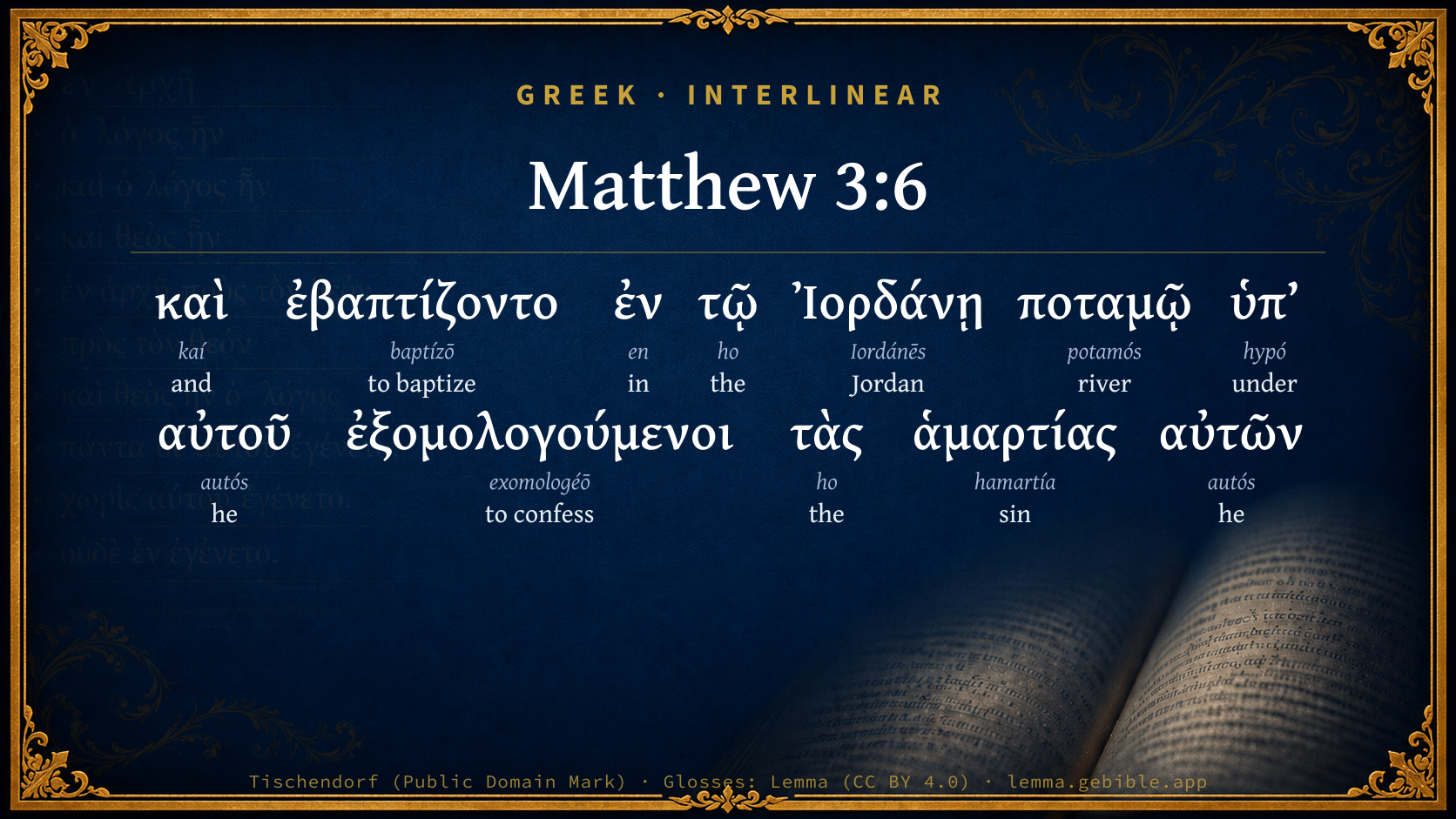
Greek (Tischendorf 8th ed.) Matthew 3:6 appears in the Greek New Testament. The text above is from the Tischendorf 8th edition. Each word links to its Strong’s number and a concise gloss. Click any word for its full Thayer’s Greek Lexicon entry.
Download image
Cite this verse

Matthew 3:6 (World English Bible). Public Domain. Lemma interlinear Bible study tool, https://lemma.gebible.app/v/matthew/3/6.

Show BibTeX & RIS
BibTeX
RIS
English Translation
They were baptized by him in the Jordan, confessing their sins.
World English Bible · Public Domain
Highlights
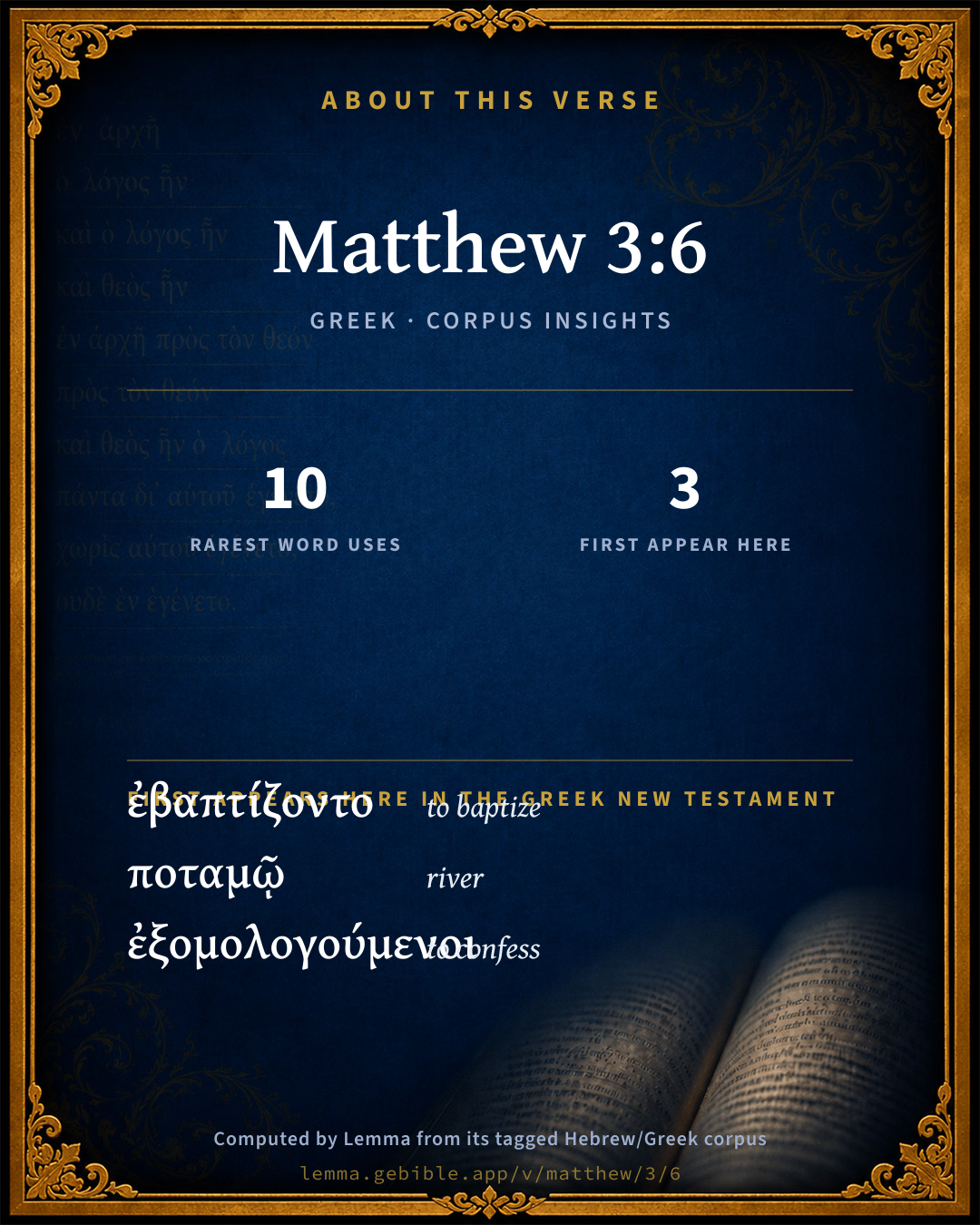
  • 3 first appearances in the Greek New Testament
Full analysis ↓
Download a study sheet

One document with this verse’s original text, its word-by-word gloss line, the meaning frame, cross-references with their text, attributed commentary, and full source and license credits — printable, and it pastes into notes with its structure intact.

This verse Autodidact and up

Study sheet (.html) Plain text (.txt)

A passage Seminary Student

Up to 50 verses in one chapter. A passage sheet keeps up to 6 commentary sources and 12 cross-references per verse, in the order this page ranks them, and says so on the sheet whenever that leaves anything out. Ask for a single verse and you get the Autodidact verse sheet above.

Everything on this page stays free to read, with no account — the sheet is a download of what is already on screen, not access to it.

Want to remove ads? Support Godless Engineer
Compare translations 3

The same verse in 3 English versions, stacked beneath the original-language interlinear above. Click any original word for its lexicon entry.

Each is an independent rendering of the whole verse — the interlinear is not word-aligned to these translations.

Highlighted words mark where these versions differ — a whole-verse word diff, not a word-by-word alignment.

  • World English Bible Public Domain
    They were baptized by him in the Jordan, confessing their sins.
  • King James Version Public Domain
    And were baptized of him in Jordan, confessing their sins.
  • unfoldingWord Literal Text CC BY-SA 4.0
    and being baptized by him in the Jordan River, confessing their sins.

unfoldingWord Literal Text — © unfoldingWord, licensed CC BY-SA 4.0. Word-aligned USFM3 via Door43 (git.door43.org/unfoldingWord/en_ult).

Versions to compare (up to 4)

3 of 4 selected

Show all 19 translations

Every available English version of this verse, each an independent rendering of the whole verse.

  • World English Bible Public Domain
    They were baptized by him in the Jordan, confessing their sins.
  • Berean Standard Bible Public Domain
    Confessing their sins, they were baptized by him in the Jordan River.
  • Majority Standard Bible Public Domain
    Confessing their sins, they were baptized by him in the Jordan.
  • King James Version Public Domain
    And were baptized of him in Jordan, confessing their sins.
  • American Standard Version (1901) Public Domain
    and they were baptized of him in the river Jordan, confessing their sins.
  • Revised Version (1885) Public Domain
    and they were baptized of him in the river Jordan, confessing their sins.
  • Geneva Bible (1599) Public Domain
    And they were baptized of him in Iordan, confessing their sinnes.
  • Douay-Rheims (1899) Public Domain
    And were baptized by him in the Jordan, confessing their sins.
  • Young's Literal Translation Public Domain
    and they were baptized in the Jordan by him, confessing their sins.
  • Literal Standard Version CC BY-SA 4.0
    and they were immersed in the Jordan by him, confessing their sins.
  • Unlocked Literal Bible CC BY-SA 4.0
    They were baptized by him in the Jordan River, as they confessed their sins.
  • unfoldingWord Literal Text CC BY-SA 4.0
    and being baptized by him in the Jordan River, confessing their sins.
  • Darby Bible Public Domain
    and were baptised by him in the Jordan, confessing their sins.
  • World Messianic Bible Public Domain
    They were immersed by him in the Jordan, confessing their sins.
  • Webster's Bible Public Domain
    And were baptized by him in Jordan, confessing their sins.
  • Free Bible Version CC BY-SA 4.0
    and were baptized in the Jordan River, publicly admitting their sins.
  • Bible in Basic English Public Domain
    And they were given baptism by him in the river Jordan, saying openly that they had done wrong.
  • Text-Critical English NT CC BY 4.0
    They were being baptized by him in the Jordan, confessing their sins.
  • Tyndale New Testament (1534) Public Domain
    and were baptised of him in Iorda confessynge their synnes

Literal Standard Version (2020), Covenant Press — licensed CC BY-SA 4.0. Text via the HelloAO Bible API (eBible.org). Unlocked Literal Bible (unfoldingWord) — licensed CC BY-SA 4.0. Text via the HelloAO Bible API (eBible.org). unfoldingWord Literal Text — © unfoldingWord, licensed CC BY-SA 4.0. Word-aligned USFM3 via Door43 (git.door43.org/unfoldingWord/en_ult). Free Bible Version, Dr. Jonathan Gallagher — licensed CC BY-SA 4.0. Text via the HelloAO Bible API (eBible.org).

Word by word

More ways to search: Search by grammar → Find every occurrence → Compare this word →

Practice this passage: Drill this verse → Learn its vocabulary →

ἐξομολογούμενοι
exomologéō
G1843
“to confess”
Verb, Present, Middle, Participle, Nominative, Plural, Masculine
Part of Speech
Verb
Tense
Present
Voice
Middle
Mood
Participle
Case
Nominative
Number
Plural
Gender
Masculine
Full Thayer's Definition

Origin: from G1537 and G3670

TDNT: 08:19,7

1. to confess 2. to profess a. acknowledge openly and joyfully b. to one's honour: to celebrate, give praise to c. to profess that one will do something, to promise, agree, engage
  1. καὶ kaí G2532 “and” Conjunction
  2. ἐβαπτίζοντο baptízō G907 “to baptize” Verb, Imperfect, Passive, Indicative, 3rd person, Plural
  3. ἐν en G1722 “in” Preposition
  4. τῷ ho G3588 “the” Article, Dative, Singular, Masculine
  5. Ἰορδάνῃ Iordánēs G2446 “Jordan” Noun, Dative, Singular, Masculine
  6. ποταμῷ potamós G4215 “river” Noun, Dative, Singular, Masculine
  7. ὑπ’ hypó G5259 “under” Preposition
  8. αὐτοῦ autós G846 “he” Personal pronoun, Genitive, Singular, Masculine
  9. τὰς ho G3588 “the” Article, Accusative, Plural, Feminine
  10. ἁμαρτίας hamartía G266 “sin” Noun, Accusative, Plural, Feminine
  11. αὐτῶν autós G846 “he” Personal pronoun, Genitive, Plural, Masculine

About this verse

These counts appear in no published source. They are computed here, from the morphology-tagged text and Lemma’s own curated glosses. What Lemma adds →

12
words
10
distinct lemmas
Gospels
section

Notable vocabulary

The rarest word here is ἐξομολογούμενοι to confess G1843 — appearing just 10 times in the whole Greek New Testament.

First appearance in Scripture

These words make their first canonical appearance in the Greek New Testament here:

  • ἐβαπτίζοντο to baptize G907
  • ποταμῷ river G4215
  • ἐξομολογούμενοι to confess G1843

Shared distinctive vocabulary

ἐξομολογούμενοι to confess G1843 occurs in 10 verses of the Greek New Testament. Also found in:
Repetition

Words recur within this verse:

  • τῷ the G3588 ×2
  • αὐτοῦ he G846 ×2

Cross-references

33

Topical passages linked to Matthew 3:6 in the Treasury of Scripture Knowledge — connected by theme and wording, ordered by reader-vote popularity; previews shown in the World English Bible.

  • Acts 19:18 Many also of those who had believed came, confessing, and declaring their deeds.
  • Matthew 3:13–16 Then Jesus came from Galilee to the Jordan to John, to be baptized by him.
  • Ezekiel 36:25 I will sprinkle clean water on you, and you shall be clean: from all your filthiness, and from all your idols, will I cleanse you.
  • Matthew 3:11 I indeed baptize you in water for repentance, but he who comes after me is mightier than I, whose shoes I am not worthy to carry. He will baptize you in the Holy Spirit.
  • John 1:25–28 They asked him, "Why then do you baptize, if you are not the Christ, nor Elijah, nor the Prophet?"
  • Acts 2:38–41 Peter said to them, "Repent, and be baptized, everyone of you, in the name of Jesus Christ for the forgiveness of sins, and you will receive the gift of the Holy Spirit.
  • Hebrews 9:10 being only (with meats and drinks and various washings) fleshly ordinances, imposed until a time of reformation.
  • 1 John 1:9 If we confess our sins, he is faithful and righteous to forgive us the sins, and to cleanse us from all unrighteousness.
  • Leviticus 16:21 Aaron shall lay both his hands on the head of the live goat, and confess over him all the iniquities of the children of Israel, and all their transgressions, even all their sins; and he shall put them on the head of the goat, and shall send him away into the wilderness by the hand of a man who is in readiness.
  • Leviticus 26:40 "'If they confess their iniquity, and the iniquity of their fathers, in their trespass which they trespassed against me, and also that, because they walked contrary to me,
  • Numbers 5:7 then he shall confess his sin which he has done, and he shall make restitution for his guilt in full, and add to it the fifth part of it, and give it to him in respect of whom he has been guilty.
  • Joshua 7:19 Joshua said to Achan, My son, please give glory to Yahweh, the God of Israel, and make confession to him; and tell me now what you have done; don't hide it from me.
  • Job 33:27–28 He sings before men, and says, 'I have sinned, and perverted that which was right, And it didn't profit me.
  • Psalms 32:5 I acknowledged my sin to you. I didn't hide my iniquity. I said, I will confess my transgressions to Yahweh, And you forgave the iniquity of my sin. Selah.
  • Proverbs 28:13 He who conceals his sins doesn't prosper, But whoever confesses and renounces them finds mercy.
  • Daniel 9:4 I prayed to Yahweh my God, and made confession, and said, Oh, Lord, the great and dreadful God, who keeps covenant and loving kindness with those who love him and keep his commandments,
  • Mark 1:5 All the country of Judea and all those of Jerusalem went out to him. They were baptized by him in the Jordan river, confessing their sins.
  • Mark 1:8–9 I baptized you in water, but he will baptize you in the Holy Spirit."
  • Luke 3:16 John answered them all, "I indeed baptize you with water, but he comes who is mightier than I, the latchet of whose sandals I am not worthy to loosen. He will baptize you in the Holy Spirit and fire,
  • Luke 15:18–21 I will get up and go to my father, and will tell him, "Father, I have sinned against heaven, and in your sight.
  • John 1:31–33 I didn't know him, but for this reason I came baptizing in water: that he would be revealed to Israel."
  • John 3:23–25 John also was baptizing in Enon near Salim, because there was much water there. They came, and were baptized.
  • Acts 1:5 For John indeed baptized in water, but you will be baptized in the Holy Spirit not many days from now."
  • Acts 10:36–38 The word which he sent to the children of Israel, preaching good news of peace by Jesus Christ--he is Lord of all--
  • Acts 11:16 I remembered the word of the Lord, how he said, 'John indeed baptized in water, but you will be baptized in the Holy Spirit.'
  • Acts 19:4–5 Paul said, "John indeed baptized with the baptism of repentance, saying to the people that they should believe in the one who would come after him, that is, in Jesus."
  • Acts 22:16 Now why do you wait? Arise, be baptized, and wash away your sins, calling on the name of the Lord.'
  • 1 Corinthians 10:2 and were all baptized into Moses in the cloud and in the sea;
  • Hebrews 6:2 of the teaching of baptisms, of laying on of hands, of resurrection of the dead, and of eternal judgment.
  • Colossians 2:12 having been buried with him in baptism, in which you were also raised with him through faith in the working of God, who raised him from the dead.
  • Titus 3:5–6 not by works of righteousness, which we did ourselves, but according to his mercy, he saved us, through the washing of regeneration and renewing by the Holy Spirit,
  • James 5:16 Confess your offenses to one another, and pray one for another, that you may be healed. The effective, earnest prayer of a righteous man is powerfully effective.
  • 1 Peter 3:21 This is a symbol of baptism, which now saves you-- not the putting away of the filth of the flesh, but the answer of a good conscience toward God, through the resurrection of Jesus Christ,

Cross-references courtesy of OpenBible.info (CC BY 4.0).

Commentary

Notes on Matthew 3:6 from classic Christian and Jewish commentators (each source and its license shown beneath its notes). The classic Christian expositions comment on the surrounding passage and are grouped to its opening verse, so a note may address several verses; the Jewish commentaries on the Tanakh (Rashi and others) are per-verse, so they appear only where the commentator wrote on this verse.

Lemma curates 59 commentaries, every one of them public domain or Creative Commons licensed, each selected and text-cleaned for this edition rather than reprinted as found. About our sources →

The Biblical Illustrator

Joseph S. Exell

Mat_3:6

Baptized of Him.

I. In baptism we are admitted to the kingdom of Christ.

1. Presented unto Him.

2. Consigned with His Sacrament.

3. Witnessing a good confession.

4. Undertaking a holy life.

II. In baptism we

(1) give our names to Christ;

(2) are matriculated and adopted into our Fathers house.

III. Baptism Is

(1) the gate of the Church;

(2) the first entrance of saints to an eternal conversion with God and the Church;

(3) the sacrament of initiation;

(4) investiture of them that enter into religion.

IV. Baptism is adoption into the

(1) covenant;

(2) a new birth;

(3) our sins are pardoned now;

(4) and we are put into a state of pardon for the time to come. (Jeremy Taylor.)

Baptism

1. An initiatory rite.

2. A leading ordinance.

3. A confirmatory rite.

4. An instrument of regeneration.

5. A representative ordinance.

6. A sealing ordinance. (T. Watson, M. A.)

Confessing their sins.

The nobility of compression;

1. Confession of sin should not be made to every one we meet; it should be discriminating.

2. It should be honest.

3. The moment a man attempts to be honest with himself in respect to his moral character, and to make confession before God, everything that is in Him rises up against him:-

1. Reason. Reason suborned by his feeling: refuses to investigate. It returns false reports.

2. Pride. How on the proud man do the evidences of sin beat as hailstones on a slate roof, and never penetrate. The mouth of pride has the lockjaw, when it is a question of confessing wrong.

3. Vanity. Vanity teaches men to regard more the opinions of men than of God.

4. Conscience. When ready to confess, conscience says, Stop, insincere hypocrite.

5. Prudence. Let well alone. Let the past alone.

6. Yet is there anything nobler than confession of wrong done? It is a way of pleasantness and peace.

7. Do not be afraid to confess your sin to Jesus. It is easy for sorrow to confess to love. (H. W. Beecher.)

Confession without extenuation

Mens faults lie like reptiles-like toads, like lizards, like serpents; and what if there is over them the evening sky, lit with glory, and all aglow? All the gorgeousness of the departing day, shining down on a reptile, leaves it a reptile still. Men think, I am generous; I am full of fine feelings; I am endowed with superior taste; but what of that? Down in the very thicket; down where men do not love often to go-there their faults lie nestling. (H. W. Beecher.)

Compression should realize the nature and peril of sin

Ah! the bank is breaking away. A craw-fish has pierced it. The stream is working, and working and working. The engineer is sent up to see if all is safe. He sees that a stream is running through the bank, big as his finger. He looks at it, and waits to see if the stream enlarges. Soon it is as big as his two fingers. He waits a little longer, and it is as big as his hand. It is wearing on either side the opening, and the waters are beginning to find it out, and slowly they swirl on the inside towards this point. It will not be many hours before the bank will be so torn that it will give way, and the flood will pour through the crevasse. But the engineer goes back and says, Well, there was a little rill there. But it was a very beautiful place: I never saw a prettier bank than that. The trees that grow in the neighbourhood are superb; and the shrubbery there is very fragrant and charming; and the moisture which finds its way through the bank seems to nourish all vegetation near it. Well, but the break! How about that? It was something of a break; but, as I was saying, it is a beautiful spot. And right there is a fine plantation; and the man that owns it- But how about the crevasse? Yes, there was a little crevasse; but, as I was saying, all things conspire to make it a lovely scene. What kind of a report is that, of an engineer sent out to investigate, when it is question of impending ruin? What kind of a report is that, when the elements are at work which will soon launch desolation on the neighbourhood? Send the engineer Reason into a mans soul, and ask it to report concerning the habit of drinking in the man. It comes back and says, Oh! well, he takes a little for the oft infirmities of his stomach; but he is a good fellow, he is a strong man, and his heart is in the right place. But what about his habit? … He takes a little now and then; but, as I was saying, he is a generous fellow. If you had heard of his kindnesses to that family when they were in distress- But what about his habit? (H. W. Beecher.)

The Biblical Illustrator, edited by Joseph S. Exell (c. 1880s–1900s) — public domain. Text from a community e-Sword module.

Joseph Benson's Commentary

Mat 3:6. And were baptized of him in Jordan — Namely, those that were awakened to repentance. It has been questioned by many, whether John baptized these immense multitudes by dipping them in Jordan? In answer to which it has been observed, “that such prodigious numbers could hardly be baptized by immerging their whole bodies under water: nor can we think they were provided with change of raiment for it, which was scarce practicable for such vast multitudes. And yet they could not be immerged naked with modesty, nor in their wearing apparel with safety.” It has been thought, therefore, “that they stood in ranks on the edge of the river, and that John, passing along before them, cast water on their heads, or faces, by which means, he might baptize many thousands in a day.” This, it must be confessed, most naturally signified Christ’s baptizing them with the Holy Ghost and with fire, which John spoke of as prefigured by his baptizing with water: and which was eminently fulfilled when the Holy Ghost sat upon the disciples, in the appearance of tongues, or flames of fire. But be this as it may: supposing that John baptized by immersion, it will not follow from hence, that immersion is essential to baptism; the washing of the soul from the guilt of sin, by the blood of Christ, or from the power and pollution of sin, by the Spirit of God, (the things signified by baptism,) being expressed by sprinkling or pouring water on a person, as well as by plunging him in it. See Isa 44:3; Eze 36:25; Col 2:12. And as Cyprian observes, in his 76th Epistle to Magnus: “Baptism is rather of the mind by faith, than of the body by immersion in water: this being only a visible sign of an invisible baptism.” It is admired by some, that this practice of John did not excite more stir, and meet with more opposition among the Jews. But it must be observed, that baptizing was not a ceremony entirely new. For, “there were two kinds of baptism in use among the Jews; one was that of the priests at their consecration, Lev 8:6; the other was that of the heathens proselyted to the Jewish religion. It was, therefore, no unheard-of rite which the Messiah’s harbinger made use of. His countrymen were well acquainted both with the thing itself and its signification. They knew that it denoted some great change, either in the opinions or practices of those who submitted to it, and implied a promise of acceptance with God. Moreover, they had been led by a passage in their sacred books, Zec 13:1, to expect, that either the Messiah himself, or some of his attendants, would baptize; as is evident from the question which the messengers of the Sanhedrim put to the Baptist, Joh 1:25 : Why baptizest thou, if thou be not that Christ, nor Elias? They must have known, therefore, that John’s baptism represented purification both of heart and life, as necessary even to Jews themselves, before they could become the subjects of so holy a prince as the Messiah; and that it was a solemn obligation, binding those who received it to lead such lives. Hence, as Dr. Whitby observes, they are mistaken who think John’s baptism the same in kind with that which Christ afterward instituted, for admission of disciples into his Church. The difference between the two was considerable: 1st, John did not baptize either in the name of Christ, or of the Holy Ghost; much less did he baptize them with the Holy Ghost, a circumstance mentioned by himself, as what remarkably distinguished Christ’s baptism from his. 2, They who were baptized with John’s baptism did not profess their faith in the Messiah as actually come, neither did they receive his baptism, in testimony of their entertaining that belief; for after having administered it he exhorted his disciples to believe on Him who was to come. Therefore his baptism could not initiate men into the Christian Church, as appears likewise by the apostles’ rebaptizing some who had been baptized by John. Act 19:4; Act 5:3 d, John’s was the baptism of repentance, whereby all that had a sense of their sins, and professed repentance, were promised pardon, and exhorted to believe in the Messiah, who was soon to appear. Or, it was a washing with water, to show the Jews that they must be cleansed, not only from their prejudices and vices, but that they must relinquish Judaism in order to their becoming fit members of the Messiah’s kingdom.” — Macknight. Indeed, John, properly speaking, was not a gospel minister, nor his ministry a gospel ministry; for that state of the Church was not then begun; but, as he was a middle person between both testaments, greater than the prophets, less than a gospel minister, Mat 11:11; Mat 11:13, so his ministry was a sort of middle ministry, the chief drift whereof was to prepare people to receive Jesus of Nazareth as the promised Messiah: in order whereunto he laboured to convince them of their sins, and their need of a Saviour, by preaching repentance, Mat 3:2; and pointed out the Messiah to them, Joh 1:29; and baptized them as a sign of repentance, on their part, and an assurance of pardon on God’s part. John’s baptism, therefore, was only a temporary sacrament or institution, set up upon a particular occasion; which, as it agreed with Christ’s in the external sign, so was perfected by his. See Grotius. Confessing their sins — Acknowledging their offences, and condemning their former lives, and that freely and of their own accord: for it does not appear that the Baptist required them to do it. It is not said whether this confession was made to God or man: but it is probable it was to both: only, so far as it was made to John, it must have been merely general. For how could one man have sufficed to hearken to a particular confession of all the offences of this immense multitude made secretly in his ears. It seems to have been like the confessions recorded in the Old Testament; (see Ezra 9.; Nehemiah 9.; Daniel 9.;) and that made by the high priest on the day of atonement, Lev 16:21. They acknowledged in words their sinfulness and guilt, professed repentance for, and a detestation of all their sins, and submitted to be baptized in token of their being convinced of their need of pardon and purification. And it must be observed, that this was the confession, not of persons who had been baptized, concerning sins committed after baptism, but of those who were to be baptized. It therefore differs widely from, and gives no countenance to, the auricular confession of the Church of Rome.

Joseph Benson's Commentary on the Old and New Testaments (1811–1818) — public domain. Text from a community e-Sword module.

Bengel's Gnomon

Johann Albrecht Bengel

Mat 3:6. Ἐβαπτίζοντο, received baptism) The verb is in the middle voice.—ἐξομολογούμενοι, confessing) The preposition ἐξ denotes that they confessed their sins freely and expressly, not merely in the ear of John. A true confession mentions even individual sins (as formerly in the case of sin-offerings), although it does not enumerate them one by one. It holds the just mean between the lax abuse of a general formula and the narrow strictness of auricular confession. Thus it relieves the soul. At the Baptism of Repentance men confessed their sins, at the Baptism of Christ they confessed Christ.

Bengel's Gnomon of the New Testament — English translation (T&T Clark, Edinburgh, 1860) — public domain. Text from a community e-Sword module.

Expositor's Greek Testament

ed. W. Robertson Nicoll

Mat 3:6 . καὶ ἐβαπτίζοντο : the imperfect again. They were baptised as they came. ἐν τῷ Ἰορ . ποταμῷ . The word ποταμῷ , omitted in T. R., by all means to be retained. Dull prosaic scribes might deem it superfluous, as all men knew the Jordan was a river, but there is a touch of nature in it which helps us to call up the scene. ὑπʼ αὐτοῦ , by him, the one man. John would not want occupation, baptising such a crowd, one by one. ἐξομολογούμενοι : confession was involved in the act of submitting to baptism at the hands of one whose preaching had for its burden, Repent. But there was explicit confession, frank, full ( ἐκ intensifies), on the part of guilt-burdened men and women glad to get relief so. General or special confession? Probably both: now one, now the other, according to idiosyncrasy and mood. Confession was not exacted as a conditio sine qua non of baptism, but voluntary. The participle means, while confessing; not, provided they confessed. This confession of sins by individuals was a new thing in Israel. There was a collective confession on the great day of atonement, and individual confession in certain specified cases (Num 5:7 ), but no great spontaneous self-unburdenment of penitent souls every man apart. It must have been a stirring sight.

The Expositor's Greek Testament, edited by W. Robertson Nicoll (1897–1910) — public domain. Text from a community e-Sword module.

Geneva Bible (1599)

Geneva Bible translators

Acknowledging that they were saved only by free remission and forgiveness of their sins.

Geneva Bible (1599) marginal notes — public domain. Text via Bolls.life.

Jamieson, Fausset & Brown

Robert Jamieson, A. R. Fausset & David Brown

And were baptized of him in Jordan, confessing their sins--probably confessing aloud. This baptism was at once a public seal of their felt need of deliverance from sin, of their expectation of the coming Deliverer, and of their readiness to welcome Him when He appeared. The baptism itself startled, and was intended to startle, them. They were familiar enough with the baptism of proselytes from heathenism; but this baptism of Jews themselves was quite new and strange to them.

Jamieson, Fausset & Brown — Commentary Critical and Explanatory on the Whole Bible (1871) — public domain (CC PDM 1.0). Text via the HelloAO Bible API.

Adam Clarke's Commentary

Verse 6. Were baptized] In what form baptism was originally administered, has been deemed a subject worthy of serious dispute. Were the people dipped or sprinkled? for it is certain βαπτω and βαπτιζω mean both. They were all dipped, say some. Can any man suppose that it was possible for John to dip all the inhabitants of Jerusalem and Judea, and of all the country round about the Jordan? Were both men and women dipped, for certainly both came to his baptism? This could never have comported either with safety or with decency. Were they dipped in their clothes? This would have endangered their lives, if they had not with them change of raiment: and as such a baptism as John's (however administered) was, in several respects, a new thing in Judea, it is not at all likely that the people would come thus provided. But suppose these were dipped, which I think it would be impossible to prove, does it follow that, in all regions of the world, men and women must be dipped, in order to be evangelically baptized? In the eastern countries, bathings were frequent, because of the heat of the climate, it being there so necessary to cleanliness and health; but could our climate, or a more northerly one, admit of this with safety, for at least three-fourths of the year? We may rest assured that it could not. And may we not presume, that if John had opened his commission in the north of Great Britain, for many months of the year, he would have dipped neither man nor woman, unless he could have procured a tepid bath? Those who are dipped or immersed in water, in the name of the Holy Trinity, I believe to be evangelically baptized - those who are washed or sprinkled with water in the name of the Father, and of the Son, and of the Holy Ghost, I believe to be equally so; and the repetition of such a baptism I believe to be profane. Others have a right to believe the contrary, if they see good. After all, it is the thing signified, and not the mode, which is the essential part of the sacrament. See the note on Mr 10:16.

Confessing their sins.] εξομολογουμενοι, earnestly acknowledging that their sins were their own. And thus taking the whole blame upon themselves, and laying nothing to the charge of GOD or man. This is essential to true repentance; and, till a man take the whole blame on himself, he cannot feel the absolute need he has of casting his soul on the mercy of God, that he may be saved.

Adam Clarke's Commentary on the Bible (1810–1826) — public domain. Text from a community e-Sword/MySword module.

Ellicott's Commentary for English Readers

(6) Were baptized.—The Greek tense implies continual succession. Crowd after crowd passed on, and still they came confessing their sins—i.e., as the position of the word implies, in the closest possible connection with the act of immersion. The Greek word (sometimes used for “confessing” in the sense of “praising,” as in Luk_12:8), always implies public utterance, and included, as the plural of the noun seems to show, a specific mention of, at least, the more grievous individual sins.

A Bible Commentary for English Readers, edited by Charles John Ellicott (1878–1897) — public domain. Text from a community e-Sword module.

The Cambridge Bible for Schools and Colleges

gen. ed. J. J. S. Perowne

6. baptized] John introduced no new custom, for ceremonial ablution or baptism was practised in all ancient religions. Among the Jews proselytes were baptized on admission to the Mosaic covenant. John’s baptism was the outward sign of the purification and “life-giving change,” and contained the promise of forgiveness of sins. Christ too adopted the ancient custom and enriched it with a new significance, and a still mightier efficacy.

The Cambridge Bible for Schools and Colleges (gen. ed. J. J. S. Perowne; Cambridge University Press, 1878–1918) — public domain. Text from a community e-Sword module.

John Gill's Exposition

And were baptized of him,.... The place where they were baptized of him was, "in Jordan"; some copies read, "in the river Jordan", as in Mar 1:5. As to the name of this river, and the etymology of it, the Jews say (l) it was so called, "because it descended" from Dan, i.e. Leshem Dan, or Pamias, which they say is a cave at the head of it. It was in John's time and long after a considerable river, a river to swim in; we (m) read that "Resh Lakish was swimming in Jordan." And elsewhere (n), that one day "R. Jochanan was swimming in Jordan." Also it was a river for boats and ships to pass in, so that it was a navigable river; hence we read (o) of "the boat of Jordan", and of ships in it, and of such and such things being forbidden to be carried over Jordan in a ship (p); particularly,

"a man might not take the water of the sin offering, and the ashes of the sin offering, and carry them over Jordan in a ship.''

Pliny (q), Pausanias (r), Solinus (s), and others, speak of it as a very considerable and delightful river; see Jos 3:15. The Christians of Christ's time are called by the Jews, in a way of contempt, apostates, that received the doctrine of baptism, and were "dipped in Jordan" (t). The manner in which they were baptized by him was by immersion or plunging them in the water: this may be concluded from the signification of the word where used, which in the primary sense of it signifies to dip or plunge; from the place in which they were baptized, "the river Jordan"; and from John's constant manner of baptizing elsewhere, who chose places for this purpose, where and because there was there much water; see Joh 1:28. The character of the persons baptized by him is this, they were such as were

confessing their sins. They were called to repentance by John's ministry, and had the grace of it bestowed upon them; being thoroughly convinced of sin, and truly sorry for it, they were ready to acknowledge and confess it to God and men; and such an abiding sense they had of it upon their minds, that they continued doing it: they were not only confessing their sins before baptism, which engaged John to administer it to them; since we find afterwards he refused to admit others, because of their want of repentance and fruits meet for it; but also whilst they were going into the water, and when they came up out of it, so full were they of a sense of sin, and so ready to own it. Even in baptism itself there is a tacit confession and acknowledgment of sin, for it represents the sufferings and death of Christ which were for sin, into which persons are baptized, and profess to be dead to sin thereby; and also the resurrection of Christ for justification from sin, which obliges the baptized person to walk in newness of life, see Rom 6:3 besides, in this ordinance believers are led to the blood of Christ, both for the cleansing and remission of their sins, which suppose filth and guilt, Act 22:16 and Act 2:38. Now this is the character given of the very first persons that were baptized by John, and ought surely to be attended to, by us; and as much care as possible should be taken, that none but such as have a true sense of sin, and are brought to an humble and hearty acknowledgment of it, be admitted to this ordinance.

(l) T. Bab. Becorot. fol. 55. 1. Kimchi in Josh. xix. 47. (m) T. Bab. Yoma, fol. 9. 2. (n) T. Bab. Bava Metzia, fol. 84. 1. (o) T. Hieros. Sabbat. fol. 7. 1. Midrash Kohelet, fol. 64. 2. (p) T. Bab. Yebamot, fol. 116. 2. Chagiga, fol. 23. 1. Sabbat. fol. 60. 2. Maimon. Hilch. Parah Adumah, c. 10. sect. 2. & Bartenora in Misn. Parah, c. 9. sect. 6. (q) Nat. Hist. l. 5. c. 15. (r) L. 5. p. 29. (s) Polyhist. c. 48. (t) Cosri, p. 3. sect. 65. p. 241. Ed. Buxtorf.

John Gill's Exposition of the Whole Bible (1746–1763) — public domain (CC PDM 1.0). Text via the HelloAO Bible API.

Trapp's Complete Commentary

John Trapp

6 And were baptized of him in Jordan, confessing their sins.

Ver. 6. And were baptized of him in Jordan] Baptizing of proselytes was in use among the Jews before the days of John Baptist. From this custom (saith Broughton, in Dan 9:1-27), though without commandment and of small authority, Christ authorizeth a seal of entering into his rest, using the Jews’ weakness as an allurement thither. As from bread and wine, used with the paschal lamb, being without all commandment of Moses, but resting upon the common reason given by the Creator, he authorized a seal of his flesh and blood.

In Jordan] At Bethabara, Joh 1:28, that is, at that very place where the people of Israel passed over Jordan and possessed the land. Baptism then was there first administered, where it had been of old foreshadowed. Here also we see that the acts of Joshua and Jesus took their happy beginning at one and the same place. And like as the people, after they had passed over Jordan, were circumcised before they received the land by lot of inheritance: so after we have been baptized, and thereby enrolled among the citizens of the New Jerusalem, the remnants of sin and superfluity of naughtiness must be daily pared off by the practice of mortification, ere we can come to the kingdom of heaven, Jas 1:21; η περισσεια της κακιας. In allusion to the garbage and excrements of the sacrificed beast.

Confessing their sins] In token of their true repentance. For as only the man that is wakened out of his dream can tell his dreams; so only he that is wakened out of his sins can clearly confess them. {a} And this confession of sin, joined with confusion of sin (without the which, confession is but wind, and the drops of contrition, water), is that which in baptism we reciprocate. "Not the putting away of the filth of the flesh, but the confident answer of a good conscience toward God," 1Pe 3:21; {b} a clearing, cheering conscience, a heart washed from wickedness in this laver of regeneration, the baptism of repentance, the washing of the new birth, the being baptized with the Holy Ghost and with fire, this sayeth, saith St Peter. Not as the efficient cause of salvation, for that is Christ alone: nor yet as a necessary instrument, for that is faith alone: but only as a badge of the saved, and a pledge of their salvation; as, on the other side, God will not own a viperous brood, though baptized, that bring not forth fruits meet for repentance. To such, baptism is not the mark of God’s child, but the brand of a fool that maketh a vow and then breaketh it, Ecc 5:4. For the font is Beersheba, the well of an oath; and there we swear (as David did) "to keep God’s righteous judgments," Psa 119:106; Isa 10:1-19. Now, if Zedekiah and Shimei paid so dearly for their perjury, for their fast and loose with men, how will God revenge the quarrel of his covenant? The Spanish converts in Mexico remember not anything of the promise and profession they made in baptism, save only their name, which many times also they forget. In the kingdom of Congo in Africa, the Portuguese, at their first arrival, finding the people to be heathens, without God, did induce them to a profession of Christ, and to be baptized in great abundance, allowing of the principles of religion; till such time as the priests pressed them to lead their lives according to their profession; which the most part of them in no case enduring, returned again to their Gentilism. Such renegades we have among us not a few, that give themselves up to Christ, Quoad Sacramenti perceptionem, by external profession (Augustine); but when it comes once ad vitae sanctificationem, to holiness of life, there they leave him in the open field, forsaking their colours, renouncing their baptism, and running away to the enemy. Now for such there is but one law, and it is martial law, Heb 10:39: If any withdraw (υποστειληται) or steal from his captain (as the military term there used importeth) he doth it to perdition, -he is even a son of perdition, as Judas; who was circumcised indeed, as well as Peter, but better he had not. As it had been better for him never to have been born, Mar 14:21, so, being born, never to have been circumcised, and thereby bound to the law. Unregenerate Israel is as Ethiopia, Amo 9:7. And it had been happy that baptismal water had never been spilt on that face that is afterwards hatched with impudent impiety, Jer 3:3-5.

{a} εξομολογεισθαι. Est aperta et clara voce confiteri.

{b} επερωτημα.

John Trapp, A Commentary or Exposition upon All the Books of the Old and New Testament (1647–1656) — public domain. Text from a community e-Sword module.

Albert Barnes' Notes on the Bible

Were baptized - The word “baptize” βαπτίζω baptizo signifies originally to tinge, to dye, to stain, as those who dye clothes. It here means to cleanse or wash anything by the application of water. See the notes at Mar 7:4. Washing, or ablution, was much in use among the Jews, as one of the rites of their religion, Num 19:7; Heb 9:10. It was not customary, however, among them to baptize those who were converted to the Jewish religion until after the Babylonian captivity. At the time of John, and for some time previous, they had been accustomed to administer a rite of baptism, or washing, to those who became proselytes to their religion; that is, to those who were converted from being Gentiles. This was done to signify that they renounced the errors and worship of the pagans, and as significant of their becoming pure by embracing a new religion.

It was a solemn rite of washing, significant of cleansing from their former sins, and purifying them for the special service of Yahweh. John found this custom in use; and as he was calling the Jews to a new dispensation - to a change in their form of religion - he administered this rite of baptism (washing), to signify the cleansing from sin, the adopting of the new dispensation, or the fitness for the pure reign of the Messiah. He applied an old ordinance to a new purpose. As it was used by him it was a significant rite, or ceremony, intended to denote the putting away of impurity, and a purpose to be pure in heart and life. The Hebrew word טבל Tabal which is rendered by the word “baptize,” occurs in the Old Testament in the following places, namely: Lev 4:6; Lev 14:6, Lev 14:51; Num 19:18; Rth 2:14; Exo 12:22; Deu 33:24; Jos 3:15; Job 9:31; Lev 9:9; 1Sa 14:27 (twice); 2Ki 5:14; 2Ki 8:15; Gen 37:31; Jos 3:15.

It occurs in no other places; and from a careful examination of these passages its meaning among the Jews is to be derived. From these passages it will be seen that its radical meaning is neither to sprinkle nor to immerse. It is to dip, commonly for the purpose of sprinkling, or for some other purpose.

Thus, to dip the finger, i. e., a part of the finger, in blood enough to sprinkle with, Lev 4:6. To dip a living bird, and cedar wood, and scarlet, and hyssop, in the blood of the bird that was killed, for the purpose of sprinkling; where it could not be that all these would be immersed the blood of a single bird, Lev 14:6. To dip hyssop in the water, to sprinkle with, Num 19:18. To dip a portion of bread in vinegar, Rth 2:14. To dip the feet in oil - an emblem of plenty, Deu 33:24. To dye, or stain, Eze 23:15. To plunge into a ditch, so as to defile the clothes, Job 9:31. To dip the end of a staff in honey, 1Sa 14:27. To dip in Jordan - a declaration respecting Naaman the Syrian, 2Ki 5:14. The direction of the prophet was to wash himself 2Ki 5:10, and this shows that he understood washing and baptizing to mean the same thing. To dip a towel, or quilt, so as to spread it on the face of a man to smother him, 2Ki 8:15.

In none of these cases can it be shown that the meaning of the word is to immerse entirely But in nearly all the cases the notion of applying the water to a part only of the person or object, though it was by dipping, is necessarily to be supposed.

In the New Testament the word βαπτίζω baptizo, in various forms, occurs 80 times; 57 with reference to persons. Of these 57 times, it is followed by “in” ἐν en 18 times, as in water, in the desert, in Jordan; 9 times by “into” εἰς eis, as into the name, etc., into Christ; once it is followed by ἐπί epi Act 2:38, and twice by “for” ὑπέρ huper, 1Co 15:29.

The following remarks may be made in view of the investigation of the meaning of this word:

That in baptism it is possible, perhaps probable, that the notion of dipping would be the one that would occur to a Jew. It would not occur to him that the word meant of necessity to dip entirely, or to immerse completely. The notion of washing would be the one which would most readily occur, as connected with a religious rite. See the cases of Naaman, and Mar 7:4 (Greek). It cannot be proved from an examination of the passages in the Old and New Testaments that the idea of a complete immersion was ever connected with the word, or that it ever occurred in any case. If those who were baptized went into the water, it is still not proved by that, that the only mode of baptism was by immersion, since it might have been by pouring, though they were in the water. It is not positively enjoined anywhere in the New Testament that the only mode of baptism shall be by an entire submersion of the body under water. Without such a precept it cannot be made obligatory on people of all ages, nations, and climes, even if it were probable that in the mild climate of Judea it was the usual mode.

In Jordan - The River Jordan is the eastern boundary of Palestine or Judea. It rises in Mount Lebanon, on the north of Palestine, and runs in a southerly direction, underground, for 13 miles, and then bursts forth with a great noise at Cesarea Philippi. It then unites with two small streams, and runs some miles farther, and empties into the Lake Merom. From this small lake it flows 13 miles, and then falls into the Lake Gennesareth, otherwise called the Sea of Tiberias or the Sea of Galilee. Through the middle of this lake, which is 15 miles long and from 6 miles to 9 miles wide, it flows undisturbed, and preserves a southerly direction for about 70 miles, and then falls into the Dead Sea. The Jordan, at its entrance into the Dead Sea, is about 90 feet wide. It flows in many places with great rapidity, and when swollen by rains pours like an impetuous torrent. It formerly regularly overflowed its banks in time of harvest, that is, in March, in some places 600 paces, Jos 3:15; 1Ch 12:15. These banks are covered with small trees and shrubs, and afford a convenient dwelling for wild beasts. Allusion is often made to these thickets in the sacred Scriptures, Jer 49:19; Jer 50:44. On the reason why a river, or a place abounding in water, was selected for administering baptism, see the notes at Joh 3:23.

Albert Barnes' Notes on the Bible (1834–1885) — public domain. Text from a community e-Sword/MySword module.

Haydock's Catholic Bible Commentary

Baptized. the word baptism signifies a washing, particularly when it is done by immersion, or by dipping, or plunging a thing under water, which was formerly the ordinary way of administering the sacrament of baptism. But the Church, which cannot change the least article of the Christian faith, is not so tied up in matters of discipline and ceremonies. Not only the Catholic Church, but also the pretended reformed churches, have altered this primitive custom in giving the sacrament of baptism, and now allow of baptism by pouring or sprinkling water on the person baptized; nay may of their ministers do it now-a-days, by filliping a wet finger and thumb over the child’s head, or by shaking a wet finger or two over the child, which it is hard enough to call a baptizing in any sense. --- Confessing their sins.[3] We bring not this as a proof for sacramental auricular confession; yet we may take notice, with Grotius, that it is a different thing for men to confess their sins, and to confess themselves sinners. And here is expressed a declaring of particular sins, (as also Acts xix. 18,) such as is recommended in the Protestant Prayer Book, in the visitation of the sick. (Witham) --- As the baptism of John was an external profession of penance, to this it was mett to add an external or oral confession of sins; and the more so, because such as were baptized by John, sought of him also, as we read in St. Luke, instructions how they were to amend their lives; now it is naturally expected of whoever asks for similar advice, that he should expose the defects of his past life. It is thus patients act with their physicians. (Haydock)

===============================

[BIBLIOGRAPHY]

confitentes peccata sua. Greek: exomologoumenoi tas amartias auton.

====================

George Leo Haydock (1774–1849), Haydock's Catholic Family Bible and Commentary, 1859 edition — public domain. Excludes Psalms (Douay-Rheims chapter numbering differs from Protestant) and Deuterocanonical books (Catholic canon only).

Matthew Poole's English Annotations

A great part of those who went out to hear John were baptized, that is dipped, in Jordan; but from hence it will not follow that dipping is essential to baptism, the washing of the soul with the blood of Christ (the thing signified by baptism) being expressed by sprinkling or pouring water, as well as by dipping or being buried in water, Isa 44:3; Eze 36:25; Col 2:12. Whether they confessed their sins, man by man, by word of mouth, or by submitting to the doctrine of the gospel declared their renunciation of the righteousness of the law, and their engagement to a holy life, is not expressed; but it is most certain, that a profession of faith and repentance was ordinarily required before the baptism of adult persons. It may be wondered that this new practice of John (if it were wholly new) made no more stir amongst the Jews. Either (as some think) baptism was in use before that time, as an appendix to circumcision, (though circumcision only be mentioned), or they had some notion that Christ, Elias, and that prophet, when they came, should baptize; for, Joh 1:25, they asked John, Why baptizest thou then, if thou be not that Christ, nor Elias, neither that prophet. That which seemeth to me most probable is, that before that time there was a baptism in ordinary use amongst them after circumcising the child, beside the baptizing of proselytes. And as in the other sacrament Christ left out the typical part, and blessed the bread, used at last in that administration, and made use of that for the institution of the sacrament of the supper; so as to the ordinance of circumcision, he in the institution of that gospel ordinance left out circumcision, (which was typical also), and retained only the washing of the person with water, and so instituted the other sacrament of the New Testament. But yet there was so much new in the Baptist’s practice, (for he did not baptize proselytes only, but Jews, nor did he use it as an appendix to circumcision preceding, but baptized adult Jews), that if the state of the Jewish church had not been declining, and their power of discipline very little, (if any), they would more than have sent to John to know by whose authority he baptized: but they were under the Roman power, and their ecclesiastical officers were more pragmatical than mischievous, God in the wisdom of his providence having so ordered it, that the change of worship should be at such a time brought in when it should be least potently opposed.

Matthew Poole's English Annotations on the Holy Bible (1683–1685) — public domain. Text from a community e-Sword/MySword module.

Whedon's Commentary on the Bible

Daniel D. Whedon

6. In Jordan — The Jordan had several banks within banks, so that a person could be in the Jordan on dry ground. “In approaching the river,” says Dr. Thomson, “you descend several benches or terraces.” This expression, “in the Jordan,” only indicates, therefore, where the rite was performed; it in no way indicates the mode.

The JORDAN is, historically, the most interesting river in the world. It derives its sources from the snows of the Lebanon, whence it flows down to the Lake Gennesaret, through which it passes. Its current through the middle of that lake is distinctly visible. Thence it descends, through a distance of about sixty miles, to the Dead Sea. Its channel is very serpentine, but it trends, very directly, toward the south. The narrow plain upon its banks is usually very fertile, it is calculated to be, on the average, about thirty yards wide and nine feet deep, and its current is very rapid.

Confessing their sins — Thus acknowledging that repentance was the object of their baptism. This act of repentance and baptism, under the administration of John, truly performed, had two effects: 1. It placed the subjects of the baptism in a present state of grace and favour with God. 2. It placed the heart in a right state to receive the coming king — Messiah — even in his mild and spiritual form, and to enter into his coming kingdom. Perseverance in the same temper, and progress in the same direction, would have brought them to the purposed result. It was by apostacy that Israel lost the Saviour.

Daniel D. Whedon (gen. ed.), Commentary on the Old and New Testaments (1874–1909) — public domain. Text from a community e-Sword module.

The Pulpit Commentary

And (they, Revised Version) were baptized. The Revised Version probably desires to call attention to the change in the verb from singular to plural. In Jordan; in the river Jordan (Revised Version, with manuscripts). So also parallel passage in Mark (cf. Introduction, p. 5.). By him; i.e. their baptism was not self-imposed, but an act of submission to his teaching, and of acceptance of his message. The forerunner saw results, not merely in crowds of listeners, but in external actions. By him. (contrast Joh_4:2) Confessing their sins; i.e. in at least some detail; cf. Josephus, "Ant.," 8:4. 6, "confessing their sins and their transgressions of the laws of their country (exomologoumenwn taav autwn kai tawn nomimwn parabaseiv);" also Act_19:18, "confessing and declaring their deeds". (cf. Jam_5:16)

The moral value of confession.

"Confessing their sins." "There are two cases which lead men in communities to the confession of particular sins in the presence of their fellows, before God and before man. Any moral exaltation which places them so that they see evil from a plane higher than that on which they live ordinarily, and where its relations, its tendencies, its nature, and character are clearly revealed, constantly tends to produce confession. There is also a confession which results from social magnetism. Communities are sometimes possessed, for short periods, with a paroxysm of contrition." There are many, however, who are quite willing to confess their sinfulness who will not confess their sins. It may be asked Why should confession be demanded? What moral value lies in it? God knows all things: why, then, does he want us to say to him what he knows? Yet we observe that man demands open acknowledgment of fault, that is, confession, as the sign of sincerity of repentance, on the part of those who grieve him.

Repentance as mere sentiment is of no value. If it is more than sentiment, it will gain two forms of expression.

1. Acknowledgment of the sin.

2. Putting away of the sin henceforth.

It is not evangelical repentance we feel if we shrink from doing either of these two things. The moral value of repentance that finds expression in confession is exhibited in a very striking way by St. Paul. "What carefulness it wrought in you, yea, what clearing of yourselves, yea, what indignation, yea, what fear, yea, what vehement desire, yea, what zeal, yea, what revenge!". (2Co_7:11) The special point which may be opened and illustrated is, that confession assures of personal thought and feeling. It is the expression of the aroused, awakened man, whose indifference is gone, who sees himself, and is oppressed with the sight. If a man really confesses, he must have got a real self-hold.

I A RELIGION OF MERE ASSOCIATION IS WORTHLESS. Yet that is all the religion so many have. It has no confession in it, save the unintelligent, parrot-like repetition of a formula.

II A RELIGION OF PERSONAL CONVICTIONS ALONE IS WORTHY. One of its earliest signs is confession: because as soon as a man comes to think, he is dissatisfied with himself, and finds that he wants to say so. Saying so is the way toward gaining relief. R.T.

The Pulpit Commentary (1880–1919), ed. H.D.M. Spence-Jones & Joseph S. Exell — public domain. Text from a community e-Sword module.

John Wesley's Explanatory Notes

Confessing their sins - Of their own accord; freely and openly. Such prodigious numbers could hardly be baptized by immerging their whole bodies under water: nor can we think they were provided with change of raiment for it, which was scarcely practicable for such vast multitudes. And yet they could not be immerged naked with modesty, nor in their wearing apparel with safety. It seems, therefore, that they stood in ranks on the edge of the river, and that John, passing along before them, cast water on their heads or faces, by which means he might baptize many thousands in a day. And this way most naturally signified Christ's baptizing them with the Holy Ghost and with fire, which John spoke of, as prefigured by his baptizing with water, and which was eminently fulfilled, when the Holy Ghost sat upon the disciples in the appearance of tongues, or flames of fire.

John Wesley, Explanatory Notes Upon the Whole Bible (1754–1765) — public domain. Text via the GEBible commentary corpus.

Scofield Reference Notes

C. I. Scofield

sins

Sin. (See Scofield "Rom 3:23").

The Scofield Reference Bible (1917 edition), notes by C. I. Scofield — public domain. Text from a community e-Sword module.

Kretzmann's Popular Commentary

Paul E. Kretzmann

John performed his ministry to all:

v. 6. And were baptized of him in Jordan, confessing their sins.

His powerful, appealing call to repentance had its effect. In ever-increasing numbers they came. The guilt-burdened men and women, whose lives had been lived in sham and deceit, made a frank, explicit, public confession of their sins, voluntarily, now general, now special, as they came under the influence of John’s personality and message. "This confession of sins by individuals was a new thing in Israel. There was a collective confession on the great Day of Atonement, and individual confession in certain specified cases (Num 5:1-31:, but no great spontaneous self-unburdenment of penitent souls—every man apart. It must have been a stirring sight. " And as they came and made confession of their sins, in a practically unbroken stream, they were baptized by John in the river Jordan. It was an awakening such as the land had not witnessed since the time of the ancient prophets.

Paul E. Kretzmann, Popular Commentary of the Bible (1921–1924) — public domain. Text from a community e-Sword module.

Burkitt's Expository Notes on the New Testament

William Burkitt

This place the papists bring to support their doctrine of auricular confession; but very groundlessly.

For, 1. The confession of those converts was voluntary, and not constrained.

2. It was general, and not of every particular sin.

3. It was public and open, not in the ear of a priest.

4. It was a confession of sin committes before baptism, not after they were baptized: in all which circumstances it differs from the auricular confession of the church of Rome very greatly.

Note, That confession of sin past, together with a profession of faith in and obedience to Christ for the time to come, are necessary requisites and qualifications in all persons of riper years that are admitted to baptism, upon their confession of sin, and promise to become better, may be admitted to the holy sacrament, provided that we warn them, as the baptist did these, not only to make profession of repentance, but to bring forth fruits worthy of repentance.

William Burkitt's Expository Notes on the New Testament (1700–1703) — public domain. Text from a community e-Sword module.

The People's New Testament

B. W. Johnson

6. And were baptized of him in the Jordan. Note that the baptism took place not at, but in, in the Jordan. Mark says, “in the river Jordan.” The Jordan, the principal stream of Palestine, rises in the mountains of Lebanon, runs south into the sea of Galilee, leaves it and descends southward along Galilee, Samaria and Judea, to the Dead Sea. In many places the streams is fordable, and furnishes good facilities for baptizing. Confessing their sins. Baptism itself, a burial in water, a “baptism into death,” a symbol of the burial of one who dies to the old life, is a confession of sins. There was, perhaps, also a verbal confession. The acknowledgment of sin, repentance and baptism are prescribed as conditions of pardon.

B. W. Johnson's The People's New Testament with Notes (1889–1891) — public domain. Electronic text from the Christian Classics Ethereal Library (CCEL) ThML edition.

Cambridge Greek Testament for Schools and Colleges

6. ἐβαπτίζοντο were ‘immersed;’ (the tense marks the successive instances). βαπτίζω, a strengthened form of βάπτω, like some other leading Christian words (e.g. Χριστός, ἀγάπη, μετάνοια), is rare in the Classics; it is used in different figurative senses by Plato, e.g. of a boy ‘drowned with questions,’ Euthyd. 277 D; in Polyb. literally of ships sinking, in Diod. Sic. both literally and metaphorically: ὁ ποταμὸς πολλοὺς ἐβάπτιζε, II. 143; and οὐ βαπτίζουσι ταῖς εἰσφοραῖς τοὺς ἰδιώτας, I. 85. Note the revival of the literal meaning in the later stage of the language.

In baptizing John introduced no new custom, for ceremonial ablution or baptism was practised in all ancient religions. Cp. Soph. Aj. 654–656, ἀλλʼ εἶμι πρός τε λουτρὰ καὶ παρακτίους | λειμῶνας, ὡς ἂν λύμαθʼ ἁγνίσας ἐμὰ | μῆνιν βαρεῖαν ἐξαλύξωμαι θεᾶς, where see Prof. Jebb’s note. Among the Jews proselytes were baptized on admission to the Mosaic covenant. John’s baptism was the outward sign of the purification and ‘life-giving change,’ and contained the promise of forgiveness of sins. Christ too adopted the ancient custom and enriched it with a new significance, and a still mightier efficacy. From the history of the word it is clear that the primitive idea of baptism was immersion. This was for long the only recognised usage in the Christian Church, and much of the figurative force was lost when sprinkling was substituted for immersion. The convert who entered the clear rushing stream, soiled, weary, and scorched by the hot Eastern sun, and then after being hidden from the sight for a few moments ‘buried in baptism’ reappeared, fresh, vigorous, and cleansed, having put off ‘the filth of the flesh,’ seemed indeed to have risen to a new and purified life in Christ. ἐν τῷ Ἰορδάνῃ ποταμῷ. Two points on the Jordan are named in John. See note on Mat 3:13.

ἐξομολογεῖσθαι. ‘To acknowledge or declare fully,’ used either (1) of confession as here, and Mar 1:5; Act 19:18; or (2) of thanks and praise as in ch. Mat 11:25; Luk 10:21; Rom 15:9.

Cambridge Greek Testament for Schools and Colleges (Cambridge University Press, 1896; 21 vols, various authors incl. Carr, Maclear, Plummer, Farrar, Lumby, Moule, M. R. James, Simcox) — public domain. Text from a community e-Sword module.

Alford’s Greek Testament

Henry Alford

6. ἐβαπτίζοντο] When men were admitted as proselytes, three rites were performed—circumcision, baptism, and oblation; when women, two—baptism and oblation. The baptism was administered in the day-time, by immersion of the whole person; and while standing in the water the proselyte was instructed in certain portions of the law. The whole families of proselytes, including infants, were baptized. It is most probable that John’s baptism in outward form resembled that of proselytes. See above, on ver. 1. Some (De Wette, Winer, Paulus, Meyer) deny that the proselyte baptism was in use before the time of John: but the contrary has been generally supposed, and maintained (cf. Lightfoot, Schöttgen, Buxtorf, Wetstein, Bengel). Indeed the baptism or lustration of a proselyte on admission would follow as a matter of course, by analogy from the constant legal practice of lustration after all uncleannesses: and it is difficult to imagine a time when it would not be in use. Besides, it is highly improbable that the Jews should have borrowed the rite from the Christians, or the Jewish hierarchy from John.

ἐξομολογούμενοι τ. ἁμ. αὐ.] From the form and expression this does not seem to have been merely ‘shewing a contrite spirit,’ ‘confessing themselves sinners,’ but a particular and individual confession; not, however, made privately to John, but before the people: see his exhortation to the various classes in Luk 3:10-15: nor in every case, but in those which required it. Josephus uses the very same expression, Antt. viii. 4. 6. The present participle carries with it a certain logical force; “confessing, as they did,”—almost = “on condition of confessing.” So Fritzsche, “si peccata sua confiterentur.”

Henry Alford, The Greek Testament (1849–1861) — public domain. Text from a community e-Sword module.

International Critical Commentary

6. And were being baptized in the river Jordan by him, confessing their sins.] Mk. has: “And were being baptized by him in the river Jordan,” etc. Mk. has the description of the Baptist and the thronging to him of the people in the reverse order. Mt.’s change is due to a sense of literary fitness. The description of the Baptist comes more appropriately after the statement of his appearance as a preacher, than it does after the account of the effect of his preaching upon the people. There is no reason to suppose that Mt. had any other source than Mk. for these six verses, unless παραγίνεται is a hint of such a source (cf. Introduction, p. lx). In Mk. they stand at the beginning of the Gospel, and are written in Mk.’s abrupt style. The construction of Mk vv. 1-4 is not altogether clear (see Swete, in loc.), and v. 7 is awkward. Mt. rewrites the passage in a smoother and more connected style.

International Critical Commentary — older volumes (1896–1929), various authors — public domain. Text from a community e-Sword module.

Vincent's Word Studies in the New Testament

Marvin R. Vincent

Were baptized [εβαπτιζοντο] . See on Mr 7:4. Confessing their sins [εξομολογουμενοι τας αμαρτιας αυτων] . The words imply :

1. That confession was connected with baptism. They were baptized while in the act of confessing.

2. An open confession, not a private one to John (ejx, compare Act 19:18; Jas 5:16).

3. An individual confession; possibly a specific one. (See Luk 3:10 - 15.)

Marvin R. Vincent, Word Studies in the New Testament (1887–1900) — public domain. Text from a community e-Sword/MySword module.

Lesson kit

Teaching starters — assembled from the data on this page, not authored interpretation. Every prompt links to the verse data it draws on. Edit before teaching.

Matthew, in the Gospels, opens this verse with 12 words (10 distinct Greek lemmas). Its most distinctive word is exomologéō (“to confess”). A historical commentator’s framing appears above. Read the whole chapter for the surrounding context.

Discussion questions

  1. What does “to confess” (exomologéō) contribute to the verse as a whole?
  2. 3 words make their first appearance in Scripture here. What does this debut establish?
  3. How does Matthew 11:25, which shares the word «to confess», read alongside this verse?
  4. What does the repetition of “the” (2× in this one verse) do in this verse?
  5. These translations render this verse differently. What is at stake in choosing one wording over another?
  6. Compare how The Biblical Illustrator and Joseph Benson's Commentary read this verse. Where do they agree or differ?

Things to notice

  • 3 words make their first canonical appearance in Scripture here.
  • These translations choose different wording for 2 words in this verse.
  • “the” occurs 2× in this single verse.
  • 10 distinct Greek lemmas span 12 words in this verse.

Reading settings

Reading text

Shown beneath each verse's original-language words.

Old Testament
Old Testament edition

Read the OT as the Masoretic Hebrew (MT) or the Greek Septuagint (LXX).

English shown for the Greek Septuagint (in the Hebrew ↔ Greek comparison).

Comparing translations? Open the Compare panel on any verse page to stack up to four side by side.