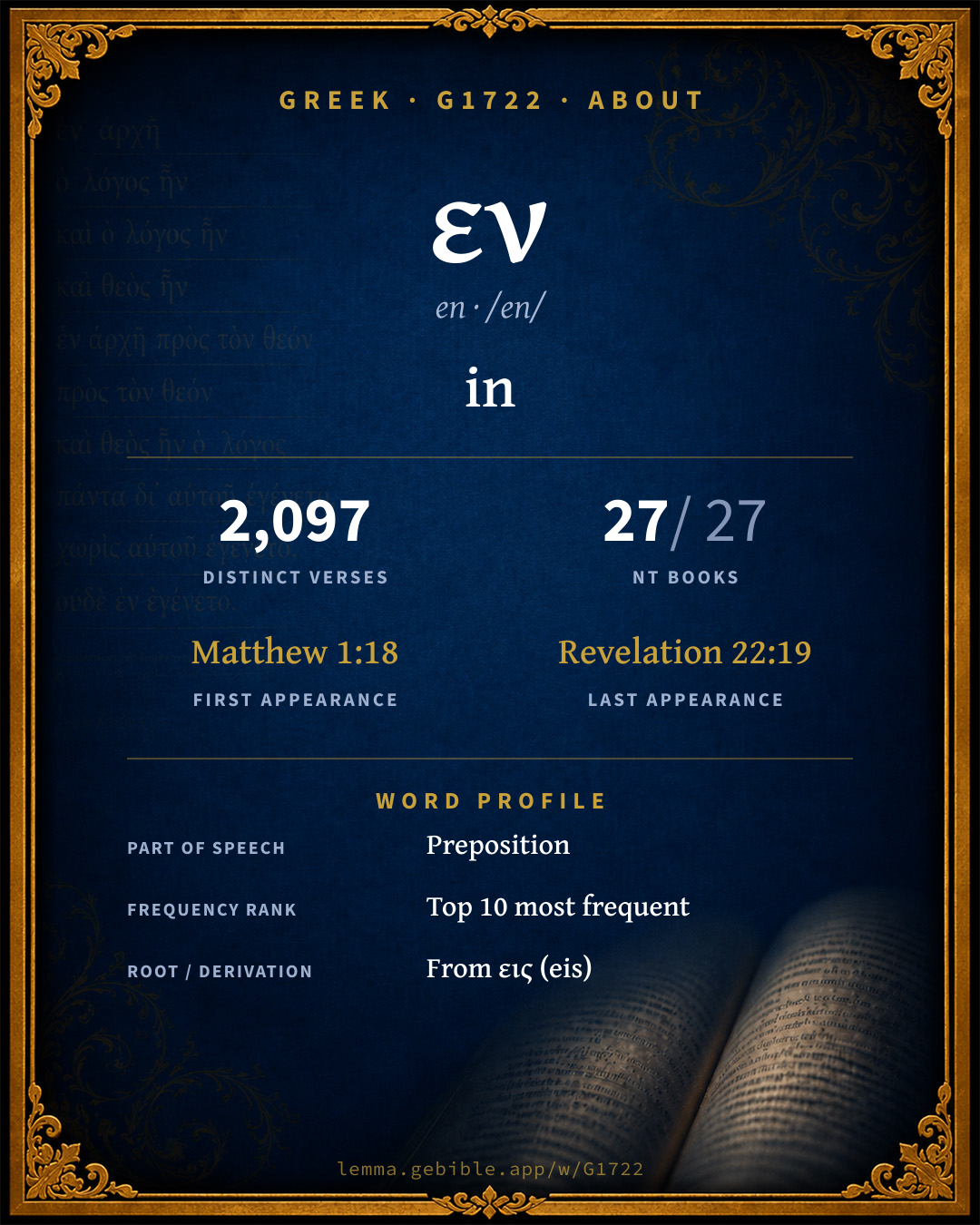
ἐν
in
Full lexicon entry — Thayer's Greek Lexicon
From Thayer's Greek Lexicon
Where this word appears
Grammar key — what these labels mean
Part of speech
- Preposition
- A relational word governing a noun in a particular case.
Every verse where G1722 appears in the Book of James — 33 distinct verses. Click any verse to open its interlinear word-by-word view. Verse text shown in the World English Bible for context — . Each verse’s Greek form is shown with its reference; the English is not keyword-highlighted, since the data carries no word-level English alignment. Use “Compare translations” on any verse to read it across multiple English versions. This concordance covers the Greek New Testament; Septuagint (Greek Old Testament) occurrences of this word are not indexed here.
James
- James 1:1 ἐν prep James, a servant of God and of the Lord Jesus Christ, to the twelve tribes which are in the Dispersion: Greetings.
- James 1:4 ἐν prep Let endurance have its perfect work, that you may be perfect and complete, lacking in nothing.
- James 1:6 ἐν prep But let him ask in faith, without any doubting, for he who doubts is like a wave of the sea, driven by the wind and tossed.
- James 1:8 ἐν prep He is a double-minded man, unstable in all his ways.
- James 1:9 ἐν prep But let the brother in humble circumstances glory in his high position;
- James 1:10 ἐν prep and the rich, in that he is made humble, because like the flower in the grass, he will pass away.
- James 1:11 ἐν prep For the sun arises with the scorching wind, and withers the grass, and the flower in it falls, and the beauty of its appearance perishes. So also will the rich man fade away in his pursuits.
- James 1:21 ἐν prep Therefore, putting away all filthiness and overflowing of wickedness, receive with humility the implanted word, which is able to save your souls.
- James 1:23 ἐν prep For if anyone is a hearer of the word and not a doer, he is like a man beholding his natural face in a mirror;
- James 1:25 ἐν prep But he who looks into the perfect law, the law of freedom, and continues, not being a hearer who forgets but a doer of the work, this man will be blessed in what he does.
- James 1:27 ἐν prep Pure religion and undefiled before our God and Father is this: to visit the fatherless and widows in their affliction, and to keep oneself unstained by the world.
- James 2:1 ἐν prep My brothers, don't hold the faith of our Lord Jesus Christ of glory with partiality.
- James 2:2 ἐν ἐν prep prep For if a man with a gold ring, in fine clothing, comes into your assembly, and a poor man in filthy clothing also comes in;
- James 2:4 ἐν prep haven't you shown partiality among yourselves, and become judges with evil thoughts?
- James 2:5 ἐν prep Listen, my beloved brothers. Didn't God choose those who are poor in this world to be rich in faith, and heirs of the Kingdom which he promised to those who love him?
- James 2:10 ἐν prep For whoever shall keep the whole law, and yet stumble in one point, he has become guilty of all.
- James 2:16 ἐν prep and one of you tells them, "Go in peace, be warmed and filled;" and yet you didn't give them the things the body needs, what good is it?
- James 3:2 ἐν prep For in many things we all stumble. If anyone doesn't stumble in word, the same is a perfect man, able to bridle the whole body also.
- James 3:6 ἐν prep And the tongue is a fire. The world of iniquity among our members is the tongue, which defiles the whole body, and sets on fire the course of nature, and is set on fire by Gehenna.
- James 3:9 ἐν ἐν prep prep With it we bless our God and Father, and with it we curse men, who are made in the image of God.
- James 3:13 ἐν ἐν prep prep Who is wise and understanding among you? Let him show by his good conduct that his deeds are done in gentleness of wisdom.
- James 3:14 ἐν prep But if you have bitter jealousy and selfish ambition in your heart, don't boast and don't lie against the truth.
- James 3:18 ἐν prep Now the fruit of righteousness is sown in peace by those who make peace.
- James 4:1 ἐν ἐν prep prep Where do wars and fightings among you come from? Don't they come from your pleasures that war in your members?
- James 4:3 ἐν prep You ask, and don't receive, because you ask with wrong motives, so that you may spend it for your pleasures.
- James 4:5 ἐν prep Or do you think that the Scripture says in vain, "The Spirit who lives in us yearns jealously"?
- James 4:16 ἐν prep But now you glory in your boasting. All such boasting is evil.
- James 5:3 ἐν prep Your gold and your silver are corroded, and their corrosion will be for a testimony against you, and will eat your flesh like fire. You have laid up your treasure in the last days.
- James 5:5 ἐν prep You have lived delicately on the earth, and taken your pleasure. You have nourished your hearts as in a day of slaughter.
- James 5:10 ἐν prep Take, brothers, for an example of suffering and of patience, the prophets who spoke in the name of the Lord.
- James 5:13 ἐν prep Is any among you suffering? Let him pray. Is any cheerful? Let him sing praises.
- James 5:14 ἐν ἐν prep prep Is any among you sick? Let him call for the elders of the assembly, and let them pray over him, anointing him with oil in the name of the Lord,
- James 5:19 ἐν prep Brothers, if any among you wanders from the truth, and someone turns him back,
About this entry
At a glance — auto-summarized from this page’s data, not written by a person. Every figure links to its source below. This summary describes the numbers; it doesn’t interpret them.
At its core, εν (en) means “in.” First canonically at Matthew 1:18, it enters the text early. With 2,097 verses in 27 books, it is one of the most common word in the Greek New Testament. From the same root come εις, εισαγω and εισακουω. Dig into 2,097-verse concordance and the renderings breakdown below.
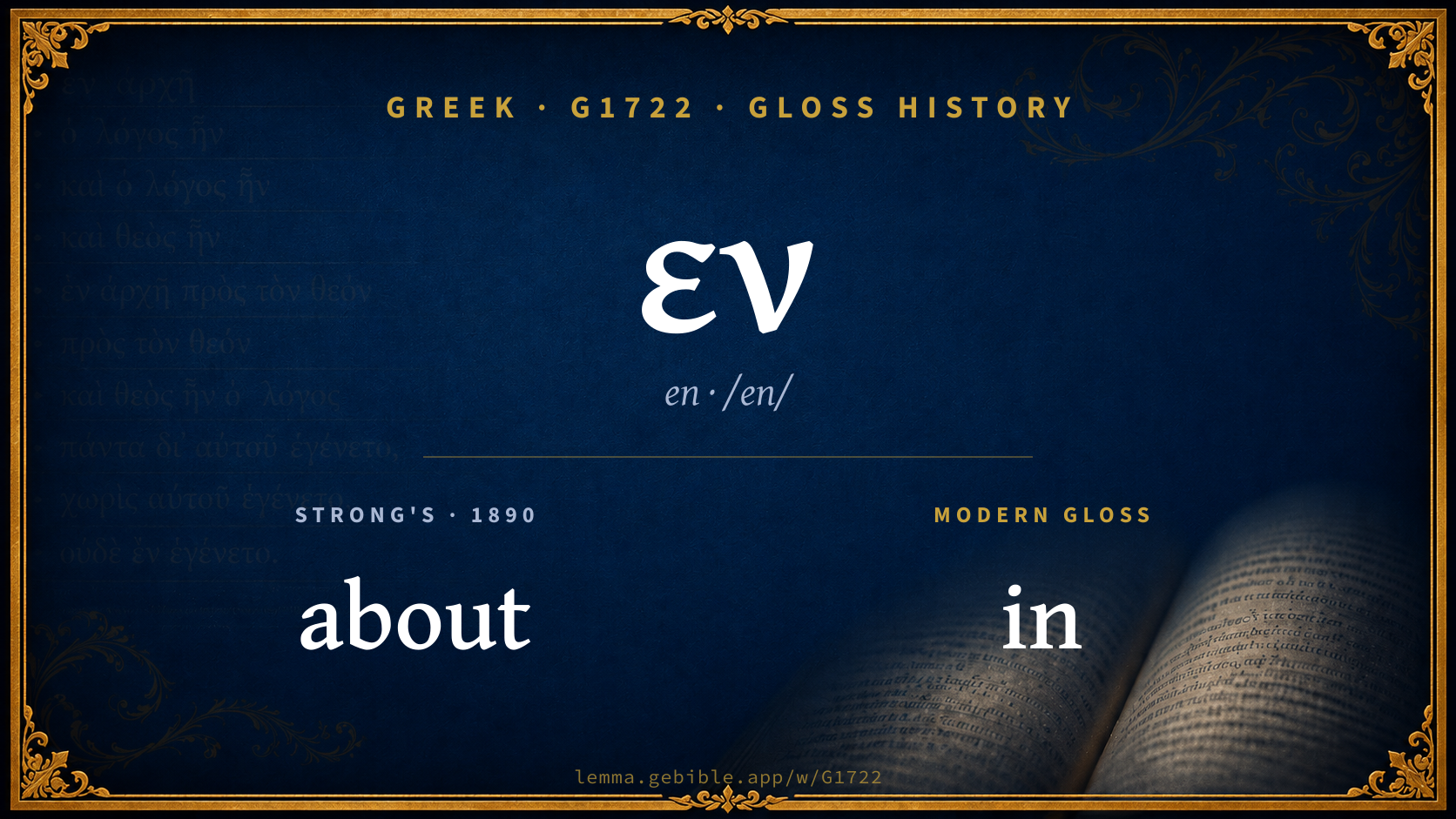
Gloss history
Strong's 1890 vs modern scholarship
About this word
Strong's G1722 catalogs a Greek word from the Greek New Testament.
These counts are not copied from any lexicon or concordance. They are computed here, from the morphology-tagged Greek New Testament. What Lemma adds →
- 2,097
- distinct verses
- The word appears in 2,097 distinct verses.
- 27 / 27
- NT books
- The word appears in 27 of 27 New Testament books.
- #5
- by frequency
- Top 10 most frequent Greek words (rank 5 of 5,347 Greek words by occurrence).
View all 2,097 occurrences in the concordance →
By section of the New Testament
By traditional corpus
Conventional, traditional groupings — biblical authorship is debated, so this is a traditional corpus grouping, not an authorship claim. Some books belong to more than one corpus (Luke is in both the Gospels and the Lukan corpus, and so on), so these shares overlap and need not total 100%. Each figure is a share of the word’s 2,097 distinct verses.
- Gospels 808 verses · 39%
- Pauline corpus 722 verses · 34%
- Lukan (Luke–Acts) 510 verses · 24%
- Johannine 352 verses · 17%
- General (Catholic) Epistles 167 verses · 8%
- Revelation 123 verses · 6%
- Hebrews 55 verses · 3%
How translations render this word
Counts come from each version’s own published word-to-Strong’s tagging or interlinear alignment — an approximate guide to how each version renders this word, not a word-level alignment the data otherwise carries. Because each total is that version’s own tagged count, the per-version totals vary from one another and need not match the appearance or distinct-verse counts above. These counts may also differ from a printed concordance because Lemma counts each distinctly tagged rendering and does not collapse phrase taggings into a single head-word total. This is a fixed set of word-tagged versions (KJV, ASV, BSB, ULT) and does not change with the reading translation you choose elsewhere. Each version’s license is shown beside its name below (and on Sources).
- King James Version: In 1,748×, By 142×, With 135×
- American Standard Version: In 1,856×, With 116×, Among 97×
- Berean Standard Bible: In 1,512×, By 152×, With 144×
- unfoldingWord Literal Text: In 2,007×, With 135×, Among 125×
King James Version Public Domain
Renders G1722 across 2,770 tagged occurrences — most commonly:
Plus other, less common renderings. Plus 91 renderings that appear only once — usually multi-word phrases or single function words the recovered tagging swept in, not distinct renderings. Not rendered by a distinct English word in 30 further occurrences.
American Standard Version Public Domain
Renders G1722 across 2,612 tagged occurrences — most commonly:
Plus other, less common renderings. Plus 133 renderings that appear only once — usually multi-word phrases or single function words the recovered tagging swept in, not distinct renderings. Not rendered by a distinct English word in 6 further occurrences.
Berean Standard Bible Public Domain
Renders G1722 across 2,394 tagged occurrences — most commonly:
Plus other, less common renderings. Plus 53 renderings that appear only once — usually multi-word phrases or single function words the recovered tagging swept in, not distinct renderings. Not rendered by a distinct English word in 224 further occurrences.
unfoldingWord Literal Text CC BY-SA 4.0
Renders G1722 across 2,754 tagged occurrences — most commonly:
Plus other, less common renderings. Plus 36 renderings that appear only once — usually multi-word phrases or single function words the recovered tagging swept in, not distinct renderings.
Senses in Thayer's
The 1 sense Thayer's distinguishes for this word, in lexicon order (not ranked by frequency or importance). The full entry — with sub-senses — is in the Lexicon Entry tab.
- in, by, with etc.
Word origin
Derived from εις (eis) (G1519) — into.
A primary preposition denoting (fixed) position (in place time or state) and (by implication) instrumentality (medially or constructively) that is a relation of rest (intermediate between G1519 and G1537 ); in at (up-) on by etc. : - about after against + almost X altogether among X as at before between (here-) by (+ all means) for (... sake of) + give self wholly to (here-) in (-to -wardly) X mightily (because) of (up-) on [open-] ly X outwardly one X quickly X shortly [speedi-] ly X that X there (-in -on) through (-out) (un-) to(-ward) under when where (-with) while with (-in). Often used in compounds with substantially the same import; rarely with verbs of motion and then not to indicate direction except (elliptically) by a separate (and different) prep.
— Strong’s Exhaustive Concordance (1890), public domain.
Forms in the corpus
The 5 distinct written forms G1722 takes in the Greek New Testament, most frequent first — each parse links to that case’s occurrences in the concordance.
| Form | Parsing | Example | Uses |
|---|---|---|---|
| ἐν en | Preposition | Matthew 1:18 | 2,703 |
| Ἐν En | Preposition | Matthew 3:1 | 25 |
| ἔν én | Preposition | Luke 18:2 | 8 |
| ἓν hèn | Preposition | Mark 4:20 | 3 |
| [ἐν en | Preposition | Ephesians 1:1 | 1 |
Same root — word family
Other Thayer's entries built from the same root as G1722, grouped by Strong’s listed origin. These share a root / origin per the lexicon — not necessarily a shared meaning. Each links to that word’s own entry.
Derives from
Shares the same root
- εισαγω eiságō G1521 to bring in
- εισακουω eisakoúō G1522 to obey
- εισδεχομαι eisdéchomai G1523 to receive
- εισειμι eíseimi G1524 to go in
- εισερχομαι eisérchomai G1525 to enter
- εισκαλεω eiskaléō G1528 to invite
- εισοδος eísodos G1529 entrance
- εισπηδαω eispēdáō G1530 to rush in
- εισπορευομαι eisporeúomai G1531 to enter
- ειστρεχω eistréchō G1532 to run in
- εισφερω eisphérō G1533 to bring in
- εσοπτρον ésoptron G2072 mirror
- εσω ésō G2080 within
- σκυβαλον skýbalon G4657 refuse
Derived from this word
- εγγραφω engráphō G1449 to inscribe
- εγγυος éngyos G1450 surety
- εγκαθετος enkáthetos G1455 to spy
- εγκαινια enkaínia G1456 dedication
- εγκαλεω enkaléō G1458 to accuse
- εγκαταλειπω enkataleípō G1459 to abandon
- εγκατοικεω enkatoikéō G1460 to dwell
- εγκεντριζω enkentrízō G1461 to graft
- εγκομβοομαι enkombóomai G1463 band
- εγκοπτω enkóptō G1465 to hinder
- εγκρατης enkratḗs G1468 strong
- εγκρινω enkrínō G1469 to judge worthy
- εγκρυπτω enkrýptō G1470 to conceal
- εγκυος énkyos G1471 pregnant
- εγχριω enchríō G1472 to anoint
- ελλογεω ellogéō G1677 impute
- εμβαινω embaínō G1684 to enter
- εμβαλλω embállō G1685 to cast in
- εμβαπτω embáptō G1686 to dip in
- εμβατευω embateúō G1687 to enter
- εμβιβαζω embibázō G1688 to lead in
- εμβλεπω emblépō G1689 to look at
- εμβριμαομαι embrimáomai G1690 to warn sternly
- εμμαινομαι emmaínomai G1693 to rage against
+59 more words derive from G1722 (not shown).
Compare all same-root words → Showing 4 of 99 — not the complete family. They share a root, not necessarily a meaning.
Septuagint usage
The same Greek word εν appears 11,235 times in the Greek Old Testament (Septuagint), across 7,742 verses in 38 books.
- 11,235
- LXX occurrences
- Tagged occurrences of this Greek word in the Septuagint.
- 7,742
- verses
- Distinct Septuagint verses containing this word.
- 38 / 39
- OT books
- The word appears in 38 of the 39 Old Testament books.
Sample Septuagint occurrences
- Genesis 1:1 ἐν
- Exodus 1:5 ἐν
- Leviticus 2:4 ἐν
- Numbers 1:1 ἐν
- Deuteronomy 1:1 ἐν
- Joshua 1:5 ἐν
- Judges 1:2 ἐν
- Ruth 1:1 ἐν
- 1 Samuel 1:1 ἐν
- 2 Samuel 1:1 ἐν
- 1 Kings 1:17 ἐν
- 2 Kings 1:1 ἐν
Septuagint occurrences (same lexeme)
Every verse where the same Strong’s number (G1722) appears in the Greek Septuagint — showing the first 50 of 7,742. Verse text shown in the World English Bible for context; the Greek form is the matched word — the English is not keyword-highlighted.
- Genesis 1:1 ἐν In the beginning God created the heavens and the earth.
- Genesis 1:6 ἐν God said, "Let there be an expanse in the midst of the waters, and let it divide the waters from the waters."
- Genesis 1:11 ἐν God said, "Let the earth put forth grass, herbs yielding seed, and fruit trees bearing fruit after their kind, with its seed in it, on the earth," and it was so.
- Genesis 1:12 ἐν The earth brought forth grass, herbs yielding seed after their kind, and trees bearing fruit, with its seed in it, after their kind: and God saw that it was good.
- Genesis 1:14 ἐν God said, "Let there be lights in the expanse of sky to divide the day from the night; and let them be for signs, and for seasons, and for days and years;
- Genesis 1:15 ἐν and let them be for lights in the expanse of sky to give light on the earth," and it was so.
- Genesis 1:17 ἐν God set them in the expanse of sky to give light to the earth,
- Genesis 1:22 ἐν God blessed them, saying, "Be fruitful, and multiply, and fill the waters in the seas, and let birds multiply on the earth."
- Genesis 1:29 ἐν God said, "Behold, I have given you every herb yielding seed, which is on the surface of all the earth, and every tree, which bears fruit yielding seed. It will be your food.
- Genesis 1:30 ἐν To every animal of the earth, and to every bird of the sky, and to everything that creeps on the earth, in which there is life, I have given every green herb for food." And it was so.
- Genesis 2:2 ἐν On the seventh day God finished his work which he had made; and he rested on the seventh day from all his work which he had made.
- Genesis 2:3 ἐν God blessed the seventh day, and made it holy, because he rested in it from all his work which he had created and made.
- Genesis 2:8 ἐν Yahweh God planted a garden eastward, in Eden, and there he put the man whom he had formed.
- Genesis 2:9 ἐν Out of the ground Yahweh God made every tree to grow that is pleasant to the sight, and good for food; the tree of life also in the midst of the garden, and the tree of the knowledge of good and evil.
- Genesis 2:15 ἐν Yahweh God took the man, and put him into the garden of Eden to dress it and to keep it.
- Genesis 2:16 ἐν Yahweh God commanded the man, saying, "Of every tree of the garden you may freely eat:
- Genesis 3:1 ἐν Now the serpent was more subtle than any animal of the field which Yahweh God had made. He said to the woman, "Yes, has God said, 'You shall not eat of any tree of the garden?'"
- Genesis 3:3 ἐν but of the fruit of the tree which is in the midst of the garden, God has said, 'You shall not eat of it, neither shall you touch it, lest you die.'"
- Genesis 3:5 ἐν for God knows that in the day you eat it, your eyes will be opened, and you will be like God, knowing good and evil."
- Genesis 3:8 ἐν They heard the voice of Yahweh God walking in the garden in the cool of the day, and the man and his wife hid themselves from the presence of Yahweh God among the trees of the garden.
- Genesis 3:10 ἐν The man said, "I heard your voice in the garden, and I was afraid, because I was naked; and I hid myself."
- Genesis 3:16 ἐν To the woman he said, "I will greatly multiply your pain in childbirth. In pain you will bring forth children. Your desire will be for your husband, and he will rule over you."
- Genesis 3:17 ἐν To Adam he said, "Because you have listened to your wife's voice, and have eaten of the tree, of which I commanded you, saying, 'You shall not eat of it,' cursed is the ground for your sake. In toil you will eat of it all the days of your life.
- Genesis 3:19 ἐν By the sweat of your face will you eat bread until you return to the ground, for out of it you were taken. For you are dust, and to dust you shall return."
- Genesis 4:8 ἐν Cain said to Abel, his brother, "Let's go into the field." It happened, when they were in the field, that Cain rose up against Abel, his brother, and killed him.
- Genesis 4:16 ἐν Cain went out from Yahweh's presence, and dwelt in the land of Nod, on the east of Eden.
- Genesis 4:20 ἐν Adah gave birth to Jabal, who was the father of those who dwell in tents and have cattle.
- Genesis 6:3 ἐν Yahweh said, "My Spirit will not strive with man forever, because he also is flesh; yet will his days be one hundred twenty years."
- Genesis 6:4 ἐν The Nephilim were in the earth in those days, and also after that, when God's sons came to men's daughters. They bore children to them: the same were the mighty men who were of old, men of renown.
- Genesis 6:5 ἐν Yahweh saw that the wickedness of man was great in the earth, and that every imagination of the thoughts of his heart was only evil continually.
- Genesis 6:9 ἐν This is the history of the generations of Noah. Noah was a righteous man, blameless among the people of his time. Noah walked with God.
- Genesis 6:17 ἐν I, even, I do bring the flood of waters on this earth, to destroy all flesh having the breath of life from under the sky. Everything that is in the earth will die.
- Genesis 7:1 ἐν Yahweh said to Noah, "Come with all of your household into the ark, for I have seen your righteousness before me in this generation.
- Genesis 7:11 ἐν In the six hundredth year of Noah's life, in the second month, on the seventeenth day of the month, on the same day all the fountains of the great deep were burst open, and the sky's windows were opened.
- Genesis 7:13 ἐν In the same day Noah, and Shem, Ham, and Japheth, the sons of Noah, and Noah's wife, and the three wives of his sons with them, entered into the ark;
- Genesis 7:15 ἐν They went to Noah into the ark, by pairs of all flesh with the breath of life in them.
- Genesis 7:23 ἐν Every living thing was destroyed that was on the surface of the ground, including man, cattle, creeping things, and birds of the sky. They were destroyed from the earth. Only Noah was left, and those who were with him in the ark.
- Genesis 8:1 ἐν God remembered Noah, all the animals, and all the cattle that were with him in the ark; and God made a wind to pass over the earth. The waters subsided.
- Genesis 8:4 ἐν The ark rested in the seventh month, on the seventeenth day of the month, on Ararat's mountains.
- Genesis 8:5 ἐν The waters receded continually until the tenth month. In the tenth month, on the first day of the month, the tops of the mountains were seen.
- Genesis 8:11 ἐν The dove came back to him at evening, and, behold, in her mouth was an olive leaf plucked off. So Noah knew that the waters were abated from off the earth.
- Genesis 8:13 ἐν It happened in the six hundred first year, in the first month, the first day of the month, the waters were dried up from off the earth. Noah removed the covering of the ark, and looked. He saw that the surface of the ground was dried.
- Genesis 8:14 ἐν In the second month, on the twenty-seventh day of the month, the earth was dry.
- Genesis 9:4 ἐν But flesh with the life of it, the blood of it, you shall not eat.
- Genesis 9:6 ἐν Whoever sheds man's blood, by man will his blood be shed, for in the image of God made he man.
- Genesis 9:13 ἐν I set my rainbow in the cloud, and it will be for a sign of a covenant between me and the earth.
- Genesis 9:14 ἐν It will happen, when I bring a cloud over the earth, that the rainbow will be seen in the cloud,
- Genesis 9:15 ἐν and I will remember my covenant, which is between me and you and every living creature of all flesh, and the waters will no more become a flood to destroy all flesh.
- Genesis 9:16 ἐν The rainbow will be in the cloud. I will look at it, that I may remember the everlasting covenant between God and every living creature of all flesh that is on the earth."
- Genesis 9:21 ἐν He drank of the wine, and got drunk. He was uncovered within his tent.
These are occurrences of the same Greek lexeme (G1722) in the Septuagint — not a translation of any one Hebrew word. The store carries no word-level Hebrew↔Greek alignment, so no Hebrew original is asserted here. Counts come from the recovered LXX Strong's tagging — high-frequency vocabulary is well covered, while rare or late forms may be untagged — so they reflect tagged occurrences and may slightly undercount.