
Matthew 7:2

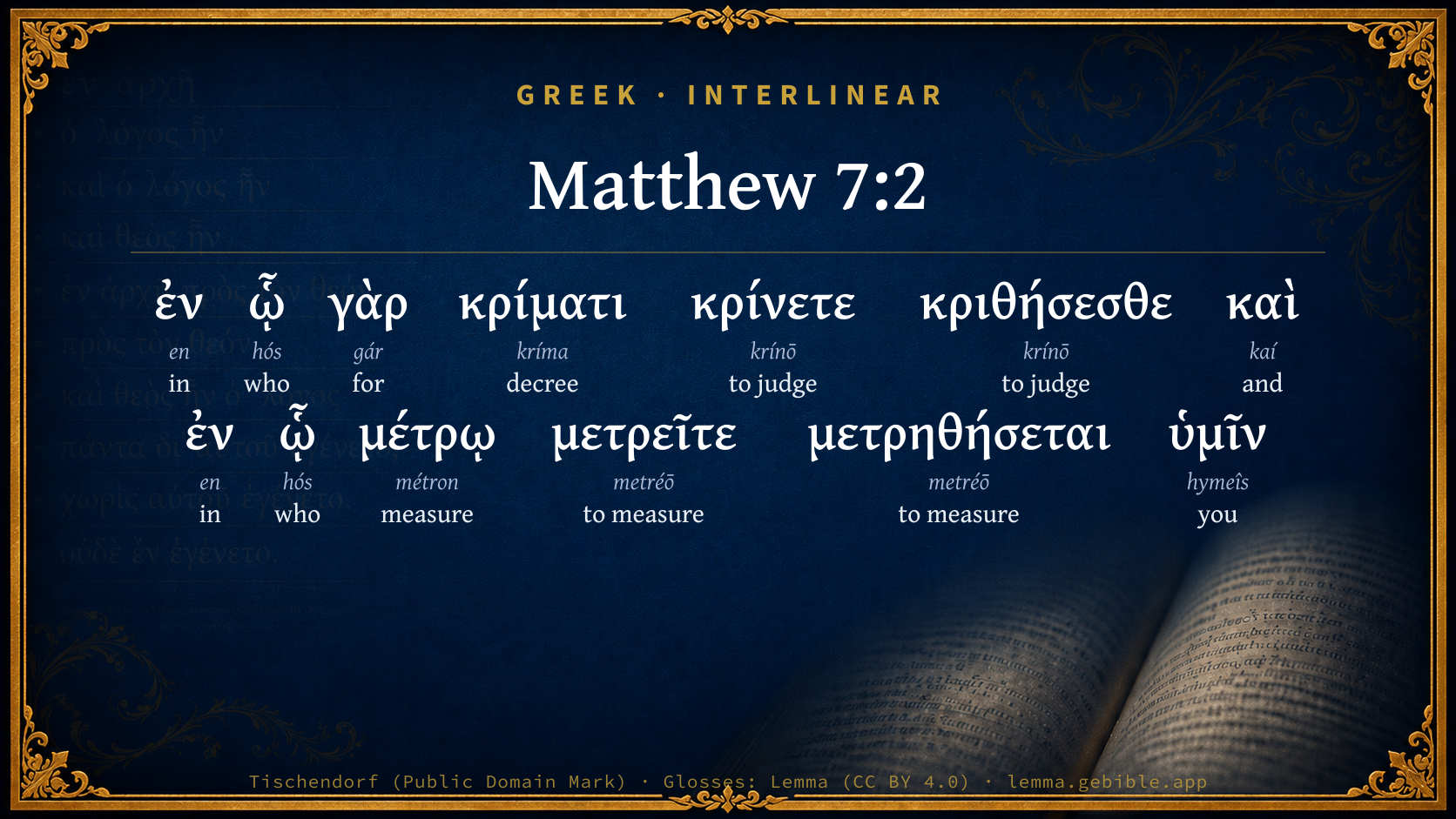
Greek (Tischendorf 8th ed.) Matthew 7:2 appears in the Greek New Testament. The text above is from the Tischendorf 8th edition. Each word links to its Strong’s number and a concise gloss. Click any word for its full Thayer’s Greek Lexicon entry.
Download image
Cite this verse

Matthew 7:2 (World English Bible). Public Domain. Lemma interlinear Bible study tool, https://lemma.gebible.app/v/matthew/7/2.

Show BibTeX & RIS
BibTeX
RIS
English Translation
For with whatever judgment you judge, you will be judged; and with whatever measure you measure, it will be measured to you.
World English Bible · Public Domain
Highlights
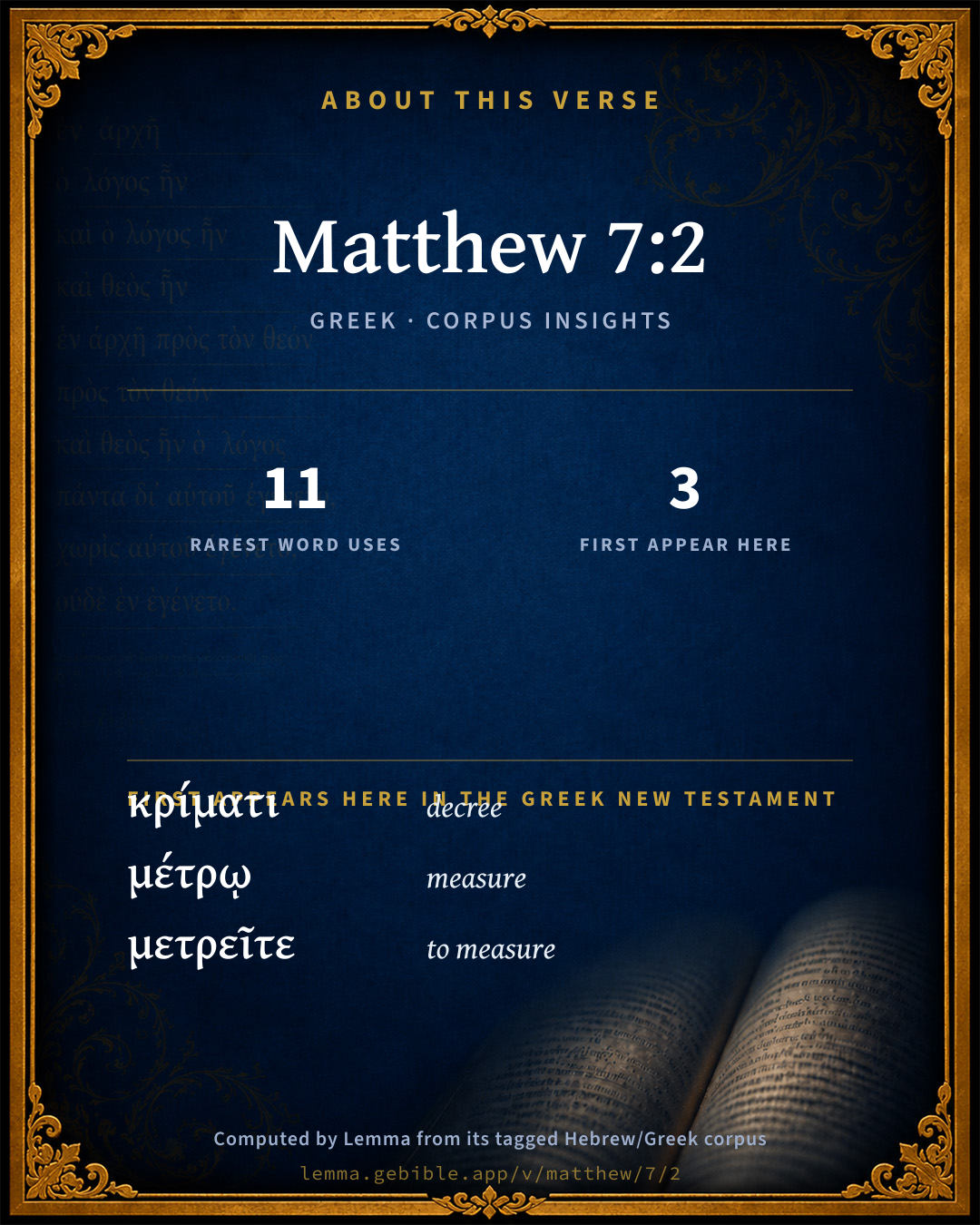
  • 3 first appearances in the Greek New Testament
Full analysis ↓
Download a study sheet

One document with this verse’s original text, its word-by-word gloss line, the meaning frame, cross-references with their text, attributed commentary, and full source and license credits — printable, and it pastes into notes with its structure intact.

This verse Autodidact and up

Study sheet (.html) Plain text (.txt)

A passage Seminary Student

Up to 50 verses in one chapter. A passage sheet keeps up to 6 commentary sources and 12 cross-references per verse, in the order this page ranks them, and says so on the sheet whenever that leaves anything out. Ask for a single verse and you get the Autodidact verse sheet above.

Everything on this page stays free to read, with no account — the sheet is a download of what is already on screen, not access to it.

Want to remove ads? Support Godless Engineer
Compare translations 3

The same verse in 3 English versions, stacked beneath the original-language interlinear above. Click any original word for its lexicon entry.

Each is an independent rendering of the whole verse — the interlinear is not word-aligned to these translations.

Highlighted words mark where these versions differ — a whole-verse word diff, not a word-by-word alignment.

  • World English Bible Public Domain
    For with whatever judgment you judge, you will be judged; and with whatever measure you measure, it will be measured to you.
  • King James Version Public Domain
    For with what judgment ye judge, ye shall be judged: and with what measure ye mete, it shall be measured to you again.
  • unfoldingWord Literal Text CC BY-SA 4.0
    For with the judgment by which you judge, you will be judged, and with the measure by which you measure, it will be measured to you.

unfoldingWord Literal Text — © unfoldingWord, licensed CC BY-SA 4.0. Word-aligned USFM3 via Door43 (git.door43.org/unfoldingWord/en_ult).

Versions to compare (up to 4)

3 of 4 selected

Show all 19 translations

Every available English version of this verse, each an independent rendering of the whole verse.

  • World English Bible Public Domain
    For with whatever judgment you judge, you will be judged; and with whatever measure you measure, it will be measured to you.
  • Berean Standard Bible Public Domain
    For with the same judgment you pronounce, you will be judged; and with the measure you use, it will be measured to you.
  • Majority Standard Bible Public Domain
    For with the same judgment you pronounce, you will be judged, and with the measure you use, it will be measured to you.
  • King James Version Public Domain
    For with what judgment ye judge, ye shall be judged: and with what measure ye mete, it shall be measured to you again.
  • American Standard Version (1901) Public Domain
    For with what judgment ye judge, ye shall be judged: and with what measure ye mete, it shall be measured unto you.
  • Revised Version (1885) Public Domain
    For with what judgment ye judge, ye shall be judged: and with what measure ye mete, it shall be measured unto you.
  • Geneva Bible (1599) Public Domain
    Eor with what iudgement ye iudge, ye shall be iudged, and with what measure ye mete, it shall be measured to you againe.
  • Douay-Rheims (1899) Public Domain
    For with what judgment you judge, you shall be judged: and with what measure you mete, it shall be measured to you again.
  • Young's Literal Translation Public Domain
    for in what judgment ye judge, ye shall be judged, and in what measure ye measure, it shall be measured to you.
  • Literal Standard Version CC BY-SA 4.0
    for in what judgment you judge, you will be judged, and in what measure you measure, it will be measured to you.
  • Unlocked Literal Bible CC BY-SA 4.0
    For with the judgment you judge, you will be judged, and with the measure that you measure, it will be measured out to you.
  • unfoldingWord Literal Text CC BY-SA 4.0
    For with the judgment by which you judge, you will be judged, and with the measure by which you measure, it will be measured to you.
  • Darby Bible Public Domain
    for with what judgment ye judge, ye shall be judged; and with what measure ye mete, it shall be measured to you.
  • World Messianic Bible Public Domain
    For with whatever judgment you judge, you will be judged; and with whatever measure you measure, it will be measured to you.
  • Webster's Bible Public Domain
    For with what judgment ye judge, ye shall be judged: and the measure which ye give, shall be measured to you again.
  • Free Bible Version CC BY-SA 4.0
    For whatever standard you use to judge others will be used to judge you, and whatever measurement you use to measure others will be used to measure you.
  • Bible in Basic English Public Domain
    For as you have been judging, so you will be judged, and with your measure will it be measured to you.
  • Text-Critical English NT CC BY 4.0
    For with the judgment you pronounce you will be judged, and with the measure you use it will be measured to you.
  • Tyndale New Testament (1534) Public Domain
    For as ye iudge so shall ye be iudged. And with what mesure ye mete with the same shall it be mesured to you agayne.

Literal Standard Version (2020), Covenant Press — licensed CC BY-SA 4.0. Text via the HelloAO Bible API (eBible.org). Unlocked Literal Bible (unfoldingWord) — licensed CC BY-SA 4.0. Text via the HelloAO Bible API (eBible.org). unfoldingWord Literal Text — © unfoldingWord, licensed CC BY-SA 4.0. Word-aligned USFM3 via Door43 (git.door43.org/unfoldingWord/en_ult). Free Bible Version, Dr. Jonathan Gallagher — licensed CC BY-SA 4.0. Text via the HelloAO Bible API (eBible.org).

Word by word

More ways to search: Search by grammar → Find every occurrence → Compare this word →

Practice this passage: Drill this verse → Learn its vocabulary →

μετρεῖτε
metréō
G3354
“to measure”
Verb, Present, Active, Indicative, 2nd person, Plural
Part of Speech
Verb
Tense
Present
Voice
Active
Mood
Indicative
Person
2nd person
Number
Plural
Full Thayer's Definition

Origin: from G3358

TDNT: 14:32,6

1. to measure, to measure out or off a. any space or distance with a measurer's reed or rule b. metaph. to judge according to any rule or standard, to estimate 2. to measure out, mete out to, i.e. to give by measure
  1. ἐν en G1722 “in” Preposition
  2. ᾧ hós G3739 “who” Relative pronoun, Dative, Singular, Neuter
  3. γὰρ gár G1063 “for” Conjunction
  4. κρίματι kríma G2917 “decree” Noun, Dative, Singular, Neuter
  5. κρίνετε krínō G2919 “to judge” Verb, Present, Active, Indicative, 2nd person, Plural
  6. κριθήσεσθε krínō G2919 “to judge” Verb, Future, Passive, Indicative, 2nd person, Plural
  7. καὶ kaí G2532 “and” Conjunction
  8. ἐν en G1722 “in” Preposition
  9. ᾧ hós G3739 “who” Relative pronoun, Dative, Singular, Neuter
  10. μέτρῳ métron G3358 “measure” Noun, Dative, Singular, Neuter
  11. μετρηθήσεται metréō G3354 “to measure” Verb, Future, Passive, Indicative, 3rd person, Singular
  12. ὑμῖν hymeîs G5210 “you” Personal pronoun, 2nd person, Dative, Plural

About this verse

These counts appear in no published source. They are computed here, from the morphology-tagged text and Lemma’s own curated glosses. What Lemma adds →

13
words
9
distinct lemmas
Gospels
section

Notable vocabulary

The rarest word here is μετρεῖτε to measure G3354 — appearing just 11 times in the whole Greek New Testament.

First appearance in Scripture

These words make their first canonical appearance in the Greek New Testament here:

  • κρίματι decree G2917
  • μέτρῳ measure G3358
  • μετρεῖτε to measure G3354

Shared distinctive vocabulary

μετρεῖτε to measure G3354 occurs in 9 verses of the Greek New Testament. Also found in:
Repetition

Words recur within this verse:

  • κρίνετε to judge G2919 ×2
  • μετρεῖτε to measure G3354 ×2
  • ἐν in G1722 ×2
  • ᾧ who G3739 ×2

Cross-references

11

Topical passages linked to Matthew 7:2 in the Treasury of Scripture Knowledge — connected by theme and wording, ordered by reader-vote popularity; previews shown in the World English Bible.

  • James 2:13 For judgment is without mercy to him who has shown no mercy. Mercy triumphs over judgment.
  • Mark 4:24 He said to them, "Take heed what you hear. With whatever measure you measure, it will be measured to you, and more will be given to you who hear.
  • Obadiah 1:15 For the day of Yahweh is near all the nations! As you have done, it will be done to you. Your deeds will return upon your own head.
  • Luke 6:38 "Give, and it will be given to you: good measure, pressed down, shaken together, and running over, will be given to you. For with the same measure you measure it will be measured back to you."
  • Psalms 18:25–26 With the merciful you will show yourself merciful. With the perfect man, you will show yourself perfect.
  • Revelation 18:6 Return to her just as she returned, and repay her double as she did, and according to her works. In the cup which she mixed, mix to her double.
  • Judges 1:7 Adoni-bezek said, "Seventy kings, having their thumbs and their great toes cut off, gathered [their food] under my table: as I have done, so God has requited me." They brought him to Jerusalem, and he died there.
  • 2 Corinthians 9:6 Remember this: he who sows sparingly will also reap sparingly. He who sows bountifully will also reap bountifully.
  • 2 Thessalonians 1:6–7 Since it is a righteous thing with God to repay affliction to those who afflict you,
  • Psalms 137:7–8 Remember, Yahweh, against the children of Edom, The day of Jerusalem; Who said, "Raze it! Raze it even to its foundation!"
  • Jeremiah 51:24 I will render to Babylon and to all the inhabitants of Chaldea all their evil that they have done in Zion in your sight, says Yahweh.

Cross-references courtesy of OpenBible.info (CC BY 4.0).

Commentary

Notes on Matthew 7:2 from classic Christian and Jewish commentators (each source and its license shown beneath its notes). The classic Christian expositions comment on the surrounding passage and are grouped to its opening verse, so a note may address several verses; the Jewish commentaries on the Tanakh (Rashi and others) are per-verse, so they appear only where the commentator wrote on this verse.

Lemma curates 59 commentaries, every one of them public domain or Creative Commons licensed, each selected and text-cleaned for this edition rather than reprinted as found. About our sources →

Trapp's Complete Commentary

John Trapp

2 For with what judgment ye judge, ye shall be judged: and with what measure ye mete, it shall be measured to you again.

Ver. 2. For with what judgment ye judge, &c.] Our Saviour sets forth what he had said before by these two proverbial sentences, as well known among them as those among us: "Ye shall sow as ye reap, drink as ye brew, be served with the same sauce," &c. {a} Compare herewith those divine proverbs, Isa 33:1; Pro 12:14; Pro 13:2; Pro 13:21; Pro 14:14; Pro 14:22; Pro 22:8; Job 6:8; Mar 6:24. God delights to give men their own, as good as they brought, to pay them home in their own coin, or, as the text here and the Hebrew proverb hath it, to remit to them in their own measure, {b} Isa 3:10-11; with the merciful to show himself merciful, and with the froward to wrestle. He will be as froward as they for the hearts of them, beat them with their own weapons, overshoot them in their own bows, shape their estates according to their own patterns, and cause others to write after their copies, as it fared with Pharaoh, Adonibezek, Agag, &c. Sodom sinned in fulness of bread, and it is expressly noted that their victuals were taken from them by the four kings, Gen 14:11. Their eyes were full of uncleanness, and they were smitten with blindness; they burned with lust, and were burned with fire; they sinned against nature, and against the course of nature, fire descends and consumes them. Eglon, stabbed into the guts, finds his bane the same way with his sin. Sisera annoys God’s people with his iron chariots, and is slain by a nail of iron. Jezebel’s brains, that devised mischief against the innocent, are strewed upon the stones; by a letter to Jezreel she shed the blood of Naboth, and by a letter from Jezreel the blood of her sons is shed. Nebuchadnezzar destroyed Solomen’s temple (that seven years’ work of so many thousands), therefore let him be turned a grazing, and seven seasons pass over him, saith the oracle, Dan 4:16. The blasphemers in the Revelation "gnaw their tongues" through pain, and Dives (for like cause) was tormented in that part chiefly. {c} Apion scoffing at religion, and especially at circumcision, had an ulcer at the same time and in the same place. Phocas, a wild, drunken, bloody, adulterous tyrant, was worthily slaughtered by Heraclius, who cut off his hands and feet, and then his genitals by piecemeal. The Donatists, that cast the holy elements in the Lord’s supper to dogs, were themselves afterward devoured of dogs. John Martin of Briqueras, a mile from Angrogne, vaunted everywhere that he would slit the minister’s nose of Angrogne, but was himself assaulted by a wolf, which bit off his nose, whereof he died mad. Sir Ralph Elerker, Knight Marshal of Calais, in Queen Mary’s reign, being present at the death of Adam Damlip, martyr, bid the executioner despatch, saying that he would not away till he saw the traitor’s heart out. Shortly after this Sir Ralph was slain, among others, in a skirmish at Bullein, and his heart cut out of his body by the enemies, -a terrible example to all merciless and bloody men, &c.; for no cause was known why they should use such indignation against him more than the rest, but that it is written, "With what measure ye mete, it shall be measured to you again." Bishop Ridley told Stephen Winchester that it was the hand of God that he was now in prison, because he had so troubled others in his time. And as he had inflamed so many good martyrs, so he died miserably of an inflammation, that caused him to thrust out his tongue all swollen and black, as Archbishop Arundel had died before him. The Archbishop of Tours made suit for the erection of a court, called Chambre Ardent, wherein to condenm the Protestants to the fire. He was afterwards stricken with a disease called "the fire of God," which began at his feet, and so ascended upward, that he caused one member after another to be cut off, and so died miserably. And there is mention made of one Christopher, an unmerciful courtier, who suffering a poor lazar {d} to die in a ditch by him, did afterwards perish himself in a ditch. To return to the present purpose: Laurentius Valla censured all that wrote before him; Erasmus comes after, and censures him as much; Beza finds as many faults with Erasmus, and not without cause, as appeareth by that one passage among many in his annotations on Rom 7:21; "I find then a law, that when I would do good, evil is present with me;" Erasmus Originem secutus, scripsit Paulum hoc Sermone balbutire, quum ipse potius ineptiat. Scaliger the hypercritic gives this absurd and unmannerly censure: Gothi belluae, Scoti non minus. Angli perfidi, inflati, feri, contemptores, stolidi, amentes, inertes, inhospitales, immanes. The Goths are beasts, so are the Scots. Englishmen are perfidious, proud, fierce, foolish, mad men, slow bellies, inhospitable, barbarous. Another comes after him, and saith, His bolt, you see, is soon shot, and so you may happily guess at the quality of the archer. Tacitus speaks reproachfully of both Jews and Christians; and is paid his own as well, both by Tertullian and Lipsius. {e} If men suffer in their good names, they may thank themselves, mostly. Contempt is a thing that man’s nature is most impatient of. Those that are given to slight and censure others, are punished with the common hatred of all. Imitation and retaliation are in all men naturally, as we may see in every child. And that of Solomon is in this sense found most rule, "As in water face answereth to face; so doth the heart of a man to a man." None are so shunned and censured as those that are most censorious. The places they live in groan for a vomit to spew them out.

{a} κριματος μετρον, Mat 7:2, est rigor iuris moderationi et mitigationi oppositus. Aret.

{b} See also Rev 13:10; Rev 18:6; Middah cenegedh middah. Psa 18:26.

{c} Quia lingua plus peccaverat.

{d} A poor and diseased person, usually one afflicted with a loathsome disease; esp. a leper. ŒD

{e} Taciturn Lipsius immemorem, secumque pugnantem; Tertullianus mendaciorum loquacissimum appellat.

John Trapp, A Commentary or Exposition upon All the Books of the Old and New Testament (1647–1656) — public domain. Text from a community e-Sword module.

Bengel's Gnomon

Johann Albrecht Bengel

Mat 7:2. Ἐν ᾧ μέτρῳ, with what measure) The principle of the lex talionis.[301]

[301] So it is not hard to judge, what retribution hereafter each one is likely to have.—V. g.

Bengel's Gnomon of the New Testament — English translation (T&T Clark, Edinburgh, 1860) — public domain. Text from a community e-Sword module.

Meyer's Critical & Exegetical Commentary

Heinrich August Wilhelm Meyer

Mat_7:2. Ἐν] Instrumental repetition of the same thought: Sota, ed. Wagenseil, p. 52. Comp. Schoettgen, p. 78. The second ἐν is also instrumental, by means of, and μέτρον is to be understood as a measure of capacity (Luk_6:38).

Meyer — Critical and Exegetical Commentary on the New Testament — English translation by Peter Christie, edited by Frederick Crombie (T&T Clark, 1880) — public domain. Text from a community e-Sword module.

Expositor's Greek Testament

ed. W. Robertson Nicoll

Mat 7:2 . ἐν ᾧ γὰρ , etc.: Vulgatissimum hoc apud Judaeos adagium, says Lightfoot (Hor. Heb.). Of course; one would expect such maxims, based on experience, to be current among all peoples ( vide Grotius for examples). It is the lex talionis in a new form: character for character . Jesus may have learned some of these moral adages at school in Nazareth, as we have all when boys learned many good things out of our lesson books with their collections of extracts. The point to notice is what the mind of Jesus assimilated the best in the wisdom of His people and the emphasis with which He inculcated the best, so as to ensure for it permanent lodgment in the minds of His disciples and in their records of His teaching.

The Expositor's Greek Testament, edited by W. Robertson Nicoll (1897–1910) — public domain. Text from a community e-Sword module.

Jamieson, Fausset & Brown

Robert Jamieson, A. R. Fausset & David Brown

For with what judgments ye Judge, ye shall be judged: and with what measure ye mete--whatever standard of judgment ye apply to others.

it shall be measured to you again--This proverbial maxim is used by our Lord in other connections--as in Mar 4:24, and with a slightly different application in Luk 6:38 --as a great principle in the divine administration. Unkind judgment of others will be judicially returned upon ourselves, in the day when God shall judge the secrets of men by Jesus Christ. But, as in many other cases under the divine administration, such harsh judgment gets self-punished even here. For people shrink from contact with those who systematically deal out harsh judgment upon others--naturally concluding that they themselves may be the next victims--and feel impelled in self-defense, when exposed to it, to roll back upon the assailant his own censures.

Jamieson, Fausset & Brown — Commentary Critical and Explanatory on the Whole Bible (1871) — public domain (CC PDM 1.0). Text via the HelloAO Bible API.

Adam Clarke's Commentary

Verse 2. For with what judgment] He who is severe on others will naturally excite their severity against himself. The censures and calumnies which we have suffered are probably the just reward of those which we have dealt out to others.

Adam Clarke's Commentary on the Bible (1810–1826) — public domain. Text from a community e-Sword/MySword module.

Ellicott's Commentary for English Readers

(2) With what judgment ye judge. . . .—Here again truth takes the form of a seeming paradox. The unjust judgment of man does not bring upon us a divine judgment which is also unjust; but the severity which we have unjustly meted out to others, becomes, by a retributive law, the measure of that which is justly dealt out to us.

A Bible Commentary for English Readers, edited by Charles John Ellicott (1878–1897) — public domain. Text from a community e-Sword module.

The Cambridge Bible for Schools and Colleges

gen. ed. J. J. S. Perowne

2. judgment] The same Greek word is used Rom_2:2-3 of the divine sentence or decision: see that passage and context which are closely parallel to these verses: cp. also Mar_12:40, where the same word is translated “damnation.”

The Cambridge Bible for Schools and Colleges (gen. ed. J. J. S. Perowne; Cambridge University Press, 1878–1918) — public domain. Text from a community e-Sword module.

John Gill's Exposition

For with what judgment ye judge, ye shall be judged,.... Both by God and men; to which agree those proverbial sentences used by the Jews;

"He that judgeth his neighbour according to the balance of righteousness, or innocence, they judge him according to righteousness.''

(w) And a little after,

"As ye have judged me according to the balance of righteousness, God will judge you according to the balance of righteousness.''

Hence that advice of Joshua ben Perachiah (x), who, by the Jewish writers, is said to be the master of Christ;

"Judge every man according to the balance of righteousness.''

Which their commentators explain thus (y); when you see a man as it were in "equilibrio", inclining to neither part, it is not clear from what he does, that he is either good or evil, righteous or unrighteous; yet when you see him do a thing which may be interpreted either to a good or a bad sense, it ought always to be interpreted to the best.

And with what measure you mete, it shall be measured to you again. This was an usual proverb among the Jews; it is sometimes delivered out thus, , "measure against measure" (z); but oftener thus, and nearer the form of it here, , "with what measure a man measures, they measure to him": one might fill up almost a page, in referring to places, where it is used in this form: besides those in the (a) margin, take the following, and the rather, because it gives instances of this retaliation (b):

""With what measure a man measures, they measure to him"; so the woman suspected of adultery, she adorned herself to commit sin, and God dishonoured her; she exposed herself to iniquity, God therefore stripped her naked; the same part of her body in which her sin begun, her punishment did. Samson walked after his eyes, and therefore the Philistines plucked out his eyes. Absalom was lifted up in his mind, with his hair, and therefore he was hanged by it; and because he lay with his father's ten concubines, they therefore pierced him with ten lances; and because he stole away three hearts, the heart of his father, the heart of the sanhedrim, and the heart of Israel, therefore he was thrust with three darts: and so it is with respect to good things; Miriam waited for Moses one hour, therefore the Israelites waited for her seven days in the wilderness; Joseph, who was greater than his brethren, buried his father; and Moses, who was the greatest among the Israelites took care of the bones of Joseph, and God himself buried Moses.''

(w) T. Bab. Sabbat, fol. 127. 2. (x) Pirke Abot, c. 1. sect. 6. (y) Maimon. & Bartenora in ib. (z) Bereshit Rabba, sect. 9. fol. 7. 4. (a) T. Bab. Megilla, fol. 12. 2. Sota, fol. 8. 2. Sanhedrim, fol. 100. 1. Zohar in Gen. fol. 87. 4. & in Lev. fol. 36. 1. & 39. 3. & in Num. fol. 67. 3. Bemidbar Rabba, fol. 194. 1. Misn. Beracot, c. 9. sect. 5. (b) Misn. Sota, c. 1. sect. 7, 8, 9. Vid. Tzeror Hammor, fol. 99. 1, 2.

John Gill's Exposition of the Whole Bible (1746–1763) — public domain (CC PDM 1.0). Text via the HelloAO Bible API.

Albert Barnes' Notes on the Bible

With what judgment ... - This was a proverb among the Jews. It expressed a truth; and Christ did not hesitate to adopt it as conveying his own sentiments. It refers no less to the way in which people will judge of us, than to the rule by which God will judge us. See 2Sa 22:27; Mar 4:24; Jam 2:13.

Mete - Measure. You shall be judged by the same rule which you apply to others.

Albert Barnes' Notes on the Bible (1834–1885) — public domain. Text from a community e-Sword/MySword module.

Haydock's Catholic Bible Commentary

This rule, which God will infallibly follow, should put a check to the freedom with which we so frequently condemn our neighbour. (Haydock) --- As we behave towards our neighbours, interpreting their actions with charitableness, and excusing their intentions with mildness; or, on the contrary, judging them with severity, and condemning them without pity; so shall we receive our judgment. (Menochius) --- As the pardon of our sins is proportioned to the pardon we afford to others, so also will our judgment be proportioned to the judgment we pass on others. If our neighbour be surprised by sin, we must not reproach or confound him for it, but mildly admonish him. Correct your brother, not as an enemy, taking revenge, but as a physician, administering appropriate remedies, assisting him with prudent counsels, and strengthening him in the love of God. (St. John Chrysostom, hom. xxiii.)

George Leo Haydock (1774–1849), Haydock's Catholic Family Bible and Commentary, 1859 edition — public domain. Excludes Psalms (Douay-Rheims chapter numbering differs from Protestant) and Deuterocanonical books (Catholic canon only).

Whedon's Commentary on the Bible

Daniel D. Whedon

2. Ye shall be judged — We must take care that our judgments will stand this test, and all is right. With what measure ye mete — Our Lord here states the divine penalty for this unholy judging. It is the divine retribution symbolically stated in the terms of the law of retaliation, like for like. The unjust judge shall be paid off in unjust judgment. To the froward God will prove himself froward. Psa_18:26. The sentiment literally is, The wicked estimator shall be judged according to his evil action.

Daniel D. Whedon (gen. ed.), Commentary on the Old and New Testaments (1874–1909) — public domain. Text from a community e-Sword module.

The Pulpit Commentary

Parallels to the second clause in Luk_6:38 and Mar_4:24, For. Explanatory of" that ye be not judged." The principle of your own judgment will be applied in turn to yourselves. With what judgment ye judge, ye shall be judged: and with what measure ye mete, it shall be measured to you again. The judgment (krima) is the verdict; the measure is the severity or otherwise of the verdict. In both clauses (cf. ver. 1, note) the passives refer to judgment by God, as is even more clear in Mar_4:24. The saying, "with what measure," etc., is found in Mishua, "Sotah," 1:7 ("With the measure with which a man measures do they measure to him"), where it is applied to the jus talionis in the case of a woman suspected of adultery. (Num_5:11-31) Again. Omitted by the Revised Version, with the manuscripts. It was naturally inserted by the copyists, either as an unconscious deduction or from the parallel passage in Luke; but it is absent in the characteristically Jewish form of the saying found in the Mishna.

The Pulpit Commentary (1880–1919), ed. H.D.M. Spence-Jones & Joseph S. Exell — public domain. Text from a community e-Sword module.

John Wesley's Explanatory Notes

With what measure ye mete, it shall be measured to you - Awful words! So we may, as it were, choose for ourselves, whether God shall be severe or merciful to us. God and man will favour the candid and benevolent: but they must expect judgment without mercy, who have showed no mercy.

John Wesley, Explanatory Notes Upon the Whole Bible (1754–1765) — public domain. Text via the GEBible commentary corpus.

The People's New Testament

B. W. Johnson

2. With what judgment ye judge ye shall be judged. Not by men, but by God. He takes note of the unkind, harsh, censorious spirit, and deals with the man according to his own spirit. There is declared here a great principle that runs through the moral government of God: Whatsoever a man soweth, that shall he also reap.

B. W. Johnson's The People's New Testament with Notes (1889–1891) — public domain. Electronic text from the Christian Classics Ethereal Library (CCEL) ThML edition.

Cambridge Greek Testament for Schools and Colleges

2. μετρηθήσεται for ἀντιμετρηθήσεται taken from parallel passage Luk 6:38. In Mat 7:28 again the simple verb is preferred on good authority to the compound συνετέλεσεν.

2. κρίμα, ‘judgment’ either (1) in the sense of a judicial sentence as Rom 2:2, τὸ κρίμα τοῦ θεοῦ ἐστὶν κατὰ ἀλήθειαν, or (2) a rule or principle of judging, apparently the meaning here. The notion of ‘censure’ or ‘condemnation’ passes into the word from the context as: οὗτοι λήμψονται περισσότερον κρίμα. Mar 12:40. The word is somewhat rare in the classics. In Æsch. Supp. 397 it means ‘the question in dispute,’ οὐκ εὔκριτον τὸ κρῖμα. For the accent see Winer’s Grammar, 57:2 and note 2. Penultimates long in Attic were sometimes shortened in later Greek, as θλίψις, ch. Mat 24:9.

Cambridge Greek Testament for Schools and Colleges (Cambridge University Press, 1896; 21 vols, various authors incl. Carr, Maclear, Plummer, Farrar, Lumby, Moule, M. R. James, Simcox) — public domain. Text from a community e-Sword module.

Alford’s Greek Testament

Henry Alford

2.] ἐν, not instrumental, but of the sphere in which the act takes place, i.e. in this case, the measure, according to which: as in ref. 2 Cor., ἐν ἑαυτοῖς ἑαυτοὺς μετροῦντες.

Henry Alford, The Greek Testament (1849–1861) — public domain. Text from a community e-Sword module.

Lesson kit

Teaching starters — assembled from the data on this page, not authored interpretation. Every prompt links to the verse data it draws on. Edit before teaching.

Matthew, in the Gospels, opens this verse with 13 words (9 distinct Greek lemmas). Its most distinctive word is metréō (“to measure”). A historical commentator’s framing appears above. Read the whole chapter for the surrounding context.

Discussion questions

  1. What does “to measure” (metréō) contribute to the verse as a whole?
  2. 3 words make their first appearance in Scripture here. What does this debut establish?
  3. How does Mark 4:24, which shares the word «to measure», read alongside this verse?
  4. What does the repetition of “to judge” (2× in this one verse) do in this verse?
  5. These translations render this verse differently; the difference is in the English rendering, not the original. What questions does that raise?
  6. Compare how Trapp's Complete Commentary and Bengel's Gnomon read this verse. Where do they agree or differ?

Things to notice

  • 3 words make their first canonical appearance in Scripture here.
  • These translations choose different wording for 7 words in this verse.
  • “to judge” occurs 2× in this single verse.
  • 9 distinct Greek lemmas span 13 words in this verse.

Reading settings

Reading text

Shown beneath each verse's original-language words.

Old Testament
Old Testament edition

Read the OT as the Masoretic Hebrew (MT) or the Greek Septuagint (LXX).

English shown for the Greek Septuagint (in the Hebrew ↔ Greek comparison).

Comparing translations? Open the Compare panel on any verse page to stack up to four side by side.