Matthew 24:16

Greek (Tischendorf 8th ed.) Matthew 24:16 appears in the Greek New Testament. The text above is from the Tischendorf 8th edition. Each word links to its Strong’s number and a concise gloss. Click any word for its full Thayer’s Greek Lexicon entry.
Download image
Cite this verse

Matthew 24:16 (World English Bible). Public Domain. Lemma interlinear Bible study tool, https://lemma.gebible.app/v/matthew/24/16.

Show BibTeX & RIS
BibTeX
RIS
English Translation
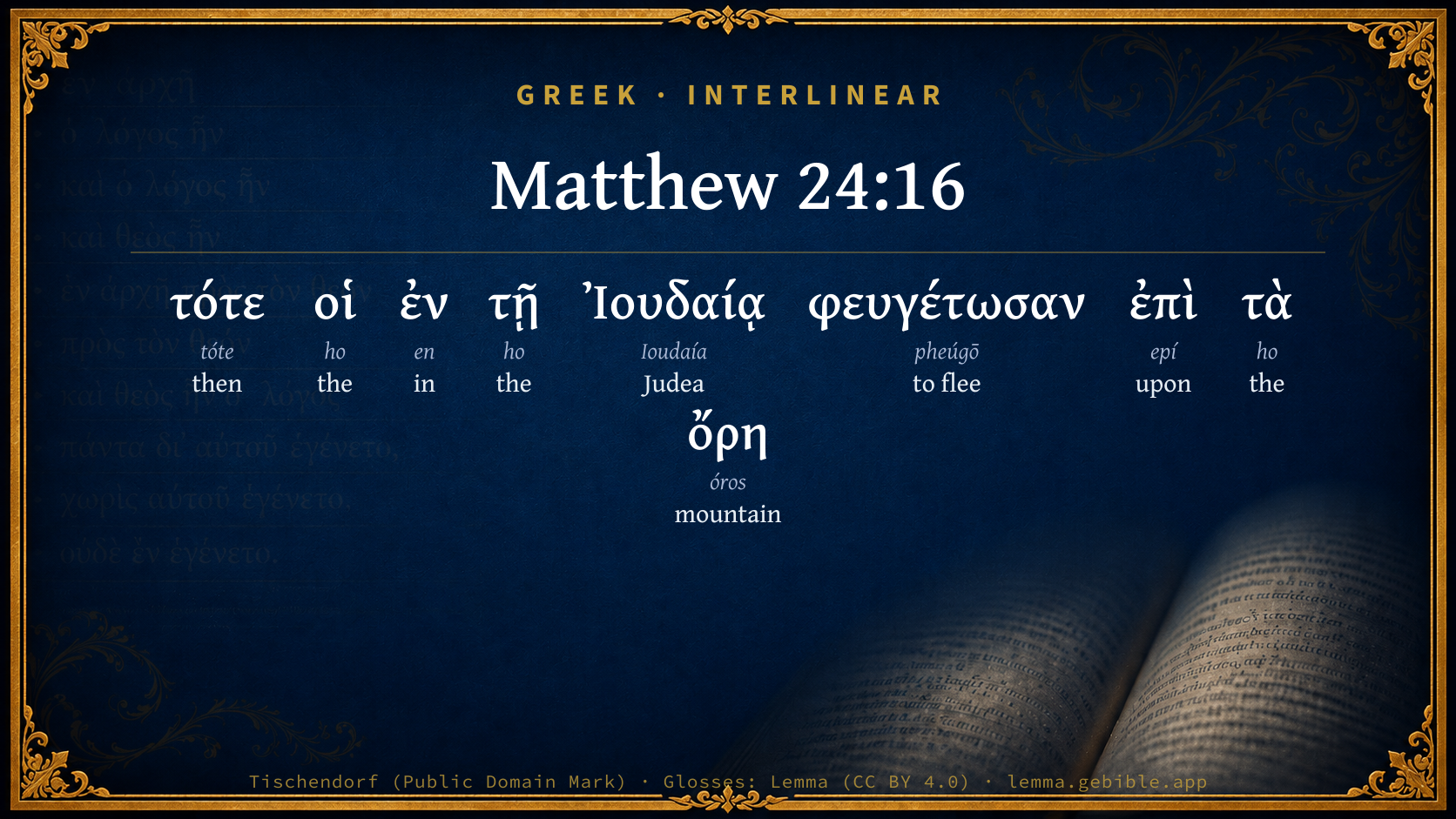
then let those who are in Judea flee to the mountains.
World English Bible · Public Domain
Download a study sheet

One document with this verse’s original text, its word-by-word gloss line, the meaning frame, cross-references with their text, attributed commentary, and full source and license credits — printable, and it pastes into notes with its structure intact.

This verse Autodidact and up

Study sheet (.html) Plain text (.txt)

A passage Seminary Student

Up to 50 verses in one chapter. A passage sheet keeps up to 6 commentary sources and 12 cross-references per verse, in the order this page ranks them, and says so on the sheet whenever that leaves anything out. Ask for a single verse and you get the Autodidact verse sheet above.

Everything on this page stays free to read, with no account — the sheet is a download of what is already on screen, not access to it.

Want to remove ads? Support Godless Engineer
Compare translations 3

The same verse in 3 English versions, stacked beneath the original-language interlinear above. Click any original word for its lexicon entry.

Each is an independent rendering of the whole verse — the interlinear is not word-aligned to these translations.

Highlighted words mark where these versions differ — a whole-verse word diff, not a word-by-word alignment.

  • World English Bible Public Domain
    then let those who are in Judea flee to the mountains.
  • King James Version Public Domain
    Then let them which be in Judaea flee into the mountains:
  • unfoldingWord Literal Text CC BY-SA 4.0
    “then let the ones in Judea flee to the mountains,

unfoldingWord Literal Text — © unfoldingWord, licensed CC BY-SA 4.0. Word-aligned USFM3 via Door43 (git.door43.org/unfoldingWord/en_ult).

Versions to compare (up to 4)

3 of 4 selected

Show all 19 translations

Every available English version of this verse, each an independent rendering of the whole verse.

  • World English Bible Public Domain
    then let those who are in Judea flee to the mountains.
  • Berean Standard Bible Public Domain
    then let those who are in Judea flee to the mountains.
  • Majority Standard Bible Public Domain
    then let those who are in Judea flee to the mountains.
  • King James Version Public Domain
    Then let them which be in Judaea flee into the mountains:
  • American Standard Version (1901) Public Domain
    then let them that are in Judaea flee unto the mountains:
  • Revised Version (1885) Public Domain
    then let them that are in Judaea flee unto the mountains:
  • Geneva Bible (1599) Public Domain
    Then let them which be in Iudea, flee into the mountaines.
  • Douay-Rheims (1899) Public Domain
    Then they that are in Judea, let them flee to the mountains:
  • Young's Literal Translation Public Domain
    then those in Judea -- let them flee to the mounts;
  • Literal Standard Version CC BY-SA 4.0
    then those in Judea—let them flee to the mountains;
  • Unlocked Literal Bible CC BY-SA 4.0
    “let those who are in Judea flee to the mountains,
  • unfoldingWord Literal Text CC BY-SA 4.0
    “then let the ones in Judea flee to the mountains,
  • Darby Bible Public Domain
    then let those who are in Judaea flee to the mountains;
  • World Messianic Bible Public Domain
    then let those who are in Judea flee to the mountains.
  • Webster's Bible Public Domain
    Then let them who are in Judea flee to the mountains:
  • Free Bible Version CC BY-SA 4.0
    then the people living in Judea should run away to the mountains.
  • Bible in Basic English Public Domain
    Then let those who are in Judaea go in flight to the mountains:
  • Text-Critical English NT CC BY 4.0
    “then those who are in Judea must flee to the mountains.
  • Tyndale New Testament (1534) Public Domain
    Then let them which be in Iury flye into the moutaynes.

Literal Standard Version (2020), Covenant Press — licensed CC BY-SA 4.0. Text via the HelloAO Bible API (eBible.org). Unlocked Literal Bible (unfoldingWord) — licensed CC BY-SA 4.0. Text via the HelloAO Bible API (eBible.org). unfoldingWord Literal Text — © unfoldingWord, licensed CC BY-SA 4.0. Word-aligned USFM3 via Door43 (git.door43.org/unfoldingWord/en_ult). Free Bible Version, Dr. Jonathan Gallagher — licensed CC BY-SA 4.0. Text via the HelloAO Bible API (eBible.org).

Word by word

More ways to search: Search by grammar → Find every occurrence → Compare this word →

Practice this passage: Drill this verse → Learn its vocabulary →

About this verse

These counts appear in no published source. They are computed here, from the morphology-tagged text and Lemma’s own curated glosses. What Lemma adds →

9
words
7
distinct lemmas
Gospels
section

Shared distinctive vocabulary

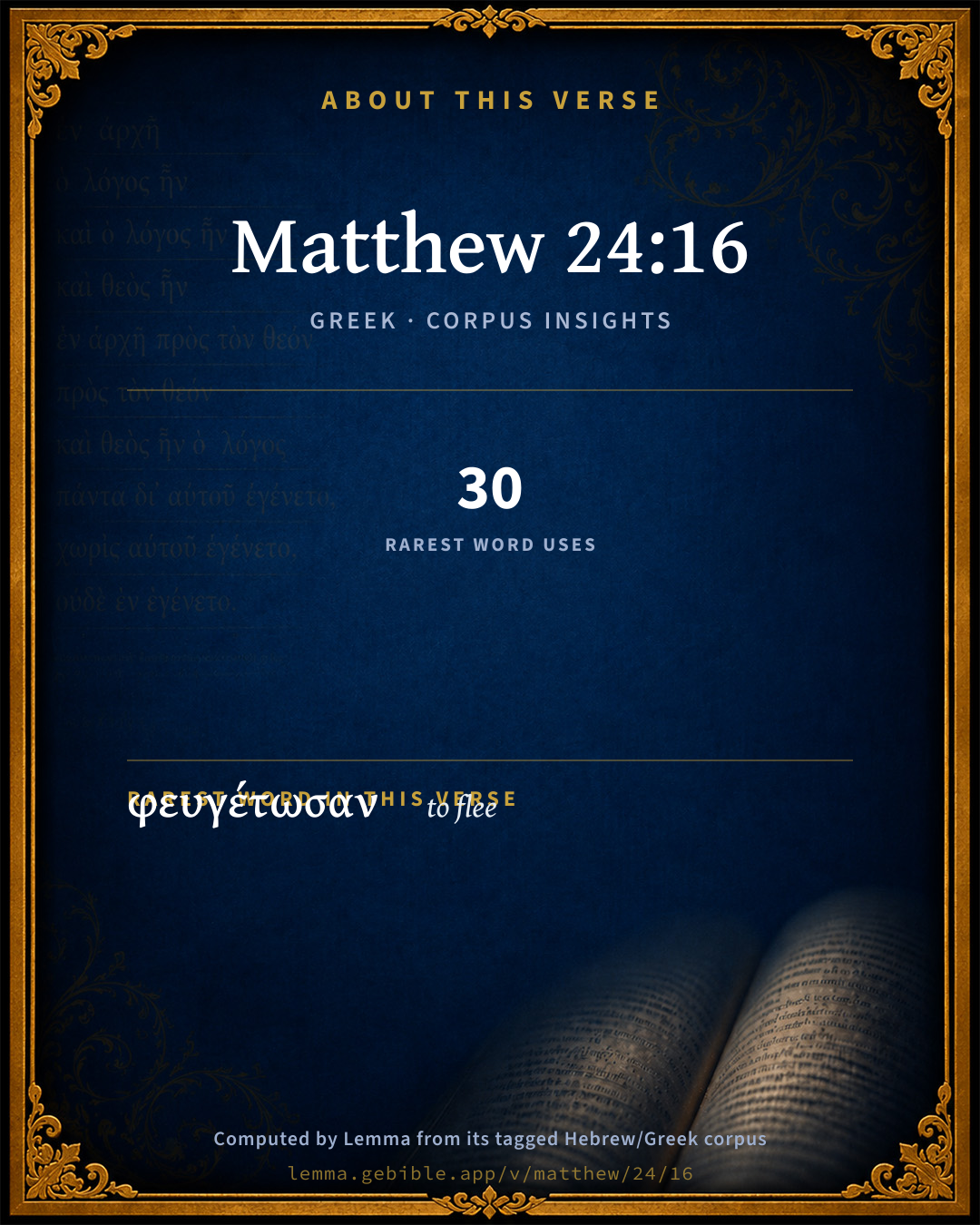
φευγέτωσαν to flee G5343 occurs in 30 verses of the Greek New Testament. Also found in:

Repetition

A word recurs within this verse:

Cross-references

7

Topical passages linked to Matthew 24:16 in the Treasury of Scripture Knowledge — connected by theme and wording, ordered by reader-vote popularity; previews shown in the World English Bible.

  • Genesis 19:15–17 When the morning arose, then the angels hurried Lot, saying, "Arise, take your wife, and your two daughters who are here, lest you be consumed in the iniquity of the city."
  • Luke 21:21–22 Then let those who are in Judea flee to the mountains. Let those who are in the midst of her depart. Let those who are in the country not enter therein.
  • Hebrews 11:7 By faith, Noah, being warned about things not yet seen, moved with godly fear, prepared an ark for the saving of his house, through which he condemned the world, and became heir of the righteousness which is according to faith.
  • Exodus 9:20–21 Those who feared the word of Yahweh among the servants of Pharaoh made their servants and their cattle flee into the houses.
  • Proverbs 22:3 A prudent man sees danger, and hides himself; But the simple pass on, and suffer for it.
  • Jeremiah 37:11–12 It happened that, when the army of the Chaldeans was broken up from Jerusalem for fear of Pharaoh's army,
  • Jeremiah 6:1 Flee for safety, you children of Benjamin, out of the midst of Jerusalem, and blow the trumpet in Tekoa, and raise up a signal on Beth Haccherem; for evil looks forth from the north, and a great destruction.

Cross-references courtesy of OpenBible.info (CC BY 4.0).

Commentary

Notes on Matthew 24:16 from classic Christian and Jewish commentators (each source and its license shown beneath its notes). The classic Christian expositions comment on the surrounding passage and are grouped to its opening verse, so a note may address several verses; the Jewish commentaries on the Tanakh (Rashi and others) are per-verse, so they appear only where the commentator wrote on this verse.

Lemma curates 59 commentaries, every one of them public domain or Creative Commons licensed, each selected and text-cleaned for this edition rather than reprinted as found. About our sources →

Bengel's Gnomon

Johann Albrecht Bengel

Mat 24:16. Τότε, then) This answers to πότε, when, in Mat 24:3. The word “then” often occurs in this discourse.—οἱ ἐν τῇ Ἰουδαίᾳ, those that are in Judea) not all the Jews, nor Christians dwelling elsewhere; but those who, believing the word of Jesus, should be in Judea.—φευγέτωσαν, let them flee) without hope that the siege might be raised.—ἐπὶ τὰ ὄρη, into the mountains) Safety was here promised in the mountains: and it was afterwards found there at Pella. See Eusebius H. E. iii. 5. Jesus warns His followers not to think that they would be safe within the city, in opposition to the persuasion pertinaciously maintained during the actual siege by the carnal prudence of the Jews.

Bengel's Gnomon of the New Testament — English translation (T&T Clark, Edinburgh, 1860) — public domain. Text from a community e-Sword module.

Meyer's Critical & Exegetical Commentary

Heinrich August Wilhelm Meyer

Mat_24:16 ff. Apodosis down to Mat_24:18.

οἱ ἐν τ. Ἰουδ.] means those who may happen to be living in the country of Judaea (Joh_3:22), in contradistinction to Jerusalem with its holy place, the abominations in which are to be the signal for flight.

μὴ καταβαινέτω, κ.τ.λ.] Some have conceived the idea to be this: ne per scalas interiores, sed exteriores descendat, Bengel (Grotius, Wetstein); or: let him flee over the roofs (over the lower walls, separating house from house, till he comes to the city wall, Michaelis, Kuinoel, Fritzsche, Paulus, Winer, Kaeuffer). Both views may be taken each according to circumstances.

τὰ ἐκ τῆς οἰκίας αὐτοῦ] common attraction for τὰ ἐν τῇ οἰκίᾳ ἐκ τῆς οἰκίας. See Kühner, I. 474, and ad Xen. Mem. iii. 6. 11; Winer, p. 584 [E. T. 784].

ἐν τῷ ἀγρῷ] where, being at work, he has no upper garment with him.

People will have to flee to save their lives (Mat_24:22); not according to the idea imported by Hofmann: to escape the otherwise too powerful temptation to deny the Lord. This again is decisively refuted by the fact that, in Mat_24:16-19, it is not merely the disciples or believers who are ordered to flee, but the summons to do so is a general one. What is said with reference to the flight does not assume an individualizing character till Mat_24:20.

Meyer — Critical and Exegetical Commentary on the New Testament — English translation by Peter Christie, edited by Frederick Crombie (T&T Clark, 1880) — public domain. Text from a community e-Sword module.

Expositor's Greek Testament

ed. W. Robertson Nicoll

Mat 24:16 . οἱ ἐν τῇ Ἰ ., those in Judaea who have no part in the struggle, with special reference to disciples of Jesus. There would naturally be some in the city, therefore the counsel to fly must refer to a point of time antecedent to the commencement of the siege. ἐπὶ τὰ ὄρη , to the mountains outside of Judaea, i.e. , east of the Jordan; general as befits prophetic speech. The actual place of refuge was Pella, as we learn from Eusebius, H. E., iii., 5, 3.

The Expositor's Greek Testament, edited by W. Robertson Nicoll (1897–1910) — public domain. Text from a community e-Sword module.

Adam Clarke's Commentary

Verse 16. Then let them which be in Judea flee into the mountains] This counsel was remembered and wisely followed by the Christians afterwards. Eusebius and Epiphanius say, that at this juncture, after Cestius Gallus had raised the siege, and Vespasian was approaching with his army, all who believed in Christ left Jerusalem and fled to Pella, and other places beyond the river Jordan; and so they all marvellously escaped the general shipwreck of their country: not one of them perished. See on Mt 24:13.

Adam Clarke's Commentary on the Bible (1810–1826) — public domain. Text from a community e-Sword/MySword module.

Ellicott's Commentary for English Readers

(16) Then let them which be in Judsea.—The words were acted on when the time came. Eusebius (Hist. Eccl. iii. 5) records that the Christians of Judæa, acting “on a certain oracle,” fled, in A.D. 68, to Pella, a town on the northern boundary of Peræa. So Josephus (Wars, iv. 9, § 1; v. 10, § 1) more generally relates that many of the more conspicuous citizens fled from the city, as men abandon a sinking ship. The “mountains” may be named generally as a place of refuge, or may point, as interpreted by the event, to the Gilead range of hills on the east of Jordan.

A Bible Commentary for English Readers, edited by Charles John Ellicott (1878–1897) — public domain. Text from a community e-Sword module.

The Cambridge Bible for Schools and Colleges

gen. ed. J. J. S. Perowne

16. let them which be in Judea flee into the mountains] Many Christians, warned by this prediction (according to Euseblus, H.E. iii. 5, “by a certain oracle”), took refuge at Pella in Peræa during the siege of Jerusalem.

The Cambridge Bible for Schools and Colleges (gen. ed. J. J. S. Perowne; Cambridge University Press, 1878–1918) — public domain. Text from a community e-Sword module.

John Gill's Exposition

Then let them which be in Judea,.... When this signal is given, let it be taken notice of and observed; let them that are in the city of Jerusalem, depart out of it; or who are in any other parts of Judea, in any of the towns, or cities thereof; let them not betake themselves to Jerusalem, imagining they may be safe there, in so strong and fortified a place, but let them flee elsewhere; see Luk 21:21 and accordingly it is observed, that many did flee about this time; and it is remarked by several interpreters, and which Josephus (a) takes notice of with surprise, that Cestius Gallus having advanced with his army to Jerusalem, and besieged it, on a sudden, without any cause, raised the siege, and withdrew his army, when the city might have been easily taken; by which means a signal was made; and an opportunity given to the Christians, to make their escape: which they accordingly did, and went over Jordan, as Eusebius says (b), to a place called Pella; so that when Titus came a few mouths after, there was not a Christian in the city, but they had fled as they are here bidden to

flee into the mountains; or any places of shelter and refuge: these are mentioned particularly, because they are usually such; and design either the mountains in Judea, or in the adjacent countries. The Syriac and Persic versions read in the singular number, "into the mountain"; and it is reported that many of them did fly, particularly to Mount Libanus (c).

(a) De Bello Jud. l. 2. c. 19. sect. 7. (b) Eccl. Hist. l. 3. c. 5. p. 75. (c) Joseph. ib.

John Gill's Exposition of the Whole Bible (1746–1763) — public domain (CC PDM 1.0). Text via the HelloAO Bible API.

Trapp's Complete Commentary

John Trapp

16 Then let them which be in Judaea flee into the mountains:

Ver. 16. Flee into the mountains] As Lot at length did, for Zoar was too hot to hold him; so should Judea be for these, who were therefore to repair to Pella, beyond Jordan, where they were hidden until the indignation was overpast, as Eusebius hath it, in the third book and fifth chapter of his history. Such a receptacle of religious people was Geneva in the Marian persecution. And such (blessed be God our strength for his unspeakable favour) is at this present Warwick Castle, to myself writing these things, and to many others in these troublous times. So Bucer and many godly people were entertained and safe guarded by that noble Franciscus a Siekengen in the German wars.

John Trapp, A Commentary or Exposition upon All the Books of the Old and New Testament (1647–1656) — public domain. Text from a community e-Sword module.

Albert Barnes' Notes on the Bible

Then let them ... - Then Christians may know that the end is come, and should seek a place of safety. Destruction would not only visit the “city,” but would extend to the surrounding part of Judea.

The mountains - The mountains of Palestine abound in caves, a safe retreat for those who are pursued. In all ages these caves have been the favorite places of robbers, and they were also resorted to by those in danger, 1Sa 13:6; 1Sa 22:1; 2Sa 23:13; Jos 10:16. In those mountains they would be safe.

Albert Barnes' Notes on the Bible (1834–1885) — public domain. Text from a community e-Sword/MySword module.

Haydock's Catholic Bible Commentary

Then let those. It is well known that this prophecy was verified to the letter, in the destruction of Jerusalem. For, as the Roman army advanced, all the Christians who were in the province, forewarned by divine admonition, retired to a distance, and crossing the Jordan, took refuge in the city of Pella, situated in Trachonitis, and became subjects of king Agrippa, who was in amity with the Romans. (St. Remigius)

George Leo Haydock (1774–1849), Haydock's Catholic Family Bible and Commentary, 1859 edition — public domain. Excludes Psalms (Douay-Rheims chapter numbering differs from Protestant) and Deuterocanonical books (Catholic canon only).

Matthew Poole's English Annotations

Mark hath this, Mar 13:14-16. Luke saith, Luk 21:21, Then let them which are in Judea flee to the mountains; and let them which are in the midst of it depart out; and let not them that are in the countriest enter thereinto. The import of all this is no more than, Let every man with as much speed as he can shift for himself, for, as Luke saith, then the desolation of Jerusalem is nigh; for, as he addeth, these are the days of vengeance, that all things which are written may be fulfilled. Let none of you think the storm will over, for when you see this be assured the time is come when all I have spoken of this city shall be accomplished.

Matthew Poole's English Annotations on the Holy Bible (1683–1685) — public domain. Text from a community e-Sword/MySword module.

Whedon's Commentary on the Bible

Daniel D. Whedon

16. Let them which be in Judea — In the country and provincial towns and cities of Judea. When they shall see the Roman army, with its eagles and idolatrous images of the emperor standing at the very temple gates, let them know that the desolating abomination will soon be subduing and slaughtering in their own vicinity, and so let them escape to the mountains, where armies cannot follow them. Ecclesiastical history informs us that no Christians perished in the siege of Jerusalem. When the Roman general Cestius Gallus invested the city, and thus furnished the sign for the Christians’ flight, be again withdrew his armies, and thus, as if unconsciously overruled, gave the Christians full chance for escape. Warned by our Lord, they fled to a city called Pella, beyond the Jordan, and survived to hand the Gospel to future times.

Daniel D. Whedon (gen. ed.), Commentary on the Old and New Testaments (1874–1909) — public domain. Text from a community e-Sword module.

The Pulpit Commentary

Then; i.e. when they shall see "the abomination of desolation," etc. Them which be in Judaea. Not only in Jerusalem, but in its vicinity, as most exposed to danger from the invading army. Flee into ( epi , over) the mountains. The Christians seem to have taken this advice when the city was attacked by Costius Gallus, about A.D. 66, some three or more years before the siege under Vespasian. Gallus had appeared before the walls, and apparently had every hope of taking the city, when, for some reason not certainly known (either owing to a supposed defeat, or ignorance of his own success, or the advice of his generals), he suddenly withdrew his forces (Josephus, "Bell. Jud:," 2:19, 6, 7). The Christians, bearing Christ"s warning in mind, and having, as we may conjecture, seen the predicted sign, took the opportunity of flight from the doomed city, and made their escape to Pella, a town of Decapotis, southeast of Bethshean, and the ruins of which are known now by the name of Fahil. Euschius probably refers to this migration, ("Hist. Ec:," 3:5) narrating that, owing to a certain revelation given to holy men among them, the whole body of the Church, before the war, removed across the Jordan to Pella, and dwelt there in safety during those troublous times. We probably, however, do not know the exact time of the flight, as we are ignorant of what was the warning of imminent danger which rendered this hurried proceeding necessary.

The Pulpit Commentary (1880–1919), ed. H.D.M. Spence-Jones & Joseph S. Exell — public domain. Text from a community e-Sword module.

John Wesley's Explanatory Notes

Then let them who are in Judea flee to the mountains - So the Christians did, and were preserved. It is remarkable that after the Roman under Cestus Gallus made their first advances toward Jerusalem, they suddenly withdrew again, in a most unexpected and indeed impolitic manner. This the Christians took as a signal to retire, which they did, some to Pella, and others to Mount Libanus.

John Wesley, Explanatory Notes Upon the Whole Bible (1754–1765) — public domain. Text via the GEBible commentary corpus.

Scofield Reference Notes

C. I. Scofield

Then let them which

Cf. Luk 21:20-24. The passage in Luke refers in express terms to a destruction of Jerusalem which was fulfilled by Titus, A.D. 70; the passage in Matthew to a future crisis in Jerusalem after the manifestation of the abomination. See "Beast"; Dan 7:8; Rev 19:20 and "Armageddon"; Rev 16:14; Rev 19:17.

As the circumstances in both cases will be similar, so are the warnings. In the former case Jerusalem was destroyed; in the latter it will be delivered by divine interposition.

The Scofield Reference Bible (1917 edition), notes by C. I. Scofield — public domain. Text from a community e-Sword module.

Burkitt's Expository Notes on the New Testament

William Burkitt

The meaning is, "As soon as you shall see the Roman army appear before the city of Jerusalem, let every one that values his own safety, fly as far and as fast as he can, even as Lot fled out of Sodom; and let such as fly be glad if by flight they can save their lives, though they lose their goods, thir clothes, and all things beside."

From hence learn, 1. That when Almighty God is pouring forth his fury upon a sinful people, it is lawful, yea a necessary duty, by flight to endeavour the hiding and sheltering themselves from the approaching calamity and desolation: When ye shall see Jerusalem encompassed with armies, then flee to the mountains.

2. That in the case of flight before a bloody enemy and army, if we lose all that we have, and our lives be given us, we fare well, and the Lord deals very mercifully with us.

William Burkitt's Expository Notes on the New Testament (1700–1703) — public domain. Text from a community e-Sword module.

Cambridge Greek Testament for Schools and Colleges

16. φευγέτωσαν ἐπὶ τὰ ὄρη. Many Christians, warned by this prediction (according to Eusebius, H.E. III. 5, ‘by a certain oracle’), took refuge at Pella in Peræa during the siege of Jerusalem. The mountains would be the natural place of refuge: cp. Thuc. VIII. 41, τήν τε πόλιν ἐκπορθεῖ τῶν ἀνθρώπων ἐς τὰ ὄρη πεφευγότων. Arrian. in Indic. c. 24, καὶ διέφυγον ἐς τὰ ὄρεα.

Cambridge Greek Testament for Schools and Colleges (Cambridge University Press, 1896; 21 vols, various authors incl. Carr, Maclear, Plummer, Farrar, Lumby, Moule, M. R. James, Simcox) — public domain. Text from a community e-Sword module.

Alford’s Greek Testament

Henry Alford

16-18.] The Christian Jews are said (Euseb. H. E. iii. 5) to have fled to Pella, a town described by Josephus (B. J. iii. 3. 3) as the northernmost boundary of Peræa. Eusebius says they were directed thither by a certain prophetic intimation (τινὰ χρησμόν), which however cannot be this; as Pella is not on the mountains, but beyond them (but in order to reach it would not they have to fly exactly ἐπὶ τὰ ὄρη—over, along, across them? See note on ch. 18:12):—Epiphanius (de mensuris et pond. § 15, vol. ii. p. 171) that they προεχρηματίσθησαν ὑπὸ ἀγγέλου.

Henry Alford, The Greek Testament (1849–1861) — public domain. Text from a community e-Sword module.

International Critical Commentary

(M) 16. Then let those in Judæa flee to the mountains.] So Mk.

International Critical Commentary — older volumes (1896–1929), various authors — public domain. Text from a community e-Sword module.

Lesson kit

Teaching starters — assembled from the data on this page, not authored interpretation. Every prompt links to the verse data it draws on. Edit before teaching.

Matthew, in the Gospels, opens this verse with 9 words (7 distinct Greek lemmas). Its most distinctive word is pheúgō (“to flee”). A historical commentator’s framing appears above. Read the whole chapter for the surrounding context.

Discussion questions

  1. What does “to flee” (pheúgō) contribute to the verse as a whole?
  2. How does Matthew 2:13, which shares the word «to flee», read alongside this verse?
  3. What does the repetition of “the” (3× in this one verse) do in this verse?
  4. These translations render this verse differently. What is at stake in choosing one wording over another?
  5. Compare how Bengel's Gnomon and Meyer's Critical & Exegetical Commentary read this verse. Where do they agree or differ?

Things to notice

  • These translations choose different wording for 6 words in this verse.
  • “the” occurs 3× in this single verse.
  • 7 distinct Greek lemmas span 9 words in this verse.

Reading settings

Reading text

Shown beneath each verse's original-language words.

Old Testament
Old Testament edition

Read the OT as the Masoretic Hebrew (MT) or the Greek Septuagint (LXX).

English shown for the Greek Septuagint (in the Hebrew ↔ Greek comparison).

Comparing translations? Open the Compare panel on any verse page to stack up to four side by side.