1 Corinthians 7:10

Greek (Tischendorf 8th ed.) 1 Corinthians 7:10 appears in the Greek New Testament. The text above is from the Tischendorf 8th edition. Each word links to its Strong’s number and a concise gloss. Click any word for its full Thayer’s Greek Lexicon entry.
Download image
Cite this verse

1 Corinthians 7:10 (World English Bible). Public Domain. Lemma interlinear Bible study tool, https://lemma.gebible.app/v/1-corinthians/7/10.

Show BibTeX & RIS
BibTeX
RIS
English Translation
But to the married I command--not I, but the Lord--that the wife not leave her husband
World English Bible · Public Domain
Download a study sheet

One document with this verse’s original text, its word-by-word gloss line, the meaning frame, cross-references with their text, attributed commentary, and full source and license credits — printable, and it pastes into notes with its structure intact.

This verse Autodidact and up

Study sheet (.html) Plain text (.txt)

A passage Seminary Student

Up to 50 verses in one chapter. A passage sheet keeps up to 6 commentary sources and 12 cross-references per verse, in the order this page ranks them, and says so on the sheet whenever that leaves anything out. Ask for a single verse and you get the Autodidact verse sheet above.

Everything on this page stays free to read, with no account — the sheet is a download of what is already on screen, not access to it.

Want to remove ads? Support Godless Engineer
Compare translations 3

The same verse in 3 English versions, stacked beneath the original-language interlinear above. Click any original word for its lexicon entry.

Each is an independent rendering of the whole verse — the interlinear is not word-aligned to these translations.

Highlighted words mark where these versions differ — a whole-verse word diff, not a word-by-word alignment.

  • World English Bible Public Domain
    But to the married I command--not I, but the Lord--that the wife not leave her husband
  • King James Version Public Domain
    And unto the married I command, yet not I, but the Lord, Let not the wife depart from her husband:
  • unfoldingWord Literal Text CC BY-SA 4.0
    Now to the married I command—not I, but the Lord—a wife is not to be separated from her husband

unfoldingWord Literal Text — © unfoldingWord, licensed CC BY-SA 4.0. Word-aligned USFM3 via Door43 (git.door43.org/unfoldingWord/en_ult).

Versions to compare (up to 4)

3 of 4 selected

Show all 19 translations

Every available English version of this verse, each an independent rendering of the whole verse.

  • World English Bible Public Domain
    But to the married I command--not I, but the Lord--that the wife not leave her husband
  • Berean Standard Bible Public Domain
    To the married I give this command (not I, but the Lord): A wife must not separate from her husband.
  • Majority Standard Bible Public Domain
    To the married I give this command (not I, but the Lord): A wife must not separate from her husband.
  • King James Version Public Domain
    And unto the married I command, yet not I, but the Lord, Let not the wife depart from her husband:
  • American Standard Version (1901) Public Domain
    But unto the married I give charge, `yea' not I, but the Lord, That the wife depart not from her husband
  • Revised Version (1885) Public Domain
    But unto the married I give charge, yea not I, but the Lord, That the wife depart not from her husband
  • Geneva Bible (1599) Public Domain
    And vnto ye maried I comand, not I, but ye Lord, Let not ye wife depart from her husband.
  • Douay-Rheims (1899) Public Domain
    But to them that are married, not I but the Lord commandeth, that the wife depart not from her husband.
  • Young's Literal Translation Public Domain
    and to the married I announce -- not I, but the Lord -- let not a wife separate from a husband:
  • Literal Standard Version CC BY-SA 4.0
    and to the married I announce—not I, but the LORD—do not let a wife separate from a husband:
  • Unlocked Literal Bible CC BY-SA 4.0
    Now to the married I give this command—not I, but the Lord—the wife should not separate from her husband
  • unfoldingWord Literal Text CC BY-SA 4.0
    Now to the married I command—not I, but the Lord—a wife is not to be separated from her husband
  • Darby Bible Public Domain
    But to the married I enjoin, not *I*, but the Lord, Let not wife be separated from husband;
  • World Messianic Bible Public Domain
    But to the married I command—not I, but the Lord—that the wife not leave her husband
  • Webster's Bible Public Domain
    And to the married I command, yet not I, but the Lord, Let not the wife depart from her husband:
  • Free Bible Version CC BY-SA 4.0
    These are my instructions to those who are married—in fact not from me but the Lord: The wife should not leave her husband
  • Bible in Basic English Public Domain
    But to the married I give orders, though not I but the Lord, that the wife may not go away from her husband
  • Text-Critical English NT CC BY 4.0
    Now to the married I give this command (not I, but the Lord): A wife must not separate from her husband
  • Tyndale New Testament (1534) Public Domain
    Vnto the maryed commaunde not I but the Lorde: that the wyfe separate not her selfe from the man.

Literal Standard Version (2020), Covenant Press — licensed CC BY-SA 4.0. Text via the HelloAO Bible API (eBible.org). Unlocked Literal Bible (unfoldingWord) — licensed CC BY-SA 4.0. Text via the HelloAO Bible API (eBible.org). unfoldingWord Literal Text — © unfoldingWord, licensed CC BY-SA 4.0. Word-aligned USFM3 via Door43 (git.door43.org/unfoldingWord/en_ult). Free Bible Version, Dr. Jonathan Gallagher — licensed CC BY-SA 4.0. Text via the HelloAO Bible API (eBible.org).

Word by word

More ways to search: Search by grammar → Find every occurrence → Compare this word →

Practice this passage: Drill this verse → Learn its vocabulary →

χωρισθῆναι
chōrízō
G5563
“to separate”
Verb, Aorist, Passive, Infinitive
Part of Speech
Verb
Tense
Aorist
Voice
Passive
Mood
Infinitive
Full Thayer's Definition

Origin: from G5561

TDNT: None

1. to separate, divide, part, put asunder, to separate one's self from, to depart a. to leave a husband or wife b. of divorce c. to depart, go away
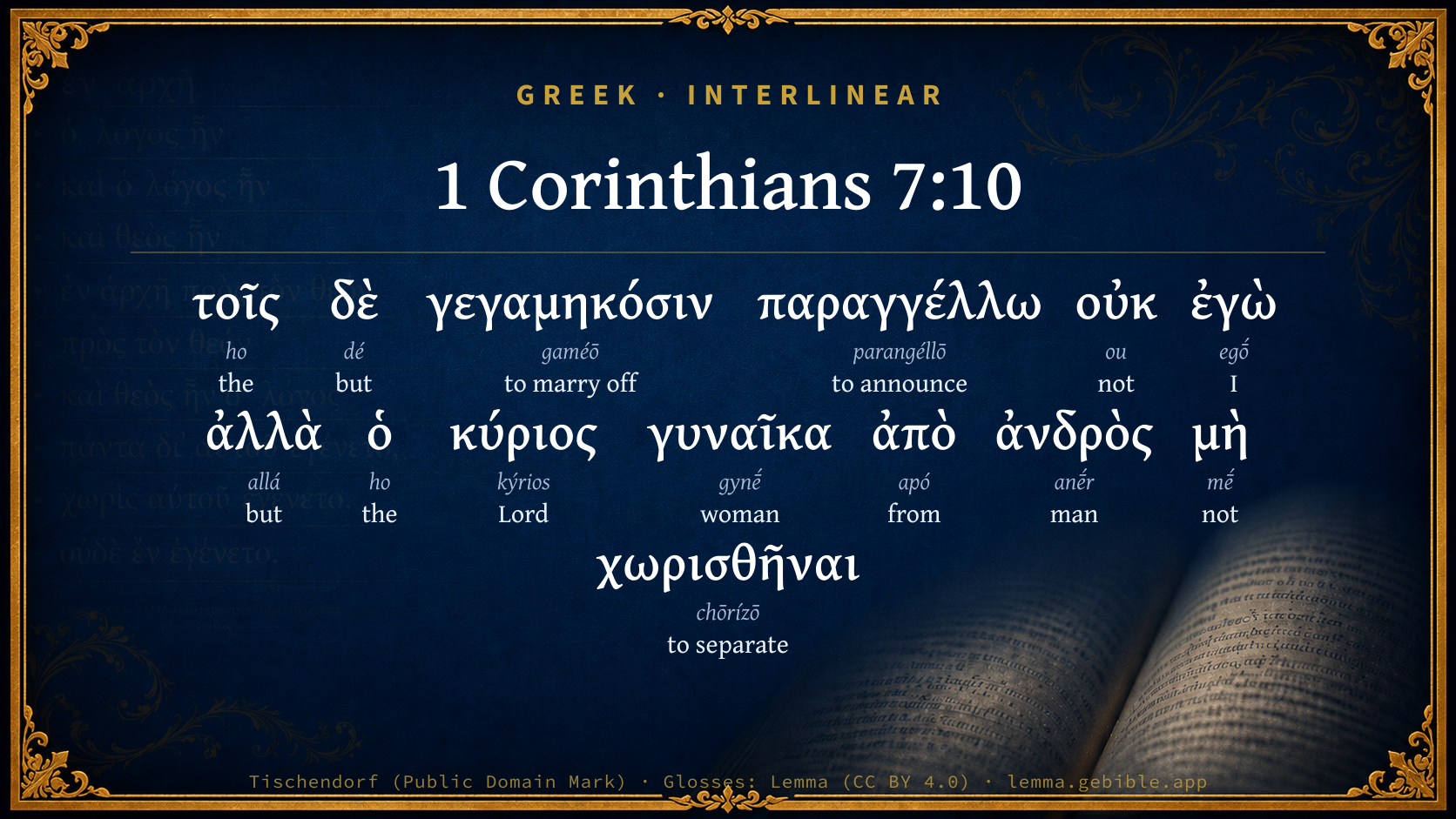
  1. τοῖς ho G3588 “the” Article, Dative, Plural, Masculine
  2. δὲ dé G1161 “but” Conjunction
  3. γεγαμηκόσιν gaméō G1060 “to marry off” Verb, Perfect, Active, Participle, Dative, Plural, Masculine
  4. παραγγέλλω parangéllō G3853 “to announce” Verb, Present, Active, Indicative, 1st person, Singular
  5. οὐκ ou G3756 “not” Particle, Negative
  6. ἐγὼ egṓ G1473 “I” Personal pronoun, 1st person, Nominative, Singular
  7. ἀλλὰ allá G235 “but” Conjunction
  8. ὁ ho G3588 “the” Article, Nominative, Singular, Masculine
  9. κύριος kýrios G2962 “Lord” Noun, Nominative, Singular, Masculine
  10. γυναῖκα gynḗ G1135 “woman” Noun, Accusative, Singular, Feminine
  11. ἀπὸ apó G575 “from” Preposition
  12. ἀνδρὸς anḗr G435 “man” Noun, Genitive, Singular, Masculine
  13. μὴ mḗ G3361 “not” Particle, Negative

About this verse

These counts appear in no published source. They are computed here, from the morphology-tagged text and Lemma’s own curated glosses. What Lemma adds →

14
words
13
distinct lemmas
Pauline Epistles
section

Notable vocabulary

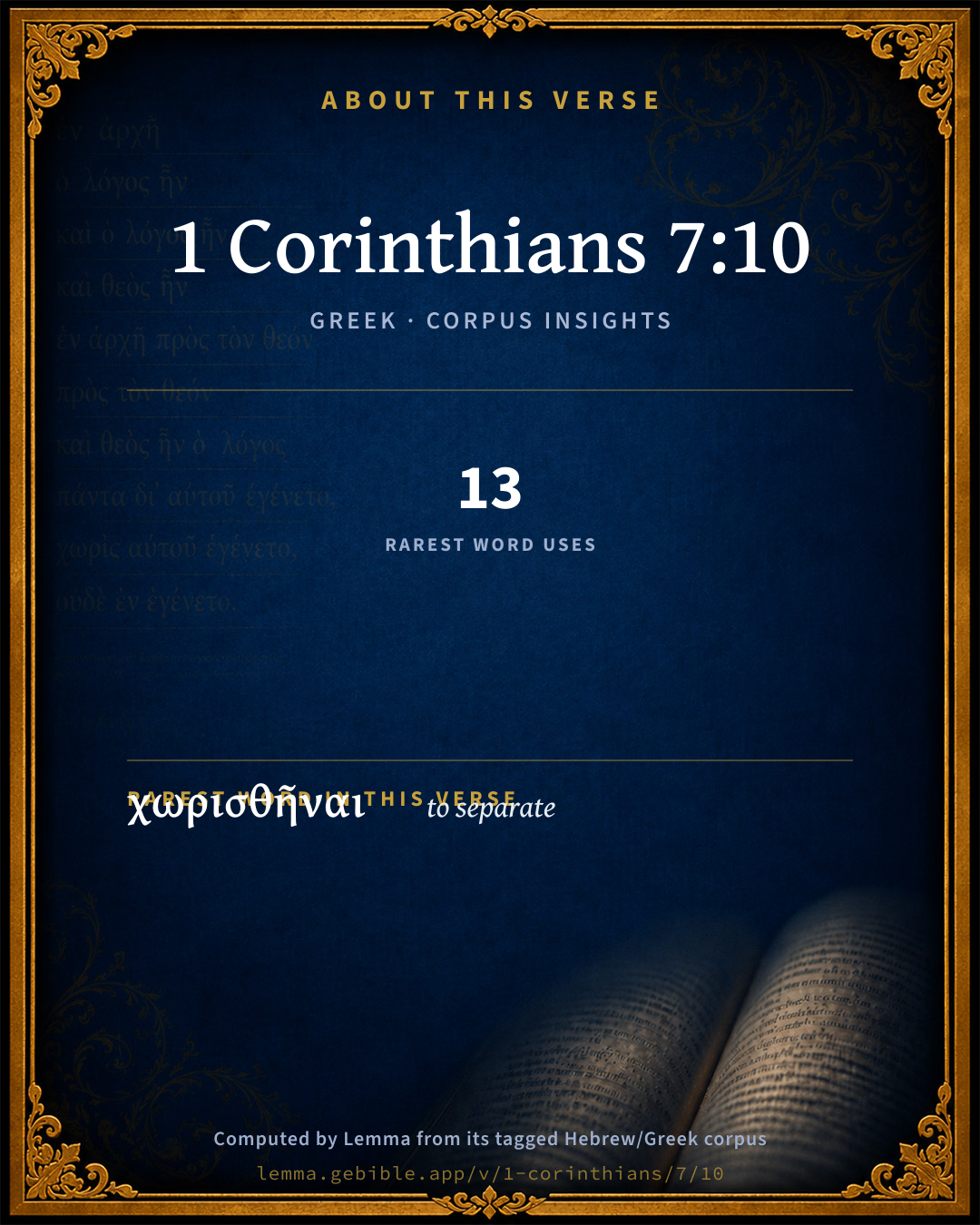
The rarest word here is χωρισθῆναι to separate G5563 — appearing just 13 times in the whole Greek New Testament.

Shared distinctive vocabulary

χωρισθῆναι to separate G5563 occurs in 12 verses of the Greek New Testament. Also found in:

Repetition

A word recurs within this verse:

  • τοῖς the G3588 ×2

Cross-references

11

Topical passages linked to 1 Corinthians 7:10 in the Treasury of Scripture Knowledge — connected by theme and wording, ordered by reader-vote popularity; previews shown in the World English Bible.

  • Matthew 5:32 but I tell you that whoever puts away his wife, except for the cause of sexual immorality, makes her an adulteress; and whoever marries her when she is put away commits adultery.
  • Luke 16:18 Everyone who divorces his wife, and marries another, commits adultery. He who marries one who is divorced from a husband commits adultery.
  • Malachi 2:14–16 Yet you say, 'Why?' Because Yahweh has been witness between you and the wife of your youth, against whom you have dealt treacherously, though she is your companion, and the wife of your covenant.
  • Matthew 19:3–9 Pharisees came to him, testing him, and saying, "Is it lawful for a man to divorce his wife for any reason?"
  • Mark 10:11–12 He said to them, "Whoever divorces his wife, and marries another, commits adultery against her.
  • Jeremiah 3:20 Surely as a wife treacherously departs from her husband, so have you dealt treacherously with me, house of Israel, says Yahweh.
  • 1 Corinthians 7:15 Yet if the unbeliever departs, let there be separation. The brother or the sister is not under bondage in such cases, but God has called us in peace.
  • 1 Corinthians 7:12 But to the rest I--not the Lord--say, if any brother has an unbelieving wife, and she is content to live with him, let him not leave her.
  • 1 Corinthians 7:6 But this I say by way of concession, not of commandment.
  • 1 Corinthians 7:25 Now concerning virgins, I have no commandment from the Lord, but I give my judgment as one who has obtained mercy from the Lord to be trustworthy.
  • 1 Corinthians 7:40 But she is happier if she stays as she is, in my judgment, and I think that I also have God's Spirit.

Cross-references courtesy of OpenBible.info (CC BY 4.0).

Commentary

Notes on 1 Corinthians 7:10 from classic Christian and Jewish commentators (each source and its license shown beneath its notes). The classic Christian expositions comment on the surrounding passage and are grouped to its opening verse, so a note may address several verses; the Jewish commentaries on the Tanakh (Rashi and others) are per-verse, so they appear only where the commentator wrote on this verse.

Lemma curates 59 commentaries, every one of them public domain or Creative Commons licensed, each selected and text-cleaned for this edition rather than reprinted as found. About our sources →

Matthew Henry's Commentary

In this paragraph the apostle gives them direction in a case which must be very frequent in that age of the world, especially among the Jewish converts; I mean whether they were to live with heathen relatives in a married state. Moses's law permitted divorce; and there was a famous instance in the Jewish state, when the people were obliged to put away their idolatrous wives, Ezr 10:3. This might move a scruple in many minds, whether converts to Christianity were not bound to put away or desert their mates, continuing infidels. Concerning this matter the apostle here gives direction. And,

I. In general, he tells them that marriage, by Christ's command, is for life; and therefore those who are married must not think of separation. The wife must not depart from the husband (Co1 7:10), nor the husband put away his wife, Co1 7:11. This I command, says the apostle; yet not I, but the Lord. Not that he commanded any thing of his own head, or upon his own authority. Whatever he commanded was the Lord's command, dictated by his Spirit and enjoined by his authority. But his meaning is that the Lord himself, with his own mouth, had forbidden such separations, Mat 5:32; Mat 19:9; Mar 10:11; Luk 16:18. Note, Man and wife cannot separate at pleasure, nor dissolve, when they will, their matrimonial bonds and relation. They must not separate for any other cause than what Christ allows. And therefore the apostle advises that if any woman had been separated, either by a voluntary act of her own or by an act of her husband, she should continue unmarried, and seek reconciliation with her husband, that they might cohabit again. Note, Husbands and wives should not quarrel at all, or should be quickly reconciled. They are bound to each other for life. The divine law allows of no separation. They cannot throw off the burden, and therefore should set their shoulders to it, and endeavour to make it as light to each other as they can.

II. He brings the general advice home to the case of such as had an unbelieving mate (Co1 7:12): But to the rest speak I, not the Lord; that is, the Lord had not so expressly spoken to this case as to the former divorce. It does not mean that the apostle spoke without authority from the Lord, or decided this case by his own wisdom, without the inspiration of the Holy Ghost. He closes this subject with a declaration to the contrary (Co1 7:40), I think also that I have the Spirit of God. But, having thus prefaced his advice, we may attend,

1. To the advice itself, which is that if an unbelieving husband or wife were pleased to dwell with a Christian relative, the other should not separate. The husband should not put away an unbelieving wife, nor the wife leave an unbelieving husband, Co1 7:12, Co1 7:13. The Christian calling did not dissolve the marriage covenant, but bind it the faster, by bringing it back to the original institution, limiting it to two persons, and binding them together for life. The believer is not by faith in Christ loosed from matrimonial bonds to an unbeliever, but is at once bound and made apt to be a better relative. But, though a believing wife or husband should not separate from an unbelieving mate, yet if the unbelieving relative desert the believer, and no means can reconcile to a cohabitation, in such a case a brother or sister is not in bondage (Co1 7:15), not tied up to the unreasonable humour, and bound servilely to follow or cleave to the malicious deserter, or not bound to live unmarried after all proper means for reconciliation have been tried, at least of the deserter contract another marriage or be guilty of adultery, which was a very easy supposition, because a very common instance among the heathen inhabitants of Corinth. In such a case the deserted person must be free to marry again, and it is granted on all hands. And some think that such a malicious desertion is as much a dissolution of the marriage-covenant as death itself. For how is it possible that the two shall be one flesh when the one is maliciously bent to part from or put away the other? Indeed, the deserter seems still bound by the matrimonial contract; and therefore the apostle says (Co1 7:11), If the woman depart from her husband upon the account of his infidelity, let her remain unmarried. But the deserted party seems to be left more at liberty (I mean supposing all the proper means have been used to reclaim the deserter, and other circumstances make it necessary) to marry another person. It does not seem reasonable that they should be still bound, when it is rendered impossible to perform conjugal duties or enjoy conjugal comforts, through the mere fault of their mate: in such a case marriage would be a state of servitude indeed. But, whatever liberty be indulged Christians in such a case as this, they are not allowed, for the mere infidelity of a husband or wife, to separate; but, if the unbeliever be willing, they should continue in the relation, and cohabit as those who are thus related. This is the apostle's general direction.

2. We have here the reasons of this advice. (1.) Because the relation or state is sanctified by the holiness of either party: For the unbelieving husband is sanctified by the wife, and the unbelieving wife by the husband (Co1 7:14), or hath been sanctified. The relation itself, and the conjugal use of each other, are sanctified to the believer. To the pure all things are pure, Tit 1:15. Marriage is a divine institution; it is a compact for life, by God's appointment. Had converse and congress with unbelievers in that relation defiled the believer, or rendered him or her offensive to God, the ends of marriage would have been defeated, and the comforts of it in a manner destroyed, in the circumstances in which Christians then were. But the apostle tells them that, though they were yoked with unbelievers, yet, if they themselves were holy, marriage was to them a holy state, and marriage comforts, even with an unbelieving relative, were sanctified enjoyments. It was no more displeasing to God for them to continue to live as they did before, with their unbelieving or heathen relation, than if they had become converts together. If one of the relatives had become holy, nothing of the duties or lawful comforts of the married state could defile them, and render them displeasing to God, though the other were a heathen. He is sanctified for the wife's sake. She is sanctified for the husband's sake. Both are one flesh. He is to be reputed clean who is one flesh with her that is holy, and vice vers: Else were your children unclean, but now are they holy (Co1 7:14), that is, they would be heathen, out of the pale of the church and covenant of God. They would not be of the holy seed (as the Jews are called, Isa 6:13), but common and unclean, in the same sense as heathens in general were styled in the apostle's vision, Act 10:28. This way of speaking is according to the dialect of the Jews, among whom a child begotten by parents yet heathens, was said to be begotten out of holiness; and a child begotten by parents made proselytes was said to be begotten intra sanctitatem - within the holy enclosure. Thus Christians are called commonly saints; such they are by profession, separated to be a peculiar people of God, and as such distinguished from the world; and therefore the children born to Christians, though married to unbelievers, are not to be reckoned as part of the world, but of the church, a holy, not a common and unclean seed. "Continue therefore to live even with unbelieving relatives; for, if you are holy, the relation is so, the state is so, you may make a holy use even of an unbelieving relative, in conjugal duties, and your seed will be holy too." What a comfort is this, where both relatives are believers! (2.) Another reason is that God hath called Christians to peace, Co1 7:15. The Christian religion obliges us to act peaceably in all relations, natural and civil. We are bound, as much as in us lies, to live peaceably with all men (Rom 12:18), and therefore surely to promote the peace and comfort of our nearest relatives, those with whom we are one flesh, nay, though they should be infidels. Note, It should be the labour and study of those who are married to make each other as easy and happy as possible. (3.) A third reason is that it is possible for the believing relative to be an instrument of the other's salvation (Co1 7:16): What knowest thou, O wife, whether thou shalt save thy husband? Note, It is the plain duty of those in so near a relation to seek the salvation of those to whom they are related. "Do not separate. There is other duty now called for. The conjugal relation calls for the most close and endeared affection; it is a contract for life. And should a Christian desert a mate, when an opportunity offers to give the most glorious proof of love? Stay, and labour heartily for the conversion of thy relative. Endeavour to save a soul. Who knows but this may be the event? It is not impossible. And, though there be no great probability, saving a soul is so good and glorious a service that the bare possibility should put one on exerting one's self." Note, Mere possibility of success should be a sufficient motive with us to use our diligent endeavours for saving the souls of our relations. "What know I but I may save his soul? should move me to attempt it."

Matthew Henry's Commentary on the Whole Bible (1708–1710) — public domain (CC PDM 1.0). Text via the HelloAO Bible API.

Ellicott's Commentary for English Readers

(10) And unto the married . . .—The Apostle has concluded his instruction to the unmarried and widows, and in 1Co_7:10-11 gives his advice to those married persons who had been troubled with doubts as to whether they ought (if marriage were undesirable) to continue in that state.

I command, yet not I, but the Lord.—The contrast which is commenced here, and again brought out in 1Co_7:12, is not between commands given by St. Paul as an inspired Apostle, and St. Paul as a private individual. In 1Co_14:37 the Apostle expressly claims that all his commands as an Apostle should be regarded as “the commandments of the Lord,” and in 1Th_4:15 the Apostle speaks of that knowledge into which he was guided by the Holy Spirit as given “by the word of the Lord.” St. Paul must not therefore be regarded as here claiming for some of his instructions apostolic authority, and not claiming it for others. The real point of the contrast is between a subject on which our Lord Himself while on earth gave direct verbal instruction, and another subject on which He now gives His commands through His Apostle St. Paul. Christ had given directions regarding divorce (Mat_5:31; Mat_19:3-9; Mar_10:2-12), and the Apostle here has only to reiterate what the Lord had already commanded.

Let not the wife depart from her husband.—Better, Let her not be separated. The account of our Lord’s words given here differs in two respects from the record given of them by St. Matthew (Mat_5:32; Mat_19:9), where the reference is, first and more prominently, to the man putting away his wife—not, as here, to the wife separating herself from her husband—and the exception made, “except it be because of fornication,” is here omitted. The fact that St. Paul only knew from others what our Lord had said, and that the Evangelists wrote what they had heard themselves, would not sufficiently account for this difference; for surely these very Evangelists, or others who like them had heard the Lord’s words, would have been St. Paul’s informants. The reason of the variety in the two accounts is to be found, not in inaccurate knowledge on St. Paul’s part, which we have no reason to suppose, but in the particular circumstances to which the Apostle was applying the teaching of Christ; and this verbal difference is an instructive indication to us of how the Apostles understood that even in the case of the Lord Himself it was the living spirit of His teaching, and not its merely verbal form, which was of abiding and universal obligation. There was no necessity here to introduce the one exceptional cause of divorce which Christ had allowed, for the subject under consideration is a separation voluntarily made, and not as the result of sin on the part of either husband or wife; so the mention here of that ground of exception would have been inapplicable, and have tended only to confuse.

The other point of difference—viz., the mention here of the woman more prominently as separating from the husband—does not in any way affect the principle of the teaching, and indeed our Lord probably did put the case in both ways. (See Mar_10:12.) It may be also that in the letter to which St. Paul was replying the doubt had been suggested by women, who were—as their sex is often still—more anxiously scrupulous about details of what they conceived to be religious duty; and the question having been asked concerning a woman’s duty, the Apostle answers it accordingly, and adds the same instruction for the husband (1Co_7:11).

A Bible Commentary for English Readers, edited by Charles John Ellicott (1878–1897) — public domain. Text from a community e-Sword module.

The Biblical Illustrator

Joseph S. Exell

1Co_7:10-17

And unto the married I command, yet not I, but the Lord, Let not the wife depart from her husband.

The marriage union: how disturbances of it are to be alleviated

I. If both parties are believers--according to our Lords command.

1. Not by divorce.

2. But by mutual conciliation.

II. If one party is an unbeliever--according to apostolic prescription.

1. Not by divorce.

2. But by patience in the believing party, that by example, &c., the unbelieving party and the children may be saved.

III. If the unbelieving party brings about a separation.

1. By submission, love to God must predominate.

2. God can overrule it for good.

3. Everyone must content himself with the appointments of Providence. (J. Lyth, D. D.)

Unity in marriage

The Cherokee marriage ceremony is very expressive. The man and woman join hands over running water, to indicate that their lives are thenceforth to flow in one stream.

Divorce is

I. A sad evidence of human depravity. Except in the case of confirmed lunacy--

1. It originates--

(1) In marrying out of impure motives.

(2) In the loss of affection,

(3) In the unfaithfulness of one or both parties.

2. Is opposed

(1) To the express command of our Lord (Mat_5:31; Mat_19:1-12), which is founded on the deep significance of the marriage bond (Mat_19:6; Eph_5:32).

(2) To the diffusion of the kingdom of God, as exerting a deleterious influence on the general welfare of mankind.

II. Cannot be entirely disallowed.

1. The Lord permits it in certain instances (Mat_5:39), and the apostle extends the permission m an exceptional case (1Co_7:15).

2. Yet so long as there is hope of reconciliation, every means must be used to maintain an unbroken union.

3. Separation is therefore allowable when it is evident that a perpetuated union will only be a source of sin, or that it will prove perilous to the salvation of the innocent party. (J. Lyth, D. D.)

Divorce: mixed marriages

Having spoken of celibacy and marriage, the apostle now deals with the case of those already married.

I. Where both parties are Christian. In this case Christ has decided, and Paul refers them to His words (Mat_5:32; Mat_19:9).

1. The marriage bond is indissoluble. This arises from the relationship itself, as well as from the Divine appointment. Husband and wife are ideally one; the bond has no parallel in the world; God has made the union sacred by blessing it.

2. Separation is not to be final. The cause of separation (ill-treatment, &c.) may or may not be sufficient to justify it, but it must not be regarded as severing the tie. The wife must remain unmarried, or she must be reconciled to her husband. The latter is the desirable course, inasmuch as husband and wife cannot go apart without scandal to the Christian name. Let them reconsider their position, and remove every barrier to union.

II. Where one party is Christian and the other heathen. Christ had given no utterance on mixed marriages, and therefore Paul gives his inspired judgment regarding them. Consider the case where--

1. The unbelieving partner is content to remain. The Christian spouse is not to seek a separation as if the marriage were unholy (1Co_7:14). The apostle does not mean that an unbeliever by conjugal union with a believer becomes personally holy; but that he or she is consecrated. As the altar sanctifies the gift (Mat_23:19), so the Christian reflects something of his character on everything connected with him. His property, business, family, are all in a sense holy as belonging to one who is in covenant with God, and are under His special protection. Hence the pagan partner is a privileged person on the ground of union with a Christian. The reason is significant (1Co_7:14). It was an accepted maxim that the children of such marriages were born within the Church. This principle was recognised among the Jews, as the case of Timothy shows (Act_16:1-3). If, then, the children of such marriage are reckoned holy, the marriage from which they spring cannot be inconsistent with the law of God (Rom_11:6 and conversely). The children take their standing from the Christian parent, who is regarded as the nobler of the two.

2. The unbelieving partner refuses to remain. In this case the Christian is to acquiesce. For--

(1) He or she is not under bondage (1Co_7:15). The marriage is not to be dissolved at the instance of the believing partner; but if the other refuses to remain, the contract is no longer binding. It would be a case of bondage if the one were held to a union which the other has wilfully broken up.

(2) God hath called us in peace. The gospel is not intended to produce strife; but if this be the result of the heathen partner continuing to dwell with the Christian, it were better to let him have his wish.

(3) The Christian partner is not to prevent the departure of the other in the hope of being instrumental to conversion. This is at best uncertain, and peace is not to be hazarded therefore. And if such a union is not to be maintained for the sake of a possible conversion, much less is it to be contracted with that view. Conclusion:

1. This passage is generally adduced as the Bible warrant for the view that wilful desertion is a sufficient reason for divorce. Such desertion is a de facto rupture of the marriage bond, and stands on the same footing as adultery.

2. The evil of mixed marriages. They--

(1) Render the complete fellowship of husband and wife impossible.

(2) Break up domestic peace.

(3) Prevent family religion.

(4) Interfere with the religious training of children. (H. Bremner, B. D.)

Christian casuistry

1. St. Paul makes a distinction between those things which he speaks by commandment and by permission; between what he says as being taught of God, and that which he speaks only as a servant, called of the Lord and faithful.

2. It is plain that there are many questions in which right and wrong are fixed; while there are others where these terms depend on circumstances, e.g., there may be circumstances in which it is the duty of a Christian to be married, and others remain unmarried. In the case of a missionary it may be right to be married; in the case of a pauper, unable to maintain a family, it may be proper to remain unmarried. No fixed law can be laid down upon this subject.

3. These, therefore, are questions of casuistry, which depend upon the particular case: from which casuistry is derived. On these points the apostle speaks not by commandment, but by permission. This distinction is not between inspired and uninspired, but between a decision in matters of Christian duty, and advice in matters of Christian prudence. God cannot give advice; He can only issue a command. When we come to advice the human element is introduced.

4. There are three main questions on which the apostle here gives his inspired decision.

I. Concerning the sanctity of the marriage bond between two Christians (1Co_7:10).

1. Of all earthly unions almost this is the only one permitting of no change but that of death. It is that engagement in which man exerts his most awful and solemn power--that of parting with his freedom. And yet it is perhaps that relationship which is spoken of and entered into most carelessly. It is not an union merely between two creature, but between two spirits; and the intention of that bond is to perfect the nature of both, by giving to each sex those excellences in which it is naturally deficient.

2. There is no earthly relationship which has so much power to ennoble (1Co_7:16). The very power of saving belongs to it, and that of ruin too. For there are two rocks on which the soul must either anchor or be wrecked. The one is the Rock of Ages, on which if the human soul anchors, it lives the blessed life of faith; against which if the soul be dashed, there ensues atheism--the worst ruin of the soul. The other rock is of another character. Blessed is the man or woman whose life-experience has taught a confiding belief in the excellences of the sex opposite to their own. And the ruin is second only to perdition. And it is the worst of these alternatives which the young risk when they form an inconsiderate union, and which parents risk when they bring up their children with no higher view than that of a rich and honourable marriage.

II. The sanctity of the marriage bond between a Christian and a heathen.

1. The question arose, Is not the marriage null and void? As if it were an union between one dead and one living. And that perpetual contact with a heathen, and therefore an enemy of God, is not that defilement? The apostle decides this with his usual inspired wisdom--the marriage bond is sacred still (1Co_7:12-13).

2. Now for us the decision is not of so much importance as the reason in support of it, which amounts to this: If this were no marriage, but an unhallowed alliance, it would follow that the offspring could not be the children of God; but it is the instinctive conviction of every Christian parent, My child is a child of God, or, in the Jewish form of expression, My child is clean (1Co_7:14). It follows if the children are holy in this sense of dedicated to God, then the marriage relation was not unhallowed, but sacred and indissoluble. The value of this argument in the present day depends on its relation to baptism. This question is whether we are baptized because we are the children of God, or, whether we are the children of God because we are baptized. Here the apostles argument is unanswerable. He does not say that these children were Christian, or clean, because they were baptized, but because they were the children of one Christian parent.

3. Observe also the important truth which comes out collaterally from this argument--namely, the sacredness of impression, which arises from the close connection between parent and child. Possibly from the very first moments of consciousness we begin to impress ourselves on our children. There is scarcely one here who cannot trace back his religious character to some impression from one or other of his parents--a tone, a look, a word, a habit, or even, it may be, a bitter exclamation of remorse.

III. Existing relations (1Co_7:17; 1Co_7:20; 1Co_7:24). Christian men were to remain in them, and in them to develop the Christian life. Paul applies this principle in two ways.

1. Ecclesiastically (1Co_7:18). The Jews, after their conversion, were to continue Jews, if they would. Christianity required no change in these outward things. Paul circumcised Timothy, and used Jewish customs. It was not the duty of a Christian to overthrow the Jewish system, but to throw into it a Christian feeling. Let us apply this to modern duties. The great desire among men now appears to be to alter, and so have perfect institutions, as if they would make perfect men. Mark the difference between this feeling and that of the apostle (verse 20). No man will get true rest for his soul in these days of controversy, until he has learned the significance of these wise words.

2. Civilly--to that relationship which, of all others, was the most difficult to harmonise with Christianity--slavery (verse 21). Recollect--

(1) That Christianity had made much way among slaves. No wonder that they embraced with joy a religion which taught the dignity of the human soul, and declared that rich and poor, master and slave, were equal in the sight of God. And yet it was to be feared lest men should be tempted to compel their masters and oppressors to do them right.

(2) That all this occurred in an age in which slavery had reached its worst and most fearful form. And yet fearful as it was, the apostle says, Care not for it. And hence we understand the way in which Christianity was to work. No doubt it will at length abolish slavery, war, &c., but there is not one case where we find Christianity interfering with institutions, as such: Onesimus Paul sent back to his master, but he told him of a higher feeling that would make him free with the shackle upon his arm. And so it was possible for the Christian then, as it is now, to be possessed of the highest liberty even under tyranny. It many times occurred that Christian men found themselves placed under an unjust government, and compelled to pay unjust taxes. The Son of Man showed His freedom not by refusing, but by paying them. His glorious liberty could do so without any feeling of degradation. Conclusion: It is possible from all this to draw a most inaccurate conclusion. Some men have spoken of Christianity as if it was entirely indifferent about public questions. This indifference is not to be found in the Apostle Paul. While he asserts that inward liberty is the only true liberty, he still goes on to say, If thou mayest be free use it rather. Christianity gave to the slave the feeling of his dignity as a man, at the same time it gave to the Christian master a new view of his relation to his slave, and taught him to regard him not now as a servant, but a brother beloved. And so by degrees slavery passed into freed servitude, and freed servitude, under Gods blessing, may pass into something else. (F. W. Robertson, M. A.)

But to the rest speak I, not the Lord.--

Pauls inspiration

The distinction here is not between his uninspired and inspired commands. If we say that he usually writes under Divine inspiration, but that when he speaks about celibacy it fails him, to return suddenly when he enters on the question of divorce, again to desert him when he writes on the case of mixed marriages, inspiration becomes at once

(1) arbitrary, because there is nothing in the nature of the subjects to account for the difference; and

(2) mechanical, because it comes and goes independently of the writers mental activity. The explanation is that on the question of divorce Christ had legislated (Mat_5:32; Mat_19:9); but on the other questions gave no direct decision. The question of divorce touches the inmost nature of marriage, as it was instituted by God at the beginning, and afterwards connected by Christianity with the union between Christ and the Church. For this reason Christ, as the Divine lawgiver, rescinded the Mosaic permission to divorce for other causes than adultery, and restored the original idea of marriage. Paul never dared to rescind a law of Moses. Yet the apostle draws various inferences from the words of Christ. One distinction between the teaching of Christ and of His apostles must necessarily be that Christ always commands. He never arrived at a conclusion through a process of reasoning, much less discussed a question and left it unanswered. This absolute certitude is essential in the revelation of central principles. But it would be destructive of all that is valuable in human effort if it extended to the minute details of life; if it decided beforehand every possible case of conscience, and reduced our moral activity to a mechanical conformity with unswerving and merely authoritative regulations. The danger attaches to all books of casuistry; but in a book accepted by the doubting conscience as containing Divinely-inspired casuistry, the effect is fatal. The writings of the apostles abound, on the other hand, in argument and inference, which sometimes end in practical decisions, sometimes only in the expression of an opinion. The decision is often left to the enlightened conscience of the spiritual man (cf. verse 25)

. But apart from the teaching of Christ, the fons et origo of revelation, the inspiration of the apostles would have been an altogether different thing from what it is. We need not suppose that Christ gave the apostle an immediate revelation on the question of divorce. The general tradition of the Early Church and the narrative in the Acts points to an intimate connection between Paul and Luke. Indeed, our Lords doctrine on that subject was in that age singular, and cannot fail to have been known among Christians throughout the world. (Principal Edwards.)

The Biblical Illustrator, edited by Joseph S. Exell (c. 1880s–1900s) — public domain. Text from a community e-Sword module.

Joseph Benson's Commentary

1Co 7:10-11. The married I command — Greek, τοις δε γεγαμηκοσι παραγγελλω, Now those that have married I charge: so these words should be rendered, the phrase being the same with that in 1Ti 1:3, rendered by our translators, that thou mightest charge some. Yet not I — Only, or not I by any new revelation, nor by mere counsel, or prudential advice, as 1Co 7:25; 1Co 7:40. But the Lord — Namely, in the first institution of marriage, Gen 2:24; and the Lord Christ also commanded the same, Mat 5:32; Mat 19:6; Mat 19:9. The Lord Jesus, during his ministry on earth, delivered many precepts of his law in the hearing of his disciples. And those which he did not deliver in person, he promised to reveal to them by the Spirit, after his departure. Therefore there is a just foundation for distinguishing the commandments which the Lord delivered in person, from those which he revealed to the apostles by the Spirit, and which they made known to the world in their sermons and writings. This distinction is not only made by Paul; it is insinuated likewise by Peter and Jude, 2Pe 3:3, Jdg 1:17, where the commandments of the apostles of the Lord and Saviour are mentioned, not as inferior in authority to the commandments of the Lord, (for they were all as really his commandments as those which he delivered in person,) but as different in the manner of their communication. And the apostle’s intention here was not, as many have imagined, to tell us in what things he was inspired, and in what not; but to show us what commandments the Lord delivered personally in his own lifetime, and what the Spirit inspired the apostles to deliver after his departure. This Paul could do with certainty; because, although he was not of the number of those who accompanied our Lord during his ministry, all the particulars of his life and doctrine were made known to him by revelation, as may be collected from 1Co 11:23; 1Co 15:3; 1Ti 5:18; and from many allusions to the words and actions of Christ, found in the epistles which Paul wrote before any of the gospels were published; and from his mentioning one of Christ’s sayings, not recorded by any of the evangelists, Act 20:35. Further, that the apostle’s intention, in distinguishing the Lord’s commandments from those he calls his own, was not to show what things he spake by inspiration, and what not, is evident, from his adding certain circumstances, which prove that, in delivering his own commandments, or judgment, he was really inspired. Thus, when he asserted that a widow was at liberty to marry a second time, by adding, (1Co 7:40,) she is happier if she so abide, after (that is, according to) my judgment; and I think, or, (as δοκω rather means,) I am certain that I also have the Spirit of God, he plainly asserted that he was inspired in giving that judgment or determination. See more on this subject in Macknight. Let not the wife depart from her husband — Wilfully leave him, on account of any disagreement between them. But if she depart — Contrary to this express prohibition, assigning, perhaps, reasons apparently necessary for it, as that her life is in danger, or the like; let her remain unmarried, or — Rather, if it may be accomplished by any submission on her part, let her be reconciled to her husband — That, if possible, they may live in such a union and harmony as the relation requires. And let not the husband put away his wife — Except for the cause of adultery; because the obligations lying on husbands and wives are mutual and equal. The apostle, after saying concerning the wife, that if she departed from her husband, she must remain unmarried, or be reconciled to him, did not think it necessary to add a similar clause respecting the husband, namely, that if he put away his wife, he must remain unmarried, or be reconciled to her. This, however, is implied in what he says concerning him.

Joseph Benson's Commentary on the Old and New Testaments (1811–1818) — public domain. Text from a community e-Sword module.

Whedon's Commentary on the Bible

Daniel D. Whedon

2. Law and counsel as to separation of married parties, 1Co_7:10-17.

10. Not I—By my own authority.

But the Lord—By his recorded command in Mat_5:31-32; Mat_19:3-12, where see our notes. It is not at all improbable that Paul was acquainted with Matthew’s gospel; yet, no doubt, both pure verbal traditions (see our vol. ii, p. 5) and authentic documents (see our note on Luk_1:1-4) furnished to him the words in which the Lord laid down this law. Mar_10:12, (which gospel was not now published,) states the law for both men and women. But one side is stated here; perhaps, as Alford suggests, because it was the Corinthian women who were conscientiously most inclined to hold celibacy as obligatory on all.

Daniel D. Whedon (gen. ed.), Commentary on the Old and New Testaments (1874–1909) — public domain. Text from a community e-Sword module.

Tyndale Open Study Notes

Tyndale Open Resources

7:10-11 Paul advises Christian couples contemplating divorce. • a command that comes . . . from the Lord: This doesn’t mean that Paul’s other instructions (see 7:12, 25, 40) have less authority. It means this particular counsel is grounded in known sayings of Jesus (see Matt 5:32; 19:9; Mark 10:11-12; Luke 16:18). • But if she does leave him: Paul acknowledges that some couples have great difficulty in living together, but even in that case they must honor their marriage vows to be faithful to their spouse alone (see 1 Cor 7:27; Rom 7:2).

Tyndale Open Study Notes — © Tyndale Open Resources, licensed CC BY-SA 4.0. Text via the HelloAO Bible API.

Bengel's Gnomon

Johann Albrecht Bengel

1Co 7:10.[58] ΠΑΡΑΓΓΈΛΛΩ, ΟὐΚ ἘΓῺ, I command, yet not I) a similar zeugma to, I live, yet not I, Gal 2:20. The force of the word, I command, is affirmatively connected with the Lord.—ὁ Κύριος, the Lord) Christ, who had given instructions on this subject, Mat 5:32; Mat 19:4-5; or even spoke to Paul respecting this matter; comp. 1Co 7:12.—μὴ χωρισθῆναι, not to be separated) The less noble party, the wife is separated; the more noble, the husband, puts away; then in a converse point of view the believing wife also is said to put away, and the unbelieving husband to be separated, 1Co 7:13; 1Co 7:15.

[58] Τοῖς—γεγαμηκόσι, to the married) when both husband and wife are among the number of believers. The antithesis is τοῖς λοιποῖς, ver. 12; when one or other of the parties is an unbeliever.—V.g.

Bengel's Gnomon of the New Testament — English translation (T&T Clark, Edinburgh, 1860) — public domain. Text from a community e-Sword module.

Meyer's Critical & Exegetical Commentary

Heinrich August Wilhelm Meyer

1Co_7:10. But to those who have married; this is opposed to the γαμησάτωσαν, which referred to future marriages. Accordingly, just as γαμησάτ. applied only to Christians of both sexes leading a single life, so γεγαμηκόσι, too, refers exclusively to married persons both of whom were Christians. It is perfectly correct, therefore, to designate the married persons, where one party in the union was not a Christian, by τοῖς λοιποῖς, 1Co_7:12; for, apart from the cases discussed down to 1Co_7:12, there are no others remaining to be spoken of except those living in mixed marriage. Rückert understands τοῖς γεγαμηκόσι to mean specially the newly married people; Paul, he holds, has a particular case in view, in which a single man perhaps had married a widow, which had been disapproved of by some; and, because the apostles had given an opinion in 1Co_7:8 unfavourable to such marriages, he must now forbid the dissolution of a union of that sort when once formed. But the fact of the ἀγάμοι and the widows being coupled together in 1Co_7:8 lends no support whatever to this, for ἀγάμοις applies to both sexes. Moreover, were the perfect participle, which is the present of the completed action, meant here to convey the notion of newly married, this would need to be indicated either by some addition (such as νεωστί), or undoubtedly at least by the context. The fact, again, that Paul speaks first and chiefly of the wife (which Rückert explains on the ground of the wife having desired a separation), may very reasonably be accounted for, without supposing any special design, in this way, that the cases in which a wife separated herself from her husband presented to the Christian consciousness the most anomalous phenomenon in this sphere, and notwithstanding might not unfrequently occur in the wanton city of Corinth even within the Christian society.[1103] This is quite sufficient, without there being any need for assuming that the apostle had been questioned about some case of this kind (Hofmann), particularly as the passage itself gives no sign of any such interrogation, but simply disposes of the point in the evenly course of the discussion regarding marriage, and with a view to its completeness.

οὐκ ἐγὼ, ἀλλʼ ὁ Κύριος] The negation is absolute. Paul knew from the living voice of tradition what commands Christ had given concerning divorce, Mat_5:31 f., Mat_19:3-9; Mar_10:2-12; Luk_16:18. Hence ὁ Κύριος, sc[1104] παραγγέλλει, for the authority of Christ lives on in His commands (against Baur, who infers from the present, which is to be supplied here, that Paul means the will of Christ made known to him by inspiration). It is otherwise in 1Th_4:15. As regards the ἐγώ, again, Paul was conscious (1Co_7:40) that his individuality was under the influence of the Holy Spirit. He distinguishes, therefore, here and in 1Co_7:12; 1Co_7:25, not between his own and inspired commands, but between those which proceeded from his own (God-inspired) subjectivity and those which Christ Himself supplied by His objective word. Since, now, the πνεῦμα Θεοῦ in no way differs from the πνεῦμα Χριστοῦ (Rom_8:9-11), Κυρίου ἐντολαί (1Co_14:37 according to the Text. recept.) could be predicated of the former class of precepts also, although neither in the same sense as of the latter, in which Pauls own subjectivity had no share whatever, nor with the same force of absolute obligation; but, on the contrary, only in so far as the other party recognises them as ἐντολὰς Κυρίου (1Co_14:37).

μὴ χωρισθῆναι] let her not be separated, which, however, is not purely passive here (as in Polybius xxxii. 12. 7), but means: let her not separate herself. Isae. viii. 36, p. 73. For the rest, 1Co_7:13; 1Co_7:15 prove that this phrase and μὴ ἀφιέναι in 1Co_7:11 are not so different, that the former can be used only of the wife and the latter only of the husband.

[1103] That we are to ascribe the tendency to such separation precisely to devout enthusiasm on the part of Corinthian wives leading them to shrink from matrimonial intercourse (de Wette, comp. Hofmann, p. 146), is a view which is inadmissible for this reason, that Paul, having before him such a mere error of feeling and judgment, would have made a disproportionate concession to it by saying μενέτω ἄγαμος. The state of morals at Corinth is explanation enough, more especially in connection with the easy and frivolous way in which divorces took place in Greek social life generally (Hermann, Privatalterth. § xxx. 1416), not merely by dismissal on the part of the husband (ἀποπέμπειν), but also by desertion on the part of the wife (ἀπολείπειν); comp. Bremi, ad Dem. I. p. 92.

[1104] c. scilicet.

Meyer — Critical and Exegetical Commentary on the New Testament — English translation by Peter Christie, edited by Frederick Crombie (T&T Clark, 1880) — public domain. Text from a community e-Sword module.

Expositor's Greek Testament

ed. W. Robertson Nicoll

1Co 7:10-16 . § 21. PROHIBITION OF DIVORCE. Pagan sentiment and law, while condoning fornication, were exceedingly lax in permitting divorce (see Hermann-Stark, Griech. Privat-alterthümer , §§ 30. 15, 17), as Jewish practice was on the side of the husband (Mat 5:31 f., Mat 19:7 ff.); and marriages were often contracted without affection. Unfit unions became irksome in the extreme, with the stricter ethics and high ideal of the new faith; in many cases one of the partners remained a heathen (1Co 7:12 f.). It was asked whether Christians were really “bound” ( δεδουλωμένοι , 1Co 7:15 ) by the ties of the old life formed under unholy conditions, and whether it was right for man and wife to live together while one was in the kingdom of God and the other in that of Satan. These questions, propounded in the letter from Cor [1030] , Paul has now to answer ( a ) as respects Christian couples (1Co 7:10 f.), ( b ) as respects married pairs divided in religion (1Co 7:12-16 ).

[1030] Corinth, Corinthian or Corinthians.

1Co 7:10-11 . “But in the case of those that have married ( τ . γεγαμηκόσιν , pf. of settled fact), I charge … wife not to separate from husband … and husband not to send away ( or let go) wife.” The parenthesis, “not I but the Lord” (it is His command, not mine), refers the indissolubility of marriage to the authority of Christ . The exceptional cause of divorce allowed by Jesus, παρεκτὸς λόγου πορνείας (Mat 5:32 ; Mat 19:9 ; also unmentioned in Mar 10:11 , Luk 16:18 ), is not contemplated in the instance of wedded Christians (Paul is addressing both partners at once). The Apostle’s tone is changed ( cf. 1Co 7:6 ff.); he is laying down the law , and on Supreme Authority. He cites Christ’s words in distinction from his own (1Co 7:12 ), not as though his word was insufficient (see, to the contrary, 1Co 7:40 , 1Co 2:16 , 1Co 5:3 f., 1Co 14:37 , etc.), but inasmuch as this was a principle upon which “the Lord” had pronounced categorically. It is noticeable that the case of the woman seeking separation comes first and is dwelt upon; Christianity had powerfully stirred the feminine mind at Cor [1031] (see 1Co 11:5 ff., 1Co 14:34 f.). In some cases, not so much incompatibility as ascetic aversion ( cf. 1Co 7:3 f.) caused the wish to separate. The γυναῖκα μὴ χωρισθῆναι is qualified by the parenthesis ἐὰν δὲ καὶ χωρισθῇ : “but if indeed she have separated, let her remain unmarried, or be reconciled to her husband”. P. is not allowing exceptions from the rule of Christ, but advising in cases where the mischief was done; the aor [1032] sbj [1033] , χωρισθῇ , is timeless, taking its occasion from the context: see Bn [1034] , § 98. Her remaining unmarried is virtually included in the law of Christ (Mat 5:32 ; Mat 19:9 ). καταλλαγήτω , pass [1035] , “let her get herself reconciled”: the vb [1036] indicates the fact of alienation or dissension, but not the side on which it exists ( cf. the theological use of καταλλάσσω in Rom 5:10 f.); if the husband disallows her return, she must remain ἄγαμος . Romanists have inferred from the text, after Aug [1037] , and notwithstanding Mat 5:32 , that even adultery leaves the marriage-vow binding on the wronged partner; but this question is not in view here (see Ed [1038] in loc .).

[1031] Corinth, Corinthian or Corinthians.

[1032] aorist tense.

[1033] subjunctive mood.

[1034] E. Burton’s Syntax of the Moods and Tenses in the N.T. (1894).

[1035] passive voice.

[1036] verb

[1037] Augustine.

[1038] T. C. Edwards’ Commentary on the First Ep. to the Corinthians .

The Expositor's Greek Testament, edited by W. Robertson Nicoll (1897–1910) — public domain. Text from a community e-Sword module.

Godet's Commentaries

Frédéric Louis Godet

Vv. 10-16.

The rules to be followed in the case of two Christian spouses (1Co 7:10-11).

Vv. 10, 11. “But unto the already married I command, not I, but the Lord, that the wife depart not from the husband, 11. that if she is parted, she ought to remain unmarried, or be reconciled to her husband, and that the husband do not put away his wife.”

The γεγαμηκότες, married, are contrasted, on the one hand, with those who are widowers or bachelors (1Co 7:8-9), and on the other, with the τοῖς λοίποις, the others, or the rest (1Co 7:12); as these are also married, those of 1Co 7:10 can only be regarded as spouses living in Christian marriage on both sides, and the others, of 1Co 7:12, as living in mixed marriage (a Christian spouse with a Jewish or heathen spouse). To understand the apostle’s mode of expressing himself, we need only call to mind that this letter was intended to be read in the assembly of the Church; consequently, when the apostle said: “Those who are in the state of marriage” (γεγαμηκότες, the perfect), he could only thereby designate two spouses who were both Christians.

The verb παραγγέλλω, I command, sometimes includes, along with the idea of commanding, that of transmitting; perhaps it is so in this passage: “As to this command, I do not give it to you myself; I transmit it to you.”

What are the meaning and bearing of the distinction which Paul establishes in the words, not I, but the Lord? The simplest supposition is that he means to speak here of a command given by Jesus Himself during His earthly sojourn. And what confirms this meaning is, that we really find this precept in our Gospels proceeding from the mouth of Jesus, just as we read it here; comp. Mat 5:32; Mat 19:9; Mar 10:11; Luk 16:18. Not that I hold that the three first Gospels were already composed and circulated in the Churches at the time when Paul wrote; rather he derives his knowledge of this saying from the oral tradition which proceeded from the apostles. Baur has objected that if Paul had meant to cite a positive command of the Lord, he must have used the past παρήγγειλεν (He commanded), and not the present. But the command of Jesus is regarded as abiding for the Church throughout all time. No doubt it might also be that the apostle meant to say he had received this command by way of revelation. But the fact that we find it expressly given in our Gospels by the Lord proves that this is the saying to which he alludes.

And what is the effect of the distinction which Paul establishes between what the Lord commands and what he himself prescribes (1Co 7:12)? Does he mean that his apostolical commands are less infallible than those of the Lord? But this would be to sap apostolical authority with his own hands, and the words, 1Co 14:37, where he calls certain prescriptions in regard to worship a commandment of the Lord, would certainly not confirm this distinction. He means rather to establish the difference between the commands given expressly by the Lord, which have consequently indisputable force for the whole Church, and those which emanate from himself, and which, as such, are law only for the Churches founded by him and subject to his apostleship. So the former required only to be cited; they had no need of being demonstrated to any one who professed faith in Christ. The latter, on the contrary, assumed the acknowledgment of Paul as an apostle of the Lord; the apostle therefore felt himself called to expound the reasons which justified them; comp. 1Co 7:14; 1Co 7:16.

In quoting the words of Jesus, Paul omits the limitation put by the Lord on the command not to separate: “unless it be for adultery.” Luke and Mark likewise omit it in the account of this discourse. The reason is that it was taken for granted; for in this relation adultery is equivalent to death; and such a crime was not to be thought possible in the Christian community.

The wife is placed first, because it is from her, as the weaker party, that the inclinations for separation oftenest come. The apostle says, in speaking of her, χωρισθῆναι, to be separated, while in the end of the following verse, in speaking of the man, he says ἀφιέναι, to send away, or let go. The reason perhaps is because the man is in his own home, and remains there, whereas the woman leaves the domicile.

Vv. 11. The first part of the verse is a parenthesis; for the proposition begun in 1Co 7:10 finishes with the last words of 1Co 7:11. The apostle anticipates the case in which, notwithstanding his, or rather the Lord’s, prohibition, a Christian woman has left her husband: ἐὰν δὲ καί, but if even (with and in spite of this prohibition). Such a violation of the Lord’s words have been regarded as inadmissible. Hofmann therefore supposes that it is solely deeds already consummated at the time when Paul wrote his letter that are in question; and Holsten concludes from this same alleged impossibility that the parenthesis, ἐὰν δὲ...καταλλαγήτω, is only a later interpolation. All this is unnecessary. Paul could perfectly anticipate the case in which, notwithstanding this prohibition, a wife, outraged by the bad treatment of which she was the victim, would go off abruptly in a moment of lively irritation. Fearing to do more harm than good by doing violence to the state of things, Paul accepts the situation. But first he seeks to prevent a second and still graver evil from being added to the first, and that by a new marriage of the separated wife, a marriage which Jesus called adultery; then he recommends a reconciliation as soon as possible. It has been asked whether the interdict against a new marriage applied also to the case in which one of the spouses had been guilty of adultery; and next, whether in this case the prohibition applied to the injured party as well as to the criminal spouse. Catholic law absolutely forbids divorce, even in the case of adultery, while Protestant law in these circumstances allows it. And, as to second marriage, Protestant law likewise permits it, but only to the innocent party. The refusal of divorce in the case of adultery seems to us to transgress the meaning of the Lord’s words; for by these adultery is implicitly put on the same footing as death. And, as to the right of remarriage granted to the innocent party, it does not seem to me at all contrary to the text of Scripture. But what seems to me absolutely irreconcileable with the Lord’s words, is the readiness with which Protestant pastors, becoming the agents of a purely civil legislation, consent to bless in the name of the Lord marriages contracted between persons whose first marriage had not been dissolved for the only reason authorized by the Lord, so that this new union, according to His positive declaration, is adultery. To bless on His part what He Himself characterizes so severely is a strange way of acting in His name. The State may have excellent reasons for not imposing on human society in general such rules as in their severity go beyond its moral level (Mat 19:8); but the Church has reasons not less valid for refusing to follow it in this region contrary to the will of its Master. Of course this faithful conduct of the Church demands, as a consequence, the distinction between State legislation and Church legislation. After this parenthesis, the apostle finishes the quotation of the Lord’s words, by adding what concerns the husband. On the term ἀφιέναι, to put away, see on 1Co 7:10. For the rest, the two sexes are put on the same footing. Among the Greeks, the wife could separate freely from her husband.

Frédéric Louis Godet — Commentaries on Luke, John, Romans, and 1 Corinthians — English translation (T&T Clark, Edinburgh, 1870s–1890s) — public domain. Text from a community e-Sword module.

Hodge's Commentary on Romans, Ephesians & First Corinthians

Charles Hodge

1Co_7:10, 1Co_7:11

And unto the married I command, (yet) not I, but the Lord, Let not the wife depart from (her) husband: But and if she depart, let her remain unmarried, or be reconciled to (her) husband: and let not the husband put away (his) wife.

The first part of the 11th verse is a parenthesis, the construction goes on with the last clause. To the married I command, Let not the wife depart from her husband; and let not the husband put away his wife. The distinction which he here and in 1Co_7:12 makes between his commands and those of the Lord, is not a distinction between what is inspired and what is not; nor is it a distinction between what Paul taught and what the Scriptures teach as Calvin understands it; but Lord here evidently refers to Christ; and the distinction intended is between what Christ had taught while on earth, and what Paul by his Spirit was inspired to teach. He tells the Corinthians that so far as the matter of divorce was concerned, they had no need to apply to him for instruction: Christ had already taught that the marriage bond could not be dissolved at the option of the parties. The wife had no right to leave her husband; nor had the husband the right to repudiate his wife. But although the marriage bond cannot be dissolved by any human authority, because it is, in virtue of the law of God, a covenant for life between one man and one woman; yet it can be annulled, not rightfully indeed, but still effectually. Adultery annuls it, because it is a breach of the specific contract involved in marriage. And so does, for the same reason, willful desertion, as the apostle teaches in a following verse. This is the Protestant doctrine concerning divorce, founded on the nature of marriage and on the explicit instructions of our Lord, Mat_5:3; Mat_19:3-9; Mar_10:2-12; Luk_16:18. According to this doctrine nothing but adultery or willful desertion is a legitimate ground of divorce, first, because the Scriptures allow of no other grounds; and secondly, because incompatibility of temper, cruelty, disease, crime, and other things of like kind, which human laws often make the occasion for divorce, are not in their nature a destruction of the marriage covenant. Romanists teach that divorce a vinculo matrimonii, where both parties were baptized, is never allowable. As this rule is contrary to Scripture, it is found injurious in practice; and therefore it is evaded by declaring marriages on frivolous grounds void ab initio; or by granting separation without dissolution of the marriage tie, for reasons not sanctioned by Scripture. The plain doctrine of the passage before us, as well as other portions of the word of God, is that marriage is an indissoluble covenant between one man and one woman for life, admitting neither of polygamy nor of divorce. If the covenant be annulled, it can only be by the sinful act of one of the parties.

But and if she depart. The law of Christ is that she should not depart; but if in violation of the law, or if from necessity she be obliged to depart, she has but two things to choose between, she must remain unmarried, or she must be reconciled to her husband. This is not intended as an exception to the law, but it contemplates a case which may occur in despite of the law. In case a woman has actually departed, with or without just cause, then she must remain unmarried, or be reconciled to her husband. There are cases undoubtedly which justify a woman in leaving her husband, which do not justify divorce. Just as there are cases which justify a child leaving, or being removed from, the custody of a parent. The apostle teaches, however, that in such cases of separation, the parties must remain unmarried.

Charles Hodge — Commentary on Romans (1835), First Corinthians (1857), and Ephesians (1856) — public domain. Text from a community e-Sword module.

Geneva Bible (1599)

Geneva Bible translators

Seventhly, he forbiddeth contentions and the publishing of divorces (for he speaketh not here of the fault of whoredom, which was then death even by the law of the Romans also) whereby he affirmeth that the hand of marriage is not dissolved, and that from Christ’s mouth.

Geneva Bible (1599) marginal notes — public domain. Text via Bolls.life.

Jamieson, Fausset & Brown

Robert Jamieson, A. R. Fausset & David Brown

not I, but the Lord--(Compare Co1 7:12, Co1 7:25, Co1 7:40). In ordinary cases he writes on inspired apostolic authority (Co1 14:37); but here on the direct authority of the Lord Himself (Mar 10:11-12). In both cases alike the things written are inspired by the Spirit of God "but not all for all time, nor all on the primary truths of the faith" [ALFORD].

Let not the wife depart--literally, "be separated from." Probably the separation on either side, whether owing to the husband or to the wife, is forbidden.

Jamieson, Fausset & Brown — Commentary Critical and Explanatory on the Whole Bible (1871) — public domain (CC PDM 1.0). Text via the HelloAO Bible API.

Adam Clarke's Commentary

Verse 10. I command, yet not I, but the Lord] I do not give my own private opinion or judgment in this case; for the Lord Jesus commands that man shall not put asunder them whom God hath joined, Mat 5:32; Mat 19:6. And God has said the same, Ge 2:24. The following extracts will prove that the law among the Jews was very loose relative to the firmness of the marriage bond:-

A woman might put away or depart from her husband by giving this simple reason to the elders, who would give the following certificate. "In ____ day of ____ week, of ____ year, A., daughter of B., put away before us and said: My mother, or my brethren, deceived me, and wedded me or betrothed me, when I was a very young maid, to C., son of D.; but I now reveal my mind before you, that I will not have him."

Sometimes they parted with mutual consent, and this also was considered legal, as was also the marriage of the separated parties to others. Witness the following story: "A good man had a good wife; but because they had no children, they mutually put away each other. The good man married a bad (a heathen) wife, and she made him bad (a heathen;) the good woman married a bad (a heathen) husband, and she made him good."

Divorces were easily obtained among them, and they considered them the dissolving of the marriage bond; and, in consequence of these, the parties might remarry with others. This was contrary to the original institution of marriage, and is opposed both by our Lord and the apostle.

Adam Clarke's Commentary on the Bible (1810–1826) — public domain. Text from a community e-Sword/MySword module.

John Calvin's Commentaries

10. To the married I command. He now treats of another condition of marriage — its being an indissoluble tie. Accordingly, he condemns all those divorces that were of daily occurrence among the heathens, and were not punished among the Jews by the law of Moses. Let not, says he, the husband put away his wife, and let not the wife depart from her husband. Why? Because they are joined together by an indissoluble bond. It is surprising, however, that he does not make an exception, at least in case of adultery; for it is not likely that he designed to curtail in anything the doctrine of Christ. To me it appears clear, that the reason why he has made no mention of this is, that as he is discoursing of these things only in passing, he chose rather to send back the Corinthians to the Lord’s permission or prohibition, than to go over everything in detail. For when persons intend to teach anything in short compass, they content themselves with a general statement. Exceptions are reserved for a minuter and more extended and particular discussion.

But as to what he subjoins — not I, but the Lord — he intimates by this correction, that what he teaches here is taken from the law of God. For other things that he taught he had also from the revelation of the Spirit; but he declares that God is the author of this, in respect of its being expressly taken from the law of God. If you inquire as to the particular passage, you will nowhere find it in so many words; but as Moses in the beginning testifies, that the connection between a husband and wife is so sacred, that for the sake of it

a man ought to leave his father and mother. (Genesis 2:24.)

It is easy to gather from this, how inviolable a connection it is. For by right of nature a son is bound to his father and mother, and cannot shake off that yoke. As the connection of marriage is preferred to that bond, much less ought it to be dissolved.

John Calvin's Commentaries (1540-1563) — public domain. Text from the Calvin Translation Society English edition (1840s-50s) via the Christian Classics Ethereal Library (ccel.org). Calvin's coverage is partial (roughly two-thirds of the Bible); uncommented books and verses are honest gaps, never fabricated. The 19th-century editor's footnotes and remarks are omitted so the notes are faithfully Calvin's own voice.

The Cambridge Bible for Schools and Colleges

gen. ed. J. J. S. Perowne

10–16. Mutual obligations of Married Persons

10. yet not I, but the Lord] The Apostle is quoting our Lord’s words in St Mar_10:11-12. No distinction is intended between what he, as a private individual enjoined, and what God commanded. “He never wrote of himself, being a vessel of the Holy Ghost, Who ever spoke by him to the Church.” Dean Alford.

Let not the wife depart from her husband] Literally, be separated, but not implying that the separation took place without her consent. The Apostle would seem here to be speaking of voluntary separations, not of such violations of the fundamental principle of marriage (see ch. 1Co_6:15-18) as are glanced at in St Mat_19:9. So St Chrysostom on 1Co_7:12 : “Here there is hope that the lost member may be saved through the marriage, but in the other case the marriage is already dissolved.” Such voluntary separations were contrary to the command of Christ, and could only be allowed (see 1Co_7:15) under very exceptional circumstances.

The Cambridge Bible for Schools and Colleges (gen. ed. J. J. S. Perowne; Cambridge University Press, 1878–1918) — public domain. Text from a community e-Sword module.

John Gill's Exposition

And unto the married I command,.... To the unmarried and widows he spoke by permission, or only gave advice and counsel to remain unmarried, provided they could contain; but if not, it was advisable to marry; but to persons already in a married state, what he has to say to them is by commandment, enjoining what they are under obligation to observe, not being at liberty to do as they will:

yet not I, but the Lord; not as if he took upon him the dominion over them, to make laws for them, and, in an imperious authoritative way, oblige them to obedience to them; no; what he was about to deliver, was not a law of his own enacting and obtruding, but what their Lord, their Creator, head, husband, and Redeemer, had ordered and enjoined; and this grave solemn way of speaking he makes use of, to excite their attention, command awe and reverence, make the greater impression upon their minds, and show the obligation they were under to regard what was said:

let not the wife depart from her husband; for the same law that obliges a man to cleave to his wife, obliges the wife to cleave to her husband, Gen 2:24 and those words of Christ, "what God hath joined together, let no man put asunder", Mat 19:6 regard the one as well as the other; and the rules he has given, forbidding divorces only in case of adultery, Mat 5:32 are as binding upon the wife as upon the husband. The wife therefore should not depart from her husband upon every slight occasion; not on account of any quarrel, or disagreement that may arise between them; or for every instance of moroseness and inhumanity; or because of diseases and infirmities; nor even on the score of difference in religion which, by what follows, seems to be greatly the case in view. The apostle observes this, in opposition to some rules and customs which obtained among Jews and Gentiles, divorcing and separating from one another upon various accounts; not only husbands put away their wives, but wives also left their husbands: for women to put away, or leave their husbands, were not in former times allowed of among the Jews, but from other nations crept in among them; indeed if a man married one under age, and she did not like him for her husband, she might refuse him, and go away without a bill of divorce; the manner of refusal was, by saying before two witnesses, I do not like such an one for my husband, or I do not like the espousals, with which my mother or my brother espoused me, or in such like words; and sometimes a written form of refusal was given (m); but otherwise where marriage was consummated, such a departure of the wife was not allowed. Salome, the sister of Herod, is thought to be the first that introduced it, who sent a bill of divorce to Costobarus (n) her husband; and in this she was followed by Herodias, the daughter of Aristobulus, who left her husband, and married Herod Antipas (o); and it seems certain, that this practice prevailed in Christ's time, since not only such a case is supposed, Mar 10:12 but a very flagrant instance is given in the woman of Samaria, Joh 4:18 who had had five husbands, not in a lawful regular manner, one after another upon their respective deaths, but she had married them, and put them away one after another: and as for the Gentiles, the account the Jews (p) give of them is, that though they had

"no divorces in form, they put away one another; R. Jochanan says, , "a man's wife might put him away", and give him the dowry:''

though, according to other accounts, they had divorces in form, which, when a man put away a woman, were called , "letters of dismission"; and when a woman left her husband, , "letters of dereliction", such as Hipparchia the wife of Alcibiades gave to him (q); and Justin Martyr (r) gives us an instance of a Christian woman, who gave her husband what the Roman senate called a divorce.

(m) Maimon. Hilch. Gerushim, c. 11. 1. 8. 11. & Ishot, c. 4. sect. 3. (n) Joseph. Antiqu. l. 15. c. 7. sect. 10. (o) lb. l. 18. c. 6. sect. 1. (p) Bereshit Rabba, sect. 18. fol. 15. 3. (q) Plutarch. in Alcibiade. (r) Apolog. 1. p. 41, 42.

John Gill's Exposition of the Whole Bible (1746–1763) — public domain (CC PDM 1.0). Text via the HelloAO Bible API.

Trapp's Complete Commentary

John Trapp

10 And unto the married I command, yet not I, but the Lord, Let not the wife depart from her husband:

Ver. 10. Yet not I] By prudential advice only.

But the Lord] Not in so many words, but by just consequence drawn from Mat 19:6.

John Trapp, A Commentary or Exposition upon All the Books of the Old and New Testament (1647–1656) — public domain. Text from a community e-Sword module.

Albert Barnes' Notes on the Bible

And unto the married - This verse commences the second subject of inquiry; to wit, whether it was proper, in the existing state of things, for those who were married to continue this relation, or whether they ought to separate. The reasons why any may have supposed that it was best to separate, may have been:

That their troubles and persecutions might be such that they might judge it best that families should be broken up; and, Probably many supposed that it was unlawful for a Christian wife or husband to be connected at all with a pagan and an idolater.

I command, yet not I, but the Lord - Not I so much as the Lord. This injunction is not to be understood as adVice merely, but as a solemn, divine command, from which you are not at liberty to depart. Paul here professes to utter the language of inspiration, and demands obedience. The express command of “the Lord” to which he refers, is probably the precept recorded in Mat 5:32, and Mat 19:3-10. These precepts of Christ asserted that the marriage tie was sacred and inviolable.

Let not the wife depart ... - Let her not prove faithless to her marriage vows; let her not, on any pretence, desert her husband. Though she is a Christian. and he is not, yet let her not seek, on that account, to be separate from him - The law of Moses did not permit a wife to divorce herself from her husband, though it was sometimes done (compare Mat 10:12); but the Greek and Roman laws allowed it - Grotius. But Paul here refers to a formal and legal separation before the magistrates, and not to a voluntary separation, without intending to be formally divorced. The reasons for this opinion are:

(1) That such divorces were known and practiced among both Jews and pagans.

(2) It was important to settle the question whether they were to be allowed in the Christian church.

(3) The claim would be set up, probably, that it might be done.

(4) The question whether a “voluntary separation” might not be proper, where one party was a Christian, and the other not, he discusses in the following verses, 1Co 7:12-17. Here, therefore, he solemnly repeats the law of Christ, that divorce, under the Christian economy, was not to be in the power either of the husband or wife.

Albert Barnes' Notes on the Bible (1834–1885) — public domain. Text from a community e-Sword/MySword module.

Haydock's Catholic Bible Commentary

But to them that are married, &c. He tells these persons that they ought not to part, or if a separation for weighty reasons can be allowed, neither party can marry another. (Witham) --- That the wife. Jesus Christ has expressly declared, that in one case only a divorce may be allowable, and that is in the case of adultery. (Estius)

George Leo Haydock (1774–1849), Haydock's Catholic Family Bible and Commentary, 1859 edition — public domain. Excludes Psalms (Douay-Rheims chapter numbering differs from Protestant) and Deuterocanonical books (Catholic canon only).

Matthew Poole's English Annotations

The apostle had spoke to the married before, but in another case, he now returneth in his discourse to them again, speaking to another case, which it should seem they had put to him; what it was is not plainly expressed, but it may easily be gathered from 1Co 7:12,13, as also from the apostle’s determination in this verse: or it was this: Whether it was lawful for the husband to depart from his wife, or the wife from her husband, unless it were in the case of adultery; for though here be nothing spoken as to that case, yet it plainly must be excepted, as determined before by our Saviour; but as the Jews, so the heathens amongst whom these Corinthians lived, had entertained much too mean thoughts about the marriage bond, indulging themselves in a liberty to break it for every slight cause; and it should seem by 1Co 7:12,13, it was judged by them a sufficient cause, if one of them were not converted to the faith of Christ. Now in this case, saith the apostle,

I command, and what I tell you is the will of God; it is not I alone who command it, but you are to look upon it as the will of God concerning you, though revealed to you by me that am the minister of God to you.

Let not the wife depart from her husband; she may be divorced from her husband in case of fornication, but let her not for any other cause make a voluntary secession.

Matthew Poole's English Annotations on the Holy Bible (1683–1685) — public domain. Text from a community e-Sword/MySword module.

The Pulpit Commentary

And; rather, but. Unto the married; to Christians who have already married. I command. This is an injunction, not a mere permission as in ver. 6. Not I, but the Lord. Because the rule had been laid down by Christ himself (Mar_10:11, 12; Mat_5:32 Mat_19:6; Luk_16:18) Let not the wife depart. By divorce or otherwise. The wife is mentioned, perhaps, because the Christian wife, in the new sense of dignity and sacredness which Christianity had bestowed upon her, might be led to claim this spurious freedom; or perhaps the Christian women of Corinth had been more impressed than their husbands by the Essene notions of purity. The exception of divorce being permissible in case of fornication is assumed. (Mat_5:32 Mat_19:9)

Vers. 10-16.

Divorce: mixed marriages.

Having spoken of celibacy and marriage, and having presented considerations for their guidance in the choice of the one or the other, the apostle proceeds to speak of persons already married. And here two different cases are dealt with:

(1) Where both the parties are Christian;

(2) where one of the parties is Christian and the other heathen.

I WHERE BOTH PARTIES ARE CHRISTIAN. In this case the Lord Jesus, in his recorded teaching, had already given a decision, and Paul refers them to his words. (vide Mat_5:32 Mat_19:9)

1. The marriage bond is indissoluble. It is a union for life, which cannot be broken up without sin. It is not to be dissolved at the mere will of the parties, nor for any frivolous reason. This perpetuity arises from the relationship itself, as well as from the Divine appointment. Husband and wife are ideally one, and their separation is the disrupting of a bond which has no parallel in this world. An additional sacredness attaches to the marriage covenant in the case of Christians, who invoke the blessing of God upon their union.

2. Separation is not to be final. The case supposed is that of a wife leaving her husband on the ground of harsh and cruel treatment or for some similar reason. The cause of separation may or may not be sufficient to justify it, but in either case it must not be regarded as severing the marriage tie. Only two alternatives are open. The wife thus separated must remain unmarried, since a new union would imply that the previous one was null and void; or she must be reconciled to her husband and return to live with him. This last is in every way the desirable course, and every means should be used to bring it about. Husband and wife cannot go apart without sin and scandal to the Christian name, and their religious profession requires them to reconsider their position and remove every barrier to reunion. The apostle is not here speaking of adultery, which is of itself a dissolution of the marriage bond and a sufficient ground for divorce, (Mat_19:9) but simply of the general rule that married persons are bound to each other for life. With what prayerful deliberation should such a union be contracted! A step that cannot be retraced should not be taken without thought.

II WHERE ONE OF THE PARTIES IS CHRISTIANS AND THE OTHERS HEATHEN. The case supposed is not that of a Christian entering into wedlock with a heathen spouse, which Paul in another place forbids; (2Co_6:14) but the case where one of the parties, already married, is converted to Christianity. This must have frequently happened in the early history of the Church, just as it is of constant occurrence in modern missions among the heathen. How does this complication affect the sanctity of the marriage bond? Is it not a union of the dead and the living, between whom there is a great gulf? The Lord Jesus had given no utterance on the subject of mixed marriages, and therefore the apostle gives his inspired judgment regarding it. If the unbelieving partner is content to remain, the Christian partner is not to seek a separation. If the unbelieving partner refuses to remain, the Christian partner is not to hinder separation.

1. Consider the case where the unbelieving partner is content to remain. The Christian spouse is not to seek a separation as if the marriage were unholy; "For the unbelieving husband is sanctified in the wife, and the unbelieving wife is sanctified in the husband" (ver. 14). The apostle does not mean that an unbeliever, in virtue of conjugal union with a believer, becomes personally holy; but that he or she is thereby consecrated or hallowed. As the altar sanctifies the gift that is laid upon it, (Mat_23:19) so the Christian reflects something of his own character upon everything connected with him. His property, his business, his family, are all in a sense holy, as belonging to one who is in covenant with God, and are under his special protection. Hence the pagan husband or wife is a privileged person on the ground of union with a Christian spouse. The tares in the wheat field are sacred for the sake of the wheat; (Mat_13:29) the ungodly men in Israel were privileged because they belonged to a holy nation. The reason adduced by Paul in support of this position is very significant. "Else were your children unclean; but now are they holy" (ver. 14). It was an accepted maxim that the children of such mixed marriages were born within the Church. This principle was recognized among the Jews, as the case of Timothy shows. (Act_16:1-3) But if the children of such a marriage are reckoned holy, the marriage whence they spring cannot be unholy or inconsistent with the Law of God. "If the root is holy, so are the branches"; (Rom_11:16) and, conversely, "If the branches are holy, so is the root." The children take their standing from the Christian parent, who is regarded as the nobler of the two.

2. Consider the case where the unbelieving partner refuses to remain. In this case the Christian partner is not to insist on maintaining the union, but to let the other depart. For:

(1) "The brother or the sister is not under bondage in such cases." The marriage is not to be dissolved at the instance of the believing partner; but if the other refuses to remain, the contract is no longer binding. It would be a case of bondage if the one were held to a union which the other has wilfully broken up.

(2) "God hath called us in peace." The gospel was not intended to produce variance and strife in families; and if this is to be the result of the heathen partner continuing to dwell with the Christian, it were better to let him have his wish and live apart. From the very centre of life out to its circumference, God desires us to live in peace.

(3) The Christian partner is not to prevent the departure of the other, in the hope of being instrumental in his or her conversion. This is at best uncertain, and peace is not to be hazarded therefore. And if such a union is not to be maintained for the sake of a possible conversion, much less is it to be contracted with that view.

REMARKS.

1. This passage is generally adduced as the Bible warrant for the view that wilful desertion is a sufficient reason for divorce. Such desertion is a de facto rupture of the marriage bond, and stands on the same footing as adultery.

2. The evil of mixed marriages:

(1) Render impossible the complete fellowship of husband and wife.

(2) Break up domestic peace.

(3) Prevent family religion.

(4) Interfere with the religious training of children. "Be not unequally yoked with unbelievers. B.

The Pulpit Commentary (1880–1919), ed. H.D.M. Spence-Jones & Joseph S. Exell — public domain. Text from a community e-Sword module.

John Wesley's Explanatory Notes

Not I - Only. But the Lord - Christ; by his express command, Matt. v, 32.

John Wesley, Explanatory Notes Upon the Whole Bible (1754–1765) — public domain. Text via the GEBible commentary corpus.

Burkitt's Expository Notes on the New Testament

William Burkitt

As if the apostle had said, Although it be no sin to marry, yet it is a sin to depart when married; herein I lay the authority of God’s command upon you, that you agree together, and that no difference which may arise between you cause you to separate and live asunder. But to marry upon departure, is a double sin.

Therefore if any disagreements and discontents between husband and wife cause you to live asunder for a time, think not either of you of marrying to another person; but be reconciled to each other, and live together in love, as it becometh persons professing godliness.

A civil war in families is fatal, as well as in the commonwealth. Domestic contentions, especially betwixt husband and wife, are dangerous and destructive of love and peace. If at any time they arise to that height as to cause a separation betwixt them two who are one flesh, yet nothing of that nature can warrant their divorce; nothing but death or adultery can untie the marriage knot, and release them from their obligation to each other.

William Burkitt's Expository Notes on the New Testament (1700–1703) — public domain. Text from a community e-Sword module.

Godbey's Commentary on the New Testament

William B. Godbey

10-13. They had written to him a diversity of questions which to them, so recently converted out of heathenism, were exceedingly complicated. Some took up the idea, somewhat looking at the example of their spiritual father, then more than fifty years old and unwedded, that it was better to forego matrimony altogether. Others had an idea that, if one of the matrimonial twain became a Christian, and the other persisted in heathenism, the former should leave the latter. This question Paul settles in the negative. “If the unsaved party abandon you because you become a Christian, let such go in peace. But when the party is willing to live with a converted husband or wife, so much the better.

William B. Godbey, Commentary on the New Testament (1896–1900) — public domain. Text from a community e-Sword module.

McGarvey & Pendleton's Commentaries

J. W. McGarvey

But unto the married I give charge, yea not I, but the Lord [by his own lips-- Mat_5:31-32 ; Mat_19:3-12 ; Mar_10:12 ], That the wife depart not from her husband

J. W. McGarvey (with Philip Y. Pendleton), Commentaries on the New Testament (The Fourfold Gospel, 1914; Acts; and the epistles) — public domain. Text from a community e-Sword/MySword module.

The People's New Testament

B. W. Johnson

10. To the married I command. Some might say, “If the unmarried state is best now, it will be better to leave our married partner.” He replies, “The Lord commands otherwise” (Mark 10:12; Matt. 5:32; Matt. 19:9).

B. W. Johnson's The People's New Testament with Notes (1889–1891) — public domain. Electronic text from the Christian Classics Ethereal Library (CCEL) ThML edition.

unfoldingWord translationNotes

Door43 World Missions Community

should not separate from

Paul's readers knew no difference between separating and divorcing. To stop living with someone was to end the marriage. AT: "should not divorce"

be reconciled to her husband

This can be stated in active form. AT: "she should make peace with her husband and return to him" (See: Active or Passive)

should not divorce

Paul's readers knew no difference between divorcing and simply separating. To do either was to end the marriage. AT: "should not separate from"

translationWords

command

lord

reconcile

divorce

unfoldingWord translationNotes — © Distant Shores Media and the Door43 World Missions Community, licensed CC BY-SA 4.0. Source: git.door43.org/Door43/en_tn.

Cambridge Greek Testament for Schools and Colleges

10–16. MUTUAL OBLIGATIONS OF MARRIED PERSONS

10. οὐκ ἐγὼ ἀλλὰ ὁ κύριος. The Apostle is quoting our Lord’s words in Mar 10:11-12. No distinction is intended between what he, as a private individual, enjoined, and what God commanded. ‘He never wrote of himself, being a vessel of the Holy Ghost, Who ever spoke by him to the Church.’ Dean Alford.

χωρισθῆναι. Literally, be separated, but not implying that the separation took place without her consent. The Apostle would seem here to be speaking of voluntary separations, not of such violations of the fundamental principle of marriage (see ch. 1Co 6:15-18) as are glanced at in Mat 19:9. So Chrysostom on 1Co 7:12: ‘Here there is hope that the lost member may be saved through the marriage, but in the other case the marriage is already dissolved.’ Such voluntary separations were contrary to the command of Christ, and could only be allowed (see 1Co 7:15) under very exceptional circumstances.

Cambridge Greek Testament for Schools and Colleges (Cambridge University Press, 1896; 21 vols, various authors incl. Carr, Maclear, Plummer, Farrar, Lumby, Moule, M. R. James, Simcox) — public domain. Text from a community e-Sword module.

Alford’s Greek Testament

Henry Alford

10. οὐκ ἐγώ, ἀλλὰ ὁ κύριος] Ordinarily, the Apostle (ἐγώ) writes, commands, gives his advice, under conscious inspiration of the Holy Spirit of God. See ver. 40. He claims expressly. ch. 14:37, that the things ἃ γράφω ὑμῖν should be recognized as κυρίου (ἐντολή). But here he is about to give them a command resting, not merely on inspired apostolic authority, great and undoubted as that was, but on that of the Lord himself. So that all supposed distinction between the Apostle’s own writing of himself and of the Lord, is quite irrelevant. He never wrote of himself, being a vessel of the Holy Ghost, who ever spoke by him to the church. The distinction between that which is imperative, and that which is optional, that which is more and that which is less weighty in his writings, is to be made by the cautious and believing Christian, from a wise appreciation of the subject-matter, and of the circumstances under which it was written. All is the outpouring of the Spirit, but not all for all time, nor all on the primary truths of the faith.

Not I, but the Lord, viz. in ref. Matt. See also Mar 10:12, where the woman’s part is brought out. That it occupies the principal place here, is perhaps because the Christian women at Corinth may have been the most ready to make the separation: or perhaps, because the woman, from her place in the matrimonial union, may be more properly said ἀπὸ ἀνδρὸς χωρισθῆναι than the man ἀπὸ γυναικὸς χωρισθῆναι.

χωρισθ., be separated, whether by formal divorce or otherwise; the καταλλαγήτω below, is like this, an absolutepassive; undefined whether by her own or her husband’s doing.

Henry Alford, The Greek Testament (1849–1861) — public domain. Text from a community e-Sword module.

International Critical Commentary

10. τοῖς δὲ γεγαμηκόσιν παραγγέλλω. He passes from those to whom it is still open to marry or not to marry. ‘But to those who have already married (since they became Christians) I give command.’ To render, ‘I pass on the order’ from Christ to you, is giving too much force to the preposition. Christ, does not ‘pass on’ the order. The meaning is, ‘I give the order; no, not I, Christ gives it.’ In class. Grk. παραγγέλλω is used of the military word of command: see 11:7; 1Th 4:11; often in 2 Thess., 1 Tim., Luke, and Acts. When the Apostle gives directions on his own authority (v. 12), he says ‘speak,’ not ‘command.’

οὐκ ἐγὼ, ἀλλὰ ὁ κύριος. Christ Himself had decided against divorce (Mar 10:9; Luk 16:18), and His Apostle repeats His teaching: see also Mal 2:16. St Paul is distinguishing between his own inspired utterances (v. 40) and the express commands of Christ, not between his own private views and his inspired utterances. And there is no need to assume (as perhaps in 1Th 4:15) that he had received a direct revelation on the subject. Christ’s decision was well known. See Dobschütz, Probleme des Ap. Zeitalters, Leipzig, 1904, p. 109; Fletcher, The Conversion of St Paul, Bell, 1910, p. 57.

γυναῖκα ἀπὸ ἀνδρός. The fact that he begins with the unusual case of a wife divorcing her husband indicates that such a thing had actually occurred or was mentioned in their letter as likely to occur. Women may have raised the question.

χωρισθῆνα (א B C K L P) is certainly to be preferred to χωρίξεσθαι (A D E F G): patristic evidence is divided.

International Critical Commentary — older volumes (1896–1929), various authors — public domain. Text from a community e-Sword module.

Vincent's Word Studies in the New Testament

Marvin R. Vincent

Not I, but the Lord. Referring to Christ 's declarations respecting divorce, Mt 5:31, 32; Mt 19:3 - 12. Not a distinction between an inspired and an uninspired saying. Paul means that his readers had no need to apply to him for instruction in the matter of divorce, since they had the words of Christ himself.

Marvin R. Vincent, Word Studies in the New Testament (1887–1900) — public domain. Text from a community e-Sword/MySword module.

Lesson kit

Teaching starters — assembled from the data on this page, not authored interpretation. Every prompt links to the verse data it draws on. Edit before teaching.

1 Corinthians, in the Pauline Epistles, opens this verse with 14 words (13 distinct Greek lemmas). Its most distinctive word is chōrízō (“to separate”). A historical commentator’s framing appears above. Read the whole chapter for the surrounding context.

Discussion questions

  1. The word chōrízō carries the sense “to separate.” How does it shape the verse?
  2. How does Matthew 19:6, which shares the word «to separate», read alongside this verse?
  3. What does the repetition of “the” (2× in this one verse) do in this verse?
  4. These translations render this verse differently; the difference is in the English rendering, not the original. What questions does that raise?
  5. Compare how Matthew Henry's Commentary and Ellicott's Commentary for English Readers read this verse. Where do they agree or differ?

Things to notice

Reading settings

Reading text

Shown beneath each verse's original-language words.

Old Testament
Old Testament edition

Read the OT as the Masoretic Hebrew (MT) or the Greek Septuagint (LXX).

English shown for the Greek Septuagint (in the Hebrew ↔ Greek comparison).

Comparing translations? Open the Compare panel on any verse page to stack up to four side by side.