1 Corinthians 11:13

Greek (Tischendorf 8th ed.) 1 Corinthians 11:13 appears in the Greek New Testament. The text above is from the Tischendorf 8th edition. Each word links to its Strong’s number and a concise gloss. Click any word for its full Thayer’s Greek Lexicon entry.
Download image
Cite this verse

1 Corinthians 11:13 (World English Bible). Public Domain. Lemma interlinear Bible study tool, https://lemma.gebible.app/v/1-corinthians/11/13.

Show BibTeX & RIS
BibTeX
RIS
English Translation
Judge for yourselves. Is it appropriate that a woman pray to God unveiled?
World English Bible · Public Domain
Download a study sheet

One document with this verse’s original text, its word-by-word gloss line, the meaning frame, cross-references with their text, attributed commentary, and full source and license credits — printable, and it pastes into notes with its structure intact.

This verse Autodidact and up

Study sheet (.html) Plain text (.txt)

A passage Seminary Student

Up to 50 verses in one chapter. A passage sheet keeps up to 6 commentary sources and 12 cross-references per verse, in the order this page ranks them, and says so on the sheet whenever that leaves anything out. Ask for a single verse and you get the Autodidact verse sheet above.

Everything on this page stays free to read, with no account — the sheet is a download of what is already on screen, not access to it.

Want to remove ads? Support Godless Engineer
Compare translations 3

The same verse in 3 English versions, stacked beneath the original-language interlinear above. Click any original word for its lexicon entry.

Each is an independent rendering of the whole verse — the interlinear is not word-aligned to these translations.

Highlighted words mark where these versions differ — a whole-verse word diff, not a word-by-word alignment.

  • World English Bible Public Domain
    Judge for yourselves. Is it appropriate that a woman pray to God unveiled?
  • King James Version Public Domain
    Judge in yourselves: is it comely that a woman pray unto God uncovered?
  • unfoldingWord Literal Text CC BY-SA 4.0
    Judge for your own selves: Is it proper for a woman to pray to God uncovered?

unfoldingWord Literal Text — © unfoldingWord, licensed CC BY-SA 4.0. Word-aligned USFM3 via Door43 (git.door43.org/unfoldingWord/en_ult).

Versions to compare (up to 4)

3 of 4 selected

Show all 19 translations

Every available English version of this verse, each an independent rendering of the whole verse.

  • World English Bible Public Domain
    Judge for yourselves. Is it appropriate that a woman pray to God unveiled?
  • Berean Standard Bible Public Domain
    Judge for yourselves: Is it proper for a woman to pray to God with her head uncovered?
  • Majority Standard Bible Public Domain
    Judge for yourselves: Is it proper for a woman to pray to God with her head uncovered?
  • King James Version Public Domain
    Judge in yourselves: is it comely that a woman pray unto God uncovered?
  • American Standard Version (1901) Public Domain
    Judge ye in yourselves: is it seemly that a woman pray unto God unveiled?
  • Revised Version (1885) Public Domain
    Judge ye in yourselves: is it seemly that a woman pray unto God unveiled?
  • Geneva Bible (1599) Public Domain
    Iudge in your selues, Is it comely that a woman pray vnto God vncouered?
  • Douay-Rheims (1899) Public Domain
    You yourselves judge: doth it become a woman, to pray unto God uncovered?
  • Young's Literal Translation Public Domain
    In your own selves judge ye; is it seemly for a woman uncovered to pray to God?
  • Literal Standard Version CC BY-SA 4.0
    Judge in your own selves: is it seemly for a woman to pray to God uncovered?
  • Unlocked Literal Bible CC BY-SA 4.0
    Judge for yourselves: Is it proper for a woman to pray to God with her head uncovered?
  • unfoldingWord Literal Text CC BY-SA 4.0
    Judge for your own selves: Is it proper for a woman to pray to God uncovered?
  • Darby Bible Public Domain
    Judge in yourselves: is it comely that a woman should pray to God uncovered?
  • World Messianic Bible Public Domain
    Judge for yourselves. Is it appropriate that a woman pray to God unveiled?
  • Webster's Bible Public Domain
    Judge in yourselves: Is it comely that a woman should pray to God uncovered?
  • Free Bible Version CC BY-SA 4.0
    Judge for yourselves: is it appropriate for a woman to pray to God with her head uncovered?
  • Bible in Basic English Public Domain
    Be judges yourselves of the question: does it seem right for a woman to take part in prayer unveiled?
  • Text-Critical English NT CC BY 4.0
    Judge for yourselves: Is it proper for a woman to pray to God with her head unveiled?
  • Tyndale New Testament (1534) Public Domain
    Iudge in youre selves whether it be coly that a woman praye vnto god bare heeded.

Literal Standard Version (2020), Covenant Press — licensed CC BY-SA 4.0. Text via the HelloAO Bible API (eBible.org). Unlocked Literal Bible (unfoldingWord) — licensed CC BY-SA 4.0. Text via the HelloAO Bible API (eBible.org). unfoldingWord Literal Text — © unfoldingWord, licensed CC BY-SA 4.0. Word-aligned USFM3 via Door43 (git.door43.org/unfoldingWord/en_ult). Free Bible Version, Dr. Jonathan Gallagher — licensed CC BY-SA 4.0. Text via the HelloAO Bible API (eBible.org).

Word by word

More ways to search: Search by grammar → Find every occurrence → Compare this word →

Practice this passage: Drill this verse → Learn its vocabulary →

ἀκατακάλυπτον
akatakályptos
G177
“unveiled”
Adjective, Accusative, Singular, Feminine
Part of Speech
Adjective
Case
Accusative
Number
Singular
Gender
Feminine
Full Thayer's Definition

Origin: from G1 (as a negative particle) and G2619 a derivative of a compound of G2596 and G2572

TDNT: None

1. not covered, unveiled
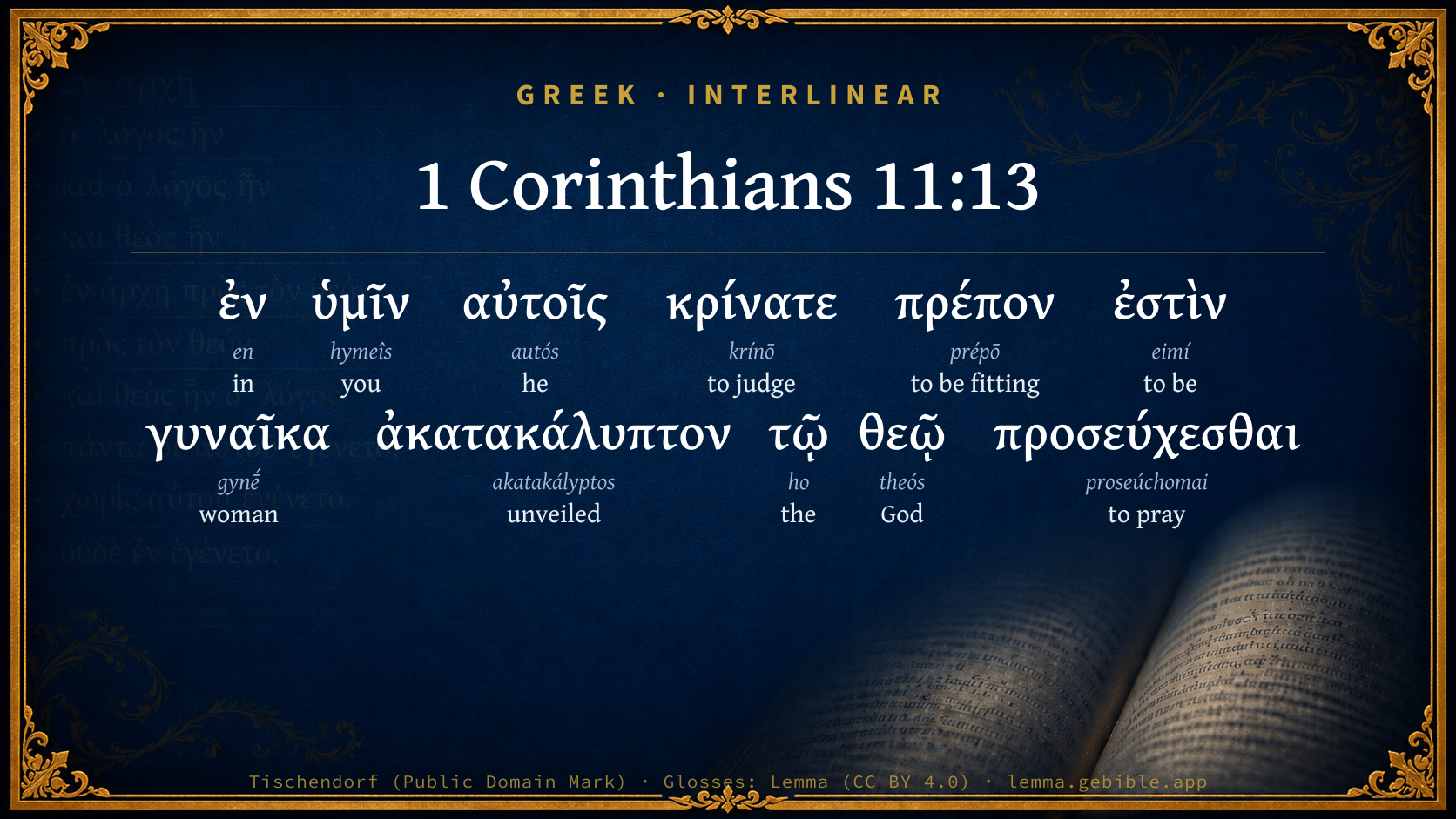
  1. ἐν en G1722 “in” Preposition
  2. ὑμῖν hymeîs G5210 “you” Personal pronoun, 2nd person, Dative, Plural
  3. αὐτοῖς autós G846 “he” Personal pronoun, Dative, Plural, Masculine
  4. κρίνατε krínō G2919 “to judge” Verb, Aorist, Active, Imperative, 2nd person, Plural
  5. πρέπον prépō G4241 “to be fitting” Verb, Present, Active, Participle, Nominative, Singular, Neuter
  6. ἐστὶν eimí G1510 “to be” Verb, Present, Active, Indicative, 3rd person, Singular
  7. γυναῖκα gynḗ G1135 “woman” Noun, Accusative, Singular, Feminine
  8. τῷ ho G3588 “the” Article, Dative, Singular, Masculine
  9. θεῷ theós G2316 “God” Noun, Dative, Singular, Masculine
  10. προσεύχεσθαι proseúchomai G4336 “to pray” Verb, Present, Middle or Passive deponent, Infinitive

About this verse

These counts appear in no published source. They are computed here, from the morphology-tagged text and Lemma’s own curated glosses. What Lemma adds →

11
words
11
distinct lemmas
Pauline Epistles
section

Notable vocabulary

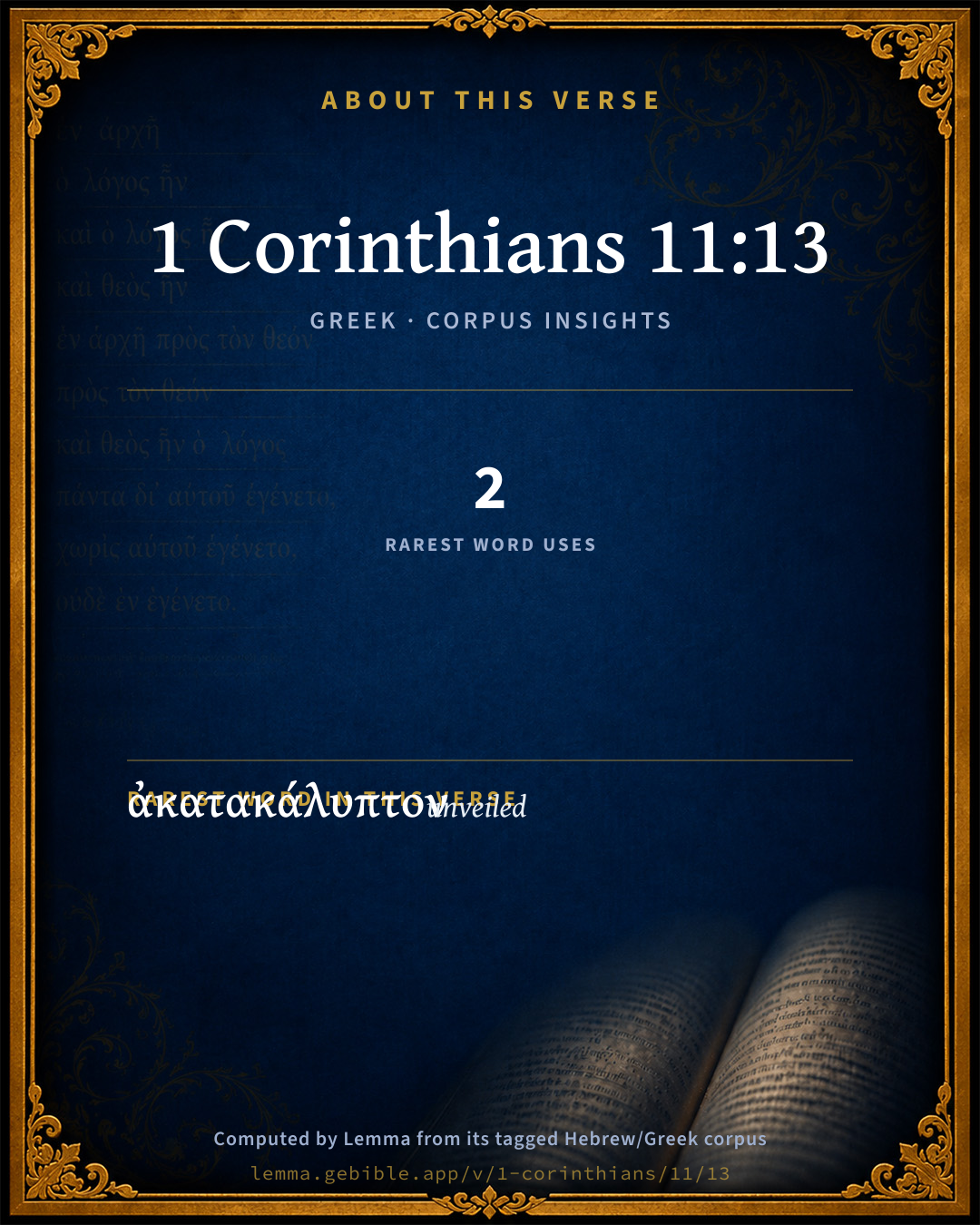
The rarest word here is ἀκατακάλυπτον unveiled G177 — appearing just 2 times in the whole Greek New Testament.

Shared distinctive vocabulary

ἀκατακάλυπτον unveiled G177 occurs in 2 verses of the Greek New Testament. Also found in:

Cross-references

3

Topical passages linked to 1 Corinthians 11:13 in the Treasury of Scripture Knowledge — connected by theme and wording, ordered by reader-vote popularity; previews shown in the World English Bible.

  • Luke 12:57 Why don't you judge for yourselves what is right?
  • John 7:24 Don't judge according to appearance, but judge righteous judgment."
  • 1 Corinthians 10:15 I speak as to wise men. Judge what I say.

Cross-references courtesy of OpenBible.info (CC BY 4.0).

Commentary

Notes on 1 Corinthians 11:13 from classic Christian and Jewish commentators (each source and its license shown beneath its notes). The classic Christian expositions comment on the surrounding passage and are grouped to its opening verse, so a note may address several verses; the Jewish commentaries on the Tanakh (Rashi and others) are per-verse, so they appear only where the commentator wrote on this verse.

Lemma curates 59 commentaries, every one of them public domain or Creative Commons licensed, each selected and text-cleaned for this edition rather than reprinted as found. About our sources →

Joseph Benson's Commentary

1Co 11:13-16. Judge in yourselves — For what need of more arguments in so plain a case? Is it comely — Decent, suitable to female modesty; that a woman pray unto God — The Most High, with that bold and undaunted air which she must have if, contrary to universal custom, she appears in public with her head uncovered? Doth not even nature — The light of nature, or natural reason; teach you — Previous to any arguments on the subject; that if a man have long hair — Carefully adjusted, it is a mark of such effeminacy as is a disgrace to him? But if a woman have long hair, it is a glory — An ornament; to her — Which does not incommode her, being suitable to her domestic state: for her hair was given her — Originally, and before the arts of dress were invented or needed; for — Αντι, instead of; a covering — Or veil. “What a value the eastern ladies put on their hair may be known from this, that when Ptolemy Euergetes, king of Egypt, was about to march against Seleucus Callinicus, his queen, Berenice, who loved him tenderly, vowed, as the most precious sacrifice she could offer, to cut off and consecrate her hair, if he returned in safety.” But if any man seem to be contentious — And will dispute this matter, on his own different views of what is naturally decent, I shall not controvert it further, but content myself with saying, that we have here no such custom — For women to appear with their heads uncovered; neither the churches of God — In any other place, whether planted by me or any of my brethren. The several churches that were in the apostles’ time, had different customs in things that were not essential; and that under one and the same apostle, as circumstances in different places made it convenient. And in all things merely indifferent the custom of each place was of sufficient weight to determine prudent and peaceable men. Yet even this cannot overrule a scrupulous conscience, which really doubts whether the thing be indifferent or not. But those who are referred to here by the apostle were contentious, not conscientious persons.

Joseph Benson's Commentary on the Old and New Testaments (1811–1818) — public domain. Text from a community e-Sword module.

Tyndale Open Study Notes

Tyndale Open Resources

11:13 Is it right? This rhetorical question expects the answer “no.”

Tyndale Open Study Notes — © Tyndale Open Resources, licensed CC BY-SA 4.0. Text via the HelloAO Bible API.

Bengel's Gnomon

Johann Albrecht Bengel

1Co 11:13. Ἐν ὑμῖν αὐτοῖς, in yourselves) without a long explanation.—ἔστι, is it?) a direct interrogation, as 1Co 6:5.—γυναῖκα—τῷ Θεῷ, a woman—to God) Paul describes the leap, which the woman uncovered takes, passing beyond both the man and angels. An excellent hypotyposis,[93] though short.

[93] A vivid picture in words of some action. Appendix.

Bengel's Gnomon of the New Testament — English translation (T&T Clark, Edinburgh, 1860) — public domain. Text from a community e-Sword module.

Meyer's Critical & Exegetical Commentary

Heinrich August Wilhelm Meyer

1Co_11:13-15. By way of appendix to the discussion, the apostle refers his readersas regards especially the praying of the women, which had given rise to debateto the voice of nature herself. He asks them: Is it seemly,judge within yourselves concerning it,is it seemly that a woman should offer up prayers uncovered? Does not nature herself even (οὐδέ) teach you the opposite?

ἐν ὑμῖν αὐτοῖς] without any influence from without; comp 1Co_10:15.

Τῷ ΘΕῷ] superfluous in itself, but added for the sake of emphasis, in order to impress upon them the more deeply the unseemliness of the uncovered state in which the woman comes forward to deal with the Most High in prayer.

Regarding the different constructions with πρέπον ἐστι, see Buttmann, neut. Gr. p. 239 [E. T. 278].

The φύσις is the natural relation of the judgment and feeling to the matter in question,the native, inborn sense and perception of what is seemly. This instinctive consciousness of propriety had been, as respected the point in hand, established by custom and had become φύσις. Comp Chrysostom. The manifold discussions, to little purpose, by the old commentators regarding the meaning of ΦΎΣΙς, may be seen in Pooles Synopsis, and in Wolf. It is here, as often in Greek writers (comp also Rom_2:14), the contrast to education, law, art, and the like. It cannot in this passage mean, as Hofmann would have it, the arrangement of things in conformity with their creationthat is to say, the arrangement of nature in the objective sense (so, frequently in the classics), for the assertion that this teaches all that is expressed by the ὅτι ἀνὴρ Κ.Τ.Λ[1797] would go much too far and be unwarranted. Were we, again, to assume that ὅτι does not depend at all on διδάσκει, but gives the ground for the question, so that διδάσκει would require its contents to be supplied out of the first half of the verse, how awkwardly would Paul have expressed himself, and how liable must he have been to misapprehension, in putting ὅτι instead of conveying his meaning with clearness and precision by γάρ! And even apart from this objection as to the form of expression, we cannot surely suppose that the apostle would find in a fact of aesthetic custom (1Co_11:14-15)that is to say, a something in its own nature accidental, and subsisting as an actual fact only for the man accustomed to itthe confirmation of what the order of things in conformity with their creation teaches.

αὐτή] independently of all other instruction.

Upon the matter itself (κόμην δὲ ἔχειν καὶ εὔκομον εἶναι γυναικώτερόν ἐστι, Eustath. a[1798] Il. iii. p. 288), see Perizonius, a[1799] Ael. V. H. ix. 4; Wetstein in loc[1800] In ancient times, among the Hellenes, the luxuriant, carefully-tended hair of the head was the mark of a free man (see generally, Hermann, Privatalterth. § xxiii. 13 ff.). Comp also 2Sa_14:25 f. In the church, both by councils and popes, the κομοτροφεῖν was repeatedly and strictly forbidden to the clergy.[1802] See Decretal. lib. iii. tit. i. cap. 4. 5. 7.

ὅτι ἡ κόμη ἀντὶ περιβ. δέδ.] Ground for long hair being an ornament to a woman: because it is given to her instead of a veil, to take its place, to be, as it were, a natural veil. This again implies that to wear a veil, as in the case in hand, is a decorous thing. For if the κόμη is an honour for a woman because it is given to her in place of a veil, then the veil itself too must be an honour to her, and to lay it aside in prayer a disgrace. Naturae debet respondere voluntas, Bengel. Περιβόλαιον, something thrown round one, a covering in general (see the Lexicons, and Schleusner, Thes. IV. p. 289), has here a special reference to the veil (καλύπτρα, κάλυμμα) spoken of in the context.

[1797] .τ.λ. καὶ τὰ λοιπά.

[1798] d refers to the note of the commentator or editor named on the particular passage.

[1799] d refers to the note of the commentator or editor named on the particular passage.

[1800] n loc. refers to the note of the commentator or editor named on the particular passage.

[1802] If we are to look upon the tonsure, however, as a symbol of the spiritual life in contradistinction to the vanities of this world (see Walter, Kirchenr. § 212), then this by no means corresponds to the view held by the apostle in our text. Long hair on the head is a disgrace to a man in his eyes; because he regards it as a sign of human subjection.

Meyer — Critical and Exegetical Commentary on the New Testament — English translation by Peter Christie, edited by Frederick Crombie (T&T Clark, 1880) — public domain. Text from a community e-Sword module.

Expositor's Greek Testament

ed. W. Robertson Nicoll

1Co 11:13 . There is a constitutional feeling which supports the above inference in favour of the woman’s veil; it was implied already in the καταισχύνει and αἰσχρὸν of 1Co 11:5 f., and is now explicitly stated: “Amongst yourselves ( inter rather than intra vos ipsos ) judge ye; is it seemly for a woman unveiled to be engaged in prayer (pr [1651] inf [1652] ) to God?” an appeal to social sentiment ( cf. Rom 2:15 , μεταξὺ ἀλλήλων ), recalling the κρίνατε ὑμεῖς of 1Co 10:15 . πρέπον (neut. ptp [1653] : see parls.), as distinguished from ὀφείλω or δεῖ (1Co 11:7 ; 1Co 11:19 ), denotes befittingness , suitability to nature or character. τῷ Θεῷ lends solemnity to προσεύχεσθαι .

[1651] present tense.

[1652] infinitive mood.

[1653] participle

The Expositor's Greek Testament, edited by W. Robertson Nicoll (1897–1910) — public domain. Text from a community e-Sword module.

Godet's Commentaries

Frédéric Louis Godet

1Co 11:13-16.

The apostle concludes by appealing to the natural impression which ought to follow from a particular feature in the physical conformation of the man and the woman. This last argument is strictly connected with the last words of 1Co 11:12.

Vv. 13-15. “Judge in yourselves: Is it comely that a woman pray unto God uncovered? 14. Doth not nature itself teach you, that, if a man have long hair, it is a shame unto him? 15. but if a woman have long hair, it is a glory to her: for her hair is given her for a covering.”

After appealing to the sacred analogies mentioned in 1Co 11:3-6, and to the relation established by creation between the sexes (1Co 11:7-12), Paul finally takes to witness a fact nearer to us, inherent in the human person itself. We here come to a formula similar to that with which he had closed the previous discussion 1Co 10:15 : “Judge of yourselves!” These words appeal to the instinct of truth which ought to exist in his readers themselves.

The following question finds its solution in 1Co 11:14-15, where the fact is stated which should serve as the basis of their judgment.

The addition of the words τῷ Θεῷ, to God, is difficult to explain; for it appears as if it were precisely in speaking to God that the woman could speak without impropriety unveiled. But let us remember that we are here in full public worship, and that it is at the moment when the woman’s voice is uttering the deepest impressions and the holiest emotions of adoration and love, that a feeling of holy modesty ought to constrain her to secure herself from every indiscreet and profane look. For the very reason that she is speaking to God, she ought in this sacred act to veil her figure from the eyes of men. These words: to God, are therefore, whatever Holsten may say, perfectly in place.

Frédéric Louis Godet — Commentaries on Luke, John, Romans, and 1 Corinthians — English translation (T&T Clark, Edinburgh, 1870s–1890s) — public domain. Text from a community e-Sword module.

Hodge's Commentary on Romans, Ephesians & First Corinthians

Charles Hodge

1Co_11:13

Judge in yourselves: is it comely that a woman pray unto God uncovered?

This is an appeal to their own sense of propriety. The apostle often recognizes the intuitive judgments of the mind as authoritative. Rom_1:32; Rom_3:8. The constitution of our nature being derived from God, the laws which he has impressed upon it, are as much a revelation from him as any other possible communication of his will. And to deny this, is to deny the possibility of all knowledge. It is comely (πρέπον ἐστί), is it becoming or decorous?

Charles Hodge — Commentary on Romans (1835), First Corinthians (1857), and Ephesians (1856) — public domain. Text from a community e-Sword module.

Geneva Bible (1599)

Geneva Bible translators

He urgeth the argument taken from the common sense of nature.

Geneva Bible (1599) marginal notes — public domain. Text via Bolls.life.

Jamieson, Fausset & Brown

Robert Jamieson, A. R. Fausset & David Brown

Appeal to their own sense of decorum.

a woman . . . unto God--By rejecting the emblem of subjection (the head-covering), she passes at one leap in praying publicly beyond both the man and angels [BENGEL].

Jamieson, Fausset & Brown — Commentary Critical and Explanatory on the Whole Bible (1871) — public domain (CC PDM 1.0). Text via the HelloAO Bible API.

Adam Clarke's Commentary

Verse 13. Judge in yourselves] Consider the subject in your own common sense, and then say whether it be decent for a woman to pray in public without a veil on her head? The heathen priestesses prayed or delivered their oracles bare-headed or with dishevelled hair, non comptae mansere comae, as in the case of the Cumaean Sibyl, AEn. vi., ver. 48, and otherwise in great disorder: to be conformed to them would be very disgraceful to Christian women. And in reference to such things as these, the apostle appeals to their sense of honour and decency.

Adam Clarke's Commentary on the Bible (1810–1826) — public domain. Text from a community e-Sword/MySword module.

Ellicott's Commentary for English Readers

(13) Judge in yourselves.—In this and the two following verses the Apostle reasons with them—appeals to their own common sense, and to the indications of Nature, as to the evident truth of what he has taught them on this question. Surely you would not think it seemly for a woman (setting aside the question of men and angels altogether) to speak face to face with God in prayer?

A Bible Commentary for English Readers, edited by Charles John Ellicott (1878–1897) — public domain. Text from a community e-Sword module.

The Cambridge Bible for Schools and Colleges

gen. ed. J. J. S. Perowne

13–15. Judge in yourselves …] Return to the argument in 1Co_11:10. An appeal is now made to our natural feeling of what is proper and becoming. Man, as his sphere is the world, and as he is the highest of God’s creatures in it, needs no covering to hide him from the gaze of others. Woman, as being, whether married or unmarried, under the dominion of man, receives of God’s providence the covering of her long hair, whereby she may veil herself from the gaze of those who are not her natural protectors.

is it comely] Decet, Vulgate. Bisemeth it? Wiclif. Our version follows Tyndale here, and is equivalent in our modern language to Is it proper? Is it becoming? “It is impossible,” remarks Robertson, “to decide how much of our public morality and private purity is owing to the spirit which refuses to overstep the smallest bound of ordinary decorum.” And again, “Whatever contradicts feelings which are universally received,” that is “in questions of morality, propriety, and decency,” “is questionable to say the least.”

uncovered] Not hilid (veiled) on the heed, Wiclif. Bare hedded, Tyndale.

The Cambridge Bible for Schools and Colleges (gen. ed. J. J. S. Perowne; Cambridge University Press, 1878–1918) — public domain. Text from a community e-Sword module.

John Gill's Exposition

Doth not even nature itself teach you,.... By nature is either meant, the law and light of nature, reason in man, common sense, or rather custom, which is second nature; and which, in this case, must be restrained to the Greeks and Jews; for though among the Grecians the men cut their hair, and did not suffer it to grow long, as also did the Jews, yet there were many nations (k) who did not, even at that time, observe such a rule or custom; but as the Jews and Greeks were the persons chiefly, if not solely, known to the Corinthians, the apostle signifies, that the usages of these people might direct and inform them in this matter:

that if a man have long hair it is a shame unto him; he looks unmanly and womanish, and exposes himself to ridicule and contempt.

(k) Alex. ab. Alex. Genial. Dier. l. 5. c. 18. Servius in Virgil. Aeneid. l. 10. prope finem.

John Gill's Exposition of the Whole Bible (1746–1763) — public domain (CC PDM 1.0). Text via the HelloAO Bible API.

Trapp's Complete Commentary

John Trapp

13 Judge in yourselves: is it comely that a woman pray unto God uncovered?

Ver. 13. Judge in yourselves] All Christ’s sheep are rational, able to discern the things that differ, having their senses thereunto exercised, Heb 5:14. But some sins are condemned by common sense, as here; and religion is founded upon so good reason, that though God had not commanded it, yet it had been our wisest way to have chosen it. But lust doth often so blear the understanding, that a man shall think he hath reason to be mad, and that there is great sense in sinning.

John Trapp, A Commentary or Exposition upon All the Books of the Old and New Testament (1647–1656) — public domain. Text from a community e-Sword module.

Albert Barnes' Notes on the Bible

Judge in yourselves - Or, “Judge among yourselves.” I appeal to you. I appeal to your natural sense of what is proper and right. Paul had used various arguments to show them the impropriety of their females speaking unveiled in public. He now appeals to their natural sense of what was decent and right, according to established and acknowledged customs and habits.

Is it comely ... - Is it decent, or becoming? The Grecian women, except their priestesses, were accustomed to appear in public with a veil - Doddridge. Paul alludes to that established and proper habit, and asks whether it does not accord with their own views of propriety that women in Christian assemblies should also wear the same symbol of modesty.

Albert Barnes' Notes on the Bible (1834–1885) — public domain. Text from a community e-Sword/MySword module.

Matthew Poole's English Annotations

No man is truly and thoroughly convinced of an error, till he be convicted by his own conscience. It is therefore very usual in holy writ for God, by his sacred penmen, to make appeals unto men’s own consciences, and put them to judge within themselves, to examine a thing by their own reason, and according to the dictates of that to give sentence for or against themselves. The thing as to which he would have them judge within themselves, and accordingly pronounce sentence, was, whether it were a decent thing for women to pray to God with their hair all hanging loose about their shoulders, or without any veil, or covering for their head and face.

Matthew Poole's English Annotations on the Holy Bible (1683–1685) — public domain. Text from a community e-Sword/MySword module.

Whedon's Commentary on the Bible

Daniel D. Whedon

13. In yourselves—Look into your own breasts and hearken to the dictates of your intuitive feelings. Man’s true nature affirms the truths of God.

Comely—Accordant with an inborn sense of propriety.

Daniel D. Whedon (gen. ed.), Commentary on the Old and New Testaments (1874–1909) — public domain. Text from a community e-Sword module.

The Pulpit Commentary

Is it comely, etc.? An appeal to the decision of their instinctive sense of propriety.

The Pulpit Commentary (1880–1919), ed. H.D.M. Spence-Jones & Joseph S. Exell — public domain. Text from a community e-Sword module.

John Wesley's Explanatory Notes

Judge of yourselves - For what need of more arguments if so plain a case? Is it decent for a woman to pray to God - The Most High, with that bold and undaunted air which she must have, when, contrary to universal custom, she appears in public with her head uncovered?

John Wesley, Explanatory Notes Upon the Whole Bible (1754–1765) — public domain. Text via the GEBible commentary corpus.

Kretzmann's Popular Commentary

Paul E. Kretzmann

The natural sense of propriety supports the apostle:

v. 13. Judge in yourselves: is it comely that a woman pray unto God uncovered?

v. 14. Doth not even nature itself teach you that, if a man have long hair, it is a shame unto him?

v. 15. But if a woman have long hair, it is a glory to her; for her hair is given her for a covering.

v. 16. But if any man seem to be contentious, we have no such custom, neither the churches of God.

Aside from all external authorities, the apostle here appeals to the natural feeling of his readers; they should decide for themselves whether the innate sense of decency and modesty did not seem to require, did not think it befitting or suitable for a woman to join in public prayer properly veiled. Or does not nature itself teach you that, if a man wears his hair long, it is a disgrace to him, but if a woman wears her hair long, it is a glory to her? It is a significant thing that practically all nations in the world agree in having the men wear the hair short while that of the women is worn long; long hair in a man is considered a sign of effeminacy, while long hair in a woman is looked upon as her crowning beauty. And although the sinful vanity of women, abetted by the foolish admiration of men, has placed the hair into the service of sin, 1Pe 3:3; 1Ti 2:9, it remains true nevertheless: It is given her to serve as a covering, in the nature of a hood. Nature itself has insisted upon woman’s veiling her head, and therefore it is proper for her to express this intention in keeping her head covered.

Since some of the Corinthians might feel inclined to take exception to these statements of Paul, he closes the discussion with a sharp word of warning: But if anyone thinks, presumes, is getting ready to be contentious, (he may know that) we have not that custom, neither the churches of God. Paul was acquainted with the quarrelsome disposition of some of the Corinthians; he knew that he might expect to be attacked for his position in this matter. And so he simply declares that he and his fellow-ministers did not have a custom of that kind. Paul neither believed in extending Christian liberty beyond the boundaries of common decency nor in the specific practice of having the women take part in public worship unveiled. He thus cuts off all further disputation about the matter by appealing to universal Christian usage. Note: The principle stated by the apostle holds to this day, and if propriety and decency in a certain matter require a degree of accommodation from Christians, they will be willing to concede the point for the sake of the Gospel.

Paul E. Kretzmann, Popular Commentary of the Bible (1921–1924) — public domain. Text from a community e-Sword module.

Burkitt's Expository Notes on the New Testament

William Burkitt

Observe here, 1. How our apostle closes his discourse, in which he had reproved the Corinthians, the men for covering, the women for uncovering, their heads, and laying aside their veils in time of religious worship: by an appeal to themselves and their own judgment concerning the matter he is speaking of, and reproving them for; namely, men’s praying with their heads covered, and women with their heads uncovered.

Observe, 2. How the apostle proceeds to blame both sexes for another disorder; namely, that men wore their hair like women, and that women appeared in the guise of men as to their hair.

Here he lets them know that both these kinds of disorders are repugnant to the institution of God, and the dictates of natural reason; Doth not nature itself teach you?

That is, (1.) The general dictates of natural reason.

(2.) The particular law of nature, concerning the distinction of sexes.

(3.) Usage and common custom, which is a second nature.

All these suggest, that for men to wear their hair at full length like the woman, is uncomely and unnatural in the manly sex, but so to do is comely and natural in the female.

Learn hence, That God disallows,and even nature itself condemns, every thing that tends to the confounding of the sexes, which it is his will and pleasure should be visibly distinguished.

It is a great offence to God, and contrary to one end for which apparel was given, when either the man or the woman wears apparel contrary to their sex; and what is said of apparel, their artificial covering, may be affirmed of the hair, that is their natural covering.

"It is a shame for either sex to wear their hair in an uncomely and indecent manner, disagreeable to the natural modesty of either sex."

Observe, 3. How the apostle appeals to the custom and practice of the churches of God in the cases before us. The custom of all the churches is against women’s being uncovered, as an unseemly thing.

It is a known rule, Ubi nihil certi statuit Scriptura, mos populi Dei, et instituta majorum, pro lege tenenda sunt: We ought not to dissent and differ from the custom and practice of the church of Christ in matters not positively determined: but the custom and practice of the church of Christ in matters not positively determined: but the custom of the church must sway with us, with whose practice it is our duty to be as concordant as we can. If any man will by contentious, we have no such custom, neither the churches of God.

Learn thence, That in things only respecting decency, and in compliance with which there is no violation of the command of Christ, the custom of the church of Christ should determine us, and be as a standing rule unto us.

Learn, 2. That it argues a contentious spirit, and savours very much of pride, in matters of little moment to be singular in our practice, and to create disturbance to the church of God. If any man seem to be contentious, &c.

William Burkitt's Expository Notes on the New Testament (1700–1703) — public domain. Text from a community e-Sword module.

McGarvey & Pendleton's Commentaries

J. W. McGarvey

Judge ye in yourselves [he appealed to their own sense of propriety, as governed by the light of nature]: is it seemly that a woman pray unto God unveiled?

J. W. McGarvey (with Philip Y. Pendleton), Commentaries on the New Testament (The Fourfold Gospel, 1914; Acts; and the epistles) — public domain. Text from a community e-Sword/MySword module.

The People's New Testament

B. W. Johnson

13–16. Is it comely that a woman should pray, etc.? That is, in the public assembly. Private prayer, or with her own sex or household, is not meant. It was very unbecoming in view of the customs of the East, nor would it generally be esteemed decorous in our times, and with our ideas, that she should appear with no covering on her head at all.

B. W. Johnson's The People's New Testament with Notes (1889–1891) — public domain. Electronic text from the Christian Classics Ethereal Library (CCEL) ThML edition.

unfoldingWord translationNotes

Door43 World Missions Community

Judge for yourselves

"Judge this issue according to the local customs and church practices you know"

Is it proper for a woman to pray to God with her head uncovered?

Paul expects the Corinthians to agree with him. This can be stated in active form. "To honor God, a woman should pray to God with a covering on her head." (See: Active or Passive and Rhetorical Question)

Does not even nature itself teach you ... for him?

Paul expects the Corinthians to agree with him. AT: "Nature itself even teaches you ... for him." (See: Rhetorical Question)

Does not even nature itself teach you ... for him?

He is speaking of the way people in society normally act as if it were a person who teaches. AT: "You know just from looking at the way people normally act ... for him." (See: Personification)

For her hair has been given to her

This can be stated in active form. AT: "For God created woman with hair" (See: Active or Passive)

translationWords

judge

pray

church

unfoldingWord translationNotes — © Distant Shores Media and the Door43 World Missions Community, licensed CC BY-SA 4.0. Source: git.door43.org/Door43/en_tn.

Cambridge Greek Testament for Schools and Colleges

13–15. ἐν ὑμῖν αὐτοῖς κρίνατε. Fifth argument. An appeal is now made to our natural feeling of what is proper and becoming. Man, as his sphere is the world, and as he is the highest of God’s creatures in it, needs no covering to hide him from the gaze of others. Woman, as her sphere is the home, and as being, whether married or unmarried, under the dominion of man, receives of God’s providence the covering of her long hair, whereby she may veil herself from the gaze of those who are not her natural protectors.

πρέπον. Decet, Vulgate. Bisemeth it? Wiclif. Our Version follows Tyndale here, and is equivalent in our modern language to Is it proper? Is it becoming? ‘It is impossible,’ remarks Robertson, ‘to decide how much of our public morality and private purity is owing to the spirit which refuses to overstep the smallest bound of ordinary decorum.’ And again, ‘Whatever contradicts feelings which are universally received,’ that is ‘in questions of morality, propriety, and decency,’ ‘is questionable, to say the least.’ There may be occasions on which it may be our duty to overstep those boundaries, but (1) if done, it must be done after careful consideration, and (2) for objects which are clearly sufficient to justify it.

Cambridge Greek Testament for Schools and Colleges (Cambridge University Press, 1896; 21 vols, various authors incl. Carr, Maclear, Plummer, Farrar, Lumby, Moule, M. R. James, Simcox) — public domain. Text from a community e-Sword module.

Alford’s Greek Testament

Henry Alford

13.] Appeal to their own sense of propriety: cf. ch. 10:15.

ἐν ὑμῖν αὐτ.] Each man within himself, in his own judgment.

Henry Alford, The Greek Testament (1849–1861) — public domain. Text from a community e-Sword module.

International Critical Commentary

13. In conclusion he asks two questions, the second of which clinches the first. He appeals to their general sense of propriety, as sense which is in harmony with the teaching of φύσις and is doubtlness inspired by φύσις. Their ideas of what is πρέπον are in the best sense natural. It should be noted that both in AV. and RV. the second question is brought to a close too soon. The note of interrogation should be placed after ‘it is a glory to her,’ as in the Vulgate, Luther, Tyndale, and Coverdale. Beza and others make three questions, breaking up the second into two.

ἐν ὑμῖν αὐτῖς κρίνατε. In their own inner judgment (6:2), cannot they decide (10:15)? ‘Is it becoming that a woman should pray to god unveiled?’ Usually προσεύχομαι has no case after it, but here τῷ Θεῷ is added to emphasize the principle that when she is addressing God she ought not to be asserting her equality with men or trying to draw the attention of men: comp. Mat 6:6. For πρέπον see Westcott on Heb 2:10.

International Critical Commentary — older volumes (1896–1929), various authors — public domain. Text from a community e-Sword module.

Lesson kit

Teaching starters — assembled from the data on this page, not authored interpretation. Every prompt links to the verse data it draws on. Edit before teaching.

1 Corinthians, in the Pauline Epistles, opens this verse with 11 words (11 distinct Greek lemmas). Its most distinctive word is akatakályptos (“unveiled”). A historical commentator’s framing appears above. Read the whole chapter for the surrounding context.

Discussion questions

  1. How does “unveiled” (akatakályptos) shape what this verse is saying?
  2. How does 1 Corinthians 11:5, which shares the word «unveiled», read alongside this verse?
  3. These translations render this verse differently; the difference is in the English rendering, not the original. What questions does that raise?
  4. Compare how Joseph Benson's Commentary and Tyndale Open Study Notes read this verse. Where do they agree or differ?

Things to notice

Reading settings

Reading text

Shown beneath each verse's original-language words.

Old Testament
Old Testament edition

Read the OT as the Masoretic Hebrew (MT) or the Greek Septuagint (LXX).

English shown for the Greek Septuagint (in the Hebrew ↔ Greek comparison).

Comparing translations? Open the Compare panel on any verse page to stack up to four side by side.