
Hebrews 11:35

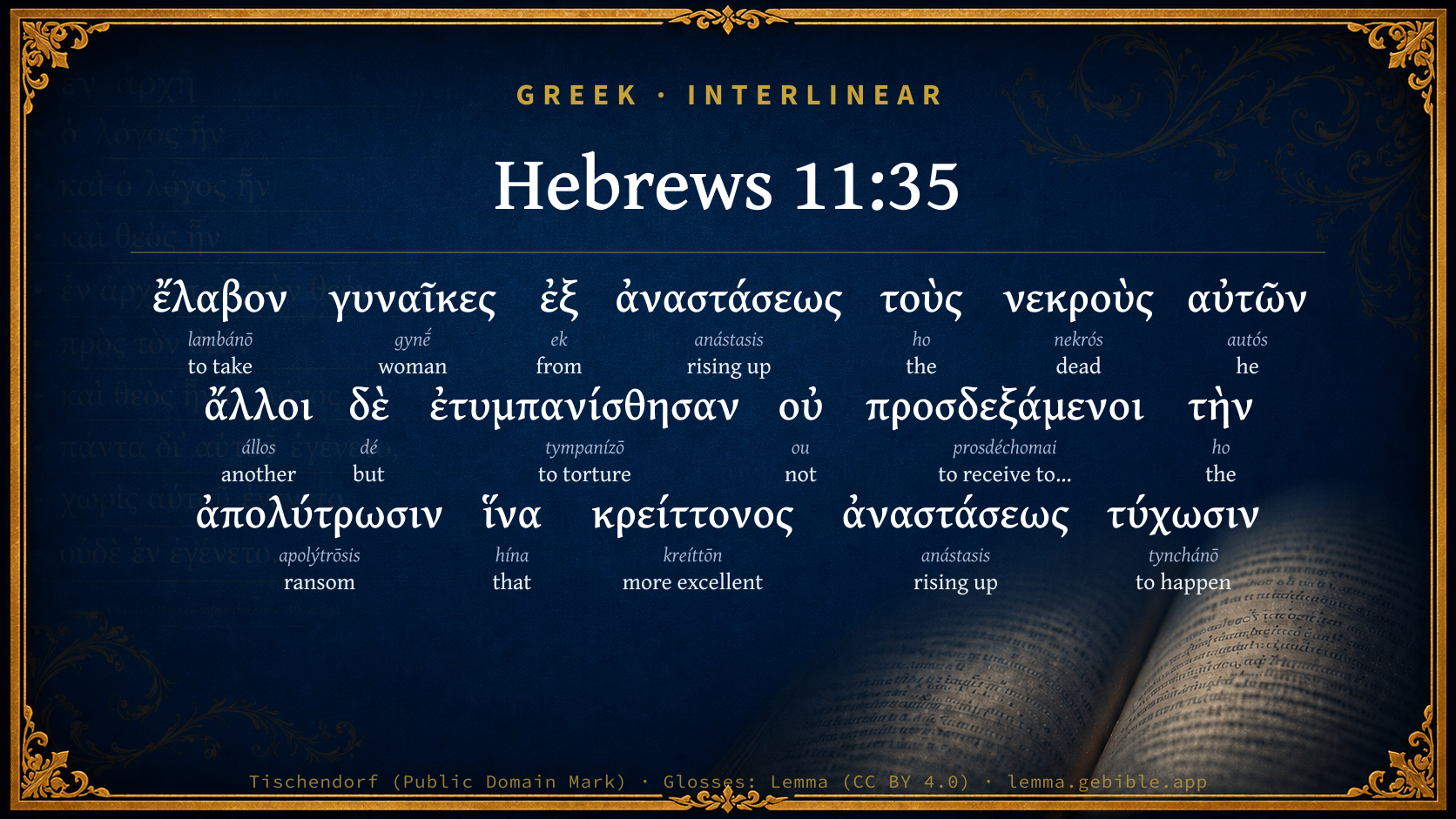
Greek (Tischendorf 8th ed.) Hebrews 11:35 appears in the Greek New Testament. The text above is from the Tischendorf 8th edition. Each word links to its Strong’s number and a concise gloss. Click any word for its full Thayer’s Greek Lexicon entry.
Download image
Cite this verse

Hebrews 11:35 (World English Bible). Public Domain. Lemma interlinear Bible study tool, https://lemma.gebible.app/v/hebrews/11/35.

Show BibTeX & RIS
BibTeX
RIS
English Translation
Women received their dead by resurrection. Others were tortured, not accepting their deliverance, that they might obtain a better resurrection.
World English Bible · Public Domain
Highlights
  • 1 hapax legomenon — only here in the Greek New Testament
  • 1 first appearance in the Greek New Testament
Full analysis ↓
Download a study sheet

One document with this verse’s original text, its word-by-word gloss line, the meaning frame, cross-references with their text, attributed commentary, and full source and license credits — printable, and it pastes into notes with its structure intact.

This verse Autodidact and up

Study sheet (.html) Plain text (.txt)

A passage Seminary Student

Up to 50 verses in one chapter. A passage sheet keeps up to 6 commentary sources and 12 cross-references per verse, in the order this page ranks them, and says so on the sheet whenever that leaves anything out. Ask for a single verse and you get the Autodidact verse sheet above.

Everything on this page stays free to read, with no account — the sheet is a download of what is already on screen, not access to it.

Want to remove ads? Support Godless Engineer
Compare translations 3

The same verse in 3 English versions, stacked beneath the original-language interlinear above. Click any original word for its lexicon entry.

Each is an independent rendering of the whole verse — the interlinear is not word-aligned to these translations.

Highlighted words mark where these versions differ — a whole-verse word diff, not a word-by-word alignment.

  • World English Bible Public Domain
    Women received their dead by resurrection. Others were tortured, not accepting their deliverance, that they might obtain a better resurrection.
  • King James Version Public Domain
    Women received their dead raised to life again: and others were tortured, not accepting deliverance; that they might obtain a better resurrection:
  • unfoldingWord Literal Text CC BY-SA 4.0
    Women received back their dead by resurrection, but others were tortured, not accepting their release, so that they might obtain a better resurrection;

unfoldingWord Literal Text — © unfoldingWord, licensed CC BY-SA 4.0. Word-aligned USFM3 via Door43 (git.door43.org/unfoldingWord/en_ult).

Versions to compare (up to 4)

3 of 4 selected

Show all 19 translations

Every available English version of this verse, each an independent rendering of the whole verse.

  • World English Bible Public Domain
    Women received their dead by resurrection. Others were tortured, not accepting their deliverance, that they might obtain a better resurrection.
  • Berean Standard Bible Public Domain
    Women received back their dead, raised to life again. Others were tortured and refused their release, so that they might gain a better resurrection.
  • Majority Standard Bible Public Domain
    Women received back their dead, raised to life again. Others were tortured and refused their release, so that they might gain a better resurrection.
  • King James Version Public Domain
    Women received their dead raised to life again: and others were tortured, not accepting deliverance; that they might obtain a better resurrection:
  • American Standard Version (1901) Public Domain
    Women received their dead by a resurrection: and others were tortured, not accepting their deliverance; that they might obtain a better resurrection:
  • Revised Version (1885) Public Domain
    Women received their dead by a resurrection: and others were tortured, not accepting their deliverance; that they might obtain a better resurrection:
  • Geneva Bible (1599) Public Domain
    The women receiued their dead raised to life: other also were racked, and woulde not be deliuered, that they might receiue a better resurrection.
  • Douay-Rheims (1899) Public Domain
    Women received their dead raised to life again. But others were racked, not accepting deliverance, that they might find a better resurrection.
  • Young's Literal Translation Public Domain
    Women received by a rising again their dead, and others were tortured, not accepting the redemption, that a better rising again they might receive,
  • Literal Standard Version CC BY-SA 4.0
    women received their dead by a resurrection, and others were tortured, not accepting the redemption, that they might receive a better resurrection,
  • Unlocked Literal Bible CC BY-SA 4.0
    Women received back their dead by resurrection. Others were tortured, not accepting release, so that they might experience a better resurrection.
  • unfoldingWord Literal Text CC BY-SA 4.0
    Women received back their dead by resurrection, but others were tortured, not accepting their release, so that they might obtain a better resurrection;
  • Darby Bible Public Domain
    Women received their dead again by resurrection; and others were tortured, not having accepted deliverance, that they might get a better resurrection;
  • World Messianic Bible Public Domain
    Women received their dead by resurrection. Others were tortured, not accepting their deliverance, that they might obtain a better resurrection.
  • Webster's Bible Public Domain
    Women received their dead raised to life again: and others were tortured, not accepting deliverance; that they might obtain a better resurrection:
  • Free Bible Version CC BY-SA 4.0
    Women were given their dead family members back through resurrection. Others were tortured, refusing to compromise and be pardoned, because they wanted to be part of a better resurrection.
  • Bible in Basic English Public Domain
    Women had their dead given back to them living; others let themselves be cruelly attacked, having no desire to go free, so that they might have a better life to come;
  • Text-Critical English NT CC BY 4.0
    Women received back their dead by resurrection. Other people were tortured, refusing to accept release, so that they might obtain a better resurrection.
  • Tyndale New Testament (1534) Public Domain
    And the wemen receaved their deed raysed to lyfe agayne. Other were racked and wolde not be delyvered that they myght receave a better resurreccion.

Literal Standard Version (2020), Covenant Press — licensed CC BY-SA 4.0. Text via the HelloAO Bible API (eBible.org). Unlocked Literal Bible (unfoldingWord) — licensed CC BY-SA 4.0. Text via the HelloAO Bible API (eBible.org). unfoldingWord Literal Text — © unfoldingWord, licensed CC BY-SA 4.0. Word-aligned USFM3 via Door43 (git.door43.org/unfoldingWord/en_ult). Free Bible Version, Dr. Jonathan Gallagher — licensed CC BY-SA 4.0. Text via the HelloAO Bible API (eBible.org).

Word by word

More ways to search: Search by grammar → Find every occurrence → Compare this word →

Practice this passage: Drill this verse → Learn its vocabulary →

ἐτυμπανίσθησαν
tympanízō
G5178
“to torture”
Verb, Aorist, Passive, Indicative, 3rd person, Plural
Part of Speech
Verb
Tense
Aorist
Voice
Passive
Mood
Indicative
Person
3rd person
Number
Plural
Full Thayer's Definition

Origin: "from a derivative of G5180 (meaning a drum, "tympanum")"

TDNT: None

1. to beat the drum or timbrel 2. to torture with the tympanum, an instrument of punishment
  1. ἔλαβον lambánō G2983 “to take” Verb, Aorist, Active, Indicative, 3rd person, Plural
  2. γυναῖκες gynḗ G1135 “woman” Noun, Nominative, Plural, Feminine
  3. ἐξ ek G1537 “from” Preposition
  4. ἀναστάσεως anástasis G386 “rising up” Noun, Genitive, Singular, Feminine
  5. τοὺς ho G3588 “the” Article, Accusative, Plural, Masculine
  6. νεκροὺς nekrós G3498 “dead” Adjective, Accusative, Plural, Masculine
  7. αὐτῶν autós G846 “he” Personal pronoun, Genitive, Plural, Feminine
  8. ἄλλοι állos G243 “another” Adjective, Nominative, Plural, Masculine
  9. δὲ dé G1161 “but” Conjunction
  10. οὐ ou G3756 “not” Particle, Negative
  11. προσδεξάμενοι prosdéchomai G4327 “to receive to oneself” Verb, Aorist, Middle deponent, Participle, Nominative, Plural, Masculine
  12. τὴν ho G3588 “the” Article, Accusative, Singular, Feminine
  13. ἀπολύτρωσιν apolýtrōsis G629 “ransom” Noun, Accusative, Singular, Feminine
  14. ἵνα hína G2443 “that” Conjunction
  15. κρείττονος kreíttōn G2909 “more excellent” Adjective, Genitive, Singular, Feminine
  16. ἀναστάσεως anástasis G386 “rising up” Noun, Genitive, Singular, Feminine
  17. τύχωσιν tynchánō G5177 “to happen” Verb, Aorist, Active, Subjunctive, 3rd person, Plural

About this verse

These counts appear in no published source. They are computed here, from the morphology-tagged text and Lemma’s own curated glosses. What Lemma adds →

18
words
16
distinct lemmas
General Epistles
section

Notable vocabulary

1 hapax legomenon — a word that appears only here in the entire Greek New Testament:

  • ἐτυμπανίσθησαν to torture G5178

First appearance in Scripture

This word makes its first canonical appearance in the Greek New Testament here:

  • ἐτυμπανίσθησαν to torture G5178

Shared distinctive vocabulary

ἀπολύτρωσιν ransom G629 occurs in 10 verses of the Greek New Testament. Also found in:
Repetition

Words recur within this verse:

  • ἀναστάσεως rising up G386 ×2
  • τοὺς the G3588 ×2

Cross-references

16

Topical passages linked to Hebrews 11:35 in the Treasury of Scripture Knowledge — connected by theme and wording, ordered by reader-vote popularity; previews shown in the World English Bible.

  • 1 Kings 17:22–24 Yahweh listened to the voice of Elijah; and the soul of the child came into him again, and he revived.
  • 2 Kings 4:27–37 When she came to the man of God to the hill, she caught hold of his feet. Gehazi came near to thrust her away; but the man of God said, Let her alone: for her soul is vexed within her; and Yahweh has hid it from me, and has not told me.
  • Philippians 3:11 if by any means I may attain to the resurrection from the dead.
  • Acts 9:41 He gave her his hand, and raised her up. Calling the saints and widows, he presented her alive.
  • Acts 24:15 having hope toward God, which these also themselves look for, that there will be a resurrection of the dead, both of the just and unjust.
  • 1 Corinthians 15:54 But when this corruptible will have put on incorruption, and this mortal will have put on immortality, then what is written will happen: "Death is swallowed up in victory."
  • John 11:40–45 Jesus said to her, "Didn't I tell you that if you believed, you would see God's glory?"
  • Acts 23:6 But when Paul perceived that the one part were Sadducees and the other Pharisees, he cried out in the council, "Men and brothers, I am a Pharisee, a son of Pharisees. Concerning the hope and resurrection of the dead I am being judged!"
  • Luke 7:12–16 Now when he drew near to the gate of the city, behold, one who was dead was carried out, the only son of his mother, and she was a widow. Many people of the city were with her.
  • Luke 14:14 and you will be blessed, because they don't have the resources to repay you. For you will be repaid in the resurrection of the righteous."
  • John 5:29 and will come out; those who have done good, to the resurrection of life; and those who have done evil, to the resurrection of judgment.
  • Acts 22:29 Immediately those who were about to examine him departed from him, and the commanding officer also was afraid when he realized that he was a Roman, because he had bound him.
  • Matthew 22:30 For in the resurrection they neither marry, nor are given in marriage, but are like God's angels in heaven.
  • Mark 12:25 For when they will rise from the dead, they neither marry, nor are given in marriage, but are like angels in heaven.
  • Luke 20:36 For they can't die any more, for they are like the angels, and are children of God, being children of the resurrection.
  • Acts 22:24–25 the commanding officer commanded him to be brought into the barracks, ordering him to be examined by scourging, that he might know for what crime they shouted against him like that.

Cross-references courtesy of OpenBible.info (CC BY 4.0).

Commentary

Notes on Hebrews 11:35 from classic Christian and Jewish commentators (each source and its license shown beneath its notes). The classic Christian expositions comment on the surrounding passage and are grouped to its opening verse, so a note may address several verses; the Jewish commentaries on the Tanakh (Rashi and others) are per-verse, so they appear only where the commentator wrote on this verse.

Lemma curates 59 commentaries, every one of them public domain or Creative Commons licensed, each selected and text-cleaned for this edition rather than reprinted as found. About our sources →

The Biblical Illustrator

Joseph S. Exell

Heb_11:35-36

Women received their dead

Women … and others

Here we find an appreciative and sympathetic reference to the unknown heroes of faith.

The apostle recognises the fact that all that is great in history cannot be catalogued under great names.

God does not care to label all His wonders. The great men and women who are brought into prominence are only specimens of what may be found in lowlier spheres of life, just as the rocky strata hurled up through the earths surface do but reveal the kind of deposit which is to be found everywhere down deep in the earths bosom. Yet men, as a rule, have ignored that wealth of resource which does not project itself in huge protrusions before their sight. It is comparatively recently that even historians have learnt that human history does not consist exclusively of the record, however faithfully given, of the lives of kings, great warriors, powerful ecclesiastics, and other recognised rulers of men. This glorious Book has been the one grand exception. It has ever taught men that there is a mightier power than that of monarchs, which determines the destinies of nations, and works for righteousness, and which often works more powerfully out of sight than on the surface. Here, after the names of patriarchs, kings, noted women, and the great judges of Israel, come the prophets, but only as a whole and unnamed; and then the nameless women … and others--not a jot inferior to those who have passed before them, and whose names have been echoed throughout the ages. The transition from the prophets to women is sudden, but not incongruous. The list of the faithful is not complete without women, those in whom faith triumphed in true womanly fashion--in the power of patient endurance. Theirs was a faith mightier than the wrench of death. They were great in what is pre-eminently the grace of sanctified womanhood--the passive virtues. What a world of suffering and of heroic endurance is epitomised here! The writer has no time to tell more: the theme grows in its vastness; hence, under the pressure of a sublime necessity, he throws what has been left untold upon the shoulders of a few sentences until they stagger and are well-nigh crushed under their burden. Here the grandest summary of all types of patient endurance, which we can find within the covers of this book, is associated with the lives of obscure men and women. Heroism is shown to be no monopoly of position or of sex, of age or of nation. The favourite type of womanly devotion is presented not only in the words received their dead to life again, but also in those which apply to the more general epithet and others--namely, were tortured, not accepting deliverance. How often is this illustrated in other days than those of persecution by the devotedness of consecrated womanhood to husband, child, sufferer, and outcast, in toil, feebleness, suffering, and shame! How often have labours and hardships been gratefully accepted, and the suggestion of deliverance or exemption from such emphatically ignored! It is the summary of this indignant repudiation of deliverance from suffering, and even death, when they have stood in the path of duty, that occupies one of the finest chapters in the illustrious history of faith. Edwin Long gives a striking illustration of this type of heroism in one of his paintings, where he depicts a Christian maid who will not burn a single grain of incense upon Caesars altar to save her life, and that notwithstanding the eloquent appeal in the beseeching look of her lover, that for his sake she would do it. What significance there is in the words and others! They represent the forces which have not been tabulated in the ordinary records of triumphs, and yet they are the greatest of all. God in His record supplements every great name with and others. Elijah in the hour of despondency thought himself alone as the centre and circumference of the true devotion of his age--I, even I only, am left. God reminded him of the and others, when He replied, Yet I have left Me seven thousand in Israel, all the knees which have not bowed unto Baal, and every mouth which hath not kissed him (1Ki_19:18). Who won the battle of Waterloo? Wellington. Yes, and others. Who have wrought Christian reformations of the past three centuries? Luther, Wycliffe, Knox, Wesley. Yes, and others in every instance. Now, it is of these women and others anonymously mentioned here that the writer adds, Of whom the world was not worthy. Observe that this is not said of any of the great names mentioned previously. That went without the saying. But there was need of emphasising this regarding the unknown heroes of God. The world which extended such poor hospitality to its King has, throughout the ages, made no room for the royal, although unknown, men and women whom the King has sent. One of the hopeful signs of to-day is that the world gives room to the good and the faithful as it never did before. We, too, can belong, if we will, to the and others. Our names will not be added to those of the worlds great ones, nor yet to those of the more prominent heroes of faith, but we can belong to the nameless ones who yet have a glorious record to give. Are we unknown? So were these; yet the story of the triumphs of faith cannot be told without admitting their achievements into the record. So shall it be with us if only we are found faithful. They without us cannot be made perfect. This is Gods reason for providing some better thing for us than was ever granted them. No age of faith is final or self-inclusive. The one becomes the counterpart of the other. Every generation of faithful heroes shall strike its own note, until all ages shall unitedly perfect the grand chord of music that shall ascend to the ear of God, and thrill heaven with its full and rich harmony. (D. Davies.)

Not accepting deliverance

Faith refusing deliverance:

We have here an exhibition of faith in one of its noblest forms. It is much for faith to commit itself to suffering, without casting about for a means of deliverance. But faith wins a victory that is greater still, at such times as release is actually presented, and it waives the temptation away. For the deliverance that is spoken of here is a thing that lies shaped and ready; it is held ever before them as a near and inviting opportunity. And the struggle in such cases is not merely to refrain from attempting an escape, but to reject the outlets that are already open, there to tempt and importune by ones very side, with the short road they offer back into life and liberty.

I. Let us take the truth before us AS A CHARACTERISTIC OF THE SAVIOURS CONSECRATION. AS His peoples Surety and His peoples Example, at once the Foundation and the Pattern of all their obedience, it holds true in regard to Christ that He accepted not deliverance. Is it not true that in our views of Christ and His Surety-work we are apt to limit ourselves to the initial condescension, and forget the life-long struggle? We are apt to fix our attention on the first grand compliance, when the covenant agreement was embraced. Then and thenceforward we regard His obedience as a matter of course--a matter, indeed, involving both continued surrender and continued suffering, but a matter whose cost He had counted, to whose endurance He was shut up, and from whose bitter experiences there was no opportunity of release. And most true it is that the endurance of a Saviour was a matter of course with Him, if what we mean is this, that all the faithfulness of all His mediatorial nature was pledged, and all the energies of His Divine will were directed to the prosecution and the final fulfilment of His task. But if we mean that He was committed to His work so securely as that there was no room for the temptation to recoil from it on His human side, and no battle with self in suppressing that temptation, then we are wrong. For the life-long temptation of Christ lay just here. Over and over again deliverance presented itself; its possibility was suggested by a power from without, its offer was responded to by the weak flesh within. And the victory was of faith--faith like our own--when the Saviour repelled it, and, having escape set before Him, accepted it not. He accepted not deliverance, that He might obtain the resurrection, and the resurrection was better than any deliverance. He laid down His life that He might take it again, and the life re-taken was more powerful and glorious--oh, how far!--than the life He originally laid down.

II. WHAT WAS TRUE IN THE HISTORY OF THE MASTER IS TRUE IN THE HISTORY OF THE DISCIPLE; FAITH, ON OCCASION, MUST BE STRONG TO REFUSE, ACCEPTING NOT DELIVERANCE. Doubtless the task given Christ to accomplish was different in many respects from the tasks given to us; and as His task was, so was His temptation to recoil from it--different in intensity, perhaps different, too, in kind. But, after all, the refusals have this great point in common, that in each ease there is the rejection of relief, because relief is to be purchased at the expense of duty. Making all due allowance for distinctions, in the saints case, as in Christs, there is abundant opportunity for the exercise of faith in the aspect we speak of, its manifestation and triumph in declinature. And perhaps never is faith so signal as when it reveals itself just in this way; never is its nature so pure and exalted as when it toils and endures, not accepting deliverance. For it is not merely that you make a grace of necessity, and settle yourself down in submission to suffer, because you recognise the suffering you endure to be inevitable; that is something, nay, it is much by itself, for there are various ways of enduring the inevitable, and there are many who meet and experience it amiss. But the victory of faith that we speak of lies here, that when the cup of relief is actually brought near, and the relief that it offers is urged by the tempter, commended by the world, and pled for by all the self-indulgence that lies deep in the human heart--I say the victory of faith lies here, that you bid the proposal away from you, rejecting the outlet for conscience sake and for Christs. Such is the principle; and on its special applications our daily experience sheds light. Perhaps the burden appointed you is the care of others. Interests may happen to be linked with your conduct, lives may happen to be left in your keeping, whose needs you are obliged to consult for, whose sufferings you are called to alleviate, whose very sins and infirmities you are bound to restrain. There by their side is your post, the opportunity which Providence has given you to use, the task which Providence has assigned you to pursue; and there are times when the work seems thankless, the success doubtful, and the the depressing and irksome. Are there not those whose life, in the appointment of God, seems largely a sacrifice to such claims; and when the temptation comes to absolve themselves, as come it may, through the sense of a seeming failure, the attractions of a pleasanter lot, or the possibility of shifting the responsibility on others, are not theirs the triumph and reward brought before us in the text, as they cleave to the post of self-denial allotted them, not accepting deliverance? Or perhaps the burden is more personal, and connects itself with circumstances in your own lot. Embarrassment in worldly affairs,--who knows not what possibilities of temptation lie here, in the retrieving of credit at the expense of truthfulness, and the purchase of relief by the sacrifice of honesty. Is not faith triumphant in declinature when it leads the sufferer at such seasons to resolve, Let perplexities thicken, and circumstances hem, and disasters threaten as they may, I will abide by whatsoever things are pure, and refuse extrication till extrication is possible with honour, in the way which God discloses, on the terms of which conscience approves; thus refusing deliverence? But why go farther? The instances are as various as the paths of obedience and suffering, which God in His providence appoints, and the victories possible are as manifold as the temptations to evade or deflect from them. (W. A. Gray.)

Anne Askews martyrdom

Rich and another of the council came to her (Anne Askew) in the Tower, where she was then confined, and demanded that she should make the disclosures which they required concerning her party and her friends. She told them nothing. Then they did put me on the rack, she relates, because I confessed no ladies or gentlemen to be of my opinion; and thereupon they kept me a long time; and because I lay still and did not cry, my Lord Chancellor and Mr. Rich took pains to rack me with their own hands till I was nigh dead. Provoked by her saint-like endurance, these two ordered the lieutenant of the Tower to rack her again. He (Sir Anthony Knevett), tendering the weakness of the woman, positively refused to do so. Then Wriothesly and Rich threw off their gowns, and threatening the lieutenant that they would complain of his disobedience to the king, they worked the rack themselves, till her bones and joints were almost pinched asunder. When the lieutenant caused her to be loosed down from the rack, she immediately swooned. Then, she writes, they recovered me again. After that, I sate two long hours reasoning with my Lord Chancellor on the bare floor, where he, with many flattering words, would have persuaded me to leave my opinion; but my Lord God (I thank His everlasting goodness) gave me grace to persevere, and I will do, I hope, to the very end. Unable to walk or stand from the tortures she had suffered, poor Anne Askew was carried in a chair to Smithfield, and when brought to the stake, was fastened to it by a chain which held up her body; and one who beheld her there describes her as having an angels countenance and a smiling face. The three Throckmortons, the near kinsmen of the queen, and members of her household, had drawn near to comfort Anne Askew and her three companions; but they were warned that they were marked men, and entreated to withdraw. At the vary last, a written pardon from the king was offered to Anne Askew, upon condition that she would recant. The fearless lady turned away her eyes, and would not look upon it. She told them that she came not thither to deny her Lord and Master. The fire was ordered to be put under her, and thus the good Anne Askew, with these blessed martyrs, having passed through so many torments, having now ended the long course of her agonies, being compassed in with flames of fire as a blessed sacrifice unto God, she slept in the Lord, A.D. 1546, leaving behind her a singular example of Christian constancy for all men to follow. Her crime was the denial of the mass. So this, she wrote, is the heresy that I hold, and for it must suffer death. She kept the faith to her God; she kept the faith to her friends, for she betrayed no one, enduring shame and agony with meek, unshaken constancy. (H. Clissold, M. A.)

The martyrs:

As willing were many of the martyrs to die as to dine. (J. Trapp.)

A better resurrection

The better resurrection:

This inspired writer teaches us that these ancient saints were believers in a resurrection to eternal life. It is strange that this should ever be doubted. It seems clear they were, when we think of the very instinct of the spiritual life--of such expressions as those of David: I shall, be satisfied when I awake with Thy likeness--or of the language of Martha and Mary when they were still standing on Old Testament ground: I know that He shall rise again in the resurrection at the last day. Their faith could not have the certainty and clearness which ours should have; but that they did look forward to a life to come there can be no question. They gave the best evidence of their faith, for they submitted to the most cruel tortures and to death, that they might obtain a better resurrection. But what are we to understand by a better resurrection? If we look to the first clause of the verse we shall see, Women received their dead raised to life again. This was one kind of resurrection--a restoration to the life of this world--and to achieve it was a great triumph of faith. But there is another and superior resurrection--to the life of the eternal world and the faith which carries men to this isof a nobler kind, because it is more difficult. There are, then, two spheres of faith--that of those whose dead were brought back to a resurrection in this life, and that of those who pressed on for truths sake to a better resurrection in the heavenly life.

I. THE BETTER RESURRECTION. Imagine to yourselves an event you must in all likelihood meet, or which many of you may already have passed through, when some object of your dearest affection has been torn from you by death. There is the utter blank of desolation--the light of the eyes in which you could read tenderness and truth, quenched--no counsel or comfort, where you could always find it, however sore bestead. And if there came, in that day of darkness, One who gave you back your dead to be with you, to listen to your history of grief--of this very grief--to take your hand in His again, and make you feel He was yours as before--more than before--what could you ask, what could you think of, better than this? And yet if we could for a little rise above feeling, and appeal to reason--the reason which comes of faith--we might see that there is a better resurrection.

1. For think of the place of it. However quiet and happy the home might be to which the earthly life was brought back, it was part of a world which was smitten with the curse. Cares and fears and dangers and griefs were always ready to invade it. And, if we think of the body as the place to which the soul is brought back, it is a home that has also the curse resting on it, subject to pain and disease, which often make death to be chosen rather than life--to long torturing agonies, and to those strange depressions which cloud the soul, so that to those who look out at the windows everything is darkened. It is otherwise with the place of the better resurrection (see Rev_21:27; Rev_22:3-5.) And the body which here depresses the soul shall be framed to lift it up, to give it perception and vigour, insight and wing, made like unto Christs glorious body.

2. Then think, by way of comparison, of the company in the place. In the case of all those who were raised again to life in this world, we find that they were restored to the family circle--the child of the Shunammite and the daughter of Jairus, the son of the widow of Nain and the brother of Martha and Mary. There was an anxiety, if I may so speak, to surround them with their nearest friends when they opened their eyes again, that the first faces they looked on might be those of kindred--of father, mother, brother, sister. It was a merciful arrangement, to break the strange transition, to soothe the agitated, wondering spirit. But there was surely something more in it than this. It was, I think, also predictive. For if these resurrections, as a whole, were intended to help men to the faith of a power stronger than death, they were also intended to lead us to something of the manner of the life beyond. Do they not shadow out this truth, that God will begin our life again among those we have known and loved, and cause us to open our eyes in the bosom of what we shall feel to be a family and a home, with faces round us that are dear and familiar, and voices whose tones we know, ready to reassure us? God will set the solitary in families, and in some way broken household ties will be re-knit in the day that the Lord bindeth up the breach of His people, and healeth the stroke of their wound. Only there will be something better in it. The feeling of sad distrust which sometimes comes over us, as if the truest human friendship had an element of selfishness in it, shall pass away. What we gain here, at intervals, in some chosen crisis of our life--the meeting of souls in one, and profound, untroubled trust in the sense of it--shall then be a fixed condition.

3. Think, then, of the essence of this eternal life. Its essence consists in its entire freedom from sin. The presence of sin in our nature is at the root of every ether evil, and deliverance from suffering in heaven is connected with perfect deliverance from sin. That must be a happy condition when all shall feel the blessedness of the man whose iniquity is forgiven, and the subject which often causes anxious thought, Can I look to God as my Friend and Father? shall be settled for perpetuity--no doubt, nor shadow of a doubt, upon it--but quietness and assurance for ever. And when there shall not only be no guilt on the conscience, but no sin in the heart, no lurking sympathy with it, but every fibre of the root of poison extracted, and the tree of life shall find its counterpart in the perfect fruit of every redeemed soul!

4. But we have to think also of the security of this state. These resurrections of earth were a return to a world of change and death. But the children of the heavenly resurrection die no more; death hath no more dominion over them. The shadow is all behind, the light before, and the light shall no more go down.

5. There is one thing more, without which the thought of this better resurrection would be incomplete--the presence to which it introduces.

The best of these other resurrections brought their subjects into the earthly presence of the Son of God; but this, into His heavenly fellowship.

II. THE HIGHER FAITH REQUIRED FOR THIS RESURRECTION. It needed very great confidence in the living God to believe that He could reanimate the dead frame which the soul had quitted for a few hours or days; but to face entire decay and mouldering dust, and to believe that those who sleep in it shall yet awake and sing--this requires a frame of soul still nobler.

1. It needs more of what I may call the patience of faith. We must endure the scorn of unbelievers, the talk of unchanging earthly laws rolled like the great stone to the door of the sepulchre, and must listen to the taunts of those who rejoice most when they think they hear the iron gates of a materialistic universe grate in upon the grave as an eternal prison. We have to struggle with the murmurs of our own hearts, that it is hard in God to put us to so long and so sore an encounter.

2. It needs also more of what we may call the sanctified imagination of faith. The circle of these earthly resurrections was very narrow and very simple compared with that which we expect. Their faith had only to bring back their dead to the old accustomed house, the well-known seat, the familiar haunts. Ours has to win out a footing for itself from the void and formless infinite, where the scenes and inhabitants and states of mind are so different that our friends seem to have passed away beyond our knowledge. There is an imagination of faith, not unbridled nor unscriptural, which has formed for itself a true and real world beyond death, which gives substance to things hoped for, and thereby helps to the evidence of things not seen the Bible has encouraged it by its figures--the tree of life, the river of life, the city of gold, the Fathers house of many mansions--and imagination has no nobler work than to enter among these visions, and brood and muse till they become a palpable and real world: and till those who are not, because God has taken them, are seen walking there.

3. It needs more of the spiritual insight of faith. The faith of those who received their dead back to the present life had a visible Helper with wonder-working power standing before them. Our faith has not such aid. It has a harder, but a nobler work. It must seek to live as seeing Him who is invisible. It must rest for its ultimate foundation, not on any outward sign, not even on any uttered word as spoken to the ear, but on the nature of

God Himself, and the life He infuses into the soul--on that basis which Christ has given it, God is not the God of the dead, but of the living. Christ Himself must be known to us in His ever-living, spiritual power.

III. SOME OF THE WAYS IN WHICH WE MAY STRENGTHEN OURSELVES IN THIS HIGHER FAITH.

1. The first thought is one addressed to your reason. We read here of men who were tortured, not accepting deliverance, that they might obtain a better resurrection. They surrendered all that life holds dear, and life itself, from loyalty to the God of truth. Not only is the Bible full of this, but the course of history. The noble army of the martyrs is seen in every age, marching on, by scaffold and through fire, into the unseen. Can you imagine that their self-devotion was founded on delusion, and that God has made His world so that the noblest and divinest deeds in its history have a perpetual falsehood at their heart?

2. The next thought is one addressed to your heart. Women received their dead raised to life again.! Observe the expression, Women--their dead. That side of human nature which has the deepest affection is clinging to its dead, claiming an abiding right of possession in them, and aiding faith to draw its lost treasure back to its arms. And it is a striking truth that in all the resurrections of which we read there was not only strong faith, but deep love--the love of woman. God intended that our deepest heart affections should be the helpers of our highest hopes, and the instinctive guarantees of a life to come. We have a right to reason that He would either have made our love less deep and lasting, or that there must be a final home in which its longings shall be realised. Every pure affection points us towards a city in the skies; every happy Christian home is a pledge of it; every bereaved heart is a Divine reason for it. A ground this why you should make your family ties so loyal and sacred that they shall keep your dead still yours, and bind you irrevocably to a life to come.

3. The last way we mention of confirming ourselves in this faith is addressed to the spirit. It is gained by the exercise of that spiritual insight to which we have already referred, leading the way to a spiritual life. The object of this sight, and the source of this life, is described by the sacred writer in words that follow--Looking unto Jesus, etc. Reasoning about immortality may lead us so far, and the instinct of the heart may lead us further; but I know of no certainty save what grows from union with the dying and risen and living Son of God. There is a spring of immortality not only welling out from the throne of God, but ready to rise up in every heart that will admit Him who is the true God and eternal life. It is this faith entering into the soul as a vital principle which formed those ancient martyrs, who counted it all joy to face suffering and shame, and to meet death, when the God of truth summoned them. (J. Ker, D. D.)

The better resurrection

I. REFLECT ON THE LESSON TAUGHT US BY THE CONDUCT OF THE ANCIENT SAINTS, THAT THIS EARTH IS NOT OUR HOME.

II. INQUIRE WHAT THERE IS IN HEAVEN WHICH COULD ENCOURAGE THEM TO ENDURE SUCH EXTREME SUFFERINGS. In heaven a full and constant sense of Gods favour, and uninterrupted communion with Him, are enjoyed. In heaven the most perfect love and gratitude are exercised towards God. Is it any wonder that the martyrs broke the fiercest terrors of death to reach such a heaven? the glorified saints possess the clearest apprehensions of the perfect and unchangeable happiness of God and of His kingdom. This is a source of the most pure and exalted delight.

III. CONTEMPLATE THE GLORIES OF THE RESURRECTION WHICH THEY HAD IN VIEW. (E. Griffin, D. D.)

Maccabaean martyrs:

There can be no doubt that the apostle has here travelled beyond the canonical books of Scripture into the records of Jewish history given in the Apocrypha. If you will read the sixth and seventh chapters of the Second Book of Maccabees, you will find a full elucidation of the very words here employed. You will find the history of a Jewish mother, who, in the persecutions under Antiochus, saw seven sons tortured and put to death on one day, and encouraged them by her words to witness a good confession, on the very ground here stated, that they might obtain a better than any earthly resurrection. You will read there, in express terms, that offer of redemption which they are here said to have refused. Antiochus, while the youngest was yet alive, did not only exhort him by words, but also assured him with oaths, that he would make him both a rich and happy man if he would turn from the laws of his fathers. And you will read there likewise the answer. The King of the universe, says one of these martyrs, shall raise us up, who have died for His laws, unto eternal life. It is good, says another, being put to death by men, to look for hope from God to be raised up again by Him. Fear not this tormentor, the mother said to the youngest, but, being worthy of thy brethren, take thy death, that I may receive thee again in mercy with thy brethren. (Dean Vaughan.)

The Biblical Illustrator, edited by Joseph S. Exell (c. 1880s–1900s) — public domain. Text from a community e-Sword module.

Joseph Benson's Commentary

Heb 11:35-36. Women, naturally weak, received their dead children raised to life again — Compare 1Ki 17:22-23; 2Ki 4:36-37; and others — Particularly seven children and one pious and holy mother; were tortured — In the most inhuman manner, to compel them to renounce their religion, and be guilty of idolatry. See the margin. Thus from those who acted great things the apostle rises higher, even to those who showed the power of faith by suffering; not accepting deliverance — When it was offered them on sinful terms, nor even riches and preferments added to the proposal; that they might obtain a better resurrection — A resurrection to a better life than that they were to lose, and a higher reward than they could have received had they not endured these afflictions; seeing the greater their sufferings, the greater would be their felicity and glory hereafter; and others — In the same glorious cause; had trial of cruel mockings — As Samson before Dagon, when the Philistines had put out his eyes; and doubtless hundreds of others, whose names and trials have not been recorded; and scourgings — Jeremiah was beaten by Pashur, Jer 20:2; and by the princes, Jer 37:15 : but scourging was so frequent a punishment, both alone and before a capital execution, that it is probable it was inflicted on many pious persons; moreover, of bonds and imprisonments — Joseph was cast into a prison, Jeremiah was let down into a dungeon full of mire, Jer 37:13; Jer 37:16; Jer 38:6; and Micaiah was imprisoned by Ahab, 1Ki 22:27.

Joseph Benson's Commentary on the Old and New Testaments (1811–1818) — public domain. Text from a community e-Sword module.

Tyndale Open Study Notes

Tyndale Open Resources

11:35 Elijah and Elisha both brought women’s loved ones back again from death (see 1 Kgs 17:17-24; 2 Kgs 4:17-37). • But others were tortured: Faith does not always have a positive outcome in this life. The author might be alluding to the 170s and 160s BC, when many Jews suffered and died rather than forsake their faith (see, e.g., 1 Maccabees 1:20-64).

Tyndale Open Study Notes — © Tyndale Open Resources, licensed CC BY-SA 4.0. Text via the HelloAO Bible API.

Bengel's Gnomon

Johann Albrecht Bengel

Heb 11:35. Ἔλαβον, women received) They as it were snatched them (rescued them).—γυναῖκες, women) that were believers, naturally weak.—ἐξ ἀναστάσεως, out of or from the resurrection) He says, from, not by. They anticipated a future resurrection.—νεκροὺς) dead sons, 1Ki 17:22; 2Ki 4:35.—ἄλλοι δὲ, and others) He comes from them that act to them that suffer (although Abel, Heb 11:4, was already long ago an example of one both acting and suffering); and the particle δὲ, but, makes an emphatic addition (Epitasis). The ἄλλοι, others, distinguishes these genera; the word ἓτεροι, others, Heb 11:36, distinguishes the species of sufferers. Paul observes the same distinction, 1Co 12:8-9.—ἐτυμπανίσθησαν) τύμπανον, a drum-stick, then a cudgel with which men were beaten to death; French, bastonnade; ἐτυμπανίσθησαν, they were beaten with clubs. Hesychius: ἐτυμπανίσθησαν, ἐκρεμάσθησαν, ἐσφαιρίσθησαν. The Vulgate, they were distended (distenti sunt): for as in a drum the parchment or skin is distended, so in this kind of punishment the bodies were distended, that they

1. Γεδεὼν

παρεμβολὰς ἔκλιναν ἀλλοτρίων.

2. Βαρὰκ

ἐγενήθησαν ἰσχυροὶ ἐν πολέμῳ.

3. Σαμψὼν

ἐνεδυναμώθησαν ἀπὸ ἀσθενείας.

4. Ἰεφθάε

ἔφυγον στόμα μαχαίρας.

5. Δαυὶδ

κατηγωνίσαντο βασιλείας.

6. Σαμουὴλ

εἰργάσαντο δικαιοσύνην.

7. Προφητῶν

ἐπέτυχον ἐπαγγελιῶν,

ἔφραξαν στόματα λεόντων,

ἔσβεσαν δύναμιν πυρός.

might more readily receive the blow. The apostle refers to Eleazar in the persecution of Antiochus, 2 Maccabees 6, of whom at Heb 11:20 we have the following account: he came of his own accord to the torture (ἐπὶ τὸ τύμπανον); again at Heb 11:28: and at Heb 11:30, but when he was at the point of death by the blows, he groaned, and said, It is manifest to the Lord, who has the holy knowledge, that though I might have been delivered (ἀπολυθῆναι) from death, I endure these severe pains in my body, being beaten, etc. Furthermore, as τυμπανίζειν is to beat with clubs, so ἀποτυμπανίζειν, is to Kill with clubs; and the apostle uses the simple verb, because after τυμπάνων πεῖραν (comp. Heb 11:36), after they had made trial of this species of torture, they might, if they were disposed to break their faith, have even still accepted of deliverance (ἀπολύτρωσιν). See Suicer’s Thesaurus, which also proves the fact from Gataker, that this word is frequently used to express any violent death. I fancy the reason is, because clubs are a kind of arms most generally met with in all tumults and in a concourse of people: at least in this very passage the apostle seems to point to all kinds of death caused by tumults and inflicted by clubs (in which is included the mode adopted by Antiochus [the tympanum], and mentioned as surpassing the other instruments of torture), and in the following verse he comes to more exquisite punishments [punishments more refined in cruelty]. But the passive form has the middle signification: They suffered themselves to be beaten with clubs. So also Heb 11:37, comp. Heb 11:36.—τὴν ἀπολύτρωσιν, deliverance) Eleazar, as we have already seen, used the word ἀπολυθῆναι. The writer of the second book of Maccabees took care to make it appear, that he stood in need of some indulgence; he pleads his excuse, 2Ma 2:24-32: but yet the history of the Jewish people from the building of the second temple to the beginning of the New Testament is exceedingly valuable.—κρείττονος, better) This resurrection is better than that which restores mortal life. There is a reference to the beginning of this verse. The antithesis is plain: Women received their dead and recovered them from the resurrection (resuscitation) to a temporal life; [in antithesis to]: Martyrs, who were subjected to death, set before their minds a better resurrection, not to temporal but to eternal life. Comp. 2Ma 7:9; 2Ma 7:11; 2Ma 7:14; 2Ma 7:29; 2Ma 7:36.

Bengel's Gnomon of the New Testament — English translation (T&T Clark, Edinburgh, 1860) — public domain. Text from a community e-Sword module.

Meyer's Critical & Exegetical Commentary

Heinrich August Wilhelm Meyer

Heb_11:35. Ἔλαβον γυναῖκες ἐξ ἀναστάσεως τοὺς νεκροὺς αὐτῶν] Women received back their dead (their sons) through resurrection. Those meant are the widow of Sarepta (1Ki_17:17 ff.), whose son was awakened out of death by Elijah, and the Shunammite woman (2Ki_4:18 ff.), whose son was raised by Elisha. Far-fetched is the supposition of Biesenthal (in Guerickes Zeitschr. f. die ges. luther. Theol. u. Kirche, 1866, H. 4, p. 616 ff.): reference is made to the tradition, preserved to us in the rabbinical and talmudic literature, of the cessation of the dying away of the male population in the wilderness on the 15th Ab.

Syntactically Heb_11:35 begins a new proposition (against Böhme, who, as unnaturally as possible, makes the statement ἔλαβον … αὐτῶν still dependent on οἵ, Heb_11:33, and regards γυναῖκες as apposition to οἵ).

With ἄλλοι δέ, to the close of Heb_11:38, the discourse passes over to examples of a suffering faith, which remained still unrewarded upon earth.

ἄλλοι δὲ ἐτυμπανίσθησαν] Others, on the other hand, were stretched on the rack. Allusion to the martyr-death of Eleazar (2Ma_6:18 ff.), and of the seven Maccabean brothers, together with their mother (2 Maccabees 7.). τυμπανίζεσθαι means: to be stretched out upon the τύμπανον (comp. 2Ma_6:19; 2Ma_6:28), an instrument of torture (probably wheel-shaped, Josephus, de Macc. c. 5, 9, 10 : τροχός),to be stretched out like the skin of a kettledrum, in order then to be tortured to death by blows (comp. 2Ma_6:30).

οὐ προσδεξάμενοι] not accepting, i.e. since the expression, by reason of the objective negation οὐ, blends into a single notion: disdaining.

τὴν ἀπολύτρωσιν] the deliverance, namely the earthly one, which they could have gained by the renouncing of their faith. Comp. 2Ma_6:21 ff; 2Ma_7:27 ff.

ἵνα κρείττονος ἀναστάσεως τύχωσιν] that they might become partakers of a better resurrection. Motive for the contemning of earthly deliverance. Comp. 2Ma_7:9; 2Ma_7:11; 2Ma_7:14; 2Ma_7:20; 2Ma_7:23; 2Ma_7:29; 2Ma_7:36, as also 2Ma_6:26. κρείττονος stands not in opposition to the resurrection of the ungodly unto judgment, Dan_12:2 (Oecumenius: κρείττονος … ἢ οἱ λοιποὶ ἄνθρωποι· ἡ μὲν γὰρ ἀνάστασις πᾶσι κοινή, ἀλλʼ οὗτοι ἀναστήσονται, φησίν, εἰς ζωὴν αἰώνιον, καὶ οὗτοι εἰς κόλασιν αἰώνιον. Comp. Theophylact), neither does it form any antithesis to ἐξ ἀναστάσεως in the beginning of the verse (Chrysostom: οὐ τοιαύτης, οἵας τὰ παιδία τῶν γυναικῶν; Theophylact, who does not, however, decide; Bengel, Schulz, Böhme, Bleek, Stein, de Wette, Stengel, Ebrard, Delitzsch, Riehm, Lehrbegr. des Hebräerbr. p. 617, Obs.; Alford, Maier, Kurtz, and others), which is too remote; but corresponds to the ἀπολύτρωσιν immediately preceding. A much higher possession was the resurrection to the eternal, blessed life, than the temporal deliverance from death; which latter could be regarded, likewise, as a sort of resurrection, but truly only as a lower and valueless one.

Meyer — Critical and Exegetical Commentary on the New Testament — English translation by Peter Christie, edited by Frederick Crombie (T&T Clark, 1880) — public domain. Text from a community e-Sword module.

Expositor's Greek Testament

ed. W. Robertson Nicoll

Heb 11:35 . ἔλαβον γυναῖκες .… “Women received their dead by resurrection,” as is narrated of the widow of Sarepta, 1Ki 17:17-24 , and the Shunamite, 2Ki 4:34 . ἄλλοι δὲ ἐτυμπανίσθησαν … “others were beaten to death”. τύμπανον (sc. τύπανον from τύπ . strike) a drum, τυμπανίζω , I beat. From the expression in 2Ma 6:17 ; 2Ma 6:28 , ἐπὶ τὸ τύμπανον , it might be supposed that some instrument more elaborate than a rod was meant and Josephus speaks of “a wheel” as being used. But that it was substantially a beating to death is proved by what is said of Eleazar ( 2Ma 2:30 ), μέλλων ταῖς πληγαῖς τελευτᾶν , εἶπε . That Eleazar and the seven brethren (2 Maccabees 7) are alluded to is obvious, for it was characteristic of them that they died οὐ προσδεξάμενοι τὴν ἀπολύτρωσιν , not accepting the offered deliverance. Eleazar was shown a way by which he could escape death ( 2Ma 6:21 ), and the seven brethren also were first interrogated and would have escaped death had they chosen to eat polluted food. They endured martyrdom, not accepting the escape that was possible, ἵνα κρείττονος ἀναστάσεως τύχωσιν , “that they might obtain a better resurrection,” “unto eternal life ‘better’ than that spoken of in the beginning of the verse, to a life that again ended” (Davidson, Weiss, von Soden). How fully the resurrection was in view of the seven brethren is shown in the saying of the second: “the King of the world shall raise us εἰς αἰώνιον ἀναβίωσιν ζωῆς ; of the third who when his hands were cut off declared that he would receive them again from God; of the fourth, who in dying said, “It is good, when put to death by men, to look for hope from God to be raised up again by Him;” and the youngest said of them all, “they are dead under God’s covenant of everlasting life”.

The Expositor's Greek Testament, edited by W. Robertson Nicoll (1897–1910) — public domain. Text from a community e-Sword module.

Geneva Bible (1599)

Geneva Bible translators

He seemeth to mean the story of that woman of Zarephath, whose son Elijah raised again from death, and the Shunammite, whose son Elisha restored to his mother.

He meaneth that persecution which Antiochus wrought.

Geneva Bible (1599) marginal notes — public domain. Text via Bolls.life.

Jamieson, Fausset & Brown

Robert Jamieson, A. R. Fausset & David Brown

Women received their dead raised--as the widow of Zarephath (Kg1 17:17-24). The Shunammite (2Ki. 4:17-35). The two oldest manuscripts read. "They received women of aliens by raising their dead." Kg1 17:24 shows that the raising of the widow's son by Elijah led her to the faith, so that he thus took her into fellowship, an alien though she was. Christ, in Luk 4:26, makes especial mention of the fact that Elijah was sent to an alien from Israel, a woman of Sarepta. Thus Paul may quote this as an instance of Elijah's faith, that at God's command he went to a Gentile city of Sidonia (contrary to Jewish prejudices), and there, as the fruit of faith, not only raised her dead son, but received her as a convert into the family of God, as Vulgate reads. Still, English Version may be the right reading.

and--Greek, "but"; in contrast to those raised again to life.

tortured--"broken on the wheel." Eleazar (2 Maccabees 6:18, end; 2 Maccabees 19:20,30). The sufferer was stretched on an instrument like a drumhead and scourged to death.

not accepting deliverance--when offered to them. So the seven brothers, 2 Maccabees 7:9, 11, 14, 29, 36; and Eleazar, 2 Maccabees 6:21, 28, 30, "Though I might have been delivered from death, I endure these severe pains, being beaten."

a better resurrection--than that of the women's children "raised to life again"; or, than the resurrection which their foes could give them by delivering them from death (Dan 12:2; Luk 20:35; Phi 3:11). The fourth of the brethren (referring to Dan 12:2) said to King Antiochus, "To be put to death by men, is to be chosen to look onward for the hopes which are of God, to be raised up again by Him; but for thee there is no resurrection to life." The writer of Second Maccabees expressly disclaims inspiration, which prevents our mistaking Paul's allusion here to it as if it sanctioned the Apocrypha as inspired. In quoting Daniel, he quotes a book claiming inspiration, and so tacitly sanctions that claim.

Jamieson, Fausset & Brown — Commentary Critical and Explanatory on the Whole Bible (1871) — public domain (CC PDM 1.0). Text via the HelloAO Bible API.

Adam Clarke's Commentary

Verse 35. Women received their dead] As did the widow of Zarephath, 1Kg 17:21, and the Shunammite, 2Kg 4:34. What other cases under all the above heads the apostle might have in view, we know not.

Others were tortured] ετυμπανισθησαν. This is a word concerning the meaning of which the critics are not agreed. τυμπανον signifies a stick, or baton, which was used in bastinadoing criminals. And τυμπανιζω signifies to beat violently, and is thus explained by the best lexicographers. After considering what others have written on this subject, I am inclined to think that the bastinado on the soles of the feet is what is here designed. That this was a most torturing and dangerous punishment, we learn from the most authentic accounts; and it is practised among the Turks and other Mohammedans to the present day. Mr. Antes, of Fulnek, is Yorkshire, twenty years a resident in Egypt, furnishes the latest account I have met with; he himself was the unhappy subject of his own description. See at the end of this chapter, article 4. See "Heb 11:40"

Not accepting deliverance] This looks very like a reference to the case of the mother and her seven sons, mentioned 2Mac 7:1, &c.

Adam Clarke's Commentary on the Bible (1810–1826) — public domain. Text from a community e-Sword/MySword module.

John Calvin's Commentaries

35. Women received, etc. He had already mentioned instances in which God had remunerated the faith of his servants, he now refers to examples of a different kind, — that saints, reduced to extreme miseries, struggled by faith so as to persevere invincible even to death. These instances at the first view widely differ: some triumphed gloriously over vanquished enemies, were preserved by the Lord through various miracles, and were rescued by means new and unusual from the midst of death; while others were shamefully treated, were despised by almost the whole world, were consumed by want, were so hated by all as to be compelled to hide themselves in the coverts of wild beasts, and lastly, were drawn forth to endure savage and cruel tortures: and these last seemed wholly destitute of God’s aid, when he thus exposed them to the pride and the cruelty of the ungodly. They seem then to have been very differently treated from the former ones; and yet faith ruled in both, and was alike powerful in both; nay, in the latter its power shone forth in a much clearer light. For the victory of faith appears more splendid in the contempt of death than if life were extended to the fifth generation. It is a more glorious evidence of faith, and worthy of higher praise, when reproaches, want, and extreme troubles are borne with resignation and firmness, than when recovery from sickness is miraculously obtained, or any other benefit from God.

The sum of the whole is, that the fortitude of the saints, which has shone forth in all ages, was the work of faith; for our weakness is such that we are not capable of overcoming evils, except faith sustains us. But we hence learn, that all who really trust in God are endued with power sufficient to resist Satan in whatever way he may assail them, and especially that patience in enduring evils shall never be wanting to us, if faith be possessed; and that, therefore, we are proved guilty of unbelief when we faint under persecutions and the cross. For the nature of faith is the same now as in the days of the holy fathers whom the Apostle mentions. If, then, we imitate their faith, we shall never basely break down through sloth or listlessness.

Others were tortured, etc. As to this verb, ἐτυμπανίσθησαν, I have followed Erasmus, though others render it “imprisoned.” But the simple meaning is, as I think, that they were stretched on a rack, as the skin of a drum, which is distended. By saying that they were tempted, he seems to have spoken what was superfluous; and I doubt not but that the likeness of the words, ἐπρίσθησαν and ἐπειρὰσθησαν, was the reason that the word was added by some unskillful transcriber, and thus crept into the text, as also Erasmus has conjectured. By sheepskins and goatskins I do not think that tents made of skins are meant, but the mean and rough clothing of the saints which they put on when wandering in deserts.

Now though they say that Jeremiah was stoned, that Isaiah was sawn asunder, and though sacred history relates that Elijah, Elisha, and other Prophets, wandered on mountains and in caves; yet I doubt not but he here points out those persecutions which Antiochus carried on against God’s people, and those which afterwards followed.

Not accepting deliverance, etc. Most fitly does he speak here; for they must have purchased a short lease of life by denying God; but this would have been a price extremely shameful. That they might then live forever in heaven, they rejected a life on earth, which would have cost them, as we have said, so much as the denial of God, and also the repudiation of their own calling. But we hear what Christ says, that if we seek to save our lives in this world, we shall lose them for ever. If, therefore, the real love of a future resurrection dwells in our hearts, it will easily lead us to the contempt of death. And doubtless we ought to live only so as to live to God: as soon as we are not permitted to live to God, we ought willingly and not reluctantly to meet death. Moreover, by this verse the Apostle confirms what he had said, that the saints overcome all sufferings by faith; for except their minds had been sustained by the hope of a blessed resurrection, they must have immediately failed.

We may hence also derive a needful encouragement, by which we may fortify ourselves in adversities. For we ought not to refuse the Lord’s favor of being connected with so many holy men, whom we know to have been exercised and tried by many sufferings. Here indeed are recorded, not the sufferings of a few individuals, but the common persecutions of the Church, and those not for one or two years, but such as continued sometimes from grandfathers even to their grandchildren. No wonder, then, if it should please God to prove our faith at this day by similar trials; nor ought we to think that we are forsaken by him, who, we know, cared for the holy fathers who suffered the same before us.

John Calvin's Commentaries (1540-1563) — public domain. Text from the Calvin Translation Society English edition (1840s-50s) via the Christian Classics Ethereal Library (ccel.org). Calvin's coverage is partial (roughly two-thirds of the Bible); uncommented books and verses are honest gaps, never fabricated. The 19th-century editor's footnotes and remarks are omitted so the notes are faithfully Calvin's own voice.

Ellicott's Commentary for English Readers

(35) Raised to life again.—Literally, by a resurrection. (See 1Ki_17:22-23; 2Ki_4:35-37.) At this point the character of the record is changed; hitherto we have heard of the victories of faith in action, now it is of the triumph of faith over suffering that the writer speaks. Those who “escaped the edge of the sword” (Heb_11:34) and those who “were slain with the sword” alike exemplified the power of faith.

Others were tortured.—See the account of the aged Eleazar (2Ma_6:30), martyred because he would not pollute himself with swine’s flesh and the “flesh taken from the sacrifice commanded by the king.” The following chapter records the martyrdom of seven brethren, who for their adherence to their law were put to death with cruel tortures. (See especially Heb_11:9; Heb_11:14; Heb_11:23; Heb_11:29; Heb_11:36.)

Not accepting deliverance.—Literally, not accepting the redemption, i.e., the deliverance offered, which must be purchased at the price of their constancy.

A better resurrection.—Better than that return to the present life which is spoken of in the first words of the verse.

A Bible Commentary for English Readers, edited by Charles John Ellicott (1878–1897) — public domain. Text from a community e-Sword module.

The Cambridge Bible for Schools and Colleges

gen. ed. J. J. S. Perowne

35. Women received their dead] The woman of Sarepta (1Ki_17:22), the Shunamite (2Ki_4:32-36).

raised to life again] Lit., “by resurrection.”

were tortured] The word means, technically, “were broken on the wheel,” and the special reference may be to 2Ma_6:18-30; 2Ma_6:7. (the tortures of Eleazer the Scribe, and of the Seven Brothers).

deliverance] “The deliverance offered them” (2Ma_6:20-21; 2Ma_7:24).

a better resurrection] Not a mere resurrection to earthly life, like the children of the women just mentioned, but “an everlasting reawakening of life” (2Ma_7:9 and passim).

The Cambridge Bible for Schools and Colleges (gen. ed. J. J. S. Perowne; Cambridge University Press, 1878–1918) — public domain. Text from a community e-Sword module.

John Gill's Exposition

They were stoned,.... As Naboth, by the order of Ahab, Kg1 21:13, Zachariah in the court of the Lord's house; Ch2 24:21 and the character of Jerusalem is, that she stoned the prophets that were sent unto her, Mat 23:37.

They were sawn asunder; to which there seems to be an allusion in Mat 24:51. There is no instance of any good men being so used in Scripture: perhaps reference is had to some that suffered thus in the time of Antiochus. The Jews have a tradition, that the Prophet Isaiah was sawn asunder in the times of Manasseh, and by his order; which some think the apostle refers unto; though it seems to be all fictitious, and ill put together. The tradition is in both Talmuds: in the one, the account is this: (z) that

"Manasseh sought to kill Isaiah, and he fled from him, and fled to a cedar, and the cedar swallowed him up, all but the fringe of his garment; they came and told him (Manasseh), he said unto them, go and saw the cedar, "and they sawed the cedar", and blood was seen to come out.''

And in the other (a) thus,

"says R. Simeon ben Azzai, I found a book of genealogies in Jerusalem, and in it was written that Manasseh slew Isaiah.''

And after relating the occasion of it, being some passages in Isaiah Manasseh was displeased with and objected to; and the prophet not thinking it worth his while to return an answer, or attempt to reconcile them with other passages, objected, knowing that the king would use him contemptuously; he is made to say,

"I will swallow (or put myself into) a cedar, they brought the cedar, "and sawed it asunder", and when it (the saw) came to his mouth, he expired.''

Another Jewish writer (b) out of the Midrash, reports it thus;

"Manasseh sought to slay him, and Isaiah fled, and the Lord remembered him, and he was swallowed up in the middle of a tree; but there remained without the tree the fringe of his garment; and then Manasseh ordered the tree to be cut down, and Isaiah died.''

And it is become a generally received opinion of the ancient Christian writers, that Isaiah was sawn asunder; as of Justin Martyr (c), Origen (d), Tertullian (e), Lactantius (f), Athanasius (g), Hilary (h), Cyril of Jerusalem (i), Gregory Nyssene (k), Jerom (l), Isidorus Pelusiota (m), Gregentius (n), Procopius Gazaeus (o), and others; but more persons seem to be designed:

were tempted; either by God, as Abraham, and Job; or by the devil, as all the saints are; or rather by cruel tyrants, to deny the faith, and renounce the worship of God, as Eleazar, and the seven brethren with their mother; at least some of them were, 2 Maccabees 6,7. Some think the true reading is "were burned"; as one of the seven brethren were in the Apocrytha,

"Now when he was thus maimed in all his members, he commanded him being yet alive to be brought to the fire, and to be fried in the pan: and as the vapour of the pan was for a good space dispersed, they exhorted one another with the mother to die manfully, saying thus,'' (2 Maccabees 7:5)

and as Zedekiah and Ahab were roasted in the fire, by the king of Babylon, Jer 29:22 though they were lying prophets, and cannot be referred to here; see Dan 11:33. This clause is wanting in the Syriac version:

were slain with the sword; as the priests at Nob, by the order of Saul; Sa1 22:18. The prophets of the Lord by Jezebel, Kg1 18:22 and many in the times of the Maccabees; Dan 11:33 and in the Apocrypha:

"And there were destroyed within the space of three whole days fourscore thousand, whereof forty thousand were slain in the conflict; and no fewer sold than slain.'' (2 Maccabees 5:14)

they wandered about in sheepskins and goatskins; with the wool or hair upon them; and with such Elijah and Elisha might be arrayed; since the former is said to be a hairy man, or covered with a hairy garment, as John the Baptist was, who came in his spirit and power, and also in his form; and the latter, wore the mantle of the other; Kg2 1:8 and to these reference may be had, who were obliged to wander about, because of those who sought their lives; and was the case of others who were forced, by reason of persecution, to quit their habitations, and wander abroad; and some clothed themselves in this manner, to show their contempt of the world, and their contentment with mean apparel; and others, because they could get no other raiment:

being destitute; of bodily food, as Elijah, who was fed by ravens, and by the widow of Zarephath; Kg1 17:6,

afflicted; pressed, drove to the greatest straits, despairing of, life, and weary of it, as the same prophet, Kg1 19:4,

tormented; or evilly treated, reproached, vilified, persecuted, and made the filth of the world, and the offscouring of all things.

(z) T. Hieros. Sanhedrin, fol. 28. 3. (a) T. Bab. Yebamot, fol. 49. 2. (b) Shalshelet Hakabala, fol. 12. 2. (c) Dialog. cum Tryph. p. 249. (d) In Jer. Homil. 19. p. 197. in lsa. Homil. 1. fol. 101. & in Matt. Homil. 26. fol. 51. (e) De Patientia, c. 14. Scorpiace, c. 8. (f) De vera sapientia, l. 4. c. 11. (g) Vol. I. de Incarnat. p. 55, 65. Vol. II. dicta & Interpret. Parab. p. 325, 353. (h) Contr. Constant, p. 199. & enarrat. in Psal. cxviii. p. 465. (i) Cateches. 2. sect. 9. p. 29. & Cateches. 13. sect. 3. p. 169. (k) Vol. II. de Castigat. p. 749. (l) In Isa. lvii. 2. (m) L. 4. Ep. 205. (n) Disputat. cum Herbano Judaeo, p. 19. (o) In Reg. l. 4. c. 21. 16.

John Gill's Exposition of the Whole Bible (1746–1763) — public domain (CC PDM 1.0). Text via the HelloAO Bible API.

Trapp's Complete Commentary

John Trapp

35 Women received their dead raised to life again: and others were tortured, not accepting deliverance; that they might obtain a better resurrection:

Ver. 35. Women received] As the Sareptan Shunammite, widow of Nain, &c. No such midwife as faith; it hath delivered even graves of their dead.

Others were tortured] Gr. ετυμπανισθησαν, they were tympanized, distended, stretched upon the rack, as a sheep’s pelt is upon a drum head. Others render it, "They were bastonaded or beaten with bars or cudgels to death," as if it were with drum sticks.

Not accepting deliverance] On base terms; they scorned to flee away for the enjoyment of any rest, except it were with the wings of a dove, covered with silver innoceney. As willing were many of the martyrs to die as to dine. The tormentors were tired in torturing Blandina. And, We are ashamed, O emperor! The Christians laugh at your cruelty, and grow the more resolute, said one of Julian’s nobles. Illud humiliter sublime et sublimiter humile, nisi in Christi Martyribus non videmus, saith Cyprian. This the heathens counted obstinacy (Tertul. in Apelog.); but they knew not the power of the Spirit, nor the private armour of proof that the saints have about their hearts.

That they might obtain a better resurrection] The resurrection they knew would recruit and rectify them. This held life and soul together. So Dan 12:3. These miserable captives, saith Lucian (the atheist of the Christians of this time), have vainly persuaded themselves of a glorious resurrection, and hence their fool hardy forwardness to die. Other of the heathens jeered the Christians, and told them they needed not to care for their lives, since they should rise again. Will you, said they, rediturae parcere vitae, spare your carcases that shall rise.

John Trapp, A Commentary or Exposition upon All the Books of the Old and New Testament (1647–1656) — public domain. Text from a community e-Sword module.

Albert Barnes' Notes on the Bible

Women received their dead raised to life again - As in the case of the woman of Zarephath, whose child was restored to life by Elijah, 1Ki 17:19-24; and of the son of the Shunamite woman whose child was restored to life by Elisha; 2 Kings 4:18-37.

And others were tortured - The word which is used here - τυμπανίζω tumpanizō - to “tympanize,” refers to a form of severe torture which was sometimes practiced. It is derived from τύμπανον tumpanon - “tympanum” - a drum, tabret, timbrel; and the instrument was probably so called from resembling the drum or the timbrel. This instrument consisted in the East of a thin wooden rim covered over with skin, as a tambourine is with us; see it described in the notes on Isa 5:12. The engine of torture here referred to, probably resembled the drum in form, on which the body of a criminal was bent so as to give greater severity to the wounds which were inflicted by scourging. The lash would cut deeper when the body was so extended, and the open gashes exposed to the air would increase the torture; see 2 Macc. 6:19-29. The punishment here referred to seems to have consisted of two things - the stretching upon the instrument, and the scourging; see Robinson’s Lexicon and Stuart in loc. Bloomfield, however, supposes that the mode of the torture can be best learned from the original meaning of the word τυμπανον tumpanon - “tympanum” - as meaning:

(1)A beatingstick, and,

(2)A beating-post which was in the form of a T, thus suggesting the posture of the sufferer. This beating, says he, was sometimes administered with sticks or rods; and sometimes with leather thongs inclosing pieces of lead. The former account, however, better agrees with the usual meaning of the word.

Not accepting deliverance - When it was offered them; that is, on condition that they would renounce their opinions, or do what was required of them. This is the very nature of the spirit of martyrdom.

That they might obtain a better resurrection - That is, when they were subjected to this kind of torture they were looked upon as certainly dead. To have accepted deliverance then, would have been a kind of restoration to life, or a species of resurrection. But they refused this, and looked forward to a more honorable and glorious restoration to life; a resurrection, therefore, which would be better than this. It would be in itself more noble and honorable, and would be permanent, and therefore better. No particular instance of this kind is mentioned in the Old Testament; but amidst the multitude of cases of persecution to which good men were subjected, there is no improbability in supposing that this may have occurred. The case of Eleazer, recorded in 2 Macc. 6, so strongly resembles what the apostle says here, that it is very possible he may have had it in his eye. The passage before us proves that the doctrine of the resurrection was understood and believed before the coming of the Saviour, and that it was one of the doctrines which sustained and animated those who were called to suffer on account of their religion. In the prospect of death under the infliction of torture on account of religion, or under the pain produced by disease, nothing will better enable us to bear up under the suffering than the expectation that the body will be restored to immortal vigour, and raised to a mode of life where it will be no longer susceptible of pain. To be raised up to that life is a “better resurrection” than to be saved from death when persecuted, or to be raised up from a bed of pain.

Albert Barnes' Notes on the Bible (1834–1885) — public domain. Text from a community e-Sword/MySword module.

Matthew Poole's English Annotations

Women received their dead raised to life again: through this Divine faith, both the prophets Elijah and Elisha did raise and restore, the one to the window of Sarepta, 1Ki 17:22,23, the other to the Shunammite, 2Ki 4:35,36, their sons from the dead; and these women and mothers did by faith receive them from the prophets alive again, who by faith and prayer procured this mercy from the quickening Lord, for them. In the general resurrection all shall be raised by the power of God, and the effect of faith therein is only receptive; we shall enjoy life again, and receive others from the dead also.

And others were tortured, not accepting deliverance; others also, besides the prophets forementioned, Heb 11:32, ετυμπανισθεσαν, were tympanized; what manner of torturing death this was, is not so certain, whether by excoriation, and making drum-heads of their skins, or extending them on the rack, as the skin or parchment is on the drum head, and then with clubs, or other instruments, beating them to death; of which sort of sufferers seems Eleazer to be under Antiochus Epiphanes, 2Ma 6:19,30, for his not turning heathen, when urged to it by that torture; and though his deliverance from torture and death were offered to him by his tormentors on compliance with them, and renouncing his religion, yet he refused it, as others did, 2Ma 7:24, resolving to endure the utmost extremity rather than turn idolater, and disobey God.

That they might obtain a better resurrection: that which influenced them to suffer, was their faith in God’s promise of obtaining thereby a resurrection to an incomparable better life than they could have enjoyed on earth; for though they might have been spared from death now threatened them, which was a kind of resurrection, yet was it not to be compared with the resurrection to eternal life, glory, bliss, and pleasure, to be enjoyed by them with God in heaven. See what influenced them, 2Co 4:17,18.

Matthew Poole's English Annotations on the Holy Bible (1683–1685) — public domain. Text from a community e-Sword/MySword module.

Whedon's Commentary on the Bible

Daniel D. Whedon

35. Women received (literally, from a resurrection) their dead—The son of the widow of Zarephath, (1Ki_17:17,) raised by Elijah, and of the Shunammite, (2Ki_4:17,) by Elisha.

Were tortured—Literally, were tympanized, or tortured, perhaps to death, on the tympanum, or tambourine, or drum. The tympanum (derived from tupto, to strike) was, first, a musical instrument with a circular frame varying from a drum to a tambourine, with a skin membrane to be beaten to produce the tune. Thence a similar frame, sometimes called a wheel, upon which criminals were stretched for beating, with a severity often ending in death.

A better resurrection—Than that of the widows’ sons; being a resurrection not to a temporal but to an immortal life.

Daniel D. Whedon (gen. ed.), Commentary on the Old and New Testaments (1874–1909) — public domain. Text from a community e-Sword module.

The Pulpit Commentary

Women received their dead raised to life again (literally, from, or, out of resurrection. The A.V gives the sense in good English; only the force of the repetition of the word "resurrection" at the end of the verse is lost); and others were tortured, not accepting deliverance, that they might obtain a better resurrection. The first part of this verse evidently refers to 1Ki_17:22 and 2Ki_4:36 the memorable instances in the Old Testament of mothers having had their sons restored to them from death. The latter part is as evidently suggested at least by the narrative of RAPC 2Ma 7; where it is recorded how, under the persecution of Antiochus Epiphanes, seven sons of one mother were tortured and lint to death; how one of them, in the midst of his tortures, having deliverance and advancement offered him if he would forsake the Law of his fathers, courageously refused the offer; and how both they and their mother, who encouraged them to persevere, reiterated their hope of a resurrection from the dead. The "better resurrection" means the resurrection to eternal life by them looked for, which was "better" than the temporary restoration to life in this world granted to the sons of the widow of Zarephath and the Shunammite; while the article in the Greek before "deliverance" (thtrwsin) may be due to the thought of that which is recorded to have been offered to those in the writer"s immediate view. There is some doubt as to the exact import of the word etumpanisyhsan (translated "tortured"). The usual meaning of the Greek word is" to beat," as a drum is beaten, from tumpanon , a drum or drumstick: and apotumpanizein means "to beat to death." But, inasmuch as the instrument of torture to which Eleazar (whose martyrdom is related in the preceding chapter of 2 Maccabees) was brought is called to tumpanon , (RAPC 2Ma 6:19, 28) it has been supposed that the punishment referred to was the stretching of the victims, in the way of a rack, on a sort of wheel called a tympanum, on which they were then beaten to death, as Eleazar was. So Vulgate, distenti sunt. The fact that the seven of RAPC 2Ma 7 were not so martyred, but by fire and other tortures, is not inconsistent with this view; for our author need not be supposed to confine his view to them, but uses the word suggested by Eleazar"s case. Whatever be the exact import of the word, the A.V ("were tortured") sufficiently gives the generally intended meaning.

The Pulpit Commentary (1880–1919), ed. H.D.M. Spence-Jones & Joseph S. Exell — public domain. Text from a community e-Sword module.

John Wesley's Explanatory Notes

Women - Naturally weak. Received their dead - Children. Others were tortured - From those who acted great things the apostle rises higher, to those who showed the power of faith by suffering. Not accepting deliverance - On sinful terms. That they might obtain a better resurrection - An higher reward, seeing the greater their sufferings the greater would be their glory. 1 Kings xvii, 22; 2 Kings iv, 35

John Wesley, Explanatory Notes Upon the Whole Bible (1754–1765) — public domain. Text via the GEBible commentary corpus.

The People's New Testament

B. W. Johnson

35. Women received their dead raised to life again. The widow of Zarephath (1 Kings 17:17–24) and the Shunammite (2 Kings 4:18–37) are examples. Others were tortured. This was especially true in the terrible persecutions recorded in the Book of Maccabees. A better resurrection. They preferred to suffer in hope of the resurrection to eternal life.

B. W. Johnson's The People's New Testament with Notes (1889–1891) — public domain. Electronic text from the Christian Classics Ethereal Library (CCEL) ThML edition.

unfoldingWord translationNotes

Door43 World Missions Community

Women received back their dead by resurrection

This can be restated to remove the abstract noun "resurrection." The word "dead" is a nominal adjective. It can be stated as a verb. AT: "Women received back alive those who had died" (See: Abstract Nouns and Nominal Adjectives)

Others were tortured, not accepting release

It is implied that their enemies would have released them from prison under certain conditions. This can be stated in active form. AT: "Others accepted torture rather than release from prison" or "Others allowed their enemies to torture them rather than doing what their enemies required of them in order to release them" (See: Active or Passive and Assumed Knowledge and Implicit Information)

tortured

made to suffer great mental or physical pain

a better resurrection

Possible meanings are 1) these people will experience a better life in heaven than what they experienced in this world or 2) these people will have a better resurrection than those who did not have faith. Those with faith will live forever with God. Those without faith will live forever separated from God.

Others had testing in mocking and whippings ... They were stoned. They were sawn in two. They were killed with the sword

These can be stated in active form. AT: "People mocked and whipped others ... People threw stones at others. People sawed others in two. People killed others with the sword" (See: Active or Passive)

Others had testing in mocking and whippings, and even chains and imprisonment

This can be reworded so that the abstract nouns are expressed as verbs. AT: "God tested others by allowing their enemies to mock and whip them and even put them in chains and imprison them" (See: Abstract Nouns)

went about

"went from place to place" or "lived all the time"

in sheepskins and goatskins

"wearing only the skins of sheep and goats"

They were destitute

"They had nothing" or "They were very poor"

The world was not worthy

Here "world" refers to the people. AT: "The people of this world were not worthy" (See: Metonymy)

They were always wandering about

This was because they had no place to live.

caves and holes in the ground

"caves, and some lived in holes in the ground"

translationWords

resurrection

test

mock

stone

sword

ewe

goat

world

worthy

desert

unfoldingWord translationNotes — © Distant Shores Media and the Door43 World Missions Community, licensed CC BY-SA 4.0. Source: git.door43.org/Door43/en_tn.

Cambridge Greek Testament for Schools and Colleges

35. γυναῖκες. The woman of Sarepta (1Ki 17:22), the Shunamite (2Ki 4:32-36).

ἐξ ἀναστάσεως. Lit., “by resurrection.”

ἐτυμπανίσθησαν. Josephus calls the instrument of torture τροχός. The word means technically, “were broken on the wheel,” and the special reference may be to 2Ma 6:18-30; 2Ma 6:7, where the word is used to describe the tortures of Eleazar the Scribe, and of the Seven Brothers.

τὴν ἀπολύτρωσιν. “The deliverance offered them” (2Ma 6:20-21; 2Ma 7:24).

κρείττονος. Not a mere resurrection to earthly life, like the children of the women mentioned, but “an everlasting reawakening to life” (2Ma 7:9 and passim).

Cambridge Greek Testament for Schools and Colleges (Cambridge University Press, 1896; 21 vols, various authors incl. Carr, Maclear, Plummer, Farrar, Lumby, Moule, M. R. James, Simcox) — public domain. Text from a community e-Sword module.

Alford’s Greek Testament

Henry Alford

35.] Women received (back: so Xen. Cyr. v. 1. 1, ταύτην οὖν (τὴν γυναῖκα) ἐκέλευσεν ὁ Κῦρος διαφυλάττειν … ἕως ἂν αὐτὸς λάβῃ. See also below) their dead by (out of, by means of, their reception springing out of it as its cause) resurrection (not, the resurrection: see below. The cases alluded to seem to be those of the widow of Zarephath, 1Ki 17:17 ff., and the Shunamite, 2Ki 4:17 ff., whose sons were raised, the former by Elijah, the latter by Elisha. The faith must be that of the women themselves, the subject of the sentence, not merely that in the Prophets): but (for the contrast, see below) others were broken on the wheel (the case especially referred to is that of Eleazar, 2 Macc. 6:18—end; and the τύμπανον seems to have been an instrument like a wheel or drumhead, on which the victim was stretched and scourged to death: cf. reff. Josephus, de Macc. v. 9, 10 (4 Macc. 5:32), makes Eleazar say to Antiochus, πρὸς ταῦτα τροχοὺς εὐτρέπιζε κ.τ.λ. And in the deaths of the seven brothers, which are related differently from the account in 2 Macc. 7, we read of the first (4 Macc. 9:12), ἀνέβαλον αἰτὸν ἐπὶ τὸν τροχόν, and similarly of several of the others. See Bleek and Wetst. for examples of the word. It occurs in the Schol. to Aristoph. Plut. 476, ὦ τύμπανα καὶ κύφωνες, οὐκ ἀρήξετε, where the Schol. says, τύμπ., ξύλα, ἐφʼ οἷς ἐτυμπάνιζον· ἐχρῶντο γὰρ ταύτῃ τῇ τιμωρίᾳ. And in Aristot. Rhet. ii. 5 al.), not accepting (οὐ, because the fact of their absolutely refusing is mainly in view) the deliverance (offered to them: see in the deaths of the seven brethren passim, 2 Macc. 7. Eleazar himself says, 2 Macc. 6:30, δυνάμενος ἀπολυθῆναι τοῦ θανάτου, σκληρὰς ὑποφέρω κατὰ τὸ σῶμα ἀλγηδόνας), that they might obtain a better resurrection (there can I think be little doubt that Chrys.’s explanation of κρείττονος is right: κρείττονος; … οὐ τοιαύτης, οἵας τὰ παιδία τῶν γυναικῶν. Those sons were raised by a kind of resurrection to a life which should again end in death: but these expected a glorious resurrection to endless life. Cf. 2 Macc. 7:9, ὁ δὲ τοῦ κόσμου βασιλεὺς ἀποθανόντας ἡμᾶς ὑπὲρ τῶν αὐτοῦ νόμων εἰς αἰώνιον ἀναβίωσιν ζωῆς ἡμᾶς ἀναστήσει: also ib. vv. 11, 14, 20, 23, 36. And so Thl., Bengel, Schulz, Böhme, Bleek, De Wette, Stuart, Ebrard, Delitzsch, al. Œc. understands κρείττονος as opposed to the resurrection of the ungodly to judgment, Dan 12:2: κρείττονος … ἢ οἱ λοιποὶ ἄνθρωποι· ἡ μὲν γὰρ ἀνάστασις πᾶσι κοινή, ἀλλʼ οὗτοι ἀναστήσονται, φησίν, εἰς ζωὴν αἰώνιον, καὶ οὗτοι εἰς κόλασιν αἰώνιον. And so Thl. as an altern. Seb. Schmidt, Hammond, Winer, Lünemann, al. strangely regard it as comparing the ἀνάστασις with the mere temporal ἀπολύτρωσις just spoken of: but if so, why not κρείττονος ἀπολυτρώσεως? Hence we may perhaps understand the ἄλλοι δέ, distinguishing these even higher triumphs of faith from these former):

Henry Alford, The Greek Testament (1849–1861) — public domain. Text from a community e-Sword module.

Lesson kit

Teaching starters — assembled from the data on this page, not authored interpretation. Every prompt links to the verse data it draws on. Edit before teaching.

Hebrews, in the General Epistles, opens this verse with 18 words (16 distinct Greek lemmas). Its most distinctive word is tympanízō (“to torture”). A historical commentator’s framing appears above. Read the whole chapter for the surrounding context.

Discussion questions

  1. What does “to torture” (tympanízō) contribute to the verse as a whole?
  2. This verse holds 1 word here found nowhere else in the Greek New Testament. What might the rare word draw attention to?
  3. The word “to torture” first appears here in Scripture. What is being introduced at this debut?
  4. Luke 21:28 shares the word «ransom» with this verse. How do the two illuminate each other?
  5. “rising up” occurs 2× in this one verse. What is the effect of the repetition?
  6. These translations render this verse differently; the difference is in the English rendering, not the original. What questions does that raise?
  7. Reading how The Biblical Illustrator and Joseph Benson's Commentary read this verse, where do the two commentators agree and where do they part?

Things to notice

  • 1 word in this verse appears nowhere else in the Greek New Testament.
  • 1 word makes its first canonical appearance in Scripture here.
  • These translations choose different wording for 6 words in this verse.
  • “rising up” occurs 2× in this single verse.
  • 16 distinct Greek lemmas span 18 words in this verse.

Reading settings

Reading text

Shown beneath each verse's original-language words.

Old Testament
Old Testament edition

Read the OT as the Masoretic Hebrew (MT) or the Greek Septuagint (LXX).

English shown for the Greek Septuagint (in the Hebrew ↔ Greek comparison).

Comparing translations? Open the Compare panel on any verse page to stack up to four side by side.