Revelation 12:14

Greek (Tischendorf 8th ed.) Revelation 12:14 appears in the Greek New Testament. The text above is from the Tischendorf 8th edition. Each word links to its Strong’s number and a concise gloss. Click any word for its full Thayer’s Greek Lexicon entry.
Download image
Cite this verse

Revelation 12:14 (World English Bible). Public Domain. Lemma interlinear Bible study tool, https://lemma.gebible.app/v/revelation/12/14.

Show BibTeX & RIS
BibTeX
RIS
English Translation
Two wings of the great eagle were given to the woman, that she might fly into the wilderness to her place, so that she might be nourished for a time, and times, and half a time, from the face of the serpent.
World English Bible · Public Domain
Download a study sheet

One document with this verse’s original text, its word-by-word gloss line, the meaning frame, cross-references with their text, attributed commentary, and full source and license credits — printable, and it pastes into notes with its structure intact.

This verse Autodidact and up

Study sheet (.html) Plain text (.txt)

A passage Seminary Student

Up to 50 verses in one chapter. A passage sheet keeps up to 6 commentary sources and 12 cross-references per verse, in the order this page ranks them, and says so on the sheet whenever that leaves anything out. Ask for a single verse and you get the Autodidact verse sheet above.

Everything on this page stays free to read, with no account — the sheet is a download of what is already on screen, not access to it.

Want to remove ads? Support Godless Engineer
Compare translations 3

The same verse in 3 English versions, stacked beneath the original-language interlinear above. Click any original word for its lexicon entry.

Each is an independent rendering of the whole verse — the interlinear is not word-aligned to these translations.

Highlighted words mark where these versions differ — a whole-verse word diff, not a word-by-word alignment.

  • World English Bible Public Domain
    Two wings of the great eagle were given to the woman, that she might fly into the wilderness to her place, so that she might be nourished for a time, and times, and half a time, from the face of the serpent.
  • King James Version Public Domain
    And to the woman were given two wings of a great eagle, that she might fly into the wilderness, into her place, where she is nourished for a time, and times, and half a time, from the face of the serpent.
  • unfoldingWord Literal Text CC BY-SA 4.0
    But two wings of a great eagle were given to the woman so that she might fly to the wilderness, to her place where she is nourished there for a time and times and half a time, away from the face of the serpent.

unfoldingWord Literal Text — © unfoldingWord, licensed CC BY-SA 4.0. Word-aligned USFM3 via Door43 (git.door43.org/unfoldingWord/en_ult).

Versions to compare (up to 4)

3 of 4 selected

Show all 19 translations

Every available English version of this verse, each an independent rendering of the whole verse.

  • World English Bible Public Domain
    Two wings of the great eagle were given to the woman, that she might fly into the wilderness to her place, so that she might be nourished for a time, and times, and half a time, from the face of the serpent.
  • Berean Standard Bible Public Domain
    But the woman was given two wings of a great eagle to fly from the presence of the serpent to her place in the wilderness, where she was nourished for a time, and times, and half a time.
  • Majority Standard Bible Public Domain
    But the woman was given two wings of a great eagle to fly from the presence of the serpent to her place in the wilderness, where she was nourished for a time, and times, and half a time.
  • King James Version Public Domain
    And to the woman were given two wings of a great eagle, that she might fly into the wilderness, into her place, where she is nourished for a time, and times, and half a time, from the face of the serpent.
  • American Standard Version (1901) Public Domain
    And there were given to the woman the two wings of the great eagle, that she might fly into the wilderness unto her place, where she is nourished for a time, and times, and half a time, from the face of the serpent.
  • Revised Version (1885) Public Domain
    And there were given to the woman the two wings of the great eagle, that she might fly into the wilderness unto her place, where she is nourished for a time, and times, and half a time, from the face of the serpent.
  • Geneva Bible (1599) Public Domain
    But to the woman were giuen two wings of a great eagle, that she might flie into the wildernes, into her place, where she is nourished for a time, and times, and halfe a time, from the presence of the serpent.
  • Douay-Rheims (1899) Public Domain
    And there were given to the woman two wings of a great eagle, that she might fly into the desert unto her place, where she is nourished for a time and times, and half a time, from the face of the serpent.
  • Young's Literal Translation Public Domain
    and there were given to the woman two wings of the great eagle, that she may fly to the wilderness, to her place, where she is nourished a time, and times, and half a time, from the face of the serpent;
  • Literal Standard Version CC BY-SA 4.0
    and there were given to the woman two wings of the great eagle, that she may fly into the wilderness, to her place, where she is nourished a time, and times, and half a time, from the face of the serpent;
  • Unlocked Literal Bible CC BY-SA 4.0
    But the woman was given the two wings of a great eagle, so that she would flee to the place prepared for her in the wilderness. This was the place where she would be taken care of, for a time, times, and half a time—out of the serpent's presence.
  • unfoldingWord Literal Text CC BY-SA 4.0
    But two wings of a great eagle were given to the woman so that she might fly to the wilderness, to her place where she is nourished there for a time and times and half a time, away from the face of the serpent.
  • Darby Bible Public Domain
    And there were given to the woman the two wings of the great eagle, that she might fly into the desert into her place, where she is nourished there a time, and times, and half a time, from [the] face of the serpent.
  • World Messianic Bible Public Domain
    Two wings of the great eagle were given to the woman, that she might fly into the wilderness to her place, so that she might be nourished for a time, times, and half a time, from the face of the serpent.
  • Webster's Bible Public Domain
    And to the woman were given two wings of a great eagle, that she might fly into the wilderness, into her place, where she is nourished for a time, and times, and half a time, from the face of the serpent.
  • Free Bible Version CC BY-SA 4.0
    The woman was given the wings of a large eagle so she could fly away to a deserted place where she could be looked after for a time, times, and half a time, protected from the serpent.
  • Bible in Basic English Public Domain
    And there were given to the woman two wings of a great eagle, so that she might go in flight into the waste land, to her place, where she is given food for a time, and times, and half a time, from the face of the snake.
  • Text-Critical English NT CC BY 4.0
    But the woman was given two wings like those of a great eagle so that she could fly away from the presence of the serpent to her place in the wilderness, to be nourished there for a time, times, and half a time.
  • Tyndale New Testament (1534) Public Domain
    And to the woman were geven two wynges of a great egle that she myght flye into the wyldrenes into her place where she is norysshed for a tyme tymes and halffe a tyme from the presence of the sarpent.

Literal Standard Version (2020), Covenant Press — licensed CC BY-SA 4.0. Text via the HelloAO Bible API (eBible.org). Unlocked Literal Bible (unfoldingWord) — licensed CC BY-SA 4.0. Text via the HelloAO Bible API (eBible.org). unfoldingWord Literal Text — © unfoldingWord, licensed CC BY-SA 4.0. Word-aligned USFM3 via Door43 (git.door43.org/unfoldingWord/en_ult). Free Bible Version, Dr. Jonathan Gallagher — licensed CC BY-SA 4.0. Text via the HelloAO Bible API (eBible.org).

Word by word

More ways to search: Search by grammar → Find every occurrence → Compare this word →

Practice this passage: Drill this verse → Learn its vocabulary →

πτέρυγες
ptéryx
G4420
“wing”
Noun, Nominative, Plural, Feminine
Part of Speech
Noun
Case
Nominative
Number
Plural
Gender
Feminine
Full Thayer's Definition

Origin: from a derivative of G4072 (meaning a feather)

TDNT: None

1. a wing: of birds
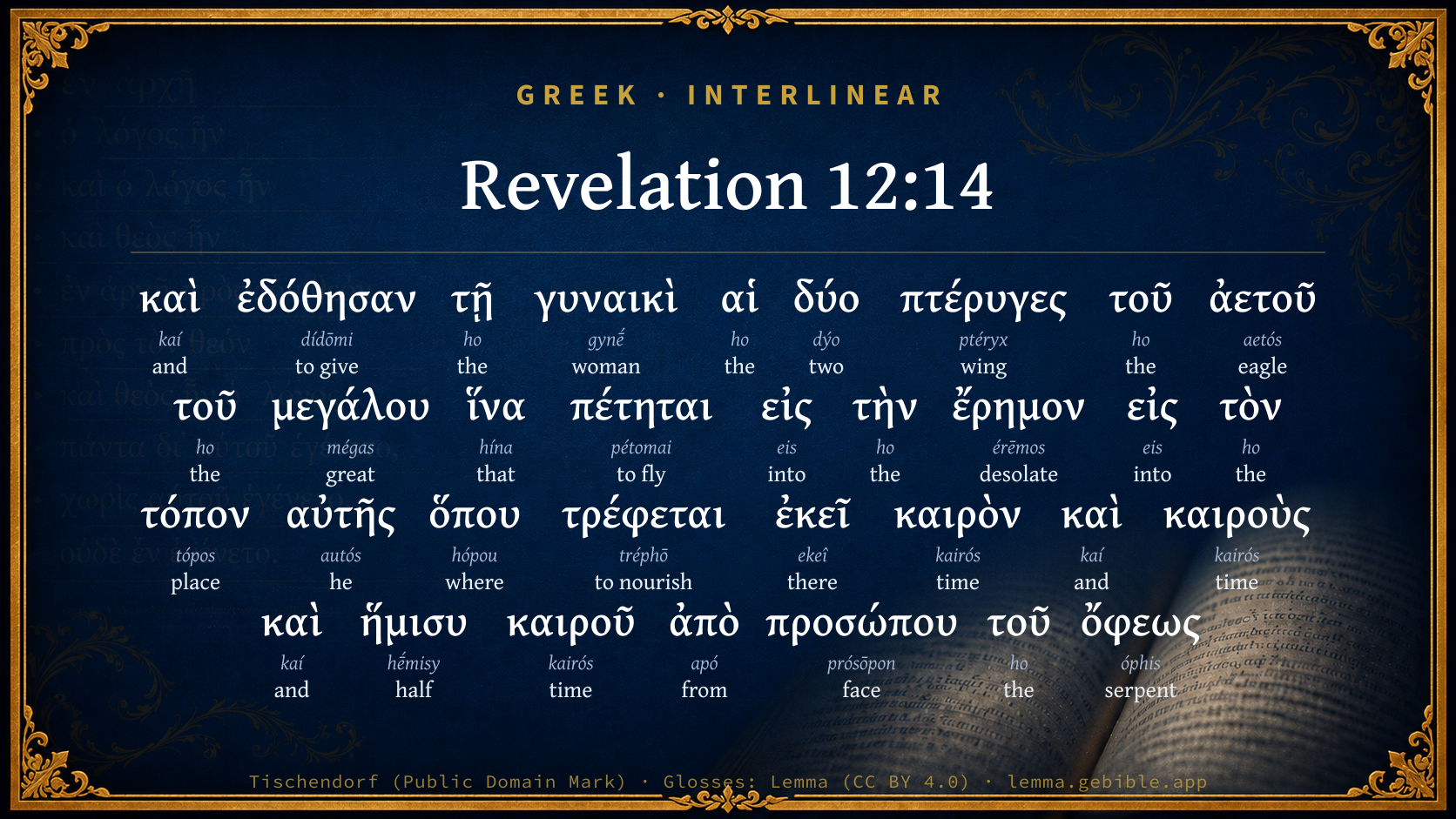
  1. καὶ kaí G2532 “and” Conjunction
  2. ἐδόθησαν dídōmi G1325 “to give” Verb, Aorist, Passive, Indicative, 3rd person, Plural
  3. τῇ ho G3588 “the” Article, Dative, Singular, Feminine
  4. γυναικὶ gynḗ G1135 “woman” Noun, Dative, Singular, Feminine
  5. αἱ ho G3588 “the” Article, Nominative, Plural, Feminine
  6. δύο dýo G1417 “two” Adjective, Numeral (indeclinable)
  7. τοῦ ho G3588 “the” Article, Genitive, Singular, Masculine
  8. ἀετοῦ aetós G105 “eagle” Noun, Genitive, Singular, Masculine
  9. τοῦ ho G3588 “the” Article, Genitive, Singular, Masculine
  10. μεγάλου mégas G3173 “great” Adjective, Genitive, Singular, Masculine
  11. ἵνα hína G2443 “that” Conjunction
  12. πέτηται pétomai G4072 “to fly” Verb, Present, Middle or Passive deponent, Subjunctive, 3rd person, Singular
  13. εἰς eis G1519 “into” Preposition
  14. τὴν ho G3588 “the” Article, Accusative, Singular, Feminine
  15. ἔρημον érēmos G2048 “desolate” Adjective, Accusative, Singular, Feminine
  16. εἰς eis G1519 “into” Preposition
  17. τὸν ho G3588 “the” Article, Accusative, Singular, Masculine
  18. τόπον tópos G5117 “place” Noun, Accusative, Singular, Masculine
  19. αὐτῆς autós G846 “he” Personal pronoun, Genitive, Singular, Feminine
  20. ὅπου hópou G3699 “where” Adverb
  21. τρέφεται tréphō G5142 “to nourish” Verb, Present, Passive, Indicative, 3rd person, Singular
  22. ἐκεῖ ekeî G1563 “there” Adverb
  23. καιρὸν kairós G2540 “time” Noun, Accusative, Singular, Masculine
  24. καὶ kaí G2532 “and” Conjunction
  25. καιροὺς kairós G2540 “time” Noun, Accusative, Plural, Masculine
  26. καὶ kaí G2532 “and” Conjunction
  27. ἥμισυ hḗmisy G2255 “half” Adjective, Accusative, Singular, Neuter
  28. καιροῦ kairós G2540 “time” Noun, Genitive, Singular, Masculine
  29. ἀπὸ apó G575 “from” Preposition
  30. προσώπου prósōpon G4383 “face” Noun, Genitive, Singular, Neuter
  31. τοῦ ho G3588 “the” Article, Genitive, Singular, Masculine
  32. ὄφεως óphis G3789 “serpent” Noun, Genitive, Singular, Masculine

About this verse

These counts appear in no published source. They are computed here, from the morphology-tagged text and Lemma’s own curated glosses. What Lemma adds →

33
words
22
distinct lemmas
Revelation
section

Notable vocabulary

The rarest word here is πτέρυγες wing G4420 — appearing just 5 times in the whole Greek New Testament.

Shared distinctive vocabulary

πτέρυγες wing G4420 occurs in 5 verses of the Greek New Testament. Also found in:

Repetition

Words recur within this verse:

Cross-references

9

Topical passages linked to Revelation 12:14 in the Treasury of Scripture Knowledge — connected by theme and wording, ordered by reader-vote popularity; previews shown in the World English Bible.

  • Exodus 19:4 'You have seen what I did to the Egyptians, and how I bore you on eagles' wings, and brought you to myself.
  • Isaiah 40:31 but those who wait for Yahweh shall renew their strength; they shall mount up with wings as eagles; they shall run, and not be weary; they shall walk, and not faint.
  • Revelation 12:6 The woman fled into the wilderness, where she has a place prepared by God, that there they may nourish her one thousand two hundred sixty days.
  • Daniel 12:7 I heard the man clothed in linen, who was above the waters of the river, when he held up his right hand and his left hand to heaven, and swore by him who lives forever that it shall be for a time, times, and a half; and when they have made an end of breaking in pieces the power of the holy people, all these things shall be finished.
  • Daniel 7:25 He shall speak words against the Most High, and shall wear out the saints of the Most High; and he shall think to change the times and the law; and they shall be given into his hand until a time and times and half a time.
  • Deuteronomy 32:11–12 As an eagle that stirs up her nest, That flutters over her young, He spread abroad his wings, he took them, He bore them on his feathers.
  • Psalms 55:6 I said, "Oh that I had wings like a dove! Then I would fly away, and be at rest.
  • Revelation 11:2–3 Leave out the court which is outside of the temple, and don't measure it, for it has been given to the gentiles. They will tread the holy city under foot for forty-two months.
  • Revelation 17:3 He carried me away in the Spirit into a wilderness. I saw a woman sitting on a scarlet-colored animal, full of blasphemous names, having seven heads and ten horns.

Cross-references courtesy of OpenBible.info (CC BY 4.0).

Where the printed editions differ

1 variant

Places in this verse where the major printed Greek editions disagree on the wording in a way that affects the translation — a comparison of editions, not a manuscript-by-manuscript collation. The editions are the modern critical texts (Nestlé-Aland 28/27, SBL, Westcott-Hort, Tregelles, Tyndale House) and the traditional texts behind the KJV (the Textus Receptus and the Byzantine/Majority text). It is not a claim about which reading is original.

  1. Different wording
    ὅπου

    “where”

    In NA28NA27TynSBLWHTregTR Not in Byz

    ὅπως (hopōs) 'so that' occurs in a few manuscripts (Byz) instead of ὅπου (hopou) 'where' in older manuscripts (NA28+NA27+Tyn+SBL+WH+Treg+TR)

Textual data: Translators Amalgamated Greek New Testament (STEPBible TAGNT) · CC BY 4.0.

Commentary

Notes on Revelation 12:14 from classic Christian and Jewish commentators (each source and its license shown beneath its notes). The classic Christian expositions comment on the surrounding passage and are grouped to its opening verse, so a note may address several verses; the Jewish commentaries on the Tanakh (Rashi and others) are per-verse, so they appear only where the commentator wrote on this verse.

Lemma curates 59 commentaries, every one of them public domain or Creative Commons licensed, each selected and text-cleaned for this edition rather than reprinted as found. About our sources →

Adam Clarke's Commentary

NOTES ON CHAP. XII., BY J. E. C.

Verse 14. And to the woman were given two wings of a great eagle] Του αετου του μεγαλου· Of THE great eagle. The great eagle here mentioned is an emblem of the Roman empire in general, and therefore differs from the dragon, which is a symbol of the HEATHEN ROMAN empire in particular. The Roman power is called an eagle from its legionary standard, which was introduced among the Romans in the second year of the consulate of C. Marius; for before that time minotaurs, wolves, leopards, horses, boars, and eagles were used indifferently, according to the humour of the commander. The Roman eagles were figures in relievo of silver or gold, borne on the tops of pikes, the wings being displayed, and frequently a thunderbolt in their talons. Under the eagle, on the pike, were piled bucklers, and sometimes crowns. The two wings of the great eagle refer to the two grand independent divisions of the Roman empire, which took place January 17, A.D. 395, and were given to the woman, Christianity being the established religion of both empires.

That she might fly into the wilderness, into her place, c.] The apparent repetition here of what is said in Re 12:6 has induced Bishop Newton to consider the former passage as introduced by way of prolepsis or anticipation for, says he, the woman did not fly into the wilderness till several years after the conversion of Constantine. But that there is no such prolepsis as the bishop imagines is evident from the ecclesiastical history of the fourth century; for the woman, or true Church, began to flee into the wilderness a considerable time before the division of the great Roman empire into two independent monarchies. The word translated fled is not to be taken in that peculiar sense as if the woman, in the commencement of her flight, had been furnished with wings, for the original word is εφυγεν. The meaning therefore of verses 6 and 14, Rev 12:6; Rev 12:14 when taken in connection with their respective contexts, is, that the woman began to make rapid strides towards the desert almost immediately after her elevation to the heaven or throne of the Roman empire, and in the course of her flight was furnished with the wings of the great eagle ινα πετηται, that she might FLY, into that place prepared of God, where she should be fed a thousand two hundred and threescore days. It is said here that the period for which the woman should be nourished in the wilderness would be a time, times, and a half; consequently this period is the same with the twelve hundred and sixty days of Re 12:6. But in no other sense can they be considered the same than by understanding a time to signify a year; times, two years; and half a time, half a year; i.e., three years and a half. And as each prophetic year contains three hundred and sixty days, so three years and a half will contain precisely twelve hundred and sixty days. The Apocalypse being highly symbolical, it is reasonable to expect that its periods of time will also be represented symbolically, that the prophecy may be homogeneous in all its parts. The Holy Spirit, when speaking of years symbolically, has invariably represented them by days, commanding, e. gr., the Prophet Ezekiel to lie upon his left side three hundred and ninety days, that it might be a sign or symbol of the house of Israel bearing their iniquity as many years; and forty days upon his right side, to represent to the house of Judah in a symbolical manner, that they should bear their iniquity forty years, The one thousand two hundred and threescore days, therefore, that the woman is fed in the wilderness, must be understood symbolically, and consequently denote as many natural years. The wilderness into which the woman flies is the Greek and Latin worlds, for she is conveyed into her place by means of the two wings of the great eagle. We must not understand the phrase flying into her place of her removing from one part of the habitable world into another, but of her speedy declension from a state of great prosperity to a forlorn and desolate condition. The woman is nourished for one thousand two hundred and threescore years from the face of the serpent, The empires in the east and west were destined, in the course of the Divine providence, to support the Christian religion, at least nominally while the rest of the world should remain in pagan idolatry or under the influence of this dragon, here called the serpent, because he deceiveth the whole world. The words of the prophecy are very remarkable, The Christian Church is said to be supported by the eastern and western empires, two mighty denominations; and at the same time situated in the wilderness, strongly denoting that, though many professed Christianity, there were but very few who "kept the commandments of God, and had the testimony of Jesus Christ."

Adam Clarke's Commentary on the Bible (1810–1826) — public domain. Text from a community e-Sword/MySword module.

Whedon's Commentary on the Bible

Daniel D. Whedon

14. Two wings of a great eagle… wilderness—There seems to be a double allusion here: to Israel’s sojourn in the wilderness, and to the flight of the blessed mother of Jesus through the same wilderness to Egypt, as driven by Herod. Of the former, Jehovah said to Moses, approaching Sinai, Exo_19:4, “Ye have seen what I did unto the Egyptians, and how I bare you on eagles’ wings, and brought you unto myself.” The woman came down from her high place in heaven, but it was on Jehovah’s wings, in order to be borne to a place of security as well as humiliation. Not that she is carried by the eagle; but the eagle’s wings are put on her, and she flies with them of herself, eagle-winged.

That she might fly—in regard to the flight of the woman into the wilderness we may note, 1. That it was under fear of paganism, even after the pagan dragon was overthrown. Even under the Christianized empire, therefore, there was a powerful pagan influence repressive of a pure Christianity. This arose from two sources: First, The remains of pagan principle and practice in the national Church assuming the various forms of Mariolatry, wafer-worship, saint-adoration, pope-worship, and ritual. Second, The paganism of the nations of Northern Europe, who filled the atmosphere of the world with a pagan malaria. 2. The wilderness is at once the repressed power of the Church at home and her difficulty in struggling with the pagan nations of Europe for their conversion. 3. But her flying is mentioned twice, Rev_12:6; Rev_12:14. The first is a fleeing in fear, and refers to the humble and persecuted, yet spiritually-prospering, obscurity of the Church before the pagan downfall, and in anticipation of her 1260-day period. The second is a divine flying, with God-given wings, into the wilderness, with a divinely-provided nourishment. This alludes to the missioning of Christianity, especially northward, by which she not only, with obscure perseverance, converted the tribes that settled in Italy, but spread her power through the forests of central and northern Europe. Thus she fled from the dragon in fear; she flew to the wilderness, both spiritual and literal, of Europe with hope; she was divinely sustained, and was helped to prosperity and even victory by the very pagan earth. Yet the spirit and power of paganism contrived to overlie the Church, even after these victories, and her wilderness state remained through the “dark ages.” Though thus borne on eagles’ wings, yet her home is the wilderness. For Rome is still Babylon. Even after a Christian emperor was seated on the throne, a quasi-paganism was still able to struggle for ascendency, and at court a semi-pagan Christianity but too much prevailed. The pure Church, therefore, retired like raven-fed Elijah to the mystic wilderness.

For a time, and times, and half a time—That is, for a season, (or year,) two seasons, and half a season; that is, three years and a half; or (Rev_12:6) 1260 days. This 1260-day period appears five times in the apocalypse. The origin of this use of this period seems to be found in the famine in Israel in the time of Elijah, which our Lord in Luk_4:25, and Jas_5:17, fix at three years and a half. But this could only be an approximation; for a famine neither begins nor ends on an exact day. And similarly, when adopted as a measurement in prophecy, the events will be found in their nature equally gradual in their commencement and termination, and the number must be viewed as simply an approximation. A similar period is adopted by Dan_7:25; Dan_12:7.

Elliott and others maintain that these five passages in the apocalypse designate the same time and train of events. But plainly two of them (Rev_12:14-15) designate the period of the dragon’s terrene troubling of the Church, and three of them (Rev_11:2-3; Rev_13:5) the supremacy of the beast.

This dragon-period is the time after the firmamental overthrow of the dragon in which he oppresses the Church, Rev_12:13; Rev_12:17. That is, it includes the time of the power of paganism in and over the Church, after paganism had ceased to rule imperially supreme. And certainly, measuring from the downfall of paganism under the reign of Constantine, we find that an approximate 1260-year period will bring us to the Reformation. And the Reformation was the establishment of an anti-pagan Church. The Roman “beast” still sustained a paganism in his own domain, for his period of domination was yet continuing. But the reformed Church completely expelled paganism from her limits. Christianity became established beyond all danger in the Roman empire about A.D. 325; and in 1588 the defeat of the Spanish armada placed the permanence of the Reformation beyond question. Constantine published the edict of Milan, by which Christianity was freed from persecution, in 313; and 1260 years bring us to 1573, when Protestantism was in full possession of all those States that became permanently Protestant.

Daniel D. Whedon (gen. ed.), Commentary on the Old and New Testaments (1874–1909) — public domain. Text from a community e-Sword module.

Tyndale Open Study Notes

Tyndale Open Resources

12:14 two wings . . . of a great eagle (see Exod 19:4-6; Deut 32:10-11; Isa 40:29-31): God strengthens his people; he does not promise that they will escape persecution or death. • a time, times, and half a time: Usually understood as three and a half years (see Rev 11:2-3).

Tyndale Open Study Notes — © Tyndale Open Resources, licensed CC BY-SA 4.0. Text via the HelloAO Bible API.

Bengel's Gnomon

Johann Albrecht Bengel

Rev 12:14. Αἱ δύο πτέρυγες) The Hebrew dual כְגָפַיִם does not always involve the number two: but it is used even in the description of four or six wings, Ezekiel 1 and Isaiah 6. Whence in the Septuagint כְגָפַיִם is never expressed by δύο πτέρυγες. Therefore in this passage it is said not without great significance, αἱ δύο πτέρυγες, those two wings. The great eagle itself is the Roman empire: the two wings, the power over the east and the west.—εἰς τὸν τόπον αὐτῆς, into her place) This place[130] comprises very large regions, Poland, Russia, Hungary, Transilvania, etc., by the addition of which to the church, A. 965, and thenceforward, the Christian power reached, in a continuous tract, from the Eastern to the Western Empire.—καιρὸν καὶ καιροὺς και ἥμισυ καιροῦ) So Dan 7:25, εὥς καιροῦ καὶ καιρῶν καὶ ἥμισυ καιροῦ; ch. Rev 12:7, εἰς καιρὸν και καιροὺς και ἥμισυ καιροῦ. In each passage the subject is the calamity of the holy people. The plural, καιροὺς, denotes two times. The plural number is to be taken most strictly. In this manner of speaking, after years, the space of two years is signified, l. 17, § 3. Digest, de manum. test. Being indefinitely commanded to be free after years, he shall be free after the space of two years: and that interpretation both the favour of liberty demands, and the words admit. Thus עשר ten, עשרים two decades, that is, twenty. According to the rule of the ancient Hebrew doctors, usually employed in expounding the Sacred Writings, the plural number is to be understood of two, if there is no reason to the contrary. Guil. Surenhusius de Alleg. V. T. in N. T., p. 589. And in this passage, indeed, the taking, in a strict sense, is admissible even on this account, because there is an interval between the one and the half. In an indefinite sense several καιροὶ are a χρόνος. Mæris the Atticist, ὥρα ἔτους, ἀττικῶς· καιρὸς ἔτους, ἑλληνικῶς. Ammonius and Thomas Magister, καιρὸς μέρος χρόνου, οἷον μεμετρημένων ἡμερῶν σύστημα· χρόνος δε, πολλῶν καιρῶν περιοχὴ καὶ σύλληψις.[131] In the Apocalyptic sense ΚΑΙΡῸς a time has a definite length, as is plain from the distribution of this very period into a time, and times, and the half of a time. This period begins before the number of the beast, and extends beyond it: nor however does the whole of it far exceed it. It has 777 7/9 years. By such a method, even a Chronus has a definite length, and comprises five καιροὺς or times: although Leop. Frid. Gans Nobilis de Putlitz determines that καιρὸν has eighty years, and a Chronus 240 years, and thus he takes three καιροὺς for Chronus. Through a time, and times, and the half of a time, the Church is nourished, being removed from the serpent, and assailed by the river, i.e. the attack of the Turks, and not however overwhelmed: therefore those times are terminated by the captivity of the serpent, and are conveniently divided by the parts “joints” of the Turkish history. The beginning of the captivity, as is shown in its place, will be in A. 1836. Therefore the time is 2222/9 years, from A. 1058 to 1280; and in the middle of the eleventh century, a new kingdom arose among the Turks, and shortly afterwards inundated the eastern part of the Christian world; but, at the close of that century, the city of Jerusalem was taken from them, which not long after they took again. The times are 4444/9 years, from A. 1280 to 1725. In that interval they greatly desolated the Church, having taken Constantinople, having long had possession of Buda, and having more than once besieged Vienna. The half a time consists of 1111/9 years, from A. 1725 to 1836. Before the end of this half a time, and indeed considerably before, the earth swallows up the last attacks of the river.—ἀπὸ προσώπου) construed with ΤΡΈΦΕΤΑΙ. Comp. מפני ἈΠῸ ΠΡΟΣΏΠΟΥ, 2Ki 16:18, and Jud. 9:21, where the Hebrew accent plainly renders it a parallel expression: and Nehemiah 4 :(9)3.

[130] In der Erkl. Offeneb. Ed. II., p. 642, the place of the wilderness, in the singular, Germany, is much more definitely distinguished from the wilderness which comprises these countries. (Comp. p. 639), so that the eastern wing might especially subserve her flight into the wilderness, the western (wing) her flight into the place.—E. B.

[131] Χρόνος and ἀιών are indefinite time. Ὥρα, definite term, generally short; Καιρός, the opportune time. Αἰών, the indefinite flow of time without the notion of an end: Χρόνος, time in its actuality, by which we perceive the succession of things; it is a sort of aggregate of times. Καιρός, a specific time, and, “as opportunity” is fleeting, that time, of short duration: in Rev 12:14, a year, not literally but applied to the time of a year. See Tittm. Syn.—E.

Bengel's Gnomon of the New Testament — English translation (T&T Clark, Edinburgh, 1860) — public domain. Text from a community e-Sword module.

Meyer's Critical & Exegetical Commentary

Heinrich August Wilhelm Meyer

Rev_12:14. Already in the ἐδίωξε τὴν γυν. (Rev_12:13), lies the presupposition afforded by the preceding account (Rev_12:6), concerning the flight of the woman; but now as the subject is properly concerning the fate of the woman, that which in Rev_12:6 is touched upon only in the main point, and by anticipation, is expressly described. For Rev_12:14 does not speak of something entirely different from Rev_12:6,as Ebrard thinks, who finds in Rev_12:6 the flight of the woman to heaven, i.e., the emblem of the dispersion of Israel on earth, but in Rev_12:14 the flight into the desert on earth, i.e., a miraculous deliverance of converted Israel on the actual earth; an interpretation which already fails, in that, in Rev_12:6, it takes heaven together with the wilderness misplaced therein by Ebrard figuratively, but in Rev_12:14, on the other hand, the earth (cf. Rev_12:13), in the proper sense, while the wilderness found in the same must again be understood figuratively, although it is manifest that all these local designations must, at all events, be understood in the same way,but that Rev_12:14 gives the proper execution, and that, too, in the natural place of the connection, of that which was shortly before in Rev_12:6 removed not without reason,[3163] results from a comparison of the two verses. Precisely the same is the goal of the flight; the ΤΌΠΟς ΑὙΤῆς in the wilderness is the place prepared there for the woman on Gods part;[3164] the same in meaning are the schematic datesfor the determination of 3½ times, i.e., years (derived also, according to the expression,[3165] from the figurative passages, Dan_7:25; Dan_12:7), agrees with the 1,260 days (Rev_12:6);[3166] the same, also, as to what is meant with the brief ἜΦΥΓΕΝ ΕἸς Τ. ἜΡ., Κ.Τ.Λ., Rev_12:6, is the detailed description, Rev_12:14 : ΚΑῚ ἘΔΌΘΗΣΑΝ

ἽΝΑ ΠΈΤΗΤΑΙ ΕἸς Τ. ἜΡ., Κ.Τ.Λ. The certainty of the flight arranged by God depends upon the fact, that to the woman two wings of a great eagle are given, in order thatfor such is the intention of God in his deliverance, by causing wings to be given the womanshe might fly to the place prepared for her on Gods part in the wilderness. The idea itself has grown by the plastic art of the writer of the Apoc. from the figure given in Exo_19:4 :[3167] As God formerly bore his people, when they fled from the Egyptians, on eagles wings, so, for her sure escape, a pair of eagles wings is given the woman fleeing from the dragon. Yet it dare not be said that the art. ΤΟῦ Ἀ., ΤΟῦ ΜΕΓ., makes the eagle named here appear identical with that mentioned (Exo_19:4),[3168] for in that figurative passage a particular eagle is not designated. Ewalds former opinion, also, that the art. in the Hebrew way[3169] designates superlatively a very great eagle, is not admissible, because the analogyeven though it corresponded better than is actually the casewould give only a purely superlative idea.[3170] Ebrard has developed from his view, that the art. designates the very eagle mentioned already in Rev_8:13, the thought that the rescue of the woman would follow in the moment when the final extraordinary developments of the fifth and sixth trumpets are to begin; or, as he also says, that the woman shall be sustained by the strength of the eagle which is to bring judgment upon the godless world. But even apart from the two interpretations, lying at the basis of the false presumption that the soaring of the woman away into the wilderness is, according to fact and time, to be entirely distinguished from the escape into the wilderness, neither the one nor the other interpretation is possible, because in this passage that eagle cannot be meant, which in Rev_8:13 appears for a very special end, and one entirely foreign to what is stated in this passage. What is said can be concerning no particular eagle; the art. is intended generically,[3171] as Rev_1:1.[3172] Two wings, like those of the great eagle, were given the woman, for rapid and sure escape. On this account, also, we are not to think of the eagle mentioned in Eze_17:3; Eze_17:7, where, in a parable, the kings of Babylon and Egypt are represented as eagles; the thought accordingly developed by Auberlen[3173] from this passage, that the secular power itselfmore specifically, the two parts of the Roman Empire in the East and West, especially since Constantinemust afford the woman, i.e., the Christian Church, a secure place by means of Roman civil and legal order, is consequently with as little foundation in the phraseology of the text, as the point of vision in general, which this form of exposition assumes, corresponds with the intention and contents of the entire ch. 12

ἵνα πέτηται εἰς τὴν ἔρημον, κ.τ.λ. As the nature of the escape, viz., by flying on eagles wings, so is also the place of refuge described according to the model of the deliverance of Israel out of Egypt in the wilderness. To the privations incident to the abode in the wilderness, the ὅπου τρέφεται, κ.τ.λ., does not refer;[3174] the only point made, is that the place prepared by God in the wilderness, for the fleeing woman, is a sure place of refuge against the persecution of the dragon, and thatas God formerly nourished his people in the wildernessthe woman would be nourished in this place of refuge, during the time determined on the part of God.

ἀπὸ προσώπου τοῦ ὄφεως. This determination is not to be combined with the remote πέτηται,[3175] but with the immediately preceding ὅπου τρέφεται, κ.τ.λ.,[3176] and, therefore, to be explained like the Heb. מִםְּני, Jdg_9:21 :[3177] out of the sight of the serpent, i.e., far and concealed from it. No addition is to be made, at least as Hengstenb. does: at its flight or in its fear; the concise mode of statement presupposes the flight as already accomplished, and states how the escaped woman now tarries in security.

[3163] Beng., Ewald, De Wette, Hofm., Hengstenb., Auberlen.

[3164] The pres. τρἐφεται, whose definite relation Ewald, Hofm., etc., try to invalidate, is just as intelligible as the pres. ἔχει; Rev_12:6. In the meaning of John, the woman is present in her place in the wilderness; there she remains concealed during the entire time of trouble for believers (cf. Rev_12:17), which continues for just three and one-half times.

[3165] Cf. Winer, p. 167.

[3166] Cf. also Rev_11:2-3.

[3167] Cf. also Deu_32:11; Psa_36:8.

[3168] Züll., Ew. ii.

[3169] Jdg_6:15; 1Sa_17:14.

[3170] The absolutely great, i.e., the greatest.

[3171] De Wette.

[3172] διὰ τοῦ ἀγγ. αὕτ.

[3173] Cf. Aret., Beng.

[3174] Against Hengstenb., etc., who, like Auberlen, wants to find it indicated that the time of the Churchs desolation, i.e., the entire heathen-Christian, or Church-historical period, is only a time of pilgrimage to the glory of the heavenly Canaan.

[3175] Vitr., Züll.

[3176] Beng., Ew., De Wette, Hengstenb.

[3177] LXX.: ἔφυγεν

καὶ ᾦκησεν ἐκεῖ ἀπὸ προσώπου Ἀβ.

Meyer — Critical and Exegetical Commentary on the New Testament — English translation by Peter Christie, edited by Frederick Crombie (T&T Clark, 1880) — public domain. Text from a community e-Sword module.

Expositor's Greek Testament

ed. W. Robertson Nicoll

Rev 12:14 . “The two wings of a huge griffon-vulture” ( τοῦ either generic article, or a Hebraism, or more likely an allusion to the mythological basis). In traditional mythology the eagle opposed and thwarted the serpent at all points ( cf. reff.). In the Egyptian myth the vulture is the sacred bird of Isis (Hathor). Any allusion to Israel’s deliverance (as in Exo 19:4 ; Deu 32:11 ) is at best secondary.

The Expositor's Greek Testament, edited by W. Robertson Nicoll (1897–1910) — public domain. Text from a community e-Sword module.

Geneva Bible (1599)

Geneva Bible translators

That is, for three years and a half: so the same speech is taken, Dan. 7:15. This space of time is reckoned in manner from that last and most grievous rebellion of the Jews, unto the destruction of the city and Temple, for their destrution or falling away, began in the twelfth year of Nero, before the beginning whereof, many foresigns and predictions were showed from heaven, as Josephus writeth, lib. 7, chap. 12, and Hegesippus, lib. 5, chap. 44, amongst which this is very memorable, that in the feast of Pentecost, not only a great sound and noise was heard in the Temple, but also a great voice was heard of many out of the Sanctuary which cried out to all, Let us depart hence. Now three years and a half after this defection was begun of the Jews, and those wonders happened, the City was taken by force, the Temple overthrown, and the place forsaken of God: and this compass of time Saint John noted in this place.

Into that place where God had appointed her.

That is, being strengthened with divine power: and taught by oracle, she fled swiftly from the assault of the devil, and from the common destruction of Jerusalem, and went into a solitary City beyond Jordan called Pella, as Eusebius telleth in the first Chapter of the third book of his Ecclesiastical history, which place God had commanded her by Revelation.

Geneva Bible (1599) marginal notes — public domain. Text via Bolls.life.

Jamieson, Fausset & Brown

Robert Jamieson, A. R. Fausset & David Brown

were given--by God's determinate appointment, not by human chances (Act 9:11).

two--Greek, "the two wings of the great eagle." Alluding to Exo 19:4 : proving that the Old Testament Church, as well as the New Testament Church, is included in "the woman." All believers are included (Isa 40:30-31). The great eagle is the world power; in Eze 17:3, Eze 17:7, Babylon and Egypt: in early Church history, Rome, whose standard was the eagle, turned by God's providence from being hostile into a protector of the Christian Church. As "wings" express remote parts of the earth, the two wings may here mean the east and west divisions of the Roman empire.

wilderness--the land of the heathen, the Gentiles: in contrast to Canaan, the pleasant and glorious land. God dwells in the glorious land; demons (the rulers of the heathen world, Rev 9:20; Co1 10:20), in the wilderness. Hence Babylon is called the desert of the sea, Isa 21:1-10 (referred to also in Rev 14:8; Rev 18:2). Heathendom, in its essential nature, being without God, is a desolate wilderness. Thus, the woman's flight into the wilderness is the passing of the kingdom of God from the Jews to be among the Gentiles (typified by Mary's flight with her child from Judea into Egypt). The eagle flight is from Egypt into the wilderness. The Egypt meant is virtually stated (Rev 11:8) to be Jerusalem, which has become spiritually so by crucifying our Lord. Out of her the New Testament Church flees, as the Old Testament Church out of the literal Egypt; and as the true Church subsequently is called to flee out of Babylon (the woman become an harlot, that is, the Church become apostate) [AUBERLEN].

her place--the chief seat of the then world empire, Rome. The Acts of the Apostles describe the passing of the Church from Jerusalem to Rome. The Roman protection was the eagle wing which often shielded Paul, the great instrument of this transmigration, and Christianity, from Jewish opponents who stirred up the heathen mobs. By degrees the Church had "her place" more and more secure, until, under Constantine, the empire became Christian. Still, all this Church-historical period is regarded as a wilderness time, wherein the Church is in part protected, in part oppressed, by the world power, until just before the end the enmity of the world power under Satan shall break out against the Church worse than ever. As Israel was in the wilderness forty years, and had forty-two stages in her journey, so the Church for forty-two months, three and a half years or times [literally, seasons, used for years in Hellenistic Greek (MOERIS, the Atticist), Greek, "kairous," Dan 7:25; Dan 12:7], or 1260 days (Rev 12:6) between the overthrow of Jerusalem and the coming again of Christ, shall be a wilderness sojourner before she reaches her millennial rest (answering to Canaan of old). It is possible that, besides this Church-historical fulfilment, there may be also an ulterior and narrower fulfilment in the restoration of Israel to Palestine, Antichrist for seven times (short periods analogical to the longer ones) having power there, for the former three and a half times keeping covenant with the Jews, then breaking it in the midst of the week, and the mass of the nation fleeing by a second Exodus into the wilderness, while a remnant remains in the land exposed to a fearful persecution (the "144,000 sealed of Israel," Rev 7:1-8; Rev 14:1, standing with the Lamb, after the conflict is over, on Mount Zion: "the first-fruits" of a large company to be gathered to Him) [DE BURGH]. These details are very conjectural. In Dan 7:25; Dan 12:7, the subject, as perhaps here, is the time of Israel's calamity. That seven times do not necessarily mean seven years, in which each day is a year, that is, 2520 years, appears from Nebuchadnezzar's seven times (Dan 4:23), answering to Antichrist, the beast's duration.

Jamieson, Fausset & Brown — Commentary Critical and Explanatory on the Whole Bible (1871) — public domain (CC PDM 1.0). Text via the HelloAO Bible API.

Ellicott's Commentary for English Readers

(14) And to the woman . . .—Better, And there were given to the woman (the) two wings of the great eagle (the definite article is used before “great eagle”), that she might fly into the wilderness, unto her place, where she is nourished there for a season, and seasons, and half a season, from the face of the serpent. The woman is persecuted and driven into the wilderness: yet it is with the eagle wings given her by her Lord that she flies; the serpent drives her into the wilderness: yet it is in the wilderness that her place is prepared by God. The way that seems hard is the way that is most blest. The opposition of the dragon brings her blessings that she never would have received except in persecution; neither the eagle power nor the heavenly sustenance had been hers without the serpent’s hate. Thus is the trial of faith precious in bringing us to know the priceless blessings of heavenly help and heavenly food. She is given eagle’s wings. God had spoken of the deliverance of Israel under a similar emblem, “Ye have seen . . . how I bare you on eagles’ wings and brought you unto myself” (Exo_19:4; comp. Deu_32:10-12). There is a difference as well as a resemblance in the emblem here. In Exodus God is said to have borne Israel on eagles’ wings: here the wings are given to the woman. The strength of the earlier dispensation is a strength often used for, rather than in, the people of God; the strength of the latter is a strength in them: “They mount up with wings as eagles” (Isa_40:31). The place is not a chance spot: it is prepared of God; it is in the wilderness, but still it is the place God prepared for her. It is always a delight to faith to mark how the ordering of God works in and through the wilfulness and wickedness of the enemy: the Son of man goeth, as it was written, though there is a “woe” against the man by whom He is betrayed. The wicked one can never drive us from God’s place, but only to it, unless we are enemies to ourselves. She is nourished in the wilderness. (See Notes on Rev_12:6.) The length of her sojourn is here called a season, seasons, and half a season; it was called twelve hundred and sixty days in Rev_12:6. The period is in both cases the same in length, viz., three years and a half—i.e., the season (one year), the seasons (two years), and the half season (half a year). This is the period of the Church’s trouble and persecution. It is not to be sought by any effort to find some historical period of persecution corresponding in length to this, lasting three years and a half, or twelve hundred and sixty days or years. No such attempt has hitherto been crowned with success. The period is symbolical of the broken time (the half of the seven, the perfect number) of the tribulation of God’s people. There may be some future period in which the vision may receive even more vivid fulfilment than it has hitherto received; but the woman has been nourished in the wilderness in the ages that are gone, and her sustenance there by God is an experience of the past, and will be in the future. It is not only in one age, but in every age, that God gives His children bread in the day of adversity, during the season that the pit is being dug for the ungodly. In many an era the servant of God can exclaim:” Thou preparedst a table before me in the presence of mine enemies.”

A Bible Commentary for English Readers, edited by Charles John Ellicott (1878–1897) — public domain. Text from a community e-Sword module.

The Cambridge Bible for Schools and Colleges

gen. ed. J. J. S. Perowne

14. two wings … eagle] Should be “the two wings of the great eagle.” The word is, however, no doubt used generically. Some suppose “the great eagle” to symbolise the Roman empire, but that did not protect the Jewish Church, though to some extent it did the Christian.

her place] Rev_12:6.

The Cambridge Bible for Schools and Colleges (gen. ed. J. J. S. Perowne; Cambridge University Press, 1878–1918) — public domain. Text from a community e-Sword module.

John Gill's Exposition

And to the woman were given two wings of a great eagle,.... By which are meant, not the two testaments, by which she was supported under afflictions, trials, and persecutions, and against Satan and all his efforts; nor the two graces of faith and hope, by which she rose, and dwelt on high, in the view of invisible things, and with contempt of the world, its frowns or flatteries; nor, as others think, prayer and good works, by the former of which she flew to God for supplies of grace and protection, and by the latter was useful and profitable to men, and gave glory to God, and escaped the just censures of the world; nor are two powerful kingdoms, within the dominions of the dragon, intended, as others have thought, who take them to be France and Spain, to which Britain was an appendix; when they were in the possession of Constantius Chlorus, the father of Constantine the great, where the Christians had refuge in the persecution under Dioclesian; but this was before the war in heaven, and the downfall of Paganism in the empire, and before the above persecution; rather these two wings of the eagle design the eastern and western divisions of the Roman empire: it is not unusual in Scripture for a monarchy, or monarch, as the Assyrian king and kingdom, to be signified by an eagle, and the wings of eagles, Eze 17:3; and it is well known that the eagle is the ensign of the Roman empire, to which the allusion is in Mat 24:28; and at the death of Theodosius the empire was divided, as has been observed before, into two parts; the eastern empire was given to one of his sons and the western to another; and this was between the Arian persecution, and the irruption of the Goths and Vandals, when the church was fleeing and gradually disappearing; and these two empires both went under the Christian name, and supported the outward visible church, though much corrupted, and still more and more corrupting; by which means the pure members of the church, though few and very obscure were preserved. In a word, these wings may denote the swiftness in which the church proceeded to disappear, having lost her former simplicity and glory for which eagles' wings are famous, Pro 23:5; and more especially that divine strength and support by which she was bore up, and carried through, and delivered out of sore afflictions and persecutions; see Isa 40:31. The allusion is to God's deliverance of the people of Israel out of Egypt when he bore them as on eagles wings, and carried them though the wilderness, Exo 19:4, so here it follows,

that she might fly into the wilderness; a place desolate, and full of serpents and scorpions, uncomfortable, and destitute of provisions, and yet a place of safety as well as of solitariness and retirement; and chiefly designs the obscure and invisible state of the pure church in the times of the antichristian apostasy; See Gill on Rev 12:6.

Into her place; which was prepared of God for her, as in Rev 12:6;

where she is nourished by the ministers of the word the two witnesses that prophesy in sackcloth who feed the church with knowledge and understanding; with the words of faith and good doctrine, with the Gospel, and the truths of it, which are sweet, comfortable and nutritive; and with the ordinances of the Gospel, the entertainment of Wisdom's house, the feast of fat things, and the breasts of consolation; and with Christ the hidden manna, the food of the wilderness: and that

for a time, and times, and half a time; that is, all the times of antichrist, the forty two months of his reign; during which time the holy city is trodden under foot, and in a desolate and afflicted condition outwardly, as may be learnt by comparing together Dan 7:25 Rev 13:5; and until the end of wonders, or when time shall be no longer or till the seventh angel has sounded his trumpet as appears from Dan 12:7. This date is the same with 1260 days in Rev 12:6, for "time" signifies a prophetic year, or 360 years; and "times" two years, or 720 years; and half a time, half a year, or 180 years, in all 1230 years; and which are to be reckoned, not from the beginning of the church's flight in Constantine's time, or from the Arian persecution, but from her entering into her wilderness state, or entire disappearance upon the prevalence of the antichristian apostasy; which might be when the bishop of Rome took upon him the title of universal bishop: and here and during this time she is hid

from the face of the serpent; that is, from his wrath so as that he cannot utterly destroy her. God having reserved a sealed number for himself; see Rev 6:16, or from the sight of the serpent as the Arabic version renders it, so as that he could not discern with all his quick sight where the church was.

John Gill's Exposition of the Whole Bible (1746–1763) — public domain (CC PDM 1.0). Text via the HelloAO Bible API.

Trapp's Complete Commentary

John Trapp

14 And to the woman were given two wings of a great eagle, that she might fly into the wilderness, into her place, where she is nourished for a time, and times, and half a time, from the face of the serpent.

Ver. 14. Two wings of a great eagle] That is, sufficient means of safety and protection from peril, Exo 19:4. By this great eagle, some mighty personage seems to be designed, Eze 17:3-7. And this may very well be Constantine, whose peculiar surname was Great: but yet so (saith Mr Forbes) as that the great honour and riches, wherewith, as with wings, he upon good intention endowed the Church, is an occasion to make her flee to the wilderness, all true and sincere religion by degrees decaying in the visible Church.

Where she is nourished for a time] {See Trapp on "Rev 8:9"}

A time, times, and a half time] That is, a year, two years, and half a year, even three years and a half, as Rev 11:9.

John Trapp, A Commentary or Exposition upon All the Books of the Old and New Testament (1647–1656) — public domain. Text from a community e-Sword module.

Albert Barnes' Notes on the Bible

And to the woman were given two wings of a great eagle - The most powerful of birds, and among the most rapid in flight. See the notes on Rev 4:7. The meaning here is, that the woman is represented as prepared for a rapid flight; so prepared as to be able to outstrip her pursuer, and to reach a place of safety. Divested of the figure, the sense is, that the church, when exposed to this form of persecution, would be protected as if miraculously supplied with wings.

That she might fly into the wilderness - There is here a more full description of what is briefly stated in Rev 12:6. A wilderness or desert is often represented as a place of safety from pursuers. Thus David 1Sa 23:14-15 is represented as fleeing into the wilderness from the persecutions of Saul. So Elijah 1Ki 19:4 fled into the wilderness from the persecutions of Jezebel. The simple idea here is, that the church, in the opposition which would come upon it, would find a refuge.

Into her place - A place appointed for her; that is, a place where she could be safe.

Where she is nourished - The word rendered here “nourished” is the same - τρέφω trephō - which occurs in Rev 12:6, and which is there rendered “feed.” It means to feed, nurse, or nourish, as the young of animals Mat 6:26; Mat 25:37; Luk 12:24; Act 12:20; that is, to sustain by proper food. The meaning here is, that the church would be kept alive. It is not indeed mentioned by whom this would be done, but it is evidently implied that it would be by God. During this long period in which the church would be in obscurity, it would not be suffered to become extinct. Compare 1Ki 17:3-6.

For a time, and times, and half a time - A year, two years, and half a year; that is, forty-two months (see the notes on Rev 11:2); or, reckoning the month at thirty days, twelve hundred and sixty days; and regarding these as prophetic days, in which a day stands for a year, twelve hundred and sixty years. For a full discussion of the meaning of this language, see the notes on Dan 7:25; and Editor’s Pref. For the evidence, also, that the time thus specified refers to the papacy, and to the period of its continuance, see the notes on that place. The full consideration given to the subject there renders it unnecessary to discuss it here. For it is manifest that there is an allusion here to the passage in Daniel; that the twelve hundred and sixty days refer to the same thing; and that the true explanation must be made in the same way. The main difficulty, as is remarked on the notes on that passage, is in determining the time when the papacy properly commenced.

If that could be ascertained with certainty, there would be no difficulty in determining when it would come to an end. But though there is considerable uncertainty as to the exact time when it arose, and though different opinions have been entertained on that point, yet it is true that all the periods assigned for the rise of that power lead to the conclusion that the time of its downfall cannot be remote. The meaning in the passage before us is, that during all the time of the continuance of that formidable, persecuting power, the true church would not in fact become extinct. It would be obscure and comparatively unknown, but it would still live. The fulfillment of this is found in the fact, that during all the time here referred to, there has been a true church on the earth. Pure, spiritual religion - the religion of the New Testament - has never been wholly extinct. In the history of the Waldenses, and Albigenses, the Bohemian brethren, and kindred people; in deserts and places of obscurity; among individuals and among small and persecuted sects; here and there in the cases of individuals in monasteries, the true religion has been kept up in the world, as in the days of Elijah God reserved seven thousand men who had not bowed the knee to Baal: and it is possible now for us, with a good degree of certainty, to show, even during the darkest ages, and when Rome seemed to have entirely the ascendency, where the true church was. To find out this, was the great design of the Ecclesiastical History of Milner; it has been done, also, with great learning and skill, by Neander.

From the face of the serpent - The dragon - or Satan represented by the dragon. See the notes at Rev 12:3. The reference here is to the opposition which Satan makes to the true church under the persecutions and corruptions of the papacy.

Albert Barnes' Notes on the Bible (1834–1885) — public domain. Text from a community e-Sword/MySword module.

Haydock's Catholic Bible Commentary

There were given to the woman two wings of a great eagle. By these two wings, some understand the love of God, and the fear of offending him; others, piety, prudence, &c. (Witham) --- The Church, on account of the severe pressure of the persecution, obtained from the Almighty a special protection and assistance. (Pastorini)

George Leo Haydock (1774–1849), Haydock's Catholic Family Bible and Commentary, 1859 edition — public domain. Excludes Psalms (Douay-Rheims chapter numbering differs from Protestant) and Deuterocanonical books (Catholic canon only).

Matthew Poole's English Annotations

And to the woman; to the sincerer part of Christians, represented by the woman, Rev 12:1, and by the temple, and altar, and them that worship therein, viz. in the oracle where the altar stood, Rev 11:1.

Were given two wings of a great eagle: the eagle being the ensign of the Roman empire, and Theodosius having two sons, Honorius and Arcadius, between which he divided the empire, making Honorius the emperor of the west, and Arcadius of the east, leadeth some very judicious interpreters to expound this passage of the providence of God (by this division of the empire about the year 390) in some measure securing his church from the great troubles that presently ensued. For in the year 411, Alaricus king of the Goths took Rome, and continual troubles so ensued, that by the year 480 the western empire was quite extinguished, ending in Augustulus, who, because of his manifold afflictions, is supposed to be the star mentioned Rev 8:10,11, called Wormwood, who fell upon the sounding of the third trumpet.

That she might fly into the wilderness: by the wilderness is here undoubtedly meant some places which were like a wilderness for solitariness, where the church might have some rest.

Into her place; the place said to be by God prepared for the church, Rev 12:6.

Where she is nourished; where God hid, and protected, and provided for his people a certain time, expressed in the next words. I know not whether we need be so critical or no, or whether it be not safer to expound all the foregoing words more generally, viz. that God graciously provided for his people hiding-places against the storm now coming upon the whole Roman empire, bearing them, as it were, on eagles’ wings, as he did his old Israelites when he brought them out of the land of Egypt. It is the very phrase used by God, Exo 19:4.

For a time, and times, and half a time: it is apparent, that the same space of time is here meant that is mentioned Rev 12:6, and called a thousand two hundred and threescore days. Most interpreters agree, that it signifieth three years and a half, consisting each of them of three hundred and sixty prophetical days, that is, years; for although we count three hundred and sixty-five days to the year, (and there are strictly so many, besides some odd hours), yet anciently they counted but three hundred and sixty, leaving out the five odd days, as we do now the odd hours and minutes, which in four years make up an odd day, which makes every fourth year leap year. Now three times three hundred and sixty make up a thousand and eighty, to which add one hundred and eighty for the half year, it makes just a thousand two hundred and sixty, the number of days mentioned Rev 12:6. If any inquire why what was expressed by one thousand two hundred and sixty days there, is thus expressed here? It is answered: To make this comport with the prophecy of Daniel, Dan 7:25; 12:7, where it is thus expressed.

Matthew Poole's English Annotations on the Holy Bible (1683–1685) — public domain. Text from a community e-Sword/MySword module.

The Pulpit Commentary

And to the woman were given two wings of a great eagle. "The two wings of the great eagle" is found in most authorities, though a omits both the articles. The symbol of the eagle is a common one in the Old Testament, and this may account for the presence of the article. The escape of the Jewish Church from the power of Pharaoh, and her preservation in the wilderness, are referred to under a like figure. (see Exo_19:4 Deu_32:11, "Ye have seen what I did unto the Egyptians, and how I bare you on eagles" wings, and brought you unto myself The natural enmity between the eagle and the serpent is alluded to by Wordsworth (Wordsworth, in loc., where see a full exposition of the symbolism here employed). "The two wings" may typify the Old and New Testaments, by the authority of which the Church convicts her adversaries, and by which she is supported during her period of conflict with the devil. That she might fly into the wilderness, into her place. The reference to the flight of Israel from Egypt is still carried on. "Her place" is the "place prepared of God" (ver. 6). The Church, though in the world, is not of the world (see on ver. 6). Where she is nourished for a time, and times, and half a time, from the face of the serpent. Still the history of Israel is borne in mind. As the chosen people were nourished in the wilderness, so the Church of God is sustained in her pilgrimage on earth. The redundant dpon ekei , "where there," follows the analogy of the Hebrew (see on ver. 6). "The time, times, and half a time," is the period elsewhere described as 42 months, 1260 days, 3.5 years. It denotes the period of the existence of this world. (see on Rev_11:2) The expression is taken from Dan_7:25 Dan_12:7. By this verse and ver. 6 is established the identity of the two expressions 1260 days, and the time, times, and half a time (i.e. one year + two years + half a year). The plural kairoi is used for "two times," as no dual occurs in the Greek of the New Testament (see Winer, p. 221, Moulton"s translation). The construction, "nourished from the face" (trefetai apo proswpou tou ofewv), is built upon the analogy of the Hebrew. The "serpent" is the "dragon" of ver. 13 (cf. ver. 9, "the great dragon, that old serpent, called the Devil, and Satan"). The two words are used as convertible terms (cf. ver. 17, where he is again called "the dragon").

The Pulpit Commentary (1880–1919), ed. H.D.M. Spence-Jones & Joseph S. Exell — public domain. Text from a community e-Sword module.

John Wesley's Explanatory Notes

And there were given to the woman the two wings of the great eagle, that she might fly into the wilderness to her place - Eagles are the usual symbols of great potentates. So Ezek. xvii, 3, by "a great eagle', means the king of Babylon. Here the great eagle is the Roman empire; the two wings, the eastern and western branches of it. A place in the wilderness was mentioned in the sixth verse also; but it is not the same which is mentioned here. In the text there follow one after the other,

1. The dragon's waiting to devour the child.

2. The birth of the child, which is caught up to God.

3. The fleeing of the woman into the wilderness.

4. The war in heaven, and the casting out of the dragon.

5. The beginning of the third woe.

6. The persecution raised by the dragon against the woman.

7. The woman's flying away upon the eagle's wings. In like manner there follow one after the other,

1. The beginning of the twelve hundred and sixty days.

2. The beginning of the little time.

3. The beginning of the time, times, and half a time. This third period partly coincides both with the first and the second. After the beginning of the twelve hundred and sixty days, or rather of the third woe, Christianity was exceedingly propagated, in the midst of various persecutions. About the year 948 it was again settled in Denmark; in 965, in Poland and Silesia; in 980, through all Russia. In 997 it was brought into Hungary; into Sweden and Norway, both before and after. Transylvania received it about 1000; and, soon after, other parts of Dacia. Now, all the countries in which Christianity was settled between the beginning of the twelve hundred and sixty days, and the imprisonment of the dragon, may be understood by the wilderness, and by her place in particular. This place contained many countries; so that Christianity now reached, in an uninterrupted tract, from the eastern to the western empire; and both the emperors now lent their wings to the woman, and provided a safe abode for her. Where she is fed - By God rather than man; having little human help. For a time, and times, and half a time - The length of the several periods here mentioned seems to be nearly this: - YEARS

1. The non-chronos contains less than 1111

2. The little time 888

3. The time, times, and half a time 777

4. The time of the beast 666 And comparing the prophecy and history together, they seem to begin and end nearly thus:

1. The non-chronos extends from about 800 to 1836

2. The 1260 days of the woman from 847-1524

3. The little time 947-1836

4. The time, time, and half 1058-1836

5. The time of the beast is between the beginning and end of the three times and a half. In the year 1058 the empires had a good understanding with each other, and both protected the woman. The bishops of Rome, likewise, particularly Victor II., were duly subordinate to the emperor. We may observe, the twelve hundred and sixty days of the woman, from 847 to 1524, and the three times and a half, refer to the same wilderness. But in the former part of the twelve hundred and sixty days, before the three times and an half began, namely, from the year 847 to 1058, she was fed by others, being little able to help herself; whereas, from 1058 to 1524, she is both fed by others, and has food herself. To this the sciences transplanted into the west from the eastern countries much contributed; the scriptures, in the original tongues, brought into the west of Europe by the Jews and Greeks, much more; and most of all, the Reformation, grounded on those scriptures.

John Wesley, Explanatory Notes Upon the Whole Bible (1754–1765) — public domain. Text via the GEBible commentary corpus.

The People's New Testament

B. W. Johnson

14. There were given two wings, etc. The meaning is that means were given to the persecuted church to flee into the wilderness, into a place where she would be hidden from view. The Church would disappear from sight. There she would be a time, and times, and half a time, or a year, two years and half a year, three and half years, forty-two months, 1260 days. See verse 6 above, and 11:2, 3. This period we found under chapter 11 to begin in a.d. 533, and to extend to about the close of the last century.

B. W. Johnson's The People's New Testament with Notes (1889–1891) — public domain. Electronic text from the Christian Classics Ethereal Library (CCEL) ThML edition.

Cambridge Greek Testament for Schools and Colleges

14. αἱ δύο. Text. Rec[423] omits αἱ with אB2.

[423] Rec. Textus Receptus as printed by Scrivener.

14. αἱ δύο πτέρυγες τοῦ ἀετοῦ τοῦ μεγάλου. The great eagle need not be any one mystical eagle known to the Seer and his disciples, it may be as general as “the eagle” Deu 28:49; if on the other hand we omit the article before δύο, it will be clear that the eagle is many-winged as in 4 Esdras, and therefore mysterious. Some suppose “the great eagle” to symbolise the Roman Empire; but that did not protect the Jewish church, though to some extent it did the Christian.

ἵνα πέτηται … τοῦ ὄφεως. This resumes Rev 12:6 in a way characteristic of the writer’s method in linking different visions together, cf. Rev 8:2; Rev 8:6 and Rev 15:1; Rev 15:5-6. In the latter passage and in this chapter it might be a question whether the earlier verse was not the afterthought.

Cambridge Greek Testament for Schools and Colleges (Cambridge University Press, 1896; 21 vols, various authors incl. Carr, Maclear, Plummer, Farrar, Lumby, Moule, M. R. James, Simcox) — public domain. Text from a community e-Sword module.

Vincent's Word Studies in the New Testament

Marvin R. Vincent

Two wings. The definite article aiJ the should be added : "the two wings." Compare Exo 19:4; Deu 32:11; Psa 36:7.

The great eagle. The article does not point to the eagle of ch. 8 13, but is generic.

A time and times and half a time. Three years and a half. See on ch. Rev 11:2.

Marvin R. Vincent, Word Studies in the New Testament (1887–1900) — public domain. Text from a community e-Sword/MySword module.

Lesson kit

Teaching starters — assembled from the data on this page, not authored interpretation. Every prompt links to the verse data it draws on. Edit before teaching.

Revelation, in the Revelation, opens this verse with 33 words (22 distinct Greek lemmas). Its most distinctive word is ptéryx (“wing”). A historical commentator’s framing appears above. Read the whole chapter for the surrounding context.

Discussion questions

  1. What does “wing” (ptéryx) contribute to the verse as a whole?
  2. How does Matthew 23:37, which shares the word «wing», read alongside this verse?
  3. What does the repetition of “time” (3× in this one verse) do in this verse?
  4. These translations render this verse differently. What is at stake in choosing one wording over another?
  5. Compare how Adam Clarke's Commentary and Whedon's Commentary on the Bible read this verse. Where do they agree or differ?

Things to notice

  • These translations choose different wording for 4 words in this verse.
  • “time” occurs 3× in this single verse.
  • 22 distinct Greek lemmas span 33 words in this verse.

Reading settings

Reading text

Shown beneath each verse's original-language words.

Old Testament
Old Testament edition

Read the OT as the Masoretic Hebrew (MT) or the Greek Septuagint (LXX).

English shown for the Greek Septuagint (in the Hebrew ↔ Greek comparison).

Comparing translations? Open the Compare panel on any verse page to stack up to four side by side.