
1 Corinthians 7:27

Greek (Tischendorf 8th ed.) 1 Corinthians 7:27 appears in the Greek New Testament. The text above is from the Tischendorf 8th edition. Each word links to its Strong’s number and a concise gloss. Click any word for its full Thayer’s Greek Lexicon entry.
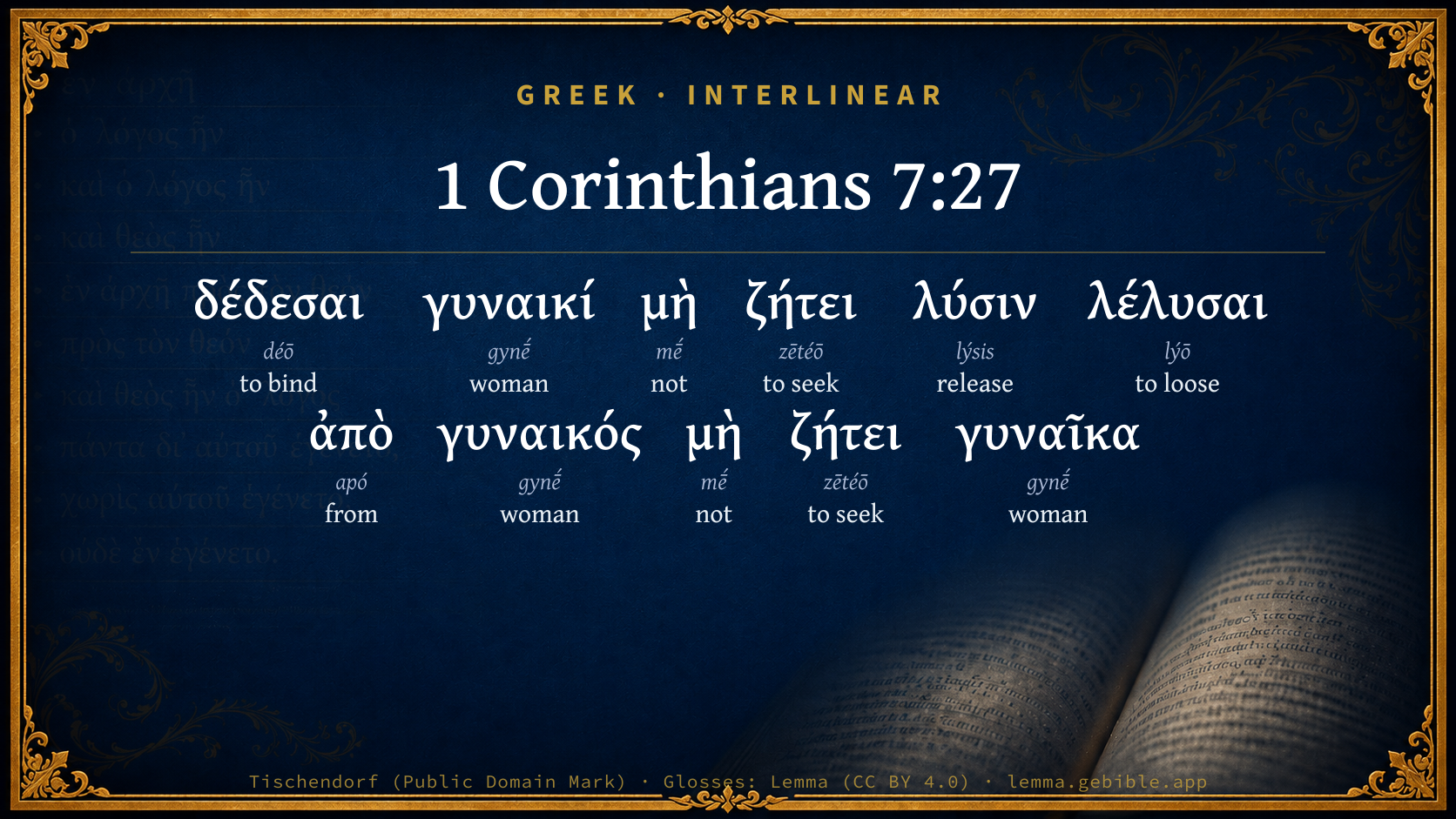
Download image
Cite this verse

1 Corinthians 7:27 (World English Bible). Public Domain. Lemma interlinear Bible study tool, https://lemma.gebible.app/v/1-corinthians/7/27.

Show BibTeX & RIS
BibTeX
RIS
English Translation
Are you bound to a wife? Don't seek to be freed. Are you free from a wife? Don't seek a wife.
World English Bible · Public Domain
Highlights
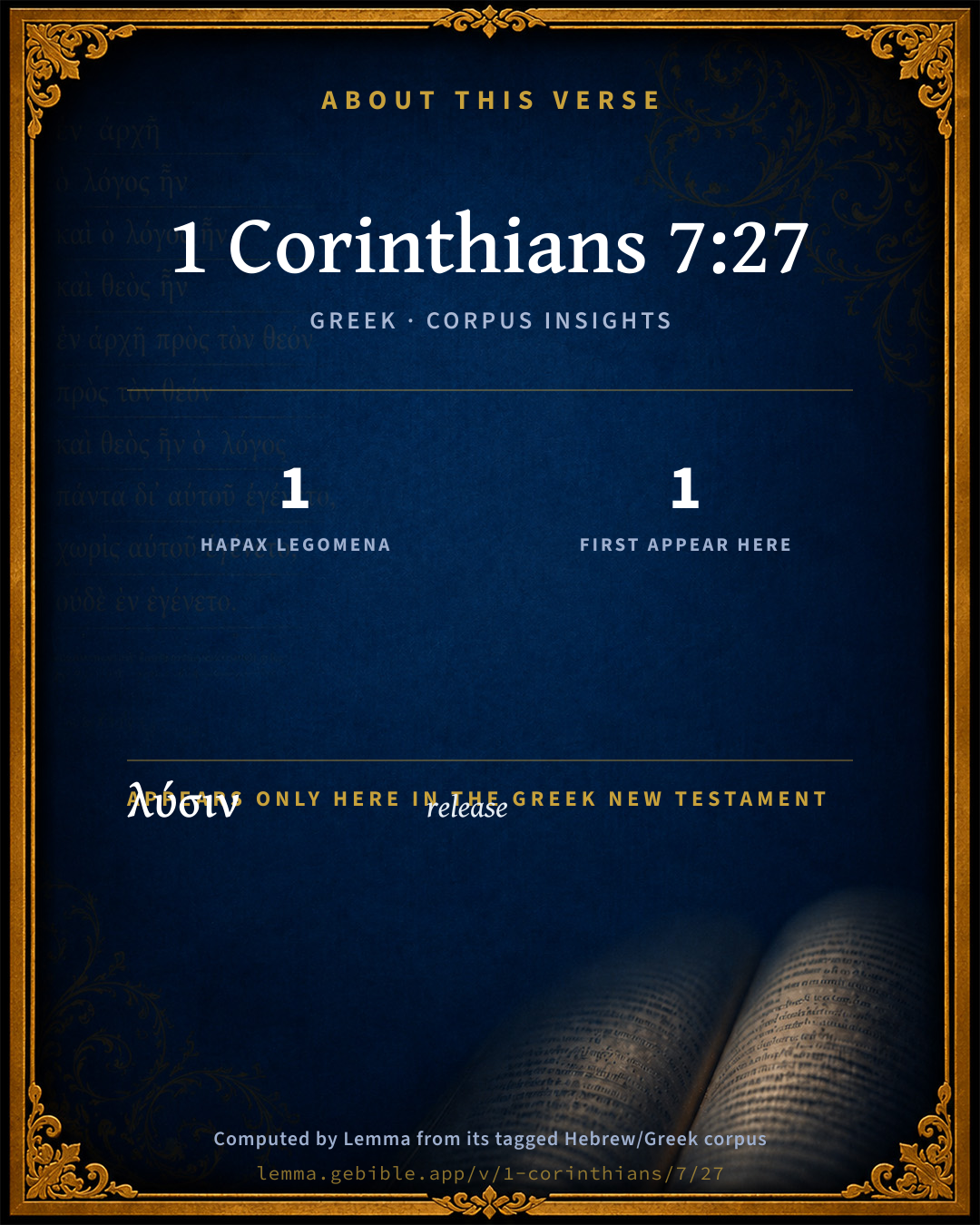
  • 1 hapax legomenon — only here in the Greek New Testament
  • 1 first appearance in the Greek New Testament
Full analysis ↓
Download a study sheet

One document with this verse’s original text, its word-by-word gloss line, the meaning frame, cross-references with their text, attributed commentary, and full source and license credits — printable, and it pastes into notes with its structure intact.

This verse Autodidact and up

Study sheet (.html) Plain text (.txt)

A passage Seminary Student

Up to 50 verses in one chapter. A passage sheet keeps up to 6 commentary sources and 12 cross-references per verse, in the order this page ranks them, and says so on the sheet whenever that leaves anything out. Ask for a single verse and you get the Autodidact verse sheet above.

Everything on this page stays free to read, with no account — the sheet is a download of what is already on screen, not access to it.

Want to remove ads? Support Godless Engineer
Compare translations 3

The same verse in 3 English versions, stacked beneath the original-language interlinear above. Click any original word for its lexicon entry.

Each is an independent rendering of the whole verse — the interlinear is not word-aligned to these translations.

Highlighted words mark where these versions differ — a whole-verse word diff, not a word-by-word alignment.

  • World English Bible Public Domain
    Are you bound to a wife? Don't seek to be freed. Are you free from a wife? Don't seek a wife.
  • King James Version Public Domain
    Art thou bound unto a wife? seek not to be loosed. Art thou loosed from a wife? seek not a wife.
  • unfoldingWord Literal Text CC BY-SA 4.0
    Are you bound to a wife? Do not seek to be released. Are you released from a wife? Do not seek a wife.

unfoldingWord Literal Text — © unfoldingWord, licensed CC BY-SA 4.0. Word-aligned USFM3 via Door43 (git.door43.org/unfoldingWord/en_ult).

Versions to compare (up to 4)

3 of 4 selected

Show all 19 translations

Every available English version of this verse, each an independent rendering of the whole verse.

  • World English Bible Public Domain
    Are you bound to a wife? Don't seek to be freed. Are you free from a wife? Don't seek a wife.
  • Berean Standard Bible Public Domain
    Are you committed to a wife? Do not seek to be released. Are you free of commitment? Do not look for a wife.
  • Majority Standard Bible Public Domain
    Are you committed to a wife? Do not seek to be released. Are you free of commitment? Do not look for a wife.
  • King James Version Public Domain
    Art thou bound unto a wife? seek not to be loosed. Art thou loosed from a wife? seek not a wife.
  • American Standard Version (1901) Public Domain
    Art thou bound unto a wife? Seek not to be loosed. Art thou loosed from a wife? Seek not a wife.
  • Revised Version (1885) Public Domain
    Art thou bound unto a wife? seek not to be loosed. Art thou loosed from a wife? seek not a wife.
  • Geneva Bible (1599) Public Domain
    Art thou bounde vnto a wife? seeke not to be loosed: art thou loosed from a wife? seeke not a wife.
  • Douay-Rheims (1899) Public Domain
    Art thou bound to a wife? seek not to be loosed. Art thou loosed from a wife? seek not a wife.
  • Young's Literal Translation Public Domain
    Hast thou been bound to a wife? seek not to be loosed; hast thou been loosed from a wife? seek not a wife.
  • Literal Standard Version CC BY-SA 4.0
    Have you been bound to a wife? Do not seek to be loosed; have you been loosed from a wife? Do not seek a wife.
  • Unlocked Literal Bible CC BY-SA 4.0
    Are you married to a wife? Do not seek a divorce. If you are unmarried, do not seek a wife.
  • unfoldingWord Literal Text CC BY-SA 4.0
    Are you bound to a wife? Do not seek to be released. Are you released from a wife? Do not seek a wife.
  • Darby Bible Public Domain
    Art thou bound to a wife? seek not to be loosed; art thou free from a wife? do not seek a wife.
  • World Messianic Bible Public Domain
    Are you bound to a wife? Don’t seek to be freed. Are you free from a wife? Don’t seek a wife.
  • Webster's Bible Public Domain
    Art thou bound to a wife? seek not to be loosed. Art thou loosed from a wife? seek not a wife.
  • Free Bible Version CC BY-SA 4.0
    Are you already married? Don't try to get divorced. Are you unmarried? Don't look to get married.
  • Bible in Basic English Public Domain
    If you are married to a wife, make no attempt to get free from her: if you are free from a wife, do not take a wife.
  • Text-Critical English NT CC BY 4.0
    Are yoʋ pledged to marry a woman? Do not seek to be released. Are yoʋ free from such a commitment? Do not seek a wife.
  • Tyndale New Testament (1534) Public Domain
    Arte thou bounde vnto a wyfe? seke not to be lowsed. Arte thou lowsed from a wyfe? seke not a wyfe.

Literal Standard Version (2020), Covenant Press — licensed CC BY-SA 4.0. Text via the HelloAO Bible API (eBible.org). Unlocked Literal Bible (unfoldingWord) — licensed CC BY-SA 4.0. Text via the HelloAO Bible API (eBible.org). unfoldingWord Literal Text — © unfoldingWord, licensed CC BY-SA 4.0. Word-aligned USFM3 via Door43 (git.door43.org/unfoldingWord/en_ult). Free Bible Version, Dr. Jonathan Gallagher — licensed CC BY-SA 4.0. Text via the HelloAO Bible API (eBible.org).

Word by word

More ways to search: Search by grammar → Find every occurrence → Compare this word →

Practice this passage: Drill this verse → Learn its vocabulary →

About this verse

These counts appear in no published source. They are computed here, from the morphology-tagged text and Lemma’s own curated glosses. What Lemma adds →

11
words
7
distinct lemmas
Pauline Epistles
section

Notable vocabulary

1 hapax legomenon — a word that appears only here in the entire Greek New Testament:

  • λύσιν release G3080

First appearance in Scripture

This word makes its first canonical appearance in the Greek New Testament here:

  • λύσιν release G3080

Shared distinctive vocabulary

λέλυσαι to loose G3089 occurs in 39 verses of the Greek New Testament. Also found in:
Repetition

Words recur within this verse:

  • γυναικί woman G1135 ×3
  • ζήτει to seek G2212 ×2
  • μὴ not G3361 ×2

Cross-references

2

Topical passages linked to 1 Corinthians 7:27 in the Treasury of Scripture Knowledge — connected by theme and wording, ordered by reader-vote popularity; previews shown in the World English Bible.

  • 1 Corinthians 7:12–14 But to the rest I--not the Lord--say, if any brother has an unbelieving wife, and she is content to live with him, let him not leave her.
  • 1 Corinthians 7:20 Let each man stay in that calling in which he was called.

Cross-references courtesy of OpenBible.info (CC BY 4.0).

Commentary

Notes on 1 Corinthians 7:27 from classic Christian and Jewish commentators (each source and its license shown beneath its notes). The classic Christian expositions comment on the surrounding passage and are grouped to its opening verse, so a note may address several verses; the Jewish commentaries on the Tanakh (Rashi and others) are per-verse, so they appear only where the commentator wrote on this verse.

Lemma curates 59 commentaries, every one of them public domain or Creative Commons licensed, each selected and text-cleaned for this edition rather than reprinted as found. About our sources →

Joseph Benson's Commentary

1Co 7:27-28. Art thou bound to a wife? — “Because the directions which the apostle was about to give (1Co 7:36) to fathers, concerning the disposal of their children in marriage, were partly to be founded on the inclination and circumstances of the children, before he gave these directions, he very properly addressed the children themselves, and set before them the considerations by which their inclinations were to be regulated in that matter, namely, the inconveniences attending a married state, and the brevity and uncertainty of all human enjoyments; considerations which, he told them, ought to determine them to wish to remain unmarried under the present distress.” Seek not to be loosed — From her by an unjust divorce, or by deserting her. Art thou loosed? — Hath Providence never led thee into those engagements; or has it broken the bond by the death of thy former companion? Seek not a wife — If thou canst conveniently and virtuously continue as thou art; at least at present, till the storm, which now hovers over the church, be a little blown over, and more peaceful times return. But yet if thou marry, thou hast not thereby sinned: and if a virgin marry, she hath not sinned — The marriage state is, no doubt, both lawful and honourable. Nevertheless, such shall have trouble in the flesh — Many outward troubles; but I spare you — I speak as little and as tenderly as possible.

Joseph Benson's Commentary on the Old and New Testaments (1811–1818) — public domain. Text from a community e-Sword module.

Bengel's Gnomon

Johann Albrecht Bengel

1Co 7:27. Δέδεσαι—λέλυσαι, thou art bound—thou art loosed) There is an argument in the very words. When bound to a wife, a man is often prevented, with or without any blame to him, from being able so munificently to practise liberality and the other virtues, as he might wish. In the verb λέλυσαι, thou art loosed, the participle is latently contained [thou art one untied], and it has the force of a noun, so that loosed denotes not only him, who is no longer bound to a wife, but also him, who never was so bound. We find a similar phrase in Job 39:5.—μὴ, not) twice, i.e. thou art not forced to seek.

Bengel's Gnomon of the New Testament — English translation (T&T Clark, Edinburgh, 1860) — public domain. Text from a community e-Sword module.

Meyer's Critical & Exegetical Commentary

Heinrich August Wilhelm Meyer

1Co_7:27. Lest the γνώμη in 1Co_7:26 should be misinterpreted as favouring divorce, he now prefaces his further discussion of the subject with the rule, which is appropriate here only as a caveat: let not the married desire to be loosed. The construction is as in 1Co_7:18.

γυναικί] dativus communionis, as in Rom_7:2, and with Greek writers. It is plain, especially from 1Co_7:29; 1Co_7:34, that δέδ. γυν. does not mean betrothal (Ewald and Hofmann), but that γυνή denotes a married wife.

λέλυσαι] does not imply: art thou separated from (Mosheim, Semler), but art thou free from, unentangled with a wife, single (sive uxorem habueris, sive non, Estius; comp so early an interpreter as Photius)? See 1Co_7:28, and comp Xenophon, Cyr. i. 1. 4, where λελύσθαι ἀπʼ ἀλλήλων is equivalent to αὐτόνομα εἶναι.

Meyer — Critical and Exegetical Commentary on the New Testament — English translation by Peter Christie, edited by Frederick Crombie (T&T Clark, 1880) — public domain. Text from a community e-Sword module.

Expositor's Greek Testament

ed. W. Robertson Nicoll

1Co 7:27-28 apply in detail the advice just given, and first as it bears on men , then on maidens . δέδεσαι , λέλυσαι , pf. pass [1121] of present state determined by the past; μὴ ζήτει , pr [1122] impv [1123] , “do not be seeking”. The two directions of 1Co 7:27 reinforce, from the new point of view, the instructions of 1Co 7:10-16 ; 1Co 7:8 respectively. λέλυσαι , as opp [1124] of δὲδεσαι , applies either to bachelor or widower.

[1121] passive voice.

[1122] present tense.

[1123] imperative mood.

[1124] opposite, opposition.

In 1Co 7:28 the general advice of 1Co 7:27 is guarded from being overpressed; cf. the relation of 1Co 7:2 to 1Co 7:1 and 1Co 7:9 to 1Co 7:8 . The punctuation of El [1125] and Nestle best marks the connexion of thought, closing 1Co 7:27 with a full st p, each of the parl [1126] ἐὰν … ἥμαρτες (- ν ) clauses with a colon, and separating θλίψιν δὲ and ἐγὼ δὲ by a comma. In the second supposition (both with ἐὰν and sbj [1127] of probable contingency ) P. reverts to the case of “the maiden,” from which he was diverted in 1Co 7:26 ; he makes her, by implication, responsible for her marriage, although in 1Co 7:36 ff., later, the action of the father is alone considered. γαμέω is used in the act . here, and in 1Co 7:39 , both of man and woman; cl [1128] Gr [1129] applies it to the latter in pass [1130] ; cf. note on the double ἀφιέτω in 1Co 7:12 f. ἔγημα and ἐγάμησα are the older and later aors. The aor [1131] in the apodosis ἥμαρτες , ἥμαρτεν is proleptic (Bn [1132] § 50; Bm [1133] , pp. 198 f., 202), rather than gnomic (Mr [1134] , Hn [1135] , Ed [1136] ), as though by way of general reflexion: the Ap. addresses specific instances “thou didst not … she did not sin”; cf. for tense, Joh 15:11 , Rev 10:7 .

[1125] C. J. Ellicott’s St. Paul’s First Epistle to the Corinthians .

[1126] parallel.

[1127] subjunctive mood.

[1128] classical.

[1129] Greek, or Grotius’ Annotationes in N.T.

[1130] passive voice.

[1131] aorist tense.

[1132] E. Burton’s Syntax of the Moods and Tenses in the N.T. (1894).

[1133] A. Buttmann’s Grammar of the N.T. Greek (Eng. Trans., 1873).

[1134] Meyer’s Critical and Exegetical Commentary (Eng. Trans.).

[1135] C. F. G. Heinrici’s Erklärung der Korintherbriefe (1880), or 1 Korinther in Meyer’s krit.-exegetisches Kommentar (1896).

[1136] T. C. Edwards’ Commentary on the First Ep. to the Corinthians . 2

The marriage Paul discourages is no sin, but will bring suffering from which he would fain save his friends. “But affliction for the flesh such (as may marry) will have, but I am seeking to spare you.” With θλίψις cf. σκόλοψ τῇ σαρκί (2Co 12:7 ; also 1Co 5:5 above); there is some thought, possibly, of recompense to “the flesh” which has had its way against advice. The affliction that Paul foresees is aptly indicated by Photius: “More easily and with small distress shall we endure if we have no wives and children to carry along with us in persecutions and countless miseries”. At such times, for those who have domestic cares, there arises “the terrible alternative, between duty to God and affection to wife and children” (Lt [1137] ). φείδομαι appears to be a conative present (see Bn [1138] § 11; cf. Rom 2:4 , Gal 5:4 ).

[1137] J. B. Lightfoot’s (posthumous) Notes on Epp. of St. Paul (1895).

[1138] E. Burton’s Syntax of the Moods and Tenses in the N.T. (1894).

The Expositor's Greek Testament, edited by W. Robertson Nicoll (1897–1910) — public domain. Text from a community e-Sword module.

Godet's Commentaries

Frédéric Louis Godet

Vv. 27, 28. “Thou art bound to a wife, seek not to be loosed; thou art loosed from a wife, seek not a wife. 28. But and if thou marry, thou hast not sinned; and if a virgin marry, she hath not sinned; nevertheless such shall have trouble in the flesh; but I would spare you.”

The apostle would not, however, have 1Co 7:26 a understood in the sense of a moral superiority granted to celibacy. He therefore expressly repeats what he had said in 1Co 7:10 (from a somewhat different standpoint): He who is bound, whether as affianced or as married, ought not, with a view to realizing a higher sanctity, to break the bond. I do not think that there is ground for restricting the application of these first words to the affianced, as Hofmann does.

If one were to take the term λέλυσαι, art thou loosed, in the strictness of the letter, it would apply only to widowers and those divorced. But the context proves that, as Origen had already understood it, the word here signifies in general: If thou art free from bond, and that it refers also to celibates.

Vv. 28 is meant to prevent a misunderstanding to which the second part of 1Co 7:27 might give rise. What Paul says here is not a command; if one act differently he will not sin.

The form ἐὰν καί evidently means, as in 1Co 7:11; 1Co 7:21, if therewith, if nevertheless, and not though.

On the two forms γήμῃς and γαμήσῃς, see on 1Co 7:9. Edwards remarks that if we read γαμήσῃς, we have here the two forms in the same verse.

The flesh strictly denotes the organ of physical sensibility; but the meaning of the word extends very often to moral sensibility.

The term trouble, literally, tribulation, must denote the same thing as the present necessity, 1Co 7:26, so: the state of permanent conflict in which the Church is with the world till the perfect establishment of the kingdom of God. As long as this state of things shall last, Christian parents who are tender and faithful will have to suffer much for themselves and for their children in a community which is strange to God. The οἱ τοιοῦτοι denotes those who marry in spite of this counsel.

There is a sort of paternal solicitude in the words, but I spare you. The path of celibacy which he recommends will be that in which they shall have least to suffer. St. Augustine makes a singular mistake in giving these words the meaning: “I spare you the enumeration of the troubles of family life.”

But, in all that precedes, Paul has not yet gone to the root of the matter. What is of importance is not: marrying or not marrying; but a habit of soul in keeping with the situation indicated above. And as in 1Co 7:17-24 he had extended his point of view and generalized the question, so as better to justify his counsel to remain in their present state, so in 1Co 7:29-31 he explains, while applying it to various analogous cases, his true view in regard to celibacy and marriage in present circumstances.

Frédéric Louis Godet — Commentaries on Luke, John, Romans, and 1 Corinthians — English translation (T&T Clark, Edinburgh, 1870s–1890s) — public domain. Text from a community e-Sword module.

Hodge's Commentary on Romans, Ephesians & First Corinthians

Charles Hodge

1Co_7:27

Art thou bound unto a wife? seek not to be loosed Art thou loosed from a wife? seek not a wife.

Marriage, in the present circumstances of the church, will prove a burden. Although this fact will not justify the dissolution of any marriage, it should dissuade Christians from getting married.

Charles Hodge — Commentary on Romans (1835), First Corinthians (1857), and Ephesians (1856) — public domain. Text from a community e-Sword module.

Jamieson, Fausset & Brown

Robert Jamieson, A. R. Fausset & David Brown

Illustrating the meaning of "so to be," Co1 7:26. Neither the married (those "bound to a wife") nor the unmarried (those "loosed from a wife") are to "seek" a change of state (compare Co1 7:20, Co1 7:24).

Jamieson, Fausset & Brown — Commentary Critical and Explanatory on the Whole Bible (1871) — public domain (CC PDM 1.0). Text via the HelloAO Bible API.

Adam Clarke's Commentary

Verse 27. Art thou bound unto a wife?] i e. Married; for the marriage contract was considered in the light of a bond.

Seek not to be loosed.] Neither regret your circumstances, notwithstanding the present distress, nor seek on this account for a dissolution of the marriage contract. But if thou art under no matrimonial engagements, do not for the present enter into any.

Adam Clarke's Commentary on the Bible (1810–1826) — public domain. Text from a community e-Sword/MySword module.

John Calvin's Commentaries

27. Art thou bound to a wife? Having stated what would be most advantageous, he adds at the same time, that we ought not to be so much influenced by the advantages of celibacy, that one that is bound by the tie of marriage should shake off the connection. It is therefore a restriction upon the preceding statement, lest any one, influenced by his commendation of celibacy, should turn his thoughts to it, and despise marriage, forgetful of his necessity or of his calling Now in these words he does not merely forbid the breaking up of the connection of marriage, but also represses the dislikes that are wont to creep in, that every one may continue to live with his wife willingly and cheerfully.

Art thou loosed from a wife? This second clause must be taken with a reservation, as is manifest from the entire context. He does not, then, allow to all the choice of perpetual celibacy, but only to those to whom it is given. Let no one, therefore, who is not constrained by any necessity, rashly ensnare himself, for liberty ought not to be lightly thrown away.

John Calvin's Commentaries (1540-1563) — public domain. Text from the Calvin Translation Society English edition (1840s-50s) via the Christian Classics Ethereal Library (ccel.org). Calvin's coverage is partial (roughly two-thirds of the Bible); uncommented books and verses are honest gaps, never fabricated. The 19th-century editor's footnotes and remarks are omitted so the notes are faithfully Calvin's own voice.

Ellicott's Commentary for English Readers

(27) Art thou bound unto a wife?—This is an explanation and re-assertion of the previous words “so to be.” Being “loosed from a wife” does not mean a separation after marriage, but simply “unmarried.”

A Bible Commentary for English Readers, edited by Charles John Ellicott (1878–1897) — public domain. Text from a community e-Sword module.

John Gill's Exposition

Art thou bound unto a wife?.... Or to a woman; either by promise, or by espousal, or by consummate marriage; either of which is a tic, or obligation, a bond, and especially the latter; marriage is such a bond as cannot be dissolved, but by the death of one of the parties; see Rom 7:2 unless in case of adultery, or of wilful desertion: and it is a bond which mutually obliges; as the husband is bound by the law of marriage to live chastely and lovingly with his wife, and to take care of her, and provide for her; so the wife is bound by the same law to live in like manner with her husband, and to submit unto him, and obey him:

seek not to be loosed; do not depart from her, nor seek to be divorced, nor even desire to be loosed by death:

art thou loosed from a wife? being either never married, or else if having been married the wife is dead, or legally divorced for a just cause:

seek not a wife, or woman; make no inquiry after one; be content to live without one; enter not into a marriage state, nor take any step towards it; it is best to continue loosed, for the reason above given, that is, provided the person has the gift of continence, otherwise not; see Co1 7:5.

John Gill's Exposition of the Whole Bible (1746–1763) — public domain (CC PDM 1.0). Text via the HelloAO Bible API.

Trapp's Complete Commentary

John Trapp

27 Art thou bound unto a wife? seek not to be loosed. Art thou loosed from a wife? seek not a wife.

Ver. 27. Art thou bound to a wife?] A manifest metaphor from oxen. Hence we call them yoke fellows:

" Quam male inaequales veniunt ad aratra iuvenci;

Tam premitur magno, &c." (Ovid. Epist.)

Dare not to yoke thyself with any untamed heifer that bears not Christ’s yoke.

John Trapp, A Commentary or Exposition upon All the Books of the Old and New Testament (1647–1656) — public domain. Text from a community e-Sword module.

Albert Barnes' Notes on the Bible

Art thou bound unto a wife? - Art thou already married? Marriage is often thus represented as a “tie,” a “bond,” etc.; see the note at Rom 7:2.

Seek not to be loosed - Seek not a “dissolution” (λύσιν lusin) of the connection, either by divorce or by a separation from each other; see the notes on 1Co 7:10-17.

Art thou loosed from a wife? - Art thou unmarried? It should have been rendered “free from” a wife; or art thou single? It does not imply of necessity that the person had been married, though it may have that meaning, and signify those who had been separated from a wife by her death. There is no necessity of supposing that Paul refers to persons who had divorced their wives. So Grotius, Schleusner, Doddridge, etc.

Albert Barnes' Notes on the Bible (1834–1885) — public domain. Text from a community e-Sword/MySword module.

Matthew Poole's English Annotations

Art thou bound by marriage, or bound by contract, do not use any sinful ways to be loosed from that bond, either by divorce or by a voluntary departure: if the unbeliever will depart, he or she may, you are not obliged to court their stay, but do not you put him or her away. Are you free from a wife, either as yet unmarried, or by the hand of God separated, in case you can without sin, abstain. If your circumstances be such as they do not oblige you to marriage, do not seek a wife; the times are like to be full of trouble and difficulty. Our Master said, Woe unto them that are with child, and to them that give suck in those days! Mat 24:19.

Matthew Poole's English Annotations on the Holy Bible (1683–1685) — public domain. Text from a community e-Sword/MySword module.

Whedon's Commentary on the Bible

Daniel D. Whedon

27. Loosed—The word seems naturally to imply a previous marriage, and hence, in some periods of the Church, second marriages have been disfavoured. But the word loosed is adopted by Paul as merely an antithesis to bound, and means unbound. See note on 1Ti_3:12.

Daniel D. Whedon (gen. ed.), Commentary on the Old and New Testaments (1874–1909) — public domain. Text from a community e-Sword module.

The Pulpit Commentary

Seek not a wife. It is entirely alien from St. Paul"s purpose to take this as an abstract or universal rule. He gives his reasons for it as a temporary necessity.

The Pulpit Commentary (1880–1919), ed. H.D.M. Spence-Jones & Joseph S. Exell — public domain. Text from a community e-Sword module.

McGarvey & Pendleton's Commentaries

J. W. McGarvey

Art thou bound unto a wife? seek not to be loosed. Art thou loosed from a wife? seek not a wife .

J. W. McGarvey (with Philip Y. Pendleton), Commentaries on the New Testament (The Fourfold Gospel, 1914; Acts; and the epistles) — public domain. Text from a community e-Sword/MySword module.

The People's New Testament

B. W. Johnson

27. Art thou bound? If married, he is to remain true to the bond; if unmarried, at present it seemed best to remain so.

B. W. Johnson's The People's New Testament with Notes (1889–1891) — public domain. Electronic text from the Christian Classics Ethereal Library (CCEL) ThML edition.

unfoldingWord translationNotes

Door43 World Missions Community

General Information:

Paul is speaking to the Corinthians as if he were speaking to each person, so all these instances of "you" and the command "do not seek" here are singular. (See: Forms of You)

Are you married to a wife? Do not ...

Paul uses this question to introduce a possible condition. The question can be translated as a phrase with "if." AT: "If you are married, do not" (See: Rhetorical Question)

Do not seek a divorce

"Do not try to divorce her" or "Do try to separate from her"

do not seek a wife

"do not try to get married"

I want to spare you from this

The word "this" refers to the kinds of worldly trouble that married people might have. AT: "I want to help you not to have worldly trouble" (See: Assumed Knowledge and Implicit Information)

translationWords

sin

unfoldingWord translationNotes — © Distant Shores Media and the Door43 World Missions Community, licensed CC BY-SA 4.0. Source: git.door43.org/Door43/en_tn.

Alford’s Greek Testament

Henry Alford

27.] τὸ οὕτως εἶναι restated and illustrated: neither the married nor the unmarried are to seek for a change. The general recommendation here is referable alike to all cases of marriage, and does not touch on the prohibition of ver. 10,—only dissuading from a spirit of change, in consideration of the ἐνεστῶσα ἀνάγκη. It seems better to take the verse thus, than with Meyer and De Wette, to regard it as inserted to guard against misunderstanding of the preceding γνώμη of the Apostle.

λέλυσαι does not imply previous marriage, but as Phot., οὐχὶ πρὸς τοὺς συναφθέντας, εἶτα διαλυθέντας, … ἀλλαʼ ἁπλῶς πρὸς τοὺς μὴ συνελθόντας ὅλως εἰς γάμου κοινωνίαν, ἀλλὰ λελυμένους ὄντας τοῦ τοιούτου δεσμοῦ,—and Estius, “intelligit liberum a conjugio, sive uxorem aliquando habuerit, sive non.”

Henry Alford, The Greek Testament (1849–1861) — public domain. Text from a community e-Sword module.

International Critical Commentary

27. δέδεσαι γυναικί; Like vv. 18 and 21, this may be either interrogative or hypothetical. The perfect indicates the settled condition of the marriage-tie, and γυναικί means ‘wife,’ not ‘woman’: betrothal to an unmarried woman is not included. There could be no doubt about this case. The Lord had prohibited divorce; therefore μὴ ζήτει λύσιν, ‘never at any time (pres. imperat.) seek freedom.’ The advice is permanent. No where else in N.T. does λύσις occur. In LXX it is used only of the solving of hard sayings (Ecc 8:1; Dan 12:8; Wisd. 8:8). See Milligan, Greek Papyri, p. 106.

λέλυσαι ἀπὸ γ. Here again the perfect means, ‘Art thou in a state of freedom from matrimonial ties?’ It does not mean ‘Hast thou been freed from a wife by death or divorce?’ The verb is chosen because of the preceding λύσιν, and bachelors as well as widowers are addressed. Here it cannot be assumed that such men are not to marry, because they were unmarried when they were called to be Christians. The Lord had not said this. But in the existing circumstances His Apostle advises this. In neither clause need we translate μὴ ζήτει ‘Cease to seek,’ We do not know that any Corinthian Christians had been trying to be divorced from their wives, though probably some were trying to be married.

International Critical Commentary — older volumes (1896–1929), various authors — public domain. Text from a community e-Sword module.

Lesson kit

Teaching starters — assembled from the data on this page, not authored interpretation. Every prompt links to the verse data it draws on. Edit before teaching.

1 Corinthians, in the Pauline Epistles, opens this verse with 11 words (7 distinct Greek lemmas). Its most distinctive word is lýsis (“release”). A historical commentator’s framing appears above. Read the whole chapter for the surrounding context.

Discussion questions

  1. The word lýsis carries the sense “release.” How does it shape the verse?
  2. 1 word here appears nowhere else in the Greek New Testament. Why might the author reach for such rare wording?
  3. This is the first place “release” appears in Scripture (first appears here). What does its debut here establish?
  4. How does Matthew 5:19, which shares the word «to loose», read alongside this verse?
  5. What does the repetition of “woman” (3× in this one verse) do in this verse?
  6. The translations on this page render this verse differently — a whole-verse word diff, not a word-by-word alignment. What might account for the different wordings?
  7. Compare how Joseph Benson's Commentary and Bengel's Gnomon read this verse. Where do they agree or differ?

Things to notice

  • 1 word in this verse appears nowhere else in the Greek New Testament.
  • 1 word makes its first canonical appearance in Scripture here.
  • These translations choose different wording for 7 words in this verse.
  • “woman” occurs 3× in this single verse.
  • 7 distinct Greek lemmas span 11 words in this verse.

Reading settings

Reading text

Shown beneath each verse's original-language words.

Old Testament
Old Testament edition

Read the OT as the Masoretic Hebrew (MT) or the Greek Septuagint (LXX).

English shown for the Greek Septuagint (in the Hebrew ↔ Greek comparison).

Comparing translations? Open the Compare panel on any verse page to stack up to four side by side.