
Romans 7:2

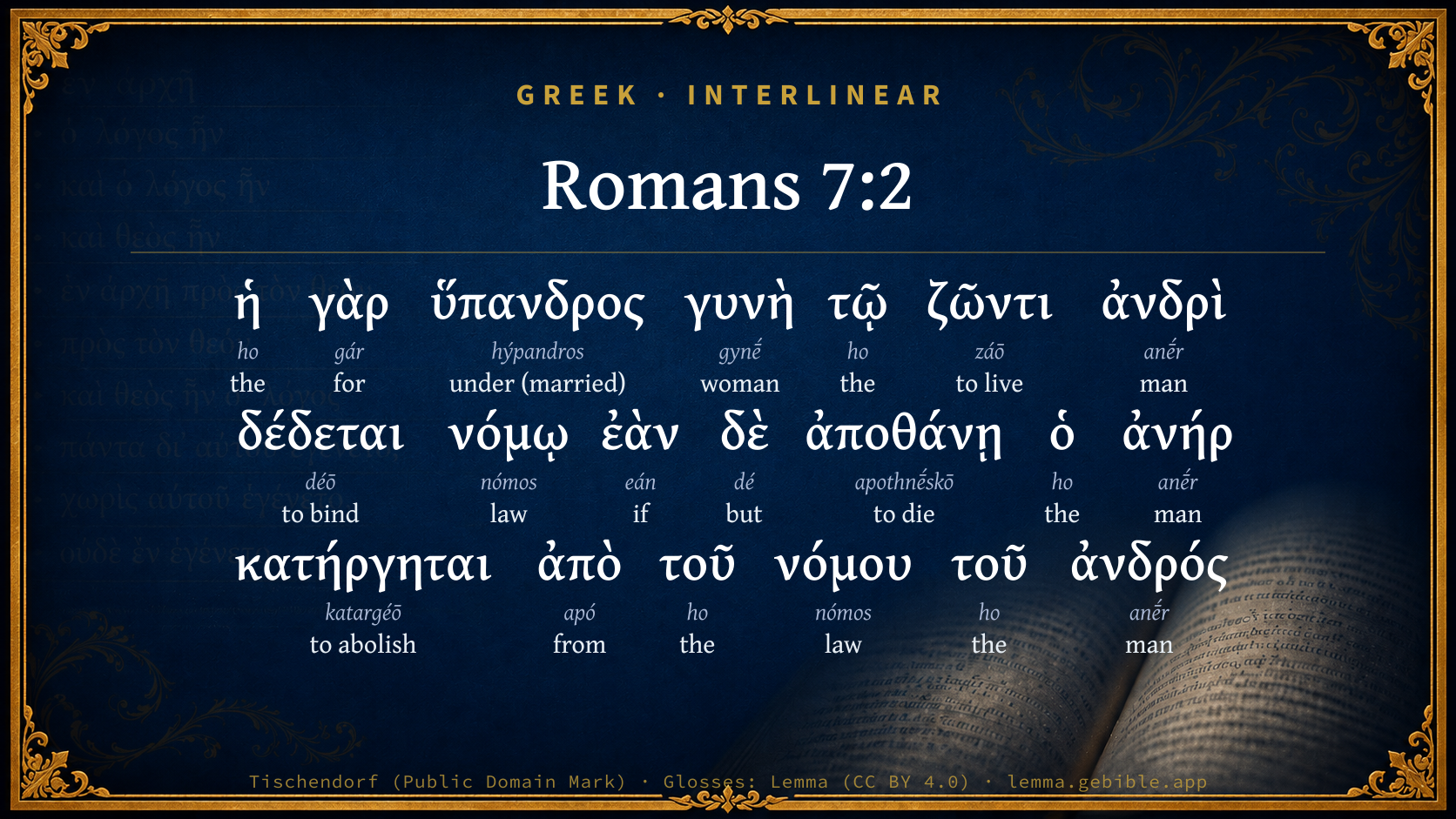
Greek (Tischendorf 8th ed.) Romans 7:2 appears in the Greek New Testament. The text above is from the Tischendorf 8th edition. Each word links to its Strong’s number and a concise gloss. Click any word for its full Thayer’s Greek Lexicon entry.
Download image
Cite this verse

Romans 7:2 (World English Bible). Public Domain. Lemma interlinear Bible study tool, https://lemma.gebible.app/v/romans/7/2.

Show BibTeX & RIS
BibTeX
RIS
English Translation
For the woman that has a husband is bound by law to the husband while he lives, but if the husband dies, she is discharged from the law of the husband.
World English Bible · Public Domain
Highlights
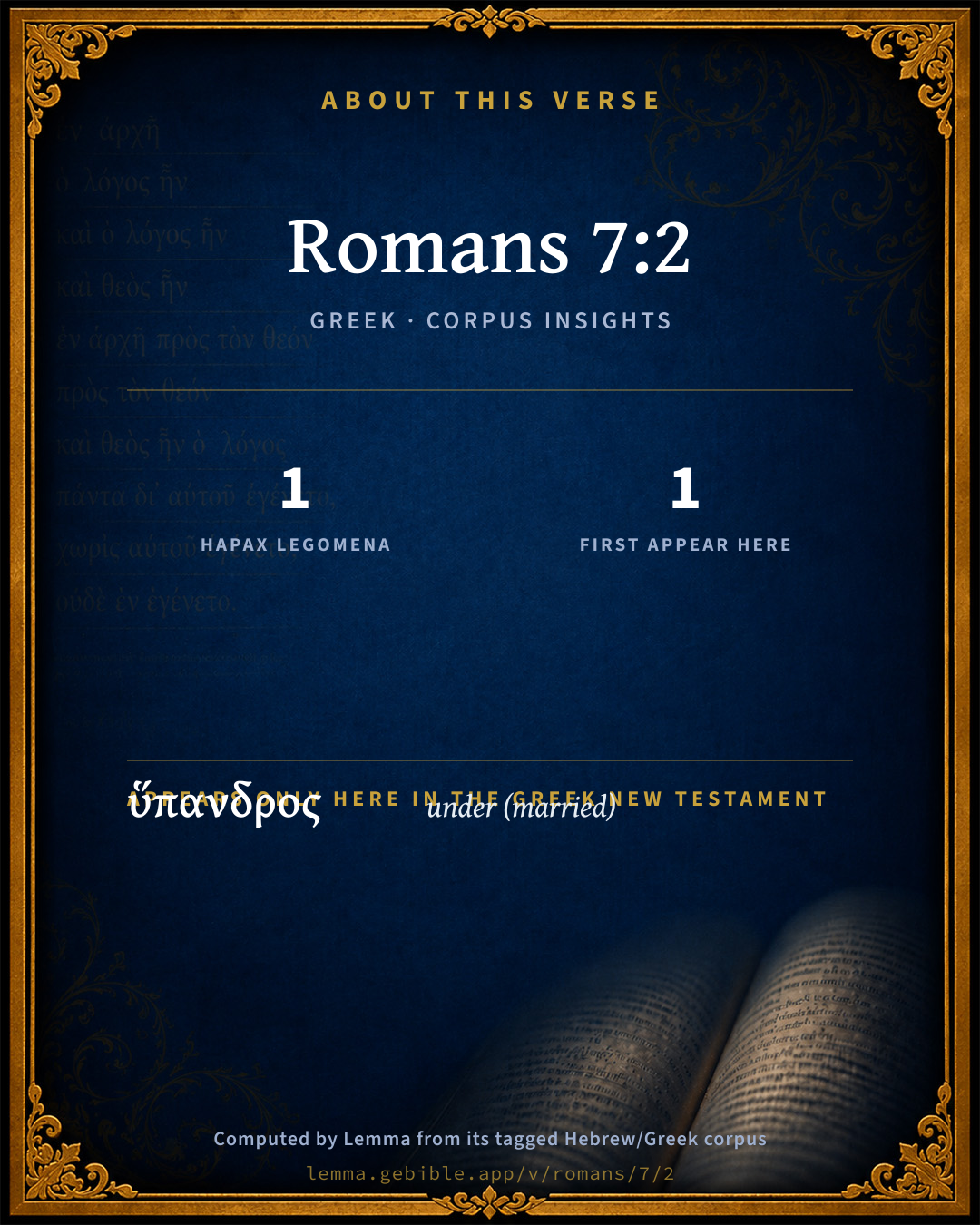
  • 1 hapax legomenon — only here in the Greek New Testament
  • 1 first appearance in the Greek New Testament
Full analysis ↓
Download a study sheet

One document with this verse’s original text, its word-by-word gloss line, the meaning frame, cross-references with their text, attributed commentary, and full source and license credits — printable, and it pastes into notes with its structure intact.

This verse Autodidact and up

Study sheet (.html) Plain text (.txt)

A passage Seminary Student

Up to 50 verses in one chapter. A passage sheet keeps up to 6 commentary sources and 12 cross-references per verse, in the order this page ranks them, and says so on the sheet whenever that leaves anything out. Ask for a single verse and you get the Autodidact verse sheet above.

Everything on this page stays free to read, with no account — the sheet is a download of what is already on screen, not access to it.

Want to remove ads? Support Godless Engineer
Compare translations 3

The same verse in 3 English versions, stacked beneath the original-language interlinear above. Click any original word for its lexicon entry.

Each is an independent rendering of the whole verse — the interlinear is not word-aligned to these translations.

Highlighted words mark where these versions differ — a whole-verse word diff, not a word-by-word alignment.

  • World English Bible Public Domain
    For the woman that has a husband is bound by law to the husband while he lives, but if the husband dies, she is discharged from the law of the husband.
  • King James Version Public Domain
    For the woman which hath an husband is bound by the law to her husband so long as he liveth; but if the husband be dead, she is loosed from the law of her husband.
  • unfoldingWord Literal Text CC BY-SA 4.0
    For the married woman remains bound by law to the living husband, but if the husband dies, she has been released from the law of the husband.

unfoldingWord Literal Text — © unfoldingWord, licensed CC BY-SA 4.0. Word-aligned USFM3 via Door43 (git.door43.org/unfoldingWord/en_ult).

Versions to compare (up to 4)

3 of 4 selected

Show all 19 translations

Every available English version of this verse, each an independent rendering of the whole verse.

  • World English Bible Public Domain
    For the woman that has a husband is bound by law to the husband while he lives, but if the husband dies, she is discharged from the law of the husband.
  • Berean Standard Bible Public Domain
    For instance, a married woman is bound by law to her husband as long as he lives. But if her husband dies, she is released from the law of marriage.
  • Majority Standard Bible Public Domain
    For instance, a married woman is bound by law to her husband as long as he lives. But if her husband dies, she is released from the law of marriage.
  • King James Version Public Domain
    For the woman which hath an husband is bound by the law to her husband so long as he liveth; but if the husband be dead, she is loosed from the law of her husband.
  • American Standard Version (1901) Public Domain
    For the woman that hath a husband is bound by law to the husband while he liveth; but if the husband die, she is discharged from the law of the husband.
  • Revised Version (1885) Public Domain
    For the woman that hath a husband is bound by law to the husband while he liveth; but if the husband die, she is discharged from the law of the husband.
  • Geneva Bible (1599) Public Domain
    For the woman which is in subiection to a man, is bound by the Lawe to the man, while he liueth: but if the man bee dead, shee is deliuered from the lawe of the man.
  • Douay-Rheims (1899) Public Domain
    For the woman that hath an husband, whilst her husband liveth is bound to the law. But if her husband be dead, she is loosed from the law of her husband.
  • Young's Literal Translation Public Domain
    for the married woman to the living husband hath been bound by law, and if the husband may die, she hath been free from the law of the husband;
  • Literal Standard Version CC BY-SA 4.0
    For the married woman to the living husband has been bound by law, and if the husband may die, she has been free from the law of the husband;
  • Unlocked Literal Bible CC BY-SA 4.0
    For the married woman is bound by law to the husband while he lives, but if the husband dies, she is released from the law of marriage.
  • unfoldingWord Literal Text CC BY-SA 4.0
    For the married woman remains bound by law to the living husband, but if the husband dies, she has been released from the law of the husband.
  • Darby Bible Public Domain
    For the married woman is bound by law to her husband so long as he is alive; but if the husband should die, she is clear from the law of the husband:
  • World Messianic Bible Public Domain
    For the woman that has a husband is bound by law to the husband while he lives, but if the husband dies, she is discharged from the law of the husband.
  • Webster's Bible Public Domain
    For the woman who hath a husband, is bound by the law to her husband so long as he liveth; but if the husband is dead, she is loosed from the law of her husband.
  • Free Bible Version CC BY-SA 4.0
    For example, a married woman is bound by the law to her husband while he's alive, but if he dies, she's released from this legal obligation to him.
  • Bible in Basic English Public Domain
    For the woman who has a husband is placed by the law under the power of her husband as long as he is living; but if her husband is dead, she is free from the law of the husband.
  • Text-Critical English NT CC BY 4.0
    For a married woman is bound by the law to her husband as long as he is alive, but if her husband dies, she is released from the law concerning her husband.
  • Tyndale New Testament (1534) Public Domain
    For the woman which is in subieccion to a man is bounde by the lawe to the man as longe as he liveth. Yf the man be deed she is lowsed from the lawe of the man.

Literal Standard Version (2020), Covenant Press — licensed CC BY-SA 4.0. Text via the HelloAO Bible API (eBible.org). Unlocked Literal Bible (unfoldingWord) — licensed CC BY-SA 4.0. Text via the HelloAO Bible API (eBible.org). unfoldingWord Literal Text — © unfoldingWord, licensed CC BY-SA 4.0. Word-aligned USFM3 via Door43 (git.door43.org/unfoldingWord/en_ult). Free Bible Version, Dr. Jonathan Gallagher — licensed CC BY-SA 4.0. Text via the HelloAO Bible API (eBible.org).

Word by word

More ways to search: Search by grammar → Find every occurrence → Compare this word →

Practice this passage: Drill this verse → Learn its vocabulary →

ὕπανδρος
hýpandros
G5220
“under (married)”
Adjective, Nominative, Singular, Feminine
Part of Speech
Adjective
Case
Nominative
Number
Singular
Gender
Feminine
Full Thayer's Definition

Origin: from G5259 and G435

TDNT: None

1. under i.e. subject to a man: married
  1. ἡ ho G3588 “the” Article, Nominative, Singular, Feminine
  2. γὰρ gár G1063 “for” Conjunction
  3. γυνὴ gynḗ G1135 “woman” Noun, Nominative, Singular, Feminine
  4. τῷ ho G3588 “the” Article, Dative, Singular, Masculine
  5. ζῶντι záō G2198 “to live” Verb, Present, Active, Participle, Dative, Singular, Masculine
  6. ἀνδρὶ anḗr G435 “man” Noun, Dative, Singular, Masculine
  7. δέδεται déō G1210 “to bind” Verb, Perfect, Passive, Indicative, 3rd person, Singular
  8. νόμῳ nómos G3551 “law” Noun, Dative, Singular, Masculine
  9. ἐὰν eán G1437 “if” Conditional
  10. δὲ dé G1161 “but” Conjunction
  11. ἀποθάνῃ apothnḗskō G599 “to die” Verb, Aorist, Active, Subjunctive, 3rd person, Singular
  12. ὁ ho G3588 “the” Article, Nominative, Singular, Masculine
  13. ἀνήρ anḗr G435 “man” Noun, Nominative, Singular, Masculine
  14. κατήργηται katargéō G2673 “to abolish” Verb, Perfect, Passive, Indicative, 3rd person, Singular
  15. ἀπὸ apó G575 “from” Preposition
  16. τοῦ ho G3588 “the” Article, Genitive, Singular, Masculine
  17. νόμου nómos G3551 “law” Noun, Genitive, Singular, Masculine
  18. τοῦ ho G3588 “the” Article, Genitive, Singular, Masculine
  19. ἀνδρός anḗr G435 “man” Noun, Genitive, Singular, Masculine

About this verse

These counts appear in no published source. They are computed here, from the morphology-tagged text and Lemma’s own curated glosses. What Lemma adds →

20
words
13
distinct lemmas
Pauline Epistles
section

Notable vocabulary

1 hapax legomenon — a word that appears only here in the entire Greek New Testament:

  • ὕπανδρος under (married) G5220

First appearance in Scripture

This word makes its first canonical appearance in the Greek New Testament here:

  • ὕπανδρος under (married) G5220

Shared distinctive vocabulary

κατήργηται to abolish G2673 occurs in 26 verses of the Greek New Testament. Also found in:
Repetition

Words recur within this verse:

Cross-references

4

Topical passages linked to Romans 7:2 in the Treasury of Scripture Knowledge — connected by theme and wording, ordered by reader-vote popularity; previews shown in the World English Bible.

  • Genesis 2:23–24 The man said, "This is now bone of my bones, and flesh of my flesh. She will be called Woman, because she was taken out of Man."
  • 1 Corinthians 7:4 The wife doesn't have authority over her own body, but the husband. Likewise also the husband doesn't have authority over his own body, but the wife.
  • 1 Corinthians 7:39 A wife is bound by law for as long as her husband lives; but if the husband is dead, she is free to be married to whoever she desires, only in the Lord.
  • Numbers 30:7–8 and her husband hear it, and hold his peace at her in the day that he hears it; then her vows shall stand, and her bonds with which she has bound her soul shall stand.

Cross-references courtesy of OpenBible.info (CC BY 4.0).

Commentary

Notes on Romans 7:2 from classic Christian and Jewish commentators (each source and its license shown beneath its notes). The classic Christian expositions comment on the surrounding passage and are grouped to its opening verse, so a note may address several verses; the Jewish commentaries on the Tanakh (Rashi and others) are per-verse, so they appear only where the commentator wrote on this verse.

Lemma curates 59 commentaries, every one of them public domain or Creative Commons licensed, each selected and text-cleaned for this edition rather than reprinted as found. About our sources →

Tyndale Open Study Notes

Tyndale Open Resources

7:2-3 These verses are not an allegory, in which every element of the story has a theological counterpart. Paul simply cites an illustration to make two basic points: Death can release a person from obligation to the law, and freedom from one relationship can allow a person to establish a new one. Paul applies the illustration in 7:4.

Tyndale Open Study Notes — © Tyndale Open Resources, licensed CC BY-SA 4.0. Text via the HelloAO Bible API.

Bengel's Gnomon

Johann Albrecht Bengel

Rom 7:2. Ὓπανδρος) So the LXX.—δέδεται, is bound) It may be construed with to her husband, and with by [to] the law.—τοῦ νόμου τοῦ ἀνδρὸς) It would not be an unsuitable apposition, were we to say, from the law [that is, from] her husband.

Bengel's Gnomon of the New Testament — English translation (T&T Clark, Edinburgh, 1860) — public domain. Text from a community e-Sword module.

Meyer's Critical & Exegetical Commentary

Heinrich August Wilhelm Meyer

Rom_7:2. Concrete illustration of the proposition in Rom_7:1, derived from the relation of the law to marriage and its dissolution, which in the womans case can only take place through the, death of the husband, so that it is only after that death has occurred that she may marry another. This example, as the tenor of the following text shows (in opposition to Hofmann), is selected, not because the legal ordinance in question was in its nature the only one that Paul could have employed, but because he has it in view to bring forward the union with Christ, which takes place after the release from the law, as analogous to a new marriage, and does so in Rom_7:4. The illustration is only apparently (not really; Usteri, Rückert, and even Umbreit in the Stud. u. Krit. 1851, p. 643) awkward, in so far namely as the deceased and the person released from the law through the event of death are represented in it as different. This appearance drove Chrysostom and his followers to adopt the hypothesis of an inversion of the comparison; thus holding that the law is properly the deceased party, but that Paul expressed himself as he has done out of consideration for the Jews (comp Calvin and others), whereas Tholuck contents himself with the assumption of a (strange) pregnancy of expression which would include in the one side the other also; and Umbreit regards the irregularity in the change of person as unavoidable. But the semblance of inappropriateness vanishes on considering καὶ ὑμεῖς in Rom_7:4 (see on that passage), from which it is plain that Paul in his illustration, Rom_7:2 f., follows the view, that the death of the husband implies (in a metaphorical sense by virtue of the union of the two spouses in one person, Eph_5:28 ff.) the death of the woman also as respected her married relation, and consequently her release from the law, so far as it had bound her as a ὕπανδρος γυνή to her husband, so that she may now marry another, which previously she could not do, because the law does not cease to be lord over the man before he is dead. So in substance also Achelis l.c[1525] Consequently Rom_7:2 f. is not to be taken allegorically, but properly and concretely; and it is only in Rom_7:4 that the allegorical application occurs. It has been allegorically explained, either so, that the wife signifies the soul and the husband the sin that has died with Christ (Augustine, comp Olshausen); or, that the wife represents humanity (or the church) and the husband the law, to which the former had been spiritually married (Origen, Chrysostom, Calvin, and others, including Klee, Reiche, and Philippi). But the former is utterly foreign to the theme of the text; and the latter would anticipate the application in Rom_7:4.

ὕπανδρος] viro subjecta, married; also current in later Greek authors, as in Polyb. x. 26, 3, Athen. ix. p. 388 C; in the N. T. only here. See Wetstein and Jacobs, a[1527] Ael. N. A. iii. 42.

τῷ ζῶντι ἀνδρί] to her (τῷ) living husband. ζῶντι has the emphasis, correlative to the ἐφ ὅσον χρόνον ζῇ in Rom_7:1. On δέδεται comp 1Co_7:27.

νόμῳ] by the law. For by the law of Moses the right of dismissing the husband was not given to the wife (Michaelis, Mos. R. § 120; Saalschütz, p. 806 f.). Paul however leaves unnoticed the case of the woman through divorce ceasing to be bound to her husband (Deu_24:2; Kiddusch. f. 2, 1 : Mulier possidet se ipsam per libellum repudii et per mortem mariti), regarding the matter, in accordance with his scope, only in such a way as not merely seemed to be the rule in the majority of cases, but also harmonized with the original ordinance of the Creator (Mat_19:8).

κατήργηται ἀπὸ τ. νόμου τ. ἀνδρ.] that is, with respect to her hitherto subsisting subordination under the law binding her to her husband she is absolved, free and rid of it. See on Gal_5:4. The Apostle thus gives expression to the thought lying at the basis of his argument, that with the decease of the husband the wife also has ceased to exist as respects her legal connection with him; in this legal relation, from which she is fully released, she is no longer existent. Comp on ἀπό 2Co_11:3. She is still there, but no longer as bound to that law, to which she died with the death of her husband; comp Rom_7:6. The joining of ὁ νόμος with the genitive of the subject concerned (frequent in the LXX.) is very common also in classic authors. Th. Schott, following Bengel, erroneously takes τ. ἀνδρ. as genitive of apposition; the law being for the wife embodied in the husband. The law that determines the relation of the wife to the husband is what is intended, like ὁ νόμος ὁ περί τοῦ ἀνδρός; see Kühner, II. 1, p. 287.

[1525] .c. loco citato or laudato.

[1527] d refers to the note of the commentator or editor named on the particular passage.

Meyer — Critical and Exegetical Commentary on the New Testament — English translation by Peter Christie, edited by Frederick Crombie (T&T Clark, 1880) — public domain. Text from a community e-Sword module.

Expositor's Greek Testament

ed. W. Robertson Nicoll

Rom 7:2 f. An illustration of the principle. It is the only illustration in which death liberates a person who yet remains alive and can enter into new relations. Of course there is an inexactness, for in the argument the Christian is freed by his own death, and in the illustration the wife is freed by the husband’s death; but we must discount that. Paul required an illustration in which both death and a new life appeared. κατήργηται ἀπό : cf. Rom 7:6 , Gal 5:4 : she is once for all discharged (or as R.V. in Gal. “severed”) from the law of the husband: for the genitive τοῦ ἀνδρός , see Winer, 235. χρηματίσει = she shall be publicly designated: cf. Act 11:26 . τοῦ μὴ εἶναι αὐτὴν μοιχαλίδα κ . τ . λ .: grammatically this may either mean (1) that she may not be an adulteress, though married to another man; or (2) so that she is not , etc. Meyer prefers the first; and it may be argued that in this place, at all events, the idea of forming another connection is essential: cf. εἰς τὸ γενέσθαι ὑμᾶς ἑτέρῳ , Rom 7:4 (Gifford); but it is difficult to conceive of innocent remarriage as being formally the purpose of the law in question, and the second meaning is therefore to be preferred. Cf. Burton, Moods and Tenses , § 398.

The Expositor's Greek Testament, edited by W. Robertson Nicoll (1897–1910) — public domain. Text from a community e-Sword module.

Hodge's Commentary on Romans, Ephesians & First Corinthians

Charles Hodge

Rom_7:2

For the woman which hath a husband, γυνὴ ὕπανδρος, viro subjecta, married, answering to תַּחַת אִישָׁהּ, Num_5:29. Is bound by the law to her living husband, τῷ ζῶντι ἀνδρί i.e. to her husband while living. But if her husband be dead, she is freed from the law of her husband. Is freed from, κατήργηται ἀπό is an expression which never occurs in common Greek. The same idiom is found in Rom_7:6 of this chapter, and in Gal_5:4. Καταργεῖν means to invalidate, to render void. The idea is, that the relation to her husband is broken off, and she is free. Law of her husband means law relating to her husband. The phrase is analogous to those often used in the Old Testament law of the sacrifice; law of leprosy; law of defilement. According to the common interpretation of this verse ga&r (for) introduces a confirmatory illustration: Law is not of perpetual obligation; for example, a married woman is free from the law which bound her to her husband, by his death. There is of course a slight incongruity between the illustration and the form in which the principle is stated in the first verse. There it is said that the law has dominion over a man so long as he lives. The illustration is, that a wife is free (not when she dies),when her husband dies. For this and other reasons, many interpreters do not regard this verse as presenting an example, but as an allegory. Those who take this view give different explanations. After Augustine, Melanchthon, Beza, and others, say: The husband is our corrupt nature, (vis illa nativa, as Beza calls it, ciens in nobis affectiones peccatorum;) the wife is the soul, or our members. When, therefore, the corrupt nature (or old man) dies, the soul is free from that husband, and is at liberty to marry another. Others, with much more regard to the contest, say that the wife is the Church, the husband the law; so Origen, Chrysostom, Olshausen, Philippi, etc. This is indeed the application which the apostle makes in the following verses, but it is not what is said in Rom_7:2, Rom_7:3. Here we have only an example, illustrating the truth of the assertion in Rom_7:1.

Charles Hodge — Commentary on Romans (1835), First Corinthians (1857), and Ephesians (1856) — public domain. Text from a community e-Sword module.

Jamieson, Fausset & Brown

Robert Jamieson, A. R. Fausset & David Brown

if her husband be dead--"die." So Rom 7:3.

Jamieson, Fausset & Brown — Commentary Critical and Explanatory on the Whole Bible (1871) — public domain (CC PDM 1.0). Text via the HelloAO Bible API.

Adam Clarke's Commentary

Verse 2. For the woman which hath a husband] The apostle illustrates his meaning by a familiar instance. A married woman is bound to her husband while he lives; but when her husband is dead she is discharged from the law by which she was bound to him alone.

Adam Clarke's Commentary on the Bible (1810–1826) — public domain. Text from a community e-Sword/MySword module.

John Calvin's Commentaries

2. For a woman subject to a man, etc. He brings a similitude, by which he proves, that we are so loosed from the law, that it does not any longer, properly and by its own right, retain over us any authority: and though he could have proved this by other reasons, yet as the example of marriage was very suitable to illustrate the subject, he introduced this comparison instead of evidence to prove his point. But that no one may be puzzled, because the different parts of the comparison do not altogether correspond, we are to be reminded, that the Apostle designedly intended, by a little change, to avoid the invidiousness of a stronger expression. He might have said, in order to make the comparison complete, “A woman after the death of her husband is loosed from the bond of marriage: the law, which is in the place of a husband to us, is to us dead; then we are freed from its power.” But that he might not offend the Jews by the asperity of his expressions, had he said that the law was dead, he adopted a digression, and said, that we are dead to the law To some indeed he appears to reason from the less to the greater: however, as I fear that this is too strained, I approve more of the first meaning, which is simpler. The whole argument then is formed in this manner “The woman is bound to her living husband by the law, so that she cannot be the wife of another; but after the death of her husband she is loosed from the bond of his law so, that she is free to marry whom she pleases.”

Then follows the application, — The law was, as it were our husband, under whose yoke we were kept until it became dead to us: After the death of the law Christ received us, that is, he joined us, when loosed from the law, to himself: Then being united to Christ risen from the dead, we ought to cleave to him alone: And as the life of Christ after the resurrection is eternal, so hereafter there shall be no divorce.

But further, the word law is not mentioned here in every part in the same sense: for in one place it means the bond of marriage; in another, the authority of a husband over his wife; and in another, the law of Moses: but we must remember, that Paul refers here only to that office of the law which was peculiar to the dispensation of Moses; for as far as God has in the ten commandments taught what is just and right, and given directions for guiding our life, no abrogation of the law is to be dreamt of; for the will of God must stand the same forever. We ought carefully to remember that this is not a release from the righteousness which is taught in the law, but from its rigid requirements, and from the curse which thence follows. The law, then, as a rule of life, is not abrogated; but what belongs to it as opposed to the liberty obtained through Christ, that is, as it requires absolute perfection: for as we render not this perfection, it binds us under the sentence of eternal death. But as it was not his purpose to decide here the character of the bond of marriage, he was not anxious to mention the causes which releases a woman from her husband. It is therefore unreasonable that anything decisive on this point should be sought here.

John Calvin's Commentaries (1540-1563) — public domain. Text from the Calvin Translation Society English edition (1840s-50s) via the Christian Classics Ethereal Library (ccel.org). Calvin's coverage is partial (roughly two-thirds of the Bible); uncommented books and verses are honest gaps, never fabricated. The 19th-century editor's footnotes and remarks are omitted so the notes are faithfully Calvin's own voice.

Ellicott's Commentary for English Readers

(2) For the woman which hath an husband.—The illustration is not quite exact. The Law is here represented by the husband, but the Apostle does not mean to say that the Law dies to the Christian, but the Christian to the Law. The proposition must therefore be understood to be stated in a somewhat abstract form. Relations of the kind indicated are terminated by death (not necessarily the death of one party to them more than another). The relation of wife and husband ceases absolutely and entirely on both sides, and not merely so much of it as affects the person who dies.

A Bible Commentary for English Readers, edited by Charles John Ellicott (1878–1897) — public domain. Text from a community e-Sword module.

The Cambridge Bible for Schools and Colleges

gen. ed. J. J. S. Perowne

2. to her husband so long, &c]. Lit. to the living husband. So it should be rendered; q. d., “to the present, not to a past or future, husband.”

she is loosed] Lit. she has been cancelled from, &c. The perfect tense indicates the ipso facto character of the release. The obvious equivalent of the phrase is, “the law of her husband has been cancelled ipso facto in respect of her.”

the law of the husband] i.e. “that special part of the law which affects her husband and his claim;” viz. the sanctions of marriage.

The Cambridge Bible for Schools and Colleges (gen. ed. J. J. S. Perowne; Cambridge University Press, 1878–1918) — public domain. Text from a community e-Sword module.

John Gill's Exposition

For the woman which hath an husband,.... The former general rule is here illustrated by a particular instance and example in the law of marriage; a woman that is married to a man,

is bound by the law to her husband; to live with him, in subjection and obedience to him,

so long as he liveth; except in the cases of adultery, Mat 19:9, and desertion, Co1 7:15, by which the bond of marriage is loosed, and for which a divorce or separation may be made, which are equal to death:

but if the husband be dead, she is loosed from the law of her husband; the bond of marriage is dissolved, the law of it is abolished, and she is at entire liberty to marry whom she will, Co1 7:39.

John Gill's Exposition of the Whole Bible (1746–1763) — public domain (CC PDM 1.0). Text via the HelloAO Bible API.

Trapp's Complete Commentary

John Trapp

2 For the woman which hath an husband is bound by the law to her husband so long as he liveth; but if the husband be dead, she is loosed from the law of her husband.

Ver. 2. She is loosed, &c.] And so at liberty to marry again, though Jerome compare such to the unclean beasts in the ark, and to vessels of dishonour in a house, yea, to dogs that return to their vomit; which was his error. Patres legendi cum venia, saith one.

John Trapp, A Commentary or Exposition upon All the Books of the Old and New Testament (1647–1656) — public domain. Text from a community e-Sword module.

Albert Barnes' Notes on the Bible

For the woman - This verse is a specific illustration of the general principle in Rom 7:1, that death dissolves those connections and relations which make law binding in life. It is a simple illustration; and if this had been kept in mind, it would have saved much of the perplexity which has been felt by many commentators, and much of their wild vagaries in endeavoring to show that “men are the wife, the law of the former husband, and Christ the new one;” or that “the old man is the wife, sinful desires the husband, sins the children.” Beza. (See Stuart.) Such expositions are sufficient to humble us, and to make us mourn over the puerile and fanciful interpretations which even wise and good people often give to the Bible.

Is bound by the law ... - See the same sentiment in 1Co 7:39.

To her husband - She is united to him; and is under his authority as the head of the household. To him is particularly committed the headship of the family, and the wife is subject to his law, in the Lord, Eph 5:23, Eph 5:33.

She is loosed ... - The husband has no more authority. The connection from which obligation resulted is dissolved.

Albert Barnes' Notes on the Bible (1834–1885) — public domain. Text from a community e-Sword/MySword module.

Matthew Poole's English Annotations

He here exemplifies and illustrates the foregoing assertion.

The woman is bound by the law to her husband so long as he liveth: see a parallel place, 1Co 7:39. This is the general rule, yet there is an exception in the case of fornication or desertion: see Mat 5:32; 1Co 7:15.

From the law of her husband; from the obligation of the law of marriage.

Matthew Poole's English Annotations on the Holy Bible (1683–1685) — public domain. Text from a community e-Sword/MySword module.

The Pulpit Commentary

Vers. 2-4. For (this is an instance of the application of the general principle, adduced as suiting the subject in band) the woman that hath a husband (upandrov , implying subjection, meaning properly, that is under a husband) is bound to her living husband; but if the husband die, she is loosed (kathrghtai ; cf. ver. 6 and Gal_5:4. The word expresses the entire abolition of the claim of the husband"s law over her) from the law of the husband. So then if, while the husband liveth, she be married to another man, she shall be called an adulteress: but if the husband die, she is free from the Law, so that she is no adulteress, though she be married to another man. Wherefore, my brethren, ye also were made dead to the Law through the body of Christ; that ye should be married to another, even to him who was raised from the dead, that we may bring forth fruit unto God. The general drift of the above verses is plain enough; namely, that, as in all cases death frees a man from the claims of human law, and, in particular, as death frees the wife from the claims of marital law, so that she may marry again, so the death of Christ, into which we were baptized, frees us from the claims of the law which formerly bound us, so that we may be married spiritually to the risen Saviour, apart from the old dominion of law, and consequently of sin. But it is not so easy to explain the intended analogy in precise terms, there being an apparent discrepance between the illustration and the application with regard to the parties supposed to die. Even before the application there is a seeming discrepance of this kind between the general statement of ver. 1 and the instance given in ver. 2. For in ver. 1 it is (according to the view we have taken of it) the death of the person who had been under law that frees him from it, whereas in ver. 2 it is the death of the husband (representing law) that frees the wife from the law she had been under. Hence the interpretation of ver. 1 above referred to, according to which law, and not a man, is the understood nominative to liveth. But, even if this interpretation were considered tenable, we should not thus get rid of the subsequent apparent discrepance between the illustration and the application. For in the former it is the death of the husband that frees the wife; whereas in the latter it seems to be the death of ourselves, who answer to the wife, in the death of Christ, that frees us. For that it is ourselves that are regarded as having died to the Law with Christ appears not only from other passages (e.g. vers. 2, 3, 4, 7, 8, 11, in Ro 6), but also, in the passage before us, from ayanatwyhte in ver. 4, and apoyanontev in ver. 6. (The reading apoyanontov of the Textus Receptus rests on no authority, being apparently only a conjecture of Beza"s.) There are various ways of explaining.

(1) That (notwithstanding the reasons against the supposition that have just been given) it is the Law, and not the man, that is conceived as having died in the death of Christ. Eph_2:15 and Col_2:14 may be referred to as supporting this conception. Thus the illustration and the application are made to hang together, the law of the husband being regarded as having died in the husband"s death, as the Law generally to us in Christ"s death; and we have already seen how ver. 1 may be forced into correspondence. This view of the Law itself being regarded as having died has the weighty support of Origen, Chrysostom, Theophylact, Ambrose, and other Greek Fathers. Chrysostom accounts for the apostle introducing a different conception in ver. 4: by suggesting that he avoided saying explicitly that the Law had died, for fear of wounding the Jews: To akolouyon hn aipein, Wste adelfoi ou kurieuei umwn o nomov apeyane gar All ouk eipen outwv ina mh plhxh tououv . This explanation hardly commends itself as satisfactory; and besides, in addition to what has been already said, it may be observed that throughout the whole passage there is no phrase to suggest in itself the idea of the Law"s death, but only of some death which emancipates from law (ver. I being taken in its natural sense, and apoyanontev , in ver. 4, being accepted as the undoubtedly true reading).

(2) That in the illustration the wife is really supposed to die when the husband dies. The death of either party to the marriage-bond cancels it; and when one dies, the other virtually dies to the law that both were under. Thus the statement of principle in ver. 1, the particular illustration in vers. 2, 3, and the application are made to hang together. Meyer takes this view decidedly, and cites Eph_5:28, seq., to show that the husband"s death may be considered as implying the wife"s death also.

(3) That there is a discrepance between the illustration and the application, the husband being regarded as dying in the former, and ourselves, who represent the wife, in the latter; but that this is of no consequence; the idea, common to both, of death abrogating the claims of law being sufficient for the apostle"s argument. Death, it may be said, however regarded in the application, is an ideal conception, and not an actual fact with respect to ourselves; and it is immaterial how it is regarded, as long as the idea comes out that through death, i.e. ours in the death of Christ, we are freed from the dominion of law. (So, in effect, De Wette, and also Alford.)

(4) That the former husband is not the law, but the lust of sin (ta payhmata twn amartiwn , ver. 5); the wife, the soul; the new husband, Christ. Augustine, who is the author of this view, puts it thus: "Cum ergo tria sint, anima, tanquam mulier; passiones peccatorum tanquam vir; et lex tanquam lex viri; non ibi peccatis mortuis, tanquam viro mortuo liberari animam dicit, sed ipsam animam mort peccato, et liberari a lege, ut sit alterius viri, i.e. Christi, cum mortua fuerit peccato, quod fit, cum adhuc manentibus in nobis desideriis et incitamentis quibusdam ad peccandum, non obedi-mus tamen, nec consentimus, mente servientes legi Dei" (Aug., "Prop.," 33). Beza, taking up the view of Augustine, puts it somewhat differently, and more clearly, thus: "There are two marriages. In the first, the old man is the wife; predominating sinful desires, the husband; transgressions of every kind, the offspring. In the second, the new man is the wife; Christ, the Husband; and the fruits of the Spirit (Gal_5:22) are the children. " This explanation being still apparently open to the objection that, in the illustration, the wife continues the same, but not so that which corresponds to her in the application, Olshausen explains thus: "In man the old man is distinguished from the new without prejudice to the unity of his personality, which Paul subsequently (ver. 20) signifies by egw . This true personality, the proper self of man, is the wife, who in the natural state appears in marriage with the old man, and, in intercourse with him, generates sins, the end of which is death. (Rom_6:21, Rom_6:22) But in the death of the mortal Christ this old man is dead with him; and, as the individual man is grafted by faith into Christ. his old man dies, by whose life he was holden under the Law." The commentator on the Epistle in the "Speaker"s Commentary" adopts this explanation, with the remark that "St. Paul"s application of the figure is quite clear, if we follow his own guidance." The view rests mainly on, and certainly derives some support from, vers. 5 and 6, if regarded as carrying out the application of the figure. Others, however, in view of the difficulties of the whole passage, may prefer to content themselves with explanation (3), as conveying as precise an idea as may possibly have been even in the apostle"s mind when he wrote. Commentators may sometimes go beyond their office in attributing to their author more exactness of thought than his words in themselves imply. It is to be observed that the con-eluding expression in ver. 4, "that we should bring forth fruit unto God," brings us back to the main purport of this whole section, which begins at Rom_6:1, viz. the obligation of a holy life on Christians. In vers. 5, 6, which follow, the hindrance to our living such a life "when we were in the flesh," and our power of doing so now, are briefly intimated in preparation for what follows. It does not seem necessary to conclude as is done by those who adopt interpretation (4) of what precedes that the illustration of the marriage bond is meant to be kept up in these two verses.

The Pulpit Commentary (1880–1919), ed. H.D.M. Spence-Jones & Joseph S. Exell — public domain. Text from a community e-Sword module.

John Wesley's Explanatory Notes

She is freed from the law of her husband - From that law which gave him a peculiar property in her.

John Wesley, Explanatory Notes Upon the Whole Bible (1754–1765) — public domain. Text via the GEBible commentary corpus.

Burkitt's Expository Notes on the New Testament

William Burkitt

Here the apostle doth exemplify and illustrate the foregoing assertion, namely, That believers are freed from the law, by a similitude taken from the law of marriage: As death freeth husband and wife from the law which bound them to each other, and empowereth the survivor to marry to another person; in like manner the death of Christ was the death of the law,, as a covenant of works, holding us under the bond of the curse of it; and so his dying gave a manumission or freedom from that bond, and a capacity of espousal unto Christ; that so living in conjugal affection and obedience to him, we may be made fuitful by his Spirit, doing such things as are agreeable to the will of God, and tending to the glory of God. Ye are dead to the law by the body of Christ: That is, through the offering up of Christ’s body upon the cross.

Learn hence, 1. That he that is under the law, is as strictly bound to the rigour and curse of the law, as a married woman is bound to her husband during his life.

Learn, 2. That one great end of Christ’s death was to purchase our freedom from the law, that we might be capable of being espoused to himself. For whilst we were under the curse of the law, we were not in a capacity of being married unto Christ. He or she that is a slave to another, is not capable to be disposed of in marriage until made free.

In like manner we were in bondage to the law, as well as in slavery unto sin and Satan; but Christ has bought out our liberty, and thereby put us into a capacity of being espoused unto himself.

Behold what manner of love the Redeemer has shewed unto us, that we should be called his spouse, and he our husband! He loved us, but not for any advantage he could have by us; for we had nothing but sin and shame to present him with. Nay, he must purchase us, and that with his own blood, before he could be united to us. Oh incomparable love! Oh fervent desires!

Learn, 3. That though believers are free from the rigour and curse of the law by the death of Christ, yet have they not an undoubted liberty, but are still under government, under an head and guide. As a wife is under the government of her husband, so are believers under the guidance and government of Jesus Christ, who in a special manner guideth them by his word and Spirit; and their being said to be dead to the law, signifies no more than the law’s not having dominion over them, in regard of the curse and condemnation of it.

William Burkitt's Expository Notes on the New Testament (1700–1703) — public domain. Text from a community e-Sword module.

McGarvey & Pendleton's Commentaries

J. W. McGarvey

For the woman that hath a husband is bound by law to the husband while he liveth; but if the husband die, she is discharged from the law of the husband . [If, on the one hand, ye are, as I have shown, emancipated from the horrible tyranny of sin, that ye may serve righteousness, so, on the other hand, are ye likewise emancipated from the more sane and orderly, but still rigorous, dominion of law, whether given by Moses or otherwise, that ye may live under the mild and gentle sway of grace. And would any of you deny this latter proposition? Surely, in order to do so, you must be very crude in knowledge; but I can not think you are so crude, for I am writing to those who know something about law, and hence must at least know this elementary principle, that law rules the living, and not the dead. The apostle might have cited many cases where this principle is applied: for instance, no public duties, taxes, etc., are required of the dead; they are never indicted for their crimes, etc.; but he chooses one illustration which peculiarly fits his argument, for it throws light on this question of dominion, viz.: the release from the law of marriage which is accorded to both the parties to a matrimonial contract, when death releases one of them. In this connection, and before we enter upon Paul's argument, we should notice the principle to which he appeals, in order that we may not be confused by his application of it. It is the party who dies that is primarily released or freed from the law, and hence left free to contract a second marriage. The party who survives is, of course, likewise freed; but the freedom of the survivor is secondary, and derived from the freedom of the deceased, which has been attained by death. If the living only were free, and the deceased were bound by the marriage contract, the apostle would have nothing on which to base an illustration or found an argument.]

J. W. McGarvey (with Philip Y. Pendleton), Commentaries on the New Testament (The Fourfold Gospel, 1914; Acts; and the epistles) — public domain. Text from a community e-Sword/MySword module.

The People's New Testament

B. W. Johnson

2. For the woman who hath an husband. This principle of law is shown from the marriage relation. Death severs it, and after it the marriage covenant is not binding. A woman can marry again without committing adultery.

B. W. Johnson's The People's New Testament with Notes (1889–1891) — public domain. Electronic text from the Christian Classics Ethereal Library (CCEL) ThML edition.

unfoldingWord translationNotes

Door43 World Missions Community

the married woman is bound by law to the husband

Here "bound by law to the husband" is a metaphor for a woman being united to her husband according to the law of marriage. AT: "according to the law, the married woman is united to the husband" (See: Metaphor)

the married woman

This refers to any woman who is married.

she will be called an adulteress

You can translate this in an active form. AT: "God will consider her an adulteress" or "people will call her an adulteress" (See: Active or Passive)

she is free from the law

Here being free from the law means not having to obey the law. In this case, the woman does not have to obey the law that says that a married woman cannot marry another man. AT: "she does not have to obey that law"

translationWords

law, laws

life

die

free

adultery

unfoldingWord translationNotes — © Distant Shores Media and the Door43 World Missions Community, licensed CC BY-SA 4.0. Source: git.door43.org/Door43/en_tn.

Cambridge Greek Testament for Schools and Colleges

2. κατήργηται ἀπό. Cf. Gal 5:4: has been made, so to speak, non-existent as regards that law and so freed from it.

Cambridge Greek Testament for Schools and Colleges (Cambridge University Press, 1896; 21 vols, various authors incl. Carr, Maclear, Plummer, Farrar, Lumby, Moule, M. R. James, Simcox) — public domain. Text from a community e-Sword module.

Alford’s Greek Testament

Henry Alford

2.] For (not merely = e.g., but, as Thol., the example is itself the proof) the married (ref.) woman is bound by the law to the living husband: but if the husband die, she is set free from (lit. annulled from) the law of (‘regarding,’ compare reff. and ὁ νόμος τοῦ λεπροῦ. Lev 14:2) the husband (no hypallage).

Henry Alford, The Greek Testament (1849–1861) — public domain. Text from a community e-Sword module.

International Critical Commentary

2. ἡ γὰρ ὕπανδρος γυνή: [‘the truth of this may be proved by a case in point.] For a woman in the state of wedlock is bound by law to her living husband.’ ὕπανδρος: a classical word, found in LXX.

κατήργηται: ‘is completely (perf.) absolved or discharged’ (lit. ‘nullified’ or ‘annulled,’ her status as a wife is abolished). The two correlative phrases are treated by St. Paul as practically convertible: ‘the woman is annulled from the law,’ and ‘the law is annulled to the woman.’ For καταργεῖν see on 3:3.

ἀπὸ τοῦ νόμου τοῦ ἀνδρός: from that section of the statute-book which is headed ‘The Husband,’ the section which lays down his rights and duties. Gif. compares ‘the law of the leper’ Lev 14:2; ‘the law of the Nazirite’ Num 6:13.

International Critical Commentary — older volumes (1896–1929), various authors — public domain. Text from a community e-Sword module.

Vincent's Word Studies in the New Testament

Marvin R. Vincent

That hath a husband [υπανδρος] . Lit., under or subject to a husband. The illustration is selected to bring forward the union with Christ after the release from the law, as analogous to a new marriage (ver. 4).

Is loosed [κατηργηται] . Rev., discharged. See on 3 3, Lit., she has been brought to nought as respects the law of the husband.

The law of the husband. Her legal connection with him She dies to that law with the husband 's death. There is an apparent awkwardness in carrying out the figure. The law, in vers. 1, 2, is represented by the husband who rules (hath dominion). On the death of the husband the woman is released. In ver. 4, the wife (figuratively) dies. "Ye are become dead to the law that ye should be married to another." But as the law is previously represented by the husband, and the woman is released by the husband 's death, so, to make the figure consistent, the law should be represented as dying in order to effect the believer 's release. The awkwardness is relieved by taking as the middle term of comparison the idea of dead in a marriage relation. When the husband dies the wife dies (is brought to nought) so far as the marriage relation is concerned. The husband is represented as the party who dies because the figure of a second marriage is introduced with its application to believers (ver. 4). Believers are made dead to the law as the wife is maritally dead - killed in respect of the marriage relation by her husband 's death.

Marvin R. Vincent, Word Studies in the New Testament (1887–1900) — public domain. Text from a community e-Sword/MySword module.

Lesson kit

Teaching starters — assembled from the data on this page, not authored interpretation. Every prompt links to the verse data it draws on. Edit before teaching.

Romans, in the Pauline Epistles, opens this verse with 20 words (13 distinct Greek lemmas). Its most distinctive word is hýpandros (“under (married)”). A historical commentator’s framing appears above. Read the whole chapter for the surrounding context.

Discussion questions

  1. How does “under (married)” (hýpandros) shape what this verse is saying?
  2. 1 word here appears nowhere else in the Greek New Testament. Why might the author reach for such rare wording?
  3. This is the first place “under (married)” appears in Scripture (first appears here). What does its debut here establish?
  4. How does Luke 13:7, which shares the word «to abolish», read alongside this verse?
  5. What does the repetition of “man” (3× in this one verse) do in this verse?
  6. These translations render this verse differently. What is at stake in choosing one wording over another?
  7. Compare how Tyndale Open Study Notes and Bengel's Gnomon read this verse. Where do they agree or differ?

Things to notice

  • 1 word in this verse appears nowhere else in the Greek New Testament.
  • 1 word makes its first canonical appearance in Scripture here.
  • These translations choose different wording for 15 words in this verse.
  • “man” occurs 3× in this single verse.
  • 13 distinct Greek lemmas span 20 words in this verse.

Reading settings

Reading text

Shown beneath each verse's original-language words.

Old Testament
Old Testament edition

Read the OT as the Masoretic Hebrew (MT) or the Greek Septuagint (LXX).

English shown for the Greek Septuagint (in the Hebrew ↔ Greek comparison).

Comparing translations? Open the Compare panel on any verse page to stack up to four side by side.