1 Timothy 3:12

Greek (Tischendorf 8th ed.) 1 Timothy 3:12 appears in the Greek New Testament. The text above is from the Tischendorf 8th edition. Each word links to its Strong’s number and a concise gloss. Click any word for its full Thayer’s Greek Lexicon entry.
Download image
Cite this verse

1 Timothy 3:12 (World English Bible). Public Domain. Lemma interlinear Bible study tool, https://lemma.gebible.app/v/1-timothy/3/12.

Show BibTeX & RIS
BibTeX
RIS
English Translation
Let deacons be husbands of one wife, ruling their children and their own houses well.
World English Bible · Public Domain
Download a study sheet

One document with this verse’s original text, its word-by-word gloss line, the meaning frame, cross-references with their text, attributed commentary, and full source and license credits — printable, and it pastes into notes with its structure intact.

This verse Autodidact and up

Study sheet (.html) Plain text (.txt)

A passage Seminary Student

Up to 50 verses in one chapter. A passage sheet keeps up to 6 commentary sources and 12 cross-references per verse, in the order this page ranks them, and says so on the sheet whenever that leaves anything out. Ask for a single verse and you get the Autodidact verse sheet above.

Everything on this page stays free to read, with no account — the sheet is a download of what is already on screen, not access to it.

Want to remove ads? Support Godless Engineer
Compare translations 3

The same verse in 3 English versions, stacked beneath the original-language interlinear above. Click any original word for its lexicon entry.

Each is an independent rendering of the whole verse — the interlinear is not word-aligned to these translations.

Highlighted words mark where these versions differ — a whole-verse word diff, not a word-by-word alignment.

  • World English Bible Public Domain
    Let deacons be husbands of one wife, ruling their children and their own houses well.
  • King James Version Public Domain
    Let the deacons be the husbands of one wife, ruling their children and their own houses well.
  • unfoldingWord Literal Text CC BY-SA 4.0
    Let deacons be husbands of one wife, leading children and their own households well.

unfoldingWord Literal Text — © unfoldingWord, licensed CC BY-SA 4.0. Word-aligned USFM3 via Door43 (git.door43.org/unfoldingWord/en_ult).

Versions to compare (up to 4)

3 of 4 selected

Show all 19 translations

Every available English version of this verse, each an independent rendering of the whole verse.

  • World English Bible Public Domain
    Let deacons be husbands of one wife, ruling their children and their own houses well.
  • Berean Standard Bible Public Domain
    A deacon must be the husband of but one wife, a good manager of his children and of his own household.
  • Majority Standard Bible Public Domain
    A deacon must be the husband of but one wife, a good manager of his children and of his own household.
  • King James Version Public Domain
    Let the deacons be the husbands of one wife, ruling their children and their own houses well.
  • American Standard Version (1901) Public Domain
    Let deacons be husbands of one wife, ruling `their' children and their own houses well.
  • Revised Version (1885) Public Domain
    Let deacons be husbands of one wife, ruling their children and their own houses well.
  • Geneva Bible (1599) Public Domain
    Let the Deacons be the husbands of one wife, and such as can rule their children well, and their owne housholdes.
  • Douay-Rheims (1899) Public Domain
    Let deacons be the husbands of one wife: who rule well their children, and their own houses.
  • Young's Literal Translation Public Domain
    Ministrants -- let them be of one wife husbands; the children leading well, and their own houses,
  • Literal Standard Version CC BY-SA 4.0
    Servants—let them be husbands of one wife, leading the children well, and their own houses,
  • Unlocked Literal Bible CC BY-SA 4.0
    Deacons must be husbands of one wife. They must manage well their children and household.
  • unfoldingWord Literal Text CC BY-SA 4.0
    Let deacons be husbands of one wife, leading children and their own households well.
  • Darby Bible Public Domain
    Let [the] ministers be husbands of one wife, conducting [their] children and their own houses well:
  • World Messianic Bible Public Domain
    Let servants be husbands of one wife, ruling their children and their own houses well.
  • Webster's Bible Public Domain
    Let the deacons be the husbands of one wife, ruling their children, and their own houses well.
  • Free Bible Version CC BY-SA 4.0
    Deacons should be married to one wife, managing their children and their homes well.
  • Bible in Basic English Public Domain
    Let Deacons be husbands of one wife, ruling their children and their houses well.
  • Text-Critical English NT CC BY 4.0
    A deacon must be the husband of one wife and must lead his children and his own household well.
  • Tyndale New Testament (1534) Public Domain
    Let the deacons be the husbandes of one wyfe and suche as rule their chyldren well and their awne housholdes.

Literal Standard Version (2020), Covenant Press — licensed CC BY-SA 4.0. Text via the HelloAO Bible API (eBible.org). Unlocked Literal Bible (unfoldingWord) — licensed CC BY-SA 4.0. Text via the HelloAO Bible API (eBible.org). unfoldingWord Literal Text — © unfoldingWord, licensed CC BY-SA 4.0. Word-aligned USFM3 via Door43 (git.door43.org/unfoldingWord/en_ult). Free Bible Version, Dr. Jonathan Gallagher — licensed CC BY-SA 4.0. Text via the HelloAO Bible API (eBible.org).

Word by word

More ways to search: Search by grammar → Find every occurrence → Compare this word →

Practice this passage: Drill this verse → Learn its vocabulary →

προϊστάμενοι
proḯstēmi
G4291
“to set before”
Verb, Present, Middle, Participle, Nominative, Plural, Masculine
Part of Speech
Verb
Tense
Present
Voice
Middle
Mood
Participle
Case
Nominative
Number
Plural
Gender
Masculine
Full Thayer's Definition

Origin: from G4253 and G2476

TDNT: 6:700,*

1. to set or place before a. to set over b. to be over, to superintend, preside over c. to be a protector or guardian 1. to give aid d. to care for, give attention to 1. profess honest occupations
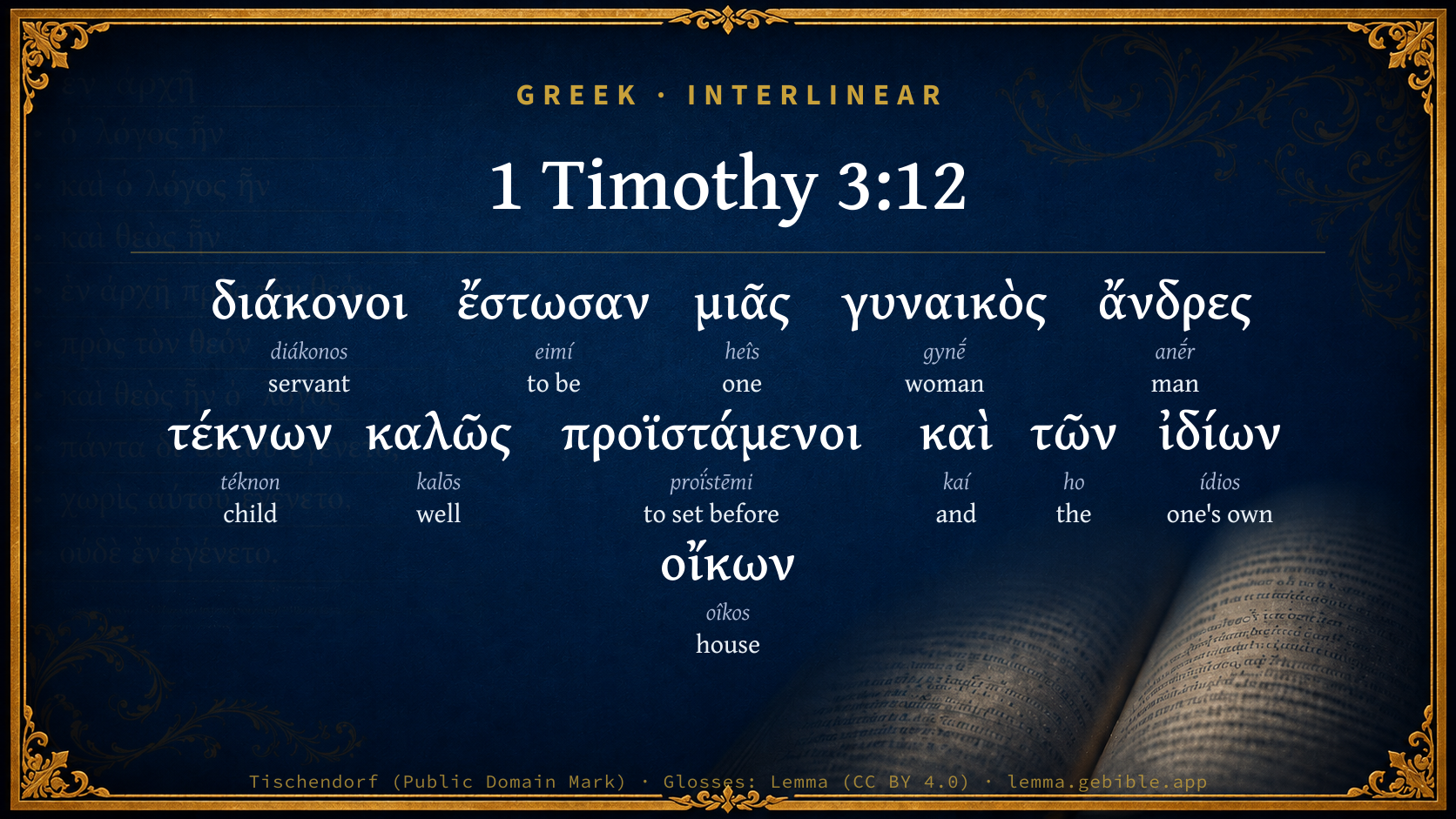
  1. διάκονοι diákonos G1249 “servant” Noun, Nominative, Plural, Masculine
  2. ἔστωσαν eimí G1510 “to be” Verb, Present, Active, Imperative, 3rd person, Plural
  3. μιᾶς heîs G1520 “one” Adjective, Genitive, Singular, Feminine
  4. γυναικὸς gynḗ G1135 “woman” Noun, Genitive, Singular, Feminine
  5. ἄνδρες anḗr G435 “man” Noun, Nominative, Plural, Masculine
  6. τέκνων téknon G5043 “child” Noun, Genitive, Plural, Neuter
  7. καλῶς kalōs G2573 “well” Adverb
  8. καὶ kaí G2532 “and” Conjunction
  9. τῶν ho G3588 “the” Article, Genitive, Plural, Masculine
  10. ἰδίων ídios G2398 “one's own” Adjective, Genitive, Plural, Masculine
  11. οἴκων oîkos G3624 “house” Noun, Genitive, Plural, Masculine

About this verse

These counts appear in no published source. They are computed here, from the morphology-tagged text and Lemma’s own curated glosses. What Lemma adds →

12
words
12
distinct lemmas
Pauline Epistles
section

Notable vocabulary

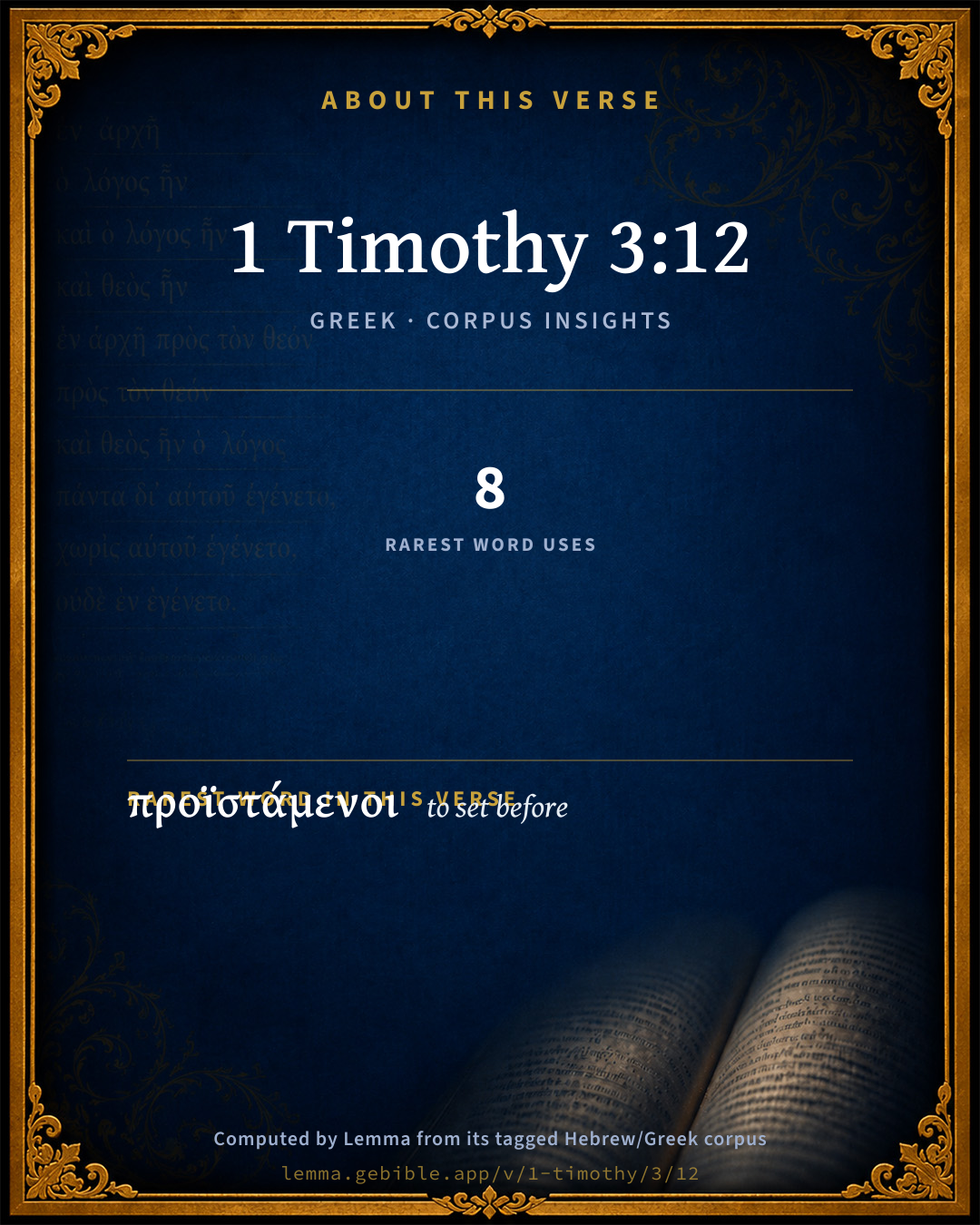
The rarest word here is προϊστάμενοι to set before G4291 — appearing just 8 times in the whole Greek New Testament.

Shared distinctive vocabulary

προϊστάμενοι to set before G4291 occurs in 8 verses of the Greek New Testament. Also found in:

Cross-references

4

Topical passages linked to 1 Timothy 3:12 in the Treasury of Scripture Knowledge — connected by theme and wording, ordered by reader-vote popularity; previews shown in the World English Bible.

  • 1 Timothy 3:2 The overseer therefore must be without reproach, the husband of one wife, temperate, sensible, modest, hospitable, good at teaching;
  • 1 Timothy 3:4–5 one who rules his own house well, having children in subjection with all reverence;
  • Philippians 1:1 Paul and Timothy, servants of Jesus Christ; To all the saints in Christ Jesus who are at Philippi, with the overseers and deacons:
  • 1 Timothy 3:8 Deacons, in the same way, must be reverent, not double-tongued, not addicted to much wine, not greedy for money;

Cross-references courtesy of OpenBible.info (CC BY 4.0).

Commentary

Notes on 1 Timothy 3:12 from classic Christian and Jewish commentators (each source and its license shown beneath its notes). The classic Christian expositions comment on the surrounding passage and are grouped to its opening verse, so a note may address several verses; the Jewish commentaries on the Tanakh (Rashi and others) are per-verse, so they appear only where the commentator wrote on this verse.

Lemma curates 59 commentaries, every one of them public domain or Creative Commons licensed, each selected and text-cleaned for this edition rather than reprinted as found. About our sources →

The Biblical Illustrator

Joseph S. Exell

1Ti_3:12

Husband of one wife.

A negligent father

I was once the guest, says Mr. Moody, of a Christian man, whose children were turning out badly. One night a conversation took place about them; and with tears trickling down his cheek he said, My four eldest sons turned out badly, and I am afraid that the others are following their example. I said: Let us look into this thing. Tell me about your family. How many nights do you go to church? On Sunday night. I am an officer in the church, and I am there on Sunday night. What about Monday? Oh, I am a deacon, and I am at the church on Monday night. What about Tuesday night? I am connected with the city government, and I have to attend committee-meetings of the council. Wednesday night is prayer-meeting, and you go to church? Yes. That is how you are occupied four nights. What do you do the other three? I belong to the Masons. I hold a high office in the lodge, and have to be there. That accounts for five nights. Of course, as you hold a high social position, you are often out at dinner-parties and committees. You go out perhaps one night each week to dinners and committees. It will average all that. Then, I said, there is one more night, that is, Saturday night; what do you do then? Oh, I am superintendent of the Sabbath school, and I lock myself in my room and prepare the lesson for my Bible-class on the following day. You dont let your children into your room then, do you? No; certainly not. Then your children have to get off early in the morning, and they are away from family prayer? Yes; some get off early, and others rise late, and they are not present at morning worship. And you have to get away as early, as possible to your business as soon as I get through worship I am off. What time do you take dinner. At six oclock. You see your children at six. But you are not always prompt. I suppose half-past six, is it not? Yes, that is about the average. And your meetings begin about half past seven; so that you have but little time with your children. What have you done for them? And at that very time he was trying to be made mayor of the city. He dropped his head, and said that he had never thought of it in that light before. There are many just like that. They are giving their time to public affairs, to the utter neglect of their children and their homes.

Evils of polygamy

Titus, brother of Africaner, was the only individual on the station who had two wives, and fearing the influence of example, I have occasionally made a delicate reference to the subject and by degrees could make more direct remarks on the point which was one of the barriers to his happiness; but he remained firm, admitting, at the same time, that a man with two wives was not to be envied, and added, He is often in an uproar, and when they quarrel he does not know whose part to take. He said, he often resolved when there was a great disturbance, he would pay one off. One morning I thought the anticipated day had come. He approached my door leading an ex upon which one of his wives was seated. What is the matter? I inquired. Giving me a shake of his hand, and laughing, he replied, Just the old thing over again. Mynheer must not laugh too much at me, for I am now in for it. The two wives had quarrelled at the outpost, and the one in a rage had thrown a dry rotten stick at the other, which had entered the palm of her hand, and had left a piece about an inch long, and the thickness of a finger. The hand had swollen to nearly four times its usual size. Why I asked, did you not bring her sooner? She was afraid to see you, and would not come till I assured her that you were a maak mensche(a tame man). Having made an incision and extracted the piece of wood, she was melted into tears with gratitude, while I earnestly exhorted her to a better way of life. (Dr. Moffatt.)

Purchase to themselves a good degree.--

The good degree

The words refer, in the first place, to a faithful discharge of the duties attached to the office of the deacon. They that have used the office of a deacon well are they who have laboured in the diaconate with honour to themselves and glory to their Master; for well is the same word used in the latter part of the verse, and translated good--a good degree. It is the specific term for the beautiful in human action, in contrast to the grudging discharge of mere obligation. It implies in the labourer not only diligence and zeal, but also carefulness and purity of motive; and the best use of every power and opportunity that God has entrusted to us--the frank, loving, self-abandoning, self-forgetting discharge of a holy obligation. Such an idea cannot be confined to any special office, and it is not, therefore, the particular work done which is thrown into the front, but the grace shown in the mode of doing it--the beautiful discharge of duty for God, in whatever sphere of the Church it may be, and whatever the exact nature of the duty Which is done. But, further, the words furnish a stimulating motive to this earnest discharge of duty, by setting before the souls desire a certain advantage that is to be secured by it. Here we must carefully put away the idea of buying--that is, of meriting in any way, as if we bargained with God. It has been thought that the word degree refers to ecclesiastical position and church office; but such a meaning would be an appeal to professional selfishness, and would be utterly out of harmony both with the spirit of St. Paul, and with the meaning of his language. We must look much deeper to find the mind of God. A good degree is a degree full of honour, praise, and joy, and such as the soul may covet with all the force of a renewed and sanctified affection. In what consists the good degree, which results from the honourable discharge of duty?

I. It consists in a higher state of spiritual life, a stronger faith, a brighter hope, a more entrancing and captivating love; in short, a larger possession of god, as if the Deity within flung His own grace and glory over the soul in which He dwells. Grace is but the souls health, the restoration of a sin-stricken creature into the full enjoyment for which it was intended. A large measure of grace is, therefore, a high measure of health--and is not health delightful? Is there pleasure in the aching head, in the weary limb, in the scorching fever, or the racking pain, or the feebleness and languor and strange incapacities of sickness and disease? But must not the same thing be true of the soul? Doubts, fears, alarms, conflicts, strange searchings of heart, dim gropings of spirit, and occasional agonies of conscience, and the gnawing aching pain of a self-upbraiding memory, are all the symptoms of spiritual sickness. That the honourable discharge of every duty promotes the health of the soul is clear enough. The more constantly duty is done, the more constantly faith and hope and love are present; and then they grow by exercise till they become the souls habit, its very life, the breath of its being, a part of the living self in the all-pervading presence and power of God. That this high measure of spiritual life is the good degree of the text, is shown by the last words, great boldness in the faith. The literal meaning of the word translated boldness is freedom, frankness, and confidence of speech. It has two relations. One looks toward man when the soul, rich in its own love for Christ, and actually overflowing with icy in the Holy Ghost, pours out to others the fulness of its own affection--not with an effort, but freshly, naturally, spontaneously, as the living spring within the soul itself, the power of the Holy Spirit of God flows forth into utterance. Such a boldness of speech to others about their souls implies a glow and warmth of emotion, a strength of experience, and a power of love such as might fill the soul of an angel. Then there is another meaning of the word. It is used elsewhere for boldness of access to God.

II. But a good degree includes a further idea, and that is a higher state in glory, a place nearer God in the world to come, a more perfect knowledge of Him, and a more entrancing enjoyment of Him for ever and ever. This, we must bear in mind, springs from the other, and is but its completion. God is infinite. His gifts will be boundless as Himself; His gifts of knowledge, of holiness, of strength, of joy and rapture, will be infinite. There is in God no limit whatever. If for all eternity we shall enjoy more and more of God, it will be because the power to enjoy grows by enjoyment as the soul becomes larger and larger with the God who fills it. Grace here increases the capacity for glory hereafter. The more grace, the more glory. (E. Garbett, M. A.)

Faithfulness in an inferior position leads to a higher

Dr. Morrison wrote to his friends in England and asked them to send him out another missionary. A young man from the country came and offered himself. He came to the office of the Missionary Society and was introduced to the gentlemen of the board and had a long talk with them. They then asked him to call again in an hour or two, and they would give him an answer. In talking the matter over after he was gone, they came to the conclusion that this young man would not do to go as the colleague of Dr. Morrison. Finally, they said to Dr. Phillips, one of their members: Doctor, you see the young man and tell him that we do not think him fit to be a missionary; but that if he would like to go out as servant to the missionary we will send him. The doctor did not like much to do this; but he did it. He told the young man just what the board said. Now, many a young man would have been angry on hearing this, and would have said: No, I shall do no such thing. If I cant go out as a missionary, I wont go at all. But this young man did not feel or act so. After hearing what the doctor said, his answer was: Well, sir, if the gentlemen dont think me fit to be a missionary I will go as a servant. I am willing to be a hewer of wood, or a drawer of water, or do anything to help on the cause of my heavenly Master. He was sent out as a servant, but he soon got to be a missionary, and turned out to be the Rev. Dr. Milne, one of the best and greatest missionaries that ever went to any country. (R. Newton, D. D.)

The Biblical Illustrator, edited by Joseph S. Exell (c. 1880s–1900s) — public domain. Text from a community e-Sword module.

Joseph Benson's Commentary

1Ti 3:12-13. Let the deacons — As well as the bishops; be husbands of one wife — That is, such as have shown their temperance by avoiding polygamy and causeless divorce; (see on 1Ti 3:2;) ruling their children, &c. — This qualification, which was required in bishops likewise, shows how anxious the apostle was that all who bore sacred offices should be unblameable in every respect; knowing that the disorderly behaviour of the members of their family might give occasion to suspect that they had been careless of their morals. For they that have used — Have discharged; the office of a deacon well, (see Rom 12:7-8,) purchase to themselves a good degree — Greek, βαθμον, step, namely, toward some higher office; and great boldness — From the testimony of a good conscience; in the faith which is in Christ Jesus — Namely, in professing and teaching it, for even the wicked must respect persons who show so much benevolence and activity in relieving the poor, the afflicted, and the persecuted.

Joseph Benson's Commentary on the Old and New Testaments (1811–1818) — public domain. Text from a community e-Sword module.

Fairbairn on Ezekiel, Jonah & the Pastoral Epistles

Patrick Fairbairn

Ver. 12. The apostle, returning again to the deacons for the purpose of supplementing what he had previously said, adds concerning them: Let the deacons be husbands of one wife, ruling well their children and their own houses; the same qualifications precisely which had been required of the higher officers in respect to family and domestic relations. See at 1Ti 3:4, and Appendix B.

Appendix B—Page 139. On the Meaning of the Expression “Husband of One Wife,” in 1Ti 3:2; 1Ti 3:12, Tit 1:6

The explanation given of this expression, under the first of the passages referred to, restricts the qualification indicated by it to an existing relationship, irrespective of the question whether a previous relationship mayor may not have existed, which had been dissolved by death. It simply required that when one was called to office in the Christian church, there should be but one living woman to whom he stood related as husband. And as the expression of itself does not import more there are various considerations which appear to shut us up to this meaning as the only one that is properly tenable.

1. First of all, let the place be noted which the qualification holds in the apostle’s delineation of fitness for office in the Christian church. In both the epistles (1 Timothy and Titus) it stands second in the list of qualifications for the pastorate,—in each also occurring immediately after the epithet blameless or irreproachable,—as if, among the characteristics of a life free from any palpable stain, the first thing that might be expected to start into notice was, whether the individual stood related in marriage to one person only, or to more than one. Now, supposing this latter alternative had respect merely to the contracting of a second marriage after the death of a first wife, is the qualification one that, in the circumstances, we could imagine to have been so prominently exhibited, and so stringently imposed? Or is it what we have reason to think would have been borne up by the moral sense of the community? Quite the reverse in both respects. The legislation and the practice of Old Testament times were notoriously of a different kind. They went to an extreme, indeed, in the opposite direction; and even our Lord, when correcting that extreme, gave no indication of His purpose to introduce a restriction of the nature in question, or to make monogamy, in this sense, a condition either of office or of sanctity. St. Paul himself had explicitly declared, in his earlier writings, that death dissolved the marriage tie, so as to leave the survivor free to enter into another union, if such might be deemed advisable or expedient (Rom 7:1-3; 1Co 7:8-9). And in the laws and usages of the Greeks and Romans no hindrance was ever known to be put upon men in respect to their use of this freedom; no stigma attached to their doing so, unless it might be in connection with the time and mode of their going about it. Such being the case, is it in the least degree probable, or does it seem to accord with the wisdom we are wont to associate with the apostle (apart altogether from his inspiration), that he should now, for the first time, and in so brief and peremptory a manner, without even a note of explanation, have pronounced more than a single marriage-union absolutely incompatible with the ministerial function?—nay, should have set it in the very front of admitted disqualifications?—and should even have extended the rule to deacons, whose employment was rather about, than in, spiritual things, serving tables, not ministering in word and doctrine? Unquestionably, if such were the import of the apostle’s instruction, a new thing was now introduced into the discipline of God’s house, and introduced in a very extraordinary way. A principle of sanctity was enunciated which was without warrant in any prior legislation or recognised usage; a principle, moreover, which, in contrariety to the whole spirit of the apostle’s writings, must have given to caste distinctions and ascetic notions of excellence a legitimate footing in the church of Christ. In point of fact, when the sense we contend against began to be put upon his words, it did work powerfully both in the ritualistic and the ascetic direction. And if that sense could be established as the natural and proper one, a difficulty of a very formidable kind would be raised against the Pauline authorship of the Pastoral epistles.

2. A second ground of confirmation to the view we advocate is the general concurrence in its favour on the part of the earlier interpreters; and this in spite of a prevalent feeling and usage tending to produce a bias in the contrary direction. Thus Chrysostom: “He (St. Paul) speaks thus, not imposing a law, as if it were not allowed one to become [an episcopos] without this condition [viz. unless he had one wife], but to restrain undue licence (τὴν ἀμετρίαν κωλύων); since among the Jews it was lawful to enter into double marriages, and have two wives at the same time.” (His comment on Tit 1:6, though less explicit, is to the same effect when rightly interpreted. It speaks merely of a double marriage relationship as incompatible with the pastoral office: “chastising the wanton, and not permitting them with a second (or twofold) marriage to assume the governing power,”—οὐκ ἀφεὶς ματὰ δευτέρου γάμου τὴν ἀρχὴν ἐγχειρίζεσθαι,—not after the marriage in question, but with it—standing in the twofold relationship at the same time—guilty of a moral wrong, though practised under the forms of law. See Suicer, under Διγαμία, vol. i. p. 897.) So, too, Theodoret: “Concerning that saying, the husband of one wife, I think certain men have said well. For of old both Greeks and Jews were wont to be married to two, three, and more wives at once. And even now, although the Imperial laws forbid men to marry two wives at one time, they have commerce with concubines and harlots. They have said, therefore, that the holy apostle declared that he who dwells in a becoming manner with a single wife is worthy of being ordained to the episcopate. For, they say, he (that is, Paul) does not reject a second marriage, who has often commanded it to be used.” Then, on the other side: “If he have put away his former wife, and married another, he is worthy of blame and deserving of reprehension; but if force of death has deprived him of his former wife, and nature has prompted him to become united to another, the second marriage is to be attributed, not to choice, but to casualty. Having respect to these and such like things, I accept the interpretation of those who so view the passage.” Theophylact is briefer, but to the same effect: “If he be a husband of one wife; this he said because of the Jews, for to them polygamy was permitted.” Even Jerome, with all his ascetic rigour, speaks favourably of this interpretation (in his notes on the passage in Titus); states that, according to the view of many and worthy divines, it was intended merely to condemn polygamy, and not to exclude from the ministry men who have been twice married. Now, considering the general prevalence of ascetic feeling at the time, and the virtue commonly attached to celibacy as a qualification for the proper discharge of priestly functions, the interpretation thus either expressly put upon the expression under consideration by those fathers, or held at least to be allowable, cannot but seem entitled to the greatest weight. It presents a series of testimonies to what may be fairly called the natural sense of the expression, and to what appeared the just and reasonable nature of the qualification demanded by the apostle, in spite of a strong current of feeling, and a very prevalent usage, tending to incline them in the opposite direction.

3. The commencement and growth of the other view—the view which understands the expression to exclude from the offices of pastor and deacon in the church any one who might have re-married after having lost a wife by death—furnishes an additional argument in favour of our interpretation. For the history of church opinion and practice on the subject puts it beyond a doubt, that the more natural view was abandoned only when a false asceticism began to flow in upon the church, and an ideal of piety unwarranted in Scripture, and at variance with the flesh and blood relations which God has established for men in this life. It is hot till near the end of the second century that the ascetic spirit makes its appearance as a disturbing element in this particular line; and when it does so, the perverting influence discovers itself in respect to the members generally of the Christian church, not specifically to those who were called to discharge any spiritual function. It may be questioned whether the Plea of Athenagoras or The Shepherd of Hermas had, in point of time, precedence of the other. Probably they were nearly contemporaneous; and they are the earliest extant of the Patristic writings which can be referred to on the present subject. Athenagoras is often erroneously adduced as a witness for the other view; for when the passage in his Plea is correctly explained, it has respect to bigamy in the proper sense. “A person (he says) should either remain as he was born, or be content with one marriage; for the second marriage (ὁ δεύτερος γάμος) is only a specious adultery. ‘For whosoever puts away his wife (says He), and marries another, commits adultery,’—neither permitting a man to put her away whose virginity he has made to cease, nor to marry another (οὐδε ἐπιγαμεῖν). For he who deprives himself of his first wife, even though she be dead, is a veiled adulterer, resisting the hand of God” (c. 33). The thought is somewhat loosely expressed, but the reason assigned for the judgment given clearly shows that the second marriage contemplated by the writer is one contracted under the forms of law, after an improper divorce had been effected against a first wife. In such a case a second marriage was justly held to be from the first vitiated—essentially adulterous; and this for all Christians alike, without respect to official distinctions. The passage in The Shepherd is more to the point: “If a wife or husband die, and the widower or widow marry, does he or she commit sin? There is no sin in marrying again, said he; but if they remain unmarried, they gain greater honour and glory from the Lord; yet if they marry, they do not commit sin” (Com. iv. c. 3). This also has respect to the Christian life generally, and makes but a slight advance upon the teaching of Scripture; for there both our Lord and St. Paul speak of the resolution to abstain from marriage as, in certain circumstances, and with a view to more entire devotedness to the service of God, an indication of spiritual excellence beyond what would be exhibited by a different course. Only here the married state is apparently contemplated more apart, as in itself, especially when entered into a second time, incompatible with the higher degrees of honour in the divine kingdom. It was still but an incipient indication of the leaven which had begun to work. A stage further on, and we meet with greatly more marked symptoms of its operation.

This stage had its commencement with the rise of that pretentious Gnosticism which, especially from about the middle of the second century, in the hands of the Encratites (Tatian and Marcion), sought to elevate the tone of Christianity, and raise the ideal of Christian perfection higher than was done by the acknowledged teachers of Christianity. According to this school, true perfection consisted in working one’s self free from the ordinary relations and enjoyments of life: marriage, which formed the common basis of these, was esteemed a kind of service of the devil, utterly at variance with the higher aims of the spiritual life; the “elect “spirits must have nothing to do with it, and must also abstain from the use of flesh and wine, and give themselves to fastings and other kinds of bodily mortification. The real tendency of this Gnostic spiritualism did not quite immediately discover itself; it pressed at various points as a reforming influence into the church; and in some of its more characteristic features it ere long burst forth with great power among the excitable and enthusiastic Christians of Phrygia in the guise of Montanism. Montanus and his followers did not profess, indeed, to stand in any proper affinity to Christians of the Gnostic type; but they so far coincided with them as to aim at introducing a new and higher style of Christianity, and one that partook largely of Gnostic elements. Having received (as they imagined) the fuller afflatus of the Spirit promised by Christ, they had attained to the position of right truly spiritual Christians; were the pneumatics (πνευματικοί), while others, if Christians at all, were but psychical or carnal (ψυχικοί); and, in proof of their nobler elevation, they renounced not only the pleasures and luxuries, but also most of the comforts of life—fasted oft, and rigidly; courted indignities, self-denials, persecutions; disparaged marriage, and stigmatized second marriages as fornication. Though the movement was opposed by all the leading authorities in the church, and the claim to supernatural guidance was on every hand rejected, yet many were impressed by the apparent elevation and moral strength of the party; and the opinion grew, that the more select class of Christians should cultivate the ascetic virtues, and should either remain in cœlibacy, or at most be but once married. The tendency of Christian thought and practice in this direction received a great impulse from Tertullian, who not only imbibed the distinctive principles of Montanism, but threw himself into the advocacy of them with zeal and energy. On the subject of marriage he occupied what he called middle ground—between those (the Encratites) who repudiated marriage altogether, as a thing inherently evil, and the Psychical party, who maintained the lawfulness of the married state, even when entered into anew after the death of a previous wife. He contended for the absolute singleness of the marriage union, pressing all sorts of considerations into his argument; such as that the first Adam had but one spouse (Eve), the second also but one (the church); that death does not entirely destroy the union of married parties, since the soul still lives, in which the more vital seat of the union resides; that at the resurrection, though there shall be no more marrying, but an angelic state of being, yet those who have been married on earth shall recognise each other as such, etc. (De Monog., and Ad Uxorem, L. i.). By considerations like these, Tertullian reaches the conclusion that in no case is more than a single marriage allowable for a Christian, while the state of cœlibacy is to be preferred as one of higher sanctity. He admits that in 1Co 7:39 the apostle grants liberty of re-marrying to those who had been deprived of a spouse by death, if only they married in the Lord; but he thinks this had respect to such merely as had been first married in heathenism, so that their union was no marriage in the Christian sense. He also admits that the principle laid down at the beginning of Romans 7 as to death severing the marriage tie, and leaving the survivor free to marry again without being guilty of adultery, is at variance with the view maintained and advocated by him; but finds his escape in the new revelation of Montanism, that as Christ had taken away the liberty which Moses allowed to the Israelites because of the hardness of their hearts, so the Paraclete now takes away what Christ and Paul allowed on account of the infirmity of the flesh, in order that the original ideal of marriage might be restored. So that he concludes second marriages are contrary to the will of Christ—not lawful—next thing to adultery (juxia adulterium; De Monog. c. xi.-xv.).

In the course of this strange piece of argumentation, the passages 1Ti 3:2, Tit 1:6, are naturally brought into consideration, and the expression husband of one wife is held, without question, to denote a person only once married: those who married a second time are termed digami, bigamists—the first time that such an explanation, followed by such an application of the term, occurs in any Christian writing. (The word is found in Justin’s Apology, c. i. 15, but in the usual sense of separating from one wife and marrying another.) Tertullian’s argument from the passages is this: The apostle requires of those who hold clerical functions in the church, that they be no more than once married; but this cannot be confined to them, no more than any of the other moral qualifications mentioned in the same connection: if the rest are common to them with believers generally, why should not this also? Or if the clergy alone have to do with this, then they, too, alone must be subject to the discipline of the rest. And is it not the doctrine of Scripture, that all genuine believers are of priestly rank, having one and the same spiritual standing, the same high and holy calling, with official distinctions only for orderly administrations? Here, undoubtedly, Tertullian got hold of a right principle, though he utterly misapplied it; for it is against the fundamental principles of the gospel (as already indicated) to have class distinctions as to moral attainments—to set up one type of purity or holiness for the pastor, and another for the flock. And it betrayed a departure from the simple faith and true spirit of Christianity when the authorities in the church began, as they did about or shortly after Tertullian’s time, to hold that it was allowable for common believers, but not for Christian ministers, to enter a second time into a marriage relationship. This was really to change the constitution of Christ’s spiritual kingdom.

The influence of Tertullian’s writings on this subject, as on many others, operated far and wide throughout the church, though he failed to carry the formal sanction of his views. In various quarters, second marriages, even among the laity, came to be viewed with disfavour, and were occasionally subjected to a measure of disciplinary treatment. Thus, in one of the canons of the provincial synod of Neo-Caesarea (A.D. 314), priests are forbidden to countenance the festivities of second marriages by their presence, “since the bigamus needed penitence.” (Thus early did the ecclesiastical use of the word bigamus become distinguished from the civil, in which it always denotes one married to two spouses still living.) The Council of Nicæa sought to interpose a check on this foolish restriction, and required (in its 8th canon) that the cathari, or purists, on being received into the church, should formally consent to communicate with such as had been married a second time. Yet a provincial council at Laodicea, held about a quarter of a century later (A.D. 352), ordained, in its very first canon, that persons legally marrying a second time should be received into communion only after fasting and prayer, and juxta indidgentiam. The general sense of the church, however, successfully withstood the ascetic tendency in this form of its manifestation; but only that it might be made to concentrate itself upon the select class of the priesthood, in respect to whom the feeling continued to grow that the normal condition was one of entire separation from married life, and that disqualification for clerical ministrations was consequent on a second marriage, especially if the second had been entered into after baptism. A rule to this effect is laid down in the so-called Apostolical Canons, which, though bearing a false title, undoubtedly expressed the general mind of the church about the close of the fourth century. They ordained, among other grounds of exception, that no one who had become involved in second marriages after baptism, or who had married a widow (this being also on one side a second marriage), could be admitted to any grade of priestly standing (Can. 17, 18). In like manner Ambrose, while distinctly asserting that the -apostolic precepts do not condemn second marriages (De Vid. c. 2, § 10), yet maintains that they were rightly held to be inconsistent with priestly functions (according to the prescription in 1Ti 3:2), and for this among other reasons, that there should not be one rule for the clergy and the people; that the former, as they stood on a higher spiritual eminence, should be held bound to a more perfect mode of life (Ep. ad Vercell. Ecclesiam, § 62-64. To the same effect also Innocent of Rome, De Cr. 13; and Epiphanius, Haer. 48).

Yet, with all this countenance from some of the more prominent authorities of the church, and the steady growth of public sentiment in the same direction, the practice in many places but slowly conformed to what the ascetic spirit, in this alliance with caste distinctions and ritualistic services, demanded as right and proper. Theodoret (whose comment on St. Paul’s expression was formerly given) mentions, in a letter to Domnus of Antioch (Ep. 110), that he had ordained one Irenaeus, though he had entered into marriage a second time; and that in doing so he had but “followed the footsteps of those who had gone before him.” He refers also to various examples of the same kind. And the frequency of the practice, coupled with the impropriety, or rather the palpable indecency, of the church’s commonly recognised procedure in excluding from sacred ministrations those who had lawfully entered into wedlock a second time, while persons guilty of concubinage and the grossest immoralities were freely admitted, is denounced by Jerome, in his own peculiar style, when commenting on a case of the former description in his letter to Oceanus. “I wonder,” says Jerome to his correspondent, “that you should think of dragging forth one bishop as having transgressed the apostolic rule, since the whole world is full of these ordinations: I don’t mean of presbyters, or those of inferior grade, but I come to bishops, of whom I could unroll such a list as would exceed in number the members of the synod of Ariminum.” He then refers to a disputation he had with an eloquent man at Rome on the subject, whose syllogistic reasoning he met by a counter reasoning of the same kind; and then he adds: “It is a new thing I hear, that what was not sin shall be reckoned for sin. All sorts of prostitutions, and the filth of public abominations, impiety towards God, acts of parricide, of incest, etc., are purged away in the font of Christ. Shall the stains of a wife still inhere, and brothels be preferred to the marriage-bed? I do not cast up to you troops of harlots, lots of catamites, shedding of blood, and swinish indulgences at every feast; and you bring up to me from the sepulchre a wife long since dead, whom I received lest I should do what you have done! Let the Gentiles hear it; let the catechumens, who are candidates for the faith, lest they marry wives before baptism, lest they enter into honourable matrimony, but may have wives and children in common—nay, may shun the term wife in every form, lest, after they have believed in Christ, it shall prove to their detriment that they had wives, and not concubines or harlots.”

Such were the factitious distinctions and the mischievous results which grew out of this unscriptural mode of teaching which the church received mainly at the hands of Tertullian, after he had assumed the heretical position of a Montanist. The view ultimately became associated nearly as much with false notions of the ministry and of the sacraments, as with unwarranted restrictions regarding marriage. And as the development in that direction could not be deemed otherwise than natural, if the principle had been sound on which it proceeded,—that a species of sanctity incompatible with second marriages was required of pastors and deacons which is not required of believers generally,—the development itself may fairly be regarded as a proof of the unsoundness of the principle. Doctrinally, it was wrong; but in a practical respect also, the view could not fail to be accompanied with serious embarrassment or trouble of a domestic kind. Pastors bereaved by death of their wives, and without any female relative to supply the blank, would often find it impossible to have their children properly cared for, and their households ruled well (according to apostolic precept), except by entering anew into married life. And to interdict this would necessarily have forced on them the painful alternative of either perilling the moral well-being of their family, or, to avoid that, renouncing their position as ministers of God’s word.

4. There remains still another line of reflection to strengthen the interpretation given—this, namely, that in addition to the objections which have been urged against understanding the expression of absolute monogamy, the other view affords a perfectly good and appropriate meaning. Recent interpreters have sometimes denied this, and laid considerable stress on the opposite allegation. Thus Alford: “The apostle would hardly have specified that as a requisite for the episcopate or presbyterate which we know to have been fulfilled by all Christians whatever; no instance being adduced of polygamy being practised in the Christian church, and no exhortation to abstain from it.” If this were anything like a fair and full representation of the matter, it would be hard to account for so many of the early interpreters (conversant, as they were, with the circumstances of the time) taking the other view of the passage, and thinking that, as matters then stood alike among the Jews and Gentiles, ample grounds existed for insisting on monogamy in the ordinary sense—monogamy in contradistinction simply to polygamy and divorce—as a qualification for office in the church. A certain proportion of its membership consisted of converts from Judaism; and though divorce, perhaps, on insufficient grounds, and subsequent marriage, or the undisguised practice of polygamy, might not be very common in the gospel age among the Jews, yet there is not wanting evidence to show that usages of that description did exist, and continued for ages after the Christian era, Justin Martyr charges it as matter of just reproach against the teachers of the Jewish people, that even till now they permitted each man to have four or five wives (Tryphio, c. 134). And in the year A.D. 393 a law was passed by Theodosius, enjoining that “none of the Jews should retain their own custom in marriage, nor enter into diverse marriage relationships at one time” (nec in diversa sub uno tempore conjugia conveniat),—a law which is not likely to have been enacted without adequate reasons for it, and still less to have been re-enacted, as it was by Justinian a century and a half later. It will readily be understood, that if persons, who in their unchristian state had become entangled in such double or treble marriage relationships, might be admitted, on their conversion, to the communion of the church, they should still not be entrusted with the spiritual administration of its affairs: there was a flaw in their condition which unfitted them for being unexceptionable guides and overseers of the flock. It is notorious, also, that among the Greeks and Romans, although polygamy was not formally sanctioned, yet it virtually prevailed—prevailed under the connivance or sanction of law; and that the most deplorable and wide-spread laxity in this respect existed, both previous to the apostolic age and for long after it. In the later stages of the Republic, with the influx of wealth and luxury, a fearful degeneracy of manners made way among the higher classes of society; many shunned the restraints of marriage, and with those who entered into the bond it was often little more than a temporary contract. Divorce was so common, that “public opinion ceased to frown on it; it could be initiated by husband or wife with almost equal freedom: there was a ready consent of both parties to the separation, in the prospect of marrying again; and this facility was open to all classes who could contract marriage.” (Dr. Thos. D. Woolsey On Divorce and Divorce Legislation, p. 41.) It was even open to them to do it without any legal process; for, as another authority on the subject tells us, “among the Romans divorce did not require the sentence of a judge; no judicial proceedings were necessary. It was considered a private act, though some distinct notice or declaration of intention was usual.” (Lord Mackenzie On Roman Law, part i. c. 6.)

This great social evil, instead of abating, grew with the introduction of the Empire, and received a powerful stimulus from the scandalous excesses of persons in high places. The two first Cæsars set here an example which was only too closely followed by many of their successors and underlings. Female manners became so loose, that no woman (Seneca could say) “was now ashamed of divorce; and illustrious and noble ladies counted their years, not by the number of consuls, but by the number of their husbands.” Hence also the bitter sarcasm of Juvenal:

Sic fiunt octo mariti

Quinque per autumnos.—vi. 229.

The influence of such a state of things at headquarters must have told disastrously throughout the empire. The States of Greece are known to have been lax enough even before such an influence began to work upon them; there was little of a high moral tone in the relations of domestic life. Along with marriage, the practice of concubinage was everywhere tolerated, and actions of divorce were effected by common consent, and on the weakest grounds. Even in Sparta, which was probably the least licentious State of Greece, what a light is thrown on the prevailing sentiments and habits of the people by such a fact as this: “To bring together the finest couples was regarded by the citizens as desirable, and by the lawgiver as a duty. There were even some married women who were recognised mistresses of two houses, and mothers of two distinct families,—a sort of bigamy strictly forbidden to the men, and never permitted except in the remarkable case of King Anaxandrides, when the royal Herakleidan line of Eurystheus was in danger of becoming extinct.” (Grote’s History, vol. ii. p. 520.) But without going further into detail, there can be no doubt that corruption in this particular line held its course generally throughout the Roman Empire for centuries after the Christian era, only partially checked by the introduction of the Christian element; so partially, indeed, that “divorce ex communi consensu kept its ground all the way down to Justinian” (Woolsey, p. 101). The legislative attempt of Constantine to grant liberty of divorce only on the proof of such heinous crimes as poisoning and adultery, failed from the impossibility of carrying it into effect. It had to be first relaxed, and by Honorius was almost abrogated. “A Christian writer, at the beginning of the fifth century, complains that men changed their wives as quickly as their clothes, and that marriage chambers were set up as easily as booths in a market. At a later period still, when Justinian attempted to prohibit all divorces except those on account of chastity, he was obliged to relax the law on account of the fearful crimes, the plots and poisonings, and other evils, which it introduced into domestic life.” (Milman’s History of Christianity, vol. iii. p. 290.)

Taking, then, all the known circumstances of the time into account, we see only too ample reason for such a qualification as that specified by the apostle for pastors and deacons—if by that qualification is understood simply fidelity to the marriage vow, or relationship to no more than one living woman as a spouse. The question was not (as put by Alford) whether, after being received into the Christian church, a looser practice might be held compatible with Christian obligations,—a wife and a concubine, or two wives at a time,—but whether those who had in these respects followed the too common practice of the world, should, on becoming Christians, be admitted to office in the church. Had they been so, the church might have seemed to take too light a view of the prevailing immorality; embarrassing complications also might have arisen for the parties themselves in the discharge of duty; so that the part of Christian wisdom with the church evidently was to stand entirely clear, in her administrative capacity, from having any participation in the abounding corruption. It is the very course which missionaries of the gospel are obliged in heathen lands to pursue still. They can often receive parties into church fellowship, because apparently sincere in the profession of the faith, whom yet, on account of essentially adulterous connections contracted in their heathenish state, they have felt it necessary to exclude from positions of honour, especially from functions of government in the church. (The comment of Conybeare and Howson on the passage under consideration, though brief, is in perfect accordance with the view we have given. “The true interpretation seems to be as follows: In the corrupt facility of divorce allowed both by Greek and Roman law, it was very common for man and wife to separate, and marry other parties during the life of one another. Thus, a man might have three or four living wives. An example of the operation of a similar code is unhappily to be found in our own colony of Mauritius. There the French revolutionary law of divorce has been suffered by the English Government to remain unrepealed; and it is not uncommon to meet in society three or four women who have all been the wives of the same man, and three or four men who have all been the husbands of the same woman. We believe it is this kind of successive polygamy, rather than simultaneous polygamy, which is here spoken of as disqualifying for the presbyterate.”)

It has been thought by some Protestant writers (by Vitringa, for example, Synag. Vet. P. i. c. 4; also by Ellicott, Alford, and some others), that the corrupt state of matters prevailing at the time may have induced the apostle to lay down the rule of absolute monogamy for rulers in the church—to provide a more efficient check against the evil —but that, as the same motive no longer operates now, the rule is fitly regarded as having had only a temporary significance, and as no longer in force. This, however, is a quite arbitrary supposition. The qualification, as given by the apostle, is coupled with no temporal limitation. It stands, in that respect, on the same footing as the other prescriptions—alike valid, apparently, for all times. Besides, the extremely lax state of morals then prevalent, while it undoubtedly called the church, especially in its official representatives, to be examples of a truly chaste and becoming behaviour, could never have justified the application of tests which went beyond the requirements of God’s law and the dictates of sound reason; for this would have been to make one evil the occasion of opening the door to another. It would have been an attempt, as the ascetic discipline in every form is, to improve upon God’s institutions by setting up a higher ideal of purity than is proper to them, and which always ends in bringing on worse evils than those it seeks to correct. In the form now under consideration, it would have given apostolic sanction to false views of marriage, and, against the whole spirit of the gospel, would have formally authorized gradations of sanctity in the membership of the church—a lower that might have sufficed for common believers; and another and higher, as not only proper, but indispensable, for those who should be called to bear rule in the congregation. A distinction certainly not of apostolic origin, and the fruitful parent, when originated, of grievous errors and perversions!

Special stress is laid, in this connection, by the writers in question on the corresponding qualification prescribed for widows, who were to be admitted to the kindly oversight and benefactions of the church: these were, among other moral characteristics, to be known as having each been the wife of one man, 1Ti 5:9, How, it is asked, could this be understood otherwise than as descriptive of a woman who had been only once married? And if such is the kind of oneness indicated in this case, how can it justly be regarded as different in the other? The facts already stated, however, show that the necessity supposed for so understanding the expression in the woman’s case by no means existed; and the very circumstance of a qualification of this sort being necessary to entitle a poor widow to become merely the recipient of the church’s charity, may surely be regarded as no mean evidence that the qualification in both cases could have involved nothing of an ascetic nature—could .have required only what is due to the claims of decency, and is in accordance with the essential nature and design of marriage. But this is shown more fully in the annotations on 1Ti 5:9.

Patrick Fairbairn — An Exposition of Ezekiel (1851), Jonah (1849), and The Pastoral Epistles (1874) — public domain. Text from a community e-Sword module.

Meyer's Critical & Exegetical Commentary

Heinrich August Wilhelm Meyer

1Ti_3:12. The apostle returns to the deacons, and gives regarding their domestic life the same instructions as he gave in 1Ti_3:2-4 in regard to the bishops.

Meyer — Critical and Exegetical Commentary on the New Testament — English translation by Peter Christie, edited by Frederick Crombie (T&T Clark, 1880) — public domain. Text from a community e-Sword module.

Expositor's Greek Testament

ed. W. Robertson Nicoll

1Ti 3:12 . As the episcopi were naturally drawn from the ranks of the deacons, the diaconate was a probation time, in the course of which the personal moral qualifications for the ἐπισκοπή might be acquired. See notes on 1Ti 3:2 ; 1Ti 3:4 .

The Expositor's Greek Testament, edited by W. Robertson Nicoll (1897–1910) — public domain. Text from a community e-Sword module.

Geneva Bible (1599)

Geneva Bible translators

They that have more wives than one at one time, must neither be called to be ministers, nor to be Deacons.

Geneva Bible (1599) marginal notes — public domain. Text via Bolls.life.

Jamieson, Fausset & Brown

Robert Jamieson, A. R. Fausset & David Brown

husbands of one wife--(See on Ti1 3:2).

ruling their children--There is no article in the Greek, "ruling children"; implying that he regarded the having children to rule as a qualification (Ti1 3:4; Tit 1:6).

their own houses--as distinguished from "the Church of God" (see on Ti1 3:5). In the case of the deacons, as in that of the bishops, he mentions the first condition of receiving office, rather than the special qualifications for its discharge. The practical side of Christianity is the one most dwelt on in the Pastoral Epistles, in opposition to the heretical teachers; moreover, as the miraculous gifts began to be withdrawn, the safest criterion of efficiency would be the previous moral character of the candidate, the disposition and talent for the office being presupposed. So in Act 6:3, a similar criterion was applied, "Look ye out among you seven men of honest report." Less stress is laid on personal dignity in the case of the deacon than in that of the bishop (compare Notes, see on Ti1 3:2-3).

Jamieson, Fausset & Brown — Commentary Critical and Explanatory on the Whole Bible (1871) — public domain (CC PDM 1.0). Text via the HelloAO Bible API.

Adam Clarke's Commentary

Verse 12. Let the deacons be the husbands of one wife] This is the same that is required of the bishops. See notes on 1Ti 3:2; "1Ti 3:4"; and "1Ti 3:5".

Adam Clarke's Commentary on the Bible (1810–1826) — public domain. Text from a community e-Sword/MySword module.

John Calvin's Commentaries

Let the deacons be Since he mentioned wives, he lays down the same injunction about deacons as he had formerly down about bishops; namely, that each of them — satisfied within having but one wife — shall set an example of a chaste and honorable father of a family, and shall keep his children and his whole house under holy discipline. And this refutes the error of those who understand this passage as referring to domestic servants.

John Calvin's Commentaries (1540-1563) — public domain. Text from the Calvin Translation Society English edition (1840s-50s) via the Christian Classics Ethereal Library (ccel.org). Calvin's coverage is partial (roughly two-thirds of the Bible); uncommented books and verses are honest gaps, never fabricated. The 19th-century editor's footnotes and remarks are omitted so the notes are faithfully Calvin's own voice.

Ellicott's Commentary for English Readers

(12) Let the deacons be the husbands of one wife.—Here the exact same qualification is to be sought for as in the higher grade of presbyter. The same orderly and decorous household is required now in the case of the deacon, as was to be looked for as qualification for the presiding elder. St. Paul knew well that in the wise yet tender father, Timothy would find the firm yet generous distributor of the Church’s alms, the loving and devoted friend of the poor sick.

A Bible Commentary for English Readers, edited by Charles John Ellicott (1878–1897) — public domain. Text from a community e-Sword module.

The Cambridge Bible for Schools and Colleges

gen. ed. J. J. S. Perowne

12. ruling their children] The sentence gives compendiously the same requirements as to domestic relationships for deacons as for presbyters; the briefer form of the latter clause favours the interpreting ‘all gravity’ above of the children rather than the father.

The Cambridge Bible for Schools and Colleges (gen. ed. J. J. S. Perowne; Cambridge University Press, 1878–1918) — public domain. Text from a community e-Sword module.

John Gill's Exposition

Let the deacons be the husbands of one wife,.... See Gill on Ti1 3:2.

ruling their children and their own houses well. These qualifications are the same with those of the bishop or elder; See Gill on Ti1 3:4.

John Gill's Exposition of the Whole Bible (1746–1763) — public domain (CC PDM 1.0). Text via the HelloAO Bible API.

Trapp's Complete Commentary

John Trapp

12 Let the deacons be the husbands of one wife, ruling their children and their own houses well.

Ver. 12. Husbands of one wife, &c.] {See Trapp on "1Ti 3:2"} {See Trapp on "1Ti 3:4"}

John Trapp, A Commentary or Exposition upon All the Books of the Old and New Testament (1647–1656) — public domain. Text from a community e-Sword module.

Albert Barnes' Notes on the Bible

Let the deacons be the husbands of one wife - notes, 1Ti 3:2.

Ruling their children and their own houses well - notes, 1Ti 3:4-5.

Albert Barnes' Notes on the Bible (1834–1885) — public domain. Text from a community e-Sword/MySword module.

Matthew Poole's English Annotations

See the sense of these words, 1Ti 3:2,4, being the qualifications also of a bishop.

Matthew Poole's English Annotations on the Holy Bible (1683–1685) — public domain. Text from a community e-Sword/MySword module.

Whedon's Commentary on the Bible

Daniel D. Whedon

12. Briefly reiterating for the deacons some of the qualifications required above for the elders.

Daniel D. Whedon (gen. ed.), Commentary on the Old and New Testaments (1874–1909) — public domain. Text from a community e-Sword module.

The Pulpit Commentary

Deacons for the deacons, A.V; husbands for the husbands, A.V Husbands of one wife (see above, ver. 2, note). Ruling, etc. (proidtamenoi); literally, being at the head of, presiding over (see ver. 4, note). In Rom_12:8 and skopov 1Th_5:12 it is applied to the spiritual ruler, the ejpi or presbuterov of the Church. Elsewhere only in the pastoral Epistles. (above, vers. 4 and 5; 1Ti_5:17; Tit_3:8, Tit_3:14) Their own houses (above, ver. 5). "Their own" is in contrast to" Gods house.

Vers. 12, 13.

The domestic duty of deacons.

The apostle here returns to add some further injunctions about deacons, as well as to suggest a reason for exacting the qualifications already described.

I THE DEACONS" DOMESTIC RELATIONS.

1. "Let the deacons be the husbands of one wife." The same qualification is needed for deacons as for bishops, for their houses were to be examples of purity, peace, and orderliness.

2. "Ruling their children and their own houses well." The father of a loving household would be best fitted for the sympathetic administration of funds allocated to the poor, while the pious order of his family would enhance the public confidence in the reality of his religious character.

II REASON FOR THE VARIOUS QUALIFICATIONS DESCRIBED. "For those who have done the work of a deacon well obtain for themselves a good degree, and much boldness in the faith which is in Christ Jesus.

1. The good degree does not refer to promotion to higher ecclesiastical office. The idea, indeed, would be quite an anachronism.

2. It refers to the place of honor and distinction that will be given to the faithful deacon in the day of final recompense. The doctrine of rewards is that of Scripture, and especially of our Lord"s parables. (Luk_19:11-27)

3. There is the further idea of the joyful confidence toward God which would characterize him in view of a faithful discharge of his duties a confidence springing out of faith resting in Jesus Christ. T.C.

The Pulpit Commentary (1880–1919), ed. H.D.M. Spence-Jones & Joseph S. Exell — public domain. Text from a community e-Sword module.

Burkitt's Expository Notes on the New Testament

William Burkitt

That is, "Let not any such be admitted deacon who has more wives than one, or that hath injuriously put away one, and married to another; and let them show by the good government of their own children and household, that they are fit to govern the church of God."

Note here, That the higher officers of the church were usually chosen out of the inferior; and accordingly, the qualifications for both offices, namely, that of bishops and deacons, are for the greatest part the same, both in this epistle and in that to Titus.

William Burkitt's Expository Notes on the New Testament (1700–1703) — public domain. Text from a community e-Sword module.

The People's New Testament

B. W. Johnson

12, 13. Let the deacons be the husbands of one wife. The same word is used in the Greek here for wife that is used in verse 11. See notes on “one wife” under verse 2. Ruling their children. See notes on verses 4 and 5.

B. W. Johnson's The People's New Testament with Notes (1889–1891) — public domain. Electronic text from the Christian Classics Ethereal Library (CCEL) ThML edition.

Cambridge Greek Testament for Schools and Colleges

12, 13. THE QUALIFICATIONS OF DEACONS (continued)

12. The injunctions of this verse are identical with those laid down before in the case of ἐπίσκοποι; see the notes on 1Ti 3:2-3. If a man’s family is disorderly, it constitutes a presumption that there has been something amiss in the methods by which he has governed and ordered his household. It will be remembered that in our Ordinal stress is laid on the due ordering of the family and the home; and candidates for the orders of deacon and priest engage ‘to frame and fashion their own lives and the lives of [their] families, according to the doctrine of Christ.’

Cambridge Greek Testament for Schools and Colleges (Cambridge University Press, 1896; 21 vols, various authors incl. Carr, Maclear, Plummer, Farrar, Lumby, Moule, M. R. James, Simcox) — public domain. Text from a community e-Sword module.

Alford’s Greek Testament

Henry Alford

12.] General directions respecting those in the diaconate (of both sexes, the female being included in the male, see Chrys. cited above), with regard to their domestic condition and duties, as above (verses 4, 5) respecting the episcopate. Let the deacons be husbands of one wife (see on this above, ver. 2), ruling well over children (the emphatic position of the anarthrous τέκνα, as above ver. 4, makes it probable that the having children to rule is to be considered as a qualification. sec Tit 1:6, note. Chrys. gives a curious and characteristic reason for the precept: πανταχοῦ τίθησι τὴν τῶν τέκνων προστασίαν, ἵνα μὴ ἀπὸ τούτου οἱ λοιποὶ σκανδαλίζωνται) and their own houses.

Henry Alford, The Greek Testament (1849–1861) — public domain. Text from a community e-Sword module.

International Critical Commentary

12. διάκονοι] The writer returns to deacons from a new point of view, as men who may become ἐπίκοποι: so in addition to what they needed as deacons they must have the two external relations—to wife and children—which were required in the ἐπίσκοπος.

International Critical Commentary — older volumes (1896–1929), various authors — public domain. Text from a community e-Sword module.

Lesson kit

Teaching starters — assembled from the data on this page, not authored interpretation. Every prompt links to the verse data it draws on. Edit before teaching.

1 Timothy, in the Pauline Epistles, opens this verse with 12 words (12 distinct Greek lemmas). Its most distinctive word is proḯstēmi (“to set before”). A historical commentator’s framing appears above. Read the whole chapter for the surrounding context.

Discussion questions

  1. The word proḯstēmi carries the sense “to set before.” How does it shape the verse?
  2. How does Romans 12:8, which shares the word «to set before», read alongside this verse?
  3. The translations on this page render this verse differently — a whole-verse word diff, not a word-by-word alignment. What might account for the different wordings?
  4. Compare how The Biblical Illustrator and Joseph Benson's Commentary read this verse. Where do they agree or differ?

Things to notice

Reading settings

Reading text

Shown beneath each verse's original-language words.

Old Testament
Old Testament edition

Read the OT as the Masoretic Hebrew (MT) or the Greek Septuagint (LXX).

English shown for the Greek Septuagint (in the Hebrew ↔ Greek comparison).

Comparing translations? Open the Compare panel on any verse page to stack up to four side by side.