1 Timothy 2:14

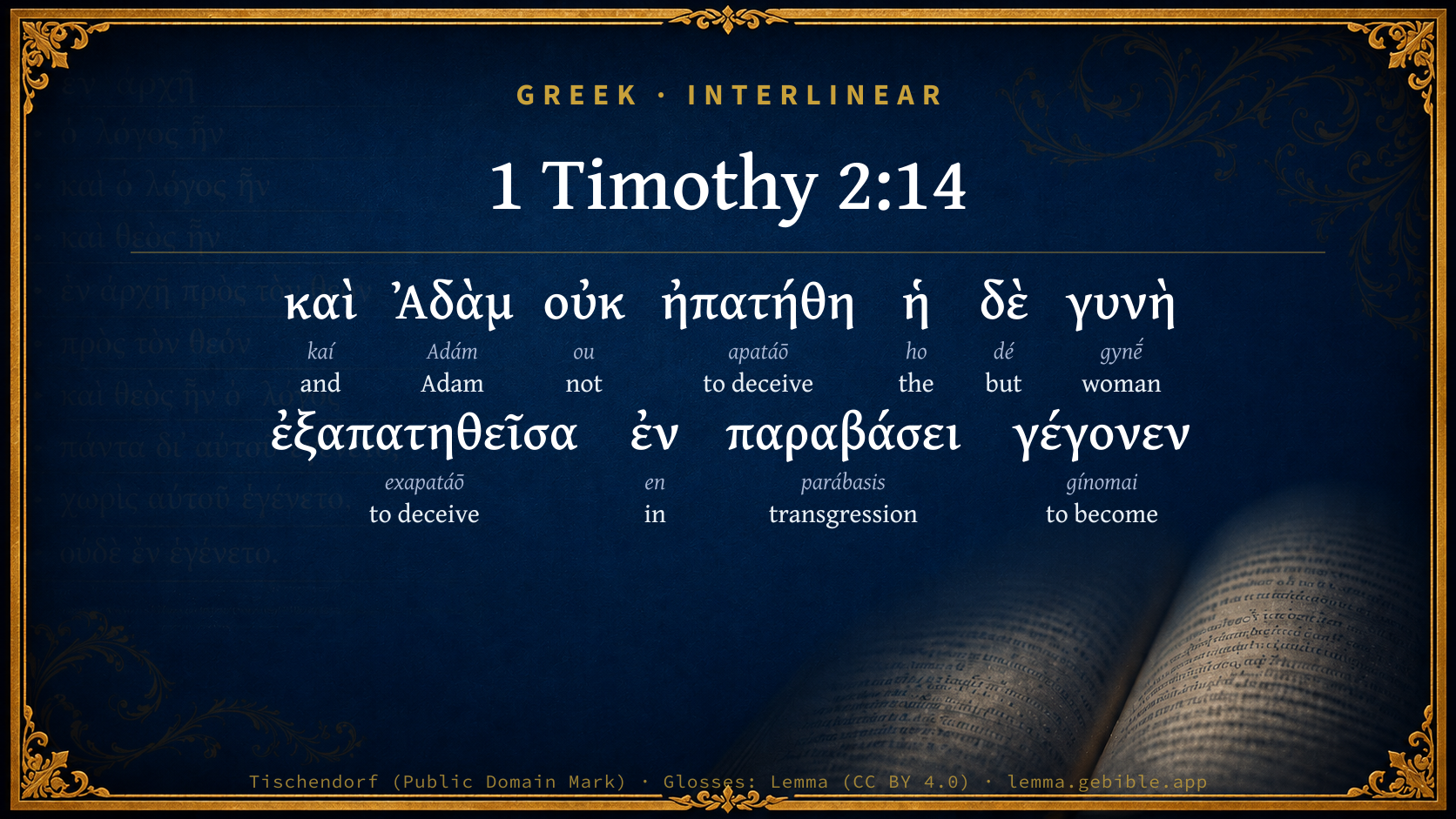
Greek (Tischendorf 8th ed.) 1 Timothy 2:14 appears in the Greek New Testament. The text above is from the Tischendorf 8th edition. Each word links to its Strong’s number and a concise gloss. Click any word for its full Thayer’s Greek Lexicon entry.
Download image
Cite this verse

1 Timothy 2:14 (World English Bible). Public Domain. Lemma interlinear Bible study tool, https://lemma.gebible.app/v/1-timothy/2/14.

Show BibTeX & RIS
BibTeX
RIS
English Translation
Adam wasn't deceived, but the woman, being deceived, has fallen into disobedience;
World English Bible · Public Domain
Download a study sheet

One document with this verse’s original text, its word-by-word gloss line, the meaning frame, cross-references with their text, attributed commentary, and full source and license credits — printable, and it pastes into notes with its structure intact.

This verse Autodidact and up

Study sheet (.html) Plain text (.txt)

A passage Seminary Student

Up to 50 verses in one chapter. A passage sheet keeps up to 6 commentary sources and 12 cross-references per verse, in the order this page ranks them, and says so on the sheet whenever that leaves anything out. Ask for a single verse and you get the Autodidact verse sheet above.

Everything on this page stays free to read, with no account — the sheet is a download of what is already on screen, not access to it.

Want to remove ads? Support Godless Engineer
Compare translations 3

The same verse in 3 English versions, stacked beneath the original-language interlinear above. Click any original word for its lexicon entry.

Each is an independent rendering of the whole verse — the interlinear is not word-aligned to these translations.

Highlighted words mark where these versions differ — a whole-verse word diff, not a word-by-word alignment.

  • World English Bible Public Domain
    Adam wasn't deceived, but the woman, being deceived, has fallen into disobedience;
  • King James Version Public Domain
    And Adam was not deceived, but the woman being deceived was in the transgression.
  • unfoldingWord Literal Text CC BY-SA 4.0
    and Adam was not deceived, but the woman, having been deceived, came into transgression.

unfoldingWord Literal Text — © unfoldingWord, licensed CC BY-SA 4.0. Word-aligned USFM3 via Door43 (git.door43.org/unfoldingWord/en_ult).

Versions to compare (up to 4)

3 of 4 selected

Show all 19 translations

Every available English version of this verse, each an independent rendering of the whole verse.

  • World English Bible Public Domain
    Adam wasn't deceived, but the woman, being deceived, has fallen into disobedience;
  • Berean Standard Bible Public Domain
    And it was not Adam who was deceived, but the woman who was deceived and fell into transgression.
  • Majority Standard Bible Public Domain
    And it was not Adam who was deceived, but the woman who was deceived and fell into transgression.
  • King James Version Public Domain
    And Adam was not deceived, but the woman being deceived was in the transgression.
  • American Standard Version (1901) Public Domain
    and Adam was not beguiled, but the woman being beguiled hath fallen into transgression:
  • Revised Version (1885) Public Domain
    and Adam was not beguiled, but the woman being beguiled hath fallen into transgression:
  • Geneva Bible (1599) Public Domain
    And Adam was not deceiued, but the woman was deceiued, and was in the transgression.
  • Douay-Rheims (1899) Public Domain
    And Adam was not seduced; but the woman being seduced, was in the transgression.
  • Young's Literal Translation Public Domain
    and Adam was not deceived, but the woman, having been deceived, into transgression came,
  • Literal Standard Version CC BY-SA 4.0
    and Adam was not deceived, but the woman, having been deceived, came into transgression,
  • Unlocked Literal Bible CC BY-SA 4.0
    Adam was not deceived, but the woman was deceived and became a transgressor.
  • unfoldingWord Literal Text CC BY-SA 4.0
    and Adam was not deceived, but the woman, having been deceived, came into transgression.
  • Darby Bible Public Domain
    and Adam was not deceived; but the woman, having been deceived, was in transgression.
  • World Messianic Bible Public Domain
    Adam wasn’t deceived, but the woman, being deceived, has fallen into disobedience;
  • Webster's Bible Public Domain
    And Adam was not deceived, but the woman being deceived was in the transgression.
  • Free Bible Version CC BY-SA 4.0
    Adam wasn't deceived, but Eve was completely deceived, and she fell into sin.
  • Bible in Basic English Public Domain
    And Adam was not taken by deceit, but the woman, being tricked, became a wrongdoer.
  • Text-Critical English NT CC BY 4.0
    And Adam was not the one who was deceived; it was the woman who was deceived and fell into transgression.
  • Tyndale New Testament (1534) Public Domain
    Also Adam was not deceaved but the woman was deceaved and was in transgression.

Literal Standard Version (2020), Covenant Press — licensed CC BY-SA 4.0. Text via the HelloAO Bible API (eBible.org). Unlocked Literal Bible (unfoldingWord) — licensed CC BY-SA 4.0. Text via the HelloAO Bible API (eBible.org). unfoldingWord Literal Text — © unfoldingWord, licensed CC BY-SA 4.0. Word-aligned USFM3 via Door43 (git.door43.org/unfoldingWord/en_ult). Free Bible Version, Dr. Jonathan Gallagher — licensed CC BY-SA 4.0. Text via the HelloAO Bible API (eBible.org).

Word by word

More ways to search: Search by grammar → Find every occurrence → Compare this word →

Practice this passage: Drill this verse → Learn its vocabulary →

About this verse

These counts appear in no published source. They are computed here, from the morphology-tagged text and Lemma’s own curated glosses. What Lemma adds →

11
words
11
distinct lemmas
Pauline Epistles
section

Notable vocabulary

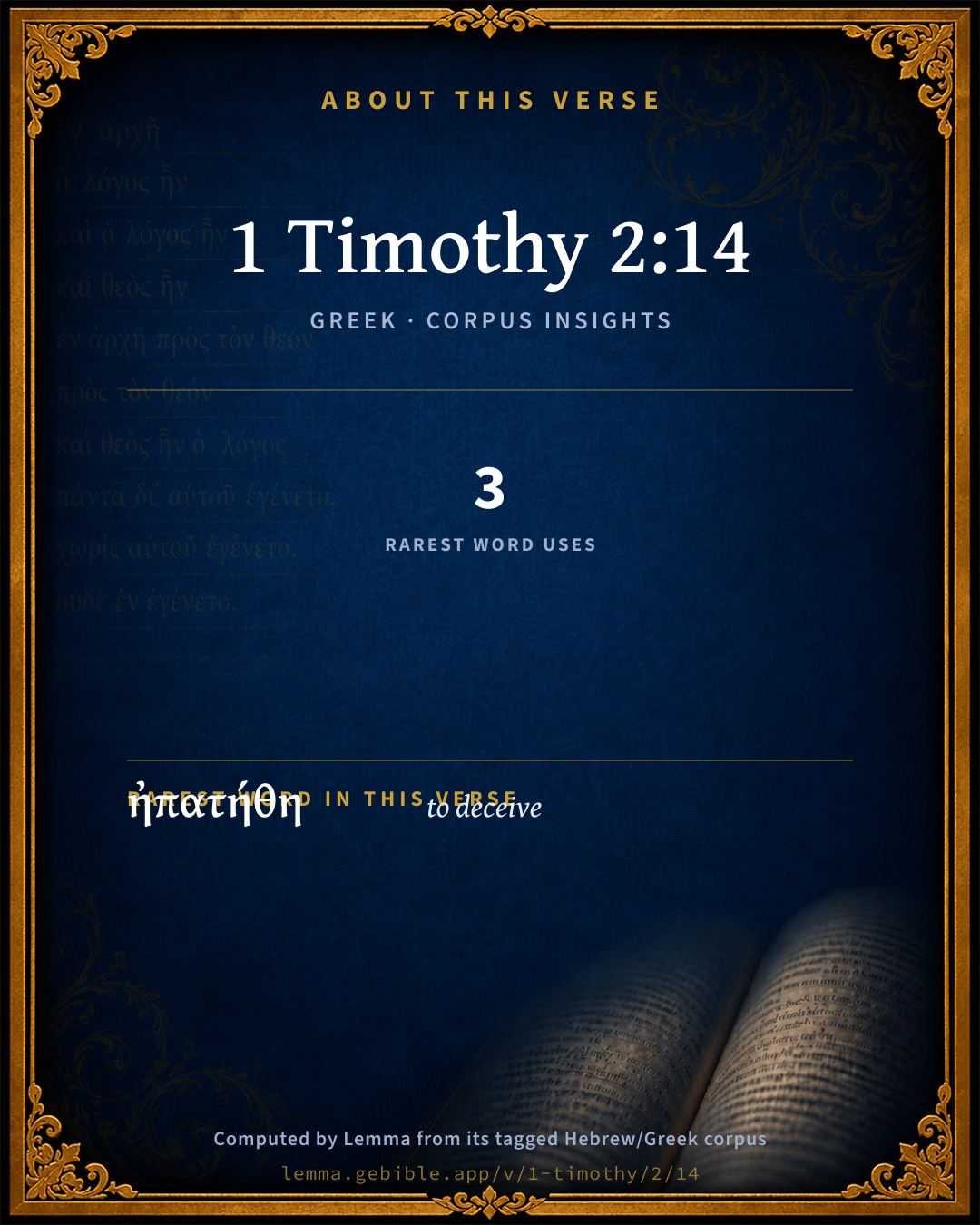
The rarest word here is ἠπατήθη to deceive G538 — appearing just 3 times in the whole Greek New Testament.

Shared distinctive vocabulary

ἠπατήθη to deceive G538 occurs in 3 verses of the Greek New Testament. Also found in:

Cross-references

3

Topical passages linked to 1 Timothy 2:14 in the Treasury of Scripture Knowledge — connected by theme and wording, ordered by reader-vote popularity; previews shown in the World English Bible.

  • 2 Corinthians 11:3 But I am afraid that somehow, as the serpent deceived Eve in his craftiness, so your minds might be corrupted from the simplicity that is in Christ.
  • Genesis 3:6 When the woman saw that the tree was good for food, and that it was a delight to the eyes, and that the tree was to be desired to make one wise, she took of the fruit of it, and ate; and she gave some to her husband with her, and he ate.
  • Genesis 3:12–13 The man said, "The woman whom you gave to be with me, she gave me of the tree, and I ate."

Cross-references courtesy of OpenBible.info (CC BY 4.0).

Commentary

Notes on 1 Timothy 2:14 from classic Christian and Jewish commentators (each source and its license shown beneath its notes). The classic Christian expositions comment on the surrounding passage and are grouped to its opening verse, so a note may address several verses; the Jewish commentaries on the Tanakh (Rashi and others) are per-verse, so they appear only where the commentator wrote on this verse.

Lemma curates 59 commentaries, every one of them public domain or Creative Commons licensed, each selected and text-cleaned for this edition rather than reprinted as found. About our sources →

The Biblical Illustrator

Joseph S. Exell

1Ti_2:9; 1Ti_2:14

That women adorn themselves in modest apparel.

Womans true dignity

If we lived in Turkey or in India, we should be better able to appreciate the wisdom of Pauls counsel in respect to the women of his day: and I am not prepared to mitigate or to apologise for his brave and wise words. Remember it was due to him more than to any other apostle that women had been so far emancipated as they were when this Epistle was written, for it was he who had taught that in Christ Jesus there was neither male nor female. But he grieved over some of the evils which at first arose from the great changes effected in their social position. Seclusion had been rigorously maintained by the customs of those Eastern cities. The picture in the Royal Academy, which represents a young girl, with slippers in her hand, drawing aside the curtain of the seraglio, and stepping across the body of a black slave, who is sleeping with naked sword in his hand, fairly represents the slave-like treatment of women in Ephesus in Pauls days. Indeed, even among the Jews the women who came to the synagogue were (and still are) kept out of sight in a carefully screened gallery. It was therefore not to be wondered at that the Christian women emancipated from such treatment felt themselves not only at liberty to assert their new-born rights but bound to do so, and that they claimed a prominence and a freedom which were good neither for themselves nor for the Church. And we must not forget that, so far as women had greater publicity in the heathen cities, it was at the risk of the virtuous reputation which Christians would be the most anxious to preserve. The priestesses of the temples, for example, were notoriously immoral, and the Hetairae were not only a recognized, but even a respectable class in Pagan society.

I. He speaks of it first negatively, declaring that her dignity does not depend upon outward adornment; and this is always and everywhere true. It is probable that the women who came to the Christian assemblies in Ephesus arrayed them selves in costly attire, and sometimes made unbecoming display of their personal charms till the custom was becoming the sensation, if not the scandal, of the city. No one professing godliness ought to spend time, and taste, and money to the extent many do on mere personal adornment, as if the body was everything and the mind nothing, or as if the chief end of a womans life was to win admiration not respect, to please man and not God. Even from a lower standpoint it is a mistake, and I venture to think that many a marriage has been prevented, and many a possibly happy home is fraught with anxiety, because of an expenditure on dress, which cannot be reasonably or rightly met. There are lives which might have been unspeakably happier if only they had been united, if the two young people had been content to face the world together with plain fare and simple habits. Listen to John Ruskin, I say further, that as long as there are cold and nakedness in the land around you, so long can there be no question at all but that splendour of dress is a crime.

II. Womans dignity is next set forth positively. I will, says Paul, that women adorn themselves in--

1. Modest apparel, with shamefastness and sobriety. Society owes its tone more to women than to men. What they frown upon will be tabooed; what they thoughtlessly tolerate will grow in evil influence.

2. But in addition to this influence, which may be almost unconsciously exercised, the Christian woman is to adorn herself with good works. She often does this behind the veil which is drawn over every home. There are those whose good works are noble in their self-sacrifice and far-reaching in their issues of whom the Church hears little. Many a man can sympathize with that soldier who said, I can stand before the enemy, but I cannot stand before my sisters prayers. And who does not know of more public work done by Christian women--such as that of our visitors and Sunday-school teachers; of saintly pleaders with the drunkards and the profligate;--of noble women whose writings have purged the atmosphere of moral corruption; of heroines like Florence Nightingale and Sister Dora, who have trodden closely in the footsteps of the Lord. These have been clothed with good works. (A. Rowland, LL. B.)

The position of woman

This was--

I. A bold declaration on the part of the apostle. Let the woman learn in silence (or rather in quietness) with all subjection, for I suffer not a woman to teach, nor to usurp authority over the man, but to be in quietness; but the course he followed in this matter was wise, in the condition of life then prevailing. In our days there is no doubt a change of those conditions, which would make the rigorous application of such a rule unwise and unjust. Women, in larger numbers now than then, are of necessity independent, and are compelled to earn their own livelihood, and make their own homes; and being, in some respects, the weaker, they should have no artificial barriers put in the way of their doing so. There are disabilities, the relics of feudal times, which slowly, yet surely, are being swept away, though much still remains to be done. Under our English laws, for example, a woman may be compelled to pay taxes, though she has no right to influence the election of those who impose them--as her gardener or coachman may do. But the general law laid down by Paul still holds good. The public work of life, whether in the world or in the Church, is, broadly speaking, not womans but mans. His is the life of turmoil, hers of quietude. She is receptive; he is aggressive: and it is not so much in her conspicuous activity as in her yielding affectionateness that her true strength is found.

II. By a scriptural argument. He goes back to Eden for justification of his teaching--for he was accustomed to regard the facts of the Old Testament as symbolical and parabolical sources of perpetual instruction. Adam was first formed, says he, then Eve. Mans priority in creation, standing as he did alone and in immediate relation to God, was an indication of his place and power, as having the headship over her whom God made to be his helpmeet. But if the helpmeet becomes the head, and the head weakly yields, there comes an overthrow of the Divine order, as there did come in Paradise. Practical shrewdness and discernment; the firm and regulative judgment which should characterize the ruler, are less hers than mans. Her very excellencies, connected as they are with the finer sensibilities and the stronger impulses of a noble and loving nature, disqualify her for the headship, whereas the balance in mans nature is the other way; in the direction of the intellectual and the governing. But it is here asserted that Adam was not deceived, and was therefore more guilty, because with his eyes open to the wrong he yielded to conjugal love. In other words, the will and the judgment were sacrificed to the affections--the essence of moral fall. Paul closes his remarks on woman by alluding to--

III. A blessed assurance. Notwithstanding she shall be saved in childbearing; or, as the R.V. has it, through the childbearing. Perhaps there was some hint here of the blessing that comes through pain and travail, of whatsoever kind it be; and also of the great and noble work possible only to motherhood. But the more correct translation gives us rather the thought of what may be called pre-eminently the childbearing --when Jesus Christ, the worlds Saviour, was born of a woman, and appeared in the likeness of sinful flesh--for it was thus that the great promise was fulfilled which brought a gleam of hope into the darkness of Eves despair, the seed of the woman shall bruise the serpents head. (A. Rowland, LL. B.)

Advice against jewellery

As to jewels, let me advise you not to buy any--even though you have the purse of Fortunatus, or may hereafter become wealthy. Some may be given you, but still I would say, do not wear them--unless, perhaps, now and then, with the pure desire of affording pleasure to the donors. A fancy for the possession and display of jewellery soon generates into a craze, ever growing, or unsatisfied unless in the ownership of gems superior to those of others around you. It is an unhealthy and vulgar feeling, Which has not seldom led to the ruin of women in all classes. Other reasons may be advanced against the indulgence of this false taste. Valuable jewels cannot but become, at times, a source of trouble and anxiety; and if lost or stolen, a bitter feeling of annoyance is retained. Opportunities for display are few; and often then, through disadvantageous comparison with others, are apt to give rise to heart-burning and envy--feelings which would never be experienced in such a way were the face resolutely set against such vanities. (Lady Bellairs.)

A passion for extravagant dress

The Empress Josephine had twenty-four thousand pounds for her personal expenses, but this sum was not sufficient, and her debts increased to an appalling degree. She rose at nine oclock. Her toilet consumed much time, and she lavished unwearied efforts on the preservation and embellishment of her person. Huge baskets were brought to her containing different dresses, shawls, and hats. From these she selected her costume for the day. She possessed between three or four hundred shawls, and always wore one in the morning, which she draped about her shoulders with unequalled grace. The evening toilet was as careful as that of the morning--then she appeared with flowers of pearls, or precious stones in her hair. Bonaparte was irritated by these expenditures; he would fly into a passion, and his wife would weep and promise to be more prudent; after which she would go on in the same way. It is almost incredible that this passion for dress should never have exhausted itself. After her divorce she arrayed herself with the same care even when she was no one. She died covered with ribbons and pale rose-coloured satin. As long as the heart is unrenewed by Divine grace, regard for the outward is even greater than regard for the inward. True religion reverses all this, and gives the things unseen and eternal their rightful place. The most humbly dressed believer in Christ has a better garment than the empress, even the wedding garment of Christs righteousness.

A good use for ornaments

Some of you might do great good with articles which you might very readily spare. You have ornaments which Christian men and women are better without, which, if broken up or sold, would aid the good cause. I wish many would follow the example of Oliver Cromwell, when he went into Exeter Cathedral, and saw twelve massive images of the apostles in silver. Oh, oh, said he, what do these gentlemen here? They are the twelve apostles, was the reply. Very well, said he, melt them down, and send them about doing good. I wish Christians would do that with some of their gold and silver jewellery. Anyhow, for our own sakes, lest the canker get into our gold, and the rust into our silver, use it for doing good. (C. H. Spurgeon.)

A becoming adornment

Goethe was in company with a mother and daughter, when the latter, being reproved for some thing, blushed and burst into tears. He said to the mother: How beautiful your reproach has made your daughter! The crimson hue and those silvery tears become her much better than any ornament of gold or pearls; those may be hung on the neck of any woman; these are never seen unconnected with moral purity. A full-blown flower, sprinkled with purest hue, is not so beautiful as this child, blushing beneath her parents displeasure, and shedding tears of sorrow for her fault. A blush is the sign which nature hangs out, to show where chastity and honour dwell.

The charity purse

Howard, soon after his marriage, sold some jewels his wife had no longer any inclination to wear, and put the money into a purse called by herself and her husband the charity purse. (J. Stoughton, D. D.)

Womans sphere of influence

For so far as a woman is sincere to the nature God has given her, her aspiration is not so much that the world should ring with her fame, or Society quote her as a leader of fashion, but that she should bless and be blessed in blessing. It is not that she should wish for power, but that she should wish for a noble, not an ignoble power. It is not that she should not wish to queen it in this world, but that she should wish to queen it, not by ostentation of dress or life, nor by eclipsing others, but by manifestation of love, by nobility of gentle service, by unconscious revelation in her life, and conscious maintenance in others by her influence, of all things true and pure, of stainless honour in life, of chivalrous aspirations in the soul. (Stoleford A. Brooke, M. A.)

Silence of women

Why, Doctor, exclaimed a shallow, talkative lady, who was in the room with Dr. Johnson, but of whom he took little notice, I believe you prefer the company of men to that of ladies. Madam, he replied, I am fond of the company of ladies; I like their beauty, I like their delicacy, and I like their silence.

Professing godliness.--

The profession of godliness

Such is the description and character of Christians in early days, such of all true Christians in every day. In no one point of view is the inconsistency of the Christian world more strikingly apparent: they would be thought to embrace the gospel of godliness without an idea of becoming godly. What should we think of a physician who had no interest in the science or practice of medicine? What of a husbandman who disliked and avoided the employments of the field? What of a soldier who declined all discipline and all obedience? But, to say the truth, and to do men justice, such instances in the natural world are extremely rare; it is only in the spiritual world, only where God, and the soul, and eternity are concerned, that we find men lost in apathy, and acting in contradiction to their pretended faith; and casting off the consideration of those liabilities and duties upon which they have openly entered. There are men, indeed, who, when charged with such palpable inconsistency, and feeling uneasy under the shame of it, at once deny that they do set up any profession at all; and make a sort of merit of saying that they do not pretend to any of the distinguished excellencies of the Christian character. But this flimsy pretext of honesty can avail them but little. Ii they pretend not to what the gospel requires, why pretend to the gospel at all? Nay, it is a melancholy fact that the generality of heathen in our Indian and other foreign possessions manifest a far more abiding sense of their various deities and idols than the generality of Christians do of the true and holy God. They fear the object of their worship, they respect it, they daily remember it. The wicked enemy, who drove man from paradise with a corrupted flesh into a corrupted world, still uses that flesh and that world as instruments of keeping up and increasing our estrangement from God. I have a message to deliver to-day to every soul that is in earnest in the great work of salvation; not to teach, but to remind you of what the truth really is: be it then understood, be it taken to heart, that godliness is the great good, in the present life, to which Christ came to bring us, as the means of our final recovery and blessedness. (J. Slade, M. A.)

The Biblical Illustrator, edited by Joseph S. Exell (c. 1880s–1900s) — public domain. Text from a community e-Sword module.

Bengel's Gnomon

Johann Albrecht Bengel

1Ti 2:14. Οὐκ ἠπατήθη, was not deceived) The Serpent deceived the woman; the woman did not deceive the man, but persuaded him: Gen 3:17, thou hast hearkened to the voice of thy wife. In the preceding verse, we are taught why the woman ought not to exercise authority, now, why she ought not to teach; more easily deceived, she more easily deceives; comp. Ecc 7:29. Deceiving indicates less strength in the understanding; and this is the strong ground on which a woman is not allowed to teach.—ἀπατηθεῖσα ἐν παραβάσει γέγονε, being deceived, fell into[18] the transgression) i.e. was guilty of falling into the deception (Gen 3:13, ὁ ὄφις ἠπάτησέ με), and so she began to be in the transgression. It is not said, ἘΝ ΠΑΡΑΒΆΣΕΙ ΓΕΓΟΝῦΙΑ ἨΠΑΤΉΘΗ, having come to be in the transgression, she was deceived. Therefore γέγονε does not apply to the very origin of the woman; for the deception followed not until after that; but γέγονε closely agrees with ἘΝ ΠΑΡΑΒΆΣΕΙ, which has the meaning of a noun; see Act 22:17 [ἘΝ ἘΚΣΤΆΣΕΙ, in a state of trance]; and comp. note on Joh 1:15. The state of transgression which quickly followed the deception, once for all admitted, is here intended. A phrase very like this is found at Num 26:10, ἐγενήθησαν ἐν σημείῳ.

[18] “Was in,” Engl. Vers.; rather, “Came to be in.” For it is γέγονε, not ἦν.—ED.

Bengel's Gnomon of the New Testament — English translation (T&T Clark, Edinburgh, 1860) — public domain. Text from a community e-Sword module.

Meyer's Critical & Exegetical Commentary

Heinrich August Wilhelm Meyer

1Ti_2:14. καὶ Ἀδὰμ οὐκ ἠπατήθη] In order to justify this expression, the expositors have sought to define it more precisely, mostly by supplying πρῶτος. So Theodoret; Tertullian, too (De Hab. Mul.), says, perhaps alluding to this passage: tu divinae legis prima es desertrix. Others, again, supply ὑπὸ τοῦ ὄφεως (Matthies: As the apostle remembers the O. T. story of the fall, there comes into his thoughts the cunning serpent by which Eve, not Adam, let herself be ensnared). De Wette thinks that the author is insisting on the notion be charmed, betrayed (by sinful desire), as opposed to some other motive to sin. Hofmann arbitrarily supplies with Ἀδὰμ οὐκ ἠπατήθη the thought: so long as he was alone.

The apparent difficulty is solved when we remember the peculiarity of allegorical interpretation, which lays stress on the definite expression as such. This here is the word ἀπατᾷν (or ἐξαπατᾷν). On this word the whole emphasis is laid, as is clearly shown by the very repetition of it. This word, however, in the Mosaic account of the fall, is used only of the woman, not of the man, for in Gen_3:13 the woman expressly says: ὁ ὄφις ἠπάτησέ με; the man, however, uses no such expression. And in the story there is no indication that as the woman was deceived or betrayed through the promises of the serpent, so was the man through the woman.

Adam did certainly also transgress the command, but not, as the woman, influenced by ἀπάτη. Paul, remembering this, says: Ἀδὰμ οὐκ ἠπατήθη, ἡ δὲ γυνὴ ἐξαπατηθεῖσα. Bengel: serpens mulierem decepit, mulier virum non decepit, sed ei persuasit. To supply anything whatever, only serves therefore to conceal the apostles real meaning.

ἡ δὲ γυνὴ ἐξαπατηθεῖσα ἐν παραβάσει γέγονε] This betrayal of the woman by the serpent is mentioned by Paul also in 2Co_11:3, where he employs the same word: ἐξαπατᾷν.

The emphasis, as is apparent from what precedes, is not on the last words, but on ἐξαπατηθεῖσα; hence it is not right to supply πρώτη with ἐν παρ. γεγ. Παράβασις here, as elsewhere (οὗ οὐκ ἔστι νόμος, οὐδὲ παράβασις, Rom_4:15), is used in regard to a definite law.

The construction γεγονέναι ἐν occurs frequently in the N. T. in order to denote the entrance into a certain condition, a certain existence. De Wette: fell into transgression. Luther wrongly: and brought in transgression.

As to the thought itself, expositors find the force of this second reason to lie in the fact that in the fall the weakness of the woman, her proneness to temptation, was manifested, and that consequently it is not seemly for the woman to have mastery over the man. But did the man resist the temptation more stoutly than the woman? Paul nowhere gives any hint of that. The significant part of the Mosaic narrative to him is rather this, that the judgment of God was passed upon the woman because she had let herself be betrayed by the serpent, and it is in accordance with this judgment that the husband is made lord over the wife.[107]

[107] The right interpretation of this passage does not even in appearance contradict Rom_5:12. In the latter, Paul does not mention the woman, but the man, as the origin of sin; but then he is thinking of the man as the image of God, of the woman as the image of the man.

Meyer — Critical and Exegetical Commentary on the New Testament — English translation by Peter Christie, edited by Frederick Crombie (T&T Clark, 1880) — public domain. Text from a community e-Sword module.

Expositor's Greek Testament

ed. W. Robertson Nicoll

1Ti 2:14 . ἡ δὲ γυνή : St. Paul says ἡ γυνή rather than Εὕα , emphasing the sex rather than the individual, because he desires to gives the incident its general application, especially in view of what follows. So Chrys.

ἐξαπατηθεῖσα : It is doubtful if we are entitled to render this, as Ell. does, being completely deceived . In 2Co 11:3 St. Paul says ὁ ὄφις ἐξηπάτησεν Εὕαν , where there is no reason why he should not have used the simple verb. St. Paul uses the compound verb in five other places, the simple verb only once (see reff.). So that the simplest account that we can give of his variation here, and in 2Co 11:3 , from the ὁ ὄφις ἠπάτησέν με of Gen 3:13 , is that the compound verb came naturally to his mind.

ἐν παραβάσει γέγονεν : Inasmuch as παράβασις is used of Adam’s transgression in Rom 5:14 , it may be asked, What is the force of St. Paul’s apparent restriction here of the phrase to Eve? Might it not be said of Adam as well, that he ἐν παραβ . γέγονεν ? To which St. Paul would perhaps have replied that he meant that it was woman who first transgressed, in consequence of having been deceived. ἀπὸ γυναικὸς ἀρχὴ ἁμαρτίας , καὶ διʼ αὐτὴν ἀποθνήσκομεν πάντες . Sir 25:24 . This notion of coming into a state of sin at a definite point of time is well expressed by γέγονεν . For γίνεσθαι ἐν cf. ἡ διακονία … ἐγενήθη ἐν δόξῃ (2Co 3:7 ); ἐν λόγῳ κολακίας ἐγενήθημεν (1Th 2:5 ).

The Expositor's Greek Testament, edited by W. Robertson Nicoll (1897–1910) — public domain. Text from a community e-Sword module.

Geneva Bible (1599)

Geneva Bible translators

Adam was deceived, but through his wife’s means, and therefore she is worthily for this cause subject to her husband, and ought to be.

Then because that after sin God enjoined the woman this punishment, for that the man was deceived by her.

Geneva Bible (1599) marginal notes — public domain. Text via Bolls.life.

Jamieson, Fausset & Brown

Robert Jamieson, A. R. Fausset & David Brown

Adam was not deceived--as Eve was deceived by the serpent; but was persuaded by his wife. Gen 3:17, "hearkened unto . . . voice of . . . wife." But in Gen 3:13, Eve says, "The serpent beguiled me." Being more easily deceived, she more easily deceives [BENGEL], (Co2 11:3). Last in being, she was first in sin--indeed, she alone was deceived. The subtle serpent knew that she was "the weaker vessel" (Pe1 3:7). He therefore tempted her, not Adam. She yielded to the temptations of sense and the deceits of Satan; he, to conjugal love. Hence, in the order of God's judicial sentence, the serpent, the prime offender, stands first; the woman, who was deceived, next; and the man, persuaded by his wife, last (Gen 3:14-19). In Rom 5:12, Adam is represented as the first transgressor; but there no reference is made to Eve, and Adam is regarded as the head of the sinning race. Hence, as here, Ti1 2:11, in Gen 3:16, woman's "subjection" is represented as the consequence of her being deceived.

being deceived--The oldest manuscripts read the compound Greek verb for the simple, "Having been seduced by deceit": implying how completely Satan succeeded in deceiving her.

was in the transgression--Greek, "came to be in the transgression": became involved in the existing state of transgression, literally, "the going beyond a command"; breach of a positive precept (Rom 4:15).

Jamieson, Fausset & Brown — Commentary Critical and Explanatory on the Whole Bible (1871) — public domain (CC PDM 1.0). Text via the HelloAO Bible API.

Adam Clarke's Commentary

Verse 14. Adam was not deceived] It does not appear that Satan attempted the man; the woman said: The serpent beguiled me, and I did eat. Adam received the fruit from the hand of his wife; he knew he was transgressing, he was not deceived; however, she led the way, and in consequence of this she was subjected to the domination of her husband: Thy desire shall be to thy husband, and he shall rule over thee; Ge 3:16. There is a Greek verse, but it is not English law, that speaks a language nearly similar to that above:-

Γυναικι δ' αρχειν ου διδωσιν ἡ φυσις.

For nature suffers not a woman's rule. God has not only rendered her unfit for it, but he has subjected her, expressly, to the government of the man.

Adam Clarke's Commentary on the Bible (1810–1826) — public domain. Text from a community e-Sword/MySword module.

John Calvin's Commentaries

14 And Adam was not deceived He alludes to the punishment inflicted on the woman:

“Because thou hast obeyed the voice of the serpent, thou shalt be subject to the authority of thy husband, and thy desire shall be to him.” (Genesis 3:16.)

Because she had given fatal advice, it was right that she should learn that she was under the power and will of another; and because she had drawn her husband aside from the command of God, it was right that she should be deprived of all liberty and placed under the yoke. Besides, the Apostle does not rest his argument entirely or absolutely on the cause of the transgression, but founds it on the sentence which was pronounced by God.

Yet it may be thought that these two statements are somewhat contradictory: that the subjection of the woman is the punishment of her transgression, and yet that it was imposed on her from the creation; for thence it will follow, that she was doomed to servitude before she sinned. I reply, there is nothing to hinder that the condition of obeying should be natural from the beginning, and that afterwards the accidental condition of serving should come into existence; so that the subjection was now less voluntary and agreeable than it had formerly been.

Again, this passage has given to some people an occasion for affirming that Adam did not fall by means of error, but that he was only overcome by the allurements of his wife. Accordingly, they think that the woman only was deceived by the wiles of the devil, to believe that she and her husband would be like the gods; But that Adam was not at all persuaded of this, but tasted the fruit in order to please his wife. But it is easy to refute this opinion; for, if Adam had not given credit to the falsehood of Satan, God would not have reproached him:

“Behold, Adam is become like one of us.” (Genesis 3:22.)

There are other reasons of which I say nothing; for there needs not a long refutation of an error which does not rest on any probable conjecture. By these words Paul does not mean that Adam was not entangled by the same deceitfulness of the devil, but that the cause or source of the transgression proceeded from Eve.

John Calvin's Commentaries (1540-1563) — public domain. Text from the Calvin Translation Society English edition (1840s-50s) via the Christian Classics Ethereal Library (ccel.org). Calvin's coverage is partial (roughly two-thirds of the Bible); uncommented books and verses are honest gaps, never fabricated. The 19th-century editor's footnotes and remarks are omitted so the notes are faithfully Calvin's own voice.

Ellicott's Commentary for English Readers

(14) And Adam was not deceived.—Priority in creation was the ground alleged by St. Paul as the reason why the woman was never to exercise authority over man, the eldest born of God. “Adam was not deceived;” the Apostle now refers to the general basis of his direction respecting the exclusion of women from all public praying and teaching contained in 1Ti_2:9-12. The argument here is a singular one—Adam and Eve both sinned, but Adam was not deceived. He sinned, quite aware all the while of the magnitude of the sin he was voluntarily committing. Eve, on the other hand, was completely, thoroughly deceived (the preposition with which the Greek verb is compounded here conveying the idea of thoroughness)—she succumbed to the serpent’s deceit. Both were involved in the sin, but only one (Eve) allowed herself to be deluded. So Bengel, “Deceptio indicat minus robur in intellectu, atque hic nervus est cur mulieri non liceat docere.” Prof. Reynolds thus comments on the argument of the Apostle:—“This may sound to our ears a far-fetched argument, when used to discountenance female usurpation of intellectual supremacy. It was, however, a method current at the time to look for and find in the Scriptures the concrete expressions of almost all philosophical judgments. At the present day we could hardly find a more vivid illustration of the essential difference between the masculine and feminine nature. If there be this distinction between the sexes, that distinction still furnishes the basis of an argument and a reason for the advice here rendered. The catastrophe of Eden is the beacon for all generations when the sexes repeat the folly of Eve and Adam, and exchange their distinctive position and functions.”

A Bible Commentary for English Readers, edited by Charles John Ellicott (1878–1897) — public domain. Text from a community e-Sword module.

The Cambridge Bible for Schools and Colleges

gen. ed. J. J. S. Perowne

14. the woman being deceived was in the transgression] The compound verb should be read as in 2Co_11:3, ‘as the serpent beguiled Eve’; ‘Adam was not beguiled,’ a general negative, limited by the compound verb following, ‘you may say he was not beguiled in comparison with the complete direct beguiling of Eve’; the woman being beguiled is found in transgression.

‘Was’ does not represent properly the perfect, lit. ‘is become,’ used, according to Greek idiom, because the past event is viewed as having a present influence, and continuing in its effects.

Here it helps the transition from the particular case of Eve in the past to the general case of women now. This is also aided by the further change to the future in ‘shall be saved.’

The Cambridge Bible for Schools and Colleges (gen. ed. J. J. S. Perowne; Cambridge University Press, 1878–1918) — public domain. Text from a community e-Sword module.

John Gill's Exposition

Notwithstanding she shall be saved,.... Not Eve, though no doubt she is saved; since she had a sense of her sin, and shame for it, a revelation of the Messiah to her, and faith in him; see Gen 3:7. But rather any woman, particularly such as profess godliness, who shall be saved

in childbearing; which is to be understood not of a temporal salvation, or being saved through childbearing, through the perilous time, and be delivered out of it; for though this is generally the case, yet not always, nor always the case of good women. Rachel died in childbed: the Jews say (t), for three transgressions women die in childbearing; because they do not take care of their menstrues, and of the cake of the firstfruits, and of lighting the lamp (when the sabbath approaches). But spiritual and eternal salvation is here meant; not that bearing children is the cause, condition, or means of salvation; for as this is not God's way of salvation, so it confines the salvation of women to childbearing ones; and which must give an uneasy reflection to maidens, and women that never bore any; but rather the meaning is, that good women shall be saved, notwithstanding their bearing and bringing forth children in pain and sorrow, according to the original curse, in Gen 3:16. And so the words administer some comfort to women, in their present situation of subjection and sorrow; though they may be rendered impersonally thus, "notwithstanding there is salvation through the birth of a son": and the sense is, that notwithstanding the fall of man by the means of the woman, yet there is salvation for both men and women, through the birth of Immanuel, the child born, and Son given; at whose birth, the angels sung peace on earth, good will to men; through the true Messiah, the deed of the woman, through the incarnate Saviour, who was made of a woman, there is salvation for lost sinners: he was born of a woman, and came into the world in order to obtain salvation for them; and he has effected it, and it is in him, for all such who apply to him for it; and with it all true believers, men and women, shall be saved through him,

if they continue in faith and charity, and holiness, with sobriety. The Vulgate Latin version reads in the singular, "if she continues", &c. but the sense is the same; for the "she", or woman, is to be taken in a collective sense, as it is in the context, for many women; even for such as profess faith and godliness. The Syriac and Ethiopic versions render the words, "she shall be saved by her children", if they continue, &c. i.e. she shall be saved by bearing of children, and bringing of them up in a religious way; if they, the children, continue as they were brought up; which is a very strange rendering of the words, and is as strange an interpretation of them; and yet is what many have given into, but needs no confutation. The meaning of the words is, that there is salvation through the incarnate Messiah, for all sorts of persons; for all men and women who believe in him, with that faith which works by love, and shows itself in holiness and sobriety; provided that they continue herein. For there are some that profess these things, that have only a temporary faith, and feigned love, and not true holiness; and these fall away, and are not saved; but such who have these graces in truth, as they do, and shall continue in them, so they shall certainly be saved.

(t) Misn. Sabbat, c. 2. sect. 6.

Next: 1 Timothy Chapter 3

John Gill's Exposition of the Whole Bible (1746–1763) — public domain (CC PDM 1.0). Text via the HelloAO Bible API.

Trapp's Complete Commentary

John Trapp

14 And Adam was not deceived, but the woman being deceived was in the transgression.

Ver. 14. And Adam was not deceived] i.e. He was not deceived so much by his judgment (though also by that too) as by his affection to his wife, which at length blinded his judgment. Look we well to our affections; for by these maids Satan still wooeth the mistress.

Being deceived, was in the transgression] Uxor mea tota in fermento est, said he in Plautus. {See Trapp on "Gen 3:6"} Yet Adam sinned more than Eve, because he had more wisdom and strength. He could set his affections as the artificer doth his clock, to make it strike when and what he will.

John Trapp, A Commentary or Exposition upon All the Books of the Old and New Testament (1647–1656) — public domain. Text from a community e-Sword module.

Albert Barnes' Notes on the Bible

And Adam was not deceived - This is the second reason why the woman should occupy a subordinate rank in all things. It is, that in the most important situation in which she was ever placed she had shown that she was not qualified to take the lead. She had evinced a readiness to yield to temptation; a feebleness of resistance; a pliancy of character, which showed that she was not adapted to the situation of headship, and which made it proper that she should ever afterward occupy a subordinate situation. It is not meant here that Adam did not sin, nor even that he was not deceived by the tempter, but that the woman opposed a feebler resistance to the temptation than he would have done, and that the temptation as actually applied to her would have been ineffectual on him. To tempt and seduce him to fall, there were needed all the soft persuasions, the entreaties, and example of his wife.

Satan understood this, and approached man not with the specious argument of the serpent, but through the allurements of his wife. It is undoubtedly implied here that man in general has a power of resisting certain kinds of temptation superior to that possessed by woman, and hence that the headship properly belongs to him. This is, undoubtedly, the general truth, though there may be many exceptions, and many noble cases to the honor of the female sex, in which they evince a power of resistance to temptation superior to man. In many traits of character, and among them those which are most lovely, woman is superior to man; yet it is undoubtedly true that, as a general thing, temptation will make a stronger impression on her than on him. When it is said that “Adam was not deceived,” it is not meant that when he partook actually of the fruit he was under no deception, but that he was not deceived by the serpent; he was not first deceived, or first in the transgression. The woman should remember that sin began with her, and she should therefore be willing to occupy an humble and subordinate situation.

But the woman being deceived - She was made to suppose that the fruit would not injure her, but would make her wise, and that God would not fulfil his threatening of death. Sin, from the beginning, has been a process of delusion. Every man or woman who violates the law of God is deceived as to the happiness which is expected from the violation, and as to the consequences which will follow it.

Albert Barnes' Notes on the Bible (1834–1885) — public domain. Text from a community e-Sword/MySword module.

Matthew Poole's English Annotations

Besides, Adam was not first deceived, nor indeed at all deceived immediately by the serpent, but only enticed, and deceived by the woman, who was the tempter’s agent; so as that she was both first in the transgression in order of time, and also principal in it, contributing to the seduction or transgression of the man; which ought to be a consideration to keep the woman humble, in a low opinion of herself, and that lower order wherein God hath fixed her.

Matthew Poole's English Annotations on the Holy Bible (1683–1685) — public domain. Text from a community e-Sword/MySword module.

Whedon's Commentary on the Bible

Daniel D. Whedon

14. Not deceived—He was, perhaps, induced to sin by love of Eve, more knowingly than she, and so perhaps more guiltily.

Daniel D. Whedon (gen. ed.), Commentary on the Old and New Testaments (1874–1909) — public domain. Text from a community e-Sword module.

The Pulpit Commentary

Beguiled (twice) for deceived, A.V; hath fallen into for was in the, A.V Beguiled (hjpathqh). The same word as is used in the Gen_3:13, "The serpent beguiled me;" hjpa me, LXX (comp. thsen). 2Co_11:3, where the verb used is ejxhpa. Hath fallen into transgression. Fell (not hath fallen) is the right tense to use here in English, though the Greek perfect, it is true, contains the further idea of continuance in the fall, as in 1Co_9:22 1Co_13:11; 1Th_2:1; 2Pe_2:20. So also Mat_1:22 Mat_19:8 Mat_21:4 Mat_25:6; Mar_5:33; Joh_1:3; gone 2Co_1:19; and elsewhere, ge is best rendered by the past (not the perfect) tense. It has frequently the notion of transition into a certain condition. (see Rom_6:5 Rom_7:13; 1Co_9:22 1Co_13:11; 2Co_5:17 2Co_12:11; Gal_4:16, etc.) Bishop Ellicott gives the passages in which gignomai is followed, as here, by ejn (Luk_22:44; Acts 2Co_3:7; 1Th_2:5) "denoting entrance into, and continuance in, any given state." As regards the apostle"s statement, Adam was not beguiled, we must understand it as based merely upon the text in Genesis to which he refers, in which Eve (not Adam) says, JO ofiv hjpathse me, "The serpent beguiled me." Just as inrmati Gal_3:16 he reasons from spe being in the singular number, and as the writer to the Heb_7:3 reasons from the silence of Genesis 14. regarding the parentage of Melchizedek. Huther (in lee.) says that this mode of reasoning is peculiar to allegorical interpretation.

The Pulpit Commentary (1880–1919), ed. H.D.M. Spence-Jones & Joseph S. Exell — public domain. Text from a community e-Sword module.

John Wesley's Explanatory Notes

And Adam was not deceived - The serpent deceived Eve: Eve did not deceive Adam, but persuaded him. "Thou hast hearkened unto the voice of thy wife," Gen. iii, 17. The preceding verse showed why a woman should not "usurp authority over the man." this shows why she ought not "to teach." She is more easily deceived, and more easily deceives. The woman being deceived transgressed - "The serpent deceived" her, Gen. iii, 13, and she transgressed.

John Wesley, Explanatory Notes Upon the Whole Bible (1754–1765) — public domain. Text via the GEBible commentary corpus.

Fairbairn on Ezekiel, Jonah & the Pastoral Epistles

Patrick Fairbairn

Ver. 14. From this sinful violation of the primeval order, with its disastrous results, the apostle fetches his second reason for fixing in the manner he does the social position of woman: And Adam was not deceived; hut the woman, being altogether deceived, (The best reading is ἐξαπατηθεῖσα, a stronger form of the verb, in order to emphasize the deception in Eve’s case.) fell into transgression: literally, became in; but the expression γίγεσθαι ἐν is always used of entering or falling into a particular state (Luk 22:44; Act 22:17; 2Co 3:7; Php 2:7). This explanatory statement has often been deemed strange, or partially misapprehended, from not sufficiently regarding the precise light in which the matter is contemplated by the apostle, and the purpose for which it is here brought into consideration. As already indicated, the case is referred to as a grand though mournful example, at the commencement of the world’s history, of the evil sure to arise if in the general management of affairs woman should quit her proper position as the handmaid of man, and man should concede to her the ascendency. She wants, by the very constitution of nature, the qualities necessary for such a task—in particular, the equability of temper, the practical shrewdness and discernment, the firm, independent, regulative judgment, which are required to carry the leaders of important interests above first impressions and outside appearances, to resist solicitations, and amid subtle entanglements and fierce conflicts to cleave unswervingly to the right. Her very excellences in other respects—excellences connected with the finer sensibilities and stronger impulses of her emotional and loving nature—tend in a measure to disqualify her here. With man, on the other hand, in accordance with his original destination, the balance as between the intellectual and the emotional, the susceptible and the governing powers, inclines as a rule in the opposite direction. Hence, in the great trial to which the parents of the human family were subjected as the test of their allegiance, it was Adam who was mainly charged with the responsibility, and who should have been, in everything relating to it, the prime agent. But Eve, affecting to play the master, and to decide the question for herself and her husband, soon gave proof of her incompetency; she was overreached by a subtler intellect than her own, and induced, under specious pretexts, to prefer an apparent to the real good. “The serpent beguiled (or deceived) me, and I did eat” (Gen 3:13), was her confession before the Judge, thereby in effect acknowledging her weakness and folly in taking her impressions from such a quarter, and acting independently of her appointed head. But Adam, says the apostle, was not deceived, although the representation of Eve may, in point of fact, have wrought like a deception on his mind. That, however, was not exactly the point of weakness in his case, nor is anything said of it in the original account. “The woman whom Thou gavest to be with me,” was his confession to the Lord, “she gave me of the tree, and I did eat” (Gen 3:12). Yes, but God had given her, not for authority and rule, but for kindly ministrations; to be a helpmate by his side, not a directress to control his judgment or determine for him the course of life. And in allowing her to become this, in what touched the very heart of his calling, whether it might be in the way of deception, by the constraint of love, or by threats of evil, it booted not; anyhow, Adam showed that he had fallen from his true position, and ceased to rule, as he should have done, with God. This aspect of the matter, however, it was not necessary for the apostle’s purpose to bring out. As his theme was the place and calling of females in respect to things of public moment, he contents himself with pointing to that part of the transactions connected with the fall which more directly concerned Eve, and presents it as a beacon to future generations, in particular to the female members of Christian congregations, lest, amid the greater liberty of gospel times, they might be tempted to assume functions which they were not qualified or called in providence to fill.

Patrick Fairbairn — An Exposition of Ezekiel (1851), Jonah (1849), and The Pastoral Epistles (1874) — public domain. Text from a community e-Sword module.

Scofield Reference Notes

C. I. Scofield

transgression

Sin. (See Scofield "Rom 3:23").

The Scofield Reference Bible (1917 edition), notes by C. I. Scofield — public domain. Text from a community e-Sword module.

The People's New Testament

B. W. Johnson

14. And Adam was not deceived. It was man who was first created, but woman who first led into the transgression. For these reasons a burden was laid on women which is spoken of in the next verse.

B. W. Johnson's The People's New Testament with Notes (1889–1891) — public domain. Electronic text from the Christian Classics Ethereal Library (CCEL) ThML edition.

Cambridge Greek Testament for Schools and Colleges

14. ἐξαπατηθεῖσα. So א*AD2*GP. Rec. text has ἀπατηθεῖσα, following אcD2bcKL and most cursives; this is obviously a correction of the text suggested by the simple verb ἠπατήθη, in the first clause of the verse.

14. Ἀδὰμ οὐκ ἠπατήθη. What Adam did, he did of his own choice and with open eyes.

On the other hand Eve was entirely deceived, ἐξαπατηθεῖσα. (See crit. note.) Compare Gen 3:13 ὁ ὄφις ἠπάτησεν με. The compound verb ἐξαπατάω is a common Pauline word (see Rom 7:11; 1Co 3:18). And so, Eve being beguiled hath fallen into transgression. The perfect tense, γέγονε, is used in preference to the aorist, as the case of Eve has permanent application; cp. Gal 4:23. Note that the construction γίγνεσθαι ἐν (1Co 2:3; 2Co 3:7) is Pauline. The term παράβασις is here used in its strict sense of a transgression of law (Rom 4:15; Gal 3:19).

At this point the writer passes from Eve, the mother and prototype of the sex, to womankind generally.

Cambridge Greek Testament for Schools and Colleges (Cambridge University Press, 1896; 21 vols, various authors incl. Carr, Maclear, Plummer, Farrar, Lumby, Moule, M. R. James, Simcox) — public domain. Text from a community e-Sword module.

Alford’s Greek Testament

Henry Alford

14.] Second reason—as the woman was last in being, so she was first in sin—indeed the only victim of the Tempter’s deceit. And Adam was not deceived (not to be weakened, as Thdrt. τὸ οὐκ ἠπατήθη, ἀντὶ τοῦ, οὐ πρῶτος, εἴρηκεν: nor, as Matthies, must we supply ὑπὸ τοῦ ὄφεως: nor, with De W., Wiesinger, al., must we press the fact that the woman only was misled by the senses. Bengel and Huther seem to me (but cf. Ellicott) to have apprehended the right reference: ‘serpens mulierem decepit, mulier virum non decepit, sed ei persuasit.’ As Huther observes, the ἠπάτησεν, in the original narrative, is used of the woman only. We read of no communication between the serpent and the man. The “subtlest beast of all the field” knew his course better: she listened to the lower solicitation of sense and expediency: he to the higher one of conjugal love): but the woman (not now Eve, but generic, as the next clause shews: for Eve could not be the subject to σωθήσεται) having been seduced by deceit (stronger than ἀπατηθεῖσα, as exoro than oro: implying the full success of the ἀπάτη) has become involved (the thought is—the present state of transgression in which the woman (and the man too: but that is not treated here) by sin is constituted, arose (which was not so in the man) from her originally having been seduced by deceit) in transgression (here as always, breach of a positive command: cf. Rom 4:15).

Henry Alford, The Greek Testament (1849–1861) — public domain. Text from a community e-Sword module.

International Critical Commentary

14. Cf. 2Co 11:3; and for the Jewish tradition that Eve was tempted by the serpent to infidelity, cf. Thackeray, The Relation of St. Paul to Contemporary Jewish Thought, pp. 50-57; for the Jewish attitude to women, Taylor, Sayings of the Jewish Fathers, i. 5 note; and for the connexion of Eve with transgression and death, Ecclus 25:24 ἀπὸ γυναικὸς ἀρχὴ ἁμαρτίας καὶ διʼ αὐτὴν ἀποθνήσκομεν πάντες.

γεγόνεν—passed into and has remained in the position of transgressor.

σωθησέται] taking up σωθῆναι, 4 ἁμαρτωλοὺς σῶσαι, 1:15; shall be spiritually saved.

διὰ τῆς (“that of Gen 3:16, ” or more technically “the great”) τεκνογονίας. Two interpretations seem possible. (a) “By bearing children,” by that child-bearing which was once a thing of sorrow but now has become a source of salvation; not by spiritual activities at the meetings, but by motherhood and the quiet duties of home (cf. 5:14); including perhaps (so Chrys.) the rearing of children (cf. 5:10 εἰ ἐτεκνοτρόφησεν, and Hippol. Canon 82, “Neve det infantes quos peperit nutricibus sed ipsa sola eos nutriat … neve administrationem familiæ negligat”), and all maternal instincts, which become the saving of a woman from self and draw out her soul both to others and to God; cf. Ramsay, Expositor, 1909, pp. 339-47. If so, there may be an implied protest against those who depreciated marriage, 4:3.

(b) By the great child-bearing, by that which has produced the Saviour, the child-bearing of Mary, which has undone the work of Eve. This use of the article is very common in the Past. Epp.; cf. τὸ μυστήριον, ἡ πίστις, ἡ διδασκαλία (p. xvi): for the thought, cf. Ign. ad Eph. 19, ἔλαθεν τὸν ἄρχοντα τοῦ αἰῶνος τούτου ἡ παρθενία Μαρίας καὶ ὁ τοκετὸς αὐτῆς, ὁμοίως καὶ ὁ θάνατος τοῦ κυρίου, Iren. Hær. v. 19, “si ea inobedierat Deo, sed hæc suasa est obedire Deo, uti Virginis Eva virgo Maria fieret advocata, et quemadmodum adstrictum est morti genus humanum per virginem, salvetur per virginem”: cf. ibid. 3:22; Prædic. Apostolica, c. 33; Justin, Dial. c. 100; Tert. de Carne, xli. c. 17: cf. the stress on ἄνθρωπος, sup.5, and Gal 4:4 γενόμενον ἐκ γυναικός.

(b) is probably right. It was given by some anonymous commentator (Cramer, Catena, vii. 22), and has been revived by Ellicott, von Soden, and Wohlenberg. Indirectly it reflects a glory upon all child-bearing, which has become the channel of the Salvation of the world.

The nominative to σωθήσεται is perhaps Εὖα (cf. Irenæus, u.s.), or ἡ γύνη; Eve as the representative of women.

15. ἐὰν μείνωσιν] Who? not “the children” (Chrys., Jerome), which is too far from the context, but γυναῖκες from 9, 10; or possibly “husband and wife,” suggested by 12-14; cf. 1 P 3:7 συγκληρονόμοι χάριτος ζώης.

πίστει καὶ ἀγ.] The essential Christian virtues, cf. 2Th 2:13; but possibly πίστει suggests marital fidelity; cf. τοὺς ἐν γάμῳ διαφύλαξον ἐν πίστει, Brightman, Lit. E. and W., p. 26. ἁγ. μετὰ σωφρ. the right relation between husband and wife, cf. 1Th 4:7, and a rhetorical amplification of the section in Clem. Hom. xii. 16-18, 21, ὁ σώφρονα γυναῖκα ἔχειν θέλων καὶ αὐτὸς σωφρονεῖ.

πιστὸς ὁ λόγος] Cf. Tit 3:8 note; and for the variant ἀνθρώπινος, Introd., p. xxxvi. The words perhaps refer to the preceding statement (so Chrys., Holtzmann, W. H., Hillard), as the other faithful sayings deal with salvation. If so, it is still uncertain how much of that sentence is included in the quotation; probably only σωθήσεται δὲ διὰ τῆς τεκνογονίας. I would suggest that the previous words, Ἀδὰμ γὰρ . . . γέγονε, are a quotation from some Jewish Apocrypha, scornful of women (this would make the perfect tense γέγονε more natural), which is answered by quoting a well-known Christian saying about the effect of the Incarnation on women.

But most editors connect the words with the following paragraph.

J. Th. St. The Journal of Theological Studies, London, 1910-

M.M. The Vocabulary of the Greek Testament, by J. H. Moulton and G. Milligan, 1914-

Bible. Antiq. The Biblical Antiquities (of Philo), ed. M. R. James, S.P.C.K., 1917.

Const. Apost. Constitutiones Apostolorum, ed. P. A. de Lagarde, 1862.

Deissmann, Light from the Ancient East, by A. Deissmann, Eng. transln., 1910.

R.V. Revised Version of the English Bible.

A.V. Authorized Version of the English Bible.

Nägeli Das Wortschatz des Apostel’s Paulus, von T. Nägeli, 1905.

Clem. Hom. Clementis Romani Homiliæ, ed. Dressel, 1853.

International Critical Commentary — older volumes (1896–1929), various authors — public domain. Text from a community e-Sword module.

Vincent's Word Studies in the New Testament

Marvin R. Vincent

Was not deceived [ουκ ηπατηθη] . Once in Paul, Eph 5:6. Comp. 2Co 11:3. Rev. beguiled. As it is evident that Adam was beguiled, the interpreters have tried many ways of explaining the expression, either by supplying prwtov first, or by saying (as Bengel) that the woman did not deceive the man, but persuaded him; or by supplying by the serpent, or so long as he was alone; or by saying that Eve was directly and Adam indirectly deceived.

Being deceived [εξαπατηθεισα] . completely or thoroughly beguiled. Was in the transgression [εν παραβασει γεγονεν] . A. V. misses the force of gegonen. Ginesqai ejn often signifies the coming or falling into a condition, as Act 12:11; Act 22:17; Rev 1:10; 1Co 2:3; 2Co 3:7; 1Th 2:5. Rend. hath fallen into transgression.

Marvin R. Vincent, Word Studies in the New Testament (1887–1900) — public domain. Text from a community e-Sword/MySword module.

Lesson kit

Teaching starters — assembled from the data on this page, not authored interpretation. Every prompt links to the verse data it draws on. Edit before teaching.

1 Timothy, in the Pauline Epistles, opens this verse with 11 words (11 distinct Greek lemmas). Its most distinctive word is apatáō (“to deceive”). A historical commentator’s framing appears above. Read the whole chapter for the surrounding context.

Discussion questions

  1. The word apatáō carries the sense “to deceive.” How does it shape the verse?
  2. Ephesians 5:6 shares the word «to deceive» with this verse. How do the two illuminate each other?
  3. The translations on this page render this verse differently — a whole-verse word diff, not a word-by-word alignment. What might account for the different wordings?
  4. Reading how The Biblical Illustrator and Bengel's Gnomon read this verse, where do the two commentators agree and where do they part?

Things to notice

Reading settings

Reading text

Shown beneath each verse's original-language words.

Old Testament
Old Testament edition

Read the OT as the Masoretic Hebrew (MT) or the Greek Septuagint (LXX).

English shown for the Greek Septuagint (in the Hebrew ↔ Greek comparison).

Comparing translations? Open the Compare panel on any verse page to stack up to four side by side.