
Acts 5:2

Greek (Tischendorf 8th ed.) Acts 5:2 appears in the Greek New Testament. The text above is from the Tischendorf 8th edition. Each word links to its Strong’s number and a concise gloss. Click any word for its full Thayer’s Greek Lexicon entry.
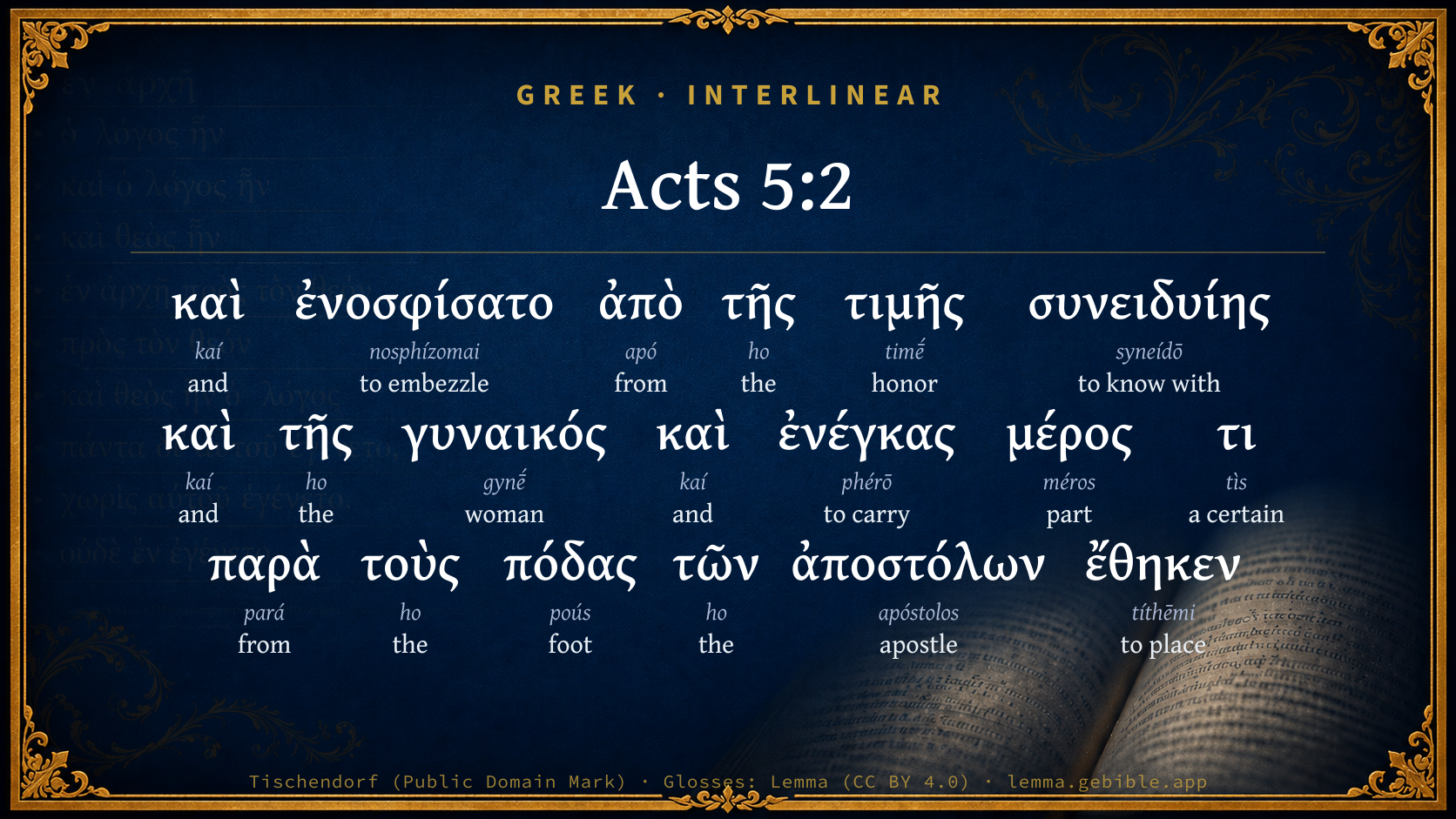
Download image
Cite this verse

Acts 5:2 (World English Bible). Public Domain. Lemma interlinear Bible study tool, https://lemma.gebible.app/v/acts/5/2.

Show BibTeX & RIS
BibTeX
RIS
English Translation
and kept back part of the price, his wife also being aware of it, and brought a certain part, and laid it at the apostles' feet.
World English Bible · Public Domain
Highlights
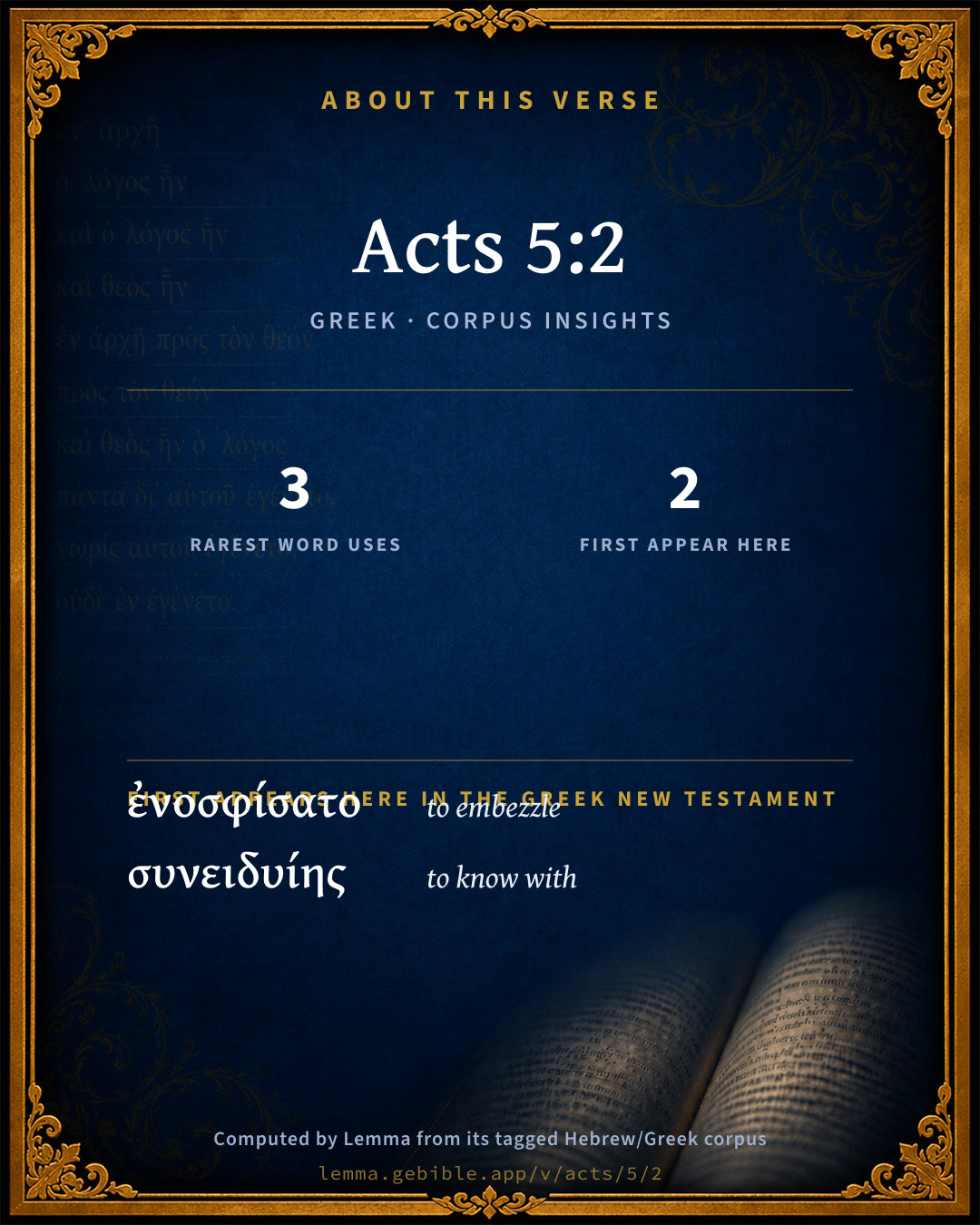
  • 2 first appearances in the Greek New Testament
Full analysis ↓
Download a study sheet

One document with this verse’s original text, its word-by-word gloss line, the meaning frame, cross-references with their text, attributed commentary, and full source and license credits — printable, and it pastes into notes with its structure intact.

This verse Autodidact and up

Study sheet (.html) Plain text (.txt)

A passage Seminary Student

Up to 50 verses in one chapter. A passage sheet keeps up to 6 commentary sources and 12 cross-references per verse, in the order this page ranks them, and says so on the sheet whenever that leaves anything out. Ask for a single verse and you get the Autodidact verse sheet above.

Everything on this page stays free to read, with no account — the sheet is a download of what is already on screen, not access to it.

Want to remove ads? Support Godless Engineer
Compare translations 3

The same verse in 3 English versions, stacked beneath the original-language interlinear above. Click any original word for its lexicon entry.

Each is an independent rendering of the whole verse — the interlinear is not word-aligned to these translations.

Highlighted words mark where these versions differ — a whole-verse word diff, not a word-by-word alignment.

  • World English Bible Public Domain
    and kept back part of the price, his wife also being aware of it, and brought a certain part, and laid it at the apostles' feet.
  • King James Version Public Domain
    And kept back part of the price, his wife also being privy to it, and brought a certain part, and laid it at the apostles' feet.
  • unfoldingWord Literal Text CC BY-SA 4.0
    and he kept back from the price, wife also knowing, and bringing a certain portion, he laid it at the feet of the apostles.

unfoldingWord Literal Text — © unfoldingWord, licensed CC BY-SA 4.0. Word-aligned USFM3 via Door43 (git.door43.org/unfoldingWord/en_ult).

Versions to compare (up to 4)

3 of 4 selected

Show all 19 translations

Every available English version of this verse, each an independent rendering of the whole verse.

  • World English Bible Public Domain
    and kept back part of the price, his wife also being aware of it, and brought a certain part, and laid it at the apostles' feet.
  • Berean Standard Bible Public Domain
    With his wife’s full knowledge, he kept back some of the proceeds for himself, but brought a portion and laid it at the apostles’ feet.
  • Majority Standard Bible Public Domain
    With his wife’s full knowledge, he kept back some of the proceeds for himself, but brought a portion and laid it at the apostles’ feet.
  • King James Version Public Domain
    And kept back part of the price, his wife also being privy to it, and brought a certain part, and laid it at the apostles' feet.
  • American Standard Version (1901) Public Domain
    and kept back `part' of the price, his wife also being privy to it, and brought a certain part, and laid it at the apostles' feet.
  • Revised Version (1885) Public Domain
    and kept back part of the price, his wife also being privy to it, and brought a certain part, and laid it at the apostles’ feet.
  • Geneva Bible (1599) Public Domain
    And kept away part of the price, his wife also being of counsell, and brought a certaine part, and layde it downe at the Apostles feete.
  • Douay-Rheims (1899) Public Domain
    And by fraud kept back part of the price of the land, his wife being privy thereunto: and bringing a certain part of it, laid it at the feet of the apostles.
  • Young's Literal Translation Public Domain
    and did keep back of the price -- his wife also knowing -- and having brought a certain part, at the feet of the apostles he laid `it'.
  • Literal Standard Version CC BY-SA 4.0
    and kept back of the price—his wife also knowing—and having brought a certain part, he laid [it] at the feet of the apostles.
  • Unlocked Literal Bible CC BY-SA 4.0
    and he kept back part of the sale money (his wife also knew it), and brought the other part of it and laid it at the apostles' feet.
  • unfoldingWord Literal Text CC BY-SA 4.0
    and he kept back from the price, wife also knowing, and bringing a certain portion, he laid it at the feet of the apostles.
  • Darby Bible Public Domain
    and put aside for himself part of the price, [his] wife also being privy to it; and having brought a certain part, laid it at the feet of the apostles.
  • World Messianic Bible Public Domain
    and kept back part of the price, his wife also being aware of it, then brought a certain part and laid it at the emissaries’ feet.
  • Webster's Bible Public Domain
    And kept back part of the price, (his wife also being privy to it) and brought a certain part, and laid it at the apostles' feet.
  • Free Bible Version CC BY-SA 4.0
    He kept back some of the money he received for himself, and brought the rest to present to the apostles. His wife knew what he was doing.
  • Bible in Basic English Public Domain
    And kept back part of the price, his wife having knowledge of it, and took the rest and put it at the feet of the Apostles.
  • Text-Critical English NT CC BY 4.0
    and kept back some of the proceeds, with his wife also being aware of it. He brought a portion of the proceeds and laid it at the apostles' feet.
  • Tyndale New Testament (1534) Public Domain
    and kepte awaye parte of the pryce (his wyfe also beynge of counsell) and brought a certayne parte and layde it doune at the Apostles fete.

Literal Standard Version (2020), Covenant Press — licensed CC BY-SA 4.0. Text via the HelloAO Bible API (eBible.org). Unlocked Literal Bible (unfoldingWord) — licensed CC BY-SA 4.0. Text via the HelloAO Bible API (eBible.org). unfoldingWord Literal Text — © unfoldingWord, licensed CC BY-SA 4.0. Word-aligned USFM3 via Door43 (git.door43.org/unfoldingWord/en_ult). Free Bible Version, Dr. Jonathan Gallagher — licensed CC BY-SA 4.0. Text via the HelloAO Bible API (eBible.org).

Word by word

More ways to search: Search by grammar → Find every occurrence → Compare this word →

Practice this passage: Drill this verse → Learn its vocabulary →

ἐνοσφίσατο
nosphízomai
G3557
“to embezzle”
Verb, Aorist, Middle, Indicative, 3rd person, Singular
Part of Speech
Verb
Tense
Aorist
Voice
Middle
Mood
Indicative
Person
3rd person
Number
Singular
Full Thayer's Definition

Origin: middle voice from nosphi (apart or clandestinely)

TDNT: None

1. to set apart, separate, divide 2. to set apart or separate for one's self 3. to purloin, embezzle, withdraw covertly and appropriate to one's own use
  1. καὶ kaí G2532 “and” Conjunction
  2. ἀπὸ apó G575 “from” Preposition
  3. τῆς ho G3588 “the” Article, Genitive, Singular, Feminine
  4. τιμῆς timḗ G5092 “honor” Noun, Genitive, Singular, Feminine
  5. συνειδυίης syneídō G4894 “to know with” Verb, Perfect, Active, Participle, Genitive, Singular, Feminine
  6. καὶ kaí G2532 “and” Conjunction
  7. τῆς ho G3588 “the” Article, Genitive, Singular, Feminine
  8. γυναικός gynḗ G1135 “woman” Noun, Genitive, Singular, Feminine
  9. καὶ kaí G2532 “and” Conjunction
  10. ἐνέγκας phérō G5342 “to carry” Verb, Aorist, Active, Participle, Nominative, Singular, Masculine
  11. μέρος méros G3313 “part” Noun, Accusative, Singular, Neuter
  12. τι tìs G5100 “a certain” Indefinite pronoun, Accusative, Singular, Neuter
  13. παρὰ pará G3844 “from” Preposition
  14. τοὺς ho G3588 “the” Article, Accusative, Plural, Masculine
  15. πόδας poús G4228 “foot” Noun, Accusative, Plural, Masculine
  16. τῶν ho G3588 “the” Article, Genitive, Plural, Masculine
  17. ἀποστόλων apóstolos G652 “apostle” Noun, Genitive, Plural, Masculine
  18. ἔθηκεν títhēmi G5087 “to place” Verb, Aorist, Active, Indicative, 3rd person, Singular

About this verse

These counts appear in no published source. They are computed here, from the morphology-tagged text and Lemma’s own curated glosses. What Lemma adds →

19
words
14
distinct lemmas
Acts
section

Notable vocabulary

The rarest word here is ἐνοσφίσατο to embezzle G3557 — appearing just 3 times in the whole Greek New Testament.

First appearance in Scripture

These words make their first canonical appearance in the Greek New Testament here:

  • ἐνοσφίσατο to embezzle G3557
  • συνειδυίης to know with G4894

Shared distinctive vocabulary

ἐνοσφίσατο to embezzle G3557 occurs in 3 verses of the Greek New Testament. Also found in:
Repetition

Words recur within this verse:

Cross-references

13

Topical passages linked to Acts 5:2 in the Treasury of Scripture Knowledge — connected by theme and wording, ordered by reader-vote popularity; previews shown in the World English Bible.

  • Acts 4:37 having a field, sold it, and brought the money and laid it at the apostles' feet.
  • 2 Peter 2:14–15 having eyes full of adultery, and who can't cease from sin; enticing unsettled souls; having a heart trained in greed; children of cursing;
  • Joshua 7:11–12 Israel has sinned; yes, they have even transgressed my covenant which I commanded them: yes, they have even taken of the devoted thing, and have also stolen, and dissembled also; and they have even put it among their own stuff.
  • 2 Kings 5:21–25 So Gehazi followed after Naaman. When Naaman saw one running after him, he alighted from the chariot to meet him, and said, Is all well?
  • Malachi 1:14 "But the deceiver is cursed, who has in his flock a male, and vows, and sacrifices to the Lord a blemished thing; for I am a great King," says Yahweh of hosts, "and my name is awesome among the nations."
  • Malachi 3:8–9 Will a man rob God? Yet you rob me! But you say, 'How have we robbed you?' In tithes and offerings.
  • Matthew 6:2–3 Therefore when you do merciful deeds, don't sound a trumpet before yourself, as the hypocrites do in the synagogues and in the streets, that they may get glory from men. Most assuredly I tell you, they have received their reward.
  • Matthew 23:5 But all their works they do to be seen by men. They make their phylacteries broad, enlarge the fringes of their garments,
  • John 12:6 Now he said this, not because he cared for the poor, but because he was a thief, and having the money box, used to steal what was put into it.
  • Acts 4:34–35 For neither was there among them any who lacked, for as many as were owners of lands or houses sold them, and brought the proceeds of the things that were sold,
  • Acts 5:3 But Peter said, "Ananias, why has Satan filled your heart to lie to the Holy Spirit, and to keep back part of the price of the land?
  • Philippians 2:3 doing nothing through rivalry or through conceit, but in humility, each counting others better than himself;
  • 1 Timothy 6:10 For the love of money is a root of all kinds of evil. Some have been led astray from the faith in their greed, and have pierced themselves through with many sorrows.

Cross-references courtesy of OpenBible.info (CC BY 4.0).

Commentary

Notes on Acts 5:2 from classic Christian and Jewish commentators (each source and its license shown beneath its notes). The classic Christian expositions comment on the surrounding passage and are grouped to its opening verse, so a note may address several verses; the Jewish commentaries on the Tanakh (Rashi and others) are per-verse, so they appear only where the commentator wrote on this verse.

Lemma curates 59 commentaries, every one of them public domain or Creative Commons licensed, each selected and text-cleaned for this edition rather than reprinted as found. About our sources →

The Biblical Illustrator

Joseph S. Exell

Act_5:2

And kept back part of the price.

The sin of pretence and its punishment

They desired to have all the credit the Church would give them for acting as generously as Barnabas did, and yet, while getting credit for unselfish and unstinting liberality, to be able to enjoy in private somewhat of that which they were believed to have surrendered. And their calculations were terribly disappointed. They tried to play the hypocrites part on most dangerous ground, just when the Divine spirit of purity, sincerity, and truth had been abundantly poured out, and when the spirit of deceit and hypocrisy was therefore at once recognised. It was with the apostles and their spiritual natures then as it is with ourselves and our physical natures still. When we are living in a crowded city we notice not strange scents and ill odours and foul gases; our senses are dulled, and our perceptive powers are rendered obtuse because the whole atmosphere is a tainted one. But when we dwell in the pure air of the country, and the glorious breezes from mountain and moor blow round us fresh and free, then we detect at once, and at a long distance, the slightest ill odour or the least trace of offensive gas. The outpoured presence of the Spirit, and the abounding love which was produced thereby, quickened the perception of St. Peter. He recognised the hypocrisy, characterised the sin of Ananias as a lie against the Holy Ghost; and then the Spirit and Giver of life, seconding and supporting the words of St. Peter, withdrew His support from the human frame of the sinner, and Ananias ceased to live, just as Sapphira, his partner in deceit, ceased to live a few hours later. It may well have been that this incident was inserted in this typical Church history to correct a false idea which would otherwise have grown up. The apostles and their followers were now realising their freedom in the spirit; and some were inclined to run into licentiousness as the result of that freedom. They were realising, too, their relationship to God as one of pure filial love, and they were in great danger of forgetting that God was a God of justice and judgment as well, till this stern dispensation recalled them to a sense of the fact that eternal love is also eternal purity and eternal truth, and will by no means clear the guilty. (G. T. Stokes, D. D.)

The nature of the sin

That it was simply the sin of lying, is impossible to believe. He who calmly told them of their instant fate had himself lied most foully, and been forgiven. It is more plausible to maintain that their sin was something far worse than mere falsehood--that it was hypocrisy of the lowest type--that they could not endure to lack the praise of the noblest Christian conduct, or to make the necessary sacrifices--that they schemed to be considered the best, whilst they were, and knew that they were, very far below the best. All this is true and terrible, but does not satisfy us as an explanation of their awful end. I venture to suggest that Ananias and Sapphira suffered the extreme penalty, not as sinners, but as criminals; not in revenge for a flagrant insult offered to the Almighty, but as the due reward for a frightful wrong inflicted upon their fellowmen; not to accentuate the hideousness of a sin (for which purpose it had been unneeded and ineffective), but to mark the enormity of a crime which blasted the fairest prospect ever opened before the sons of men. It seems to me that they suffered death just as the dynamitards ought to suffer death, because in the recklessness of political hatred they destroy the lives of innocent people. Their crime was beyond all possible reach of human justice, therefore God Himself intervened to mark for once and all how great a crime, how vast a wrong they had committed in the sight of Heaven. Of what, then, were they guilty? What did they do? Before the deceit of Ananias and Sapphira communism was the rule within the Christian fold. It was practised freely as a natural, nay, a necessary part of a whole-hearted following after Christ. After the deceit of Ananias and Sapphira communism ceased to be the rule--apparently it ceased to exist. In the very next chapter we find, not communism, but charity, with all its paltry greeds and grudges. Why was this? What became of the communism? I say that Ananias and his wife killed it. Such a state of things depends essentially upon mutual confidence, and they killed that confidence. The fatal blow had been given: and what had been an actual working system, perfect in its principle, and boundless in its promise, faded at once into a beautiful dream Co-operation in the labours of life does very well for beavers, for they do not deceive one another, nor does one desire to grow fat at his neighbours expense, neither does another wish to take credit for having done what he has not really done. Why cannot Christian men he as true to one another, and to the society of which they form a part, as beavers? Ask Ananias and Sapphira. Before they began, there were no suspicions, no grudgings, no wealth, and no poverty, neither was there any among them that lacked. When they had ended there were rich and poor, there was a murmuring of one class against another, there was the foretaste of those monstrous evils which we deplore to-day. They only told a lie, but that lie gave a mortal blow to the mutual confidence on which any system of communism has to rest. If it is only to-day that we are beginning to face the social problems of advanced civilisation in their naked ugliness, if it is only to-day that we are in a position to estimate the results of unlimited competition, and the reign of universal greed; if it is only to-day that we are becoming thoroughly frightened at the hideous contrast between the professed principles and the existing facts of Christian society; it is for this very reason only to-day that we are able to appreciate the true moral of that tremendous and unexampled judgment. The socialism of the first believers was the fairest work of the Holy Ghost--it was the truest following after Christ--it was the loftiest faith and the broadest charity translated into that simple language of everyday life, which must be read and loved of all men. The Magnificat is the inspired hymn of gospel communism, it is the Marseillaise of the Christian socialist. Striking at once to the heart of the matter, rising at once to the principle of the new order, forestalling (like all inspired strains) the end from the beginning, it pronounces without mitigation, it exults without qualification, that He hath put down the mighty, etc. (R. Winterbotham, M. A.)

Making gain out of a pretence of godliness

When Nineveh was burned under Sardanapalus, great quantities of treasure were known to bare fallen into the fiery ruins. Belesis, governor of Babylon, had been one of the conspirators against the dead king, and was aware of all the circumstances of the sack of the city. He told the other generals that in the midst of the fight he had at one time despaired of success, and then he had solemnly sworn to the immortal gods that, if victory were vouchsafed him, he would convey bodily all the ashes of the conflagration to Babylon, and deposit them in a vast temple which he would erect to receive them in honour of the propitious deities: he added that his tender conscience would not permit him to delay the fulfilment of his vow. No one could object to so pious a proposal; so Belesis set the whole army at work to gather up the remains of the fire. When the valuable mass reached Babylon he smelted the heaps in great furnaces, and enriched himself to a fabulous amount with the gold and silver that came forth. This he had understood all along; but he was neither the first nor the last man who has put forward his conscience to make gain out of godliness with a villainous deceit. (C. S. Robinson, D. D.)

Keeping back the price

We read in French history that Louis XI. once proffered the entire department of Bologne to the Blessed Virgin Mary. He drew up a deed, signed, sealed; he delivered it to the proper ecclesiastics of the Church. But with a peculiar perversity he kept all the revenues and taxes, appointing every year new collectors who might secure the income rigidly for himself without any peril of being tampered with by the priests. (C. S. Robinson, D. D.)

The Biblical Illustrator, edited by Joseph S. Exell (c. 1880s–1900s) — public domain. Text from a community e-Sword module.

Bengel's Gnomon

Johann Albrecht Bengel

Act 5:2. Ἐνοσφίσατο, he fraudulently kept back) The sin of Achan and that of Ananias were in many respects similar, at the beginning of the churches of the Old and New Testament respectively; and the same verb, ἐνοσφίσατο, fraudulently appropriated or kept, is used of Achan, in Jos 7:1. The former, however, in the Old Testament, according to the direction of God, was killed by the hand of men; the latter, in the New Testament, by the Divine hand, at the word of the apostle. The sin of Judas also was similar to that of Ananias.—ἀπὸ τῆς τιμῆς, of the price) These two seem not to have believed that Christianity would last long.—συνειδυίας, being conscious of it) They sinned the more grievously, since they might have mutually dissuaded one another from the sin.—ἐνέγκας μέρος τὶ, having brought a certain part) just as if it were the whole. Ananias however had wished to seem to have brought the whole: therefore he had not kept back much.

Bengel's Gnomon of the New Testament — English translation (T&T Clark, Edinburgh, 1860) — public domain. Text from a community e-Sword module.

Expositor's Greek Testament

ed. W. Robertson Nicoll

Act 5:2 . ἐνοσφίσατο : may merely mean from its derivation, to set apart νόσφι . But both in LXX and N.T. it is used in a bad sense of appropriating for one’s own benefit, purloining, Jos 7:1 , of Achan, 2Ma 4:32 , so here and in Act 5:3 , and Tit 2:10 , cf. also a similar use of the word in Jos., Ant. , iv., 8, 29 (so in Greek authors, Xen., Polyb., Plut.). ἀπό : the same combination in Jos 7:1 ( cf. Act 2:17 above, ἐκχεῶ ἀπό , cf. Hebrew מִן . See Bengel’s note, in loco , on the sin of Achan and Ananias). συνειδυίης : it was thus a deliberate and aggravated offence. On the irregular form, instead of - υιας , cf. the LXX, Exo 8:21 ; Exo 8:24 , 1Sa 25:20 ; and see also Winer-Schmiedel, p. 81, note, and Blass on instances from the papyri, in loco . παρὰ τοὺς πόδας : a further aggravation (Act 4:35 ), since the money was brought ostentatiously to gain a reputation for the donors. Blass well comments: “in conventu ecclesiæ hoc liberalitatis documentum editum”; cf. Calvin, who in marking the ambition of Ananias to gain a reputation for liberality adds: “ita fit ut pedes Apostolorum magis honoret quam Dei oculos”.

The Expositor's Greek Testament, edited by W. Robertson Nicoll (1897–1910) — public domain. Text from a community e-Sword module.

Geneva Bible (1599)

Geneva Bible translators

Craftily took away.

Geneva Bible (1599) marginal notes — public domain. Text via Bolls.life.

Adam Clarke's Commentary

Verse 2. Kept back part of the price] Ananias and Sapphira were evidently persons who professed faith in Christ with the rest of the disciples. While all were making sacrifices for the present necessity, they came forward among the rest, pretending to bring all the money they had got for a possession, κτημα, (of what kind we know not,) which they had sold. A part of this price, however, they kept back, not being willing to trust entirely to the bounty of Providence, as the others did; thinking probably, that, as the whole was their own, they had a right to do with it as they pleased. And so they had: they were under no necessity to sell their possession; but the act of selling it for the ostensible purpose of bringing it into the common stock, left them no farther control over it, nor property in it; and their pretense, that the money which they brought was the whole produce of the sale, was a direct lie in itself, and an attempt to deceive the Holy Spirit, under whose influence they pretended to act. This constituted the iniquity of their sin.

Adam Clarke's Commentary on the Bible (1810–1826) — public domain. Text from a community e-Sword/MySword module.

Ellicott's Commentary for English Readers

(2) And kept back part of the price.—The mere act of keeping back would not in itself have been sinful. The money was his own, to give the whole or part (Act_5:4). But the formal act, apparently reproducing that of Barnabas, was an acted lie. The part was offered as if it were the whole. The word for “kept back” is rendered “purloining” in Tit_2:10, and always carried with it the idea of stealthy and dishonest appropriation. It is used in the LXX. of Jos_7:1, as describing the sin of Achan.

A Bible Commentary for English Readers, edited by Charles John Ellicott (1878–1897) — public domain. Text from a community e-Sword module.

The Cambridge Bible for Schools and Colleges

gen. ed. J. J. S. Perowne

2. and kept back part of the price] i.e. while at the same time they professed to be bringing the whole sum into the common fund. The portion which was kept back was probably not large, for otherwise the general sense of the value of the land would have made it conspicuous. The word translated “kept back” is the same which is rendered Tit_2:10 purloining, and in classical Greek it has frequently the meaning to rob.

his wife also being privy to it] This is mentioned to shew that the offence was an aggravated one, and had not been committed without deliberation and set purpose. She was a willing accomplice in the intended fraud.

and brought a certain part, and laid it at the apostles’ feet] Thus professing equal devotion with all the others who were making sacrifices for the cause of the faith. We are not told what they hoped to gain by their act, whether in reputation among the people (Act_2:47), or, by giving what was supposed to be their whole estate (which may be implied in the vague word possession), to procure for themselves in perpetuity a maintenance from the common funds. The former ambition was most probably what led to their offence. They thought more of the display made at the Apostles’ feet than of the offence before God’s eyes. And we know from St Peter’s Epistle (2Pe_2:3) that it was soon foretold that men would arise in the Christian community, who “through covetousness would with feigned words make merchandise of” the society, and at a later date (Judges 11), these men are described as those who run “greedily after the error of Balaam for reward.” We may therefore be convinced that in the example of Ananias we have a typical instance of the kind of offence into which at this time the Christian community was in danger of being tempted.

The Cambridge Bible for Schools and Colleges (gen. ed. J. J. S. Perowne; Cambridge University Press, 1878–1918) — public domain. Text from a community e-Sword module.

John Gill's Exposition

And kept back part of the price,.... At which the possession was sold; he reserved it for his own use, after he had given out that he sold it for the service of the church:

his wife also being privy to it; to this private reserve:

and brought a certain part; whether the greater part, or an equal part, half of it, or a lesser part; some little part of it, so the phrase seems to signify, is not certain:

and laid it at the apostles' feet; as the rest did, thereby to make a show of charity, and cover the deceit.

John Gill's Exposition of the Whole Bible (1746–1763) — public domain (CC PDM 1.0). Text via the HelloAO Bible API.

Trapp's Complete Commentary

John Trapp

2 And kept back part of the price, his wife also being privy to it, and brought a certain part, and laid it at the apostles’ feet.

Ver. 2. And kept back part] Interverted, ενοσφισατο, purloined, nimmed it away. Here was a concurrence of hypocrisy, sacrilege, diffidence, and ambition; for he would be thought as good as the best, and therefore laid that he brought at the apostles’ feet, &c. Hypocrites shall be uncased; no goat in a sheepskin shall steal on Christ’s right hand at the last day.

John Trapp, A Commentary or Exposition upon All the Books of the Old and New Testament (1647–1656) — public domain. Text from a community e-Sword module.

Albert Barnes' Notes on the Bible

And kept back - The word used here means properly “to separate, to part:” and then it means to “separate surreptitiously or clandestinely for our own use” a part of public property, as taxes, etc. It is used but three times in the New Testament, Act 5:3, and in Tit 2:10, where it is rendered “purloining.” Here it means that they “secretly” kept back a part, while “professedly” devoting all to God.

His wife also being privy to it - His wife “knowing it,” and evidently concurring in it.

And laid it at the apostles’ feet - This was evidently an act professedly of devoting all to God. Compare Act 4:37; also Act 5:8-9. That this was his “profession,” or “pretence,” is further implied in the fact that Peter charges him with having “lied” unto God, Act 5:3-4.

Albert Barnes' Notes on the Bible (1834–1885) — public domain. Text from a community e-Sword/MySword module.

Haydock's Catholic Bible Commentary

By fraud kept part.[1] Ananias, and his wife Saphira, had make a promise or vow, to put into the common stock the price of what they had to sell. When they had sold the field, they resolved by mutual consent to keep for their private use part of the money, and to bring in the rest, as if they had received no more. The whole price being promised, and by that means consecrated to God, St. Augustine calls it a sacrilegious fraud, and St. John Chrysostom, a theft of what was already made sacred to God. (Witham)

===============================

[BIBLIOGRAPHY]

Defraudavit, Greek: enosphisato. Intervertit aliquid de pretio. St. Augustine, serm. xxvii. de verbis apostoli. Sacrilegii damnatur, & fraudis. See. St. John Chrysostom, hom xii. in Acta.

George Leo Haydock (1774–1849), Haydock's Catholic Family Bible and Commentary, 1859 edition — public domain. Excludes Psalms (Douay-Rheims chapter numbering differs from Protestant) and Deuterocanonical books (Catholic canon only).

Matthew Poole's English Annotations

Kept back part of the price, when they had vowed the whole to God and his service, which made it a robbing of God, whatsoever pretence they might possibly have of detaining some part for their own necessities in old age, or time of sickness; arguing a great distrust in that God, whom, when they had made their vow, they pretended to give themselves and their substance unto.

His wife also being privy to it; her subjection to her husband not excusing her partaking in his sin and punishment.

Brought a certain part; their ambition carried them thus far, they would seem devout, charitable, &c., and their covetousness hindered them from going farther.

Laid it at the apostles’ feet: see Act 4:35.

Matthew Poole's English Annotations on the Holy Bible (1683–1685) — public domain. Text from a community e-Sword/MySword module.

Whedon's Commentary on the Bible

Daniel D. Whedon

2. Brought—It would seem that the money was brought and presented to the apostles in the meeting-room (note Act_2:2) of the church. Yet the three hours of Act_5:7 presuppose a lengthened stay at the place.

Daniel D. Whedon (gen. ed.), Commentary on the Old and New Testaments (1874–1909) — public domain. Text from a community e-Sword module.

John Wesley's Explanatory Notes

And bringing a certain part - As if it had been the whole: perhaps saying it was so.

John Wesley, Explanatory Notes Upon the Whole Bible (1754–1765) — public domain. Text via the GEBible commentary corpus.

McGarvey & Pendleton's Commentaries

J. W. McGarvey

See notes on verse 1

J. W. McGarvey (with Philip Y. Pendleton), Commentaries on the New Testament (The Fourfold Gospel, 1914; Acts; and the epistles) — public domain. Text from a community e-Sword/MySword module.

The People's New Testament

B. W. Johnson

2. Kept back part of the price. Like many others, of their own accord they sold a possession for the benefit of the church. They were not compelled to sell it, or when sold to give the money, or to give all. Their sin was not withholding a part, but lying about it. (1) They gave from the wrong motives, not for the Lord, but for human praise. (2) There was hypocrisy and falsehood. His wife being privy to it. Hence equally guilty. There was a guilty conspiracy between them. Brought a certain part. Pretending it was all. His was a deliberate, public lie.

B. W. Johnson's The People's New Testament with Notes (1889–1891) — public domain. Electronic text from the Christian Classics Ethereal Library (CCEL) ThML edition.

Cambridge Greek Testament for Schools and Colleges

2. αὐτοῦ omitted with אABD.

2. ἐνοσφίσατο, kept back, withheld, bringing only a part and pretending it was the whole. The portion withheld can hardly have been large, or the disproportion between what was offered and the value of the property sold and represented as sacrificed to the common cause would have been too apparent. νοσφίζομαι is rendered (Tit 2:10) to purloin, and is used 2Ma 4:32 of the golden vessels which Menelaus stole. It has the stronger sense constantly in classical Greek.

συνειδυίης, being privy to it. This is mentioned to shew that the offence was an aggravated one, and had not been committed without deliberation and set purpose. She was a willing accomplice in the intended fraud.

παρὰ τοὺς πόδας … ἔθηκεν. Thus professing equal devotion with all the others who were making sacrifices for the cause of the faith. We are not told what Ananias and his wife hoped to gain by their act, whether in reputation among the people (Act 2:47), or, by giving what was supposed to be their whole estate (which may be implied in the vague word possession), to procure for themselves in perpetuity a maintenance from the common funds. The former ambition was most probably what led to their offence. They thought more of the display made at the Apostles’ feet than of the offence before God’s eyes. And we know from St Peter’s Epistle (2Pe 2:3) that it was soon foretold that men would arise in the Christian community who ‘through covetousness would with feigned words make merchandise of’ the society, and at a later date (Jud 1:11) these men are described as those who run ‘greedily after the error of Balaam for reward.’ We may therefore be convinced that in the example of Ananias we have a typical instance of the kind of offence into which at this time the Christian community was in danger of being tempted.

Cambridge Greek Testament for Schools and Colleges (Cambridge University Press, 1896; 21 vols, various authors incl. Carr, Maclear, Plummer, Farrar, Lumby, Moule, M. R. James, Simcox) — public domain. Text from a community e-Sword module.

Vincent's Word Studies in the New Testament

Marvin R. Vincent

Kept back [ενοσφισατο] . Only here, ver. 3, and Tit 2:10, where it is rendered purloining. From nosfi, aloof, apart. The verb means to set apart for one's self; hence to appropriate wrongfully.

Marvin R. Vincent, Word Studies in the New Testament (1887–1900) — public domain. Text from a community e-Sword/MySword module.

Lesson kit

Teaching starters — assembled from the data on this page, not authored interpretation. Every prompt links to the verse data it draws on. Edit before teaching.

Acts, in the Acts, opens this verse with 19 words (14 distinct Greek lemmas). Its most distinctive word is nosphízomai (“to embezzle”). A historical commentator’s framing appears above. Read the whole chapter for the surrounding context.

Discussion questions

  1. How does “to embezzle” (nosphízomai) shape what this verse is saying?
  2. 2 words here appear for the first time in Scripture. What is being introduced at this debut?
  3. Acts 5:3 shares the word «to embezzle» with this verse. How do the two illuminate each other?
  4. “the” occurs 4× in this one verse. What is the effect of the repetition?
  5. These translations render this verse differently; the difference is in the English rendering, not the original. What questions does that raise?
  6. Reading how The Biblical Illustrator and Bengel's Gnomon read this verse, where do the two commentators agree and where do they part?

Things to notice

  • 2 words make their first canonical appearance in Scripture here.
  • These translations choose different wording for 8 words in this verse.
  • “the” occurs 4× in this single verse.
  • 14 distinct Greek lemmas span 19 words in this verse.

Reading settings

Reading text

Shown beneath each verse's original-language words.

Old Testament
Old Testament edition

Read the OT as the Masoretic Hebrew (MT) or the Greek Septuagint (LXX).

English shown for the Greek Septuagint (in the Hebrew ↔ Greek comparison).

Comparing translations? Open the Compare panel on any verse page to stack up to four side by side.