Revelation 12:6

Greek (Tischendorf 8th ed.) Revelation 12:6 appears in the Greek New Testament. The text above is from the Tischendorf 8th edition. Each word links to its Strong’s number and a concise gloss. Click any word for its full Thayer’s Greek Lexicon entry.
Download image
Cite this verse

Revelation 12:6 (World English Bible). Public Domain. Lemma interlinear Bible study tool, https://lemma.gebible.app/v/revelation/12/6.

Show BibTeX & RIS
BibTeX
RIS
English Translation
The woman fled into the wilderness, where she has a place prepared by God, that there they may nourish her one thousand two hundred sixty days.
World English Bible · Public Domain
Download a study sheet

One document with this verse’s original text, its word-by-word gloss line, the meaning frame, cross-references with their text, attributed commentary, and full source and license credits — printable, and it pastes into notes with its structure intact.

This verse Autodidact and up

Study sheet (.html) Plain text (.txt)

A passage Seminary Student

Up to 50 verses in one chapter. A passage sheet keeps up to 6 commentary sources and 12 cross-references per verse, in the order this page ranks them, and says so on the sheet whenever that leaves anything out. Ask for a single verse and you get the Autodidact verse sheet above.

Everything on this page stays free to read, with no account — the sheet is a download of what is already on screen, not access to it.

Want to remove ads? Support Godless Engineer
Compare translations 3

The same verse in 3 English versions, stacked beneath the original-language interlinear above. Click any original word for its lexicon entry.

Each is an independent rendering of the whole verse — the interlinear is not word-aligned to these translations.

Highlighted words mark where these versions differ — a whole-verse word diff, not a word-by-word alignment.

  • World English Bible Public Domain
    The woman fled into the wilderness, where she has a place prepared by God, that there they may nourish her one thousand two hundred sixty days.
  • King James Version Public Domain
    And the woman fled into the wilderness, where she hath a place prepared of God, that they should feed her there a thousand two hundred and threescore days.
  • unfoldingWord Literal Text CC BY-SA 4.0
    and the woman fled into the wilderness, where she has a place prepared by God there so that they might nourish her there for 1,260 days.

unfoldingWord Literal Text — © unfoldingWord, licensed CC BY-SA 4.0. Word-aligned USFM3 via Door43 (git.door43.org/unfoldingWord/en_ult).

Versions to compare (up to 4)

3 of 4 selected

Show all 19 translations

Every available English version of this verse, each an independent rendering of the whole verse.

  • World English Bible Public Domain
    The woman fled into the wilderness, where she has a place prepared by God, that there they may nourish her one thousand two hundred sixty days.
  • Berean Standard Bible Public Domain
    And the woman fled into the wilderness, where God had prepared a place for her to be nourished for 1,260 days.
  • Majority Standard Bible Public Domain
    And the woman fled into the wilderness, where God had prepared a place for her to be nourished for 1,260 days.
  • King James Version Public Domain
    And the woman fled into the wilderness, where she hath a place prepared of God, that they should feed her there a thousand two hundred and threescore days.
  • American Standard Version (1901) Public Domain
    And the woman fled into the wilderness, where she hath a place prepared of God, that there they may nourish her a thousand two hundred and threescore days.
  • Revised Version (1885) Public Domain
    And the woman fled into the wilderness, where she hath a place prepared of God, that there they may nourish her a thousand two hundred and threescore days.
  • Geneva Bible (1599) Public Domain
    And the woman fled into wildernes where she hath a place prepared of God, that they should feede her there a thousande, two hundreth and three score dayes.
  • Douay-Rheims (1899) Public Domain
    And the woman fled into the wilderness, where she had a place prepared by God, that there they should feed her a thousand two hundred sixty days.
  • Young's Literal Translation Public Domain
    and the woman did flee to the wilderness, where she hath a place made ready from God, that there they may nourish her -- days a thousand, two hundred, sixty.
  • Literal Standard Version CC BY-SA 4.0
    and the woman fled into the wilderness, where she has a place made ready from God, that there they may nourish her—one thousand, two hundred, sixty days.
  • Unlocked Literal Bible CC BY-SA 4.0
    and the woman fled into the wilderness, where God had prepared a place for her, so she could be taken care of for 1,260 days.
  • unfoldingWord Literal Text CC BY-SA 4.0
    and the woman fled into the wilderness, where she has a place prepared by God there so that they might nourish her there for 1,260 days.
  • Darby Bible Public Domain
    And the woman fled into the wilderness, where she has there a place prepared of God, that they should nourish her there a thousand two hundred [and] sixty days.
  • World Messianic Bible Public Domain
    The woman fled into the wilderness, where she has a place prepared by God, that there they may nourish her one thousand two hundred sixty days.
  • Webster's Bible Public Domain
    And the woman fled into the wilderness, where she hath a place prepared by God, that they should feed her there a thousand two hundred and sixty days.
  • Free Bible Version CC BY-SA 4.0
    The woman ran away into the desert, where God had prepared a place for her, so that she could be looked after for 1,260 days.
  • Bible in Basic English Public Domain
    And the woman went in flight to the waste land, where she has a place made ready by God, so that there they may give her food a thousand, two hundred and sixty days.
  • Text-Critical English NT CC BY 4.0
    And the woman fled into the wilderness, where God had a place prepared for her to be nourished for one thousand two hundred sixty days.
  • Tyndale New Testament (1534) Public Domain
    And the woman fleed into wyldernes where she had a place prepared of god that they shulde fede her there a M..ii.C and lx. dayes.

Literal Standard Version (2020), Covenant Press — licensed CC BY-SA 4.0. Text via the HelloAO Bible API (eBible.org). Unlocked Literal Bible (unfoldingWord) — licensed CC BY-SA 4.0. Text via the HelloAO Bible API (eBible.org). unfoldingWord Literal Text — © unfoldingWord, licensed CC BY-SA 4.0. Word-aligned USFM3 via Door43 (git.door43.org/unfoldingWord/en_ult). Free Bible Version, Dr. Jonathan Gallagher — licensed CC BY-SA 4.0. Text via the HelloAO Bible API (eBible.org).

Word by word

More ways to search: Search by grammar → Find every occurrence → Compare this word →

Practice this passage: Drill this verse → Learn its vocabulary →

τρέφουσιν
tréphō
G5142
“to nourish”
Verb, Present, Active, Indicative, 3rd person, Singular
Part of Speech
Verb
Tense
Present
Voice
Active
Mood
Indicative
Person
3rd person
Number
Singular
Full Thayer's Definition

Origin: a primary verb (properly, threpho

TDNT: but perhaps strength. from the base of 5157 through the idea of convolution)

1. to nourish, support 2. feed 3. to give suck, to fatten 4. to bring up, nurture
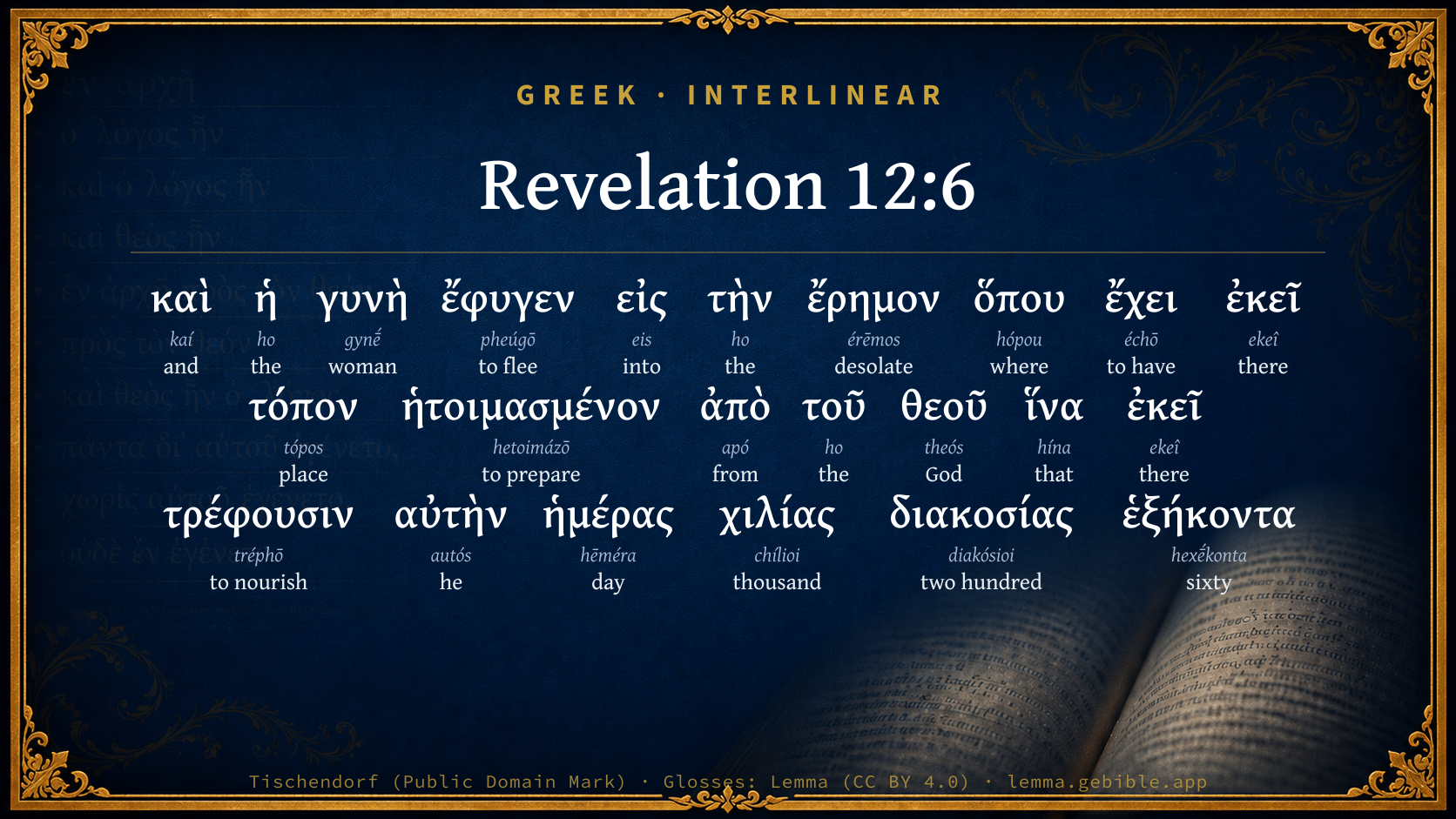
  1. καὶ kaí G2532 “and” Conjunction
  2. ἡ ho G3588 “the” Article, Nominative, Singular, Feminine
  3. γυνὴ gynḗ G1135 “woman” Noun, Nominative, Singular, Feminine
  4. ἔφυγεν pheúgō G5343 “to flee” Verb, Aorist, Active, Indicative, 3rd person, Singular
  5. εἰς eis G1519 “into” Preposition
  6. τὴν ho G3588 “the” Article, Accusative, Singular, Feminine
  7. ἔρημον érēmos G2048 “desolate” Adjective, Accusative, Singular, Feminine
  8. ὅπου hópou G3699 “where” Adverb
  9. ἔχει échō G2192 “to have” Verb, Present, Active, Indicative, 3rd person, Singular
  10. ἐκεῖ ekeî G1563 “there” Adverb
  11. τόπον tópos G5117 “place” Noun, Accusative, Singular, Masculine
  12. ἡτοιμασμένον hetoimázō G2090 “to prepare” Verb, Perfect, Passive, Participle, Accusative, Singular, Masculine
  13. ἀπὸ apó G575 “from” Preposition
  14. τοῦ ho G3588 “the” Article, Genitive, Singular, Masculine
  15. θεοῦ theós G2316 “God” Noun, Genitive, Singular, Masculine
  16. ἵνα hína G2443 “that” Conjunction
  17. ἐκεῖ ekeî G1563 “there” Adverb
  18. αὐτὴν autós G846 “he” Personal pronoun, Accusative, Singular, Feminine
  19. ἡμέρας hēméra G2250 “day” Noun, Accusative, Plural, Feminine
  20. χιλίας chílioi G5507 “thousand” Adjective, Accusative, Plural, Feminine
  21. διακοσίας diakósioi G1250 “two hundred” Adjective, Accusative, Plural, Feminine
  22. ἑξήκοντα hexḗkonta G1835 “sixty” Adjective, Numeral (indeclinable)

About this verse

These counts appear in no published source. They are computed here, from the morphology-tagged text and Lemma’s own curated glosses. What Lemma adds →

23
words
20
distinct lemmas
Revelation
section

Notable vocabulary

The rarest word here is τρέφουσιν to nourish G5142 — appearing just 8 times in the whole Greek New Testament.

Shared distinctive vocabulary

τρέφουσιν to nourish G5142 occurs in 8 verses of the Greek New Testament. Also found in:

Repetition

Words recur within this verse:

Cross-references

8

Topical passages linked to Revelation 12:6 in the Treasury of Scripture Knowledge — connected by theme and wording, ordered by reader-vote popularity; previews shown in the World English Bible.

  • Revelation 11:2–3 Leave out the court which is outside of the temple, and don't measure it, for it has been given to the gentiles. They will tread the holy city under foot for forty-two months.
  • Revelation 13:5 A mouth speaking great things and blasphemy was given to him. Authority to make war for forty-two months was given to him.
  • Revelation 12:14 Two wings of the great eagle were given to the woman, that she might fly into the wilderness to her place, so that she might be nourished for a time, and times, and half a time, from the face of the serpent.
  • 1 Kings 17:3–6 Get you hence, and turn you eastward, and hide yourself by the brook Cherith, that is before the Jordan.
  • Revelation 12:4 His tail drew one third of the stars of the sky, and threw them to the earth. The dragon stood before the woman who was about to give birth, so that when she gave birth he might devour her child.
  • 1 Kings 19:4–8 But he himself went a day's journey into the wilderness, and came and sat down under a juniper tree: and he requested for himself that he might die, and said, It is enough; now, O Yahweh, take away my life; for I am not better than my fathers.
  • Matthew 4:11 Then the devil left him, and behold, angels came and ministered to him.
  • 1 Kings 17:9–16 Arise, get you to Zarephath, which belongs to Sidon, and dwell there: behold, I have commanded a widow there to sustain you.

Cross-references courtesy of OpenBible.info (CC BY 4.0).

Commentary

Notes on Revelation 12:6 from classic Christian and Jewish commentators (each source and its license shown beneath its notes). The classic Christian expositions comment on the surrounding passage and are grouped to its opening verse, so a note may address several verses; the Jewish commentaries on the Tanakh (Rashi and others) are per-verse, so they appear only where the commentator wrote on this verse.

Lemma curates 59 commentaries, every one of them public domain or Creative Commons licensed, each selected and text-cleaned for this edition rather than reprinted as found. About our sources →

Jamieson, Fausset & Brown

Robert Jamieson, A. R. Fausset & David Brown

woman fled--Mary's flight with Jesus into Egypt is a type of this.

where she hath--So C reads. But A and B add "there."

a place--that portion of the heathen world which has received Christianity professedly, namely, mainly the fourth kingdom, having its seat in the modern Babylon, Rome, implying that all the heathen world would not be Christianized in the present order of things.

prepared of God--literally, "from God." Not by human caprice or fear, but by the determined counsel and foreknowledge of God, the woman, the Church, fled into the wilderness.

they should feed her--Greek, "nourish her." Indefinite for, "she should be fed." The heathen world, the wilderness, could not nourish the Church, but only afford her an outward shelter. Here, as in Dan 4:26, and elsewhere, the third person plural refers to the heavenly powers who minister from God nourishment to the Church. As Israel had its time of first bridal love, on its first going out of Egypt into the wilderness, so the Christian Church's wilderness-time of first love was the apostolic age, when it was separate from the Egypt of this world, having no city here, but seeking one to come; having only a place in the wilderness prepared of God (Rev 12:6, Rev 12:14). The harlot takes the world city as her own, even as Cain was the first builder of a city, whereas the believing patriarchs lived in tents. Then apostate Israel was the harlot and the young Christian Church the woman; but soon spiritual fornication crept in, and the Church in the seventeenth chapter is no longer the woman, but the harlot, the great Babylon, which, however, has in it hidden the true people of God (Rev 18:4). The deeper the Church penetrated into heathendom, the more she herself became heathenish. Instead of overcoming, she was overcome by the world [AUBERLEN]. Thus, the woman is "the one inseparable Church of the Old and New Testament" [HENGSTENBERG], the stock of the Christian Church being Israel (Christ and His apostles being Jews), on which the Gentile believers have been grafted, and into which Israel, on her conversion, shall be grafted, as into her own olive tree. During the whole Church-historic period, or "times of the Gentiles," wherein "Jerusalem is trodden down of the Gentiles," there is no believing Jewish Church, and therefore, only the Christian Church can be "the woman." At the same time there is meant, secondarily, the preservation of the Jews during this Church-historic period, in order that Israel, who was once "the woman," and of whom the man-child was born, may become so again at the close of the Gentile times, and stand at the head of the two elections, literal Israel, and spiritual Israel, the Church elected from Jews and Gentiles without distinction. Eze 20:35-36, "I will bring you into the wilderness of the people (Hebrew, 'peoples'), and there will I plead with you . . . like as I pleaded with your fathers in the wilderness of Egypt" (compare Notes, see on Eze 20:35-36): not a wilderness literally and locally, but spiritually a state of discipline and trial among the Gentile "peoples," during the long Gentile times, and one finally consummated in the last time of unparalleled trouble under Antichrist, in which the sealed remnant (Rev 7:1-8) who constitute "the woman," are nevertheless preserved "from the face of the serpent" (Rev 12:14).

thousand two hundred and threescore days--anticipatory of Rev 12:14, where the persecution which caused her to flee is mentioned in its place: Rev 13:11-18 gives the details of the persecution. It is most unlikely that the transition should be made from the birth of Christ to the last Antichrist, without notice of the long intervening Church-historical period. Probably the 1260 days, or periods, representing this long interval, are RECAPITULATED on a shorter scale analogically during the last Antichrist's short reign. They are equivalent to three and a half years, which, as half of the divine number seven, symbolize the seeming victory of the world over the Church. As they include the whole Gentile times of Jerusalem's being trodden of the Gentiles, they must be much longer than 1260 years; for, above several centuries more than 1260 years have elapsed since Jerusalem fell.

Jamieson, Fausset & Brown — Commentary Critical and Explanatory on the Whole Bible (1871) — public domain (CC PDM 1.0). Text via the HelloAO Bible API.

The Biblical Illustrator

Joseph S. Exell

Rev_12:6

The woman fled into the wilderness.

The emblem of the church militant

And the woman, there is the frailty of her nature; fled, there is the uncertainty of her state; into the wilderness, there is the place of her retiredness; where she is nourished by God, there is the staff of her comfort; a thousand two hundred and three score days, there is the term of her obscurity, and the period of all her troubles.

1. First her origin.

2. Her fruitfulness. The honour of women is their childbearing. The Church a fruitful mother, the mother of all that live by faith.

3. Her tenderness. Such is the temper of the militant Church, in fear always, weeping continually for her children, never out of trouble in one place or other.

4. Her weakness or impotency. Howsoever she be always strong in the Lord, and the power of His might.

5. Her frailty. All those usual similitudes whereby the Scripture setteth the Church militant before our eyes, show her frailty and imbecility. She is a vine, a lily, a dove, a flock of sheep in the midst of ravening wolves. What tree so subject to take hurt as a vine, which is so weak that it needeth continual binding and supporting, so tender that if it be pricked deep it bleedeth to death? No flower so soft and without all defence or shelter as a lily; no fowl so harmless as the dove that hath no gall at all; no cattle so oft in danger as sheep and lambs in the midst of wolves. This picture might leave been taken of the Church as she fled from Pharaoh into the wilderness, or as she fled into Egypt from Herod, or as she fled into all parts of the earth in the time of the first persecutions from heathen emperors, in all which her trials she gained more than she lost. For as Justin Martyr rightly observed, persecution is that to the Church which pruning is to the vine, whereby it is made more fruitful. (D. Featly, D. D.)

The Biblical Illustrator, edited by Joseph S. Exell (c. 1880s–1900s) — public domain. Text from a community e-Sword module.

Tyndale Open Study Notes

Tyndale Open Resources

12:6 Like the people of Israel who were spiritually refined in the wilderness (see Hos 2:14-15; Acts 7:38-45) and in exile (see Isa 5:13; Ezek 12:1-3), the Christian church must face its own wilderness. Revelation presents messages of endurance and perseverance in the face of trouble and shows that God provides places of refuge and avenues of escape for his people (cp. 1 Cor 10:13). 1,260 days: See study note on Rev 11:2-3.

Tyndale Open Study Notes — © Tyndale Open Resources, licensed CC BY-SA 4.0. Text via the HelloAO Bible API.

Bengel's Gnomon

Johann Albrecht Bengel

Rev 12:6. Εἰς τὴν ἔρημον) The wilderness is the western part of the world, Europe, or its districts in particular on this side of the Danube; for on the other side of the Danube the countries were already before this more imbued with Christianity. ערבה, the wilderness, and נזערב, the west, are connected by derivation. D. Laurence Reinhard, in his chronological arrangement of the Apocalypse, p. 14, rightly thinks that this passage has reference to the state of the Church from the ninth century.—ἡμέρας χιλίας διακοσίας ἑξήκοντα, 1260 days) The 1260 prophetic days are 657 ordinary years in full. And if you reckon these from A. 864 to 1521, you will certainly not be far from the truth. The woman obtained a firm place in the wilderness, in Europe, especially in Bohemia, and there, in particular, she was nourished; until more free and abundant nourishment was vouchsafed to her by means of the Reformation. The close of the 1260 days is the Reformation.[124] The close of the times, 1, 2, and ½, is the Millennium. Between the Reformation and the Millennium there is no more remarkable revolution, than the Reformation itself, the great importance of which is sufficiently perceived from this.

[124] By a somewhat different method of computation, in der Erkl. Offeneb. Ed. ii. p. 592, the commencement [terminus a quo] of the 1260 days (by which 677 ordinary years are there equally made up) is fixed not in the year 864, but 940, and the end [terminus ad quem] not in the year 152], that is, at the Reformation, but in the violent suppression of the Bohemian Church, which followed in the year 1617, so that the Reformation itself, ver. 14, finds its place in the middle of times 1, 2, ½, and speaking exactly in the middle of the binary number, which these times represent. That you may not think that a great leap is here made, Reader! I wish you to remember (aus der Einlcitung zur Erkl. Offenb. § 52), that a prophetical day comprises half an ordinary year, with the addition of about 14 days. If you take 14 full days: 1260 days, by this measure will make 678 years, with an addition (which Erkl. Offenb. nearly represents at the passage quoted); but if, instead of 14 days, you take 8, the sum of 657 years will come forth (which the Gnomon proposes, which is almost equally distant from Erkl. Offenb. c. ix. 15). The method of computation therefore itself introduces a difference of only 21 years (in which matter I would rather give the preference to Erkl. Offenb., the 2d Edition of which is certainly more recent than the Gnomon, than to the Gnomon): but the places assigned to the beginning and the end respectively [termini a quo et ad quem], vary within a space of 96 years; but this difference makes no variance as far as concerns the chief point of the subject, which comprises most important revolutions, and those brought about gradually. (Respecting a latitude of this kind, comp. den Beschluss der Erkl. Offenb. ii. St. p. 1082, and the next, or die Vorrede zu meiner erklärenden Umschreibung, etc., p. ix.) To this you may refer the conclusion which presents itself in der Erkl. Offenb., Ed. ii., p. 591. Also wären die 677, Jahre zwischen A. 1524 und 1624 ausgeloffen. In dem Raum dieser 100 Jahre ist nichts bedenklicher, als die Reformation, und die mit deren Bestätigung verknupfte betrübte Zerstörung der Bohmischen Bruder—Gemeine: und also ist bey soldier Revolution das Ziel der 677, Jahre order der 1260, prophetischen Tage zu suchen. Wir lassen einem jeden die Freyheit, das Jahr zn bestimmen: doch prüfe man, was folgt. A. 1517, nahm diess grosse Werk seinen Anfang. Die Böbmische Brüder—Gemeine, und die Reformation, stunden 100 Jahr nebeneinander, bis auf Jahr 1617.—Von A. 1617, kommt man mit 677 Jahren zwuïcke auf das Jahr 940.—und also geben die 1260, Tage den Periodum der böhmischen Kirche.—E. B.

Bengel's Gnomon of the New Testament — English translation (T&T Clark, Edinburgh, 1860) — public domain. Text from a community e-Sword module.

Expositor's Greek Testament

ed. W. Robertson Nicoll

Rev 12:6 . ἀπὸ κ . τ . λ ., = ὑπό of agent (so Act 2:22 ; Act 4:36 , etc., Ps. Sol. 15:6, and a contemporary inscription in Dittenberger’s Sylloge Inscr. 655 8 συντετηρημένα ἀπὸ βασιλέων καὶ Σεβαστῶν ) only here in Apocalypse. On the flight of the faithful to the wilderness, a stereotyped feature of the antichrist period, cf. A. C. 211 f. Apocalyptic visions, particularly in the form of edited sources or adapted traditions, were not concerned to preserve strict coherency in details or consistency in situation. Thus it is not clear whether the ἔρημος was conceived to exist in heaven, or whether heaven is the background rather than the scene of what transpires. What follows in 7 12 is the description (from the popular religious version of the source) of what John puts from a definitely Christian standpoint in Rev 3:21 , Rev 5:5 , where (as in Asc. Isa. Gk. ii. 9 11 the downfall of Satan is ascribed to Jesus himself.

The Expositor's Greek Testament, edited by W. Robertson Nicoll (1897–1910) — public domain. Text from a community e-Sword module.

Geneva Bible (1599)

Geneva Bible translators

Namely the Apostles, and servants of God ordained to feed with the word of life, the Church collected both of the Jews and Gentiles, unless that any man will take the word alerent impersonally after the use of the Hebrews instead, of aleretur, but I like the first better. For he hath respect unto those two Prophets, of whom Rev. 11:3, as for the meaning of the 1260 days, look the same place.

The Church of Christ which was of the Jews, after his assumption into heaven, hid itself in the world as in a wilderness, trusting in the only defense of God, as witnesseth S. Luke in the Acts of the Apostles.

Geneva Bible (1599) marginal notes — public domain. Text via Bolls.life.

Adam Clarke's Commentary

NOTES ON CHAP. XII., BY J. E. C.

Verse 6. And the woman fled into the wilderness] The account of the woman's flying into the wilderness immediately follows that of her child being caught up to the throne of God, to denote the great and rapid increase of heresies in the Christian Church after the time that Christianity was made the religion of the empire.

Where she hath a place prepared of God] See Clarke on Re 12:14.

Adam Clarke's Commentary on the Bible (1810–1826) — public domain. Text from a community e-Sword/MySword module.

Ellicott's Commentary for English Readers

(6) And the woman fled . . .—Translate, And the woman fled into the wilderness, where she hath there a place prepared from God, that there they may nourish her for a thousand two hundred and sixty days. The flight of the woman into the wilderness, and her fortunes there, are more fully described in Rev_12:13. This verse simply tells us that the woman fled; we read afterwards that it was persecution which drove her into the wilderness. As long as the evil one can be called the prince of this world: as long, that is, as the world refuses to recognise her true Prince, and pays homage to worldliness, and baseness, and falseness in heart, mind, or life, so long must the Church, in so far as she is faithful to Him who is true, dwell as an exile in the wilderness. This feeling it was—not any hostility to life as life, or to life’s duties—which led the Apostle to speak of Christians as strangers and pilgrims, and of the Church as another Israel, whom a greater than Moses or Joshua was conducting to a land of better promise (Heb_4:8-9). The woman, the representative of the Church, has a place prepared by God for her in the wilderness; she is not altogether uncared for; she has a place prepared, and nourishment. God provides her with a tabernacle of safety (Psa_90:1), and with the true Bread “which came down from heaven” (Exo_16:15; Psa_78:24-25; Joh_6:49-50), and with the living water from the Rock (Joh_4:14; Joh_7:37-39; 1Co_10:3-4). The time of the sojourn in the wilderness is twelve hundred and sixty days, a period corresponding in length to the forty-two months during which the witnesses prophesied; it is the period of the Church’s witness against predominant evil. Driven forth, her voice, though but as the voice of one crying in the wilderness, is lifted up on behalf of righteousness and truth.

A Bible Commentary for English Readers, edited by Charles John Ellicott (1878–1897) — public domain. Text from a community e-Sword module.

The Cambridge Bible for Schools and Colleges

gen. ed. J. J. S. Perowne

6. into the wilderness] Did she descend to earth? she had appeared in heaven before. See on Rev_10:9.

where she hath a place] Most of the historical interpretations that have been advanced for this part of the vision proceed on the assumption that the Woman is the Christian Church. As interpretations, they are excluded if we admit that she is the ancient Israel: though applications and illustrations drawn from one may be appropriate to the other. On the view taken here, the doctrine of this chapter is analogous to that of Romans 11, though the point of view is not quite the same. St Paul distinguishes a double fulfilment of God’s promises to Israel—“the Election,” the believing minority, receive them now, and “all Israel shall be saved” at last. St John does not distinguish the two, but uses language that covers both. The Daughter of Zion is kept alive by God, both in the continued quasi-national life of the Jewish people, and in the number (be it large or small) of Christians of Jewish race; who are known to God, though for 1500 years at least they have, as a community, disappeared in the mass of their Gentile fellow-believers. It is hardly necessary to contradict the utterly unhistorical theory, that any now existing Christian nation can be identified with a portion of Israel. The theory is perhaps most absurd when applied to the English, whose ancestors are mentioned as a pagan tribe of north Germany, within 30 years, if not within three of the date of this vision. (Tac. Germ. 40.)

1260 days] See on Rev_11:2-3. Here, as in the earlier of those verses, the time defined is that of the humiliation of Israel: perhaps we may say that in the second it is conceived as that of their temporary rejection.

The Cambridge Bible for Schools and Colleges (gen. ed. J. J. S. Perowne; Cambridge University Press, 1878–1918) — public domain. Text from a community e-Sword module.

John Gill's Exposition

And the woman fled into the wilderness,.... Not as soon as she was delivered of her child, which is not reasonable to suppose, and would have been improper if not impracticable; nor indeed was this flight until after the war was over, mentioned in Rev 12:13; nor until the dragon and his angels were conquered and cast out; nor until a fresh persecution was raised by the dragon against the woman, as appears from Rev 12:14; where this account stands in its proper place, and is here only introduced by way of prolepsis, or anticipation, and that with this view, to show what care was taken of the woman, as well as of her son: and this does not design the flight of the Christians from Jerusalem to Pella, a little before the destruction of the former; nor the expulsion of the Jews or Christians from Rome, either by Claudius or by Nero; but the disappearance of the true church, and its obscure state and condition quickly after the above advance of it; for through the riches and honours which Constantine bestowed upon the Christians, they became vain, proud, ambitious, and careless; false doctrine and superstition obtained; the antichristian apostasy came on apace, and prevailed and increased, and so obscured the true church, that in process of time it became invisible, was in the cleft of the rock, and in the secret places of the stairs, or like persons in a wood or wilderness, not to be seen, as well as desolate and uncomfortable:

where she hath a place prepared of God; God has had, and will have a church in the worst of times; as he reserved a number in Elijah's time, so he did in the times of the antichristian apostasy, who bowed not the knee to idolatry; this woman, the church, and her case, are the same with the 144,000 sealed ones in Rev 7:1, whom God distinguished, hid, and preserved; for the wilderness is a place of retirement and safety, Eze 34:25, as well as of obscurity; and if any particular place is pointed at, I should think the valleys of Piedmont, which lie between France and Italy, are intended, where God has preserved, and continued a set of witnesses to the truth, in a succession, from the beginning of the apostasy to the present time, living in obscurity, and in safety, so far as not to be utterly destroyed:

that they should feed her there a thousand two hundred and threescore days: in allusion to the children of Israel in the wilderness, where they were fed with manna forty years; so the overcomers, or true Christians in the Pergamos church state, have hidden manna given them to eat, the food of the wilderness, with which church state the church in the wilderness must be considered as contemporary, as also with the Thyatirian and Sardian church states; for though, at the Reformation, which the Sardinian church state introduces, the church appeared again, and has been ever since coming up out of the wilderness, yet she is stall in it; where she is fed and nourished with the Gospel, and the ordinances of it, by the faithful ministers of the word, the two witnesses that prophesy in sackcloth; the time of whose prophesying: is exactly of the same date with the woman's bring in the wilderness, and with the reign of antichrist, namely, forty two months, or 1260 days, that is so many years, Rev 11:2.

John Gill's Exposition of the Whole Bible (1746–1763) — public domain (CC PDM 1.0). Text via the HelloAO Bible API.

Trapp's Complete Commentary

John Trapp

6 And the woman fled into the wilderness, where she hath a place prepared of God, that they should feed her there a thousand two hundred and threescore days.

Ver. 6. And the woman fled] viz. After the battle mentioned in the next verse was fought and finished. See Rev 12:13-14.

Into the wilderness] This notes her afflicted and desolate condition, forced now to live in poverty and exile.

Where she hath a place] To wit, that temple that was so exactly measured, Rev 11:12, called here a wilderness, as was that of Judea, Mat 3:1, because but thinly inhabited. The elect are but a handful to a houseful of Atheists and Papists. Or else in allusion to the wilderness of Arabia, through which the Israelites fled from that dragon Pharaoh.

That they should feed her there] Those two prophets, Rev 11:3, were appointed to feed these hidden ones, Psa 83:3, with the hidden manna, Rev 2:17. Their time and hers agree.

John Trapp, A Commentary or Exposition upon All the Books of the Old and New Testament (1647–1656) — public domain. Text from a community e-Sword module.

Albert Barnes' Notes on the Bible

And the woman - The woman representing the church. See the notes at Rev 12:1.

Fled - That is, she fled in the manner, and at the time, stated in Rev 12:14. John here evidently anticipates, by a summary statement, what he relates more in detail in Rev 12:14-17. He had referred Rev 12:2-5 to what occurred to the child in its persecutions, and he here alludes, in general, to what befell the true church as compelled to flee into obscurity and safety. Having briefly referred to this, the writer Rev 12:7-13 gives an account of the efforts of Satan consequent on the removal of the child to heaven.

Into the wilderness - On the meaning of the word “wilderness” in the New Testament, see the notes on Mat 3:1. It means a desert place, a place where there are few or no inhabitants; a place, therefore, where one might be concealed and unknown - remote from the habitations and the observations of people. This would well represent the fact, that the true church became for a time obscure and unknown - as if it had fled away from the habitations of people, and had retired to the solitude and loneliness of a desert. Yet even there Rev 12:14, Rev 12:16 it would be mysteriously nourished, though seemingly driven out into wastes and solitudes, and having its abode among the rocks and sands of a desert.

Where she hath a place prepared of God - A place where she might be safe, and might be kept alive. The meaning is, that during that time the true church, though obscure and almost unknown, would be the object of the divine protection and care - a beautiful representation of the church during the corruptions of the papacy and the darkness of the middle ages.

That they should feed her - That they should “nourish” or “sustain” her - τρέφωσιν trephōsin - to wit, as specified in Rev 12:14, Rev 12:16. Those who were to do this, represented by the word “they,” are not particularly mentioned, and the simple idea is that she would be nourished during that time. That is, stripped of the figure, the church during that time would find true friends, and would be kept alive. It is hardly necessary to say that this has, in fact, occurred in the darkest periods of the history of the church.

A thousand two hundred and threescore days - That is, regarding these as prophetic days, in which a day denotes a year, twelve hundred and sixty years. The same period evidently is referred to in Rev 12:14, in the words “for a time, and times, and half a time.” And the same period is undoubtedly referred to in Dan 7:25; “And they shall be given into his hand until a time, and times, and the dividing of time.” For a full consideration of the meaning of this language, and its application to the papacy, see the notes on Dan 7:25. The full investigation there made of the meaning and application of the language renders its consideration here unnecessary. I regard it here, as I do there, as referring to the proper continuance of the papal power, during which the true church would remain in comparative obscurity, as if driven into a desert. Compare the notes on Rev 11:2. The meaning here is, that during that period the true church would not become wholly extinct. It would have an existence upon the earth, but its final triumph would be reserved for the time when this great enemy should be finally overthrown. Compare the notes on Rev 12:14-17.

Albert Barnes' Notes on the Bible (1834–1885) — public domain. Text from a community e-Sword/MySword module.

Haydock's Catholic Bible Commentary

The woman fled into the wilderness. The Church, in the times of persecutions, must be content to serve God in a private manner; but by the divine Providence, such persecutions never lasted with violence only for a short time, signified by 1260 days, or as the same is expressed here, (ver. 14) for a time, and times, and half a time, i.e. for a year, and two years, and half a year. (Witham) --- The Christians were accustomed to fly during the times of persecution into the deserts, to avoid the fury of the pagans. This was done by the greatest saints; and St. Jerome remarks, that it was this which gave rise to the eremitical state of life.

George Leo Haydock (1774–1849), Haydock's Catholic Family Bible and Commentary, 1859 edition — public domain. Excludes Psalms (Douay-Rheims chapter numbering differs from Protestant) and Deuterocanonical books (Catholic canon only).

Matthew Poole's English Annotations

And the woman fled into the wilderness: as the Israelites, when they fled from Pharaoh, went into the wilderness; and Joseph, watched upon by Herod, fled into Egypt; so the church did hide herself during the antichristian persecutions, every one shifting for themselves as well as they could.

Where she hath a place prepared of God; God provided for them in some more obscure places.

Matthew Poole's English Annotations on the Holy Bible (1683–1685) — public domain. Text from a community e-Sword/MySword module.

Whedon's Commentary on the Bible

Daniel D. Whedon

6. Fled into the wilderness—Commentators think that this is said in anticipation of Rev_12:14; but the time-periods in both verses are not precisely identical. This verse tells what became of the woman while the firmamental fight lasts; Rev_12:14 tells what, after the dragon’s fall. The two flights seem to be somewhat different. In this she fearfully flees; in Rev_12:14 she is eagle-winged and flies. Note Rev_12:14.

Daniel D. Whedon (gen. ed.), Commentary on the Old and New Testaments (1874–1909) — public domain. Text from a community e-Sword module.

The Pulpit Commentary

And the woman fled into the wilderness. As with Christ, so with his Church. His great trial took place in the wilderness; so the trial of the Church occurs in the wilderness, by which figure the world is typified. It is generally pointed out that this verse is here inserted in anticipation of ver. 14. We prefer rather to look upon it as occurring in its natural place, the narrative being interrupted by vers. 7-13 in order to account for the implacable hostility of the devil. Where she hath a place prepared of God. a, A, B, P, and others insert ekei as well as opou , "where she there hath," etc. a redundancy which is an ordinary Hebraism. Though the Church is "in the world," she is not "of the world"; (Joh_17:14, Joh_17:15) though the woman is in the "wilderness," her place is "prepared of God." The harlot"s abode (Re 17) is in the wilderness, and it is also of the wilderness; it is not in a place specially prepared of God. That they should feed her there a thousand two hundred and three score days. The sense is the same as in ver. 14, "that she should be sustained there." The interpretation of the 1260 days, or 3.5 years, coincides here with that adopted in Rev_11:2. It describes the period of this world"s existence, during the whole of which the devil persecutes the Church of God. As Auberlen points out, this is, in Rev_13:5, declared to be "the period of the power of the beast, that is, the world power." (For a discussion of the whole subject of this period, see on Rev_11:2)

HOMILIES BY S. CONWAY. Ver. 6. The Church in the wilderness.

This ver. 6 is repeated in ver. 14, as if calling special attention to the facts which it declares. But it cannot be understood, nor its lessons learnt, until sundry questions are asked and answered.

1. Who is the woman told of? She is the same as we read of in ver. 1, where she appears, not in distress, humiliation, and fear, fleeing with all speed from her dreaded foe, as is the case in this ver. 6; but in all august splendour, with radiant vestments and starry crown, with the moon as her footstool, and the glory of the sun shining upon her. But who is she? "The blessed Virgin Mary," answers the whole Catholic world without a moment"s hesitation; and in innumerable paintings and sculptures, sermons and songs, they have so set her forth as she is represented here. And that there is no reference to the nativity and incarnation of our Lord Jesus Christ in this chapter, he would be a bold man who would affirm; but that the mother of our Lord is mainly, and, much more, exclusively meant, we cannot think. What is further said concerning her is impossible as applied to the virgin mother. But, without question, Mary, "the handmaid of the Lord," was a true and beautiful type of that queenly woman who is portrayed in the opening verses of this chapter. And that woman is none other than the Church of God, she of whom it was so often said, "Thy Maker is thy Husband;" "Behold, I am married unto thee." And in this very book how often we read of" the Bride, the Lamb"s wife"! Of that faithful Church of God under the ancient dispensation, Christ, according to the flesh, came. "Born of a woman, made under the Law.

2. What is meant by the "travail" of the woman at the hour of her child"s birth? The sweet story of Christmas is indeed pointed at here; but much more than that. Are we not reminded of those words of Isaiah, "As soon as Zion travailed, she brought forth children;" and of St. Paul"s words to the Galatians, "My little children, of whom I travail in birth again until Christ be formed in you"? And so did the ancient Church, with much spiritual travail, in earnest trust and fervent prayer, in patient hope, "waiting for the consolation of Israel," give birth to the Christian Church, of which Christ himself was the Head and Type and Lord. And then:

3. Who is, or what is, the great red dragon that portentous monster whose hideous portrait and purpose are here revealed? Who is that who is as Pharaoh, watching for the birth of Israel"s babes, in the far off evil days of their bondage in Egypt, that he might destroy them; or as Herod, inquiring diligently concerning the birth of the holy Child Jesus, that he might murderously rid himself of the possible rival "King of the Jews, who is meant here? And surely not Herod, nor, exclusively, Nero or Rome, but the prince of this world, Satan, the old serpent, the devil he and none other is the "great red dragon." "Red, as the colour of fire and as the colour of blood. Red, as the emblem of the waster and destroyer, as the emblem of him who "was a murderer from the beginning. The dragon is that fabulous monster of whom ancient poets told as "huge in size, coiled like a snake, blood red in colour, or shot with changing tints," insatiable in voracity and ever athirst for human blood. In Ps 91 it is linked with "the lion and adder, and the young lion all which, together with the dragon, God"s servant should "trample underfoot." Fit emblem, therefore, for that cruel, bloodthirsty, and persecuting power with which Christ"s Church has so often had to contend. Its variety of assault is told of by the "seven heads;" its huge strength, by the "ten horns;" its exalted authority amidst men, by the "seven diadems;" and its arrogant and audacious dominance, by "the tail which drew the third part of the stars of heaven, and cast them down to the earth." Such is the Church"s adversary, the devil, who, in St. John"s day, assumed a form which justified this horrid portraiture, but who, in whatever form he may assume, from whichever of his "seven heads" his attack may spring, is ever, in spirit, purpose, and aim, one and the same, always and everywhere. We need not linger on the next question:

4. Who is the child that was born? That the Lord Jesus Christ is meant is, we think, incontestable; but as it is not of his life and ministry that this vision mainly tells, but of that Church in which and for which he was born, his sojourn and sufferings here are passed over. Only his entrance into and departure from this world are spoken of, and we are bidden contemplate him not here, but at the right hand of God, whither he ascended after his work on earth was done. But "the woman," and not her child, lingers here, exposed to the cruel assaults of her dread foe until the twelve hundred and sixty days, the period of time which we find so perpetually mentioned in this book, and which equals the three years and a half, the half of the complete number seven, and therefore type of a period not complete, but brief and broken, until this time be done, the woman the Church must remain in the wilderness to which she has fled, or, rather, has been borne of God (ver. 14), and where she is sheltered from the power of her dread foe, and nourished by the ministers of God. It now only remains to ask:

5. What is this wilderness which is spoken of here? And the reply is that it is a type of the condition of the Church until the twelve hundred and sixty days, the time allotted for the Church"s trial, be accomplished. And concerning that condition we would now speak of its privations and perils, but, most of all, of its privileges.

I ITS PRIVATIONS. No doubt there are these; the very name of "wilderness" indicates that there would be. We cannot have the good things of the world flesh pots of Egypt and the good things of Christ too. We have to make choice between them. Making the best of both worlds is generally, if not always, a very doubtful procedure, though not a few professed Christians are forever attempting it. "How hardly shall they that have riches the specially good thing of this world into the kingdom of heaven!" So said our Saviour, and all experience confirms his word. For such things are but hindrances and impedimenta, that do but render our way through the wilderness yet more difficult, where it was difficult enough before. It is told of a great cardinal how, when in his last illness, he had himself wheeled into his sumptuous picture gallery, and as he wistfully looked at one art treasure after another, he said to a friend who was with him, "Ah, these are the things that make it hard to die!" No doubt it is so; and hence we are bidden go by the way of the wilderness, so that we may escape the besetments that would otherwise delay our progress. Nor may we look for rest here. The pilgrim may never here say to his soul, "Soul, take thine ease." Here we have no continuing city, but we seek one to come. There were Elims and other "quiet resting places" where, once and again, Israel was permitted to relieve the stress and strain of their long pilgrimage; but the common characteristics of their life was that of pilgrims, and their forty years" sojourn in the wilderness are spoken of, not as rest, but as their "wanderings." And, indeed, the providence of God is ever busy to prevent his people from settling down here as if it were their rest. Hence the disquiet and trouble, the "black care" which enters every abode the palatial as well as the poorest; the loss and bereavement, all that which the Bible calls the "stirring up the nest, all is for the purpose of reminding us that this is not our rest, and to induce us so slow, generally, to be induced to seek the better country, even the heavenly one. Oh that men would remember this, and reckon on all these things as the necessary, indispensable, and salutary, if severe, conditions of our present lot! They would then be far less hard to bear, and would more readily fulfil their mission, and serve as a spur to urge us forward in the heavenly road. And there are also

II PERILS BELONGING TO THIS PILGRIMAGE. One we have now glanced at the persistent temptation to make the wilderness a home; to so bring the world into the Church, as that the Church itself should become a world; so to mingle the worldly with the religious life, that the latter should partake more of the former than the former of the latter. This is no imaginary peril, but one actual and visible, and yielded to in cases not a few. And another is the failure of faith. Ah, what trouble came to Israel of old from this one fatal fountain! Their miserable record of sinning and repenting, which went on almost from the day they left Egypt till the day they entered Canaan, caused that all that time should be branded with the reproachful name of "the day of provocation in the wilderness." And it was all owing to their persistent unbelief. And the like peril exists still. Without doubt the difficulties of unbelief are greater than those of faith; but these latter are so great and pressing, oftentimes, that faith well nigh suffers shipwreck. It is easy, comparatively, for the comfortable and well to do, in whose even tenor of life little occurs to raffle or disturb, much less distress it is easy for such to say fine things about faith, and to censure and condemn those for not believing whose whole life is one long trial of faith; but let those who thus condemn be themselves likewise tried, and then it is probable that their condemnations will gradually change into comprehension, and that into sympathy with, and that into actual sharing of their brothers" unbelief. Yes, this is a real peril of our wilderness condition, and it is one which, if we do not conquer, it will conquer us. It is this which gives force to another peril the temptation to go back to Egypt, to return to the world which we have avowedly forsaken. Israel was on the point of doing this, and often looked longingly back to the lives they had left. And some yield to it. How many are there who apostatize leave the Church of Christ, and become, to all intents and purposes, what they were before they entered it, if not worse! Such are some of the perils of the wilderness, from all which may God in his great mercy deliver us! But

III THE PRIVILEGES and blessings of the wilderness condition are far more than either its privations or perils. Look back to that ancient record which tells of God"s favour to Israel when they were in the wilderness, for the types of the like favour which he shows towards his people now.

1. Think of their security. The free air of the wilderness played upon them instead of the stifling heat of the valley of the Nile. They were on the high mountain plateau of Sinai, wandering over its grassy Alps, on which their flocks and herds freely fed, and over which the mountain breezes played. And they had seen their enemies dead on the seashore; they had no longer any fear of them. Their bondage was over, and they were free. And if we be the Lord"s redeemed people, and have trusted in Christ our Passover, who was sacrificed for us, if we be of that blood besprinkled band, then we, too, are free. The guilt of sin, the tyranny and torture of sin, torment us no more. Ours is "the glorious liberty of the children of God," and we stand fast in "that liberty wherewith Christ has made his people free.

2. Unfailing sustenance, too, was theirs, and is ours. He fed them with angels" food; he gave them bread from heaven to eat. The manna fell morning by morning, and they all drank of the water from the smitten rock, which, for its perpetual, flee, full flowing streams, was so fit a type of Christ, that St. Paul says of it, "which rock was Christ." The antitype of all this in the spiritual sustenance the bread of life, the water of life, the communion of his body and blood, and the manifold means of grace are manifest, and his people know them, and rejoice in them day by day.

3. Guidance, too, was theirs. The pillar of cloud by day, and the pillar of fire by night, it was always." And he guides us by his counsel. His Word is "a lamp unto our feet, and a light unto our path." By the promptings of his Holy Spirit, by the indication of his providence, he causes us to "know the way wherein we should walk," and makes "plain our path before our feet." None who seek that miss it; for those who "commit" their "way unto the Lord," he does "bring it to pass.

4. Instruction, moreover, was given Israel. God gave them his holy Law. To them were committed "the oracles of God." And so likewise to us, in his Word, the Holy Scriptures, which are able to make us "wise unto salvation.

5. Nor must we forget that great privilegethe presence of God with them. God "tabernacled amongst them." In that sacred tent, hovering over the ark of the covenant, rested the cloud of glory, the visible sign of him who "dwelt between the cherubim." St. John teaches us that this was the type of the yet more blessed fact, the incarnation of him who was "made flesh and tabernacled amongst us," and who now, by his Spirit, is with us evermore. In our hallowed moments of communion do we not know that he is with us? Cannot we see his face, hear his voice, feel the touch of his hand, behold the radiance of his countenance? It is so, and we know it.

6. Finally, they had a bright, sure, and ever-nearing hope of the rest God had promised them. Every day brought them "a day"s march nearer home." More surely is this true of us than it was of Israel. For they were made, for their unbelief, to turn back and go over the way again, which can hardly be said of us. And ours is no earthly Canaan, but the heavenly rest, the "inheritance of the saints in light.

CONCLUSION. Shall, then, the privations or perils of the wilderness make us think lightly of these wondrous privileges; much less shall they make us abandon them? Ah no! Gladly will we bear all that now may pain or distress, comforted as surely we ought to be by the presence, the promise, and the power of God. S. C.

The Pulpit Commentary (1880–1919), ed. H.D.M. Spence-Jones & Joseph S. Exell — public domain. Text from a community e-Sword module.

John Wesley's Explanatory Notes

And the woman fled into the wilderness - This wilderness is undoubtedly on earth, where the woman also herself is now supposed to be. It betokens that part of the earth where, after having brought forth, she found a new abode. And this must be in Europe; as Asia and Afric were wholly in the hands of the Turks and Saracens; and in a part of it where the woman had not been before. In this wilderness, God had already prepared a place; that is, made it safe and convenient for her. The wilderness is, those countries of Europe which lie on this side the Danube; for the countries which lie beyond it had received Christianity before. That they may feed her - That the people of that place may provide all things needful for her. Twelve hundred and sixty days - So many prophetic days, which are not, as some have supposed, twelve hundred and sixty, but seven hundred and seventy-seven, common years. This Bengelius has shown at large in his German Introduction. These we may compute from the year 847 to 1524. So long the woman enjoyed a safe and convenient place in Europe, which was chiefly Bohemia; where she was fed, till God provided for her more plentifully at the Reformation.

John Wesley, Explanatory Notes Upon the Whole Bible (1754–1765) — public domain. Text via the GEBible commentary corpus.

Scofield Reference Notes

C. I. Scofield

a thousand

Rev 11:2; Rev 11:3; Rev 13:5; Dan 9:27; Dan 7:14 (See Scofield "Dan 7:14").

The Scofield Reference Bible (1917 edition), notes by C. I. Scofield — public domain. Text from a community e-Sword module.

The People's New Testament

B. W. Johnson

6–9. And the woman fled into the wilderness. The flight into the wilderness is alluded to again in verse 14. There it belongs in order. Under that verse the meaning will be more fully considered.

B. W. Johnson's The People's New Testament with Notes (1889–1891) — public domain. Electronic text from the Christian Classics Ethereal Library (CCEL) ThML edition.

Cambridge Greek Testament for Schools and Colleges

6. ἔχει. So Text. Rec[404] with C 1 and Treg[405] text. All other editors and Treg[406] margin add ἐκεῖ with אAB2P and early vg[407]

[404] Rec. Textus Receptus as printed by Scrivener.

[405] Tregelles.

[406] Tregelles.

[407] Vulgate.

τρέφουσιν. Text. Rec[408] and Lachmann read τρέφωσιν with Revelation 1.

[408] Rec. Textus Receptus as printed by Scrivener.

6. εἰς τὴν ἔρημον. Did she descend to earth? she had appeared in heaven before. See on Rev 10:9. Possibly, as the vision proceeds, heaven, if we ought not to say the sky, becomes the mere background or even the canvas of its scenery.

ὅπου ἔχει [ἐκεῖ] τόπον. See critical note. The redundant adverb is genuine and a Hebraism. Most of the historical interpretations that have been advanced for this part of the vision proceed on the assumption that the Woman is the Christian Church. As interpretations, they are excluded if we admit that she is the ancient Israel: though applications and illustrations drawn from one may be appropriate to the other. On the view taken here, the doctrine of this chapter is analogous to that of Romans 11, though the point of view is not quite the same. St Paul distinguishes a double fulfilment of God’s promises to Israel—“the Election,” the believing minority, receive them now, and “all Israel shall be saved” at last. St John does not distinguish the two, but uses language that covers both. The Daughter of Zion is kept alive by God, both in the continued quasi-national life of the Jewish people, and in the number (be it large or small) of Christians of Jewish race; who are known to God, though for 1500 years at least they have, as a community, disappeared in the mass of their Gentile fellow-believers. It is hardly necessary to contradict the utterly unhistorical theory, that any now existing Christian nation can be identified with a portion of Israel. The theory is perhaps most absurd when applied to the English, whose ancestors are mentioned as a pagan tribe of north Germany, within 30 years, if not within three, of the date of this vision. (Tac. Germ. 40.)

ἡμέρας χιλίας διακοσίας ἑξήκοντα. See on Rev 11:2-3. Here, as in the earlier of those verses, the time defined may be that of the humiliation of Israel, as perhaps in the second it is conceived as that of their temporary rejection. It is a curious coincidence (even on the hypothesis that distinctly Jewish elements have been incorporated in the Apocalypse, it can scarcely be more) that the desert fortress of Masada did hold out three years and a half after the fall of Jerusalem.

Cambridge Greek Testament for Schools and Colleges (Cambridge University Press, 1896; 21 vols, various authors incl. Carr, Maclear, Plummer, Farrar, Lumby, Moule, M. R. James, Simcox) — public domain. Text from a community e-Sword module.

Vincent's Word Studies in the New Testament

Marvin R. Vincent

Of God [απο του θεου] . Lit., from God, the preposition marking the source from which the preparation came. For a similar use, see Jas 1:13, "tempted of God."

Marvin R. Vincent, Word Studies in the New Testament (1887–1900) — public domain. Text from a community e-Sword/MySword module.

Lesson kit

Teaching starters — assembled from the data on this page, not authored interpretation. Every prompt links to the verse data it draws on. Edit before teaching.

Revelation, in the Revelation, opens this verse with 23 words (20 distinct Greek lemmas). Its most distinctive word is tréphō (“to nourish”). A historical commentator’s framing appears above. Read the whole chapter for the surrounding context.

Discussion questions

  1. The word tréphō carries the sense “to nourish.” How does it shape the verse?
  2. Matthew 6:26 shares the word «to nourish» with this verse. How do the two illuminate each other?
  3. “there” occurs 2× in this one verse. What is the effect of the repetition?
  4. The translations on this page render this verse differently — a whole-verse word diff, not a word-by-word alignment. What might account for the different wordings?
  5. Reading how Jamieson, Fausset & Brown and The Biblical Illustrator read this verse, where do the two commentators agree and where do they part?

Things to notice

Reading settings

Reading text

Shown beneath each verse's original-language words.

Old Testament
Old Testament edition

Read the OT as the Masoretic Hebrew (MT) or the Greek Septuagint (LXX).

English shown for the Greek Septuagint (in the Hebrew ↔ Greek comparison).

Comparing translations? Open the Compare panel on any verse page to stack up to four side by side.