1 Timothy 2:11

Greek (Tischendorf 8th ed.) 1 Timothy 2:11 appears in the Greek New Testament. The text above is from the Tischendorf 8th edition. Each word links to its Strong’s number and a concise gloss. Click any word for its full Thayer’s Greek Lexicon entry.
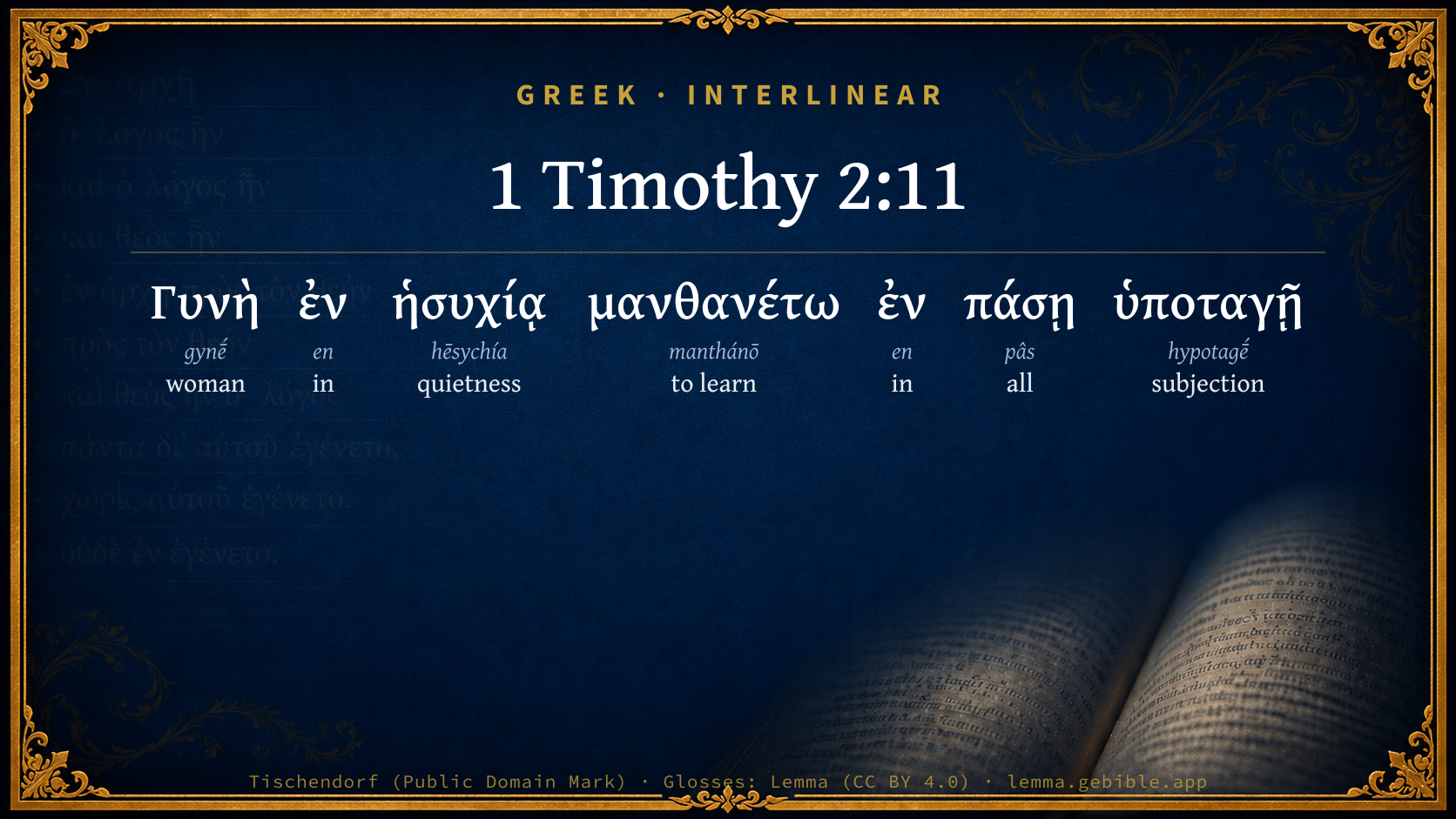
Download image
Cite this verse

1 Timothy 2:11 (World English Bible). Public Domain. Lemma interlinear Bible study tool, https://lemma.gebible.app/v/1-timothy/2/11.

Show BibTeX & RIS
BibTeX
RIS
English Translation
Let a woman learn in quietness with all subjection.
World English Bible · Public Domain
Download a study sheet

One document with this verse’s original text, its word-by-word gloss line, the meaning frame, cross-references with their text, attributed commentary, and full source and license credits — printable, and it pastes into notes with its structure intact.

This verse Autodidact and up

Study sheet (.html) Plain text (.txt)

A passage Seminary Student

Up to 50 verses in one chapter. A passage sheet keeps up to 6 commentary sources and 12 cross-references per verse, in the order this page ranks them, and says so on the sheet whenever that leaves anything out. Ask for a single verse and you get the Autodidact verse sheet above.

Everything on this page stays free to read, with no account — the sheet is a download of what is already on screen, not access to it.

Want to remove ads? Support Godless Engineer
Compare translations 3

The same verse in 3 English versions, stacked beneath the original-language interlinear above. Click any original word for its lexicon entry.

Each is an independent rendering of the whole verse — the interlinear is not word-aligned to these translations.

Highlighted words mark where these versions differ — a whole-verse word diff, not a word-by-word alignment.

  • World English Bible Public Domain
    Let a woman learn in quietness with all subjection.
  • King James Version Public Domain
    Let the woman learn in silence with all subjection.
  • unfoldingWord Literal Text CC BY-SA 4.0
    Let a woman learn in quietness, in all submission.

unfoldingWord Literal Text — © unfoldingWord, licensed CC BY-SA 4.0. Word-aligned USFM3 via Door43 (git.door43.org/unfoldingWord/en_ult).

Versions to compare (up to 4)

3 of 4 selected

Show all 19 translations

Every available English version of this verse, each an independent rendering of the whole verse.

  • World English Bible Public Domain
    Let a woman learn in quietness with all subjection.
  • Berean Standard Bible Public Domain
    A woman must learn in quietness and full submissiveness.
  • Majority Standard Bible Public Domain
    A woman must learn in quietness and full submissiveness.
  • King James Version Public Domain
    Let the woman learn in silence with all subjection.
  • American Standard Version (1901) Public Domain
    Let a woman learn in quietness with all subjection.
  • Revised Version (1885) Public Domain
    Let a woman learn in quietness with all subjection.
  • Geneva Bible (1599) Public Domain
    Let the woman learne in silence with all subiection.
  • Douay-Rheims (1899) Public Domain
    Let the woman learn in silence, with all subjection.
  • Young's Literal Translation Public Domain
    Let a woman in quietness learn in all subjection,
  • Literal Standard Version CC BY-SA 4.0
    Let a woman learn in quietness in all subjection,
  • Unlocked Literal Bible CC BY-SA 4.0
    A woman should learn in silence and with all submission.
  • unfoldingWord Literal Text CC BY-SA 4.0
    Let a woman learn in quietness, in all submission.
  • Darby Bible Public Domain
    Let a woman learn in quietness in all subjection;
  • World Messianic Bible Public Domain
    Let a woman learn in quietness with full submission.
  • Webster's Bible Public Domain
    Let the woman learn in silence with all subjection.
  • Free Bible Version CC BY-SA 4.0
    Women should learn quietly, respecting their place.
  • Bible in Basic English Public Domain
    Let a woman quietly take the place of a learner and be under authority.
  • Text-Critical English NT CC BY 4.0
    A woman should learn quietly with full submission.
  • Tyndale New Testament (1534) Public Domain
    Let the woman learne in silence with all subieccion.

Literal Standard Version (2020), Covenant Press — licensed CC BY-SA 4.0. Text via the HelloAO Bible API (eBible.org). Unlocked Literal Bible (unfoldingWord) — licensed CC BY-SA 4.0. Text via the HelloAO Bible API (eBible.org). unfoldingWord Literal Text — © unfoldingWord, licensed CC BY-SA 4.0. Word-aligned USFM3 via Door43 (git.door43.org/unfoldingWord/en_ult). Free Bible Version, Dr. Jonathan Gallagher — licensed CC BY-SA 4.0. Text via the HelloAO Bible API (eBible.org).

Word by word

More ways to search: Search by grammar → Find every occurrence → Compare this word →

Practice this passage: Drill this verse → Learn its vocabulary →

About this verse

These counts appear in no published source. They are computed here, from the morphology-tagged text and Lemma’s own curated glosses. What Lemma adds →

7
words
6
distinct lemmas
Pauline Epistles
section

Notable vocabulary

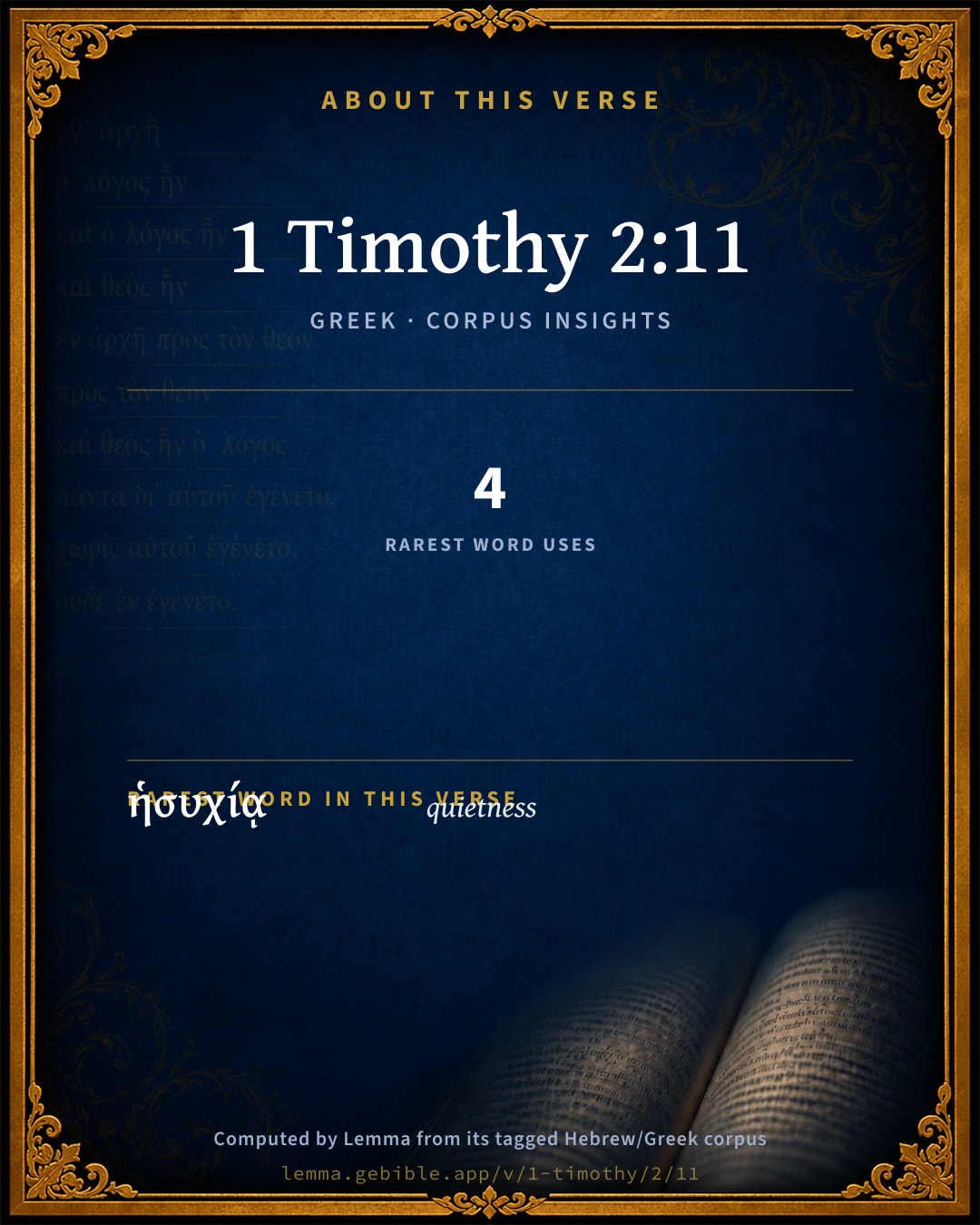
The rarest word here is ἡσυχίᾳ quietness G2271 — appearing just 4 times in the whole Greek New Testament.

Shared distinctive vocabulary

ἡσυχίᾳ quietness G2271 occurs in 4 verses of the Greek New Testament. Also found in:

Repetition

A word recurs within this verse:

Cross-references

9

Topical passages linked to 1 Timothy 2:11 in the Treasury of Scripture Knowledge — connected by theme and wording, ordered by reader-vote popularity; previews shown in the World English Bible.

  • 1 Corinthians 14:34–35 let your wives keep silent in the assemblies, for it has not been permitted for them to speak; but let them be in subjection, as the law also says.
  • Ephesians 5:22–24 Wives, be subject to your own husbands, as to the Lord.
  • 1 Corinthians 11:3 But I would have you know that the head of every man is Christ, and the head of the woman is the man, and the head of Christ is God.
  • Colossians 3:18 Wives, be in subjection to your husbands, as is fitting in the Lord.
  • 1 Peter 3:5–6 For this is how the holy women before, who hoped in God, also adorned themselves, being in subjection to their own husbands:
  • Genesis 3:16 To the woman he said, "I will greatly multiply your pain in childbirth. In pain you will bring forth children. Your desire will be for your husband, and he will rule over you."
  • Titus 2:5 to be sober-minded, chaste, workers at home, kind, being in subjection to their own husbands, that God's word may not be blasphemed.
  • 1 Peter 3:1 In like manner, wives, be in subjection to your own husbands; so that, even if any don't obey the Word, they may be won by the behavior of their wives without a word;
  • Esther 1:20 When the king's decree which he shall make shall be published throughout all his kingdom (for it is great), all the wives will give to their husbands honor, both to great and small.

Cross-references courtesy of OpenBible.info (CC BY 4.0).

Commentary

Notes on 1 Timothy 2:11 from classic Christian and Jewish commentators (each source and its license shown beneath its notes). The classic Christian expositions comment on the surrounding passage and are grouped to its opening verse, so a note may address several verses; the Jewish commentaries on the Tanakh (Rashi and others) are per-verse, so they appear only where the commentator wrote on this verse.

Lemma curates 59 commentaries, every one of them public domain or Creative Commons licensed, each selected and text-cleaned for this edition rather than reprinted as found. About our sources →

John Gill's Exposition

But I suffer not a woman to teach, They may teach in private, in their own houses and families; they are to be teachers of good things, Tit 2:3. They are to bring up their children in the nurture and admonition of the Lord; nor is the law or doctrine of a mother to be forsaken, any more than the instruction of a father; see Pro 1:8. Timothy, no doubt, received much advantage, from the private teachings and instructions of his mother Eunice, and grandmother Lois; but then women are not to teach in the church; for that is an act of power and authority, and supposes the persons that teach to be of a superior degree, and in a superior office, and to have superior abilities to those who are taught by them:

nor to usurp authority over the man; as not in civil and political things, or in things relating to civil government; and in things domestic, or the affairs of the family; so not in things ecclesiastical, or what relate to the church and government of it; for one part of rule is to feed the church with knowledge and understanding; and for a woman to take upon her to do this, is to usurp an authority over the man: this therefore she ought not to do,

but to be in silence; to sit and hear quietly and silently, and learn, and not teach, as in Ti1 2:11.

John Gill's Exposition of the Whole Bible (1746–1763) — public domain (CC PDM 1.0). Text via the HelloAO Bible API.

Joseph Benson's Commentary

1Ti 2:11-14. Let the women learn in silence — Let every woman receive instruction in religious matters from the men in silence, in your public assemblies; with all subjection — With becoming submission to the other sex, neither teaching nor asking questions there. I suffer not a woman to teach — Namely, publicly; nor to usurp authority over the man — Which she might seem to do if she officiated under the character of a public teacher. The word αυθεντειν, here used, signifies both to have, and to exercise authority over another. In this passage it is properly translated usurp authority; because, when a woman pretends to exercise authority over a man, she arrogates a power which does not belong to her. See note on 1Co 14:34-35. For Adam was first formed — As the head and chief; then Eve — To denote her subordination to and dependance on Adam. So that the woman was originally inferior. As if he had said, What I now enjoin is agreeable to what was intimated at the first formation of the human race. And Adam was not deceived — The serpent did not attempt to deceive Adam. But he attacked the woman, knowing her to be the weaker of the two. Hence Eve, in extenuation of her fault, pleaded, The serpent beguiled me, and I did eat, Gen 3:13. And Eve did not deceive Adam, but persuaded him; for he said, The woman whom thou gavest to be with me, she gave me of the tree, and I did eat, Gen 3:12; insinuating that, as the woman had been given him for a companion and help, he had eaten of the tree from affection to her, which is also intimated Gen 3:17, in God’s words to him, Thou hast hearkened unto the voice of thy wife. “In this view of the matter, the fall of the first man stands as a warning to his posterity to beware of the pernicious influence which the love of women, carried to excess, may have upon them to lead them into sin.” The preceding verse showed why a woman should not usurp authority over the man: this shows why she ought not to teach. She is more easily deceived, and more easily deceives. Let it be observed here, however, that the apostle’s doctrine concerning the inferiority of the woman to the man, in point of understanding, is to be interpreted of the sex in general, and not of every individual; it being well known that some women, in understanding, are superior to most men. The woman being deceived, was first in the transgression — And prevailed upon Adam, by her solicitations, to transgress also. “The behaviour of Eve, who may be supposed to have been created by God with as high a degree of understanding as any of her daughters ever possessed, ought to be remembered by them all, as a proof of their natural weakness, and as a warning to them to be on their guard against temptation. Perhaps also the apostle mentioned Eve’s transgression on this occasion, because the subjection of women to their husbands was increased at the fall on account of Eve’s transgression, Gen 3:16.” — Macknight.

Joseph Benson's Commentary on the Old and New Testaments (1811–1818) — public domain. Text from a community e-Sword module.

Tyndale Open Study Notes

Tyndale Open Resources

2:11-15 Paul is still talking about women in the assembly—here, in their relationship to public teaching (cp. 1 Cor 11:2-16; 14:33-36; 2 Cor 11:3).

Tyndale Open Study Notes — © Tyndale Open Resources, licensed CC BY-SA 4.0. Text via the HelloAO Bible API.

Bengel's Gnomon

Johann Albrecht Bengel

1Ti 2:11. Μανθανέτω, let the woman learn) The antithesis of to teach, 1Ti 2:12.—ὑποταγῇ, in subjection) The antithesis is to the phrase, to use (usurp) authority, 1Ti 2:12.

Bengel's Gnomon of the New Testament — English translation (T&T Clark, Edinburgh, 1860) — public domain. Text from a community e-Sword module.

Meyer's Critical & Exegetical Commentary

Heinrich August Wilhelm Meyer

1Ti_2:11-12. Further injunctions for women.

γυνὴ ἐν ἡσυχίᾳ μανθανέτω] ἐν ἡσυχίᾳ, without speaking herself; μανθάνειν denotes here, as in 1Co_14:31, attention to the word in order to learn from it what is necessary for advancing and building up the Christian life.

ἐν πάσῃ ὑποταγῇ] in complete subordination, i.e. without contradiction.

The thought here expressed is to be filled up by what Paul says in 1Co_14:35 (which passage should be particularly compared with this[104]): ΕἸ ΔΈ ΤΙ ΜΑΘΕῖΝ ΘΈΛΟΥΣΙΝ, ἘΝ ΟἼΚῼ ΤΟῪς ἸΔΊΟΥς ἌΝΔΡΑς ἘΠΕΡΩΤΆΤΩΣΙΝ.Spiritual receptivity and activity in domestic life were recognised as the appropriate destiny of women, and therefore the female sex was excluded from the public discussion of religious subjects (Neander, Geschichte der Pflanzung der Kirche durch die Aposteln, Part I. p. 125). Though in Christ there is no distinction, yet Christianity does not put an end to the natural distinctions ordained by God; it recognises them in order to inform them with its higher life.

διδάσκειν δὲ γυναικὶ οὐκ ἐπιτρέπω] Διδ. stands first in emphatic opposition to ΜΑΝΘΆΝΕΙΝ; in the parallel passage (1 Corinthians 14) ΔΙΔ. stands instead of the more general word ΛΑΛΕῖΝ.

ΟὐΔῈ ΑὐΘΕΝΤΕῖΝ ἈΝΔΡΌς] Leo: ΑὐΘΕΝΤΕῖΝ et ΑὐΘΈΝΤΗς apud seriores tantum scriptores ita occurrit, ut dominii notionem involvat; melioribus scriptoribus est αὐθέντης idem quod ΑὐΤΌΧΕΙΡ (see Valckenaer, Diatr. in Eurip. rell. chap. 18 pp. 188 ff.; Lobeck, ad Phryn. p. 120). Luther has rightly: that she be master of her husband; whereas in the translation: to assume to herself respect or mastery (Heydenreich, de Wette, van Oosterzee), the notion of assumption is imported. Hofmann, too, is wrong when he says that αὐθεντεῖν in conjunction with the genitive of the person should mean: to act independently of this person, i.e. as ones own master (!).

Many expositors (Matthies, and earlier, Estius, Calovius, and others) assume in this word a reference to domestic relations; whereas Heydenreich, de Wette, Wiesinger, and others, limit even this command to behaviour in the assemblies for divine worship.[105] This last is correct, as is shown by ἈΛΛʼ ΕἾΝΑΙ ἘΝ ἩΣΥΧΊᾼ, corresponding to ἘΝ ἩΣΥΧΊᾼ in 1Ti_2:11. Yet ΟὐΔῈ ΑὐΘΕΝΤΕῖΝ Τ. ἈΝΔΡ. puts the prohibition to teach under a more general point of view, and at the same time confirms it. Nor can it be denied that women are not ΑὐΘΕΝΤΕῖΝ Τ. ἈΝΔΡ. in the assemblies, because in the apostles opinion that does not beseem them at any time. The reason why not, is given in the verses that follow.

It is to be observed, further, that 1Ti_2:12 corresponds exactly with 1Ti_2:11 : ΓΥΝῊ … ΓΥΝΑΙΚΊ; ΜΑΝΘΑΝΈΤΩ … ΔΙΔΆΣΚΕΙΝ ΟὐΚ ἘΠΙΤΡΈΠΩ; ἘΝ ΠΆΣῌ ὙΠΟΤΑΓῇ … ΟὐΔῈ ΑὐΘΕΝΤΕῖΝ ΤΟῦ ἈΝΔΡ.; ἘΝ ἩΣΥΧΊᾼ … ἈΛΛʼ ΕἾΝΑΙ ἘΝ ἩΣΥΧΊᾼ. This parallelism is clear proof that the same thing is spoken of in 1Ti_2:12 as in 1Ti_2:11, which Hofmann denies. Still 1Ti_2:12 is not therefore superfluous, since it both emphasizes and more precisely defines the particular ideas in 1Ti_2:11.

ἈΛΛʼ ΕἾΝΑΙ ἘΝ ἩΣΥΧΊᾼ] The same construction is found in 1Co_14:34. The infinitive is dependent on a ΒΟΎΛΟΜΑΙ to be supplied from ΟὐΚ ἘΠΙΤΡΈΠΩan abbreviated construction which occurs also in classic Greek.

De Wette rightly directs attention to these points, that we must not by arbitrary interpretations take away the clear definite meaning from the commands here laid down, in order to make them universal in application; and, on the other hand, that they are not to be considered as local and temporal ordinances: they are rather injunctions to be still held valid as applying to public assemblies.[106]

[104] Otto quotes the agreement of these passages with one another as a proof that the letters are contemporaneous. It is, however, to be observed that Paul himself, in the words: ὡς ἐν πάσαις ταῖς ἐκκλησίαις τῶς ἁγίων (1Co_11:33), describes the maxim as one which he was seeking to establish in all the churches. Hence there is nothing strange in his urging it on Timothys attention at a later period, just as he had urged it before on the Corinthians.

[105] Hofmann, in opposition to these two views, maintains that the apostle here speaks of the Christian life in general, of all action for which there was occasion in ordinary life; but the context gives no ground for his assertion.

[106] Compare with this apostolic expression, Const. Apost. iii. 6 : οὐκ ἐπιτρέπομεν γυναῖκας διδάσκειν ἐν ἐκκλησίᾳ, ἀλλὰ μόνον προσεύχεσθαι καὶ τῶν διδασκάλων ἐπακούειν. Tertull. De Virg. Vel.: non permittitur mulieri in ecclesia loqui, sed nec docere, nec tinguere, nec ullius virilis muneris, nedum sacerdotalis officii sortem sibi vindicare. It is curious that in the Apost. Const. it is permitted to women προσεύχεσθαι in church, while here it is granted only to men to do so. But, on the one hand, προσεύχεσθαι in the Constitutions does not mean exactly prayer aloud; and, on the other hand, this passage here does not plainly and directly forbid προσεύχεσθαι to women; it only forbids distinctly διδάσκειν on their part.There is the same apparent contradiction between 1Co_14:34-35, and 1Co_11:5; 1Co_11:13. While in the former passage λαλεῖν is forbidden to women, in the latter προσεύχεσθαι and even προθητεύειν are presupposed as things done by women, and the apostle does not rebuke it.The solution is, that Paul wishes everything in church to be done εὐσχημόνως καὶ κατὰ τάξιν; while, on the other hand, he holds by the principle: τὸ πνεῦμα μὴ σβέννυτε (1Th_5:19). Meyer on 1Co_11:5 differs.

Meyer — Critical and Exegetical Commentary on the New Testament — English translation by Peter Christie, edited by Frederick Crombie (T&T Clark, 1880) — public domain. Text from a community e-Sword module.

Expositor's Greek Testament

ed. W. Robertson Nicoll

1Ti 2:11 sqq . With these directions compare those in 1Co 14:33-35 .

ἐν πάσῃ ὑποταγῇ : with complete subjection [to their husbands]. Cf. Tit 2:5 .

The Expositor's Greek Testament, edited by W. Robertson Nicoll (1897–1910) — public domain. Text from a community e-Sword module.

Jamieson, Fausset & Brown

Robert Jamieson, A. R. Fausset & David Brown

learn--not "teach" (Ti1 2:12; Co1 14:34). She should not even put questions in the public assembly (Co1 14:35).

with all subjection--not "usurping authority" (Ti1 2:12). She might teach, but not in public (Act 18:26). Paul probably wrote this Epistle from Corinth, where the precept (Co1 14:34) was in force.

Jamieson, Fausset & Brown — Commentary Critical and Explanatory on the Whole Bible (1871) — public domain (CC PDM 1.0). Text via the HelloAO Bible API.

Adam Clarke's Commentary

Verse 11. Let the woman learn in silence] This is generally supposed to be a prohibition of women's preaching. I have already said what I judge necessary on this subject in the notes on "1Co 11:5", c., and 1Co 14:34; 1Co 14:35 to which places I beg leave to refer the reader.

Adam Clarke's Commentary on the Bible (1810–1826) — public domain. Text from a community e-Sword/MySword module.

John Calvin's Commentaries

11 Let a woman learn in quietness. After having spoken of dress, he now adds with what modesty women ought to conduct themselves in the holy assembly. And first he bids them learn quietly; for quietness means silence, that they may not take upon them to speak in public. This he immediately explains more clearly, by forbidding them to teach.

John Calvin's Commentaries (1540-1563) — public domain. Text from the Calvin Translation Society English edition (1840s-50s) via the Christian Classics Ethereal Library (ccel.org). Calvin's coverage is partial (roughly two-thirds of the Bible); uncommented books and verses are honest gaps, never fabricated. The 19th-century editor's footnotes and remarks are omitted so the notes are faithfully Calvin's own voice.

Ellicott's Commentary for English Readers

(11) Let the woman learn in silence.—The thought of public ministration is still in the Apostle’s mind, when he gives this injunction. The very questioning on difficult points is forbidden them at the public assembly (1Co_14:35). So averse was St. Paul to anything which might mar the quiet solemnity of these meetings for prayer and praise and authoritative instruction.

This prohibition to speak publicly in assemblies for prayer and praise in the case of Christian women, was renewed in the North African Church, at the Council of Carthage, held A.D. 398. The same Council, however, specially permitted women to teach those of their own sex in private; indeed, the power to teach “ignorant and rustic women” was required as one qualification in deaconesses. The employment of deaconesses as private instructors seems to have been the custom generally in the Eastern Churches.

A Bible Commentary for English Readers, edited by Charles John Ellicott (1878–1897) — public domain. Text from a community e-Sword module.

The Cambridge Bible for Schools and Colleges

gen. ed. J. J. S. Perowne

11. Let the woman learn in silence] The reference is still to the public assemblies. The exact rendering in our idiom of the article is, with R.V., Let a woman learn, in silence, in quiet, as in 1Ti_2:2. Cf. 1Co_14:34-35.

The Cambridge Bible for Schools and Colleges (gen. ed. J. J. S. Perowne; Cambridge University Press, 1878–1918) — public domain. Text from a community e-Sword module.

Trapp's Complete Commentary

John Trapp

11 Let the woman learn in silence with all subjection.

Ver. 11. Let the woman learn] Not to teach, to wit, in the public assemblies, be she never so learned or godly. {See Trapp on "Rom 16:1"}

John Trapp, A Commentary or Exposition upon All the Books of the Old and New Testament (1647–1656) — public domain. Text from a community e-Sword module.

Albert Barnes' Notes on the Bible

Let the woman learn in silence - Listen attentively to instruction, without attempting to teach in public; see the notes on 1Co 14:35.

With all subjection - With due subjection to those who are in authority, and who are appointed to minister in holy things; notes, 1Co 14:34.

Albert Barnes' Notes on the Bible (1834–1885) — public domain. Text from a community e-Sword/MySword module.

Haydock's Catholic Bible Commentary

In silence. See 1 Corinthians xiv. 34. See St. John Chrysostom.[3] (Witham)

===============================

[BIBLIOGRAPHY]

In silentio. St. John Chrysostom (Greek: log. th.) Greek: edidazen apax e gune, kai panta katestrepse.

====================

George Leo Haydock (1774–1849), Haydock's Catholic Family Bible and Commentary, 1859 edition — public domain. Excludes Psalms (Douay-Rheims chapter numbering differs from Protestant) and Deuterocanonical books (Catholic canon only).

Matthew Poole's English Annotations

That is, in the public assemblies for worship, it is the woman’s part silently to learn, showing thereby a subjection to the man, who is the head of the woman.

Matthew Poole's English Annotations on the Holy Bible (1683–1685) — public domain. Text from a community e-Sword/MySword module.

Whedon's Commentary on the Bible

Daniel D. Whedon

11. In silence—Rather in quietude, the absence of any commotion.

Daniel D. Whedon (gen. ed.), Commentary on the Old and New Testaments (1874–1909) — public domain. Text from a community e-Sword module.

The Pulpit Commentary

A for the, A.V; quietness for silence, A.V Quietness is not so good a rendering as "silence," because the quietness here meant is silence, as appears clearly by the parallel direction in 1Co_14:34. Soscon Act_22:2, pare hJsoucian is properly rend red in the A.V, "They kept silence." And hJsucasan (Luk_14:4 and Act_11:18) is read, red, both in the A.V and the R.V, "They held their peace." With all subjection (ejn pash uJpotagh); as 1Ti_3:4. The words occur also in 2Co_9:13; ssomai Gal_2:5. But the verb uJpota is very common in the sense of "being subject." It is used of the subjection of the wife to her husband. (1Co_14:34; Eph_5:22; Col_3:18; Tit_2:5; 1Pe_3:1)

Vers. 11-15.

The proper sphere and behavior of women.

The apostle is still thinking of the public services of the Church.

I THE WOMAN IS FORBIDDEN TO TEACH OR PREACH IN THE CHURCH. "Let a woman learn in silence in all subjection. But I permit not a woman to teach, nor to lord it over the man, but to be in silence." This injunction has a threefold relation first to herself, then to her husband, then to the Church.

1. She is to learn in silence. This duty concerns herself. She is to be a learner, not a teacher. She is to give all devout attention to the public instruction, so as to learn more and more of Christ and his gospel. And if what she heard was either difficult or doubtful, she was to ask her husband at home; (1Co_14:34) and, in case of his inability to meet her difficulties, she could resort privately to the authorized teachers of the Church. This learning attitude was to be "in all subjection" both to her husband and to the rulers of the Church. Yet it did not imply that she was to accept false teaching, or forego her just right to prove all things and reject what was unsound.

2. She is not to lord it over the man. As teaching or preaching is the act of those in authority, her assumption of this function would imply a lordship over her husband. Husband and wife are "heirs together of the grace of life," but the gospel has not exalted woman to a position of authority over her husband.

3. She is not to teach in the Church.

(1) This injunction of the apostle does not forbid her teaching privately, either her children, as Timothy was taught by his mother, or her servants, or the younger women, (Tit_2:4) or even her husband privately on fit occasions, or even strangers, as Priscilla taught Apollos. (Act_18:26)

(2) It forbids her teaching in public.

(a) It is suggestive that the words usually translated in the New Testament "to preach" (khrussw eujaggelizw, kataggellw) are not used in connection with this prohibition, as if women were merely forbidden to preach, but still allowed to teach. The word used here is "to teach" (didaskw), and the word used in 1Co 14. (lalew) talk, chatter, babble is even more comprehensive. These words all include preaching as the greater includes the less; therefore preaching is also forbidden to women.

(b) Prophesying was forbidden to women as well as teaching. This was a supernatural gift enjoyed both by men and women in the primitive Church, but is not enjoyed now by either men or women. It is never in the New Testament used for preaching, or for mere speaking in meeting. But were there not women who prophesied in the Corinthian Church? (1Co_11:4, 1Co_11:5)

(a) The gift of prophecy being connected with the gift of tongues, and bothbeing now obsolete, the title of women to the exercise of such a gift in this age utterly fails.

(b) The apostle, in his discussion concerning prophecy and the gift oftongues, forbids women to speak at all in the Churches. (1Co 14) It was in the very midst of his injunctions respecting the use of supernatural gifts that he says, "As in all Churches of the saints, let your women keep silence in the Churches, for it is not; permitted to them to speak... for it is a shame for women to speak in the Churches." Prophesying as well as preaching is forbidden to women.

(c) Much unnecessary difficulty has been caused by the passage respecting"a woman praying or prophesying with her head uncovered". (1Co_11:5) The apostle seems for the time to allow the practice, while he condemns the manner of its performance; but afterwards he forbids the practice itself. In the earlier passage he rebukes merely the indecency of an existing custom, and then in the later he forbids the custom itself. Calvin says, "By condemning the one he does not commend the other." You cannot regard as of equal authority a practice and a command, both explicit and repeated, which destroys the practice.

(d) "But these directions were given to Greek Churches, and cannot applyto the women of our day." We answer that they apply to all Churches; for the apostle says, "As in all Churches of the saints, let your women keep silence in the Churches." The reasons given for the prohibition prove that it has nothing to do with usages, or customs, or times, or races.

II THE REASON OR GROUND OF THE APOSTLE"S PROHIBITION. It is to be found in the original law of the relation of woman to man.

1. Mans headship in creation. "For Adam was first formed, then Eve." Man"s priority of creation is the first reason, but it is to be taken together with the statement in 1Co_11:8, 1Co_11:9, "For the man is not of the woman, but the woman of the man; for also the man was not made for the sake of the woman, but the woman for the sake of the man." Besides, as "the Head of every man is Christ, the head of the woman is the man". (1Co_11:3) "The husband is the head of the wife". (Eph_5:23) The woman, therefore, stands under law to her husband, and therefore any attempt on her part to assume the part of head or guide is to overturn the primal order of creation.

2. Womans priority in transgression. "And Adam was not deceived, but the woman being altogether deceived fell into transgression." They both sinned; but Adam was not deceived, for he fully understood the sin he was committing when he yielded to the persuasiveness of his wife.

(1) This reference implies the truly historical character of the narrative in Genesis. It is no myth or legend. The fall of man is an historic fact of the greatest importance, for it grounds the doctrine of original sin, without which human nature, says Pascal, is an inexplicable riddle.

(2) The deception was practiced upon Eve, not upon Adam, for she confessed that the serpent beguiled her.

(3) This facility of deception on her part seems to suggest to the apostle her inferiority to man in strength of intellect, and the consequent wrongness of allowing to woman an intellectual supremacy over man.

III THE BLESSING UPON WOMAN STANDING WITHIN HER TRUE SPHERE. "But she shall be saved through the child-bearing, if they abide in faith and love and holiness with sobriety.

1. It is here implied if, at woman is to find her right sphere in the relations of motherhood. The change of number implies that Eve is here to be regarded as the representative of her sex. Her sphere is in the home life; her destiny lies in the faithful discharge of its duties. Eve was to be the mother of all living; it was to be through the seed thus given her that the curse was to be lifted off the world, and the head of the serpent bruised. There is an evident allusion in "the child-bearing" to the Incarnation, but it points likewise to the collective seed associated with Christ.

2. It implies that women are not saved, as Roman Catholics contend, by mere childbearing, so that a woman dying in her travail is necessarily saved, for the apostle links with it certain spiritual qualifications as necessary to salvation.

(1) Faith implicitly resting in the Divine promise and upon the Divine Redeemer, "as the seed of the woman;

(2) love, as the inspiration of all her wifely and motherly duties;

(3) holiness, as implying purity of life, circumspectness of walk, and devotedness to God;

(4) with sobriety, as marking the self-effacing, self-restraining, self-governing spirit which she is to carry into all the conditions of her life as a Christian mother. T.C.

The Pulpit Commentary (1880–1919), ed. H.D.M. Spence-Jones & Joseph S. Exell — public domain. Text from a community e-Sword module.

Fairbairn on Ezekiel, Jonah & the Pastoral Epistles

Patrick Fairbairn

Vers. 11, 12. The apostle proceeds now to give prescriptions of a more general kind respecting the proper sphere and behaviour of women. Let a woman learn in silence in all subjection—spoken primarily and mainly with reference to the public assemblies of the church, and only an abbreviated reinforcement of the instruction previously issued to the church at Corinth (1Co 14:34): “Let your women keep silence in the churches; for it is not permitted unto them to speak, but to be under obedience, as also saith the law.” The all subjection, however, can only be understood to reach as far as the authoritative teaching is of the right stamp. Woman does not lose her rational power of thought and responsibility by abiding in the place assigned her by the gospel; and she also has a right to prove all things—only in a manner suited to her position—in order that she may hold fast that which is good, and reject what is otherwise. But to teach (the best authorities place διδάσκειν first) I permit not a woman—namely, in public: she is not to act the part of a teacher in the meetings of the faithful; nor to lord it over the man, but to be in silence. The verb αὐθεντεῖν scarcely means to usurp authority, the sense ascribed to it in the Authorized Version, but only to exercise it in an imperious manner. Leo (as quoted by Huther): “αὐθεντεῖν et αὐθέντης apud seriores tantum scriptores ita occurrit, ut dominii notionem involvat; melioribus scriptoribus est αὐθέντης idem quod αὐτόχειρ.” Here it is plainly the later use that must be adopted; and what is forbidden by it to woman is, that she is not to assume the part of ruling or domineering over man. When she attempts this she goes out of her proper place, and ventures upon a line of things which is not compatible either with her natural constitution or with her distinctive vocation. And in proof of this, the apostle appeals to the original order and course of things as marking out the great landmarks for all time.

Ver. 13. For Adam was first formed (ἐπλάσθη) taken from the Sept. version of Gen 2:7; ἐκτίσθη is used in the corresponding passage at 1Co 11:9), then Eve; the precedence in time implying superiority in place and power. The relation in this respect is still more strongly marked in the Epistle to the Corinthians: “For the man is not of the woman, but the woman of the man; for also the man was not made for the sake of the woman, but the woman for the sake of the man.” Thus did God in the method of creation give clear testimony to the headship of man—to his right, and also his obligation, to hold directly of God, and stand under law only to Him; while woman, being formed for his helpmate and partner, stands under law to her husband, and is called to act for God in him. And simply by inverting this relative position and calling—the helpmate assuming the place of the head or guide, and the head facilely yielding to her governance—was the happy constitution of paradise overthrown, and everything involved in disorder and evil.

Patrick Fairbairn — An Exposition of Ezekiel (1851), Jonah (1849), and The Pastoral Epistles (1874) — public domain. Text from a community e-Sword module.

Burkitt's Expository Notes on the New Testament

William Burkitt

Still our apostle is directing Timothy how persons should and ought to manage themselves in the public assemblies, and particularly how women ought to behave themselves at the time and in the place of worship. Let, says he, the women in your assemblies, learn in silence, with all subjection to the better sex; for I suffer not a woman to teach publicly, and to usurp authority over the man, to whom God has given authority over her; but rather according to her duty, let her learn in silence.

Here note, 1. That it is only women’s public teaching that is here forbidden; not their private teaching their children, or servants, or the younger women, or even their husbands themselves upon a fit occasion. Act 18:26, we find Priscilla privately instructing Apollos.

Note, 2. That none ought to teach but who have authority; and teaching is exercising that authority. A woman therefore teaching publicly, doth usurp an authority not due unto her.

Note, 3. There were some women in the Jewish church endowed with extraordinary gifts of the Spirit, and particularly with the gift of prophesying, who did teach publicly; as Miriam, Deborah, Huldah, and Anna. And it is probable, that the speaking of these extraordinary women encouraged others to do the like, whom the apostle here directs his speech against. I suffer not a woman to teach, nor to usurp authority &c.

William Burkitt's Expository Notes on the New Testament (1700–1703) — public domain. Text from a community e-Sword module.

The People's New Testament

B. W. Johnson

11–15. Let the women learn in silence. In the public worship on the Gentile churches the teaching was confined to the men. For a discussion of the reasons, see notes on 1 Cor. 14:33–36, where the same directions are given. With all subjection. Submission to the authorized teachers of the church.

B. W. Johnson's The People's New Testament with Notes (1889–1891) — public domain. Electronic text from the Christian Classics Ethereal Library (CCEL) ThML edition.

unfoldingWord translationNotes

Door43 World Missions Community

in silence

"in quietness"

and with all submission

"and submit to what is taught"

I do not permit a woman

"I do not allow a woman"

translationWords

authority

unfoldingWord translationNotes — © Distant Shores Media and the Door43 World Missions Community, licensed CC BY-SA 4.0. Source: git.door43.org/Door43/en_tn.

Cambridge Greek Testament for Schools and Colleges

11. γυνὴ ἐν ἡσυχίᾳ μανθανέτω. We should observe the close parallelism in thought between these directions and those laid down in 1Co 14:34-35: αἱ γυναῖκες ἐν ταῖς ἐκκλησίαις σιγάτωσαν, οὐ γὰρ ἐπιτρέπεται αὐταῖς λαλεῖν. ἀλλὰ ὑποτασσέσθωσαν, καθὼς καὶ ὁ νόμος λέγει. εἰ δέ τι μανθάνειν θέλουσιν, ἐν οἴκῳ τοὺς ἰδίους ἄνδρας ἐπερωτάτωσαν, αἰσχρὸν γάρ ἐστιν γυναικὶ λαλεῖν ἐν ἐκκλησίᾳ.

Women are to be learners ἐν πάσῃ ὑποταγῇ. This is not, of course, primarily in reference to their general attitude to men, but only to their behaviour at public worship. The reason assigned, however, in vv, 13, 14 gives the direction a wider bearing. Cp. 1Pe 3:5.

The ‘subjection of women’ is a topic freely debated at the present day; and, although it has been argued that St Paul is basing his rules on the position assigned to the sex in the society of his time, rather than laying down precepts of universal and permanent obligation, there can be no doubt that the distinction which he makes between the respective duties of men and women lies deep down in the facts of human nature as originally constituted. see on Tit 2:5. With ἐν πάσῃ ὑποταγῇ may be compared πάσης ἀποδοχῆς ἄξιος (1Ti 1:15) and ἐν πάσῃ εὐσεβείᾳ (1Ti 2:2) and μετὰ πάσης σεμνότητος of 1Ti 3:4.

Cambridge Greek Testament for Schools and Colleges (Cambridge University Press, 1896; 21 vols, various authors incl. Carr, Maclear, Plummer, Farrar, Lumby, Moule, M. R. James, Simcox) — public domain. Text from a community e-Sword module.

Alford’s Greek Testament

Henry Alford

11.] Let a woman learn (in the congregation, and every where: see below) in silence in all (possible) subjection (the thought of the public assemblies has evidently given rise to this precept (see 1Co 14:34); but he carries it further than can be applied to them in the next verse): but (the contrast is to a suppressed hypothesis of a claim to do that which is forbidden: cf. a similar δέ, 1Co 11:16) to a woman I permit not to teach (in the church (primarily), or, as the context shews, any where else), nor to lord it over (αὐθέντης μηδέποτε χρήσῃ ἐπὶ τοῦ δεσπότου, ὡς οἱ περὶ τὰ δικαστήρια ῥήτορες, ἀλλʼ ἐπὶ τοῦ αὐτόχειρος φονέως, Phryn. But Euripides thus uses it, Suppl. 442: καὶ μὴν ὅπου γε δῆμος αὐθέντης χθονός, ὑποῦσιν ἀστοῖς ἥδεται νεανίαις. The fact is that the word itself is originally a ‘vox media,’ signifying merely ‘one who with his own hand’ … and the context fills up the rest, αὐθέντης φόνου, or the like. And in course of time, the meaning of ‘autocrat’ prevailing, the word itself and its derivatives henceforth took this course, and αὐθεντέω, -ία, -ημα, all of later growth, bore this reference only. Later still we have αὐθεντικός, from first authority (‘id enim αὐθεντικῶς, nuntiabatur,’ Cic. ad Att. x. 9). It seems quite a mistake to suppose that αὐθέντης arrived at its meaning of a despot by passing through that of a murderer) the man, but (supply (“βούλομαι, not κελεύω, which St. Paul does not use.” Ellic.) ‘I command her:’ the construction in 1Co 14:34, is the same) to be in silence.

Henry Alford, The Greek Testament (1849–1861) — public domain. Text from a community e-Sword module.

International Critical Commentary

11-15. Still dealing directly with conduct at the meetings; but the word ὑποταγή suggests a reference to the whole relation of wife to husband, cf. Eph 5:23. The language is coloured throughout by Gen_2 and 3: ἐπλάσθη = ἔπλασεν, Gen 2:7; ἠπατήθη = ἠπάτησε 3:18; τεκνογονία = τέξεις τέκνα, 3:16.

11. ἐν πάσῃ ὑποταγῇ] “Submission to constituted authority, i.e. the officials and regulations of the Church,” Ramsay, though πάσῃ suggests also “their husbands.”

International Critical Commentary — older volumes (1896–1929), various authors — public domain. Text from a community e-Sword module.

Vincent's Word Studies in the New Testament

Marvin R. Vincent

Learn [μανθανετω] . Comp. 1Co 14:35.

In silence [εν ησυχια] . See on peaceable, ver. 2. Rev, renders quietness; but the admonition concerns the behavior of women in religious assemblies. Comp. 1Co 14:34. The word is used in the sense of silence, Act 22:2 : with the broader meaning quietness in 2Th 3:12.

Marvin R. Vincent, Word Studies in the New Testament (1887–1900) — public domain. Text from a community e-Sword/MySword module.

Lesson kit

Teaching starters — assembled from the data on this page, not authored interpretation. Every prompt links to the verse data it draws on. Edit before teaching.

1 Timothy, in the Pauline Epistles, opens this verse with 7 words (6 distinct Greek lemmas). Its most distinctive word is hēsychía (“quietness”). A historical commentator’s framing appears above. Read the whole chapter for the surrounding context.

Discussion questions

  1. How does “quietness” (hēsychía) shape what this verse is saying?
  2. How does Acts 22:2, which shares the word «quietness», read alongside this verse?
  3. What does the repetition of “in” (2× in this one verse) do in this verse?
  4. The translations on this page render this verse differently — a whole-verse word diff, not a word-by-word alignment. What might account for the different wordings?
  5. Compare how John Gill's Exposition and Joseph Benson's Commentary read this verse. Where do they agree or differ?

Things to notice

  • These translations choose different wording for 4 words in this verse.
  • “in” occurs 2× in this single verse.
  • 6 distinct Greek lemmas span 7 words in this verse.

Reading settings

Reading text

Shown beneath each verse's original-language words.

Old Testament
Old Testament edition

Read the OT as the Masoretic Hebrew (MT) or the Greek Septuagint (LXX).

English shown for the Greek Septuagint (in the Hebrew ↔ Greek comparison).

Comparing translations? Open the Compare panel on any verse page to stack up to four side by side.