1 Corinthians 7:33

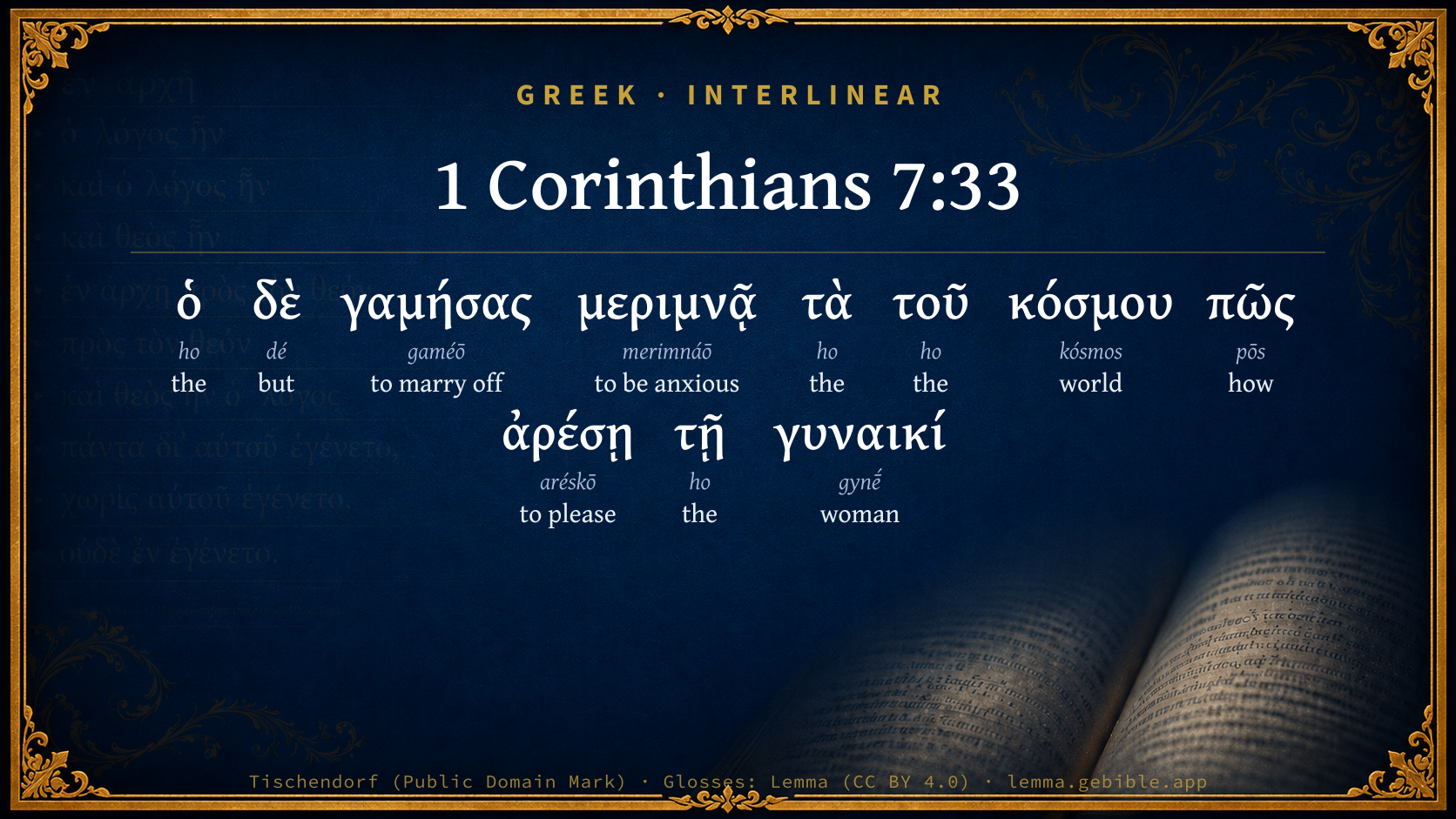
Greek (Tischendorf 8th ed.) 1 Corinthians 7:33 appears in the Greek New Testament. The text above is from the Tischendorf 8th edition. Each word links to its Strong’s number and a concise gloss. Click any word for its full Thayer’s Greek Lexicon entry.
Download image
Cite this verse

1 Corinthians 7:33 (World English Bible). Public Domain. Lemma interlinear Bible study tool, https://lemma.gebible.app/v/1-corinthians/7/33.

Show BibTeX & RIS
BibTeX
RIS
English Translation
but he who is married is concerned about the things of the world, how he may please his wife.
World English Bible · Public Domain
Download a study sheet

One document with this verse’s original text, its word-by-word gloss line, the meaning frame, cross-references with their text, attributed commentary, and full source and license credits — printable, and it pastes into notes with its structure intact.

This verse Autodidact and up

Study sheet (.html) Plain text (.txt)

A passage Seminary Student

Up to 50 verses in one chapter. A passage sheet keeps up to 6 commentary sources and 12 cross-references per verse, in the order this page ranks them, and says so on the sheet whenever that leaves anything out. Ask for a single verse and you get the Autodidact verse sheet above.

Everything on this page stays free to read, with no account — the sheet is a download of what is already on screen, not access to it.

Want to remove ads? Support Godless Engineer
Compare translations 3

The same verse in 3 English versions, stacked beneath the original-language interlinear above. Click any original word for its lexicon entry.

Each is an independent rendering of the whole verse — the interlinear is not word-aligned to these translations.

Highlighted words mark where these versions differ — a whole-verse word diff, not a word-by-word alignment.

  • World English Bible Public Domain
    but he who is married is concerned about the things of the world, how he may please his wife.
  • King James Version Public Domain
    But he that is married careth for the things that are of the world, how he may please his wife.
  • unfoldingWord Literal Text CC BY-SA 4.0
    But the married is concerned about the things of the world, how to please the wife, and he is divided. And the unmarried woman or the virgin

unfoldingWord Literal Text — © unfoldingWord, licensed CC BY-SA 4.0. Word-aligned USFM3 via Door43 (git.door43.org/unfoldingWord/en_ult).

Versions to compare (up to 4)

3 of 4 selected

Show all 19 translations

Every available English version of this verse, each an independent rendering of the whole verse.

  • World English Bible Public Domain
    but he who is married is concerned about the things of the world, how he may please his wife.
  • Berean Standard Bible Public Domain
    But the married man is concerned about the affairs of this world, how he can please his wife,
  • Majority Standard Bible Public Domain
    But the married man is concerned about the affairs of this world, how he will please his wife.
  • King James Version Public Domain
    But he that is married careth for the things that are of the world, how he may please his wife.
  • American Standard Version (1901) Public Domain
    but he that is married is careful for the things of the world, how he may please his wife,
  • Revised Version (1885) Public Domain
    but he that is married is careful for the things of the world, how he may please his wife.
  • Geneva Bible (1599) Public Domain
    But hee that is maried, careth for the things of the world, how he may please his wife.
  • Douay-Rheims (1899) Public Domain
    But he that is with a wife, is solicitous for the things of the world, how he may please his wife: and he is divided.
  • Young's Literal Translation Public Domain
    and the married is anxious for the things of the world, how he shall please the wife.
  • Literal Standard Version CC BY-SA 4.0
    and the married is anxious for the things of the world, how he will please the wife.
  • Unlocked Literal Bible CC BY-SA 4.0
    But the married man is concerned about the things of the world, how to please his wife—
  • unfoldingWord Literal Text CC BY-SA 4.0
    But the married is concerned about the things of the world, how to please the wife, and he is divided. And the unmarried woman or the virgin
  • Darby Bible Public Domain
    but he that has married cares for the things of the world, how he shall please his wife.
  • World Messianic Bible Public Domain
    but he who is married is concerned about the things of the world, how he may please his wife.
  • Webster's Bible Public Domain
    But he that is married, is anxious for the things that are of the world, how he may please his wife.
  • Free Bible Version CC BY-SA 4.0
    But a man who is married pays attention to what is important in this world, and how he can please his wife.
  • Bible in Basic English Public Domain
    But the married man gives his attention to the things of this world, how he may give pleasure to his wife.
  • Text-Critical English NT CC BY 4.0
    But the married man is concerned about the affairs of the world, how he will please his wife.
  • Tyndale New Testament (1534) Public Domain
    But he that hath maried careth for the thinges of the worlde howe he maye please his wyfe.

Literal Standard Version (2020), Covenant Press — licensed CC BY-SA 4.0. Text via the HelloAO Bible API (eBible.org). Unlocked Literal Bible (unfoldingWord) — licensed CC BY-SA 4.0. Text via the HelloAO Bible API (eBible.org). unfoldingWord Literal Text — © unfoldingWord, licensed CC BY-SA 4.0. Word-aligned USFM3 via Door43 (git.door43.org/unfoldingWord/en_ult). Free Bible Version, Dr. Jonathan Gallagher — licensed CC BY-SA 4.0. Text via the HelloAO Bible API (eBible.org).

Word by word

More ways to search: Search by grammar → Find every occurrence → Compare this word →

Practice this passage: Drill this verse → Learn its vocabulary →

About this verse

These counts appear in no published source. They are computed here, from the morphology-tagged text and Lemma’s own curated glosses. What Lemma adds →

11
words
8
distinct lemmas
Pauline Epistles
section

Notable vocabulary

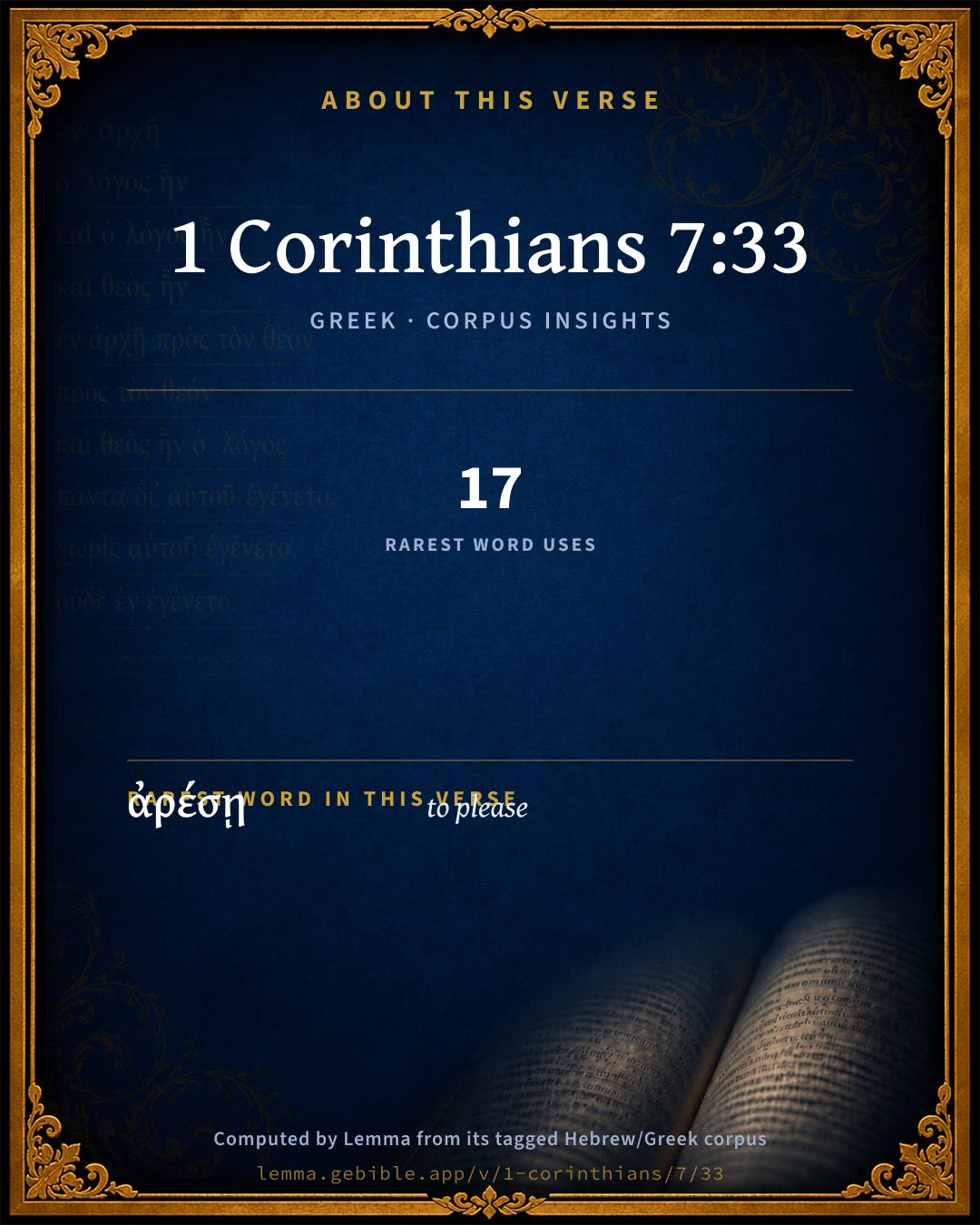
The rarest word here is ἀρέσῃ to please G700 — appearing just 17 times in the whole Greek New Testament.

Shared distinctive vocabulary

ἀρέσῃ to please G700 occurs in 16 verses of the Greek New Testament. Also found in:

Repetition

A word recurs within this verse:

Cross-references

8

Topical passages linked to 1 Corinthians 7:33 in the Treasury of Scripture Knowledge — connected by theme and wording, ordered by reader-vote popularity; previews shown in the World English Bible.

  • 1 Peter 3:7 You husbands, in like manner, live with your wives according to knowledge, giving honor to the woman, as to the weaker vessel, as being also joint heirs of the grace of life; that your prayers may not be hindered.
  • Colossians 3:19 Husbands, love your wives, and don't be bitter against them.
  • 1 Timothy 5:8 But if anyone doesn't provide for his own, and especially his own household, he has denied the faith, and is worse than an unbeliever.
  • Ephesians 5:25–33 Husbands, love your wives, even as Christ also loved the assembly, and gave himself up for it;
  • 1 Samuel 1:4–8 When the day came that Elkanah sacrificed, he gave to Peninnah his wife, and to all her sons and her daughters, portions:
  • Nehemiah 5:1–5 Then there arose a great cry of the people and of their wives against their brothers the Jews.
  • Luke 12:22 He said to his disciples, "Therefore I tell you, don't be anxious for your life, what you will eat, nor yet for your body, what you will wear.
  • 1 Corinthians 7:3 Let the husband render to his wife the affection owed her, and likewise also the wife to her husband.

Cross-references courtesy of OpenBible.info (CC BY 4.0).

Commentary

Notes on 1 Corinthians 7:33 from classic Christian and Jewish commentators (each source and its license shown beneath its notes). The classic Christian expositions comment on the surrounding passage and are grouped to its opening verse, so a note may address several verses; the Jewish commentaries on the Tanakh (Rashi and others) are per-verse, so they appear only where the commentator wrote on this verse.

Lemma curates 59 commentaries, every one of them public domain or Creative Commons licensed, each selected and text-cleaned for this edition rather than reprinted as found. About our sources →

Bengel's Gnomon

Johann Albrecht Bengel

1Co 7:33. Πῶς ἀρέσει) how he may please. The word please is repeated from the preceding verse, and comprehends here all the duties of a husband, which the wife may demand in everthing relating to the married state.

Bengel's Gnomon of the New Testament — English translation (T&T Clark, Edinburgh, 1860) — public domain. Text from a community e-Sword module.

Hodge's Commentary on Romans, Ephesians & First Corinthians

Charles Hodge

1Co_7:32, 1Co_7:33

But I would have you without carefulness. He that is unmarried careth for the things that belong to the Lord, how he may please the Lord: but he that is married careth for the things that are of the world, how he may please (his) wife.

This is the third reason why Paul wished the early Christians to remain unmarried. The first was, the increased suffering marriage would probably bring with it. The second was, the transitory nature of all earthly things. And the third is, the comparative freedom from care connected with a single life. The unmarried man may devote himself to the things of the Lord, i.e. to the service of Christ. Having no family to provide for and to protect in times of distress and persecution, he is less encumbered with worldly cares. Christ, and not his wife is, or may be, the great object of his solicitude.

Charles Hodge — Commentary on Romans (1835), First Corinthians (1857), and Ephesians (1856) — public domain. Text from a community e-Sword module.

Geneva Bible (1599)

Geneva Bible translators

They that are married, have their wits drawn hither and thither, and therefore if any man have the gift of continency, it is more commodious for him to live alone: but they that are married may care for the things of the Lord also, Clement, Strom. 3.

Geneva Bible (1599) marginal notes — public domain. Text via Bolls.life.

Adam Clarke's Commentary

Verse 33. But he that is married] He has a family to provide for, and his wife to please, as well as to fulfil his duty to God, and attend to the concerns of his own soul. The single man has nothing to attend to but what concerns his own salvation: the married man has all this to attend to, and besides to provide for his wife and family, and take care of their eternal interests also. The single man has very little trouble comparatively; the married man has a great deal. The single man is an atom in society; the married man is a small community in himself. The former is the centre of his own existence, and lives for himself alone; the latter is diffused abroad, makes a much more important part of the body social, and provides both for its support and continuance. The single man lives for and does good to himself only; the married man lives both for himself and the public. Both the state and the Church of Christ are dependent on the married man, as from him under God the one has subjects, the other members; while the single man is but an individual in either, and by and by will cease from both, and having no posterity is lost to the public for ever. The married man, therefore, far from being in a state of inferiority to the single man, is beyond him out of the limits of comparison. He can do all the good the other can do, though perhaps sometimes in a different way; and he can do ten thousand goods that the other cannot possibly do. And therefore both himself and his state are to be preferred infinitely before those of the other. Nor could the apostle have meant any thing less; only for the present distress he gave his opinion that it was best for those who were single to continue so. And who does not see the propriety of the advice?

Adam Clarke's Commentary on the Bible (1810–1826) — public domain. Text from a community e-Sword/MySword module.

John Calvin's Commentaries

33. He that is married careth for the things of the world. By the things of the world you must understand the things that belong to the present life; for the world is taken here to mean the condition of this earthly life. But from this someone will infer, that all, therefore, who are married are strangers to the kingdom of God, as thinking of nothing but this earth. I answer, that the Apostle speaks only of a portion of the thoughts, as though he had said: “They have one eye directed to the Lord, but in such a way as to have the other directed to their wife; for marriage is like a burden, by which the mind of a pious man is weighed down, so that he does not move God-ward with so much alacrity.” Let us always, however, bear in mind, that these evils do not belong to marriage, but proceed from the depravity of men. Hence the calumnies of Jerome, who scrapes together all these things for the purpose of bringing marriages into disrepute, fall. For, were any one to condemn agriculture, merchandise, and other modes of life, on this ground, that amidst so many corruption’s of the world, there is not one of them that is exempt from certain evils, who is there that would not smile at his folly? Observe, then, that whatever evil there is in marriage, has its origin somewhere else; for at this day a man would not have been turned away from the Lord by the society of his wife, if he had remained in a state of innocence, and had not corrupted the holy institution of God; but a wife would have been a help-meet to him in everything good, as she was created for that end. (Genesis 2:18.)

But some one will say: “If anxieties that are faulty and blameworthy are invariably connected with marriage, how is it possible for married persons to call upon God, and serve him, with a pure conscience?” I answer, that there are three kinds of anxieties. There are some that are evil and wicked in themselves, because they spring from distrust. Of these Christ speaks in Matthew 6:25: There are others that are necessary, and are not displeasing to God; as, for example, it becomes the father of a family to be concerned for his wife and children, and God does not mean that we should be mere stumps, so as to have no concern as to ourselves. The third class are a mixture of the two former; when we are anxious respecting those things as to which we ought to feel anxiety, but feel too keenly excited, in consequence of that excess which is natural to us. Such anxieties, therefore, are not by any means wrong in themselves, but they are corrupt, in consequence of αταξια, that is to say, undue excess. And the Apostle did not intend merely to condemn here those vices by which we contract guilt in the sight of God, but he desires in a general way, that we may be freed from all impediments, so as to be wholly at leisure for the service of God.

And is divided. It is surprising how there has come to be so much diversity upon this passage. For the common Greek version is so widely different from the old Latin translation, that the diversity cannot be ascribed to mistake or inadvertence, in the way in which a mistake often happens in a single letter or a single word. Now the Greeks commonly read it literally, “He that is married thinks of the things of the world, how he may please his wife: a married woman and a virgin are divided: She that is unmarried, thinketh of the things of the Lord,” etc. And being divided they understand as meaning to differ, as if it had been said: “There is a great difference between a married woman and a virgin; for the one is at leisure to attend to the things of God exclusively, while the other is taken up with various matters.” But as this interpretation is somewhat at variance with the simple meaning of the word, I do not approve of it, especially as the meaning of the other reading (which is found also in some Greek manuscripts) is more suitable and less forced. We may, accordingly, understand it in this manner — that a man who is married is divided, inasmuch as he devotes himself partly to God and partly to his wife, and is not wholly and exclusively God’s.

John Calvin's Commentaries (1540-1563) — public domain. Text from the Calvin Translation Society English edition (1840s-50s) via the Christian Classics Ethereal Library (ccel.org). Calvin's coverage is partial (roughly two-thirds of the Bible); uncommented books and verses are honest gaps, never fabricated. The 19th-century editor's footnotes and remarks are omitted so the notes are faithfully Calvin's own voice.

John Gill's Exposition

But he that is married careth for the things that are of the world,.... Attending diligently to the business and calling of life, he is engaged in, that he may provide food and clothing, and other necessaries for the support and sustenance of his family:

how he may please his wife: and make her and his children easy and comfortable. This also is not to be understood of every individual person in a married state as matter of fact; for, on the one hand, there are some who take no care to please their wives and provide for their families, and are worse than infidels; and, on the other hand, there are others who take a proper care to make a suitable provision for their wives and children, to the satisfaction of both; and yet this is not their only care, they also care for the things of the Lord, and concern themselves much for his honour and glory: but the sense is, that, generally speaking, persons in such a state are greatly involved in worldly cares, and have not that leisure, and those opportunities, that single persons have to attend religious exercises; wherefore the single state, on this account, is, in the apostle's opinion, the more preferable.

John Gill's Exposition of the Whole Bible (1746–1763) — public domain (CC PDM 1.0). Text via the HelloAO Bible API.

Trapp's Complete Commentary

John Trapp

33 But he that is married careth for the things that are of the world, how he may please his wife.

Ver. 33. Careth how he may please] He taketh extraordinary care to please, and so doth she, 1Co 7:34. The word μεριμνα implies a dividing of the mind into various thoughts, casting this way and that way, and every way, how to give best content. That is a happy study.

John Trapp, A Commentary or Exposition upon All the Books of the Old and New Testament (1647–1656) — public domain. Text from a community e-Sword module.

Albert Barnes' Notes on the Bible

careth for the things of the world - Is under a necessity of giving attention to the things of the world; or cannot give his undivided attention and interest to the things of religion. This would be especially true in times of persecution.

How he may please his wife - How he may gratify her; how he may accommodate himself to her temper and wishes, to make her happy. The apostle here plainly intimates that there would be danger that the man would be so anxious to gratify his wife, as to interfere with his direct religious duties. This may be done in many ways:

The affections may be taken off from the Lord, and bestowed upon the wife. she may become the object of even improper attachment, and may take the place of God in the affections.

(2)The time may be taken up in devotion to her, which should be given to secret prayer, and to the duties of religion.

(3)She may demand his “society and attention” when he ought to be engaged in doing good to others, and endeavoring to advance the kingdom of Christ.

(4)She may be frivilous and fashionable, and may lead him into improper expenses, into a style of living that may be unsuitable for a Christian, and into society where his piety will be injured, and his devotion to God lessened; or,

She may have erroneous opinions on the doctrines and duties of religion; and a desire to please her may lead him insensibly to modify his views, and to adopt more lax opinions, and to pursue a more lax course of life in his religious duties.

Many a husband has thus been injured by a frivilous, thoughtless, and imprudent wife; and though that wife may be a Christian, yet her course may be such as shall greatly retard his growth in grace, and mar the beauty of his piety.

Albert Barnes' Notes on the Bible (1834–1885) — public domain. Text from a community e-Sword/MySword module.

Haydock's Catholic Bible Commentary

It is far easier to give our whole heart and application without any the least reserve to God, than to divide them without injustice.

George Leo Haydock (1774–1849), Haydock's Catholic Family Bible and Commentary, 1859 edition — public domain. Excludes Psalms (Douay-Rheims chapter numbering differs from Protestant) and Deuterocanonical books (Catholic canon only).

Matthew Poole's English Annotations

But he that is married hath other things which he must take care about; for besides that he is obliged to provide for his family, husbands and wives are under some obligations to please each other by divertisements, which, though not in themselves sinful, yet take up time, which those free from such relations may spend more religiously.

Matthew Poole's English Annotations on the Holy Bible (1683–1685) — public domain. Text from a community e-Sword/MySword module.

Whedon's Commentary on the Bible

Daniel D. Whedon

33. Please his wife—And there is a sad chance that the things that please his wife may not please the Lord. Hence there is a danger in every marriage; but a danger which in many a marriage turns out a safeguard.

Daniel D. Whedon (gen. ed.), Commentary on the Old and New Testaments (1874–1909) — public domain. Text from a community e-Sword module.

The Pulpit Commentary

Careth for the things that are of the world. St. Paul"s language must not be extravagantly pressed. It only applies absolutely to times in which the conditions are the same as they then were. The "anxious cares" which marriage involves may be more innocent and less distracting than those which attack the celibate condition; and when that is the case, marriage, on St. Paul"s own principle, becomes a duty. Thus some of the best and greatest of our missionaries have found their usefulness as God"s messengers vastly increased by marriage, in spite of the awful trials which marriage often involves. The apostles and brethren of the Lord felt the same. St. Paul"s opinions here are, as he tells us, opinions only, and admit of many modifications. Advice given to men and women when Christians believed that the Lord was coming, perhaps in that very age, to judge the world, is not universally applicable to all ages. In St. Paul"s later Epistles he does not revert to this advice, but assumes that marriage is the normal condition.

The Pulpit Commentary (1880–1919), ed. H.D.M. Spence-Jones & Joseph S. Exell — public domain. Text from a community e-Sword module.

John Wesley's Explanatory Notes

But the married careth for the things of the world - And it in his duty so to do, so far as becomes a Christian. How he may please his wife - And provide all things needful for her and his family.

John Wesley, Explanatory Notes Upon the Whole Bible (1754–1765) — public domain. Text via the GEBible commentary corpus.

Scofield Reference Notes

C. I. Scofield

world

kosmos = world-system. 2Co 7:10; Joh 7:7. (See Scofield "Rev 13:8").

The Scofield Reference Bible (1917 edition), notes by C. I. Scofield — public domain. Text from a community e-Sword module.

Godbey's Commentary on the New Testament

William B. Godbey

33. “I wish you to be free from care.” He now proposed to give them so plain and unmistakable a precept on this vexed question as to enable them to dismiss every care. “The unmarried man cares for the things of the Lord, in order that he may please the Lord: the married man cares for the things of the world, that he may please his wife.

William B. Godbey, Commentary on the New Testament (1896–1900) — public domain. Text from a community e-Sword module.

McGarvey & Pendleton's Commentaries

J. W. McGarvey

but he that is married is careful for the things of the world, how he may please his wife ,

J. W. McGarvey (with Philip Y. Pendleton), Commentaries on the New Testament (The Fourfold Gospel, 1914; Acts; and the epistles) — public domain. Text from a community e-Sword/MySword module.

International Critical Commentary

33. ὁ δὲ γαμήσας. The aorist points to the time when the change of interest took place: ‘once a man is married.’ Epictetus (Enchir. 18) holds that the care of external things (τὰ ἐκτός) is fatal to devotion to one’s higher nature: a man is sure (πᾶσα ἀνάγκη) to neglect the one in caring for the other.

After τῇ γυναικί there is much doubt as to punctuation and reading. Does καί μεμέρισται belong to v. 33 or v. 34? The Vulg. takes it with v. 33, et divisus est, ‘and he is a divided man,’ ‘he is no longer single-hearted.’ This spoils the balance of πῶς ἀρ. τ.κ. and πῶς ἀρ. τῇ γ. Moreover, it is a weak addition to the latter. The arrangement in AV. and RV. seems better. Some texts (D3 E F G K L) omit the καί before μεμέρισται, and with that omission μεμέρισται must belong to what follows: but this καί is probably genuine (א A B D* P 17, Vulg. Surr. Arm. Aeth.). So also the καί after μεμ. (א A B D3 F G K L P, Vulg. Aeth.). The position of ἡ ἂγαμος is uncertain. Should it be inserted after ἡ γυνή only (B P Vulg.), or after ή παρθένος only (D E F G K L Syrr. Arm.), or in both places (א A F2 17, Aeth.)? This third reading cannot be right, and the evidence for ἡ ἅγαμος after ἡ γυνή is thereby weakened. If, however, ἡ ἅγαμος be read after ἡ γυνή only, then καί μεμέρισται must be taken with v. 33. The alternative readings therefore are: τῇ γυναικὶ καὶ μεμέρισται, καὶ ἡ γυνὴ ἡ ἂγαμος καὶ ἡ παρθένος μεριμνᾷ τ.τ.κ. (Lach. Treg. WH.) and: τῇ γυναικί, καὶ μεμέρισται καὶ ἡ γυνὴ καὶ ἡ παρθένος, ἡ ἂγαμος μεριμνᾷ τ.τ.κ. (Tisch. Alf. Rev. Ell.). Lightfoot (writing before the appearance of WH.) says: “I venture to prefer this latter reading, though supported chiefly by Western authorities, from internal evidence; for the sentences then become exactly parallel. There is just the same distinction between the married woman and the virgin as between the married and the unmarried man. The other view throws sense and parallelism into confusion, for καὶ μεμέρισται is not wanted with v. 33, which is complete in itself. It also necessitates the awkward phrase ἡ γυνὴ καὶ ἡ παρθένος μεριμνᾷ. The reading ἡ γυνὴ ἡ ἂγαμος καὶ ἡ παρθένος ἡ ἂγαμος illustrates the habitual practice of scribes to insert as much as possible, and may be neglected.” Heinrici proposed a second μεμέρισται: τῇ γυναικὶ καὶ μεμέρισται, μεμέρισται καὶ ἡ γυνή. ἡ ἂγαμος καὶ ἡ παρθένος μεριμνᾷ, κ.τ.λ. This is pure conjecture; but it restores the balance of clauses and accounts for the double καί. Findlay thinks it “tempting.” Bachmann tabulates the confusing evidence. See Resch., Agrapha, pp. 8, 183.

On the other hand, see Introd. § “Text.” The question of reading must precede and determine that of punctuation. The MS. evidence for καί before μεμέρισται is overwhelming; that for ἡ ἂγαμος immediately after γυνή scarcely less so. The sense given to μεμέρισται in AV. is “ill attested and improbable” (WH.) and would require a plural verb.

International Critical Commentary — older volumes (1896–1929), various authors — public domain. Text from a community e-Sword module.

Godet's Commentaries

Frédéric Louis Godet

Vv. 33. The aorist γαμήσας signifies: from the time he is married. The step once taken, what follows is the necessary result. But it is no blame which Paul thereby throws on marriage; it is a fact which he states to justify the greater difficulty a married man experiences in realizing in this state entire fidelity to the Lord. The unmarried man has only one question to put to Himself: how shall I act to please the Lord? The married man is obliged to take into account another will than that of the Lord and his own, a will which he should consult and which must be gained for his plans. There are, besides, earthly interests to manage; for they concern the future of her who shares with him the burden of the family. This care is not a sin, otherwise marriage would be a morally defective state; it is a sacred obligation, a duty at once of delicacy and justice, which the husband contracted by marriage. With the same measure of fidelity, the married man will therefore have a double difficulty to surmount, from which the celibate is exempt, that of getting his wife to accept the moral decisions which he feels bound to take, and that of not sacrificing his Christian walk to the earthly fortune of his family. — These reflections are true, practical, sensible, in accordance with the experience of life, and they do not in the least justify the charge brought against the apostle of degrading marriage. If the married believer comes out of these difficulties victorious, he will not be either more or less holy than the unmarried believer.

All this is only an introduction; in the following verses, the apostle reaches the subject strictly so called; for it is of virgins he is now speaking.

Frédéric Louis Godet — Commentaries on Luke, John, Romans, and 1 Corinthians — English translation (T&T Clark, Edinburgh, 1870s–1890s) — public domain. Text from a community e-Sword module.

Lesson kit

Teaching starters — assembled from the data on this page, not authored interpretation. Every prompt links to the verse data it draws on. Edit before teaching.

1 Corinthians, in the Pauline Epistles, opens this verse with 11 words (8 distinct Greek lemmas). Its most distinctive word is aréskō (“to please”). A historical commentator’s framing appears above. Read the whole chapter for the surrounding context.

Discussion questions

  1. How does “to please” (aréskō) shape what this verse is saying?
  2. Matthew 14:6 shares the word «to please» with this verse. How do the two illuminate each other?
  3. “the” occurs 4× in this one verse. What is the effect of the repetition?
  4. The translations on this page render this verse differently — a whole-verse word diff, not a word-by-word alignment. What might account for the different wordings?
  5. Reading how Bengel's Gnomon and Hodge's Commentary on Romans, Ephesians & First Corinthians read this verse, where do the two commentators agree and where do they part?

Things to notice

  • These translations choose different wording for 9 words in this verse.
  • “the” occurs 4× in this single verse.
  • 8 distinct Greek lemmas span 11 words in this verse.

Reading settings

Reading text

Shown beneath each verse's original-language words.

Old Testament
Old Testament edition

Read the OT as the Masoretic Hebrew (MT) or the Greek Septuagint (LXX).

English shown for the Greek Septuagint (in the Hebrew ↔ Greek comparison).

Comparing translations? Open the Compare panel on any verse page to stack up to four side by side.