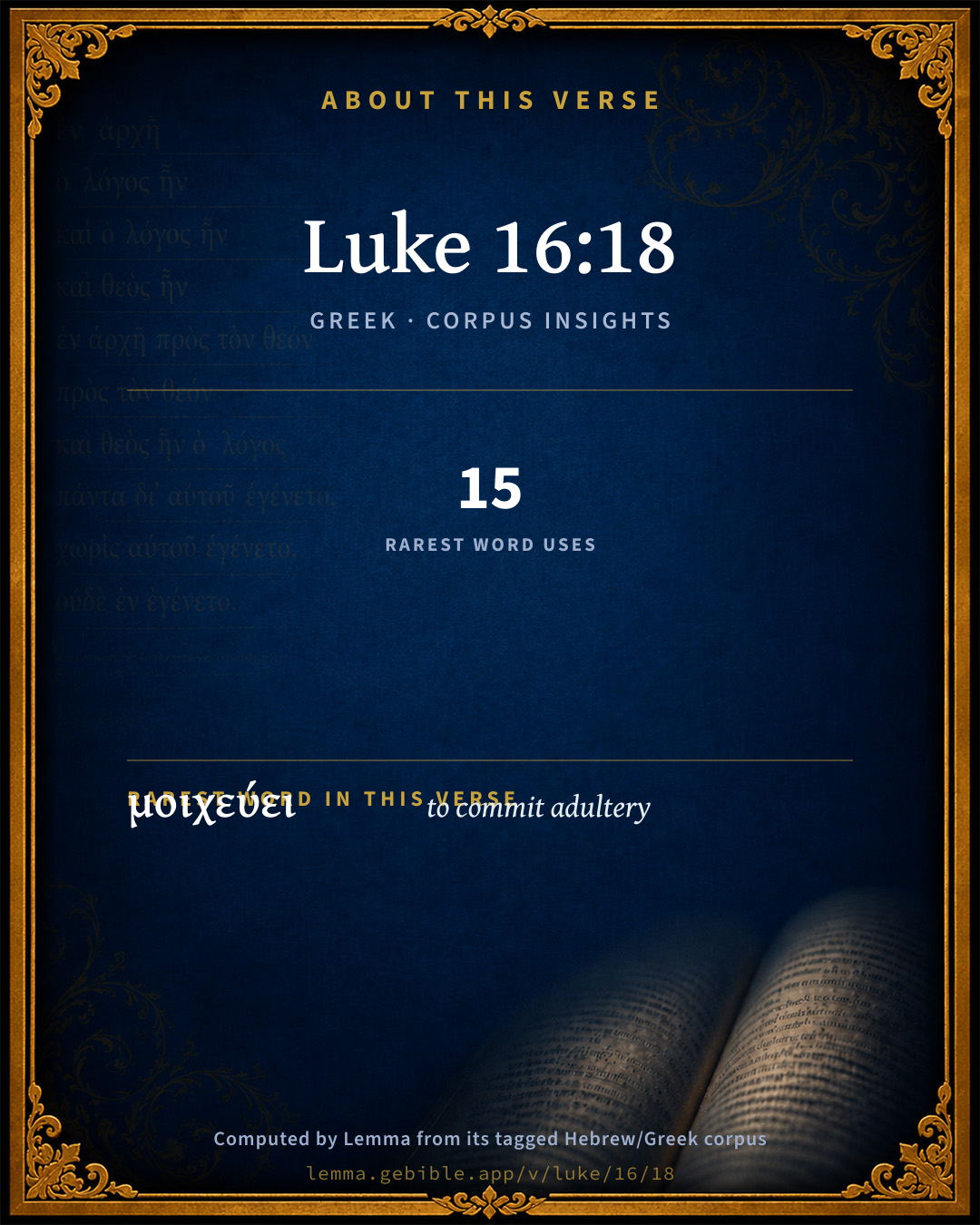
Luke 16:18

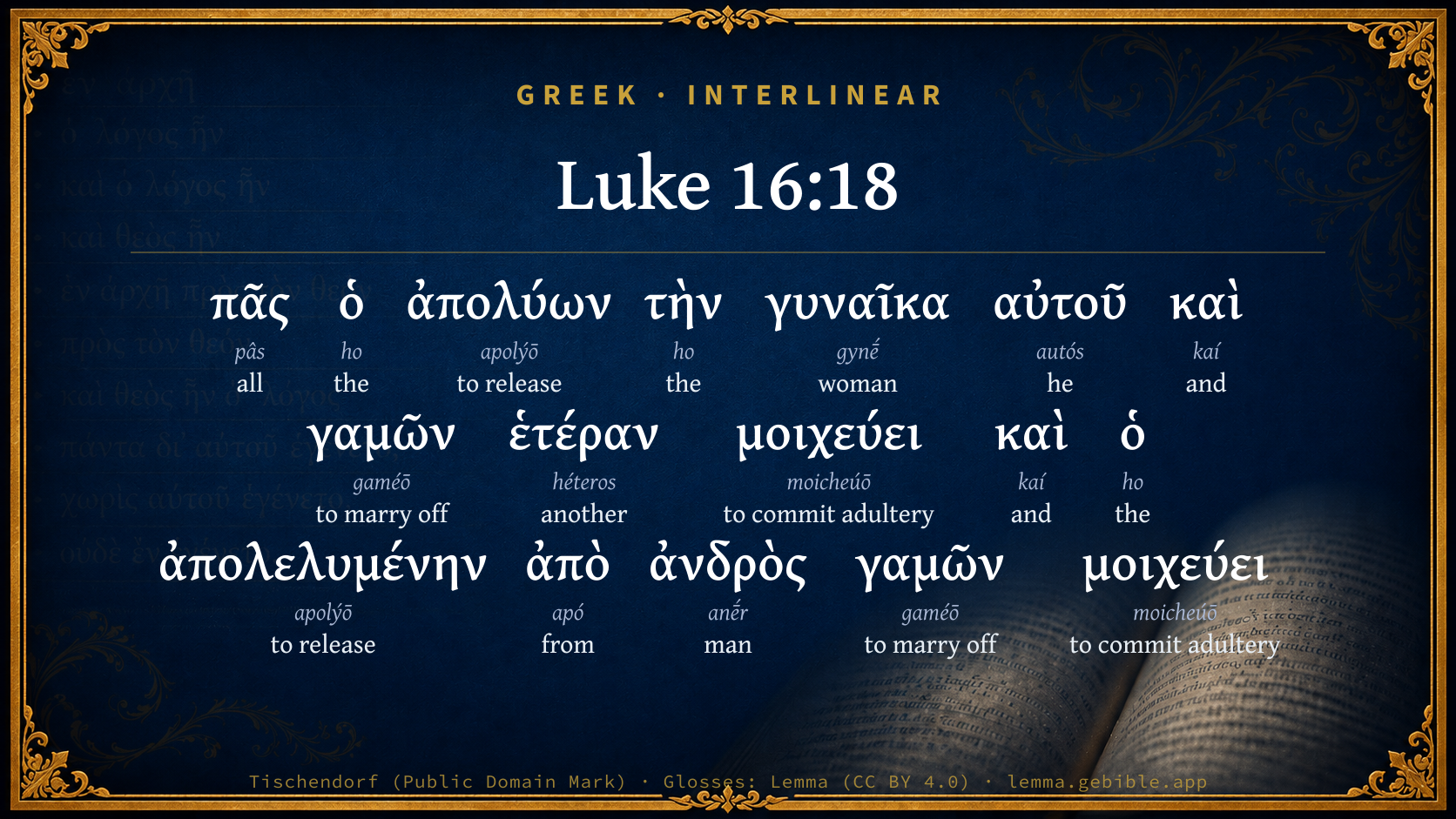
Greek (Tischendorf 8th ed.) Luke 16:18 appears in the Greek New Testament. The text above is from the Tischendorf 8th edition. Each word links to its Strong’s number and a concise gloss. Click any word for its full Thayer’s Greek Lexicon entry.
Download image
Cite this verse

Luke 16:18 (World English Bible). Public Domain. Lemma interlinear Bible study tool, https://lemma.gebible.app/v/luke/16/18.

Show BibTeX & RIS
BibTeX
RIS
English Translation
Everyone who divorces his wife, and marries another, commits adultery. He who marries one who is divorced from a husband commits adultery.
World English Bible · Public Domain
Download a study sheet

One document with this verse’s original text, its word-by-word gloss line, the meaning frame, cross-references with their text, attributed commentary, and full source and license credits — printable, and it pastes into notes with its structure intact.

This verse Autodidact and up

Study sheet (.html) Plain text (.txt)

A passage Seminary Student

Up to 50 verses in one chapter. A passage sheet keeps up to 6 commentary sources and 12 cross-references per verse, in the order this page ranks them, and says so on the sheet whenever that leaves anything out. Ask for a single verse and you get the Autodidact verse sheet above.

Everything on this page stays free to read, with no account — the sheet is a download of what is already on screen, not access to it.

Want to remove ads? Support Godless Engineer
Compare translations 3

The same verse in 3 English versions, stacked beneath the original-language interlinear above. Click any original word for its lexicon entry.

Each is an independent rendering of the whole verse — the interlinear is not word-aligned to these translations.

Highlighted words mark where these versions differ — a whole-verse word diff, not a word-by-word alignment.

  • World English Bible Public Domain
    Everyone who divorces his wife, and marries another, commits adultery. He who marries one who is divorced from a husband commits adultery.
  • King James Version Public Domain
    Whosoever putteth away his wife, and marrieth another, committeth adultery: and whosoever marrieth her that is put away from her husband committeth adultery.
  • unfoldingWord Literal Text CC BY-SA 4.0
    Everyone divorcing his wife and marrying another commits adultery, and the one marrying one that has been divorced from a husband commits adultery.

unfoldingWord Literal Text — © unfoldingWord, licensed CC BY-SA 4.0. Word-aligned USFM3 via Door43 (git.door43.org/unfoldingWord/en_ult).

Versions to compare (up to 4)

3 of 4 selected

Show all 19 translations

Every available English version of this verse, each an independent rendering of the whole verse.

  • World English Bible Public Domain
    Everyone who divorces his wife, and marries another, commits adultery. He who marries one who is divorced from a husband commits adultery.
  • Berean Standard Bible Public Domain
    Anyone who divorces his wife and marries another woman commits adultery, and he who marries a divorced woman commits adultery.
  • Majority Standard Bible Public Domain
    Anyone who divorces his wife and marries another woman commits adultery, and everyone who marries a divorced woman commits adultery.
  • King James Version Public Domain
    Whosoever putteth away his wife, and marrieth another, committeth adultery: and whosoever marrieth her that is put away from her husband committeth adultery.
  • American Standard Version (1901) Public Domain
    Every one that putteth away his wife, and marrieth another, committeth adultery: and he that marrieth one that is put away from a husband committeth adultery.
  • Revised Version (1885) Public Domain
    Every one that putteth away his wife, and marrieth another, committeth adultery: and he that marrieth one that is put away from a husband committeth adultery.
  • Geneva Bible (1599) Public Domain
    Whosoeuer putteth away his wife, and marieth another, committeth adulterie: and whosoeuer marieth her that is put away from her husband, committeth adulterie.
  • Douay-Rheims (1899) Public Domain
    Every one that putteth away his wife, and marrieth another, committeth adultery: and he that marrieth her that is put away from her husband, commmitteth adultery.
  • Young's Literal Translation Public Domain
    `Every one who is sending away his wife, and marrying another, doth commit adultery; and every one who is marrying her sent away from a husband doth commit adultery.
  • Literal Standard Version CC BY-SA 4.0
    Everyone who is sending his wife away, and marrying another, commits adultery; and everyone who is marrying her sent away from a husband commits adultery.
  • Unlocked Literal Bible CC BY-SA 4.0
    Everyone who divorces his wife and marries another commits adultery, and he who marries one who is divorced from her husband commits adultery.
  • unfoldingWord Literal Text CC BY-SA 4.0
    Everyone divorcing his wife and marrying another commits adultery, and the one marrying one that has been divorced from a husband commits adultery.
  • Darby Bible Public Domain
    Every one who puts away his wife and marries another commits adultery; and every one that marries one put away from a husband commits adultery.
  • World Messianic Bible Public Domain
    “Everyone who divorces his wife and marries another commits adultery. He who marries one who is divorced from a husband commits adultery.
  • Webster's Bible Public Domain
    Whoever putteth away his wife, and marrieth another, committeth adultery; and whoever marrieth her that is put away from her husband, committeth adultery.
  • Free Bible Version CC BY-SA 4.0
    Any man who divorces his wife and marries someone else commits adultery, and a man who marries a divorced woman commits adultery.
  • Bible in Basic English Public Domain
    Everyone who puts away his wife and takes another, is a false husband: and he who is married to a woman whose husband has put her away, is no true husband to her.
  • Text-Critical English NT CC BY 4.0
    “For example, any man who divorces his wife and marries another commits adultery, and any man who marries a woman divorced from her husband commits adultery.
  • Tyndale New Testament (1534) Public Domain
    Whosoever forsaketh his wyfe and marieth another breaketh matrimony. And every man which marieth her that is devorsed from her husbande committeth advoutry also.

Literal Standard Version (2020), Covenant Press — licensed CC BY-SA 4.0. Text via the HelloAO Bible API (eBible.org). Unlocked Literal Bible (unfoldingWord) — licensed CC BY-SA 4.0. Text via the HelloAO Bible API (eBible.org). unfoldingWord Literal Text — © unfoldingWord, licensed CC BY-SA 4.0. Word-aligned USFM3 via Door43 (git.door43.org/unfoldingWord/en_ult). Free Bible Version, Dr. Jonathan Gallagher — licensed CC BY-SA 4.0. Text via the HelloAO Bible API (eBible.org).

Word by word

More ways to search: Search by grammar → Find every occurrence → Compare this word →

Practice this passage: Drill this verse → Learn its vocabulary →

μοιχεύει
moicheúō
G3431
“to commit adultery”
Verb, Present, Active, Indicative, 3rd person, Singular
Part of Speech
Verb
Tense
Present
Voice
Active
Mood
Indicative
Person
3rd person
Number
Singular
Full Thayer's Definition

Origin: from G3432

TDNT: 16:09,6

1. to commit adultery a. to be an adulterer b. to commit adultery with, have unlawful intercourse with another's wife c. of the wife: to suffer adultery, be debauched d. A Hebrew idiom, the word is used of those who at a woman's solicitation are drawn away to idolatry, i.e. to the eating of things sacrificed to idols
  1. πᾶς pâs G3956 “all” Adjective, Nominative, Singular, Masculine
  2. ὁ ho G3588 “the” Article, Nominative, Singular, Masculine
  3. ἀπολύων apolýō G630 “to release” Verb, Present, Active, Participle, Nominative, Singular, Masculine
  4. τὴν ho G3588 “the” Article, Accusative, Singular, Feminine
  5. γυναῖκα gynḗ G1135 “woman” Noun, Accusative, Singular, Feminine
  6. αὐτοῦ autós G846 “he” Personal pronoun, Genitive, Singular, Masculine
  7. καὶ kaí G2532 “and” Conjunction
  8. γαμῶν gaméō G1060 “to marry off” Verb, Present, Active, Participle, Nominative, Singular, Masculine
  9. ἑτέραν héteros G2087 “another” Adjective, Accusative, Singular, Feminine
  10. καὶ kaí G2532 “and” Conjunction
  11. ὁ ho G3588 “the” Article, Nominative, Singular, Masculine
  12. ἀπολελυμένην apolýō G630 “to release” Verb, Perfect, Passive, Participle, Accusative, Singular, Feminine
  13. ἀπὸ apó G575 “from” Preposition
  14. ἀνδρὸς anḗr G435 “man” Noun, Genitive, Singular, Masculine
  15. γαμῶν gaméō G1060 “to marry off” Verb, Present, Active, Participle, Nominative, Singular, Masculine
  16. μοιχεύει moicheúō G3431 “to commit adultery” Verb, Present, Active, Indicative, 3rd person, Singular

About this verse

These counts appear in no published source. They are computed here, from the morphology-tagged text and Lemma’s own curated glosses. What Lemma adds →

17
words
11
distinct lemmas
Gospels
section

Notable vocabulary

The rarest word here is μοιχεύει to commit adultery G3431 — appearing just 15 times in the whole Greek New Testament.

Shared distinctive vocabulary

μοιχεύει to commit adultery G3431 occurs in 12 verses of the Greek New Testament. Also found in:

Repetition

Words recur within this verse:

  • ἀπολύων to release G630 ×2
  • γαμῶν to marry off G1060 ×2
  • μοιχεύει to commit adultery G3431 ×2
  • ὁ the G3588 ×3
  • καὶ and G2532 ×2

Cross-references

5

Topical passages linked to Luke 16:18 in the Treasury of Scripture Knowledge — connected by theme and wording, ordered by reader-vote popularity; previews shown in the World English Bible.

  • Matthew 19:9 I tell you that whoever divorces his wife, except for sexual immorality, and marries another, commits adultery; and he who marries her when she is divorced commits adultery."
  • Mark 10:11–12 He said to them, "Whoever divorces his wife, and marries another, commits adultery against her.
  • Matthew 5:31–32 "It was also said, 'Whoever shall put away his wife, let him give her a writing of divorce,'
  • 1 Corinthians 7:4 The wife doesn't have authority over her own body, but the husband. Likewise also the husband doesn't have authority over his own body, but the wife.
  • 1 Corinthians 7:10–12 But to the married I command--not I, but the Lord--that the wife not leave her husband

Cross-references courtesy of OpenBible.info (CC BY 4.0).

Commentary

Notes on Luke 16:18 from classic Christian and Jewish commentators (each source and its license shown beneath its notes). The classic Christian expositions comment on the surrounding passage and are grouped to its opening verse, so a note may address several verses; the Jewish commentaries on the Tanakh (Rashi and others) are per-verse, so they appear only where the commentator wrote on this verse.

Lemma curates 59 commentaries, every one of them public domain or Creative Commons licensed, each selected and text-cleaned for this edition rather than reprinted as found. About our sources →

Tyndale Open Study Notes

Tyndale Open Resources

16:18 This example fit the context by showing that Jesus’ authoritative words interpreted and fulfilled the Old Testament law. • a man who divorces his wife and marries someone else commits adultery: The Old Testament allowed for divorce but did not sanction it (Deut 24:1-4), and the rabbis of Jesus’ day debated what constituted legitimate grounds. The school of Shammai allowed a man to divorce his wife only because of unfaithfulness, while the school of Hillel allowed divorce for almost any reason. Against such a casual attitude, Jesus said that breaking the marriage vow by divorce and marrying someone else was equivalent to adultery. Elsewhere (Matt 5:32; 19:9), Jesus provided a clear exception for cases of unfaithfulness.

Tyndale Open Study Notes — © Tyndale Open Resources, licensed CC BY-SA 4.0. Text via the HelloAO Bible API.

Bengel's Gnomon

Johann Albrecht Bengel

Luk 16:18. Πᾶς ὁ ἀπολύων, every one who putteth away) The cause also of divorce either on the part of him who put away his wife, or on the part of the Pharisees and Judges, may have been “covetousness,” Luk 16:14, for the sake of the gain derived from the writing of divorcement. This abuse at that time prevailed to a great degree. [The express exception[174] (Mat 5:32; Mat 19:9) in the case of one put away on account of adultery did not belong to this place: for in that case it is not the husband but the unfaithful party (wife) who by the very act separates her own self from him.—V. g.]

[174] The Ed. Tert. Tubing. 1835, has ‘deserta,’ evidently a misprint for ‘diserta,’ as the Germ. Vers. has ausdrückliche.—E. and T.

Bengel's Gnomon of the New Testament — English translation (T&T Clark, Edinburgh, 1860) — public domain. Text from a community e-Sword module.

Meyer's Critical & Exegetical Commentary

Heinrich August Wilhelm Meyer

Luk_16:18. See on Mat_5:32; Mat_19:9. Of what Christ has just said of the continual obligation of the law he now gives an isolated example, as Luke found it here already in his original source. For the choice of this place (not the original one) a special inducement must have been conceived of, which Luke does not mention; perhaps only, in general, the remembrance of the varieties of doctrine prevailing at that time on the question of divorce (see on Mat_19:3); perhaps, also, the thought that among those Pharisees were such as had done that which the verse mentions (comp. Euthymius Zigabenus).

The saying, however, in the mind of Jesus, serves as a voucher for the obligation of the law without exception, on the ground of Gen_2:24. See on Mat_19:4 ff.; Mar_16:6 ff. Olshausen explains this of spiritual fornication,[205] that what God had joined together (i.e. the law according to its everlasting significance, Luk_16:17), the Pharisees had arbitrarily loosed (in that they loved money and wealth more than God), and that which God had loosed (i.e. the Old Testament theocracy in its temporary aspect, Luk_16:16), they wished to maintain as obligatory, and had thus practised a twofold spiritual adultery. How arbitrary, without the slightest hint in the text! The supposed meaning of the second member would be altogether without correspondence to the expressions, and the Pharisees might have used the first member directly for their justification, in order to confirm their prohibition of any accession to the Gospel. As to the obviousness of the exception which adultery makes in reference to the prohibition of divorce, see on Mat_5:32.

[205] Comp. also H. Bauer, op. cit. p. 544, who thinks the meaning is that Israel is not to separate himself from the Mosaic law, and not to urge it upon the heathens.

Meyer — Critical and Exegetical Commentary on the New Testament — English translation by Peter Christie, edited by Frederick Crombie (T&T Clark, 1880) — public domain. Text from a community e-Sword module.

Geneva Bible (1599)

Geneva Bible translators

They that gather by this place, that a man cannot be married again after that he hath put away his wife for adultery, while she liveth, reason fondly: for Christ speaketh of those divorces which the Jews used, of which sort we cannot take the divorcement for adultery, for adulterers were put to death by the law.

Geneva Bible (1599) marginal notes — public domain. Text via Bolls.life.

Jamieson, Fausset & Brown

Robert Jamieson, A. R. Fausset & David Brown

putteth away his wife, &c.--(See on Mat 19:3-9). Far from intending to weaken the force of the law, in these allusions to a new economy, our Lord, in this unexpected way, sends home its high requirements with a pungency which the Pharisees would not fail to feel.

Jamieson, Fausset & Brown — Commentary Critical and Explanatory on the Whole Bible (1871) — public domain (CC PDM 1.0). Text via the HelloAO Bible API.

Adam Clarke's Commentary

Verse 18. Putteth away (or divorceth) his wife] See on Mt 5:31; Mt 5:32; Mt 19:9; Mt 19:10; Mr 10:12; where the question concerning divorce is considered at large. These verses, from the 13th to the 18th Lu 16:13-18 inclusive, appear to be part of our Lord's sermon on the mount; and stand in a much better connection there than they do here; unless we suppose our Lord delivered the same discourse at different times and places, which is very probable.

Adam Clarke's Commentary on the Bible (1810–1826) — public domain. Text from a community e-Sword/MySword module.

Ellicott's Commentary for English Readers

(18) Whosoever putteth away his wife.—On the special points involved, see Notes on Mat_5:31-32; Mat_19:3-9. Here, again, the explanation that has been given of the parable of the Unjust Steward, offers the only satisfactory explanation of the introduction of a topic apparently so irrelevant. The doctrine and discipline of divorce which the Pharisees taught, lowering the sacredness of the life of home, and ministering to the growing laxity of men’s morals, was precisely what was meant by the steward’s bidding the debtors take their bill and write fifty, or fourscore measures, instead of the hundred. (See Note on Luk_16:6-7).

A Bible Commentary for English Readers, edited by Charles John Ellicott (1878–1897) — public domain. Text from a community e-Sword module.

The Cambridge Bible for Schools and Colleges

gen. ed. J. J. S. Perowne

18. Whosoever putteth away his wife] At first sight this verse (which also occurs with an important limitation in Mat_5:32) appears so loosely connected with the former as to lead the Dutch theologian Van der Palm to suppose that St Luke was merely utilising a spare fragment on the page by inserting isolated words of Christ. But compressed as the discourse is, we see that this verse illustrates, no less than the others, the spirit of the Pharisees. They professed to reverence the Law and the Prophets, yet divorce (so alien to the primitive institution of marriage) was so shamefully lax among them that great Rabbis in the Talmud practically abolished all the sacredness of marriage in direct contradiction to Mal_2:15-16. Even Hillel said a man might divorce his wife if she over-salted his soup. They made the whole discussion turn, not on eternal truths, but on a mere narrow verbal disquisition about the meaning of two words ervath dabhar, ‘some uncleanness’ (lit. ‘matter of nakedness’), in Deu_24:1-2. Not only Hillel, but even the son of Sirach (Sir_25:26) and Josephus (Anil. iv. 8, § 23), interpreted this to mean ‘for any or every cause.’ (Mat_19:3-12; Mar_10:2-12.) Besides this shameful laxity the Pharisees had never had the courage to denounce the adulterous marriage and disgraceful divorce of which Herod Antipas had been guilty.

The Cambridge Bible for Schools and Colleges (gen. ed. J. J. S. Perowne; Cambridge University Press, 1878–1918) — public domain. Text from a community e-Sword module.

John Gill's Exposition

There was a certain rich man,.... In Beza's most ancient copy, and in another manuscript of his it is read by way of preface, "he said also another parable": which shows, that this is not a history of matter of fact, or an historical account of two such persons, as the "rich" man and the beggar, who had lately lived at Jerusalem; though the Papists pretend, to this day, to point out the very spot of ground in Jerusalem, where this rich man's house stood: nor is it to be understood parabolically of any particular rich man, or prince; as Saul the first king of Israel; or Herod, who now was reigning, and was clothed in purple, and lived in a sumptuous manner: nor of rich men in general, though it greatly describes the characters of such, at least of many of them; who only take care of their bodies, and neglect their souls; adorn and pamper them, live in pleasure, and grow wanton, and have no regard to the poor saints; and when they die go to hell; for their riches will not profit them in a day of wrath, nor deliver from it, or be regarded by the Judge, any more than hills and mountains will hide them from his face: but by the rich man are meant, the Jews in general; for that this man is represented, and to be considered as a Jew, is evident from Abraham being his father, and his calling him so, and Abraham again calling him his son, Luk 16:24 of which relation the Jews much boasted and gloried in; and from his brethren having Moses and the prophets, Luk 16:29 which were peculiar to the Jewish people; and from that invincible and incurable infidelity in them, that they would not believe, though one rose from the dead, Luk 16:31 as the Jews would not believe in Christ though he himself rose from the dead, which was the sign he gave them of his being the Messiah: and the general design of the parable, is to expose the wickedness and unbelief of the Jews, and to show their danger and misery, for their contempt and rejection of the Messiah; and particularly the Pharisees are designed, who being covetous, had derided Christ for what he had before said; and, who though high in the esteem of men, were an abomination to God, Luk 16:14. These more especially boasted of Abraham being their father; and of their being the disciples of Moses, and trusted in him, and in his law; and thought they should have eternal life through having and reading the books of Moses and the prophets: these may be called "a man", because this was the name by which the Jews style themselves, in distinction from the Gentiles, whom they compare to beasts; See Gill on Mat 15:26 and this they ground on a passage in Eze 34:31 "and ye my flock, the flock of my pasture, are men": upon which their note is (e),

"ye are called, "men", but the nations of the earth are not called men.''

And they may be called a "certain" man, a famous man, a man of note, as the Jews, and especially the Pharisees, thought themselves to be; and therefore coveted the chief places in the synagogues, and at feasts, and loved salutations and greetings in market places, and to be called of men Rabbi, and master: as also a "rich man"; for the Jews in general were a wealthy people, lived in a very fruitful country, and were greatly indulged with the riches of providential goodness; and particularly the Pharisees, many of whom were of the great sanhedrim, and rulers of synagogues, and elders of the people; and who by various methods, amassed to themselves great riches, and even devoured widows' houses; see Luk 6:24 and they were also rich in outward means and ordinances, having the oracles of God, his word, worship, and service; and as to their spiritual and eternal estate, in their own esteem; though they were not truly rich in grace, not in faith, nor in spiritual knowledge, nor even in good works, of which they so much boasted; but in appearance, and in their own conceit, they were rich in the knowledge of the law, and in righteousness, which they imagined was perfect, and so stood in need of nothing; no, not of repentance, and especially of Christ, or of any thing from him:

which was clothed in purple and fine linen; or "byssus", which is said to (f) grow on a tree, in height equal to a poplar, and in leaves like a willow, and was brought out of India into Egypt, and much used there, as it also was among the Jews: hence we often read (g) of or "garments of byssus", or fine linen: the Jews in general dressed well; their common apparel were fine linen and silk; see Eze 16:10 and so the Arabic version here renders it, "silk and purple"; and the Persic version, "silks and bombycines": and the priests particularly, were arrayed in such a habit; the robe of the ephod, and also its curious girdle, were of blue, purple, scarlet, and fine linen, and at the hem of it were pomegranates of blue, purple, and scarlet, Exo 28:6. And as for the Pharisees, they loved to go in long robes, and to make broad their phylacteries, and enlarge the borders of their garments, which were fringes of blue, joined unto them; and which may figuratively express the fine outside show of holiness and righteousness, they made;

and fared sumptuously every day. The Jews in common lived well, being in a land that flowed with milk and honey; see Eze 16:13 and especially the priests, who offered up lambs every day, besides other offerings, of which they had their part; as also the Pharisees, who were often at feasts, where they loved the chief places: and this may signify the easy and jocund life they lived; knowing no sorrow upon spiritual accounts, having no sense of sin, nor sight of the spirituality of the law, nor view of danger; but at perfect ease, and not emptied from vessel to vessel.

(e) T. Bab. Bava Metzia, fol. 114. 2. & Kimchi in loc. (f) Philostrat. Vit. Appollon. l. 2. c. 9. (g) Targum in Gen. xli. 42. in 2 Chron. v. 12. & in Ezek. xliv. 17.

John Gill's Exposition of the Whole Bible (1746–1763) — public domain (CC PDM 1.0). Text via the HelloAO Bible API.

Trapp's Complete Commentary

John Trapp

18 Whosoever putteth away his wife, and marrieth another, committeth adultery: and whosoever marrieth her that is put away from her husband committeth adultery.

Ver. 18. See Mat 5:32; Mat 19:9; Mar 10:5;

John Trapp, A Commentary or Exposition upon All the Books of the Old and New Testament (1647–1656) — public domain. Text from a community e-Sword module.

Albert Barnes' Notes on the Bible

See the notes at Mat 5:32. These verses occur in Matthew in a different order, and it is not improbable that they were spoken by our Saviour at different times. The design, here, seems to be to reprove the Pharisees for not observing the law of Moses, notwithstanding their great pretensions to external righteousness, and to show them that they had “really” departed from the law.

Albert Barnes' Notes on the Bible (1834–1885) — public domain. Text from a community e-Sword/MySword module.

Matthew Poole's English Annotations

See Poole on "Mat 5:32", where this is expounded; also, See Poole on "Mat 19:9", and See Poole on "Mar 10:11".

Matthew Poole's English Annotations on the Holy Bible (1683–1685) — public domain. Text from a community e-Sword/MySword module.

Whedon's Commentary on the Bible

Daniel D. Whedon

18. Marrieth her—Our Lord calls no names, but there was no hearer but made the application. Herod Antipas had married the wife of his brother, as all the nation knew. See notes on Mat_14:1-4. The part these guardians of the nation’s morals had acted would rise up to every man’s mind to their confusion as deriders of Jesus. Thus did this first reply of Jesus serve to show them how little they were making the mammon of unrighteousness the genuine friend of their highest interest.

Daniel D. Whedon (gen. ed.), Commentary on the Old and New Testaments (1874–1909) — public domain. Text from a community e-Sword module.

The Pulpit Commentary

Whosoever putteth away his wife, and marrieth another, committeth adultery: and whosoever marrieth her that is put away from her husband, committeth adultery. The teaching of the rabbis in the time of our Lord on the question of the marriage he was exceedingly lax, and tended to grave immorality in the family life. In the late unlawful marriage of Herod Antipas with Herodias, in which so many sacred and family ties were rudely torn asunder, no rabbi or doctor in Israel but one had raised his voice in indignant protest, and that one was the friend and connection of Jesus of Nazareth, the prophet John the Baptist. Divorce for the most trivial causes was sanctioned by the rabbis, and even such men as Hillel, the grandfather of that Gamaliel whom tradition speaks of as the rabbi whose lectures were listened to by the Boy Jesus, taught that a man might divorce his wife if in the cooking she burnt his dinner or even over salted his soup (see Talmud, treatise "Gittin," 9:10).

St. Luke and Paul, different to the great masters of profane history, like Thucydides, or Livy, or Xenophon, were evidently at no pains to round off their narratives. They give us the account of the Lord"s words and works very much as they had them from the first listeners and eye-witnesses. When the notes and memories were very scant and fragmentary, as appear to have been the case in the Lord"s discourse which St. Luke interposes between the parable of the steward and that of Dives and Lazarus, the fragmentary notes are reproduced without any attempt to round off the condensed, and at first sight apparently disconnected, utterances. So here, directly after the fragmentary report of certain sayings of Jesus, the great parable of Lazarus and Dives is introduced with somewhat startling abruptness; nothing of St. Luke"s is added simply the original report as Luke or Paul received it is reproduced.

The following is probably the connection in which the famous parable was spoken.

When the Lord spoke the parable-story of the unjust steward, he pressed home to the listeners, as its great lesson, the necessity of providing against the day of death, and he showed how, by the practice of kindness here towards the poor, the weak, and the suffering, they would make to themselves friends who would in their turn be of use to them who would, in their hour of sore need, when death swept them out of this life, receive them into everlasting habitations.

We believe that the Master, as he spoke these things, purposed either on that very occasion, or very shortly after, when his listeners were again gathered together supplementing this important teaching by another parable, in which the good of having friends in the world to come should be clearly shown. The parable of Lazarus as Dives, then, may be regarded as a piece of teaching following on to and closely connected with the parable of the unjust steward.

Nine verses, however, as we have seen are inserted between the two parables. Of these, vers. 10-13 are simply some reflections of the Master on the parable of the steward just spoken. Then comes ver. 14 a scornful interruption on the part of the Pharisee listeners. Our Lord replies to this (vers. 15-18), and then goes on, either then or very soon after, to the same auditory, with the parable of Lazarus and Dives, which is, in fact, a direct sequel to the parable of the unjust steward, and which St. Luke proceeds to relate without any further preamble.

The Pulpit Commentary (1880–1919), ed. H.D.M. Spence-Jones & Joseph S. Exell — public domain. Text from a community e-Sword module.

John Wesley's Explanatory Notes

But ye do; particularly in this notorious instance. Matt. v, 31; xix, 7.

John Wesley, Explanatory Notes Upon the Whole Bible (1754–1765) — public domain. Text via the GEBible commentary corpus.

The People's New Testament

B. W. Johnson

18. Every one that putteth away his wife. See note on Matt. 5:31.

The Rich Man and the Beggar (verses 19–31). A parable, also, showing the consequences of a worldly spirit and the worldly use of wealth. “Here, as in other cognate parables, great wisdom is displayed in bringing the whole force of the rebuke to bear on one point. It is not intimated that this man made free with other people's money, or that he had gained his fortune in a dishonest way. All other charges are removed, that the weight lying all on one point may more effectively imprint the intended lesson. To have represented him as dishonest, or drunken, would have blunted the weapon's edge. Here is an affluent citizen, on whose fair fame the breath of scandal can fix no blot. He had a large portion in this world, and did not seek—did not desire—any other. He spent his wealth in pleasing himself, and did not lay it out in serving God or helping man.”—Arnot.

B. W. Johnson's The People's New Testament with Notes (1889–1891) — public domain. Electronic text from the Christian Classics Ethereal Library (CCEL) ThML edition.

unfoldingWord translationNotes

Door43 World Missions Community

Everyone who divorces his wife

"Anyone who divorces his wife" or "Any man who divorces his wife"

commits adultery

"is guilty of adultery"

he who marries one

"any man who marries a woman"

translationWords

divorce

adultery

unfoldingWord translationNotes — © Distant Shores Media and the Door43 World Missions Community, licensed CC BY-SA 4.0. Source: git.door43.org/Door43/en_tn.

Cambridge Greek Testament for Schools and Colleges

18. ὁ ἀπολύων τὴν γυναῖκα αὐτοῦ. At first sight this verse (which also occurs with an important limitation in Mat 5:32) appears so loosely connected with the former as to lead the Dutch theologian Van der Palm to suppose that St Luke was merely utilising a spare fragment on the page by inserting isolated words of Christ. But compressed as the discourse is, we see that this verse illustrates, no less than the others, the spirit of the Pharisees. They professed to reverence the Law and the Prophets, yet divorce (so alien to the primitive institution of marriage) was so shamefully lax among them that great Rabbis in the Talmud practically abolished all the sacredness of marriage in direct contradiction to Mal 2:15-16. Even Hillel said a man might divorce his wife if she over-salted his soup. They made the whole discussion turn, not on eternal truths, but on a mere narrow verbal disquisition about the meaning of two words ervath dabhar, ‘some uncleanness’ (lit. ‘matter of nakedness’), in Deu 24:1-2. Not only Hillel, but even the son of Sirach (Sir 25:26) and Josephus (Antt. IV. 8, § 23), interpreted this to mean ‘for any or every cause.’ (Mat 19:3-12; Mar 10:2-12.) Besides this shameful laxity the Pharisees had never had the courage to denounce the adulterous marriage and disgraceful divorce of which Herod Antipas had been guilty.

Cambridge Greek Testament for Schools and Colleges (Cambridge University Press, 1896; 21 vols, various authors incl. Carr, Maclear, Plummer, Farrar, Lumby, Moule, M. R. James, Simcox) — public domain. Text from a community e-Sword module.

International Critical Commentary

18. Perhaps this introduces an example of the durability of the moral law in spite of human evasions. Adultery remains adultery even when it has been legalized, and legalized by men who jealously guarded every fraction of the letter, while they flagrantly violated the spirit of the Law. “Because he hath found some unseemly thing in her” (Deu 24:1), was interpreted with such frivolity, that Hillel is said to have taught that a man might divorce his wife for spoiling the dinner. Comp. Mar 10:11, Mar 10:12 and Mat 5:32 for other statements of Christ’s doctrine. Mat 5:32 states the one exception.

It is very forced to take the whole utterance as a parable. “It is spiritual adultery to cast off all the obligations of the Law; and it is also spiritual adultery to maintain all those obligations which have been rescinded by the Gospel.” But this does not fit the wording; and, if it did, would it have been intelligible to those who heard it? According to this explanation the wife unlawfully put away = those elements in the Law which are eternal; and the divorced wife unlawfully married to another man = those elements of the Law which are obsolete. But in the parable (if it be a parable) we have not two women but one. It is better to take the words literally, and leave me connexion with what precedes undetermined.

International Critical Commentary — older volumes (1896–1929), various authors — public domain. Text from a community e-Sword module.

Lesson kit

Teaching starters — assembled from the data on this page, not authored interpretation. Every prompt links to the verse data it draws on. Edit before teaching.

Luke, in the Gospels, opens this verse with 17 words (11 distinct Greek lemmas). Its most distinctive word is moicheúō (“to commit adultery”). A historical commentator’s framing appears above. Read the whole chapter for the surrounding context.

Discussion questions

  1. The word moicheúō carries the sense “to commit adultery.” How does it shape the verse?
  2. How does Matthew 5:27, which shares the word «to commit adultery», read alongside this verse?
  3. What does the repetition of “to release” (2× in this one verse) do in this verse?
  4. These translations render this verse differently; the difference is in the English rendering, not the original. What questions does that raise?
  5. Compare how Tyndale Open Study Notes and Bengel's Gnomon read this verse. Where do they agree or differ?

Things to notice

  • These translations choose different wording for 17 words in this verse.
  • “to release” occurs 2× in this single verse.
  • 11 distinct Greek lemmas span 17 words in this verse.

Reading settings

Reading text

Shown beneath each verse's original-language words.

Old Testament
Old Testament edition

Read the OT as the Masoretic Hebrew (MT) or the Greek Septuagint (LXX).

English shown for the Greek Septuagint (in the Hebrew ↔ Greek comparison).

Comparing translations? Open the Compare panel on any verse page to stack up to four side by side.