1 Corinthians 11:15

Greek (Tischendorf 8th ed.) 1 Corinthians 11:15 appears in the Greek New Testament. The text above is from the Tischendorf 8th edition. Each word links to its Strong’s number and a concise gloss. Click any word for its full Thayer’s Greek Lexicon entry.
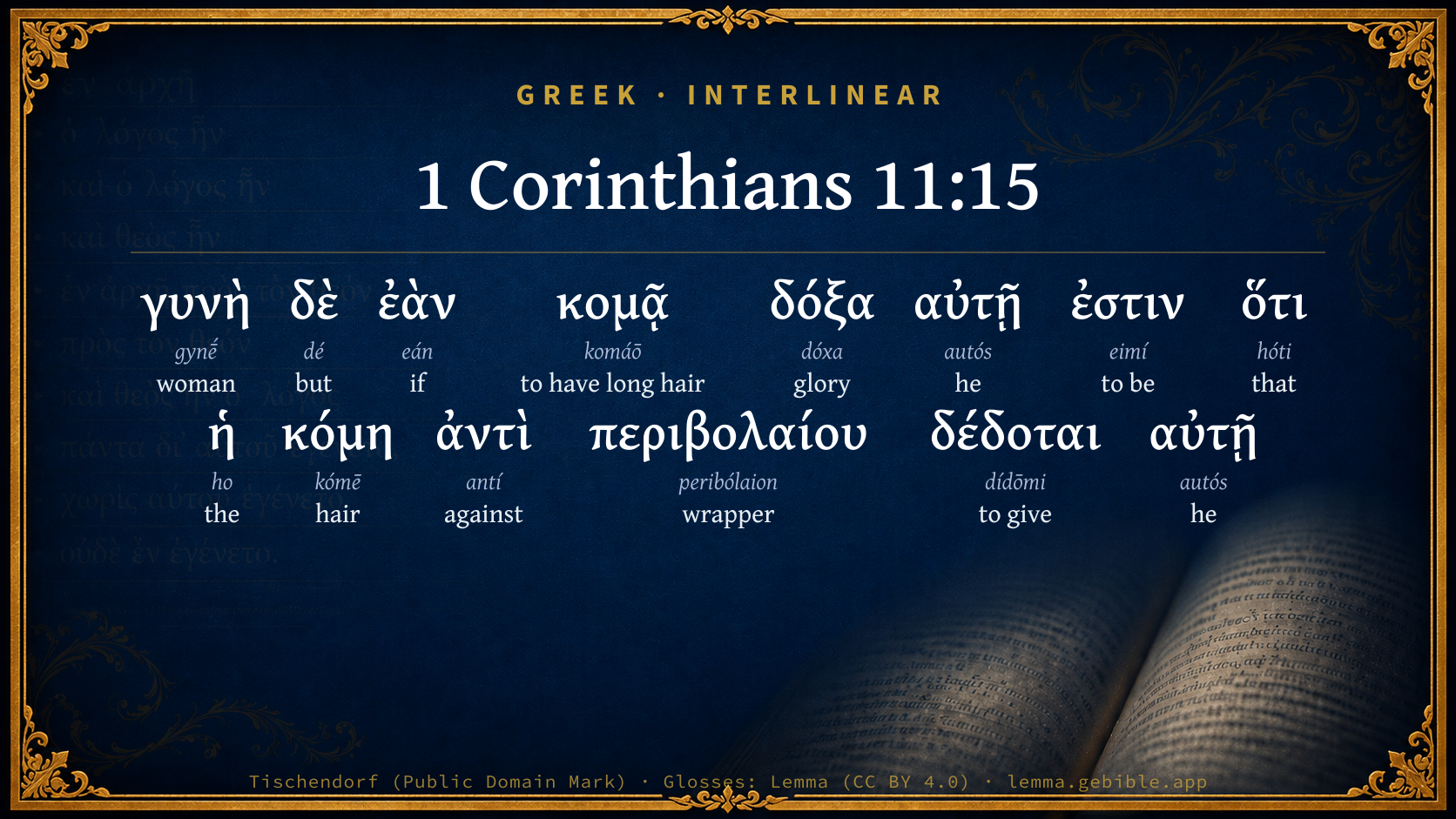
Download image
Cite this verse

1 Corinthians 11:15 (World English Bible). Public Domain. Lemma interlinear Bible study tool, https://lemma.gebible.app/v/1-corinthians/11/15.

Show BibTeX & RIS
BibTeX
RIS
English Translation
But if a woman has long hair, it is a glory to her, for her hair is given to her for a covering.
World English Bible · Public Domain
Highlights
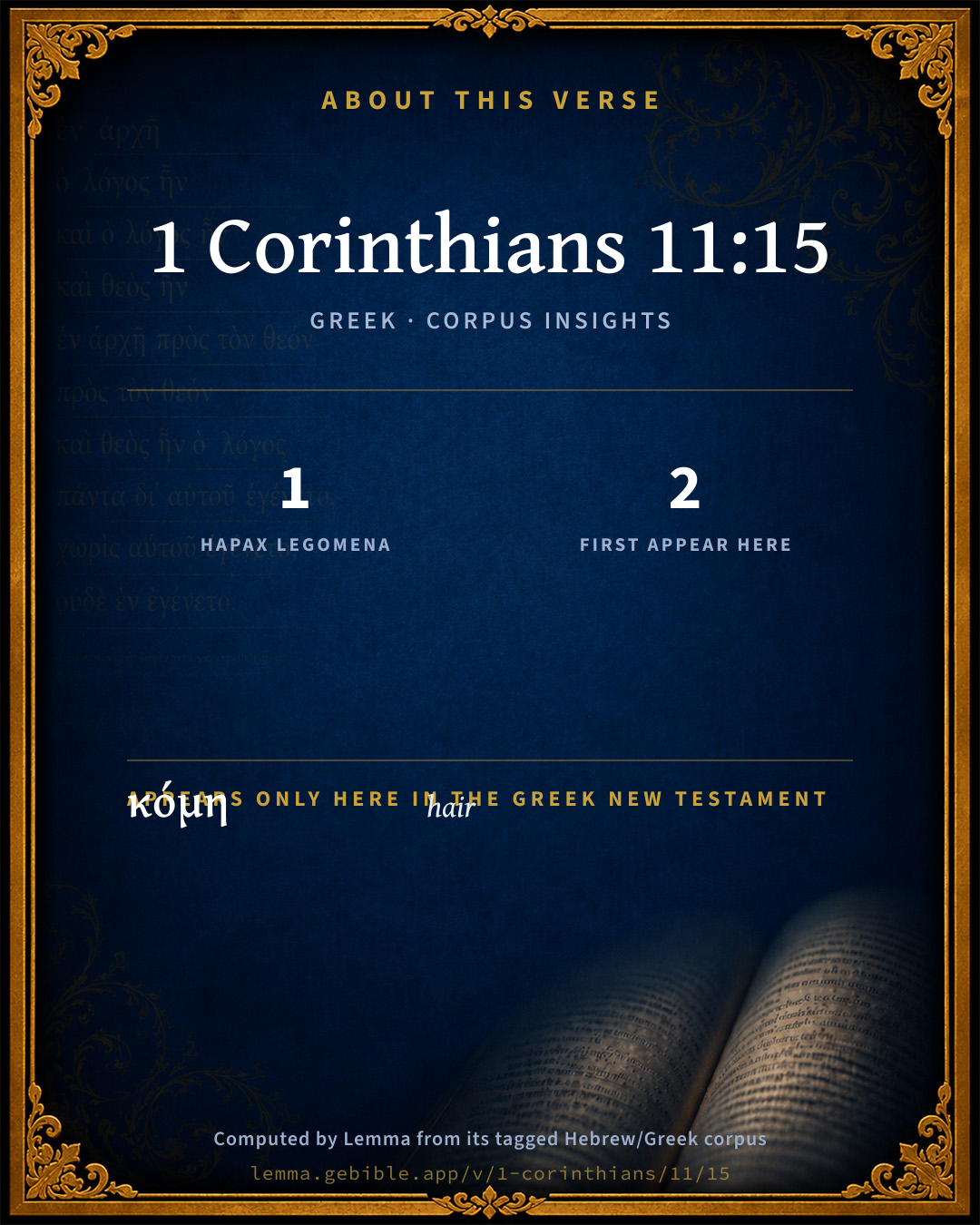
  • 1 hapax legomenon — only here in the Greek New Testament
  • 2 first appearances in the Greek New Testament
Full analysis ↓
Download a study sheet

One document with this verse’s original text, its word-by-word gloss line, the meaning frame, cross-references with their text, attributed commentary, and full source and license credits — printable, and it pastes into notes with its structure intact.

This verse Autodidact and up

Study sheet (.html) Plain text (.txt)

A passage Seminary Student

Up to 50 verses in one chapter. A passage sheet keeps up to 6 commentary sources and 12 cross-references per verse, in the order this page ranks them, and says so on the sheet whenever that leaves anything out. Ask for a single verse and you get the Autodidact verse sheet above.

Everything on this page stays free to read, with no account — the sheet is a download of what is already on screen, not access to it.

Want to remove ads? Support Godless Engineer
Compare translations 3

The same verse in 3 English versions, stacked beneath the original-language interlinear above. Click any original word for its lexicon entry.

Each is an independent rendering of the whole verse — the interlinear is not word-aligned to these translations.

Highlighted words mark where these versions differ — a whole-verse word diff, not a word-by-word alignment.

  • World English Bible Public Domain
    But if a woman has long hair, it is a glory to her, for her hair is given to her for a covering.
  • King James Version Public Domain
    But if a woman have long hair, it is a glory to her: for her hair is given her for a covering.
  • unfoldingWord Literal Text CC BY-SA 4.0
    but if a woman might have long hair, it is glory for her? For the long hair has been given to her as a covering.

unfoldingWord Literal Text — © unfoldingWord, licensed CC BY-SA 4.0. Word-aligned USFM3 via Door43 (git.door43.org/unfoldingWord/en_ult).

Versions to compare (up to 4)

3 of 4 selected

Show all 19 translations

Every available English version of this verse, each an independent rendering of the whole verse.

  • World English Bible Public Domain
    But if a woman has long hair, it is a glory to her, for her hair is given to her for a covering.
  • Berean Standard Bible Public Domain
    but that if a woman has long hair, it is her glory? For long hair is given to her as a covering.
  • Majority Standard Bible Public Domain
    but that if a woman has long hair, it is her glory? For long hair is given as a covering.
  • King James Version Public Domain
    But if a woman have long hair, it is a glory to her: for her hair is given her for a covering.
  • American Standard Version (1901) Public Domain
    But if a woman have long hair, it is a glory to her: for her hair is given her for a covering.
  • Revised Version (1885) Public Domain
    But if a woman have long hair, it is a glory to her: for her hair is given her for a covering.
  • Geneva Bible (1599) Public Domain
    But if a woman haue long heare, it is a prayse vnto her: for her heare is giuen her for a couering.
  • Douay-Rheims (1899) Public Domain
    But if a woman nourish her hair, it is a glory to her; for her hair is given to her for a covering.
  • Young's Literal Translation Public Domain
    and a woman, if she have long hair, a glory it is to her, because the hair instead of a covering hath been given to her;
  • Literal Standard Version CC BY-SA 4.0
    And a woman, if she has long hair, it is a glory to her, because the hair has been given to her instead of a covering;
  • Unlocked Literal Bible CC BY-SA 4.0
    Does not nature teach you that if a woman has long hair, it is her glory? For her hair has been given to her as a covering.
  • unfoldingWord Literal Text CC BY-SA 4.0
    but if a woman might have long hair, it is glory for her? For the long hair has been given to her as a covering.
  • Darby Bible Public Domain
    But woman, if she have long hair, [it is] glory to her; for the long hair is given [to her] in lieu of a veil.
  • World Messianic Bible Public Domain
    But if a woman has long hair, it is a glory to her, for her hair is given to her for a covering.
  • Webster's Bible Public Domain
    But if a woman hath long hair, it is a glory to her: for her hair is given her for a covering.
  • Free Bible Version CC BY-SA 4.0
    However, a woman with long hair brings herself glory, because her hair is given to her as a covering.
  • Bible in Basic English Public Domain
    But if a woman has long hair, it is a glory to her: for her hair is given to her for a covering.
  • Text-Critical English NT CC BY 4.0
    but if a woman has long hair it is her glory? For her long hair is given for a covering.
  • Tyndale New Testament (1534) Public Domain
    and a prayse to a woman yf she have longe heere? For her heere is geven her to cover her with all.

Literal Standard Version (2020), Covenant Press — licensed CC BY-SA 4.0. Text via the HelloAO Bible API (eBible.org). Unlocked Literal Bible (unfoldingWord) — licensed CC BY-SA 4.0. Text via the HelloAO Bible API (eBible.org). unfoldingWord Literal Text — © unfoldingWord, licensed CC BY-SA 4.0. Word-aligned USFM3 via Door43 (git.door43.org/unfoldingWord/en_ult). Free Bible Version, Dr. Jonathan Gallagher — licensed CC BY-SA 4.0. Text via the HelloAO Bible API (eBible.org).

Word by word

More ways to search: Search by grammar → Find every occurrence → Compare this word →

Practice this passage: Drill this verse → Learn its vocabulary →

About this verse

These counts appear in no published source. They are computed here, from the morphology-tagged text and Lemma’s own curated glosses. What Lemma adds →

14
words
13
distinct lemmas
Pauline Epistles
section

Notable vocabulary

1 hapax legomenon — a word that appears only here in the entire Greek New Testament:

First appearance in Scripture

These words make their first canonical appearance in the Greek New Testament here:

  • κόμη hair G2864
  • περιβολαίου wrapper G4018

Shared distinctive vocabulary

κομᾷ to have long hair G2863 occurs in 2 verses of the Greek New Testament. Also found in:

Repetition

A word recurs within this verse:

  • αὐτῇ he G846 ×2

Commentary

Notes on 1 Corinthians 11:15 from classic Christian and Jewish commentators (each source and its license shown beneath its notes). The classic Christian expositions comment on the surrounding passage and are grouped to its opening verse, so a note may address several verses; the Jewish commentaries on the Tanakh (Rashi and others) are per-verse, so they appear only where the commentator wrote on this verse.

Lemma curates 59 commentaries, every one of them public domain or Creative Commons licensed, each selected and text-cleaned for this edition rather than reprinted as found. About our sources →

Tyndale Open Study Notes

Tyndale Open Resources

11:15 Paul argues that social conventions regarding hair length express fundamental differences between men and women. • it has been given to her as a covering: Paul suggests that women’s long hair, covering their head, shows that God intends women to have some type of “covering.”

Tyndale Open Study Notes — © Tyndale Open Resources, licensed CC BY-SA 4.0. Text via the HelloAO Bible API.

Bengel's Gnomon

Johann Albrecht Bengel

1Co 11:15. Ἀντὶ περιβολαίου, for a covering) Not but that an artificial covering ought to be added, but because her longer hair is a proof of covering the head as much as possible: the will ought to correspond to nature.—[94] δέδοται, has been given) by nature.

[94] The word αὐτῇ, the omission of which was thrust down by the marg. of 2d edition from the mark γ to the mark ε, is exhibited in the Germ. Ver.—E. B.

Αὐτῇ is read by Lachm. with ABg after δέδοται, and before it, in CH and later Syr. and Vulg. Tisch. omits it with D (Λ)Gfg.—ED.

Bengel's Gnomon of the New Testament — English translation (T&T Clark, Edinburgh, 1860) — public domain. Text from a community e-Sword module.

Hodge's Commentary on Romans, Ephesians & First Corinthians

Charles Hodge

1Co_11:14, 1Co_11:15

Doth not even nature itself teach you, that, if a man have long hair, it is a shame unto him? But if a woman have long hair, it is a glory to her: for (her) hair is given her for a covering.

Doth not nature itself. The word (φύσις), nature, sometimes means essence or substance, sometimes the laws of nature or of our natural constitution; sometimes, the instinctive feelings or judgments which are the effects of those laws. The form which feelings assume is necessarily determined in a great measure by education and habit. The instinctive sense of propriety in an eastern maiden prompts her, when surprised by strangers, to cover her face. In an European it would not produce that effect. In writing, therefore, to eastern females, it would be correct to ask whether their native sense of propriety did not prompt them to cover their heads in public. The response would infallibly be in the affirmative. It is in this sense the word nature is commonly taken here. It may, however, mean the laws or course of nature. Nature gives the man short hair and the woman long hair; and therefore nature itself teaches that long hair is a disgrace to the one and an ornament to the other; for it is disgraceful in a man to be like a woman, and in a woman to be like a man. Wearing long hair was contrary to the custom both of the Hebrews and Greeks. The Nazarites, as a distinction, allowed their hair to grow. Num_6:8; see also Eze_44:20. It was considered so much a mark of effeminacy for men to wear long hair, that it was not only ridiculed by Juvenal, but in after times seriously censured by church councils. To a woman, however, in all ages and countries, long hair has been considered an ornament. It is given to her, Paul says, as a covering, or as a natural veil; and it is a glory to her because it is a veil. The veil itself, therefore, must be becoming and decorous in a woman.

Charles Hodge — Commentary on Romans (1835), First Corinthians (1857), and Ephesians (1856) — public domain. Text from a community e-Sword module.

Geneva Bible (1599)

Geneva Bible translators

To be a covering for her, and such a covering as should procure another.

Geneva Bible (1599) marginal notes — public domain. Text via Bolls.life.

Jamieson, Fausset & Brown

Robert Jamieson, A. R. Fausset & David Brown

her hair . . . for a covering--Not that she does not need additional covering. Nay, her long hair shows she ought to cover her head as much as possible. The will ought to accord with nature [BENGEL].

Jamieson, Fausset & Brown — Commentary Critical and Explanatory on the Whole Bible (1871) — public domain (CC PDM 1.0). Text via the HelloAO Bible API.

Adam Clarke's Commentary

Verse 15. But if a woman have long hair] The Author of their being has given a larger proportion of hair to the head of women than to that of men; and to them it is an especial ornament, and may in various cases serve as a veil.

It is a certain fact that a man's long hair renders him contemptible, and a woman's long hair renders her more amiable. Nature and the apostle speak the same language; we may account for it as we please.

Adam Clarke's Commentary on the Bible (1810–1826) — public domain. Text from a community e-Sword/MySword module.

Ellicott's Commentary for English Readers

(15) But if a woman have long hair, it is a glory to her.—We should follow the suggestions of Nature. If a woman has naturally long hair, which is given to her as a covering for her head, the covering of her head can be no shame to her; therefore let her wear a veil. “The will ought to correspond to Nature.”

A Bible Commentary for English Readers, edited by Charles John Ellicott (1878–1897) — public domain. Text from a community e-Sword module.

The Cambridge Bible for Schools and Colleges

gen. ed. J. J. S. Perowne

15. it is a glory to her] The true glory of every creature of God is to fulfil the law of its being. Whatever helps woman to discharge the duties of modesty and submissiveness assigned to her by God is a glory to her.

for her hair is given her for a covering] A mantle, or cloak. Literally, something flung around the body. It is worthy of remark that the Vestal Virgins at Rome wore their hair short, or confined by a fillet. They may, however, have been regarded as protected by their sacred character.

The Cambridge Bible for Schools and Colleges (gen. ed. J. J. S. Perowne; Cambridge University Press, 1878–1918) — public domain. Text from a community e-Sword module.

John Gill's Exposition

But if any man seem to be contentious,.... That is, if anyone will not be satisfied with reasons given, for men's praying and prophesying with their heads uncovered, and women's praying and prophesying with their heads covered; but will go on to raise objections, and continue carping and cavilling, showing that they contend not for truth, but victory, can they but obtain it any way; for my part, as if the apostle should say, I shall not think it worth my while to continue the dispute any longer; enough has been said to satisfy any wise and good man, anyone that is serious, thoughtful, and modest; and shall only add,

we have no such custom, nor the churches of God; meaning, either that men should appear covered, and women uncovered in public service, and which should have some weight with all those that have any regard to churches and their examples; or that men should be indulged in a captious and contentious spirit; a man that is always contending for contention sake, and is continually cavilling and carping at everything that is said and done in churches, and is always quarrelling with one person or another, or on account of one thing or another, and is constantly giving uneasiness, is not fit to be a church member; nor ought he to be suffered to continue in the communion of the church, to the disturbance of the peace of it. This puts me in mind of a passage in the Talmud (n).

"The Rabbans teach, that after the departure of R. Meir, R. Judah said to his disciples, do not let the disciples of R. Meir enter here, , "because they are contentious".''

(n) T. Bab. Nazir, fol. 49. 2. & Kiddushin, fol. 52. 2.

John Gill's Exposition of the Whole Bible (1746–1763) — public domain (CC PDM 1.0). Text via the HelloAO Bible API.

Trapp's Complete Commentary

John Trapp

15 But if a woman have long hair, it is a glory to her: for her hair is given her for a covering.

Ver. 15. Her hair is given her] Now it is a vile thing to go against nature. Cyprian and Austin say that garish apparel is worse than whoredom; because whoredom only corrupts chastity, but this corrupts nature.

John Trapp, A Commentary or Exposition upon All the Books of the Old and New Testament (1647–1656) — public domain. Text from a community e-Sword module.

Albert Barnes' Notes on the Bible

It is a glory unto her - It is an ornament, and adorning. The same instinctive promptings of nature which make it proper for a man to wear short hair, make it proper that the woman should suffer hers to grow long.

For a covering - Margin, “veil.” It is given to her as a sort of natural veil, and to indicate the propriety of her wearing a veil. It answered the purposes of a veil when it was allowed to grow long, and to spread over the shoulders and ever parts of the face, before the arts of dress were invented or needed. There may also be an allusion here to the fact that the hair of women naturally grows longer than that of men. See Rosenmuller. The value which eastern females put on their long hair may be learned from the fact that when Ptolemy Euergetes, king of Egypt, was about to march against Seleucus Callinicus, his queen Berenice vowed, as the most precious sacrifice which she could make, to cut off and consecrate her hair if he returned in safety. “The eastern ladies,” says Harmer, “are remarkable for the length and the great number of the tresses of their hair. The men there, on the contrary, wear very little hair on their heads.” Lady M. W. Montague thus speaks concerning the hair of the women:” Their hair hangs at full length behind, divided into tresses, braided with pearl or riband, which is always in great quantity. I never saw in my life so many fine heads of hair. In one lady’s I have counted one hundred and ten of these tresses, all natural; but it must be owned that every kind of beauty is more common here than with us.” The men there, on the contrary, shave all the hair off their heads, excepting one lock; and those that wear hair are thought effeminate. Both these particulars are mentioned by Chardin, who says they are agreeable to the custom of the East: “the men are shaved; the women nourish their hair with great fondness, which they lengthen, by tresses and tufts of silk, down to the heels. The young men who wear their hair in the East are looked upon as effeminate and infamous.”

Albert Barnes' Notes on the Bible (1834–1885) — public domain. Text from a community e-Sword/MySword module.

Matthew Poole's English Annotations

But, he saith, if a woman have long hair, it is a glory to her. Long hair is comely for the woman, and accounted to her for a beauty or ornament, for God hath

given her her hair for a covering. There have been books written about the lawfulness or unlawfulness of men’s wearing long hair, and the due or undue lengths of men’s hair, the substance of which were too much to transcribe here. That which in these verses seemeth to be commended to us, as the will of God in this matter, is:

1. That men and women should so order their hair, as by it to preserve the distinction of sexes.

2. That men should not wear their hair after the manner of women, either dishevelled, or curled, and tricked up about their heads, which speaks too much of an unmanly and effeminate temper, much more was what became not Christians. And if this be forbidden men, as to the use of their own hair, they stand concerned to consider whether it be lawful for them thus to wear and adorn themselves with the hair of other men and women.

Matthew Poole's English Annotations on the Holy Bible (1683–1685) — public domain. Text from a community e-Sword/MySword module.

Whedon's Commentary on the Bible

Daniel D. Whedon

15. A glory to her—And beauty is the rightful prerogative of womanhood, as force is that of manhood. And this divine gift of beauty it is her right to cultivate within the laws of modesty; and, united with cultured gifts of mind and character, it forms a loveliness which is the true source of her rightful power.

A covering—The apostle sees, even in the glory of the woman’s long hair, the symbol of concealment and of modesty. It is nature’s sign, suggesting, if it does not require, that art and custom should follow and add a covering to the female head.

Daniel D. Whedon (gen. ed.), Commentary on the Old and New Testaments (1874–1909) — public domain. Text from a community e-Sword module.

The Pulpit Commentary

It is a glory to her. Because it is at once beautiful and natural; and as Bengel says, "Will should follow the guidance of nature."

The Pulpit Commentary (1880–1919), ed. H.D.M. Spence-Jones & Joseph S. Exell — public domain. Text from a community e-Sword module.

John Wesley's Explanatory Notes

Given her - Originally, before the arts of dress were in being.

John Wesley, Explanatory Notes Upon the Whole Bible (1754–1765) — public domain. Text via the GEBible commentary corpus.

McGarvey & Pendleton's Commentaries

J. W. McGarvey

But if a woman have long hair, it is a glory to her: for her hair is given her for a covering . [Instinct should teach us that the head of a woman is more properly covered than that of a man, for nature grants it a greater abundance of hair. In Paul's time the hair of a man, unless he was under some vow, such as that of the Nazarite, was uniformly cut short. Long hair in a man betokened base and lewd effeminacy, and we find those who wore it ridiculed by Juvenile. Since nature gives a woman more covering than man, her will should accord with nature, and vice versa. Masculine women and effeminate men are alike objectionable. Let each sex keep its place. And in point of attire it is still disgraceful for men and women to appear in public in each other's garments.]

J. W. McGarvey (with Philip Y. Pendleton), Commentaries on the New Testament (The Fourfold Gospel, 1914; Acts; and the epistles) — public domain. Text from a community e-Sword/MySword module.

Cambridge Greek Testament for Schools and Colleges

15. δόξα. The true glory of every creature of God is to fulfil the law of its being. Whatever helps woman to discharge the duties of modesty and submissiveness assigned to her by God is a glory to her.

ἀντὶ περιβολαίου. Literally, something flung around the body. It is worthy of remark that the Vestal Virgins at Rome wore their hair short, or confined by a fillet. They may, however, have been regarded as protected by their sacred character.

Cambridge Greek Testament for Schools and Colleges (Cambridge University Press, 1896; 21 vols, various authors incl. Carr, Maclear, Plummer, Farrar, Lumby, Moule, M. R. James, Simcox) — public domain. Text from a community e-Sword module.

Alford’s Greek Testament

Henry Alford

15.] See on ver. 14: compare Milton, Par. Lost. iv. 304 ff.

περιβόλαιον, properly a wrapper, or enveloping garment: see reff., and Eurip. Herc. fur. 549, and in a metaphorical sense, 1269. “In this passage,” says Stanley, “the Apostle would refer to the ‘peplum,’ which the Grecian women used ordinarily as a shawl, but on public occasions as a hood also, especially at funerals and marriages,” See a woodcut in Smith’s Dict. of Antt. art. ‘peplum.’

Henry Alford, The Greek Testament (1849–1861) — public domain. Text from a community e-Sword module.

Godet's Commentaries

Frédéric Louis Godet

Vv. 15. By giving to the woman a covering of hair, which envelopes her, in a manner, from head to foot, nature itself has shown that it is suitable to her to withdraw as much as possible from view, and to remain concealed. This long and rich hair is given to her ἀντὶ περιβολαίου, in place of a veil. This substantive does not merely denote, as κάλυμμα would do, an ornament for the head; it is a vestment enveloping the whole body, a sort of peplum. It is a natural symbol of reserve and modesty, woman’s most beautiful ornament.

It has been objected, not without a touch of irony, that for the very reason that nature has endowed woman with such a covering, she does not need to add a second and artificial one (Holsten). But this is to mistake the real bearing of the apostle’s argument. All is spiritual in his view. He means that nature, by constituting as it has done each of the two sexes, has given both to understand the manner in which they will fulfil their destiny; for man, it will be public and independent action; for woman, life in domestic retirement and silence. Whoever has the least appreciation of the things of nature, will recognise the profound truth of this symbolism.

The Greco-Lat. and Byz. reading omits the αὐτῇ at the end of the verse. The meaning is not affected by the omission (contrary to Holsten).

Notwithstanding the unanimity of the Mjj. and Vss. in favour of the text of this passage, Holsten has thought right to propose a whole list of rejections; that, for example, of 1Co 11:5 b and 6, of 1Co 11:10, and even of 1Co 11:13-15. We have refuted this critic’s objections when it seemed to us necessary. They arise from certain general ideas about the passage, which we think false; the first: that Paul has in view only husbands and wives who are Christians; the second: that if the wife is bound to speak veiled it is only in presence of her own husband, to whom she ought to show, that while fulfilling this function, she does not forget her dependence on him; the third: that on reaching the last section (1Co 11:13-15), the text passes, in a far from logical way, from the domain of moral obligation—which is Paul’s true standpoint—to that of social propriety, which, according to Holsten, is the interpolator’s standpoint. But (1) from the outset, and even in 1Co 11:3, it is of the difference of the sexes as such that the apostle is thinking. He is speaking of man and woman in general, regarding young men and young women as naturally destined for marriage. The whole female sex is in his eyes created with a view to its subordination to the male sex, as Tertullian well says (see Heinrici): “Si caput mulieris vir est, utique et virginis, de quâ fit mulier quoe nupsit.” (2) It is not because of her husband only that the woman who speaks in public ought to continue veiled; it is as a woman, and to maintain in her own consciousness and in that of the Church her permanent character of dependence. (3) The passage 1Co 11:13-15 does not give a reason which lies outside of moral obligation. Woman’s physical constitution is a revelation of the Creator’s will regarding her. Not to conform to this indication, is not merely to offend social propriety, it is to transgress the will of the Creator. Thus fall all Holsten’s objections against the authenticity of the text of our passage.

The apostle closes with a sentence which seems to say: Now, enough of discussion; let us have done with it.

Frédéric Louis Godet — Commentaries on Luke, John, Romans, and 1 Corinthians — English translation (T&T Clark, Edinburgh, 1870s–1890s) — public domain. Text from a community e-Sword module.

Lesson kit

Teaching starters — assembled from the data on this page, not authored interpretation. Every prompt links to the verse data it draws on. Edit before teaching.

1 Corinthians, in the Pauline Epistles, opens this verse with 14 words (13 distinct Greek lemmas). Its most distinctive word is kómē (“hair”). A historical commentator’s framing appears above. Read the whole chapter for the surrounding context.

Discussion questions

  1. What does “hair” (kómē) contribute to the verse as a whole?
  2. 1 word here appears nowhere else in the Greek New Testament. Why might the author reach for such rare wording?
  3. 2 words make their first appearance in Scripture here. What does this debut establish?
  4. How does 1 Corinthians 11:14, which shares the word «to have long hair», read alongside this verse?
  5. What does the repetition of “he” (2× in this one verse) do in this verse?
  6. The translations on this page render this verse differently — a whole-verse word diff, not a word-by-word alignment. What might account for the different wordings?
  7. Compare how Tyndale Open Study Notes and Bengel's Gnomon read this verse. Where do they agree or differ?

Things to notice

  • 1 word in this verse appears nowhere else in the Greek New Testament.
  • 2 words make their first canonical appearance in Scripture here.
  • These translations choose different wording for 4 words in this verse.
  • “he” occurs 2× in this single verse.
  • 13 distinct Greek lemmas span 14 words in this verse.

Reading settings

Reading text

Shown beneath each verse's original-language words.

Old Testament
Old Testament edition

Read the OT as the Masoretic Hebrew (MT) or the Greek Septuagint (LXX).

English shown for the Greek Septuagint (in the Hebrew ↔ Greek comparison).

Comparing translations? Open the Compare panel on any verse page to stack up to four side by side.