
1 Timothy 3:2

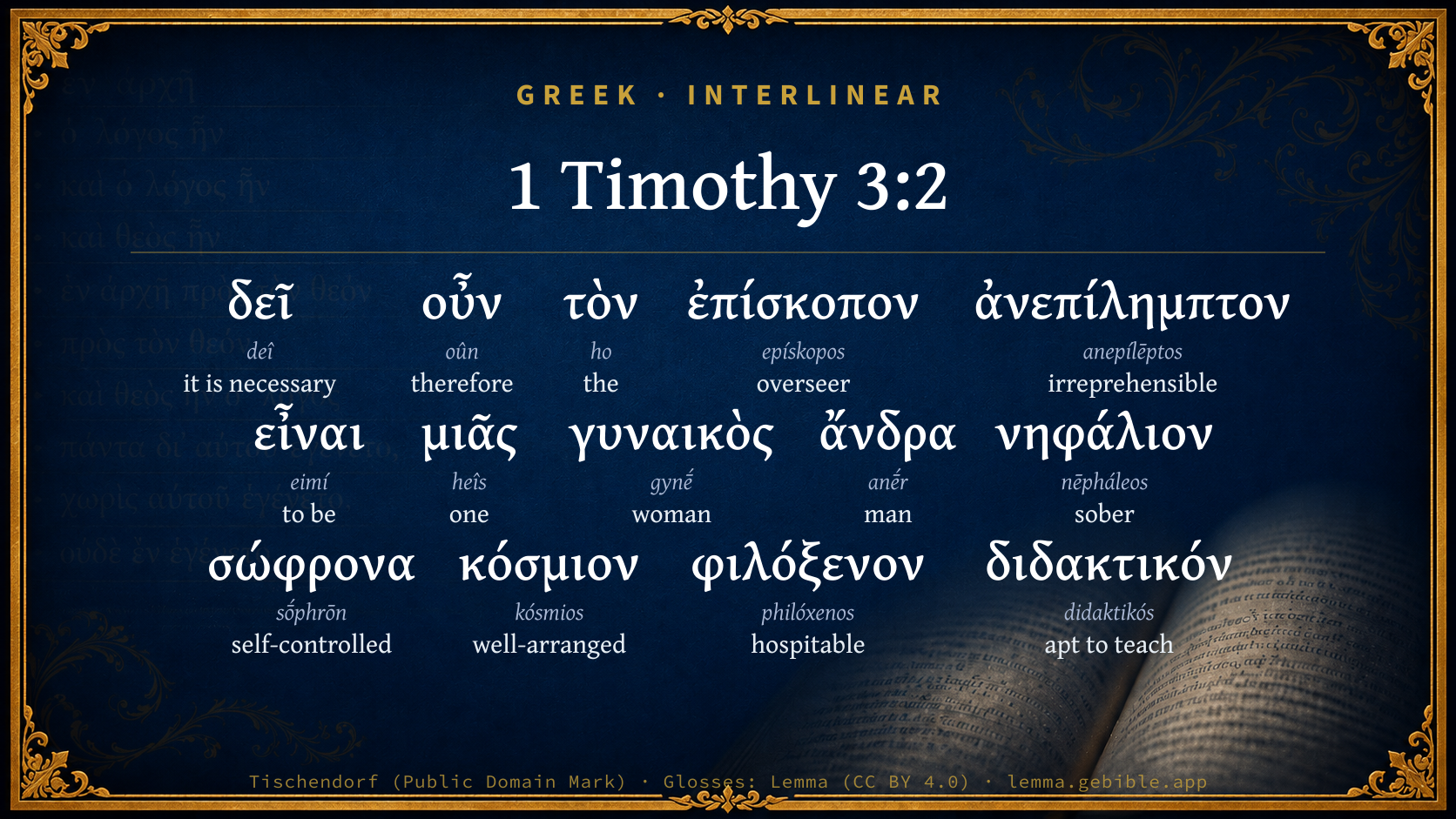
Greek (Tischendorf 8th ed.) 1 Timothy 3:2 appears in the Greek New Testament. The text above is from the Tischendorf 8th edition. Each word links to its Strong’s number and a concise gloss. Click any word for its full Thayer’s Greek Lexicon entry.
Download image
Cite this verse

1 Timothy 3:2 (World English Bible). Public Domain. Lemma interlinear Bible study tool, https://lemma.gebible.app/v/1-timothy/3/2.

Show BibTeX & RIS
BibTeX
RIS
English Translation
The overseer therefore must be without reproach, the husband of one wife, temperate, sensible, modest, hospitable, good at teaching;
World English Bible · Public Domain
Highlights
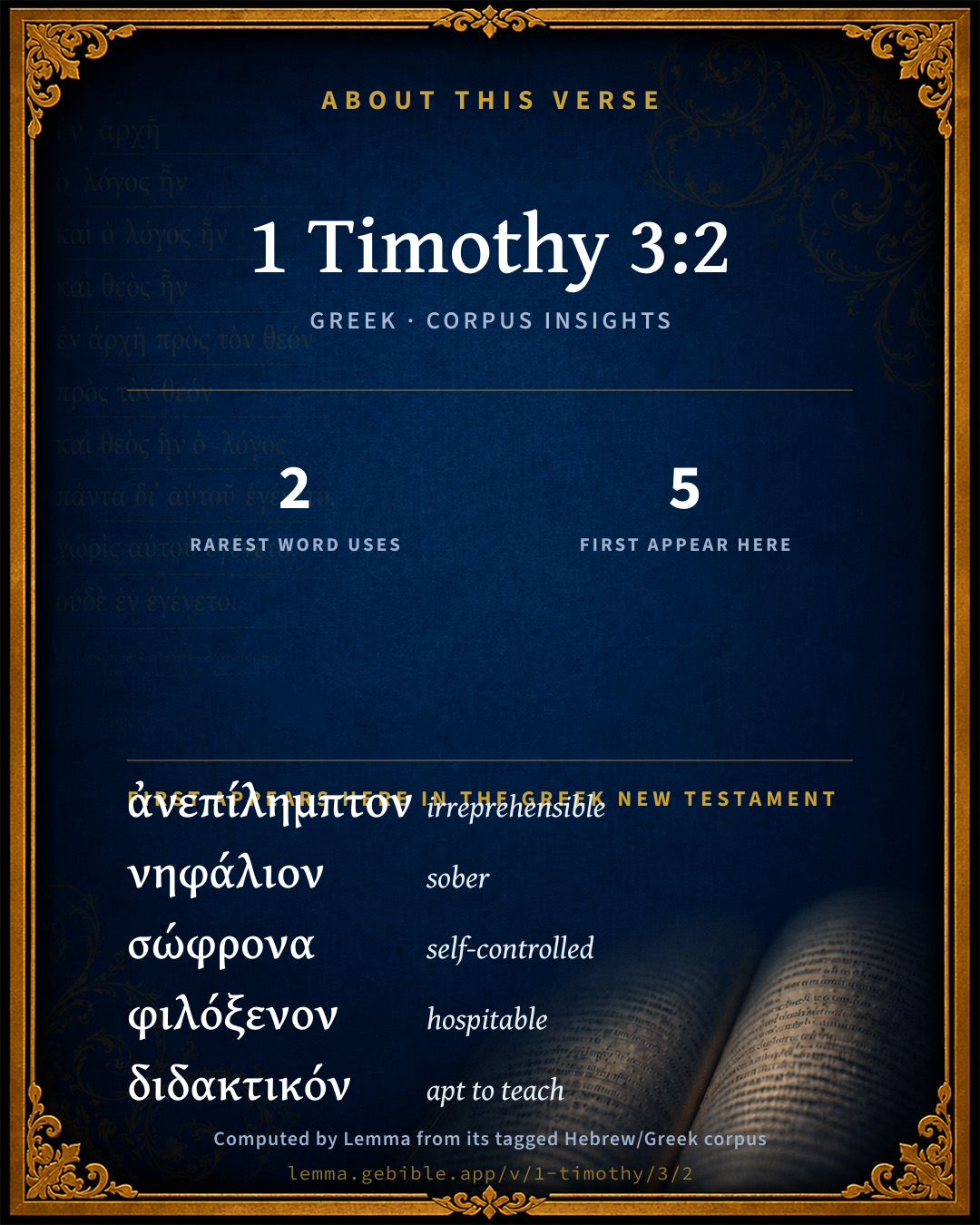
  • 5 first appearances in the Greek New Testament
Full analysis ↓
Download a study sheet

One document with this verse’s original text, its word-by-word gloss line, the meaning frame, cross-references with their text, attributed commentary, and full source and license credits — printable, and it pastes into notes with its structure intact.

This verse Autodidact and up

Study sheet (.html) Plain text (.txt)

A passage Seminary Student

Up to 50 verses in one chapter. A passage sheet keeps up to 6 commentary sources and 12 cross-references per verse, in the order this page ranks them, and says so on the sheet whenever that leaves anything out. Ask for a single verse and you get the Autodidact verse sheet above.

Everything on this page stays free to read, with no account — the sheet is a download of what is already on screen, not access to it.

Want to remove ads? Support Godless Engineer
Compare translations 3

The same verse in 3 English versions, stacked beneath the original-language interlinear above. Click any original word for its lexicon entry.

Each is an independent rendering of the whole verse — the interlinear is not word-aligned to these translations.

Highlighted words mark where these versions differ — a whole-verse word diff, not a word-by-word alignment.

  • World English Bible Public Domain
    The overseer therefore must be without reproach, the husband of one wife, temperate, sensible, modest, hospitable, good at teaching;
  • King James Version Public Domain
    A bishop then must be blameless, the husband of one wife, vigilant, sober, of good behaviour, given to hospitality, apt to teach;
  • unfoldingWord Literal Text CC BY-SA 4.0
    Therefore, it is necessary for the overseer to be irreproachable, a husband of one wife, temperate, self-controlled, proper, hospitable, able to teach,

unfoldingWord Literal Text — © unfoldingWord, licensed CC BY-SA 4.0. Word-aligned USFM3 via Door43 (git.door43.org/unfoldingWord/en_ult).

Versions to compare (up to 4)

3 of 4 selected

Show all 19 translations

Every available English version of this verse, each an independent rendering of the whole verse.

  • World English Bible Public Domain
    The overseer therefore must be without reproach, the husband of one wife, temperate, sensible, modest, hospitable, good at teaching;
  • Berean Standard Bible Public Domain
    An overseer, then, must be above reproach, the husband of but one wife, temperate, self-controlled, respectable, hospitable, able to teach,
  • Majority Standard Bible Public Domain
    An overseer, then, must be above reproach, the husband of but one wife, temperate, self-controlled, respectable, hospitable, able to teach,
  • King James Version Public Domain
    A bishop then must be blameless, the husband of one wife, vigilant, sober, of good behaviour, given to hospitality, apt to teach;
  • American Standard Version (1901) Public Domain
    The bishop therefore must be without reproach, the husband of one wife, temperate, sober-minded, orderly, given to hospitality, apt to teach;
  • Revised Version (1885) Public Domain
    The bishop therefore must be without reproach, the husband of one wife, temperate, soberminded, orderly, given to hospitality, apt to teach;
  • Geneva Bible (1599) Public Domain
    A Bishop therefore must be vnreproueable, the husband of one wife, watching, temperate, modest, harberous, apt to teache,
  • Douay-Rheims (1899) Public Domain
    It behoveth therefore a bishop to be blameless, the husband of one wife, sober, prudent, of good behaviour, chaste, given to hospitality, a teacher,
  • Young's Literal Translation Public Domain
    it behoveth, therefore, the overseer to be blameless, of one wife a husband, vigilant, sober, decent, a friend of strangers, apt to teach,
  • Literal Standard Version CC BY-SA 4.0
    it is required, therefore, the overseer to be blameless, a husband of one wife, vigilant, sober, respectable, a friend of strangers, apt to teach,
  • Unlocked Literal Bible CC BY-SA 4.0
    Therefore the overseer must be without reproach. He must be a husband of one wife. He must be moderate, sensible, orderly, and hospitable. He must be able to teach.
  • unfoldingWord Literal Text CC BY-SA 4.0
    Therefore, it is necessary for the overseer to be irreproachable, a husband of one wife, temperate, self-controlled, proper, hospitable, able to teach,
  • Darby Bible Public Domain
    The overseer then must be irreproachable, husband of one wife, sober, discreet, decorous, hospitable, apt to teach;
  • World Messianic Bible Public Domain
    The overseer therefore must be without reproach, the husband of one wife, temperate, sensible, modest, hospitable, good at teaching;
  • Webster's Bible Public Domain
    A bishop then must be blameless, the husband of one wife, vigilant, sober, of good behavior, given to hospitality, apt to teach;
  • Free Bible Version CC BY-SA 4.0
    An elder must be above reproach, married to one wife, self-controlled, well-balanced, sensible, hospitable, and able to teach.
  • Bible in Basic English Public Domain
    The Bishop, then, is to be a man of good name, the husband of one wife, self-controlled, serious-minded, having respect for order, opening his house freely to guests, a ready teacher;
  • Text-Critical English NT CC BY 4.0
    Therefore the overseer must be above reproach, the husband of one wife, sober-minded, sensible, respectable, hospitable, able to teach,
  • Tyndale New Testament (1534) Public Domain
    Ye and a bisshope must be fautlesse the husband of one wyfe sober discrete honestly aparelled harberous apt to teache

Literal Standard Version (2020), Covenant Press — licensed CC BY-SA 4.0. Text via the HelloAO Bible API (eBible.org). Unlocked Literal Bible (unfoldingWord) — licensed CC BY-SA 4.0. Text via the HelloAO Bible API (eBible.org). unfoldingWord Literal Text — © unfoldingWord, licensed CC BY-SA 4.0. Word-aligned USFM3 via Door43 (git.door43.org/unfoldingWord/en_ult). Free Bible Version, Dr. Jonathan Gallagher — licensed CC BY-SA 4.0. Text via the HelloAO Bible API (eBible.org).

Word by word

More ways to search: Search by grammar → Find every occurrence → Compare this word →

Practice this passage: Drill this verse → Learn its vocabulary →

κόσμιον
kósmios
G2887
“well-arranged”
Adjective, Accusative, Singular, Masculine
Part of Speech
Adjective
Case
Accusative
Number
Singular
Gender
Masculine
Full Thayer's Definition

Origin: from G2889 (in its primary sense)

TDNT: 17:55,5

1. well arranged, seemly, modest
  1. δεῖ deî G1163 “it is necessary” Verb, Present, Active, Indicative, 3rd person, Singular
  2. οὖν oûn G3767 “therefore” Conjunction
  3. τὸν ho G3588 “the” Article, Accusative, Singular, Masculine
  4. ἐπίσκοπον epískopos G1985 “overseer” Noun, Accusative, Singular, Masculine
  5. ἀνεπίλημπτον anepílēptos G423 “irreprehensible” Adjective, Accusative, Singular, Masculine
  6. εἶναι eimí G1510 “to be” Verb, Present, Active, Infinitive
  7. μιᾶς heîs G1520 “one” Adjective, Genitive, Singular, Feminine
  8. γυναικὸς gynḗ G1135 “woman” Noun, Genitive, Singular, Feminine
  9. ἄνδρα anḗr G435 “man” Noun, Accusative, Singular, Masculine
  10. νηφάλιον nēpháleos G3524 “sober” Noun, Accusative, Singular, Masculine
  11. σώφρονα sṓphrōn G4998 “self-controlled” Adjective, Accusative, Singular, Masculine
  12. φιλόξενον philóxenos G5382 “hospitable” Adjective, Accusative, Singular, Masculine
  13. διδακτικόν didaktikós G1317 “apt to teach” Adjective, Accusative, Singular, Masculine

About this verse

These counts appear in no published source. They are computed here, from the morphology-tagged text and Lemma’s own curated glosses. What Lemma adds →

14
words
14
distinct lemmas
Pauline Epistles
section

Notable vocabulary

The rarest word here is κόσμιον well-arranged G2887 — appearing just 2 times in the whole Greek New Testament.

First appearance in Scripture

These words make their first canonical appearance in the Greek New Testament here:

  • ἀνεπίλημπτον irreprehensible G423
  • νηφάλιον sober G3524
  • σώφρονα self-controlled G4998
  • φιλόξενον hospitable G5382
  • διδακτικόν apt to teach G1317

Shared distinctive vocabulary

κόσμιον well-arranged G2887 occurs in 2 verses of the Greek New Testament. Also found in:
Cross-references

15

Topical passages linked to 1 Timothy 3:2 in the Treasury of Scripture Knowledge — connected by theme and wording, ordered by reader-vote popularity; previews shown in the World English Bible.

  • 2 Timothy 2:24 The Lord's servant must not quarrel, but be gentle towards all, able to teach, patient,
  • Titus 1:6–9 if anyone is blameless, the husband of one wife, having children who believe, who are not accused of loose or unruly behavior.
  • Romans 12:13 contributing to the needs of the saints; given to hospitality.
  • 1 Timothy 5:9 Let no one be enrolled as a widow under sixty years old, having been the wife of one man,
  • 1 Timothy 3:10–11 Let them also first be tested; then let them serve as deacons, if they are blameless.
  • 1 Peter 4:9 Be hospitable one to another without grumbling.
  • 1 Peter 5:8 Be sober and self-controlled. Be watchful. Your adversary the devil, walks around like a roaring lion, seeking whom he may devour.
  • Philippians 2:15 that you may become blameless and harmless, children of God without blemish in the midst of a crooked and perverse generation, among whom you are seen as lights in the world,
  • Titus 2:2 that older men should be temperate, sensible, sober-minded, sound in faith, in love, and in patience:
  • Hebrews 13:2 Don't forget to show hospitality to strangers, for in doing so, some have entertained angels without knowing it.
  • Luke 1:6 They were both righteous before God, walking blamelessly in all the commandments and ordinances of the Lord.
  • 1 Timothy 4:3 forbidding marriage and commanding to abstain from foods which God created to be received with thanksgiving by those who believe and know the truth.
  • Hebrews 3:14 For we have become partakers of Christ, if we hold fast the beginning of our confidence firm to the end:
  • 1 Peter 4:7 But the end of all things is near. Therefore be of sound mind, self-controlled, and sober in prayer.
  • Isaiah 56:10 His watchmen are blind, they are all without knowledge; they are all mute dogs, they can't bark; dreaming, lying down, loving to slumber.

Cross-references courtesy of OpenBible.info (CC BY 4.0).

Commentary

Notes on 1 Timothy 3:2 from classic Christian and Jewish commentators (each source and its license shown beneath its notes). The classic Christian expositions comment on the surrounding passage and are grouped to its opening verse, so a note may address several verses; the Jewish commentaries on the Tanakh (Rashi and others) are per-verse, so they appear only where the commentator wrote on this verse.

Lemma curates 59 commentaries, every one of them public domain or Creative Commons licensed, each selected and text-cleaned for this edition rather than reprinted as found. About our sources →

Adam Clarke's Commentary

Verse 2. A bishop then must be blameless] Our term bishop comes from the Anglo-Saxon [A.S.], which is a mere corruption of the Greek επισκοπος, and the Latin episcopus; the former being compounded of επι, over, and σκεπτομαι, to look or inspect, signifies one who has the inspection or oversight of a place, persons, or business; what we commonly term a superintendent. The New Testament writers have borrowed the term from the Septuagint, it being the word by which they translate the pakid of the Hebrew text, which signifies a visiter, one that personally inspects the people or business over which he presides. It is given by St. Paul to the elders at Ephesus, who had the oversight of Christ's flock, Ac 20:28; and to such like persons in other places, Php 1:1; 1Ti 3:2, the place in question; and Tit 1:7.

Let us consider the qualifications of a Christian bishop, and then we shall soon discover who is fit for the office.

First. - This Christian bishop must be blameless; ανεπιληπτον, a person against whom no evil can be proved; one who is everywhere invulnerable; for the word is a metaphor, taken from the case of an expert and skilful pugilist, who so defends every part of his body that it is impossible for his antagonist to give one hit. So this Christian bishop is one that has so conducted himself, as to put it out of the reach of any person to prove that he is either unsound in a single article of the Christian faith, or deficient in the fulfilment of any duty incumbent on a Christian. He must be irreprehensible; for how can he reprove that in others which they can reprove in him?

Second. - He must be the husband of one wife. He should be a married man, but he should be no polygamist; and have only one wife, i.e. one at a time. It does not mean that, if he has been married, and his wife die, he should never marry another. Some have most foolishly spiritualized this, and say, that by one wife the Church is intended! This silly quibbling needs no refutation. The apostle's meaning appears to be this: that he should not be a man who has divorced his wife and married another; nor one that has two wives at a time. It does not appear to have been any part of the apostle's design to prohibit second marriages, of which some have made such a serious business. But it is natural for some men to tithe mint and cummin in religion, while they neglect the weightier matters of the law.

Third. - He must be vigilant; νηφαλεον, from νη, not and πιω, to drink. Watchful; for as one who drinks is apt to sleep, so he who abstains from it is more likely to keep awake, and attend to his work and charge. A bishop has to watch over the Church, and watch for it; and this will require all his care and circumspection. Instead of νηφαλεον, many MSS. read νηφαλιον. this may be the better orthography, but makes no alteration in the sense.

Fourth. - He must be sober; σωφρονα, prudent or, according to the etymology of the word, from σως, sound, and φρην, mind, a man of a sound mind; having a good understanding, and the complete government of all his passions.

A bishop should be a man of learning, of an extensive and well cultivated mind, dispassionate, prudent, and sedate.

Fifth. - He must be of good behaviour; κοσμιον, orderly, decent, grave, and correct in the whole of his appearance, carriage, and conduct. The preceding term, σωφρονα, refers to the mind; this latter, κοσμιον, to the external manners. A clownish, rude, or boorish man should never have the rule of the Church of God; the sour, the sullen, and the boisterous should never be invested with a dignity which they would most infallibly disgrace.

Sixth. - He must be given to hospitality; φιλοξενον, literally, a lover of strangers; one who is ready to receive into his house and relieve every necessitous stranger. Hospitality, in those primitive times, was a great and necessary virtue; then there were few inns, or places of public entertainment; to those who were noted for benevolence the necessitous stranger had recourse. A Christian bishop, professing love to God and all mankind, preaching a religion, one half of the morality of which was included in, Thou shalt love thy neighbour as thyself, would naturally be sought to by those who were in distress and destitute of friends. To enable them to entertain such, the Church over which they presided must have furnished them with the means. Such a bishop as St. Paul, who was often obliged to labour with his hands for his own support, could have little to give away. But there is a considerable difference between an apostolical bishop and an ecclesiastical bishop: the one was generally itinerant, the other comparatively local; the former had neither house nor home, the latter had both; the apostolical bishop had charge of the Church of Christ universally, the ecclesiastical bishop of the Churches in a particular district. Such should be addicted to hospitality, or works of charity; especially in these modern times, in which, besides the spiritualities, they possess the temporalities, of the Church.

Seventh. - He should be apt to teach; διδακτικον, one capable of teaching; not only wise himself, but ready to communicate his wisdom to others. One whose delight is, to instruct the ignorant and those who are out of the way. He must be a preacher; an able, zealous, fervent, and assiduous preacher.

He is no bishop who has health and strength, and yet seldom or never preaches; i.e. if he can preach - if he have the necessary gifts for the office.

In former times bishops wrote much and preached much; and their labours were greatly owned of God. No Church since the apostle's days has been more honoured in this way than the British Church. And although bishops are here, as elsewhere, appointed by the state, yet we cannot help adoring the good providence of God, that, taken as a body, they have been an honour to their function; and that, since the reformation of religion in these lands, the bishops have in general been men of great learning and probity, and the ablest advocates of the Christian system, both as to its authenticity, and the purity and excellence of its doctrines and morality.

CHAUCER'S character of the Clerke of Oxenford is a good paraphrase on St. Paul's character of a primitive bishop: -

Of studie tookin he moste cure and hede,

Nought oo word spak he more than there was nede,

And that was selde in forme and and reverence,

And short, and quick, and full of high sentence;

Sowning in moral vertue was speche,

And gladly wolde he lerne, and gladly teache.

Adam Clarke's Commentary on the Bible (1810–1826) — public domain. Text from a community e-Sword/MySword module.

Joseph Benson's Commentary

1Ti 3:2-3. A bishop then — Or an overseer of the flock of Christ, that he may be capable of such an office; must be blameless — In every respect with regard to his moral character, since any thing which might be amiss in that would tend to bring a reproach upon his office, and greatly obstruct his usefulness; the husband of one wife — This neither means that a bishop must be married, nor that he may not marry a second wife; which is just as lawful for him to do as to marry a first, and may, in some cases, be his bounden duty. But whereas polygamy and divorce, upon slight occasions, were both common among the Jews and heathen, it teaches us that ministers, of all others, ought to stand clear of those sins. Macknight’s reasoning on this subject is very conclusive. “That the gospel allows women to marry a second time, is evident from 1Co 7:9; 1Co 7:39. By parity of reason it allows men to marry a second time likewise. Wherefore, when it is said here that a bishop must be the husband of one wife, and (1Ti 5:9,) that the widow, who is employed by the church in teaching the young of her sex, must have been the wife of one husband, the apostle could not mean that persons who have married a second time are thereby disqualified for sacred offices. For in that case, a bishop whose wife dies while he is young, must lay down his office, unless he can live continently unmarried. The apostle’s meaning, therefore, in these canons, is, that such persons only were to be intrusted with sacred offices who in their married state had contented themselves with one wife, and with one husband at a time; because thereby they had showed themselves temperate in the use of sensual pleasures; through the immoderate love of which the Asiatic nations universally practised polygamy. In like manner because, according to our Lord’s determination, persons who divorced each other unjustly were guilty of adultery when they married themselves to others; also because such really had more wives and husbands than one at a time, as was the case with the woman of Samaria, (Joh 4:18,) the apostle, to restrain these licentious practices, which were common among the Greeks and Romans, as well as among the Jews, ordered that no widow should be chosen to instruct the younger women, but such as had been the wife of one husband only at a time.” Vigilant — Intent upon his duty, ready to resist temptation, and careful to preserve his flock from seduction; sober — Greek, σωφρονα, prudent; or, as the word also implies, one who governs well his passions, and whose mind is well regulated. He must be lively and zealous, yet calm and wise; of good or comely behaviour — As κοσμιον might be properly rendered; implying that his conduct, in all respects, must be such as becomes his office: his discourse, his dress, his visage, his gait, his manners being all suitable to the gravity of his functions. The former word respects the inward man, and this the outward. Given to hospitality — Literally, a lover of strangers. As the primitive Christians took a particular charge of orphans, widows, sick people, and of such as were imprisoned for their religion, or spoiled of their goods, so also of strangers; to the care of whom they were led by the manners of the age, and the peculiar circumstances of the times. For many of the first converts, having devoted themselves to the preaching of the gospel, often travelled from one place to another; and as there were no inns in the eastern countries like those used now with us, it was customary for travellers to lodge with their acquaintance, or with such persons as they were recommended to. But all the disciples of Christ, considering themselves as brethren, and as engaged in one common cause for the benefit of the world, they made each other welcome, though unacquainted, to such food and lodging as they could afford. And therefore, when travellers were not acquainted with the brethren in any particular place, all they had to do was to make themselves known as Christians, by declaring their faith, (2Jn 1:10,) especially to the bishops, who had a liberal maintenance given them to enable them to be hospitable. Yet the bishop’s hospitality was not to be confined to the brethren: he was to extend it, on occasion at least, even to such heathen strangers as, agreeably to the manners of the times, came to him, drawn by his reputation for wisdom or beneficence. The reason was, by receiving such into his house, he would have an opportunity of recommending the true religion to them by his conversation and example. From this account it is evident, that the hospitality anciently required in a bishop was not what is now meant by that word, namely, the keeping a good table, and an open house for one’s friends and others, who are able to make him a return in kind; but it consisted in entertaining strangers of the character just now described; the poor also, and the persecuted for the sake of religion. Apt, or fit, to teach — By having a thorough knowledge of the things he is to teach, a clear manner of expressing his thoughts, and an earnest desire to instruct the ignorant; or one that is himself well instructed in the things of the kingdom of God, and is communicative of what he knows; is both able and willing to impart to others the knowledge which God hath given him. Not given to wine — Or any other kind of strong liquor; no striker — Not of such a hasty temper as to have so little government of himself as to be ready to strike those who provoke him; or one that is apt to use violence to any one, but who does every thing in a spirit of meekness, gentleness, long- suffering, and love. For the servant of the Lord must not strive, but be gentle toward all men, 2Ti 2:24; not greedy — Or desirous, rather, of filthy lucre — That is, who does not make his ministry subservient to any secular design or interest; that uses no mean, base, sordid ways of getting money; who is dead to the wealth of this world, and makes it appear by his conduct that he is so, and that he lives above it. It is remarkable that the phrase αισχροκερδης, which is here used, and signifies a person attached to sordid gain, is seldom or never used in the New Testament to express any gain, but that which is made or procured by the covetousness of Christian ministers; and “never surely,” as Doddridge observes, “does an eagerness in pursuit of money appear more dishonourable and sordid than in persons of that noble, but, alas! too often prostituted profession.” But patient — Επιεικη, gentle, yielding, or moderate; one that does not insist upon the extremity of his right, but is ready to give it up, in some degree, for the sake of peace; not a brawler — A contentious person; not covetous — Αφιλαργυρον, not a lover of money, or of riches, but who, having food and raiment for himself and those dependant upon him, is content therewith.

Joseph Benson's Commentary on the Old and New Testaments (1811–1818) — public domain. Text from a community e-Sword module.

Fairbairn on Ezekiel, Jonah & the Pastoral Epistles

Patrick Fairbairn

Ver. 2. A pastor, therefore, ought to be blameless (ἀνεπίλημπτον, irreproachable), husband of one wife, sober, discreet, orderly, hospitable, apt to teach. With one exception, all these qualifications are so easily understood, and so obviously becoming in a Christian pastor, that they scarcely call for any remark. The epithet sober (νηφάλιον), while it necessarily includes moderation in the use of intoxicating liquors, freedom from intemperance, has also a wider meaning, and denotes a wakeful, vigilant habit, opposed to all kinds of excess. Hospitable, also, though simple enough in import, denoted what was relatively of greater moment in apostolic times than it usually is now. For there were not the same conveniences for travellers in those times that almost everywhere exist in the present day; and the loose, ungodly manners which prevailed in all places of public resort, rendered it of especial importance that Christian strangers should know where to find a kindly reception and a proper fellowship. The last of the epithets in the verse, διδακτικόν, having the teaching gift, apt or skilled in teaching, is remarkable as the only one, either here or in the corresponding passage in Titus, which directly bears on the discharge of ministerial functions. In Titus it is more fully expressed: “that he may be able by sound doctrine both to exhort and to convince the gainsayers.” The place given to the qualification in both passages is a clear proof of the importance attached by the apostle to the teaching gift in relation to the pastoral office. But even this, possessed too in no ordinary measure, will prove of little avail for the great practical ends of the ministry, unless it is accompanied with not only the sobriety which shuns all lawless excess, but also the discreet and orderly or becoming deportment which instinctively shrinks from needless occasions of offence, and indicates a temper and habits under due management and control. Both for the comfort and the success of pastoral work, a great deal depends upon the possession of such qualities. How often do ministers, otherwise highly endowed, lose well-nigh the fruit of all their gifts and labours, by marked failings and imperfections here! It is not obvious unfaithfulness in duty; not slothfulness of spirit; not deficiency of life and power in pulpit ministrations, or anything distinctly criminal in behaviour: in these and other respects a man may stand clear from any charge of blame or palpable shortcoming, and yet, by ever recurring exhibitions of ungoverned temper, or specific acts of indiscretion, may as thoroughly defeat the ends of his high calling as if he were living in a course of worldliness and indifference. There is but one safeguard against the evil—the possession of what may be called sanctified common sense; and for this the godly pastor should earnestly strive and pray, under the conviction that for him, not open transgression merely, but imprudence also, indiscretion, is sin, since it throws a stumbling-block in the way of his usefulness, and in a manner robs him of his talents and opportunities.

One part, however, of the apostle’s description has given rise to difference of opinion, and calls for more consideration. It is that in which he says the pastor ought to be husband of one wife. Does this mean that he must never have been more than once married? Or simply, that he must not stand related to more than one living woman as his wife? On this point interpreters have been from early times, and still are, divided; though, if one were to have respect merely to the words themselves employed by the apostle, there might seem no reason, and even no propriety, in looking beyond an existing relationship. For it is of what the individual pastor is or has, at any particular period during his pastorate, that the apostle is speaking, not of this along with what he may have previously had or been. If he should, after having been deprived of a wife by death, become married to another, he still is the man of but one wife; for the previous relationship no longer exists, it was dissolved by death—dissolved absolutely and for ever, since in the life to come the flesh and blood relations of this life are unknown. So that re-marriage cannot with justice be said to constitute him more than the husband of one wife. And, as justly remarked by Harless (Christian Ethics, § 52), since the not being husband of one wife is mentioned as a reproach, and a reproach placed on the same line with gluttony and covetousness and the like, the immediate context should alone have guarded us from understanding by the expression “husband of one wife,” one that had only once been married. But so many incidental considerations have been imported into the discussion of the subject, and so much can be said that is plausible on the other side, that the full examination of it must be reserved for separate treatment. (See Appendix B.)

The qualification, however, if applied only, as I believe it should be, to an existing relationship, must be taken chiefly in a restrictive meaning, not as prescribing what must invariably be found. From the prominence given to it, indeed, and the stress presently afterwards laid upon the pastor’s proper management of his family, we may certainly infer that the pastoral relation was viewed by the apostle as one that would usually be filled by married persons—and should be so. Still, the language employed cannot justly be understood as implying more than that the pastor must not have more than one wife, not that he must absolutely and in every case have a wife. This last is the view taken of the prescription by the Greek Church, which ordains to the oversight of parishes only those who have been once married, and yet, with a kind of stupid inconsistency, the result of ascetic influences early begun and still continued, excludes all married persons from the higher offices of the church: monkish cœlibates, themselves without pastoral experience, ruling over and controlling a married clergy! Bengel’s note on the prescription is: “The apostle does not exclude cœlibates from the sacred office, while yet he presupposes that the head of a family would be somewhat fitter for the office; and of two candidates, if other things were equal, that he who has a wife and a well-ordered family should be preferred to a bachelor, who has less of testimony in his behalf from the circumstances of actual life.” In some remarks contained in his Life by Burk, he carries the matter rather further,—a little, indeed, too far,—but presenting, at the same time, some excellent remarks on the general subject: “The married state is usually that in which we can best surmount hardships, and attain the happy end of life, with many refreshments by the way. He, therefore, who has no particular calling or occasion forbidding his entrance into this condition, ought to marry. God often teaches us more by our domestic experiences, family illnesses, deaths of children, and the like, than we can learn by any independent speculations, however spiritual these may seem. It is in the married life that I have had my most serious afflictions, but with them my strongest consolations. Therefore I consider it more than a mere permission that a pastor should be ‘the husband of one wife,’—to me it seems all but a matter of necessity. And yet so serious a concern is marriage, that if we consider all its bearings on time and eternity, we cannot wonder that some anxious persons are never able to resolve upon it; or that, having a special delight in spiritual things, they should be the more disinclined to become instruments of perpetuating our sinful race: nevertheless, marriage is an ordinance of the good and benevolent Creator” (p. 386).

Appendix B—Page 139. On the Meaning of the Expression “Husband of One Wife,” in 1Ti 3:2; 1Ti 3:12, Tit 1:6

The explanation given of this expression, under the first of the passages referred to, restricts the qualification indicated by it to an existing relationship, irrespective of the question whether a previous relationship mayor may not have existed, which had been dissolved by death. It simply required that when one was called to office in the Christian church, there should be but one living woman to whom he stood related as husband. And as the expression of itself does not import more there are various considerations which appear to shut us up to this meaning as the only one that is properly tenable.

1. First of all, let the place be noted which the qualification holds in the apostle’s delineation of fitness for office in the Christian church. In both the epistles (1 Timothy and Titus) it stands second in the list of qualifications for the pastorate,—in each also occurring immediately after the epithet blameless or irreproachable,—as if, among the characteristics of a life free from any palpable stain, the first thing that might be expected to start into notice was, whether the individual stood related in marriage to one person only, or to more than one. Now, supposing this latter alternative had respect merely to the contracting of a second marriage after the death of a first wife, is the qualification one that, in the circumstances, we could imagine to have been so prominently exhibited, and so stringently imposed? Or is it what we have reason to think would have been borne up by the moral sense of the community? Quite the reverse in both respects. The legislation and the practice of Old Testament times were notoriously of a different kind. They went to an extreme, indeed, in the opposite direction; and even our Lord, when correcting that extreme, gave no indication of His purpose to introduce a restriction of the nature in question, or to make monogamy, in this sense, a condition either of office or of sanctity. St. Paul himself had explicitly declared, in his earlier writings, that death dissolved the marriage tie, so as to leave the survivor free to enter into another union, if such might be deemed advisable or expedient (Rom 7:1-3; 1Co 7:8-9). And in the laws and usages of the Greeks and Romans no hindrance was ever known to be put upon men in respect to their use of this freedom; no stigma attached to their doing so, unless it might be in connection with the time and mode of their going about it. Such being the case, is it in the least degree probable, or does it seem to accord with the wisdom we are wont to associate with the apostle (apart altogether from his inspiration), that he should now, for the first time, and in so brief and peremptory a manner, without even a note of explanation, have pronounced more than a single marriage-union absolutely incompatible with the ministerial function?—nay, should have set it in the very front of admitted disqualifications?—and should even have extended the rule to deacons, whose employment was rather about, than in, spiritual things, serving tables, not ministering in word and doctrine? Unquestionably, if such were the import of the apostle’s instruction, a new thing was now introduced into the discipline of God’s house, and introduced in a very extraordinary way. A principle of sanctity was enunciated which was without warrant in any prior legislation or recognised usage; a principle, moreover, which, in contrariety to the whole spirit of the apostle’s writings, must have given to caste distinctions and ascetic notions of excellence a legitimate footing in the church of Christ. In point of fact, when the sense we contend against began to be put upon his words, it did work powerfully both in the ritualistic and the ascetic direction. And if that sense could be established as the natural and proper one, a difficulty of a very formidable kind would be raised against the Pauline authorship of the Pastoral epistles.

2. A second ground of confirmation to the view we advocate is the general concurrence in its favour on the part of the earlier interpreters; and this in spite of a prevalent feeling and usage tending to produce a bias in the contrary direction. Thus Chrysostom: “He (St. Paul) speaks thus, not imposing a law, as if it were not allowed one to become [an episcopos] without this condition [viz. unless he had one wife], but to restrain undue licence (τὴν ἀμετρίαν κωλύων); since among the Jews it was lawful to enter into double marriages, and have two wives at the same time.” (His comment on Tit 1:6, though less explicit, is to the same effect when rightly interpreted. It speaks merely of a double marriage relationship as incompatible with the pastoral office: “chastising the wanton, and not permitting them with a second (or twofold) marriage to assume the governing power,”—οὐκ ἀφεὶς ματὰ δευτέρου γάμου τὴν ἀρχὴν ἐγχειρίζεσθαι,—not after the marriage in question, but with it—standing in the twofold relationship at the same time—guilty of a moral wrong, though practised under the forms of law. See Suicer, under Διγαμία, vol. i. p. 897.) So, too, Theodoret: “Concerning that saying, the husband of one wife, I think certain men have said well. For of old both Greeks and Jews were wont to be married to two, three, and more wives at once. And even now, although the Imperial laws forbid men to marry two wives at one time, they have commerce with concubines and harlots. They have said, therefore, that the holy apostle declared that he who dwells in a becoming manner with a single wife is worthy of being ordained to the episcopate. For, they say, he (that is, Paul) does not reject a second marriage, who has often commanded it to be used.” Then, on the other side: “If he have put away his former wife, and married another, he is worthy of blame and deserving of reprehension; but if force of death has deprived him of his former wife, and nature has prompted him to become united to another, the second marriage is to be attributed, not to choice, but to casualty. Having respect to these and such like things, I accept the interpretation of those who so view the passage.” Theophylact is briefer, but to the same effect: “If he be a husband of one wife; this he said because of the Jews, for to them polygamy was permitted.” Even Jerome, with all his ascetic rigour, speaks favourably of this interpretation (in his notes on the passage in Titus); states that, according to the view of many and worthy divines, it was intended merely to condemn polygamy, and not to exclude from the ministry men who have been twice married. Now, considering the general prevalence of ascetic feeling at the time, and the virtue commonly attached to celibacy as a qualification for the proper discharge of priestly functions, the interpretation thus either expressly put upon the expression under consideration by those fathers, or held at least to be allowable, cannot but seem entitled to the greatest weight. It presents a series of testimonies to what may be fairly called the natural sense of the expression, and to what appeared the just and reasonable nature of the qualification demanded by the apostle, in spite of a strong current of feeling, and a very prevalent usage, tending to incline them in the opposite direction.

3. The commencement and growth of the other view—the view which understands the expression to exclude from the offices of pastor and deacon in the church any one who might have re-married after having lost a wife by death—furnishes an additional argument in favour of our interpretation. For the history of church opinion and practice on the subject puts it beyond a doubt, that the more natural view was abandoned only when a false asceticism began to flow in upon the church, and an ideal of piety unwarranted in Scripture, and at variance with the flesh and blood relations which God has established for men in this life. It is hot till near the end of the second century that the ascetic spirit makes its appearance as a disturbing element in this particular line; and when it does so, the perverting influence discovers itself in respect to the members generally of the Christian church, not specifically to those who were called to discharge any spiritual function. It may be questioned whether the Plea of Athenagoras or The Shepherd of Hermas had, in point of time, precedence of the other. Probably they were nearly contemporaneous; and they are the earliest extant of the Patristic writings which can be referred to on the present subject. Athenagoras is often erroneously adduced as a witness for the other view; for when the passage in his Plea is correctly explained, it has respect to bigamy in the proper sense. “A person (he says) should either remain as he was born, or be content with one marriage; for the second marriage (ὁ δεύτερος γάμος) is only a specious adultery. ‘For whosoever puts away his wife (says He), and marries another, commits adultery,’—neither permitting a man to put her away whose virginity he has made to cease, nor to marry another (οὐδε ἐπιγαμεῖν). For he who deprives himself of his first wife, even though she be dead, is a veiled adulterer, resisting the hand of God” (c. 33). The thought is somewhat loosely expressed, but the reason assigned for the judgment given clearly shows that the second marriage contemplated by the writer is one contracted under the forms of law, after an improper divorce had been effected against a first wife. In such a case a second marriage was justly held to be from the first vitiated—essentially adulterous; and this for all Christians alike, without respect to official distinctions. The passage in The Shepherd is more to the point: “If a wife or husband die, and the widower or widow marry, does he or she commit sin? There is no sin in marrying again, said he; but if they remain unmarried, they gain greater honour and glory from the Lord; yet if they marry, they do not commit sin” (Com. iv. c. 3). This also has respect to the Christian life generally, and makes but a slight advance upon the teaching of Scripture; for there both our Lord and St. Paul speak of the resolution to abstain from marriage as, in certain circumstances, and with a view to more entire devotedness to the service of God, an indication of spiritual excellence beyond what would be exhibited by a different course. Only here the married state is apparently contemplated more apart, as in itself, especially when entered into a second time, incompatible with the higher degrees of honour in the divine kingdom. It was still but an incipient indication of the leaven which had begun to work. A stage further on, and we meet with greatly more marked symptoms of its operation.

This stage had its commencement with the rise of that pretentious Gnosticism which, especially from about the middle of the second century, in the hands of the Encratites (Tatian and Marcion), sought to elevate the tone of Christianity, and raise the ideal of Christian perfection higher than was done by the acknowledged teachers of Christianity. According to this school, true perfection consisted in working one’s self free from the ordinary relations and enjoyments of life: marriage, which formed the common basis of these, was esteemed a kind of service of the devil, utterly at variance with the higher aims of the spiritual life; the “elect “spirits must have nothing to do with it, and must also abstain from the use of flesh and wine, and give themselves to fastings and other kinds of bodily mortification. The real tendency of this Gnostic spiritualism did not quite immediately discover itself; it pressed at various points as a reforming influence into the church; and in some of its more characteristic features it ere long burst forth with great power among the excitable and enthusiastic Christians of Phrygia in the guise of Montanism. Montanus and his followers did not profess, indeed, to stand in any proper affinity to Christians of the Gnostic type; but they so far coincided with them as to aim at introducing a new and higher style of Christianity, and one that partook largely of Gnostic elements. Having received (as they imagined) the fuller afflatus of the Spirit promised by Christ, they had attained to the position of right truly spiritual Christians; were the pneumatics (πνευματικοί), while others, if Christians at all, were but psychical or carnal (ψυχικοί); and, in proof of their nobler elevation, they renounced not only the pleasures and luxuries, but also most of the comforts of life—fasted oft, and rigidly; courted indignities, self-denials, persecutions; disparaged marriage, and stigmatized second marriages as fornication. Though the movement was opposed by all the leading authorities in the church, and the claim to supernatural guidance was on every hand rejected, yet many were impressed by the apparent elevation and moral strength of the party; and the opinion grew, that the more select class of Christians should cultivate the ascetic virtues, and should either remain in cœlibacy, or at most be but once married. The tendency of Christian thought and practice in this direction received a great impulse from Tertullian, who not only imbibed the distinctive principles of Montanism, but threw himself into the advocacy of them with zeal and energy. On the subject of marriage he occupied what he called middle ground—between those (the Encratites) who repudiated marriage altogether, as a thing inherently evil, and the Psychical party, who maintained the lawfulness of the married state, even when entered into anew after the death of a previous wife. He contended for the absolute singleness of the marriage union, pressing all sorts of considerations into his argument; such as that the first Adam had but one spouse (Eve), the second also but one (the church); that death does not entirely destroy the union of married parties, since the soul still lives, in which the more vital seat of the union resides; that at the resurrection, though there shall be no more marrying, but an angelic state of being, yet those who have been married on earth shall recognise each other as such, etc. (De Monog., and Ad Uxorem, L. i.). By considerations like these, Tertullian reaches the conclusion that in no case is more than a single marriage allowable for a Christian, while the state of cœlibacy is to be preferred as one of higher sanctity. He admits that in 1Co 7:39 the apostle grants liberty of re-marrying to those who had been deprived of a spouse by death, if only they married in the Lord; but he thinks this had respect to such merely as had been first married in heathenism, so that their union was no marriage in the Christian sense. He also admits that the principle laid down at the beginning of Romans 7 as to death severing the marriage tie, and leaving the survivor free to marry again without being guilty of adultery, is at variance with the view maintained and advocated by him; but finds his escape in the new revelation of Montanism, that as Christ had taken away the liberty which Moses allowed to the Israelites because of the hardness of their hearts, so the Paraclete now takes away what Christ and Paul allowed on account of the infirmity of the flesh, in order that the original ideal of marriage might be restored. So that he concludes second marriages are contrary to the will of Christ—not lawful—next thing to adultery (juxia adulterium; De Monog. c. xi.-xv.).

In the course of this strange piece of argumentation, the passages 1Ti 3:2, Tit 1:6, are naturally brought into consideration, and the expression husband of one wife is held, without question, to denote a person only once married: those who married a second time are termed digami, bigamists—the first time that such an explanation, followed by such an application of the term, occurs in any Christian writing. (The word is found in Justin’s Apology, c. i. 15, but in the usual sense of separating from one wife and marrying another.) Tertullian’s argument from the passages is this: The apostle requires of those who hold clerical functions in the church, that they be no more than once married; but this cannot be confined to them, no more than any of the other moral qualifications mentioned in the same connection: if the rest are common to them with believers generally, why should not this also? Or if the clergy alone have to do with this, then they, too, alone must be subject to the discipline of the rest. And is it not the doctrine of Scripture, that all genuine believers are of priestly rank, having one and the same spiritual standing, the same high and holy calling, with official distinctions only for orderly administrations? Here, undoubtedly, Tertullian got hold of a right principle, though he utterly misapplied it; for it is against the fundamental principles of the gospel (as already indicated) to have class distinctions as to moral attainments—to set up one type of purity or holiness for the pastor, and another for the flock. And it betrayed a departure from the simple faith and true spirit of Christianity when the authorities in the church began, as they did about or shortly after Tertullian’s time, to hold that it was allowable for common believers, but not for Christian ministers, to enter a second time into a marriage relationship. This was really to change the constitution of Christ’s spiritual kingdom.

The influence of Tertullian’s writings on this subject, as on many others, operated far and wide throughout the church, though he failed to carry the formal sanction of his views. In various quarters, second marriages, even among the laity, came to be viewed with disfavour, and were occasionally subjected to a measure of disciplinary treatment. Thus, in one of the canons of the provincial synod of Neo-Caesarea (A.D. 314), priests are forbidden to countenance the festivities of second marriages by their presence, “since the bigamus needed penitence.” (Thus early did the ecclesiastical use of the word bigamus become distinguished from the civil, in which it always denotes one married to two spouses still living.) The Council of Nicæa sought to interpose a check on this foolish restriction, and required (in its 8th canon) that the cathari, or purists, on being received into the church, should formally consent to communicate with such as had been married a second time. Yet a provincial council at Laodicea, held about a quarter of a century later (A.D. 352), ordained, in its very first canon, that persons legally marrying a second time should be received into communion only after fasting and prayer, and juxta indidgentiam. The general sense of the church, however, successfully withstood the ascetic tendency in this form of its manifestation; but only that it might be made to concentrate itself upon the select class of the priesthood, in respect to whom the feeling continued to grow that the normal condition was one of entire separation from married life, and that disqualification for clerical ministrations was consequent on a second marriage, especially if the second had been entered into after baptism. A rule to this effect is laid down in the so-called Apostolical Canons, which, though bearing a false title, undoubtedly expressed the general mind of the church about the close of the fourth century. They ordained, among other grounds of exception, that no one who had become involved in second marriages after baptism, or who had married a widow (this being also on one side a second marriage), could be admitted to any grade of priestly standing (Can. 17, 18). In like manner Ambrose, while distinctly asserting that the -apostolic precepts do not condemn second marriages (De Vid. c. 2, § 10), yet maintains that they were rightly held to be inconsistent with priestly functions (according to the prescription in 1Ti 3:2), and for this among other reasons, that there should not be one rule for the clergy and the people; that the former, as they stood on a higher spiritual eminence, should be held bound to a more perfect mode of life (Ep. ad Vercell. Ecclesiam, § 62-64. To the same effect also Innocent of Rome, De Cr. 13; and Epiphanius, Haer. 48).

Yet, with all this countenance from some of the more prominent authorities of the church, and the steady growth of public sentiment in the same direction, the practice in many places but slowly conformed to what the ascetic spirit, in this alliance with caste distinctions and ritualistic services, demanded as right and proper. Theodoret (whose comment on St. Paul’s expression was formerly given) mentions, in a letter to Domnus of Antioch (Ep. 110), that he had ordained one Irenaeus, though he had entered into marriage a second time; and that in doing so he had but “followed the footsteps of those who had gone before him.” He refers also to various examples of the same kind. And the frequency of the practice, coupled with the impropriety, or rather the palpable indecency, of the church’s commonly recognised procedure in excluding from sacred ministrations those who had lawfully entered into wedlock a second time, while persons guilty of concubinage and the grossest immoralities were freely admitted, is denounced by Jerome, in his own peculiar style, when commenting on a case of the former description in his letter to Oceanus. “I wonder,” says Jerome to his correspondent, “that you should think of dragging forth one bishop as having transgressed the apostolic rule, since the whole world is full of these ordinations: I don’t mean of presbyters, or those of inferior grade, but I come to bishops, of whom I could unroll such a list as would exceed in number the members of the synod of Ariminum.” He then refers to a disputation he had with an eloquent man at Rome on the subject, whose syllogistic reasoning he met by a counter reasoning of the same kind; and then he adds: “It is a new thing I hear, that what was not sin shall be reckoned for sin. All sorts of prostitutions, and the filth of public abominations, impiety towards God, acts of parricide, of incest, etc., are purged away in the font of Christ. Shall the stains of a wife still inhere, and brothels be preferred to the marriage-bed? I do not cast up to you troops of harlots, lots of catamites, shedding of blood, and swinish indulgences at every feast; and you bring up to me from the sepulchre a wife long since dead, whom I received lest I should do what you have done! Let the Gentiles hear it; let the catechumens, who are candidates for the faith, lest they marry wives before baptism, lest they enter into honourable matrimony, but may have wives and children in common—nay, may shun the term wife in every form, lest, after they have believed in Christ, it shall prove to their detriment that they had wives, and not concubines or harlots.”

Such were the factitious distinctions and the mischievous results which grew out of this unscriptural mode of teaching which the church received mainly at the hands of Tertullian, after he had assumed the heretical position of a Montanist. The view ultimately became associated nearly as much with false notions of the ministry and of the sacraments, as with unwarranted restrictions regarding marriage. And as the development in that direction could not be deemed otherwise than natural, if the principle had been sound on which it proceeded,—that a species of sanctity incompatible with second marriages was required of pastors and deacons which is not required of believers generally,—the development itself may fairly be regarded as a proof of the unsoundness of the principle. Doctrinally, it was wrong; but in a practical respect also, the view could not fail to be accompanied with serious embarrassment or trouble of a domestic kind. Pastors bereaved by death of their wives, and without any female relative to supply the blank, would often find it impossible to have their children properly cared for, and their households ruled well (according to apostolic precept), except by entering anew into married life. And to interdict this would necessarily have forced on them the painful alternative of either perilling the moral well-being of their family, or, to avoid that, renouncing their position as ministers of God’s word.

4. There remains still another line of reflection to strengthen the interpretation given—this, namely, that in addition to the objections which have been urged against understanding the expression of absolute monogamy, the other view affords a perfectly good and appropriate meaning. Recent interpreters have sometimes denied this, and laid considerable stress on the opposite allegation. Thus Alford: “The apostle would hardly have specified that as a requisite for the episcopate or presbyterate which we know to have been fulfilled by all Christians whatever; no instance being adduced of polygamy being practised in the Christian church, and no exhortation to abstain from it.” If this were anything like a fair and full representation of the matter, it would be hard to account for so many of the early interpreters (conversant, as they were, with the circumstances of the time) taking the other view of the passage, and thinking that, as matters then stood alike among the Jews and Gentiles, ample grounds existed for insisting on monogamy in the ordinary sense—monogamy in contradistinction simply to polygamy and divorce—as a qualification for office in the church. A certain proportion of its membership consisted of converts from Judaism; and though divorce, perhaps, on insufficient grounds, and subsequent marriage, or the undisguised practice of polygamy, might not be very common in the gospel age among the Jews, yet there is not wanting evidence to show that usages of that description did exist, and continued for ages after the Christian era, Justin Martyr charges it as matter of just reproach against the teachers of the Jewish people, that even till now they permitted each man to have four or five wives (Tryphio, c. 134). And in the year A.D. 393 a law was passed by Theodosius, enjoining that “none of the Jews should retain their own custom in marriage, nor enter into diverse marriage relationships at one time” (nec in diversa sub uno tempore conjugia conveniat),—a law which is not likely to have been enacted without adequate reasons for it, and still less to have been re-enacted, as it was by Justinian a century and a half later. It will readily be understood, that if persons, who in their unchristian state had become entangled in such double or treble marriage relationships, might be admitted, on their conversion, to the communion of the church, they should still not be entrusted with the spiritual administration of its affairs: there was a flaw in their condition which unfitted them for being unexceptionable guides and overseers of the flock. It is notorious, also, that among the Greeks and Romans, although polygamy was not formally sanctioned, yet it virtually prevailed—prevailed under the connivance or sanction of law; and that the most deplorable and wide-spread laxity in this respect existed, both previous to the apostolic age and for long after it. In the later stages of the Republic, with the influx of wealth and luxury, a fearful degeneracy of manners made way among the higher classes of society; many shunned the restraints of marriage, and with those who entered into the bond it was often little more than a temporary contract. Divorce was so common, that “public opinion ceased to frown on it; it could be initiated by husband or wife with almost equal freedom: there was a ready consent of both parties to the separation, in the prospect of marrying again; and this facility was open to all classes who could contract marriage.” (Dr. Thos. D. Woolsey On Divorce and Divorce Legislation, p. 41.) It was even open to them to do it without any legal process; for, as another authority on the subject tells us, “among the Romans divorce did not require the sentence of a judge; no judicial proceedings were necessary. It was considered a private act, though some distinct notice or declaration of intention was usual.” (Lord Mackenzie On Roman Law, part i. c. 6.)

This great social evil, instead of abating, grew with the introduction of the Empire, and received a powerful stimulus from the scandalous excesses of persons in high places. The two first Cæsars set here an example which was only too closely followed by many of their successors and underlings. Female manners became so loose, that no woman (Seneca could say) “was now ashamed of divorce; and illustrious and noble ladies counted their years, not by the number of consuls, but by the number of their husbands.” Hence also the bitter sarcasm of Juvenal:

Sic fiunt octo mariti

Quinque per autumnos.—vi. 229.

The influence of such a state of things at headquarters must have told disastrously throughout the empire. The States of Greece are known to have been lax enough even before such an influence began to work upon them; there was little of a high moral tone in the relations of domestic life. Along with marriage, the practice of concubinage was everywhere tolerated, and actions of divorce were effected by common consent, and on the weakest grounds. Even in Sparta, which was probably the least licentious State of Greece, what a light is thrown on the prevailing sentiments and habits of the people by such a fact as this: “To bring together the finest couples was regarded by the citizens as desirable, and by the lawgiver as a duty. There were even some married women who were recognised mistresses of two houses, and mothers of two distinct families,—a sort of bigamy strictly forbidden to the men, and never permitted except in the remarkable case of King Anaxandrides, when the royal Herakleidan line of Eurystheus was in danger of becoming extinct.” (Grote’s History, vol. ii. p. 520.) But without going further into detail, there can be no doubt that corruption in this particular line held its course generally throughout the Roman Empire for centuries after the Christian era, only partially checked by the introduction of the Christian element; so partially, indeed, that “divorce ex communi consensu kept its ground all the way down to Justinian” (Woolsey, p. 101). The legislative attempt of Constantine to grant liberty of divorce only on the proof of such heinous crimes as poisoning and adultery, failed from the impossibility of carrying it into effect. It had to be first relaxed, and by Honorius was almost abrogated. “A Christian writer, at the beginning of the fifth century, complains that men changed their wives as quickly as their clothes, and that marriage chambers were set up as easily as booths in a market. At a later period still, when Justinian attempted to prohibit all divorces except those on account of chastity, he was obliged to relax the law on account of the fearful crimes, the plots and poisonings, and other evils, which it introduced into domestic life.” (Milman’s History of Christianity, vol. iii. p. 290.)

Taking, then, all the known circumstances of the time into account, we see only too ample reason for such a qualification as that specified by the apostle for pastors and deacons—if by that qualification is understood simply fidelity to the marriage vow, or relationship to no more than one living woman as a spouse. The question was not (as put by Alford) whether, after being received into the Christian church, a looser practice might be held compatible with Christian obligations,—a wife and a concubine, or two wives at a time,—but whether those who had in these respects followed the too common practice of the world, should, on becoming Christians, be admitted to office in the church. Had they been so, the church might have seemed to take too light a view of the prevailing immorality; embarrassing complications also might have arisen for the parties themselves in the discharge of duty; so that the part of Christian wisdom with the church evidently was to stand entirely clear, in her administrative capacity, from having any participation in the abounding corruption. It is the very course which missionaries of the gospel are obliged in heathen lands to pursue still. They can often receive parties into church fellowship, because apparently sincere in the profession of the faith, whom yet, on account of essentially adulterous connections contracted in their heathenish state, they have felt it necessary to exclude from positions of honour, especially from functions of government in the church. (The comment of Conybeare and Howson on the passage under consideration, though brief, is in perfect accordance with the view we have given. “The true interpretation seems to be as follows: In the corrupt facility of divorce allowed both by Greek and Roman law, it was very common for man and wife to separate, and marry other parties during the life of one another. Thus, a man might have three or four living wives. An example of the operation of a similar code is unhappily to be found in our own colony of Mauritius. There the French revolutionary law of divorce has been suffered by the English Government to remain unrepealed; and it is not uncommon to meet in society three or four women who have all been the wives of the same man, and three or four men who have all been the husbands of the same woman. We believe it is this kind of successive polygamy, rather than simultaneous polygamy, which is here spoken of as disqualifying for the presbyterate.”)

It has been thought by some Protestant writers (by Vitringa, for example, Synag. Vet. P. i. c. 4; also by Ellicott, Alford, and some others), that the corrupt state of matters prevailing at the time may have induced the apostle to lay down the rule of absolute monogamy for rulers in the church—to provide a more efficient check against the evil —but that, as the same motive no longer operates now, the rule is fitly regarded as having had only a temporary significance, and as no longer in force. This, however, is a quite arbitrary supposition. The qualification, as given by the apostle, is coupled with no temporal limitation. It stands, in that respect, on the same footing as the other prescriptions—alike valid, apparently, for all times. Besides, the extremely lax state of morals then prevalent, while it undoubtedly called the church, especially in its official representatives, to be examples of a truly chaste and becoming behaviour, could never have justified the application of tests which went beyond the requirements of God’s law and the dictates of sound reason; for this would have been to make one evil the occasion of opening the door to another. It would have been an attempt, as the ascetic discipline in every form is, to improve upon God’s institutions by setting up a higher ideal of purity than is proper to them, and which always ends in bringing on worse evils than those it seeks to correct. In the form now under consideration, it would have given apostolic sanction to false views of marriage, and, against the whole spirit of the gospel, would have formally authorized gradations of sanctity in the membership of the church—a lower that might have sufficed for common believers; and another and higher, as not only proper, but indispensable, for those who should be called to bear rule in the congregation. A distinction certainly not of apostolic origin, and the fruitful parent, when originated, of grievous errors and perversions!

Special stress is laid, in this connection, by the writers in question on the corresponding qualification prescribed for widows, who were to be admitted to the kindly oversight and benefactions of the church: these were, among other moral characteristics, to be known as having each been the wife of one man, 1Ti 5:9, How, it is asked, could this be understood otherwise than as descriptive of a woman who had been only once married? And if such is the kind of oneness indicated in this case, how can it justly be regarded as different in the other? The facts already stated, however, show that the necessity supposed for so understanding the expression in the woman’s case by no means existed; and the very circumstance of a qualification of this sort being necessary to entitle a poor widow to become merely the recipient of the church’s charity, may surely be regarded as no mean evidence that the qualification in both cases could have involved nothing of an ascetic nature—could .have required only what is due to the claims of decency, and is in accordance with the essential nature and design of marriage. But this is shown more fully in the annotations on 1Ti 5:9.

Patrick Fairbairn — An Exposition of Ezekiel (1851), Jonah (1849), and The Pastoral Epistles (1874) — public domain. Text from a community e-Sword module.

The Expositor's Bible

Chapter 11

THE APOSTLES RULE RESPECTING SECOND MARRIAGES; ITS MEANING AND PRESENT OBLIGATION. - 1Ti_3:2

THE Apostle here states, as one of the first qualifications to be looked for in a person who is to be ordained a bishop, that he must be "the husband of one wife." The precise meaning of this phrase will probably never cease to be discussed. But, although it must be admitted that the phrase is capable of bearing several meanings, yet it cannot be fairly contended that the meaning is seriously doubtful. The balance of probability is so largely in favor of one of the meanings, that the remainder may be reasonably set aside as having no valid ground for being supported in competition with it.

Three passages in which the phrase occurs have to be considered together, and these have to be compared with a fourth.

(1) There is the passage before us about a bishop,

(2) another in ver. 12 (1Ti_3:12) about deacons, and

(3) another in Tit_1:6 about elders or presbyters, whom St. Paul afterwards mentions under the title of bishop.

In these three passages we have it plainly set forth that Timothy and Titus are to regard it as a necessary qualification in a bishop or elder or presbyter, and also in a deacon, that he should be a "man of one woman" or "husband of one wife" (μιας γυναικορ). In the fourth passage {1Ti_3:2} he gives as a necessary qualification of one who is to be placed on the roll of Church widows, that she must be a "woman of one man" or "wife of one husband" (ενο). This fourth passage is of much importance in determining the meaning of the converse expression in the other three passages.

There are four main interpretations of the expression in question.

1. That which the phrase at once suggests to a modern mind, -that the person to be ordained bishop or deacon must have only one wife and not more; that he must not be a polygamist. According to this interpretation, therefore, we are to understand the Apostle to mean, that a Jew or barbarian with more wives than one might be admitted to baptism and become a member of the congregation, but ought not to be admitted to the ministry. This explanation, which at first sight looks simple and plausible, will not bear inspection. It is quite true that polygamy in St. Pauls day still existed among the Jews. Justin Martyr, in the "Dialogue with Trypho," says to the Jews, "It is better for you to follow God than your senseless and blind teachers, who even to this day allow you each to have four and five wives" (134). But polygamy in the Roman Empire must have been rare. It was forbidden by Roman law, which did not allow a man to have more than one lawful wife at a time, and treated every simultaneous second marriage, not only as null and void, but infamous. Where it was practiced it must have been practiced secretly. It is probable that, when St. Paul wrote to Timothy and Titus, not a single polygamist had been converted to the Christian faith. Polygamists were exceedingly rare inside the Empire, and the Church had not yet spread beyond it. Indeed, our utter ignorance as to the way in which the primitive Church dealt with polygamists who wished to become Christians amounts to something like proof that such cases were extremely uncommon. How improbable, therefore, that St. Paul should think it worth while to charge both Timothy and Titus that converted polygamists must not be admitted to the office of bishop, when there is no likelihood that a one of them knew of a single instance of a polygamist who had become a Christian! On these grounds alone this interpretation of the phrase might be safely rejected.

But these grounds do not stand alone. There is the convincing evidence of the converse phrase, "wife of one husband." If men with more than one wife were very rare in the Roman Empire, what are we to think of women with more than one husband? Even among the barbarians outside the Empire, such a thing as a plurality of husbands was regarded as monstrous. It is incredible that St. Paul could have had any such case in his mind, when he mentioned the qualification "wife of one husband." Moreover, as the question before him was one relating to widows, this "wife of one husband" must be a person who at the time had no husband. The phrase, therefore, can only mean a woman who after the death of her husband has not married again. Consequently the converse expression, "husband of one wife," cannot have any reference to polygamy.

2. Far more worthy of consideration is the view that what is aimed at in both cases is not polygamy, but divorce. Divorce, as we know from abundant evidence, was very frequent both among the Jews and the Romans in the first century of the Christian era. Among the former it provoked the special condemnation of Christ; and one of the many influences which Christianity had upon Roman law was to diminish the facilities for divorce. According to Jewish practice the husband could obtain a divorce for very trivial reasons; and in the time of St. Paul Jewish women sometimes took the initiative. According to Roman practice either husband or wife could obtain a divorce very easily. Abundant instances are on record, and that in the case of people of high character, such as Cicero. After the divorce either of the parties could marry again; and often enough both of them did so; therefore in the Roman Empire in St. Pauls day there must have been plenty of persons of both sexes who had been divorced once or twice and had married again. There is nothing improbable in the supposition that quite a sufficient number of such persons had been converted to Christianity to make it worth while to legislate respecting them. They might be admitted to baptism; but they must not be admitted to an official position in the Church. A regulation of this kind might be all the more necessary, because in a wealthy capital like Ephesus it would probably be among the upper and more influential classes that divorces would be most frequent; and from precisely these classes, when any of them had become Christians, officials would be likely to be chosen. This explanation, therefore, of the phrases "husband of one wife" and "wife of one husband" cannot be condemned, like the first, as utterly incredible. It has a fair amount of probability: but it remains to be seen whether another explanation (which really includes this one) has not a far greater amount.

3. We may pass over without much discussion the view that the phrases are a vague way of indicating misconduct of any kind in reference to marriage. No doubt such misconduct was rife among the heathen, and the Christian Church by no means escaped the taint, as the scandals in the Church of Corinth and the frequent warnings of the Apostles against sins of this kind show. But when St. Paul has to speak of such things he is not afraid to do so in language that cannot be misunderstood. We have seen this already in the first chapter of this Epistle; and the fifth chapters of 1 Corinthians, Galatians, and Ephesians supply other examples. We may safely say that if St. Paul had meant to indicate persons who had entered into illicit unions before or after marriage, he would have used much less ambiguous language than the phrases under discussion.

4. There remains the view, which from the first has been the dominant one, that these passages all refer to second marriage after the first marriage has been dissolved by death. A widower who has married a second wife ought not to be admitted to the ministry; a widow who has married a second husband ought not to be placed on the roll of Church widows. This interpretation is reasonable in itself, is in harmony with the context and with what St. Paul says elsewhere about marriage, and is confirmed by the views taken of second marriages in the case of clergy by the early Church.

(a) The belief that St. Paul was opposed to the ordination of persons who had contracted a second marriage is reasonable in itself. A second marriage, although perfectly lawful and in some cases advisable, was so far a sign of weakness; and a double family would in many cases be a serious hindrance to work. The Church could not afford to enlist any but its strongest men among its officers; and its officers must not be hampered more than other men with domestic cares. Moreover, the heathen certainly felt a special respect for the univira, the woman who did not enter into a second marriage; and there is some reason for believing that second marriages were sometimes thought unfitting in the case of men, e.g., in the case of certain priests. Be that as it may, we may safely conclude that, both by Christians and heathen, persons who had abstained from marrying again would so far be more respected than those who had not abstained.

(b) This interpretation is in harmony with the context. In the passage before us the qualification which immediately precedes the expression, "husband of one wife," is "without reproach"; in the Epistle to Titus it is "blameless." In each case the meaning seems to be that there must be nothing in the past or present life of the candidate, which could afterwards with any show of reason be urged against him as inconsistent with his office. He must be above and not below the average of men; and therefore he must not have been twice married.

(c) This agrees with what St. Paul says elsewhere about marriage. His statements are clear and consistent, and it is a mistake to suppose that there is any want of harmony between what is said in this Epistle and what is said to the Corinthian Church on this subject. The Apostle strongly upholds the lawfulness of marriage for all. {1Co_7:28; 1Co_7:36; 1Ti_4:3} For those who are equal to it, whether single or widowed, he considers that their remaining as they are is the more blessed condition. {1Co_7:1; 1Co_7:7-8; 1Co_7:32; 1Co_7:34; 1Co_7:40; 1Ti_5:7} But so few persons are equal to this that it is prudent for those who desire to marry to do so, and for those who desire to marry again to do so. {1Co_7:2; 1Co_7:9; 1Co_7:39; 1Ti_5:14} These being his convictions is it not reasonable to suppose that in selecting ministers for the Church he would look for them in the class which had given proof of moral strength by remaining unmarried or by not marrying a second time? In an age of such boundless licentiousness continency won admiration and respect; and a person who had given clear evidence of such self-control would have his moral influence thereby increased. Few things impress barbarous and semi-barbarous people more than to see a man having full control over passions to which they themselves are slaves. In the terrific odds which the infant Church had to encounter, this was a point well worth turning to advantage.

And here we may note St. Pauls wisdom in giving no preference to those who had not married at all over those who had married only once. Had he done so, he would have played into the hands of those heretics who disparaged wedlock. And perhaps he had seen something of the evils which abounded among the celibate priests of heathenism. It is quite obvious that, although he in no way discourages celibacy among the clergy, yet he assumes that among them, as among the laity, marriage will be the rule and abstaining the exception; so much so, that he does not think of giving any special directions for the guidance of a celibate bishop or a celibate deacon.

5. Lastly, this interpretation of the phrases in question is strongly confirmed by the views of leading Christians on the subject in the first few centuries, and by the decrees of councils; these being largely influenced by St. Pauls language, and therefore being a guide as to what his words were then supposed to mean.

Hermas, Clement of Alexandria, of course Tertullian, and among later Fathers, Chrysostom, Epiphanius, and Cyril, all write in disparagement of second marriages, not as sin, but as weakness. To marry again is to fall short of the high perfection set before us in the Gospel constitution. Athenagoras goes so far as to call a second marriage "respectable adultery," and to say that one who thus severs himself from his dead wife is an "adulterer in disguise." Respecting the clergy, Origen says plainly, "Neither a bishop, nor a presbyter, nor a deacon, nor a widow, can be twice married." The canons of councils are not less plain, either as to the discouragement of second marriages among the laity, or their incompatibility with what was then required of the clergy. The synods of Ancyra (Song of Solomon 19), of Neocaesarea (Song of Solomon 3 and 7), and of Laodicea (Song of Solomon 1) subjected lay persons who married more than once to a penalty. This penalty seems to have varied in different Churches; but in some cases it involved excommunication for a time. The Council of Nicaea, on the other hand, makes it a condition that members of the Puritan sect of Cathari are not to be received into the Church unless they promise in writing to communicate with those who have married a second time (Song of Solomon 8). The "Apostolic Constitutions" (6:17) and the so-called "Apostolic Canons" (17) absolutely forbid the promotion of one who has married twice, to be a bishop, presbyter, or deacon; and the "Apostolic Constitutions" forbid the marriage of one who is already in Holy Orders. He may marry once before he is ordained: but if he is single at his ordination he must remain so all his life. Of course, if his wife dies he is not to marry again. Even singers, readers, and door-keepers, although they may marry after they have been admitted to office, yet are in no case to marry a second time or to marry a widow. And the widow of a cleric was not allowed to marry a second time.

All these rigorous views and enactments leave little doubt as to how the early Church understood St. Pauls language: viz, that one who had exhibited the weakness of marrying a second time was not to be admitted to the ministry. From this they drew the inference that one who was already in orders must not be allowed to marry a second time. And from this they drew the further inference that entering into a marriage contract at all was inadmissible for one who was already a bishop, presbyter, or deacon. Marriage was not a bar to ordination, but ordination was a bar to marriage. Married men might become clergy, but the higher orders of clergy might not become married.

A little thought will show that neither of these inferences follows from St. Pauls rule; and we have good reason for doubting whether he would have sanctioned either of them. The Apostle rules that those who have shown want of moral strength in taking a second wife are not to be ordained deacons or presbyters. But he nowhere says or hints that, if they find in themselves a want of moral strength of this kind after their ordination, they are to be made to bear a burden to which they are unequal. On the contrary, the general principle, which he so clearly lays down, decides the case: "If they have not continency, let them marry: for it is better to marry than to burn." And if this holds good of clergy who have lost their first wives, it holds good at least as strongly of those who were unmarried at the time of their ordination. Those Churches, therefore, which, like our own, allow the clergy to marry, and even to marry a second time, after ordination, may rightly claim to have the Apostle on their side.

But there are Churches, and among them the Church of England, which disregard the Apostles directions, in admitting those who have been more than once married to the deaconate, and even to the episcopate. What defense is to be made of an apparent laxity, which seems to amount to lawlessness? The answer is that there is nothing to show that St. Paul is giving rules which are to bind the Church for all time. It is quite possible that his directions are given "by reason of the present distress." We do not consider ourselves bound by the regulation, which has far higher authority than that of a single Apostle, respecting the eating of blood and of things strangled. The first council, at which most of the Apostles were present, forbade the eating of these things. It also forbade the eating of things offered to idols. St. Paul himself led the way in showing that this restriction is not always binding: and the whole Church has come to disregard the other. Why? Because in none of these case is the act sinful in itself. While the Jewish converts were likely to be scandalized by seeing their fellow-Christians eating blood, it was expedient to forbid it; and while heathen converts were likely to think lightly of idolatry, if they saw their fellow-Christians eating what had been offered in sacrifice to an idol, it was expedient to forbid it. When these dangers ceased, the reason for the enactment ceased; and the enactment was rightly disregarded. The same principle applies to the ordination of persons who have been twice married. Nowadays a man is not considered less strong than his fellows, because he has married a second time. To refuse to ordain such a person would be to lose a minister at a time when the need of additional ministers is great; and this loss would be without compensation.

And we have evidence that in the primitive Church the Apostles rule about bigamists was not considered absolute. In one of his Montanist treatises Tertullian taunts the Catholics in having even among their bishops men who had married twice, and who did not blush when the Pastoral Epistles were read; and Hippolytus, in his fierce attack on Callistus, Bishop of Rome, states that under him men who had been twice and thrice married were ordained bishops, priests, and deacons. And we know that a distinction was made in the Greek Church between those who had married twice as Christians, and those who had concluded the second marriage before baptism. The latter were not excluded from ordination. And some went so far as to say that if the first marriage took place before baptism, and the second afterwards, the man was to be considered as having been married only once. This freedom in interpreting the Apostles rule not unnaturally led to its being, in some branches of the Church, disregarded. St. Paul says, "Do not ordain a man who has married more than once." If you may say, "This man, who has married more than once, shall be accounted as having married only once; you may equally well say, The Apostles rule was only a temporary one, and we have the right to judge of its suitableness to our times and to particular circumstances." We may feel confidence that in such a matter it was not St. Pauls wish to deprive Churches throughout all time of their liberty of judgment, and the Church of England is thus justified.

William Robertson Nicoll, ed., The Expositor's Bible (London: Hodder & Stoughton, 1887–1910) — public domain. 65 of 66 books (1 Corinthians is not separately keyed, as that volume carries no machine-parseable verse references); section-level commentary keyed to the opening verse. Introductory and overview sections not keyed to a specific passage are excluded.

Tyndale Open Study Notes

Tyndale Open Resources

3:2 whose life is above reproach: This is the most general prerequisite for a community leader and public representative (see 3:7, 10; 5:7; 6:14; Titus 1:6-7; 2:8). • must be faithful to his wife (or must have only one wife, or must be married only once; literally must be the husband of one wife; also in 1 Tim 3:12): This assumes but does not require a married male. It mainly addresses purity and faithfulness in the marriage relationship, something that could not be taken for granted in the surrounding culture; it probably does not prohibit remarriage after the death of a spouse (see 5:9), nor does it address the issue of polygamy. See also 3:12; Titus 1:6; cp. 1 Tim 5:9. • enjoy having guests in his home (literally be hospitable): Hospitality was an important duty and a respected virtue in the ancient world. Any traveling Christian would seek out and probably stay with fellow believers (see 2 Jn 1:10-11; 3 John). In addition, first-century churches often met in private homes (see Col 4:15; Phlm 1:2).

Tyndale Open Study Notes — © Tyndale Open Resources, licensed CC BY-SA 4.0. Text via the HelloAO Bible API.

Bengel's Gnomon

Johann Albrecht Bengel

1Ti 3:2. Δεῖ, must) Paul shows what Timothy ought to look to in the appointment of bishops, 1Ti 3:15; wherefore he so in particular describes the virtues as they meet the eye.—οὖν, therefore) A good office must be entrusted to good men.—τὸν ἐπίσκοπον, the bishop) Deacons are directly opposed to bishops, 1Ti 3:8; therefore the presbyter is included in the bishop; Act 20:28, note.—ἀνεπίληπτον, blameless) without crime, bad report, and just suspicion; comp. Tit 1:6.—εἶναι, be) not only during the time of discharging his duty, but at the time when he is being appointed: 1Ti 3:10. The order of the virtues, which follow, should be attended to.—μιᾶς γυναικὸς ἄνδρα, the husband of one wife) So 1Ti 3:12, ch. 1Ti 5:9; Tit 1:6. This element of the blameless man’s character is put in the first place. It is the ancient nature of marriage, that one man should have one woman. The husband (man) of one wife (woman) is therefore a simple periphrasis of husband; ch. 1Ti 5:9, note. The opinion as to successive polygamy[20] being forbidden here to bishops, seems formerly to have been drawn from “the Canons of the Apostles;”[21] since the 17th Canon runs thus: “Whosoever after baptism enters into a second marriage[22] or keeps a concubine, he is disqualified from being a bishop.” Some have understood it, as if second marriages were forbidden, and certainly the old translation gives this meaning:[23]If any one after baptism is joined in wedlock for the second time, etc.; whence the unfavourable interpretation of the Canon was easily transferred to Paul. But of what importance is it, whether a man has for his help one woman during twenty years, for example, or two after a term of widowhood? But why does Paul, rather taking for granted than requiring that the bishop should have one wife, not add ἢ ἄγαμον, or be unmarried? Unmarried persons were then rare, nor does he exclude the latter from the sacred office, but yet he assumes that the father of a family was somewhat better fitted for the discharge of these duties: and that, of two candidates, if they be equal in other respects, he who has a wife and virtuous family, is to be preferred to a bachelor, who has less testimony from actual practice (experience), 1Ti 3:4-5; for he who is himself bound to discharge the domestic duties, which are here so frequently mentioned, is likely to be more attractive to those who are in like manner attached by ties to the world, and is of advantage to the community by a more popular example: 1Ti 3:4. It is to be added to this, that indiscriminate celibacy has rendered many open to blame. The Jews also teach, that a priest should be neither unmarried nor childless, lest he should be unmerciful.—νηφάλιον) vigilant in mind; so 1Ti 3:11 [νηφαλίους, which Engl. Vers. renders sober]; Tit 2:2; for νήφω is to watch. See on Chrys. de Sacerd., p. 428. This is opposed to slumbering and sloth, which are sins in defect. Νήφω, when it is used alone, denotes both watchfulness and sobriety, and by Metonymy the one is put for the other (comp. 1Th 5:8, Let us be sober, νήφωμεν); but when ΓΡΗΓΟΡΈΩ and ΝΉΦΩ are joined (as at 1Th 5:6), the latter verb has the strict signification, to be sober, and is opposed to μεθύσκεσθαι, to be drunk. σώφρονα) of sound mind [‘sober’,] under self-control. It is opposed to vehemence (impetuosity) of mind, which sins in excess. The derivatives, σωφρονῶ, ΣΩΦΡΟΣΎΝΗ, Κ.Τ.Λ., have a consonant signification. Comp. Tit 1:7-8, where ΠΆΡΟΙΝΟς (which in Greek implies a bold and rash man, such as drunkards usually are) and ΣΏΦΡΩΝ are opposed to each other.—ΚΌΣΜΙΟΝ, decorous, orderly [of good behaviour]) What the σώφρων is within, the ΚΌΣΜΙΟς is without. Hesychius defines ΚΟΣΜΊΟΥς as ἈΝΕΠΙΛΉΠΤΟΥς; Plato, ΚΌΣΜΙΟΙ ΚΑῚ ΕὔΚΟΛΟΙ, men moderate and good-natured. The new man bears somewhat of a sacred-festival character, and is at variance with every species of pollution, confusion, disorder, excess, violence, laxity, assumption, harshness, depravity, mutilation, meanness; he sparingly and in private obeys the necessity of nature, and of the material food, which is put in motion by ingestion, digestion, and egestion, and keeps all the traces of the corruptible body concealed; Php 4:8.—φιλόξενον, hospitable) to strangers, especially to the needy and exiles, whom many treat with disdain.—διδακτικὸν, apt to teach) See 2Ti 2:24, note.

[20] That is, the marrying a second time after the death of the first wife, which was forbidden by the subsequent canons of the Church in less pure ages.—ED.

[21] A work of later ages, wrongly so called.—ED.

[22] ὁ δυσὶ γάμοις συμπλακεὶς.

[23] Si quis post baptisma secundis fuerit nuptiis copulatus.

Bengel's Gnomon of the New Testament — English translation (T&T Clark, Edinburgh, 1860) — public domain. Text from a community e-Sword module.

Meyer's Critical & Exegetical Commentary

Heinrich August Wilhelm Meyer

1Ti_3:2. Δεῖ οὖν τὸν ἐπίσκοπον ἀνεπίληπτον εἶναι κ.τ.λ.] τὸν ἐπίσκοπον, as a name for the superintendent of the congregation, only occurs in the Pastoral Epistles (here and at Tit_1:7), and in Act_20:28; Php_1:1 (the verb ἐπισκοπεῖν is found in 1Pe_5:2). There can be no doubt that in the N. T. the ἐπίσκοποι and the πρεσβύτεροι denote the same persons. The question why these different names should be given to the same persons has been differently answered.

REMARK.

Baur supposes that every single town had originally one superintendent, who in his relation to the congregation was called ἐπίσκοπος, but that when several ἐπίσκοποι over single congregations were taken together, they were for the most part designated by the co-ordinate name of πρεσβύτεροι. He finds the chief support for his opinion in the passages, Tit_1:5 : ἵνα καταστήσῃς κατὰ πόλιν πρεσβυτέρους, and Act_14:23 : χειροτονήσαντες … πρεσβυτέρους κατʼ ἐκκλησίαν; but the form of expression here used does not necessarily imply that every single town (or congregation) received or was to receive only one presbyter. Since κατὰ πόλιν (ἐκκλησίαν) means: by cities, i.e. in every city, and the plural (πρεσβυτέρους) is herewith joined with it, it may be taken in Baurs sense, but it may also be as well taken to mean that the plural refers to each single city. The passage in Act_15:21, to which Baur appeals, proves nothing for his view, since it is well known that there were several synagogues in each city of the Jewish country.

According to the view of Kist (Illgens Zeitschrift f. hist. Theol. II. 2, pp. 47 ff.), the Christians in any one place formed originally several house-congregations, each of which had its particular superintendent. The college of presbyters then consisted of the superintendents of those house-congregations in one city, which, taken together, were regarded as a congregation. The passage in Epiphanius, Haer. lxix. 1,[114] shows that in later times such an arrangement did exist; but there is no passage in the N. T. to prove that that was the original arrangement. In the N. T. the presbyters are always named as the superintendents of one congregation, and there is nowhere any hint that each house-congregation had its special superintendent. Even when James (1Ti_5:14) enjoins that a sick man is to summon τοὺς πρεσβυτέρους τῆς ἐκκλησίας,and not the presbyter of the house-congregation of which he was a member,his words are clearly against Kists view.

The most probable theory is, that originally the superintendents of the single congregationsaccording to the analogy of Jewish custombore the name of πρεσβύτεροι, but that, in so far as they were ἐπισκοποῦντες in reference to the congregation, they were called ἐπίσκοποι; comp. Act_20:17; Act_20:28.

There are, however, two striking facts to be noticed. In the first place, Paul in his epistles (the Pastoral Epistles excepted) makes use of the word ἐπίσκοπος only in Php_1:1, and of the word πρεσβύτεροι not at all. Nay, he almost never mentions the superintendent of the congregation except in Eph_4:11, where he calls them ποιμένες καὶ διδάσκαλοι, and 1Th_5:12, where he mentions them as προϊστάμενοι ὑμῶν (comp. also Rom_12:8 : ὁ προϊστάμενος); comp., however, the passages quoted above from Acts. From this it is clear that at first his attention was directed to the congregation only in its indivisible unity, and only by degrees does he give more prominence to its leaders. We cannot, however, conclude from this, either that the congregations in the earlier period had no leaders, for it lay in the very-nature of a congregation to have some kind of leading; or that the Pastoral Epistles were not written by Paul, for why in the later period of his career should circumstances not so have shaped themselves that he thought it necessary to give the leaders more prominence?

The second striking fact is, that both in this passage and in Tit_1:7 the singular ἐπίσκοπος and not the plural ἐπίσκοποι is used, though in the latter passage the plural πρεσβύτεροι immediately precedes, and here at 1Ti_3:8 we have the plural διάκονοι (comp. also 1Ti_5:17 : οἱ καλῶς προεστῶτες πρεσβύτεροι). Is there any reason for this in the nature of the episcopate? The fact certainly might be interpreted to favour Kists view; but it may more simply and naturally be thus explained. Both times a τις precedes, and this almost by necessity compels the use of the plural after it.

[114] Ὅσαι ἐκκλησίαι τῆς καθολικῆς ἐκκλησίας ἐν Ἀλεξανδρείᾳ ὑπὸ ἕνα ἀρχιεπίσκοπον οὖσαι, καὶ κατʼ ἰδίαν ταύταις ἐπιτεταγμένοι εἰσὶ πρεσβύτεροι διὰ τὰς ἐκκλησιαστικὰς χρείας τῶν οἰκητόρων.

Οὖν] is not simply a particle of transition. From the fact that the ἐπισκοπή is a καλὸν ἔργον, the apostle deduces the necessity of a blameless character on the part of the ἐπίσκοπος; Bengel: bonum negotium bonis committendum.

ἀνεπίληπτον εἶναι] In enumerating the qualities which an ἐπίσκοπος must possess, the apostle begins appropriately with a general idea; so also Tit_1:7 : ἀνεπίληπτος, equivalent to μὴ παρέχων κατηγορίας ἀφορμήν, Schol. Thucyd. v. 17. It is important that they who stand at the head of the church should lead an irreproachable life in the opinion both of Christians and of non-Christians.

μιᾶς γυναικὸς ἄνδρα] This expression cannot here be properly referred to polygamy; for, although polygamy might at that time be still found among the civilised heathen, and even among the Jews (comp. Justin Martyr, Dialog. c. Tryph.; Chrysostom on the passage; Josephus, Antiq. vii. 2), it was as a rare exception. Besides, there is an argument against such an interpretation in the phrase ἑνὸς ἀνδρὸς γυνή, 1Ti_5:9; for similarly such a phrase ought to refer to polyandry, which absolutely never occurred.

Most recent expositors (Leo, Mack, de Wette, Heydenreich, Wiesinger, van Oosterzee, Plitt) take the expression as referring to a second marriage after the death of the first wife. Heydenreich quotes many testimonies from the earlier Fathers to justify this view. The results which these give are the following:

Firstly, Many held marriage after the death of the first wife to be something immoral. Athenagoras (Leg. pro Christo, p. 37, edit. Colon.) calls second marriage a εὐπρεπὴς μοιχεία; and Tertullian repudiates it utterly, as do the Montanists. Secondly, This was, however, by no means the view that generally prevailed. It had many decided opponents, but even opponents of the view regard[115] abstinence from a second marriage as something praiseworthy, nay, meritorious. Hermas (Past. mandat. iv. chap. 4 : dic, Domine, si vir vel mulier alicujus discesserit et nupserit aliquis eorum, num quid peccat? Qui nubit, non peccat; sed si per se manserit, magnum sibi conquirit honorem apud Dominum) and the later Fathers, as Chrysostom, Epiphanius, Cyril, all write in this strain.

Clement of Alexandria (Stromata, iii. p. 461) says, that he who marries a second time does not commit sin: οὐ γὰρ κεκώλυται πρὸς τοῦ νόμου· οὐ πληροῖ δὲ τῆς κατὰ τὸ εὐαγγέλιον πολιτείας τὴν κατʼ ἐπίτασιν τελειότητα. Thirdly, As to those who held office in the church, it was a general principle that they should not marry a second time. The proof of this is the objection which Tertullian puts in the mouth of his opponents against his condemnation of second marriages: adeo, inquiunt, permisit Apostolus iterare connubium, ut solos qui sunt in Clero, monogamiae jugo adstrinxerit (de Monogamia, chap. 12). Origens words are in complete accordance with this: ab ecclesiasticis dignitatibus non solum fornicatio, sed et nuptiae repellunt; neque enim episcopus, nec presbyter, nec diaconus, nec vidua possunt esse digami.

On the other hand, there is a weighty counter-argument in the fact that the earlier expositors of the Pastoral Epistles (Theodoret, Theophylact, Jerome, Oecumenius) do not share in this view,[116] though the practice prevailing in their day must have made the interpretation to them an obvious one. Besides, nowhere else in the N. T. is there the slightest trace of any ordinance against second marriages; nay, in Rom_7:2-3, and also in 1Co_7:39, Paul declares widows to be perfectly free to marry again; in 1Co_7:8, he even places widows and virgins on the same level; and in this epistle, 1Ti_5:14, he says: ΒΟΎΛΟΜΑΙ ΝΕΩΤΈΡΑς (ΧΉΡΑς) ΓΑΜΕῖΝ. It would certainly be more than strange if the apostle should urge the younger widows to a step which would hinder them later in life from being received into the class of church-widows (see on chap. 1Ti_5:9).

Appeal has been made to the facts that the nuptiae secundae were held to be unseemly for women even among the heathen (comp. Rein, Das römische Privatrecht, pp. 211, 212, and the Latin word univira); but it is to be observed, on the other hand, that it was considered in no way objectionable for a man to marry again after the death of his wife, and that there exists no trace of the opposite principle. (There is no ground for Heydenreiehs opinion, that the priests highest in rank, e.g. the Pontifex Maximus, could only be married once.) Hence, neither Christians nor non-Christians could be offended if the presbyters of the churches were married a second time, and Paul would have laid down a maxim which in his day had never been heard of. The undecided opposition to second marriages appeared among the Christians only in the post-apostolic age, when asceticism was already taking a non-Pauline direction, and was therefore inclined to give its own interpretation to the apostles words. Besides, the expression here, as also in Tit_1:6, stands in the midst of others, which denote qualities to be possessed not only by the bishop, but also by every Christian as such. Accordingly, there is good ground for taking the disputed expression simply as opposed to an immoral life, especially to concubinage. What he says then is, that a bishop is to be a man who neither lives nor has lived in sexual intercourse with any other woman than the one to whom he is married (Matthies, Hofmann[117]). Thus interpreted, the apostles injunction is amply justified, not only in itself, but also in regard to the extraordinary laxness of living in his day, and it is in full harmony with the other injunctions. The expression under discussion might also be possibly referred to successive polygamy, i.e. to the re-marriage of divorced persons, but its terms are too general to make such a reference certain.[118]

ΝΗΦΆΛΙΟΝ] only here and in 1Ti_3:11 (Tit_2:2). In its proper meaning it is equivalent to ΜῊ ΟἼΝῼ ΠΟΛΛῷ ΠΡΟΣΈΧΟΝΤΑ, 1Ti_3:8; but it is also used in a kindred sense (like the Latin sobrius) to denote one who is not enchanted nor intoxicated by any fleshly passion. It is used, therefore, of sobriety of spirit. This is the meaning of the word here, where it is joined immediately with σώφρονα, and where the original sense follows in the word ΠΆΡΟΙΝΟς, 1Ti_3:3. Even the root-word ΝΉΦΩ occurs in the N. T. only in the figurative sense, as in 1Th_5:6; 1Th_5:8, where it is joined with ΓΡΗΓΟΡΕῖΝ, and stands in opposition to the spiritual ΚΑΘΕΎΔΕΙΝ and ΜΕΘΎΕΙΝ; and in 1Pe_4:7, where it is also connected with ΣΩΦΡΟΝΕῖΝ.

ΣΏΦΡΟΝΑ-G0-, ΚΌΣΜΙΟΝ-G0-] see 1Ti_2:9.

Bengel: quod ΣΏΦΡΩΝ est intus, id ΚΌΣΜΙΟς est extra. Theodoret: ΚΌΣΜΙΟς· ΚΑῚ ΦΘΈΓΜΑΤΙ ΚΑῚ ΣΧΉΜΑΤΙ ΚΑῚ ΒΛΈΜΜΑΤΙ ΚΑῚ ΒΑΔΊΣΜΑΤΙ ὭΣΤΕ ΚΑῚ ΔΙᾺ ΤΟῦ ΣΏΜΑΤΟς ΦΑΊΝΕΣΘΑΙ ΤῊΝ Τῆς ΨΥΧῆς ΣΩΦΡΟΣΎΝΗΝ.

ΦΙΛΌΞΕΝΟΝ] in special reference to strangers who were Christian brethren; comp. 1Pe_4:9; Heb_13:2; Rom_12:13.

ΔΙΔΑΚΤΙΚΌΝ] able to teach (Luther); good at teaching (van Oosterzee). Διδακτικός is one who possesses everything that fits him for teaching, including also the inclination (Plitt: inclined to teach) or the willingness (Hofmann). Hofmann is wrong in specializing it into a moral quality. That is justified neither by the etymology of the word (comp. the similarly-formed πρακτικός, γραφικός, etc.), nor by the position in which it stands here or in 2Ti_2:24. The word is found elsewhere only in Philo, De Praem. et Virt. 4, not in classic Greek. Though the public address in the congregation (both that of the διδασκαλία and that of the ΠΡΟΦΗΤΕΊΑ, 1 Corinthians 12-14.) was permitted to every one to whom the Holy Spirit had imparted the ΧΆΡΙΣΜΑ, still the ἘΠΊΣΚΟΠΟς in particular had to know how to handle doctrine, in instructing the catechumens, in building up the faith of the church, and in refuting heretics (see Tit_1:9); hence Paul, in Eph_4:11, calls the ΠΟΊΜΕΝΕς of the church, ΔΙΔΆΣΚΑΛΟΙ.

[115] Still there are exceptions, such as Theodore of Mopsuestia, who shows his freedom of thought in arguing most decidedly against this view; see Theodori ep. Mops, in N. T. commentarium, quae reperiri potuerunt; ed. O. F. Fritzsche, pp. 150152.

[116] Chrysostom places the two views together: οὐ νομοθετῶν τοῦτο φησίν, ὡς μὴ εἶναι ἐξὸν ἅνευ τούτου (γυναικός) γένεσθαι· ἀλλὰ τὴν ἀμετρίαν κωλύων, ἐπειδὴ ἐπὶ τῶν Ἰουδαίων ἐξῆν, καὶ δευτέροις ὁμιλεῖν γάμοις, καὶ δύο ἔχειν κατὰ ταυτὸν γυναῖκας.

[117] Hofmann (Schriftbew. II. 2, p. 421) says: The injunction is, that the husband have no other wives in addition to his own wife, and the widow (chap. 1Ti_5:9) no other husbands in addition to her own husband. So also in his comment, on Tit_1:6.

[118] As a matter of course, Paul did not, as Carlstadt thought, mean in these words to command the bishop to marry; but, on the other hand, there is at bottom a presupposition that it is better for a bishop to be married than to be unmarried (see vv. 4, 5).We should note also as an exegetical curiosity, that some Catholic expositors, in the interests of celibacy, have explained the word γυνή of the church.The strange opinion of Bretschneider, that μιᾶς is here the indefinite article, and that Paul meant a bishop should be married, hardly needed the elaborate refutation which is accorded to it by Winer, pp. 111 f. [E. T. p. 146].

Meyer — Critical and Exegetical Commentary on the New Testament — English translation by Peter Christie, edited by Frederick Crombie (T&T Clark, 1880) — public domain. Text from a community e-Sword module.

Expositor's Greek Testament

ed. W. Robertson Nicoll

1Ti 3:2 . With the qualifications of the episcopus as given here should be compared those of the deacons, 1Ti 3:8 sqq. , and those of the episcopus in Tit 1:6 sqq .

δεῖ οὖν … ἀνεπίλημπτον εἶναι . The ἐπισκοπή being essentially a good work, “ bonum negotium bonis committendum ” (Bengel). The episcopus is the persona of the Church. It is not enough for him to be not criminal; he must be one against whom it is impossible to bring any charge of wrong doing such as could stand impartial examination . (See Theodoret, cited by Alf.). He must be without reproach (R.V.), irreprehensible (Trench), a term which involves a less exacting test than blameless (A.V.); the deacon (and the Cretan episcopus) must be ἀνέγκλητος , one against whom no charge has, in point of fact, been brought .

No argument can be based on the singular τὸν ἐπίσκοπον , here or in Tit 1:7 , in favour either of the monarchical episcopate or as indications of the late date of the epistle; it is used generically as ἡ χήρα , ch. 1Ti 5:5 ; δοῦλον Κυρίου , 2Ti 2:24 .

The better to ensure that the episcopus be without reproach , his leading characteristic must be self-control. In the first place and this has special force in the East he must be a man who has natural or acquired a high conception of the relations of the sexes: a married man, who, if his wife dies, does not marry again. Men whose position is less open to criticism may do this without discredit, but the episcopus must hold up a high ideal. Second marriage, which is mentioned as a familiar practice (Rom 7:2-3 ), is expressly permitted to Christian women in 1Co 7:39 , and even recommended to, or rather enjoined upon, young widows in 1Ti 5:14 .

μιᾶς γυναικὸς ἄνδρα , of course, does not mean that the episcopus must be, or have been, married. What is here forbidden is digamy under any circumstances. This view is supported ( a ) by the general drift of the qualities required here in a bishop; self-control or temperance, in his use of food and drink, possessions, gifts, temper; ( b ) by the corresponding requirement in a church widow, 1Ti 5:9 , ἑνὸς ἀνδρὸς γυνή , and ( c ) by the practice of the early church (Apostolic Constitutions, vi. 17; Apostolic Canons, 16 (17); Tertullian, ad Uxorem , i. 7: de Monogam . 12; de Exhort. Castitatis , Son 7:13 ; Athenagoras, Legat . 33; Origen, in Lucam , xvii. p. 953, and the Canons of the councils, e.g. , Neocaesarea (A.D. 314) Song of Son 7 . Quinisext. Song of Son 3 ).

On the other hand, it must be conceded that the patristic commentators on the passage (with the partial exception of Chrysostom) Theodore Mops. Theodoret, Theophylact, Oecumenius, Jerome suppose that it is bigamy or polygamy that is here forbidden. But commentators are prone to go too far in the emancipation of their judgments from the prejudices or convictions of their contemporaries. In some matters “the common sense of most” is a safer guide than the irresponsible conjectures of a conscientious student.

νηφάλιον : temperate (R.V.). A.V. has vigilant here, following Chrys.; sober in 1Ti 3:11 , and Tit 2:2 , with vigilant in margin. As this quality is required also in women officials, 1Ti 3:11 , and in aged men, Tit 2:2 , it has in all probability a reference to moderate use of wine, etc., and so would be equivalent to the μὴ οἴνῳ πολλῷ προσέχοντας of the diaconal qualifications, 1Ti 3:8 . ἐγκρατῆ is the corresponding term in Tit 1:8 . The adj. only occurs in these three places; but the verb νήφειν six times; in 1Th 5:6 ; 1Th 5:8 , and in 1Pe 4:7 , it is used of the moderate use of strong drink.

σώφρονα : soberminded (R.V.), serious, earnest . See note on 1Ti 2:9 . Vulg., prudentem here and in Tit 2:2 ; Tit 2:5 ; but sobrium in Tit 1:8 . Perhaps σεμνός (1Ti 3:8 ) is the quality in deacons that corresponds to σώφρων and κόσμιος in the episcopus.

κόσμιον : orderly (R.V.), perhaps dignified in the best sense of the term. ordinatum ( [264] 47 ). “Quod σώφρων est intus, id κόσμιος est extra” (Bengel). The word is not found in Titus .

[264] Speculum

φιλόξενον : This virtue is required in the episcopus also in Tit 1:8 , but not of the deacons, below; of Christians generally, 1Pe 4:9 , 1Ti 5:10 ( q.v .), Rom 12:13 , Heb 6:10 ; Heb 13:2 , 3Jn 1:5 . See Hermas, Sim . ix. 27 (“Bishops, hospitable persons ( φιλόξενοι ), who gladly received into their houses at all times the servants of God without hypocrisy”). This duty, in episcopi, “was closely connected with the maintenance of external relations,” which was their special function. See Ramsay, Church in the Roman Empire , p. 368.

διδακτικόν , as a moral quality would involve not merely the ability, but also the willingness, to teach, such as ought to characterise a servant of the Lord, 2Ti 2:24 . The notion is expanded in Tit 1:9 . The deacon’s relation to theology is passive, 1Ti 3:9

The Expositor's Greek Testament, edited by W. Robertson Nicoll (1897–1910) — public domain. Text from a community e-Sword module.

Cambridge Greek Testament for Schools and Colleges

2. The best MSS. (אAD2GH) have ἀνεπίλημπτον (which should also be read in 1Ti 5:7 and 1Ti 6:14); the received spelling ἀνεπίληπτον has the support of KL and most cursives.

2. δεῖ οὖν. Therefore is it necessary &c. The ἔργον is καλόν, and demands therefore men of high moral character no less than of ability in affairs. Bonum negotium bonis committendum says Bengel.

τὸν ἐπίσκοπον. Stress is perhaps not to be laid on the singular number (see Introd. p. lxxii.), since it may be used generically. Yet it is remarkable that both here and at Tit 1:7 the singular is found, while the διάκονοι are mentioned (1Ti 3:8) in the plural[523]. And the presence of the definite article, which is so sparingly used in the Pastorals, seems to be significant.

[523] Yet the same thing occurs in 1Ti 5:1-2 where πρεσβυτέρῳ is singular and νεωτέρους plural, but there we find no definite article.

ἀνεπίλημπτον. The bishop must be without reproach. This is a classical word, not found outside this Epistle (cp. 1Ti 5:7, 1Ti 6:14) in N.T. or LXX.; it is stronger than ἄμεμπτος or ἀνέγκλητος, for it implies not only that the man is of good report, but that he deserves it: μὴ παρέχων κατηγορίας ἀφορμήν is the Scholiast’s comment on the word, Thuc. v. 17. “The rule that a defectus bonae famae is a canonical impediment to Ordination is based upon this, although the Apostolic language is in reality more exacting.… The si quis before Ordination, and the confirmation before Episcopal Consecration, at the present day, are designed to secure what this word prescribes.” Liddon in loc.)

The qualifications now given are not, it will be observed, descriptive of the actual functions of Church officers; they have reference to spiritual and moral, not to official, requirements, and are not to be regarded as exhaustive. The list of a bishop’s qualifications in 1Ti 3:2-7 should be compared with that in the parallel passage Tit 1:6-9. There are some differences, although on the whole there is a marked similarity. Here e.g. we have κόσμιον, ἐπιεικῆ, ἄμαχον (but see Tit 3:2), μὴ νεόφυτον, and δεῖ μαρτυρίαν καλὴν ἔχειν ἀπὸ τῶν ἔξωθεν, which are not found in Titus; while μὴ αὐθάδη, μὴ ὀργίλον, φιλάγαθον, δίκαιον, ὅσιον, ἐγκρατῆ, ἀντεχόμενον τοῦ κατὰ τὴν διδαχὴν πιστοῦ λόγου of the later Epistle have no place here. It is not necessary to invent a theory (such as that each list was drawn up in view of the needs of the local Church) to account for these differences. They are neither more nor greater than might be expected in two letters written during the same period by the same man to two friends under somewhat similar circumstances. Neither list, as has been said, can be regarded as exhaustive.

μιᾶς γυναικὸς ἄνδρα. The sense is fixed by the parallel clause in ch. 1Ti 5:9 (see note) ἑνὸς ἀνδρὸς γυνή which cannot possibly mean anything but a woman who has not re-married after the death or divorce of her husband. It excludes from ecclesiastical position those who have been married more than once. For ordinary Christians second marriages are not forbidden: see esp. Rom 7:3; 1Co 7:9; 1Co 7:39; and 1Ti 5:14. But they are forbidden to the ἐπίσκοπος, to the διάκονοι (1Ti 3:12), and to the χήραι who are put on the Church’s list, inasmuch as it is all important that they should be ἀνεπίλημπτοι[524]. For these persons is prescribed περὶ τὸν ἔνα γάμον σεμνότης (Clem. Alex. Strom. III. 1). Clement (l.c.) goes on to explain that second marriages, though not forbidden by the law, are a breaking in upon the Christian ideal of faithful union between one man and one woman. But, whatever truth there be in this view (see Mat 19:4; Eph 5:32) it is not expressed here by St Paul, whose injunction μιᾶς γυναικὸς ἄνδρα is directly suggested by the statement that the bishop is to be ἀνεπίλημ πτος. The point is that he must not lay himself open to charges like that of ἀκρατεία.

[524] Under the Pentateuchal law, the regulations about marriage were in like manner stricter for the priests than for the people; the priest was forbidden to marry a widow or a divorced woman (Lev 21:14).

How far such a prohibition is binding in the present condition of the world and of the Church is another question. It must be remembered that St Paul is not enumerating here the essential characteristics of a bishop; he is dwelling upon certain moral and personal qualities which, in the Church of that day, it was desirable that he should possess. And it has been argued with considerable force that regulations of this sort cannot be regarded as of universal and permanent obligation, for circumstances may so change as to render them unwise or unnecessary. The Roman, the Greek, and the Anglican Communions have, as a matter of history, all departed from the letter of this rule; the Roman in forbidding the marriage of the clergy in general; the Greek in requiring celibacy of bishops; and the Anglican in permitting their re-marriage. The sense of the Church plainly is that this regulation, at least, may be modified by circumstances. See below on διδακτικός.

Other interpretations of these disputed words are (a) that they forbid polygamy. But, although polygamy is said to have been not unknown among the Jews of the Apostolic age (Joseph. Antt. xvii. 12; Just. Mart. Trypho 134), it was quite an exceptional thing; and it was never countenanced by Christians. Polygamy would not have been lawful for any Christian convert, whether from Judaism or from heathendom; and therefore the special prohibition in the case of a bishop would have been without point. Such an interpretation is indeed absolutely excluded by the parallel clause ἑνὸς ἀνδρὸς γυνή of ch. 1Ti 5:9. (b) That they forbid any deviation from the ordinary laws of Christian purity of life. But this is not a satisfactory or precise interpretation of the words. (c) That the ἐπίσκοπος must be a married man, not a celibate. This would not only be inconsistent with 1Co 7:17, but does not represent the force of μιᾶς, the emphatic word in the sentence. No explanation is adequate save that which lies on the surface, viz. the ἐπίσκοπος must be married only once, if at all.

νηφάλιον. The word does not occur in the Greek Bible outside the Pastoral Epp.; but νήφειν is a Pauline word (see 1 These. 1Ti 5:6 &c.). Primarily having reference to sobriety in the case of wine, it has here the more extended sense of temperate.

σώφρονα. see on 1Ti 2:9 above, σώφρων is a word of higher meaning and wider use than νηφάλιος. Compare the juxtaposition in 1Pe 4:7: σωφρονήσατε οὗν καὶ νήψατε.

κόσμιον, orderly. This expresses the outward manifestation of the spirit of σωφροσύνη. The ‘wise man’ of the Stoics was to be κόσμιος (Stob. II. 240); and the idea is also found, though in an absurd and exaggerated form, in Aristotle’s description of the μεγαλόψυχος: καὶ κίνησις δὲ βραδεῖα τοῦ μεγαλοψύχου δοκεῖ εἷναι, καὶ φωνὴ βαρεῖα, καὶ λέξις στάσιμος• οὐ γὰρ σπευστικὸς ὁ περὶ ὀλίγα σπουδάζων κ.τ.λ. (Nic. Eth. IV. iii. 34). The ἐπίσκοπος, at least, must be vir compositus et ordinatus (Seneca, de vita beata 8).

φιλόξενον. The duty of hospitality was especially incumbent on the ἐπίσκοπος as the persona ecclesiae; but it is also recommended to widows (ch. 1Ti 5:10), and to all Christians (Rom 12:13; Heb 13:2; 1Pe 4:9; 3Jn 1:5). The duty was of even greater moment in the Apostolic age than now; a Christian e.g. might readily find cause of offence in the meat set before him in any heathen household (see 1Co 10:28 &c.), and it was therefore specially incumbent on Christians to minister hospitality to their brethren.

διδακτικόν. So 2Ti 2:24 and Tit 1:9, where this qualification is more fully expressed. Cp. also Eph 4:11. This was, perhaps, not part of the formal duty of the ἐπίσκοπος (see Introd. p. lxxii.); it was a desirable qualification in view of the special circumstances of Ephesus and Crete. That it should be mentioned at all as pertaining to the ἐπίσκοπος is an argument in favour of the comparatively early date of the Pastoral Epistles.

Cambridge Greek Testament for Schools and Colleges (Cambridge University Press, 1896; 21 vols, various authors incl. Carr, Maclear, Plummer, Farrar, Lumby, Moule, M. R. James, Simcox) — public domain. Text from a community e-Sword module.

International Critical Commentary

2-8. Qualifications for the ἐπίσκοπος. For the relation of the ἐπίσκοπος to the presbyters, v. Introd., p. xix. The singular here may imply that there was only one in the community, or it may be limited by the context—the ἐπίσκοπος who is leading the worship. No definition is given of his duties, but the following are implied: (a) Presiding (προΐστασθαι, ἐπιμελεῖσθαι) i.e. (i) exercising discipline, cf. the analogy of the family (5); (ii) (arising from the context) presiding at worship. (b) Teaching, διδακτικόν (2). (c) Control of the finances, ἀφιλάργυρον (3). (d) Representing the community to Christians elsewhere (φιλόξενον (2)) and to the world outside (7).

These qualifications form guidance for “the scrutiny of candidates” who desire the office (Ramsay): they are partly the ordinary moral qualities which would be respected in a layman, and failure in which would imply censure; partly those which would be required for his special position. “To St. Paul the representative character of those who had oversight in the Ecclesia, their conspicuous embodiment of what the Ecclesia itself was meant to show itself, was more important than any acts or teachings by which their oversight could be exercised” (Hort). Hence it scarcely gives the ideal of a bishop, but the necessary requirements (so Chrys. συμμετρηένην εἶπεν ἀρέτην, οὐκ ἐκείνην τὴν ἄνω, τὴν ὑψηλήν). A comparison with Tit 1:5-9 shows how the list of moral qualifications was getting stereotyped: Bernard compares the requirements for the Stoic wise man, who was to be a married man (2), ἄτυφος (6), temperate in wine (2), and to combine σωφροσύνη with κοσμιότης Diog. Laert. vii. 116-26. Wetstein and Dibelius (q.v.) quote the close analogy of the requirements for the choice of a general, who was to be σώφρονα, ἐγκρατῆ, νήπτην . . . ἀφιλάργυρον, ἂν τύχῃ καὶ πατέρα παίδων, ἱκανὸν λέγειν, ἔνδοξον: Onosander, De Imperatorum Officio, c. 1 (fl. c. 55 b.c.). Either of such lists may have been known to our writer, but they are all probably independent.

2. ἀνεπίληπτον. (5:7, 6:14; cf. M.M. s.v.) perhaps slightly stronger than ἀνέγκλητος, Tit 1:6. That would imply more definite charges (κατηγορία, ib.): this, any criticism or censure. It is explained by the following words: Not liable to criticism as he would be if he failed in any of these qualities.

μιᾶς γυναικὸς ἄνδρα . . . κόσμιον, general moral qualifications, in relation to his own life: φιλόξενον, διδακτικόν, qualifications for his special office.

μὴ πάροινον . . . ἄμαξον, qualifications in relation to other members of the community.

ἀφιλάργυρον, qualification in relation to the finance of the community.

τοῦ ἰδίου οἴκου, in relation to his own family.

μὴ νεοφύτον, in relation to his standing in the community.

δεῖ δέ, in relation to the world outside.

μιᾶς γυναικὸς ἄνδρα] In interpreting this difficult phrase, two facts guide us. (a) The standard is not the highest (v. supra); it must be something, failure in which would incur reproach; (b) but the standard is that of a Christian community; contrast 7. It presupposes a knowledge of the teaching of Our Lord and of St. Paul.

(i) The phrase might imply that the bishop must be a married man (so Wordsworth, The Ministry of Grace, pp. 215-20; Lindsay, The Church and the Ministry, p. 145), and the writer might well prefer a man with the experience of the head of a family (cf. 4) for the overseership of a church, and might wish to guard against any depreciation of marriage (cf. 4:3); but to be unmarried would incur no reproach: such a requirement would be scarcely consistent with the teaching of Our Lord (Mat 19:12) and of St. Paul (1Co 7:7, 1Co 7:8): so the writer is only thinking of the true character of a bishop, if married; as in 4 he deals only with his relation to his children, if he has children.

(ii) It certainly implies—not a polygamist. Such a rule would still be necessary, as polygamy might still be found among Jews; cf. Justin Martyr, Tryph. c. 134, οἵτινες καὶ μέχρι νῦν καὶ τέσσαρας καὶ πέντε ἔχειν ὑμᾶς γυναῖκας ἕκαστον συγχωροῦσι: Joseph. Ant. xvii. 1, 2, πάτριον γὰρ πλείοσιν ἡμῖν συνοικεῖν: cf. Schürer, i. 1, p. 455 note. Schechter, Documents of jewish Sectaries, i. 17.

(iii) It also certainly implies “a faithful husband,” married to one woman and loyal to her, having no mistress or concubine; cf. Tertull. Apol. 46, “Christianus uxori soli suæ masculus nascitur.” Canones Apost. xvii. ὁ δυσὶ γάμοις συμπλακεὶς μετὰ τὸ βάπτισμα ἢ παλλακὴν κτησάμενος οὑ δυνάται εἶναι ἐπίσκοπος: cf. ib. lxi. A similar provision is found in heathen marriage contracts; cf. Tebt. Pap. 104, μὴ ἐξέστω Φιλίσκῳ γυναῖκα ἄλλην ἐπαγάγεσθαι ἀλλὰ Ἀπολλωνίαν μηδὲ παλλακὴν μηδὲ τεκνοποιεῖσθαι ἐξ ἄλλης γυναικός, ζώσης Ἀπολλωνίας (92 b.c.), and similarly Pap. Eleph. 1 (310 b.c.).

(iv) It also implies, and was probably meant to imply, not divorcing one wife and marrying another. This would be a Christian rule, based both on Our Lord’s teaching and on St. Paul’s (cf. Hermas, M. iv. 1, which forms a good commentary on this phrase), and very necessary in view of the laxity of divorce both among Jews (Schechter, u.s.; Abrahams, Studies in Pharisaism, § 9) and among heathen; cf. Friedländer (Eng. tr.), pp. 242-43; Fowler, Social Life in Rome, c. 5. Dill, Roman Society from Nero to M. Aurelius, pp. 76-79, though he points out that the heathen standard was rising: “The ideal of purity, both in men and women, in some circles was actually rising … there were not only the most spotless and high-minded women, there were also men with a rare conception of temperance and mutual love. … Plutarch’s ideal of marriage, at once severe and tender, would have satisfied St. Paul. … Seneca and Musonius, who lived through the reign of Nero, are equally peremptory in demanding a like continence from men and from women.”

(v) Did it also imply, “not marrying a second time after his wife’s death”? This is possible, but scarcely likely. No doubt the phrase led to this interpretation and was used to support it, and that by the end of the and century; cf. Tertull. ad Uxor. i. 7; Clem. Alex. Strom. iii. 12; Origen, Hom. xvii. in Luc., and the later Church orders; cf. Apost. Ch. Order, i. καλὸν μὲν εἶναι ἀγύναιος· εἰ δὲ μή, ἀπὸ μιᾶς γυναικὸς. Apost. Canons, xvii. (quoted above); Apost. Const. ii. 2, μιᾶς γυναικός ἄνδρα γεγενημένον: ib. vi. 17. Test. Dom. N. J. Christi, c. 20 (where see Cooper-Maclean’s note). There were also tendencies in the heathen world moving in the same direction. There was the feeling for the children of the first wife who might be harmed by the stepmother; cf. Eur. Alc. 301 sqq.; Propert. iv. 11. 81, and the law of Charondas forbidding such a second marriage, quoted in Diod. Sic. xii. 12 (Wetstein): there was also the natural devotion to a loved wife; cf. the Inscr. at Pisa (Orelli, ii. p. 517, No. 4623), “conjugi karissimæ … cum quâ vixit annos xviii. sine querella, cujus desiderio juratus se post eam uxorem non habiturum”; cf. Bigg, The Church’s Task, p. 102: “In the epitaphs two not uncommon words are virginius and virginia: they denote a husband who never had but the one wife, a wife who never had but the one husband.” Such a feeling would be increased by the Christian thought of the eternal relation of husband and wife (cf. Chrys. on Tit 1:6); yet such a standard is always regarded as exceptional, and is too high for this context; and the later writers are influenced by a growing love for celibacy (ἀγύναιος), which is certainly alien to this passage, and by the denunciation of second marriages in all cases (Athenag. Leg. 33), which is also alien to the Epistle, 5:14; cf. Suicer, s.v. διγαμία. Dict. Christ. Ant., s.v. Marriage, p. 1097 and p. 1103; and for a strong defence of the stricter view, The Library of the Fathers, Tertullian, vol. i. pp. 420-32.

νηφάλιον] (11, Tit 2:2 only in N.T.), temperate in use of wine; cf. 8, 11, 5:23; perhaps also “sober-minded” or “vigilant” (ἄγρυπνον, Chrys., cf. Heb 13:17, and Homer, Il. ii. 24, 25). Cf. 2Ti 4:5 σὺ δὲ νῆφε ἐν πᾶσιν: 1 P 1:13 (ubi v. Hort) 5:8, 1Co 15:34 ἐκνήψατε.

σώφρονα, κόσμιον] (2:9 only in N.T.). “Quod σώφρων est intus, id κόσμιος est extra,” Bengel. καὶ φθέγματι καὶ σχήματι καὶ βλέμματι καὶ βαδίσματι, Thdt.; Inscr. from Magnesia. ζήσαντα σωφρόνως καὶ κοσμίως (Dibelius, and M.M. s.v.). It implies wellordered demeanour, but also the orderly fulfilment of all duties and the ordering of the inner life from which these spring. Cf. Trench, Syn., p. 332. It is the quiet, orderly citizen, the antithesis of ἄτακτος.

φιλόξενον] The duty of individual Christians (5:10) and of the whole Church (Rom 12:13, Rom 12:1 P 4:9, 3Jn 1:5), with a special blessing attached to it (Heb 13:2 διὰ ταύτης γὰρ ἔλαθόν τινες ξενίσαντες ἀλλέλους: cf. Clem. Rom 1:10-12, a comment on that passage); finding its fullest expression in the ἐπίσκοπος, cf. Herm. S. ix. 27, where ἐπίσκοποι φιλόξενοι, οἵτινες ἡδέως εἰς τοὺς οἴκους ἑαυτῶν πάντοτε ὑπεδέξαντο τοὺς δούλους τοῦ θεοῦ are compared to trees sheltering sheep, and singled out for special praise (Dibelius). For its importance, cf. Harnack, Exp. of Christ. 1. ii, 3.; Ramsay, Pauline Studies, pp. 382-86.

μὴ πάροινον, μὴ πλήκτην] the negative of the positive νηφάλιον, σώφρονα, in relation to others. Cf. Tit 1:8 note.

ἐπιεικῆ, ἄμαχον] the mark of all Christians, Tit 3:2, where see note.

ἀφιλάργυρον] Tit 1:8 note.

International Critical Commentary — older volumes (1896–1929), various authors — public domain. Text from a community e-Sword module.

Vincent's Word Studies in the New Testament

Marvin R. Vincent

Blameless [ανεπιλημπτον] . Or without reproach : one who cannot be laid hold of [λαμβανειν] : who gives no ground for accusation. o P. Only in

1st Timothy.

The husband of one wife [μιας γυναικος ανδρα] . Comp. ver. 12; Tit 1:6. Is the injunction aimed (a) at immoralities respecting marriage - concubinage, etc., or (b) at polygamy, or (c) at remarriage after death or divorce ?

The last is probably meant. Much of the difficulty arises from the assumption that the Pastorals were written by Paul. In that case his views seem to conflict. See Rom 7:2, 3; 1Co 7:39; 1Co 8:8, 9, where Paul declares that widows are free to marry again, and puts widows and virgins on the same level; and comp. 1Ti 5:9, according to which a widow is to be enrolled only on the condition of having been the wife of but one man. The Pauline view is modified in detail by the writer of the Pastorals. Paul, while asserting that marriage is right and honorable, regards celibacy as the higher state (1Co 7:1, 7, 26, 34, 37, 38). In this the Pastoral writer does not follow him (see 1Ti 2:15; 1Ti 3:4, 12; 1Ti 4:3; 1Ti 5:10, 14). The motive for marriage, namely, protection against incontinency, which is adduced by Paul in 1Co 7:2, 9, is given in 1Ti 5:11 - 14. As in Paul, the married state is honorable, for Bishops, Deacons, and Presbyters are married (1Ti 3:2, 12; Tit 1:6), and the honor of childbearing conferred upon the mother of our Lord is reflected in the Christian woman of later times (1Ti 2:15). While Paul advises against second marriages (1Co 7:8, 9, 27, 39, 40), in the Pastorals emphasis is laid only on the remarriage of church - officers and churchwidows. In the Pastorals we see a reflection of the conditions of the earlier post - apostolic age, when a non - Pauline asceticism was showing itself (see 1Ti 4:3, 4, 8; Tit 1:15). The opposition to second marriage became very strong in the latter part of the second century. It was elevated into an article of faith by the Montanists, and was emphasised by Tertullian, and by Athenagoras, who called second marriage "a specious adultery" [ευπρεπης μοιχεια] . 102 Vigilant (nhfalion). Only in the Pastorals. See ver. 11, and Tit 2:2. o LXX The kindred verb nhfein means to be sober with reference to drink, and, in a metaphorical sense, to be sober and wary; cool and unimpassioned. Thus Epicharmus, nafe kai memnas ajpistein be wary and remember not to be credulous. See on 1Th 5:6. In N. T. the meaning of the verb is always metaphorical, to be calm, dispassionate, and circumspect. The A. V. vigilant is too limited. Wise caution may be included; but it is better to render sober, as A. V. in ver. 11 and Tit 2:2, in the metaphorical sense as opposed to youthful levity.

Of good behavior [κοσμιον] . o P. Only here and 1Ti 2:9, see note. Rend. orderly.

Given to hospitality [φιλοξενον] . o P. Comp. Tit 1:8; 1Pe 4:9. See note on pursuing hospitality, Rom 12:13.

Apt to teach [διδακτικον] . o P. Only here and 2Ti 2:24. o LXX, o Class. In the Pastorals the function of teaching pertains to both Bishops and Elders (see 1Ti 5:17; Tit 1:9). It is at this point that the tendency to confound and identify the two reveals itself. Bishops and Presbyters are not identical. Earlier, the teaching function does not seem to have attached to the position of ejpiskopov. The office acquired a different character when it assumed that function, which is not assigned to it in Clement's Epistle to the Corinthians. In the Didache or Teaching of the Twelve Apostles (about 100 A. D.) the ministry of teaching is to be assumed by the Bishops only in the absence of the Prophets and Teachers (xiii. xv).

Marvin R. Vincent, Word Studies in the New Testament (1887–1900) — public domain. Text from a community e-Sword/MySword module.

Geneva Bible (1599)

Geneva Bible translators

Therefore he that shutteth out married men from the office of Bishops, only because they are married, is Antichrist.

Geneva Bible (1599) marginal notes — public domain. Text via Bolls.life.

Jamieson, Fausset & Brown

Robert Jamieson, A. R. Fausset & David Brown

The existence of Church organization and presbyters at Ephesus is presupposed (Ti1 5:17, Ti1 5:19). The institution of Church widows (1Ti. 5:3-25) accords with this. The directions here to Timothy, the president or apostolic delegate, are as to filling up vacancies among the bishops and deacons, or adding to their number. New churches in the neighborhood also would require presbyters and deacons. Episcopacy was adopted in apostolic times as the most expedient form of government, being most nearly in accordance with Jewish institutions, and so offering the less obstruction through Jewish prejudices to the progress of Christianity. The synagogue was governed by presbyters, "elders" (Act 4:8; Act 24:1), called also bishops or overseers. Three among them presided as "rulers of the synagogue," answering to "bishops" in the modern sense [LIGHTFOOT, Hebrew and Talmudic Exercitations], and one among them took the lead. AMBROSE (in The Duties of the Clergy [2.13], as also BINGHAM [Ecclesiastical Antiquities, 2.11]) says, "They who are now called bishops were originally called apostles. But those who ruled the Church after the death of the apostles had not the testimony of miracles, and were in many respects inferior. Therefore they thought it not decent to assume to themselves the name of apostles; but dividing the names, they left to presbyters the name of the presbytery, and they themselves were called bishops." "Presbyter" refers to the rank; "bishop," to the office or function. Timothy (though not having the name) exercised the power at Ephesus then, which bishops in the modern sense more recently exercised.

blameless--"unexceptionable"; giving no just handle for blame.

husband of one wife--confuting the celibacy of Rome's priesthood. Though the Jews practiced polygamy, yet as he is writing as to a Gentile Church, and as polygamy was never allowed among even laymen in the Church, the ancient interpretation that the prohibition here is against polygamy in a candidate bishop is not correct. It must, therefore, mean that, though laymen might lawfully marry again, candidates for the episcopate or presbytery were better to have been married only once. As in Ti1 5:9, "wife of one man," implies a woman married but once; so "husband of one wife" here must mean the same. The feeling which prevailed among the Gentiles, as well as the Jews (compare as to Anna, Luk 2:36-37), against a second marriage would, on the ground of expediency and conciliation in matters indifferent and not involving compromise of principle, account for Paul's prohibition here in the case of one in so prominent a sphere as a bishop or a deacon. Hence the stress that is laid in the context on the repute in which the candidate for orders is held among those over whom he is to preside (Tit 1:16). The Council of Laodicea and the apostolic canons discountenanced second marriages, especially in the case of candidates for ordination. Of course second marriage being lawful, the undesirableness of it holds good only under special circumstances. It is implied here also, that he who has a wife and virtuous family, is to be preferred to a bachelor; for he who is himself bound to discharge the domestic duties mentioned here, is likely to be more attractive to those who have similar ties, for he teaches them not only by precept, but also by example (Ti1 3:4-5). The Jews teach, a priest should be neither unmarried nor childless, lest he be unmerciful [BENGEL]. So in the synagogue, "no one shall offer up prayer in public, unless he be married" [in Colbo, ch. 65; VITRINGA, Synagogue and Temple].

vigilant--literally, "sober"; ever on the watch, as sober men alone can be; keenly alive, so as to foresee what ought to be done (Th1 5:6-8).

sober--sober-minded.

of good behaviour--Greek, "orderly." "Sober" refers to the inward mind; "orderly," to the outward behavior, tone, look, gait, dress. The new man bears somewhat of a sacred festival character, incompatible with all confusion, disorder, excess, violence, laxity, assumption, harshness, and meanness (Phi 4:8) [BENGEL].

apt to teach-- (Ti2 2:24).

Jamieson, Fausset & Brown — Commentary Critical and Explanatory on the Whole Bible (1871) — public domain (CC PDM 1.0). Text via the HelloAO Bible API.

John Calvin's Commentaries

2 A bishop, therefore, must be blameless The particle therefore confirms the exposition which I have given; for, on account of the dignity of the office, he concludes that it is requisite that he be a man endowed with rare gifts, and not any person taken out of the crowd. If the expression used had been “a good work,” as the ordinary translation has it, or “an honorable work,” (honestam,) as Erasmus has translated it, the inference would not have been suitable.

He wishes a bishop to be blameless, instead of which, in the Epistle to Titus, He has used (Titus 1:7) the word ἀνέγκλητον, meaning by both words, that he must not be marked by any infamy that would lessen his authority. There will be no one found among men that is free from every vice; but it is one thing to be blemished with ordinary vices, which do not hurt the reputation, because they are found in men of the highest excellence, and another thing to have a disgraceful name, or to be stained with any baseness. In order, therefore, that a bishop may not be without authority, he enjoins that there shall be made a selection of one who has a good and honorable reputation, and not chargeable with any remarkable vice. Besides, he does not merely lay down a rule for Timothy what sort of person he must select, but likewise reminds every one of those who aspire to that rank, to institute a careful examination of himself and of his life.

The husband of one wife. It is a childish fancy to interpret this as meaning “the pastor of a single church.” Another other exposition has been more generally received, that the person set apart to that office must be one who has not been more than once married, that one wife being since dead, so that now he is not a married man. But both in this passage and in Titus 1:6, the words of the apostle are, “Who is,” and not “Who hath been;” and in this very Epistle, where he treats of widows, (1 Timothy 3:10,) he expressly makes use of the participle of the past tense. Besides, in this way he would contradict himself; because elsewhere he declares that he has no wish to lay a snare on the consciences.

The only true exposition, therefore, is that of Chrysostom, that in a bishop he expressly condemns polygamy, which at that time the Jews almost reckoned to be lawful. This corruption was borrowed by them partly from sinful imitation of the Fathers, (for they who read that Abraham, Jacob, David, and others of the same class, were married to more wives than one at the same time, thought that it was lawful for them also to do the same) and partly from neighboring nations; for the inhabitants of the East never observed that conscientiousness and fidelity in marriage which was proper. However that might be, polygamy was exceedingly prevalent among them; and therefore with great propriety does Paul enjoin that a bishop should be free from this stain.

And yet I do not disapprove of the opinion of those who think that the Holy Spirit intended to guard against the diabolical superstition which afterwards arose; as if he had said, “So far is it from being right and proper that celibacy should be enforced on bishops, that marriage is a state highly becoming in all believers.” In this way, he would not demand it as a thing necessary for them, but would only praise it as not inconsistent with the dignity of the office. Yet the view which I have already given is more simple and more solid, that Paul forbids polygamy in all who hold the office of a bishop, because it is a mark of an unchaste man, and of one who does not observe conjugal fidelity.

But there it might be objected, that what is sinful in all ought not to have been condemned or forbidden in bishops alone. The answer is easy. When it is expressly prohibited to bishops, it does not therefore follow that it is freely allowed to others. Beyond all doubt, Paul condemned universally what was contrary to an unrepealed law of God; for it is a settled enactment,

“They shall be one flesh.” (Genesis 2:24.)

But he might, to some extent, bear with that in others which, in a bishop, would have been excessively vile, and therefore not to be endured.

Nor is this a law laid down for the future, that no bishop, who already has one wife, shall marry a second or a third, while the first wife is still living; but Paul excludes from the office of a bishop any one who shall be guilty of such an enormity. Accordingly, what had been once done, and could not be corrected, he reluctantly endures, but only in the common people. For what was the remedy for those who, under Judaism, had fallen into the snare of polygamy? Should they have divorced their second and third wives? Such a divorce would not have been free from doing wrong. Since, therefore, the deed was done, and could not be undone, he left it untouched, but with this exception, that no bishop should be blemished by such a stain.

Sober, temperate, modest The word which we have translated sober, Erasmus has translated (vigilantem) watchful. As the Greek word νηφάλεος admits of either signification, the readers may make their own choice. I have preferred to translate σώφρονα, temperate, instead of sober, because σωφροσύνη has a more extensive meaning than sobriety. Modest means one who conducts himself with decency and propriety.

Hospitable The “hospitality” here spoken of, is toward strangers, and this was very common among the ancients; for it would have been reckoned disgraceful for respectable persons, and especially for those who were well known, to lodge in taverns. In the present day, the state of matters is different; but this virtue is and always will be highly necessary in a bishop, for many reasons. Besides, during the cruel persecution of the godly, many persons must have been constrained frequently to change their habitation; and therefore it was necessary that the houses of bishops should be a retreat for the exiles. In those times hard necessity compelled the churches to afford mutual aid, so that they gave lodgings to one another. Now, if the bishops had not pointed out the path to others in this department of duty, the greater part, following their example, would have neglected the exercise of humanity, and thus the poor fugitives would have been greatly discouraged.

Able to teach In the epistle to Titus, doctrine is expressly mentioned; here he only speaks briefly about skill in communicating instruction. It is not enough to have profound learning, if it be not accompanied by talent for teaching. There are many who, either because their utterance is defective, or because they have not good mental abilities, or because they do not employ that familiar language which is adapted to the common people, keep within their own minds the knowledge which they possess. Such persons, as the phrase is, ought to Sing to themselves and to the muses. They who have the charge of governing the people, ought to be qualified for teaching. And here he does not demand volubility of tongue, for we see many persons whose fluent talk is not fitted for edification; but he rather commends wisdom in applying the word of God judiciously to the advantage of the people.

It is worth while to consider how the Papists hold that the injunctions which the apostle gives do not at all belong to them. I shall not enter into a minute explanation of all the details; but on this one point what sort of diligence do they observe? And, indeed, that gift would be superfluous; for they banish from themselves the ministry of teaching as low and groveling, although this belonged especially to a bishop. But everybody knows how far it is from observing Paul’s rule, to assume the title of bishop, and boast proudly of enacting a character without speaking, provided only that they make their appearance in a theatrical dress. As if a horned mitre, a ring richly set in jewels, or a silver cross, and other trifles, accompanied by idle display, constituted the spiritual government of a church, which can no more be separated from doctrine than any one of us can be separated from his own soul.

John Calvin's Commentaries (1540-1563) — public domain. Text from the Calvin Translation Society English edition (1840s-50s) via the Christian Classics Ethereal Library (ccel.org). Calvin's coverage is partial (roughly two-thirds of the Bible); uncommented books and verses are honest gaps, never fabricated. The 19th-century editor's footnotes and remarks are omitted so the notes are faithfully Calvin's own voice.

Ellicott's Commentary for English Readers

(2) A bishop then must be blameless.—Now follow the various social and moral characteristics of the appointed and recognised officers of the Christian Church—the presbyters or bishops, and the junior ministers, the deacons. The second chapter had treated of the duties of congregations collectively in the matter of public prayer; the third chapter speaks of the special character and qualities necessary for the rulers of these congregations. These “elders” must, in the first place, be men whose character is unimpeachable—men who stand high in public estimation, known for their pure life and spotless integrity. Not only must believers reverence the character of the superintending and ruling elders of their community, but even those outside the brotherhood of Christ must respect the life and conversation of these prominent and conspicuous members of a society which, from the nature of things, would be sure to provoke distrust and jealousy.

The husband of one wife.—The general opinion of the most ancient writers—the decisions of Church councils when the question seems to have been placed before them—the custom of the great Greek Church, which, while permitting a single nuptial, still regarded the repetition of the marriage relation as a disqualification for the higher grade of the episcopate—tell us in general terms that the opinion of the Church from the earliest times interprets this saying of St. Paul as a declaration against second marriages in the case of those seeking the office of presbyter or deacon. The Greek Church evidently accepts this interpretation, though it relaxes the rule in the case of the inferior orders.

There seems, however, good reason for doubting the accuracy of this popular interpretation, which appears, by thus casting a reproach upon second marriages, to urge a spirit of asceticism on all Christian society, very foreign to St. Paul’s usual teaching, which was content with gently inculcating a higher and a purer life as alone in accordance with the mind of his pitiful and loving Master. It was only by slow degrees that he hoped to raise the tone of society and public opinion in this world.

Inspired Christian teaching was careful not to distract the everyday life of men and women by insisting on sudden and violent changes. The behaviour of the great Christian teachers in the matter of that terrible and universal practice of slavery should be especially noted.

When we ask, What then did St. Paul mean by these words? we must picture to ourselves the state of society in the empire at the time when the Apostle wrote to Timothy. An inundation of Eastern luxury and Eastern morals had submerged all the old Roman habits of austere simplicity. The long civil war and the subsequent license of the empire had degraded the character of the people. The period when St. Paul wrote was especially marked by an extreme depravity. A great and general indisposition towards marriage at all, and the orderly restraints of home and family life, had become so marked a feature in Roman society, that we find Augustus positively enacting laws against celibacy. Another cause which helped to undermine the stability of home life and those family ties which ought to be deemed so sacred, was the ease and frequency of divorce, which Seneca, who may be considered almost as the contemporary of St. Paul, alludes to as incidents no longer looked upon as shameful in Rome. He even, in his indignation at the laxity of the morals of his day, cites cases of women who reckoned their years rather by their husbands than by the consuls. Martial writes of a woman who had arrived at her tenth husband. Juvenal speaks of one who, in five years, had had eight husbands. Among the Jews we know polygamy was then prevalent. St. Paul, fully conscious of this low and debased moral tone which then pervaded all society in the empire, in these few words condemned all illicit relations between the sexes, and directed that in choosing persons to fill holy offices in the congregations of Christians, those should be selected who had married and remained faithful to the wife of their choice, whose life and practice would thus serve as an example to the flock, and to whose homes men might point as the pattern which Jesus loved, while the heathen world around them would see that the hated and despised Christians not only loved and honoured, but lived that pure home life their own great moralists pressed so earnestly upon them, but in vain. This direction, which requires that those to be selected to fill holy offices should be known for their purity in their family relations, of course does not exclude—should any such offer themselves—those men who, while contracting no marriage ties, still were known to lead upright, moral lives.

Vigilant.—The Greek word here is more accurately rendered sober. The presbyter or elder should be soberminded, self-restrained, temperate (not merely in wine, but in all things).

Sober.—Better rendered, discreet.

Of good behaviour.—Rather, orderly. This word refers to outward conduct, to behaviour in public.

The Christian office-bearer must not only be wise and self-restrained in himself, but his outward bearing must in all respects correspond to his inner life.

Given to hospitality.—In the early days of Christianity, when Christians travelling from one place to another, were in the habit, when it was possible, of resorting to the houses of their brethren in the faith, to avoid consorting with idolaters in the public inns. It was of no slight importance that the presiding elders in a congregation should be men who loved to entertain strangers and others, from whom nothing could be expected in return.

Apt to teach.—The elder should possess something more than a willingness, or glad readiness, to teach the less instructed the mysteries of the faith. He ought also to have the far rarer qualification of a power to impart knowledge to others. Zeal is not by any means the only, or even the principal, qualification to be sought for in a minister of the Word.

A Bible Commentary for English Readers, edited by Charles John Ellicott (1878–1897) — public domain. Text from a community e-Sword module.

The Cambridge Bible for Schools and Colleges

gen. ed. J. J. S. Perowne

2. A bishop] R.V. The bishop, as St Mar_4:3, ‘the sower’: so George Herbert, ‘The country Parson’: ‘A bishop’ is however quite idiomatic too.

blameless] R.V. without reproach; twice again, ch. 1Ti_5:7 and 1Ti_6:14, nowhere else in N. T.; ‘giving no handle’ is exact, though rather colloquial, implying in Greek and in R.V. the absence of definite acts or habits to give occasion for reproach. See note on 1Ti_3:7.

the husband of one wife] A regulation apparently very simple, but one that has much exercised both ancient and modern commentators. We may pass by the view (1) ‘husband of a wife,’ i.e. ‘a married man,’ as ungrammatical; because the definite numeral has not lost its force ‘one’ in N.T.; in all the 36 or 37 passages where it might be thought to approach the sense of the indefinite article there is something in the context which draws attention to the singleness, the individuality of the person or thing named in a way which is lost by simply rendering ‘an’ or ‘a.’ This is virtually the view of the Greek Church, which requires all priests to be married, but forbids a second marriage, and requires the priest who has lost his wife to cease from exercising his functions.

We may pass by also view (2), that of the Mormons, though at least grammatical, ‘husband of one wife if not more.’

The weight of authority is divided between (3) ‘not a digamist’ and (4) ‘not a bigamist.’

Alford, Wordsworth and Ellicott adopt (3) and understand a second marriage after the loss of the first wife, however happening, to be forbidden, digamia; relying on (a) the very early interpretation by many Greek and Latin Fathers, the action by many bishops and the enactment of some councils, (b) the supposed propriety of greater strictness for officers of the Church.

But as to (a), the more general interpretation by the prevailing ‘voice of the Church’ in the first and second centuries was for (4), and St Paul has express statements on this point, Rom_7:2; 1Co_7:39, countenancing second marriages; as to (b), St Paul’s usage is not to make laws of a ‘higher life’ for ministers than for people, but to expect the same laws kept in a way to serve for ensample to the flock. We adopt (4) therefore—which is the prima facie meaning, and was the view of the Antiochene fathers (though Chrysostom seems to have changed his mind when he came to annotate Tit_1:6), and was acted upon by some of the Eastern bishops. Many converts to Christianity would have more than one wife. They are nowhere commanded to put away all but one; but it was not seemly that a man in such a position should be a Christian minister, who ought in all respects to be an ensample to the flock. See further on Tit_1:6. The parallel passage in ch. 1Ti_5:10 need cause no difficulty: then as now many a woman would change her partner and with or without a so-called re-marriage feel no scruple so long as she was faithful to the new partner. The elementary principle of Christian relationship needed then to be taught in Christian Asia, and needs teaching now in many still half-heathen circles of Christian England.

vigilant, sober] Rather sober, pure; the first word, from which nephalism comes, occurs only here and in 1Ti_3:11 of the ‘women deacons,’ and in Tit_2:2 of ‘the aged men,’ and is rendered by R.V. ‘temperate’; while the verb with which it is connected, occurring 1Th_5:6; 1Th_5:8, 2Ti_4:5, and 1Pe_1:13; 1Pe_4:7, is rendered ‘be sober.’ The second word here and usually in the Pastoral Epistles, where it and its connexions occur nine times, is rendered by R.V. ‘soberminded’: in the passage however where both the verbs occur, 1Pe_4:7, we have ‘be of sound (not sober) mind and be sober unto prayer.’

‘Sober,’ not indulging the desire of ‘winebibbings, revellings, carousings’; ‘pure,’ not indulging in the thought of ‘lasciviousness and lusts.’ See 1Pe_4:3 compared with 7. Cf. also 1Th_5:6, and Tit_2:2.

of good behaviour] R.V. with Conybeare and Lewin orderly; the same word describes the ‘modest’ dress of the women above 1Ti_2:9, and occurs nowhere else in N. T. The root-idea of the word is the ‘beauty of order,’ such as made it an appropriate word to describe the world, ‘kosmos,’ created out of bare blank chaos. Our word ‘decent’ had originally a somewhat similar force; see Prayer-Book rubrics in Communion Service, directing the alms to be received in a decent, i.e. fair and fitting bason, and the priest so to place the bread and wine that he may with the more readiness and decency, i.e. fair and holy order, break the bread.

Here the word expresses the character of the presbyter in his outward behaviour, ‘modest’ but not ‘shy,’ ‘genial’ but not ‘noisy’—that of a Christian gentleman.

given to hospitality] The adjective occurs (excepting in the parallel account of the presbyter, Tit_1:8) only in 1Pe_4:9, the same passage from which we have just drawn two other of the characteristic words of the Pastoral Epistles. The subst. occurs however Rom_12:13 and Heb_13:2. ‘Brethren in their travels could not resort to the houses of the heathen, and would be subject to insult in the public deversoria.’ Alford.

apt to teach] The only specially ministerial qualification, enlarged in Tit_1:9, ‘able both to exhort in the sound doctrine, and to convict the gainsayers.’

The Cambridge Bible for Schools and Colleges (gen. ed. J. J. S. Perowne; Cambridge University Press, 1878–1918) — public domain. Text from a community e-Sword module.

John Gill's Exposition

A bishop then must be blameless,.... Or "an elder", as the Syriac version renders it; not that it can be expected that such an one should be entirely free from sin, or be blameless in the sight of God; but that he should be one, who is so before men, and has not been guilty of any notorious and flagitious crime; and particularly, is not chargeable with the vices hereafter mentioned or hinted at. So the priests under the law were to be without blemish, even in their bodies, Lev 21:17 to which the apostle may here allude.

The husband of one wife; which is not to be understood in a mystical and allegorical sense of his being the pastor of one church, since the apostle afterwards speaks of his house and children, that are to be ruled and kept in good order by him, in distinction from the church of God; but in a literal sense of his conjugal estate; though this rule does not make it necessary that he should have a wife; or that he should not marry, or not have married a second wife, after the death of the first; only if he marries or is married, that he should have but one wife at a time; so that this rule excludes all such persons from being elders, or pastors, or overseers of churches, that were "polygamists"; who had more wives than one at a time, or had divorced their wives, and not for adultery, and had married others. Now polygamy and divorces had very much obtained among the Jews; nor could the believing Jews be easily and at once brought off of them. And though they were not lawful nor to be allowed of in any; yet they were especially unbecoming and scandalous in officers of churches. So the high priest among the Jews, even when polygamy was in use, might not marry, or have two wives, at once; if he did, he could not minister in his office until he divorced one of them (u). For it is written, Lev 21:13, "he shall take a wife", , "one, and not two" (w). And the same that is said of the high priest, is said of all other priests; see Eze 44:22, likewise the Egyptian priests might not marry more wives than one, though others might have as many as they pleased (x): and so the Flamines among the Romans (y). An elder or pastor must also be one that is

vigilant; or wakeful and watchful, who is diligent in his business, and attends to his care and charge; is watchful over himself, his words, and actions; and watches for the souls of men, to do them all the good he can; and is sober in body, is temperate, and uses moderation in eating and drinking; and in mind, is modest, humble, and prudent; and so the Vulgate Latin Version renders the word "prudent": and the Ethiopic version, "a wise man", one of a sound judgment, a good understanding, and prudent conduct; is not wise above what is written, but thinks soberly of himself, as he ought. The Syriac and Arabic versions render it, "chaste", as free from intemperance, so from uncleanness: and

of good behaviour: neat and decent in his apparel; modest in his whole deportment and conduct, and affable and courteous to all; beautiful in his life and conversation, being adorned with every thing that is graceful and comely:

given to hospitality: to the love of strangers, and to the entertainment of them; and especially the saints and fellow ministers, who are exiled, or are travelling for the sake of spreading the Gospel, or upon some lawful and laudable account. These he is to assist by his advice and counsel, and with the necessaries of life, according to his abilities. Abraham and Lot are noted instances of this virtue.

Apt to teach; who has a considerable store of knowledge; is capable of interpreting the Scripture to the edification of others; is able to explain, lay open, and illustrate the truths of the Gospel, and defend them, and refute error; and who is not only able, but ready and willing, to communicate to others what he knows; and who likewise has utterance of speech, the gift of elocution and can convey his ideas of things in plain and easy language, in apt and acceptable words; for otherwise it signifies not what a man knows, unless he has a faculty of communicating it to others, to their understanding and advantage.

(u) Maimon. lssurc Bia, c. 7. sect. 13. & Cele Hamikdash. c. 5. sect. 10. (w) T. Bab. Yebamot, fol. 59. 1. (x) Diodor. Sicul. l. 1. p. 51. vide Tertull. de monogamia, c. 17. & Exhort. castitat. c. 13. (y) Alex. ab. Alex. Genial Dier. l. 6. c. 12.

John Gill's Exposition of the Whole Bible (1746–1763) — public domain (CC PDM 1.0). Text via the HelloAO Bible API.

Trapp's Complete Commentary

John Trapp

2 A bishop then must be blameless, the husband of one wife, vigilant, sober, of good behaviour, given to hospitality, apt to teach;

Ver. 2. A bishop then must be blameless] That is, every faithful pastor must be such as against whom no just exception can be laid, no gross fault objected. Involuntary failings and unavoidable infirmities have a pardon, of course, both with God and all good men.

The husband of one wife] sc. At once. The Egyptian priests were forbidden also polygamy.

Vigilant] νηφαλιον, pale and wan with watching, ου χρη παννυχιον ευδειν βουληφορον ανδρα (Homer): a public person should not sleep a whole night together.

Sober] σωφρονα, that can contain his passions and keep a mean.

Of good behaviour] κοσμιον. {a} Compositus, modestus. Neat and handsome in his outward habit, venerable in all his behaviour.

Given to hospitality] Quicquid habent clerici, pauperum est: the minister’s chest is the poor man’s box.

Apt to teach] Not able only, as Dr Taylor, martyr, who preached not only every Lord’s day and holy day, but whensoever else he could get the people together. (Acts and Mon.) Praedicationis officium suscipit, quisquis ad sacerdotium accedit, saith Gregory. (Greg. Pastor.) He is no minister that is no preacher.

{a} Bene moratum. Hieron. ad Damasum.

John Trapp, A Commentary or Exposition upon All the Books of the Old and New Testament (1647–1656) — public domain. Text from a community e-Sword module.

Albert Barnes' Notes on the Bible

A bishop - A minister of religion, according to the foregoing remarks, who has the charge or oversight of any Christian church. The reference here is doubtless to one who had the government of the church entrusted to him 1Ti 3:4-5, and who was also a preacher of the gospel.

Must be blameless - This is a different word (ἀνεπίλημπτον anepilēmpton) from that rendered “blameless” in Luk 1:6; Phi 2:15; Phi 3:6 (ἄμεμπτος amemptos); compare however, Luk 1:6 note; Phi 3:6 note. The word here used does not mean that, as a necessary qualification for office, a bishop should be “perfect;” but that he should be a man against whom no charge of immorality, or of holding false doctrine, is alleged. His conduct should be irreprehensible or irreproachable. Undoubtedly it means that if “any” charge could be brought against him implying moral obliquity, he is not fit for the office. He should be a man of irreproachable character for truth, honesty, chastity, and general uprightness.

The husband of one wife - This need not be understood as requiring that a bishop “should be” a married man, as Vigilantius, a presbyter in the church at Barcelona in the fourth century, supposed, however desirable in general it may be that a minister of the gospel should be married. But, while this interpretation is manifestly to be excluded as false, there has been much difference of opinion on the question whether the passage means that a minister should not have more than one wife at the same time, or whether it prohibits the marriage of a second wife after the death of the first. On this question, the notes of Bloomfield, Doddridge, and Macknight, may be consulted. That the former is the correct opinion, seems to me to be evident from the following considerations:

(1) It is the most obvious meaning of the language, and it would doubtless be thus understood by those to whom it was addressed. At a time when polygamy was not uncommon, to say that a man should “have but one wife” would be naturally understood as prohibiting polygamy.

(2) The marriage of a second wife, after the death of the first, is nowhere spoken of in the Scriptures as wrong. The marriage of a widow to a second husband is expressely declared to be proper 1Co 7:39; and it is not unfair to infer from that permission that it is equally lawful and proper for man to marry the second time. But if it is lawful for any man it is right for a minister of the gospel. No reason can he assigned against such marriages in his case, which would not be equally valid in any other. Marriage is as honorable for a minister of the gospel as for any other man (compare notes on Heb 13:4); and, as Doddridge has well remarked, “Circumstances may be so adjusted that there may be as much reason for a second marriage as for the first, and as little inconvenience of any kind may attend it.”

(3) There was a special propriety in the prohibition, if understood as prohibiting polygamy. It is known that it was extensively practiced, and was not regarded as unlawful. Yet one design of the gospel was to restore the marriage relation to its primitive condition; and though it might not have seemed absolutely necessary to require of every man who came into the church to divorce his wives, if he had more than one, yet, in order to fix a brand on this irregular practice, it might have been deemed desirable to require of the ministers of the gospel that they should have but one wife. Thus the practice of polygamy would gradually come to be regarded as dishonorable and improper, and the example and influence of the ministry would tend to introduce correct views in regard to the nature of this relation. One thing is clear from this passage, that the views of the Papists in regard to the celibacy of the clergy are directly at variance with the Bible. The declaration of Paul in Heb 13:4, is, that “marriage is honorable in all;” and here it is implied that it was proper that a minister should be married. If it were not, why did not Paul prohibit it altogether? Instead of saying that it was improper that a bishop should have more than one wife, why did he not say that it was improper that he should be married at all? Would not a Romanist say so now?

Vigilant - This word (νηφάλεος nēphaleos) occurs only here and in 1Ti 3:11; Tit 2:2. It means, properly, “sober, temperate, abstinent,” especially in respect to wine; then “sober-minded, watchful, circumspect. Robinson.” A minister should have a watchful care over his own conduct. He should be on his gaurd against sin in any form.

Sober - σώφρονα sōphrona Properly, a man of “a sound mind;” one who follows sound reason, and who is not under the control of passion. The idea is, that he should have his desires and passions well regulated. Perhaps the word “prudent” would come nearer to the meaning of the apostle than any single word which we have.

Of good behaviour - Margin, “modest.” Coverdale renders it, “mannerly.” The most correct rendering, according to the modern use of language, would be, that he should be “a gentleman.” He should not be slovenly in his appearance, or rough and boorish in his manners. He should not do violence to the usages of refined conversation, nor be unfit to appear respectable in the most refined circles of society. Inattention to personal neatness, and to the rules which regulate refined contact, is indicative neither of talent, learning, nor religion; and though they are occasionally - not often - connected with talent, learning, and religion, yet they are never the fruit of either, and are always a disgrace to those who exhibit such incivility and boorishness, for such men “ought” to know better. A minister of the gospel should be a finished gentleman in his manners, and there is no excuse for him if he is not. His religion, if he has any, is adapted to make him such. He has usually received such an education as ought to make him such, and in all cases “ought” to have had such a training. He is admitted into the best society, and has an opportunity of becoming familiar with the laws of refined conversation. He should be an example and a pattern in all that goes to promote the welfare of mankind, and there are few things so easily acquired that are suited to do this, as refinement and gentility of manners. No man can do good, on the whole, or in the “long run,” by disregarding the rules of refined contact; and, other things being equal, the refined, courteous, polite gentleman in the ministry, will always do more good than he who neglects the rules of goodbreeding.

Given to hospitality - This is often enjoined on all Christians as a duty of religion. For the reasons of this, and the nature of the duty, see the Rom 12:13 note; Heb 13:2 note. It was a special duty of the ministers of religion, as they were to be examples of every Christian virtue.

Apt to teach - Greek, “Didactic;” that is, capable of instructing, or qualified for the office of a teacher of religion. As the principal business of a preacher of the gospel is to “teach,” or to communicate to his fellow-men the knowledge of the truth, the necessity of this qualification is obvious. No one should be allowed to enter the ministry who is not qualified to impart “instruction” to others on the doctrines and duties of religion; and no one should feel that he ought to continue in the ministry, who has not industry, and self-denial, and the love of study enough to lead him constantly to endeavor to “increase” in knowledge, that he may be qualified to teach others. A man who would “teach” a people, must himself keep in advance of them on the subjects on which he would instruct them.

Albert Barnes' Notes on the Bible (1834–1885) — public domain. Text from a community e-Sword/MySword module.

Haydock's Catholic Bible Commentary

A bishop (the same name then comprehended priest) to be blameless, as to life and conversation, adorned, (says St. John Chrysostom) with all virtues. See also St. Jerome in his letter to Oceanus. --- The [1] husband of one wife. It does not signify, that to be a bishop or priest he must be a married man; nor that he must be a man who has but one wife at a time; but that he must be a man who has never been married but once, or to one wife: because to be married more than once, was looked upon as a mark of too great an inclination to sensual pleasures. It is true, at that time he was to live with her as with a sister. This St. Jerome testifies as to the discipline of the Latin Church. (Witham) --- The meaning is not that every bishop should have a wife, (for St. Paul himself had none) but that no one should be admitted to the holy orders of bishop, priest, or deacon, who had been married more than once. (Challoner) --- Sober.[2] The Greek rather signifies watchful. --- Chaste.[3] There is nothing for this in the Greek text at present, unless in some few manuscripts. Perhaps the ancient Latin interpreter added it, as being signified and comprehended in the words. --- Teacher: a doctor, as the Greek signifies. (Witham)

===============================

[BIBLIOGRAPHY]

See St. John Chrysostom, p. 285.

===============================

[BIBLIOGRAPHY]

Sobrium, Greek: nephalion. Vigilantem.

===============================

[BIBLIOGRAPHY]

Pudicum: some Greek manuscripts, Greek: semnon.

George Leo Haydock (1774–1849), Haydock's Catholic Family Bible and Commentary, 1859 edition — public domain. Excludes Psalms (Douay-Rheims chapter numbering differs from Protestant) and Deuterocanonical books (Catholic canon only).

Matthew Poole's English Annotations

In the following description there is the complete character of an evangelical bishop, with respect to the virtues wherewith he must be adorned, and the vices from which he must be exempt, and as to the conduct of his person, and the government of his family, and his carriage to the church, and to those that are without.

A bishop, whoever hath the office of oversight in the church of God,

must be blameless, such a person as none can truly blame for any notorious or conspicuous errors in his life.

The husband of one wife; none who at the same time hath more wives than one, as many of the Jews had; nor was polygamy only common amongst the Jews, but amongst the other Eastern nations; but this was contrary to the institution of marriage. Some interpret this of successive marriage, as if it were a scandalous thing for a minister to marry a second time; but for this they have no pretence from holy writ, or reason, or the practice and custom of nations. Many persons lose their first wives so soon after marriage, that, were not second marriages lawful, all the ends of marriage must be frustrate as to them. The apostle commanding ministers to be the husbands but of one wife, doth not oblige them to marry, if God hath given them the gift of continency, but it establisheth the lawfulness of their marrying, against the doctrine of devils in this particular, which the Church of Rome teacheth.

Vigilant: the word here translated vigilant signifieth also sober, but for that αωφρονα is after used. He must be one that watcheth his flock, and is attentive to his work; one that will neither be long absent from his flock, nor vet sluggish while he is with them.

Sober; one that is prudent, modest, temperate, that can govern his affections and passions.

Of good behaviour; a man of a comely, decent behaviour, κοσμιος, no proud, supercilious man, that despiseth others, nor a morose man, who cannot accommodate himself to others.

Given to hospitality; one that loveth strangers, that is, who is ready to express his love to strangers (especially such as for the truth have left their country) by all courteous offices.

Apt to teach; one that is able to instruct others, and who hath a facility or aptness to it, neither an ignorant nor yet a lazy man.

Matthew Poole's English Annotations on the Holy Bible (1683–1685) — public domain. Text from a community e-Sword/MySword module.

Whedon's Commentary on the Bible

Daniel D. Whedon

2. Blameless—Unimpeachable; one against whom no fair charge can be made.

Husband of one wife—Upon these words, and the parallel in Tit_1:6, there have been three interpretations: as, 1, A requirement of marriage; 2, A prohibition of polygamy; and, 3, A prohibition of deuterogamy, or marriage of widower or widow.

Upon the first it may be fairly said, that though the apostle does not enjoin the marriage of an elder, he certainly assumes its probability. The text is, therefore, conclusive against enforced clerical celibacy.

That deuterogamy is forbidden, or at least for that age discouraged, is the interpretation of Alford, Huther, and Wordsworth. Fairbairn has a full dissertation ably maintaining that polygamy only is forbidden.

For applying it to deuterogamy it is urged that sacred professions, even among heathens, were often prohibited from deuterogamy, as by the Romans to their priestesses. Sicilian law forbade a man who gives a stepmother to his children to fill the judicial office. In an age when the female character is degraded such a law may have its reasons. Alford’s objection to applying the text to polygamy only is, that it makes Paul forbid to clergy alone what truly no Christian should, or in that age did, commit. Tertullian had used that argument long before him. “They say that the apostle permitted the repetition of marriage in such way as to forbid polygamy to the clergy alone.” But the apostle does not imply a permission to laity when he restricts the clergy, as, for instance, from the being a striker.

In favour of the application of the text to polygamy, and not deuterogamy, it may be urged, 1. That St. Paul, in Rom_7:1; Rom_7:3, and 1Co_7:8-9, decides that death dissolves the marriage tie, and permits new marriage to the survivor. He states it as marriage law without exception. The assumption of Alford, that St. Paul lays down a special ethics here for the clergy, cannot be admitted without some special proof.

2. Polygamy, in St. Paul’s time, was usual with both Jews and Gentiles. It was demoralizing both races. Rabbies had four and five wives. Converts to Christianity involved in polygamy would often present themselves for admission to the Church, and the peculiarities of their case might be considered in the instance of private Christians; but Paul forbids any such entanglement for an elder. 3. Alford admits that the early commentators, Theodoret, Chrysostom, Theophylact, each made the text forbid only polygamy. On the other hand, Fairbairn maintains, truly, that the earliest writers who made it condemn deuterogamy, as Hermas and Tertullian, were ascetically inclined. 4. The uniform shaping of the three expressions obviously applies to polgyamy only. A man whose single wife died, and who marries again a single wife only, is always the husband of one wife. See note on 1Ti_4:9.

Vigilant—Wide awake, and alert for all opportunities for holy success. Sober—Discreet, given to no undignified excitement or levities.

Good behaviour—Orderly in external manners and conduct.

Hospitality—In especial relation to entertaining Christian brethren; a duty very important in times when the present system of public accommodations but imperfectly existed. 1Pe_4:9; Heb_13:2; Rom_12:13.

Apt to teach—Possessing full knowledge of Christian doctrine. and naturally gifted to deliver it. See note, Tit_1:9.

Daniel D. Whedon (gen. ed.), Commentary on the Old and New Testaments (1874–1909) — public domain. Text from a community e-Sword module.

The Pulpit Commentary

The for a, A.V; therefore for then, A.V; without reproach for blameless, A.V; temperate for vigilant, A.V; sober-minded for sober, A.V; orderly for of good behavior, A.V The bishop (see note on ver. 1); "a bishop" is better English. Without reproach (ajnepilhptov); only here 1Ti_5:7 and 6:14 in the New Testament; not found anywhere in the LXX, but used by Thucydides, Euripides, and others, in the sense of "not open to attack," "blameless." The metaphor is said (though denied by others)to be from wrestling or boxing, when a man leaves no part of his body exposed to the attack of his adversary. The husband of one wife. (comp. Tit_1:6) Three senses are possible. The passage may be understood

(1) as requiring a bishop, (or presbyter) to have a wife, and so some took it even in Chrysostom"s time (though he does not so understand it), and so the Russian Church understands it;

(2) as prohibiting his having more than one with at a time;

(3) as prohibiting second marriages for priests and bishops. Bishop Wordsworth, Bishop Ellicott, and Dean Alford, among English commentators, all agree in thinking that (3) is the apostle"s meaning. In spite of such consensus, it appears in the highest degree improbable that St. Paul should have laid down such a condition for the priesthood. There is nothing in his writings when treating expressly of second marriages (Rom_7:2, Rom_7:3; 1Co_7:8, 1Co_7:39) to suggest the notion of there being anything disreputable in a second marriage, and it would obviously cast a great slur upon second marriages if it were laid down as a principle that no one who had married twice was fit to be an ejpiskopov. But if we consider the general laxity in regard to marriage, and the facility of divorce, which prevailed among Jews and Romans at this time, it must have been a common thing for a man to have more than one woman living who had been his wife. And this, as a distinct breach of the primeval law, (Gen_2:24) would properly be a bar to any one being called to the "office of a bishop." The same case is supposed in 1Co_7:10-13. But it is utterly unsupported by any single passage in Scripture that asecond marriage should disqualify a man for the sacred ministry. As regards the opinion of the early Church, it was not at all uniform, and amongst those who held that this passage absolutely prohibits second marriages in the case of an episcopus, it was merely a part of the asceticism of the day. As a matter of course, such writers as Origen and Tertullian held it. The very early opinion that Joseph, the husband of Mary, had children by a former wife, which finds place in the Protevangelium of James (9.), is hardly consistent with the theory of the disreputableness of second marriages. In like manner, the phrase in 1Ti_5:9, ejnov ajndro, is best explained in accordance with the apostle"s doctrine about the lawfulness of a woman"s second marriage, as meaning that she was the husband of one man only, as long as her husband lived. (For the chief patristic opinions on the subject, see Bishop Wordsworth"s note, and Bingham"s "Christian Antiquities," bk. 4. 1 Timothy 5.) Temperate (nhfalion); peculiar to the pastoral Epistles (see ver. 11 and, Tit_2:2) but found in classical Greek. The verb nhfein means "to be sober" (1Th_5:6; 2Ti_4:5 1Pe_1:13 1Pe_4:7 1Pe_5:8) It denotes that temperate use of meat and drink which keeps the mind watchful and on the alert, and then the state of mind itself so produced. The opposite state of mind is described infrona); Luk_21:34. Sober-minded (sw) in the New Testament only here and inw Tit_1:8 Tit_2:2, Tit_2:5. But swfrone is found in the Gospels and Epistles; swfronizw swfronismov swfronwv, in the pastoral Epistles; and swfrosunh in 1Ti_2:15. (where see note) Orderly. (kosmion see 1Ti_2:9, note) Given to hospitality. (filoxenon; as Tit_1:8 and 1Pe_4:9) The substantive filoxenia is found in Romansn); Heb_13:2. Apt to teach (didaktiko) only here and 2Ti_2:24, and Philo, "De Proem. et Virt.," 4 (Huther). The classical word is didaskalikov, though chiefly applied to things. In the above-quoted passage in 1Pe 4. the gifts of speaking and ministering are, as here, placed alongside that of hospitality.

The positive qualifications of the Christian pastor.

The apostle first sets forth those qualifications which respect the personal life of the pastor, and afterwards those which affect his family life. His personal qualifications are those of a spiritual and moral order presented positively.

I HE OUGHT TO BE BLAMELESS. It may be hard for a faithful man to avoid the censure of a critical society, but he must be irreproachable as being guilty of no scandal, and, above all, free from the vices enumerated under the negative aspect of his qualifications. He must be held in high moral repute by the community around him.

II HE IS TO BE THE HUSBAND OF ONE WIFE.

1. This condemns the rule of celibacy in the Church of Rome. It is quite absurd to say that the "one wife" is the Church; for the context regards the minister as having relation both to a Church and to a wife (ver. 5). Besides, this Roman ides would make the Church the wife of many husbands. Where the apostle, in the seventh chapter of 1 Corinthians, seems to favor a celibate condition "on account of the present distress," it is not on account of any superior holiness belonging to the unmarried state, but because it sometimes affords a better opportunity for pursuing Christian work under trying conditions.

2. It does not necessarily compel pastors to marry, like the Greek Church, which yet inconsistently reserves its bishoprics for unmarried monks. But it clearly gives the preference to a married ministry.

3. It does not mean that a pastor is to avoid a second marriage as the Greek Fathers generally understood it under the growing influence of Eastern asceticism because the apostle sanctions such marriages; (1Co_7:1) and, secondly, because a remarrying does not make a pastor more than the husband of one wife.

4. It seems, then, to mean that the pastor was to be "the husband of one wife," avoiding the polygamy that was then so common among the Jews, and the system of divorce still so common in that age, and remaining faithful to the wife of his choice.

III SOBER. He must be not only so in eating and drinking, but watchful over himself, his work, and his actions.

IV DISCREET. With a sound judgment and good understanding, capable of directing himself wisely in the midst of difficult situations.

V ORDERLY. With a due proportion in his life, modest in deportment, courteous to all, of a calm temper and grave demeanor.

VI GIVEN TO HOSPITALITY. In an age when Christians traveled from place to place, and were exposed to the risks of evil companionship in public inns, it was important that pastors should be able to show hospitality, and assist with their counsel as well as with the necessaries of life.

VII APT TO TEACH. The pastor must have the capacity to impart Christian knowledge, the ability to interpret Scripture, to explain its doctrines, to enforce its precepts, and to defend it against errorists of every class. He must possess the gifts of utterance and knowledge. He must have both "skill and will, ability and dexterity, being neither ignorant of his duty nor negligent in the performance of it. T.C.

The Pulpit Commentary (1880–1919), ed. H.D.M. Spence-Jones & Joseph S. Exell — public domain. Text from a community e-Sword module.

John Wesley's Explanatory Notes

Therefore - That he may be capable of it. A bishop - Or pastor of a congregation. Must be blameless - Without fault or just suspicion. The husband of one wife - This neither means that a bishop must be married, nor that he may not marry a second wife; which it is just as lawful for him to do as to marry a first, and may in some cases be his bounden duty. But whereas polygamy and divorce on slight occasions were common both among the Jews and heathens, it teaches us that ministers, of all others, ought to stand clear of those sins. Vigilant, prudent - Lively and zealous, yet calm and wise. Of good behaviour - Naturally flowing from that vigilance and prudence.

John Wesley, Explanatory Notes Upon the Whole Bible (1754–1765) — public domain. Text via the GEBible commentary corpus.

Burkitt's Expository Notes on the New Testament

William Burkitt

Here we have St. Paul’s positive character of a bishop, and what he ought to be, who is admitted into that high and honourable office in the church of God: he ought to be

blameless, a person free from scandal, without any just ground of blame: the life of a bishop should shine so bright, that others may not only behold it, but admire it, and guide their lives by the example of it.

The husband of one wife; that is, one at a time; not guilty of the sin of having many wives, or of putting away the wife by divorce, as the Jews frequently did for frivolous causes.

Here note, 1. The apostle’s command (that the bishop be the husband of one wife) doth not oblige him to marry, but it establishes the lawfulness of his marriage, if he sees sufficient reason for it.

Nor, 2. Does the apostle here forbid successive marriages, as if when a bishop has married one wife, or more, he might not lawfully marry again; for this he elsewhere allows, 1Co 7:8.

From this it may not be in a man’s power to abstain: many lose their first, and sometimes their second wives, so soon, that were not after-marriages lawful, all the ends of marriage must be frustrate to them; yet may we suppose by these words, and many others, that St. Paul proposes a greater degree of chastity to church governors than to other persons.

Vigilant, very diligent and watchful in the performance of his whole duty, not long absent from his flock, nor negligent when he is among them:

sober, governing his passions and appetites, reducing those rebellious powers under the dominion of reason and religion:

of good behaviour, in his words, in habit and garb, in his deeds and actions, neither proud and supercilious, nor morose and sour, but affable and easy, kind and courteous, of a composed temper and grave behaviour:

given to hospitality, not to sensuality; it is not the keeping of a free table, and open house for all comers, which St. Paul points at; but charity in entertaining strangers, poor Christians that left their country by persecuton, or such as traveled upon their lawful affairs from place to place; the free relieving of such as are necessitous and exposed to want and hardship, is the hospitality pointed at by our apostle:

apt to teach, that is, both knowing and willing, able to teach, and forward to it, having both skill and will, ability and dexterity, for that part of his duty; one that is neither ignorant of his duty, nor negligent in the performance of it.

William Burkitt's Expository Notes on the New Testament (1700–1703) — public domain. Text from a community e-Sword module.

The People's New Testament

B. W. Johnson

2–7. A bishop then must be blameless. None must be appointed because they desire the place. None are eligible unless they fill the following qualifications. Blameless. Not under charges; of good repute. The husband of one wife. A married man, and having only one wife. In those loose times of divorce, men might be converted who had successively several wives. Divorce for unscriptural reasons would not free a man from his first, lawful wife. Hence the limitation to those who had only one living wife. I do not think there is any reference to re-marriage after the death of a wife. Vigilant. Temperate. See Revision. Sober. Sedate. Given to hospitality. Often saints by persecution were made homeless. The bishops must set the example of receiving such. Apt to teach. Men who have the knowledge and discretion which fit them to teach the flock.

B. W. Johnson's The People's New Testament with Notes (1889–1891) — public domain. Electronic text from the Christian Classics Ethereal Library (CCEL) ThML edition.

Lesson kit

Teaching starters — assembled from the data on this page, not authored interpretation. Every prompt links to the verse data it draws on. Edit before teaching.

1 Timothy, in the Pauline Epistles, opens this verse with 14 words (14 distinct Greek lemmas). Its most distinctive word is kósmios (“well-arranged”). A historical commentator’s framing appears above. Read the whole chapter for the surrounding context.

Discussion questions

  1. How does “well-arranged” (kósmios) shape what this verse is saying?
  2. 5 words here appear for the first time in Scripture. What is being introduced at this debut?
  3. 1 Timothy 2:9 shares the word «well-arranged» with this verse. How do the two illuminate each other?
  4. These translations render this verse differently. What is at stake in choosing one wording over another?
  5. Reading how Adam Clarke's Commentary and Joseph Benson's Commentary read this verse, where do the two commentators agree and where do they part?

Things to notice

Reading settings

Reading text

Shown beneath each verse's original-language words.

Old Testament
Old Testament edition

Read the OT as the Masoretic Hebrew (MT) or the Greek Septuagint (LXX).

English shown for the Greek Septuagint (in the Hebrew ↔ Greek comparison).

Comparing translations? Open the Compare panel on any verse page to stack up to four side by side.