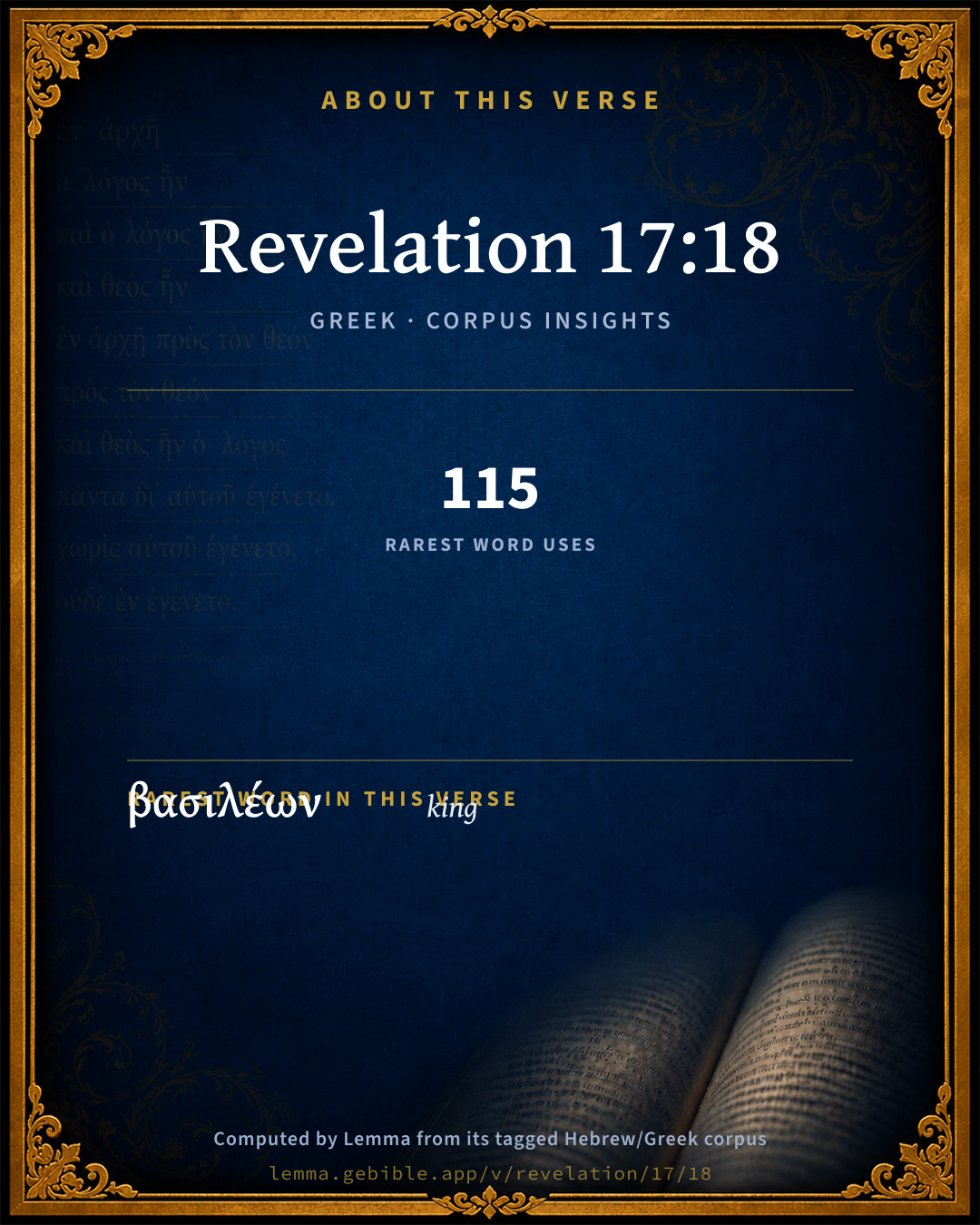
Revelation 17:18

Greek (Tischendorf 8th ed.) Revelation 17:18 appears in the Greek New Testament. The text above is from the Tischendorf 8th edition. Each word links to its Strong’s number and a concise gloss. Click any word for its full Thayer’s Greek Lexicon entry.
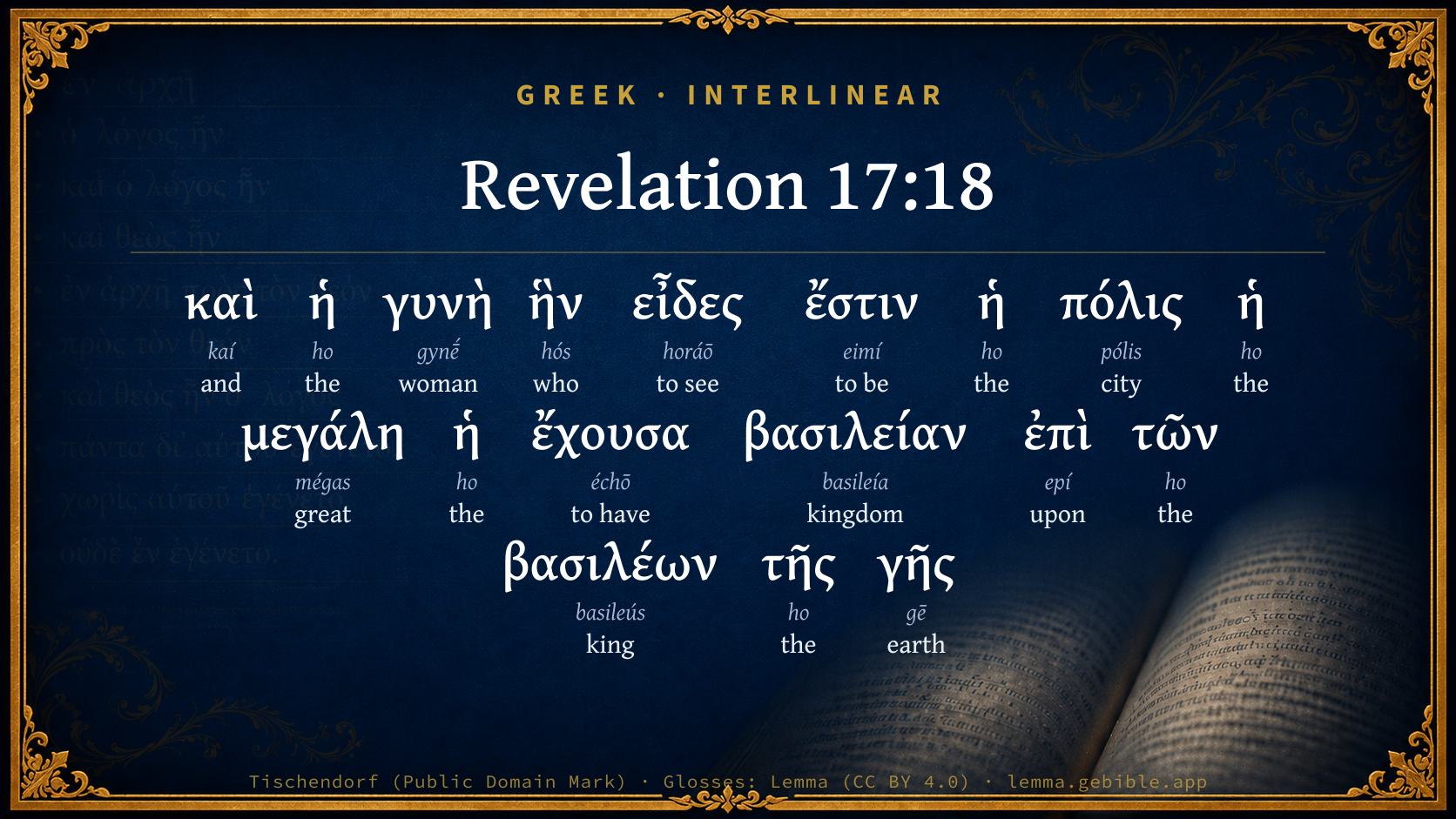
Download image
Cite this verse

Revelation 17:18 (World English Bible). Public Domain. Lemma interlinear Bible study tool, https://lemma.gebible.app/v/revelation/17/18.

Show BibTeX & RIS
BibTeX
RIS
English Translation
The woman whom you saw is the great city, which reigns over the kings of the earth."
World English Bible · Public Domain
Download a study sheet

One document with this verse’s original text, its word-by-word gloss line, the meaning frame, cross-references with their text, attributed commentary, and full source and license credits — printable, and it pastes into notes with its structure intact.

This verse Autodidact and up

Study sheet (.html) Plain text (.txt)

A passage Seminary Student

Up to 50 verses in one chapter. A passage sheet keeps up to 6 commentary sources and 12 cross-references per verse, in the order this page ranks them, and says so on the sheet whenever that leaves anything out. Ask for a single verse and you get the Autodidact verse sheet above.

Everything on this page stays free to read, with no account — the sheet is a download of what is already on screen, not access to it.

Want to remove ads? Support Godless Engineer
Compare translations 3

The same verse in 3 English versions, stacked beneath the original-language interlinear above. Click any original word for its lexicon entry.

Each is an independent rendering of the whole verse — the interlinear is not word-aligned to these translations.

Highlighted words mark where these versions differ — a whole-verse word diff, not a word-by-word alignment.

  • World English Bible Public Domain
    The woman whom you saw is the great city, which reigns over the kings of the earth."
  • King James Version Public Domain
    And the woman which thou sawest is that great city, which reigneth over the kings of the earth.
  • unfoldingWord Literal Text CC BY-SA 4.0
    And the woman whom you saw is the great city having a kingdom over the kings of the earth.”

unfoldingWord Literal Text — © unfoldingWord, licensed CC BY-SA 4.0. Word-aligned USFM3 via Door43 (git.door43.org/unfoldingWord/en_ult).

Versions to compare (up to 4)

3 of 4 selected

Show all 19 translations

Every available English version of this verse, each an independent rendering of the whole verse.

  • World English Bible Public Domain
    The woman whom you saw is the great city, which reigns over the kings of the earth."
  • Berean Standard Bible Public Domain
    And the woman you saw is the great city that rules over the kings of the earth.”
  • Majority Standard Bible Public Domain
    And the woman you saw is the great city that rules over the kings of the earth.”
  • King James Version Public Domain
    And the woman which thou sawest is that great city, which reigneth over the kings of the earth.
  • American Standard Version (1901) Public Domain
    And the woman whom thou sawest is the great city, which reigneth over the kings of the earth.
  • Revised Version (1885) Public Domain
    And the woman whom thou sawest is the great city, which reigneth over the kings of the earth.
  • Geneva Bible (1599) Public Domain
    And that woman which thou sawest, is that great citie, which reigneth ouer the kings of ye earth.
  • Douay-Rheims (1899) Public Domain
    And the woman which thou sawest, is the great city, which hath kingdom over the kings of the earth.
  • Young's Literal Translation Public Domain
    and the woman that thou didst see is the great city that is having reign over the kings of the land.'
  • Literal Standard Version CC BY-SA 4.0
    and the woman that you saw is the great city that is having reign over the kings of the earth.”
  • Unlocked Literal Bible CC BY-SA 4.0
    The woman you saw is the great city that rules over the kings of the earth.”
  • unfoldingWord Literal Text CC BY-SA 4.0
    And the woman whom you saw is the great city having a kingdom over the kings of the earth.”
  • Darby Bible Public Domain
    And the woman which thou sawest is the great city, which has kingship over the kings of the earth.
  • World Messianic Bible Public Domain
    The woman whom you saw is the great city which reigns over the kings of the earth.”
  • Webster's Bible Public Domain
    And the woman whom thou sawest is that great city, which reigneth over the kings of the earth.
  • Free Bible Version CC BY-SA 4.0
    The woman you saw is the great city which rules over the kings of the earth.”
  • Bible in Basic English Public Domain
    And the woman whom you saw is the great town, which is ruling over the kings of the earth.
  • Text-Critical English NT CC BY 4.0
    As for the woman yoʋ saw, she is the great city that has dominion over the kings over the earth.”
  • Tyndale New Testament (1534) Public Domain
    And the woman which thou sawest ys that gret cyte which raigneth over the kynges of the erth.

Literal Standard Version (2020), Covenant Press — licensed CC BY-SA 4.0. Text via the HelloAO Bible API (eBible.org). Unlocked Literal Bible (unfoldingWord) — licensed CC BY-SA 4.0. Text via the HelloAO Bible API (eBible.org). unfoldingWord Literal Text — © unfoldingWord, licensed CC BY-SA 4.0. Word-aligned USFM3 via Door43 (git.door43.org/unfoldingWord/en_ult). Free Bible Version, Dr. Jonathan Gallagher — licensed CC BY-SA 4.0. Text via the HelloAO Bible API (eBible.org).

Word by word

More ways to search: Search by grammar → Find every occurrence → Compare this word →

Practice this passage: Drill this verse → Learn its vocabulary →

βασιλέων
basileús
G935
“king”
Noun, Genitive, Plural, Masculine
Part of Speech
Noun
Case
Genitive
Number
Plural
Gender
Masculine
Full Thayer's Definition

Origin: probably from G939 (through the notion of a foundation of power)

TDNT: 10:37,0

1. leader of the people, prince, commander, lord of the land, king
  1. καὶ kaí G2532 “and” Conjunction
  2. ἡ ho G3588 “the” Article, Nominative, Singular, Feminine
  3. γυνὴ gynḗ G1135 “woman” Noun, Nominative, Singular, Feminine
  4. ἣν hós G3739 “who” Relative pronoun, Accusative, Singular, Feminine
  5. εἶδες horáō G3708 “to see” Verb, Aorist, Active, Indicative, 2nd person, Singular
  6. ἔστιν eimí G1510 “to be” Verb, Present, Active, Indicative, 3rd person, Singular
  7. ἡ ho G3588 “the” Article, Nominative, Singular, Feminine
  8. πόλις pólis G4172 “city” Noun, Nominative, Singular, Feminine
  9. ἡ ho G3588 “the” Article, Nominative, Singular, Feminine
  10. μεγάλη mégas G3173 “great” Adjective, Nominative, Singular, Feminine
  11. ἡ ho G3588 “the” Article, Nominative, Singular, Feminine
  12. ἔχουσα échō G2192 “to have” Verb, Present, Active, Participle, Nominative, Singular, Feminine
  13. βασιλείαν basileía G932 “kingdom” Noun, Accusative, Singular, Feminine
  14. ἐπὶ epí G1909 “upon” Preposition
  15. τῶν ho G3588 “the” Article, Genitive, Plural, Masculine
  16. τῆς ho G3588 “the” Article, Genitive, Singular, Feminine
  17. γῆς gē G1093 “earth” Noun, Genitive, Singular, Feminine

About this verse

These counts appear in no published source. They are computed here, from the morphology-tagged text and Lemma’s own curated glosses. What Lemma adds →

18
words
13
distinct lemmas
Revelation
section

Repetition

A word recurs within this verse:

Cross-references

4

Topical passages linked to Revelation 17:18 in the Treasury of Scripture Knowledge — connected by theme and wording, ordered by reader-vote popularity; previews shown in the World English Bible.

  • Revelation 16:19 The great city was divided into three parts, and the cities of the nations fell. Babylon the great was remembered in the sight of God, to give to her the cup of the wine of the fierceness of his wrath.
  • Revelation 18:2 He cried with a mighty voice, saying, "Fallen, fallen is Babylon the great, and she has become a habitation of demons, a prison of every unclean spirit, and a prison of every unclean and hateful bird!
  • Daniel 2:40–41 The fourth kingdom shall be strong as iron, because iron breaks in pieces and subdues all things; and as iron that crushes all these, shall it break in pieces and crush.
  • Daniel 7:23 Thus he said, The fourth animal shall be a fourth kingdom on earth, which shall be diverse from all the kingdoms, and shall devour the whole earth, and shall tread it down, and break it in pieces.

Cross-references courtesy of OpenBible.info (CC BY 4.0).

Commentary

Notes on Revelation 17:18 from classic Christian and Jewish commentators (each source and its license shown beneath its notes). The classic Christian expositions comment on the surrounding passage and are grouped to its opening verse, so a note may address several verses; the Jewish commentaries on the Tanakh (Rashi and others) are per-verse, so they appear only where the commentator wrote on this verse.

Lemma curates 59 commentaries, every one of them public domain or Creative Commons licensed, each selected and text-cleaned for this edition rather than reprinted as found. About our sources →

Expositor's Greek Testament

ed. W. Robertson Nicoll

Rev 17:18 . The dramatic climax of the oracle: the great harlot is Rome, domina Roma, the pride and queen of the world! Cf. Spenser’s Ruines of Rome , 360 f. (“Rome was th’ whole world, and al the world was Rome”). For the probable position of Rev 19:9-10Rev 19:9-10Rev 19:9-10 at this point in the original form of the Apocalypse, see below ( ad loc. ).

After a prelude on the doom of this second and western Babylon (Rev 18:1-3 ) two sublime songs follow: one of triumph in heaven (Rev 17:4-8 ) one of wailing on earth (9 f.). Both are modelled in semi-strophic style upon the earlier taunt-songs ( cf. Introd. § 4) over Tyre and Babylon ( cf. also Apoc. Bar. lxxxii. 3 9). But the severe invective against Rome reveals the shuddering impression which this marvel and mistress of the world made upon the conscience of her provincial subjects, Jewish or Christian. They were half fascinated, even as they felt repelled, by the sight of her grandeur. This magnificent doom song (9 f.) like that of Apoc. Bar. 12. (cf. Rev 17:13 ), however, celebrates her downfall, partly on grounds which might be justified from contemporary pagan authors ( cf. Renan’s Apôtres , ch. xvii.). ver. 24 (note the sudden change from σοί to αὐτῇ ) and 20 (in whole or part) are Christian editorial insertions, ( a ) either by some scribe or editor after the Apocalypse was completed, or ( b ) by John himself in an earlier source (Jewish or from his own hand). The presence of a special source is suggested by e.g. , the unexampled use of οὐαί ( cf. on Rev 17:16 , and Oxyrh. Fragment of Uncan. Gospel , 31), the large number of ἅπαξ εὑρημένα ( στρήν . 3, διπλόω 6, διπλόος , cf. 1Ti 5:17 , στρην . 7 and 9, σιρικοῦ , ἐλεφ ., σιδήρου , μαρμάρου and θύϊνον in 12, κινν ., ἄμωμον , σεμίδ ., ῥεδῶν , and σωμάτων , [in this sense] in 13, ἀπώλετο (14), ἐργάζονται [in this sense in Apoc.] in 17, τιμ . 19, ὁρμ . 21, μους ., σαλπιστῶν , κιθαρῳδῶν [only in Rev 14:2 ] 22, ὀπώρα and λιπαρά , 14) and rare terms, for which the special character of the contents can hardly account. Differences of outlook also emerge; e.g. , Rev 18:9 f. is out of line with Rev 17:17 and Rev 16:13 f., Rev 18:1-3 (Rome long desolate) hardly tallies with Rev 18:9 f. (ruins still smouldering, cf. Rev 19:3 ), and the kings of Rev 18:9-10 lament, whereas in Rev 17:16 they attack, Rome. These inconsistencies (Schön, Schmiedel) might in part be set down to the free poetic movement of the writer’s imagination, working in dramatic style and oblivious of matter-of-fact incongruities like the sauve qui peut of 4; just as the lack of any allusion to the Imperial cultus, the Lamb, or the martyrs (exc. 20 and 24) does not necessarily denote a Jewish origin. But the cumulative effect of these features points to 20 and 24 as insertions by John in a Jewish ( cf. e.g. , the special emphasis on the trader’s point of view, 11 17) Vespasianic source which originally formed a pendant to that underlying 17 (so variously in detail but agreeing on a source, probably Jewish Sabatier, Rauch, Spitta, Weyland, Bousset, J. Weiss, Schmidt, Baljon, Pfleid., Wellhausen, von Soden, de Faye, Calmes). The original breathed the indignant spirit of a Jewish apocalyptist against the proud empire which had won a temporary triumph over the city and people of God. John applies it to the Rome which was also responsible for the persecutions. The tone of it has been severely censured, as if it breathed a malignant orgy of revenge. “It does not matter whether Jewish or Christian materials are the ultimate source. He who takes delight in such fancies is no whit better than he who first invented them” (Wernle, p. 370). So far as this is true, it applies to Rev 19:17-21 (or 14 20) rather than to 18. But the criticism must be qualified; see notes on Rev 18:7 ; Rev 18:20 . There is smoke in the flame, but a profound sense of moral indignation and retribution overpowers the mere vindictiveness of an unpatriotic fanatic who exults to see his oppressor humiliated.

The Expositor's Greek Testament, edited by W. Robertson Nicoll (1897–1910) — public domain. Text from a community e-Sword module.

Geneva Bible (1599)

Geneva Bible translators

That is, Rome that great City, or only City (as Justinian calleth it) the King and head whereof was then the Emperor, but now the Pope, since that the condition of the beast was changed.

Geneva Bible (1599) marginal notes — public domain. Text via Bolls.life.

Jamieson, Fausset & Brown

Robert Jamieson, A. R. Fausset & David Brown

reigneth--literally, "hath kingship over the kings." The harlot cannot be a mere city literally, but is called so in a spiritual sense (Rev 11:8). Also the beast cannot represent a spiritual power, but a world power. In this verse the harlot is presented before us ripe for judgment. The eighteenth chapter details that judgment.

Next: Revelation Chapter 18

Jamieson, Fausset & Brown — Commentary Critical and Explanatory on the Whole Bible (1871) — public domain (CC PDM 1.0). Text via the HelloAO Bible API.

Adam Clarke's Commentary

Verse 18. And the woman which thou sawest is that great city, which reigneth over the kings of the earth.] It has already been shown that the woman sitting upon the seven-headed beast is a representation of the Latin Church; here we have the greatest assurance that it is so, because the woman is called a city, which is a much plainer emblem of a Church, as the word is used unequivocally in this sense in so many parts of Scripture that we cannot well mistake its meaning. See Rev 3:12; Rev 11:2; Rev 21:10; Rev 22:19; and also Ps 46:4; Ps 87:3; Heb 12:22, c. The woman therefore must be the Latin Church and as the apostle saw her sitting upon the beast, this must signify that ηεχουσα βασιλειαν, she hath A KINGDOM over the kings of the earth, i.e., over the kings of the Latin world, for that this is the meaning of earth has been shown before in numerous instances. That KINGDOM which the woman has over the kings of the Latin world, or secular Latin empire, or in other words THE KINGDOM of the Latin Church, is the numbered Latin kingdom or Romish hierarchy. See Clarke on Re 13:18. The woman is also called a GREAT city, to denote the very great extent of her jurisdiction; for she has comprehended within her walls the subjects of the mighty dominations of France, Spain, England, Scotland, The Empire, Sweden, Denmark, Poland, Hungary, and Portugal. What an extensive city was this! Surely such as to justify the prophetic denomination, that GREAT city.

HAVING now gone through the whole of the angel's interpretation of St. John's vision of a whore sitting upon the seven-headed and ten-horned beast, it will be essentially necessary to examine a little more attentively the eighth verse of this chapter. Re 17:8 It has already been shown that the phrases, was, is not, shall ascend out of the bottomless pit, and yet is, refer to the Latin kingdom which existed before the building of Rome, to the Roman empire in the time of St. John, and to the Latin empire which was in futurity in the apostolic age. But as the words was, is not, c., are spoken of the beast upon which the apostle saw the woman, or Latin Church, sit how can it be said of this beast that it had an existence before the date of the Apocalypse, when the woman whom it carried was not in being till long after this period? And what connection has the Latin empire of the middle ages with that which derived its name from Latinus, king of the Aborigines, and was subjugated by the ancient Romans; or even with that which existed in the time of the apostle? The answer is as follows: St. John saw the beast upon which the woman sat with all his seven heads and ten horns. Consequently, as the angel expressly says that five of these seven heads had already fallen in the time of the vision, it therefore necessarily follows that the apostle must have seen that part of the Latin empire represented by the seven-headed beast which had already been under the emblem of five heads. Therefore the woman sat upon the beast that WAS. But it is plain from the angel's interpretation that the whole of the seven heads fell, before the beast upon which the woman sat arose; and yet the woman is represented as sitting upon the seven-headed beast to denote, as we have before observed, that it is the Latin kingdom in its last estate, or under one of its heads restored, which is the secular kingdom of antichrist. The beast is also said not to have any existence in the time of the vision; from which it is evident that the monarchy of the Latins, and not that of the Romans, is here intended; because the latter was in the time of the vision. Again, the beast which St. John saw had not ascended out of the bottomless pit in his time; consequently the whole seven heads and ten horns were in futurity, for all these heads and horns rose up out of the abyss at the same time with the beast. How is this apparent contradiction reconciled? In the most plain and satisfactory manner, by means of the angel's double interpretation of the heads; for if the seven heads be taken in the sense of seven mountains, (head in the Scripture style being a symbol of precedency as well as supremacy,) then the beast with all its heads and horns was altogether in futurity in the apostle's time, for the seven heads are the seven electorates of the German empire, and the ten horns the ten monarchies in the interest of the Latin Church. Finally, the beast is said to exist in the time of the vision; therefore the Roman empire, which governed the world, must be here alluded to; and consequently the phrase and yet is is a proof that, as the beast is the Latin kingdom, and this beast is said to have an existence in the time of the apostle, the empire of the Caesars, though generally known by the name of the Roman, is in a very proper sense the Latin kingdom, as the Latin was the language which prevailed in it. Hence the seven-headed and ten-horned beast is at once the representation of the ancient Latin power, of the Roman empire which succeeded it, and of the Latin empire which supports the Latin Church. Here is then the connection of the ancient Latin and Roman powers with that upon which the woman sits. She sits upon the beast that was and is not, because three of his heads represent the three forms of government which the ancient Latins had before they were subjugated by the Romans, viz., the regal power, the dictatorship, and the power of the praetors. She sits upon the beast which SHALL ASCEND out of the bottomless pit, because all his seven heads, taken in the sense of mountains were in futurity in the apostolic age. She sits upon the beast that yet is, because four of his heads represent four forms of government of the Roman or Latin empire now in existence, viz., the consulate, the triumvirate, the imperial power, and the patriciate. It is hence evident that the beast, in the largest acceptation of this term, is a symbol of the Latin power in general, from its commencement in Latinus to the end of time; his seven heads denoting seven kings or supreme forms of Latin government, during this period, king or kingdom, as we have already observed, being a general term in the prophetical writings for any kind of supreme governor or government, no matter by what particular name such may have been designated among men. Thus the Latin power from the time of Latinus to the death of Numitor was the beast under the dominion of his first head; from the death of Numitor to the destruction of Alba it was the beast under the dominion of his second head; from the destruction of Alba to the final subjugation of the Latins by the Romans the beast under the dominion of his third head. And as the four Roman forms of government which were subsequent to the final conquest of the Latins, were also Latin dominations, the Latin power under these forms of government was the beast under the dominion of his fourth, fifth, sixth and seventh heads. The beast of the bottomless pit, which followed the fall of all the heads of the sea beast or general Latin empire, is, according to the angel's interpretation, ογδοος, (βασιλευς,) an EIGHTH king, i.e., an eighth species of Latin power, or, in other words, a supreme form of Latin government essentially differing from all the foregoing; yet, as it is nominally the same with one of the preceding seven, it is not accounted an eighth head of the beast. The first beast of Re 13:1 is a description of the eighth or last condition of the GENERAL Latin empire, and is said to arise εκτηςθαλασσης, out of the sea, because the heads are there taken in a double sense, sea being a general term to express the origin of every great empire which is raised up by the sword; but when (as in Re 17:11) one of the heads of the sea beast (viz., that secular power which is still in being, and has supported the Latin Church for more than a thousand years) is peculiarly styled The Beast, the Holy Ghost, speaking of this secular Latin empire exclusively, declares it to be εκ της αβυσσου, FROM the bottomless pit.

JOHN EDWARD CLARKE.

Adam Clarke's Commentary on the Bible (1810–1826) — public domain. Text from a community e-Sword/MySword module.

Ellicott's Commentary for English Readers

(18) And the woman which thou sawest . . .—Read, And the woman whom thou sawest is (not “that,” but) the great city, which has a kingdom over the kings of the earth. With these words the angel’s explanation of “the mystery of the woman” (see Rev_17:7) ends. The harlot is a city; the Babylon of the past lives again in Rome; the woman is Rome, the goddess of lands and peoples.”

“She who was named Eternal, and arrayed

Her warriors but to conquer—she Who veiled

Earth with her haughty shadow and displayed

Until the o’er canopied horizon failed

Her rushing wings—Oh! she who was Almighty hailed.”

A Bible Commentary for English Readers, edited by Charles John Ellicott (1878–1897) — public domain. Text from a community e-Sword module.

The Cambridge Bible for Schools and Colleges

gen. ed. J. J. S. Perowne

18. that great city &c.] Again as in Rev_17:9 the designation of Rome is unmistakeable. The words cannot be glossed, “Babylon is (now represented by) Rome,” but must mean “Babylon is Rome.”

which reigneth] Lit., which hath kingdom, or kingly power.

The Cambridge Bible for Schools and Colleges (gen. ed. J. J. S. Perowne; Cambridge University Press, 1878–1918) — public domain. Text from a community e-Sword module.

John Gill's Exposition

And the woman which thou sawest,.... Rev 17:3 as there described,

is that great city, often mentioned in this book; great Babylon, the city of Rome, Rev 11:8 which reigneth over the kings of the earth; which then reigned in John's time over the kings of the earth; and this clearly points out the city of Rome, for there was no other city then, but that, which reigned over the kings of the earth; that was then the metropolis of the Roman empire, to which the whole world was subject; and therefore it is called all the world, Luk 2:1 and since, all the kings of the empire have been under the jurisdiction of Rome Papal. It was formerly called Urbs Regum, a "city of kings" (z), either for the reason in the text, or because its inhabitants looked like kings.

(z) Justin. l. 18. c. 2.

Next: Revelation Chapter 18

John Gill's Exposition of the Whole Bible (1746–1763) — public domain (CC PDM 1.0). Text via the HelloAO Bible API.

Trapp's Complete Commentary

John Trapp

18 And the woman which thou sawest is that great city, which reigneth over the kings of the earth.

Ver. 18. Is that great city] Rome, that radix omnium malorum, the base of all evil. This is confessed by Bellarmine, Ribera, Alcasar, and other Jesuits. The Rhemists are so straited, that they know not which way to turn them, or how to deny so clear a truth, which yet they are not willing to acknowledge. The wit of heretics will better serve them to devise a thousand shifts to elude the truth, than their pride will suffer them once to yield and acknowledge it.

John Trapp, A Commentary or Exposition upon All the Books of the Old and New Testament (1647–1656) — public domain. Text from a community e-Sword module.

Albert Barnes' Notes on the Bible

And the woman which thou sawest - Rev 17:3.

Is that great city - Represents that great city.

Which reigneth over the kings of the earth - Rome would of course be understood by this language in the time of John, and all the circumstances, as we have seen, combined to show that Rome, in some form of its dominion, is intended. Even the name could hardly have designated it more clearly, and all expositors agree in supposing that Rome, either as pagan or as Christian, is referred to. The chapter shows that its power is limited; and that, although for purposes which he saw to be wise, God allows it to have a wide influence over the nations of the earth, yet, in his own appointed time, the very powers that have sustained it will become its foes, and combine for its overthrow. Europe needs but little further provocation, and the fires of liberty, which have been so long pent up, will break forth, and that storm of indignation which has expelled the Jesuits from all the courts of Europe; which has abolished the Inquisition; which has more than once led hostile armies to the very gates of papal Rome, will again be aroused in a manner which cannot be allayed, and that mighty power, which has controlled so large a part of the nations of Europe for more than a thousand years of the world’s history, will come to an end.

Albert Barnes' Notes on the Bible (1834–1885) — public domain. Text from a community e-Sword/MySword module.

Matthew Poole's English Annotations

And the woman which thou sawest: see Rev 17:3.

Is that great city; that is, signifieth that great city, Babylon the great: see Rev 17:5.

Which reigneth over the kings of the earth, commanding and punishing them as she pleaseth. To what person or power that either now is, or ever was, upon the earth, is this applicable, but to the pope, who makes emperors hold his stirrup, sends his edicts to princes to execute, excommunicates them, and interdicts their subjects, and arms them against them if they refuse? So that if the pope sits upon seven hills, or Rome he built upon them; if the papacy hath allured the inhabitants of the earth to idolatry; if in her idolatries she be the image of the old pagan idolaters; if to her many princes have given their power and strength; if she reigneth over the kings of the earth; and these things be applicable to no other person or government; there is no more doubt, whether the pope be antichrist, and Rome mystical Babylon, which shall certainly be destroyed for her idolatries and shedding the blood of God’s holy ones, than there is of what we have Rev 1:1,2, that this book contains The Revelation of Jesus Christ, to show unto his servants things which must shortly come to pass; which he sent and signified by his angel unto his servant John; who bare record of the word of God, and of the testimony of Jesus Christ, and of all things that he saw.

Matthew Poole's English Annotations on the Holy Bible (1683–1685) — public domain. Text from a community e-Sword/MySword module.

Whedon's Commentary on the Bible

Daniel D. Whedon

18. The woman… is that great city—The harlot is Babylon, and Babylon is the beast, for all three are different aspects of the same one antichrist.

Yet the woman survives the city and the beast survives both, Rev_19:20.

We refer the Babylon-symbol to the politico-ecclesiastical organism of this ever-enlarging antichristic system—a system which finds its immediate symbol in Rome as the seventh head, but its inherited totality symbolized in the eighth. Note Rev_17:11. It is secular and ecclesiastical CESARISM, which, essentially pagan and atheistic, usurps the place of the true King, and tyrannizes over the consciences and rights of mankind and subjects them to the despotism of antichrist.

The harlot symbol is that unity of corrupt doctrine with corrupt character and conduct once eminently belonging to the ancient Baal system, (see note on Rev_2:20,) by which whoredom, united with dogma, became a common name for a false and corrupt religionism. This harlotry is a compound of false theology with a debauchery and depravation of mind and manners.

The organic combination falls first, has fallen, and is falling. Men are gaining freedom of conscience; and religious despotism, with its religious wars and inquisitions, is going down by force of right asserting itself. But the purification of thought and life, the banishment of false theology and of all practical depravities and vices, social and individual, is a later reformation. Its fullest earthly completion will not be attained till Satan himself is bound and banished, and the millennial reign is inaugurated.

Daniel D. Whedon (gen. ed.), Commentary on the Old and New Testaments (1874–1909) — public domain. Text from a community e-Sword module.

The Pulpit Commentary

And the woman which thou sawest is that great city, which reigneth over the kings of the earth. A repetition of the assertion made in ver. 5, viz. that the harlot and Babylon are identical (see on ver. 5). Many writers have been led by this verse to believe that Rome, either pagan or papal, is thus pointed out as the antitype of the harlot. That this is one fulfilment of the vision need hardly be doubted. Rome was in St. John"s time the foremost embodiment of the hostile forces of the world. But this is not the whole fulfilment, which is in all time (see above, especially on ver. 1 of this chapter).

The Pulpit Commentary (1880–1919), ed. H.D.M. Spence-Jones & Joseph S. Exell — public domain. Text from a community e-Sword module.

John Wesley's Explanatory Notes

The woman is the great city, which reigneth - Namely, while the beast "is not," and the woman "sitteth upon him."

John Wesley, Explanatory Notes Upon the Whole Bible (1754–1765) — public domain. Text via the GEBible commentary corpus.

Burkitt's Expository Notes on the New Testament

William Burkitt

This is so clear a description of Rome, that the church of Rome herself acknowledges it: for if that be the city built upon seven hills, the city that allures the inhabitants of the earth to idolatry; if her idolatries be a lively image of the old Pagan idolatries; if to her many kings have given their power and strength; and if she reigneth over the kings of the earth; their remains no doubt but that this great city is Rome:--that Rome is mystical Babylon, which has shed the blood of saints and martyrs without number, and must be destroyed for so doing; no pomp nor grandeur can exempt or shall save her from the revenging hand of God, and his just indignation.

Lord! hasten that desirable time.

William Burkitt's Expository Notes on the New Testament (1700–1703) — public domain. Text from a community e-Sword module.

The People's New Testament

B. W. Johnson

18. The woman … is the great city. The city named in 16:19. See notes there.

Note. —In chap. 16:19 it is declared that when the seventh vial is poured out the great city Babylon shall be divided into three parts It is there suggested in the notes that this may refer to the separation of the dragon, the beast, and the false prophet from each other. In the present chapter (17:16) it is stated that the ten horns, which become the strength of the beast, shall be turned upon the woman who is Mystery, Babylon, the Great. This implies a separation between the beast and the woman, between the secular power that had supported the Papacy and the Papacy itself. This seems to have been already fulfilled. The temporal dominion of the popes, “the states of the church,” has been taken from them, the powers of Europe have ceased to obey the popes, even the Catholic powers, such as France and Italy, have shut up monasteries and appropriated the overgrown possessions of the church to the uses of the state. The passages referred to imply that the Papacy will continue to exist after it has ceased to receive the support of the secular power, since the woman still lives after the support of the beast is withdrawn.

B. W. Johnson's The People's New Testament with Notes (1889–1891) — public domain. Electronic text from the Christian Classics Ethereal Library (CCEL) ThML edition.

unfoldingWord translationNotes

Door43 World Missions Community

Connecting Statement:

The angel finishes speaking to John about the prostitute and the beast.

is

Here "is" stands for "represents." (See: Metaphor)

the great city that rules

When it says that the city rules, it means that the leader of the city rules. AT: "the great city whose leader rules" (See: Metonymy)

translationWords

rule

king

unfoldingWord translationNotes — © Distant Shores Media and the Door43 World Missions Community, licensed CC BY-SA 4.0. Source: git.door43.org/Door43/en_tn.

Cambridge Greek Testament for Schools and Colleges

18. βασιλέων. א reads βασιλειῶν.

18. ἡ πόλις ἡ μεγάλη. Again as in Rev 17:9 the designation of Rome is unmistakeable. The words cannot be glossed, “Babylon is (now represented by) Rome,” but must mean “Babylon is Rome.”

Cambridge Greek Testament for Schools and Colleges (Cambridge University Press, 1896; 21 vols, various authors incl. Carr, Maclear, Plummer, Farrar, Lumby, Moule, M. R. James, Simcox) — public domain. Text from a community e-Sword module.

Vincent's Word Studies in the New Testament

Marvin R. Vincent

Reigneth [εχουσα βαοιλειαν] . Lit., hath a kingdom.

Marvin R. Vincent, Word Studies in the New Testament (1887–1900) — public domain. Text from a community e-Sword/MySword module.

Lesson kit

Teaching starters — assembled from the data on this page, not authored interpretation. Every prompt links to the verse data it draws on. Edit before teaching.

Revelation, in the Revelation, opens this verse with 18 words (13 distinct Greek lemmas). Its most distinctive word is basileús (“king”). A historical commentator’s framing appears above. Read the whole chapter for the surrounding context.

Discussion questions

  1. What does “king” (basileús) contribute to the verse as a whole?
  2. Revelation 16:19 shares this passage’s theme. How do the two illuminate each other?
  3. “the” occurs 6× in this one verse. What is the effect of the repetition?
  4. These translations render this verse differently. What is at stake in choosing one wording over another?
  5. Reading how Expositor's Greek Testament and Geneva Bible (1599) read this verse, where do the two commentators agree and where do they part?

Things to notice

Reading settings

Reading text

Shown beneath each verse's original-language words.

Old Testament
Old Testament edition

Read the OT as the Masoretic Hebrew (MT) or the Greek Septuagint (LXX).

English shown for the Greek Septuagint (in the Hebrew ↔ Greek comparison).

Comparing translations? Open the Compare panel on any verse page to stack up to four side by side.