Revelation 19:7

Greek (Tischendorf 8th ed.) Revelation 19:7 appears in the Greek New Testament. The text above is from the Tischendorf 8th edition. Each word links to its Strong’s number and a concise gloss. Click any word for its full Thayer’s Greek Lexicon entry.
Download image
Cite this verse

Revelation 19:7 (World English Bible). Public Domain. Lemma interlinear Bible study tool, https://lemma.gebible.app/v/revelation/19/7.

Show BibTeX & RIS
BibTeX
RIS
English Translation
Let us rejoice and be exceedingly glad, and let us give the glory to him. For the marriage of the Lamb has come, and his wife has made herself ready."
World English Bible · Public Domain
Download a study sheet

One document with this verse’s original text, its word-by-word gloss line, the meaning frame, cross-references with their text, attributed commentary, and full source and license credits — printable, and it pastes into notes with its structure intact.

This verse Autodidact and up

Study sheet (.html) Plain text (.txt)

A passage Seminary Student

Up to 50 verses in one chapter. A passage sheet keeps up to 6 commentary sources and 12 cross-references per verse, in the order this page ranks them, and says so on the sheet whenever that leaves anything out. Ask for a single verse and you get the Autodidact verse sheet above.

Everything on this page stays free to read, with no account — the sheet is a download of what is already on screen, not access to it.

Want to remove ads? Support Godless Engineer
Compare translations 3

The same verse in 3 English versions, stacked beneath the original-language interlinear above. Click any original word for its lexicon entry.

Each is an independent rendering of the whole verse — the interlinear is not word-aligned to these translations.

Highlighted words mark where these versions differ — a whole-verse word diff, not a word-by-word alignment.

  • World English Bible Public Domain
    Let us rejoice and be exceedingly glad, and let us give the glory to him. For the marriage of the Lamb has come, and his wife has made herself ready."
  • King James Version Public Domain
    Let us be glad and rejoice, and give honour to him: for the marriage of the Lamb is come, and his wife hath made herself ready.
  • unfoldingWord Literal Text CC BY-SA 4.0
    Let us rejoice and exult and give glory to him because the wedding of the Lamb has come and his bride has made herself ready

unfoldingWord Literal Text — © unfoldingWord, licensed CC BY-SA 4.0. Word-aligned USFM3 via Door43 (git.door43.org/unfoldingWord/en_ult).

Versions to compare (up to 4)

3 of 4 selected

Show all 19 translations

Every available English version of this verse, each an independent rendering of the whole verse.

  • World English Bible Public Domain
    Let us rejoice and be exceedingly glad, and let us give the glory to him. For the marriage of the Lamb has come, and his wife has made herself ready."
  • Berean Standard Bible Public Domain
    Let us rejoice and be glad and give Him the glory. For the marriage of the Lamb has come, and His bride has made herself ready.
  • Majority Standard Bible Public Domain
    Let us rejoice and be glad and give Him the glory. For the marriage of the Lamb has come, and His bride has made herself ready.
  • King James Version Public Domain
    Let us be glad and rejoice, and give honour to him: for the marriage of the Lamb is come, and his wife hath made herself ready.
  • American Standard Version (1901) Public Domain
    Let us rejoice and be exceeding glad, and let us give the glory unto him: for the marriage of the Lamb is come, and his wife hath made herself ready.
  • Revised Version (1885) Public Domain
    Let us rejoice and be exceeding glad, and let us give the glory unto him: for the marriage of the Lamb is come, and his wife hath made herself ready.
  • Geneva Bible (1599) Public Domain
    Let vs be glad and reioyce, and giue glory to him: for the marriage of that Lambe is come, and his wife hath made her selfe ready.
  • Douay-Rheims (1899) Public Domain
    Let us be glad and rejoice, and give glory to him; for the marriage of the Lamb is come, and his wife hath prepared herself.
  • Young's Literal Translation Public Domain
    may we rejoice and exult, and give the glory to Him, because come did the marriage of the Lamb, and his wife did make herself ready;
  • Literal Standard Version CC BY-SA 4.0
    May we rejoice and exult, and give the glory to Him, because the marriage of the Lamb has come, and His wife has made herself ready;
  • Unlocked Literal Bible CC BY-SA 4.0
    Let us rejoice and be very happy and give him the glory because the wedding celebration of the Lamb has come, and his bride has made herself ready.
  • unfoldingWord Literal Text CC BY-SA 4.0
    Let us rejoice and exult and give glory to him because the wedding of the Lamb has come and his bride has made herself ready
  • Darby Bible Public Domain
    Let us rejoice and exult, and give him glory; for the marriage of the Lamb is come, and his wife has made herself ready.
  • World Messianic Bible Public Domain
    Let’s rejoice and be exceedingly glad, and let’s give the glory to him. For the wedding of the Lamb has come, and his wife has made herself ready.”
  • Webster's Bible Public Domain
    Let us be glad and rejoice, and give honor to him: for the marriage of the Lamb is come, and his wife hath made herself ready.
  • Free Bible Version CC BY-SA 4.0
    Let's celebrate and be glad and give him the glory, because the wedding day of the Lamb has arrived, and his bride has prepared herself.”
  • Bible in Basic English Public Domain
    Let us be glad with delight, and let us give glory to him: because the time is come for the Lamb to be married, and his wife has made herself ready.
  • Text-Critical English NT CC BY 4.0
    Let us rejoice and be glad and give him the glory, for the marriage of the Lamb has come, and his bride has made herself ready.
  • Tyndale New Testament (1534) Public Domain
    Let vs be glad and reioyce and geve honour to him: for the mariage of the lambe is come and hys wyffe made her sylfe reddy.

Literal Standard Version (2020), Covenant Press — licensed CC BY-SA 4.0. Text via the HelloAO Bible API (eBible.org). Unlocked Literal Bible (unfoldingWord) — licensed CC BY-SA 4.0. Text via the HelloAO Bible API (eBible.org). unfoldingWord Literal Text — © unfoldingWord, licensed CC BY-SA 4.0. Word-aligned USFM3 via Door43 (git.door43.org/unfoldingWord/en_ult). Free Bible Version, Dr. Jonathan Gallagher — licensed CC BY-SA 4.0. Text via the HelloAO Bible API (eBible.org).

Word by word

More ways to search: Search by grammar → Find every occurrence → Compare this word →

Practice this passage: Drill this verse → Learn its vocabulary →

ἀγαλλιῶμεν
agalliáō
G21
“to rejoice greatly”
Verb, Present, Active, Subjunctive, 1st person, Plural
Part of Speech
Verb
Tense
Present
Voice
Active
Mood
Subjunctive
Person
1st person
Number
Plural
Full Thayer's Definition

Origin: from agan (much) and G242

TDNT: 1:19, *

1. to exult, rejoice exceedingly, be exceeding glad
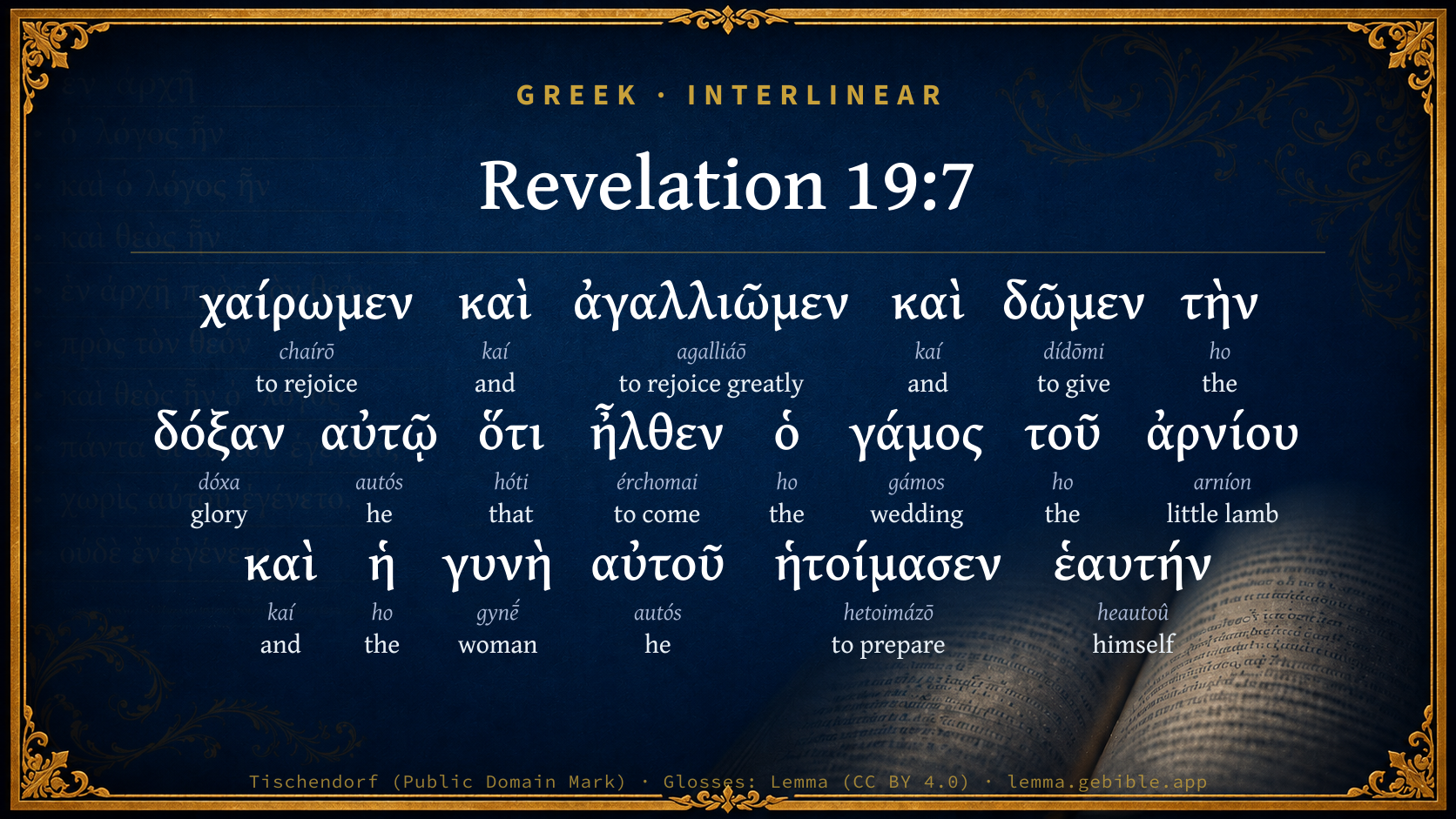
  1. χαίρωμεν chaírō G5463 “to rejoice” Verb, Present, Active, Subjunctive, 1st person, Plural
  2. καὶ kaí G2532 “and” Conjunction
  3. καὶ kaí G2532 “and” Conjunction
  4. δῶμεν dídōmi G1325 “to give” Verb, Aorist, Active, Subjunctive, 1st person, Plural
  5. τὴν ho G3588 “the” Article, Accusative, Singular, Feminine
  6. δόξαν dóxa G1391 “glory” Noun, Accusative, Singular, Feminine
  7. αὐτῷ autós G846 “he” Personal pronoun, Dative, Singular, Masculine
  8. ὅτι hóti G3754 “that” Conjunction
  9. ἦλθεν érchomai G2064 “to come” Verb, Aorist, Active, Indicative, 3rd person, Singular
  10. ὁ ho G3588 “the” Article, Nominative, Singular, Masculine
  11. γάμος gámos G1062 “wedding” Noun, Nominative, Singular, Masculine
  12. τοῦ ho G3588 “the” Article, Genitive, Singular, Neuter
  13. ἀρνίου arníon G721 “little lamb” Noun, Genitive, Singular, Neuter
  14. καὶ kaí G2532 “and” Conjunction
  15. ἡ ho G3588 “the” Article, Nominative, Singular, Feminine
  16. γυνὴ gynḗ G1135 “woman” Noun, Nominative, Singular, Feminine
  17. αὐτοῦ autós G846 “he” Personal pronoun, Genitive, Singular, Neuter
  18. ἡτοίμασεν hetoimázō G2090 “to prepare” Verb, Aorist, Active, Indicative, 3rd person, Singular
  19. ἑαυτήν heautoû G1438 “himself” Reflexive pronoun, 3rd person, Accusative, Singular, Feminine

About this verse

These counts appear in no published source. They are computed here, from the morphology-tagged text and Lemma’s own curated glosses. What Lemma adds →

20
words
14
distinct lemmas
Revelation
section

Notable vocabulary

The rarest word here is ἀγαλλιῶμεν to rejoice greatly G21 — appearing just 11 times in the whole Greek New Testament.

Shared distinctive vocabulary

ἀγαλλιῶμεν to rejoice greatly G21 occurs in 11 verses of the Greek New Testament. Also found in:

Repetition

Words recur within this verse:

Cross-references

27

Topical passages linked to Revelation 19:7 in the Treasury of Scripture Knowledge — connected by theme and wording, ordered by reader-vote popularity; previews shown in the World English Bible.

  • Revelation 21:2 I saw the holy city, New Jerusalem, coming down out of heaven from God, made ready like a bride adorned for her husband.
  • Revelation 21:9 One of the seven angels who had the seven bowls, who were loaded with the seven last plagues came, and he spoke with me, saying, "Come here. I will show you the wife, the Lamb's bride."
  • Revelation 19:9 He said to me, "Write, 'Blessed are those who are invited to the marriage supper of the Lamb.'" He said to me, "These are true words of God."
  • Matthew 22:2 "The Kingdom of Heaven is like a certain king, who made a marriage feast for his son,
  • 2 Corinthians 11:2 For I am jealous over you with a godly jealousy. For I married you to one husband, that I might present you as a pure virgin to Christ.
  • John 3:29 He who has the bride is the bridegroom; but the friend of the bridegroom, who stands and hears him, rejoices greatly because of the bridegroom's voice. This, my joy, therefore is made full.
  • Ephesians 5:32 This mystery is great, but I speak concerning Christ and of the assembly.
  • Isaiah 62:5 For as a young man marries a virgin, so shall your sons marry you; and as the bridegroom rejoices over the bride, so shall your God rejoice over you.
  • Hosea 2:19–20 I will betroth you to me forever. Yes, I will betroth you to me in righteousness, in justice, in loving kindness, and in compassion.
  • Ephesians 5:23 For the husband is the head of the wife, and Christ also is the head of the assembly, being himself the savior of the body.
  • Psalms 45:10–16 Listen, daughter, consider, and turn your ear. Forget your own people, and also your father's house.
  • Matthew 25:1–10 "Then the Kingdom of Heaven will be like ten virgins, who took their lamps, and went out to meet the bridegroom.
  • Isaiah 66:10 Rejoice you with Jerusalem, and be glad for her, all you who love her: rejoice for joy with her, all you who mourn over her;
  • Psalms 100:1–2 Shout for joy to Yahweh, all you lands!
  • Song of Solomon 3:11 Go forth, you daughters of Zion, and see king Solomon, With the crown with which his mother has crowned him, In the day of his weddings, In the day of the gladness of his heart. Lover
  • Isaiah 52:1 Awake, awake, put on your strength, Zion; put on your beautiful garments, Jerusalem, the holy city: for henceforth there shall no more come into you the uncircumcised and the unclean.
  • Zechariah 9:9 Rejoice greatly, daughter of Zion! Shout, daughter of Jerusalem! Behold, your king comes to you! He is righteous, and having salvation; Lowly, and riding on a donkey, Even on a colt, the foal of a donkey.
  • Luke 12:36 Be like men watching for their lord, when he returns from the marriage feast; that, when he comes and knocks, they may immediately open to him.
  • 1 Samuel 2:1 Hannah prayed, and said: My heart exults in Yahweh; My horn is exalted in Yahweh; My mouth is enlarged over my enemies; Because I rejoice in your salvation.
  • Psalms 9:14 That I may show forth all your praise. In the gates of the daughter of Zion, I will rejoice in your salvation.
  • Philippians 3:3 For we are the circumcision, who worship God in the Spirit, and rejoice in Christ Jesus, and have no confidence in the flesh;
  • Psalms 48:11 Let Mount Zion be glad! Let the daughters of Judah rejoice, Because of your judgments.
  • Psalms 95:1–3 Oh come, let's sing to Yahweh. Let's shout aloud to the rock of our salvation!
  • Psalms 107:42 The upright will see it, and be glad. All the wicked will shut their mouths.
  • Proverbs 29:2 When the righteous thrive, the people rejoice; But when the wicked rule, the people groan.
  • Deuteronomy 32:43 Rejoice, you nations, [with] his people: For he will avenge the blood of his servants, Will render vengeance to his adversaries, Will make expiation for his land, for his people.
  • Isaiah 66:14 You shall see [it], and your heart shall rejoice, and your bones shall flourish like the tender grass: and the hand of Yahweh shall be known toward his servants; and he will have indignation against his enemies.

Cross-references courtesy of OpenBible.info (CC BY 4.0).

Commentary

Notes on Revelation 19:7 from classic Christian and Jewish commentators (each source and its license shown beneath its notes). The classic Christian expositions comment on the surrounding passage and are grouped to its opening verse, so a note may address several verses; the Jewish commentaries on the Tanakh (Rashi and others) are per-verse, so they appear only where the commentator wrote on this verse.

Lemma curates 59 commentaries, every one of them public domain or Creative Commons licensed, each selected and text-cleaned for this edition rather than reprinted as found. About our sources →

The Cambridge Bible for Schools and Colleges

gen. ed. J. J. S. Perowne

The Marriage of the Lamb, Rev_19:7-9

7. honour] Better, the glory.

the marriage of the Lamb] The first suggestion of this image in the N. T. is in our Lord’s parables, St Mat_22:2; Mat_25:1-10 : it is more fully worked out by St Paul, Eph_5:22-32. But men’s minds were prepared for it by the language of all the Prophets about the spiritual marriage of the Lord and Israel: still more, perhaps, by that of the 45th Psalm, rising so far above the royal marriage that no doubt furnished its occasion. And there is little doubt that the Song of Songs was already mystically interpreted among the Jews, though its claim to a place in the Canon was still disputed.

his wife] Called by St John the New Jerusalem, Rev_21:2, by St Paul both by that name, Gal_4:26, and more simply the Church, Eph_5:23 sqq.

The Cambridge Bible for Schools and Colleges (gen. ed. J. J. S. Perowne; Cambridge University Press, 1878–1918) — public domain. Text from a community e-Sword module.

Tyndale Open Study Notes

Tyndale Open Resources

19:7 the wedding feast of the Lamb: This event—the wedding of the Messiah with his bride, the church (see Isa 54:5; 61:10; Jer 31:32; Ezek 16:7-14; Hos 2:16-20; Mark 2:19-20; 2 Cor 11:2)—symbolizes complete victory and eternal fellowship.

Tyndale Open Study Notes — © Tyndale Open Resources, licensed CC BY-SA 4.0. Text via the HelloAO Bible API.

Bengel's Gnomon

Johann Albrecht Bengel

Rev 19:7. [210] Ἡτοίμασεν ἑαυτὴν, hath prepared herself) that is, hath begun to prepare herself; as τεπίστευκα, ἠγάπηκα, ἤλπικα, I have obtained faith, etc. Respecting the marriage itself, see ch. Rev 21:2; Rev 21:9, etc.

[210] 6. καὶ, and) The stirring call brought forward in ver. 5, Hallelujah! is now fully responded to.—V. g.

Bengel's Gnomon of the New Testament — English translation (T&T Clark, Edinburgh, 1860) — public domain. Text from a community e-Sword module.

Expositor's Greek Testament

ed. W. Robertson Nicoll

Rev 19:7 . A proleptic allusion to the triumphant bliss as a marriage between the victorious messiah and his people or the new Jerusalem ( cf. Volz, 331). The conception is primarily eschatological (Weinel, p. 137; cf. Mechilta on Exo 19:17 ) and is so employed here. The marriage-day of Christ and his church is the day of his second advent. This is the more intimate and tender aspect of the divine βασιλεία . But, as a traditional feature of the Oriental myth (Jeremiah , 45 f.) was the postponement of the deity’s wedding until he returned from victory ( i.e. , after vanquishing the darkness and cold of the winter), the religious application turns first of all to the overthrow of messiah’s foes (Rev 19:11 f.). ἀγαλλιῶμεν , act. as in 1Pe 1:8 ( cf. Abbott, Diatessarica , 2, 689).

The Expositor's Greek Testament, edited by W. Robertson Nicoll (1897–1910) — public domain. Text from a community e-Sword module.

Geneva Bible (1599)

Geneva Bible translators

Namely unto that holy marriage both herself in person in this verse and also furnished of her spouse with marriage gifts princely and divine is adorned and prepared in the next verse.

Geneva Bible (1599) marginal notes — public domain. Text via Bolls.life.

Jamieson, Fausset & Brown

Robert Jamieson, A. R. Fausset & David Brown

glad . . . rejoice--Greek, "rejoice . . . exult."

give--so B and ANDREAS. But A reads, "we will give."

glory--Greek, "the glory."

the marriage of the Lamb is come--The full and final consummation is at Rev 21:2-9, &c. Previously there must be the overthrow of the beast, &c., at the Lord's coming, the binding of Satan, the millennial reign, the loosing of Satan and his last overthrow, and the general judgment. The elect-Church, the heavenly Bride, soon after the destruction of the harlot, is transfigured at the Lord's coming, and joins with Him in His triumph over the beast. On the emblem of the heavenly Bridegroom and Bride, compare Mat 22:2; Mat 25:6, Mat 25:10; Co2 11:2. Perfect union with Him personally, and participation in His holiness; joy, glory, and kingdom, are included in this symbol of "marriage"; compare Song of Solomon everywhere. Besides the heavenly Bride, the transfigured, translated, and risen Church, reigning over the earth with Christ, there is also the earthly bride, Israel, in the flesh, never yet divorced, though for a time separated, from her divine husband, who shall then be reunited to the Lord, and be the mother Church of the millennial earth, Christianized through her. Note, we ought, as Scripture does, restrict the language drawn from marriage-love to the Bride, the Church as a whole; not use it as individuals in our relation to Christ, which Rome does in the case of her nuns. Individually, believers are effectually-called guests; collectively, they constitute the bride. The harlot divides her affections among many lovers: the bride gives hers exclusively to Christ.

Jamieson, Fausset & Brown — Commentary Critical and Explanatory on the Whole Bible (1871) — public domain (CC PDM 1.0). Text via the HelloAO Bible API.

Adam Clarke's Commentary

Verse 7. The marriage of the Lamb is come] The meaning of these figurative expressions appears to be this: After this overthrow of idolatry and superstition, and the discomfiture of antichrist, there will be a more glorious state of Christianity than ever was before.

Adam Clarke's Commentary on the Bible (1810–1826) — public domain. Text from a community e-Sword/MySword module.

John Gill's Exposition

Let us be glad, and rejoice, and give honour to him,.... The saints particularly; the converted Jews will call upon one another to express their gladness at the glorious display of Christ's kingly power and authority, and at the destruction of his enemies, and the happy and comfortable state of his church and people; and to rejoice in him as the Lord their righteousness and strength, and to give him the honour and glory of salvation, and to return him thanks for all the benefits they shall have received from him, particularly on account of what follows:

for the marriage of the Lamb is come; that is, of Christ, the Son of God, with the Jewish church more especially; there was a secret betrothing of all the elect to Christ before the world began; and there is an open espousal of every individual of them at conversion; but the public and general solemnization of the nuptials will not be until the new Jerusalem church state takes place in the personal reign of Christ, hereafter mentioned, Rev 21:1 but here, and as previous to that, there will be a very general and open marriage of Christ with the people of the Jews, who have long rejected and forsaken him; for if the conversion of a single person may be called a marriage with Christ, much more the conversion of such members; and which is often prophesied of under this metaphor of a marriage, as in Isa 62:4. And now the time will be come for the accomplishment of it, the evidence of which follows:

and his wife hath made herself ready, or "dressed herself"; by decking herself with jewels, and putting on her wedding garment provided for her, and given to her by her husband, the Lamb, as appears from the next verse: this preparation will lie partly in the number of converts that will be brought into the Jewish church, which she will receive and clothe herself with, as with the ornament of a bride, Isa 49:18 and partly by the exercise of the several graces of the Spirit upon Christ, comparable to the jewels of a bride, with which she will be adorned for her husband; and also by putting on the robe of his righteousness, hereafter mentioned, which the old Jewish synagogue rejected, and therefore was cast off, Rom 10:3. The Arabic version reads, "the marriage of the Lamb is now come with his spouse, prepared for him"; and the Ethiopic version, "the marriage of his Lamb is come, and the wife is prepared"; and that her preparation is not by her own merits and works of righteousness, but by the grace of her husband, is clear from the following verse. Mr. Daubuz, by "the marriage of the Lamb", understands the first resurrection, and the state of the church at that time; and by "the fine linen", the dress of the church, next mentioned, the incorruptible body of the saints compared to a garment, Co1 15:53 and by those who are afterwards said to be "called to the marriage", the converted nations in a mortal state: but all the saints will share in the first resurrection; besides, as yet the beast and false prophet are not destroyed, which must be before the first resurrection, as the following vision shows.

John Gill's Exposition of the Whole Bible (1746–1763) — public domain (CC PDM 1.0). Text via the HelloAO Bible API.

Trapp's Complete Commentary

John Trapp

7 Let us be glad and rejoice, and give honour to him: for the marriage of the Lamb is come, and his wife hath made herself ready.

Ver. 7. Hath made herself ready] Being first made ready by the grace of Christ. Certain est nos facere quod facimus; sed ille facit ut faciamus. (Aug.) The bowls of the candlestick had no oil but that which dropped from the olive branches, Zec 4:12.

John Trapp, A Commentary or Exposition upon All the Books of the Old and New Testament (1647–1656) — public domain. Text from a community e-Sword module.

Albert Barnes' Notes on the Bible

Let us be glad and rejoice - Let all in heaven rejoice - for all have an interest in the triumph of truth; all should be glad that the government of God is set up over an apostate world.

And give honour to him - Because the work is glorious; and became it is by his power alone that it has been accomplished. See the notes on Rev 5:12.

For the marriage of the Lamb is come - Of the Lamb of God - the Redeemer of the world. See the notes on Rev 5:6. The relation of God, and especially of the Messiah, to the church, is often in the Scriptures represented under the image of marriage. See the Isa 54:4-6; 62:4-5 notes; 2Co 11:2 note; Eph 5:23-33 note. Compare Jer 3:14; Jer 31:32; Hos 2:19-20. The idea is also said to be common in Arabic and Persian poetry. It is to be remembered, also, that papal Rome has just been represented as a frivolous and meretricious woman; and there is a propriety, therefore, in representing the true church as a pure bride, the Lamb’s wife, and the final triumph of that church as a joyous marriage. The meaning is, that the church was now to triumph and rejoice as if in permanent union with her glorious head and Lord.

And his wife hath made herself ready - By putting on her beautiful apparel and ornaments. All the preparations had been made for a permanent and uninterrupted union with its Redeemer, and the church was henceforward to be recognized as his beautiful bride, and was no more to appear as a decorated harlot - as it had during the papal supremacy. Between the church under the papacy, and the church in its true form, there is all the difference which there is between an abandoned woman gaily decked with gold and jewels, and a pure virgin chastely and modestly adorned, about to be led to be united in bonds of love to a virtuous husband,

Albert Barnes' Notes on the Bible (1834–1885) — public domain. Text from a community e-Sword/MySword module.

Haydock's Catholic Bible Commentary

For the marriage, &c. In the New Testament, the word marriage points out the establishment of the Church, the vocation of different people to the faith, or the reign of the Messias. (Calmet)

George Leo Haydock (1774–1849), Haydock's Catholic Family Bible and Commentary, 1859 edition — public domain. Excludes Psalms (Douay-Rheims chapter numbering differs from Protestant) and Deuterocanonical books (Catholic canon only).

Matthew Poole's English Annotations

A late reverend author tells us: That as there is a three-fold resurrection mentioned in Scripture;

1. A rising to a newness of life, Eph 5:14;

2. The conversion of the Jews, called life from the dead, Rom 11:15;

3. In the end of the world:

so there is a threefold marriage of the Lamb;

1. To particular souls, when by faith they are united to Christ;

2. To his church completed, when the Jews shall be called;

3. When all his elect shall be made one with him in glory, after the general resurrection.

He seemeth to understand it of all these. Probably the conversion of the Jews stayeth for the fall of the papacy, whose worship and persecution are great scandals to them. Probably also, upon the fall of it, many will be converted besides the Jews, and the general resurrection will not be far off. The learned Dr. More seems to restrain it to the Jews’ conversion; I had rather understand it more generally.

Matthew Poole's English Annotations on the Holy Bible (1683–1685) — public domain. Text from a community e-Sword/MySword module.

Whedon's Commentary on the Bible

Daniel D. Whedon

7. The marriage of the Lamb—By the association of contrast the thought turns from the harlot to the pure and holy wife. Nevertheless, the immediacy of the time-words here is no proof that the marriage of Rev_21:9 (and so the second advent) is literally close at hand.

Even in our Lord’s day on earth (Mat_21:1-10) that marriage was “ready,” and the invitations were sent forth. That is, men are now invited to the New Jerusalem, irrespective of time. And so the justification of the believer is a marriage supper, Rev_2:20. And so, in different stages, both the sanctification of the Church and her glorification is a divine marriage.

Mr. Glasgow, however, calls attention to the fact that the marriage and the marriage supper are two entirely different things. He avers that in every instance in the New Testament the word γαμος, wedding, refers, not to the marriage ceremony but to the feast, which was often some days after. The marriage at Cana was the marriage feast, not the actual wedding. Jesus, by his incarnation, became the bridegroom, (since John was the friend of the bridegroom,) as appears by Joh_3:29. So that while the marriage is on earth, the feast is in heaven. And so here the word is not bride, but wife; and in Rev_21:9, the word “bride” is explained by “wife,” as if the marriage had passed, and the feast was to come.

Is come—The union of the pure Church with Christ is frequently imaged as a marriage. Thus, to the Jewish Church Jehovah says: “I am married unto you.” Jer_3:14. And in Isa_50:1, there is divorce in consequence of unfaithfulness. Yet the completion of the marriage of the Lamb, in its fullest sense, is after the great white throne of Rev_20:11. For the actual final wife is the New Jerusalem, as shown by Rev_21:9. And at Rev_21:2, this New Jerusalem comes “down out of heaven prepared as a bride adorned for her husband.” And that is very decisive proof that, as the bride is the pure Church, so the harlot is an impure Church.

Daniel D. Whedon (gen. ed.), Commentary on the Old and New Testaments (1874–1909) — public domain. Text from a community e-Sword module.

The Pulpit Commentary

Let us be glad and rejoice, and give honour to him; let us rejoice and be exceeding glad, and let us give the glory unto him. Alford reads dwsomen , "we will give," with a, A. P, 36; but the T.R. dwmen , "let us give," which is found in a, B, 1, 7, 38, Vulgate, Cyprian, Primasius, is to be preferred. For the marriage of the Lamb is come, and his wife hath made herself ready. This is somewhat anticipatory; the full vision of the bride of the Lamb is reserved until Re 21. But the rejoicing over Babylon and the harlot naturally suggests the allusion to Christ"s faithful Church, just as the vision of Re 7 is suggested by the concluding words of Re 6. "The marriage of the Lamb" is the figure under which is depicted that complete union between Christ and his faithful Church, which will be consummated at the last day, when Satan has been overcome and sin destroyed. It stands in contrast with the fornication of the harlot the union of the spiritually unfaithful portion of Christ"s Church with the powers of the world. (see on Rev_17:1, Rev_17:2) Alford remarks, "This figure, of a marriage between the Lord and his people, is too frequent and familiar to need explanation." (cf. in the Old Testament, Isa_54:1-8 Eze_16:7, etc.; Hos_2:19, etc.; and in the New Testament, Mat_9:15 Mat_25:1, etc.; Joh_3:29 Eph_5:25, etc.) This symbol of the wife or bride indicates the redeemed, who have already in several places been alluded to in this book. (Rev_7:9 Rev_12:1 Rev_14:1 Rev_17:14, "they that are with him The saints have made themselves ready by enduing themselves with the robe of righteousness (ver. 8).

The Pulpit Commentary (1880–1919), ed. H.D.M. Spence-Jones & Joseph S. Exell — public domain. Text from a community e-Sword module.

John Wesley's Explanatory Notes

The marriage of the Lamb is come - Is near at hand, to be solemnized speedily. What this implies, none of "the spirits of just men," even in paradise, yet know. O what things are those which are yet behind! And what purity of heart should there be, to meditate upon them! And his wife hath made herself ready - Even upon earth; but in a far higher sense, in that world. After a time allowed for this, the new Jerusalem comes down, both made ready and adorned, chap. xxi, 2.

John Wesley, Explanatory Notes Upon the Whole Bible (1754–1765) — public domain. Text via the GEBible commentary corpus.

Scofield Reference Notes

C. I. Scofield

wife

The "Lamb’s wife" here is the "bride" Rev 21:9 the Church, identified with the "heavenly Jerusalem" Heb 12:22; Heb 12:23 and to be distinguished from Israel, the adulterous and repudiated "wife" of Jehovah, yet to be restored; Isa 54:1-10; Hos 2:1-17 who is identified with the earth Hos 2:23. A forgiven and restored wife could not be called either a virgin 2Co 11:2; 2Co 11:3 or a bride.

The Scofield Reference Bible (1917 edition), notes by C. I. Scofield — public domain. Text from a community e-Sword module.

The People's New Testament

B. W. Johnson

7. For the marriage of the Lamb is come. The blessed union of the Lord with his chosen Bride, the Church. The consummation of this marriage is described in 21:2. His wife hath made herself ready. The Church has to prepare herself for this event before it can take place. The Lord will not accept a bride who is not purified and fit for the Heavenly Bridegroom.

B. W. Johnson's The People's New Testament with Notes (1889–1891) — public domain. Electronic text from the Christian Classics Ethereal Library (CCEL) ThML edition.

unfoldingWord translationNotes

Door43 World Missions Community

Connecting Statement:

The voice of the crowd from the previous verse continues speaking.

Let us rejoice

Here "us" refers to all of God's servants.

give him the glory

"give God the glory" or "honor God"

wedding celebration of the Lamb ... his bride has made herself ready

Here John speaks of the joining of Jesus and his people together forever as if it were a wedding celebration. (See: Metaphor)

Lamb

This is a young sheep. Here is it used symbolically to refer to Christ. See how you translated this in Revelation 5:6. (See: Symbolic Language)

has come

Existing in the present is spoken of as having come. (See: Metaphor)

his bride has made herself ready

John speaks of God's people as if they were a bride who has gotten ready for her wedding. (See: Metaphor)

She was permitted to be dressed in bright and clean fine linen

Here "she" refers to the people of God. John speaks of the righteous acts of God's people as if they were a bright and clean dress that a bride wears on her wedding day. You can state this in active form. AT: "God allowed her to wear a dress of bright and clean fine linen" (See: Metaphor and Active or Passive)

translationWords

joy

glory

lamb

bride

righteous

works

people of God

unfoldingWord translationNotes — © Distant Shores Media and the Door43 World Missions Community, licensed CC BY-SA 4.0. Source: git.door43.org/Door43/en_tn.

Cambridge Greek Testament for Schools and Colleges

7. χαίρωμεν. The joy of the festival which makes heaven and earth one follows inseparably on the joy of the judgement on earth.

δῶμεν. The present subjunctive of this verb is not found in the New Testament, and even in the indicative the aorists are far commoner. If we read δώσομεν the construction will be substantially as in Mic 4:2, ἀναβῶμεν … καὶ δείξουσιν ἡμῖν, though there the change of person makes it clear.

ὁ γάμος τοῦ ἀρνίου. The first suggestion of this image in the N.T. is in our Lord’s parables, St Mat 22:3; Mat 25:1-10: it is more fully worked out by St Paul, Eph 5:22-32. But men’s minds were prepared for it by the language of all the Prophets about the spiritual marriage of the Lord and Israel: still more, perhaps, by that of the 45th Psalm, rising so far above the royal marriage that no doubt furnished its occasion. And there is little doubt that the Song of Songs was already mystically interpreted among the Jews, though its claim to a place in the Canon was still disputed.

ἡ γυνὴ αὐτοῦ. Called by St John “the New Jerusalem,” Rev 21:2, by St Paul, Gal 4:26, “Jerusalem above,” as well as more simply the Church, Eph 5:23 sqq.

Cambridge Greek Testament for Schools and Colleges (Cambridge University Press, 1896; 21 vols, various authors incl. Carr, Maclear, Plummer, Farrar, Lumby, Moule, M. R. James, Simcox) — public domain. Text from a community e-Sword module.

Vincent's Word Studies in the New Testament

Marvin R. Vincent

The marriage of the Lamb. For the figure, compare Isa 54:1 - 8; Eze 16:7 - 14; Hos 2:19; Mt 9:15; Joh 3:29; Eph 5:25.

Marvin R. Vincent, Word Studies in the New Testament (1887–1900) — public domain. Text from a community e-Sword/MySword module.

Lesson kit

Teaching starters — assembled from the data on this page, not authored interpretation. Every prompt links to the verse data it draws on. Edit before teaching.

Revelation, in the Revelation, opens this verse with 20 words (14 distinct Greek lemmas). Its most distinctive word is agalliáō (“to rejoice greatly”). A historical commentator’s framing appears above. Read the whole chapter for the surrounding context.

Discussion questions

  1. What does “to rejoice greatly” (agalliáō) contribute to the verse as a whole?
  2. Matthew 5:12 shares the word «to rejoice greatly» with this verse. How do the two illuminate each other?
  3. “the” occurs 4× in this one verse. What is the effect of the repetition?
  4. The translations on this page render this verse differently — a whole-verse word diff, not a word-by-word alignment. What might account for the different wordings?
  5. Reading how The Cambridge Bible for Schools and Colleges and Tyndale Open Study Notes read this verse, where do the two commentators agree and where do they part?

Things to notice

Reading settings

Reading text

Shown beneath each verse's original-language words.

Old Testament
Old Testament edition

Read the OT as the Masoretic Hebrew (MT) or the Greek Septuagint (LXX).

English shown for the Greek Septuagint (in the Hebrew ↔ Greek comparison).

Comparing translations? Open the Compare panel on any verse page to stack up to four side by side.